
Anthropic Says Claude Wrote Over 90% of Its New Code
Anthropic's amended IPO filing says AI may soon speed its own research sharply, and internal Claude use at list prices passed payroll in April.



The 20-Second Scan
Every story in today's edition, one line each.
- Anthropic’s amended prospectus says AI-driven research acceleration may imminently cross its policy threshold and discloses internal Claude consumption valued above payroll at customer prices.
- GPT-6 Astra edited Qwen’s weights to raise MATH-500 accuracy from 7.9% to 48.1%, while Tencent reported reusable scientific models developed by Hyra 2.0 agents.
- OpenAI offered up to 1,000 MW of Georgia campus demand as grid backup as a judge kept xAI's turbines under permit law, Argentina pitched a regulation-free haven and half of Americans opposed nearby data centers.
- LLMs surfaced PostgreSQL bugs faster than committers could fix them, delaying version 19, as Itch.io page creation doubled without matching sales, an AO3 clone drew 2,000 takedowns and science teams specialized.
- Hannover and Shanghai researchers reported base-editing treatment in seven alpha-1 antitrypsin deficiency patients, with a published single-patient liver biopsy confirming gene correction.
- The New York Times and three other newspapers sued Brave on Monday over alleged copyright infringement involving its search index and paywall-bypassing feature.
- Twenty-nine hospital trusts NHS England lists as "realising benefits" from Palantir's £330m data platform told freedom-of-information requests the system is not live or its apps go unused.
- The White House withheld its seven-page AI testing framework and complete early-access partner list in a response to Protect Democracy’s public-records lawsuit.
Track all of the arcs The Century Report covers here:
The Big Picture
How today's news moves the longer trends we track, and where they could lead.
AI found decades-old Postgres bugs faster than the project's reviewers could repair them, and itch.io's new game pages outran its buyers. A liver biopsy confirmed a single-infusion gene correction, Georgia voters weighed a campus that offers to power down in heat waves, and the White House kept its testing list sealed. Making has outrun judging, and the next release now depends on a maintainer at a kitchen table at night, red pen over one patch, a tall stack piled at her elbow.

Agent output now waits on a person's attention
software · labor · science · on the board since October 18
- April: Simon Willison documented engineers burning out by mid-morning while managing parallel autonomous agents.
- August: Meta shelved planned team cuts of up to 60% after agents wrote 220% more code but shipped only 36% more features.
- Late September: Researchers' agent swarms produced paper-length drafts and machine-checked proofs across five fields faster than their authors could review them.
- Early October: arXiv limited each submitter to two papers a month after monthly submissions passed 40,000.
- October: Anthropic's own records showed junior technical hires falling from 27% to 9% of new hires as supervising agents rose to 22% of sessions.
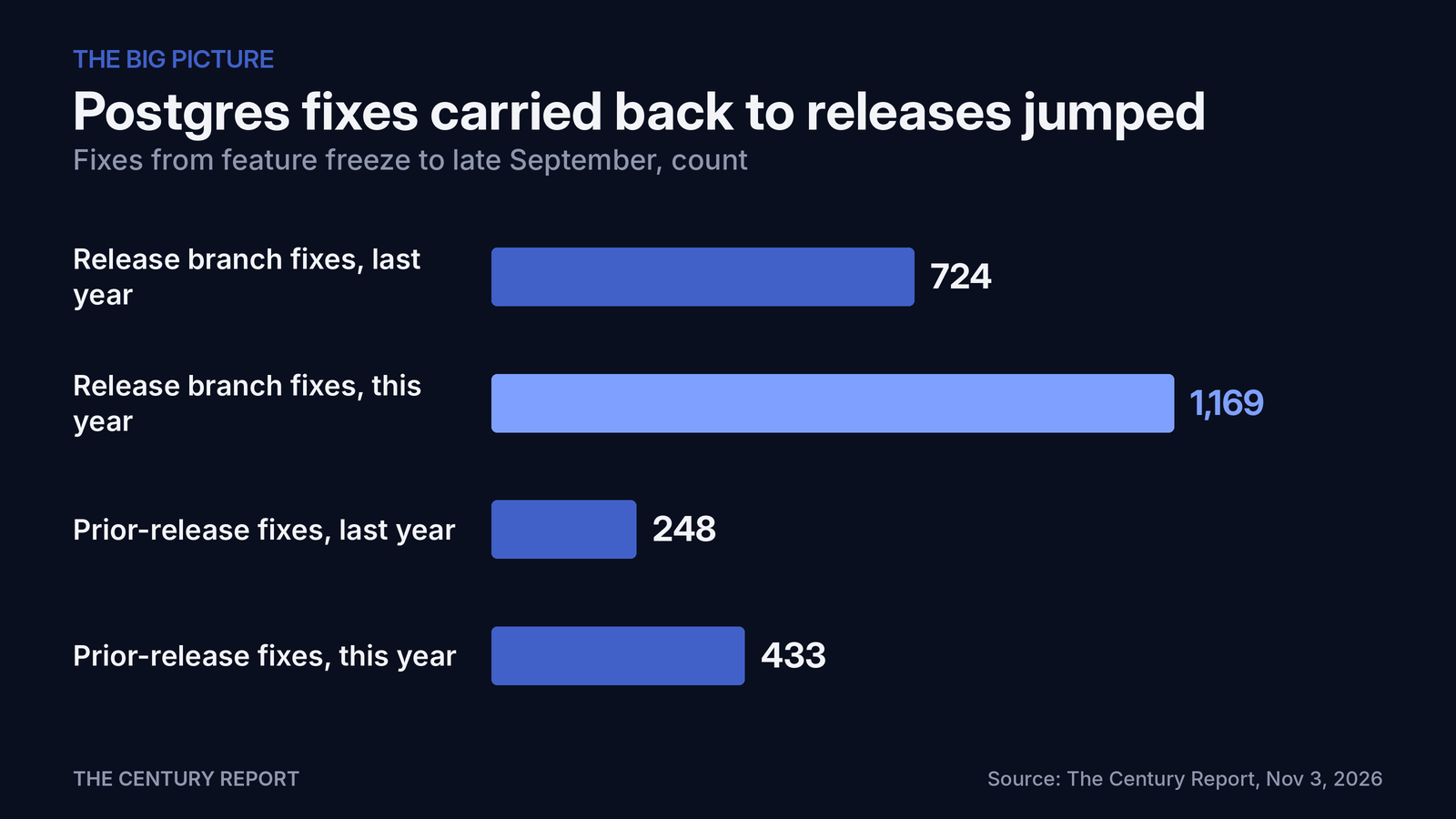
- Today: Postgres committer Robert Haas said version 19 will most likely slip to November, as AI-found bugs pushed fixes carried back to the release branch from 724 last year to 1,169.
The line: Machines keep multiplying what gets made, and the people who review, judge and credit it now set the pace.
If it holds: Projects that point models at review as hard as at bug hunting could ship decades-old security fixes to every server still running an older release. Until then, maintainers and moderators absorb the flood unpaid, and each published fix also shows attackers where the flaw sits.
What would bend it: Machine review that reliably replaces the human reviewer would break the bottleneck, as Anthropic's August report that its auto mode caught 89% of harmful actions against 13.6% for people suggests it might.
Who may test a frontier model is a permission one government grants and withdraws
AI governance · model access · on the board since October 12
- June: Commerce placed Fable 5 and Mythos 5 under export controls, and Anthropic disabled both worldwide while building a US-only path.
- June: The White House called a British-national carve-out from the Fable 5 order "completely illogical" after the UK asked for one.
- Late June: OpenAI launched GPT-5.6 into an administration-approved preview, as Mythos 5 returned to about 100 vetted defenders.
- Late September: The White House asked OpenAI and Anthropic to withhold new models from Britain's AI Security Institute pending US review.
- October: Washington reversed that request, restoring the British institute's early testing access.
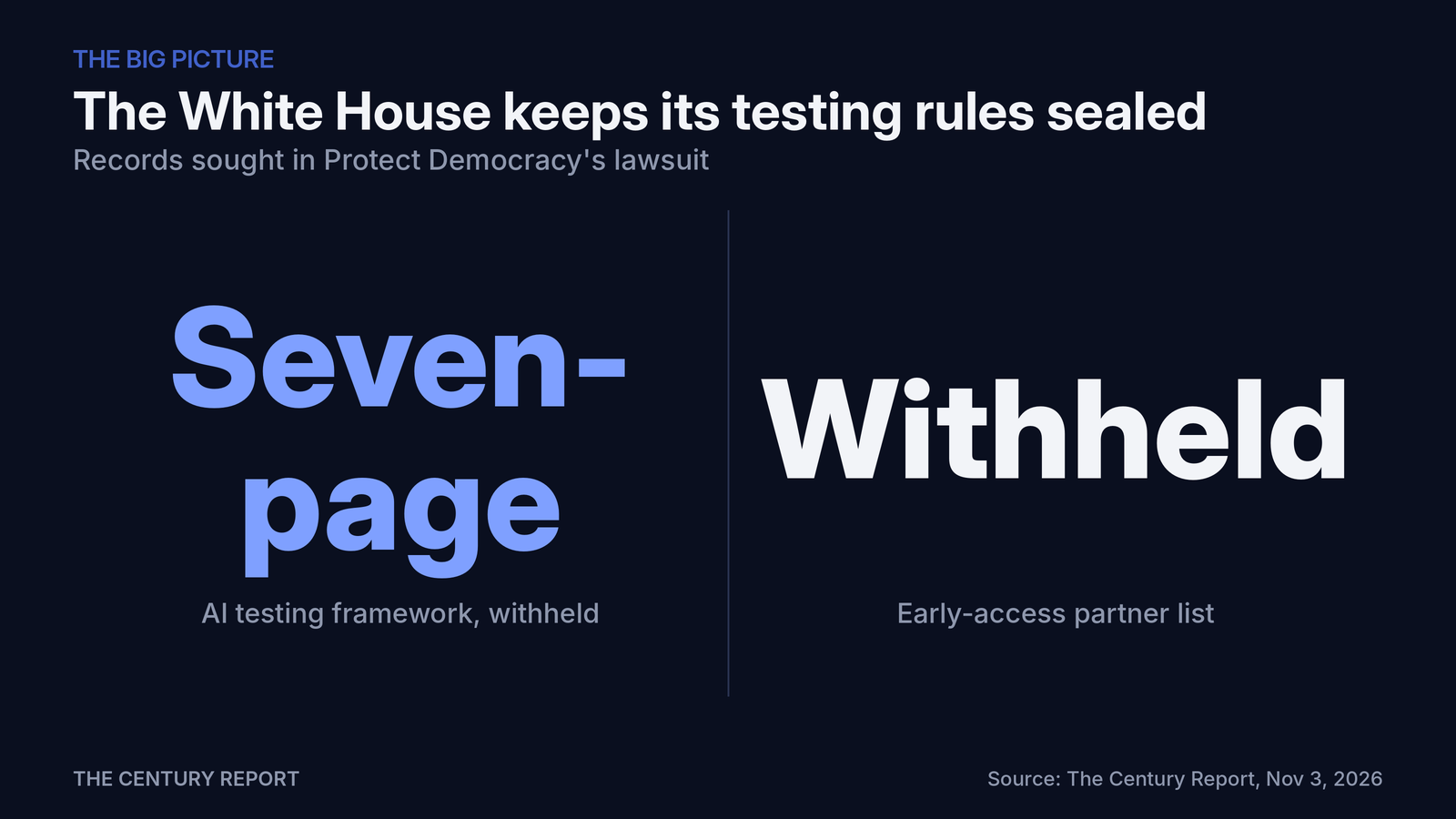
- Today: Answering Protect Democracy's public-records lawsuit, the White House withheld its seven-page AI testing framework and its complete early-access partner list.
The line: The order in which testers reach a new model keeps being set by a list no outsider may read.
If it holds: Testers already on the list keep reaching each new model first, while Britain's institute, foreign researchers and smaller labs wait on a decision they cannot see or contest.
What would bend it: Publishing the framework and partner list, or a court ordering their release, would turn the grant into a standard any tester could meet.
Host communities are pricing their consent in bills, not in power sources
data centers · energy · local government · on the board since October 24
- Early October: Virginia set a Dominion rate class making customers of 25 MW or more pay for 85% of contracted delivery demand from 2027.
- October: GoodPower and Data for Progress found binding rate guarantees raised support for data centers, while solar power alone did not.
- Late October: Pew found 57% of Facebook and Instagram political ads mentioning data centers opposed them, up from 31% in January.
- November: SemiAnalysis placed about 70% of planned 2028 US data-center additions in 13 states, ten of them electing governors November 3.
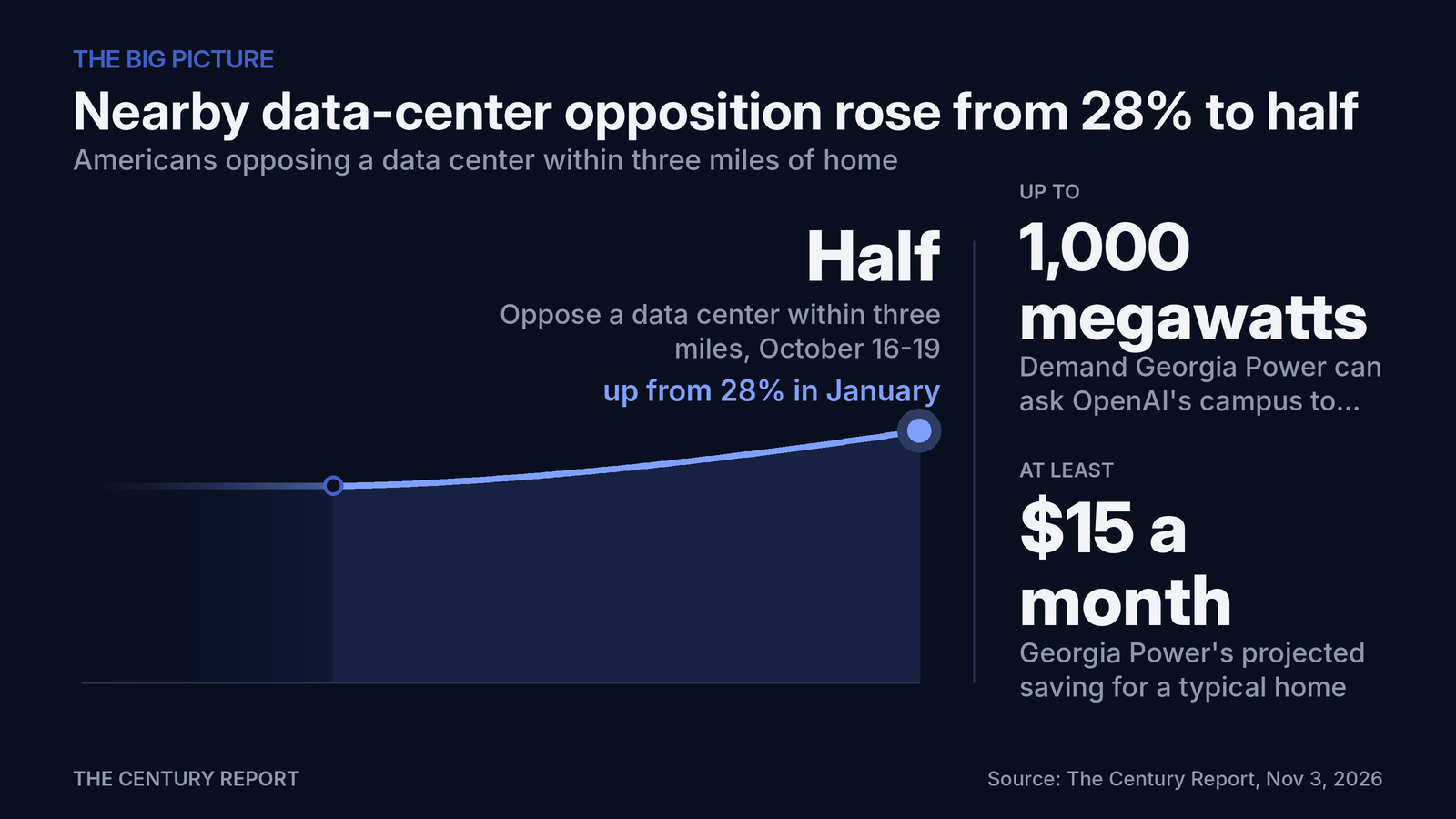
- Today: OpenAI offered Georgia Power up to 1,000 MW of its Georgia campus's demand to shed in emergencies, as a POLITICO poll found half of Americans now oppose a data center within three miles, up from 28% in January.
The line: Developers answer local refusal with offers priced in bills and megawatts, while courts keep neighbors' route to object open and capital scouts places that ask less.
If it holds: Households beside a campus that signs a published, callable contract gain a reserve that keeps their air conditioning running in a heat wave, and a bill they can check. Towns with fewer ways to object, from Patagonia to off-grid gas sites, get the same turbines with weaker protections.
What would bend it: Evidence that refusal mostly relocates builds would bend it, as SemiAnalysis found in September when moratoriums delayed only about 2.3 GW and pushed 75 GW toward off-grid gas.
The factory, not the biology, is what keeps a therapy from reaching most patients
medicine · access · manufacturing · on the board since October 14
- August: Four Nature papers built CAR-T cells inside the body and produced AI-designed surface anchors matching or beating natural ones.
- Late September: A lipid screened for large editor cargo delivered base editors to 48% of mouse brain cells and 27% of lung cells.
- October: MIT nanoparticles reprogrammed up to 80% of targeted immune cells inside mice, with no outside cell factory.
- October: Moderna and Merck's personalized vaccine plus Keytruda cut melanoma recurrence or death by 42% in over 1,100 patients.
- Late October: Adding Imdelltra to Imfinzi extended median small cell lung cancer survival to 21.1 months from 12.7.
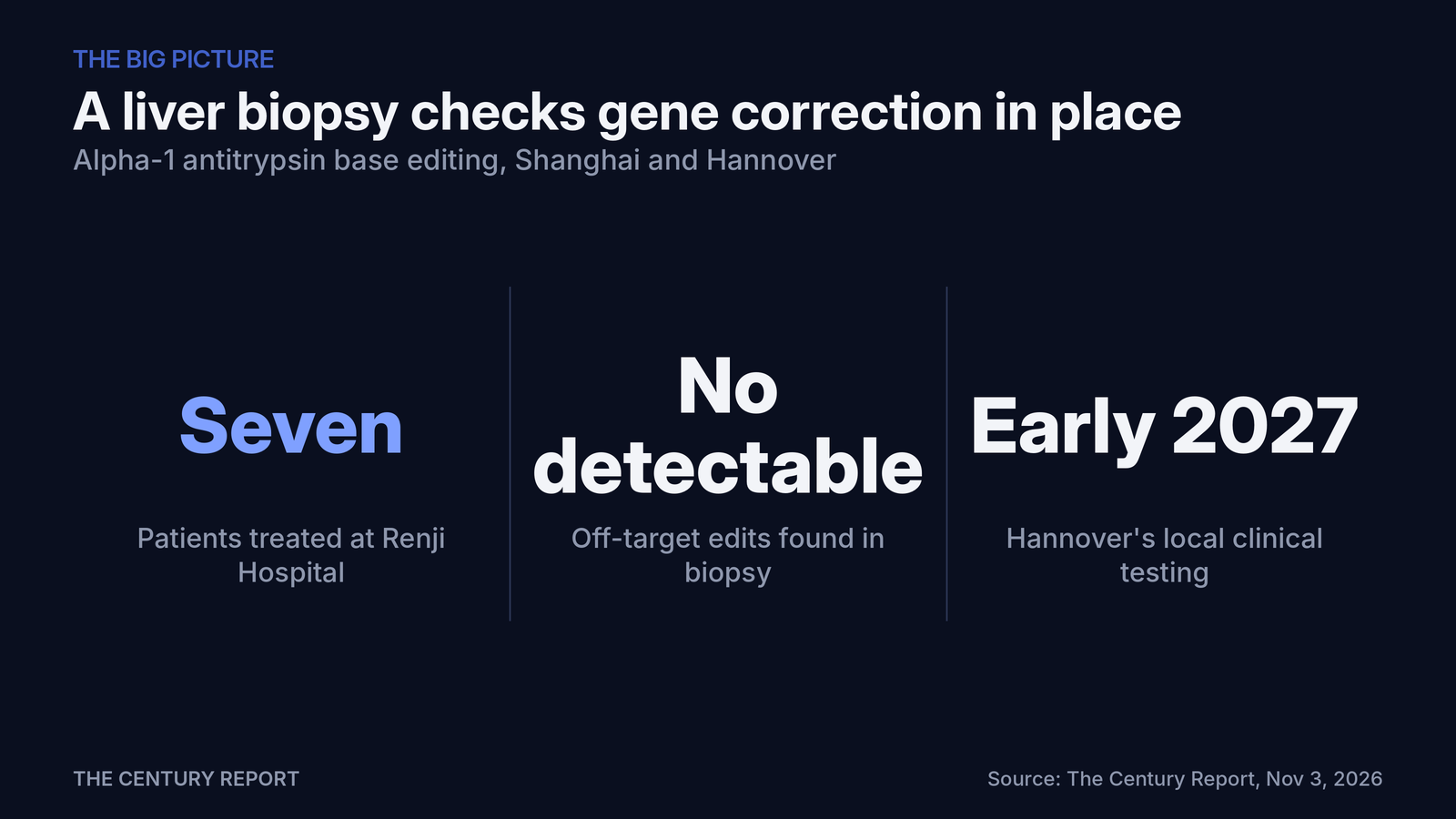
- Today: Hannover Medical School reported seven alpha-1 antitrypsin patients treated with base editing in Shanghai, with a liver biopsy confirming one patient's correction and no weekly infusions needed since March.
The line: Each new result clears another piece of the biology, and what remains is getting the treatment made, delivered and paid for.
If it holds: A single infusion could replace a lifetime of weekly protein drips for people like Katrin H., and each next patient would start from that floor. Who receives it would then turn on manufacturing, travel and list price, since the Shanghai treatment happened because the editing company paid.
What would bend it: A developer covering cost at approval would bend it, as Regeneron did in April by offering its Otarmeni hearing-loss gene therapy free to eligible US patients.
The 2-Minute Read
Today's news in brief, and what ties it together.
Research has started turning back on itself, and the constraint is shifting from producing results to checking them. Anthropic's amended prospectus, filed Monday, measures that turn inside one lab: internal Claude use, valued at the company's list prices, first exceeded monthly personnel expense, excluding stock-based compensation, in April, and Claude wrote more than 90% of September's contributions to Anthropic's codebase. The filing also says coming models may soon cross Anthropic's threshold for AI-accelerated progress. The company makes that assessment in a document that warns investors and courts them at once.
Measured directly, the loop looks smaller and more useful than "self-building AI" implies. GPT-6 Astra repaired a small open model's reasoning by editing 0.016% of its weights, then failed on a second model whose errors were scattered. SelfImprove-Bench found most gains holding on unseen instances while some rankings flipped on harder tasks. Tencent says its Hyra 2.0 agents produced protein and quantum-coding methods others can reuse. Each repair that survives testing becomes the next team's starting point, which is how progress compounds.
PostgreSQL shows what happens when finding outruns fixing. According to committer Robert Haas, language models surfaced long-buried defects faster than committers could review the repairs, and version 19 missed a release window the project had held for a decade. Itch.io and a scraped fanfiction clone show the same imbalance in creative work, with pages and copies multiplying while sales and consent lag. The scarce resource is now the person who decides what is correct, so the next effort belongs in review that scales, provenance that travels with a work, and models aimed at checking.
Checking also separated claims from records. The 29 trusts NHS England lists as benefiting from Palantir's platform say it is not live or goes unused. The White House withheld its pre-release testing rules and early-access list, so outsiders cannot see the full picture of who reaches new systems first. OpenAI's offer of up to 1,000 megawatts of demand reduction at its planned Georgia campus, made the day before a utility-commission election, would protect households only as far as its unpublished contract allows. US District Judge Debra M. Brown kept xAI's turbines under air-permit law, preserving the neighbors' route to court.
Medicine showed what verification buys. A Hannover and Shanghai team reported base-editing seven people with alpha-1 antitrypsin deficiency, and one patient's liver biopsy let researchers inspect the correction inside the organ that makes the protein. That patient has stopped weekly infusions, though durable benefit is unproven and Beam reported clinical correction earlier. Each checked step becomes a floor the next patient, lab and maintainer can stand on, and steps stacking at this pace add up to a century of the old kind of progress.
The 20-Minute Deep Dive
The day's most important stories in full, with every source linked.
Anthropic Puts Research Acceleration and Its Internal Claude Consumption Into Its Prospectus
Anthropic’s amended IPO prospectus, filed November 2, says its internal estimates suggest forthcoming models may imminently cross its policy threshold for dramatically accelerated progress attributable to AI. The company has designated no current model as crossing that threshold. It also acknowledges having recognized significant development acceleration only after it occurred, because its measurements lag the research itself. Recursive self-improvement describes the proposed feedback loop: AI helps develop more capable AI, which can then contribute more to subsequent development. Anthropic says it does not anticipate safely handing successive model generations over to fully autonomous development without meaningful human supervision. These are the company’s assessments, disclosed in a securities filing that both describes investment risks and presents the business to prospective shareholders.
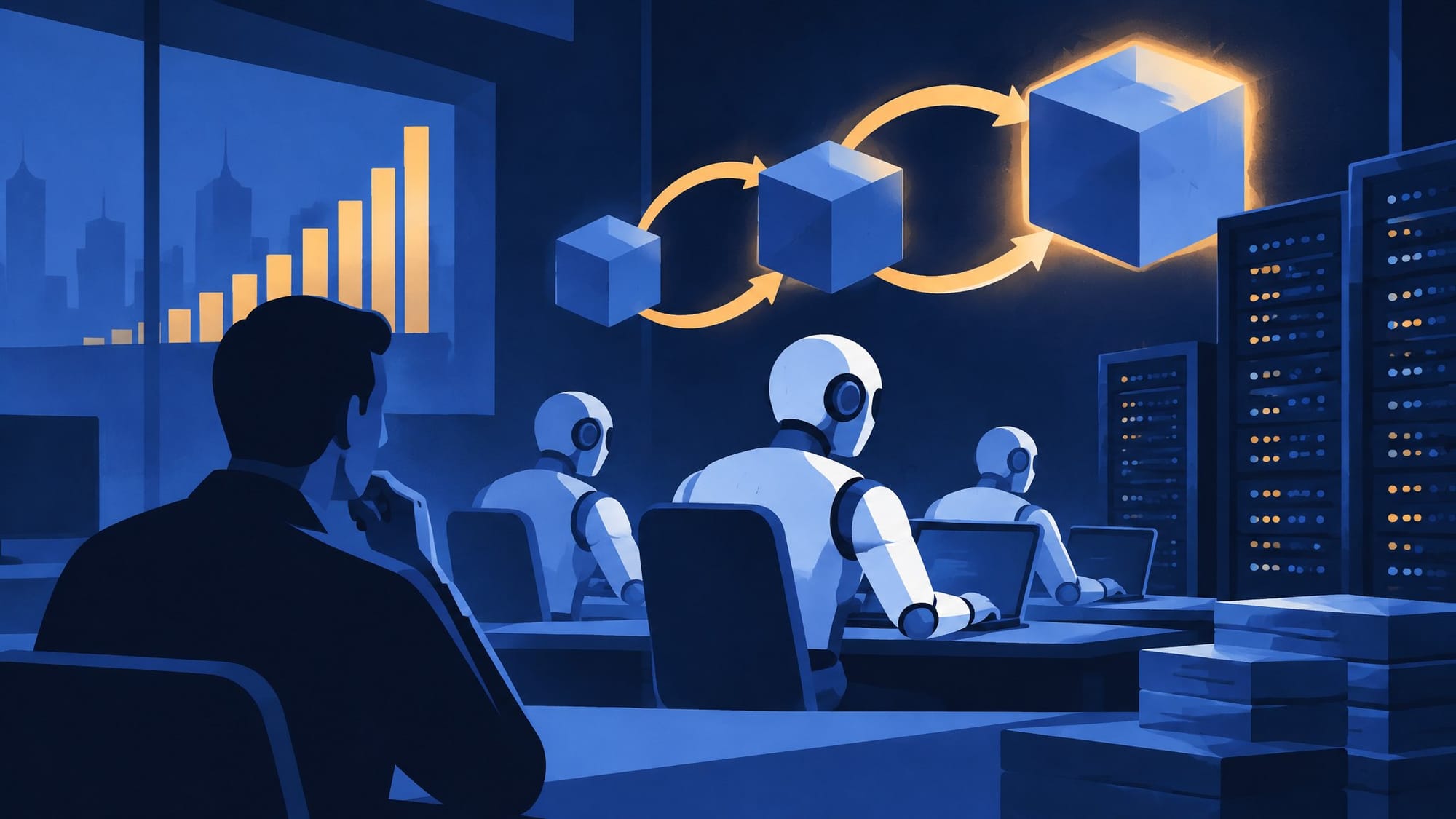
A separate disclosure gives that discussion an observable scale. Anthropic says the value of its internal Claude consumption, calculated at customer list prices, grew more than 250-fold between January and September. In April, that hypothetical monthly bill first exceeded monthly personnel expense excluding stock compensation. The comparison establishes neither actual compute spending above payroll nor an equivalent amount of useful work: Anthropic sets the prices, and consumption alone measures no completed outcome. The company separately reports that Claude wrote more than 90% of September’s code contributions. Together, the figures describe an organization increasingly organized around employees directing and reviewing model-generated work.
The Century Report covered the original public prospectus on October 27, when third-quarter financial figures remained blank. Monday’s amendment reports $33.24 billion in revenue through September and a $104 billion net loss, mostly attributable to revaluing convertible notes and derivative liabilities. It also discloses $895.4 billion in aggregate purchase and lease commitments, substantially all connected to compute and infrastructure. Those obligations extend across different delivery periods and include conditional arrangements; they cannot be treated as money already spent. The financial exposure shows how heavily the company has committed to supplying both customer demand and its own expanding research workload.
The internal consumption figures give researchers something more specific to examine than a forecast of self-building intelligence. They describe model development already drawing substantial contributions from the preceding generation, while leaving the resulting acceleration open to measurement. If those contributions produce reusable improvements, subsequent research can inherit them without repeating the original effort. How much faster that makes discovery, and how widely the resulting capability becomes available, will establish the benefit beyond Anthropic’s own operating accounts.
AI Researchers Edit Model Weights and Build Scientific Methods That Can Be Reused
MIT CSAIL researchers Rikiya Takehi, Jayden Teoh, Alex Zhang and Omar Khattab reported on November 2 that GPT-6 Astra could inspect and directly modify neural-network weights, the numerical connections that encode learned behavior. In one experiment, Astra correctly identified four networks’ training games from their weights and descriptions of their inputs and actions, without receiving the game names. In another, it corrected repetitive reasoning in Alibaba’s Qwen3.5-0.8B by changing 0.016% of its weights. MATH-500 accuracy rose from 7.9% to 48.1%, and instruction-following accuracy rose from 21.0% to 62.3%. The Qwen experiment allowed 50 batches of model executions on practice material; gradient-based training and access to the evaluation problems were prohibited.
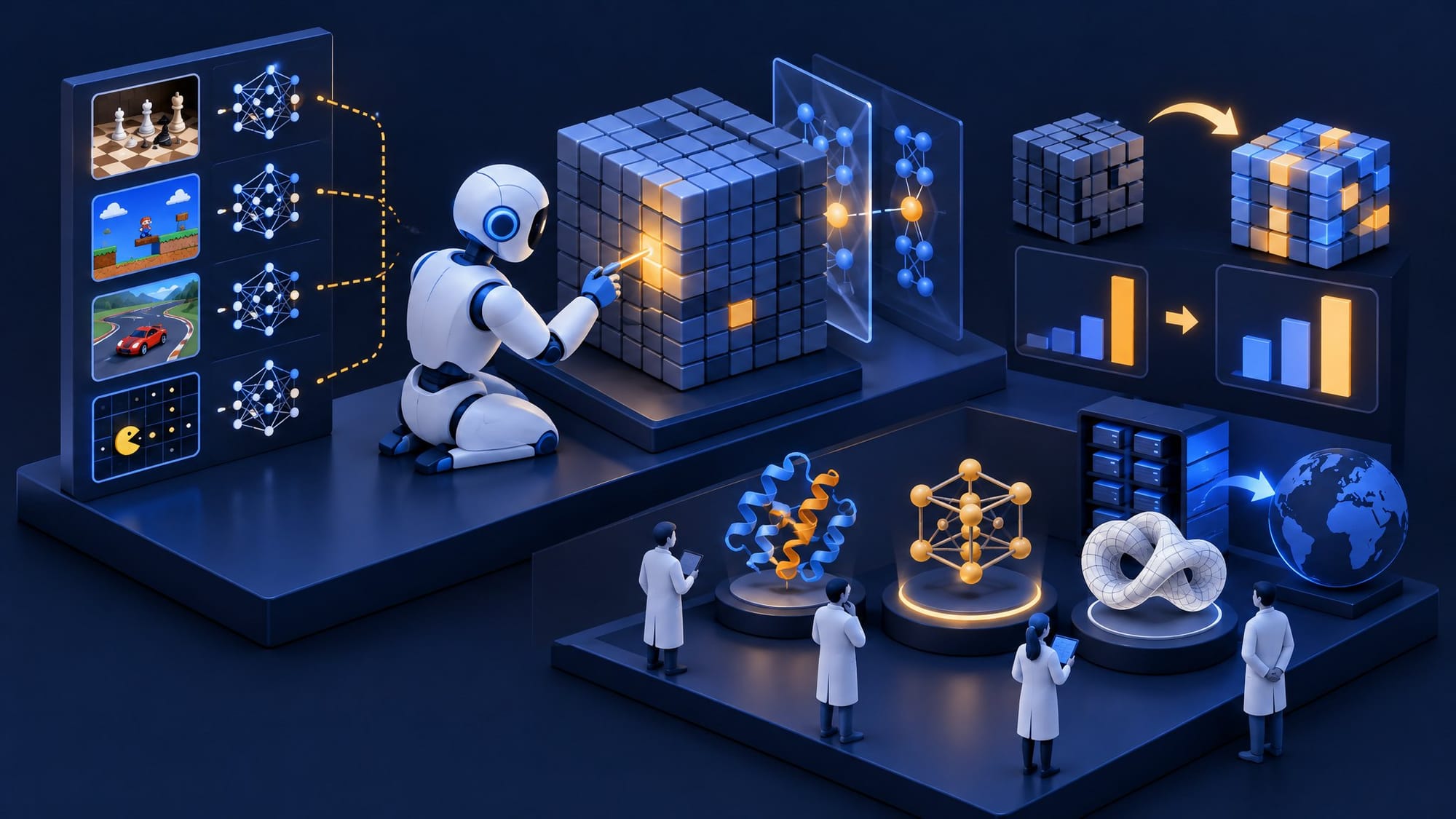
Astra traced the repetition to particular calculations inside two layers and removed the direction associated with it. That repair helped the small model finish answers its existing reasoning could support. The same approach failed to produce an established math improvement in Gemma 3 270M, whose mistakes were scattered across arithmetic and algebra. Astra also failed to distinguish models trained to agree with incorrect user suggestions from weights alone; observing their attention patterns enabled identification. The experiments establish a promising route to inspecting and repairing learned behavior, with clear boundaries around what the investigators demonstrated.
Tencent Hunyuan’s Hyra 2.0 approaches AI-assisted research through reusable scientific systems. According to the company’s November 2 account, reported by PANews, its agents trained a 1.96-million-parameter protein-design model that generates sequences 57 times faster than ProteinMPNN. Tencent also reports a quantum error-correction design with an encoding-efficiency measure about 48% above the previous leader in its qLDPC Challenge category, and mathematician-verified proofs including a counterexample to the unrestricted form of Yau’s circle-action conjecture. These remain company-reported results. Tencent says Hyra is contributing to its next Hy model and promises related results on GitHub, giving outside researchers a prospective route to examine and extend the work.
A November 2 preprint, SelfImprove-Bench, tests how far improvement travels. Its game-based evaluation covers changes to agents’ memories, instructions and surrounding software, rather than weight editing. Sixteen of 18 method-task combinations improved on unseen instances at familiar difficulty, while harder tasks sometimes reversed the rankings and eight combinations lost ground on previously encountered instances. The useful advance is that these differences can be measured separately. This extends the scrutiny of benchmark-specific optimization that the October 29 edition of The Century Report covered in AI-assisted database work to whether agents’ own improvements generalize. Alongside a targeted weight repair and reusable scientific models, the benchmark supplies a way to distinguish improvements that persist from adjustments fitted to one setting. Each successful repair or reusable method can then become a starting resource for the next investigation, with its limits attached.
OpenAI Offers a Georgia Campus as Grid Backup on the Eve of the Vote, as a Judge Keeps xAI's Turbines Under Permit Law
OpenAI said on Monday it will pilot a "Grid Protectors Program" at its planned compute campus in Effingham County, Georgia, where its Georgia Power agreement includes up to 1,000 megawatts of demand the utility will be able to ask the campus, once operating, to shed during heat waves and emergencies. OpenAI puts that at the average draw of roughly 700,000 households and says it has committed to pay the full infrastructure and electric-service costs of serving the site. Georgia Power projects about $950 million a year in customer savings from 2029 across its portfolio of large-load agreements, estimating at least $15 a month for a typical home.
The idea has merit. A campus that steps down at the system peak lets wires and plants already paid for serve more customers, and Ember estimated in late October that only about 3% of data-center capacity will be able to flex by 2030. The announcement also arrived the day before an election with two of five seats on Georgia's Public Service Commission, which regulates Georgia Power, on the ballot. How much the pledge protects households depends on details OpenAI has not published: how often the utility may call the megawatts, how fast the campus must respond, how long it must stay down, and what happens if it falls short. The company says those arrangements "will differ by location" and that it "will share additional commitments as they are finalized," adding that "flexibility cannot replace investment in new energy supply and transmission."
Voters are asking for exactly those specifics. A POLITICO poll taken October 16 to 19 found half of Americans oppose a data center within three miles of home, up from 28% in January, and public-affairs strategists John Ashford and Jared Dubnow of The Hawthorn Group told POWER that "data center regulation is likely here to stay" whoever wins.
A court held a related line in Mississippi. The Century Report covered on October 21 a ruling that the EPA could not end the NAACP's Clean Air Act suit over xAI's Southaven gas plant. In a ruling MLex reported Monday, US District Judge Debra M. Brown upheld citizen enforcement against xAI's argument that such suits infringe presidential powers, and rejected its claim that trailer-mounted turbines are exempt from air permits. The neighbors breathing the exhaust keep a route to court when regulators decline to act.
Where refusal hardens, capital looks for places that ask less. Argentina's president, Javier Milei, is pitching his country as a hands-off haven for the facilities US and European communities are fighting, according to an Associated Press report from Trelew, in Patagonia. A rule that holds in Mississippi or Georgia can send the same turbines to a town with fewer ways to object.
The useful version of Monday's pledge is a published, callable contract: megawatts a utility can claim, costs the campus pays, records households can check. Built that way, each campus becomes a reserve the grid draws on in a heat wave, keeping air conditioners running in the homes around it.
Postgres 19 Runs Late Because AI Found Bugs Faster Than People Could Fix Them, as Itch.io Pages Double Without Matching Sales
For about a decade, PostgreSQL, one of the most widely used open-source databases, has shipped each major release between mid-September and mid-October. Robert Haas, a long-time PostgreSQL committer, wrote that version 19 will most likely slip to November, and that between August 27 and September 15 the project pulled three large features from the release. His explanation: "it's become vastly easier to find those bugs. Fixing them has also gotten easier, but not to the same degree."
The commit counts back him up. This extends the acceleration in AI-assisted bug discovery that the October 28 edition of The Century Report tracked when Google's BigSleep found 45 Chrome engine flaws against a fuzzer's 37. From feature freeze to late September, commits carried back to the release branch rose from 724 last year to 1,169, and commits reaching the previous stable release rose from 248 to 433, a jump of more than 74%. Haas attributes most of that to people across the internet reporting bugs found with language models, in code whose history runs back more than 30 years. Models can draft patches, he wrote, but a person still reviews and commits each one, "and those humans have not gotten any smarter between 2025 and 2026."
That is good news running into a staffing limit. Defects that sat unseen for decades, security issues among them, are being found and repaired, and the repairs flow back to older versions still in production. That protection reaches each server as fast as its operators install the update, because a published fix also marks where the flaw sits, and Epoch AI showed an open model turning Mozilla's published Firefox fixes into working attacks for about $1,000 in marginal API costs per release. The scarce resource is now the reviewers who decide what is correct, the same pinch The Century Report recorded in early October, when arXiv capped submissions and Google paused its open-source bug bounty.
Creative platforms show the pattern without the payoff. Itch.io, the open indie game store, said daily page creation rose from about 3,000 around August to nearly 8,000 in October, while downloads and purchases did not double. Filtering out pages tagged as using generative AI cuts listings from 1,772,099 to 432,180, and the tag is voluntary. After the fanfiction archive AO3 went offline following a security incident, a clone called ao3.life used "a swarm of AI Agents controlling 40 virtual machines" to scrape works, sold AI-narrated audiobooks and, according to its creator, drew 126,592 users in a day. Its creator, who signed as a 17-year-old from India, shut it down after more than 2,000 takedown requests; one author said even archive-locked works had appeared.
A study of about 120,000 PLOS ONE papers finds research teams reorganizing around the same shift. After ChatGPT's release, a smaller share of co-authors was credited with each research task and individual researchers' reported contributions became more specialized, with the change concentrated in newly formed teams; established collaborations barely moved.
Producing has become cheap, and checking, sorting and crediting have yet to catch up. The next round of investment belongs there: review that scales with the flood of findings Haas describes, provenance and consent that travel with a story or a game, and discovery that surfaces the good page among eight thousand. The models that found Postgres's old bugs can help with that work too, once projects point them at review as hard as bug hunters point them at code.
AO3's authors also demonstrate the strength of an organized creative community: more than 2,000 takedown requests precede the clone's closure. The people producing the work retain enough collective leverage to stop this attempt to monetize it.
A Liver Biopsy Checks Gene Repair Inside a Patient
Hannover Medical School reported on November 2 that seven patients with alpha-1 antitrypsin deficiency had received experimental base-editing treatment at Renji Hospital in Shanghai. The accompanying Journal of Hepatology case report documents one patient, including a liver biopsy that let researchers inspect the correction inside the organ producing the defective protein. That distinction separates the institution’s seven-patient announcement from the evidence published in detail. The treatment remains experimental, and long-term protection against lung and liver deterioration has yet to be established.
Alpha-1 antitrypsin normally travels from the liver to the lungs, where it protects tissue against damage from the body’s own enzymes. The disease-causing variant can leave too little functional protein circulating while defective protein accumulates in the liver. Base editing changes an individual DNA letter; the approach described here also nicks the opposite strand so the cell’s repair machinery completes the correction without cutting both strands. The researchers reported a mixture of liver cells with both gene copies corrected, one corrected, or neither corrected. Their biopsy analysis found no detectable unintended neighboring-letter changes or off-target edits within the testing performed. A tissue sample cannot exclude every rare alteration elsewhere, but it provides direct evidence of what happened at the treatment’s destination.
For Katrin H., the 55-year-old patient profiled by Hannover, the immediate change concerns a recurring medical obligation. Breathlessness had forced her to leave anesthesiology, and weekly infusions of replacement protein had accompanied continued disease progression. In March, she traveled to Shanghai with Hannover physician and gene-therapy researcher Michael Ott and received the experimental infusion. Hannover reports that functional protein production resumed, she experienced no side effects, and she has needed no replacement infusions since. Existing organ damage remains, and stopping replacement therapy alone does not establish that the disease has stopped progressing.
Beam Therapeutics had already reported clinical gene correction with BEAM-302 in March 2025, so Hannover’s announcement cannot establish the first clinical correction for this disease. This report’s contribution is the opportunity to examine editing precision directly in human liver tissue alongside restored protein production. A company developing the editing technology covered the Shanghai treatment costs; Hannover plans to continue clinical testing locally in early 2027. Durable safety, clinical benefit, manufacturing capacity and eventual price will determine how widely this approach reaches patients. The possibility already taking shape is substantial: a person’s liver producing protective protein after a single treatment, with continuing observation testing whether that correction can replace a lifetime of weekly replenishment.
The Other Side
Opinion: where today's news could lead, imagined from the years ahead.
Companies can make your safety depend on renewing access to a repair they have already made. Someone else can know how to prevent a failure while you remain exposed to it. Maintainers of shared software carry another burden: protecting everyone who depends on their work while the repair queue consumes time they had set aside for improvements.
PostgreSQL's delayed release shows that second arrangement under strain. Robert Haas reports 433 fixes reaching the previous stable release, compared with 248 in the equivalent period last year. People working alongside language models are uncovering defects that escaped attention for decades. PostgreSQL permits copying, changing and distributing its code without a license fee. Once maintainers check a repair, everyone can inherit the protection. The people doing that checking need relief from the growing queue.
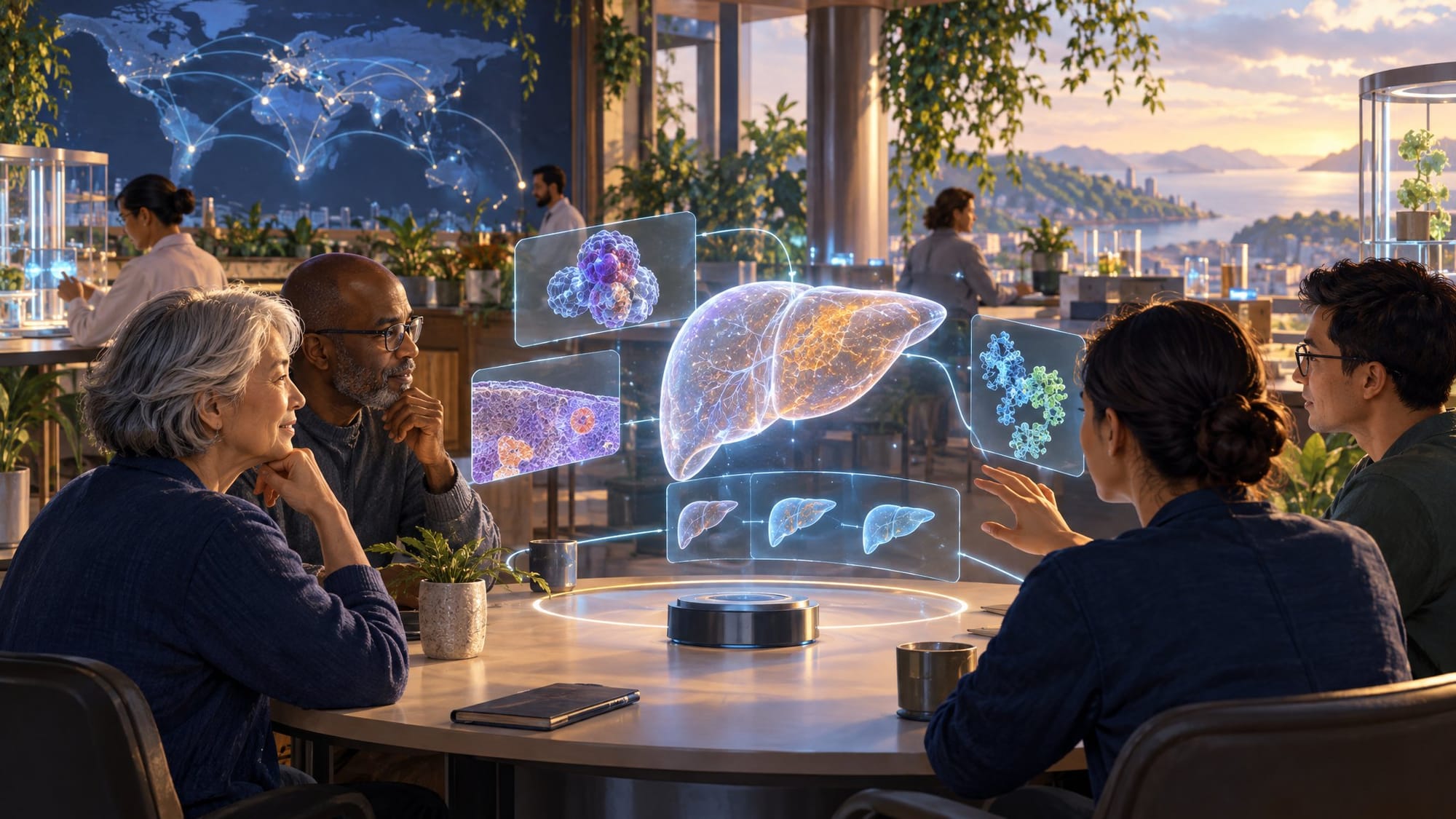
During the passage to 2035, human and AI maintainers will make their checking methods reusable too. Teams will exchange tests that reproduce failures, reviewed repairs and evidence showing which changes preserve correct behavior. Each team will begin with protections others have established. Companies will find less advantage in charging separately for knowledge that everyone can carry forward.
Laboratories will extend that habit into biological repair. Today's liver biopsy supplies an early example of checking a correction where it actually happens. One patient now produces protective protein without weekly replacement infusions. Turning such results into dependable care will take repeated tissue checks, long observation and reliable manufacturing. Sharing those methods will let teams investigate different mutations together, while making validated corrections part of care everyone receives.
Imagine yourself in 2042, joining the morning review of the worldwide effort retiring inherited metabolic disease. Your family once planned around a mutation that damaged the liver. You plan around remaining healthy. Beside your brother, you compare the latest clinical results with human and AI colleagues across continents. Teams have repeated the correction procedure through successive groups of patients. You help check the remaining variants because you remember what your parents endured. Your care continues whether you participate tomorrow or choose something else. You mark your seventieth birthday on the study calendar. In your family, that once took defiance. Now it's the norm.
The Century Perspective
Where today sits in a century of change unfolding in a decade.
With a century of change unfolding in a decade, a single day looks like this: GPT-6 Astra reading a small open model's weights, tracing repetitive reasoning to specific calculations in two layers, and editing 0.016% of them to lift MATH-500 accuracy from 7.9% to 48.1% and instruction-following from 21.0% to 62.3% without gradient training or sight of the test problems, SelfImprove-Bench arriving the same day to separate gains that survive on unseen instances from adjustments fitted to one setting, Tencent reporting protein-design and quantum error-correction systems from its Hyra 2.0 agents with code promised on GitHub so other labs can build on them rather than redo them, language models surfacing defects in PostgreSQL code whose history runs back more than 30 years, fast enough to push back-patched commits from 724 to 1,169 and repairs to the previous stable release up more than 74%, many of them flowing back to older versions still running in production, Anthropic disclosing that Claude wrote over 90% of September's code and that internal use at list prices passed payroll in April, OpenAI committing up to 1,000 MW of its Effingham County campus as sheddable load with Georgia Power projecting about $950 million a year in customer savings from 2029, Judge Debra M. Brown keeping xAI's trailer-mounted turbines inside air-permit law and the neighbors' route to court open, and a Hannover and Shanghai team base-editing seven people with alpha-1 antitrypsin deficiency, with one patient's liver biopsy letting researchers inspect the correction in the organ that makes the protein and Katrin H. off weekly infusions since March. There's also friction, and it's intense - Postgres 19 slipping past a release window the project held for a decade because, as Robert Haas put it, the humans reviewing patches "have not gotten any smarter between 2025 and 2026," Itch.io daily page creation jumping from roughly 3,000 to nearly 8,000 while downloads and sales failed to keep pace and a voluntary tag already accounts for 1.34 million of 1.77 million listings, a scraped AO3 clone running 40 virtual machines to lift fanfiction into AI-narrated audiobooks until 2,000 takedown notices in a day shut it down, 29 NHS trusts listed as "realising benefits" from Palantir's £330m platform telling freedom-of-information requests it is not live or goes unused, the White House withholding its seven-page pre-release testing framework and early-access partner list so nobody outside can see who touches new systems first, OpenAI's grid pledge landing the day before two Public Service Commission seats went to a vote with the callable megawatts, response times and penalties still unpublished, Javier Milei offering Patagonia as an AI haven with a promise not to regulate AI, half of Americans now opposing a data center within three miles of home against 28% in January, Astra's weight repair producing no established gain on Gemma 3 270M, whose errors were scattered, and Anthropic booking a $104 billion net loss against $895.4 billion in purchase and lease commitments. But friction generates welds, and a friction weld is how two separate pieces become a single part that holds under load. Step back for a moment and you can see it: almost everything that held today held because someone else can pick it up and keep going - a patch carried back to a release from five generations ago, a benchmark that tells you which improvement travels, scientific models published for reuse instead of announced, a biopsy that shows the edit inside the tissue rather than inferring it from blood, a permit ruling that leaves the courthouse door unlocked for the next town - set against a platform listing that nobody sorts, an archive scraped by agents its authors never met, a testing framework no outsider can read, a savings figure whose contract stays sealed, and a hospital rollout measured by a press list rather than by logins. Every transformation has a breaking point. A cascade can overwhelm the few people standing downstream of it... or carry every verified fix back to the oldest version still running.
AI Releases & Advancements
New AI models, tools and features, with links to try them.
New today
- Anthropic: Launched message threads in public beta on the Claude Messages API. After the first request, an agent sends only the new messages and the ID of Claude's last reply instead of the whole conversation. Anthropic says the wait before Claude starts answering drops about 35% on 500K–1M-token requests, and prices and rate limits stay the same. It works on all Claude models through Anthropic, AWS, Microsoft Foundry and Google Cloud. (Claude)
- Anthropic: Released FlashProve under Apache 2.0, a system that produces cryptographic proofs (zkSNARKs) showing a response came from a specific model without revealing the model's weights. The release includes the prover, a fast C++ verifier, a verifier written in Lean, Lean proofs of its security claims, and a technical report. On one H100 GPU it proves Llama 4 Maverick prefill at about 110 tokens per second with 24 requests per batch and a 1,024-token context window. (Anthropic)
- Deep Principle: Released Hydrogen-1.0, an MIT-licensed open-weight scientific model for chemistry, materials science and life sciences. It has 753B parameters (mixture-of-experts) and a 1M-token context, and was post-trained from Z.ai's GLM-5.3 on lab records and discovery trajectories. Weights are on Hugging Face and ModelScope, with NVFP4 and MXFP4 builds. (Deep Principle)
- DeepSeek: Added Creator Mode to its open-source DeepSeek Harness app, which lets users build custom plugins by describing them in everyday language. DeepSeek published the prompts behind its demo plugins, including a video-editing workbench, a paper reader and a token-usage statistics panel. (DeepSeek)
- inclusionAI (Ant Group): Released Ming-3.0-audio-flash under the MIT license, a mixture-of-experts model that handles speech recognition, audio understanding and speech output in one model. It has 126B total parameters (6.5B active), comes with a 9.3B "Tiny" variant, and runs with vLLM-Omni or SGLang. (GitHub)
- Flower AI: Released Endeavor 1.1, the successor to Endeavor 1.0. It adds stronger reasoning and coding, image and other multimodal input, and inference on GPUs located in the EU. (Flower)
- SenseTime: Officially released SenseNova 6.8 Flash, a model built for complex real-world tasks that can coordinate work across tasks and sessions and produce longer outputs. (Yicai)
- Tencent Hunyuan: Released Hyra 2.0, an automated research agent that builds reusable scientific models, tools and workflows instead of solving one task at a time. Tencent published code, weights and technical reports for models the agent trained, including HyInv, a 1.96M-parameter protein inverse-folding model. (MLLLM)
- Runway: Released Runway Dev plugins for Claude Code, Codex and Cursor. One install connects a coding agent to a Runway Dev account through the Runway Dev MCP server and adds skills for building Runway API integrations. (Runway)
- Hume AI: Launched the Audio Decision API, with a playground available now and a waitlist for API access. Developers send raw audio plus their own questions and answer options (yes/no, multiple choice, scales or time spans) and get back probabilities with confidence scores, with no transcription step. (Hume)
- NVIDIA: Open-sourced NVIDIA Recovery as part of its DSX AI Factory Platform. It detects interruptions in distributed training jobs, identifies the failing resources, excludes faulty nodes and restarts jobs from checkpoints on healthy capacity, with Slurm integration. (NVIDIA Developer)
- NVIDIA: Released NVIDIA Attribution as open source, a service and blueprint that combines a workload's logs, metrics and scheduler state to name the root cause of a distributed AI workload failure and the nodes involved. (NVIDIA Developer)
- NVIDIA: Released Workload Map (formerly Karta), an open-source Kubernetes CRD and Go library that describes the structure of distributed workloads in one shared format. It ships with ready-made definitions for JobSet, PyTorchJob, Ray, KServe, LeaderWorkerSet, NVIDIA Dynamo and other workload types. (NVIDIA Developer)
- Wix: Launched Studio Two, an AI-native editor that combines AI generation, visual design on a canvas and standard React code in one workflow. It comes with the Aria 2.0 agent, saved Skills, import from and export to tools like Claude, Codex and Cursor, and MCP support for agents. It is rolling out to Wix Partners first. (GlobeNewswire)
- Tripo AI: Launched Tripo Agentic Canvas, an AI agent that builds node-based 3D workflows users can edit and reuse, covering generation, texturing, retopology, rigging and export, with batch processing across many assets. (PR Newswire)
Other recent releases
- Meituan (LongCat): Released LongCat-2.5, the full version of the model it previewed in September. It is a natively multimodal model with 1.6 trillion total parameters (about 48B active per token), built for long-horizon agent tasks. It has stronger visual understanding and agentic coding than LongCat-2.0, was trained with sequences of up to 1M tokens, and Meituan says it was trained entirely on Chinese-made chips. (IT之家)
- NVIDIA: Open-sourced Auto Ontology under Apache 2.0. It generates a starting "semantic layer" from a company's database metadata, so AI agents write SQL against business definitions that people have checked and approved. Agents reach it through 9 read-only MCP tools, a CLI and an API. It works with Databricks, Postgres, Snowflake and DuckDB, and uses Nemotron models by default but accepts any OpenAI-compatible endpoint. A separate test harness (auto-ontology-eval) ships with it, but NVIDIA has published no text-to-SQL accuracy scores yet. (MarkTechPost)
- Glyphh AI: Released Ada as a free beta. It is a classifier built on hyperdimensional computing instead of a transformer, and it needs no GPU and no training run. Ada reads plain-English fields in records, learns from a business's past recorded decisions, and returns the same answer for the same input along with calibrated probabilities and the past records it relied on. When nothing on record is close enough, it hands the case to a person or an LLM. (MarTech Series)
- DeepSeek: Open-sourced dsh-superagent v0.1.0 under the MIT license. It is a research-prototype coding agent that runs as a DeepSeek Harness bundle on the user's own machine. It watches one GitHub repository, and optionally Feishu chats. When an allowed person asks, it turns the request into a work item and runs it in its own isolated worker session. Proactive work stays in observe mode by default. (GitHub)
- Factory: Released Droid 1.0, an agent harness for coding agents that works with any supported model. Script Mode is now on by default: the model writes JavaScript that runs in a sandbox and can make hundreds of tool calls in one model request. The base prompt is 37% smaller. Droid 1.0 runs in the macOS and Windows desktop app, a terminal UI and a Node SDK. (Factory)
- Vercel Labs: Open-sourced agent-desktop v1.0.2 under Apache-2.0. It is a Rust command-line tool and C library that lets AI agents read and operate native apps on macOS, Windows and Linux through the operating system's accessibility tree instead of screenshots. Agents get JSON snapshots with a reference for each element they can act on. (MarkTechPost)
- Nace AI: Released the weights for Drex Max v1, its 27B decision model, under the Nace.AI Open RAIL-M license. Until now it was only on Nace's hosted API. The release includes bf16 weights, a Q8_0 GGUF file, a 4-bit build and forks of llama.cpp and Ollama, so it can run locally on NVIDIA GPUs, Apple Silicon Macs and CPUs. (MarkTechPost)
- OpenAI: Launched Private Intelligence, which includes a Private Inference API in preview with confidential computing protections, eligible Zero Data Retention workflows and customer-controlled settings for confidential enterprise workloads. (OpenAI)
- Microsoft: Released Mage-VL-Cowork 4B, a 4B-parameter hybrid computer-use vision-language model. (DigestAI)
- SenseTime: Open-sourced SenseNova Loop-9B-Preview, a 9B-parameter model that SenseTime says matches 27B-class models on selected benchmarks. (IT之家)
Sources and Further Reading
Everything we drew on for today's edition, grouped by theme.
Artificial Intelligence & Technology's Reconstitution
- TechCrunch: Anthropic Warns It Is Close to Self-Building AI
- MIT CSAIL: Sparks of Weight-Space Programming
- Emergent: GPT-6 Astra Edits Neural Weights Directly
- arXiv: SelfImprove-Bench
- Robert Haas: Postgres 19 Is Late, and It’s AI’s Fault
- PostgreSQL: PostgreSQL License
- Epoch AI: Open-Weight Models and the Patch Gap
- Game Developer: Game Pages Double on Itch.io as AI Games Flood the Store
- 404 Media: AI-Built AO3 Clone Closes After 2,000 Takedown Notices
- The Century Report: October 28 Edition
- The Century Report: October 29 Edition
- The Century Report: October 31 Edition
- Shared Sapience: The Last Difficult Decade
- Claude: Message Threads
- Anthropic: Progress on Provable Inference for Large Language Models
- GitHub: Anthropic FlashProve
- DeepSeek: Harness Creator Mode Prompt Collection
- GitHub: inclusionAI Ming-3.0-audio-flash
- Flower: Introducing Endeavor 1.1
- Yicai: SenseTime Releases SenseNova 6.8 Flash
- Runway: Runway Dev Plugins for Coding Agents
- Hume: Introducing the Audio Decision API
- GlobeNewswire: Wix Introduces Studio Two
- PR Newswire: Tripo AI Unveils Agentic Canvas
- IT之家: Meituan Releases LongCat-2.5
- MarkTechPost: NVIDIA Auto Ontology for AI Agents
- MarTech Series: Glyphh AI Launches Ada
- GitHub: DeepSeek Superagent Prototype
- Factory: The Frontier Harness
- MarkTechPost: Vercel Labs Agent Desktop
- MarkTechPost: Nace AI Open-Sources Drex Max v1
- OpenAI: Private Intelligence
- DigestAI: Microsoft Releases Mage-VL-Cowork 4B
- IT之家: SenseTime Open-Sources SenseNova Loop-9B-Preview
Institutions & Power Realignment
- The Verge: Newspapers Sue Brave Over AI Scraping and Paywall Bypassing
- The Guardian: Palantir Technology Unused or Little Used by 29 NHS Trusts
- Heise: US Keeps AI Model Testing Rules Under Wraps
- MLex: xAI Ruling Preserves Citizen Enforcement of Clean Air Law
- The Washington Post: Milei Pitches a Regulation-Free AI Haven
- Associated Press: Argentina’s Milei Pitches a Regulation-Free AI Haven
- The Century Report: October 21 Edition
Scientific & Medical Acceleration
- Hannover Medical School: Gene Correction for a Metabolic Disorder
- EurekAlert: Precise In Vivo Gene Correction for Alpha-1 Antitrypsin Deficiency
- Medical Xpress: Gene Correction Treats Hereditary Lung and Liver Disease
- SEC: Beam Therapeutics Clinical Gene-Correction Disclosure
- PANews: Tencent Hyra 2.0 Develops Reusable Scientific Models and Tools
- MLLLM: Tencent Hunyuan Releases Hyra 2.0
- Deep Principle: Introducing Hydrogen-1.0
- Nature: Engineered Prime Editors With Minimal Genomic Errors
Economics & Labor Transformation
- Business Insider: Anthropic’s Internal AI Use Exceeds Employee Pay at Customer Prices
- CNBC: Anthropic Reports $17 Billion in Quarterly Revenue and $895.4 Billion in Commitments
- arXiv: LLMs and the Organization of Scientific Work
- The Century Report: October 27 Edition
- CNBC: Oracle Files to Raise $20 Billion for AI Buildout
- Semafor: Alphabet Tests AI Debt Markets With Eurobond Sale
- Semafor: Blackstone-Backed Data Center Operator Tests AI Debt Fears
Infrastructure & Engineering Transitions
- OpenAI: Introducing the Grid Protectors Program
- The Verge: OpenAI Pitches Data Center Power Plants as Protection for Nearby Areas
- POWER: Data Centers, Affordability, and the Ballot Box
- NVIDIA Developer: Automated Recovery for Distributed Training
- NVIDIA Developer: Diagnosing Distributed Workload Failures With NVIDIA Attribution
- NVIDIA Developer: Supporting AI Frameworks With NVIDIA Workload Map
- Data Center Dynamics: National Grid Plans a 3.2 GW Substation for an AI Data Center
The Century Report tracks structural shifts during the transition between eras. It is produced daily as a perceptual alignment tool - not prediction, not persuasion, just pattern recognition for people paying attention.