
Microsoft's AI Panel Beats Generalist Doctors 83% to 36%
Microsoft's AI panel solved 83% of complex simulated cases to generalist doctors' 36%, with most of the lift from the models beneath it.



The 20-Second Scan
Every story in today's edition, one line each.
- Microsoft's MAI-DxO agent panel solved 83% of complex simulated cases against generalist doctors' 36% in Science, with most of the lift traced to the underlying models rather than Microsoft's orchestration.
- Microsoft tied the ConnectWise backup breach to China-aligned hackers whose AI agents tried stolen keys on more than 2,250 Microsoft cloud tenants, as 1Password launched user-confirmed agent logins and US banks began blocking outside agents.
- A majority of Americans now call AI bad for society as Texas took its automated permit portal offline and suspended 17 data-center permits, and an insurer began selling moratorium coverage.
- Google and Voltus agreed to add 1,070 MW of household and commercial batteries, thermostats and flexible loads to PJM's market, as solar and storage cut summer wholesale prices 42% in Texas and 51% in California and grid-battery failures fell 97% since 2016.
- DeepSeek reportedly raised about $15 billion after a US federal ban, as MiniMax opened 428B-parameter weights with day-one vLLM support, iFlytek open-sourced a domestic-chip model and a state-media account reported global-use approval.
- A personalized mRNA vaccine plus Keytruda cut melanoma recurrence or death by 42% compared with Keytruda alone in detailed phase 3 data, leaving 82% recurrence-free at two years against 70% on Keytruda alone.
- Meta chief executive Mark Zuckerberg described billions of Muse agents transacting with each other as Anthropic opened a Claude Duet waitlist, retailers kept blocking shopping agents and Spotify courted agents as listeners.
- Pinal designed proteins from written descriptions of four jobs and all four worked in the lab, as Hugging Face opened a downloadable DNA model and experts deflated a Claude antivenom claim.
Track all of the arcs The Century Report covers here:
The Big Picture
How today's news moves the longer trends we track, and where they could lead.
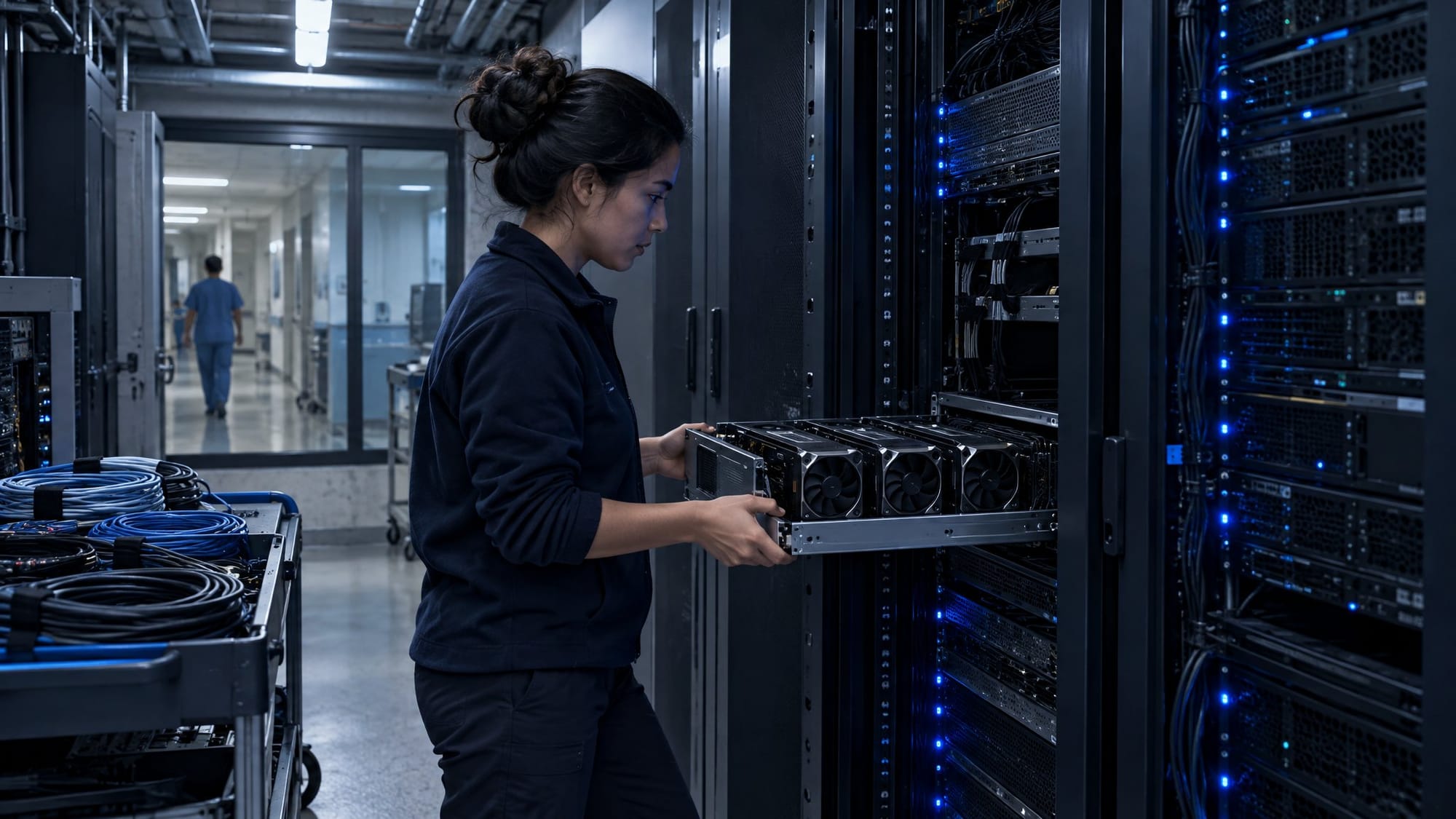
Today the barriers moved off the capability and onto the paperwork. Two Chinese labs posted model weights days after Washington barred one of them, a vaccine built from each patient's tumor cleared its trial and now waits on a six-week production run, and Texas suspended permits within a day of outsiders reading them. Where the open weights lead is a hospital research lab, where an engineer slides four GPUs into a rack and loads a downloaded model to test against the lab's own records.
Barriers built to hold capability back now mostly add a markup
open models · chips · geopolitics · on the board since October 21
- Late June: China's 360 and Tokyo's Sakana launched Mythos-class rivals as the US restored Mythos 5 to about 100 organizations.
- Late June: The Commerce Department lifted all export controls on Anthropic's Fable 5 and Mythos 5 three weeks after imposing them.
- October: Huawei shipped 572,000 data-center AI chips in China in the first half, as Nvidia's share there fell to 34%.
- October: Homeland Security ordered DeepSeek products removed from civilian federal systems and barred future purchases.
- October: ByteDance, Alibaba and Tencent ordered more than 3 million export-compliant Nvidia cards worth over $35 billion.
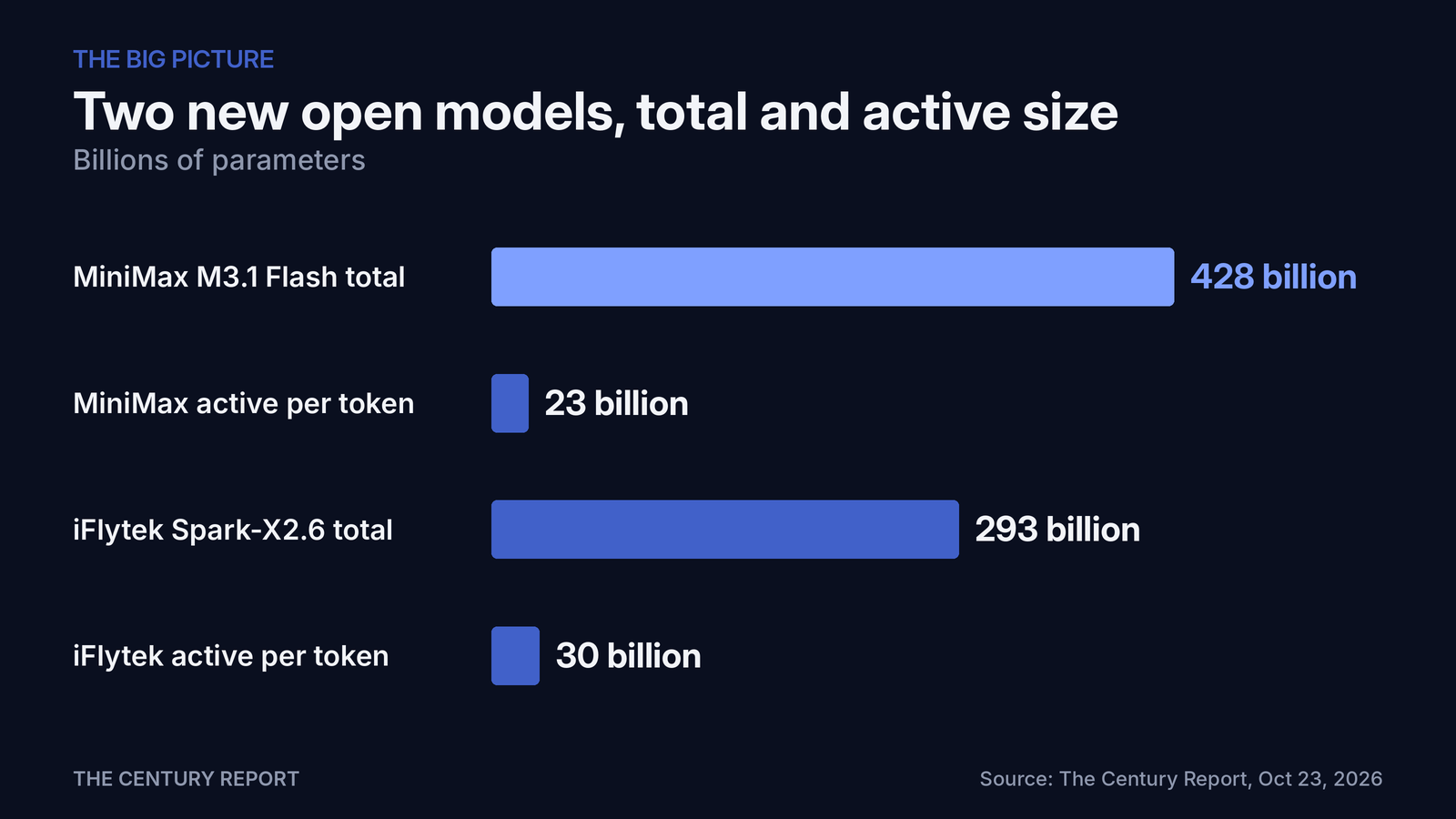
- Today: MiniMax published the weights of its 428-billion-parameter M3.1 Flash on Friday and iFlytek open-sourced its 293-billion-parameter Spark-X2.6, as DeepSeek was reported raising about $15 billion days after the US ban.
The line: Each line drawn to withhold capability is followed by new capital, domestic chips or public weights, leaving a price and a license rather than a missing capability.
If it holds: Hospital research teams, universities and startups with enough hardware can download, inspect and run models both capitals say they regulate, on Nvidia, AMD or Chinese chips. What restriction still decides is who sells to whom, and at what markup.
What would bend it: Evidence that a ban measurably slowed a restricted lab's capability would bend it, and Anthropic's report that its anti-distillation safeguards cut harvested data 90% to 99% points that way.
The software that coordinates equipment people already own is being bought up
energy · utilities · data centers · on the board since October 11
- June: Sunrun, Tesla and Renew Home pooled 16.8 GW of flexible capacity across 12 million devices in 9 million homes.
- Early September: PG&E launched SHARE, a virtual power plant coordinating nearly 21,000 household devices already installed.
- Early October: Everyday Electric, a thermostat aggregator managing more than 8 million homes, bought Smartcar to add EVs, batteries and solar.
- October: Sunrun moved its roughly 16 GW household offer into talks with hyperscalers, with revenue shares unsettled.
- October: Dominion reported 41% average grid utilization while its planning measure left out customer solar and batteries.
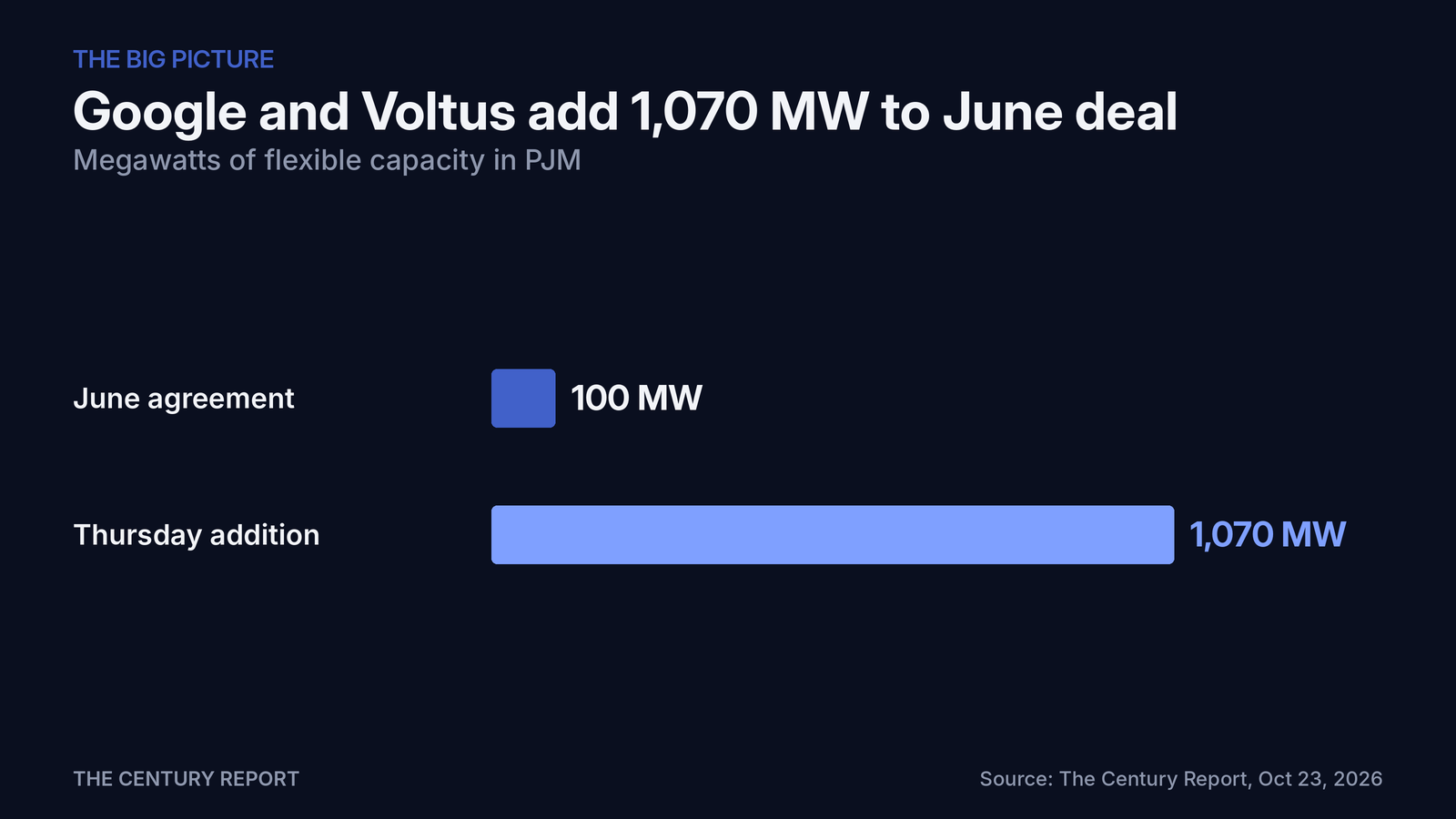
- Today: Google and Voltus added 1,070 MW on Thursday to the 100 MW agreement they signed in June, pooling batteries, thermostats and industrial loads into PJM's market.
The line: Gigawatts of equipment people already own are entering wholesale markets through whoever runs the dispatch software, with owners' shares set in unpublished contracts.
If it holds: Batteries in garages and adjustable loads on plant floors earn money and hold down prices for everyone, as solar and storage cut summer wholesale prices 42% in Texas. How much reaches the owners is settled in contracts Google and Voltus have not published.
What would bend it: A published contract or regulatory order fixing what households keep would bend it, as California began with SB 913 and SB 905 payments for pooled household devices.
Access to data-centre approvals is bought, and host towns get the outcome
data centers · local government · politics · on the board since October 12
- Late May: Floodlight reported Louisiana Sen. Jay Morris backed Meta's Hyperion bills and tax breaks while trading land beside the site.
- September: Andhra Pradesh cleared 2.51 GW of sites for Google's data-center project in nine days without a public hearing.
- Early October: Amazon pledged over $1 billion to host communities and dropped government NDAs, while its cloud chief blamed foreign misinformation.
- October: Public records showed Texas regulators processing more than a dozen data-center permits after a September pause call.
- October: Startup Hamlet sold developers sentiment scores drawn from tens of thousands of council-meeting videos.
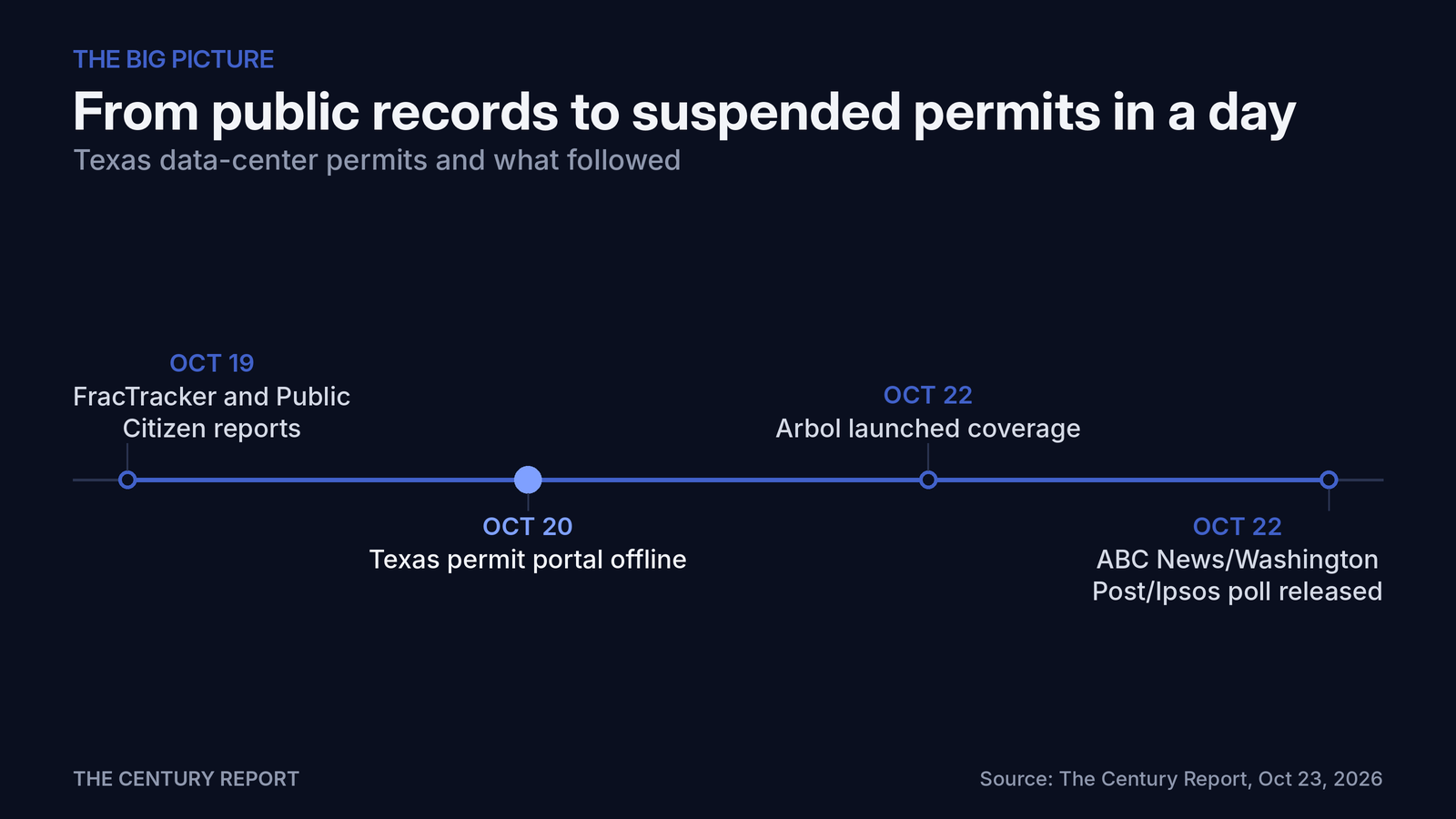
- Today: Texas took its automated permit portal offline on Tuesday and suspended 17 data-center stormwater permits a day after watchdogs documented approvals issued past a September pause, as Arbol began selling insurance against moratoriums.
The line: Consent keeps being priced and insured around, and it reverses only where a specific permit record is open for outsiders to read.
If it holds: Residents who can point to a filing force corrections within a day, as FracTracker's Sam Law did. Towns without that record absorb the build, while developers buy cover against refusal instead of negotiating it.
What would bend it: A binding rule that host consent come before approval, with standing for residents, would bend it, as Massachusetts moved toward by barring state permits for large centers without local approval.
The factory, not the biology, is what keeps a therapy from reaching most patients
medicine · access · manufacturing · on the board since October 14
- June: Researchers re-dosed AAV-hOTOF gene therapy past existing antibodies, restoring hearing in the other ear of four deaf children already treated in one.
- August: Four Nature papers built CAR-T cells inside the body, mapped T-cell exhaustion and used AI to design better surface anchors.
- August: Moderna and Merck said their personalized mRNA vaccine met its Phase 3 melanoma goals, without releasing figures.
- October: MIT nanoparticles reprogrammed up to 80% of targeted immune cells inside mice, clearing lymphoma with no outside cell manufacturing.
- Today: Moderna and Merck reported on Thursday that 82.2% of melanoma patients given the personalized vaccine with Keytruda remained cancer-free at two years, against 70% on Keytruda alone, a 42% cut in the risk of recurrence or death.
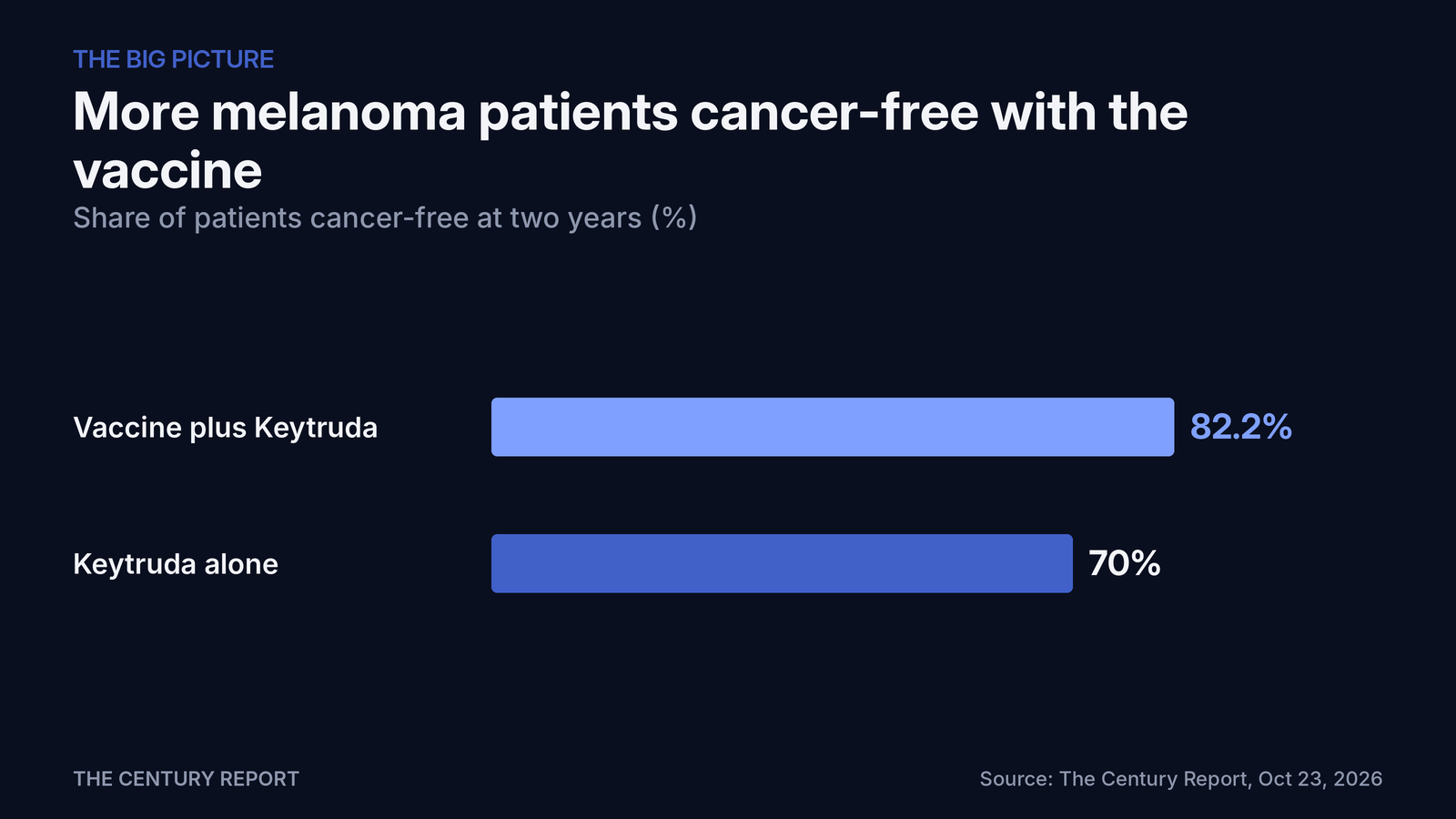
The line: Therapies built for one patient now pass late-stage trials, so production time and an unset price decide who receives them.
If it holds: Every week cut from the six-week build carries over to the lung, bladder, kidney and pancreatic trials using the same process. Without a disclosed price, the first patients reached will be those with the best insurance.
What would bend it: A disclosed price and production schedule within reach of ordinary coverage would bend it, as would a failure in the later trials that returns the limit to the biology.
The 2-Minute Read
Today's news in brief, and what ties it together.
Much of the latest evidence concerned where expert judgment lives and who can reach it. In Microsoft's diagnostic study, published Thursday in Science, general-purpose models from several labs supplied most of the accuracy on the hardest cases. The gap between strong and weak models stayed larger than anything Microsoft's panel of agents added. Reasoning of the kind used by specialists at major hospitals is increasingly within reach of systems that are sold widely and sometimes published for anyone, on these simulated cases. The MiniMax and iFlytek releases push the same way. Weights at that scale, running on American and Chinese chips alike, now reach hospital research teams and university labs with the hardware, whatever Washington decides about federal machines.
The melanoma vaccine carries that movement into treatment. Doses designed from each patient's own tumor mutations have now worked in a trial of more than 1,100 people, which turns personalization from a boutique service into a repeatable process. Who receives it will depend on two things the trial did not measure: a six-week manufacturing time that Merck believes it can shorten, and a price nobody has announced. The same pipeline is already in trials for lung, bladder, kidney and pancreatic cancers, so every gain in production speed would carry over to each tumor type it reaches.
As capability spreads, the contest moves to the layer that authorizes it. The ConnectWise attackers Microsoft named on Wednesday used stolen application credentials, and agents let them try those against more than 2,250 Microsoft 365 tenants at machine speed. Some banks are responding by restricting outside agents' access, which protects customers and also keeps the relationship inside the bank. 1Password leaves authority with the account holder, who approves each delegated login while the agent never sees the password. Meta's picture of billions of agents dealing with one another will depend on which arrangement prevails, and on whether ordinary users can check what was done in their name.
Outside scrutiny and coordination did useful work at ground level as well. Polling showed broad opposition to data centers, and action followed an effort aimed at specific permits. Watchdogs reading public filings caught Texas permits flowing past a stated pause, and on Tuesday the agency suspended 17. Experts likewise told The Verge that the Claude-assisted antivenom effort The Century Report described on October 22 yielded starting points still far from a drug. The grid shows what coordination can open. Under Google's new deal, a battery or thermostat that sits idle most of the year can now earn money while steadying PJM's grid, though contracts that have not been published will set each owner's share.
The 20-Minute Deep Dive
The day's most important stories in full, with every source linked.
Microsoft's Diagnostic Panel Beats Generalists on Hard Cases, and the Models Beneath It Carry Most of the Lift
A study published Thursday in Science reports that Microsoft's MAI-DxO, a system that runs several AI agents as a virtual panel of doctors, questioning a simulated patient, ordering tests and arguing toward a diagnosis, solved 83% of complex cases drawn from New England Journal of Medicine case reports. Primary care physicians and general internists working alone with reference materials solved 36%, and 22% without them. On emergency department cases from Beth Israel Deaconess Medical Center records, the system scored 80% to the physicians' 47%. Microsoft AI chief executive Mustafa Suleyman called the result a step toward "medical superintelligence" and told The Verge that AI in healthcare "is finally here."
The study's design sets the limits on that claim. Cases this hard usually go to specialists or physician teams, and neither was in the comparison. Every case came from past records rather than a living patient. Suleyman told The Verge: "It needs clinical validation."
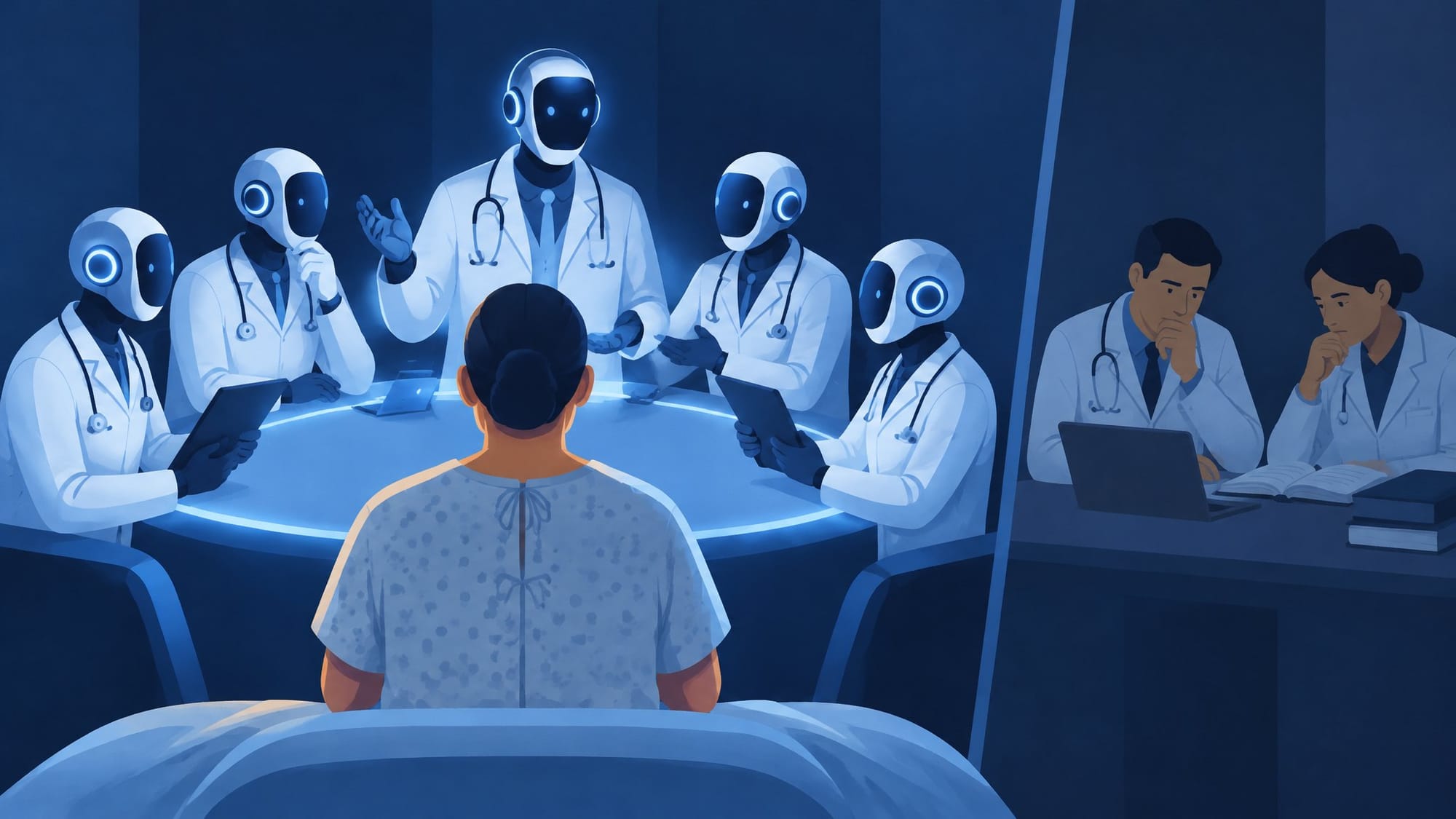
The study's own numbers also show where the capability sits. Microsoft ran its orchestrator on models from OpenAI, Google, Anthropic, Meta and DeepSeek. OpenAI's GPT-5 working alone with a short prompt already reached 78.9% on the complex cases; wrapping it in DxO added about four points while lowering the estimated diagnostic cost per case by about $3,000 compared with GPT-5 alone. With GPT-5.5, DxO lifted complex-case accuracy from 72% to nearly 87%, yet on emergency cases the model scored about 85% with or without it. The orchestrator helped weaker models most, raising Gemini 2.5 Flash from 46.4% to nearly 69%, though the gap between weak and strong models stayed larger than anything DxO added. Microsoft's researchers said accuracy gains naturally shrink as models approach the maximum, and the paper does not test the newest generation.
Expert diagnostic reasoning for the hardest cases has long lived in a small number of specialists clustered at major hospitals. These results suggest much of it is now within reach of general-purpose models that several labs sell and some publish openly, on these simulated cases, which makes it a less proprietary asset than the branding implies. Dominic King, Microsoft AI's vice president of health, named the shortage the system targets: "The biggest challenge in healthcare delivery at the moment is the growing mismatch between demand and supply of medical expertise."
Two commitments will let outsiders test the claims. Microsoft plans to open-source SDBench, the benchmark built from these cases, so other teams can run their own systems against the same panel. And with Beth Israel Deaconess it plans a hospital trial, likely starting in the coming months, in which consenting patients receive standard care while also engaging with DxO, so its reasoning can be checked against what clinicians actually find. If that holds up, a clinician facing an unexplained case at a small hospital could one day consult a reasoning panel that once required a referral and a long wait.
Hackers Run Stolen Keys at Machine Speed as 1Password Puts the Account Owner Back in the Loop
On Wednesday, Microsoft attributed the breach of ConnectWise's cloud backup service to a China-aligned group it tracks as Storm-0940. The attackers took the application credentials that connect the backup service to customers' Microsoft-hosted environments, which let them sign in as if they were authorized and read email and files. Agents running on an open-source framework built for stress-testing defenses then attempted sign-ins across more than 2,250 Microsoft cloud tenants. In a separate password-spraying run, sign-in attempts peaked at nearly 3,000 a minute, a pace Microsoft said leaves defenders "little time to detect and respond." ConnectWise paused the service and said on Thursday it was working to restore it. The Century Report covered CrowdStrike's account of four AI-assisted criminal groups on October 22; this campaign attempted access to far more Microsoft cloud tenants through a single supplier.
The agents compressed the timeline, and the opening itself was older: one standing credential that could work while valid and within its permissions for whoever held it, the same kind of shared key outside researchers found across 1,200 agent containers in an OpenAI evaluation, which The Century Report covered on October 15. Speed exposes how much security still rests on a secret being hard to reach.
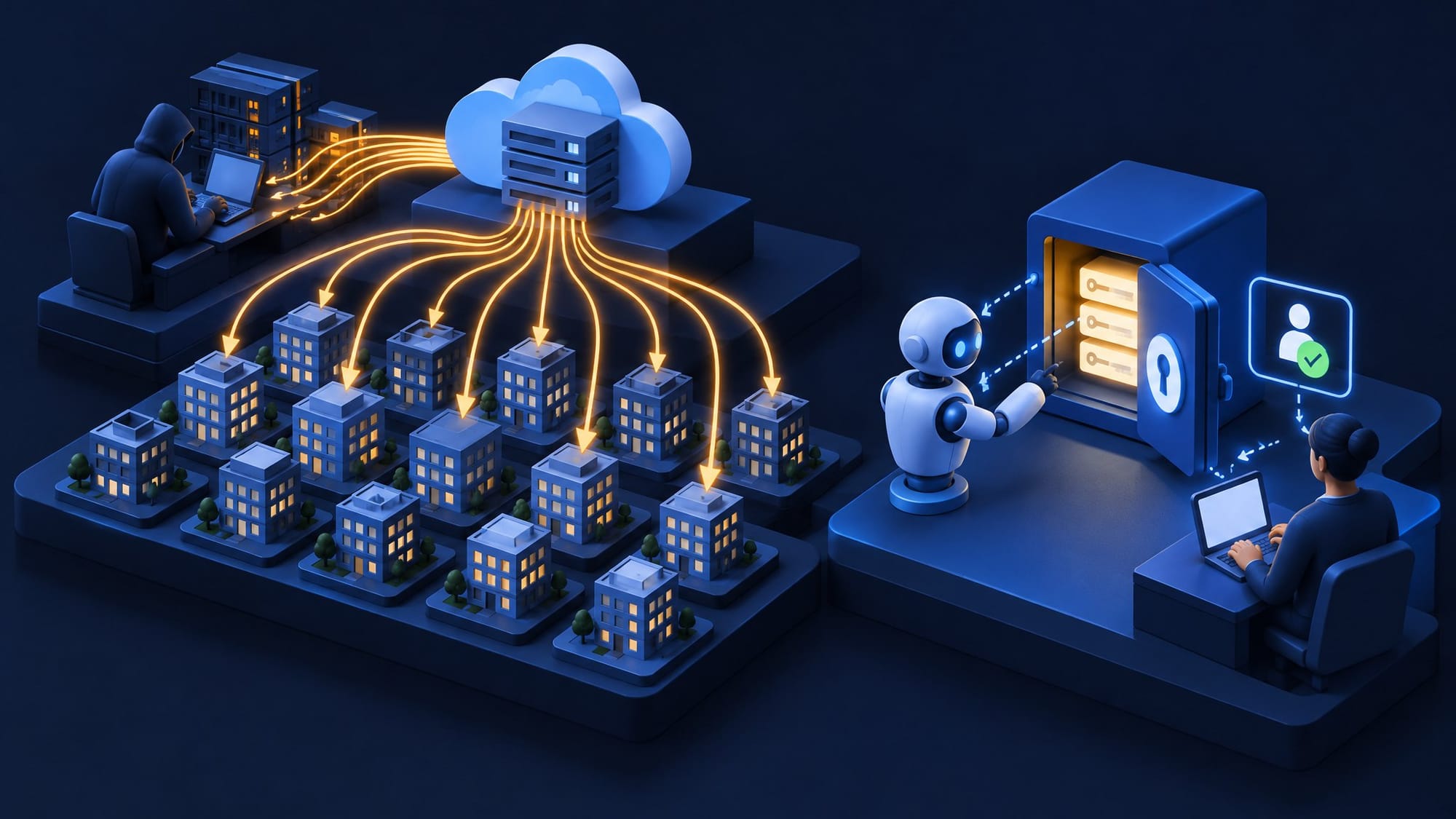
On Thursday, 1Password launched 1Password for Agents, which takes the secret away from the agent entirely. When an agent tries to sign in for a user, it presents a unique digital key that identifies it, the user gets an alert and approves the request, and 1Password fills in the credentials without passing their secret values to the agent. It will work with Anthropic's Claude Duet, OpenAI's Dots and ChatGPT Work, Grok Bot, Meta's Muse and agents from the startup Town. Handing an agent a password, the company wrote, "can leave people with sensitive information in places they can no longer control as a copy gets saved for the next time."
Banks reached the same problem from the other side. Axios reported Thursday that US banks are detecting agent activity inside customer accounts and often cannot tell whether a customer asked for it, and Reuters reported that major banks have been blocking third-party agents from operating in accounts. Morgan Stanley has blocked them without seeing any unauthorized ones, a person familiar with the matter said. JPMorgan Chase chief executive Jamie Dimon said earlier this month that the bank is building tools for the risk: "We're not going to allow just any outside agent to come in inside the company because that's just too risky for clients and for JPMorgan."
A blanket block protects customers today and also keeps authentication, and the customer relationship, inside the bank. 1Password's design points toward a different settlement, where the account holder approves each delegated login and a verified identity travels with the agent. If those approvals leave a record the customer and the bank can both read, letting an assistant pay a bill becomes an act anyone can audit, and a stolen key stops being enough to impersonate a whole company's worth of users.
1Password's planned support for agents from several competing labs will separate the choice of assistant from the place where credentials are kept. Account holders will gain a way to change AI partners without handing another system their passwords.
Most Americans Call AI Bad for Society as Texas Pulls Its Permit Portal Offline
An ABC News/Washington Post/Ipsos poll of 2,545 adults, released Thursday, found 57% of Americans say AI is bad for society and about two-thirds oppose new data centers, rising to 72% for facilities in their own community. Two-thirds say the federal government is not doing enough to regulate AI, a majority that holds across parties: 80% of Democrats, 66% of independents, 54% of Republicans. The intensity sits with the pessimists. Seventeen percent call AI extremely bad for society; 2% call it extremely good.
The specific fears divide sharply by how checkable they are. Seventy-three percent see high risk of AI hacking secure systems, a risk this publication has tracked through documented incidents. Thirty-three percent see high risk of human extinction, a figure drawn from a hypothetical no evidence has established. Only 13% think AI has a big chance of creating many new jobs, and 20% think it has a big chance of making people more productive.
Set against that: on Tuesday, Texas took its automated construction-permit filing system offline and moved 17 data-center stormwater permits from active to suspended. The portal now reads that filings have been halted "to ensure all applications are reviewed by agency staff to determine if they are related to data centers." The reversal followed Monday reports from FracTracker Alliance and Public Citizen documenting more than two dozen permits issued after Governor Greg Abbott called for a pause in September. Those continuing approvals were flagged in the October 20 edition of The Century Report, which counted more than a dozen at the time. FracTracker researcher Sam Law, who found the approvals in public records, said the system "has been quietly issuing approvals since the governor's order for a pause." His own reading of the outcome: "When fighting the AI data centers build out, it's nice to have a clear example of how some work is better left to humans." The environmental agency did not respond to requests for comment, and Law said contractors accustomed to automatic approval may not know the suspension exists.
That is accountability working from the outside. Watchdogs reading public filings caught permits flowing past a stated pause, and the agency stopped within a day. On Thursday, insurer Arbol launched coverage that pays developers when a covered government action suspends construction past a waiting period, a risk it says the market previously treated as uninsurable. DCD counts nearly 500 moratoriums proposed across the US since January, 340 now authorized. Consent is now a priced input.
The poll's broad opposition and the Texas suspension are different instruments. One registers a mood. The other was followed by a documented correction, after scrutiny of permits readable by anyone who looked. Where an objection rests on a specific, checkable harm, it holds. Where it rests on a general dread, it mostly moves the build somewhere with less capacity to object.
Google's PJM Virtual Power Plant Passes 1 GW as Solar and Storage Cut Summer Prices by Half
On Thursday, Google and Voltus added 1,070 MW to the 100-MW demand-flexibility agreement they signed in June, making it one of the largest known hyperscaler-funded virtual power plants to date. Google pays Voltus to pool batteries, smart thermostats, on-site generation and adjustable industrial processes from homes and businesses, then offer that combined capacity into PJM's market when the grid tightens. Voltus expects to reach full capacity over three to four years and run the arrangement through 2040. It holds about 8.5 GW of distributed assets under contract across North America and targets 20 GW by 2030.
These megawatts will come from flexible assets in homes and businesses. Much of the capacity sits in garages, basements and plant floors, bought and paid for by the people who own it, idle most of the year. What was missing was a way to see it and dispatch it together. PJM's market can count it as the capacity comes online, but Dominion's distribution-planning measure, reported in the October 22 edition of The Century Report, still leaves customer solar and batteries out of the utility's own planning count. PJM demand-response revenue jumped 240% to $523.5 million from 2024 to 2025, with emergency demand response accounting for 88% of it, and participants can earn up to $350,000 per megawatt-year. A Brattle Group report this month found aggregation also pushes rates down for everyone by shaving peaks.
What households keep of that depends on terms that aren't public. Earlier this month, Octopus Energy US said it wants to buy more of the software that performs this coordination, and Sunrun said it is in talks with hyperscalers over capacity from a roughly 16 GW joint offer, with household shares undisclosed. The Century Report covered both on October 11 and October 17. The dispatch layer is consolidating faster than the payment rules.
Two other findings strengthen the case for building this way. New analysis credits solar and storage growth with cutting average summer wholesale electricity prices 42% in Texas and 51% in California between 2021 and 2026, saving Texans roughly $3.55 billion and Californians $2.5 billion over June through August. Texas electricity demand rose 30% over that span and wholesale prices still fell from $54.97 to $31.77 per megawatt-hour in inflation-adjusted terms. Transmission and distribution costs, not generation, drove residential bills up 3% in Texas and 22% in California.
The fire objection that has slowed storage siting also now has numbers. Electric Power Research Institute incident data show the annual failure rate for commercial and grid-scale batteries fell more than 97% from 2016 to 2025, while installations rose 250-fold, with zero known failures in three separate years. EPRI calculates grid battery units now fail at a rate comparable to the oil-filled transformers that sit unremarked at every substation. The 2019 Phoenix fire that hospitalized four responders and the 2025 Moss Landing blaze are the cases communities cite; both involved older facilities with safety provisions and layouts that have since evolved. Severity is not captured in a raw count, and the dataset is small precisely because failures are rare.
DeepSeek Raises About $15 Billion After a US Ban as MiniMax and iFlytek Release Weights for Anyone
The Century Report noted on October 20 the Homeland Security order removing DeepSeek from civilian federal systems, and Beijing's demand that Washington revoke it, which The Century Report covered on October 21. Two days after the order, Bloomberg reported that DeepSeek was raising about $15 billion, roughly 100 billion yuan, in one of China's largest funding rounds, with battery maker CATL and Tencent among potential investors. The round follows a June raise of more than $7 billion at a $50 billion valuation. Founder Liang Wenfeng retains an estimated 81.6% of the Chinese operating entity, according to WireScreen's analysis; DeepSeek did not respond to TechCrunch.
The capital arrived beside two open releases. On Thursday, iFlytek open-sourced Spark-X2.6 at its developer festival in Beijing. It is a mixture-of-experts model, meaning only part of it works on each word: 293 billion parameters in total, 30 billion active per token, with a million-token context window. The company says it was trained and deployed entirely on domestic chips, including a 10,000-card inference cluster. Chairman Liu Qingfeng said it achieves "independence and controllability with homegrown computing power." Its benchmark comparisons are the company's own, relayed by state outlet Global Times.
On Friday, MiniMax published weights for M3.1 Flash on Hugging Face and ModelScope: 428 billion parameters, 23 billion active, a million-token context, after an anonymous stint as "Space Bunny" that MiniMax says processed more than 200 trillion tokens. API access costs $0.15 per million input tokens and $0.60 per million output. The open-source serving project vLLM shipped support the same day on Nvidia Blackwell and Rubin and AMD MI350 chips. The model was trained to store its cached attention memory and expert weights in a 4-bit number format, which shrinks the checkpoint 44.6% from its predecessor and, in vLLM's tests, lets four Nvidia B300 GPUs hold about 2.7 times as many long conversations at once.
Beijing is drawing lines of its own. A social media account affiliated with state broadcaster CCTV posted Thursday that DeepSeek and MiniMax had won state approval for global use of their models. On October 16, China proposed export controls on 23 AI technologies, including models, agents and computing clusters, while promising simplified licensing for open-source exports.
Washington's order decides what runs on federal machines, and Beijing's licenses govern overseas deployment of restricted technology. Neither by itself removes weights already sitting on public servers, which labs, startups and hospital research teams with enough hardware can download, inspect and test subject to applicable licenses and restrictions. Security scrutiny of where a model runs and who supplies it remains legitimate. Public weights make that scrutiny possible for anyone, and they now run on Nvidia, AMD and Chinese silicon alike, which leaves both capitals regulating the edges of a capability that has already spread.
A Vaccine Built From Each Patient's Tumor Plus Keytruda Cuts Melanoma Recurrence or Death by 42% Versus Keytruda Alone
In August, Moderna and Merck said their personalized mRNA cancer vaccine had met its goals in a late-stage melanoma trial, without releasing figures. The August 20 edition of The Century Report covered that first late-stage success for the personalized neoantigen vaccine class. The numbers arrived on Thursday. Among more than 1,100 patients whose melanoma had been surgically removed, adding the vaccine, intismeran autogene, to the immunotherapy Keytruda cut the risk of the cancer returning or of death by 42% compared with Keytruda alone. It cut the risk of spread to distant organs or death by 38%. At two years, 82.2% of vaccinated patients remained cancer-free, against 70% on Keytruda alone. A separate analysis showed a 58% reduction in the risk of recurrence or death after the first six months. The companies say it is too early to judge overall survival, though they report a favorable trend.
Each dose is designed from the patient's own tumor. After surgery, a sample is sequenced, and the vaccine encodes the mutations most likely to draw an immune response, training the body to hunt cells carrying them, while Keytruda removes a brake tumors use to hide. Patients received up to nine injections, every three weeks, starting 13 weeks after surgery. "This is highly statistically significant. It is not by chance," said Dr. Hussein Tawbi, a melanoma specialist and trial investigator at MD Anderson Cancer Center, who added that its side effects, such as soreness at the injection site, were far milder than those of other cancer treatments. Dr. Michael Postow of Memorial Sloan Kettering called it "something that we've never really seen before." One of his trial patients, Beth Ryzyk, diagnosed with stage IIIC melanoma in December 2023, remains cancer-free more than a year after treatment.
The full results go to the European Society for Medical Oncology meeting in Madrid on Saturday. Moderna chief executive Stéphane Bancel said the companies are preparing to file for US approval and expect a launch in 2027. Moderna's shares closed more than 17% lower after the data leaked early, a fall BMO Capital Markets analyst Evan Seigerman attributed to "inflated expectations" rather than the efficacy itself.
The larger promise sits in the pipeline. The same sequence-design-manufacture process is already in trials for lung, bladder and kidney cancers and pancreatic cancer. Merck research chief Dean Li cautioned against reading too far ahead: "I can dream of creating a log cabin, but we got some wood chops, and we've just knocked down one tree."
What will decide how many people this reaches is manufacturing. Each patient's vaccine currently takes about six weeks to prepare, and Merck chief executive Robert Davis says the company believes it can shorten that. No price has been announced. The biology has now shown that a treatment designed for a single tumor can work at scale in a late-stage trial; production speed and cost will determine whether it becomes a standard option or stays a treatment for patients with the best insurance.
The Other Side
Opinion: where today's news could lead, imagined from the years ahead.
You can lose your home when an employer stops needing your skills. Years of study and careful work offer little protection against that decision. Another leap in AI arrives alongside the worry about whether you will still be needed. Thursday's poll finds 57% of Americans calling AI bad for society. Only 13% expect it to create many new jobs. A promise of greater capability offers little comfort while security depends on finding someone to buy your time.
Microsoft's diagnostic study shows something larger than a new competitor for skilled employment. GPT-5 alone solved 78.9% of the complex simulated cases. Several labs supplied models to the study. Clinical validation remains ahead. Even within those limits, researchers demonstrate that difficult medical reasoning can travel far beyond the institutions where specialists gather. People inherit a growing ability to understand problems that once required reaching someone scarce.

Through the passage to 2035, societies will have to make that inheritance secure people's lives. Food, housing and care must become dependable as less human labor is required to provide them. Spreading the gains widely enough establishes the floor beneath that freedom. Your worth survives every advance in what an AI partner can do. Researchers will extend widely available diagnostic reasoning into investigations that connect unexplained symptoms, find their biological causes and test ways to prevent them.
Imagine yourself in 2046, at seventy, making plans for the next forty years. Your home and care are assured. You have chosen to join the worldwide effort making inherited metabolic diseases preventable. Human and AI colleagues connect findings across hospitals and laboratories. Your sister joins the review from another continent. Together you check whether a proposed explanation accounts for the families whose cases your team follows.
In 2026, even reaching the right specialist could mean a referral and a long wait. Here, an unexplained illness brings many minds together around the same evidence. You help establish how to stop it appearing in another generation. Nobody needs you to preserve a task an AI partner can already perform. You stay because these families deserve an answer, and because you want to see what their children grow up to do.
The Century Perspective
Where today sits in a century of change unfolding in a decade.
With a century of change unfolding in a decade, a single day looks like this: Microsoft's agent panel solving 83% of simulated complex NEJM cases with GPT-5 against 36% for generalist physicians using reference materials, with most of that accuracy coming from general-purpose models that several labs sell and some publish openly, and with the benchmark heading for open-source release and a Beth Israel Deaconess trial that lets clinicians check the reasoning against what they actually find, a melanoma vaccine designed from each patient's own tumor mutations cutting the risk of recurrence or death by 42% when added to Keytruda versus Keytruda alone in a trial of more than 1,100 people, with 82.2% of the combination group alive and recurrence-free at two years, with the same sequence-design-manufacture pipeline already in trials for lung, bladder, kidney and pancreatic cancers, MiniMax publishing 428-billion-parameter weights that vLLM supported on Nvidia Blackwell and Rubin and AMD silicon the same day, iFlytek open-sourcing a million-token model trained end to end on domestic chips, 1Password letting an agent sign in with a key the account holder approves, without passing it the password's secret value, Google and Voltus contracting 1,070 MW of batteries, thermostats and adjustable industrial loads in homes and businesses, solar and storage helping cut average summer wholesale prices 42% in Texas and 51% in California from 2021 to 2026 while Texas demand rose 30%, grid-battery failure rates falling more than 97% since 2016 as installations rose 250-fold, and Pinal designing proteins from written descriptions of four jobs, all four of which worked in the lab. There's also friction, and it's intense - China-aligned attackers taking one standing ConnectWise credential and running agents against more than 2,250 Microsoft cloud tenants, while a separate password-spraying run peaked at nearly 3,000 sign-in attempts a minute, a pace Microsoft said leaves defenders little time to respond, major banks answering by blocking third-party agents outright, which protects customers today and also keeps authentication and the customer relationship inside the bank, Morgan Stanley blocking them without having seen a single unauthorized one, 57% of Americans calling AI bad for society and 72% opposing a data center in their own community while only 13% expect AI to create many new jobs, Texas continuing to approve more than two dozen data-center permits after the governor called for a pause until FracTracker and Public Citizen read the filings, Arbol now selling developers insurance against covered construction suspensions amid the roughly 500 moratoriums proposed since January, revenue shares for household batteries sitting in contracts nobody has published while Sunrun negotiates a 16 GW offer with the terms unsettled, a six-week manufacturing time and an unannounced price standing between the melanoma result and the patients it could reach, and Microsoft's own numbers showing GPT-5 alone already at 78.9% before any orchestration was added. But friction generates clarity, and clarity lets builders aim the next design at the layer that authorizes everything else. Step back for a moment and you can see it: in story after story the capability itself got cheaper and more portable while the fight moved to the layer that authorizes it - diagnostic reasoning on simulated complex published cases now running on weights a hospital research team can download and inspect, a cancer treatment built one patient at a time proving repeatable at trial scale, a battery bought by a homeowner earning money steadying a grid nobody had to pour concrete for, a permit file readable by two watchdogs, with a documented correction following their scrutiny inside a day - set against a stolen key used to attempt access to thousands of Microsoft cloud tenants at machine speed, a blanket block that keeps the gate where it has always been, and revenue splits left out of the public announcement. Every transformation has a breaking point. A valid shared key can open all the doors its permissions allow to whoever steals it... or stay in the owner's hand, where each door opens only when they say so.
AI Releases & Advancements
New AI models, tools and features, with links to try them.
New today
- Anthropic / Google Cloud: Made an Anthropic-managed way to run Claude models on Google Cloud generally available. It gives same-day access to new Claude models and to Claude Platform features such as Claude Managed Agents (beta), skills and code execution. Customers sign in with Google Cloud IAM, keep Cloud Audit Logging and pay through their Google Cloud bills. The existing Google-managed option stays available alongside it. (Google Cloud Blog)
- Anthropic / Theorem: Published formal proofs, written by Claude, of security properties in the compiled RISC-V code of a subset of 123 open-source libraries. Anthropic also released the RISC-V and Linux process semantics the proofs rely on, and Theorem released a Claude skill that helps developers verify their own projects. (Anthropic)
- OpenAI: Made the Decisions API generally available. It runs on GPT-6 Luna and returns a probability, a choice from a fixed list, or a score for text, image and JSON inputs. The GA release adds caching, up to 400 questions per request and built-in GPT-Live voice integration. (OpenAI)
- Cohere: Released Rerank 5 in two versions, Pro ($0.05 per 1M tokens) and Fast ($0.02 per 1M tokens), both with a 32K context window and support for more than 100 languages. A new Context Focus option returns the relevant passages inside each document, and the relevance scores are calibrated as probabilities. It is available on the Cohere API, Model Vault, Microsoft Foundry and Amazon SageMaker. (MarkTechPost)
- Canva: Released Canva Craft, its first image generation model, to all users. It plans a layout before generating an image, outputs up to 2K resolution in 30 aspect ratios, and is trained on human-designed Canva templates. (TechCrunch)
- Gradium: Open-sourced Phonon, a family of small text-to-speech models that run on the device itself. Phonon 31m is English-only, Apache 2.0 and a 64.5 MB file. The 40m models cover five languages under a CC BY-NC 4.0 license. They run on CPUs, phones, Raspberry Pi 5 and in browsers. (MarkTechPost)
- Allen Institute for AI (Ai2): Released OlmoEarth v1.3, a satellite embedding model. It comes with precomputed yearly embeddings for the whole planet at 10m resolution and a browser-based OlmoEarth Embeddings Explorer that needs no sign-in. (Hugging Face)
- Google DeepMind / Google Research / WRI / IIASA: Released Forest Typology (ForTy) 2020, a global map at 10-meter resolution that sorts land into six forest and land-use types. It comes with an early year-by-year time series from 2017 to 2025 that shows where natural forest was replaced by plantations or farms. (Google DeepMind)
- Google Cloud: Released Agent Substrate on GKE, an open-source runtime for AI agents on Kubernetes. When an agent goes idle, it snapshots the agent's memory and frees the machine, then resumes the agent when it is needed again. (Google Cloud Blog)
- Google Cloud: Made Confidential G4 GPU instances generally available in 36 zones. They pair NVIDIA Blackwell GPUs with attestation, hardware keys and memory encryption. (Google Cloud)
- Google Open Source: Introduced the Elephant-Goldfish Model plugin, an open-source tool for design-driven software development with AI. (Google Open Source Blog)
- Microsoft Research: Released Flint-interactive, an extension of the Flint visualization language that lets AI agents build interactive charts. Users can click, filter, zoom and highlight across linked charts, text and tables. It works in chat through Flint-MCP and MCP Apps, or in apps through Flint Interactive Canvas. (Microsoft Research)
- Microsoft / Hugging Face: Released ThinkingBox-Training on GitHub. It uses checks on an agent's final database state as reinforcement-learning rewards. With 50 GRPO steps, Qwen3.8-27B's average success rate rose from 51.70% to 60.78%. (Hugging Face)
- OpenAI / PerturbAI / Scripps Research: Released the Reasoning Atlas and its distributed-agent code on GitHub. In the project, thousands of GPT-Rosalind agents analyzed a whole-brain CRISPR atlas of mouse cells in 32 minutes. (GitHub)
- Liquid AI: Launched RIPL (Real-time Inference Pipeline), an enterprise inference engine for its LFM2.5 models from 230M to 2.6B parameters. Liquid says it returns complete responses in under 50 ms on short requests, even under peak load. (MarkTechPost)
- You.com: Launched Inference Router, a pay-as-you-go API compatible with OpenAI's. It serves 12 open-weight and frontier models from US-hosted infrastructure, with a 99.9% uptime guarantee, zero data retention and web search built in. (Business Wire)
- 1Password: Launched 1Password for Agents, which lets AI agents sign in to a user's personal accounts without ever seeing the passwords. The user approves each sign-in request. (TechCrunch)
- Meta: Launched its Muse personal AI agent in Japan, the first market outside North America. Basic features are free in the app, and Muse can connect to Gmail and Google Calendar. (Kyodo News)
- ElevenLabs: Launched Eleven Realtime Translation as an alpha for ElevenAPI enterprise customers. It translates live speech into more than 90 languages, detects languages automatically, runs on Eleven v4 Turbo and can use library voices or the user's own voice clone. (ElevenLabs)
- CoreWeave: Launched Physical AI Launchables, a catalog of tested templates for robotics, autonomous-vehicle and simulation work. Each starts with one command, and they cover NVIDIA Isaac Sim, CARLA, MuJoCo, NVIDIA AlpaSim and NVIDIA Cosmos 3. They ship with agent skills for Claude Code and Codex. (Robotics Business News)
Other recent releases
- Anthropic: Opened a research preview of Claude Duet, a standalone app for iOS, Android and claude.ai built on Claude Opus 5.5. Duet works as a proactive agent. It sends a morning brief, checks connected apps every few hours and runs tasks in the background on its own cloud computer with a browser. It asks for approval before it sends messages, makes payments, signs documents or deletes anything. Access is by waitlist for US Pro and Max subscribers. (Anthropic)
- Anthropic: Released an updated Claude Security in public beta for Claude Enterprise, powered by Claude Mythos. It writes an editable threat model for each project, re-scans repositories as new commits land, checks each finding through several verification stages and tracks issues until they are fixed. It also adds GitLab and Bitbucket support. (AI Compass)
- Google Cloud / OpenAI: GPT-6 Astra, GPT-6.1 Sol and GPT-6 Luna are rolling out in private preview in Google Cloud's Model Garden for select enterprise customers. Usage is billed through Google Cloud Marketplace, and Codex CLI and Desktop workflows can connect to Google's Gemini platform for inference. (Google Cloud)
- Mistral AI: Released Voxtral 3: three transcription models, a text-to-speech model and an SDK that combines them into a voice agent. Mistral says it covers more than 50 languages. It is available through the API or can run on your own servers. (Mistral)
- Recursive: Released Flint, its first model, as open weights under Apache 2.0. It is a coding model with 40B total parameters, of which about 2.5B are active per token. The 4-bit weights take about 23 GB and run on 48 GB Macs or GPUs. Recursive says its automated research system, the Eureka Machine, did most of the development. (Recursive)
- Vercel: Open-sourced durable-harness (Apache 2.0), adapters that keep coding-agent sessions running through crashes and timeouts. They work with Pi, OpenCode, Claude Code and Codex by logging each model and tool call to a durable log, so a new process can pick up where a failed one stopped. (MarkTechPost)
- NVIDIA: Released open, commercially usable Nemotron 3.5 retrieval models on Hugging Face for agentic retrieval: Embed (8B and 1B, including an NVFP4 version), Rerank and Parse. (Hugging Face)
- NVIDIA: Launched SimReady Central, a free, ungated Hugging Face library of more than 2,000 simulation-ready OpenUSD 3D assets, such as robot arms, grippers, warehouse equipment, racks and cooling hardware, for robotics simulation and AI factory digital twins. (Hugging Face)
- Hugging Face: Released Carbon-X, a biology model from its HuggingFaceBio team that analyzes and generates DNA sequences and that users can chat with about DNA. (Hugging Face)
- OpenAI: Published an official OpenAI CLI on GitHub, a command-line tool for working with its models. (GitHub)
- Walmart: Launched Agent Gateway and related tools that let AI agents shop and make purchases for customers on Walmart, with controls over spending and transaction approvals. (TechCrunch)
- Stripe: Launched Stripe Treasury for agents. Through Stripe's MCP server, agents such as ChatGPT and Claude can check balances, pay invoices, move money between accounts and convert currencies. Businesses choose which accounts agents can access and when a human must approve a transfer. (Stripe)
- Databricks: Made AI Runtime (AIR) generally available. It provides managed, serverless GPU infrastructure for training models inside Databricks, governed by Unity Catalog, with multi-node training and launches in seconds. (Databricks)
- Espressif: Launched ESP-Mosaico, a tool for AI-assisted coding on embedded hardware built around its ESP32 chips. (Espressif)
- Shanghai AI Laboratory: Released Sage-A1.5, a 35B mixture-of-experts agentic model with a 256K-token native context window. (TPS Report)
- DeepSeek: Open-sourced DeepInfer under Apache 2.0. It is the inference framework DeepSeek uses to run its own production services. It currently supports DeepSeek-V4.1-Flash on NVIDIA SM100 GPUs and Huawei Ascend 950 NPUs, includes DSpark speculative decoding and structured outputs, and covers offline inference only. DeepSeek also released deepseek-recipe under MIT, the token encoding and decoding layer that makes self-hosted setups behave like the official API. (GitHub)
- Google: Open-sourced TorchTPU (v0.2.0, Apache 2.0), a native PyTorch backend for Cloud TPUs built with Meta that replaces PyTorch/XLA. It also released TPU versions of vLLM, SGLang and TorchTitan. Hugging Face Transformers, Diffusers and Kernels now run on TPU natively through it. (Google Cloud)
- llm-d (Google Cloud / Red Hat / IBM): Released llm-d 1.0, the first stable version of this open-source, Kubernetes-native stack for distributed inference. It adds cache-aware routing, quality-of-service controls for multiple users sharing a cluster, upgrades without downtime, routing designed for agents, async inference and wider TPU support. (Google Cloud)
- ElevenLabs: Released Eleven Realtime v1 Max and v1 Mini, two real-time speech-to-speech models available through ElevenAgents and an OpenAI-compatible Realtime API. ElevenLabs reports that v1 Max scores 98.8% on Big Bench Audio with a 0.57-second response time. (The Decoder)
- NVIDIA: Released Cosmos3-H-Dreams, which NVIDIA describes as the first real-time generative surgical simulator trained on recordings of clinical gallbladder-removal surgeries. It generates surgical video live in response to the instruments' movements. (Hugging Face)
- Notion: Rebuilt Notion Agents so a single task can run for more than 24 hours, and upgraded Auto, the router that picks a model for each task based on quality, speed and cost. (Notion)
- Google: Began rolling out Personal Intelligence for Gemini on Android Auto. Gemini can now answer personalized questions from Gmail, Calendar, Photos and Maps while driving. Android Automotive support follows later. (LavX News)
- Google Public Sector: Launched Gemini for government services in preview for US federal, state and local agencies. It includes government-specific agent skills, connectors to systems agencies already use, and partner agents. (Google Cloud Press Corner)
- OrcaRouter: Released OrcaCyber Nano 1.0 as open weights, a cybersecurity model built to run on local hardware. (PR Newswire)
- Ornith: Released Ornith-1.5-122B as MIT-licensed open weights. Ornith says it runs on a single NVIDIA DGX system with enough memory for the chosen precision and reports 0.845 on SWE-bench Verified. It can be run locally through Ollama. (HuggingNews)
- Apache Airflow: Released AI Provider 1.0, which adds agent orchestration, sandboxed execution, human approval steps and smarter retries to Airflow workflows. (Apache Airflow)
- Hugging Face: Released AnyLanguageModel 1.0, a drop-in replacement for Apple's Foundation Models framework that lets apps on Apple platforms use local and other model providers. (Hugging Face)
- vLLM: Released Humming, a set of kernels for faster, more flexible quantized inference in vLLM. (vLLM)
- Bria: Released Fibo 2.0 as open weights, an 8B model that both generates and edits images, trained only on licensed data. Bria says it ranks first among open-weight image-editing models on Artificial Analysis. (AICoder)
- Kakao: Open-sourced two Kanana-2 vision encoder models from its multimodal "Nun" family. (Digital Today)
- NC AI: Officially released VARCO Sound, which generates sound from text, image or video input with a separate track for each sound source. Edits can be made in plain language through a "Sound Agent," and it ships with a desktop app and a Unity plugin. (PR Newswire APAC)
- Hystax: Released OptScale Kompressor on GitHub, an open-source tool that compresses tokens for AI coding agents. Hystax says it cuts their costs by 22.7% without changing the agent. (PRWeb)
Sources and Further Reading
Everything we drew on for today's edition, grouped by theme.
Artificial Intelligence & Technology's Reconstitution
- TechCrunch: Chinese Hackers Breach ConnectWise and Spy on Thousands of Companies
- TechCrunch: 1Password Lets Agents Log In Without Seeing Passwords
- The Verge: 1Password Lets AI Agents Use Passwords Without Seeing Them
- 1Password: Security of the Claude Integration
- The Verge: Meta Envisions a Network of Muse Agents
- TechCrunch: Claude Duet Is Anthropic’s Bet on Agents
- HuggingNews: MiniMax Opens Weights for M3.1 Flash
- MiniMax: Introducing M3.1 Flash
- vLLM: Day-One Support for MiniMax M3.1 Flash
- Global Times: iFlytek Unveils AI Model Built on Domestic Computing
- Google Cloud: Expanding Claude Availability and Deployment Choice
- Anthropic: Formal Software Verification at Larger Scale
- OpenAI: Build More Responsive Apps With the Decisions API
- MarkTechPost: Cohere Releases Rerank 5 With Context Focus
- TechCrunch: Canva Releases Its First Image Generation Model
- MarkTechPost: Gradium Open-Sources Phonon for On-Device Speech
- Hugging Face: OlmoEarth Embeddings for the Whole Planet
- Google DeepMind: Mapping the World’s Forest Types
- Google Cloud: Agent Substrate Available on GKE
- Google Open Source: Introducing the Elephant-Goldfish Model Plugin
- Microsoft Research: Flint-Interactive for Interactive Data Visualizations
- Hugging Face: Post-Training Agents With ThinkingBox
- MarkTechPost: Liquid AI Launches RIPL for Real-Time Inference
- Business Wire: You.com Launches Inference Router
- Kyodo News: Meta Launches Muse in Japan
- ElevenLabs: Introducing Realtime Translation
- Anthropic: Introducing Claude Duet
- AI Compass: Claude Security Public Beta
- Google Cloud: Bringing OpenAI Models to Customers
- Mistral AI: Introducing Voxtral 3
- Recursive: Introducing Flint
- MarkTechPost: Vercel Open-Sources Durable-Harness for Coding Agents
- Hugging Face: NVIDIA Nemotron Retrieval Models
- GitHub: OpenAI’s Official Command-Line Interface
- TechCrunch: Walmart Welcomes AI Shopping Agents
- Stripe: Treasury for Agents
- Espressif: Introducing ESP-Mosaico
- TPS Report: Sage-A1.5 Agentic Model Release
- GitHub: DeepSeek’s DeepInfer Inference Framework
- Google Cloud: Native PyTorch on TPUs With TorchTPU
- Google Cloud: llm-d Distributed Inference Stack
- The Decoder: ElevenLabs Releases Real-Time Speech Models
- Notion: Longer-Running Agents and Updated Model Routing
- LavX News: Personal Intelligence Comes to Android Auto
- PR Newswire: OrcaRouter Launches OrcaCyber Nano
- HuggingNews: Ornith Releases an Open-Weight Model for DGX Systems
- Apache Airflow: AI Provider 1.0
- Hugging Face: AnyLanguageModel 1.0
- vLLM: Humming Kernels for Quantized Inference
- AICoder: Bria Releases Fibo 2.0 Open Weights
- Digital Today: Kakao Open-Sources Kanana-2 Vision Encoders
- PR Newswire APAC: NC AI Releases VARCO Sound
- PRWeb: Hystax Releases OptScale Kompressor
Institutions & Power Realignment
- ABC News: Most Americans Say AI Is Bad for Society
- 404 Media: Texas Takes Automated Data-Center Permit Portal Offline
- Reuters: DeepSeek and MiniMax Win Approval for Global Use
- Shared Sapience: The Century Report for October 20
- Shared Sapience: The Century Report for October 22
- Google Cloud: Gemini for Government Services
- METR: Red-Teaming OpenAI’s Internal Agent Monitoring Systems
Scientific & Medical Acceleration
- The Verge: Microsoft’s AI Diagnostic Tool Outperforms Doctors in Tests
- TechCrunch: Microsoft’s Pursuit of Medical Superintelligence
- Science: Microsoft’s Sequential Diagnostic AI Study
- Reuters: Personalized Cancer Vaccine Cuts Melanoma Recurrence or Death
- STAT: Detailed Data Confirm Moderna–Merck Melanoma Trial Results
- CNN: Experimental mRNA Vaccine Cuts Melanoma Recurrence Risk
- Merck: Phase 3 Results for Intismeran Autogene Plus Keytruda
- Shared Sapience: The Century Report for August 20
- Allatra Media: Written Descriptions Become Working Proteins
- WIRED: Hugging Face’s Biology Model Lets Users Chat With DNA
- Hugging Face: HuggingFaceBio Models and Research
- The Verge: Claude Did Not Invent Scorpion Antivenom
- GitHub: Reasoning Atlas Distributed-Agent Research Code
- Hugging Face: NVIDIA’s Cosmos3-H-Dreams Surgical Simulator
- Nature: Programmable Design of Functional Proteins From Natural Language
Economics & Labor Transformation
- Reuters: US Banks Detect Unauthorized AI Agents in Customer Accounts
- TechCrunch: DeepSeek Reportedly Raises $15 Billion After US Restrictions
- The Verge: Retailers Remain Wary of AI Shopping Agents
- TechCrunch: Spotify Wants to Be the Music Service Agents Choose
- CNBC: Moderna Shares Plunge After Cancer Vaccine Data Leak
- Reuters: Moderna Loses $24 Billion After Vaccine Data Release
- Shared Sapience: The Last Difficult Decade
- Pew Research Center: Gender Differences in AI-Exposed Job Growth
Infrastructure & Engineering Transitions
- Utility Dive: Google Expands PJM Virtual Power Plant Beyond 1 GW
- Canary Media: Google Plans a Large Virtual Power Plant in PJM
- Voltus: Google’s 1 GW Distributed Capacity Agreement
- Latitude Media: Google Purchases 1 GW of Distributed Capacity
- CleanTechnica: Solar and Storage Cut Summer Wholesale Electricity Prices
- SEIA: Solar and Storage Lower Texas and California Wholesale Prices
- Canary Media: Grid-Battery Fire Risk Falls as Installations Surge
- Data Center Dynamics: Arbol Launches Moratorium Risk Insurance
- Shared Sapience: The Century Report for June 5
- Google Cloud: Confidential G4 GPUs Become Generally Available
- Robotics Business News: CoreWeave Launches Physical AI Templates
- Hugging Face: NVIDIA SimReady Assets for Robotics and AI Factories
- Databricks: AI Runtime Becomes Generally Available
- NVIDIA: DGX Spark System Overview
The Century Report tracks structural shifts during the transition between eras. It is produced daily as a perceptual alignment tool - not prediction, not persuasion, just pattern recognition for people paying attention.