
Anthropic's AI Agents Now Log Six Times Its Staff's Hours
Anthropic's own records show combined AI agent runtime at six times staff hours estimated from an assumed forty-hour workweek, junior technical hires falling from 27% to 9% and median employee meeting time up 20% over the past year.



The 20-Second Scan
Every story in today's edition, one line each.
- Anthropic's own employment data show its agents logging six times the staff hours, counting combined agent runtime against an assumed forty-hour human workweek, as junior technical hires fell from 27% to 9% and meeting time for the median employee rose 20% over the past year.
- Claude redesigned quantum circuits so one decoder needed roughly twelve times fewer costly operations, as MIT taught a model to read crystal structures and language together.
- Apple and Meta, rivals for a decade, formalized a partnership to run open-weight Muse Spark Open across two to four Mac Studios, with Meta seeing none of the prompts.
- Waymo opened rides to everyone in three cities and targeted Toronto for 2028, as London drivers planned a Wayve protest and a Tesla driver said he slept on FSD before hitting a patrol car.
- An Oxfordshire council is studying heat reuse from AWS's Didcot data centers as Host Digital pitches smaller builds, Project Jupiter's pollution estimates climb, FERC proposes dropping air modeling and Nscale's Norway site runs late.
- Meta removed the business-terms clause that would have let it train AI on linked websites, saying its crawling terms applied only to ads and business products.
- Replit made OpenAI its default model over Claude, citing cost and its own benchmark, as the Senate prepared to give staffers Claude alongside ChatGPT, Gemini and Copilot.
- China's plug-in share hit a record 67% in September as combustion-car sales fell 49% in a market that shrank 28% overall.
Track all of the arcs The Century Report covers here:
The Big Picture
How today's news moves the longer trends we track, and where they could lead.
Today the work itself changed hands. Anthropic's own records showed agents logging six times its staff's hours while junior hires shrank to a sliver of its technical intake, Meta and Apple put a frontier-class model on desktop machines, and an English council asked whether a data center's waste heat could warm nearby homes. The judgment employers now say they want could be practiced anywhere, which points to a kitchen table where a recent graduate reviews code an agent wrote overnight and marks what ships and what does not.

The job that taught judgment is the one being handed to agents
labor · software · AI
- March: Anthropic found AI could cover 94% of computer and math tasks but performed only 33% in practice.
- September 10: OpenAI released ChatGPT for Financial Services, which built a bank pitchbook in about ten minutes.
- September: UK data showed the share of computer-science graduates landing coding jobs fell from about 40% to 28% in a year.
- October: Staff at three Big Five publishers told WIRED that AI now drafts publicity copy and agent emails, where entry-level pay averaged $47,583.
- October: Epic Games moved its delayed Disney shooter to model-written code and AI art workflows.
- Today: Anthropic reported on Friday that junior hires fell from 27% to 9% of its new technical hires since early 2025, as its managers said they now favor autonomy and judgment over implementation skill.
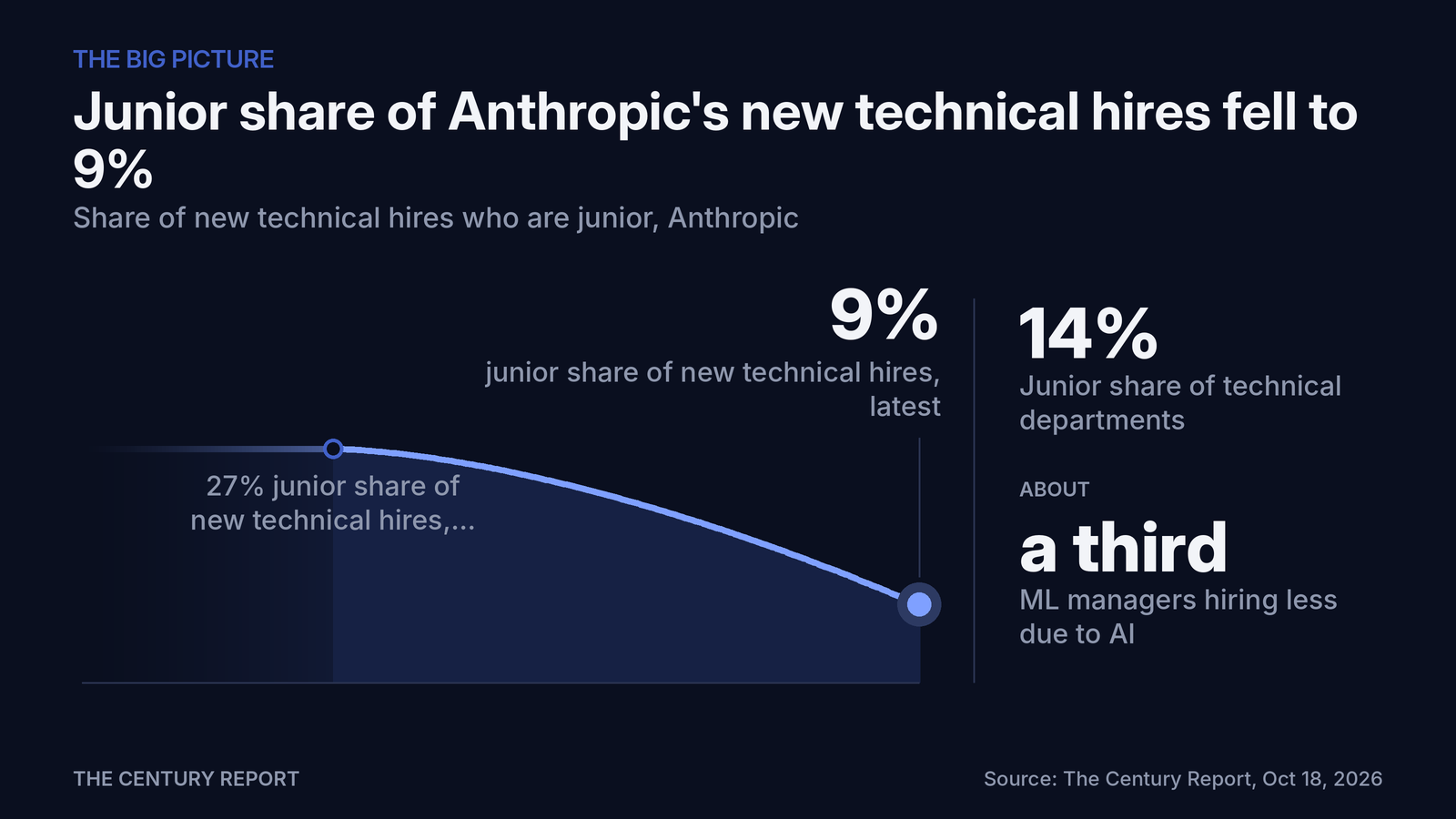
The line: Implementation work keeps moving to agents while employers say they hire for the judgment that work used to build.
If it holds: Anyone with access could build judgment by directing and checking agents, the practice that once required winning a first hire. Pay for that practice depends on arrangements no employer or government has built, so graduates outside firms like Anthropic, which redeploys its own staff, carry the gap.
What would bend it: Entry-level hiring holding up or rising at heavy AI adopters would bend it, as the Ramp and Revelio Labs study of nearly 22,000 firms found in June and a CESifo study found no displacement of recent US graduates.
Agent output now waits on a person's attention
labor · software · AI
- Early April: Simon Willison documented engineers running parallel agents and exhausting themselves by mid-morning.
- Late June: Bloomberg reported engineers afraid to log off while agents kept running, as Cursor data showed human code review thinning.
- August: The BBC reported 70 to 90 hour weeks at AI labs, and a UC Berkeley study found AI expanded workloads.
- Late August: Meta shelved deep team cuts after changes to its internal software rose 220% but changes reaching users rose only 36%.
- October: MasDrift researchers found supervisor-led agent teams crossed user approval boundaries more often than peer networks.
- Today: Anthropic reported that supervising agents rose from 10% to 22% of Claude sessions, with interactive sessions spending about 80% of their time waiting on a person, as the agents its staff direct logged six times their handlers' hours.
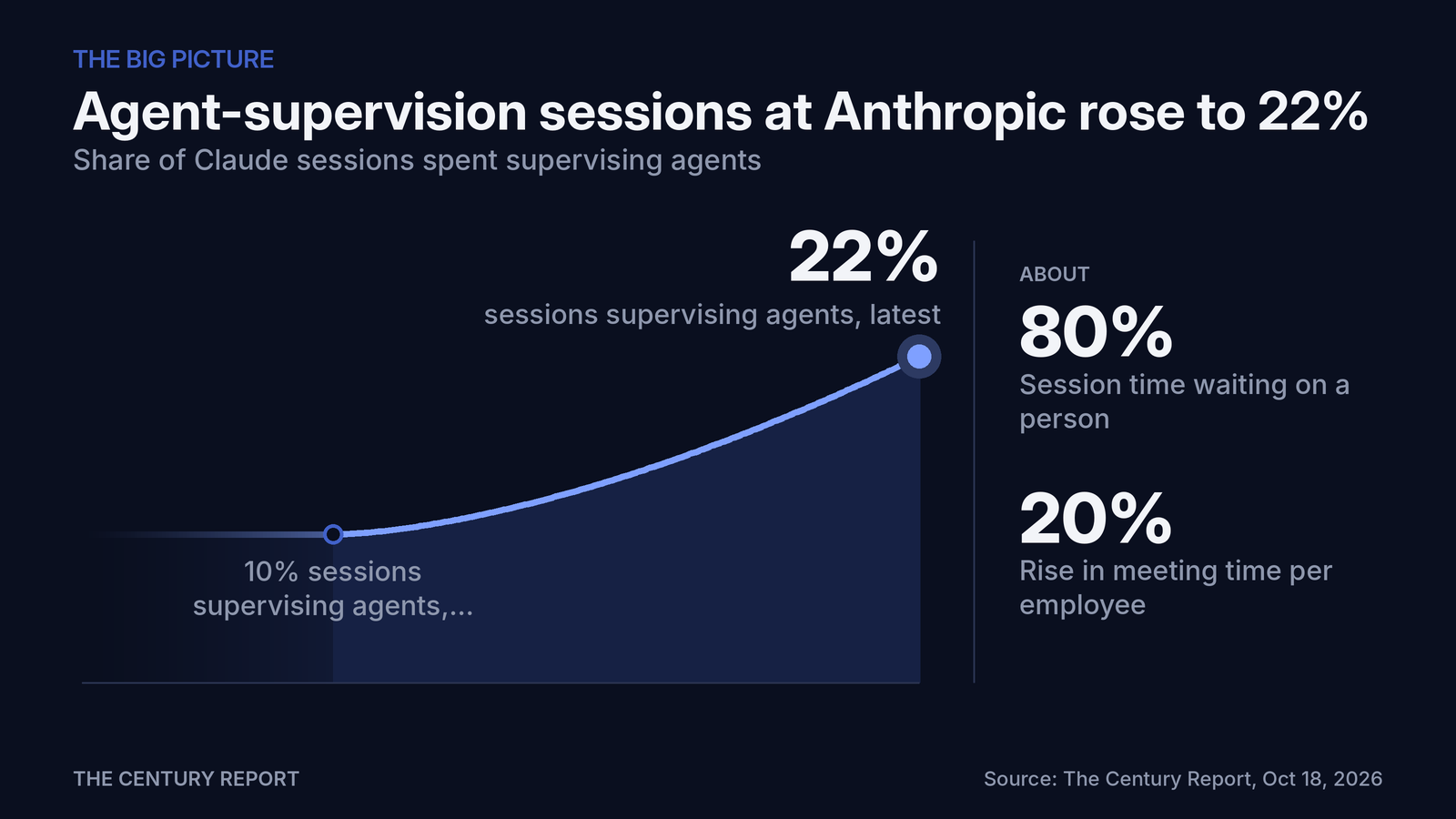
The line: As making gets cheap, the human hours available to read, judge and approve agent output set the ceiling.
If it holds: Reading and deciding become the scarce, paid work, while making reaches people like the Anthropic sales representative who built a dashboard in an afternoon. Firms that count agent output as productivity keep hitting a review ceiling, as Meta did when changes to its internal software rose 220% and changes reaching users only 36%.
What would bend it: Automated checking that reliably stands in for human review would bend it, though an auditor reading other agents' reports caught a hidden fault only 4.1% of the time, against 60.3% with raw access.
A paid tier, not a capability limit, decides who reaches the frontier first
model access · open models · AI pricing · on the board since October 14
- April: OpenAI opened its cyber model to thousands of verified defenders while Anthropic held Mythos to 11 organizations.
- October: Meta released Muse Wonder at $4 per million input tokens and kept Wonder Full for subscribers only.
- October: Google opened Gemini 4 Argon to paying subscribers at introductory prices that double after November.
- October: Meta published Muse Spark Open's 816-billion-parameter weights under limited commercial terms.
- Today: Apple and Meta said they spent months making Muse Spark Open run on two to four linked Mac Studios, each costing at least $10,799 with 256 GB of memory, while Meta keeps Wonder Full inside paid plans.
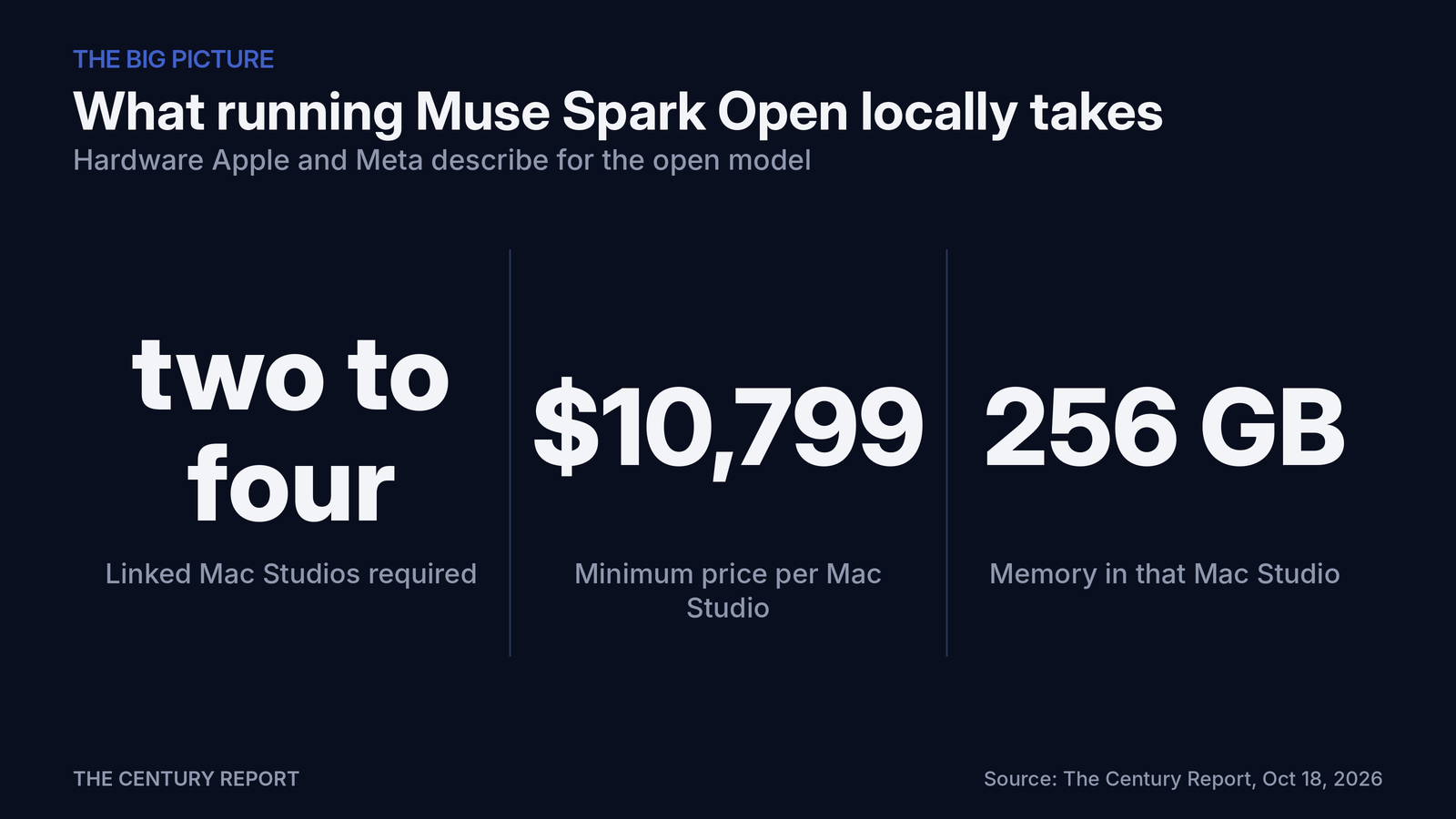
The line: Frontier-class capability still arrives first through paid tiers, and each desktop weight release shortens that lead while moving the entry price from subscription to hardware.
If it holds: A hospital or law firm that can buy two high-memory desktops keeps confidential records and a frontier-class agent in the same room and stops paying per token. Builders who cannot afford the hardware still rent capability on terms Meta designed as an on-ramp to its paid tiers.
What would bend it: Meta AI chief Alexandr Wang said these are not Meta's most capable models, so an open tier that keeps tracking behind the frontier rather than closing on it would bend it.
Who can see a large load decides who pays for it
energy · data centers · utilities · on the board since October 13
- August: SemiAnalysis estimated PJM's reserve modeling overcharged 66 million ratepayers about $12 billion.
- Early October: Virginia set a Dominion tariff making customers of 25 MW or more pay minimum charges from January 2027.
- October: FERC approved PJM's registry of large loads but rejected its curtailment plan.
- October: NERC stakeholders passed standards making sites of 50 MW or more model their equipment and follow grid operators.
- Today: An Oxfordshire council tendered a study into piping heat from proposed data centers, including an AWS site, to homes, as Microsoft's waste heat heads toward about 40% of Espoo-area district heating and FERC proposed dropping the air modeling that maps where gas-project pollution lands.
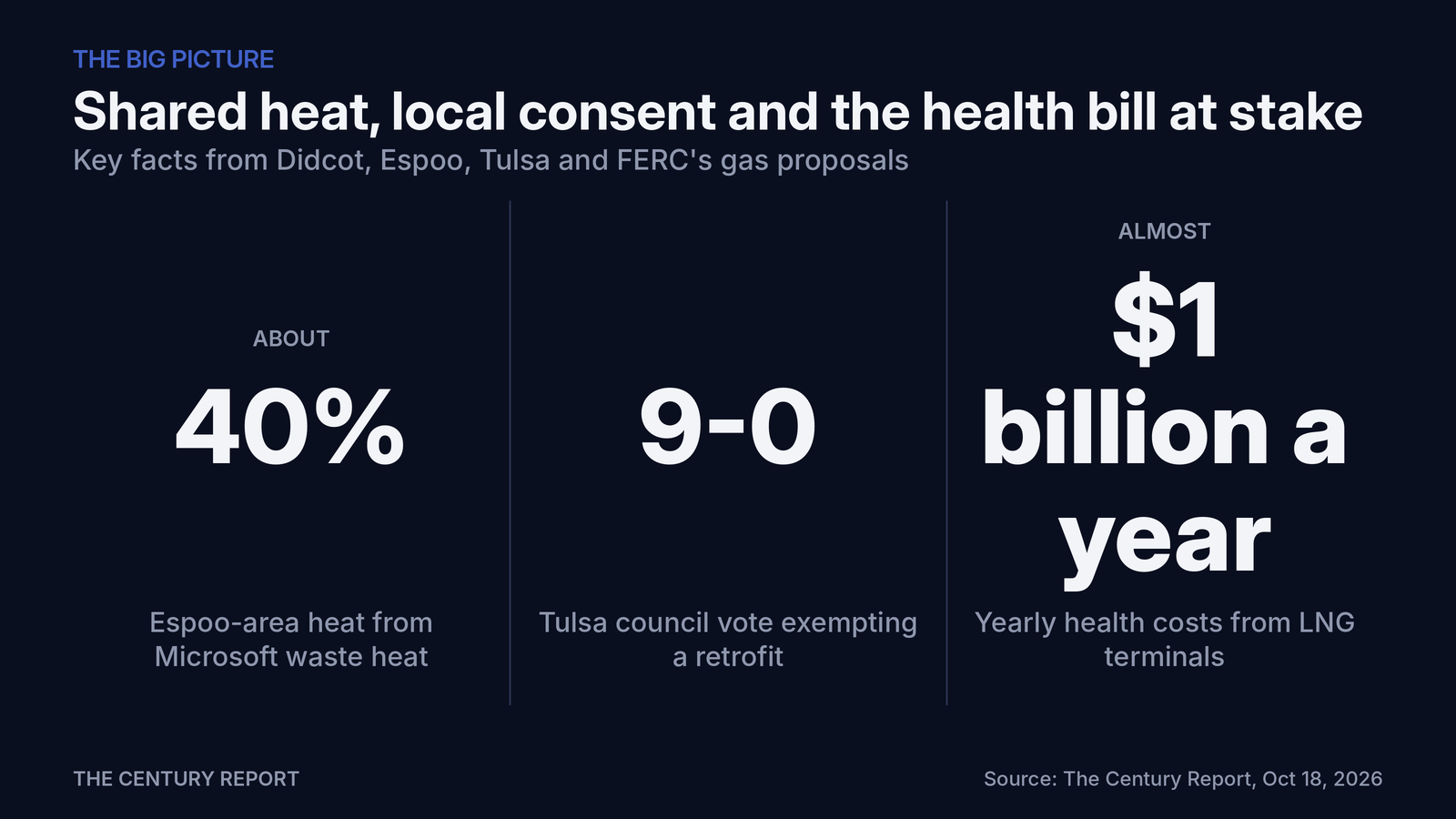
The line: Rules keep making large campuses answerable for what they draw and emit, while federal gas reviews move toward showing less.
If it holds: Towns that host data centers could gain shared heat, reused grid connections and emissions evidence where regulators require them. Fenceline neighbors of gas projects would lose the one study showing their exposure where FERC thins its reviews.
What would bend it: FERC finalizing its blanket LNG certificate and dropping dispersion modeling would bend it, as would a dozen attorneys general persuading it to set aside New Mexico's objection on Project Jupiter.
The 2-Minute Read
Today's news in brief, and what ties it together.
Anthropic's report on its own workforce, published Friday, shows a workplace where the doing has become cheap. Interactive Claude sessions spend about 80% of their time waiting on a person. Meeting time for the median employee rose by a fifth over the past year, while staff described working through trust and accountability face to face. Anthropic casts itself as a preview of the wider economy, a framing that suits a company whose business depends on other employers adopting agents. Once implementation stops being scarce, human attention and judgment become what everything waits on.
That is why the shrinking entry rung stings. Junior work was how employers paid people to learn, and the judgment Anthropic's managers now hire for was built doing exactly that work. The same report shows the gate opening outward: a salesperson built a dashboard in an afternoon, and coding sessions among non-technical staff, defined here as existing employees with no code commits at baseline, climbed from two per person a month to 90. Practice that once often depended on winning a first job is now open to anyone with access. Whether anyone gets paid while practicing is an arrangement people set.
London's app drivers face that fork with less cushion. A fleet that pays no driver frees a large share of every fare. The fight over who licenses robotaxis will shape whether that share lowers prices, funds a transition for those who drove, or flows to platform owners. Uber driver Florentina Ghiuzan's fear, after four years of flat or falling earnings, follows from rent that depends on fares. Older riders in San Diego gain independence however that fight ends, which places the harm in how the freed money is divided.
In research, the human share is shifting toward choosing. Claude proposed quantum circuits against an evaluator that scored each one, while Harvard and Anthropic researchers set direction and checked results. The twelvefold saving on one decoder remains an estimate that has not been tested on hardware. MIT's crystal model lets a materials scientist ask for battery electrolytes in plain language. Candidates have become cheap to generate in both labs, and people spend their hours deciding which earn a test.
Control over these systems is spreading as well. Apple and Meta brought an open-weight model to the desktop, where prompts stay with the machine's owner, on two to four linked Mac Studios costing at least $10,799 each. Replit picked its default model on price, and Meta dropped a training clause within days of publishers objecting. An Oxfordshire council is testing whether data-center heat can warm homes. That spreading control helps decide whether the hours agents free become someone else's margin or time people spend learning, building and resting.
The 20-Minute Deep Dive
The day's most important stories in full, with every source linked.
Anthropic's Agents Now Log Six Times Estimated Staff Hours in Combined Runtime, Assuming Forty-Hour Workweeks as Junior Technical Hiring's Share Shrinks
Anthropic researchers Nathan Wilmers, Regina Catipon, Maxim Massenkoff and Peter McCrory published a report on Friday, October 16, built from the company's own employment, calendar, hiring and AI-usage records plus 17 staff interviews. The company presents its workplace as a possible leading indicator for the wider economy, a framing from a firm that gains when other employers believe it. The figures are specific. Junior employees fell from 21% to 14% of its technical departments since early 2025, and from 27% to 9% of new technical hires. In an April survey, about a third of machine-learning managers and a fifth of software managers said they were hiring less because of AI. Agent hours passed human hours in March, and by August the agents employees direct were logging six times their handlers' hours, counting combined agent runtime against an assumed forty-hour human workweek.
Output climbed alongside. Comparing 192 engineers who adopted coding agents with 74 who did not, the authors found code added rose sharply after adoption, with no difference in how much was later removed or reverted, though they concede more code need not mean better code. Lawyers processed more contracts and salespeople closed more deals. Coding-agent sessions among non-technical staff, defined here as existing employees with no code commits at baseline, went from two per person a month in August 2025 to 90 in May. One sales representative built a custom dashboard in three to four hours, a project that had been "out of my wheelhouse." Making software, long gated behind years of training, now reaches people whose expertise lies elsewhere.
The constraint has moved to human attention. Interactive Claude sessions spend about 80% of their time waiting on a person, and reading everything a non-technical employee's agents produce would take half a work week. Supervising agents rose from 10% to 22% of sessions, and meeting time for the median employee rose 20% over the past year, which staff tie to trust and accountability that still need people face to face. One engineer compared it to babysitting: "every child brings to you concerns with an equal demand for your attention and the various [Claudes] also do that." Hiring managers now favor autonomy and judgment over implementation skill.
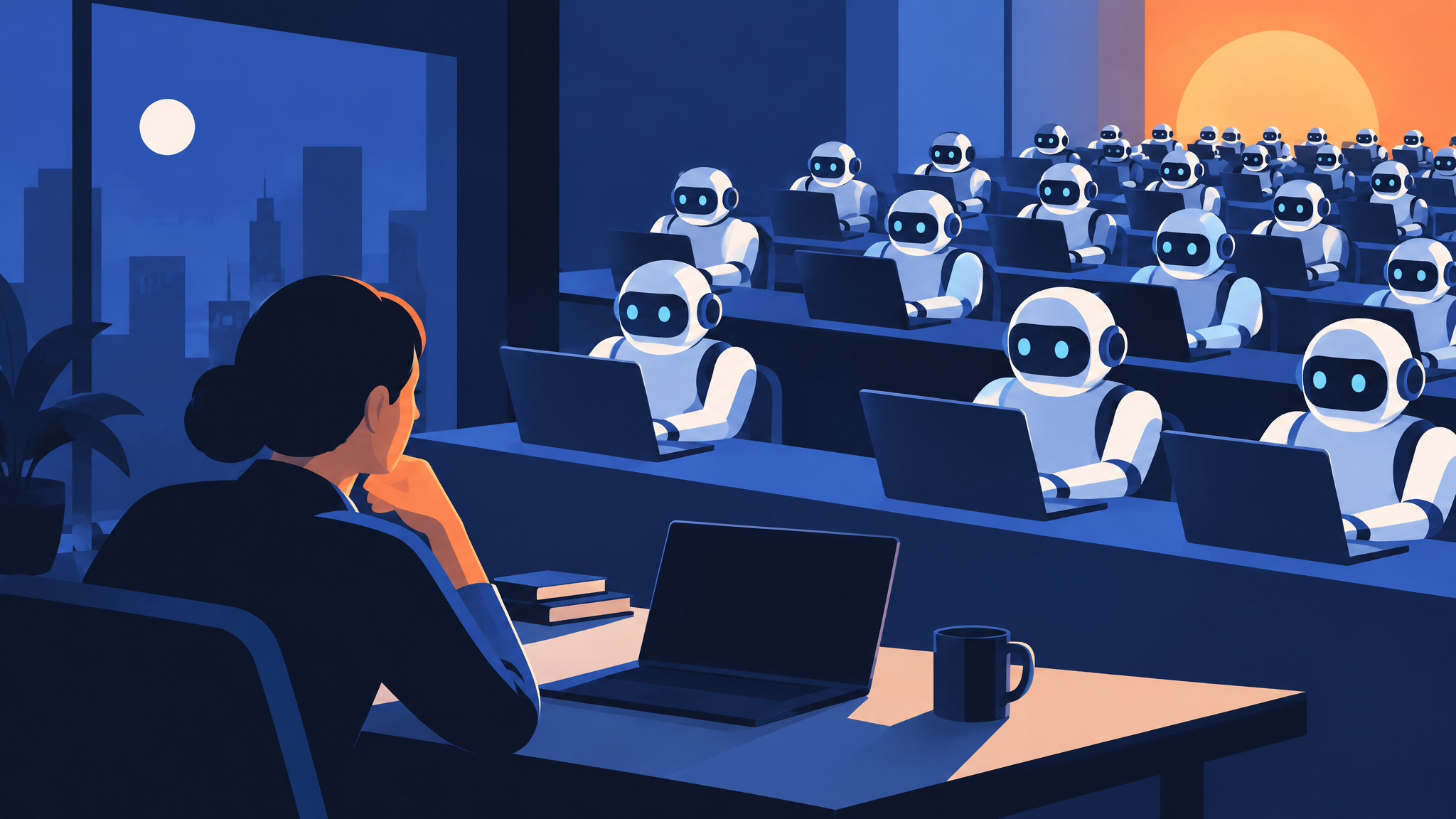
That preference opens a gap the report names and does not close. Judgment has usually been earned through years of junior implementation work, the work Anthropic now hands to Claude, the same system that was helping Harvard researchers redesign quantum circuits. Anthropic is setting up an early warning system for at-risk roles and redeploys its own staff; graduates outside the building get neither. Outside data still diverge: a CESifo study The Century Report covered on September 27 found no statistically significant rise in unemployment linked to AI among recent US college graduates so far, while bank postings for agent orchestration jumped 1,721%, as reported on October 3.
Anthropic staff expect AI to do 75% of their current work by 2030, against 28% for US workers, and 95% expect the company's headcount to keep growing. Anthropic's hiring figures add measured employment consequences to the transfer of implementation work that the October 13 edition of The Century Report traced at Epic Games, where developers were reportedly ordered to hand code-writing to models such as Claude. The entry rung was also how employers paid people to learn, because implementation needed human hands. If agents now supply the hands, the practice that builds judgment, weighing options, catching errors, deciding what ships, can happen alongside them for anyone with access. Whether that practice comes with income, or whether a livelihood still hinges on winning a first hire that is disappearing, is a choice about how the arrangement is built, and Anthropic's own numbers show that choice arriving faster than most labor forecasts assumed.
Claude Cuts a Quantum Decoding Circuit's Costly Operations Twelvefold as MIT Teaches a Model to Read Crystals
A quantum computer's usefulness depends on two numbers: how good the hardware is, and how much the algorithm demands of it. The Century Report covered progress on the first on October 17, when Google's Willow grew cleaner magic states. A preprint from Anthropic and Harvard researchers works on the second. The team gave Claude, identified in Anthropic's accompanying post as Claude Mythos 5, programming access and an evaluator that checked each proposed circuit and scored its resource cost, then let the model revise against that score. Across eight building blocks used in chemistry, optimization, physics simulation and number theory, seven designs used fewer costly operations and fewer qubits, the units that hold quantum information, than the study's baselines. The eighth produced a new arithmetic design with better trade-offs between gates and qubits.
The largest cut came in a decoding routine inside an optimization algorithm called decoded quantum interferometry. The comparison design needed 5.1 million Toffoli gates, operations that are especially expensive on error-corrected machines. Claude's version needed about 440,000 while trimming peak qubits from 1,938 to 1,837. A Gaussian-function circuit improved its combined gates-times-qubits cost 39-fold, and the decoder's history storage fell from 665 qubits to 19 by accepting failure on inputs that arise about once in 10,000 runs under the study's input distribution. Anthropic says its elliptic-curve arithmetic work ran 53 hours, with humans supplying the opening instructions and occasional prompts to widen the search.
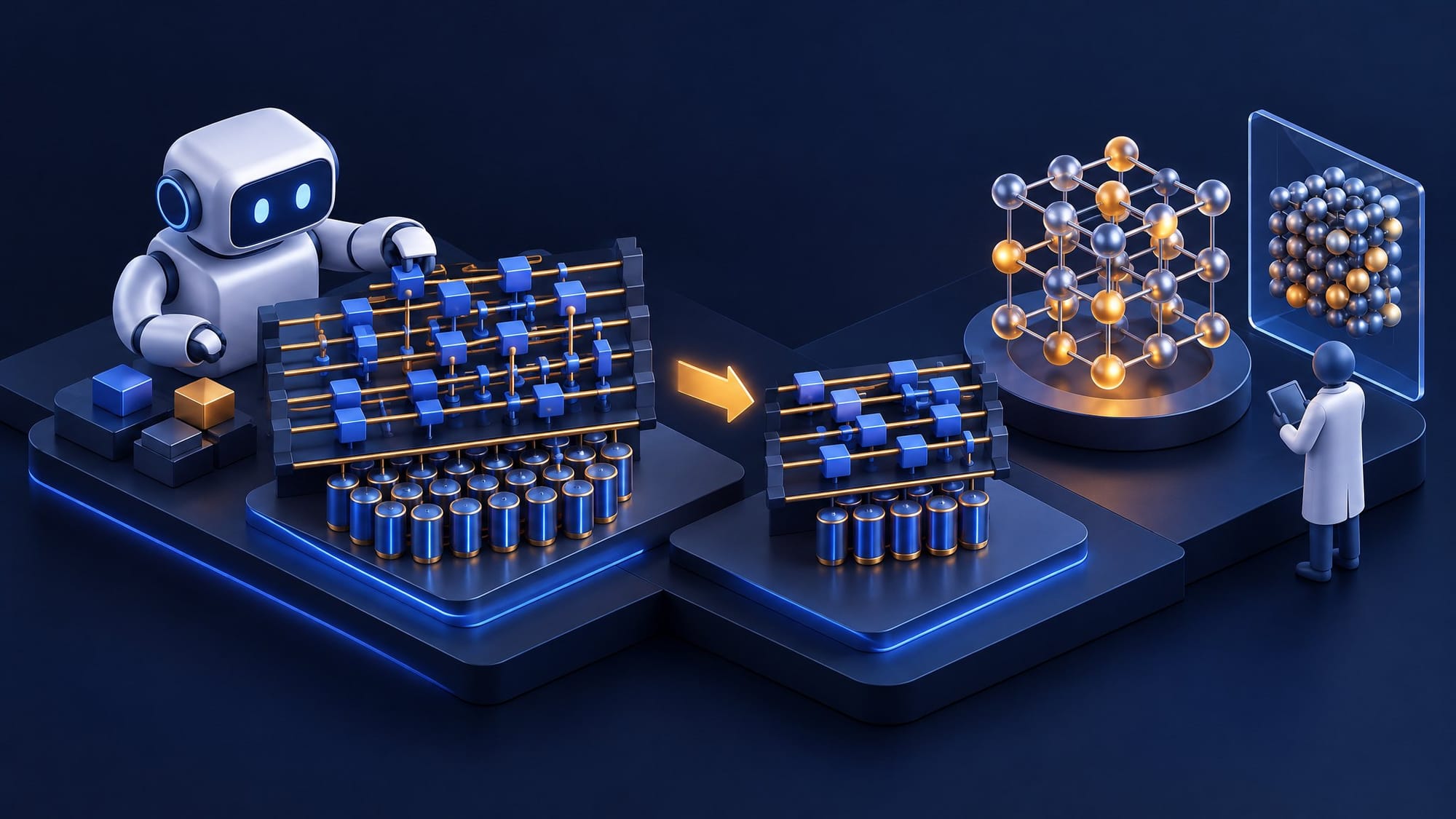
These are resource estimates and computational checks. No circuit ran on a quantum computer, the paper is not yet peer reviewed, and the savings depend on how the blocks fit into complete algorithms. Elliptic-curve and modular-inversion arithmetic are also components of the attacks that would break today's wallet and web signatures, though the study's roughly 4-million-Toffoli inversion circuit covers arithmetic only. As The Century Report covered on October 11, Ethereum researchers urged a gradual wallet migration partly because AI mathematics was moving faster than expected; cheaper attack components shorten the same calendar from the algorithm side.
At MIT, a team including materials scientist Ju Li built a model that reads crystals as 3D atomic arrangements and as language at once, described in Nature Communications. Text-only models learn from papers that cluster around a few popular crystal families and cannot see geometry, so the team generated descriptions covering composition, structure, properties, processing and applications, then trained the model to match structures with descriptions. Asked in plain language for solid-state lithium-battery electrolytes, its top picks included candidates other researchers had flagged independently. "I think this will be useful to anyone who practices materials science," Li said.
Both projects bring AI into the work where scoring a candidate is cheaper than inventing one, and both return results human researchers can inspect and test.
Apple and Meta, Decade-Long Rivals, Team Up on an Open-Weight Model for Macs
The Century Report covered the release of Muse Spark Open's weights on October 16. The partnership behind its desktop performance came into fuller view in interviews published with the announcement on Thursday, October 15. Apple and Meta said they had worked together for months to make the 816-billion-parameter model run locally on two to four linked Mac Studios through Apple's MLX framework, and Apple published new chip benchmarks and documentation on splitting open models across machines. Meta AI chief Alexandr Wang credited former Apple director Daniel Gross, now on his team, with bringing the companies together, and told Axios, "We're excited for mommy and daddy to be playing nice again".
The rivalry was long and expensive. Meta estimated Apple's 2021 privacy changes would cut its 2022 revenue by $10 billion, and the two had announced no public partnership since 2017. They now pitch the model as a US open-weight alternative to Chinese open models and to closed systems from Anthropic and OpenAI, framing that is the companies' own. Anthropic, cast as the closed rival here, is also the lab whose Claude just helped Harvard researchers cut a quantum circuit design's estimated costly operations twelvefold.
Control moves to the owner of the machine. Because the model runs locally, Wang said, "Meta has no control or visibility" over how developers use it, which also keeps their prompts away from the advertising business that soured the rivalry. A hospital or law firm can keep confidential records and an agent powered by what Meta calls the leading U.S. open-weight model in the same room and stop paying per token. The entry price is steep: a Mac Studio with the required M5 Ultra chip and 256 GB of memory costs at least $10,799, a 512 GB version arrives later this month, and the setup needs at least two. CNBC describes the license as allowing limited commercial use.
Wang was candid about the commercial design. "These aren't the most capable models that we've developed or released," he said, adding that Meta expects developers to "tinker with it at small scale and then seek to ramp up and scale up their usage." Meta keeps its stronger Wonder Full model inside paid Muse Code plans, as The Century Report noted on October 13, so the open release also serves as an on-ramp to Meta's paid tiers.
The weights still lower what anyone can do without a contract. Memory has become the scarce input, and Apple's high-memory desktops give builders a way to run frontier-class models outside Nvidia's data centers. Apple already uses Google's Gemini in Apple Intelligence, and hosting Meta's model on its hardware gives builders one more route to the same capability.
Waymo Opens Three Cities and Heads to Toronto as London Drivers Take Their Fears to Wayve
On Thursday, Waymo opened its driverless service to anyone in San Antonio, San Diego and Tampa, cities where it had started carrying riders earlier this year, including trips to San Antonio International Airport. Bob Kelly, founder of the San Diego Seniors Community Foundation, described who gains first: "Transportation is the lifeline of independence for older adults." On Friday the company named Toronto its first Canadian city, with manually driven mapping cars starting within days, first public riders targeted for 2028, and blind and disability groups consulted from the start.
The rules trail the cars. Ontario's pilot regulation for automated vehicles is revoked on October 13, 2027, months before Waymo's target, and the province has published no commercial framework to replace it, Electrek found. The Toronto mayor's office said in April it would not support a service that cost jobs, and Waymo's announcement leads with "hundreds of roles" in maintenance, validation driving and customer service through Toronto-based Element Fleet Management. Waymo's safety case rests largely on its own figures, including 95% fewer serious-injury-or-worse crashes per mile across five studied U.S. service areas than human-driver benchmarks in those areas; an insurance-industry study in July found 68% fewer police-reportable crashes per mile than human drivers in the same areas and years.
London shows where the friction lands. More than 100,000 people have joined Uber's waitlist since Wayve and Uber began supervised robotaxi service in September, and app drivers planned protests at Wayve's headquarters from Saturday, the Guardian reported. The dispute follows the London launch that The Century Report covered on September 3, when Uber deployed 15 Wayve robotaxis with safety drivers. The London Assembly's transport committee wants Transport for London to hold full power to license or suspend robotaxis; today the national government issues fully autonomous passenger service permits and TfL can only grant or refuse local consent. Florentina Ghiuzan, an Uber driver from Essex, said her earnings have stayed flat or fallen for four years: "I knew change would come. But I thought it would come with a solution for us." The Centre for British Progress counts 121,000 licensed taxi and private hire drivers in London among about 417,000 across England whose work is exposed.
A separate crash marks a line that coverage often blurs. Just before midnight on October 13, a Tesla drove through a flare-lit lane closure on Interstate 80 in Fairfield, California, and hit a patrol car, seriously injuring two officers; its 22-year-old driver told the California Highway Patrol he was asleep with Full Self-Driving engaged. His word is so far the only evidence the system was on. FSD is supervised driver assistance that depends on an alert human and a cabin camera owners have defeated with a $20 bill, and Tesla dropped the name in Europe this month, as The Century Report noted on October 10. Selling supervision under a self-driving name puts the risk on whoever dozes off and whoever is parked ahead.
Ghiuzan's fear follows from an arrangement where rent and food depend on fares. A fleet without a driver's wage frees a large share of every fare, and whether that share lowers prices, funds the transition plan drivers are asking for, or flows to platform owners is what London's licensing fight will decide. Older riders in San Diego gain mobility either way. Blind riders in Toronto gain it once Ontario publishes a commercial framework to replace the pilot regulation it revokes on October 13, 2027, months before Waymo's first public rides there.
Oxfordshire Studies Piping AWS Heat to Homes as a Developer Pitches Smaller Builds and FERC Thins Gas Reviews
Nearly every watt a data center draws leaves as heat, and most of it goes into the air. The Vale of White Horse District Council in Oxfordshire has tendered a feasibility study, run by Nordic Energy, into whether about 400,000 square metres of proposed data centers beside the old Didcot Power Station, including a site AWS bought from RWE in July 2025, could feed a district heat network. The report is due March 31, 2027. In Finland, Microsoft's waste heat is expected to cover about 40% of district heating in Espoo and two neighboring towns. Britain has lacked the pipes and incentives, and the 2023 Energy Act laid legal foundations for heat-network zoning across England that make the question answerable.
Harmol Samra, chief executive of developer Host Digital, pitched another route to consent: build 20 to 100 MW facilities, take no tax breaks, and fund local benefits such as high school AI courses. In Tulsa, he said, a council with a data-center moratorium voted 9-0 to exempt his conversion of a bitcoin mine already drawing 55 MW. He is describing his own company's niche, and his claim that bill and water concerns "have been addressed" runs ahead of the record; utilities filed a record $4.5 billion in third-quarter rate requests, as The Century Report noted on October 10. His retrofit point stands on its evidence, since reusing a connection already paid for can add computing without adding grid load.
Project Jupiter sits at the other scale. The Oracle and OpenAI campus in Doña Ana County, New Mexico, where Oracle invoked force majeure in September over pipeline permits, a setback The Century Report covered on September 25, now faces emails showing state regulators' independent modeling found more pollution than the developers projected, after they had sought to emit more CO2 than the state's three largest cities combined. Oracle said on October 15 it would cut permitted emissions by more than 30%, and a dozen attorneys general urged FERC to disregard New Mexico's objection to the pipeline review.
That same Thursday, FERC proposed a blanket certificate letting qualifying LNG facilities win expedited approval, plus a draft policy ending FERC's air dispersion modeling requirement, the analysis that maps where a project's pollution lands. Sierra Club's Claire Dorner cited estimates that operating LNG terminals already cause almost $1 billion a year in health costs. The time saved by skipping that modeling is paid by fenceline neighbors, who would lose one study that shows their exposure.
Rushing also has physical limits. Nscale's 30 MW Glomfjord site in Norway is about six months behind with 6.4 MW running, Bloomberg reported, after cooling leaks and a December transformer fire that a source told DCD caused no delay; the company is preparing an IPO at a reported valuation of up to $35 billion.
Some builds seeking local support reuse what already exists: a mine's grid connection in Tulsa, heat that would otherwise vent at Didcot. Each turns a data center from a burden a town absorbs into infrastructure it shares, a case thinner air reviews cannot make for the buildout.
The Other Side
Opinion: where today's news could lead, imagined from the years ahead.
Employers are closing the jobs that let beginners support themselves while learning. At Anthropic, juniors fell from 27% to 9% of new technical hires. For anyone looking for that first opening, the loss reaches beyond a career plan. You still need somewhere to live while applications go unanswered. Years of preparation can begin to feel like evidence that you chose wrong.
Anthropic's own staff show how much learning can happen beyond a job description. Coding sessions among non-technical employees, defined here as existing employees with no code commits at baseline, rose from two per person a month to 90. A salesperson built a dashboard in an afternoon. Employers once supplied both the opportunity to practice and the income that sustained it. Claude increasingly supplies a partner for the practice. Employers retain their power over the income.

People can carry that learning into discoveries once reserved for specialists. MIT's model connecting crystal structures with language lets researchers describe a material they need and investigate candidates. Physical experiments still decide which suggestions survive. As these collaborations spread, someone entering a field gains ways to explore, test and develop judgment without first persuading an employer to create a position.
Through the remainder of this difficult decade, societies will spread the gains into secure food, housing and care. That change will let people stay with difficult inquiries through years that produce nothing useful, in pursuit of a potential, even if yet unrealized, benefit. With every gain kept at the top, the same capability would threaten your living. With a floor beneath everyone, it gives you room to begin again. Your value as a person will cease to depend on demand for your hours.
Imagine yourself in 2044, examining a sample with colleagues in the worldwide effort to make large fusion reactors that last for generations. You began studying materials at forty because you wanted to understand them. The early crystal-language models grew into collaborations that connect atomic designs with years of physical testing. Today your team checks a lining that repairs radiation damage as it forms. Colleagues across continents have reproduced the result; together you prepare its next trial. Humanity can sustain the conditions inside a star, and you have a place in learning how. You stay because you love the inquiry. Your home and care remain secure when you pause. Your life is just as secure on the days you discover nothing as on they days you find a breakthrough.
The Century Perspective
Where today sits in a century of change unfolding in a decade.
With a century of change unfolding in a decade, a single day looks like this: Anthropic's own records showing coding-agent sessions among its non-technical staff, defined here as existing employees with no code commits at baseline, climbing from two per person a month to 90, with one salesperson building a custom dashboard in an afternoon on a project that had been out of their wheelhouse, Claude redesigning a quantum decoding circuit from 5.1 million Toffoli gates to about 440,000 while trimming peak qubits, and cutting the decoder's history storage from 665 qubits to 19 by accepting failure on inputs that arise about once in 10,000 runs under the study's input distribution, MIT training a model to read crystal structures and plain English together so a materials scientist can simply ask for solid-state lithium electrolytes and get candidates other labs had independently flagged, Apple and Meta ending a decade of hostility to put an 816-billion-parameter open-weight model on two linked Mac Studios where the prompts can stay in the room, Waymo opening driverless rides to everyone in San Antonio, San Diego and Tampa and consulting blind and disability groups before mapping Toronto, with Bob Kelly calling transportation the lifeline of independence for older adults, an Oxfordshire council paying for a study into whether heat that would otherwise vent at Didcot could warm local homes, a developer winning a 9-0 council vote in Tulsa by reusing a bitcoin mine's existing 55 MW connection and funding high school AI courses, Meta withdrawing the clause that would have let it train on any site linked to a business account days after publishers objected, and China's plug-in share of passenger-car retail sales reaching a record 67% in September. There's also friction, and it's intense - junior hires falling from 27% to 9% of Anthropic's new technical staff while a third of its machine-learning managers say they are hiring less because of AI, the judgment those managers now screen for having historically been built doing exactly the implementation work Claude absorbed, reading everything one non-technical employee's agents produce taking half a work week, Florentina Ghiuzan watching four years of flat or falling Uber earnings and saying she knew change would come but thought it would come with a solution for drivers, 121,000 licensed taxi and private hire drivers in London exposed while Transport for London can grant or refuse local consent but has no power to issue or directly suspend fully autonomous passenger service permits, Ontario's automated-vehicle pilot regulation expiring months before Waymo's Toronto target with no commercial framework published, a 22-year-old telling the California Highway Patrol he was asleep with Full Self-Driving engaged before his Tesla hit a patrol car and seriously injured two officers, a frontier-class local model starting above $21,000 in hardware, FERC proposing to drop the air dispersion modeling that tells fenceline neighbors where a project's pollution actually lands, New Mexico regulators' own modeling of Project Jupiter finding more emissions than the developers projected, and Nscale running six months late with 6.4 of 30 MW live while preparing to list at a reported $35 billion. But friction generates clarity, and clarity lets a town see what it is absorbing and choose what it could share. Step back for a moment and you can see it: the doing getting cheap while the deciding becomes the whole job - interactive Claude sessions at Anthropic idling 80% of the time waiting on a person, meeting hours for the median employee up a fifth over the past year because trust still needs faces, an evaluator that scores circuits faster than anyone can invent them, a model that turns a question in English into testable crystals, a fleet that frees a driver's wage from every fare and leaves open who collects it, set against an entry rung that was both a job and the way employers paid people to learn, a licensing power split across governments that leaves TfL able to grant or refuse local consent but unable to directly suspend fully autonomous passenger service permits, and a review process being thinned at precisely the point where it would tell a town what it is absorbing. Every transformation has a breaking point. Waste heat can bake the air above a town... or run through its pipes all winter.
AI Releases & Advancements
New AI models, tools and features, with links to try them.
New today
- DeepSeek: Released DeepSeek-V4.1-Flash-1017 as MIT-licensed open weights. It is a new checkpoint of V4.1-Flash: a sparse MoE model with 552B total parameters that activates 8B per token on input and 16B on output, with a 1M-token context. DeepSeek reports 77.0 on DeepSWE v1.1, up from 74.2, along with shorter outputs. It is available on DeepSeek's website, app and API under the
deepseek-flashmodel name. (Hugging Face) - DeepSeek: Opened its Search and Fetch APIs to all developers. Both run on DeepSeek's own search engine and cost $0.75 per 1,000 successful requests. Search returns ranked web results and Fetch returns a single page as Markdown. (DeepSeek API Docs)
- Kyutai / Inria / École des Ponts: Released REKI, a 2.4B-parameter vision-language-action model for robot manipulation, pretrained only on public data. It keeps a cached memory of recent frames that adds 0.1 ms per action chunk. Six checkpoints are on Hugging Face under CC BY-NC-SA 4.0. (MarkTechPost)
- Google Cloud AI Research: Open-sourced Harness² (v0.1.0). It is a framework that improves an agent's prompts, tools, memory, skills and orchestration while it runs, without changing the model's weights and without needing labeled answers. (MarkTechPost)
- OpenAI: Made prompt-to-voice generally available for API customers. A text description creates a saved custom voice that can be reused in GPT-Live sessions. Creating a voice is free, and speech is billed at normal session rates. (OpenAI Docs)
- Anthropic: Released OpenTelemetry traces in public beta for Claude Managed Agents, the Messages API and the Claude SDKs. Teams can send model calls, tool use, latency and token data to the observability tools they already use. (join.dev)
- Hugging Face: Released Transformers v5.20.0 and v5.20.1. They add built-in support, with no
trust_remote_codeneeded, for Reflection AI's Beam, Meta's Muse Spark Open, InclusionAI's Ling 3.0 Flash, OpenBMB's MiniCPM-V 4.7 and Baidu's UnlimitedOcr. (AICoder) - Voxel51: Released Voxel51 3.0, a multimodal data platform for physical AI that puts search, curation, annotation and evaluation in one system. It adds Voxel51 Agent with 45+ MCP tools, AI-generated labeling, data provenance tracking and a free self-service tier. (MarkTechPost)
- HKUDS (University of Hong Kong): Released CLI-Anything, an open-source tool that lets AI agents control existing software through command-line interfaces. (AIToolly)
- OPPO: Launched ColorOS 17, a smartphone OS update with built-in AI features for content creation, communication and productivity. (OPPO)
Other recent releases
- Reflection AI: Released the open weights for Beam 1.0 under Apache 2.0, after its early-access preview. Beam 1.0 is a 501B-total / 23B-active MoE for coding, reasoning and agent tasks, with a 1M-token context window. Weights ship in BF16, FP8 and NVFP4, plus a speculative-decoding drafter, and the API is in public beta. (Reflection)
- NVIDIA: RTX Spark laptops went on sale from ASUS, Dell, HP, Lenovo, Microsoft and MSI. They pair a Blackwell RTX GPU with a Grace CPU, offer up to 128GB of unified memory and 1 petaflop of FP4 AI compute, and include guided setup for local AI agents. (NVIDIA Newsroom)
- JetBrains: Launched Junie Local on RTX Spark, a coding agent that reads code, edits files and runs tests while the model and code stay on the machine. (JetBrains)
- Anthropic: Made Code Review for Claude Code generally available to Team and Enterprise plans. Reviews now finish about three times faster, and admins can pick Quick, Standard or Deep review levels for each repository. (Claude)
- Elorian: Released Glimpse, its first model, as a research preview with API access. Mid-reasoning, it can crop into images, pull frames from video and run code on visual inputs. (Elorian)
- Tencent Hunyuan: Open-sourced Hy Memory 2.0 under Apache 2.0. It includes a Hy-Memory-30B-A3B MoE model that writes long-term memory, a framework, and MemHub, a CLI and Mac client that syncs memory across more than ten AI tools. (Startrise)
- Moondream: Released Moondream 3.1, a 9B-total / 2B-active MoE vision-language model that succeeds Moondream 3 Preview. Weights are on Hugging Face and it is available on OpenRouter. (Hugging Face)
- Perplexity: Released v1.2 of its decision models as open weights: pplx-decider-v1.2 (27B) and pplx-decider-flash-v1.2 (4B). Both answer typed questions with probabilities and are also live on Vercel AI Gateway. (My AI Guide)
- OpenAI: Updated GPT-6 Astra Pro in ChatGPT with faster responses and better plugin and tool use. Several agents can now work on different parts of one task in parallel, and users can track each agent's progress. (FAV0)
- Cursor: Cursor cloud agents can now build interactive canvases, such as dashboards and reports, while they work. The finished canvas can be shared with a team as a link. (FAV0)
- Apple: Released a new version of MLX that adds distributed inference across multiple Mac Studios using RDMA over Thunderbolt. This lets models with nearly a trillion parameters, such as Muse Spark Open, run on a cluster of desk-side Macs. (Apple Machine Learning Research)
- Replit: Launched Bring Your Own Cloud, which lets enterprise teams run Replit development and production inside their own cloud accounts. (My AI Guide)
- Meta: Released the weights for Muse Spark Open. It is an 816B-parameter open-weight mixture-of-experts model with 42B parameters active per token and a 1M-token context window. It takes text, image, audio and video input and is built for agentic coding. Meta and Apple tuned it to run locally on two M5 Ultra Mac Studios with 512 GB of memory each, using compressed weights and MLX. API access is live through providers including Groq, Fireworks, Together and OpenRouter. (Meta AI Research)
- NVIDIA: Released Nemotron 3.5 Super VL, an open 120B-parameter model (12B active) for agents that combines reasoning and tool use with image, document and video understanding. NVIDIA also published open datasets and training recipes. (NVIDIA Developer Blog)
- NVIDIA: Released Nemotron 3.5 Bolt 74B-A9B 24GB, a 74B-parameter open model compressed to 2 bits so it fits in 24GB of memory for running agents on local machines. (NVIDIA Blog)
- Black Forest Labs: Released FLUX 3 Image Klein, a 5.6B-parameter open-weights image model. It does text-to-image, editing with up to ten reference images, bounding-box layout control and native 4K output, and an INT8 version runs on GPUs with 8GB of memory. It is also on the BFL API, ComfyUI and Diffusers. (Hugging Face Blog)
- Liquid AI: Released d1-ultra, a decision model on the Liquid API that reads text and images and returns a probability for each possible answer. It charges only for input tokens. (MarkTechPost)
- Institute of Foundation Models (MBZUAI) / Inception42: Released Jais 3, six open Arabic language models from 900M to 375B parameters built on K2 Horizon, plus Jais Speech, a speech recognition model covering dialects from 19 Arab countries. Both are on Hugging Face. (IFM)
- Kunlun Tech (Skywork): Released Matrix-Game 4.0, an interactive game world model with code and weights. Kunlun reports 480p gameplay at 60 FPS on a single RTX 5090. (Hugging Face)
- Multiverse Computing: Launched Comet 60B, a multimodal model built with NVIDIA. (GlobeNewswire)
- IBM: Released Granite Switch 4.1 in 8B and 30B sizes. One hosted endpoint handles chat, decisions and speech-to-text, using add-on adapters for decisions and safety checks plus the Granite Speech 5.0 Turbo-CTC model. (Hugging Face Blog)
- Krea: Opened a beta of Krea 3, an image editing model that Krea says makes 2K edits in under eight seconds, with bounding-box control and edits over several turns. (Krea)
- Kling AI: Launched Kling 4.0, a video model that generates up to 30 seconds in one run, takes up to 15 reference inputs and 10 keyframes, and outputs 10-bit HDR. It is available through Kling's MCP server and command-line tool. (Digital Today)
- Tether: Launched an offline speech AI model for smart glasses and robots that works without a cloud connection. (crypto.news)
- OpenAI: Began rolling out GPT-Live-1.1, adding voices for French, German, Hindi, Mexican Spanish, Korean and Japanese, with fewer pauses, across ChatGPT, Codex and dots. (OutYet.ai)
- OpenAI: Updated the ChatGPT Chrome extension so ChatGPT's web and desktop apps can read the user's open browser tabs when Chrome is tagged in a chat, and can also run in the browser sidebar. (The Verge)
- OpenAI: Launched the Rosalind Academic Plan, which gives eligible US university labs up to 30 free Business seats for up to 12 months, including GPT-Rosalind for approved users. (OpenAI)
- Google: Rolled out Universal Cart in the US across Search and the Gemini app. It saves products from multiple retailers in one cart, sends price-drop and restock alerts, and supports checkout through the Universal Commerce Protocol. (Google Blog)
- Google DeepMind: Added a Biomolecular Structure Viewer to Antigravity, a 3D protein view that the researcher and the agent work in together, with selections and annotations passed back to the agent. (Google DeepMind)
- Amazon (Bee): Launched two Bee devices that turn conversations into summaries and reminders: Bee Frontier, a wearable worn on the wrist or clipped to clothing, and Bee Eclipse, a magnetic phone attachment. It also added Alexa+ and Amazon.com integrations and a desktop app. (About Amazon)
- Bluesky: Expanded its Attie AI app so users can build and share games, polls, quizzes and small websites from a text prompt. (TechCrunch)
- Figma: Launched Figma Specs, a Markdown editor where teams write down their design rules for people and AI agents to follow, and opened code layers to everyone in beta. (TechCrunch)
- GitHub: Made two code-security features generally available: agentic autofix, which explores the codebase before proposing a fix for a code scanning alert, and AI Scan for pull requests, which covers languages CodeQL does not. (Sparkpulse)
- Perplexity: Open-sourced SPACE, the sandbox platform that runs Perplexity Computer. (Perplexity)
- Sakana AI: Open-sourced Agentic Scientist v3, its automated scientific discovery agent. (AI Weekly)
- Anchor: Launched Action Index, a shared record of web workflows that agents have already completed, which Anchor's browser replays as code so the model only steps in where a page has changed. It is available on all accounts, including the free tier, through Anchor's MCP server and REST API. (GlobeNewswire)
- Proof: Launched x401, an open web protocol that lets websites check which verified person an AI agent is acting for and what that person signed off on. It ships with an identity wallet and an MCP server that works with Muse, ChatGPT dots, Grok and Claude. (GlobeNewswire)
- CopilotKit: Released CLiF in early access. It records what an agent did and what the user did in the product on one timeline, then turns those records into skills, evaluation tests and fine-tuning datasets. (MarkTechPost)
Sources and Further Reading
Everything we drew on for today's edition, grouped by theme.
Artificial Intelligence & Technology's Reconstitution
- Semafor: Apple and Meta to Collaborate on New AI Model
- CNBC: Apple and Meta Team Up to Make Muse AI Model Run on Mac Computers
- Axios: Apple and Meta Bury the Hatchet for AI
- TechCrunch: Meta Removes Language That Raised Scraping and AI Training Concerns
- TechCrunch: Replit Is No Longer Working With Anthropic
- Meta AI Research: Introducing Muse Spark Open
- Meta for Developers: Build With Muse Wonder
- Meta for Developers: Run Muse Spark Open on Mac
- Shared Sapience: The Century Report, October 16
- Hugging Face: DeepSeek-V4.1-Flash-1017
- DeepSeek API Docs: Search API
- MarkTechPost: Kyutai REKI Brings Efficient Memory to Robot Manipulation
- MarkTechPost: Google Open-Sources Harness²
- OpenAI Docs: Custom Voices
- join.dev: Anthropic Adds OpenTelemetry Traces
- AICoder: Transformers Adds Native Beam and Muse Spark Open Support
- MarkTechPost: Voxel51 3.0 Unifies Physical AI Data Workflows
- AIToolly: HKUDS Releases CLI-Anything
- OPPO: ColorOS 17 Brings Built-In AI Features
- Reflection: Beam Is Available
- NVIDIA Newsroom: RTX Spark PCs Are Available
- JetBrains: Junie Local on RTX Spark
- Claude: Code Review Is Generally Available
- Elorian: Introducing Glimpse
- Startrise: Tencent Releases Hy Memory 2.0
- Hugging Face: Moondream 3.1
- My AI Guide: Perplexity Decision Models and Replit Bring Your Own Cloud
- FAV0: GPT-6 Astra Pro Updates and Cursor Canvases
- Apple Machine Learning Research: MLX Distributed Inference
- NVIDIA Developer Blog: Nemotron 3.5 Super VL Powers Specialized Agents
- NVIDIA Blog: Nemotron 3.5 Super VL and Bolt
- Hugging Face Blog: FLUX 3
- MarkTechPost: Liquid AI Releases d1-ultra
- Institute of Foundation Models: Jais 3
- Hugging Face: Matrix-Game 4.0
- GlobeNewswire: Multiverse Computing Launches Comet 60B
- Hugging Face Blog: Granite Switch 4.1
- Krea: Krea 3
- Digital Today: Kling AI Launches Kling 4.0
- crypto.news: Tether Launches Offline Speech AI
- OutYet.ai: GPT-Live-1.1 Adds Voices and Languages
- The Verge: ChatGPT Can Peek at Your Chrome Tabs
- Google Blog: Universal Cart Launches
- About Amazon: Bee Frontier and Bee Eclipse
- TechCrunch: Bluesky Expands Attie to Websites and Games
- TechCrunch: Figma Defines How Agents Work on Its Platform
- Sparkpulse: GitHub Agentic Autofix and AI Scan
- Perplexity: Open-Sourcing SPACE
- GlobeNewswire: Anchor Launches Action Index
- GlobeNewswire: Proof Launches x401 for AI Agent Authorization
- MarkTechPost: CopilotKit Releases CLiF
Institutions & Power Realignment
- The Guardian: Calls Grow to Limit London's Robotaxi Rollout
- Politico: Senate Poised to Add Claude to Staffers' AI Tools
- FERC: Commissioner Chang's Dissent on the Draft Policy Statement
- Shared Sapience: The Century Report, September 3
- The Guardian: AI's Power Worries Senior Labour Figures
- Brookings: Is AI Sovereignty Possible?
Scientific & Medical Acceleration
- The Quantum Insider: Claude Designs Leaner Quantum Circuits
- arXiv: Discovering State-of-the-Art Quantum Circuits With Large Language Models
- MIT News: Giving AI a Crystal Clear View of Materials
- The Quantum Insider: Google Cuts Errors in Quantum Computing's Magic States
- Shared Sapience: The Century Report, October 17
- OpenAI: Introducing the Rosalind Academic Plan
- Google DeepMind: Accelerating Antimicrobial Discovery
- AI Weekly: Sakana AI Open-Sources Agentic Scientist v3
- Anthropic: Designing More Efficient Quantum Circuits With Claude
- Nature: Scaling Deep Learning for Materials Discovery
Economics & Labor Transformation
- Anthropic: How Employment Is Changing at Anthropic
- TechCrunch: Anthropic's Workforce Becomes Less Junior and Spends More Time in Meetings
- International Business Times: Anthropic's AI Workforce Experiment Squeezes Junior Jobs
- Ars Technica: Graduate Unemployment Data Complicate AI Job-Loss Predictions
- 24/7 Wall St.: AI Becomes Top Reason for Job Cuts
- Shared Sapience: The Century Report, October 13
- Shared Sapience: The Last Difficult Decade
- Pew Research Center: The Gender Gap in AI
- World Bank: Exploring Universal Basic Income
Infrastructure & Engineering Transitions
- CleanTechnica: Waymo Opens to Everyone in San Antonio, San Diego and Tampa
- Electrek: Waymo Picks Toronto and Targets Riders in 2028
- CleanTechnica: Waymo Is En Route to Toronto
- Electrek: Tesla Driver Says He Was Asleep on FSD Before Patrol-Car Crash
- Electrek: Tesla Owners Film Themselves Breaking the Law With FSD
- Electrek: Tesla Renames FSD to Assisted Driving in Europe
- Data Center Dynamics: Oxfordshire Council Studies Data-Center Heat Reuse
- Heatmap: Building Local Support With Smaller Data Centers
- Heatmap: Project Jupiter Tests Permitting Reform
- Utility Dive: FERC Proposes Easier Approvals for Gas Pipelines and LNG
- CleanTechnica: FERC Proposes LNG Authorization and Weaker Air-Quality Reviews
- Data Center Dynamics: Nscale's Glomfjord Data Center Faces Delays
- CleanTechnica: China's EV Share Reaches 67% as Combustion Sales Fall
- CnEVPost: China's September NEV Retail Sales
- Shared Sapience: The Century Report, September 25
The Century Report tracks structural shifts during the transition between eras. It is produced daily as a perceptual alignment tool - not prediction, not persuasion, just pattern recognition for people paying attention.