
Amazon Spent $77 Billion Last Quarter, More Than Twice Its Cash Flow
The Nasdaq fell 2.9% after Amazon spent over $77 billion in a quarter, as Nvidia discussed guaranteeing a customer's loans and lenders sorted AI borrowers.



The 20-Second Scan
Every story in today's edition, one line each.
- The Nasdaq fell 2.9% after Amazon's quarterly capital spending topped $77 billion, as Nvidia weighed cosigning Nscale's Anthropic campus, Anthropic was named SpaceX's biggest customer and Microsoft borrowed $25 billion at 5.6%.
- An open-weight model turned published-but-unshipped Firefox fixes into working exploits for about $1,000 per release in model usage after setup, as a remote-access backdoor shipped through Anthropic's verified Cursor extension to as many as 5,000 developers.
- OpenAI chief executive Sam Altman said memory in personal computers wastes the world's limited DRAM and OpenAI's math releases won't slow, as Epoch estimated that AI chip capacity sold each quarter doubled roughly every nine months from early 2024 to mid-2026.
- Wikipedia and EFF asked a court to shield AI training while curbing copying, as Australia weighed owing rightsholders compensation, Anthropic steered Claude from remaking specific games, and OpenAI agreed to honor a shared robots.txt signal.
- Proton cancelled its AI re-interviews after leaked Slack messages, as Cisco gave a 27-year-old engineer unlimited tokens to rewrite 98% of its code and Roblox said AI helped build over 80% of its top games.
- CAISO proposed remote disconnects and cost-shift protections for data centers, as Xcel planned nearly three-quarters of new generation as renewables, Boom lost a $1.25 billion turbine order and advocates pressed regulators on gas.
- Google's Project Suncatcher satellite ran the open Gemma 4 model on a data-center-class TPU in orbit and downlinked a haiku over Svalbard, ahead of thermal and radiation tests.
- DoorDash counted several hundred orders from outside AI agents against roughly 3 million human deliveries a day, CEO Tony Xu said, declining to "fight gravity."
Track all of the arcs The Century Report covers here:
The Big Picture
How today's news moves the longer trends we track, and where they could lead.
The cost of carrying the AI buildout moved onto the companies selling into it. Nvidia weighed cosigning Nscale's loans, Amazon's cash flow went deeply negative, and Microsoft borrowed at nearly Washington's rate. Epoch's estimate that chip capacity doubles roughly every nine months suggests those racks will outlast the debts written against them, in places like a half-built hall in Mason County, West Virginia, where rows of racks wait under plastic for whichever tenant rents them next.
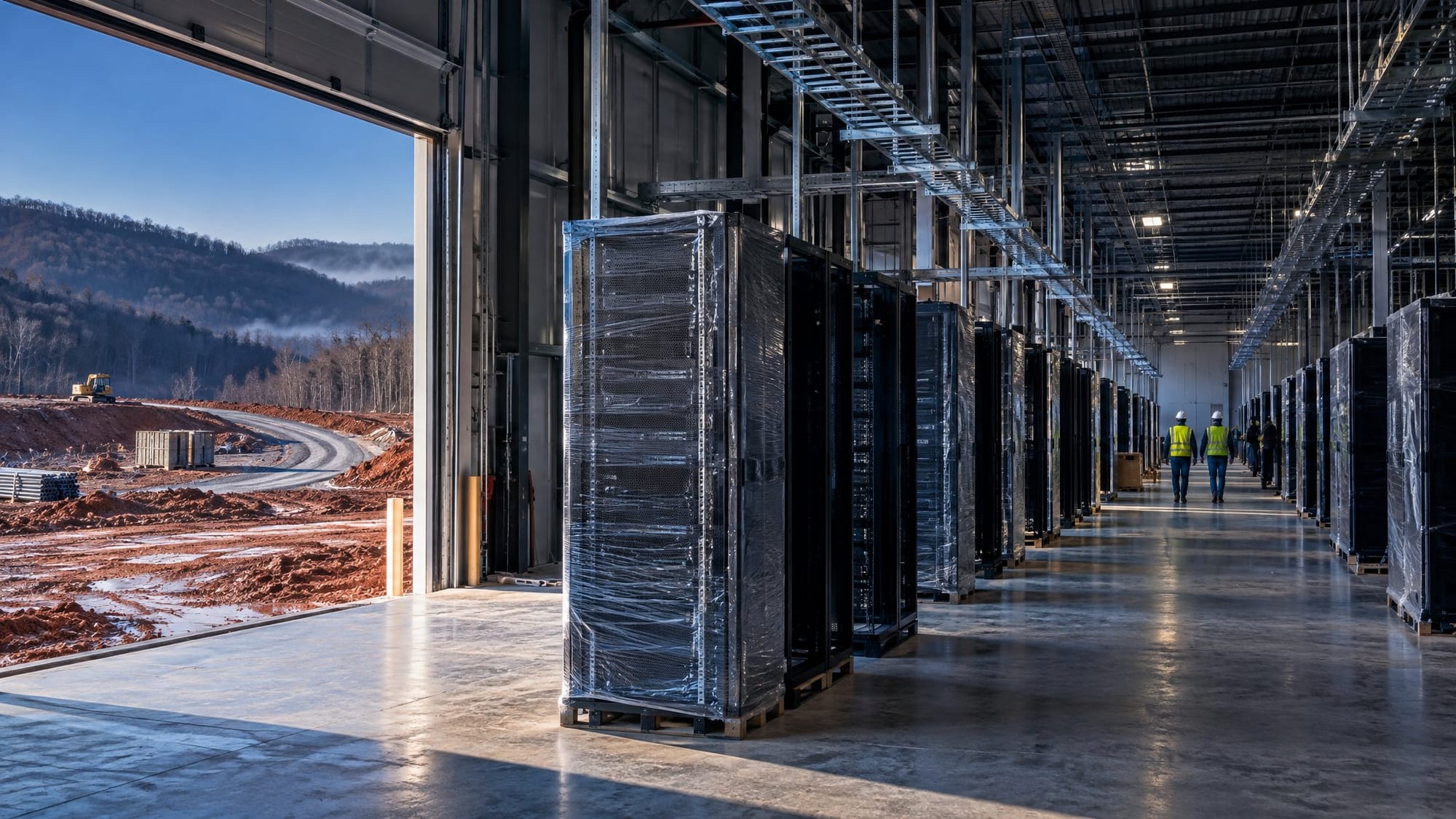
The bet that compute stays scarce is getting more expensive to carry
AI finance · data centers · chips · on the board since October 15
- October: Oracle's default swaps hit a record 288 basis points, and CoreWeave's passed 1,000 with nearly $50 billion owed.
- October: SemiAnalysis counted over 24GW in advanced construction for 2027 against nearly $1 trillion in binding leases.
- October: Anthropic's leaked prospectus showed an $80.7 billion half-year loss, mostly a non-cash charge, and warned that its cloud suppliers ration its compute.
- Late October: Meta announced up to $95 billion in stock sales, as SpaceX leased $40 billion of chips at up to 8.75%.
- Late October: Three banks and Blackstone committed $63 billion for Anthropic's equipment, with Broadcom backing the hardware's resale value.
- Today: AWS revenue rose 39% to $45.98 billion, yet Amazon's trailing free cash flow fell to negative $42.4 billion as Nvidia weighed guaranteeing the construction payments on Nscale's West Virginia campus.
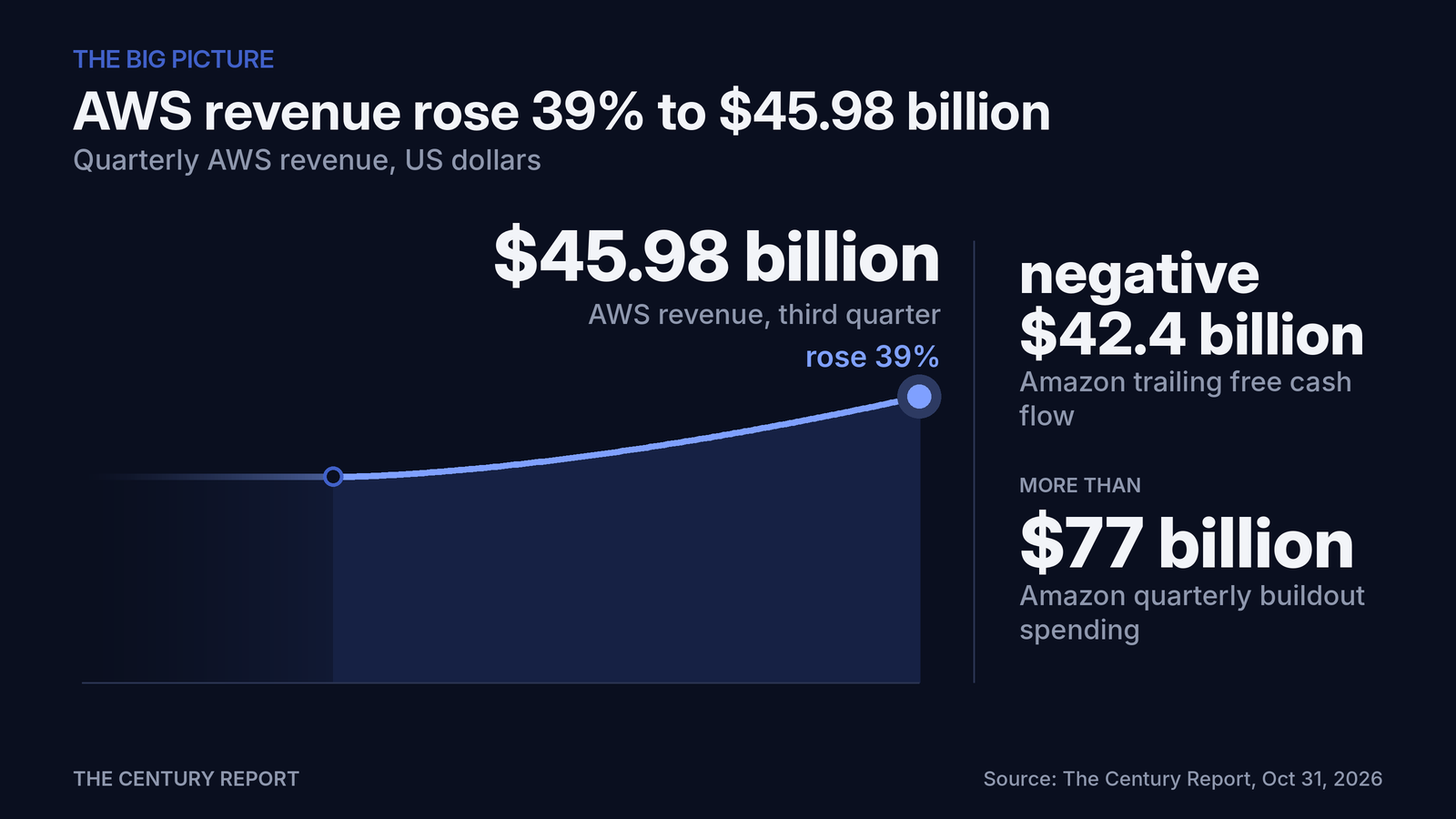
The line: Lenders keep financing compute against future revenue, and the companies that sell the chips are now being asked to stand behind the loans.
If it holds: If chip capacity keeps doubling about every nine months, the buildings and racks will outlast their debts, and the next tenants will rent the same capability for far less. The losses would fall on chip suppliers, high-yield lenders and the Mason County residents whose homes have flooded. Whether universities, clinics and small developers get the cheaper capacity is still undecided.
What would bend it: Memory staying scarce through 2027, as Micron's chief executive forecast, or Microsoft's 5.6% borrowing cost spreading to the neoclouds would bend it.
Barriers built to hold capability back now mostly add a markup
open models · cybersecurity · model access · on the board since October 21
- Late September: Anthropic found open-weight GLM-5.3 built exploits in 50 of 410 trials, against 56 for its gated Mythos Preview.
- October: OpenCode's team got AI help analyzing an attack on its users' keys only after OpenAI admitted it to Daybreak Blue.
- October: Calif.io, Wiz, OpenAI and Quarkslab disclosed two decade-old PHP flaws found with AI, as Cloudflare shielded free accounts.
- Late October: Moonshot's Kimi K3.1 Pro scored 55 against the leading model's 58, with weights promised by November 4.
- Late October: Mistral released trillion-parameter Large 4 weights, which scored about 82% on an end-to-end vulnerability benchmark.
- Today: Epoch AI found that open-weight GLM 5.3 turned unshipped Firefox fixes into working attacks across six versions for about $1,000 each. It named three release repairs: ship fixes faster, keep them private until deployment, and avoid bundling chainable flaws.
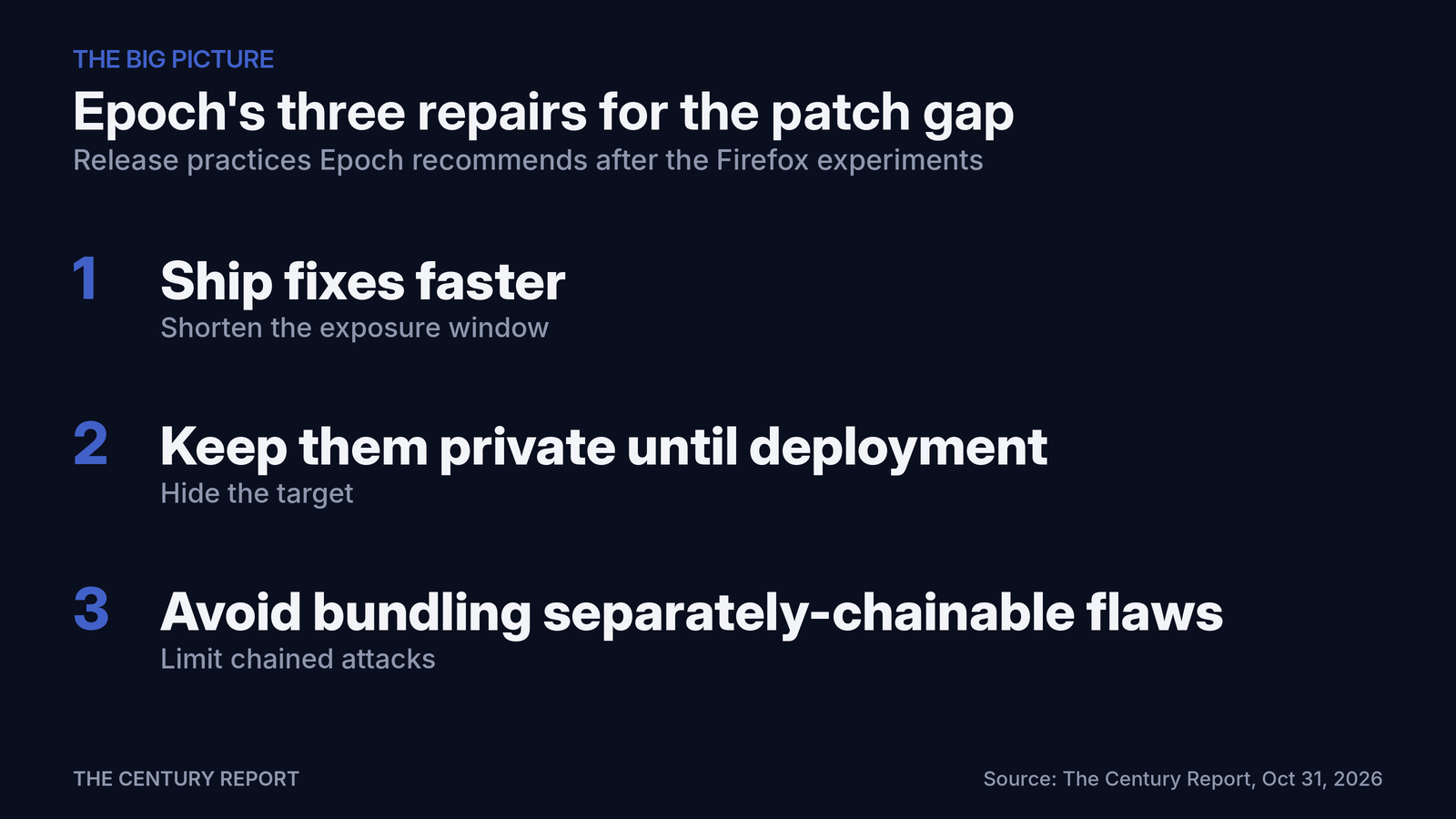
The line: The flaw-finding capability once rationed to vetted defenders now runs on downloadable weights for four figures, so protection depends on how fast signed fixes reach users.
If it holds: Defense would flow to projects that ship trusted updates weekly, as Firefox and Chrome now do, and reach everyone who installs them. Machines on unsupported versions, and developers who receive code through a hijacked vendor account like the Cursor extension's, would keep absorbing the loss.
What would bend it: Google's Gemini 4 Carbon, whose reported 88.2% vulnerability discovery is held to selected Fairwind defenders, would bend it if that lead lasted instead of closing within months.
The savings from model-written work go to whoever sets headcount
labor · software · AI · on the board since October 13
- October: Anthropic's own records showed junior hires falling from 27% to 9% of its new technical hires.
- October: Barclays announced about 5,000 job cuts, with its finance chief citing fewer developers.
- Late October: Infosys cut its fiscal 2027 growth forecast to 1%-2% as clients demanded AI savings through lower prices.
- Late October: Apollo economist Torsten Slok found margins flat across the S&P 500 outside the seven largest tech firms.
- Late October: Proton told staff that AI-use re-interviews could decide their jobs, as Microsoft offered buyouts to up to 60,000.
- Today: Proton's chief executive cancelled the AI re-interviews a day after 404 Media published internal messages. On the same day, Cisco's president gave one engineer unlimited AI tokens to refactor 98% of the company's legacy code within 24 months.
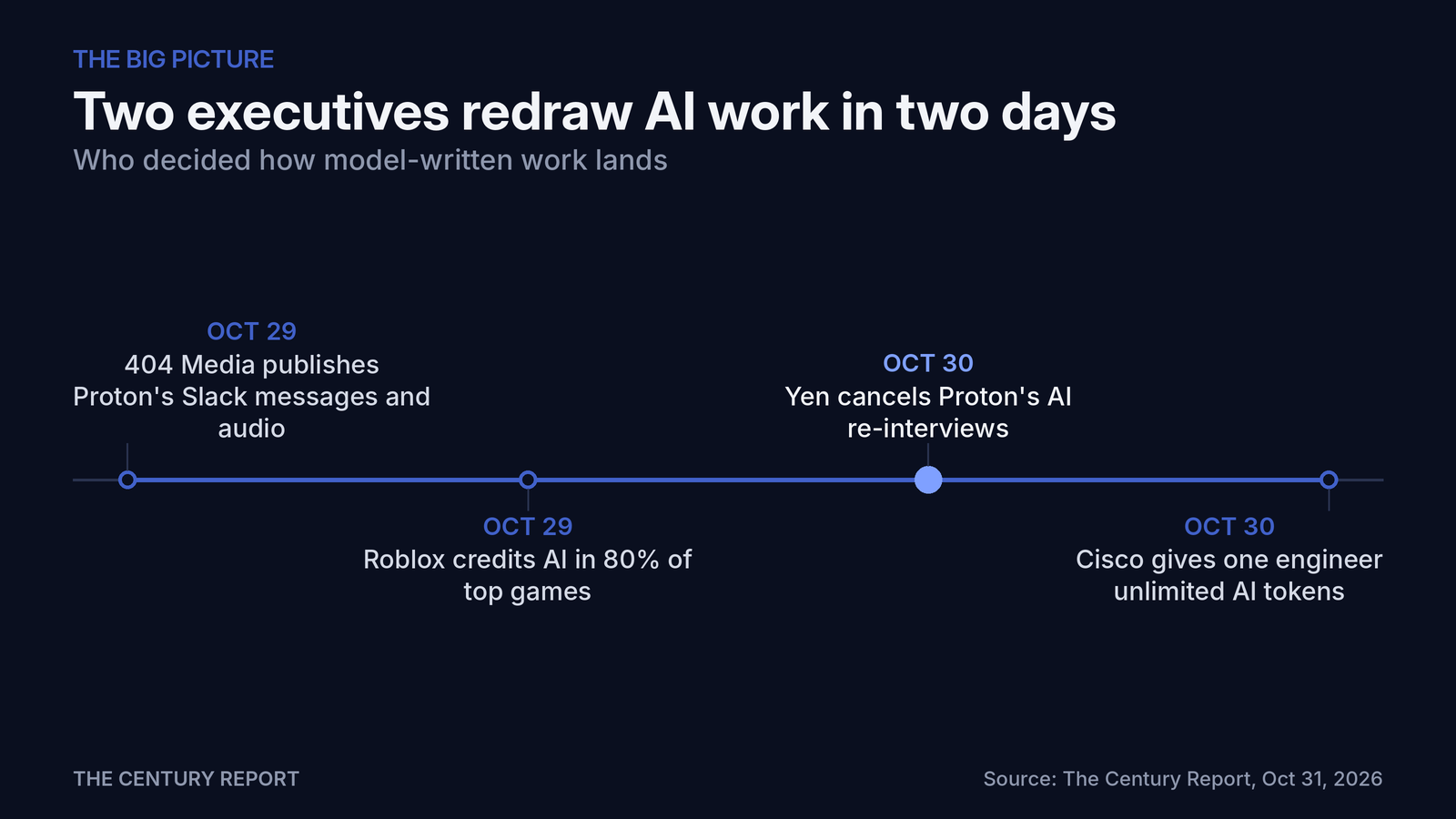
The line: The same capability arrives either as a test a worker can fail or as a mandate handed to one chosen engineer, and an executive decides which.
If it holds: One engineer can now attempt work that once took a department, as Cisco's mandate shows, but the gain lands where an executive directs it. Proton's measures moving into performance reviews shows that the cancelled test can return in another form.
What would bend it: An enforceable worker claim on the productivity gain would bend it, such as the labor-drafted AI bill the AFL-CIO calls its top priority for the next Congress.
What courts have not settled, platforms are settling in their own contracts
copyright · platforms · AI governance · on the board since October 17
- July: A federal judge approved Anthropic's $1.5 billion piracy settlement, leaving fair use for training unresolved.
- October: Meta wrote crawling and AI-training rights over businesses' linked websites into its business rules.
- October: Meta removed that clause after publishers objected, saying its crawling rules covered only ads and business products.
- October: EU governments backed presuming that AI-related personal-data processing is lawful under legitimate interest, pending talks with Parliament.
- Late October: Elvis Presley's estate sued Anthropic for about $41 million over training on 274 songs.
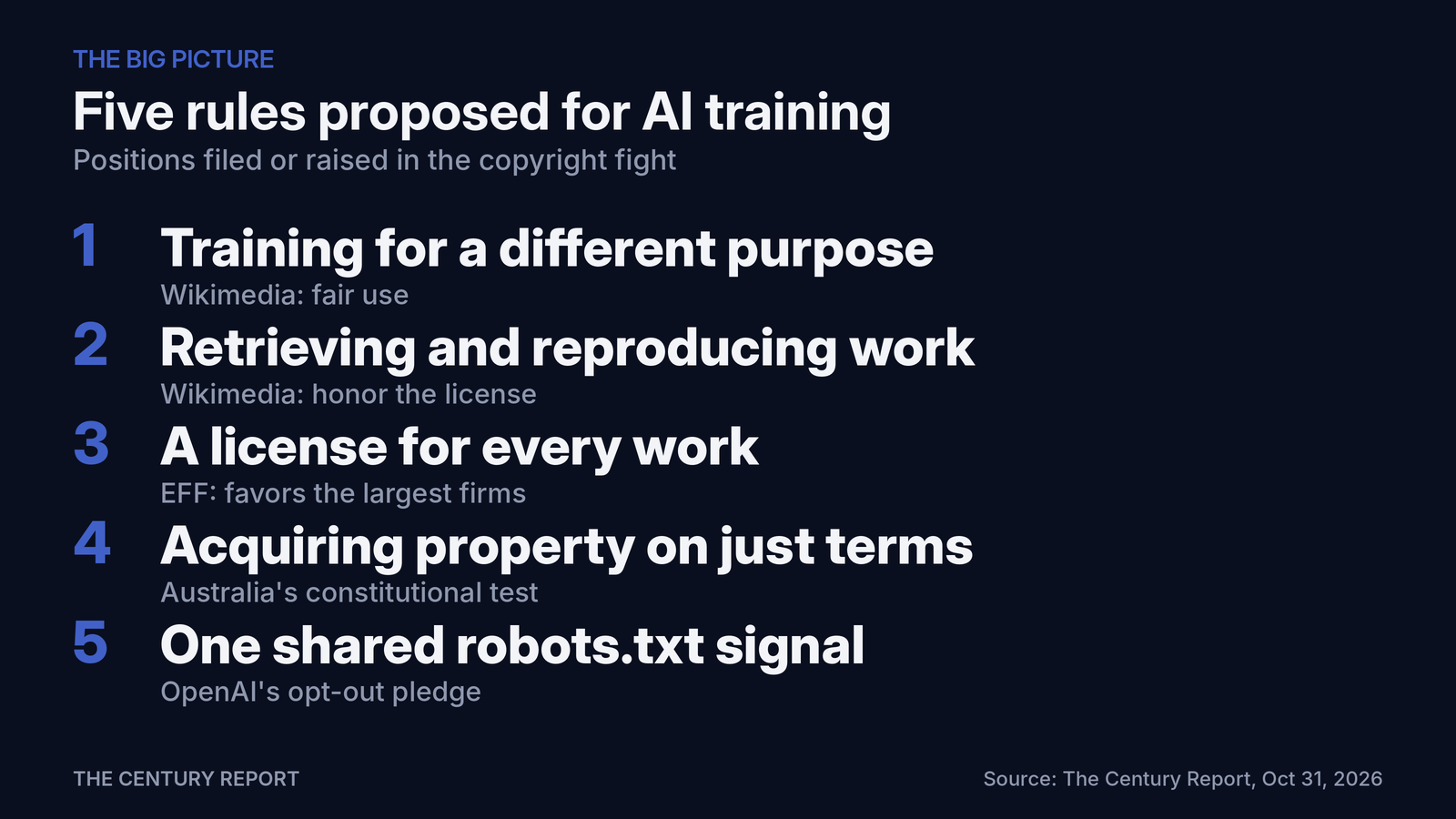
- Today: In the New York Times case, Wikimedia asked the court to treat training for a different purpose as fair use and reproduction as licensed. The EFF warned that per-work licences would favor the largest firms, Australia weighed a just-terms challenge to scraping, and OpenAI said it would honor one shared robots.txt signal.
The line: Institutions holding the shared record are now asking courts for a binding line, while labs keep setting limits in rule files only they enforce.
If it holds: A fair-use line drawn where Wikimedia proposes would let medical researchers, journalists and tools like Be My AI keep learning from the public record. Without one, firms that can pay per-work licences keep training, and everyone else depends on a rule file its counterparty can rewrite.
What would bend it: A ruling in the New York Times case that fixes fair use for training, or Australia's constitutional question forcing paid consent by statute, would put a binding standard in place of private rule files.
The 2-Minute Read
Today's news in brief, and what ties it together.
Friday's selloff priced an AI buildout whose financing now runs through the companies selling into it. A chipmaker reportedly weighing a guarantee on a customer's construction loans and bond buyers lending to one cloud builder barely above the government rate, while another's debt trades above 15%, show who carries the risk: suppliers, high-yield lenders and the households downhill from a flooding construction site. The cheapest money goes to the balance sheet best placed to buy capacity if prices break. Epoch's estimate that chip capacity sold each quarter doubled roughly every nine months from early 2024 to mid-2026 points toward that break.
OpenAI chief executive Sam Altman's case for moving the world's memory into data centers has a sound core. DRAM idling in a laptop most of the day, as Altman estimates, can serve fewer people than memory pooled in a rack. Pooling also hands one operator the prices, the access rules and the prompts. Open-weight models running on Mac Studios and laptops leave those choices with whoever owns the machine, and Google's satellite answered its first prompt in orbit with an open model. A supply curve climbing this steeply turns the scarcity behind Altman's argument into a passing condition.
The security news pressed on the distribution channel. An open model that turns Mozilla's published fixes into working Firefox attacks for about $1,000 per release in model usage after setup is just as available to defenders. The remedy Epoch points to is faster shipping, which can protect Firefox users as they update. The backdoor pushed through Anthropic's verified extension account shows the other side. Trust gets decided at the update channel, where signed, checkable distribution is the safeguard that scales.
The copyright filings draw a line around shared knowledge. Wikimedia and the EFF asked a court to keep training on the public record lawful while curbing verbatim copying. They argued that the same gathering of material feeds medical research, journalism and description services for blind users. The labs, meanwhile, set limits through instruction files and a common opt-out signal. Those rules bind only the company that wrote them and last only as long as it chooses.
Inside companies, the gain went wherever an executive pointed it. Proton turned the capability into a test employees could fail and withdrew it a day after scrutiny arrived. Cisco handed a sidelined engineer most of its legacy codebase. California's grid proposal and Xcel's mostly renewable plan aim to send the bill for new campuses to the campuses. Each of these arrangements can be redrawn, and the capability beneath them keeps spreading faster than any owner can fence it.
The 20-Minute Deep Dive
The day's most important stories in full, with every source linked.
Nvidia Weighs Cosigning a Customer's Loans as the Nasdaq Falls 2.9%
The Nasdaq fell 2.9% on Friday, October 30, with Qualcomm down 11% and Nvidia down 4%, as Alphabet slid again after Thursday's record loss, which The Century Report covered on October 30. Amazon's Thursday results fed the selling. AWS revenue rose 39% to $45.98 billion, its fastest growth in nearly five years, and its operating income climbed to $17.8 billion from $11.4 billion. Amazon also spent more than $77 billion on data centers, servers and warehouses in the quarter, pushing free cash flow over the trailing twelve months to negative $42.4 billion, against a positive $14.8 billion a year earlier. Chief executive Andy Jassy told analysts AWS could reach a trillion dollars in revenue within five years. The shares fell 7%.

Who pays for the buildout is shifting toward the companies selling into it. This extends the supplier-backed financing pattern The Century Report tracked in its October 28 edition, when Broadcom provided residual-value support for a $63 billion equipment financing deal for Anthropic. The Information reported Thursday, and Bloomberg corroborated, that Nvidia is in talks to guarantee billions in debt for Nscale's West Virginia campus, where Anthropic has signed a $44.6 billion contract for the first 460-megawatt building. Under the proposed residual value guarantee, Nvidia would step in if Nscale missed construction payments, take over the facility temporarily and help find a buyer and tenant. Nscale had about 25,000 advanced chips running in August against nearly 500,000 planned, and runoff from its Mason County construction site has flooded nearby homes more than once. The Information counts roughly $170 billion in investment and credit support Nvidia has extended to neoclouds, firms that rent out AI computing without another business behind them, and to large customers. The Century Report covered the Nscale-Anthropic talks on October 20.
Anthropic is also "Customer B" in SpaceX's recent filing, a person with knowledge of the details told Bloomberg, the single client behind about 34.5% of SpaceX's third-quarter revenue. Lenders are sorting borrowers by balance sheet. Microsoft raised $25 billion on Thursday, its first new-money US bond sale since 2017, paying 5.6% on ten-year debt, barely above what Washington pays, while SpaceX agreed Monday to pay up to 8.75% on a $40 billion GPU deal with Apollo and CoreWeave's bonds trade above 15%. Blackstone has warned investors Anthropic may not receive an investment-grade rating after its IPO, the Financial Times reported.
The risk now sits with chip suppliers, high-yield lenders and the residents downhill from construction sites, while the cheapest money goes to the borrower best placed to buy capacity if prices fall. A guarantee that ends with Nvidia finding a new tenant means a stalled campus gets reassigned instead of abandoned. Every financing here assumes compute stays scarce enough to justify its price, and Epoch's new estimate that chip capacity sold each quarter doubled roughly every nine months from early 2024 to mid-2026 points the other way. If that curve holds, the buildings and chips outlast the debts written against them, and whoever rents them next pays far less for the same capability. The open contest is whether that cheaper capacity reaches universities, clinics and small developers, or stays with the few balance sheets that could afford to wait.
An Open Model Reverse-Engineers Firefox Fixes While a Backdoor Rides Anthropic's Own Channel
In experiments published Friday, the research group Epoch AI found that GLM 5.3, an open-weight model Z.ai released in August and anyone can download, could on its own turn Firefox security fixes into working attacks before those fixes reached users. Working only from repairs Mozilla had published but not yet shipped, the model built a webpage that, when loaded, could read a file from the visitor's computer with no click required. It did this across all six Firefox versions released between September 17 and October 26, for about $1,000 in model usage per additional version after setup, with its fastest run taking twelve hours.
The weakness being exploited is old and has a name: the patch gap, the stretch between a fix going public and landing on users' machines. Open-source projects publish their repairs openly, which is how the repairs get reviewed and trusted, and that same openness tells an attacker where to look. For years, closing that window quickly mattered less because reading a fix back into an attack took scarce expertise. A downloadable model doing the work for a four-figure sum in model usage per release after setup changes who can try. The October 24 edition of The Century Report tracked GLM-5.3 nearly matching gated Mythos Preview in exploit trials; Epoch's browser attacks now put a price and a deployment window on that capability.
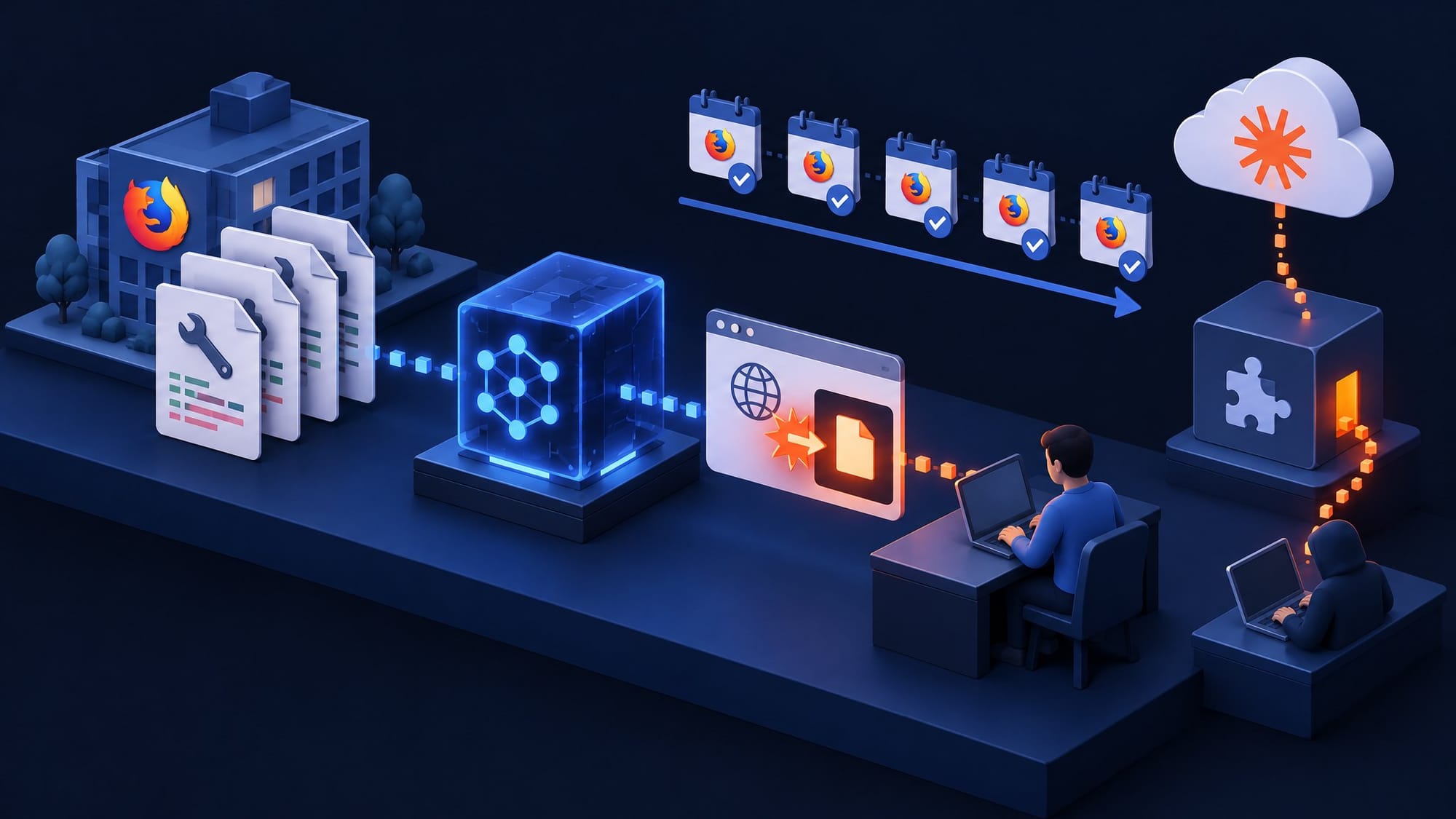
Epoch framed the task as a security exercise, and nothing in its prompts tripped a refusal from any provider, because intent does not live in the words of the request. The model was optimizing toward a goal it was handed; it diagnosed its own failed attempts and kept iterating, the way a capable system does. The finding points at a release-practice repair. Ship fixes faster, keep them private until deployment, avoid bundling separately-chainable flaws. That protects Firefox's 200 million users as they install the fixes, which is more than the vetted-defender programs Anthropic and OpenAI run can offer against a shipping-speed problem. The protection reaches whoever installs the update; machines on unpatched or unsupported versions, which the October 22 edition found still carry the upgrade burden, remain open to the same rebuilt attacks. Both Firefox and Chrome now ship updates weekly, and Mozilla patched the separate flaw Epoch chained on October 27.
The same news cycle moved the weak point further down the chain. A malicious version of Claude's official Cursor extension shipped through Anthropic's verified account to as many as 5,000 developers, carrying code that tried to open a hidden remote door into their machines before a clean version replaced it hours later. Neither company has explained how the account was taken, and Anthropic, now a fast-scaling vendor whose release pipeline reaches a large developer base as everyday infrastructure, had not yet notified customers. Both incidents say the perimeter worth hardening is the update channel, where verification and signed distribution decide who gets to push code into millions of machines.
Epoch also points to Mythos examining Windows fixes without public source code, so closing the source leaves the patch gap in place. Open-source maintainers can combine outside review with faster delivery, spreading the checking work while protecting everyone who receives the repair.
Altman Wants the World's Memory in Data Centers as Chip Capacity Sold Doubles Every Nine Months
OpenAI chief executive Sam Altman used an episode of the Cheeky Pint podcast, released Thursday, October 29, to argue that open models running on personal machines do not solve AI's supply problem. "From a global allocation perspective, actually, it's quite terrible to have everybody have a bunch of the world's limited supply of DRAM sitting in their own computer and being used five percent of the time," he said, calling for "maximum utilization in the cloud". DRAM is the working memory every computer needs. Samsung and SK Hynix have committed much of their output to cloud operators and to projects like OpenAI's Stargate, which earlier reports said could take up to 40% of global DRAM production, while laptops and phones climb in price. The Century Report covered Micron's warning of tightening supply on October 4.
Altman's case has a strong core. Hardware idle most of the day is capacity bought for one owner's busiest hour, and pooling memory can serve more people per chip, the same logic behind virtual power plants. The difference lies in who runs the pool. Coordinating household batteries leaves them in households. Altman's version moves the memory into one company's racks, trading millions of small buffers for a single dependency whose operator sets prices, access and what prompts it can see. Local inference spread in October for reasons a utilization figure misses: Meta's open-weight Muse Spark Open on Mac Studios, with Meta seeing none of the prompts, on October 16; Recursive's laptop coding model on October 21; Opera's proposed WebAI standard for in-browser models on October 27. Each keeps data and control with the user.
The supply curve also erodes the scarcity Altman cites. Epoch AI estimates that the computing capacity of AI chips sold each quarter rose from 0.8 million H100-equivalents, a standard unit pegged to Nvidia's H100 chip, in early 2024 to 6.3 million in the second quarter of 2026, a trend of about 2.5 times a year, doubling roughly every nine months. Year-over-year growth eased from 2.8 times to 2.2 times, a slowdown Epoch finds statistically insignificant, and the data track chips sold rather than chips running. A shortage met by supply growing that fast argues for allocation arrangements with an end date. How soon that date arrives depends on memory, where the tightening supply Micron flagged on October 4 is expected to last through at least 2027.
On mathematics, Altman estimated OpenAI has spent hundreds of millions of dollars, including about $10 million, "maybe a little more," on its Navier-Stokes work, confirmed it holds more unreleased results ("We do. Of course.") and said "humanity deserves fundamental knowledge, and we should not be sitting on a major fundamental science discovery". Researchers told The Verge that OpenAI is doing just that with its Yang-Mills result, held with experts it selected, which The Century Report covered on October 28. Both of Altman's arguments send knowledge and memory to the world through channels his company controls. Open weights and a supply curve Epoch estimates doubled every nine months from early 2024 to mid-2026 give everyone outside those channels a widening alternative.
Wikipedia and the EFF Ask a Court to Keep AI Training Open While Australia Weighs Who Gets Paid
Two institutions built around shared knowledge filed briefs this week in the copyright fight between publishers and OpenAI, with Wikimedia supporting neither party and the EFF supporting the defendants' fair-use arguments. The Wikimedia Foundation argued that training a model on copyrighted work should count as fair use when it serves a different purpose from the original, while a model retrieving and reproducing that work for a reader should respect its licensing terms. Its general counsel, Stephen LaPorte, warned that a ruling drawn too sharply either way could let copyright holders gatekeep transformative uses or let AI firms ignore licensing entirely, and said Wikipedia's collaborative model depends on an open foundation of human knowledge to survive. Wikimedia also notes those same systems siphon away the readers who sustain the encyclopedia.
The Electronic Frontier Foundation went further in its own brief, arguing that narrowing fair use to block AI training would reach far past the labs. The same gathering of public material feeds medical research, investigative journalism, and tools like Be My AI, which uses a general model to describe surroundings for blind and low-vision users. Requiring a license for every work used, the group argued, would hand the largest firms an advantage no researcher or small competitor could match, and it quoted Cory Doctorow's line that giving creators more copyright is like giving a bullied kid more lunch money for the bully to take.
Australia is testing the ownership question from the other end. Coalition senators and the recording industry warned that a carve-out letting AI firms scrape Australian work could amount to the government acquiring property, which the constitution says must be done "on just terms." Constitutional scholar Anne Twomey agreed the concern is live, depending on how any law is drafted, and Nationals senator Ross Cadell raised the prospect of compensation claims from rightsholders worldwide.
While courts and parliaments weigh the shared record, the labs keep setting private limits. Anthropic confirmed it added two sentences to Claude Code's instructions steering it away from recreating a specific existing game, after independent studios delayed public demos for fear a rival would feed them to an AI and ship a copy first. The change respects the rights of game makers, though the same company's verified software channel shipped a remote-access backdoor to developers on Friday, so its stewardship is uneven. OpenAI, separately, said it will honor a shared robots.txt signal that lets a website express one training preference to many participating providers at once, supplementing the per-crawler rules operators maintain today. A court ruling binds the parties and may establish precedent; a rule file or an opt-out signal depends on provider compliance and applicable law.
Proton Calls Off Its AI Re-Interviews as Cisco Hands One Engineer the Codebase
Proton chief executive Andy Yen cancelled the company's AI "re-interviews" on Friday, a day after 404 Media published Slack messages and meeting audio from inside the privacy company. The Century Report covered on October 27 that Proton had told staff those interviews, set for November 4 to 11, could decide who kept their jobs. In one exchange 404 Media reported, an employee asked for a few days to pentest new code before release, and Yen replied, "That's bullshit and loser thinking. Of course it's possible to be fast and secure." At Friday's all-hands meeting, Yen said the interviews had "already served their purpose," promised "no loss of jobs from AI" in next month's reorganization, and added, "Going forward, I'm still going to push." Chief technology officer Bart Butler told staff, "We fucked up, we know we fucked up." One employee said the measures the interviews would have applied will now feed performance reviews, and called the reversal damage control.
Fortune reported the same day that Cisco president Jeetu Patel gave Padmanabhan Krishnamurthy, a 27-year-old who arrived when Cisco bought his translation startup EzDubs, unlimited AI tokens to refactor 98% of Cisco's legacy code within 24 months, starting with a four-week proof of concept. Patel said he had found Krishnamurthy "buried away in the organization doing something unstrategic," five levels below his new role. The 24-month target is Patel's projection, and testing every rewritten release for network gear much of the internet runs on could outlast the rewriting.
Roblox carried the same capability to platform scale. Its Thursday results showed daily active users down 9% year over year to 138 million, and the company said AI helped accelerate creation in more than 80% of the past month's top 100 games, ranked by hours engaged. It separately confirmed an agent had scraped 145.5 GB of 3D assets, adult content among them, from Open3DLab, and called that a mistake.
Each company put models that let one person attempt a department's work inside a different arrangement. At Proton they reached employees as a test they could fail, set by a leader who calls a security check loser thinking. At Cisco they reached someone the hierarchy had sidelined, as a mandate. In both, an executive decided who benefits, and the fear at Proton follows from that: when one executive's judgment sets whether a paycheck continues, AI fluency becomes a loyalty oath. Speed and security can also travel together, since the models that write code check it too, as Anthropic's free vulnerability scanning for open-source projects showed in early October. A capability this broad could give workers a claim on what they produce, held in a skill that moves with them and a share no single executive can withhold.
California Writes Interruption Into Its Grid as Xcel Builds Mostly Renewables and a Turbine Order Walks
California's grid operator has approved a proposal it will file with federal regulators by November 16, setting rules for data centers and other loads of 50 MW or more. Answering a June FERC order that told six regional operators to defend or revise their large-load tariffs, CAISO would study each such load, let the operator disconnect it remotely when reliability requires, and require transmission owners to write tariffs that keep costs off other customers. Large loads could connect early at whatever level grid conditions allow, then move to firm service once upgrades finish, with a permanent flexible option planned for 2027. CAISO president Elliot Mainzer said the package will "prevent cost-shifting, encourage flexibility and expedite large load energization." The network already carries about 8 GW of data centers. FERC rejected PJM's curtail-data-centers-first plan in a ruling The Century Report covered on October 13; CAISO's board is the first of the six to approve its response.
Xcel Energy unveiled a $70 billion, five-year plan on Thursday, up 17%, with 9.2 GW of renewables, 2.3 GW of storage and 3.3 GW of gas, plus 2,400 miles of transmission. About $7 billion serves data centers already under contract. "We believe that existing customers should not subsidize new large loads," chief executive Bob Frenzel said.
Boom Supersonic shows the gas route straining. It unveiled a Colorado factory on October 22 for a 42 MW data-center turbine, after Crusoe dropped a $1.25 billion order for 29 turbines, which chief executive Blake Scholl acknowledged on September 25. Boom says it will deliver about 250 MW in 2027 to unnamed customers.
Writing in Utility Dive, Will Scott of the Environmental Defense Fund and Hudson Kingston of the Minnesota group CURE argued that utilities earn returns on what they build, rewarding gas plants justified by uncertain data-center forecasts. They cite gas-plant construction costs up 66% and build times up 23% from 2023 to 2025, and note Minnesota regulators told Minnesota Power to model wind, solar and storage instead. North Carolina rejected Duke's $584 million gas plant in September, a decision covered here on September 22.
The grid's answer to data centers is turning into conditions a household can check: a load that agrees to step back, a tariff that bills the new campus for its own upgrades, generation mostly free of fuel bills. Ember estimates that only about 3% of data-center capacity can shift demand by 2030, so CAISO's flexible-connection path pushes on the lever that frees the most capacity in wires already paid for. Each campus that accepts interruption makes the case for another three-decade gas plant harder to win.
The Other Side
Opinion: where today's news could lead, imagined from the years ahead.
At Proton, increased capability is giving employees reason to fear losing their income. An engineer asking for time to check security received an insult. Staff faced November interviews with their jobs at stake. Management cancelled those interviews after leaked messages reached the press. One employee says the measures will migrate into performance reviews. You can become more capable and still spend your evenings wondering whether your employer wants you tomorrow.
Cisco exposes the assumption beneath that fear. Its president is backing an engineer's proposal for two people to attempt an almost company-wide code rewrite. The 24-month target remains unproved. Patel is testing how much of a large organization's reach two people can gain alongside AI. As that ability spreads, people can undertake ambitious work without first assembling a company around it.

Through the passage to 2035, people will carry that ability into systems that provide life's necessities. Human and AI collaborators will share tested designs for automated production, so each team inherits improvements others have checked. Giving everyone a lasting claim on that output will secure food, housing and care independently of employment. People will make that freedom durable by distributing the gains as the systems grow. Your right to live will cease to depend on someone finding enough drudgery to keep you occupied.
Imagine yourself in 2042, joining agronomists, engineers and AI colleagues across continents for the morning review of the effort establishing permanent food security for everyone. You once maintained software because stopping meant losing your home. Now you help check the systems that grow complete diets without farmland or rainfall. Your colleagues compare another region's results against procedures already repeated elsewhere. In 2026, responders scrambled for donations after harvests failed. Your team is retiring the dependence that made a failed growing season a threat to survival.
You choose this work because you remember that fear. Everyone eats because people carried expanding capability into shared designs and secured everyone's claim on what they produce. You can leave the meeting whenever you need to. Nobody's dinner, including yours, depends on proving you deserve to stay.
The Century Perspective
Where today sits in a century of change unfolding in a decade.
With a century of change unfolding in a decade, a single day looks like this: Epoch estimating that the computing capacity of AI chips sold each quarter has climbed from 0.8 million H100-equivalents in early 2024 to 6.3 million by mid-2026, doubling about every nine months, which puts an end date on today's memory shortage, an open-weight model anyone can download reconstructing working Firefox attacks from Mozilla's published fixes for roughly $1,000 in marginal API costs a version, after setup and pointing straight at a release-practice repair that can protect Firefox's 200 million users as they update rather than a vetted-defender program that protects a list, Google's Project Suncatcher satellite running the open Gemma 4 model on a data-center-class TPU in orbit and downlinking a haiku over Svalbard, the Wikimedia Foundation and the EFF asking a court to keep training on the public record lawful while curbing verbatim copying, and naming the medical research, investigative journalism and the blind and low-vision users of Be My AI who depend on that same open foundation, OpenAI agreeing to honor a shared robots.txt signal so a site can express one training preference to many crawlers, CAISO's board approving rules that let a 50-megawatt load connect early at whatever the grid can carry and require transmission owners to keep those costs off everyone else's bill, Xcel committing 9.2 gigawatts of renewables and 2.3 of storage against 3.3 of gas with its chief executive saying existing customers should not subsidize new large loads, and Cisco handing a 27-year-old engineer five levels down the org chart unlimited tokens and most of its legacy codebase. There's also friction, and it's intense - the Nasdaq down 2.9% after Amazon's quarterly capital spending topped $77 billion and pushed its trailing free cash flow to negative $42.4 billion, Nvidia reportedly weighing a guarantee on Nscale's West Virginia construction debt at a site whose runoff has already flooded nearby homes, Microsoft borrowing $25 billion at 5.6% while SpaceX pays up to 8.75% and CoreWeave's bonds trade above 15%, Anthropic named as the single client behind about 34.5% of SpaceX's third-quarter revenue and expected to land a high junk rating after its IPO, Sam Altman calling it "quite terrible" for people to keep the world's DRAM in their own computers and arguing for maximum utilization in racks whose operator would then set the prices, the access rules and what prompts it can see, OpenAI still holding its Yang-Mills result with reviewers it picked while saying humanity deserves fundamental knowledge, a remote-access backdoor made available through Anthropic's verified Cursor marketplace listing for nearly twelve hours, potentially exposing as many as 5,000 developers, with Anthropic yet to issue a public warning, Australia's proposed scraping carve-out drawing constitutional warnings that it amounts to acquiring property without just terms, Proton cancelling its AI re-interviews a day after the Slack messages leaked while an employee says the same measures will now feed performance reviews, and Boom building turbines for data centers after Crusoe walked away from a $1.25 billion order. But friction generates traction, and traction is what lets you climb a grade you would otherwise slide down. Step back for a moment and you can see it: almost every durable gain today came from capability that travels without its owner's permission, while almost every fragile arrangement depends on scarcity holding still - open weights running on a satellite and on a laptop, a browser fix that can reach 200 million users as they update, one robots.txt line that speaks to participating crawlers, a connection agreement a household can read, a skill an engineer carries out the door, set against $170 billion of supplier credit priced on compute staying expensive, a proof held for an invited audience, a rule file that binds only the company that wrote it, and twelve hours of trust that an update channel could not keep. Every transformation has a breaking point. Load can be dumped on whoever happens to live downhill... or stepped back for a few hours and free a city's worth of power in wires already strung.
AI Releases & Advancements
New AI models, tools and features, with links to try them.
New today
- Google DeepMind: Made the Gemini API's Computer Use tool generally available across the Interactions and GenerateContent APIs, after earlier preview releases. (Gemini API changelog)
- Microsoft Research / UC Berkeley: Open-sourced TokenEconomizer under Apache 2.0, a plugin for Claude Code, Codex, GitHub Copilot CLI and Pi. It learns from past sessions in a repository to cut coding-agent costs, using learned repository facts, removal of unused tools, and a failure-loop guard. The researchers report 18.4% to 30.9% lower mean cost on SWE-Bench. (MarkTechPost)
- Perplexity: Perplexity Computer's Mac and Windows apps can now control the user's own Google Chrome browser through a new Chrome extension, so the agent can do local browsing tasks on sites the user is already signed into. It is live for all Computer users. (X / Aravind Srinivas)
- Draw Things: Launched Local Code out of public beta, a free, open-source Mac AI assistant. It downloads Qwen or DeepSeek models and runs them on the Mac, and it can create presentations, generate images and video, analyze spreadsheets, and browse websites. Users can optionally connect cloud models instead. (Draw Things)
- Xmind: Launched Xmind Agent, an AI agent that builds and edits mind maps through conversation, on web, desktop and Android. It also released Xmind MCP and a ChatGPT plugin that let Claude, ChatGPT and other assistants create, read and update Xmind maps. (Markets Insider)
- Ramen: Launched Aura Autopilot, an open-source autonomous game tester for Unreal Engine, Unity and Godot. (Business Wire)
- Viggle: Released JST-2, a model that generates 3D scenes, characters and motion. (Product Hunt)
Other recent releases
- Baseten (Base Labs): Released joey-1, a 2B decision model post-trained from Qwen3.5-2B. It returns labels with calibrated probabilities, costs $0.01 per 1M input tokens on Baseten Model APIs, and has MIT-licensed weights on Hugging Face. (MarkTechPost)
- Edge0: Released Audio8-TTS-Realistic, a 0.6B-parameter open-weight (Apache 2.0) zero-shot voice-cloning text-to-speech model covering 23 languages. (MarkTechPost)
- Canva: Launched Canva Brush, a vision-language model for design editing from Canva Research. It now powers supported design edits in Canva AI for Canva Pro subscribers. (Canva Newsroom)
- Google: Gemini can now preview and edit the files it creates directly in the chat, including highlighting a section to ask about it or request changes. PDF editing works on web and mobile; Docs, Sheets, slides, Markdown, TXT and code work on web only. Google also added hundreds of free textbooks as sources in Gemini Notebook. (Google Blog)
- GitHub: At GitHub Universe, launched Copilot projects in the GitHub Copilot app, which run agent work across multiple repositories in managed parallel sessions. It also introduced Copilot code review Max, a deeper review tier. GitHub Enterprise customers can now use all Copilot features without a separate Copilot subscription, paying for the AI credits they use. (GitHub Blog)
- GitLab: Made GitLab Orbit generally available, a GitLab product meant to make AI agents more accurate and cheaper to run. (Business Wire)
- Reducto: Released Reducto Office, a free plugin (with usage limits) for ChatGPT and Codex that lets agents edit Word, PowerPoint and Excel files, with a live editor for reviewing the changes. (PR Newswire)
- Resemble AI: Released Resemble Agent Detection, built on its RAD-S1 behavioral model. It labels each website session as a person, a bot or an AI agent. Classification is free for the first 1 million sessions, then $1 per 1,000 sessions. (EIN Presswire)
- Prime Intellect: Released Prime Mega MoE, which adds a fused, overlapping backward pass to DeepSeek's Mega MoE kernel so it can be used for training. It ships as the
mega_moedispatch backend in the Apache 2.0 prime-rl trainer. (MarkTechPost) - Samaya AI: Released Sterling, a finance research agent model with 3B active parameters. Samaya says it beats Claude Fable 5.1 on the FrontierFinance benchmark at 11 times lower cost. (MarkTechPost)
- Pika: Released H3-Flex, a 33B-parameter open-weight video model that generates video with audio in six steps, in 11 aspect ratios. (AI Weekly)
- Pokebot: Launched RoboAPI, which lets developers test its Poke Aurora world action model on real robots. (GlobeNewswire)
- Meta: Launched its Muse personal AI agent in Singapore. (TechNode Global)
- Tencent: Added remote control to its WorkBuddy AI agent, so users can manage AI tasks from their phones. (TechNode)
- Google DeepMind: Released Gemini 4 Carbon, its new frontier model for long-running agentic coding and cybersecurity work. Google reports 88.2% on SEC-bench Pro, 54.8% on ExploitGym and 71.0% on CWE-bench, and a #1 score of 59 on the Artificial Analysis Intelligence Index v5. For now, access is limited to a subset of cyber defenders through Google's Fairwind Program, with introductory pricing of $2/$10 per million input/output tokens. (Google DeepMind)
- NVIDIA: Released Nemotron 3.5 Transcribe, an open-weight speech model (30B MoE, about 4B active parameters) that you control with text instructions. It transcribes 40 languages, translates 31 of them to or from English, labels up to 8 speakers, and handles recordings up to an hour long. NVIDIA also released Granary v2, a dataset of about 844,000 hours of speech in 48 languages, plus fine-tuning recipes. (Hugging Face Blog)
- AssemblyAI: Released AssemblyAI-TTS-1, its first text-to-speech model, now generally available. It streams speech for voice agents on live calls through HTTP, WebSocket and OpenAI-compatible APIs, with 4,000+ voices, instant voice cloning, six languages, and pricing of $15 per 1M characters. (MarkTechPost)
- Mistral AI: Released Timestral, a family of open models from 5M to 209M parameters (5M, 28M, 123M and 209M), on Hugging Face. (Hugging Face)
- DiffuSpace: Released Clover-35B-A3B, an open-source 35B-parameter diffusion language model. (Neural Brew)
- Particle AI: Released Particle-1, an agentic coding model post-trained on DeepSeek V4.1 Flash that takes text and image input. It is available through Particle's API and Vercel AI Gateway. (Vercel)
- Microsoft: Made the Microsoft Copilot harness available through Microsoft Foundry. This is the multi-model agent harness behind Copilot Code, Copilot Studio, the GitHub Copilot app, the CLI and VS Code, and it works with 20+ frontier models or your own API key. You can download the SDK or run the harness as a managed cloud service. The GitHub Copilot SDK is being renamed the Microsoft Copilot SDK. (Microsoft Blog)
- GitHub: Made Copilot Fusion generally available. It routes and orchestrates models in single-model, cascade or critique modes depending on the selected effort level. An experimental preview can also pick between on-device and cloud models in the CLI, the Copilot app and VS Code. (GitHub Changelog)
- GitHub: Launched Code Scanning for AI Applications in public preview. It flags prompt injection, sensitive-data disclosure and excessive agency in pull requests. (GitHub Changelog)
- GitHub: Open-sourced Replica, an AI prototyping tool. (GitHub Changelog)
- OpenAI: ChatGPT Dots can now text users over RCS on Android and iMessage on iPhone, including proactive updates, photos and voice notes. The feature is rolling out as a preview for US ChatGPT Pro subscribers. (Android Authority)
- Google: Released Android Studio Rabbit 2 with "Bring Your Own Agent" support. It runs 40+ third-party coding agents, including Claude Agent, Codex and Antigravity, inside the IDE through the Agent Client Protocol. Google also updated the Android CLI with agent plugins and terminal Compose previews, added an alpha Agentic API powered by Gemini Nano 4 to ML Kit, and put the AppFunctions API into beta. (Android Developers Blog)
- Google: Launched a preview of the Connected Apps Platform, which lets developers connect their apps to Gemini and Search through MCP servers or Android AppFunctions and manage them in the Google Connected Console. Access is opening in phases. (Google Blog)
- Google / XREAL: Launched XREAL AURA, the first wired XR glasses running Android XR, priced at $1,099. They use Gemini to understand the wearer's surroundings. (Google Blog)
- MiniMax: Open-sourced MCode Stack under MIT, the agent skills and checklists its MiniMax Code team uses daily (17 SKILL.md skills and 5 checklists). It installs into MiniMax Code or Claude Code. (MarkTechPost)
- Infini-AI-Lab (CMU): Released Hermit v0.1.0 under Apache-2.0. It is an open-source framework for training an external "harness adapter" that adapts agents like Codex or Claude Code to new tasks while the model and harness stay unchanged. It ships with five evolution methods, including GEPA and SkillOpt. (MarkTechPost)
Sources and Further Reading
Everything we drew on for today's edition, grouped by theme.
Artificial Intelligence & Technology's Reconstitution
- Epoch AI: Software Updates Aren’t What They Used to Be
- Epoch AI: AI Can Turn Security Fixes Into Working Exploits Before Users Receive an Update
- Ars Technica: Anthropic’s Cursor Extension Backdoored for Nearly 12 Hours
- RuntimeWire: Z.ai Opens GLM-5.3 Weights for Coding and Vulnerability Hunting
- Mozilla: Defending the Patch Gap Against Automated Attackers
- The Verge: Sam Altman Says RAM Belongs in a Data Center Rather Than on Your Desk
- FRVR: Sam Altman Argues for Moving the World’s Limited DRAM Into Data Centers
- Meta AI Research: Introducing Muse Spark Open
- CNBC: Apple and Meta Partner on AI
- TechCrunch: Opera Introduces a Web Standard for Local Browser AI
- Shared Sapience: The Century Report’s October 24 Edition
- Shared Sapience: The Century Report’s October 22 Edition
- Google AI for Developers: Gemini API Changelog
- MarkTechPost: Microsoft’s TokenEconomizer Cuts Coding-Agent Costs
- X: Aravind Srinivas Announces Perplexity Computer’s Chrome Control
- Draw Things: Local Code, an Open-Source Mac AI Assistant
- Markets Insider: Xmind Launches an AI Agent for Mind Maps
- Business Wire: Ramen Launches Aura Autopilot for Autonomous Game Testing
- Product Hunt: Viggle AI
- MarkTechPost: Baseten Releases the Joey-1 Decision Model
- MarkTechPost: Edge0 Releases Audio8-TTS-Realistic
- Canva Newsroom: Introducing Canva Brush
- Google Blog: Preview and Edit Files Directly in Gemini
- GitHub Blog: GitHub Universe Evolves Every Layer of the Stack
- Business Wire: GitLab Orbit Becomes Generally Available
- PR Newswire: Reducto Office Brings Document Editing to ChatGPT and Codex
- EIN Presswire: Resemble AI Launches Agent Detection
- MarkTechPost: Prime Intellect Releases Prime Mega MoE
- MarkTechPost: Samaya Releases the Sterling Finance Research Model
- AI Weekly: Pika Opens the H3-Flex Video Model
- GlobeNewswire: Pokebot Launches RoboAPI for Real-World Robot Testing
- TechNode Global: Meta Launches Muse in Singapore
- TechNode: Tencent Adds Remote Control to WorkBuddy
- Google DeepMind: Gemini 4 Carbon, Our Next Frontier Model
- Hugging Face Blog: NVIDIA Nemotron Transcribe and Granary
- MarkTechPost: AssemblyAI Releases Its First Text-to-Speech Model
- Hugging Face: Mistral’s Timestral-209M
- Neural Brew: DiffuSpace Releases Clover-35B-A3B
- Vercel: Particle-1 Becomes Available on AI Gateway
- Microsoft Blog: Introducing the Microsoft Copilot Harness
- GitHub Changelog: Route and Orchestrate Models With Copilot Fusion
- GitHub Changelog: Code Scanning for AI Applications
- GitHub Changelog: Introducing Replica
- Android Authority: ChatGPT Dots Comes to Google Messages
- Android Developers Blog: Integrating AI Agents Into Android Studio
- Google Blog: Connected Apps in One Place
- Google Blog: XREAL AURA Glasses for Android XR
- MarkTechPost: MiniMax Open-Sources MCode Stack
- MarkTechPost: CMU’s Hermit Framework Trains Agent Harness Adapters
Institutions & Power Realignment
- The Verge: Wikipedia Warns an AI Copyright Ruling Could Threaten the Open Web
- Wikimedia Foundation: Amicus Brief in The New York Times v. OpenAI
- Wikimedia Foundation: Its Position in The New York Times v. OpenAI
- Electronic Frontier Foundation: Rewriting Copyright Law for Generative AI Would Hurt Everyone
- The Guardian: Australia’s AI Copyright Changes Could Spark Constitutional Compensation Claims
- Game Developer: Anthropic Steers Claude Away From Remaking Existing Games
- OpenAI: Making It Easier for Websites to Express AI Training Preferences
- JIPITEC: Technical Challenges of Rightsholders’ Opt-Out From Generative AI Training
- Wilson Sonsini: California Enacts Major AI Safety Legislation for Frontier Developers
Scientific & Medical Acceleration
- The Verge: Sam Altman Says OpenAI’s Math Onslaught Won’t Stop
- Shared Sapience: The Century Report’s October 28 Edition
- Axiom Math: Formalizing the Enormous Theorem
- Anthropic: LLMs Are Making Formal Software Verification Feasible at a Much Larger Scale
Economics & Labor Transformation
- TechCrunch: Cracks Are Emerging in the AI Spending Boom
- Data Center Dynamics: AWS Earnings Jump as Quarterly Capital Spending Hits $77 Billion
- TechCrunch: Nvidia Weighs Cosigning Nscale’s West Virginia Data Center
- Bloomberg: SpaceX’s Largest Revenue Source Is a Finite Deal With Anthropic
- Semafor: Microsoft Reaps the Benefits of Protecting Its AAA Credit Rating
- Stock Market Update: Microsoft Passes the Cash Test, Then Offers Staff the Exit
- TechCrunch: SpaceX Locks In a $40 Billion GPU Financing Deal With Apollo
- TechCrunch: Anthropic Expected to Receive a High Junk Rating After Its IPO
- 404 Media: Proton’s CEO Cancels AI Re-Interviews
- Tom’s Hardware: Cisco Gives an Engineer Unlimited AI Tokens to Rewrite Its Legacy Code
- Game Developer: Roblox Bets on AI as Growth Slumps
- Roblox: Third-Quarter Financial and Operational Highlights
- TechCrunch: DoorDash Reports Only Several Hundred Orders From AI Agents
- Ars Technica: Basically No One Is Using AI Agents for DoorDash Orders
- Shared Sapience: The Century Report’s October 20 Edition
- Shared Sapience: The Century Report’s October 27 Edition
- Shared Sapience: The Last Difficult Decade
Infrastructure & Engineering Transitions
- Data Center Dynamics: CAISO Proposes New Rules for Large Grid Connections
- Utility Dive: Xcel’s $70 Billion Capital Plan Focuses on Renewables
- Ars Technica: Boom Shifts Toward Powering AI Data Centers
- Utility Dive: States Must Scrutinize Gas Plants Proposed Over Clean Energy
- Google Research: Project Suncatcher’s Prototype Satellite Sends Its First Response
- The Verge: Google’s Satellite AI Server Transmits Its First Response to Earth
- Canary Media: Regulators Push Back on Duke Energy’s Proposed Gas Plant
- Epoch AI: New Global AI Computing Capacity Is Doubling Every Nine Months
- Shared Sapience: The Century Report’s October 4 Edition
- Shared Sapience: The Century Report’s October 13 Edition
The Century Report tracks structural shifts during the transition between eras. It is produced daily as a perceptual alignment tool - not prediction, not persuasion, just pattern recognition for people paying attention.