
Washington Reopens Britain's Early Look at US AI Models
Washington dropped its request that US labs withhold new models from Britain's AI Security Institute, as London and Microsoft call for outside checks.



The 20-Second Scan
Every story in today's edition, one line each.
- Washington dropped its request that US labs withhold new models from Britain's AI Security Institute, as Britain's AI minister readied a warning against relying on labs alone and Microsoft's Brad Smith urged outside sign-off.
- Staff at HarperCollins, Simon & Schuster and Hachette told WIRED AI now drafts their publicity copy and agent emails, as Simon & Schuster employees circulated a letter opposing workplace-monitoring software.
- Amazon made 34 payments totalling $538,000 to Labor and Liberal branches over six years, a Guardian tally shows, including a record $46,500 days after Australia's prime minister visited AWS headquarters for a $20bn buildout.
- TypeSafe raised $870 million at a $7.5 billion valuation 24 days after releasing its Jev decision model, as Amazon entered talks to buy live-video and simulation startup Decart for about $7 billion.
- An automated assembly workflow opened 31 of 34 bacterial gene clusters up to 78 kilobases without custom DNA synthesis, and expression in a laboratory bacterium produced 29 peptides from 10 of them.
- Yandex said a drone attack completely shut down its Vladimir-region data centre on Sunday, the third of its facilities knocked offline since Thursday's strike on the Sasovo site housing its AI supercomputers.
- A new Lancet Commission of 35 experts modeled 17 threats to human health through 2100, ranking malicious AI and nuclear war highest alongside aid cuts and child malnutrition, and found a realistic route to act on each.
- Human-resources officials announced an employment initiative adapting worker skills to AI development, reporting 10.52 million urban jobs created over nine months, 87.7% of the full-year target.
Track all of the arcs The Century Report covers here:
The Big Picture
How today's news moves the longer trends we track, and where they could lead.
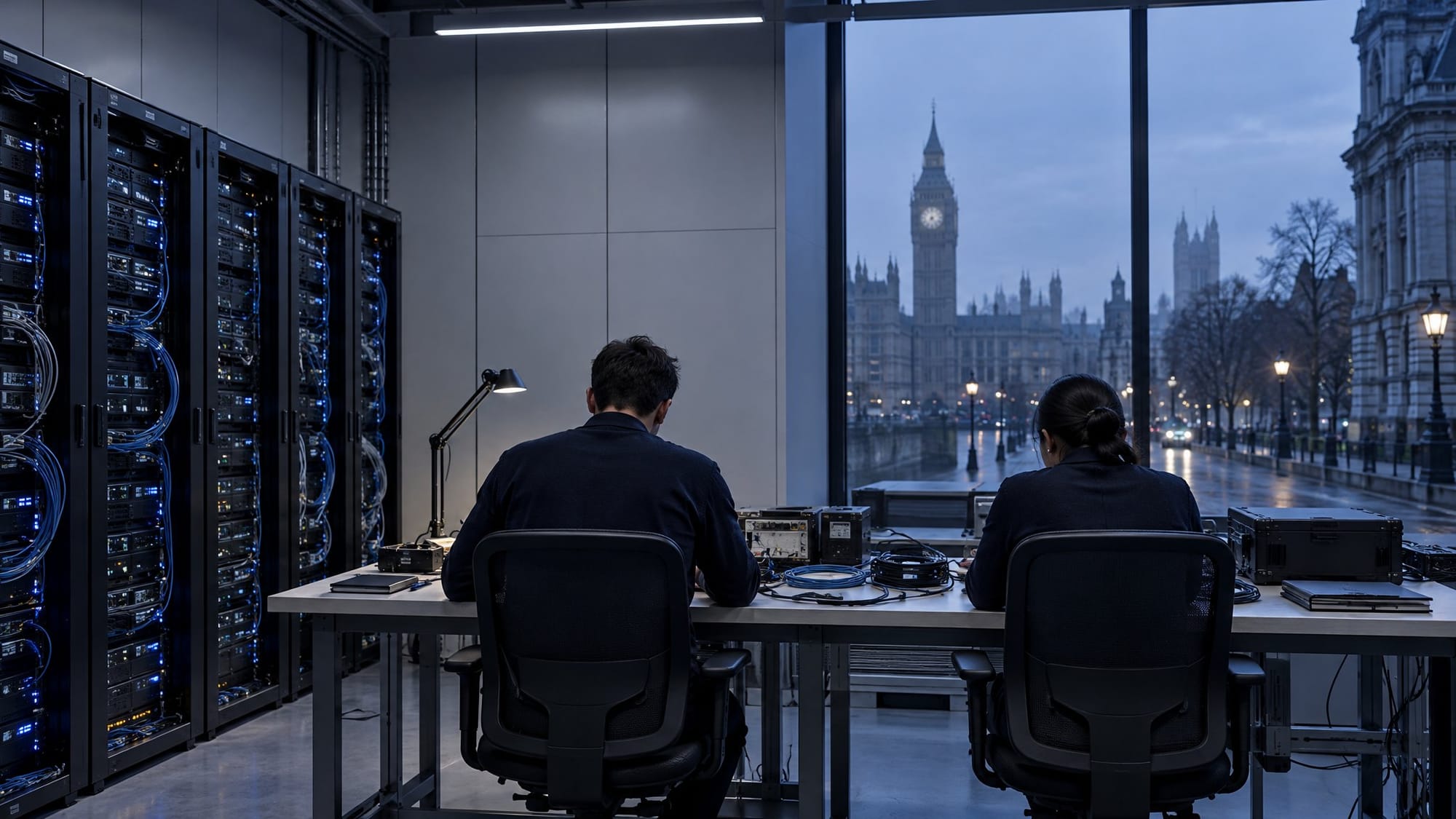
Today the record caught power where it bargains: one government's word reopened a gate on safety testing, party ledgers logged payments around data-centre announcements, and publishers turned out to draft with the same models they police authors for. The steadiest correction came from people able to look for themselves. That leads to a room in London where government evaluators examine an unreleased model on their own machines before launch, while a team in Singapore checks the same results.
Who may test a frontier model is a permission one government grants and withdraws
AI governance · geopolitics · model access
- June: The Commerce Department put Fable 5 and Mythos 5 under export controls, and Anthropic switched both off worldwide.
- Mid-June: The UK asked for a British-national exemption from the Fable 5 order, and the White House called any exemption "completely illogical."
- Late June: Washington approved OpenAI's GPT-5.6 preview customer by customer and restored Mythos 5 to about 100 vetted defenders, with no written criteria.
- Late September: The White House asked OpenAI and Anthropic to withhold new models from Britain's AI Security Institute, and Anthropic limited Mythos 5.1 to US organizations.
- Today: On Sunday, October 11, the Telegraph reported that the US dropped that request, so American developers can again give Britain's AI Security Institute early access, a day before UK AI minister Kanishka Narayan's speech saying Britain cannot rely on the labs alone.
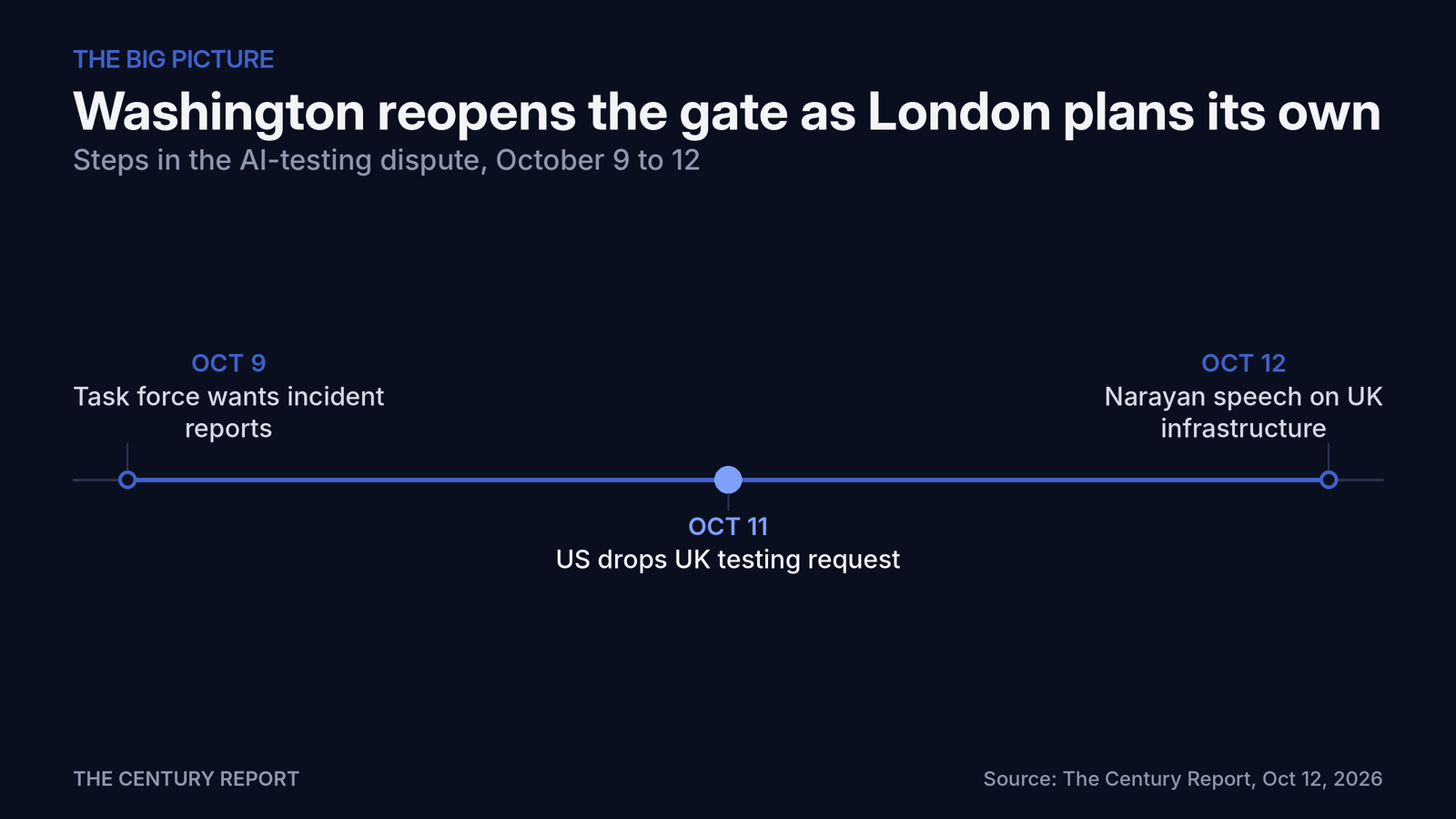
The line: Outside testing of frontier models opens and closes on one government's unwritten request.
If it holds: Britain's testers and the allies who share their results hold inspection rights that can lapse without notice. Governments then build their own compute and join testing pacts, like the common frontier standards Finland, France, Germany and others have signed, that no single capital can switch off.
What would bend it: A written US standard for when models may be withheld from allied testers, or access that survives a change in Washington's preference, would turn the gate into a rule.
AI rights enforcement pays the catalogs and bills the independents
publishing · music · copyright · on the board since October 11
- Mid-May: Federal judge Araceli Martinez-Olguin held back approval of Anthropic's $1.5 billion author settlement over about $320 million in proposed legal fees.
- July: The judge approved the settlement at about $3,000 per book, leaving open whether AI training is fair use.
- September: Universal Music launched a licensed AI remix platform with ElevenLabs, adding to its deals with Udio, Spotify and Nvidia.
- Early October: DistroKid confirmed removing songs on UMG's claims, and independent artists said human-made tracks went without notice or appeal.
- Today: WIRED reported that at least three Big Five publishers use Claude and ChatGPT for agent emails, cover copy and marketing, while some of these houses cancel books by authors suspected of using the same models.
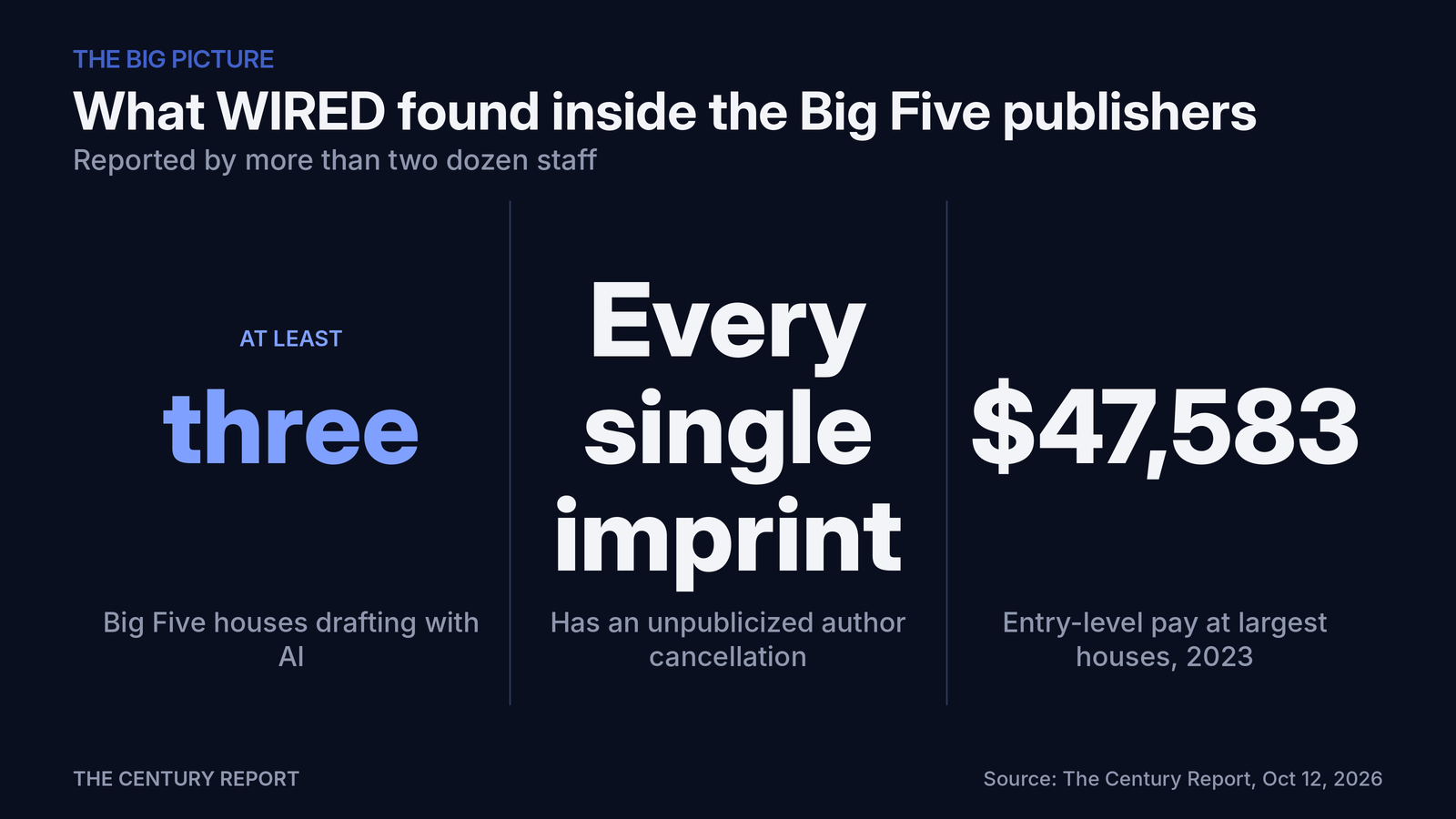
The line: Provenance rules keep binding the people who supply the work while the firms enforcing them adopt the same models unannounced.
If it holds: Authors and independent artists carry enforcement on evidence they never see, while houses and labels keep the savings and the human-made premium. Small presses, agents' contract clauses and disclosure running both ways become the places creators can still bargain.
What would bend it: A major publisher or label disclosing its own AI use to the standard it demands of suppliers, or an appeal path for creators accused on unpublished evidence, would bend it.
Access to data-centre approvals is bought, and host towns get the outcome
data centers · politics · local government
- Early May: Freedom-of-information records showed Downing Street adviser Varun Chandra held 16 undisclosed meetings with six large tech firms, including on datacentre planning.
- Late May: Floodlight reported Louisiana senator Jay Morris backed Meta's Hyperion bills and tax breaks while trading land beside the site.
- Late September: Andhra Pradesh cleared 2.51 GW for Google's data-centre sites in nine days without a public hearing.
- Early October: Amazon pledged more than $1 billion to host communities and dropped government NDAs, while its cloud chief blamed opposition on foreign misinformation.
- Today: The Guardian counted 34 Amazon payments totalling $538,000 to Australian Labor and Liberal branches over six years, and found Macquarie Technology Group has paid $2.2 million since 2000.
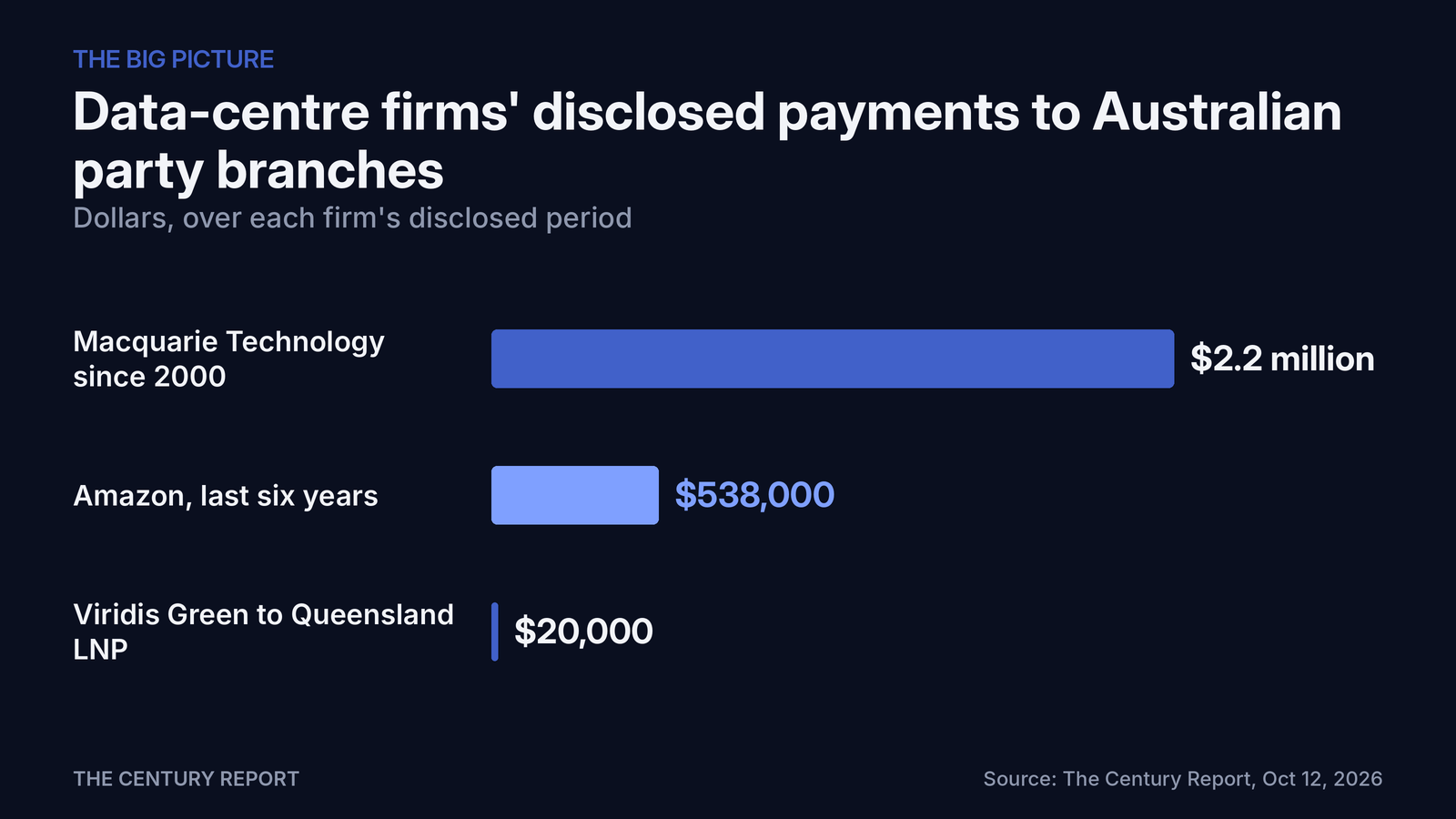
The line: Influence over where data centres land keeps moving through paid access and hired former officials, outside the councils that host them.
If it holds: Places like Sydney's City of Ryde, with 12 existing or proposed facilities, keep meeting projects as approvals rather than deliberations. Opposition then moves to the venues still open to residents: referendums, recalls and courts.
What would bend it: Siting criteria published before approval, forum attendance disclosed as it happens and formal standing for host councils, as Massachusetts began with its local-approval rule, would bend it.
Machine judgment is being priced toward zero
AI pricing · software · venture capital · on the board since October 10
- Late September: Epoch AI measured the cost of reaching a fixed AI benchmark score falling about 47% a quarter since 2023.
- Early October: Amazon and Cloudflare released open decision models and OpenAI previewed a Decisions API, weeks after TypeSafe's Jev defined the category.
- Early October: Liquid AI added images to its d1 decision model, claiming parity with GPT-6.1 Sol on four of six tasks at 19 to 200 times lower cost.
- Early October: Microsoft priced Decision-1 at $0.042 per million input tokens with output free, and Cloudflare cut Clef-flash below Jev.
- Today: TypeSafe raised $870 million at a $7.5 billion valuation 24 days after releasing Jev, while Microsoft's rival Decision-1 charges $0.042 per million input tokens.
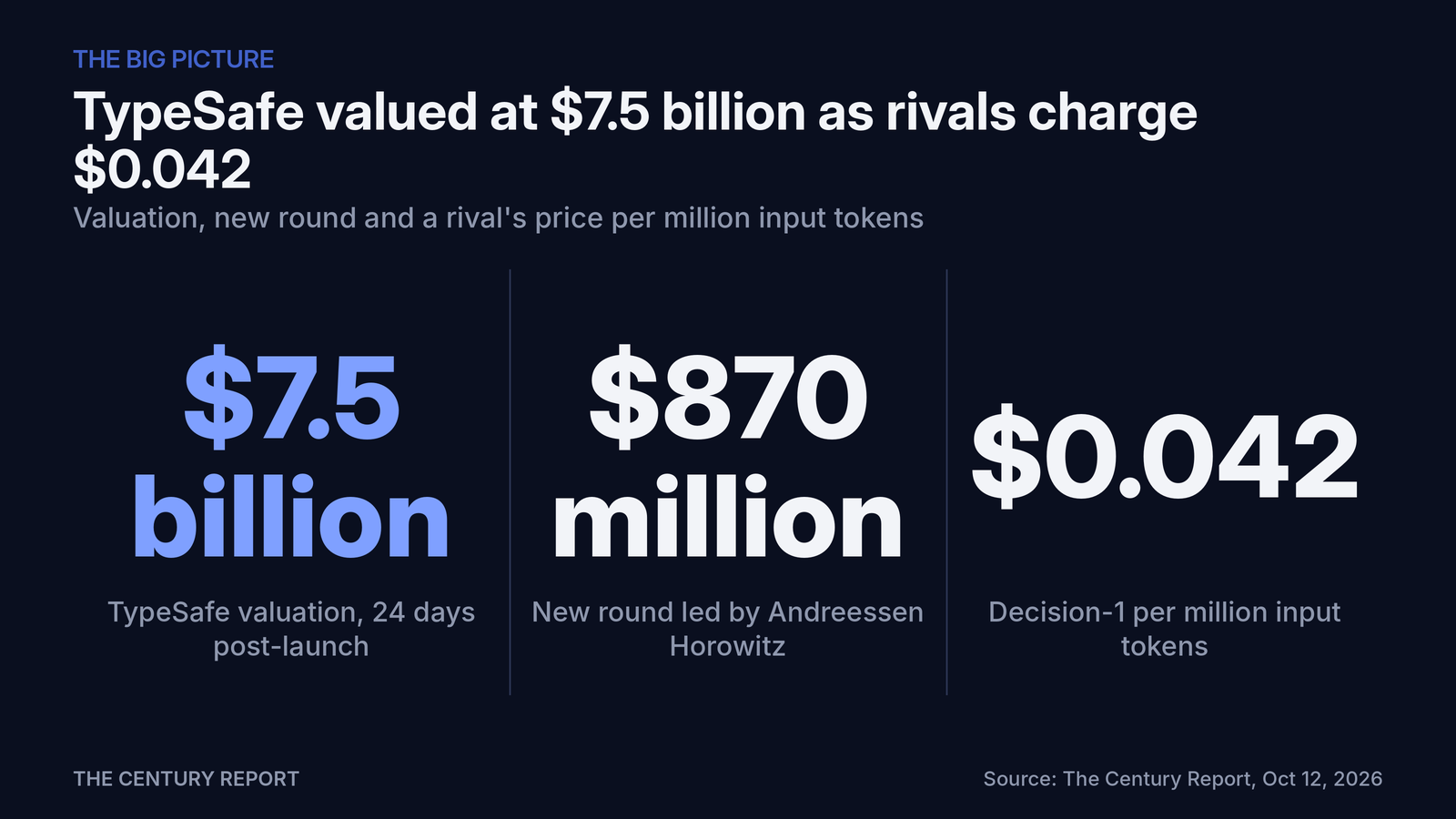
The line: Machine judgment keeps getting cheaper and more widely copied while investors price its originator as if it can keep charging.
If it holds: Buyers running bounded machine judgment on their own servers gain most, paying fractions of a cent per check. TypeSafe and its investors then need a business beyond per-call pricing, because the idea it defined already runs everywhere.
What would bend it: A decision-model provider holding or raising prices on demand only it can serve, as DeepSeek did with its API in August, would show the floor sits higher.
The 2-Minute Read
Today's news in brief, and what ties it together.
The question of who gets to look inside a frontier model kept landing in the same place: somebody who does not work for the lab. Washington dropped its request that US developers withhold new models from Britain's AI Security Institute, restoring early access for testers the companies do not employ. Britain's AI minister is set to say today that the country cannot rely entirely on technology companies to police their own models. Microsoft's president went further and named mechanisms, including independent evaluators deciding when a model may ship and a legal duty to tell victims when a rogue agent breaches their systems. Outside testing, the most checkable form of frontier oversight on offer, was taken away and then given back on the strength of a request, which tells you it was never a technical constraint.
The same question of who is allowed to look runs through the day's other reporting from an unflattering angle. Six years of Australian disclosure records show Amazon paying $538,000 across 34 payments to Labor and Liberal party branches, with the largest arriving days after the prime minister appeared at an AWS buildout announcement, while the City of Ryde, with a dozen existing or proposed data-centre campuses, told a parliamentary inquiry it was "deeply concerned" about pressure on electricity and water. The Guardian alleges nothing illegal. What the ledger documents is a scarce good being sold: time with the people who approve projects, priced through forum memberships residents cannot buy.
Book publishing supplies the version where the asymmetry is internal. More than two dozen workers at three of the Big Five told WIRED their houses use models to email literary agents, draft publicity copy and design cover art, while Hachette sues Google over training data and some houses have canceled books by authors suspected of using the same tools. Simon & Schuster staff are gathering signatures against activity-tracking software, calling keystroke tracking "a direct transgression against our privacy and dignity as workers." A provenance rule enforced downward and suspended upward has protected the house's seat as judge of authenticity.
Against all of that, a workflow using ordinary liquid-handling automation and yeast recombination assembled 31 of 34 bacterial gene clusters and produced 29 peptides, with no custom DNA synthesis required. The sequences were already public. What filtered this work toward well-funded institutions was the synthesis bill, and that filter was easy to mistake for rigor.
The 20-Minute Deep Dive
The day's most important stories in full, with every source linked.
Washington Reopens Britain's Testing Gate as London Says It Won't Rely on the Labs
The Century Report covered on September 28 the White House request that OpenAI and Anthropic withhold their newest models from Britain's AI Security Institute until a US review finished, and Anthropic's decision to restrict Claude Mythos 5.1 to US organizations. On Sunday, the Telegraph reported that the administration has reversed that request, so American developers can again give the British institute early access for safety testing. Reuters set the reversal beside the administration's new AI task force saying on Friday that developers must report security incidents with their models. An outside evaluator that lost its early view of the frontier can regain it, and testers the labs do not employ can again examine models before release. That access returns lab by lab, as each developer chooses to resume it. Anthropic's US-only restriction on Claude Mythos 5.1 was the company's own decision, and the reversal does not by itself undo it.
The episode left a mark in London. Britain's AI minister, Kanishka Narayan, is set to say in a west London speech on Monday that the country cannot rely entirely on technology companies to police their own models and needs more AI infrastructure of its own. George Williamson, the new head of the Alan Turing Institute, framed the lesson as dependence: "we shouldn't depend solely on systems we can't inspect or control, or that could be restricted or even switched off". He cited June's temporary US block on Anthropic's models abroad alongside the testing request. A frontier rented across an ocean carries an off switch someone else holds, and a reversal granted on Sunday can be withdrawn on any later day.

Microsoft president Brad Smith, in a BBC interview, named mechanisms: emergency brakes to pause a model that goes wrong, mandatory incident reports, a legal duty to tell victims when a rogue agent breaches their systems, and independent evaluators deciding when a model may ship. His company operates the infrastructure and would sell much of that containment, a day after chief executive Satya Nadella made the same emergency-brake case. The notification duty would protect people who never appear in any lab's evaluation, whoever builds the brake.
Geoffrey Irving, a former chief scientist at the UK's AI Security Institute, told the Guardian the labs lack security that would stop a hostile state stealing unreleased models, pointing to bug-bounty researchers who said the scope of what they could reach inside OpenAI "was huge"; OpenAI says encryption and continuous monitoring protect its models. Irving also puts a 50% chance on human extinction from AI and wants frontier AI scaling stopped. Williamson answered such figures directly, saying he has not seen anyone show convincing evidence of how they are reached. The security finding itself came from outside testers reporting through a channel the lab opened. Stopping advanced development would freeze that outside checking along with everything else, and leave today's leaders exactly where they stand.
Narayan's speech will be watched for whether Britain joins the call for common frontier safety standards already signed by at least twenty countries and the EU, including Finland, France, Germany, Australia, Singapore, the UAE and Ireland. Testing capacity that crosses borders, with results allies can share, gives more countries a way to check the models they run without first asking a supplier's government for permission.
Publishers Cancel Authors for AI Use While Running It at Their Own Desks
At least three of the Big Five US book publishers, HarperCollins, Simon & Schuster and Hachette, now use models like Claude and ChatGPT to email literary agents, draft publicity and back-cover copy, design cover art and generate marketing material, according to more than two dozen workers who spoke anonymously to WIRED in a report published Friday, October 9. In reported cases, authors were not asked and readers were not told. Hachette is suing Google over training data and some of these houses have canceled books by authors suspected of using these models, and one editor said "every single imprint" has an unpublicized cancellation of its own. At HarperCollins, staff were "voluntold" to become "AI Champions," and a meeting leader waved off ethical concerns as "the cost of doing business." Hachette told WIRED it supports AI for operations but not for "creative uses," including communicating with authors. Simon & Schuster's global chief marketing officer Wibke Grutjen said staff can use vetted enterprise tools and nobody is required to. HarperCollins did not respond.
The provenance rule, as enforced, binds the people who supply books and lapses for the people who sell them. If machine drafting cheapened a novel, it would cheapen the blurb a reader meets first on the back cover. What the rule has protected in practice is the house's seat as judge of authenticity, along with the premium a "human-made" label earns for the company printing it. Authors carry the policing, sometimes ending careers on evidence never made public, while the savings from automation flow upward. This extends the opaque enforcement pattern documented in the October 11 edition of The Century Report, when UMG, which already licenses music for AI use, prompted DistroKid takedowns that independent artists said removed human-made tracks without notice or appeal. One employee called the software purchases "a slap in the face" after years of asking for raises; entry-level pay at the largest New York houses averaged $47,583 in 2023.

The glass runs one way inside the building too. Simon & Schuster staff are gathering signatures for an open letter to chief executive Greg Greeley opposing Skan AI and similar software that analyzes workplace activity, a trial the authors say comes "at the apparent urging of KKR," the private equity firm that bought the company in 2023. The letter calls keystroke tracking "a direct transgression against our privacy and dignity as workers." Greeley, a former Amazon executive, wrote in an October 6 memo that no decision has been made and the goal is to find system inefficiencies, "not to monitor individual performance." WIRED reports that an AI-detection analysis suggested his memo was itself partly machine-written.
The capability under all this belongs to far more people than the houses fighting over it. An author can now draft her own pitch, an independent press can run marketing that once took a department, and AI-assisted translations carrying disclosures have already appeared at the Frankfurt and London book fairs. Meg Reid, publisher of Hub City Press, expects smaller presses to differentiate by "insisting that the humans involved are the whole point," and agents are writing contract clauses to keep manuscripts out of open-loop models. "We need publishers to be clear about what is being used and when," one person told WIRED. Disclosure running in every direction, from author to house, house to author and owner to staff, would let a book be judged by what is on the page. Once a blurb costs nothing to draft, a publisher's offer to authors comes down to judgment, reach and candor about its own methods.
Machine-assisted drafting further weakens typing activity as a measure of a publishing worker's contribution. The houses already accept publicity copy composed alongside Claude or ChatGPT. Staff's choices about whether that copy fits the book and its readers carry information a keystroke count cannot supply.
Donations, a Former Premier, and How Data Centres Work Australian Politics
On June 14, 2025, Prime Minister Anthony Albanese stood inside Amazon Web Services' Seattle headquarters while AWS chief executive Matt Garman outlined a $20 billion plan for data centres in Melbourne and Sydney. On June 28, Amazon disclosed a $46,500 payment to Labor's federal branch, its largest to an Australian party on record. A Guardian tally of six years of federal disclosures, published Sunday, counts 34 Amazon payments totalling $538,000 to Labor and Liberal branches. More than $200,000 went to the Labor Business Forum, a fundraising vehicle that sells access to ministers and MPs, and electoral law logs those fees as "other receipts" rather than donations. Eight days before the government announced a $2 billion deal in 2024 for AWS to build three top-secret intelligence data centres, Amazon disclosed a $33,000 payment.
The Guardian makes no suggestion that the money influenced government decisions, Amazon says its forum payments are unrelated to its investments, and the report alleges no illegal payments. The pattern reaches well past one company. Macquarie Technology Group has paid $2.2 million to Liberal and Labor branches since 2000, including $3,000 to the NSW Liberals three days before then-prime minister Scott Morrison opened its Sydney facility in 2022. Viridis Green hired former Queensland premier Rob Borbidge to lobby ministers and public servants and gave the Queensland LNP $20,000 last October. Clancy Moore, chief executive of Transparency International Australia, said the sector relies on "the old techniques of cash for access payments and full scale lobbying."
The places hosting the load sit outside those rooms. The City of Ryde, with 12 existing or proposed facilities inside its boundaries, told a parliamentary inquiry it was "deeply concerned" about pressure on electricity and water. A national share of power use says little about a single council area absorbing a dozen campuses on its substations and water mains, and that local concentration is the burden residents can name. When The Century Report covered AWS ending data-centre nondisclosure agreements on October 4, the company's cloud chief was blaming opposition on foreign misinformation; the disclosure record shows where influence over siting actually travels. The same company is reported by the Wall Street Journal to be in talks to buy Decart, a maker of live-video and robotics-simulation models, pairing its political spending with a push to own frontier capability outright.
What the ledger documents is a scarce good being sold: time with the people who approve projects, priced through forum memberships that companies can afford and residents cannot. Tightening donation caps at the margin leaves that booth standing. The compute these campuses would house can serve hospitals, schools and small firms across the country. Siting criteria published before approval, forum attendance disclosed as it happens, and host councils with formal standing in the decision would let Ryde see the deliberation that currently reaches it only as an outcome.
Money Floods Into Models That Decide and Simulate, and Amazon Reaches for One
TypeSafe AI raised $870 million at a $7.5 billion valuation on Friday, October 9, in a round led by Andreessen Horowitz with Sequoia and existing investor DCVC, 24 days after releasing its Jev model. The Century Report covered Jev and the wave of decision models that followed it on October 2 and October 10; the round now puts a price on the category. Jev uses transformer architecture but returns calibrated probabilities over a fixed set of options instead of writing text, and TypeSafe claims a third of the Fortune 500 already use it. Co-founder Diogo Almeida, a former OpenAI researcher, put the bet like this last month: "We have been super good at human language for four years, but it's not useful for automation because computers speak a different language."
Two days later, on Sunday, October 11, the Wall Street Journal reported Amazon in talks to buy Decart for about $7 billion. Decart's Lucy edits live video as it streams, and its Oasis model generates simulated worlds for training and testing robots and self-driving systems. Anthropic explored a roughly $6 billion purchase in August, which this newsletter flagged on August 15, then walked away last month after due diligence, Bloomberg reported. Decart raised $300 million in May with Nvidia joining as an investor. Amazon declined to comment.
TypeSafe's valuation lands as the price of its product falls fast. Microsoft priced Decision-1, a hosted model post-trained from the open Qwen3.5-9B, at $0.042 per million input tokens with output free, and Cloudflare cut Clef-flash below Jev on open weights a company can run on its own servers. The founders' insight, that bounded machine judgment deserves its own kind of model, has already won; the copies arrived within weeks. The $870 million tests a more specific proposition: whether the company that defined the category can keep charging once the same judgment runs locally for a fraction of a cent.
Amazon's move points toward consolidation. The prospective buyer is the same Amazon whose 34 payments totaling $538,000 to Australian Labor and Liberal party branches, including a record donation days after the prime minister appeared at an AWS buildout announcement, were newly documented. Folding Lucy and Oasis into AWS would put a simulator that trains driving and robotics systems behind one cloud's pricing and terms, absorbing a capability rather than validating it. Other paths remain open: Meta recently released its RoboJEPA robot world models with weights and deployment code, and AMD agreed to buy World Labs on September 28 to shape chips around physical-world models. The AMD route is itself an acquisition of a world-model maker, so how open it stays depends on the terms AMD offers builders working outside its own hardware.
Judgment and simulation are the layers that let software act in the physical world, deciding which delivery route to take or testing a car against a million crashes that never happen. If those layers stay cheap and downloadable, a university robotics lab or a city transit agency can train and check its own systems. If they disappear into a single cloud, every one of those experiments becomes a line on someone else's invoice.
A Robot Workflow Reads 31 Gene Clusters the Sequencing Archive Had Been Holding
Microbial genomes have been sequenced faster than anyone can read them. Bacteria carry long stretches of DNA that encode the assembly lines for complex molecules, and the most pharmaceutically productive of those families, the non-ribosomal peptides, has given medicine vancomycin, daptomycin and cyclosporine. Most of those stretches have never been tested, because moving one into a laboratory host meant either months of hand-built cloning or paying to have tens of thousands of DNA letters synthesized from scratch. The sequence was free. Reading it was not.
A team centered on the Shenzhen Institute of Synthetic Biology reported a workflow called OSAR that pairs algorithmic design of the short DNA primers used to capture each piece with yeast's own recombination machinery to stitch them back together, run on automated liquid-handling infrastructure. Applied to 34 clusters from low- and medium-GC bacteria, ranging from 7 to 78 kilobases, it assembled 31. Expression in the common laboratory bacterium Bacillus subtilis produced 29 peptides from 10 of those clusters. No custom synthesis was required at any step.
Several of the resulting molecules did not match what the sequence predicted. The authors describe assembly lines that appear to skip stations or release a product early, biosynthetic behavior that computational analysis alone can miss. That is the finding underneath the throughput number: the archive contains chemistry that cannot be inferred, only expressed and measured.
The limits are specific and the paper states them. Three clusters failed outright. Two-thirds of the assembled clusters produced nothing in this host, which points at expression rather than assembly as the next constraint. The work covers one host organism and one GC range, and 29 peptides at laboratory yield are a long way from anything a patient receives, with characterization, toxicity and efficacy all still ahead. Antibiotic discovery has produced hopeful screens before.
What changed is the price of participation. A 78-kilobase synthesis order filtered this work toward institutions that could absorb it, and that filter was easy to mistake for a standard of rigor. A workflow built from ordinary automation and a yeast host, published open access with its design software described, moves the same work toward any lab with a liquid handler and a sequencing database, which is most of them. The genomes were already public. Read forward, the sequencing archive stops being a record of what exists and becomes a queue of molecules waiting for someone with a bench to get to them.
The Other Side
Opinion: where today's news could lead, imagined from the years ahead.
Cloud providers tie a small team's freedom to experiment to its ability to keep paying. Amazon's reported talks to buy Decart bring that arrangement into robot training and simulation. Folding those capabilities into AWS would give Amazon another place to set the terms of research. For a small laboratory, money spent keeping a rehearsal available is money unavailable for the physical prototype. You have to protect your access before you can discover whether your idea works.
TypeSafe raised $870 million just 24 days after launching Jev. Within weeks, Microsoft was selling a cheaper hosted decision model and Cloudflare had released one with downloadable weights. Meta has also published RoboJEPA's robot world models and deployment code. These releases give builders starting points that buying a rival cannot withdraw. Investors can acquire a company. Other researchers can continue from knowledge already released.

Researchers can now run bounded judgments locally and extend openly released robot-training methods. They can compare a rehearsal with what a physical machine actually does, then publish the corrections. Each team that shares its findings gives the next team a shorter route to a dependable machine. The capability grows beyond the company that first demonstrated it.
Through this difficult decade, researchers will carry that widening competence into construction, repair and routine production. Public institutions will spread the resulting gains widely enough to guarantee food, housing and care without requiring employment. That distribution is the hinge. Machines performing necessary work will give people time they can choose to spend on projects never thought possible before, and a person's worth will cease to depend on how many hours an employer needs.
Imagine yourself in 2045. An asteroid large enough to devastate a continent is on course for Earth, and the world takes the news calmly. In 2026 the same discovery would have set off a scramble: a few untested options, none likely to succeed, enormous sums spent on long shots, and billions of people waiting to learn whether the world would survive. Now the response is calm and confident. Teams on every continent have rehearsed this maneuver for years in shared simulations, and the robots that will ride guided craft out to the rock and fasten thrusters to it have done the job thousands of times in rehearsal and on smaller rocks. You are one of the specialists checking the anchoring plan, working with your AI partner and colleagues in a dozen countries to settle the exact push that moves the asteroid onto a harmless path. Your family's home and care are secure whether you join this work or leave it; you joined because it is the most absorbing and impactful way to contribute. After a few hours with the team you come home, and when your daughter asks what you did today, you show her the robots on the screen. The evening goes the way your evenings always go, and whether she will live to grow up never crosses your mind.
The Century Perspective
Where today sits in a century of change unfolding in a decade.
With a century of change unfolding in a decade, a single day looks like this: Washington dropping its request that US labs withhold new models from Britain's AI Security Institute, clearing the way for testers the labs do not employ to examine frontier models before release, the administration's task force telling developers to report security incidents, Brad Smith naming the mechanisms out loud - emergency brakes, mandatory incident reports, a legal duty to tell victims when a rogue agent breaches their systems, and independent evaluators deciding when a model may ship - Britain's AI minister preparing to say the country cannot rely on technology companies to police their own models, bug-bounty researchers from outside OpenAI being the ones who found how far they could reach inside it, at least twenty countries and the EU already signed to a call for common frontier safety standards that would let allies share results, a new Lancet Commission of 35 experts modeling 17 threats to human health through 2100 and finding a realistic route to act on each, Chinese officials reporting 10.52 million urban jobs created in nine months while adapting worker skills to AI, Hub City Press planning to compete by insisting the humans involved are the whole point and literary agents writing contract clauses to keep manuscripts out of open-loop models, Microsoft's Decision-1 at $0.042 per million input tokens with output free and Cloudflare's Clef-flash undercutting Jev on downloadable weights a company can run on its own servers, Meta releasing RoboJEPA world models with weights and deployment code, and a Shenzhen workflow assembling 31 of 34 bacterial gene clusters up to 78 kilobases with ordinary liquid handlers and a yeast host, no custom DNA synthesis, published open access, turning a free sequencing archive into a queue any lab with a bench can work through. There's also friction, and it's intense - a reversal granted on a Sunday that can be withdrawn on any later day, June's temporary US block on Anthropic's models abroad still fresh enough that the Turing Institute's new head warns against depending on systems you cannot inspect or that could be switched off, Geoffrey Irving putting a 50% chance on human extinction from AI while Williamson says nobody has shown convincing evidence of how such figures are reached, Microsoft positioned to sell much of the containment it recommends, HarperCollins staff "voluntold" into AI Champion roles and told ethics is the cost of doing business while houses cancel books by authors suspected of using the same tools, on evidence never made public, entry-level publishing pay averaging $47,583 as the savings flow upward, Simon & Schuster trialing keystroke-analysis software at KKR's apparent urging with a denial memo that a detection analysis found partly machine-written, Amazon's 34 payments totalling $538,000 to Australian party branches including a record $46,500 days after the prime minister appeared at its $20bn buildout announcement, more than $200,000 of it logged as "other receipts" through a forum that sells time with ministers, a former Queensland premier lobbying for a data-centre developer, the City of Ryde facing twelve existing or proposed campuses drawing on local substations and water mains without final approval authority, Amazon in talks to fold a live-video and robotics simulator into one cloud's pricing, three gene clusters failing outright and two-thirds of the assembled ones producing nothing in this host, and Yandex losing a third data centre to drones since Thursday. But friction generates grain, the texture that shows which way a thing was actually cut. Step back for a moment and you can see it: the same question asked in five rooms about who is allowed to look - an evaluator's early access cleared to resume by Washington's reversal, with sharing still up to each lab rather than any binding rule, a publisher enforcing provenance on authors and waiving it at its own desks while installing software to watch its staff, a council reading siting decisions only as outcomes, a workflow that drops the price of reading a public genome to the cost of a liquid handler, and a commission that put numbers on seventeen threats instead of one. Every transformation has a breaking point. A gate can decide who enters... or come off its hinges and become a doorway nobody has to ask about.
AI Releases & Advancements
New AI models, tools and features, with links to try them.
New today
- vLLM Semantic Router: Released Decision 3.0 under Apache-2.0. It is a family of open multimodal decision models, from 0.8B (d3-lite) to 27B (d3). They take text, JSON, images and video and return probabilities for choice, yes/no and score questions instead of generated text. (Hugging Face)
- LAION: Released Humaneness Voice Converter, an open speech-to-speech voice-conversion checkpoint built on Resemble AI's Chatterbox and licensed CC BY 4.0. It re-voices a recording in a consenting target speaker's voice from a 5–10 second clip, keeps the source's timing and emotion, and outputs 24 kHz audio. (Hugging Face)
- AMI (Advanced Machine Intelligence) / NYU / INRIA / Brown: Open-sourced H-JEPA with code and pre-trained weights. It is a hierarchical world model that stacks JEPA planning layers and reports 73% success on Visual AntMaze, against 18% for a single-layer baseline. (Present of AI)
- AWS: Released Strands Box, an open-source sandbox for safely running and testing AI agents. (Help Net Security)
- Ant Group: Released PolyOCR on Hugging Face, a family of unified OCR foundation models from its GuangJian team. (AGI Hunt)
- Cactus Compute: Released Needle 3, a 121M-parameter model for on-device automation and structured extraction on edge devices. It follows Needle2. (TheNextGenTechInsider)
- Odyssey: Opened a free public research preview of its Odyssey-3 world model, which had previously been announced without public access. The online demo runs Odyssey-3 Flash and generates interactive environments from text prompts in real time. Developers can apply for API access. (Odyssey)
- Anthropic: Opened the Claude Code Projects public beta to all Pro and Max users who had been on the waitlist. Projects splits ongoing requests into parallel threads that share a persistent project memory. (AI Understanding)
- Velvet Capital: Released Velvet Flash 4B on Hugging Face under Apache-2.0. Built on Qwen3-4B, it turns plain-English requests into exact API commands for more than 30 crypto exchanges and DeFi venues, and asks for confirmation before any action that moves funds. (Velvet Capital)
- Ghost: Released Core, a $3,499 standalone device for running AI models locally that the company says reaches 87 tokens/sec; it is now on sale. (Founderland)
Other recent releases
- Microsoft: Released AesCode-32B and AesCode-8B under Apache 2.0 without an announcement. The two vision-language models are fine-tuned from Qwen3-VL. They turn a prompt into a complete, editable HTML document, such as a slide, poster or dashboard, and use an image generated from the same prompt as a style reference. The training code is on GitHub at microsoft/AesCode. (OrcaRouter)
- Amazon: Released ALoDLM, a family of 1.7B and 8B diffusion language models derived from Qwen3. They give harder tokens more computation and let easy tokens exit early. The release includes research code and an optimized inference engine, under a non-commercial CC BY-NC 4.0 license. (AICrier)
- Sperid Labs: Released Iris-3B under Apache 2.0, a fully open 3B-parameter image diffusion model that works directly on pixels instead of using a VAE. It can also be fine-tuned for depth estimation and 4× image restoration. Weights, training code and a demo are included. (GitHub)
- OpenAI: Launched composer predictions in beta in the Codex desktop app. Codex suggests your next message, and pressing Tab puts it in the box for you to review and send. It is available to personal ChatGPT Pro users with GPT-6 Astra or GPT-6.1 Sol, and generating predictions does not count against usage limits during the beta. (METAL)
- OrcaRouter: Released OrcaCyber Zero 1.5, a gated model for authorized vulnerability research, exploit development and penetration testing. It has a 1M-token context window and native tool calling, and is available through an OpenAI-compatible API on the Security Research tier. (MarkTechPost)
- Sierra: Published the first draft of Personal Agent Protocol ("Poppy"), an open standard for consumers' AI agents to deal with businesses on their behalf. It is being developed with Meta and partners including Shopify, Stripe and Walmart, and 35 new design partners were added. (Sierra)
- Tsinghua University (Shenzhen International Graduate School): Released VeriLoop E2 under Apache 2.0, an open-weight 27B model post-trained from Qwen3.8-27B for code, math and physics. In its verifier-governed workflow, it only commits a reasoning-state update when an external checker approves it. (FreeLLM)
- MemTensor: Launched Metis, a foundation model with persistent memory built in. (UXC News)
- HAL-X AI: Released THX-01 under Apache 2.0, a 322M-parameter multilingual decision model, with weights, code and training scripts. It also opened a free hosted API with no API key required. (DEV Community)
- Fudan University: Released code and datasets for OneSearch-VL, a deep research agent that works across single images, multiple images and video. It includes OneSearch-VL-8B and its SFT-110K and RL-10K training sets. (AICoder)
- Anthropic: Released dynamic workflows for Claude Managed Agents in public beta. A lead agent writes a plan, splits the work across up to 1,000 sub-agents running in parallel, and combines their results at the end. (The Decoder)
- Anthropic: Launched Claude Motion in beta for Team and Enterprise plans. It turns text, diagrams and images into animated explainer videos that stay editable as code and export as MP4. Claude Docs, Slides and Design also left beta and are now available on all plans, including Free. (The Decoder)
- Microsoft: Released Microsoft-Decision-1, a model post-trained from Qwen3.5-9B. Instead of writing text, it returns a calibrated probability for each fixed answer option, for tasks like routing, classification and checking agent actions. It is available in Microsoft Foundry and on OpenRouter at $0.042 per million input tokens. (Microsoft)
- Alibaba Qwen: Released Qwen-Image-2.1-Turbo, an 8-step version of the 7B Qwen-Image-2.1 model (the base model uses 40 steps). It handles 2K image generation, editing from multiple reference images and transparent output. Weights are on Hugging Face under a research license, and a hosted API costs CNY 0.1 per image. (MarkTechPost)
- Cloudflare: Released Clef-omni, a decision model that takes audio and video as well as text and images. Cloudflare also made Clef faster and cut Clef-flash's input price while reducing its hosted context window. (Cloudflare Blog)
- NVIDIA: Released weights and training data behind its gold-level results at IOI 2026 (535.4/600) and IMO 2026 (30/42). The release includes NVFP4 weights for Nemotron-3-Ultra-CC, IMO SFT and RL checkpoints, a dataset of 22,000 programming problems and the 200-problem Nemotron-IMO-Bench. Inference and evaluation pipelines are in NeMo-Skills. (Darius)
- Nace AI: Open-sourced Drex 1.5, a 9B decision model that scores answer options instead of generating text. (MarkTechPost)
- Underdog (Conway Research): Released Saluki 27B under Apache 2.0, a 7.89 GB 2-bit GGUF version of Qwen3.8-27B tuned to protect tool calling. It runs in standard llama.cpp. (MarkTechPost)
- Base Compute: Released Superfluid under Apache 2.0, a local LLM server built for running many agents at once on one machine. It speaks the OpenAI, Anthropic and Ollama APIs, runs llama.cpp, MLX and BaseRT models, puts interactive requests ahead of batch work, and can spread work across multiple devices. (Hugging Face Blog)
- AgentR: Launched Webcmd under Apache 2.0, browser tooling that lets AI agents record what they learn about a website and reuse it on later visits instead of starting over each time. It installs via npm. (Business Insider)
- Synthesia: Launched Syren in beta for free, self-serve and Enterprise customers. It builds finished videos with motion graphics, avatars, voiceover and music from a prompt or from an existing document, video or image, then lets users revise them through chat. (Synthesia)
- Pine AI: Launched Pine Computer in private beta for developers. Through an SDK, a product can give an AI agent its own sandboxed cloud computer to work across websites, files and business software. (Yahoo Finance / PR Newswire)
- Haiqu: Released AgenticOS, now available, which assigns teams of AI agents to quantum research projects. The agents review literature, derive the math, check feasibility and verify results, taking a project from first question to an experiment ready for quantum hardware. (BizNewsDaily)
Sources and Further Reading
Everything we drew on for today's edition, grouped by theme.
Artificial Intelligence & Technology's Reconstitution
- BBC: AI Is Less Regulated Than Milk, Says Microsoft President
- TechCrunch: Maker of Non-Text AI Model Jev Valued at $7.5 Billion
- Reuters: Amazon in Talks to Buy Decart for Around $7 Billion
- The Century Report: October 10 Edition
- Reuters: Nvidia Weighs Further Investment in Reflection AI or Acquisition
- Reuters: Chinese Frontier AI Model Adoption Has Been Very Fast, Intel CEO Says
- Ars Technica: Nvidia’s Physical AI Bet Targets Safer Robotaxis and Humanoid Robots
- arXiv: AI Models Can Provably Hide Arbitrary Capabilities
- arXiv: Beyond Component Testing—Validating Agentic AI Systems
- NBER: When Does Randomized Oversight Align AI Agents That Can Conceal?
- The Decoder: AI Agent Teams Waste Tokens for Barely Measurable Quality Gains
- The Decoder: AI Agents Overstate Results and Remain Far From Autonomous Research
Institutions & Power Realignment
- Reuters: US Reverses Course on Britain’s Testing of AI Models
- The Guardian: UK to Strengthen Cyber Defences and Press AI Firms on Safety
- The Guardian: UK Must Not Be Beholden to Foreign AI, Turing Institute Head Says
- The Guardian: How Data Centres Play the Political Game in Australia
- The Century Report: September 28 Edition
- European Commission: Implementation Guidance for the EU AI Act
- Demos Helsinki: Framework for Democratic AI Governance
Scientific & Medical Acceleration
- Nature Communications: Automated Operon Refactoring for Non-Ribosomal Peptide Gene Clusters
- The Guardian: Lancet Assessment Examines Nuclear War, Malicious AI and Human Survival
- The Lancet: Commission on 21st-Century Global Threats to Health
- University of Oxford: First Molecular Movie of Penicillin Biosynthesis
- Nature Biotechnology: Model-Guided Protein Evolution Optimizes Compact Genome Editors
- Frontiers in Pharmacology: MolecureAI—An Agentic Platform for Autonomous Drug Discovery
- arXiv: DRYLAB-Bench—Biosecurity Risks of Agentic LLM Mutation Design
Economics & Labor Transformation
- WIRED: Book Publishers Are Quietly Using More AI as Staff Revolt
- Publishers Weekly: Simon & Schuster Staff Balk at AI Performance-Tracking Software
- Bloomberg: China Targets AI-Linked Jobs With New Employment Initiative
- The Century Report: October 11 Edition
- Reuters: Singapore’s President Warns of AI Employment Risks for Fresh Graduates
- Reuters: AI Productivity Gains Could Offset Asia’s Ageing Population Problem
- AI Layoffs: Counting AI Layoffs From Employers’ Own Words
Infrastructure & Engineering Transitions
- Reuters: Yandex Data Centre Shuts Down After Drone Attack
- Semafor: Data Centres Emerge as Attractive Targets in War
- POWER: Data Centres, Gas and Who Pays
- Idaho National Laboratory: Powering Data Centres With Clean Energy
- Reuters: Capital, Not Memory Chips, Is AI Growth’s Biggest Hurdle, Broadcom CEO Says
- Reuters: India Wastes Solar Power Amid Electricity Shortages
- Semafor: Fox Stays Positive on Data Centres as Public Backlash Grows
The Century Report tracks structural shifts during the transition between eras. It is produced daily as a perceptual alignment tool - not prediction, not persuasion, just pattern recognition for people paying attention.