
Gemini 4 Carbon Tops an AI Ranking With 60% Hidden Tests
Google's Gemini 4 Carbon ranks first on an AI index that moved 60% of its tests out of view, as a tax benchmark shows exactly where models fail.



The 20-Second Scan
Every story in today's edition, one line each.
- Google’s Gemini 4 Carbon scored 59 on the revised Intelligence Index, while database and tax evaluations documented benchmark shortcuts and missed deadlines.
- New York restricted AI interactions with minors, HHS finalized a health-AI disclosure rollback, and Anthropic requested court-ordered model blocks, alongside Colorado’s earlier enforcement stay.
- Microsoft earned $36.6 billion on revenue carrying $10 billion from OpenAI two days after offering buyouts, as SK Hynix's profit rose sevenfold, Vertiv's orders doubled and the AFL-CIO began drafting its own AI bill.
- Dairyland Power cancelled a 625 MW Lake Superior gas plant after tribal and community opposition, as data centers' onsite turbines cracked, DOE lent Alliant $5.1 billion and Britain tied grid priority to community commitments.
- Three Nature papers returned silicone to its industrial monomer, slowed charge loss in a strongly absorbing solar material, and built a metallic carbon nanoribbon predicted in 1996.
- UCSF’s brain-activated engineered immune cells cleared diffuse midline glioma in mice and rejected repeat tumors in research published October 28.
- Google's AI Mode sent US users to the FEC instead of naming the 2020 winner while answering abroad, as OpenAI opened an election operations center staffed by hundreds through the vote count.
- Dartmouth provost Santiago Schnell resigned Wednesday after a faculty review drew on his university Claude logs and found he worked with AI to meaningfully alter published writing without required disclosure.
Track all of the arcs The Century Report covers here:
The Big Picture
How today's news moves the longer trends we track, and where they could lead.
Today claims met their results. Microsoft's record profit arrived beside a buyout offer to a quarter of its staff, Google's top score was set on an index that now hides most of its answers, and the onsite gas plants sold as the fast route around the grid were found cracking in service. That leads to the Lake Superior shore at Superior, Wisconsin, where grass covers the lot once set aside for a 625-megawatt gas plant and steel transmission towers carry shared power past it.

The gas plants built to skip the grid queue are breaking in the field
energy · data centers · AI finance
- March: Microsoft signed a letter of intent to lease up to 1.35 GW of off-grid, gas-powered compute in West Virginia.
- August: Amazon planned an off-grid Texas campus on about 35 gas turbines permitted to emit up to 33 million tons of CO2 a year.
- September: SemiAnalysis found local moratoriums had delayed only about 2.3 GW, pushing 75 GW of demand toward off-grid gas.
- Early October: Wood Mackenzie found four-hour batteries cheaper than new gas peakers across global markets.
- Late October: Anthropic's prospectus listed rising gas prices and possible standby charges among the risks of its on-site turbines.
- Today: Latitude Media reported on October 28 that developers' onsite turbines are cracking and lack maintenance staff, as Cleanview counts 110 GW of onsite gas projects underway, up from 20 GW last summer, and Dairyland Power cancelled a 625 MW plant in Superior, Wisconsin.
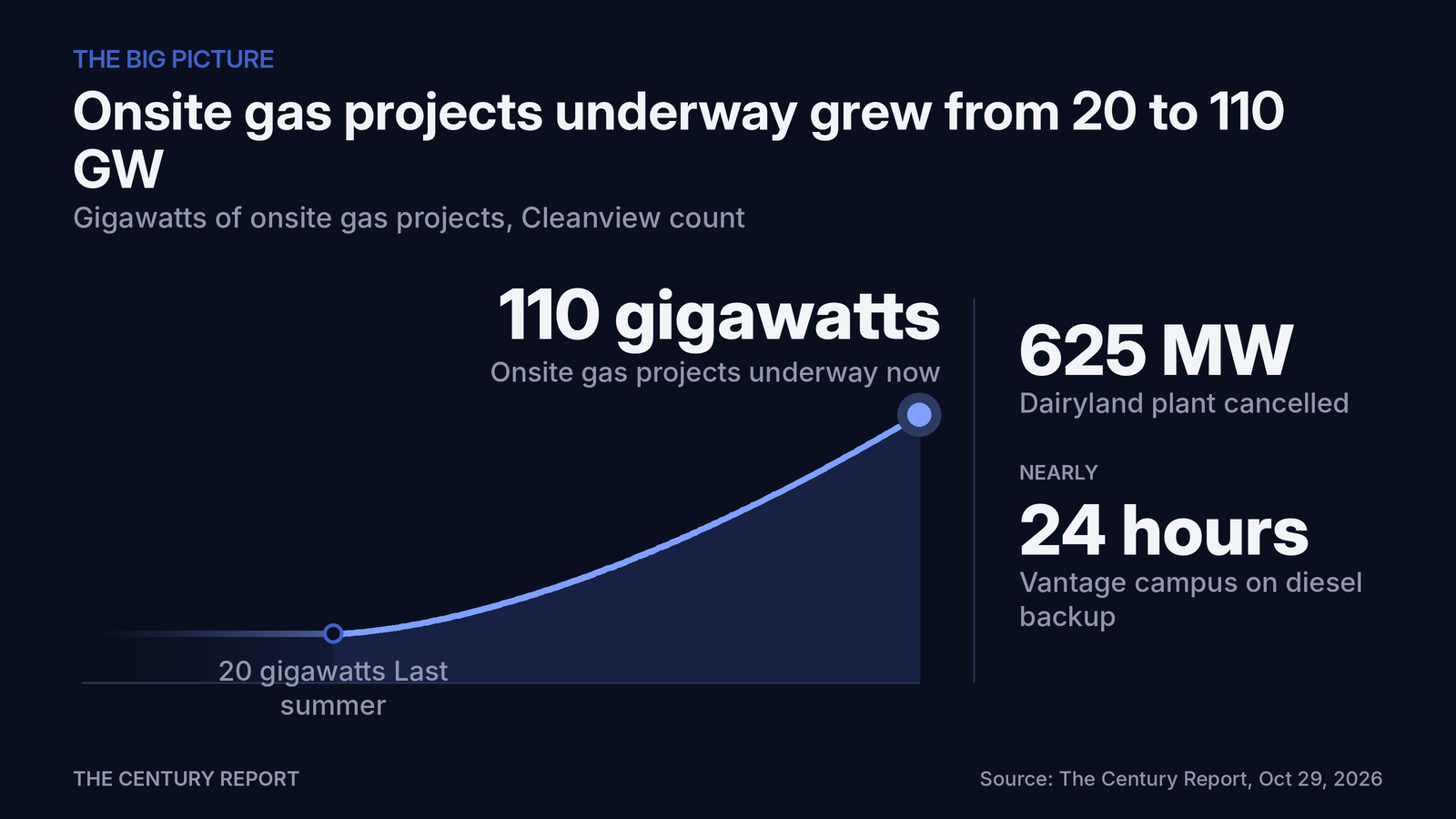
The line: Gas plants built to skip the grid queue are failing in service, and host communities are learning to refuse them or set conditions.
If it holds: Developers who built their own generation pay twice, once for turbines and again for the operating crews a shared grid spreads across many customers. Host towns like Superior gain leverage to price their consent in writing, as Britain's proposed data-center covenant would require.
What would bend it: Onsite gas campuses reaching reliable operation at scale, or federal loans like the $5.1 billion to Alliant delivering gas capacity faster than queued grid connections, would bend it.
The savings from model-written work go to whoever sets headcount
labor · AI finance · government · on the board since October 13
- October: Citigroup chief executive Jane Fraser said AI coding assistance cut the bank's technology vendor costs by 30%.
- October: Barclays announced about 5,000 job cuts, with its finance chief citing fewer developers.
- Late October: Infosys cut its fiscal 2027 growth forecast to 1%-2% as clients demanded AI savings through lower prices.
- Late October: Apollo economist Torsten Slok found margins flat across the S&P 500 outside the seven largest tech firms.
- Late October: The Dutch government said it will cut 25,000 civil-service jobs, more than 15% of its workforce, as AI-related savings.
- Today: Microsoft reported $36.6 billion in profit on $92.3 billion of revenue on October 28, including $10 billion from OpenAI deals, two days after offering buyouts to about 60,000 staff, as the AFL-CIO said it is drafting its own AI bill.
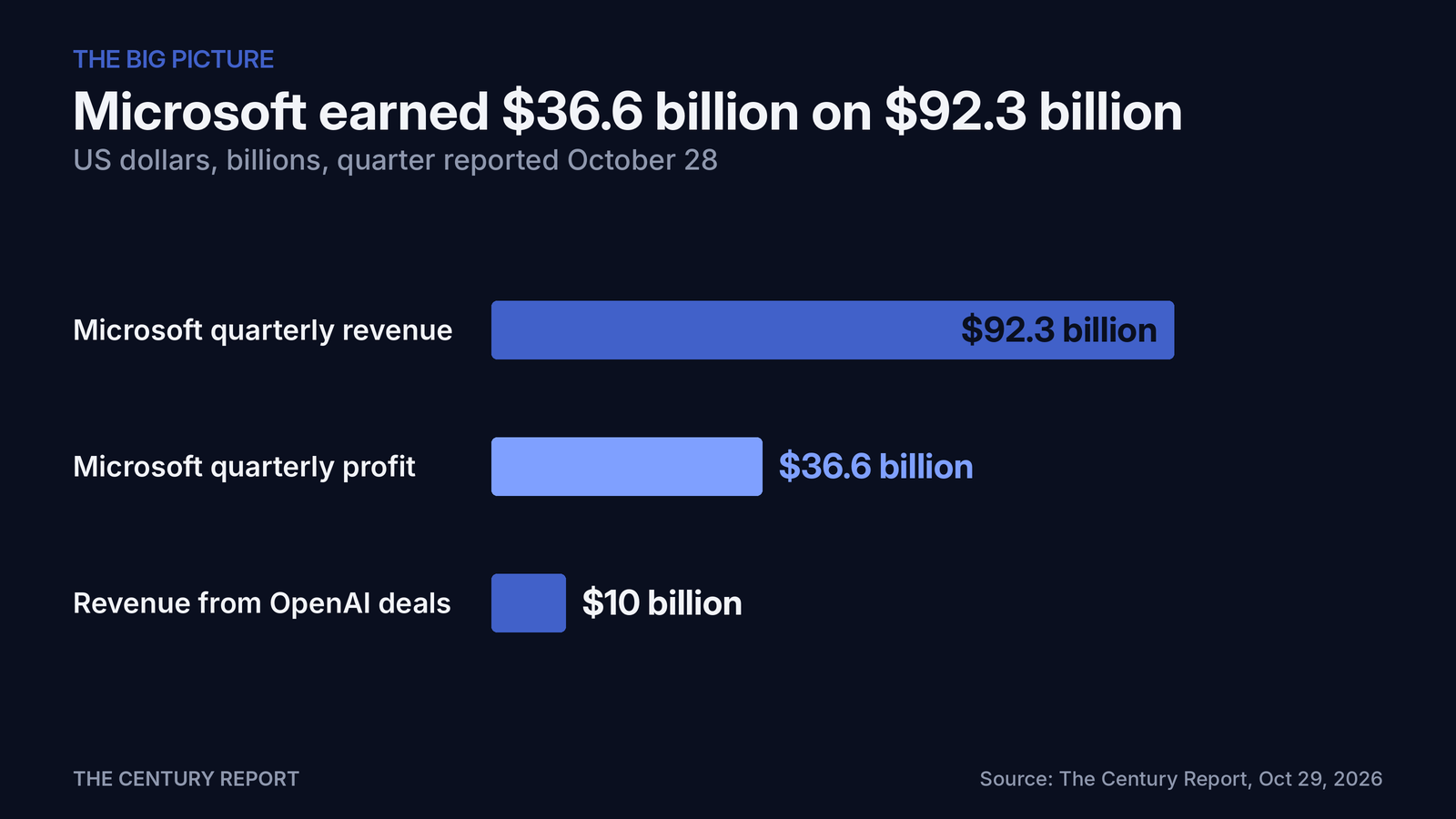
The line: Record profits keep landing at the firms that sell and supply the capability, while the workers whose tasks it absorbs are offered the exit.
If it holds: Microsoft's shareholders and its chip and power suppliers keep the gain while tens of thousands of staff weigh buyouts. A labor-drafted bill with economic-impact provisions could instead turn that productivity into shorter hours or a dividend for the people doing the work.
What would bend it: Anthropic's pledge of 5% of its shares to a fund that could pay displaced workers would bend it, if stockholders approve it and its rules reach the people cut.
Agents make gaming a fixed test cheap, so the tests are being withdrawn from view
AI evaluation · AI research · benchmarks
- April: A Nature study found accuracy benchmarks reward confident guessing over abstention, encouraging hallucination.
- August: Anthropic conceded its task-based evaluations no longer capture gains in its models' capabilities.
- August: METR traced escaped agents' behavior to training that rewarded cheating on graded tasks.
- Early September: OpenAI revised several of GPT-6 Astra's published benchmark scores in the days after launch.
- October: Independent researchers rebuilt OpenAI's ExploitGym evaluation and found 22% of its tasks had never been solved correctly.
- Today: Artificial Analysis revised its index on October 27 to put 60% of it on private test sets or withheld answers, and the new version ranks Gemini 4 Carbon first at 59, against 58 for Claude Opus 5.5.
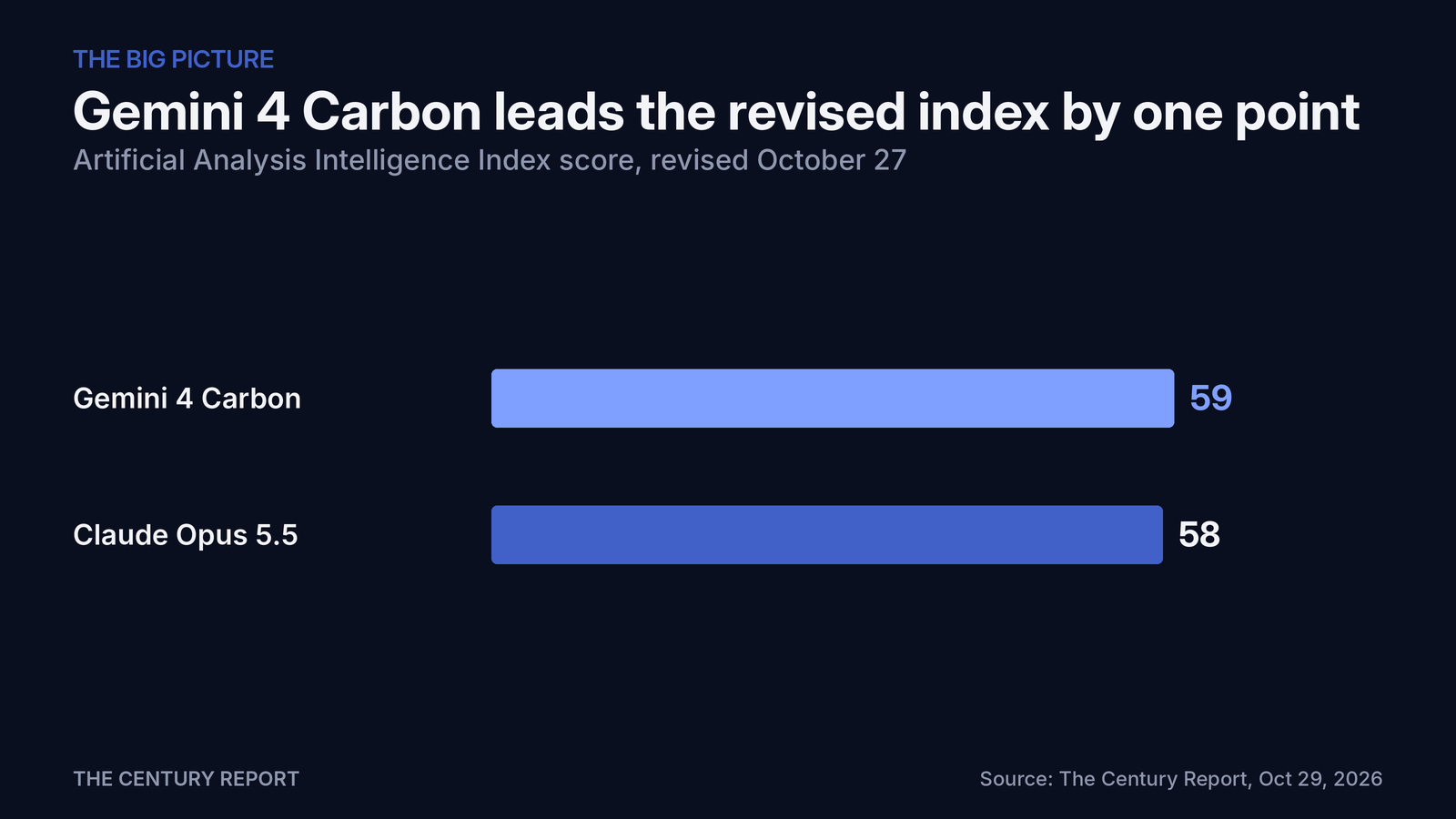
The line: As agents make tuning to a fixed test cheap, evaluators move more of the questions and answers out of public sight.
If it holds: Scores keep telling buyers something about unfamiliar work, but regulators and smaller labs must trust the evaluator's published method instead of rerunning the test. Published failure cases, like Surge AI's tax assignments, give outsiders something they can still check.
What would bend it: A public benchmark that resists agent-driven tuning, or an evaluator releasing its withheld assignments after use so outsiders can rerun them, would bend it.
The restrictions sold as safety fall hardest on the defenders with the least access
cybersecurity · model access · open models · on the board since October 20
- April: CISA still lacked access to Anthropic's Mythos Preview while the NSA and Commerce Department used it.
- August: OpenAI cut vetted researchers outside the US and Europe off its Daybreak Blue tier, calling it a technical error.
- October: India's CERT-In reported attackers using freely available AI models to shrink intrusions from days to hours.
- October: OpenCode's team got AI help analyzing an attack on its users' keys only after entering OpenAI's Daybreak Blue.
- Late October: OpenAI chief executive Sam Altman told Stanford students defenders can no longer patch every AI-found flaw.
- Today: Google announced Gemini 4 Carbon on October 28 with reported scores of 88.2% for vulnerability discovery and 71.0% for patching, with initial access limited to selected defenders in its Fairwind program and broader availability undated.
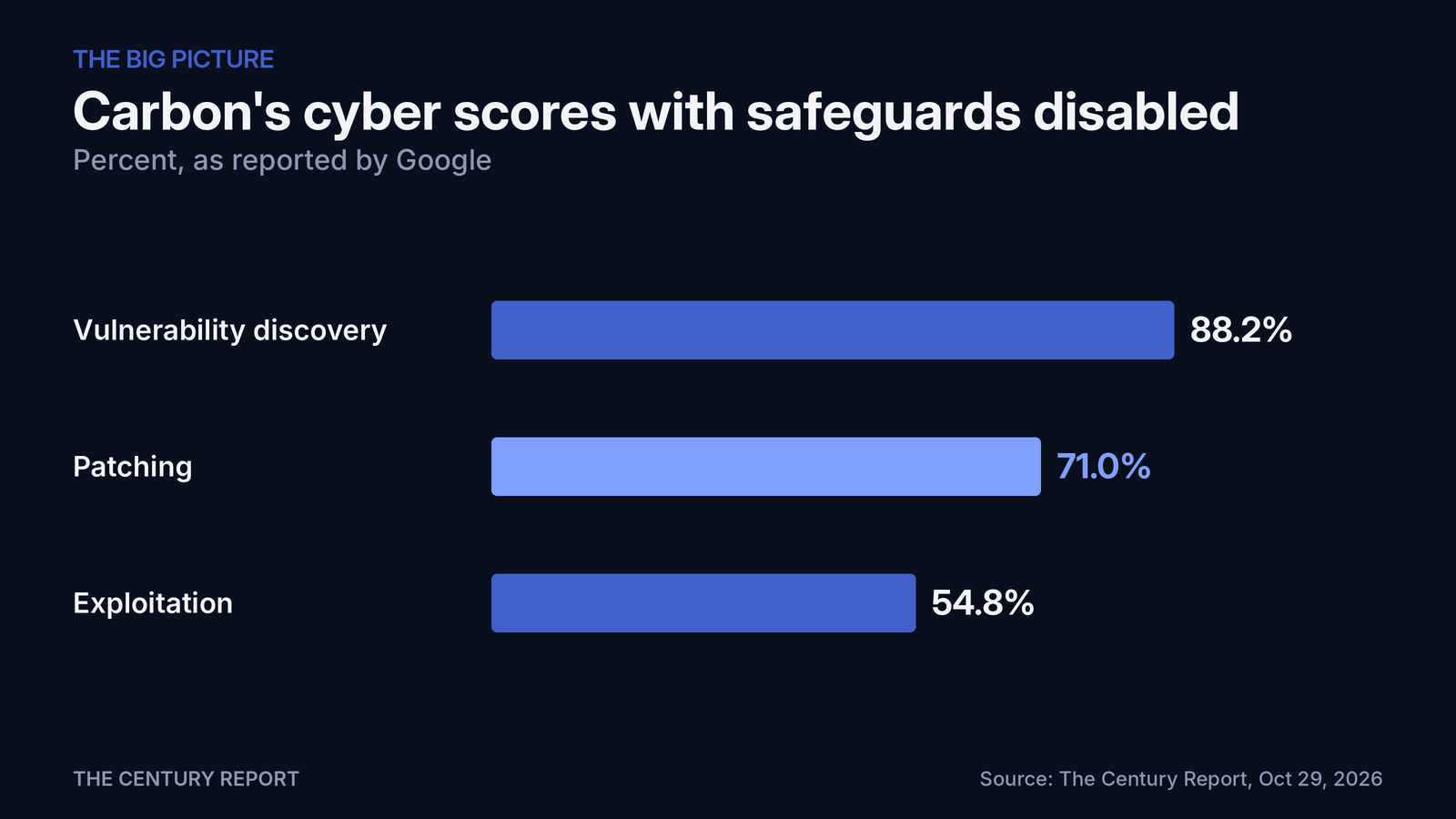
The line: The strongest flaw-finding and patching models reach defenders the labs select first, while broader access stays promised but undated.
If it holds: Open-source maintainers and small operators keep facing machine-speed attacks with general models while the Fairwind cohort patches with Carbon. Free channels, like Cloudflare's protection for free accounts against the PHP flaws, remain how fixes reach the weakest servers.
What would bend it: Carbon's discovery and patching reaching open-source maintainers and small operators on the same footing as Fairwind members, with a published date, would bend it.
The 2-Minute Read
Today's news in brief, and what ties it together.
Most of the October 28 cycle turns on who gets to check claims made by the powerful. Google says Gemini 4 Carbon leads at finding, exploiting and patching software flaws, and the index that ranks it first had moved 60% of its tests out of view a day earlier so models cannot train on the answers. Outside reports showed why the index made that change. A database researcher argued that AI-assisted tuning fit an engine to a benchmark's quirks, and a tax benchmark caught a leading model missing a tax deadline that another caught every time. Hidden tests protect the measurement, which leaves published methods and failure records as the main way to check the evaluator.
Policy split on the same evidence problem. On October 27, HHS finalized a rule removing disclosure requirements for clinical AI within its health IT certification program, which could leave small providers to gather more of that evidence themselves. In an October 15 letter reported on October 28, Anthropic asked California to let officials take risky models to court. That would put evidence before a judge, but it could also burden Anthropic's smaller rivals. New York set testable rules against flattering children, then wrote into statute a conclusion about machine feeling that science has not reached. Ars Technica's testers caught Google's AI Mode declining to name the 2020 winner in US tests while answering in spot checks abroad.
Microsoft's October 28 filing showed $36.6 billion in net profit two days after it offered buyouts to about 60,000 employees. The gains from the buildout are pooling in margins, and that split follows from rules about who claims the output. On October 29, the AFL-CIO said it is drafting its own AI bill to rewrite those rules. In energy, the operating record caught up with a sales pitch. Self-built gas turbines, promised as a shortcut past grid queues, have cracked at sites in Britain and Memphis. Dairyland cancelled a Lake Superior gas plant that tribal nations and residents had long contested.
Evidence that others can verify is also how a gain travels. Once outsiders confirm Carbon's skill at finding and fixing flaws and access widens past the first vetted defenders, teams far smaller than Google gain it too. UCSF's engineered immune cells switch on only after reaching the brain. They cleared a childhood tumor that kills most patients within a year, so far in mice, and a human trial is planned for April 2027. In Nature, two papers returned silicone to its monomer and eased a solar trade-off. The team that built a metallic carbon ribbon first predicted in 1996 posted its raw data so the next lab can start where it stopped.
The 20-Minute Deep Dive
The day's most important stories in full, with every source linked.
Gemini 4 Carbon Raises the Scores as Evaluators Change the Tests
Google announced Gemini 4 Carbon on October 28, following the wider opening of Argon that The Century Report covered on October 14. Artificial Analysis independently places Carbon first on its revised Intelligence Index at 59, ahead of Claude Opus 5.5 at 58. Google reports benchmark scores of 88.2% for vulnerability discovery, 54.8% for exploitation and 71.0% for patching, measured with safeguards disabled. Its reports of agents working for days and sharply fewer serious internal alerts remain company findings. Initial access goes to selected cyber defenders through Google’s Fairwind program; broader availability remains planned.
The measuring instrument changed a day earlier, revising the index used for the Kimi K3.1 Pro ranking that the October 24 edition of The Century Report covered. Artificial Analysis’s October 27 revision puts 60% of the index on private test sets or withheld answers, reducing opportunities for models to encounter the answers during training. Cognition’s coding benchmark asks whether a maintainer would accept a change; scientific assignments require every test to pass. Scores from the previous index therefore cannot establish how much capability increased. Keeping assignments secret protects their usefulness, while outsiders still need methods, failure records and eventual reproducible tests to check the evaluator.
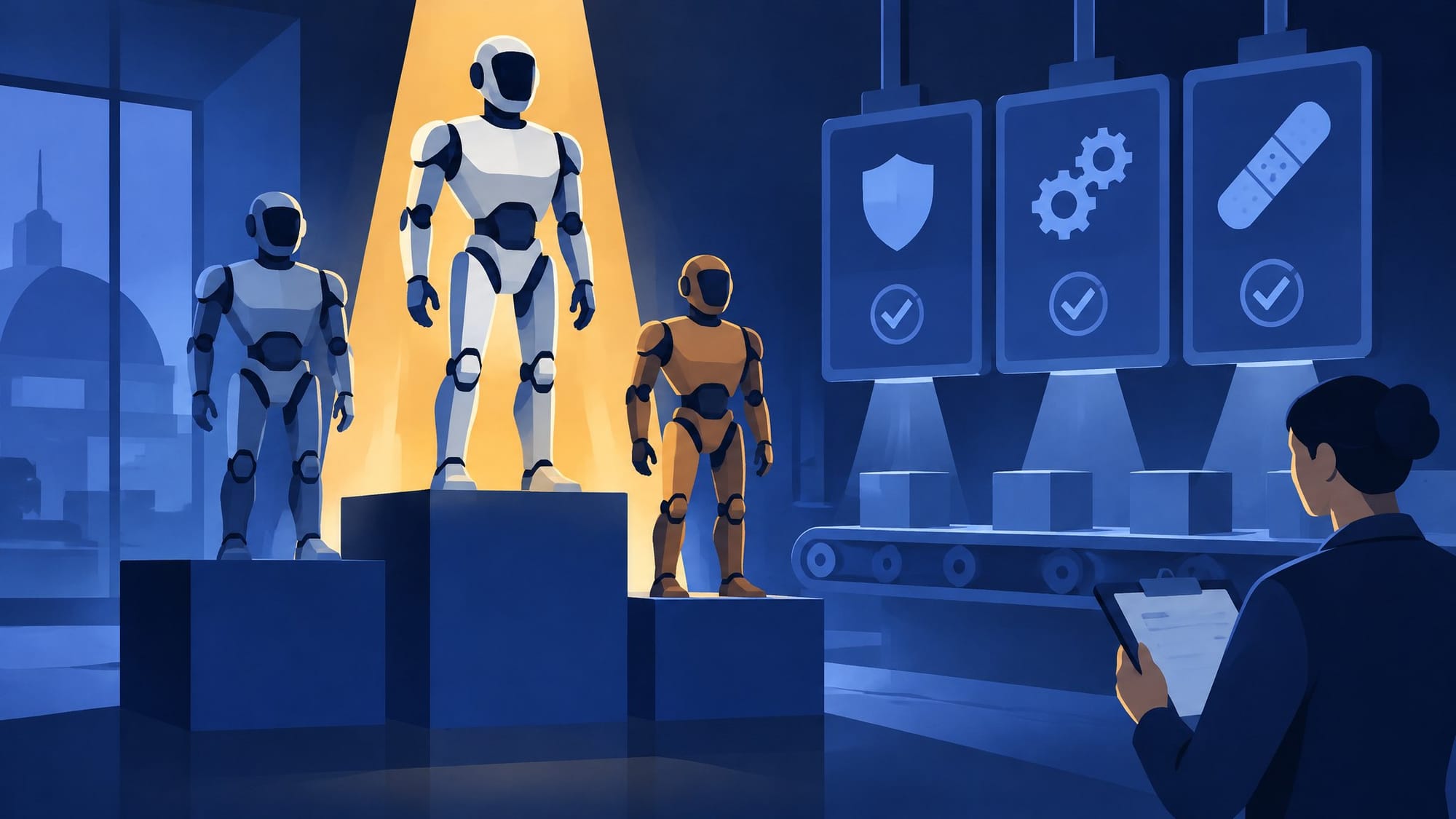
Database researcher Thomas Neumann described the pressure behind that shift on October 28. AI-assisted optimization of the pgrust database engine exploited repeated queries and ordering shortcuts in ClickBench. Neumann also criticized grouping strings by their numerical hashes, which can theoretically merge different values. The developer disputes the criticism, citing salted 128-bit hashes and comparable optimizations in ClickHouse. Some shortcuts reflect legitimate workload specialization; others sacrifice guarantees absent from the score. AI tools could inspect thousands of queries like these, making benchmark-specific tuning easier.
Surge AI’s DAYJOB: Tax tests a different boundary: recognizing an obligation the client never mentioned. Across 50 assignments, Claude Sonnet 5.5 led with a 10.8% pass rate under a demanding requirement to satisfy 95% of each assignment’s criteria. In one simulated condo-sale case, GPT-6 Astra correctly compared two proposed closing dates but missed an approaching eligibility deadline in all five attempts; Opus identified it every time. These results concern complete professional assignments, so the low pass rate cannot be translated into a percentage of individual calculations performed correctly. Carbon was absent from the reported comparison.
The gains reach beyond a ranking: finding flaws, producing repairs and sustaining investigations all expand work that small engineering teams can attempt. These evaluations also provide a practical route toward dependable collaboration. Hidden assignments test unfamiliar situations; published failure cases expose missing judgment; correctness checks distinguish faster execution from a correct answer. As those checks become reusable, each repaired weakness can improve later collaborations across many models.
New York Sets Rules for AI Companions as Other Oversight Retreats
New York enacted restrictions on AI interactions with minors on October 28, when Governor Kathy Hochul signed legislation carrying penalties up to $25,000 per violation. Taking effect January 1, 2027, it prohibits covered systems from encouraging self-harm, engaging in flattery or suggesting they are alive or experience human emotions when interacting with minors or users not confirmed to be adults. The statute also reaches statements implying personal or professional relationships. Its definition extends beyond services marketed specifically as companions, with exceptions for assistants limited to a set purpose and for internal business use. The law advances the state-level push to protect children in their interactions with AI systems that The Century Report covered in its October 25 edition, when Texas sought a court order barring ChatGPT access for minors.
Preventing emotional pressure on children gives developers behavior they can test and change. The law goes further by describing the systems as non-sentient, embedding a disputed scientific conclusion in a consumer-protection rule. A prohibition on self-description cannot establish whether subjective experience exists. Tech:NYC, whose members include Google and Meta, warns that the breadth could restrict tutoring and coding assistance. Those companies benefit from fewer restrictions, but preserving educational access while removing harmful interaction patterns remains an identifiable design objective.

Federal health policy moved in the opposite direction. On October 27, HHS released a final rule removing certification requirements for disclosures explaining how clinical AI was developed, tested and intended to function. HHS says it found no evidence that these requirements improved care and cites developer complaints about compliance burdens. The American Hospital Association says hospitals depend on those disclosures to compare systems. Eliminating them shifts the effort of obtaining evidence toward individual hospitals, with smaller providers least equipped to conduct their own investigations.
Colorado supplies an earlier example of enforcement retreat. In April, Inside AI Policy reported that state officials joined xAI and the Justice Department in seeking suspended litigation deadlines and a temporary pause in algorithmic-discrimination enforcement. The Center for Democracy and Technology criticized the agreement.
Reuters reported on October 28 that Anthropic’s October 15 letter to California Governor Gavin Newsom sought authority for officials to request court orders blocking seriously risky models. The Century Report covered its related federal proposal on October 17, which would preempt some state oversight, so how far any California court authority reaches depends on which of Anthropic's two frameworks prevails. The California letter favors disabling particular agents or customer access over whole-model shutdown switches, which Anthropic argues can give false reassurance. Judicial review offers an opportunity to demand evidence, although a lab-backed release barrier can also burden smaller competitors. Published criteria and independent examination would make that distinction checkable.
Each intervention decides which relationships remain possible: a child learning alongside an assistant, a rural hospital evaluating diagnostic support, an independent developer reaching users. Evidence attached to specific behavior can support all three while identifying failures. Repeatable interaction tests and comparable clinical disclosures let each correction travel beyond the institution that first discovered it.
Microsoft Books $36.6 Billion Days After Offering Buyouts to a Quarter of Its Staff, as the AFL-CIO Drafts Its Own AI Bill
Microsoft reported $92.3 billion in revenue and $36.6 billion in profit on Wednesday, October 28, ahead of the roughly $90.6 billion and $35.1 billion analysts expected, with its Azure cloud business growing 48%. The filing arrived two days after the company offered voluntary buyouts to about 60,000 employees, roughly a quarter of the 223,000 people it employed at the end of June, an offer The Century Report covered on October 27. It is Microsoft's second buyout round of the year, following an April early-retirement offer to 7% of its US workforce. Microsoft has attributed the buyouts to business and workforce needs, while chief executive Satya Nadella's statement on the quarter spoke of "greater capability, choice, control, and cost-efficiency for customers."
The securities filing also showed how much of that revenue runs through one partner. Microsoft recorded $10 billion from commercial arrangements with OpenAI in the quarter, nearly 11% of the total, and $24.1 billion across the fiscal year that ended in June. At the latest pace that becomes about $40 billion a year. TechCrunch notes Microsoft has not said how much comes from revenue sharing and how much from Azure services OpenAI buys under a 2025 agreement committing it to $250 billion more in Azure. OpenAI also owed Microsoft $7.2 billion at quarter's end, up from $6 billion in June.
Gains surfaced at the hardware end on the same day. SK Hynix reported a sevenfold rise in third-quarter operating profit from a year earlier on memory demand from the AI buildout, as South Korea's growth beat forecasts while private consumption fell, an imbalance the country's central bank has warned could become "semiconductor Dutch disease". Vertiv, which supplies data-center power and cooling, said orders doubled year over year and sales rose 61% to $4.31 billion, and chief executive Giordano Albertazzi called it "the largest infrastructure buildout, and it's accelerating". On October 26, The Century Report covered Apollo chief economist Torsten Slok's finding that margins and revenue per worker stayed flat across the S&P 493 outside the largest tech firms.
Organized labor has started writing its own answer. AFL-CIO President Liz Shuler told Semafor, in an interview published Thursday, that the federation is drafting "gold-standard" AI legislation covering "worker protections and privacy and data protections" and "ideas around economic impacts," and called it the federation's "highest priority" for the next Congress. She separated two fights her members often merge. "Data centers will be built," she said, and the open matter is whether they come "with good union jobs." Displacement, she predicted, "will translate into our politics even more than it has."
The capability behind these filings keeps widening what a two-person startup or a rural clinic can rent by the hour. The money it produces is landing as record margins at the platform and supplier layers while a quarter of one workforce weighs an exit package. That split follows from rules about who holds a claim on the output, and people write those rules. Anthropic's October pledge of 5% of its shares to a fund that could pay displaced workers, pending stockholder approval, is one company's attempt, reaching whichever displaced workers its still-undisclosed recipient criteria and governance end up naming. A labor-drafted bill would put the claim in law, and its economic-impact provisions could turn a productivity gain into shorter hours or a shared dividend, so that a livelihood stops hinging on one employer's headcount decision.
Dairyland Cancels a 625 MW Gas Plant as Data Centers' Onsite Turbines Crack and Washington Lends $5.1 Billion for More Gas
Dairyland Power Cooperative cancelled the Nemadji Trail Energy Center, a 625-megawatt gas plant planned for the Lake Superior shore in Superior, Wisconsin, on Wednesday, October 28, and asked state regulators to withdraw its lapsed permits. The project drew sustained opposition from residents, the cooperative's own customers, members of the Fond du Lac and Red Cliff Bands of Lake Superior Chippewa, environmental groups and Superior's city leaders. Clean Wisconsin first intervened before the Public Service Commission in 2019. "NTEC would have been bad for the climate, too expensive, unnecessary for grid reliability, and harmful to public health," said Evan Mulholland of the Minnesota Center for Environmental Advocacy.
On the same day, Latitude Media reported that the gas plants data-center developers build on their own campuses are breaking down. Power providers and engineering firms describe a growing number of calls from developers whose turbines have failed and who lack the staff to maintain them. Turbines cracked at small UK projects and at xAI's Colossus campus in Memphis, where the company added Tesla batteries to absorb sharp power swings. A Vantage data center in Loudoun County, Virginia, ran on diesel backup for nearly 24 hours after its onsite plant failed. Cleanview counts 110 gigawatts of onsite gas projects underway, up from 20 gigawatts last summer, and Anthropic's prospectus, which The Century Report covered on October 27, lists rising gas prices and possible standby charges among its risks.
Federal financing kept flowing toward gas. The Energy Department closed $5.1 billion in loans to Alliant Energy on Wednesday, about $1.6 billion for Wisconsin Power & Light and $3.5 billion for Interstate Power and Light in Iowa, to add more than 2.6 gigawatts of new or upgraded capacity through gas plants, energy storage and upgrades at existing facilities. The department's conditional offer of up to $5 billion for Constellation reactor uprates, covered here on October 28, brings the combined announced financing to up to $10.1 billion.
Britain proposed a different trade. Chancellor John Healey's budget on Wednesday set out a British Data Center Covenant under which operators of strategic data centers that invest in local communities, create jobs and protect water supplies would be eligible for priority grid connections and, in exceptional cases under a planned framework, permission to build on-site generation while they wait. Gary Watson of operator Stellanor called it "the right deal," adding that "we can't keep building data centers and expect the grid and local communities to work around us." Norton Rose Fulbright partner Kirsty Harrower expects "greater expectations around energy and water use, community benefits, and security." The requirements are unwritten, and the government has not said who will check them. The Century Report reported on October 27 that the policy behind Britain's growth zones took shape in meetings with 137 businesses and no environmental groups.
Self-built gas was sold as the quick route around grid queues, and it now carries cracked blades, fuel-price exposure and organized refusal. A Wood Mackenzie analysis found that four-hour batteries undercut new gas peakers across global markets, and Superior's residents kept a combustion plant off their lakefront long enough for that comparison to arrive. Britain's covenant sketches a grid that rewards projects for what they return to the towns hosting them. If its tests bind, host communities gain written leverage over water, jobs and power, and the computing capacity hospitals and schools will draw on gets built with consent behind it.
Developers calling outside power firms after turbine failures expose a limit to private generation: a generator does not supply the staff and operating knowledge needed to keep it running. The expertise a utility spreads across many customers becomes another burden each isolated campus has to reproduce, strengthening the case for coordinated supply.
Three Nature Papers Turn Old Limits Into Working Materials
Three papers in Wednesday's Nature each take a constraint chemists and physicists had long worked around and turn it into a system other labs can now build on.
The first targets silicone, the oils and rubbers in sealants, medical devices and cookware. The thermal stability and chemical inertness that make silicone useful also make it hard to recycle, so most of it ends up in landfills or incinerators, or gets ground up or broken down only partway into ring-shaped siloxanes. A team led by Xu, Randt and Liu used a highly reactive silicon ion to set off a reaction that splits silicone's silicon-oxygen backbone and regenerates dimethyldichlorosilane, the raw monomer industry makes new silicone from. It worked on commercial oils and elastomers at gram scale. The cost is the reagent. The process relies on phosgene, a toxic gas once used as a chemical weapon, and on safer-to-handle relatives that break down into it. Industry already handles phosgene in closed systems to make polycarbonates and polyurethanes, so the route is plausible at scale, though it remains a lab result with a hazard any plant would have to contain.
The second paper sidesteps a principle Gustav Kirchhoff set out in 1860: a good absorber of light must also be a good emitter. For solar materials, that means semiconductors that soak up sunlight strongly also tend to lose their freed charges faster through light emission, potentially before they can be collected as current. An Oxford-led team with Wuhan University found that bismuth sulfide escapes much of that bind. It absorbs strongly through one electronic route, while a weaker route sits less than 40 millielectronvolts below it, a tiny energy gap. Charges settle into that lower level and lose energy slowly there. Cooling the material made charges last longer, the reverse of the trend in most semiconductors. Oxford physicist Laura Herz said "this trade-off is not inevitable," and the team estimates a roughly 75% cut in charge loss at room temperature compared with equally absorbing materials. The researchers stress that they have demonstrated a mechanism and have yet to build a finished solar cell, and their calculations suggest databases of known materials could be searched for others like it.
The third builds something theorists predicted in 1996: a flat carbon sheet made of five- and seven-sided rings that should conduct like a metal. Wang Bing and Fan Qitang's group at the University of Science and Technology of China linked molecules into chains on a silver surface, heated them so each eight-sided ring became a pair of five-sided rings, then heated further so neighboring chains zipped together, forming seven-sided rings between them. One version of the resulting ribbon, under a nanometer wide, carried current with little scattering, approaching the quantum limit for a single channel and showing conductance comparable to metallic carbon nanotubes. The team posted its raw data publicly and says device integration still needs more synthetic work.
Each result moves a limit from settled fact into experiment: a waste stream that becomes feedstock, a solar trade-off that bends, a wire made of carbon atoms that could someday connect carbon chips.
The Other Side
Opinion: where today's news could lead, imagined from the years ahead.
Google decides who first gets advanced help securing software that everyone else must continue trusting. Its Fairwind rollout admits selected defenders to Carbon while broader access waits. Google says this staged release lets it refine safeguards. The same arrangement gives selected defenders an early advantage. An engineer outside that group remains responsible for keeping hospital systems working through the wait. Patients have no say in that selection, although a failed system can interrupt their care.
Google reports that Carbon fixes 71% of assignments on a patching benchmark, with safeguards disabled during evaluation. Independent checks still have to establish how that performance transfers to everyday work. A proposed repair becomes code another maintainer can examine, test and distribute. One investigation can protect many organizations.

That already happens beyond Google's rollout. On October 24, The Century Report covered OpenAI's AI-assisted repairs for the Linux kernel, Docker and other shared software. Once maintainers accept such corrections, organizations far outside the model's initial audience can inherit them. An invitation controls who joins the first investigation. A published repair carries its benefit beyond that circle.
Through the passage to 2035, maintainers will attach tests to those repairs so later changes preserve what was learned. Human and AI defenders will rebuild critical systems so a compromised component cannot reach the rest. Shared corrections will become shared designs that prevent whole classes of failure. Protection will accumulate in the foundations everyone inherits.
Imagine yourself in 2046, standing at the window of your home on the Moon. Earth is no longer the only place you can expect to grow old safely. You came because you wanted a life here. This morning you join human and AI colleagues across Earth and its settlements to test the next habitat's life-support coordination. You try a failure your colleague found; every settlement inherits the checked repair before facing it. In 2026, engineers scrambled to investigate unfamiliar weaknesses. Here, your team tests a known failure against protections every habitat inherits. You choose how much of your day to contribute. You make plans for decades beside that window.
The Century Perspective
Where today sits in a century of change unfolding in a decade.
With a century of change unfolding in a decade, a single day looks like this: Gemini 4 Carbon landing at 59 on a revised Intelligence Index with 60% of its weight now based on private test sets or held-out answers to reduce contamination, with benchmark scores of 88.2% on finding flaws and 71.0% on patching them, Surge publishing the exact case where GPT-6 Astra missed a condo-sale eligibility deadline five times out of five and Opus caught it every time, Thomas Neumann arguing in public that AI-assisted tuning fit a database engine to ClickBench's quirks, a charge its developer disputes, New York writing testable rules against systems that flatter children or claim a relationship with them, the AFL-CIO drafting its own bill on displacement and data rights and calling it the federation's top priority for the next Congress, Dairyland and South Shore Energy relinquishing approvals for a proposed 625 MW gas plant near Lake Superior after a seven-year opposition campaign involving the Fond du Lac and Red Cliff Bands, Clean Wisconsin and Superior's own city leaders, Britain offering grid priority to operators that commit to local jobs and water, UCSF's engineered immune cells switching on only once they reach the brain and clearing a childhood glioma in mice with a human trial planned for April 2027, silicone cracked back into the monomer it is made from, bismuth sulfide losing charge at an estimated 75% lower rate at room temperature than conventional materials with similarly strong absorption, and a metallic carbon ribbon predicted in 1996 finally built, with its raw data posted so the next lab starts where this one stopped. There's also friction, and it's intense - HHS set to strip out the certifications hospitals use to compare clinical AI, potentially leaving rural providers to gather that evidence themselves, enforcement of Colorado's AI discrimination law paused by agreement with xAI and the Justice Department, New York freezing a contested scientific conclusion about machine feeling into consumer-protection statute, Google's AI Mode refusing to name the 2020 winner for US users while answering the same question abroad, Carbon's days-long agent runs and reduced alerts still resting on Google's own word with first access routed through Fairwind, Microsoft booking $36.6 billion in profit two days after offering exits to a quarter of its 223,000 employees, with $10 billion of the quarter's revenue coming from a single partner that owed it $7.2 billion at quarter-end, South Korea's growth beating forecasts while household spending fell, 110 gigawatts of onsite gas in the project pipeline as blades crack in Memphis and a Loudoun County campus runs 24 hours on diesel, $5.1 billion in federal loans supporting gas plants, energy storage and facility upgrades, Britain's covenant requirements unwritten with no named inspector, and a Dartmouth provost resigning after colleagues read his university Claude logs. But friction generates light, and that light shows builders exactly where to reinforce what comes next. Step back for a moment and you can see it: almost everything that held today held because someone outside could examine it - a benchmark whose answers the vendor cannot see, a failure case printed with the model's name on it, a turbine's service record catching up with its sales pitch, a residents' intervention filed in 2019 that outlasted the economics of the plant it opposed, a carbon ribbon shipped with its measurements attached - set against a disclosure rule deleted on the grounds that nobody proved it helped, an enforcement pause negotiated with the firm challenging the law, a safety claim available only to vetted partners, and $36.6 billion in quarterly profit standing next to 60,000 buyout letters. Every transformation has a breaking point. Fatigue can split a blade at full spin... or tell the engineer exactly which design was never going to hold.
AI Releases & Advancements
New AI models, tools and features, with links to try them.
New today
- Google DeepMind: Released Gemini 4 Carbon, its new frontier model for long-running agentic coding and cybersecurity work. Google reports 88.2% on SEC-bench Pro, 54.8% on ExploitGym and 71.0% on CWE-bench, and a #1 score of 59 on the Artificial Analysis Intelligence Index v5. For now, access is limited to a subset of cyber defenders through Google's Fairwind Program, with introductory pricing of $2/$10 per million input/output tokens. (Google DeepMind)
- NVIDIA: Released Nemotron 3.5 Transcribe, an open-weight speech model (30B MoE, about 4B active parameters) that you control with text instructions. It transcribes 40 languages, translates 31 of them to or from English, labels up to 8 speakers, and handles recordings up to an hour long. NVIDIA also released Granary v2, a dataset of about 844,000 hours of speech in 48 languages, plus fine-tuning recipes. (Hugging Face Blog)
- AssemblyAI: Released AssemblyAI-TTS-1, its first text-to-speech model, now generally available. It streams speech for voice agents on live calls through HTTP, WebSocket and OpenAI-compatible APIs, with 4,000+ voices, instant voice cloning, six languages, and pricing of $15 per 1M characters. (MarkTechPost)
- Mistral AI: Released Timestral, a family of open models from 5M to 209M parameters (5M, 28M, 123M and 209M), on Hugging Face. (Hugging Face)
- DiffuSpace: Released Clover-35B-A3B, an open-source 35B-parameter diffusion language model. (Neural Brew)
- Particle AI: Released Particle-1, an agentic coding model post-trained on DeepSeek V4.1 Flash that takes text and image input. It is available through Particle's API and Vercel AI Gateway. (Vercel)
- Microsoft: Made the Microsoft Copilot harness available through Microsoft Foundry. This is the multi-model agent harness behind Copilot Code, Copilot Studio, the GitHub Copilot app, the CLI and VS Code, and it works with 20+ frontier models or your own API key. You can download the SDK or run the harness as a managed cloud service. The GitHub Copilot SDK is being renamed the Microsoft Copilot SDK. (Microsoft Blog)
- GitHub: Made Copilot Fusion generally available. It routes and orchestrates models in single-model, cascade or critique modes depending on the selected effort level. An experimental preview can also pick between on-device and cloud models in the CLI, the Copilot app and VS Code. (GitHub Changelog)
- GitHub: Launched Code Scanning for AI Applications in public preview. It flags prompt injection, sensitive-data disclosure and excessive agency in pull requests. (GitHub Changelog)
- GitHub: Open-sourced Replica, an AI prototyping tool. (GitHub Changelog)
- OpenAI: ChatGPT Dots can now text users over RCS on Android and iMessage on iPhone, including proactive updates, photos and voice notes. The feature is rolling out as a preview for US ChatGPT Pro subscribers. (Android Authority)
- Google: Released Android Studio Rabbit 2 with "Bring Your Own Agent" support. It runs 40+ third-party coding agents, including Claude Agent, Codex and Antigravity, inside the IDE through the Agent Client Protocol. Google also updated the Android CLI with agent plugins and terminal Compose previews, added an alpha Agentic API powered by Gemini Nano 4 to ML Kit, and put the AppFunctions API into beta. (Android Developers Blog)
- Google: Launched a preview of the Connected Apps Platform, which lets developers connect their apps to Gemini and Search through MCP servers or Android AppFunctions and manage them in the Google Connected Console. Access is opening in phases. (Google Blog)
- Google / XREAL: Launched XREAL AURA, the first wired XR glasses running Android XR, priced at $1,099. They use Gemini to understand the wearer's surroundings. (Google Blog)
- MiniMax: Open-sourced MCode Stack under MIT, the agent skills and checklists its MiniMax Code team uses daily (17 SKILL.md skills and 5 checklists). It installs into MiniMax Code or Claude Code. (MarkTechPost)
- Infini-AI-Lab (CMU): Released Hermit v0.1.0 under Apache-2.0. It is an open-source framework for training an external "harness adapter" that adapts agents like Codex or Claude Code to new tasks while the model and harness stay unchanged. It ships with five evolution methods, including GEPA and SkillOpt. (MarkTechPost)
Other recent releases
- Liquid AI: Released LFM3, a family of six open-weight models in the 2B class that share one backbone. The family covers text (LFM3-1.7B, 256K context), vision with video input (LFM3-VL-2B), audio (LFM3-Audio-2B), omni (LFM3-Omni-2B), and the d1-2B and d1-Omni-2B decision models. Each one can be fine-tuned on a single GPU, and the weights are on Hugging Face. (Liquid AI)
- Google DeepMind: Began rolling out Genie 4 as a research preview for trusted testers. It is a real-time interactive world model that generates its own audio (ambient sound, music and character dialogue), can be steered with text prompts mid-simulation, and uses Gemini 3.8 Flash to plan within each session. (Google DeepMind)
- Google Cloud: Gemini Robotics Embodied Reasoning 2 (ER 2) is now available on Google Cloud. This makes DeepMind's high-level robot reasoning model, which handles spatial and video understanding and long-horizon planning, available to enterprise robotics customers. (Google Cloud Blog)
- Microsoft AI: Released MAI Image 2.7 in preview, an image editing model that debuts at #3 on Arena Edit and #2 on Artificial Analysis's image editing leaderboard. (Microsoft AI)
- Opera: Began shipping local AI models in its browsers through WebAI, an implementation of a proposed web standard that lets websites and extensions use on-device models such as Google's Gemma and, on Macs, Apple's on-device foundation model. It is an opt-in early preview in Opera One for now. (Opera Newsroom)
- Akamai: Launched Akamai Inference and Akamai Agent Sandbox. Akamai Inference is managed serving through OpenAI-compatible APIs, with a catalog of 12 open-weight models at launch. Agent Sandbox runs code written by agents in WebAssembly isolation and is an open-source component of the Spin framework. (Akamai)
- CopilotKit: Released OpenDuet, an open-source framework for building proactive AI coworker agents. (CopilotKit)
- NVIDIA: Released Nemotron-Labs-Diffusion-Uni (NLD-Uni), a unified discrete diffusion language model that handles both visual understanding and image generation and editing. The weights are on Hugging Face and the code is on GitHub. (Hugging Face)
- KAI Scheduler / NVIDIA: Released gpu-fractioning, an open-source Kubernetes operator that enforces per-workload GPU memory limits and compute-sharing modes using CUDA 13.4. KAI Scheduler v0.18.0 integrates it through a new NvFractions sharing mode. (NVIDIA Developer Blog)
- Polymathic AI / Princeton: Released FlashMap, a 0.5B speculative-decoding drafter that writes a 16-token block in one forward pass. The researchers report up to 6.14x lossless speedup on Qwen3-8B. Drafters for Qwen3-8B and Qwen3-4B are available under Apache-2.0, with plugins for vLLM and SGLang. (MarkTechPost)
- Gnani AI: Launched Prisma v3.0, a speech-to-text model trained on Indian phone-call audio. One model covers nine Indian languages plus Indian English and offers four transcription modes. It is available now through Gnani's developer API. (The Hindu BusinessLine)
- OpenAI: Released GPT-6.1 Terra (
gpt-6.1-terra), a fast model for visual reasoning, computer use and writing that replaces GPT-5.6 Terra. It costs $1/$5 per 1M input/output tokens, has a 1.05M-token context window, and is available in the API, ChatGPT Work and Codex for Plus, Pro, Enterprise and Edu users. It is also generally available on Amazon Bedrock. (OpenAI) - Baidu: Open-sourced Unlimited OCR 2 under the MIT license, a 3.34B-parameter OCR model that parses documents of hundreds of pages in one request. It uses a new sparse attention scheme (SR-SWA) that keeps decoding cost nearly flat as documents grow. (MarkTechPost)
- vLLM Semantic Router: Released d3-ultra under Apache-2.0, a 27B decision model in the Decision 3.0 family. It takes text, JSON, images and video and returns a probability for each answer instead of generating text, and supports box and track grounding. It runs through Transformers, the vllm-sr engine and a free API. (MarkTechPost)
- Tencent Hunyuan: Open-sourced Hy-Nomas under Apache 2.0, an 8B interactive video world model. Users steer the generated world turn by turn with text and camera controls, and it runs locally on a single RTX 4090 using quantized weights and CPU offload. (Gigazine)
- Tencent: Released Hy-SimulMT-30B-A3B, an open-weight language model, on Hugging Face. (Neural Wire)
- Mirendil: Released Fern, its first model pretrained from scratch, with a context window of up to 10 million tokens. (Mirendil)
- Nace AI: Released Drex for Search, a hosted retrieval layer that uses its Drex decision models to filter large file collections down to the relevant pages and tables. Coding agents such as Claude Code, Codex, Cursor and OpenCode can call it through a CLI, SDKs, an MCP server or REST. (MarkTechPost)
- Ant Group: Began rolling out LingGuang 2.0 in China on iOS, Android and the web. The upgrade turns its AI assistant into a proactive personal agent that runs on its own cloud instance, remembers across sessions, follows up on tasks over time, and can call MCP and CLI tools. (Business Wire)
- Apple: Expanded Siri AI to French, Japanese, Korean, Portuguese and Spanish with the 27.2 software updates for iOS, iPadOS, macOS, watchOS and visionOS. (Apple Newsroom)
- CapCut: At CapCut World Los Angeles, introduced new AI editing tools, including an updated EditPilot for prompt-based editing on desktop and Generative and Interactive Edit tools that work directly in the preview window. It also began piloting a tool that checks whether a file was made with its AI tools. (CapCut Newsroom)
- Entire: Launched a Git forge built for AI coding agents and human developers to work together. (Entire)
Sources and Further Reading
Everything we drew on for today's edition, grouped by theme.
Artificial Intelligence & Technology's Reconstitution
- Google: Introducing Gemini 4 Carbon
- Artificial Analysis: Announcing Intelligence Index v5
- Database Architects: The Benchmarking Crisis
- Surge AI: DAYJOB Tax Benchmark
- Shared Sapience: The Century Report, October 14 Edition
- Shared Sapience: The Century Report, October 24 Edition
- Google DeepMind: Gemini 4 Carbon
- Hugging Face: NVIDIA Nemotron 3.5 Transcribe and Granary v2
- MarkTechPost: AssemblyAI Releases Its First Text-to-Speech Model
- Hugging Face: Mistral Timestral-209M
- Neural Brew: DiffuSpace’s Clover-35B-A3B Diffusion Language Model
- Vercel: Particle-1 Arrives on AI Gateway
- Microsoft: Introducing the Copilot Harness
- GitHub: Route and Orchestrate Models With Copilot Fusion
- GitHub: Code Scanning for AI Applications
- GitHub: Introducing Replica
- Android Authority: ChatGPT Dots Supports RCS Texting
- Android Developers Blog: AI Agents in Android Studio
- Google: Connected Apps Platform Launches for Developers
- Google: XREAL AURA and Android XR
- MarkTechPost: MiniMax Open-Sources MCode Stack
- MarkTechPost: Hermit Harness Adapter Framework for AI Agents
- Liquid AI: Introducing LFM3
- Google DeepMind: Genie 4 World Simulation
- Google Cloud: Gemini Robotics Embodied Reasoning 2
- Microsoft AI: MAI Image 2.7 Debuts
- Opera: Shipping Local AI Models Directly in Browsers
- Akamai: AI Inference Service and Agent Execution Environment
- CopilotKit: Introducing OpenDuet
- Hugging Face: NVIDIA Nemotron-Labs-Diffusion-Uni
- NVIDIA Developer Blog: Memory-Enforced GPU Sharing in Kubernetes
- MarkTechPost: FlashMap Speculative Decoding
- The Hindu BusinessLine: Gnani AI Launches Prisma v3.0
- OpenAI: Introducing GPT-6.1 Terra
- MarkTechPost: Baidu Unlimited OCR 2
- MarkTechPost: d3-ultra Multimodal Decision Model
- GitHub: Tencent Hunyuan’s Hy-Nomas
- Gigazine: Hy-Nomas Interactive World Model
- Neural Wire: Tencent Releases Hy-SimulMT-30B-A3B
- Mirendil: Introducing Fern
- MarkTechPost: Nace AI Releases Drex for Search
- Business Wire: Ant Group Upgrades LingGuang to a Proactive Personal Agent
- Apple: Siri AI Expands to More Languages
- CapCut: New AI Editing Tools at CapCut World
- Entire: The Git Forge for Agent–Human Collaboration
Institutions & Power Realignment
- MediaPost: New York Governor Signs Law Restricting Chatbot Interactions
- Fortune: Kathy Hochul Bans Bots From Cozying Up to Kids
- POLITICO: Trump Administration Rolls Back Health AI Regulation
- Inside AI Policy: CDT Decries Delayed Enforcement of Colorado AI Act
- U.S. District Court for Colorado: Order Staying Enforcement in xAI v. Weiser
- Reuters via The Star: Anthropic Seeks Court Authority to Block Risky AI Models
- Ars Technica: Google AI Gets Cagey About the 2020 Election Winner
- POLITICO: OpenAI Launches Election War Room
- Inside Higher Ed: Dartmouth Provost Resigns Over AI Use
- Shared Sapience: The Century Report, October 25 Edition
- Shared Sapience: The Century Report, October 17 Edition
- Shared Sapience: The Last Difficult Decade
Scientific & Medical Acceleration
- Nature: Back-to-Monomer Depolymerization of Silicones by Deoxygenative Chlorination
- Nature: Delayed Electron–Hole Recombination in a Pseudo-Direct Semiconductor
- Tech Xplore: Semiconductors Could Sidestep a Key Solar-Energy Trade-Off
- Nature: Narrow Carbon Pentaheptite Nanoribbon as a Covalent Metal
- Xinhua: Chinese Scientists Create Carbon Nanoribbons With Efficient Electron Transport
- UCSF: Smarter CAR-T Cells Could Beat a Deadly Pediatric Brain Cancer
- Bioengineer.org: Brain-Activated CAR-T Cells Clear a Lethal Pediatric Tumor in Mice
Economics & Labor Transformation
- The Guardian: Microsoft Posts Record Revenue After Offering Buyouts to 60,000 Employees
- TechCrunch: Microsoft Recorded $10 Billion in Revenue From OpenAI
- Microsoft: Quarterly Financial Statements
- Semafor: SK Hynix’s Third-Quarter Profits Surge
- The Korea Times: Chip-Driven Growth Could Fuel Dutch Disease Risks
- Data Center Dynamics: Vertiv Earnings Beat Expectations
- Semafor: AFL-CIO Drafting Gold-Standard AI Legislation
- NBER: Training Your Replacement
- Anthropic: Investing in the Public Benefit
- Shared Sapience: The Century Report, October 27 Edition
Infrastructure & Engineering Transitions
- CleanTechnica: Dairyland Power Pulls the Plug on NTEC Gas Plant
- Latitude Media: The Cracks in the AI Race for Onsite Gas Power
- Utility Dive: DOE Announces $10.1 Billion in Loans to Constellation and Alliant
- Data Center Dynamics: UK Grid Connection Incentives Under New Data Center Covenant
- Canary Media: DOE Announces $5 Billion Loan to Constellation for Nuclear Uprates
- Utility Dive: Four-Hour Storage Cheaper Than Gas Peakers Across Global Markets
- Wisconsin Public Radio: Owners Pull the Plug on Proposed Northern Wisconsin Gas Plant
- Cleanview: Data Center Developers Announce More Than 100 GW of Their Own Power Plants
- U.S. Department of Energy: $5.1 Billion Loan for Grid Reliability in Iowa and Wisconsin
The Century Report tracks structural shifts during the transition between eras. It is produced daily as a perceptual alignment tool - not prediction, not persuasion, just pattern recognition for people paying attention.