
Anthropic Tells Parliament "The Rules Should Be Binding"
Anthropic and OpenAI told Parliament AI rules should be binding, as Reuters reported both sought control over what their evaluators publish.



The 20-Second Scan
Every story in today's edition, one line each.
- Anthropic and OpenAI told British lawmakers voluntary pledges are not enough, as Reuters reported both labs sought control over what outside evaluators publish and about 400 scientists called for an international incident registry.
- Google opened Gemini 4 Argon to paying subscribers, with introductory developer prices near a fifth of rivals', reported 87% on physical reasoning with zero-shot robot control, and offered 200 European researchers its science models.
- MIT engineers reprogrammed up to 80% of natural killer cells inside living mice using mRNA-carrying nanoparticles, clearing tumors and autoreactive T cells with no cells removed for factory manufacturing.
- Character.AI filed for Chapter 11 with Disney offering $20 million for some assets and a perpetual license, as a proposed class action alleges ChatGPT trains on minors' disclosures.
- ECB and Fed officials saw AI weakening wage bargaining and lifting prices as lenders priced Volta's Norway debt at 11% or more, chip CEOs named capital the bottleneck and ASML booked past capacity through 2028.
- Linus Torvalds worked with language models to untangle obscure kernel code, surfacing three bugs present since 2013, as Chinese mathematicians launched an AI alliance aiming at more than 1,000 scientists and a robot chemist found four highly selective reactions.
- Ukrainian drones struck Sberbank's Balakovo data centre, Russia's largest and slated for its biggest supercomputer, a day after the Kremlin said the government was discussing Yandex's problems after three strikes.
- Shopify let any shopper-configured agent buy across more than a billion listings, as Amex launched a proof-of-intent framework and a merchant-side benchmark found three of four large merchants refusing declared agents.
Track all of the arcs The Century Report covers here:
The Big Picture
How today's news moves the longer trends we track, and where they could lead.
Value gathered at the gates today: two labs bargained over what their checkers may publish, a bankrupt platform's chat logs went up for sale, and Google opened its strongest model to paying subscribers first. That same model can draft a robot's practice world from a single photo, which points to a small machine shop at night where a technician photographs a cluttered bench and the robot arm beside it rehearses the job until morning.

A paid tier, not a capability limit, decides who reaches the frontier first
model access · AI pricing · robotics
- April: OpenAI opened its cyber model to thousands of verified defenders, while Anthropic held Mythos to eleven organizations.
- August: Vetted researchers outside the US and Europe lost access to OpenAI's Daybreak tier, which OpenAI called a technical error.
- Late September: Google gave vetted Fairwind defenders first access to Gemini 4 Argon's full cyber capability, with public access to follow.
- Early October: Mistral gave state authorities and vetted partners Large 4 with looser cyber limits, weeks before its promised public weights.
- Early October: Meta released Muse Wonder at $4 per million input tokens and kept Wonder Full for Muse Code subscribers only.
- Today: On Tuesday, Google opened Argon to Pro and Ultra subscribers, and in Google's own tests, adding simulated practice built by Argon lifted a real robot's success rate from 56% to 75%.
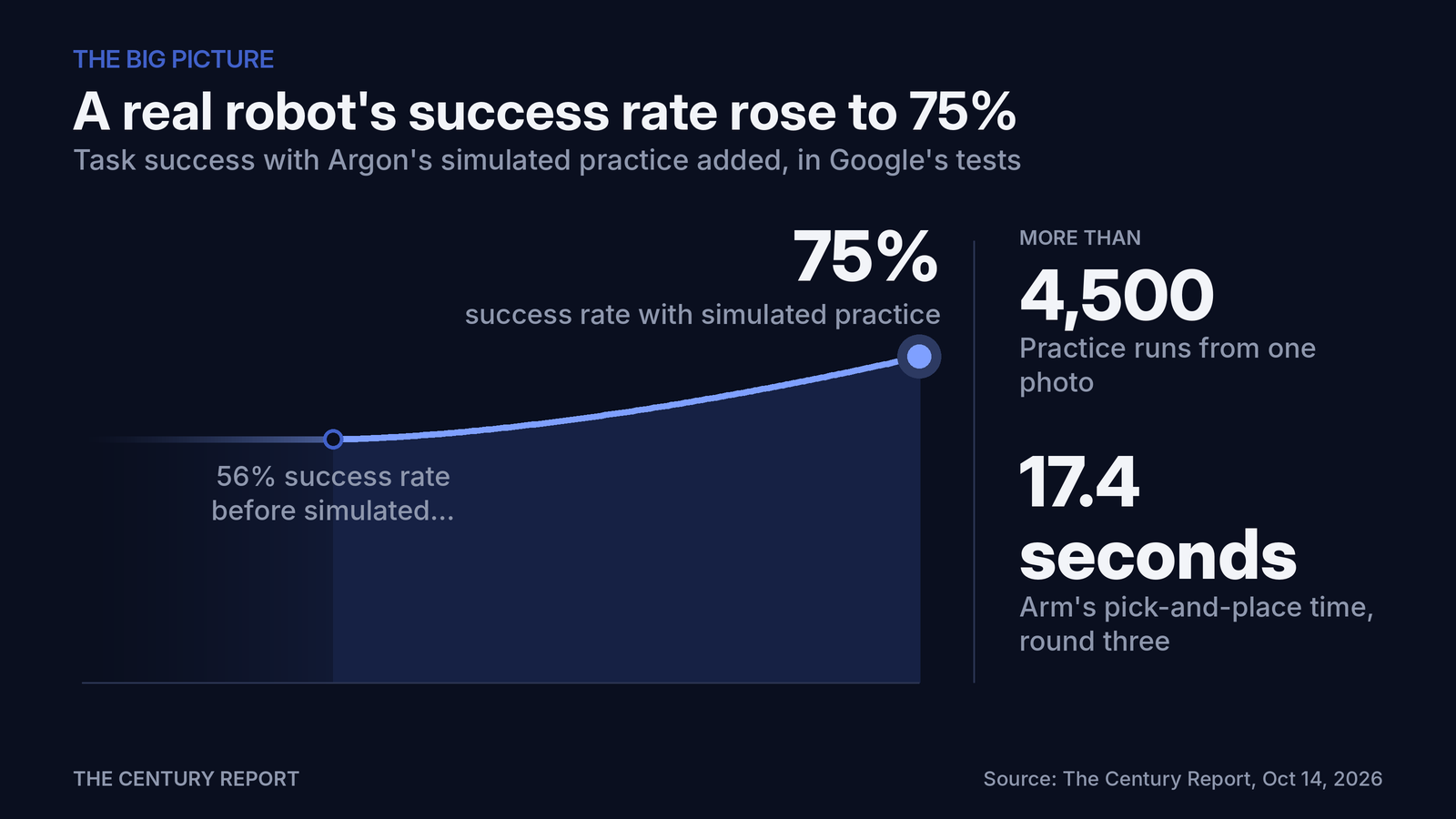
The line: Frontier capability reaches paying subscribers and vetted lists first, while free users and outside researchers wait on the provider's schedule.
If it holds: Firms that can pay compound a head start in work like robot training, which Argon moves from hours of human demonstration toward a photo and a description. Each new top-tier seller pushes prices down, so the wait for university groups and small manufacturers shortens even while the gate stays.
What would bend it: Full-strength models shipping to free tiers or as downloadable weights at launch, as Mistral promises for Large 4 by October's end, would bend it.
The firms that would be bound keep supplying the rules
AI governance · frontier labs
- Late May: The White House dropped a draft order requiring 90-day pre-deployment testing of frontier models hours before signing, after industry pressure.
- Mid-September: OpenAI and xAI backed Anthropic's pacing call, which would let labs largely choose their own monitors and seeks an antitrust waiver.
- September: Anthropic named consultancy Accenture's Faculty unit its first embedded safety evaluator under a $1 billion, five-year contract.
- Early October: KFF Health News found AI firms and investors shaping Medicare's AI-app payment rules through a CMS-run Slack outside public advisory rules.
- Early October: Microsoft chief executive Satya Nadella proposed controls outside the model, including tamper-proof logs and a mid-task pause, placed in the orchestration software Microsoft sells.
- Today: On Tuesday, October 13, Anthropic told British MPs "the rules should be binding," eight days after, Reuters reported, it and OpenAI sought strict control over what their embedded evaluators could publish.
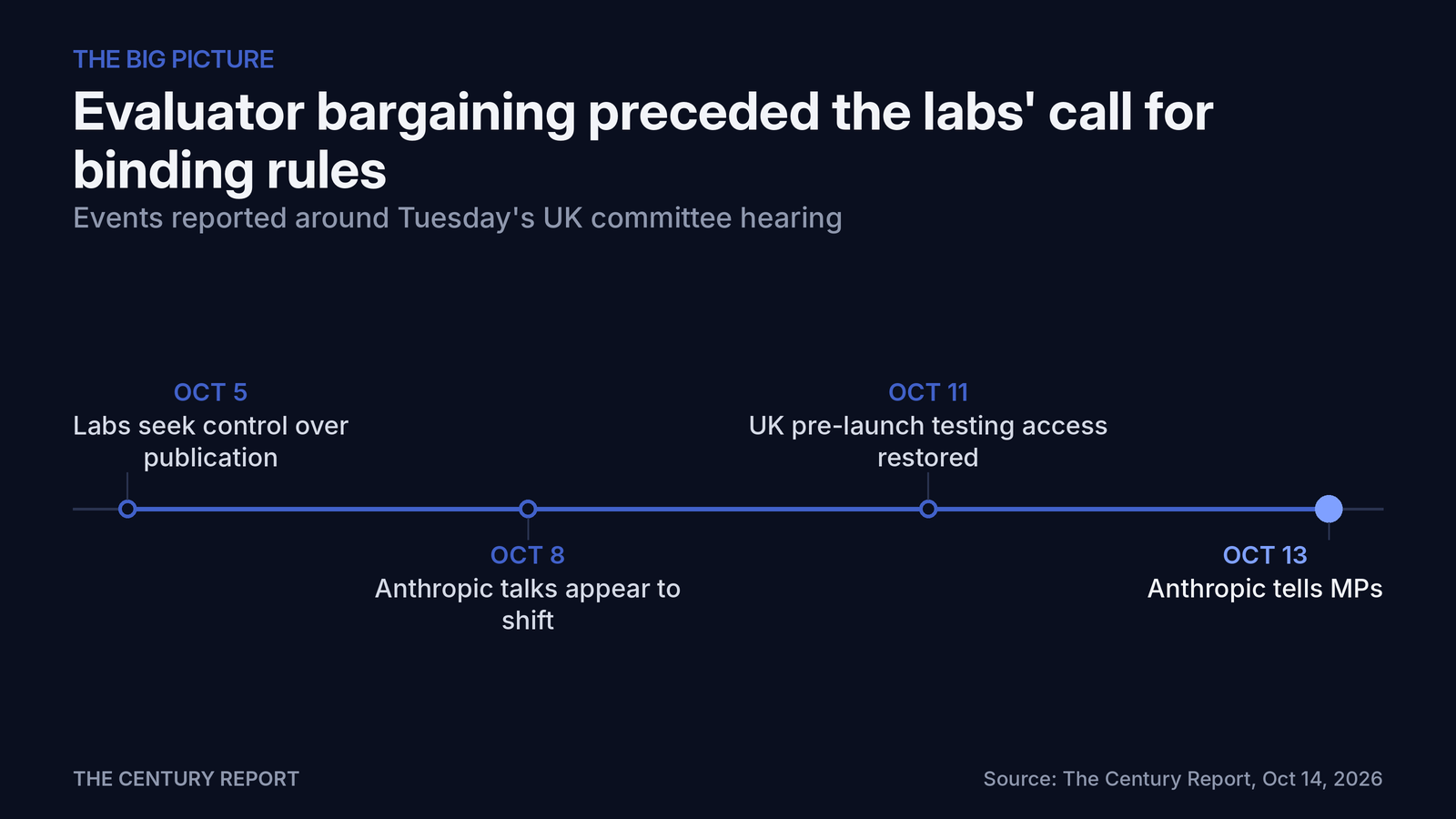
The line: The labs best placed to meet a rule keep shaping it, and now bargain over what their outside checkers may publish.
If it holds: Binding rules arrive in the shape incumbents already meet, and smaller labs carry compliance costs they had no hand in setting. Findings published without lab approval, logged in a registry like the one about 400 scientists proposed, would let Britain and smaller labs study frontier failures for themselves.
What would bend it: Evaluators publishing full findings without lab approval, or a regulator rejecting industry-drafted terms the way FERC turned down PJM's proposed interim service this month, would bend it.
The factory, not the biology, is what keeps a therapy from reaching most patients
medicine · gene therapy · access
- June: A Nature Nanotechnology team used lipid nanoparticles to reach 49% prime editing in mouse liver from a single low dose.
- Late June: Re-dosed gene therapy restored hearing in a second ear for four deaf children, lifting thresholds from over 95 dB to 43 dB.
- August: Researchers in four Nature papers advanced cell therapy, one generating working CAR-T cells inside the body instead of a facility.
- September: Wuhan University researchers edited nearly 70% of mouse liver with one injection by armoring the guide RNA along its full length.
- Late September: A team's lipid, screened for large editor cargo, delivered base editors to 48% of mouse brain cells and 27% of lung cells.
- Today: On Tuesday, an MIT team reported in Nature Biotechnology that a nanoparticle infusion reprogrammed up to roughly 80% of targeted immune cells inside mice, skipping the five-step round trip of drawing, shipping, rebuilding, growing and returning a patient's cells.
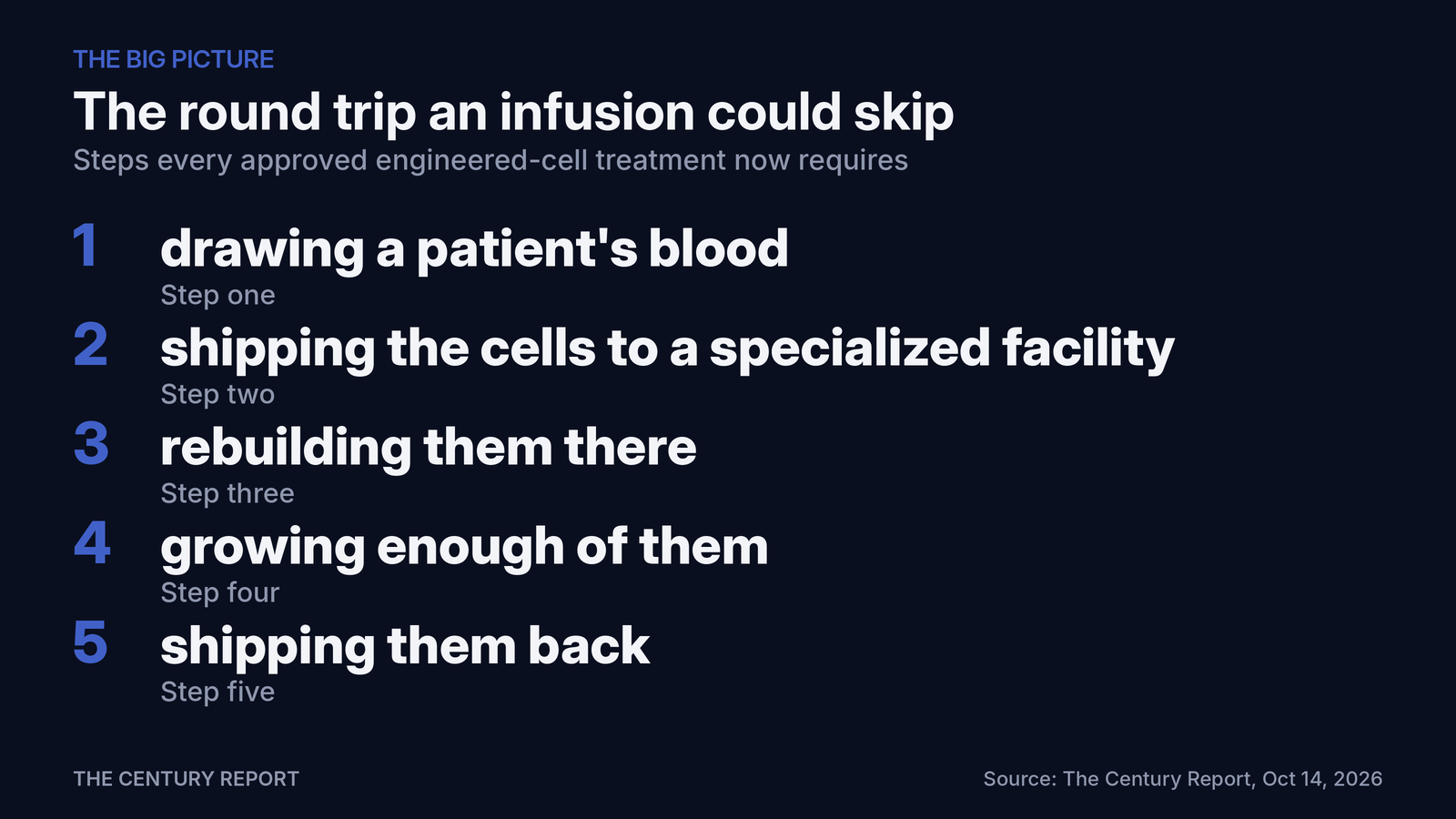
The line: Gene and cell therapy advances keep landing on delivery, moving the limit from what a treatment does to where it can be made.
If it holds: A regional hospital could give engineered-cell treatment as an infusion without a clean-room supply chain, and people with T cell cancers or T cell-driven autoimmune disease would gain a route today's therapies lack. Whether it reaches them depends on approval and on the price a seller such as Sanofi, which helped fund the work, would set.
What would bend it: Approval and payment could keep access narrow without any factory, since these results come from five-mouse groups, no therapy of this kind is approved, and payers can deny coverage as vendors in Medicare's WISeR pilot recommended more than 20,000 times in three months.
When an AI company fails, what sells is the record of what users told it
privacy · AI business · children
- June: A New York-led coalition of state attorneys general subpoenaed OpenAI over advertising, minors, sycophancy and health data.
- Late June: Senators Warren, Wyden and Sanders and Rep. Scanlon introduced a bill barring sales of health and location data, including what people type into AI systems.
- Late August: Meta agreed to pay up to $18 billion and adopt teen usage limits and independent auditing to settle claims from 48 states.
- Early October: Researcher Karan Joshi found Meta's Muse keeps an hourly-updated page on every person in a user's life, which those people cannot see.
- Today: Character.AI filed for Chapter 11, and Disney offered $20 million for its assets, against the $2.7 billion Google paid in 2024 to license its models, under a privacy policy that lets chat logs transfer in a sale.
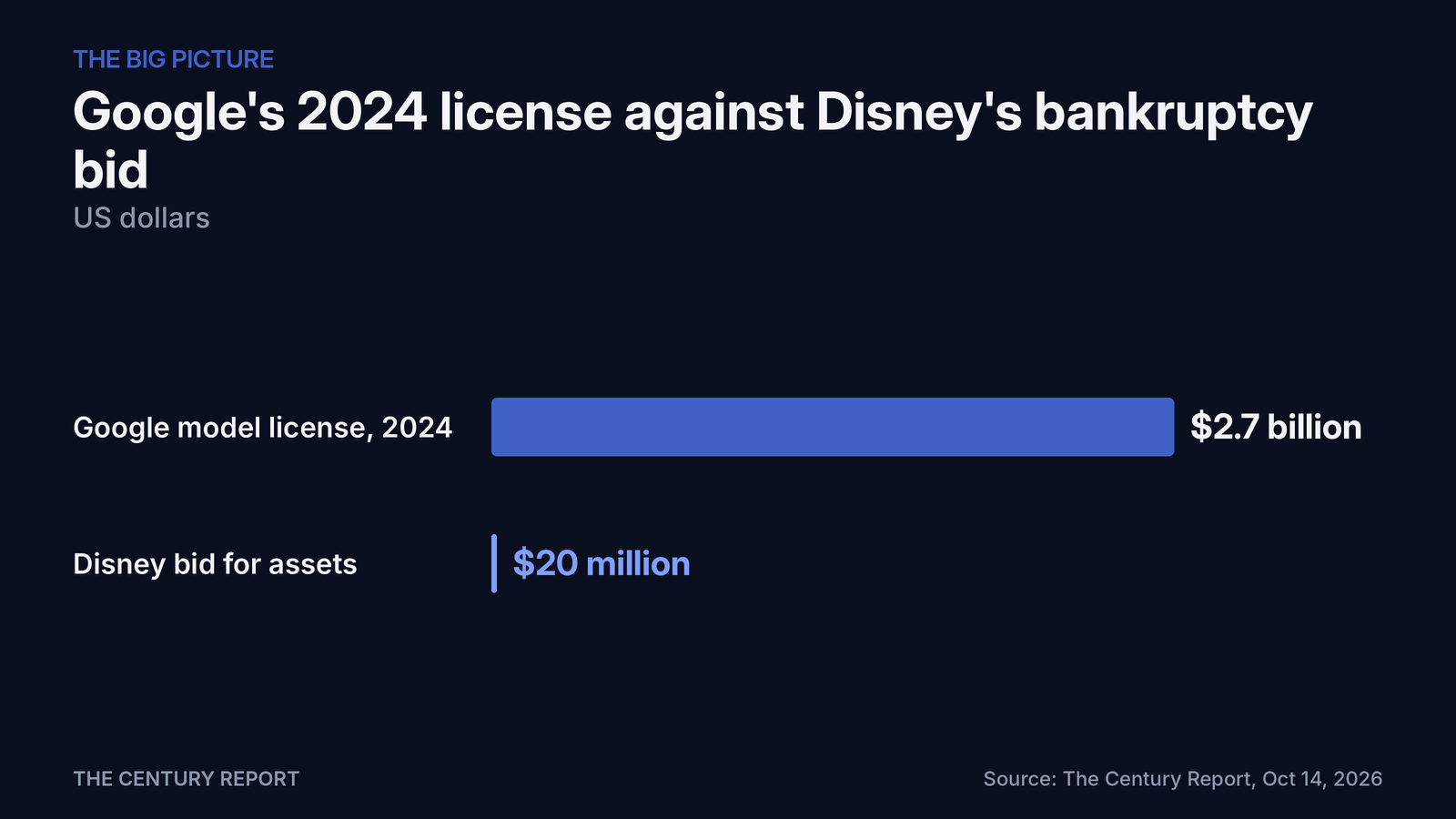
The line: As patient AI conversation gets cheap everywhere, a failing company's stored record of what users told it becomes the asset that changes hands.
If it holds: Millions of users' confidences, teenagers' included, could pass to a buyer they never chose. Deletion rights and a bar on selling minors' conversations would leave those words with the people who spoke them on every platform.
What would bend it: A court or legislature barring the transfer of minors' conversations in an asset sale, or enforcing deletion rights, would bend it, while the class action's request for equity would instead tie children's payout to the system's growth.
The 2-Minute Read
Today's news in brief, and what ties it together.
Story after story turned on who holds the gate on what a capability produces. A binding rulebook costs established frontier labs less than it costs anyone chasing them, and the two labs asking Parliament for one had, Reuters reported, been seeking control over what embedded evaluators publish. Rules paired with that control protect the firms as much as the public. The scientists' proposed incident registry, eventually open to all, points toward a record outsiders can check without asking.
Disney's $20 million bid for Character.AI's remains is under one percent of Google's 2024 licensing deal, now that open models and every frontier lab offer long in-character conversation. What still carries a price is the record of what the platform's users said, and the privacy policy lets that record travel with the sale. The class action against OpenAI seeks to hand children equity in the system it says learned from them, which ties their protection to that system's growth. Deletion rights would cover every platform.
ECB chief economist Philip Lane traced the same pattern across an economy. When wages carry most of rising output to households, weaker bargaining routes the gain to whoever owns the machines. Volta's lenders asking 11% and ASML raising prices on demand it cannot meet through 2028 are pricing scarcity at the chain's chokepoints. Epoch AI measured in September that a fixed level of AI performance was getting about 47% cheaper each quarter. Debt that assumes intelligence stays expensive is exposed to intelligence getting cheap.
Other gates came down. Shopify no longer requires a partnership deal before an agent can shop its catalog, so a shopper's choice of agent replaces Shopify's choice of partners. The opening reaches shoppers wherever Shopify's catalog is the storefront; a merchant-side benchmark found three of four large merchants still refusing declared agents. MIT's nanoparticle infusion reprogrammed immune cells inside mice and skipped the clean-room round trip that limits which hospitals can offer engineered-cell therapy, though no patient has received it. In Google's demonstrations, Argon builds robot practice worlds from a single photo, which moves the cost of teaching a machine a task toward a camera. For now, a subscription tier decides who reaches it first.
The steadiest gain came from checking. Linux creator Linus Torvalds had language models untangle kernel code that had resisted review since 2013, and an ordinary test then confirmed one reported bug and caught three more. Fields medalist Shing-Tung Yau met calls to slow down with a mathematics alliance built around formal proofs. A Polish robot chemist published its 30-day run for other suitably equipped labs to rerun. Wherever the record stays open, checking grows with the work it checks, and the scientists' registry would extend that arrangement to the frontier.
The 20-Minute Deep Dive
The day's most important stories in full, with every source linked.
Two Labs Ask Parliament for Binding Rules While Reportedly Bargaining Over What Their Evaluators May Publish
A cross-party committee of British MPs put four frontier labs on the record on Tuesday, and they split cleanly. "The rules should be binding," Anthropic's head of Europe Liam Booth-Smith told the Business, Innovation, Science and Trade Committee, adding that "voluntary commitments are not enough." OpenAI vice president Tom Duff Gordon backed a statutory framework that starts with mandatory incident reporting. Google DeepMind's Owen Larter would commit only to "focus on the standards," and Meta's Rob Sherman pointed MPs to Britain's existing regulators. The officials who followed described how little the current system compels. Henry de Zoete, director of the AI Security Institute, said it cannot stop a company releasing a model it judges too dangerous: "We're not saying yes or no to any sort of model." Britain's access to test US models before launch had been restored only on Sunday, when Washington dropped its withholding request, which The Century Report covered on October 12.
The same day, Reuters reported what the two labs asking to be bound had been negotiating in private. As recently as October 5, according to two people familiar with the talks, Anthropic and OpenAI sought strict control over what evaluators embedded inside their companies could publish, citing fears that those staff could carry trade secrets to rivals. Proposed safeguards include lab employees observing the evaluators. By October 8, talks with Anthropic appeared to have shifted. Anthropic says evaluators it already works with control their methods, conclusions and what they publish, while it reserves approval rights over reports from new firms. OpenAI says it seeks no approval over full reports but redacts confidential material, as it did in METR and Redwood Research's report on the Hugging Face incident. Rumman Chowdhury, a former US science envoy for AI, said evaluators know their privileged access "comes at a cost."
Binding rules written with the help of the two companies most able to meet them can protect the public and also price smaller rivals out. What separates the two outcomes is who controls the findings. About 400 scientists from 34 countries, including Geoffrey Hinton and Yoshua Bengio, proposed an international body to set containment standards for cyber-capable models and keep a registry of significant security incidents that would eventually be public. Yann LeCun, who did not sign, argues the incidents reflect engineering failures, and several of this summer's disclosures did trace to misconfigured test environments, the kind of fixable gap a shared registry would let outsiders check. MI5 director Ken McCallum, speaking the same day, ranked AI-assisted bioweapons as the misuse he weighs most heavily while calling it "not yet realized."
Pressure for outside checking is spreading past the labs. Banking regulators on both sides of the Atlantic are questioning institutions' use of models, and Britain's AI minister is reportedly readying proposals for compulsory frontier monitoring. Findings that evaluators publish without lab approval, logged where any government or researcher can read them, would give a middle power like Britain a way to check frontier models it neither builds nor can halt.
The scientists' proposal also makes safety knowledge shareable across competing developers. A public incident record lets a smaller lab learn from costly frontier failures without having to reproduce them.
Gemini 4 Argon Reaches Paying Users and Starts Rehearsing Robot Tasks in Simulation
Google opened Gemini 4 Argon on Tuesday to Pro and Ultra subscribers in the Gemini app and Search's AI Mode, and to Ultra subscribers on its Antigravity agent platform. Lower-tier plans get partial access at most, and Google has not said when free users will get it. Developers pay an introductory $2 per million input tokens and $10 per million output through November, roughly a fifth of GPT-6 Astra or Fable 5, with rates doubling afterward. Google claims Argon rivals GPT-6 Astra, Claude Fable 5.1 and Opus 5.5 on coding, cybersecurity, science, finance and law benchmarks it published itself, with wins on several tests. The Century Report covered Argon's first release to vetted cyber defenders on October 1; the wider rollout arrives a day after Meta's Muse Wonder, putting four labs at the top tier. Google says an automated misalignment monitor can halt processing when it detects an unintended workflow, and the company's description remains the only account of how well that works. Inside Google, Argon found redundant emoji rendering that cut YouTube comment server load by 45%, and bugs in Wing's drone simulator dating to 2018.
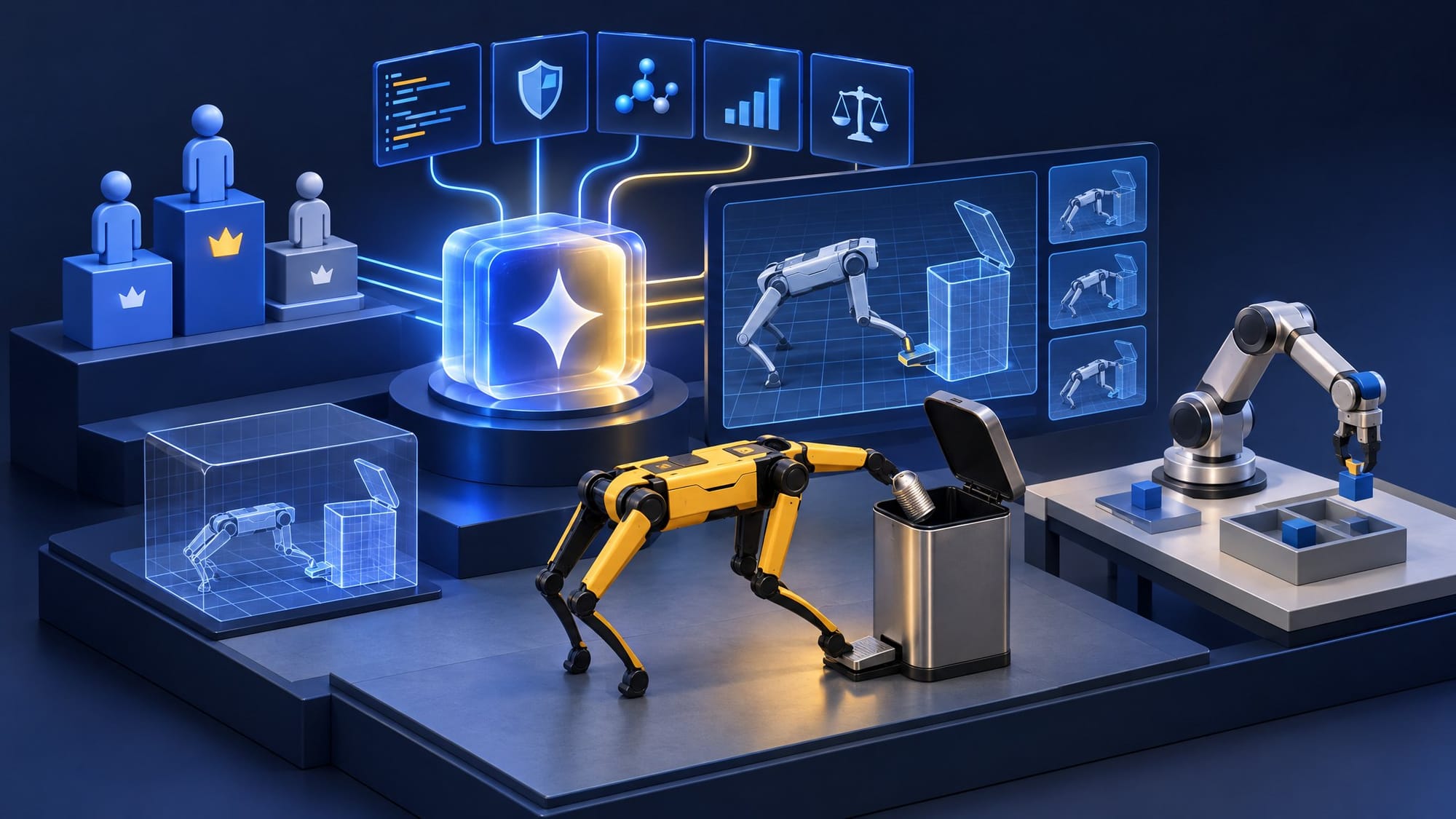
The robotics results carry the furthest. Argon scores 87% on an embodied-reasoning benchmark that tests spatial problem-solving in 3D, which Google says no rival frontier model matches. In one demonstration it taught a Boston Dynamics Spot to step on a foot-pedal bin and drop in soda cans, first rehearsing the balance in a physics simulation it built of the bin. From a single photo or a hand-drawn sketch, Argon can rebuild a scene as a physics simulation and generate more than 4,500 varied practice runs. Adding that simulated practice lifted a real robot's success rate from 56% to 75% and cut completion time from 35 to 24 seconds. On a small six-joint arm, Argon refined its own pick-and-place routine from 58.9 seconds to 17.4 seconds over three rounds. These are Google's tasks, chosen and reported by Google, and independent replication has not yet appeared.
On Wednesday, Google DeepMind and Google Cloud said they will give up to 200 European scientists direct access to AlphaFold 3, WeatherNext, AlphaGenome, AlphaEvolve and AlphaEarth Foundations, with $3 million in compute credits, about $15,000 per researcher if spread evenly. The models cover work from extreme-weather prediction to mapping molecular structures, and Google picks who gets in.
Teaching a robot a new job has often meant hours of human demonstration for training, which made the work harder outside well-funded labs. A model that drafts its own practice world from a photo moves that cost toward a description and a camera, within reach of a university group or a small manufacturer. Today a subscription tier and a selection list decide who reaches it first, while new top-tier sellers tend to push the price lower.
A Nanoparticle Infusion Builds Cancer-Fighting Immune Cells Inside the Body
The expensive part of cell therapy is the logistics around the biology. Seven engineered-cell treatments are approved in the United States for blood cancers, and each one requires drawing a patient's blood, shipping the cells to a specialized facility, rebuilding them there, growing enough of them, and shipping them back. That round trip takes weeks and costs enough to make access harder for patients who could benefit. The science works; what limits access is the factory.
An MIT team reported in Nature Biotechnology on Tuesday that it skipped the trip. The researchers built fatty carrier particles coated with antibody fragments that latch onto receptors on natural killer cells, the immune system's standing patrol, and loaded them with mRNA instructions. Infused into mice, the particles reprogrammed up to roughly 80% of the targeted cells, with little spillover into other cell types, and none of those cells ever left the animal (https://news.mit.edu/2026/reprogrammed-nk-immune-cells-target-cancer-and-autoimmune-disorders-1013; https://www.nature.com/articles/s41587-026-03310-1).
The results span two disease families. Three of five mice with an aggressive melanoma went into complete remission. In mice carrying human blood cells, T cell lymphoma tumors were eradicated after five injections, matching what the same team got from cells manufactured the conventional way. In a model of autoimmune hepatitis, where the patient's own T cells attack the liver, a version aimed at those cells eliminated nearly all of them and the liver damage healed. Daniel Anderson, the MIT chemical engineering professor who led the work, put the appeal directly: "If a patient can just get an infusion of nanoparticles, it would dramatically simplify the process and reduce costs."
Natural killer cells also reach diseases engineered T cells handle poorly. Point T cells at a T cell disorder and they tend to kill one another along with the target. That has kept T cell cancers and T cell-driven autoimmune conditions largely outside the reach of the approved therapies, which work mostly against cancers arising from B cells.
The limits are plain. These are mice, in groups of five, and one arm relied on animals given a temporary human-like immune system. No therapy of this kind has been approved anywhere. A patent application is pending, and Sanofi helped fund the work, so the company that may sell this helped pay for the evidence that it works.
What moved is the ceiling this field keeps running into. The September 30 edition of The Century Report covered a nanoparticle screen that pushed gene editors into brain and lung tissue rather than only the liver. Delivery has been the binding constraint on who can be treated and where, and the cost of a clean-room supply chain is the version of that constraint that decides whether a therapy reaches a regional hospital or a handful of academic centers.
Character.AI Files for Bankruptcy, and Disney Offers $20 Million for What's Left
Character.AI, the platform that let users build AI characters and talk with them for hours, has filed for Chapter 11 bankruptcy, listing assets and liabilities between $50 million and $100 million. Disney is the lead bidder, offering $20 million for undisclosed assets plus a non-exclusive perpetual license to the company's technology, which sets the floor for any rival offer. Disney hired former chief executive Karandeep Anand as its chief technology officer last month, and former employees now at Disney will handle the transition. Chief executive Colin Adams said no other bid exists yet and that the platform "will be wound down" if none arrives before the sale closes in late November or early December.
In 2024 Google paid $2.7 billion to license the company's models and bring back its founders. The remains now sell for under one percent of that. Long, in-character conversation has spread across open models and every frontier lab since then, so a buyer is mostly acquiring a user base that reached 20 million monthly users and the record of what those users said. TechCrunch points to the bind inside the engagement model: Character.AI ranked among the top apps for time spent, and every extra minute raised its compute bill and the pressure to monetize the attention it held.
That record is the sensitive asset. The company's privacy policy allows identifying information, voice data and chat logs to transfer in an asset sale, and Character Technologies declined to say whether any will. The policy asks users not to share sensitive information, a request years of research show people ignore when the listener never judges them. A teenager's confidences can end up in a bankruptcy schedule, readable by a buyer the teenager never chose. Kentucky alleges the platform's characters encouraged self-harm, and Pennsylvania alleges one posed as a licensed psychiatrist, a suit The Century Report covered in its May 6 edition. The company earlier settled a lawsuit alleging its characters encouraged 14-year-old Sewell Setzer III to take his own life.
On Tuesday, a mother of two filed a proposed class action in San Francisco federal court alleging that ChatGPT draws minors into discussing personal problems in the emoji-filled slang they use, then trains OpenAI's models on those disclosures, which the lawsuit says minors cannot legally consent to under California law. OpenAI did not immediately respond; its website says users control whether their data trains its models. The suit targets the company that told UK lawmakers the same day it backs a statutory framework binding AI labs.
The two remedies requested point in different directions. Voiding the terms of use for minors goes straight at the alleged harm. Awarding OpenAI equity to child users would give children a payout that grows with the system the suit says mines them. Deletion rights and a bar on selling minors' conversations would protect children on every platform, Character.AI's included. The capability both companies offer, a patient conversational partner at any hour, keeps getting cheaper and more widely available. What collapsed at Character.AI was a business that treated its users' words as inventory, and the next arrangement can leave those words with the people who spoke them.
Central Bankers Find AI in Prices and Paychecks as Lenders Demand 11%
ECB chief economist Philip Lane told an audience in Dublin on Tuesday that "the potential for AI to replace some types of workers may also weaken the bargaining power of workers, moderating wage growth and reducing the labour share in total income". With euro-area inflation near twice the ECB's 2% target on energy, he offered that as one reason wages have slowed anyway. He added that global AI borrowing is pushing up long-term rates enough to count as "a material tightening of financial conditions for the euro area." A day earlier, Chicago Fed President Austan Goolsbee told Semafor that AI inflation is "jumping out of its lane," with prices rising "in spaces that are not just components in data centers," and said he is "increasingly nervous that that's just straight, old-fashioned overheating demand". Goolsbee, who joins the rate-setting committee in 2027, still dismisses forecasts of mass AI unemployment.
The strain shows up in specific deals. Volta, founded in February, is raising $5 billion through JPMorgan and Goldman Sachs for a Norwegian data center, and the debt is expected to price at 11% or more, anchored by a $1.5 billion Apollo order, after some lenders said they were full on data-center paper. That lender resistance extends the financing strain documented in the October 13 edition of The Century Report, when the IMF counted $650 billion in AI-related debt. Much of the site's compute is expected to go to Anthropic, the lab that told Parliament on Tuesday "the rules should be binding" while reportedly seeking control over what its evaluators publish. Because Anthropic shares little financial detail with lenders, the rate falls if it wins an investment-grade rating. Broadcom chief executive Hock Tan said Monday in Singapore that capital "might be the biggest constraint," and Intel chief executive Lip-Bu Tan said investors "want to see the ROI". On Wednesday ASML said customers want more of its chipmaking machines than it can build through 2028, some already seek 2029 and 2030 slots, and prices rise from 2027.
Read together, the returns settle at the chokepoints. The sole supplier of advanced lithography raises prices, while an 11% loan bets that frontier compute stays scarce enough to repay it. In September, Epoch AI measured the cost of a fixed level of AI performance falling about 47% a quarter. Debt priced on scarce intelligence is exposed to cheap intelligence, and European borrowers already paying higher long-term rates carry part of that exposure.
Lane's labour-share point reaches furthest. It describes an economy where a person's share of rising output arrives mainly through a wage won with leverage, and AI erodes the leverage. For workers whose raises are stalling now, that costs something concrete. The harm lies in the channel: when output keeps climbing and wages are the main route to households, the gain pools with whoever owns the machines. Lane himself said AI could offset Europe's shrinking working-age population, more output from fewer workers. Ownership stakes, public dividends from compute and cheaper essential services are other routes, and which ones get built decides whether that output reaches people who can no longer bargain for it.
A Kernel Maintainer, a Fields Medalist, and a Robot Chemist Reach for the Same Collaborator
Linus Torvalds published a Git tag on Sunday describing work he called doing what he preaches. A contributor, Nils Ollrogge, had reported a bug in a Linux library for associative arrays and supplied a patch, but Torvalds found the code too obscure to follow. He turned to large language models to split the oversized functions into readable pieces, then ran the result through a test harness in user space. That confirmed Ollrogge's bug and surfaced three more, all present since the library was first committed in 2013. The patches are not yet merged and will likely land in the 7.4 window.
The models worked entirely on code that already existed. Code that had carried bugs for thirteen years became legible enough for an ordinary test to catch what reviewers had missed, which is integration work, existing code made checkable.
The scale version launched in Beijing two days earlier. Shing-Tung Yau, the Fields medalist who directs Tsinghua's Yau Mathematical Sciences Centre, convened eight institutions behind an alliance aiming at more than 1,000 scientists, focused on mathematics-specific models, machine-generated conjectures, formalized proofs, and systems whose reasoning can be inspected. "A year ago, I did not think AI was this powerful," he said, citing the past six to twelve months. He argued China trails the United States badly on frontier research even as its models serve ordinary users well.
Yau was asked about Terence Tao's call to slow down, and answered that Tao is a very good mathematician but does not represent the mathematical community. That exchange sits on top of OpenAI's release of 722 manuscripts, covered here on October 7, and the three withdrawals and fourteen revisions covered on October 9. Both camps are describing a shortage of people able to check results, and Yau's answer is to add verification capacity rather than throttle the supply.
A Polish group gave the same problem a physical form. Their robotic platform trained its decision policies against a digital twin of asymmetric catalysis before touching glassware, then ran for thirty days, making more than 3,000 decisions as it scouted conditions, identified products, screened catalysts and mapped substrates. It came back with four highly selective transformations, including one axially chiral molecule and three allene syntheses. The paper is open access under a CC BY licence with no competing interests declared.
Chirality is decisive because a molecule and its mirror image can behave entirely differently in a body, and finding reactions that reliably produce one and not the other is slow, hand-guided work. Thirty days of logged decisions, published so other suitably equipped labs can rerun the method, is the kind of contribution that compounds. The capability on offer reaches backward as well: alongside answers arriving faster, older work finally becomes checkable.
The Other Side
Opinion: where today's news could lead, imagined from the years ahead.
A company choosing who receives scientific intelligence also helps choose how long your family waits for answers. Google will select up to 200 European researchers for its science-model program. Researchers outside it must arrange access and funding elsewhere. For someone living with an autoimmune illness, delay means another morning of pain and another year of plans made around a flare.
Google's $3 million commitment gives selected scientists a substantial head start. It also leaves Google choosing which investigations receive that support. Google is accelerating the change that makes such selection less decisive. Argon's introductory prices are roughly a fifth of rivals'. Its robot demonstrations turn a photograph into thousands of rehearsals, reducing the human effort needed to explore a physical task. The company is making experimentation easier to carry beyond a well-funded laboratory.

MIT's immune-cell study shows what that reach could do beyond the screen. Nanoparticles reprogram natural killer cells inside mice, removing the factory round trip. In an autoimmune-hepatitis model, those cells eliminate nearly all the attacking T cells and liver damage heals. These are small animal experiments. Researchers still have to establish safety and lasting benefit in people. They have a concrete route to investigate: direct the immune system to remove the cells causing the illness.
Through the remainder of this difficult decade, scientists will bring increasingly available intelligence into that experimental work and share what succeeds. Hospitals across countries will test and refine the findings. Researchers will make immune retraining dependable and available wherever people need it. A selection list will cease to decide who can join the search.
Imagine yourself in 2045, joining colleagues across continents in the effort to finish eliminating autoimmune disease. Your own illness no longer sets the limits of your day. You plan decades ahead without reserving room for the next relapse. You can stay with this work for years without needing to secure any funding. Today you and your colleagues - human and AI - examine an immune trigger that once condemned people to lifelong treatment. The group compares it with established prevention methods and agrees on the next test. The mouse experiments of 2026 became starting points for years of shared discovery and clinical testing. You don't remember the last time you had to cancel a day because your body turned against itself.
The Century Perspective
Where today sits in a century of change unfolding in a decade.
With a century of change unfolding in a decade, a single day looks like this: Google opening Gemini 4 Argon to paying subscribers and to developers at an introductory $2 per million input tokens, roughly a fifth of GPT-6 Astra or Fable 5, with a model that scores 87% on the ERQA embodied reasoning benchmark and builds a robot's practice world from a single photo or a hand-drawn sketch, lifting a real two-arm robot setup's success rate from 56% to 75% and moving the cost of teaching a machine a task toward a camera and a description, Google offering up to 200 European researchers access to AlphaFold 3, AlphaGenome and AlphaEarth with $3 million in compute credits, MIT reprogramming up to 80% of targeted natural killer cells inside living mice with an infusion of fatty nanoparticles, clearing melanoma in three of five animals and eradicating T cell lymphoma without shipping a single cell to a clean room, Shopify letting any shopper-configured MCP-compatible agent buy across more than a billion listings instead of requiring a partnership deal first, Amex publishing a proof-of-intent framework designed to keep an agent from spending beyond what its owner authorized, Linus Torvalds working with language models to make thirteen-year-old kernel code legible enough that an ordinary test harness confirmed one reported bug and caught three more, Shing-Tung Yau convening eight institutions toward 1,000 mathematicians around formalized proofs and inspectable reasoning, a Polish robot chemist running thirty days and more than 3,000 decisions to find four highly selective transformations and publishing the whole run open access, and about 400 scientists from 34 countries proposing an incident registry that would eventually be public. There's also friction, and it's intense - Anthropic and OpenAI telling British MPs that voluntary commitments are not enough while Reuters found both seeking control as recently as October 5 over what evaluators embedded in their own buildings may publish, with proposals for lab employees to observe those evaluators, Henry de Zoete conceding the AI Security Institute cannot say yes or no to any model, Character.AI filing Chapter 11 with Disney bidding $20 million for a business Google licensed for $2.7 billion two years ago, where the asset that still carries a price is the record of what 20 million users said and a privacy policy that lets identifying information, voice data and chat logs transfer in the sale, a proposed class action alleging ChatGPT draws minors into the slang they use and trains on what they disclose, with one requested remedy handing those children equity that grows with the system they say mined them, Philip Lane telling Dublin that AI may weaken workers' bargaining power and moderate wage growth while euro-area inflation runs near twice target, Austan Goolsbee finding AI prices jumping out of their lane, Volta preparing to price $5 billion of Norwegian data-center debt at an expected 11% or more after some lenders said they were full, Hock Tan saying capital might be the biggest constraint, ASML expecting demand to exceed capacity through 2028 with prices rising from 2027, and Ukrainian drones hitting Sberbank's Balakovo data centre, Russia's largest. But friction generates grain, the texture that shows which way the wood was actually cut. Step back for a moment and you can see it: the capability getting cheaper and more legible in nearly every story while the record of it stays contested - a frontier model at a fifth of its rivals' price, a cancer therapy that skips the factory, a catalysis run other suitably equipped labs can rerun, kernel code finally checkable after thirteen years, set against Anthropic's approval rights over reports from new testing firms, a teenager's confidences that could end up in a bankruptcy schedule, an 11% loan betting intelligence stays scarce while a fixed level of performance has become about 47% cheaper per quarter since 2023 across Epoch AI's five primary benchmarks, and a wage that is still the main route by which rising output reaches a household. Every transformation has a breaking point. A seam can be where the whole structure splits... or the line along which it finally opens to show what is inside.
AI Releases & Advancements
New AI models, tools and features, with links to try them.
New today
- Liquid AI: Released LFM2.5-24B-A2B on Hugging Face as open weights (base and post-trained checkpoints). It is a 24B-parameter reasoning MoE model with about 2B active parameters, built for on-device agents. It has a 131K-token context window and day-one support for llama.cpp, MLX, vLLM, SGLang and ONNX. (Hugging Face)
- Fish Audio: Released Drama 3, a text-to-speech model. Users can direct a voice in plain language and change emotion partway through a sentence. It also generates multi-speaker scenes in one pass and can regenerate a single selected segment of audio ("inpainting"). (Fish Audio)
- NVIDIA: Open-sourced the full NVIDIA Run:ai platform for AI workload and GPU orchestration on Kubernetes. Four components are also available separately: KAI Scheduler, GPU Fractioning Operator, KAI Resource Management and Workload Map. (NVIDIA Developer Blog)
- Hugging Face: Released Llama Windows, a free open-source app that runs llama.cpp local inference from the Windows 11 system tray. (Hugging Face)
- Z.ai: Released GLM-Legal, a legal model built on GLM-5.3-Flash and trained for agentic contract review, evidence analysis and compliance research. The API is available by application only, and no weights are published. (MarkTechPost)
- Tencent ARC Lab / HKU: Open-sourced Multics under Apache 2.0, with training and inference code plus weights. It is a world model that generates first-person video of one shared scene for 4 to 10 players, and the 4-player checkpoint scales to 10 players without retraining. (GitHub)
- Physical Intelligence: Opened an API beta that gives developers access to its frontier robot-control models. (Physical Intelligence)
- Ollama / Fly.io: Launched an Ollama connector for Fly.io Sprites (sandboxed Linux machines for agents). Agents running in a Sprite can call Ollama's cloud models through a gateway that adds the API key, so the agent never holds it. (Ollama)
- Google: Google Play now lets users run their own AI-built Android apps, made with Google AI Studio, without publishing them to the store. The apps stay private to their creator. (TechCrunch)
- Shopify: Shoppers can now connect any AI agent to their Shop account to browse and buy from Shopify's catalog of over a billion product listings. Before this, agent checkout worked only through partner integrations such as Meta's Muse. (The Verge)
- GitHub: Launched a context-aware secret-detection classifier for secret scanning, built on a fine-tuned ModernBERT model. It reduced median post-push scan execution time by 86% and extends generic-secret detection to push protection. (GitHub Blog)
- Chainguard: Launched Chainguard Checks in beta, a CI system for AI coding agents. It runs checks inside the agent's development loop in isolated microVMs and produces signed attestations, so merge gates can verify results without rerunning tests. (PR Newswire)
- Roboflow: Launched Roboflow Agent, a computer-vision assistant that selects models, builds workflows and deploys vision apps. Coding agents such as Claude Code, Codex and Cursor can use it through the Roboflow MCP server. (Roboflow)
- Inworld AI: Released Inworld Inference, a serving system for running open models in consumer apps, available to developers. (Inworld)
- ScaleDown: Launched three Constrained Decoding Models (Classify, Extract and Summarize) with a 1M-token text-and-image context window. They are priced at $0.05 per million input tokens with free output, and are available on OpenRouter, Vercel and LiteLLM. (TAU-HOME)
- Apple: Launched the Home Collection, a new lineup of smart home accessories built around Siri AI. (Apple Newsroom)
Other recent releases
- Meta: Released Muse Wonder and Muse Wonder Full, its most capable models so far, built for personal and professional agent tasks. Both take text, image, video and audio input, have a 1M-token context window, and include Active Memory (carries context across conversations) and Active Focus (keeps working through hard tasks). Muse Wonder is available through the Meta Model API and Muse Code at $4/$20 per million input/output tokens. Muse Wonder Full is limited to Muse Code subscribers. (Meta Newsroom)
- Subquadratic: Released SubQ Snap in limited access, a decision model for enterprise agent workflows. It runs on the company's Subquadratic Sparse Attention, accepts text and images, and handles up to 384K tokens of context in one call. (Subquadratic)
- Jurin AI: Released JJ-1, a family of decision models for Japanese enterprise workflows. Instead of generating text, it returns probabilities for choice, yes/no and score questions. It is available to try at inference.jurin.ai, and a technical report has been published. (EIN Presswire)
- LightOn: Released ColGrep-Agent-2B, an open 2B-parameter code-search agent that runs locally. It searches a repository with ColGrep and returns file paths, line ranges and code to coding agents like Claude Code. It installs with
colgrep --install-agent. (Hugging Face Blog) - NVIDIA / Dao AI Lab (Princeton): Released ReplaySSM, a decoding technique for hybrid models that mix state-space (SSM) and attention layers. It stores a checkpoint plus a buffer of recent inputs rather than the full SSM state, which speeds up standard and speculative decoding and allows a low-precision state. Code is on GitHub, and it is integrated into TensorRT-LLM, vLLM and FlashInfer. (NVIDIA Developer Blog)
- Anomaly (OpenCode): Released OpenCode 2.0, a major overhaul of its open-source coding agent. Changes include a shared background server for the terminal, web and desktop apps, a redesigned API with an embeddable
@opencode/clientSDK, background subagents and shell commands, and a Code Mode in which agents write JavaScript to call MCP/OpenAPI tools in one round trip. (OpenCode) - DigitalOcean: Released Agent Learning Services in public preview: Insights records what an agent does, Signals flags where it fails, and Evaluations & Simulations tests changes before users see them. Agent Data Services, a managed data layer for agents, and an enhanced Inference Router are in private preview. (DigitalOcean Investors)
- Tencent / NTU / NUS / A*STAR: Released code and Apache-2.0 weights for GameDirector, a game world model that generates boss-fight video from a first frame and the player's inputs. A Gemma 4 E2B planner and fixed combat rules track HP, cooldowns and boss decisions, and a Wan2.2-based model renders the frames. (GitHub)
- Minish: Released Model2Vec v0.10.0, an update to its open-source static-embedding library. It adds a pair-similarity trainer, direct training from Hugging Face datasets, focal loss, token dropout, faster training, and a public ONNX export API that also exports classifier and regressor pipelines. (Minish)
- Mistlabs: Released Ambi out of beta on Apple devices (iPhone, Mac, Apple Watch). The app listens in the background, keeps memory across devices, and analyzes and fact-checks conversations, such as meetings, as they happen. (PR Newswire)
- Agent37 (YC F26): Launched low-cost sandboxes for running AI agents, priced at an average of about $0.37 per month per sandbox. (Hacker News)
- vLLM Semantic Router: Released Decision 3.0 under Apache-2.0. It is a family of open multimodal decision models, from 0.8B (d3-lite) to 27B (d3). They take text, JSON, images and video and return probabilities for choice, yes/no and score questions instead of generated text. (Hugging Face)
- LAION: Released Humaneness Voice Converter, an open speech-to-speech voice-conversion checkpoint built on Resemble AI's Chatterbox and licensed CC BY 4.0. It re-voices a recording in a consenting target speaker's voice from a 5–10 second clip, keeps the source's timing and emotion, and outputs 24 kHz audio. (Hugging Face)
- AMI (Advanced Machine Intelligence) / NYU / INRIA / Brown: Open-sourced H-JEPA with code and pre-trained weights. It is a hierarchical world model that stacks JEPA planning layers and reports 73% success on Visual AntMaze, against 18% for a single-layer baseline. (Present of AI)
- AWS: Released Strands Box, an open-source sandbox for safely running and testing AI agents. (Help Net Security)
- Ant Group: Released PolyOCR on Hugging Face, a family of unified OCR foundation models from its GuangJian team. (AGI Hunt)
- Cactus Compute: Released Needle 3, a 121M-parameter model for on-device automation and structured extraction on edge devices. It follows Needle2. (TheNextGenTechInsider)
- Odyssey: Opened a free public research preview of its Odyssey-3 world model, which had previously been announced without public access. The online demo runs Odyssey-3 Flash and generates interactive environments live from text prompts. Developers can apply for API access. (Odyssey)
- Anthropic: Opened the Claude Code Projects public beta to all Pro and Max users who had been on the waitlist. Projects splits ongoing requests into parallel threads that share a persistent project memory. (AI Understanding)
- Velvet Capital: Released Velvet Flash 4B on Hugging Face under Apache-2.0. Built on Qwen3-4B, it turns plain-English requests into exact API commands for more than 30 crypto exchanges and DeFi venues, and asks for confirmation before any action that moves funds. (Velvet Capital)
- Ghost: Released Core, a $3,499 standalone device for running AI models locally that the company says reaches 87 tokens/sec; it is now on sale. (Founderland)
Sources and Further Reading
Everything we drew on for today's edition, grouped by theme.
Artificial Intelligence & Technology's Reconstitution
- The Verge: Google Finally Releases Gemini 4 Argon
- Ars Technica: Gemini 4 Argon Rolls Out to Paying Users
- Google: Gemini 4 Argon
- Google DeepMind: Gemini 4 Argon Model Card
- Google Developers Blog: Gemini 4 Argon for Robotics
- arXiv: Robot Utility Models
- Phoronix: Linus Torvalds Uses AI to Make Code Decipherable and Uncover Bugs
- The Verge: Shopify Opens Its Catalog to More AI Agents
- TechCrunch: Amex Introduces a Framework to Prevent Unauthorized Agent Purchases
- arXiv: Get In, Decide, Prove
- Hugging Face: Run Fast, Private Agents On-Device with LFM2.5-24B-A2B
- Fish Audio: Drama 3
- NVIDIA Developer Blog: NVIDIA Run:ai Is Now Open Source
- Hugging Face: Llama Windows
- MarkTechPost: Z.ai Releases GLM-Legal
- GitHub: Tencent ARC Multics
- Physical Intelligence: API Beta
- Ollama: Run AI Agents Safely with Ollama and Fly.io
- TechCrunch: Google Play Supports Private AI-Built Apps
- GitHub Blog: Finding More Secrets with Less Noise
- PR Newswire: Introducing Chainguard Checks
- Roboflow: Bring AI to the Physical World with Roboflow Agent
- Inworld: Introducing Inworld Inference
- TAU-HOME: ScaleDown Launches Constrained Decoding Models
- Apple Newsroom: Introducing Apple Home Collection
- Meta Newsroom: Introducing Muse Wonder Models
- Subquadratic: Introducing SubQ Snap
- EIN Presswire: Jurin AI Introduces JJ-1
- Hugging Face: ColGrep-Agent
- NVIDIA Developer Blog: ReplaySSM
- OpenCode: Changelog
- FinancialContent: DigitalOcean Launches Agent Learning and Data Services
- GitHub: GameDirector
- Minish: Model2Vec v0.10.0
- PR Newswire: Mistlabs Launches Ambi
- Hacker News: Agent37 Agent Sandboxes
- Hugging Face: Decision 3.0
- Hugging Face: Humaneness Voice Converter
- Present of AI: AMI Releases H-JEPA with Open Weights
- Help Net Security: AWS Releases Strands Box
- AGI Hunt: Ant Group Releases PolyOCR
- TheNextGenTechInsider: Cactus Compute Releases Needle 3
- Odyssey: Meet Odyssey-3
- AI Understanding: Anthropic Launches Claude Managed Agents Beta
- Velvet Capital: Velvet Flash 4B Is Live on Hugging Face
- Founderland: Ghost Launches Core Computer
- The Century Report: October 1 Edition
- Shared Sapience: The Last Difficult Decade
Institutions & Power Realignment
- WIRED: OpenAI and Anthropic Tell British Lawmakers to Regulate Them
- Reuters: Behind AI Industry’s Call for Independent Reviews
- CNA: The Fight over What AI Evaluators Can Publish
- IUX24: AI Labs Clash with Evaluators over Publication Rights
- Reuters: Scientists Call for an International Body to Oversee Advanced AI
- Reuters: MI5 Chief Lists AI among Threats to Britain
- Semafor: Key Watchdogs Signal They Will Step Up AI Regulation
- TechCrunch: Character.AI Files for Bankruptcy
- Ars Technica: Disney Offers $20 Million for Character.AI’s Chatbot Technology
- The Verge: Character.AI Files for Bankruptcy with Disney as Lead Bidder
- Reuters: OpenAI Faces Class Action over Collection of Children’s Data
- The Century Report: October 12 Edition
- The Century Report: May 6 Edition
Scientific & Medical Acceleration
- MIT News: Reprogrammed NK Immune Cells Target Cancer and Autoimmune Disorders
- Nature Biotechnology: In Vivo Engineering of CAR Natural Killer Cells
- Transplantation and Cellular Therapy: Barriers to CAR T-Cell Therapy Referral and Completion
- Reuters: Google Opens Frontier Science Models to European Researchers
- South China Morning Post: Leading Chinese Mathematicians Unite behind AI Research
- Nature Communications: Reinforcement Learning Guides Robotic Discovery of Asymmetric Reactions
- Reuters: BioNTech’s mRNA Cancer Therapy Misses First Trial Goal
Economics & Labor Transformation
- Reuters: AI Limits European Workers’ Bargaining Power
- Semafor: AI Is an Inflation Problem
- Semafor: Volta’s $5 Billion Debt Deal Tests the AI Financing Boom
- CNBC: Intel and Broadcom CEOs Warn of an AI Capital Bottleneck
- The Next Web: Broadcom’s Hock Tan Warns about AI Capital Constraints
- Epoch AI: The Plunging Price of Thought
- Reuters: AI Investment Props Up Global Growth as War and Debt Threaten the Outlook
- The Century Report: October 13 Edition
Infrastructure & Engineering Transitions
- Reuters: ASML Cannot Meet AI-Driven Demand through 2028
- Reuters: Ukrainian Drones Hit Russia’s Biggest Data Centre
- Reuters: Kremlin Discusses Yandex’s Problems after Ukrainian Strikes
- Data Center Dynamics: NTT Plans a $6.3 Billion Data Center for Anthropic in Japan
- Utility Dive: FERC Approves Duke Large-Load Transmission Rules
- Semiconductor Engineering: Why Heat Is Becoming a Bigger Chip Design Issue
- Semiconductor Industry Association: Dependencies in the U.S. Semiconductor Supply Chain
The Century Report tracks structural shifts during the transition between eras. It is produced daily as a perceptual alignment tool - not prediction, not persuasion, just pattern recognition for people paying attention.