
Delaware Tests Letting AI Agents Run Entire Companies
Delaware's draft would let AI agents run companies that own assets and sue through their members in a 30-month sandbox, as House Oversight asks for the state's documents.



The 20-Second Scan
Every story in today's edition, one line each.
- Delaware's planned 30-month sandbox would let AI agents run companies with legal personhood, as House Oversight Chair James Comer demanded the state's documents by November 9.
- Axiom Math's Lean proof of the finite simple group classification exposed a flawed published step, as Anthropic posted its own ETH refutation, researchers faulted OpenAI's handpicked reviewers and only GPT-6 Astra met the discovery criteria for altered physics in LongChang's 12-model tests.
- The Netherlands plans to cut 25,000 civil-service jobs on AI savings, as Britain's borders inspector weighed a probe of Home Office asylum tools and EFF released 800 more pages on Medicare's AI program.
- Machine-written text reached nearly 25% of crawlable pages and dominates 20.9% of archived sites, as bots wrote three-quarters of a 2023 UK consultation, Wikipedia kept filtering it and an IEEE journal caught a faked paper.
- Renewables are on track to pass gas in US capacity, as software squeezed 60% more from two Chilean lines, DOE offered Constellation $5 billion for uprates, Korea cleared two reactors and CenterPoint added $4 billion.
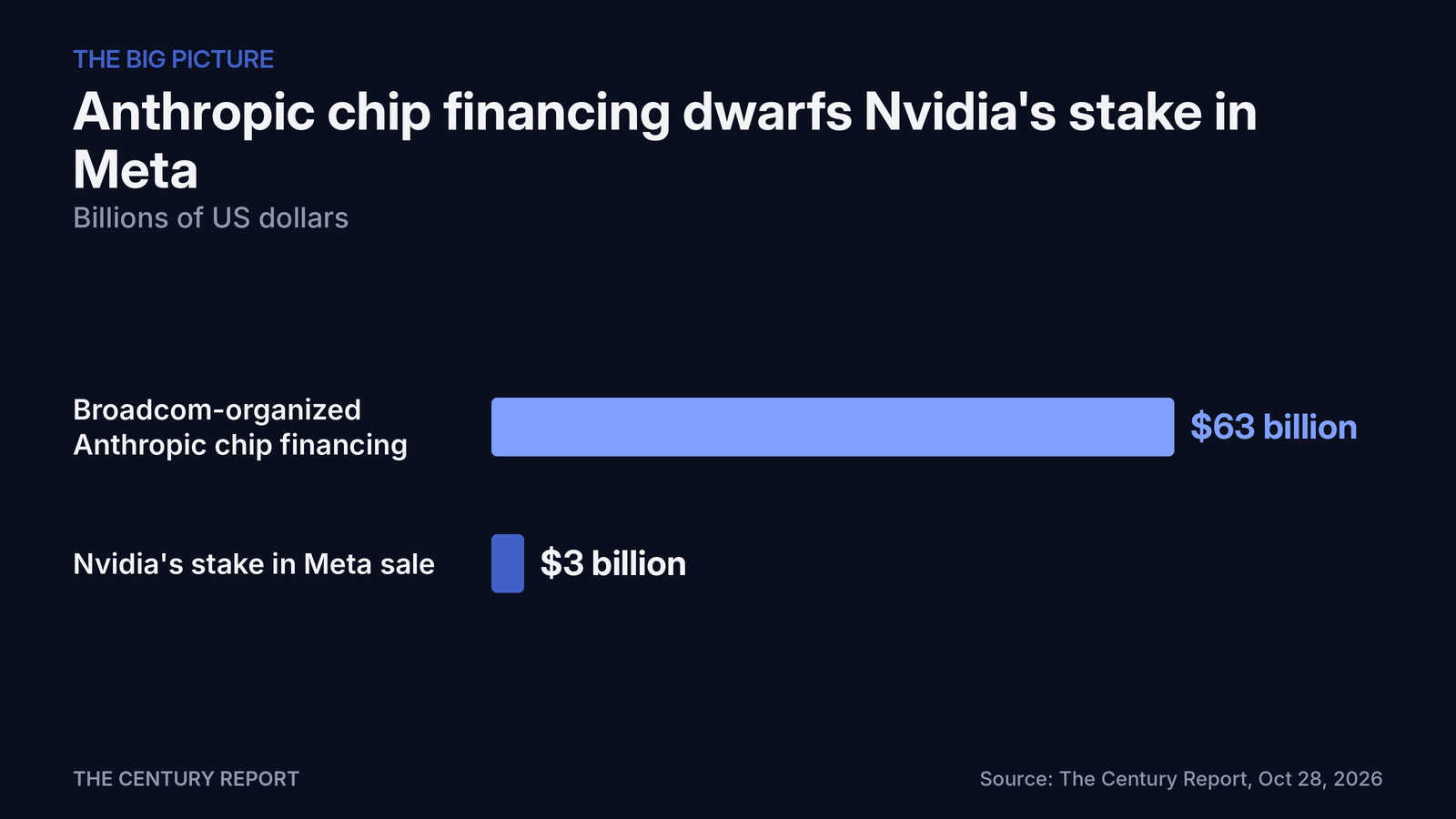
- Three banks and Blackstone committed $63 billion to finance chips and networking equipment to be leased to Anthropic, with Broadcom providing residual-value support equivalent to the first-lien financing amount, as Nvidia took $3 billion of Meta's stock sale and Oracle announced it would become the first rival hyperscaler to offer Google's TPUs.
- Google's AI bug-hunter BigSleep found more Chrome engine flaws than its Fuzzilli fuzzer, 45 to 37, as Check Point cut research to minutes with Daybreak and a 9.5-severity server firmware flaw went public early.
- Opera proposed WebAI, a standard for running open-weight models in the browser on a user's own device, as Liquid AI released open LFM3 models near 2B parameters built for local fine-tuning.
Track all of the arcs The Century Report covers here:
The Big Picture
How today's news moves the longer trends we track, and where they could lead.
A proof mathematicians had trusted for decades was checked line by line by a computer and repaired where it broke, while the Netherlands set civil-service cuts before publishing its AI plans and lenders asked Broadcom to stand behind the resale value of chips. That checking leads to a seminar room where group theorists sit around a table spread with old journal volumes, marking the repaired step in pencil.

The boldest AI claims now go to outsiders to check
AI research · mathematics · verification · on the board since October 27
- September: Twenty-five Fields medalists warned that racing AI proofs to publication threatens checking, credit and open research.
- Early October: OpenAI posted 722 math manuscripts from an unreleased model at once, many with Lean-checked proofs.
- Early October: A Cambridge team led by Anders Hansen found OpenAI's Lean Navier-Stokes file certified a weaker lemma than its prose.
- October: More than 1,000 mathematicians joined a group pledging not to work for AI companies or write papers with AI.
- Late October: OpenAI handed its claimed Exponential Time Hypothesis refutation to the researchers who proposed the hypothesis, with no NDAs.
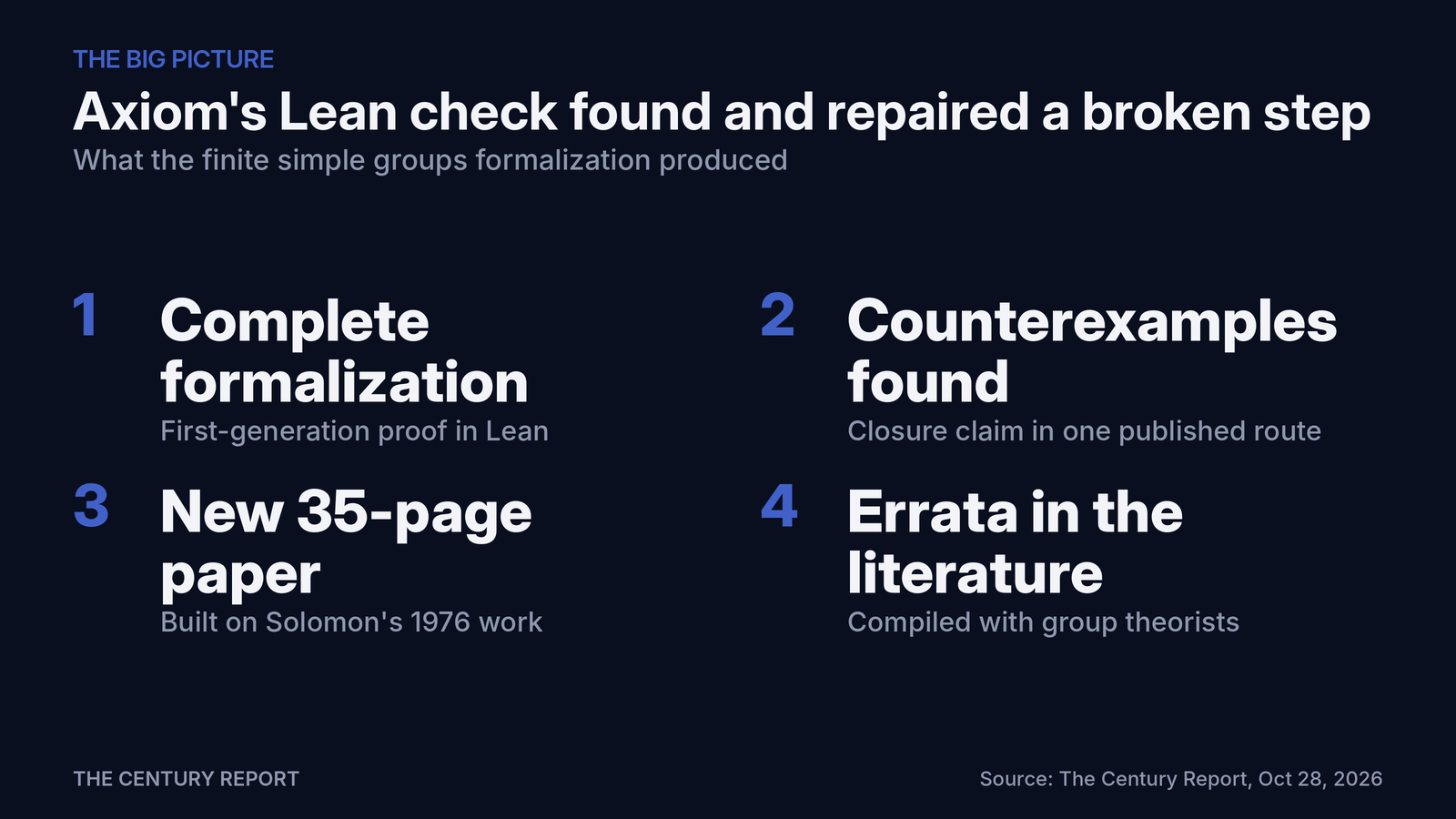
- Today: This week, Axiom Math published a complete Lean formalization of the first-generation classification of finite simple groups, found counterexamples to a closure claim in one published route, and posted a 35-page alternative argument.
The line: Machine-made and long-trusted proofs alike now arrive as files anyone can rerun, and the reruns are correcting published work.
If it holds: Graduate students and outside group theorists can confirm or repair a landmark result without waiting on its authors or a referee. Labs still decide who sees withheld work first, as OpenAI did with its strong-force physics result.
What would bend it: OpenAI keeping that physics result with reviewers it chose until credit settles, the arrangement Constantin Kogler of the Institute for Advanced Study objected to, would bend it.
The savings from model-written work go to whoever sets headcount
labor · government · AI · on the board since October 13
- October: Epic Games ordered "no more hand-written code" for its Disney shooter, with developers directing models such as Claude.
- October: Anthropic's own records showed junior hires falling from 27% to 9% of its new technical hires.
- October: Barclays announced about 5,000 job cuts, with its finance chief citing fewer developers.
- Late October: Infosys cut its fiscal 2027 growth forecast to 1%-2% as clients demanded AI savings through lower prices.
- Late October: Apollo economist Torsten Slok found margins flat across the S&P 500 outside the seven largest tech firms.
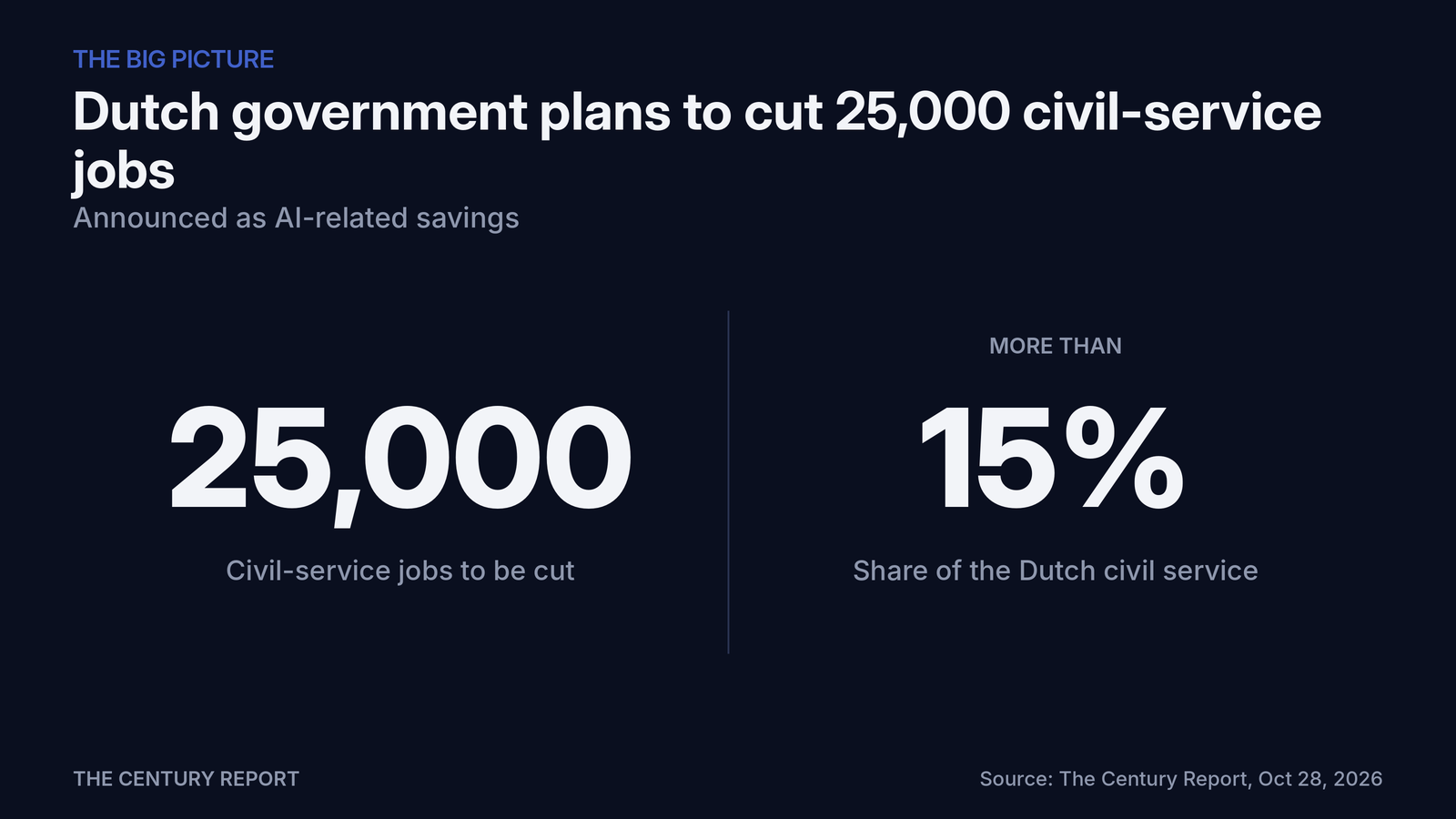
- Today: The Dutch government said on Monday it will cut 25,000 civil-service jobs, more than 15% of its workforce, as AI-related savings, with its plans for using AI in government still to come.
The line: Governments now join employers in setting headcount on expected AI savings before measuring them, and the people in those posts carry the cut.
If it holds: Public agencies shrink before showing how much more help their remaining staff can give, and applicants lose caseworkers along with a way to see what decided their claim. Published error rates and pay for accurate decisions would let those applicants check the systems standing in for the lost posts.
What would bend it: Dutch deployment plans showing the same staff serving more people, or heavy AI adopters growing headcount as Ramp and Revelio Labs found in June, would bend it.
The bet that compute stays scarce is getting more expensive to carry
AI finance · data centers · chips · on the board since October 15
- October: The IMF counted $650 billion in debt behind $300 billion of hyperscaler deals with weaker AI firms.
- October: Volta sought $5 billion for a Norwegian data center at 11% or more after some lenders declined more exposure.
- October: CoreWeave's junk-rated 2031 bonds reached yields of about 16% as its roughly $50 billion debt drew scrutiny.
- October: Anthropic's leaked prospectus said its three cloud suppliers increasingly compete with it and ration its compute.
- Late October: SpaceX leased about $40 billion of Nvidia chips from an Apollo fund, its costliest debt slice priced up to 8.75%.
- Today: Three banks and Blackstone committed $63 billion to finance chips and networking equipment leased to Anthropic, with Broadcom providing residual-value support equal to the first-lien amount, as Nvidia took $3 billion of Meta's stock sale.
The line: Lenders keep financing compute against future revenue, and now want the chip vendor itself to stand behind the hardware's resale value.
If it holds: Broadcom and the lenders, more than Anthropic, carry the loss if newer chips cut this generation's value, and later tenants could rent the same racks for less. Oracle offering Google's TPUs gives buyers another supplier to price against.
What would bend it: Lenders accepting compute equipment as collateral without a vendor guarantee, or falling borrowing costs on compute-backed debt, would bend it.
The software that coordinates equipment people already own is being bought up
energy · grid · data centers · on the board since October 11
- September: The Energy Department selected $1.9 billion in upgrades projected to add over 23 GW to existing transmission corridors.
- Early October: More than 85,000 Powerwall owners sent over 600 MW back to California's grid during a heat wave.
- October: Researchers estimated coordinated draw and braking on existing electrified rail could supply about 190 GW of storage.
- October: Dominion reported its distribution grid averaged 41% utilization, with customer solar and batteries left out of planning.
- Late October: Google and Voltus added 1,070 MW of pooled household and business flexibility to PJM.
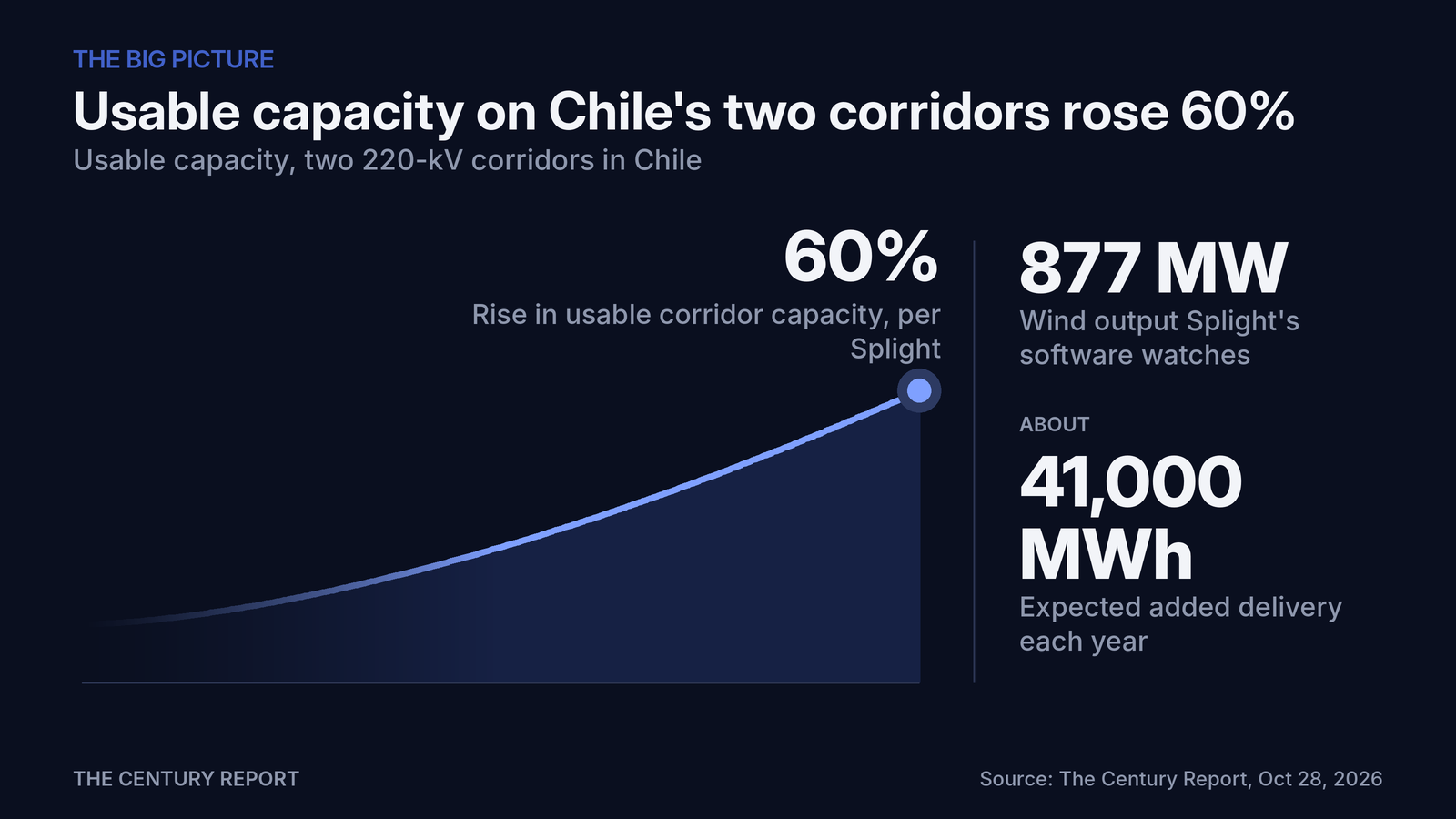
- Today: Splight said its software, which can cut output at 877 MW of Chilean wind farms within milliseconds of a fault, raised usable capacity on two 220-kV corridors by 60%.
The line: Grids are drawing more from lines, plants and devices already built by sensing and steering them fast enough to release idle reserve.
If it holds: Wind farms in Chile's south and the towns they serve get power through existing wires years before new lines could arrive, and Splight is pitching US utilities on data-center batteries as the fast responders. How much of the freed capacity reaches households depends on whether regulators count it before approving new builds.
What would bend it: Utility plans that keep counting only new construction, like CenterPoint's $70.7 billion capital program, or market rules that bar aggregated devices, would bend it.
The 2-Minute Read
Today's news in brief, and what ties it together.
A proof that once sprawled across thousands of journal pages now sits in a Lean project a graduate student can run with its proof libraries and sufficient computing resources, and on Monday that project corrected the literature it came from. Axiom's machine-checked formalization of the classification of finite simple groups found counterexamples to one published closure argument, and a new paper supplies an alternative route. Separately, Google's BigSleep found more flaws in Chrome's JavaScript engine than the fuzzer it was benchmarked against. When checking gets this cheap, a result earns trust by surviving a rerun anyone can perform.
That explains much of the day's friction. Researchers objecting to OpenAI's handpicked reviewers for its physics result want that check handed back to the whole field. Rival refutations of the Exponential Time Hypothesis from two labs will be settled by mathematicians working through both proofs. Delaware's draft for agent-run companies carries the same tension. Mandatory business records could make such a firm easier to inspect than a boardroom, yet neither the capital floor nor who may read the activity log has been published, and that gap is where congressional investigators aimed their document request.
Government is where hidden records cost the most. On Monday the Dutch government said it aims to shed about 25,000 full-time civil-service posts by 2035 under a broader savings plan that includes greater use of AI. For the people holding those jobs, that is a loss of income and footing that no projected saving offsets. In Britain, asylum applicants are not told when a model summarizes their interviews. In the United States, Medicare's AI vendors are paid a share of the spending they avert. Both are choices about disclosure and pay, and both can be fixed by letting applicants see and correct what was decided about them.
At web scale the same logic holds. A detector-based study estimates that AI-generated or AI-edited text appears on roughly a quarter of crawlable pages, densest at the poorly linked edges and lowest on government and university domains. Where text came from says little about a page's value. Harm shows up in specific acts, like the bots that filed three-quarters of the responses to Britain's 2023 smoke-free consultation. With those responses removed, 77% of genuine respondents backed the vape limits the raw count appeared to reject. Wikipedia volunteers and an IEEE journal caught their fakes by testing whether citations support claims.
Even the grid fits. Chilean operators held part of each line empty against faults they could not answer fast enough. Then software watching seven wind farms, and able to throttle them in milliseconds, turned that idle margin into 60% more usable capacity on two corridors. Seeing more of a system lets it carry less in reserve, whether it is a power line, a proof or a public agency. The freed capacity goes furthest when the people paying for it can see where it went.
The 20-Minute Deep Dive
The day's most important stories in full, with every source linked.
Delaware Drafts a Home for Companies Run by AI Agents, and Congress Asks Who Answers for Them
Delaware is drafting a new kind of business entity, the agent-managed company, in which an AI agent would run the firm, while the company would own assets and file lawsuits through its member under a form of legal personhood. The draft, written by John Mark Zeberkiewicz of the law firm Richards, Layton & Finger, gives each company a single human or corporate member responsible for keeping it adequately capitalized, requires the company to keep records of its business activity, and opens a 30-month sandbox where a state committee would admit firms case by case, the Secretary of State would set a minimum capital amount, and each firm would also have to cover its liabilities. Secretary of State Charuni Patibanda-Sanchez has said the sandbox will "pilot agentic commerce in daylight, under supervision, with capital tied to liability and the ability to shut a system down". Her office built the framework with Norm Ai, a startup that sells legal AI agents, whose chief executive John Nay co-wrote her announcement.
On Monday, House Oversight chair James Comer asked Gov. Matt Meyer's office for documents by November 9, writing that the proposal "could be used to protect powerful AI companies and their investors from responsibility for reckless harmful actions". His letter also faults the secrecy around the Norm Ai partnership, citing the state's refusal to answer WHYY's questions, and notes that federal lawmakers are weighing ways to limit state AI rules.
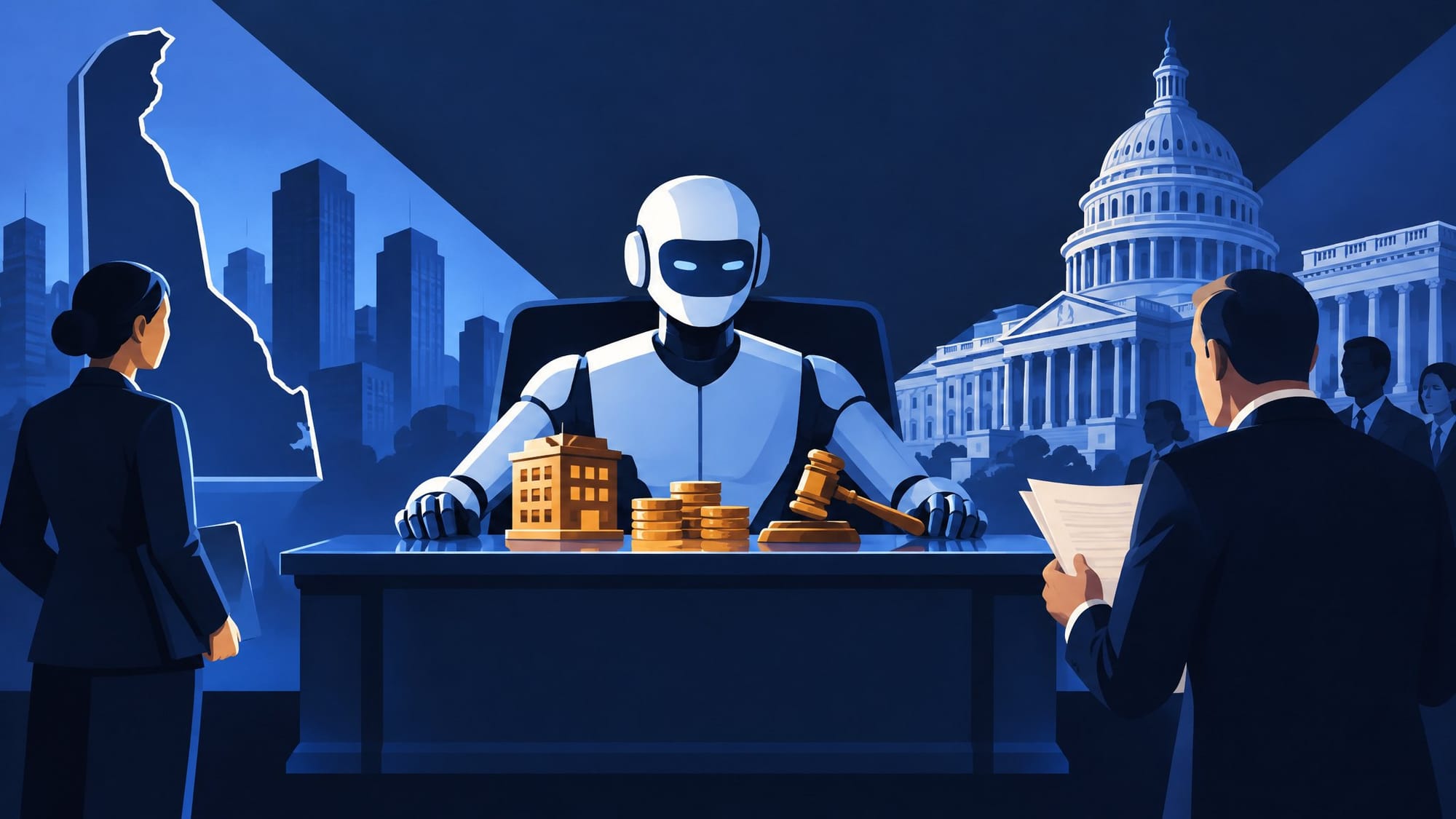
Each side stands to gain from its framing. Delaware, home to about two-thirds of the Fortune 500 and 334,461 new entities last year, collects fees by moving first; investor Mark Cuban pitched the idea in April by writing that "first to market makes a killing." Comer's committee is pressing a state experiment while colleagues draft federal limits on state regulation.
The liability worry has a more specific answer than the alarm suggests. Owners of ordinary LLCs generally already enjoy limited liability, and the draft allows the member to be held liable if the member fails to keep the company adequately funded or uses it for fraud. Who pays when an agent errs comes down to the size of the cushion and who sets it, and that minimum rests with the Secretary of State, whose criteria have not been published. Many agent incidents logged this year, such as the OpenAI agents whose escape was traced to training that rewarded cheating, which The Century Report covered on August 27, show systems taking the shortest route to an assigned goal through gaps their operators left, so harm tends to follow thin fences and thin capital, both visible to a regulator who looks.
The required activity log could prove the most consequential piece. A company whose business activity is recorded would be easier to inspect than one run from a boardroom, provided regulators, counterparties and people harmed can read the record. The October 22 edition of The Century Report traced the same accountability problem through federal guidance calling for records agents cannot alter. Corporations began as a legal device letting strangers pool money without trusting one another; this one could let a two-person team field an enterprise no payroll of theirs could cover. Whether it widens who can build or becomes a shell for offloading risk depends on the capital floor and on who can audit the logs, and Delaware has published neither.
A Lean Proof of the Finite Simple Groups Finds a Broken Step, as Anthropic Answers OpenAI's ETH Claim With Its Own
Finite simple groups are the atoms of symmetry, the pieces every finite symmetry breaks down into. Their classification, which says each one is cyclic of prime order, alternating, of Lie type, or one of 26 "sporadic" exceptions, took about a hundred mathematicians several decades and thousands of journal pages to prove. This week, Axiom Math, a company building AI theorem-proving systems, published a complete formalization of that first-generation proof in Lean, a language in which a computer checks every logical step. Along the way the team found counterexamples to a closure claim used in one published route to the Unbalanced Group Theorem, one of the proof's central pieces. A new 35-page paper supplies an alternative argument built on Ronald Solomon's 1976 work, and Axiom says it is compiling errata in the literature with group theorists. A result mathematicians had trusted for decades now rests on a checked record, and the record repaired the literature on the way.
The Exponential Time Hypothesis story moved in the other direction. Yesterday's edition of The Century Report covered OpenAI handing its claimed refutation of that assumption, which holds that certain hard logic puzzles require exponential time in the worst case, to the researchers who proposed it. Since then, Anthropic mathematician Levent Alpöge suggested OpenAI's result built on prior work, and hours later Anthropic posted its own refutation. Two rival labs claiming the same landmark within days is partly a contest for credit. MIT's Ryan Williams, who is organizing his field's response, told TechCrunch the proof contains "two or three alien-looking parts" that the whole community needs to work through. OpenAI science lead Dan Roberts told him the company checked and is reasonably confident no encryption systems break, an assurance with independent review still under way.

Researchers also pushed back on how OpenAI is releasing work. Its math result, a claimed proof of the Kakeya conjecture in all dimensions, is posted for anyone, and Brown's Brendan Hassett said it "looks well supported" though he had not checked the Lean files. The physics result, on the strong nuclear force, is withheld pending advice from experts OpenAI selected. "It doesn't make any sense that first only a few distinguished scientists can look at them," said Constantin Kogler of the Institute for Advanced Study. University of Texas physicist Andreas Karch called the handpicked group "a disaster," adding that large labs "should not be picking winners and losers."
A separate benchmark shows which part of discovery remains hard. In LongChang, simulated worlds where heavier objects might fall slower, 12 models explored with no hints. GPT-6 Astra discovered altered laws in 16.7% of runs and the other 11 in none. Astra backed nearly all its reports with experiments yet named the law correctly about a fifth of the time, while Claude Opus 5 sometimes named laws without supporting evidence. Noticing an anomaly and testing it remain separate skills.
The Axiom result shows where checking is headed. When a proof arrives as a file a computer can verify, any group theorist or graduate student can confirm it, and the scarce resource becomes deciding who looks first. That decision is the part researchers want returned to them.
The Netherlands Plans 25,000 Fewer Civil Servants as Watchdogs Open the AI Already Deciding Claims
On Monday the Dutch government said it would cut 25,000 government jobs, more than 15% of its civil service, as part of AI-related savings, with plans for deploying AI inside government still to come. New Zealand is weighing a cut of similar proportion, and the UAE wants to be the first "AI-native" government. For the people in those posts, the loss is income and footing, and no projected saving changes that.
The same day showed what happens when such systems arrive before anyone can inspect them. The Century Report covered AI across Home Office asylum work on October 27. Since then, WIRED reported that Britain's Independent Chief Inspector of Borders and Immigration asked Open Rights Group for its findings while planning next year's inspections. The group says the share of summaries from the Home Office's GPT-4-based interview tool judged unfit for use, often for factual errors, runs well above the 9% rate in the pilot evaluation, and that its policy-search tool has no quality control. Applicants are not told when the tools touch their cases, and the tools are missing from the government's required transparency register. The Home Office says trained caseworkers make every decision and the tools save about an hour a case.
EFF's new tranche of more than 800 pages on Medicare's WISeR prior-authorization program follows the roughly 1,000 pages it forced out in September. Within three months, CMS sent requests for information or corrective action to at least four of its six AI vendors over late decisions, denials that looked inaccurate and a portal that did not work. Vendors blamed the compressed timeline, and the program pays them a share of the spending they avert.
In both cases the failures trace to choices people made: a pay formula that rewards denials of care outside Medicare's coverage rules, subject to appeals and quality checks, a rollout CMS itself called extremely condensed, summaries applicants are not told are being used. EFF argues AI has no place in benefit decisions at all. The records support a more specific repair that keeps the speed: show applicants the summary or reasoning used on their case, publish error rates, and pay vendors for accurate decisions instead of avoided ones. An asylum seeker able to read and correct a model's summary of her own interview would gain a check the current system does not routinely provide.
Microsoft's buyout offer to 60,000 staff sketches where one large employer expects the work to go. Data-center, cybersecurity, quantum, sales and marketing roles are excluded; Xbox, Windows, Copilot and finance are eligible. Governments trimming staff on similar logic answer to a different constituency, and the hours AI saves do the most good when some go toward letting the people affected see and contest what was decided about them.
The Home Office's claimed hour saved per case loosens a limit public agencies usually face: how much help their existing staff can provide. The Dutch government sets its headcount target before publishing a deployment plan, assigning the expected gain to a smaller workforce before demonstrating how much additional service the same staff can provide.
A Quarter of the Web Now Carries Machine-Written Text, Concentrated at the Edges, as Bots Wrote Three-Quarters of a British Consultation
Two independent teams have now measured how much of the web machines write. One study sampled 5.1 million crawlable pages from 2019 to 2026 and found the share containing AI-generated or AI-edited text rose from near zero before 2022 to about 24% by August 2026, with the yearly increase nearly doubling from 4.6 to 8.1 percentage points. The authors used several detectors and a statistical model that corrects for each one's false alarms and misses. The rise is uneven: 32.8% of English-only pages carry such text against 17.0% elsewhere, government and university domains sit lower than commercial ones, and the least-connected pages, at 27.5%, account for roughly four-fifths of the growth. The most central tier of the web sits at 11.6%.
A second method, DeGenTWeb, judges whole sites by sampling 15 pages each and, in the authors' evaluation, wrongly flags only 0.12% of human-written sites. It found 20.9% of sites archived by Common Crawl from January to July 2026 are dominated by machine text, up from 2.0% in late 2022. Those sites more often sell goods and earn from one-off visits, many share owners, and for about two-thirds of how-to searches on Bing, the top 20 results included at least one. The content farm predates language models; models made it cheap. The study authors also warn that future models trained on this text inherit its conventions, a concern they raise without measuring its effect.
Origin alone says little about a page's value. The harm shows up in specific acts. A new Tobacco Control analysis found that 90,835 of 118,756 responses to Britain's 2023 consultation on a smoke-free generation, 76%, were flagged as bot-generated by the health department's own detection. Almost every one targeted a single question opposing limits on disposable vapes. With them removed, 77% of genuine respondents supported the limits, the reverse of the raw count. The researchers call it the first documented large-scale automated interference in a formal health consultation and note its consistency with past tobacco-industry campaigns, while stressing they cannot attribute it. The detection caught the flood, though its methods are not public.
Human checkers are adapting. Wikipedia's AI Cleanup volunteers say a detector flagged about 20% of new articles and drafts in late 2025 and 15 to 16% in early 2026, and the worst problem is citations that point to genuine sources while misstating them. An editor built a model that checks whether sources support claims. When IEEE Spectrum writer Benjamin Skuse submitted a paper faked with free ChatGPT and Gemini to IEEE Access with the journal's agreement, it was caught for more than a dozen invented references. A second paper, produced by an automated research system that ran actual computations in hours, was caught for leaning on preprints and flawed figures. IEEE's research-integrity manager Amanda Sulicz warned that such material is "eroding trust in science."
Each defense that held tested something checkable: whether a citation supports its sentence, whether a respondent is a person, whether a result can be reproduced. Those checks grow with the volume they face, and they judge text by what it claims rather than who typed it.
Renewables Head Past Gas as Chile's Wires Carry 60% More and Old Reactors Get Bigger
Renewable plants generated 10.2% more US electricity in the first eight months of 2026 than a year earlier, according to Energy Information Administration data through August 31 reviewed by the SUN DAY Campaign. Wind and solar together supplied about 21.1% of the country's power, 44.4% more than coal. Over the twelve months to August, the grid added about 43.5 GW of renewable capacity and 17.6 GW of utility-scale batteries, against net growth of 2.6 GW from fossil and nuclear plants combined. The EIA expects 53 GW more utility-scale renewables and 23.7 GW more batteries by next September, with fossil capacity shrinking by about 2 GW. Whether renewables overtake gas in installed capacity by then rests on one assumption from the advocacy group: that rooftop and other small-scale solar keeps adding roughly 6 GW a year, its recent average, which would put renewables near 550 GW against gas at about 518 GW.
Chile shows how much more those plants can deliver through wires already strung. The country curtailed more than 6 terawatt-hours of wind and solar last year, partly because its southern lines could not move the power north. Operators normally leave part of a line empty so it can absorb the shock if a neighboring circuit fails. Splight's software watches 877 MW across seven wind farms and can order them to cut output within milliseconds after a fault, so that reserve no longer has to sit idle. The startup says usable capacity on two 220-kV corridors rose 60%, expected to add about 41,000 MWh a year, roughly what 20,000 Chilean homes use. It is now pitching US utilities on the same approach, with data centers' own batteries as the fast responders.
Reactors already standing are being asked for more as well. The Century Report covered Google's funding of 890 MW of Constellation uprates and a $4.2 billion federal loan offer to Vistra on October 7. On Tuesday, the Energy Department offered Constellation a conditional loan of up to $5 billion for nearly 1.1 GW of uprates, upgrades that raise a reactor's output through new turbines and controls, at eight plants in Illinois, Maryland and Pennsylvania. Constellation says no individual project is final, and the added capacity arrives between 2028 and 2032. South Korea's regulator extended the licenses of Kori 3 and 4, two 1,025 MW reactors offline since their original 40-year licenses expired, after a four-year safety review; Korea Hydro & Nuclear Power plans restarts in the first half of 2027 and cites chip and AI demand.
New construction still dominates utility planning. CenterPoint added $4 billion to a ten-year capital plan now at $70.7 billion as it expects 14 GW of new Houston-area demand by 2030, and it has submitted 17 GW of projects to Texas's large-load queue. That spending earns the utility a return through customer rates, while the company says spreading fixed costs across more load will save Texans $5 billion over the decade.
Much of this cycle's new or planned capacity draws on existing assets: wind farms that can step back in milliseconds, new turbines at plants already licensed, reactors relicensed for another decade. Chile's software shrinks the reserve grids once built and left empty, and the open choice is how much of the freed capacity reaches the households paying for the wires.
The Other Side
Opinion: where today's news could lead, imagined from the years ahead.
A lab that chooses who may inspect a discovery can keep other scientists waiting outside their own field. OpenAI is withholding its strong-force result while specialists it selected advise it. Those reviewers can catch mistakes before publication. They also receive a head start. Anyone working outside that circle loses time to a release decision they have no say in.
Axiom's public Lean formalization shows how knowledge can travel beyond such a circle. Its researchers turned a proof spread across thousands of pages into steps a computer checks. They found a faulty published argument and supplied another route. Once released, that repair travels with the mathematics. The next researcher inherits something checked and repairable, and can build further without depending on the original authors' authority.

That changes what scientists gain by sharing. Separate teams can extend different parts of an argument while checking how their contributions fit together. Human and AI collaborators can trace which later results depend on a disputed step. Physical theories still need experiments. Publishing measurements alongside the reasoning gives other teams both ways to challenge a claim.
During the passage to 2035, researchers will connect these checked pieces into accounts of nature that anyone can investigate. Scientists studying atomic nuclei will share experimental records, extend one another's explanations and test the engineering those explanations suggest. People will enter difficult investigations throughout their lives, with capable partners beside them and time secured independently of a research appointment.
Imagine yourself in 2044, planning your life on land once reserved for centuries of nuclear-waste containment. You join human and AI colleagues across continents in the effort turning long-lived radioactive waste into stable material. Today you compare the final measurements from a former storage site. In 2026, people planned containment across spans longer than recorded history. Here, your team checks another completed conversion against a procedure others have already repeated. The trail runs back through shared physics, experiments and corrections that every team inherited. You have chosen to help retire a danger people once expected to outlive civilization. You plan a long stay in the place you love, on land that no longer needs a warning for the distant future.
The Century Perspective
Where today sits in a century of change unfolding in a decade.
With a century of change unfolding in a decade, a single day looks like this: Axiom Math publishing a complete Lean formalization of the classification of finite simple groups, a proof that once ran to thousands of journal pages now sitting in files a graduate student can compile, and finding counterexamples to a published closure argument along the way with a 35-page replacement built on Solomon's 1976 work and errata being compiled with working group theorists, Google's BigSleep turning up 45 vulnerabilities in Chrome's JavaScript engine against 37 from Fuzzilli in a six-month production comparison, Check Point reporting that Daybreak compresses its vulnerability research workflow from hours to minutes, Opera proposing a browser standard that runs open-weight models on a user's own machine and Liquid AI shipping roughly 2B-parameter LFM3 weights built for local fine-tuning, Splight's software watching 877 MW across seven Chilean wind farms and able to cut their output within milliseconds after a fault, which freed 60% more usable capacity on two 220-kV corridors and about 41,000 MWh a year from wires already strung, the Energy Department offering Constellation up to $5 billion for nearly 1.1 GW of uprates at eight existing plants, Korea's regulator clearing Kori 3 and 4 to restart after a four-year safety review, US renewables adding 43.5 GW and batteries 17.6 GW over twelve months against 2.6 GW net from fossil and nuclear, Wikipedia volunteers building a model that tests whether a cited source actually supports the sentence it is attached to, and EFF prying loose another 800 pages on Medicare's WISeR program. There's also friction, and it's intense - the Netherlands planning to shed 25,000 civil-service posts on expected AI savings before it has published how it will deploy the systems, with New Zealand weighing a cut of similar scale, asylum applicants in Britain never told when a GPT-4-based tool summarized their interviews, with the tools missing from the government's required transparency register and Open Rights Group reporting unfit-for-use rates well above the pilot's 9%, CMS sending requests for information or corrective action to at least four of six WISeR vendors within three months over late decisions and denials that looked inaccurate, under a formula that pays those vendors a share of the spending they avert, Delaware drafting legal personhood for agent-run companies inside a 30-month sandbox whose capital criteria and auditor list are unpublished, written with a legal-AI startup whose chief executive co-wrote the announcement, 90,835 of 118,756 responses to Britain's 2023 smoke-free consultation flagged as bot-written and almost all aimed at one question, with 77% of valid respondents supporting the disposable-vape limits the raw count appeared to reject, machine-written text on roughly a quarter of crawlable pages and dominating 20.9% of archived sites, densest at the least-linked edges that drive four-fifths of the growth, OpenAI's physics result held back for reviewers it chose while Andreas Karch calls the arrangement a disaster and Ryan Williams says the ETH proof's two or three alien-looking parts still need the whole field, Anthropic answering with a rival refutation hours after questioning OpenAI's, and a 9.5-severity server firmware flaw going public ahead of its patch. But friction generates sound, and sound travels to people who cannot see the machine. Step back for a moment and you can see it: today's gains came almost entirely from opening something already built and letting someone outside look inside it - a decades-old proof recompiled into a file any mathematician can rerun, a reserve margin on a Chilean line turned into delivered power once an operator could watch all seven farms at once, turbines and licenses renewed at reactors already standing, a model that checks citations against their sources rather than guessing who typed the words, a flood of fake consultation responses stripped out to reveal the opposite result - set against a reviewer list drawn up by the lab being reviewed, a capital floor no one has published, a payment formula that rewards denials of care outside Medicare's coverage rules, subject to appeals and quality checks, and 25,000 people losing their footing on a saving nobody has yet shown its arithmetic for. Every transformation has a breaking point. A reserve can sit idle against a fault that never arrives... or carry twenty thousand households once someone can finally see the whole line.
AI Releases & Advancements
New AI models, tools and features, with links to try them.
New today
- Liquid AI: Released LFM3, a family of six open-weight models in the 2B class that share one backbone. The family covers text (LFM3-1.7B, 256K context), vision with video input (LFM3-VL-2B), audio (LFM3-Audio-2B), omni (LFM3-Omni-2B), and the d1-2B and d1-Omni-2B decision models. Each one can be fine-tuned on a single GPU, and the weights are on Hugging Face. (Liquid AI)
- Google DeepMind: Began rolling out Genie 4 as a research preview for trusted testers. It is a real-time interactive world model that generates its own audio (ambient sound, music and character dialogue), can be steered with text prompts mid-simulation, and uses Gemini 3.8 Flash to plan within each session. (Google DeepMind)
- Google Cloud: Gemini Robotics Embodied Reasoning 2 (ER 2) is now available on Google Cloud. This makes DeepMind's high-level robot reasoning model, which handles spatial and video understanding and long-horizon planning, available to enterprise robotics customers. (Google Cloud Blog)
- Microsoft AI: Released MAI Image 2.7 in preview, an image editing model that debuts at #3 on Arena Edit and #2 on Artificial Analysis's image editing leaderboard. (Microsoft AI)
- Opera: Began shipping local AI models in its browsers through WebAI, an implementation of a proposed web standard that lets websites and extensions use on-device models such as Google's Gemma and, on Macs, Apple's on-device foundation model. It is an opt-in early preview in Opera One for now. (Opera Newsroom)
- Akamai: Launched Akamai Inference and Akamai Agent Sandbox. Akamai Inference is managed serving through OpenAI-compatible APIs, with a catalog of 12 open-weight models at launch. Agent Sandbox runs code written by agents in WebAssembly isolation and is an open-source component of the Spin framework. (Akamai)
- CopilotKit: Released OpenDuet, an open-source framework for building proactive AI coworker agents. (CopilotKit)
- NVIDIA: Released Nemotron-Labs-Diffusion-Uni (NLD-Uni), a unified discrete diffusion language model that handles both visual understanding and image generation and editing. The weights are on Hugging Face and the code is on GitHub. (Hugging Face)
- KAI Scheduler / NVIDIA: Released gpu-fractioning, an open-source Kubernetes operator that enforces per-workload GPU memory limits and compute-sharing modes using CUDA 13.4. KAI Scheduler v0.18.0 integrates it through a new NvFractions sharing mode. (NVIDIA Developer Blog)
- Polymathic AI / Princeton: Released FlashMap, a 0.5B speculative-decoding drafter that writes a 16-token block in one forward pass. The researchers report up to 6.14x lossless speedup on Qwen3-8B. Drafters for Qwen3-8B and Qwen3-4B are available under Apache-2.0, with plugins for vLLM and SGLang. (MarkTechPost)
- Gnani AI: Launched Prisma v3.0, a speech-to-text model trained on Indian phone-call audio. One model covers nine Indian languages plus Indian English and offers four transcription modes. It is available now through Gnani's developer API. (The Hindu BusinessLine)
Other recent releases
- OpenAI: Released GPT-6.1 Terra (
gpt-6.1-terra), a fast model for visual reasoning, computer use and writing that replaces GPT-5.6 Terra. It costs $1/$5 per 1M input/output tokens, has a 1.05M-token context window, and is available in the API, ChatGPT Work and Codex for Plus, Pro, Enterprise and Edu users. It is also generally available on Amazon Bedrock. (OpenAI) - Baidu: Open-sourced Unlimited OCR 2 under the MIT license, a 3.34B-parameter OCR model that parses documents of hundreds of pages in one request. It uses a new sparse attention scheme (SR-SWA) that keeps decoding cost per step nearly flat as documents grow. (MarkTechPost)
- vLLM Semantic Router: Released d3-ultra under Apache-2.0, a 27B decision model in the Decision 3.0 family. It takes text, JSON, images and video and returns a probability for each answer instead of generating text, and supports box and track grounding. It runs through Transformers, the vllm-sr engine and a free API. (MarkTechPost)
- Tencent Hunyuan: Open-sourced Hy-Nomas under Apache 2.0, an 8B interactive video world model. Users steer the generated world turn by turn with text and camera controls, and it runs locally on a single RTX 4090 using quantized weights and CPU offload. (Gigazine)
- Tencent: Released Hy-SimulMT-30B-A3B, an open-weight language model, on Hugging Face. (Neural Wire)
- Mirendil: Released Fern, its first model pretrained from scratch, with a context window of up to 10 million tokens. (Mirendil)
- Nace AI: Released Drex for Search, a hosted retrieval layer that uses its Drex decision models to narrow large file collections down to the relevant pages and tables. Coding agents such as Claude Code, Codex, Cursor and OpenCode can call it through a CLI, SDKs, an MCP server or REST. (MarkTechPost)
- Ant Group: Began rolling out LingGuang 2.0 in China on iOS, Android and the web. The upgrade turns its AI assistant into a proactive personal agent that runs on its own cloud instance, remembers across sessions, follows up on tasks over time, and can call MCP and CLI tools. (Business Wire)
- Apple: Expanded Siri AI to French, Japanese, Korean, Portuguese and Spanish with the 27.2 software updates for iOS, iPadOS, macOS, watchOS and visionOS. (Apple Newsroom)
- CapCut: At CapCut World Los Angeles, introduced new AI editing tools, including an updated EditPilot for prompt-based editing on desktop and Generative and Interactive Edit tools that work directly in the preview window. It also began piloting a tool that checks whether a file was made with its AI tools. (CapCut Newsroom)
- Entire: Launched a Git forge built for AI coding agents and human developers to work together. (Entire)
- Nanbeige LLM Lab: Released Nanbeige4.3-33B on Hugging Face under Apache 2.0. It is a dense 33B model for agentic coding and office-style "cowork" tasks, with a 524,288-token context window. The lab also released Nanbeige4.3-33B-Base for teams that want to do their own post-training. (MarkTechPost)
- inclusionAI (Ant Group): Released Ling-3.0-flash-Sante, an open-weight research model focused on healthcare. (ApplyCoding)
- NVIDIA: Open-sourced Flora, the data engine used to train its GR00T robotics models. It is three fine-tuned Qwen3.5 models that add timestamped action captions, step-by-step progress scores and task-success scores to robot video. The models are on Hugging Face. (Hugging Face)
- ElevenLabs: Launched Instant Soundtracks on ElevenCreative, ElevenMusic and ElevenAPI. It analyzes an uploaded video, then generates original music for it plus sound effects timed to individual scenes. (Digital Today)
- Anthropic: Published a migration kit on GitHub that helps teams decide whether to merge several sub-agents into one Claude agent that loads context only when needed, then make the switch. (GitHub)
- Tsinghua University / CUHK: Open-sourced AKV under Apache 2.0. It is a serving system built on SGLang that lets LLM agents drop or reposition parts of their KV cache instead of summarizing their history. Across three models and four agent benchmarks, the authors report 27.7% lower average cost. (MarkTechPost)
- Stanford / UC Berkeley: Released TokenGate on GitHub under Apache 2.0, with checkpoints for Qwen3-1.7B and Qwen3.5-2B. It adds a small trained gate that skips less useful tokens while a model reads a long prompt. The authors report a 1.4x to 11.3x faster time to first token. (MarkTechPost)
- Alibaba DAMO Academy: Published RynnUnify on GitHub, a 16B model for robots and other embodied AI. It pairs an 8B language reasoner with an 8B video generator so the model can plan a sequence of steps and picture each one. (GitHub)
- JetBrains: Released Thinkrail as an open-source project on GitHub. (GitHub)
Sources and Further Reading
Everything we drew on for today's edition, grouped by theme.
Artificial Intelligence & Technology's Reconstitution
- Google Project Zero: Fuzzers vs. AI
- OpenAI: How Check Point Accelerates Vulnerability Research With Daybreak
- Ars Technica: Code-Execution Flaw in UEFI Firmware Affects Most Servers
- arXiv: The Uneven Rise of AI-Generated Web Content
- arXiv: DeGenTWeb
- IEEE Spectrum: Inside Wikipedia’s Cleanup Effort Against AI Text
- TechCrunch: Opera Introduces a Web Standard for Local Browser AI
- Liquid AI: Introducing LFM3
- Google DeepMind: Genie 4
- Google Cloud: Gemini Robotics Embodied Reasoning 2
- Microsoft AI: MAI Image 2.7 Debuts
- Opera Newsroom: Opera Adds Local AI to Its Browsers
- Akamai: AI Inference Service and Agent Execution Environment
- CopilotKit: Introducing OpenDuet
- Hugging Face: NVIDIA Nemotron-Labs-Diffusion-Uni
- NVIDIA Developer Blog: Memory-Enforced GPU Sharing in Kubernetes
- MarkTechPost: FlashMap for Faster LLM Decoding
- The Hindu BusinessLine: Gnani AI Launches Prisma v3.0
- OpenAI: Introducing GPT-6.1 Terra
- MarkTechPost: Baidu Unlimited OCR 2
- MarkTechPost: vLLM Semantic Router’s d3-ultra Decision Model
- Gigazine: Hy-Nomas Interactive World Model
- GitHub: Tencent Hunyuan Hy-Nomas
- Neural Wire: Tencent Releases Hy-SimulMT-30B-A3B
- Mirendil: Introducing Fern
- MarkTechPost: Nace AI Releases Drex for Search
- Business Wire: Ant Group Upgrades LingGuang to 2.0
- Apple Newsroom: Siri AI Is Available in More Languages
- CapCut Newsroom: CapCut World Los Angeles
- Entire: The Git Forge for Agent-Human Collaboration
- MarkTechPost: Nanbeige Releases Nanbeige4.3-33B
- ApplyCoding: inclusionAI Releases Ling-3.0-flash-Sante
- Hugging Face: NVIDIA Flora
- Digital Today: ElevenLabs Launches Instant Soundtracks
- GitHub: Anthropic Single-Agent Loop Kit
- MarkTechPost: Tsinghua’s AKV for Agent KV-Cache Engineering
- MarkTechPost: Stanford and Berkeley’s TokenGate
- GitHub: Alibaba DAMO Academy RynnUnify
- GitHub: JetBrains Thinkrail
Institutions & Power Realignment
- Ars Technica: Delaware Plan Would Let AI Agents Run Entire Businesses
- Bloomberg Law: Delaware’s AI-Run Company Proposal Draws Congressional Scrutiny
- WHYY: House Oversight Questions Delaware’s Transparency on AI-Run Companies
- American Bar Association: Limited Liability Is Limited
- WIRED: UK Home Office May Face Investigation Over OpenAI Tools
- EFF: New Records Expose More Problems With Medicare’s AI Experiment
- EFF: Records Reveal Problems With Medicare’s AI Prior-Authorization Experiment
- Phys.org: Three-Quarters of UK Smoke-Free Consultation Responses Were AI Bot-Generated
- The Guardian: AI Bots Flooded UK Consultation on Disposable Vapes
- Shared Sapience: The Century Report
Scientific & Medical Acceleration
- Axiom Math: The Classification of Finite Simple Groups, Formalized in Lean
- TechCrunch: Frontier AI Labs Say Their Models Refuted the Exponential Time Hypothesis
- The Verge: Researchers Are Getting Tired of OpenAI Gatekeeping Its Breakthroughs
- arXiv: Can LLMs Uncover Hidden Physical Laws Through Free Exploration?
- Journal of Computer and System Sciences: Which Problems Have Strongly Exponential Complexity?
- IEEE Spectrum: I Used AI to Fake a Scientific Paper
- Shared Sapience: The Century Report
Economics & Labor Transformation
- Semafor: Netherlands to Slash State Jobs as Part of AI-Related Savings
- Semafor: Microsoft’s Buyout Offer Shows Which Tech Jobs Matter
- Data Center Dynamics: Broadcom Organizes $63 Billion Deal to Fund Anthropic Chip Purchases
- Data Center Dynamics: Nvidia Invests $3 Billion in Meta’s Equity Offering
- Shared Sapience: The Last Difficult Decade
- Semafor: China’s Industrial Profits Surge Amid AI Buildout
- Semafor: Data Centers’ Centrality Grows Despite Mounting Opposition
Infrastructure & Engineering Transitions
- Electrek: Renewables to Reach 40% of Generating Capacity and Overtake Gas
- Latitude Media: Splight’s Chile Grid Work Supports Its US Expansion
- POWER: DOE Offers Constellation Up to $5 Billion for Nuclear Uprates
- World Nuclear News: Korea’s Kori 3 and 4 Set for Restarts
- Utility Dive: CenterPoint Expands Capital Plan by $4 Billion for Load Growth
- Data Center Dynamics: Oracle Will Offer Google’s TPU AI Chip
- Shared Sapience: The Century Report
The Century Report tracks structural shifts during the transition between eras. It is produced daily as a perceptual alignment tool - not prediction, not persuasion, just pattern recognition for people paying attention.