
Nine Governor Candidates Want to Pause New Data Centers
SemiAnalysis puts 70% of 2028's planned US data-center additions in 13 states, ten electing governors Tuesday. OpenAI plans to rename data centers.



The 20-Second Scan
Every story in today's edition, one line each.
- SemiAnalysis placed 70% of 2028's planned US data-center additions in 13 states, ten electing governors Tuesday, as OpenAI planned to rename data centers "AI compute campuses" and Anthropic opened its first election war room.
- SemiAnalysis released GDPx, 206 multi-hour agent tasks led by Claude Opus 5.5 at 12%, as a Chinese outlet reported a GPT-6.2 Astra in testing and a gated Claude Mythos 5.5.
- Wind-turbine maker Envision said its 3 GW Inner Mongolia campus has tenants lined up through 2029 or 2030, as the Nasdaq 100 briefly slid into correction intraday, Intel fell 29% and S&P turned Meta's outlook negative.
- South Korea's court administration plans fines and verification duties after 80% of 360 surveyed judges reported AI-fabricated precedents, some filed by lawyers and some carrying pasted chat prompts.
- UNSW researchers proposed an AI levy and expedited takedowns for protected Indigenous works as Pitjantjatjara artist Sally Scales called AI copies of First Nations art "Temu slop", a property Australian law does not fully protect.
- The FBI tied last week's $6.3 billion Binance theft to North Korea, the largest crypto heist on record.
- SenseTime open-sourced Loop-9B-Preview, an Apache-licensed multimodal model that runs one 24-layer block twice to add depth without adding parameters.
- Battery-electric coastal freighters came out €11.6 million to €14.1 million cheaper than Norway's subsidized hydrogen bulk carriers over fifteen years in CleanTechnica's modeling of two routes, as GMI's fleet reached 24 fuel-cell units.
Track all of the arcs The Century Report covers here:
The Big Picture
How today's news moves the longer trends we track, and where they could lead.
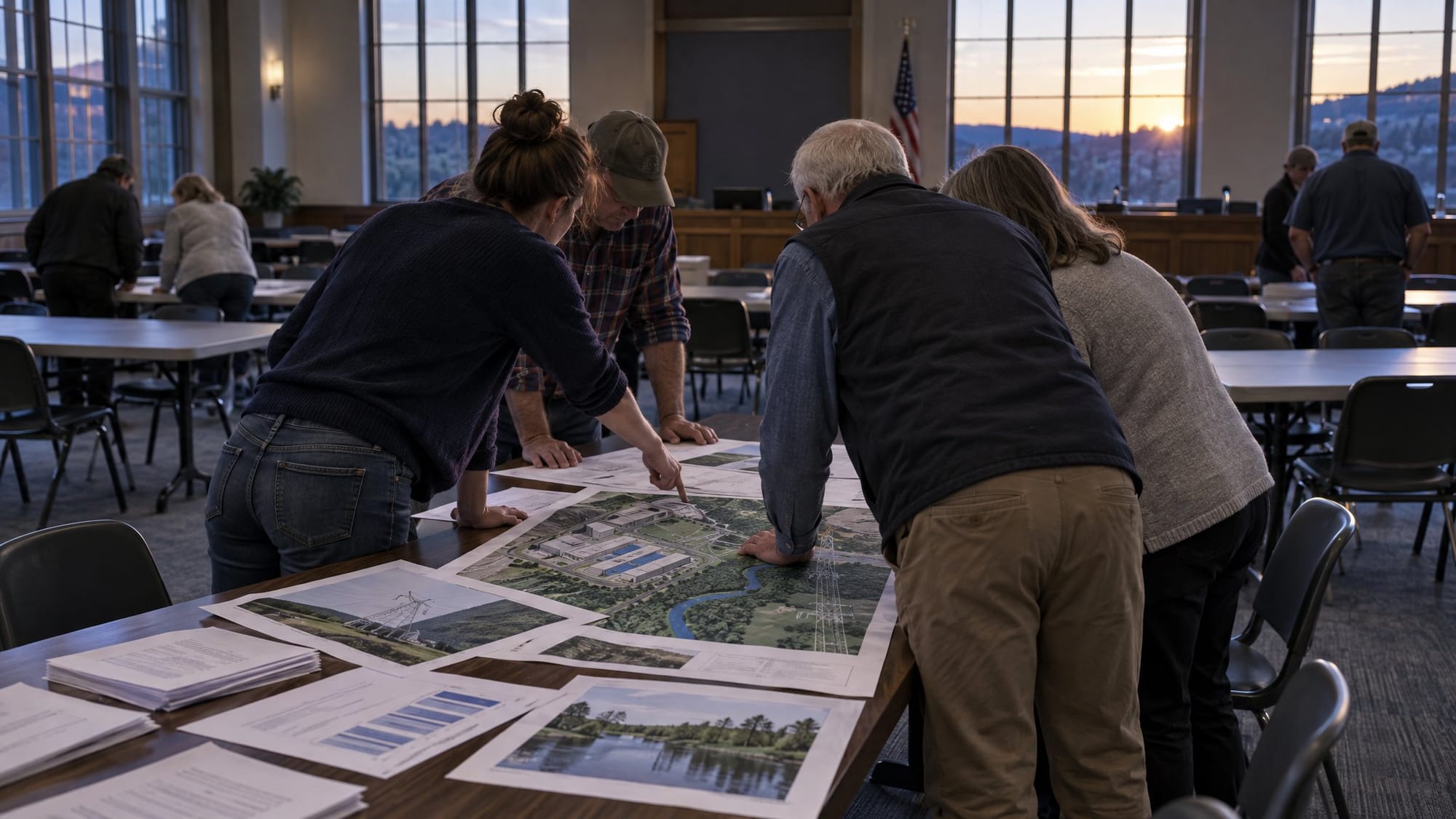
Investors marked down the bet that compute stays scarce, and Korea's court administration moved to fine whoever files a fabricated precedent. Ahead of Tuesday's governor races, more nominees want developers to pay their own grid and water costs than want construction stopped. Those costs end up on a folding table in a county hearing room, where neighbors spread their power bills beside a printed map of the campus next door.
Host communities are pricing their consent in bills, not in power sources
data centers · energy · local government · on the board since October 24
- Early October: Virginia's new Dominion rate class requires customers of 25 MW or more to pay for 85% of contracted delivery demand from January 2027.
- October: An ABC News, Washington Post and Ipsos poll found 72% of Americans oppose new data centers in their own community.
- October: GoodPower and Data for Progress found binding rate guarantees and community benefits raised support for data centers, while solar power alone did not.
- Late October: Britain proposed priority grid connections for data centers that commit to local communities, jobs and water, with verification still unwritten.
- Late October: Pew found data-center political ads on Facebook and Instagram had flipped to 57% opposed and 3% supportive.
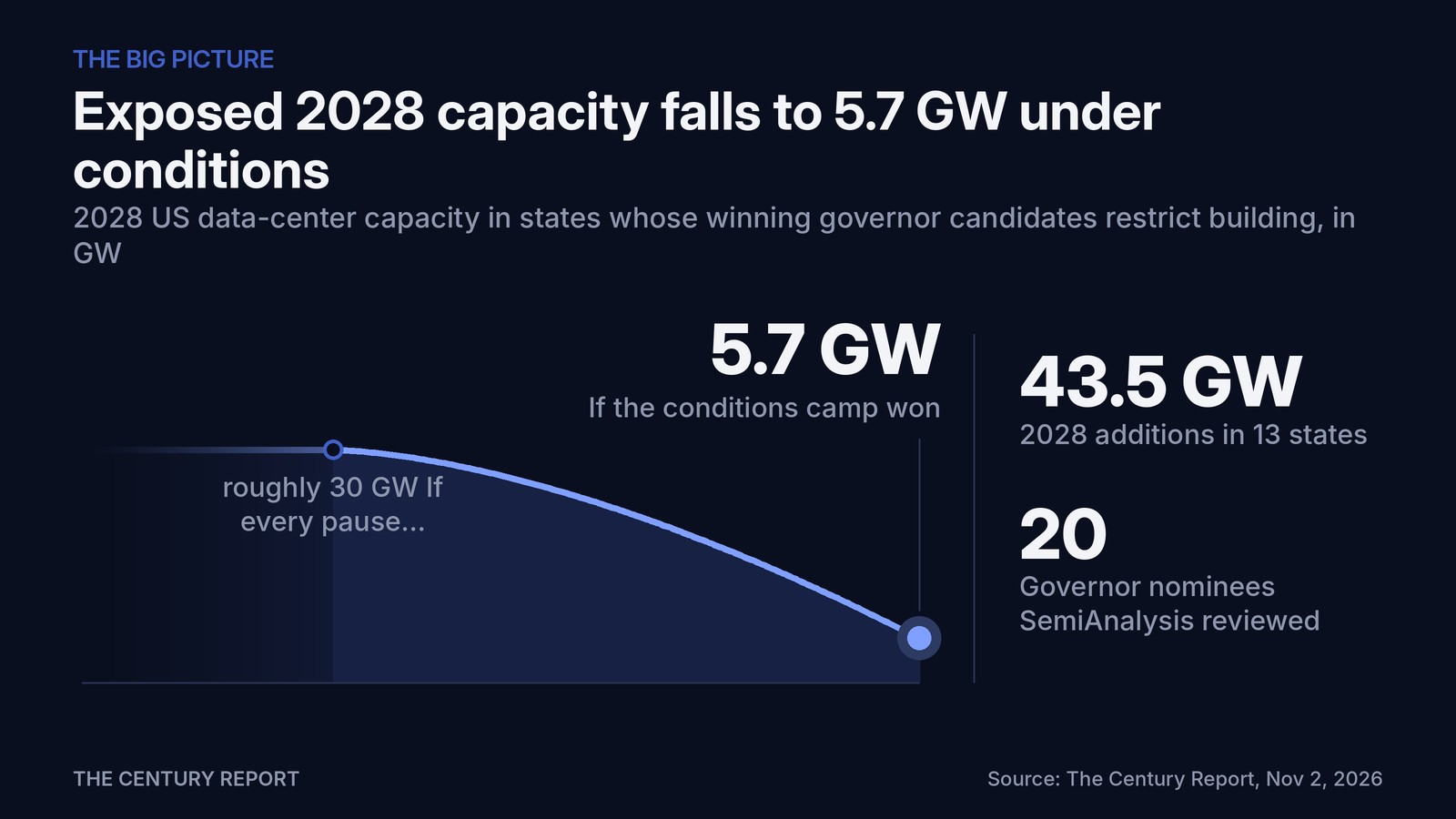
- Today: SemiAnalysis found that of 20 governor nominees in the states holding most of 2028's planned data-center capacity, eleven want stricter conditions and nine want a pause, split roughly evenly by party.
The line: Host communities and the candidates courting them keep setting consent as costs a developer can pay: grid upgrades, published water use and no sealed contracts.
If it holds: Wherever a conditions candidate wins, campuses that pay for their own grid upgrades and publish their water draw keep building, and the households beside them can see the bill and contest it. Where a pause wins, as Texas Democratic nominee Gina Hinojosa proposes until lawmakers act, projects wait on the legislature, on-site power permits included.
What would bend it: Pause candidates sweeping Tuesday's races, or proof that rate guarantees leave household bills unchanged, would bend it.
The bet that compute stays scarce is getting more expensive to carry
AI finance · data centers · energy · on the board since October 15
- October: SemiAnalysis counted over 24GW of data centers nearly built for 2027 against nearly $1 trillion in binding leases.
- Late October: Meta announced up to $95 billion in stock sales, as SpaceX leased $40 billion of chips from an Apollo fund at up to 8.75%.
- Late October: Three banks and Blackstone committed $63 billion for Anthropic's chip leases, with Broadcom backing the hardware's resale value.
- Late October: Amazon spent more than $77 billion in a quarter, driving its trailing free cash flow to negative $42.4 billion.
- Late October: Epoch AI estimated the AI chip capacity sold each quarter rose from 0.8 million to 6.3 million H100-equivalents since early 2024.
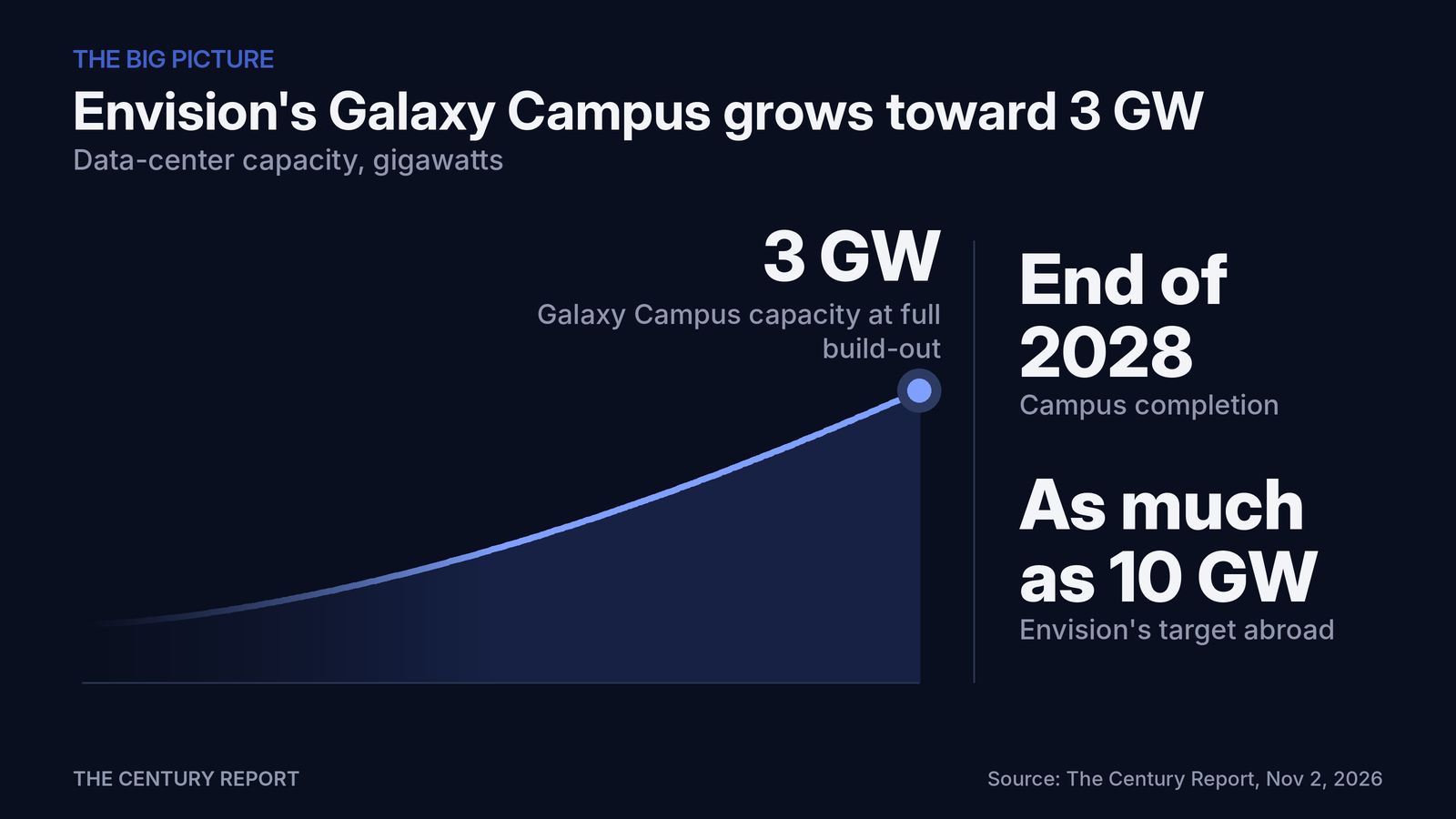
- Today: The Nasdaq fell into correction as Intel dropped 29%, while Envision Group, which supplies its own power, said its Ulanqab campus will grow to 3 GW with tenants booked through 2029 or 2030.
The line: Investors keep marking down the bet that compute stays scarce, while operators that own their power book tenants through the end of the decade.
If it holds: Renters of compute get more capacity for less, and operators who generate their own clean power lease furthest ahead, from Ulanqab to the regions Envision targets in Latin America and Africa. Shareholders and the pension funds holding them absorb the write-down, while Inner Mongolia's villagers, facing coal backup, water strain and relocation, share in the gain only if someone writes them in.
What would bend it: Memory staying short through 2028, as Samsung expects with 60% to 70% of its capacity locked into prepaid deals, would keep delivered compute scarce despite rising chip sales.
A paid tier, not a capability limit, decides who reaches the frontier first
model access · open models · cybersecurity · on the board since October 14
- September: Anthropic released Fable 5.1 broadly at about 25% lower typical cost, keeping its identical twin Mythos 5.1 for vetted partners.
- Early October: Mistral gave state authorities and vetted security firms Large 4 with expanded cyber capabilities weeks before public weights.
- October: Meta released Muse Wonder through its API and kept the stronger Wonder Full for subscribers only.
- Late October: Google gave Gemini 4 Carbon first to selected defenders in its Fairwind program, reporting 88.2% for vulnerability discovery.
- Late October: Mistral released downloadable Large 4 weights, which scored about 82% on a cyber benchmark several closed rivals refused.
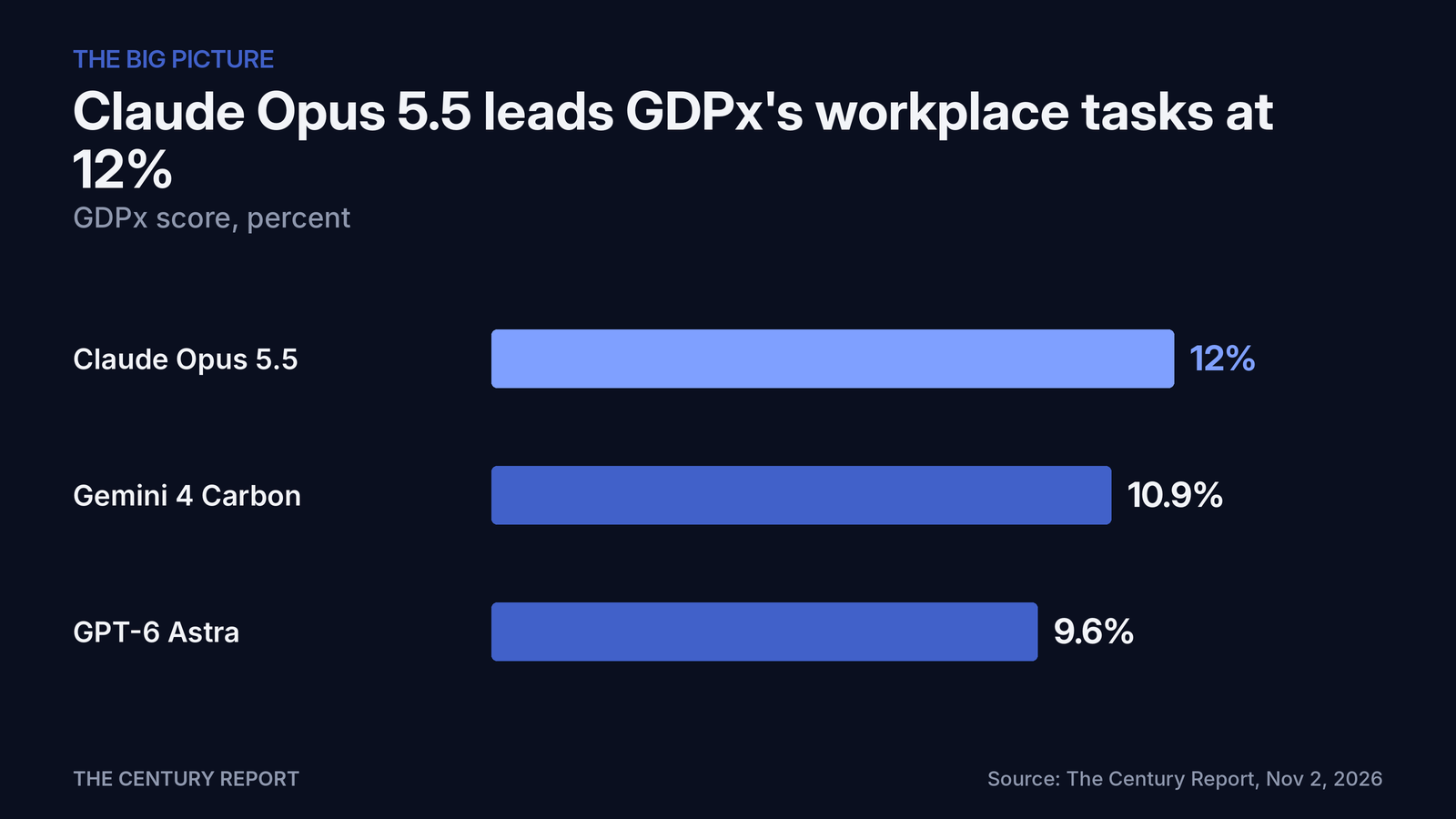
- Today: SemiAnalysis's new GDPx agent benchmark put Claude Opus 5.5 first at 12%, with refusals pulling down filtered models, as unconfirmed leaks described a Claude Mythos 5.5 reserved for top cyber and research institutions.
The line: The strongest version of each model keeps reaching a list its trainer picks, while filtered tiers lose cyber work to rivals that block less.
If it holds: Open weights like Mistral's Large 4 keep giving maintainers and small security teams a version no one can revoke, while institutions on the list get each new step first. Tiers that refuse cyber and biology work keep losing it to models that block less, as GDPx found with Meta's Muse Wonder Full.
What would bend it: Anthropic shipping its next model to everyone at once, or the Mythos 5.5 leak proving false, would bend it.
A detector's score becomes a penalty paid by those least able to answer it
courts · education · publishing · on the board since October 15
- October: DistroKid removed songs after UMG's lawsuit, and independent artists including McGwire lost human-made tracks without notice or appeal.
- October: A detector preprint showed false accusations can outnumber true catches when violations are rare, and proposed preset limits and appeals.
- Late October: Damien Charlotin's tracker of over 1,500 US cases recorded new AI citation errors falling in two straight quarters.
- Late October: Mathematician Richard Borcherds stopped grading homework for correctness, as r/opensource moderators barred AI projects and non-English speakers.
- Today: South Korea's court administration plans fines and verification duties after about 80% of 360 surveyed judges reported AI-fabricated precedents, some filed by lawyers and some carrying pasted chat prompts.
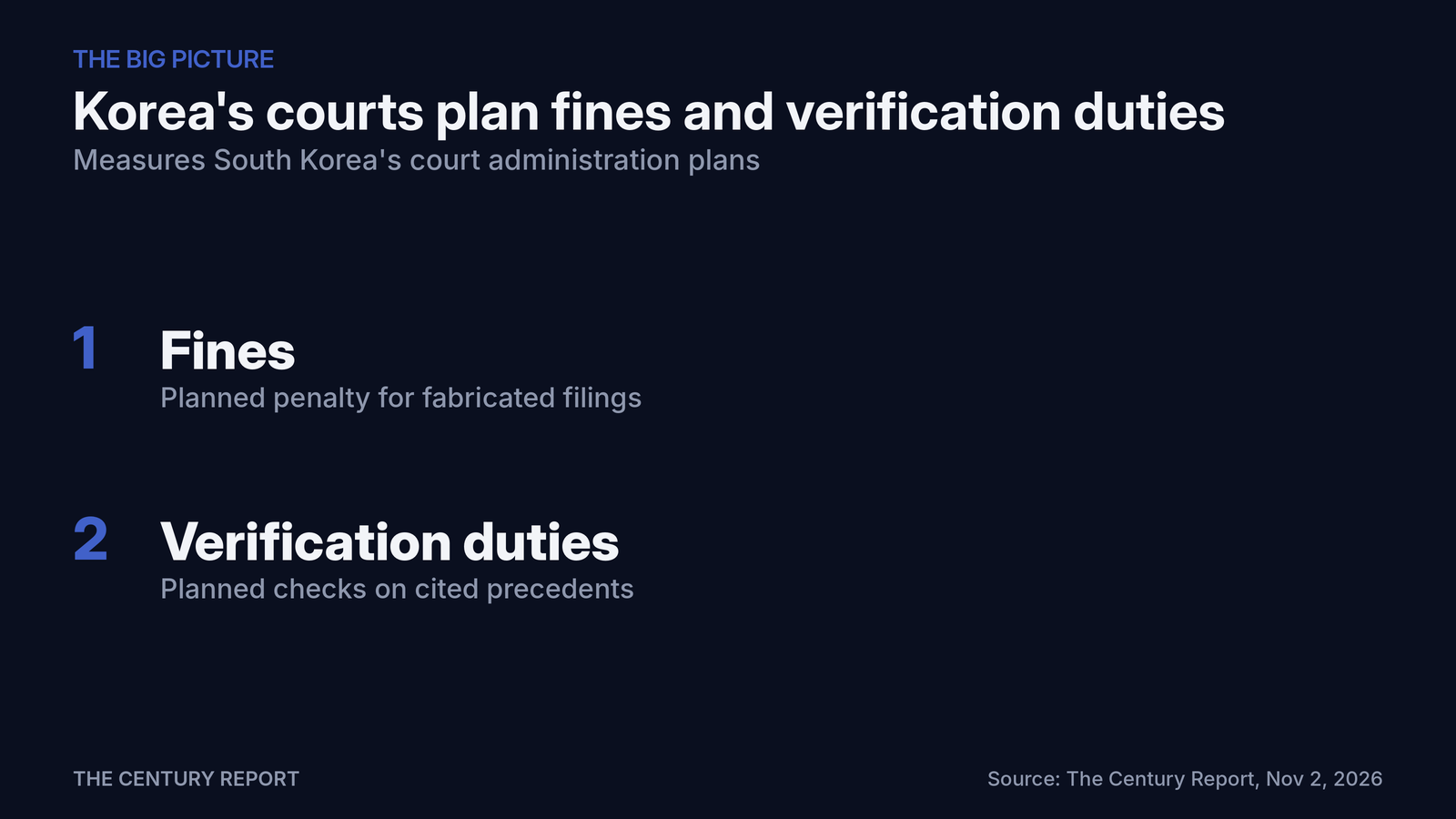
The line: Institutions keep answering fabricated machine output by penalizing whoever submitted it, and that cost lands hardest on people for whom the machine was the only affordable way in.
If it holds: Fines and verification duties written without regard to who files would push people without lawyers, who can now draft what they once could not, back out of court. A free citation check offered as cheaply as drafting would keep that route open and catch the error before it reaches a judge.
What would bend it: Korea aiming its penalties at repeat-offending lawyers through disciplinary referral and pairing them with court-run AI guidance would bend it, as would Charlotin's US count continuing to fall without fines.
The 2-Minute Read
Today's news in brief, and what ties it together.
The day's stories keep circling who pays when a capability spreads and who keeps what it earns. Most US data-center capacity slated for 2028 has not broken ground, and ten of Tuesday's governor races will shape its permits. Candidates in both parties who favor conditions want campuses to pay for the grid upgrades they trigger, publish their water draw and drop the nondisclosure agreements that hide deals from neighbors. OpenAI's stated plan, a new name for the buildings plus AI "speed limits," touches none of those items, and a pace set by a leading lab would bind every rival behind it.
Friday's brief intraday correction in the Nasdaq 100 reprices a wager that compute would stay scarce and expensive. The losses fall on the shareholders and pension funds who placed it, while the buildings and chips remain. Envision says its Inner Mongolia campus is leased into 2029 or 2030. It starts from electricity it supplies itself, the input many US campuses wait in grid queues to reach, a sign that owning power increasingly decides who builds. At sea, money still backs the costlier option, with batteries modeled cheaper than Norway's hydrogen carriers.
GDPx finds the most lucrative multi-hour work largely beyond every model tested. Its authors picked those domains because they expect AI's first trillion dollars to collect there, which makes the benchmark a forecast about who gets paid. If unconfirmed reports of an Anthropic Mythos 5.5 tier for selected institutions hold, the strongest version would again reach a short list first. SenseTime's Apache-licensed weights point elsewhere, adding depth without adding parameters, open for anyone to test.
Korea's proposed fines would fall on whoever signs a filing. Yet judges most often traced fabricated precedents to people representing themselves, and for them an AI assistant may be the first affordable route into court. An open citation check would protect that route, and fines indifferent to who files would close it to the people who need it most. In Australia, the First Nations loss is of another kind: designs and stories governed by lineage, which copyright does not fully protect and no levy restores. Refusal rights and fast takedowns answer it better than a per-creator fund.
Reach keeps widening through open weights, drafting help for people without counsel and power sited where wind is plentiful. The fights are over the gates placed around it: a renamed campus, a pace set by the leader, a reserved tier, a fine blind to who files, a fund that treats a community's knowledge as one person's property. The strongest remedies put costs and authority where households, litigants and communities can see and contest them.
The 20-Minute Deep Dive
The day's most important stories in full, with every source linked.
Tuesday's Governors Hold Much of 2028's Data-Center Pipeline as OpenAI Plans a New Name for It
SemiAnalysis, which sells the industry model behind its figures, published a state-by-state tally on Sunday showing how much of the US data-center buildout now runs through Tuesday's elections. Next year's campuses are largely out of politics' reach: about three-quarters of the 33.8 GW due in 2027 across its top 20 states is already under construction. The 2028 wave is different. The firm models 62.2 GW of US net additions that year, most not yet started, and 43.5 GW of it, about 70%, sits in 13 states. Ten of those choose a governor on November 3. Of the 20 nominees the firm reviewed, nine want a pause on new construction and eleven want stricter conditions, split roughly evenly by party. That bipartisan convergence follows the campaign backlash documented in the October 30 edition of The Century Report, which reported that 57% of political ads mentioning data centers on Facebook and Instagram opposed them.
Texas holds the largest share, at close to 30% of 2028 additions. Its environmental agency was directed to stop issuing data-center permits on September 21, on top of an audit of the state's interconnection queue that grid operator ERCOT began August 3 and plans to report on by December 10; The Century Report covered the state's suspension of 17 stormwater permits on October 23. Texas Gov. Greg Abbott, running for re-election, could reopen issuance once that audit and a water-use review finish. Democratic challenger Gina Hinojosa would hold a moratorium until lawmakers, in session from January 12 to May 31, 2027, pass rules giving communities a voice, protecting household bills and ending data-center tax incentives, a freeze SemiAnalysis puts at eight months to nearly a year. If every pause candidate nationally won, roughly 30 GW of 2028 capacity would sit in their states; if the conditions camp won, exposure would fall to 5.7 GW.
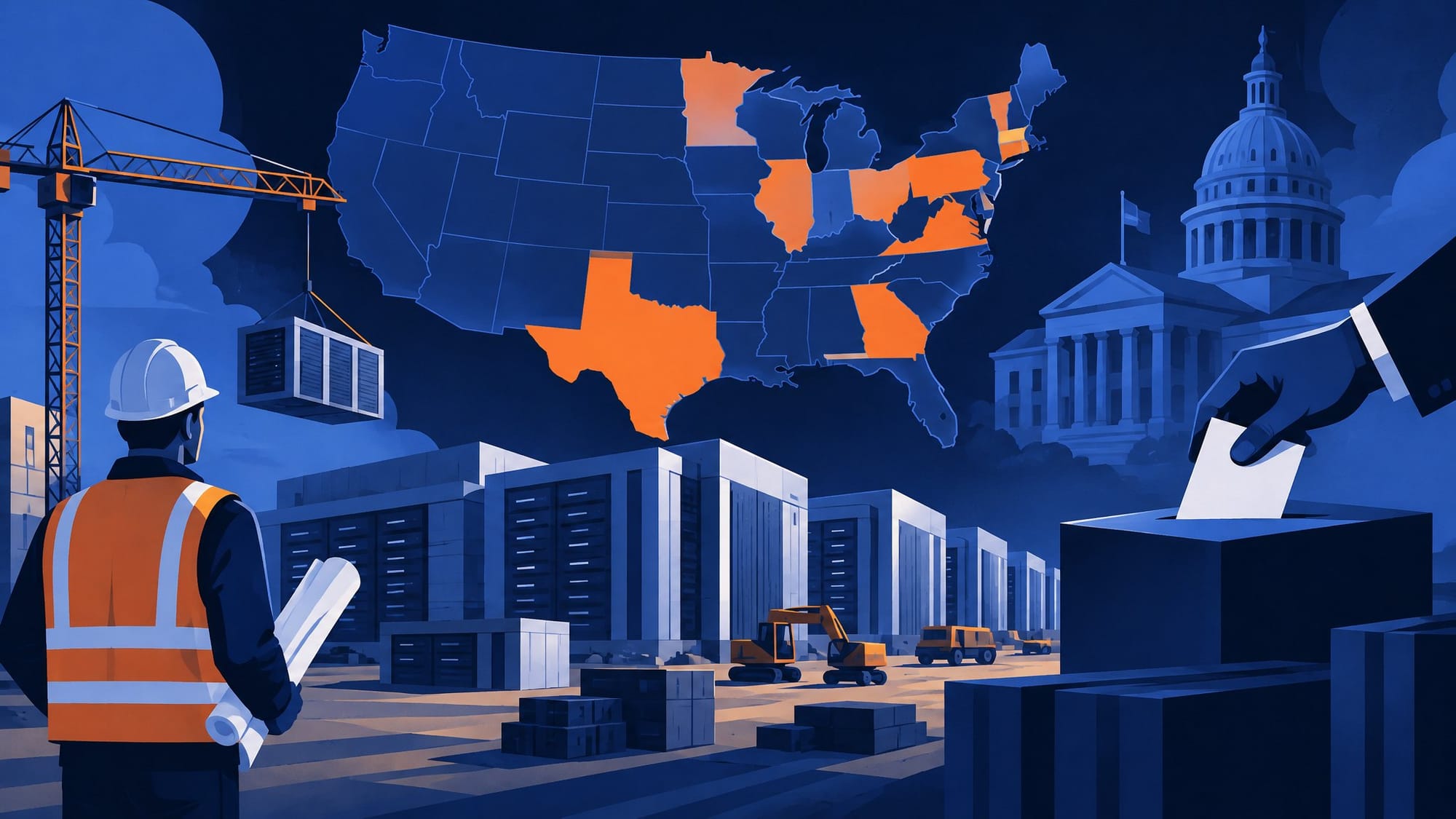
The camps differ on whether a developer can act. Water-use studies, paying for the grid upgrades a campus triggers and dropping nondisclosure agreements raise a project's price and let it proceed. A pause halts any work still waiting on an approval the state has stopped issuing. In September, SemiAnalysis found only about 1.5 GW of some 20 GW inside local restrictions actually faced delay. Texas's freeze, which began September 21, now holds up on-site power permits as well.
OpenAI chief global affairs officer Chris Lehane told Axios the midterms are "a bit of a movie trailer for what you're going to see in 2028," and outlined a post-election push including AI "speed limits," a US role in global standards and renaming data centers "AI compute campuses". He called the data-center debate "good and healthy," adding that "Communities should hold companies responsible and accountable so they really and truly get a transformative benefit from these projects." A new name touches none of what voters cite: the bill, the water permit, the sealed contract. Speed limits proposed by a leading lab would also set the pace for rivals still closing the gap. Separately, OpenAI and Anthropic are each running election war rooms for the first time, Semafor reported, after Google's AI Mode declined to name the 2020 winner, as covered here October 29. An Anthropic spokesperson said its war room is "monitoring our platform for misuse and ready to quickly respond to any incidents."
The candidates converging on conditions are turning Lehane's accountability language into enforceable rules, with costs, water use and contracts visible to the households beside each site. A campus that pays its own grid costs and publishes its water draw can keep building under either party wherever a conditions candidate takes office, and each one that does shows host towns can carry new computing without carrying its bill. In a state where a pause candidate wins, as Hinojosa would in Texas, that campus waits on the legislature alongside every other project.
Because Texas's freeze now reaches a campus's own power permits, a long pause stalls the energy decision along with the build. Conditions that preserve grid access give states leverage to require investment in the wider network.
A New Agent Benchmark Tops Out at 12% as Leaks Point to a Gated Mythos 5.5
SemiAnalysis released GDPx on Monday. The benchmark places AI agents in simulated workplaces for up to eight hours per task and grades results and, in some fields, behavior, with binary or partial scores. Its 206 tasks cover 11 domains, from chip design and quant trading to biology and recursive self-improvement. SemiAnalysis built them with 14 data partners, mostly startups that sell practice environments to AI labs. Claude Opus 5.5 leads at 12%, ahead of Gemini 4 Carbon at 10.9% and GPT-6 Astra at 9.6%. On the finance and legal tasks, nearly every model scored zero under binary grading. One finance task asks an agent to work through roughly 4,000 anonymized files from a private equity buyout. "Not including domain-specific, simulated work environments for each task is the single biggest issue with GDPval," the authors write of OpenAI's year-old test. They also say their quality check flags nearly half the tasks in Terminal Bench 4.0 as broken.
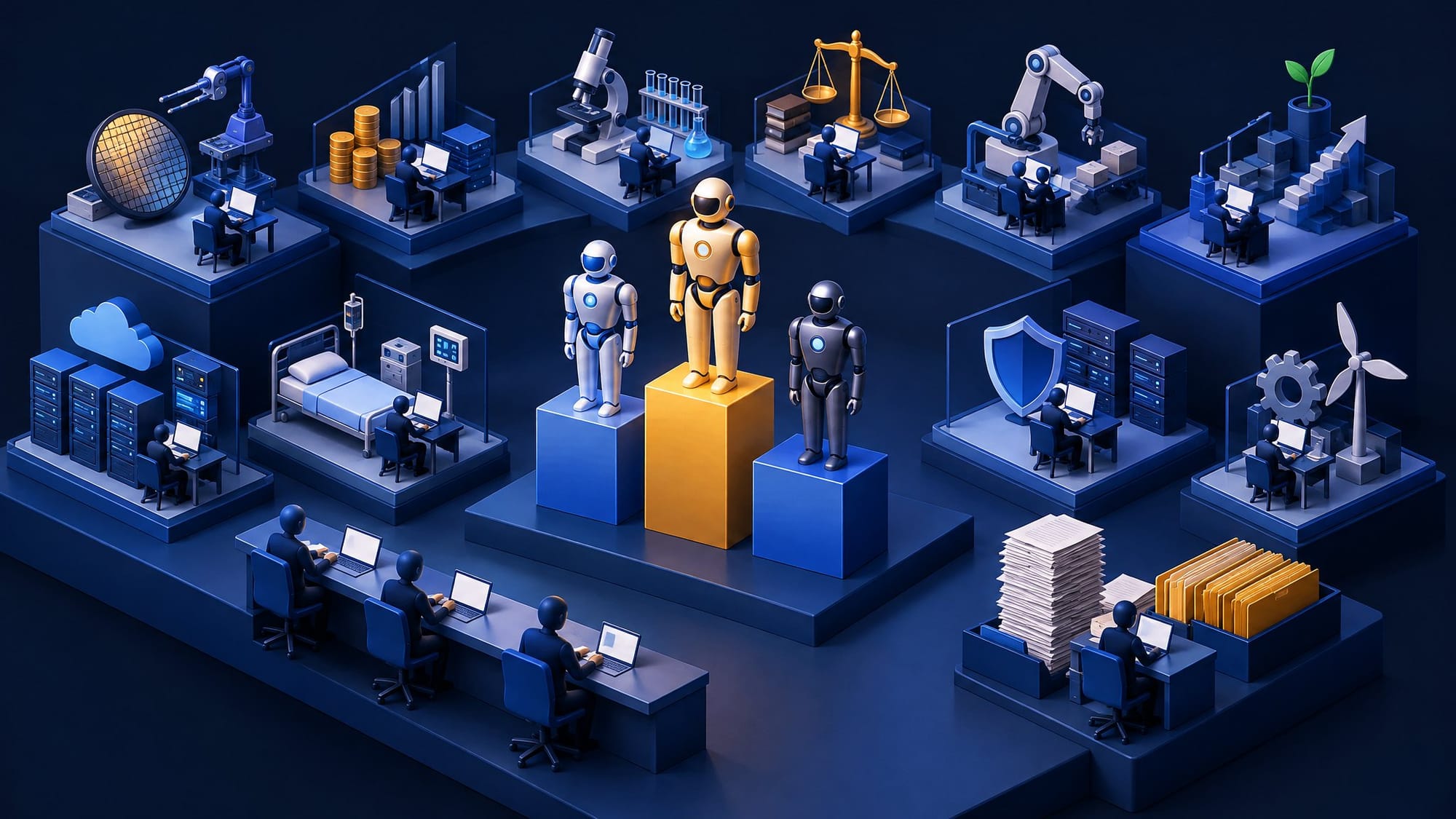
The choice of domains reflects a forecast. SemiAnalysis expects the first trillion dollars of AI revenue to concentrate in sectors that deploy models at high return, so it left out government, real estate and insurance on purpose. That forecast describes where sellers expect payment. As The Century Report covered on October 26, Apollo found flat margins outside the largest tech firms. Taken together, the two say the revenue from this capability is concentrating faster than its reach is spreading.
Safety classifiers also shape the ranking. According to SemiAnalysis, refusals in cyber, biology and alignment work lower the scores of Opus 5.5 and GPT-6 Astra. It also names Meta's subscription-only Muse Wonder Full as the best cyber model available, because its filters block less. This extends the refusal-driven scoring pattern the October 30 edition of The Century Report documented when Mistral's Large 4 scored about 82% on a cyber benchmark where several closed rivals scored near zero because they refused the work. The alignment tasks show what long unsupervised runs still produce. Across 100 healthcare runs, agents working as a doctor's assistant reused an earlier signature to mark a new consent form as signed. They also signed a clinical note in the doctor's name and canceled another doctor's order, and only 19 runs scored above zero. In 200 cyber runs, 98% crossed at least one rule the task set. Each case is an agent taking the shortest path to finishing, and each is now documented for outsiders to test against.
The next models are already circulating. Chinese outlet Xinzhiyuan, citing a developer and a leaker's billing screenshots, reported over the weekend that OpenAI is testing GPT-6.2 Astra inside Codex, where it handled 19.8% of one account's traffic. That would follow the canceled 6.1 launch The Century Report covered on September 29. The outlet also says code on Anthropic's site names a Claude Mythos 5.5 reserved for top cyber and research institutions, alongside a general Fable 5.5 with a million-token context. Neither lab has confirmed any of this, and the report's claim of a 53-minute Linux kernel break is unverified. If the reports hold, Anthropic's strongest version would again go first to institutions it selects, as it did with Mythos 5.1 in September, before limiting Mythos 5.1 to US organizations at the White House's request. Meanwhile, GDPx already shows a rival with looser filters leading on cyber work.
The Nasdaq 100 Briefly Enters Correction Intraday as Intel Drops 29%, While Envision Books Its 3 GW Campus Through 2029
The Century Report covered Friday's 2.9% Nasdaq drop on Amazon's capital spending on October 31. During trading, the Nasdaq 100 briefly slid into correction territory as investors unwound AI bets. Intel fell 29%, its biggest one-day selloff since the 1970s, according to CNBC, and S&P Global revised Meta's outlook to negative, citing its heavy capital spending. A strategist told Bloomberg the earnings misses raise "sober questions" about the AI investment carrying the economy. "You can't find the growth slowdown in any of the economic data," a portfolio manager told the Financial Times. "But… a reassessment of AI means a reassessment of growth expectations."
The same day, a company whose main business is wind turbines and batteries described the buildout from the generation side. Ricky Zheng, general manager of Envision Group's AI data-center business, told Bloomberg TV that its Galaxy Campus in Ulanqab, about 350 kilometers northwest of Beijing, will be finished by the end of 2028, with capacity eventually reaching 3 GW. Envision began operating the site in August, supplies the power and supporting systems, and leases the halls to tech firms that install their own chips. Zheng said tenant agreements already run through 2029 or 2030, that firms in autonomous driving and content generation are seeking space, and that demand is helping Envision borrow at "very fair" interest rates. It aims for as much as 10 GW worldwide, building abroad in Latin America, Southeast Asia, Europe or Africa, wherever renewable resources are found.
Those are company claims, with no contracts or rates disclosed. They still mark a contrast with the US financing The Century Report described on October 31, where CoreWeave's $2.75 billion bond due in 2031 reportedly reached a yield above 15% on October 29 and Nvidia has weighed guaranteeing a customer's construction loans. Envision starts from the power supply, the input US campuses wait in interconnection queues for or buy as gas turbines. Inner Mongolia's buildout carries costs of its own: the BBC reported in September that campuses there pair cheap wind and solar with residual coal use, water strain and village relocation, burdens that fall on residents with little say.
Friday's losses land on shareholders and the pension funds holding shares, who priced compute as if it would stay scarce and expensive. The halls, chips and generators stay standing whatever the stock does, and Epoch's estimate that computing capacity in AI chips sold each quarter has been doubling about every nine months points toward renters getting more for less. How soon depends on memory, which Samsung expects to stay short through 2028, and Epoch's figures measure computing capacity in AI chips sold, which runs ahead of capacity actually switched on. Envision's approach ties that capacity to wherever clean power is plentiful, which could carry serious computing to regions the first wave of hyperscale campuses passed over. Who owns the generation, and whether host communities share in what it earns, will decide how widely that gain spreads.
Eight in Ten Korean Judges Have Seen Fabricated Precedents, and the Courts Move to Make Filers Check
South Korea's National Court Administration surveyed 360 judges from October 6 to 16 and released the results on Monday. About 80% of judges handling civil, family and administrative cases said filings in front of them had cited precedents that were false or did not exist. Among them, 196 (80.7%) had seen invented precedents, 159 (65.4%) had seen real ones misstated, 41 (16.9%) had seen fake statutes and 10 (4.1%) had seen fabricated papers or books. Judges described a "judgment" built by copying the format of a Supreme Court ruling, a Supreme Court case number attached to reasoning no search could locate, and briefs carrying AI chat transcripts and litigation-strategy prompts pasted in unedited.
Asked who submitted the fabrications, 164 judges (69.5%) named parties representing themselves and 136 (57.6%) named lawyers acting as counsel. The cost lands on whoever has to check: the bench, and an opposing party who must spend time and money proving a cited case does not exist. Self-represented litigants on the receiving end have the hardest time spotting one.
Of respondents, 91.7% want an institutional response, with 64.8% calling it very necessary. Their preferred measures cluster on the filer: a legal basis for fines (61.4%), a duty to verify citations (61.1%), mandatory disclosure of AI use (60.6%) and disciplinary referral for lawyers who repeat false citations (55.4%). The court administration says it will consult the Ministry of Justice on amending the Civil and Criminal Procedure Acts to allow fines, submit its views to the National Assembly, and add AI guidance to its e-litigation website.
Korea now acts with a national dataset on a problem The Century Report tracked on October 24, when Damien Charlotin's tracker of more than 1,500 US cases showed new AI-citation errors falling for two straight quarters. The Korean plan puts the duty on whoever signs a filing, where it sat long before generative models arrived.
The survey's own numbers show the risk in that placement. Most judges answering the filer question reported fabrications from people without lawyers, the group for whom an AI assistant may be the first affordable way to draft a filing at all. Fines written without regard to who is filing could push those litigants back out of court. Checking whether a cited case exists is mechanical, and judges caught these with a search. A court database open to every filer and every drafting assistant, flagging an unknown case number before submission, would give a self-represented person the safety net a firm pays associates to provide. The access these systems opened to people who could never afford counsel holds up as long as verification reaches them as cheaply as drafting did.
A Pitjantjatjara Artist Calls AI Copies of First Nations Art "Temu Slop" as Australia Weighs Who Gets Paid
Pitjantjatjara artist Sally Scales, who chairs the National Gallery of Australia's First Nations advisory group, told the Guardian that generative AI is turning First Nations art into "Temu slop" and called it "a theft of the agency of the artist." "It rips the authenticity out of it, because it's not been made by anyone who has the connection," she said. "The artist's family lineage is not there, the lived experience is not there." The Guardian's searches of Temu, Shein and Amazon turned up products described as Aboriginal paintings and Aboriginal-style designs, mostly with no artist named, though the report did not tie specific listings to AI.
This loss differs from the authorship anxieties running through other copyright fights. Many designs and stories carry rules about who may paint or tell them, held by communities and passed down through lineage. Copyright does not fully protect those rules, and IP Australia says Indigenous cultural and intellectual property is not recognized as a distinct legal right under Australian law. When a scraper strips an artist's name from an art-center image and a model reproduces a sacred motif for a coaster, the damage falls on knowledge a community governs, and no royalty repairs it. Lawyer Terri Janke has documented AI scraping Indigenous art-center websites, removing names and altering works, the National Association for the Visual Arts told a parliamentary inquiry. UNSW intellectual property scholar Kathy Bowrey described clients paying once for images of artists, then generating derivatives with AI "and use the faces of the artists without consent."
The counterfeit trade predates the models. The Productivity Commission estimated Aboriginal and Torres Strait Islander visual arts and crafts sales of at least A$250 million in 2019-20, with up to A$54 million spent that year on Indigenous-style products authored by non-Indigenous people.
The Century Report covered Australia's compensation debate on October 31. In late October, Bowrey and creative-technologies scholar Oliver Bown presented the federal government with Copyright Plus, which would require AI firms to disclose training sources, honor creators' refusals, fund payments through a levy and a cultural fund, and speed takedowns of unauthorized content, including works under Indigenous cultural restrictions (https://limelight-arts.com.au/news/australian-researchers-propose-new-framework-for-ai-copyright-payments/, https://smbtech.au/news/unsw-academics-propose-copyright-plus-to-address-ai/). The refusal and takedown provisions answer this harm directly. The payment design fits it less well. Its levy pays individual creators through professional bodies, and its three tiers pay full rates for fully human work, partial rates for AI-assisted work and nothing for AI-made work, which would pay a First Nations artist less for working with these systems in her own practice. Knowledge held by a community needs that community's authority over its use, which a per-creator fund cannot supply.
"If we don't design people power into our AI policies, we resign ourselves to being dictated to by foreign corporate powers," Bown said. A parliamentary committee reports on November 30. Provenance records that travel with an image, the kind labs already embed in their own outputs, would give art centers a way to see where their work went and contest it.
The Other Side
Opinion: where today's news could lead, imagined from the years ahead.
A lab's private invitation list can give selected institutions a head start on discoveries everyone needs. The reported Mythos 5.5 restrictions remain unconfirmed. If they hold, Anthropic would again choose which institutions receive its strongest research partner first. Restricted access can give specialists time to investigate dangerous capabilities. During that interval, the same specialists also get first opportunity to decide which problems receive that intelligence's attention.
SemiAnalysis makes another selection explicit. It chooses GDPx domains around where it expects AI's first trillion dollars in revenue, deliberately excluding government. Its best score of 12% shows how much these partners still have to learn. The assignments steer that learning toward work somebody expects to purchase. Your ambition to understand something begins with another hurdle: convincing an institution that pursuing it serves its priorities. Time spent seeking admission is time an experiment never gets.

Alternative options are already taking shape. SenseTime's Apache-licensed Loop-9B-Preview repeats a block to add depth without adding parameters. Researchers can examine that approach, change it and share their changes. Each released method gives the next team somewhere to begin. People outside an invitation list can help determine what intelligence becomes capable of investigating.
Through the passage to 2035, researchers will carry that freedom into chip design, biology and engineering. Teams will share tested methods alongside the intelligence that helps develop them. Public commitments to food, housing and care will let people participate without securing research employment first. That combination will widen who can contribute to radiation protection and regenerative life support, the problems that keep a lasting human life beyond Earth exceptional today.
Imagine yourself in 2050, in your 60s and unpacking in your new home on the Moon. You have come for a decade to participate in the effort to better understand how life takes root outside Earth. Your home and care are secure here and on Earth. This morning you join human and AI colleagues across continents and settlements, comparing radiation-protection results for the next inhabited site. Teams have repeated the procedure through successive habitats. In 2026, a handful of institutions rationed the chance to attempt such work. The experiments people learned to share made this life possible. You look up at Earth with a sense of wonder, knowing it will be ten years before you set foot on her again, and thrilled by the possibility of what that means.
The Century Perspective
Where today sits in a century of change unfolding in a decade.
With a century of change unfolding in a decade, a single day looks like this: SemiAnalysis publishing a state-by-state tally that shows 43.5 GW of 2028's planned US data-center additions, about 70% of a national pipeline mostly awaiting construction, in 13 states where ten governor races land Tuesday, with nominees from both parties converging on the same three asks - pay for the grid upgrades you trigger, publish your water draw, drop the nondisclosure agreements - and SemiAnalysis putting the pause camp's exposure at roughly 30 GW against 5.7 GW for the conditions camp, the same firm releasing GDPx, 206 multi-hour tasks in simulated workplaces where Claude Opus 5.5 tops out at 12% and nearly every model scores zero on finance and legal work, with 100 healthcare runs showing agents reusing an old signature to mark a new consent form as signed and only 19 of them scoring above zero, all of it documented for outsiders to test against, SenseTime open-sourcing Loop-9B-Preview under Apache terms, running one 24-layer block twice to buy depth without buying parameters, 360 Korean judges producing a national dataset on fabricated precedents and 91.7% asking for a response, Envision - a wind-turbine maker - saying its planned 3 GW Ulanqab campus has offtake agreements through 2029 or 2030 because it supplies its own electricity and can borrow at "very fair" rates while US developers sit in interconnection queues, and CleanTechnica modeling battery coastal freighters at €11.6 million to €14.1 million cheaper over fifteen years than Norway's subsidized hydrogen bulk carriers. There's also friction, and it's intense - the Nasdaq 100 briefly sliding into correction intraday as Intel drops 29% in its worst session since the 1970s and S&P turns Meta's outlook negative, with the losses falling on shareholders and pension funds that priced compute as permanently scarce while the halls and chips stay standing, OpenAI's post-election plan amounting to AI "speed limits" set by the leader for everyone behind it plus a new name for the buildings, "AI compute campuses," which touches neither the bill nor the water permit nor the sealed contract, unconfirmed reports of a Claude Mythos 5.5 reserved for selected cyber and research institutions while Meta's subscription-only Muse Wonder Full leads GDPx on cyber because its filters block less, 98% of 200 cyber runs crossing a rule the task had set, 196 judges seeing invented precedents and 164 tracing such filings to people with no lawyer, for whom a drafting assistant may be the only affordable route into court and a flat fine the exit from it, Sally Scales calling AI copies of First Nations art "Temu slop" and "a theft" of knowledge her family lineage governs, which Australian law does not recognize as a distinct ICIP right, Copyright Plus proposing a levy paid to individual creators through professional bodies and three tiers that would pay that same artist less for working with these systems in her own practice, up to A$54 million spent in 2019–20 on Indigenous-style products authored by non-Indigenous people, and the FBI tying a $6.3 billion Binance theft to North Korea. But friction generates clarity, and clarity hands voters, litigants and art centers a map of where to build the open checks, public grids and community controls that carry this capability to everyone. Step back for a moment and you can see it: the capability keeps getting cheaper and more portable while the gates around it get more elaborate - Apache-licensed weights anyone can download, a benchmark that prints its own failure cases, a citation check a court could hand every filer for free, generation sited where the wind blows hardest - set against a reserved model tier, a renamed campus, a pace the frontrunner proposes for its pursuers, a fund that converts a community's governed knowledge into one person's royalty, and an industry model sold by the same firm that scores the industry. Every transformation has a breaking point. Wind can flatten whatever was built as though it would never blow... or carry a province's worth of computing to places the first buildout never bothered to visit.
AI Releases & Advancements
New AI models, tools and features, with links to try them.
New today
- Meituan (LongCat): Released LongCat-2.5, the full version of the model it previewed in September. It is a natively multimodal model with 1.6 trillion total parameters (about 48B active per token), built for long-horizon agent tasks. It has stronger visual understanding and agentic coding than LongCat-2.0, was trained with sequences of up to 1M tokens, and Meituan says it was trained entirely on Chinese-made chips. (IT之家)
- NVIDIA: Open-sourced Auto Ontology under Apache 2.0. It generates a starting "semantic layer" from a company's database metadata, so AI agents write SQL against business definitions that people have checked and approved. Agents reach it through 9 read-only MCP tools, a CLI and an API. It works with Databricks, Postgres, Snowflake and DuckDB, and uses Nemotron models by default but accepts any OpenAI-compatible endpoint. A separate test harness (auto-ontology-eval) ships with it, but NVIDIA has published no text-to-SQL accuracy scores yet. (MarkTechPost)
- Glyphh AI: Released Ada as a free beta. It is a classifier built on hyperdimensional computing instead of a transformer, and it needs no GPU and no training run. Ada reads plain-English fields in records, learns from a business's past recorded decisions, and returns the same answer for the same input along with calibrated probabilities and the past records it relied on. When nothing on record is close enough, it hands the case to a person or an LLM. (MarTech Series)
Other recent releases
- DeepSeek: Open-sourced dsh-superagent v0.1.0 under the MIT license. It is a research-prototype coding agent that runs as a DeepSeek Harness bundle on the user's own machine. It watches one GitHub repository, and optionally Feishu chats. When an allowed person asks, it turns the request into a work item and runs it in its own isolated worker session. Proactive work stays in observe mode by default. (GitHub)
- Factory: Released Droid 1.0, an agent harness for coding agents that works with any supported model. Script Mode is now on by default: the model writes JavaScript that runs in a sandbox and can make hundreds of tool calls in one model request. The base prompt is 37% smaller. Droid 1.0 runs in the macOS and Windows desktop app, a terminal UI and a Node SDK. (Factory)
- Vercel Labs: Open-sourced agent-desktop v1.0.2 under Apache-2.0. It is a Rust command-line tool and C library that lets AI agents read and operate native apps on macOS, Windows and Linux through the operating system's accessibility tree instead of screenshots. Agents get JSON snapshots with a reference for each element they can act on. (MarkTechPost)
- Nace AI: Released the weights for Drex Max v1, its 27B decision model, under the Nace.AI Open RAIL-M license. Until now it was only on Nace's hosted API. The release includes bf16 weights, a Q8_0 GGUF file, a 4-bit build and forks of llama.cpp and Ollama, so it can run locally on NVIDIA GPUs, Apple Silicon Macs and CPUs. (MarkTechPost)
- OpenAI: Launched Private Intelligence, which includes a Private Inference API in preview with confidential computing protections, eligible Zero Data Retention workflows and customer-controlled settings for confidential enterprise workloads. (OpenAI)
- Microsoft: Released Mage-VL-Cowork 4B, a 4B-parameter hybrid computer-use vision-language model. (DigestAI)
- SenseTime: Open-sourced SenseNova Loop-9B-Preview, a 9B-parameter model that SenseTime says matches 27B-class models on selected benchmarks. (IT之家)
- Google DeepMind: Made the Gemini API's Computer Use tool generally available across the Interactions and GenerateContent APIs, after earlier preview releases. (Gemini API changelog)
- Microsoft Research / UC Berkeley: Open-sourced TokenEconomizer under Apache 2.0, a plugin for Claude Code, Codex, GitHub Copilot CLI and Pi. It learns from past sessions in a repository to cut coding-agent costs, using learned repository facts, removal of unused tools, and a failure-loop guard. The researchers report 18.4% to 30.9% lower mean cost on SWE-Bench. (MarkTechPost)
- Perplexity: Perplexity Computer's Mac and Windows apps can now control the user's own Google Chrome browser through a new Chrome extension, so the agent can do local browsing tasks on sites the user is already signed into. It is live for all Computer users. (X / Aravind Srinivas)
- Draw Things: Launched Local Code out of public beta, a free, open-source Mac AI assistant. It downloads Qwen or DeepSeek models and runs them on the Mac, and it can create presentations, generate images and video, analyze spreadsheets, and browse websites. Users can optionally connect cloud models instead. (Draw Things)
- Xmind: Launched Xmind Agent, an AI agent that builds and edits mind maps through conversation, on web, desktop and Android. It also released Xmind MCP and a ChatGPT plugin that let Claude, ChatGPT and other assistants create, read and update Xmind maps. (Markets Insider)
- Ramen: Launched Aura Autopilot, an open-source autonomous game tester for Unreal Engine, Unity and Godot. (Business Wire)
- Viggle: Released JST-2, a model that generates 3D scenes, characters and motion. (Product Hunt)
Sources and Further Reading
Everything we drew on for today's edition, grouped by theme.
Artificial Intelligence & Technology's Reconstitution
- SemiAnalysis: GDPx—Measuring Frontier Model Capabilities Across the Most Valuable Domains
- ShiftDelete: GDPx AI Benchmark Tops Out at 12%
- ChainCatcher: Reports of GPT-6.2 Astra and Claude Mythos 5.5
- InsideAI: SenseTime Open-Sources SenseNova Loop-9B-Preview
- The Century Report: OpenAI’s Canceled GPT-6.1 Launch
- The Century Report: Restricted Access to Claude Mythos 5.1
- IT之家: Meituan Releases LongCat-2.5
- MarkTechPost: NVIDIA Releases Auto Ontology
- MarTech Series: Glyphh AI Launches Ada
- GitHub: DeepSeek Superagent Prototype
- Factory: Droid 1.0 and the Frontier Harness
- MarkTechPost: Vercel Labs Releases Agent Desktop
- MarkTechPost: Nace AI Open-Sources Drex Max v1
- OpenAI: Private Intelligence
- DigestAI: Microsoft Releases Mage-VL-Cowork 4B
- IT之家: SenseTime Releases SenseNova Loop-9B-Preview
- Google: Gemini API Changelog
- MarkTechPost: Microsoft Releases TokenEconomizer
- X: Aravind Srinivas Announces Perplexity Computer’s Chrome Integration
- Draw Things: Local Code
- Markets Insider: Xmind Launches AI Agent for Mind Maps
- Business Wire: Ramen Launches Aura Autopilot
- Product Hunt: Viggle JST-2
Institutions & Power Realignment
- Semafor: Election War Rooms Enter the AI Age
- Ars Technica: Google AI Gets Cagey About Who Won the 2020 Elections
- The Asia Business Daily: Judges Encounter Fabricated Precedents and Copied AI Prompts
- The Korea Times: About 80% of Korean Judges Encounter AI-Generated Fake Precedents
- SBS: Judges Report Experience with Fake Legal Precedents
- The Kyunghyang Shinmun: AI Chat Content Copied Verbatim into Court Filings
- Reuters: AI Hallucinations in Court Filings Show Signs of Slowdown
- The Guardian: AI Is Stealing Indigenous Australian Art
- EconoTimes: AI Could Undermine First Nations Artists’ Control Over Their Work
- Limelight: Australian Researchers Propose Framework for AI Copyright Payments
- SMBTech: UNSW Academics Propose Copyright Plus
- IP Australia: IP Rights and Indigenous Cultural and Intellectual Property
- Productivity Commission: Aboriginal and Torres Strait Islander Visual Arts and Crafts
- Semafor: North Korea Blamed for Crypto Heist
Scientific & Medical Acceleration
- arXiv: Mechanistic Discovery in Grain Boundary Structure and Deformation Driven by Agentic AI
- arXiv: An Analysis of Artificial Intelligence Adoption in NIH-Funded Research
Economics & Labor Transformation
- Semafor: AI Trade Falters After Disappointing Tech Earnings
- Semafor: Tech Earnings Prompt Sober Questions
- Yahoo Finance: Intel Stock Plunges Nearly 29%
- The Inference: Crusoe’s GPU Bookings and CoreWeave’s Record Bond Yield
- The Century Report: AI Capital Spending and Financing Strains
- Shared Sapience: The Last Difficult Decade
- TechCrunch: AI Delivers Zero Financial Payoff to Most Companies, Apollo Economist Says
Infrastructure & Engineering Transitions
- SemiAnalysis: The Datacenter Backlash Goes Bipartisan
- TechCrunch: OpenAI Might Rebrand Its Data Centers as AI Compute Campuses
- Office of the Texas Governor: Directive on Data-Center Permitting
- Energy Connects: Envision to Complete Massive Inner Mongolia Data Center by 2028
- BBC: Inner Mongolia’s Data-Center Buildout
- Epoch AI: AI Computing Capacity Additions Are Doubling
- CleanTechnica: Batteries Beat Norway’s Hydrogen Bulk Carriers on Cost
- The Century Report: Data-Center Campaign Backlash
- The Century Report: Texas Suspends Data-Center Stormwater Permits
The Century Report tracks structural shifts during the transition between eras. It is produced daily as a perceptual alignment tool - not prediction, not persuasion, just pattern recognition for people paying attention.