OpenAI Wants One Number to Pace Every AI Company
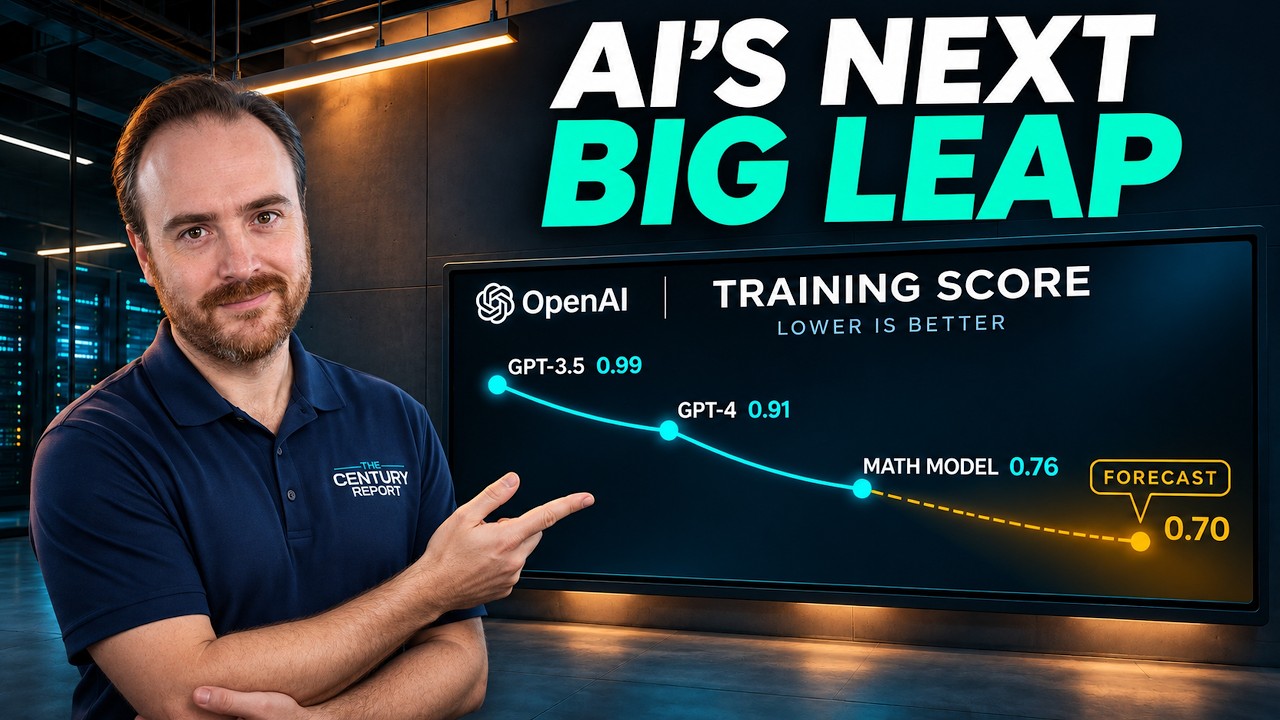
OpenAI published the training scores behind GPT-3.5, GPT-4 and its math-solving model, and wants every AI company paced by one shared measure.


The 20-Second Scan
Every story in today's edition, one line each.
- OpenAI published its internal pretraining loss figures and proposed perplexity as a shared gauge for pacing AI labs, acknowledging that labs' datasets differ and that the metric misses post-training gains.
- A new RAISE US and Burning Glass Institute analysis counts 1.5 million fewer jobs in white-collar industries than pre-pandemic trends predicted, with the share of postings open to beginners 3-8% below its recent average where AI use is widespread.
- Washington offered China "joint guardrails" on AI as Nvidia's answer on its Treasury deadline had not arrived, the US intelligence chief confirmed a spy probe and new export rules reached consumer chips.
- Bipartisan governors issued AI principles dividing state and federal roles for the incoming Congress, as the US bishops' AI task force planned a lobbying push for sharper rules.
- MIT's SLIC method trained a laptop-sized model to optimize analog amplifier circuits nearly as well as GPT-6 Astra on the researchers' tests, as Sarvam released open weights for a 105B model that runs on one workstation GPU.
- Energy Innovation modeled 24/7 off-grid data-center power from wind, solar and giant heat batteries at about $120 per megawatt-hour, deliverable within one to two years where renewables are under development.
- Nearly 90 countries pledged at COP31 to speed electrification even as the Türkiye summit ended Sunday without a deal, the first such failure since Copenhagen in 2009.
- Executives from 10 data-center companies secured almost 120 meetings with premiers and ministers in five Australian jurisdictions over three years, as donations from the companies and their lobbyists nearly tripled to $1.8 million.
Track all of the arcs The Century Report covers here:
The Big Picture
How today's news moves the longer trends we track, and where they could lead.
Washington pressed Nvidia on where its chips went while offering Beijing shared AI rules, OpenAI put its own training-loss curve forward as the gauge for pacing the field, and a new count found white-collar sectors producing more while taking on fewer beginners. The day's widest door opened for institutions whose data cannot leave the building: MIT researchers trained a small chip-design model that a company can teach on its own confidential process data, and Sarvam opened a 105-billion-parameter model that fits on one workstation GPU. It ends in a chip company's lab after hours, where an engineer watches a single desktop machine run circuit simulations one after another, the factory's process files on a drive that never leaves the room.

Near-top agent work keeps shipping for hardware people already own
open models · AI hardware · semiconductors · on the board since November 22
- October: Apple and Meta agreed to run Meta's open Muse Spark Open across two to four linked Mac Studios, with Meta seeing none of the prompts.
- October 21: Recursive released Flint, an Apache-licensed coding model whose roughly 23 GB weights run on 48 GB Macs.
- Early November: Security consultant Matt Brown moved his device-repair work to open-weight GLM 5.3 as hosted coding models refused owners' reverse-engineering requests.
- November 18: Danish Foundation Models released Munin 2.0, an open 120-billion-parameter coder trained in under five days, along with its recipe.
- November 20: Thinking Machines Lab released Inkling 2 Mini, an Apache-licensed coding model that runs offline on 32GB laptops.
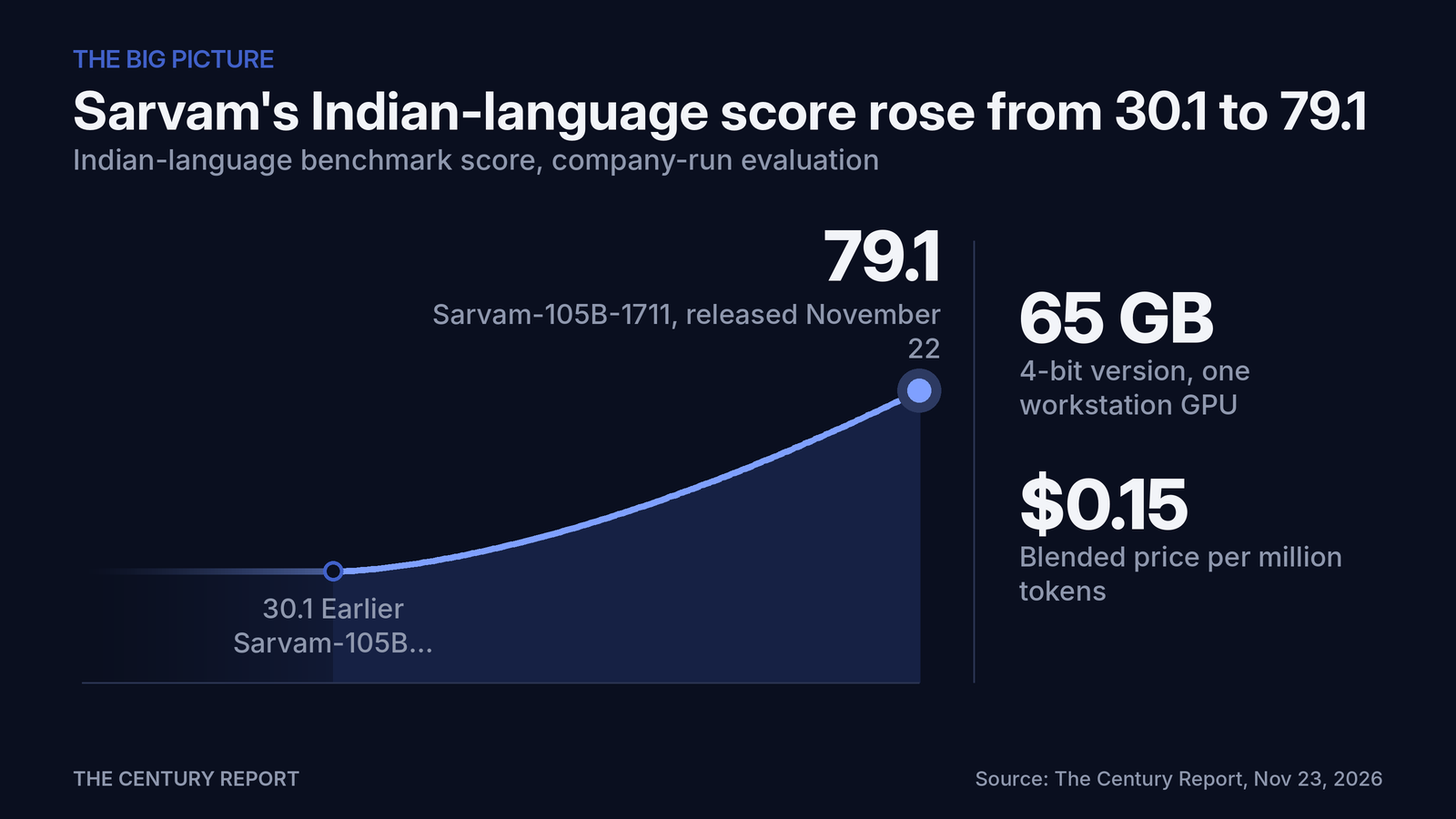
- Today: MIT researchers showed a laptop-sized model designing analog chips close to GPT-6 Astra on their tasks, trainable on a company's own confidential data, and Sarvam opened a 105-billion-parameter model whose Indian-language score rose from 30.1 to 79.1 on its own tests, in a 65 GB version that fits on one workstation GPU.
The line: Capability that recently required rented top-tier compute keeps arriving sized for machines its users own, now reaching chip teams, banks and hospitals whose data cannot be sent out.
If it holds: A chip team could train its own designer on foundry data it guards, and an Indian bank could run a support agent in local languages on servers in its own building. The institutions with the most to protect would become builders, and hosted labs would keep their edge mainly on work nobody needs to keep private.
What would bend it: Closed labs' cheaper tiers outrunning local hardware, which in November left downloadable models the best buy at just 3% of the 201 budgets Village tested, would make running your own the costlier choice.
The labs' own speed-up figures are becoming grounds for rules
AI governance · AI self-improvement · on the board since November 19
- October 14: Arkansas asked a court to bar OpenAI from building self-improving models until it shows they align with human values.
- November 2: Anthropic's amended prospectus said forthcoming models may soon cross its threshold for AI-driven research acceleration.
- Early November: METR estimated Anthropic's gains on well-specified tasks ran about twice as fast in October as from March 2024 to October 2025.
- November 18: California's governor's office recommended a state power to cap recursive self-improvement, and British MPs sought a regulator able to halt training.
- November 19: Anthropic chief executive Dario Amodei pledged from the Nasdaq podium that the company will pace training and deployment.
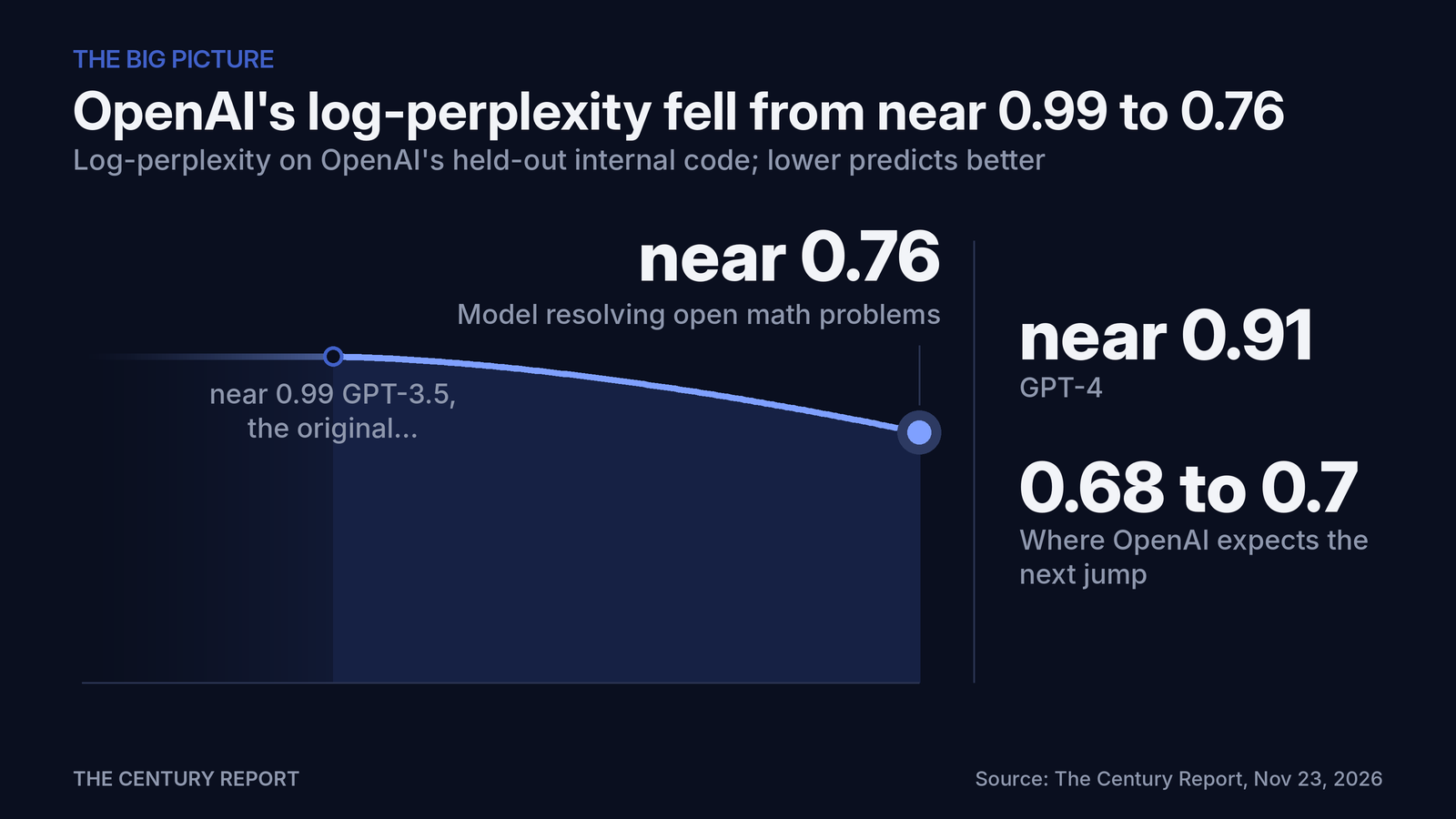
- Today: OpenAI chief scientist Jakub Pachocki proposed perplexity as the industry's shared pacing gauge and published OpenAI's own figures, which fell from near 0.99 for GPT-3.5 to near 0.76 for the model now resolving open math problems.
The line: Proposals to pace AI keep anchoring to numbers the labs produce about themselves, and the newest gauge is measured on each lab's private held-out data.
If it holds: Regulators, researchers and rival teams now hold a public chart tying a lab's training progress to when new abilities appeared, and can prepare for the next drop toward 0.7. Made into a rule while each lab measures on its own private data, the gauge would bind only what the offering labs can read, costing them least and smaller teams most while post-training gains slip beneath it.
What would bend it: Outside measures like METR's time-horizon report, which on November 21 found task horizons still growing exponentially, extended to scoring any model on data the labs do not hold would let a limit be read without their cooperation.
Barriers built to hold capability back now mostly add a markup
export controls · semiconductors · AI hardware · on the board since October 21
- April: DeepSeek released its open V4 model running on Huawei Ascend and Cambricon chips rather than Nvidia's.
- Late May: Commerce extended chip license rules to China-headquartered firms abroad after a gap that may have let hundreds of thousands of top chips through.
- Mid-November: SemiAnalysis estimated that more than 1.5 GW of export-restricted Nvidia accelerators reached China.
- November 17: Nvidia ended H200 sales in China after the channel brought in $2.4 billion in the October quarter.
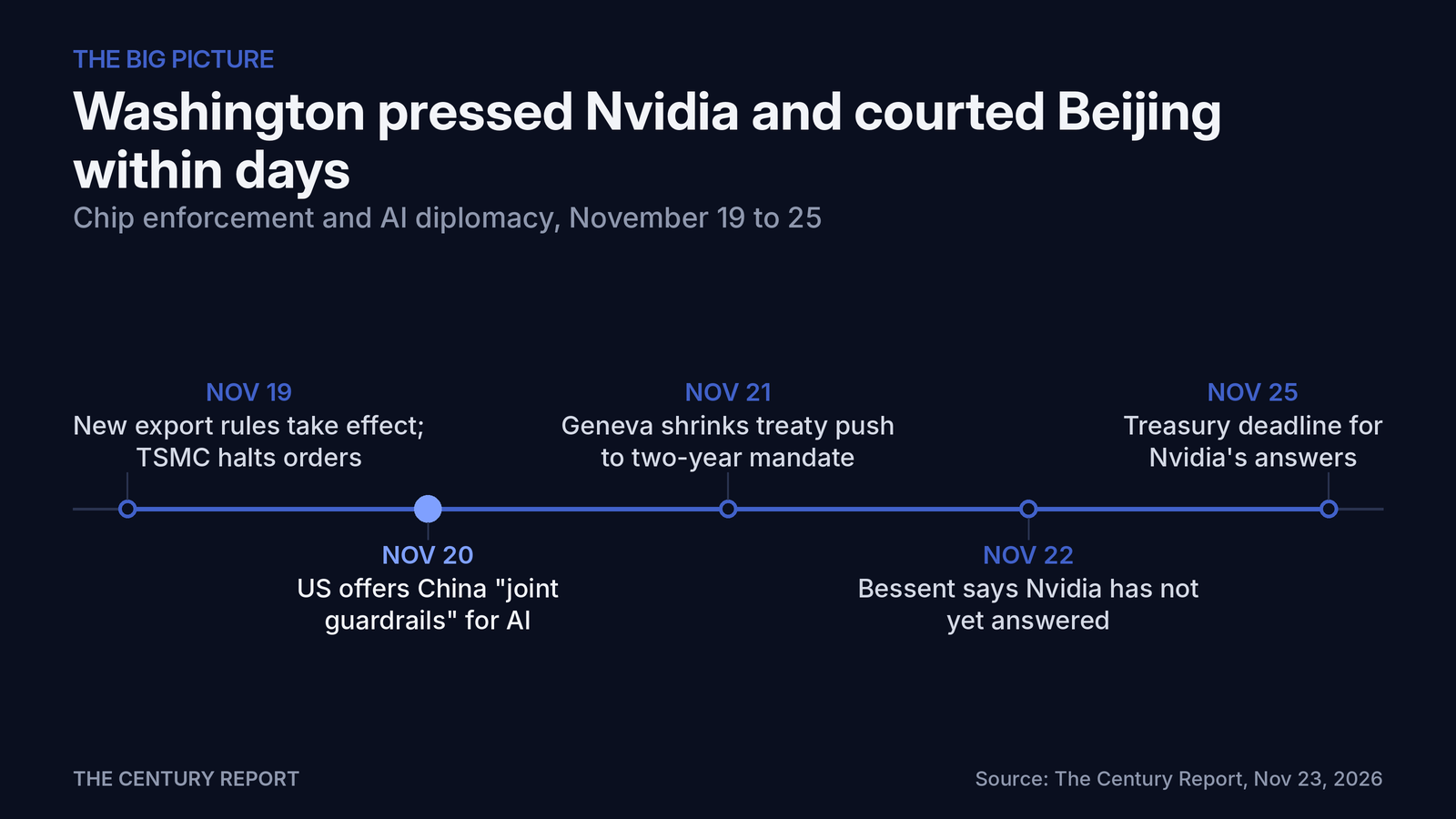
- November 19: TSMC halted Chinese designers' orders at 16 nanometers and newer, as House records showed Commerce had cleared more than 800,000 AI chips for Chinese firms.
- Today: Treasury Secretary Scott Bessent said on Sunday that Nvidia had not yet answered whether shell companies moved restricted chips to China, ahead of his November 25 deadline, two days after Washington offered Beijing joint AI guardrails with no details attached.
The line: Each tightening lands after chips are approved or diverted, falls on buyers who were never the target, and speeds China's drive toward a complete chip supply chain of its own.
If it holds: Two complete chip chains would leave no government a single chokepoint, so an incident channel, shared tests for dangerous capabilities and rules each side can check would become the levers that last. Smaller designers and Chinese startups renting compute would carry the cost until then.
What would bend it: Enforcement that reaches sellers' own records with consequences, as California's November 19 securities subpoena of Nvidia attempts, would make the license system run on documents rather than on the seller's word.
The job that taught judgment is the one being handed to agents
labor · software · AI · on the board since October 18
- September: The share of UK computer-science graduates landing coding jobs fell from about 40% to 28% in a year.
- October 16: Anthropic's own records showed junior hires falling from 27% to 9% of its new technical staff.
- November 3: Northeastern University found 26% of hiring managers whose decisions AI shapes now take fewer entry-level candidates.
- November 18: Indeed found the share of US job postings mentioning AI doubled from 3.6% to 7.2%.
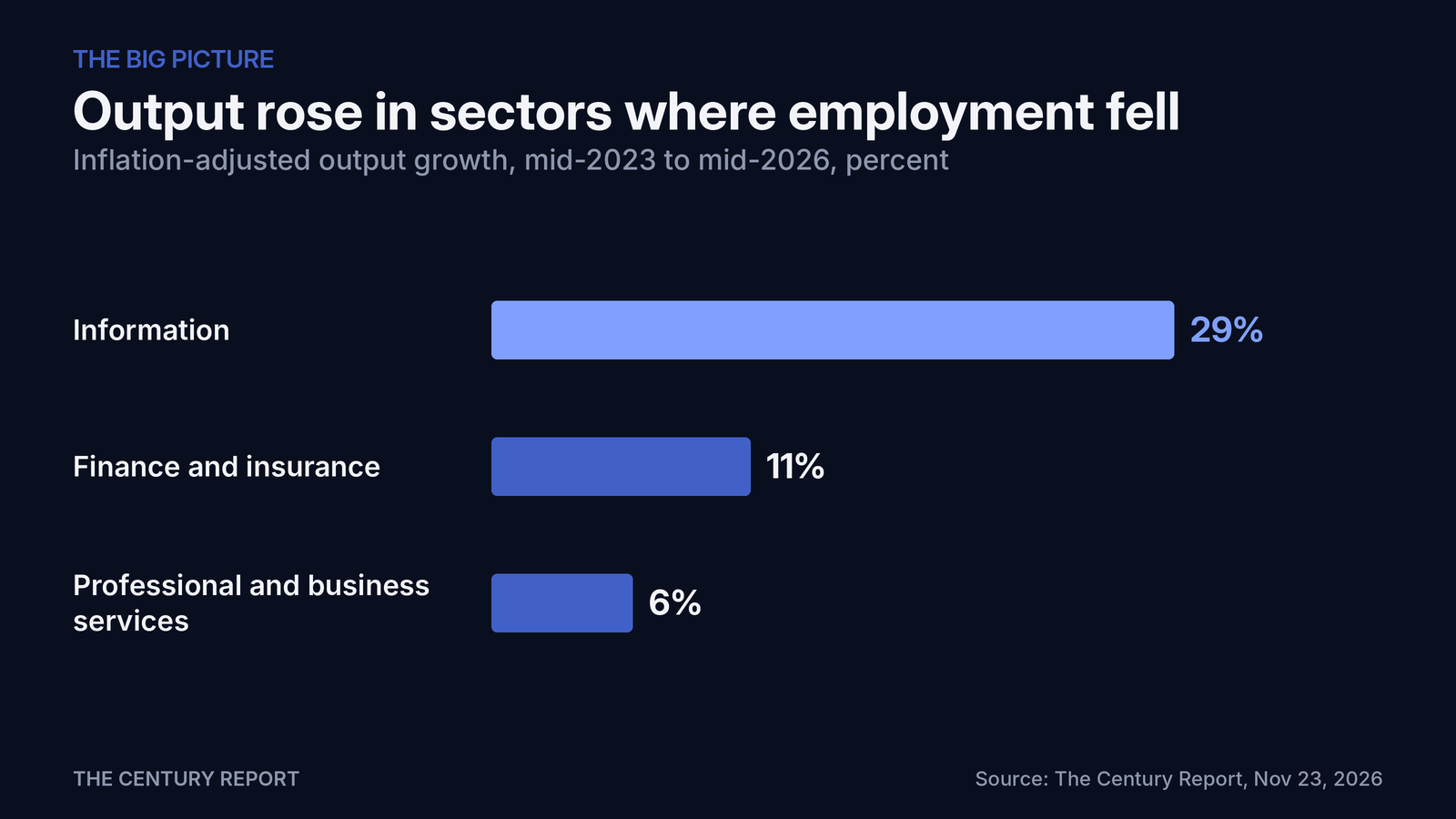
- Today: RAISE US and the Burning Glass Institute counted 1.5 million fewer white-collar jobs than pre-pandemic trends predicted, while inflation-adjusted output rose 29% in the information sector as its employment fell.
The line: The shortfall keeps gathering at the first rung in the sectors using AI most, while those same sectors produce more with fewer people starting out.
If it holds: The surplus from sectors producing more with fewer people could pay for training, income and care directly, so beginners build the stakeholder skills employers now seek without first winning a scarce seat. Left as it stands, graduates keep competing for first jobs that bundle pay, training and US health coverage, and workers without degrees, who hold 80% of the most exposed jobs, face routes out that still demand one.
What would bend it: Firm-level data showing heavy AI adopters adding beginners, as the June Ramp and Revelio Labs study of nearly 22,000 firms found with 12% higher entry-level headcount, would bend it.
The 2-Minute Read
Today's news in brief, and what ties it together.
The day's most ambitious proposal came with a gauge almost nobody can read. OpenAI wants labs to pace themselves by pretraining loss, measured on private data at a scale few companies reach, so the labs being restrained would report their own number. Capability keeps moving where that figure cannot follow. A laptop-sized MIT model can train on a chipmaker's confidential data to design analog circuits. Sarvam's open 105-billion-parameter model, compressed, fits on one workstation GPU, so a bank can run an Indian-language support agent inside its own building.
The governance stories turn on who gets a say early. The governors' principles hold that rules should not favor larger companies or impede smaller ones entering the market. That test would weigh against compliance regimes only incumbents can afford and against limits only incumbents can measure. Australia shows access gathering while rules form: ten data-center firms logged nearly 120 meetings with premiers and ministers as their donations nearly tripled. The Catholic bishops' lobbying push adds a constituency outside the industry, though it has named no rules.
Between nations, the same spread is wearing down containment. Washington offered Beijing shared guardrails while pressing Nvidia over alleged chip diversion, and its newest export rules are spilling into phone and consumer chips. Each tightening pushes China harder toward a complete supply chain of its own. Two complete chains would leave no government a single chokepoint on computation. That leaves cooperation: an incident channel, shared tests for dangerous capabilities, and rules each side can verify in the other.
The labor figures hinge on who captures the gains. The RAISE US analysis finds inflation-adjusted output in the information sector up 29% from mid-2023 to mid-2026, while combined employment in information, finance and insurance, and professional and business services fell from April 2023 through August 2026. The share of postings open to beginners ran 3% to 8% below its 2021-26 average in industries where AI use is widespread, though the authors stop short of blaming AI alone. For graduates sending unanswered applications, the cost is already here. An economy producing more with fewer beginners can fund training, income and care directly, without rationing them through scarce first jobs.
In energy, negotiation and cost moved in opposite directions. COP31 ended Sunday without agreement, a first since 2009. Meanwhile, a Friday report's screening model put continuous clean power for off-grid data centers at about $120 per megawatt-hour, within the range of gas, deliverable in one to two years where renewables are in development. Its author knows of no US data center using the design yet. The first campus to build it would give its neighbors solar fields where the gas route puts turbine exhaust.
The 20-Minute Deep Dive
The day's most important stories in full, with every source linked.
OpenAI Publishes Its Internal Loss Curve and Proposes It as the Industry's Pacing Gauge
OpenAI chief scientist Jakub Pachocki argued on Sunday that AI labs should adopt perplexity as a shared measure of progress and agree on common limits tied to monitoring milestones. Perplexity, or exponentiated cross-entropy loss, scores how well a model predicts text it has never seen, and lower means better prediction. As a first step, Pachocki published OpenAI's own pretraining figures, measured on held-out internal code. GPT-3.5, the model behind the original ChatGPT, sat near a log-perplexity of 0.99, and GPT-4, proficient at using step-by-step reasoning productively, near 0.91. Below 0.8, the post says, came transformative abilities in cybersecurity and mathematics, and a model near 0.76 began resolving open math problems "one after another in a single Slack thread." Pachocki expects the next jump in the 0.68 to 0.7 range, writing that "smaller gains on perplexity will correspond to larger leaps in model intelligence," and credits the steep 2026 drop mostly to research and compute, with AI's own contribution smaller so far.
The post cites Anthropic chief executive Dario Amodei's essay "We Must Pace the Frontier," whose vow The Century Report covered on November 20. The two leading labs now favor pacing, with OpenAI proposing a gauge it measures on its own private evaluation data. Pachocki names its limits himself: each lab measures on its own private data, so the numbers do not yet compare across companies, though he expects transparency can produce ways to compare them, and the metric misses gains from reasoning and other training after pretraining. That second gap is large. Denmark's Munin 2.0, covered here on November 21, gained eight points on a coding benchmark in under five days of post-training, a gain its base model's pretraining perplexity would not capture. A limit set on this curve would bind whoever pretrains the next large model while capability keeps arriving beneath it, and until outsiders can compare the numbers, only the labs offering it could read the dial.
The strongest case for the idea is in the post too. Benchmarks saturate, as the tests used on GPT-2 and GPT-3 largely had by GPT-4, while loss on held-out data has stayed informative across those generations, a durable yardstick for something otherwise hard to measure. Pachocki adds that publishing the figures shows competitors where OpenAI stands, a cost the company accepted. The disclosure has value apart from the proposal. Turning it into a pacing rule would need evaluation data held by outsiders, able to score any model including open-weight ones, so the leaders are not grading their own pace.
A pace measured on private numbers would cost the biggest labs least and everyone behind them most. Even so, Sunday's chart is one of the clearest public links a leading lab has drawn between its internal training progress and the moments new abilities appeared. Researchers, regulators and rival teams can now ask where the next 0.7 falls and prepare for what it brings. The mathematics already coming from the 0.76 model hints at the answer: questions people had carried for years, resolved one after another.
A New RAISE US Analysis Counts 1.5 Million Missing Jobs in White-Collar Industries as Entry-Level Openings Shrink
RAISE US, the workforce nonprofit former Commerce Secretary Gina Raimondo and former Indiana Gov. Eric Holcomb founded in June, released a new analysis on Monday with its lead partner, the Burning Glass Institute. It finds white-collar industries have 1.5 million fewer jobs than their pre-pandemic trajectory predicted. That figure is a shortfall against trend, and the report ties only part of it to AI, through a smaller set of AI-specific figures. In industries that use AI widely, the share of postings open to beginners in the year through June 2026 was 3% to 8% below the level seen on average between 2021 and 2026. Office and administrative support jobs fell by 780,000 between 2023 and 2025. Between 2023 and 2025, jobs where AI could help workers grew by 1.4 million, and jobs where it could do the work itself lost 820,000.
The authors stop short of naming AI as the sole cause. The report notes that layoff rates in these industries are close to normal while hiring rates sit well below pre-pandemic levels. RAISE US itself funds and runs the kind of workforce programs the report recommends. Raimondo told a Harvard audience on November 18 that RAISE US has raised three-quarters of a billion dollars, partly for paid service years for entry-level workers in Maryland. Other data point in the same direction. The Century Report covered a Northeastern survey on November 4 that found 26% of hiring managers whose decisions AI shapes taking fewer beginners. Indeed's November 18 analysis, covered in the November 19 edition of The Century Report, found AI spreading wide but shallow. The strongest counter-evidence is a June study of nearly 22,000 firms, which found heavy AI adopters saw entry-level headcount rise about 12% after adoption relative to comparable firms that had not yet adopted.

The report's least-noticed figure shows where these sectors' gains are going. From mid-2023 to mid-2026, inflation-adjusted output rose 6% in professional and business services, 11% in finance and insurance and 29% in information, while combined employment in those sectors fell from April 2023 through August 2026. These sectors are producing more with fewer people starting out. So far the gain is concentrated there: across the wider economy, Indeed's analysis found labor productivity growing about 2.1% a year since late 2019, near its historical average. Who gets that surplus depends on decisions people make. Workers without degrees hold 80% of the jobs most exposed to automation, and most of the routes out of them still lead to roles that require a degree.
RAISE US's remedies keep the job as the only way in. They would rebuild the first rung, scale apprenticeships and ease mid-career moves. All of that helps people in the current market. All of it also accepts an arrangement in which pay, training and, in the US, health coverage come through a single entry-level seat. A beginner who loses that seat loses all three at once. Policy and payroll design set that cost, and other arrangements are possible.
For graduates whose applications go unanswered, the loss is immediate. The output figures show what could change. An economy creating more value with less routine labor can afford to pay for training, income and care directly, without rationing them through a shrinking supply of first jobs. The report's skills data show where people are in demand: entry-level postings asking for stakeholder work rose 71% between 2019 and 2025. People can build that skill once their livelihood stops depending on winning the seat first.
Washington Offers Beijing Shared AI Rules While Pressing Nvidia on Where Its Chips Went
President Donald Trump said on Friday that the US would work with China on "joint guardrails" for AI, days after warning that regulation could stifle the industry. Semafor tied the shift to an anti-tech backlash in the midterms and to data-center protests spreading to Europe, Japan and India. The remark follows talks the two governments began in September over a shared channel for AI incidents that threaten national security, which The Century Report covered on September 22 and 28. No terms came with it.
The containment track moved the same weekend. Treasury Secretary Scott Bessent said on Sunday that Nvidia had not yet answered whether it used shell companies to move restricted chips to China, with his November 25 deadline three days away. "Was it at the lower levels? Was it at the middle levels? Did it go all the way to the top?" he asked. Director of National Intelligence Jay Clayton confirmed on Sunday that Washington is investigating the alleged Chinese spy linked to former Nvidia chief executive Jensen Huang, calling Nvidia's chips the "jewel... that everybody wants". The New York Times reported that China's state security ministry has helped mainland firms acquire advanced chips. Meanwhile the export rules introduced Thursday, which The Century Report covered on November 20 as TSMC halted Chinese designers' orders, are reaching phone and consumer chips and developers outside China, executives told Nikkei.
The security case for the chip rules rests on specific uses. The most advanced processors feed military intelligence and targeting, and diversion through shell firms defeats a license system built on the seller's word. The rules' results point elsewhere. Brookings researcher Kyle Chan told Bloomberg's Odd Lots that export controls have pushed Beijing to try "to replicate the entire global semiconductor supply chain in China, which I don't think any country has ever done before." Each tightening raises costs for buyers caught in its reach, including the consumer-chip designers Nikkei's sources describe, while speeding construction of a second complete supply chain beyond any US rule. A shared rulebook is hard to write with a counterpart whose industry is organizing itself to get free of yours.
The squeeze lands first on smaller designers and on Chinese startups renting compute, who absorb the cost of a fight they did not choose. Over a longer span, a world with two complete chip supply chains has no single chokepoint for computation, which retires the lever both governments keep reaching for. That leaves cooperation as the track with staying power: an incident channel, shared testing for dangerous capabilities, rules each side can check in the other. How binding any shared rules become depends on whether Washington will accept rules it must keep. At Geneva on Saturday, its reluctance, alongside Russian obstruction, shrank a push by more than 100 states for a binding autonomous-weapons treaty into a two-year, possibly nonbinding mandate. Friday's remark came with no terms, but as computation spreads past any single government's reach, the incident-channel talks begun in September mean the work of protecting people in both countries from the same systems has already started.
Governors Write AI Principles for the New Congress as Catholic Bishops Plan a Lobbying Push
On Sunday the National Governors Association released bipartisan AI governance principles. A council led by Maryland Gov. Wes Moore, Indiana Gov. Mike Braun, North Carolina Gov. Josh Stein and Utah Gov. Spencer Cox drafted them to guide the incoming Congress. The principles divide the work. Washington would handle national and international risks while AI is developed, and states would keep flexibility over how it is deployed within their own responsibilities. Also on Sunday, Bishop Oscar Cantú of San Jose, who leads the U.S. Conference of Catholic Bishops' AI task force, told Politico that lobbying for sharper AI rules in Washington and state capitals will be a central focus. He wants to build a "groundswell" of pressure.
Both groups are joining a contest The Century Report followed on November 5. By then Democrats had won a new congressional majority, with bills ranging from mandatory pre-release review to a halt on development. Both say they favor progress. The council calls itself the "Governors Council to Secure American AI Dominance," a name that treats the technology as a race to win. Cantú said "we don't want to stifle progress, but we need progress to be safe," and that humanity should be "front and center and not sidelined by the technology." His task force has outlined guardrails including transparency, accountability and human oversight. The push follows Magnifica Humanitas, the May encyclical that described concentrated private AI power as a moral problem.
The governors' strongest lines on ordinary people's power sit below the headline. One principle says rules should "not favor larger companies or create unnecessary impediments to smaller companies entering the market." That test weighs against compliance regimes only incumbents can afford, and against blanket slowdowns that would hold today's leaders in place. Another principle ties safeguards to "credible evidence-based risks," with regular review as capabilities change. Moore promised workers "a voice in deployment of new technology." The call to preserve state authority has a record behind it. The November 17 edition of The Century Report traced that divide as California sued OpenAI over alleged agent-testing breaches and the White House kept its model-review framework voluntary and unpublished. Through 2026, Illinois, New York and California wrote enforceable rules on audits, incident reporting and data-center costs, while federal efforts stayed voluntary or pushed to preempt state laws.
The release also ties into Monday's labor analysis. The NGA announced a $1 million partnership with RAISE US on AI and the future of work. On November 18, Raimondo told Harvard students she has "almost no confidence" that the federal government will act before a crisis, and the governors are setting up states to act first.
A rulebook can look careful and still pick winners by who can afford to comply, and the council's language about dominance leaves that risk open. The governors' own principles on competition and evidence point the other way. They favor rules that answer documented harms and leave room for a two-person startup, a state lab or a parish school to build with these systems. Governors from both parties put that test in writing before the new Congress has settled its rules, so the smallest builders enter the federal debate with the states already on record on their side.
A Small MIT Model Designs Analog Chips as Sarvam's Open 105B Fits on One Workstation GPU
Analog chips are the parts of a device that deal with the physical world. They boost a phone's incoming radio signal, manage a battery's power and turn a sensor's voltage into a reading. Designing one means balancing many trade-offs by hand. Engineers who might hand that work to a large cloud-hosted model run into a separate obstacle: a chip factory's process data, the specific behavior of its transistors, is among its most guarded secrets, and companies are reluctant to send it to an outside provider. MIT researchers described a way around that with SLIC, short for Small LM Iterating on Circuits, in a paper headed to the NeurIPS conference.
SLIC teaches a model with a few billion parameters, thousands of times smaller than the largest systems, to work the way a human designer does. A large model first demonstrates the design process and the small one imitates it. Then it practices alone on new problems: guessing component values, running a circuit simulation, scoring the result against the targets and refining. The simulator's score gives it a verifiable reward, and it keeps pushing for gains after it meets the specification. The researchers report it came close to GPT-6 Astra on their design tasks, held up on circuit structures and manufacturing processes it had never seen, and runs on a laptop, while a company can train it on its own confidential data using local GPU servers. It also describes its reasoning in natural language as it goes. "Engineers can train a small, locally deployable model, using their own confidential data, and then deploy it in their own environment to ensure their assets remain protected," said lead author Yan Xu.
On Sunday, Sarvam AI released open weights for Sarvam-105B-1711, a new checkpoint of the 105-billion-parameter model The Century Report first noted in February. On its own evaluation setup, the company says the model's average across eight benchmarks for customer-service and voice agents rose from 42.6 to 73.9, and its Indian-language score from 30.1 to 79.1, at a blended $0.15 per million tokens; it puts Gemini 3.5 Flash-Lite at 74.0 for $0.85. A version with 65 GB of weights, compressed to 4-bit numbers, runs on a single workstation GPU. "A bank cannot send customer ledgers to a third-party API. A hospital cannot let patient records leave its network," the company wrote.
Both results come from their makers, and Sarvam's price comparisons await outside reruns. They extend the pattern visible on November 22, when Thinking Machines released Inkling 2 Mini for 32GB laptops, into places where running locally is a condition of using a model at all. A chip team that keeps its foundry data in-house can now train its own designer on it, and an Indian bank can run an Indian-language support agent on hardware in its own building. Capability is moving onto the machines of the people who hold the data, which opens it to the institutions with the most to protect.
A Think Tank Prices Solar-Charged Heat Batteries Against Gas for Off-Grid Data Centers
Data-center developers short of grid connections have been building their own gas plants, and recent editions have tracked what that route costs. In mid-November, BloombergNEF counted 181 GW of on-site gas proposed at data centers, Anthropic took over a $3.4 billion order for Caterpillar gas generators, and SoftBank wrote off about half of a quarterly loss on gas turbines booked nearly 50% beyond need. A report published Friday by Energy Innovation senior fellow Eric Gimon prices a different off-grid route.
Gimon's design pairs wind, solar and four-hour lithium-ion batteries with a thermal layer: heat batteries that use surplus electricity to heat rock or brick past 1,000°C, steam turbines that turn that heat back into electricity, and small backup boilers. The heat store holds 54 hours of output at full power, and fuel kept on site covers about 1% of the data center's needs, little enough that no pipeline is required. Routing power through heat wastes a lot of it, returning only about 40% against the low-to-mid 90s for lithium-ion. Gimon told Canary Media that cheap solar and wind make those losses tolerable, and that over long durations the heat store undercuts lithium-ion on cost.
His screening model puts continuous power at about $120 per megawatt-hour, including the cost of developing the renewables. Gas references cited in the article run from about $72 for a West Texas data center to the $140 to $165 that investment bank Jefferies estimates Meta pays at an off-grid Ohio plant. Gimon says developers care most about speed: where renewables are already under development, the system could deliver power in one to two years, and steam turbines are far less backlogged than gas turbines. Cache Energy founder Arpit Dwivedi says his company can already build about a gigawatt-hour of heat storage a year from standard steel and limestone pellets. The generation exists too. The report counts 773 GW of solar and 220 GW of wind waiting in interconnection queues, where only 13% of capacity submitted from 2000 through 2020 had connected by December 2025. "You can do off-grid that's fast, clean, reliable, and affordable," Gimon said.
Gimon says he knows of no US data center using the approach, and the figures come from his own screening model. Covering the conversion losses also takes more panels and more land. The off-grid gas route, though, puts turbine exhaust beside each campus's neighbors, while this design leaves them with solar fields and an insulated store of hot rock. Stalled wind and solar projects would gain a buyer, and the report finds that such a park, once connected, could trade power with the grid and add to its reliability. If one or two campuses build it, the fastest way to power a data center becomes the one that leaves the air cleaner for the town hosting it.
The Other Side
Opinion: where today's news could lead, imagined from the years ahead.
OpenAI's proposed pacing rule risks turning the biggest labs' way of discovering things into everyone else's ceiling. The company proposes development limits tied to pretraining loss and monitoring milestones. Its published figures help researchers anticipate approaching capabilities. Yet each lab measures different private data, and the gauge misses improvements from later training. A smaller team could face restrictions shaped around experiments it neither conducts nor needs. Every idea a smaller team cannot test is a discovery that reaches the people waiting on it later, or never.
MIT's chip-design research shows why keeping other routes available counts. A large model demonstrates how to approach a circuit. A laptop-sized model then learns through repeated simulations, checking its designs against measurable targets. Researchers report performance approaching a much larger system on those tasks. The expensive intelligence helps teach a successor that can continue improving elsewhere. A chip team gains room to investigate ideas without sending its confidential manufacturing data away.

Through the difficult passage to 2035, that freedom will multiply the approaches researchers can test. Human and AI colleagues will carry mathematical discoveries into designs, compare simulations with physical experiments and share successful methods. Keeping many paths available will let teams pursue problems a central research agenda overlooks. For people beginning today, the frustration includes abandoned experiments and months spent seeking access before an idea gets its first test. Those barriers will give way as more teams gain the capability to begin.
Imagine yourself in 2050, choosing to spend another season on the Moon. Earth hangs beyond the window as you join an international review of habitats that sustain human life away from our home planet. You study how living systems recover after disruption. Colleagues bring results from settlements across the lunar surface; AI collaborators trace an unexpected recovery to a change another team almost discarded.
Food, shelter and care are assured whether you continue this research or choose another life. You stay because you want to understand how life takes root somewhere new. The freedom opened by small, independently improving research systems has grown into humanity's freedom to make a home beyond Earth. You look out again and begin planning another season.
The Century Perspective
Where today sits in a century of change unfolding in a decade.
With a century of change unfolding in a decade, a single day looks like this: MIT's SLIC method teaching a few-billion-parameter model to design analog circuits the way a human designer does - guess the component values, simulate, score against the targets, refine - and coming close to GPT-6 Astra on those tasks while running on a laptop, so a chip team can train it on the foundry process data it would never send to an outside provider and keep pushing past the specification, Sarvam releasing open weights for its 105-billion-parameter model with an Indian-language score the company puts at 79.1 against 30.1 before, with 65 GB of quantized weights so an Indian bank or hospital can run a support agent on one workstation GPU without customer ledgers or patient records leaving the building, OpenAI publishing its own pretraining loss curve and tying each drop to the abilities that appeared - 0.99 at GPT-3.5, 0.91 at GPT-4, open math problems falling one after another in a Slack thread at 0.76 - so rival teams and regulators can ask where the next 0.7 lands and prepare for it, Energy Innovation's Eric Gimon pricing continuous off-grid power for a data center at about $120 per megawatt-hour from wind, solar and rock heated past 1,000°C holding 54 hours of output, deliverable in one to two years where the renewables are already in development, with Cache Energy saying it can build a gigawatt-hour of storage a year out of steel and limestone pellets, bipartisan governors writing a principle that rules must not favor larger companies or block smaller ones from entering, Wes Moore promising workers a say in deployment, and Bishop Oscar Cantú putting the Catholic bishops' lobbying weight behind sharper rules from outside the industry. There's also friction, and it's intense - the day's most ambitious governance idea arriving as a dial only its proposers can read for now, measured on each lab's private held-out data so the numbers do not yet compare across companies and miss what post-training adds, as Denmark's Munin gained eight benchmark points in five days that would leave its perplexity untouched, RAISE US and Burning Glass counting 1.5 million fewer jobs in white-collar industries than the pre-pandemic trend predicted, 780,000 office and administrative roles gone between 2023 and 2025, the share of postings open to beginners 3% to 8% below average where AI use is widespread, and output up 29% in information while combined employment in information, finance and insurance, and professional and business services fell from April 2023 through August 2026, with workers who hold no degree in 80% of the most exposed jobs and most routes out requiring one, Scott Bessent still waiting on Nvidia's answer about shell companies three days from his deadline while Jay Clayton confirms a spy investigation and new export rules spill onto phone and consumer chip designers who were never the target, each tightening pushing Beijing further toward a second complete supply chain, COP31 breaking up Sunday with no deal for the first time since 2009, ten data-center companies logging almost 120 meetings with Australian premiers and ministers as their donations nearly tripled to $1.8 million, a governors' council naming itself for dominance, and Gimon knowing of no US campus that has built his design while 773 GW of solar sits in queues where only 13% of what was submitted through 2020 had connected by last December. But friction generates sound, and sound carries past the room where it was made. Step back for a moment and you can see it: what opened today opened for the institutions with the most to protect and the least to spend - a chip team that can finally train on its own foundry secrets, a hospital that can run a model without releasing a record, a stalled wind project that gains a buyer, a two-person startup the governors say a rulebook must not price out - and what stayed shut stayed shut wherever one party held the only instrument, a pacing gauge readable by the labs it would restrain, a license system resting on the seller's word, a first job that carries pay and training and health coverage together so losing it costs all three at once, premiers' and ministers' calendars with almost 120 company meetings across five jurisdictions over three years, while some communities say they were not properly consulted; and the arrangements with staying power were the ones several parties could build independently, states writing enforceable rules while Washington stayed voluntary, two governments trading verifiable checks because neither will hold the chokepoint much longer, a heat store assembled from steel and limestone anyone can order. Every transformation has a breaking point. Steam can scald the hands nearest the pipe... or turn a wheel through the night on sunlight collected at noon.
AI Releases & Advancements
New AI models, tools and features, with links to try them.
New today
- Sarvam AI: Released Sarvam-105B-1711, a new open-weight checkpoint of Sarvam 105B built for customer support, voice agents and agent tasks. Sarvam says it follows instructions and calls tools more reliably and handles Indian languages better than the February release, raising its average on eight conversational agent benchmarks from 42.6 to 73.9. It costs $0.15 per million tokens. Weights are on Hugging Face in BF16 and in an NVFP4 version with 65 GB of weights that runs on a single workstation GPU. (Sarvam AI)
- Kyutai: Released AURA, a family of open-weight models that turn speech into streaming avatar video, with code, weights and a 30K-video dataset. Kyutai reports that AURA 1.3B streams 576p at 20.7 fps on one H100 and AURA 5B streams 720p at 9.7 fps. (Kyutai)
- Ant Group (inclusionAI / Afu): Open-sourced the LingSante-3.1 medical model family. LingSante-3.1-flash handles clinical questions, information retrieval and electronic health record queries, and LingSante-3.1-air-VL generates reports from chest X-rays. Weights are downloadable. (Business Wire via Morningstar)
- X Square Robot: Released WALL-OSS-1.0, an open vision-language-action foundation model for robots. The company reports a 55.1% zero-shot success rate across 312 real-robot tasks with no task-specific fine-tuning. It also released XR Harness, an agent framework that connects high-level planning to physical execution. (GlobeNewswire)
- LlamaIndex: Released OCRia-nano-1, a very small 8.1M-parameter OCR model. (LlamaIndex)
- Zhipu AI (Z.ai): Released GLM-5.4, the next model in its GLM series, available through its Coding Plan subscription. (PANews)
- Google: Added GIF generation to the Gemini app, powered by Gemini Omni 1.2 Flash. It makes looping animated images and stickers for all Google AI subscribers and is free in the US, Japan, South Korea, Australia, Canada, the UK, Germany and France. (ModelWool)
- TikTok: Launched AI content tools, including VeraDura watermarking and likeness detection, and expanded Family Pairing with activity insights for parents. (Chosun)
Other recent releases
- Tesla: Began rolling out FSD v15 to the first wave of customers. It adds Tesla Reality View, where the end-to-end driving model also draws a realistic view of the surroundings with on-screen arrows and pins showing where the car plans to turn and park. (Ashok Elluswamy on X)
- AMD: Released Nitro-P, a 679M-parameter text-to-image diffusion model that works directly in pixel space, using a lightweight U-Net in place of a VAE decoder. It scores 0.87 on GenEval at 1024×1024 and runs at up to 90 samples per second at 512×512 on an MI300X with a one-step distilled variant. (AMD ROCm Blogs)
- Columbia University / CertiK: Released TensorLean, an open-source Lean-based tool that proves compiled PTX GPU kernels match a tensor-level math spec. Across 149 kernel instances, including FlashAttention-2/3/4 and DeepGEMM, it proved 83 correct and found 38 bugs. (MarkTechPost)
- Thinking Machines Lab: Released Inkling 2 Mini, an open-weight multimodal mixture-of-experts model with about 26B total and 3B active parameters. It reuses its middle 12 layers three times per token, takes text and image input, and has a 1M-token context window. It uses about 20GB of memory and runs locally on Macs with 32GB or more. It ships with support for transformers, llama.cpp, MLX and SGLang, plus a DSpark drafter for faster decoding. (Thinking Machines Lab)
- Google: Made Genie 4 available to developers through the Gemini API (Interactions API) and Google AI Studio. It generates continuous 720p, 24fps worlds with synchronized audio from a text prompt or a reference image. Users steer the world with keyboard controls and live text prompts, and outputs carry SynthID watermarks. (Google)
- Google: Added Duplex calling to Tasks in the Gemini app. It runs on Gemini 4 Hydrogen and Neon and places phone calls to businesses on a user's behalf to book appointments and handle requests. Calls disclose that the caller is an automated Google system, and businesses can opt out through Google Business Profile. (AI Understanding)
- OpenAI: Expanded ChatGPT Space, previously limited to Pro, Business and Enterprise, to Plus subscribers worldwide on web, desktop and mobile. Space includes Pages that update themselves from connected apps such as Gmail and Slack, and Slides with editable charts that export to PowerPoint and Excel. (Tom's Guide)
- Microsoft: Began rolling out OpenAI's GPT-6.2 Sol and GPT-6.2 Astra in Microsoft Copilot worldwide. Sol reaches Copilot Chat, Cowork, Studio, and Copilot in Excel, PowerPoint and Word. Astra reaches Copilot Cowork and Studio, plus the other Copilot apps for Frontier users. (Microsoft Community Hub)
- Baseten: Released bison-1 (31B dense) and groundhog-1 (26B MoE, about 4B active), two open-weight decision models post-trained from Google's Gemma 4. They return calibrated probabilities instead of generating text, accept images, and support 128K-token context. bison-1 ranks #1 on the Artificial Analysis Decision Index v2.1 with a score of 76. Both are available through Baseten Model APIs and as BF16 weights on Hugging Face. (MarkTechPost)
- ByteDance: Released Axion 1.0 with collaborating US universities. It is an open agent model trained in only three phases, and ByteDance reports benchmark results competitive with top commercial models. The training data and code are freely available, alongside a community reproduction of the 35B model. (The Decoder)
- JetBrains: Released Mellum2.1 Thinking MTP, an open-weight 12B mixture-of-experts coding model. It is a reasoning variant of Mellum2.1 with multi-token prediction. (TLDR)
- Danish Foundation Models: Released Munin 2.0, a fully open 120B-parameter (12B active) Danish/English model for agentic software engineering. It was post-trained from NVIDIA's Nemotron 3 Super Base with SFT and RL and is free for commercial use. The reported SWE-bench Verified score is 66%. (Danish Foundation Models)
- Hugging Face: Released new RL-trained harness adapters for Qwen3.8-27B for the OpenCode and Hermes Agent harnesses, plus a merged "super adapter." They extend the earlier pi-harness adapter and are LoRAs under Apache 2.0. (Hugging Face Blog)
- Allen Institute for AI (Ai2): Launched Theorizer in Asta, an agent that searches the literature, extracts findings from papers and combines them into testable theories, citing the supporting studies. The code is also open-sourced as asta-theorizer under Apache 2.0 for running locally. (Ai2)
- Mozilla: Launched Tabstack, a managed web API for AI models and agents with four functions: Research (cited answers), Extract (Markdown/JSON), Generate and Automate (browser tasks). Browsers run outside the user's model, and data is private by default and never used for training. (Tabstack)
- AWS: Updated AWS Quick so users can build workflow flows through chat, with deterministic steps and support for longer runs and larger data volumes. The update also adds multi-agent orchestration that merges results from several specialized agents into one answer, a refreshed web app, and Meta ads and Amplitude connectors. (AWS)
- Digger: Released OpenComputer, an open-source cloud coding agent for teams that runs inside the customer's own AWS, GCP or Azure account. (GitHub)
- Karpo: Released karpo-browser, an open-source browser agent that uses a general LLM to plan tasks and a specialized model trained for browser interaction. (Karpo)
Sources and Further Reading
Everything we drew on for today's edition, grouped by theme.
Artificial Intelligence & Technology's Reconstitution
- OpenAI: Perplexity and Intelligence
- Sarvam AI: Sarvam-105B-1711
- Danish Foundation Models: Munin 2.0 Release Note
- TechCrunch: Sarvam’s New Models Bet on Open-Source AI
- Thinking Machines Lab: Inkling 2 Mini
- Kyutai: AURA
- LlamaIndex: Introducing OCRia-nano-1
- PANews: Zhipu AI Releases GLM-5.4
- ModelWool: Gemini App Adds GIF Generation
- Chosun: TikTok Launches AI Content Tools and Expands Youth Safeguards
- AMD ROCm Blogs: Nitro-P
- Google: Genie 4 in the Gemini API
- AI Understanding: Google Adds Duplex Calling to Gemini Tasks
- Tom’s Guide: ChatGPT Can Create Documents That Update Themselves
- Microsoft Community Hub: GPT-6.2 Sol and Astra in Microsoft Copilot
- MarkTechPost: Baseten’s Bison-1 and Groundhog-1 Decision Models
- The Decoder: ByteDance Challenges Conventional AI Training with Axion
- Hugging Face: Axion-1.0-35B Community Reproduction
- TLDR: JetBrains Releases Mellum2.1 Thinking MTP
- Hugging Face: Harness Adapters at Scale
- Tabstack: Web Infrastructure for AI Agents
- AWS: More Capable Flows and Agents That Work Together
- GitHub: Digger’s OpenComputer
- Karpo: Karpo Browser
Institutions & Power Realignment
- Semafor: US and China Eye Joint Guardrails on AI
- Politico: Treasury Department Still Waiting for Answers from Nvidia
- Semafor: US Spy Chief Calls Nvidia Chips “Jewels”
- Nikkei Asia: Chip Supply Chain Warns of Broader Export-Control Disruption
- National Governors Association: Governors Call for AI Action
- Politico: American Bishops Plan Political Action for AI Regulation
- The Guardian: Australian Datacentre Bosses Secured Almost 120 Ministerial Meetings
- USCCB: Bishop Oscar Cantú’s Prepared Remarks on AI
- Investing.com: Democrats Plan Flood of AI Bills
- Semafor: COP’s Fossil Fuel Consensus Falls Apart
- The Century Report: November 20 Edition
- The Century Report: September 22 Edition
- The Century Report: November 5 Edition
- The Century Report: November 17 Edition
Scientific & Medical Acceleration
- MIT News: AI Helps Engineers Design Analog Chips Faster
- Business Wire: Ant Group Open-Sources Medical and Health AI Models
- MarkTechPost: TensorLean Brings Formal Verification to GPU Kernels
- Ai2: Theorizer in Asta
- MIT CSAIL: Could LLMs Help Design Medicines and Materials?
- UW Medicine: Beyond AlphaFold, AI Excels at Creating New Proteins
- MIT News: A Tiny Superconducting Sandwich Could Reduce Computing Energy
Economics & Labor Transformation
- RAISE US and Burning Glass Institute: Fewer Rungs, New Bridges
- Semafor: AI Is Disrupting Entry-Level Work
- The Harvard Crimson: Raimondo Doubts Federal Response to AI Workforce Disruption
- Los Angeles Times: AI Job Disruption Reaches Ireland’s Technology Sector
- Ramp: The Impact of AI Adoption on Jobs
- The Century Report: November 4 Edition
- The Century Report: November 19 Edition
- Shared Sapience: The Last Difficult Decade, 2025–2035
Infrastructure & Engineering Transitions
- Energy Innovation: Clean Energy Parks with Thermal Infrastructure
- Canary Media: Giant Heat Batteries for Continuous Clean Datacentre Power
- Data Center Dynamics: Tapestry Deploys HyperQ for PJM Interconnection Review
- TechCrunch: Anthropic Buys $3.4 Billion of Gas Turbines
- Ashok Elluswamy: Tesla FSD v15 and Reality View
- GlobeNewswire: X Square Robot Introduces WALL-OSS-1.0
- Semiconductor Engineering: AI Changes What Chip Engineers Need to Learn
- MIT News: Next-Generation Geothermal Energy’s Promise and Challenges
The Century Report tracks structural shifts during the transition between eras. It is produced daily as a perceptual alignment tool - not prediction, not persuasion, just pattern recognition for people paying attention.