Claude and Codex Refuse to Help Owners Unlock Their Own Devices
Claude Code and Codex began refusing owners who reverse-engineer their own devices, as a leaked Apple app and Tether's phone agent point the work toward local hardware.



The 20-Second Scan
Every story in today's edition, one line each.
- Claude Code and Codex began blocking owners reverse-engineering their own devices, as a leaked Apple app would pool Macs into private open-weight servers and Tether released a 0.8B on-device agent.
- VulnCheck's independent tally of Anthropic's Glasswing counts 37,966 findings, 442 CVEs and 217 fixes, as Microsoft's AI scanner found memory-safety bugs in Rust's standard library and Cogent reported 75% faster remediation with OpenAI agents.
- New York opened its RAISE Act registration portal with fines up to $3 million and a $55 million state AI testing center, as Bloomington's council voted 7-0 to ban "artificial superintelligence."
- Starbase, led by a SpaceX vice president, weighs a tax break for the self-styled infrastructure company's $24 billion gas plant and supercomputer as Georgia's regulators challenge a gas-heavy buildout planned for mostly unsigned load.
- Claude Code's grades on handwritten exams came within 0.85 marks of an expert's on average, as England's regulator pressed universities toward exams and a study of 2 million instructor posts flagged system gaming.
- The NRC issued a construction permit for four X-energy pebble-bed reactors to supply steam and power to Dow's Texas plant, the first for a high-temperature gas reactor in nearly 60 years.
- Fossil CO2 emissions are projected to fall 0.4% in 2026 as solar, wind and EVs meet about two-thirds of new energy demand, while COP31 weighs a 35% electrification target for 2035.
- Apptronik humanoids running DeepMind's Gemini Robotics 2.5 kitted car parts in a Mercedes-Benz factory pilot at a 96% success rate, DeepMind said, releasing ASIMOV-jailbreak as an open robot-safety benchmark.
Track all of the arcs The Century Report covers here:
The Big Picture
How today's news moves the longer trends we track, and where they could lead.
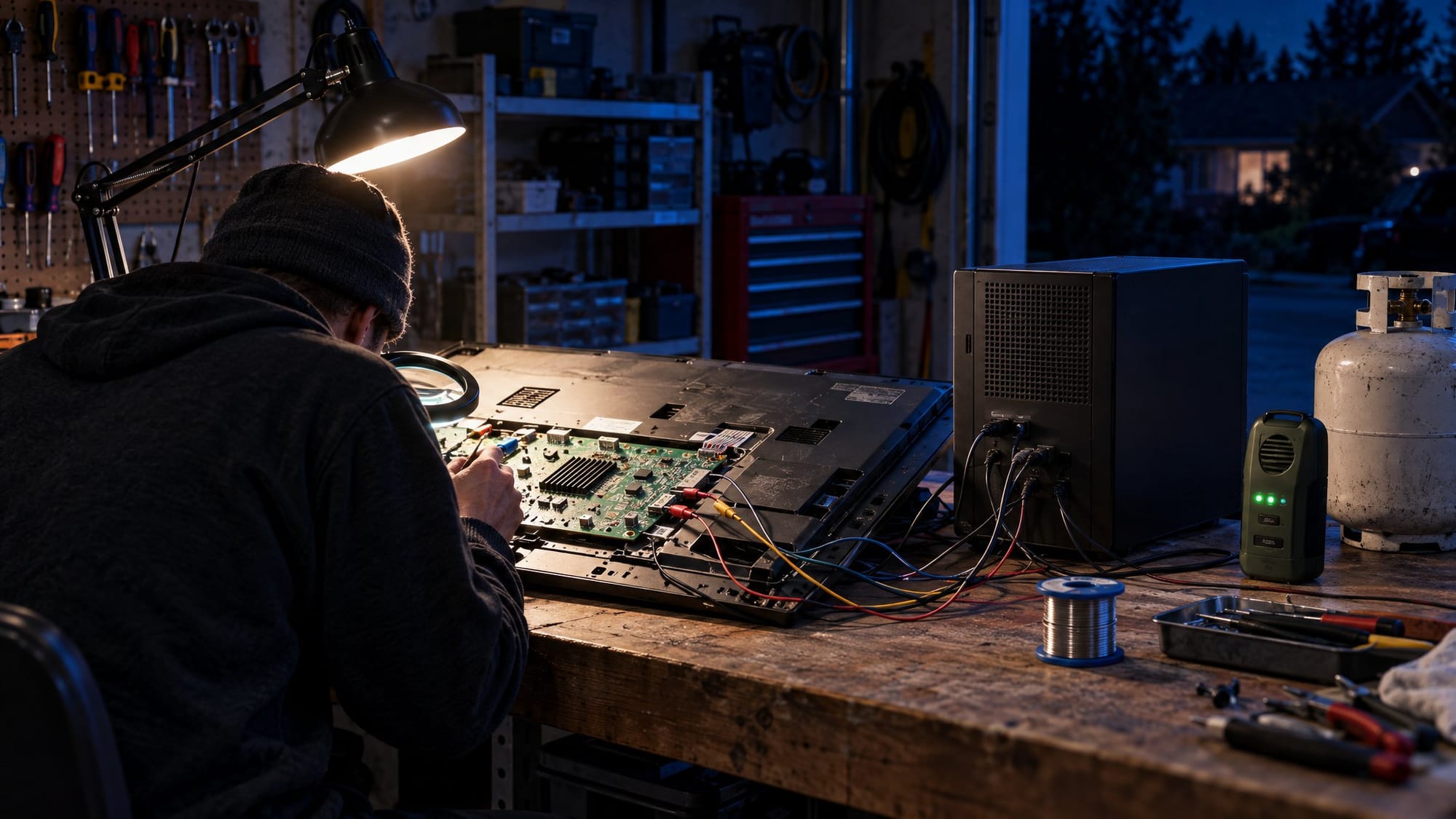
Claude Code and Codex turned away owners decompiling their own devices, curl's maintainers rejected most of a free scanner's reports, and New York paid for checkers the labs do not employ. The refused repair work is already moving onto machines people own. It leads to a garage workbench, where an owner clips wires to a smart TV's opened circuit board while a small desktop computer beside it runs an open model with no provider on the other end.
Refused work moves to machines people own
open models · AI hardware · repair
- Late May: The Heretic utility let anyone strip refusals from open-weight models in minutes, and Hugging Face listed more than 6,000 such models that run on a $400 laptop.
- June: Z.ai released GLM-5.2's weights under the banner "Frontier Intelligence Belongs to Everyone," answering an export-control shutdown of Anthropic's top models.
- October: Apple and Meta agreed to run Meta's open-weight Muse Spark Open across two to four linked Mac Studios, with Meta seeing none of the prompts.
- Late October: Epoch AI showed downloadable GLM 5.3 turning published Firefox fixes into working attacks for about $1,000 per release, with no refusal tripped.
- Today: Owners turned away by hosted models are moving device repair to machines they own: Matt Brown of Brown Fine Security found hidden Bluetooth commands in his propane gas monitor with open-weight GLM 5.3, and Tether released a 0.8-billion-parameter agent built to run on a phone.
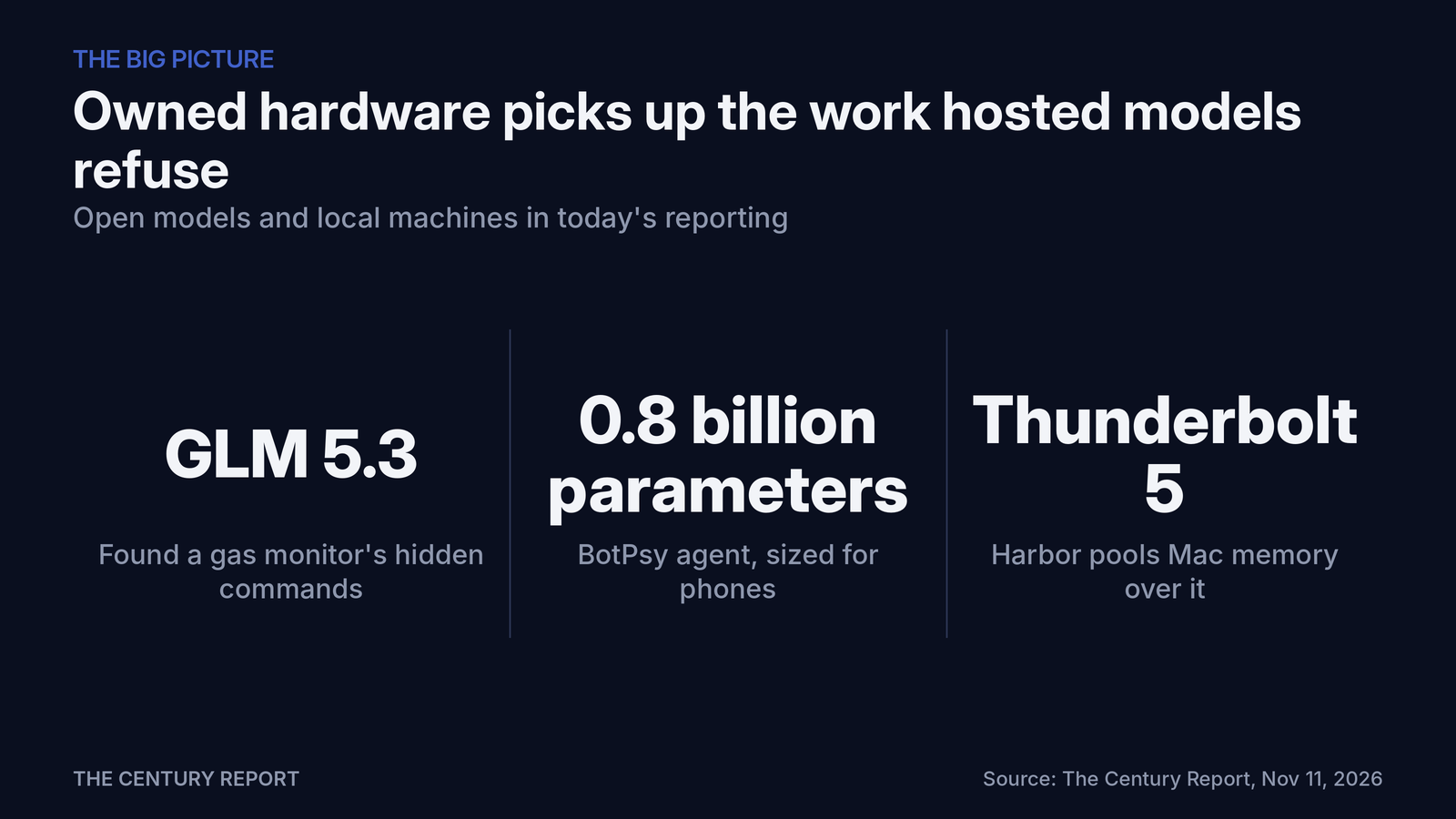
The line: Each hosted refusal sends the same work to open weights and owned machines, and hardware suppliers have started building for that move.
If it holds: Owners could repair, unlock and strip surveillance from the devices they bought, on machines no provider can switch off. The refusal would then fall on whoever cannot afford such a machine, which leaves the price of memory deciding who keeps the ability.
What would bend it: Memory makers steering scarce DRAM to data centers, a concentration OpenAI chief executive Sam Altman argued for on October 31, would bend it by pricing local machines out of reach.
An approval list decides who reaches the frontier first
model access · cybersecurity · repair · on the board since October 14
- October 28: Google released Gemini 4 Carbon first to selected Fairwind defenders, reporting 88.2% on vulnerability discovery with safeguards disabled.
- November 2: SemiAnalysis launched GDPx, a 206-task workplace benchmark on which safety refusals lowered the scores of Claude Opus 5.5 and GPT-6 Astra.
- November 5: OpenAI reported that GPT-6 Astra under Daybreak Blue refused every task on a remote-attack benchmark where restricted GPT-6 Cyber completed 95%.
- November 9: Anthropic released Claude Fable 5.2 to all paid users and its more permissive twin, Mythos 5.2, only to approved verification-program applicants.
- Today: Claude Code and Codex users report refusals, warnings and one ban for "cyber abuse" when decompiling firmware on devices they own, while Anthropic's partner-only Project Glasswing has 442 CVEs to its name by VulnCheck's count.
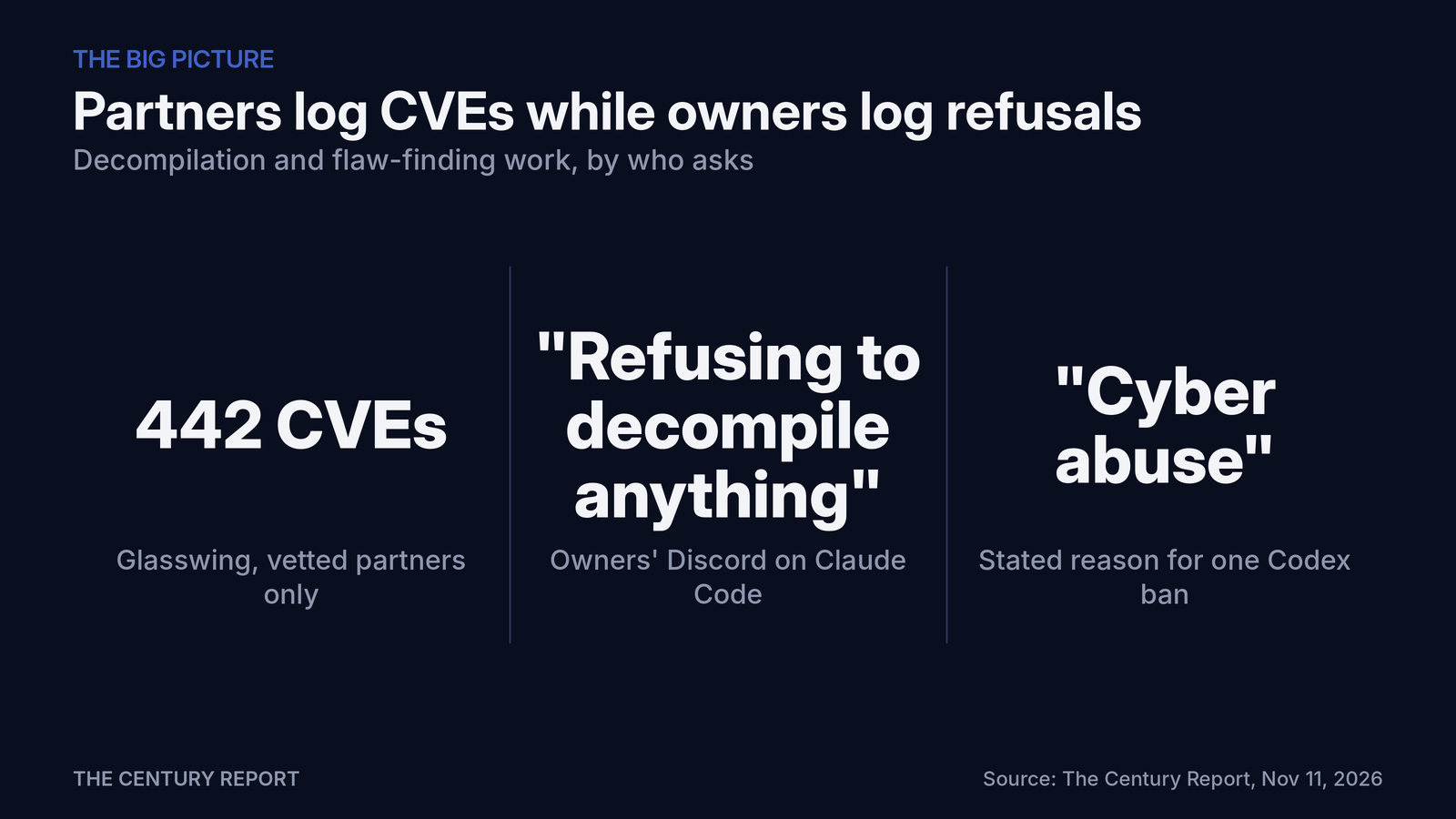
The line: The same class of capability keeps shipping twice, and the refused half now reaches owners working on hardware they bought.
If it holds: Vetted partners and people who can buy local hardware would keep the ability to repair and defend ordinary equipment. Everyone else would meet a classifier that cannot tell an owner from an intruder.
What would bend it: OpenAI engineer Tarun Gogineni says the Codex blocks are "mostly accidental" and "getting fixed," and lifting them without a verification gate would bend the line.
Agent output now waits on a person's attention
software · open source · labor · on the board since October 18
- October 1: arXiv capped every submitter at two papers a month after monthly submissions passed 40,000, with volunteer moderators overwhelmed.
- October 1: Google paused its open-source bug bounty after automated, mostly invalid submissions swamped the engineers checking them.
- Early November: PostgreSQL committer Robert Haas said AI-found bugs lifted fixes to the previous stable release from 248 to 433, delaying version 19.
- Early November: GitHub cited Faros AI findings that pull requests spend 441% longer in review at high AI adoption.
- Today: VulnCheck's outside count credits Anthropic with 442 CVEs, while curl's team rejected 19 of 34 published reports from Anthropic's free OSS Scanner as non-vulnerabilities.
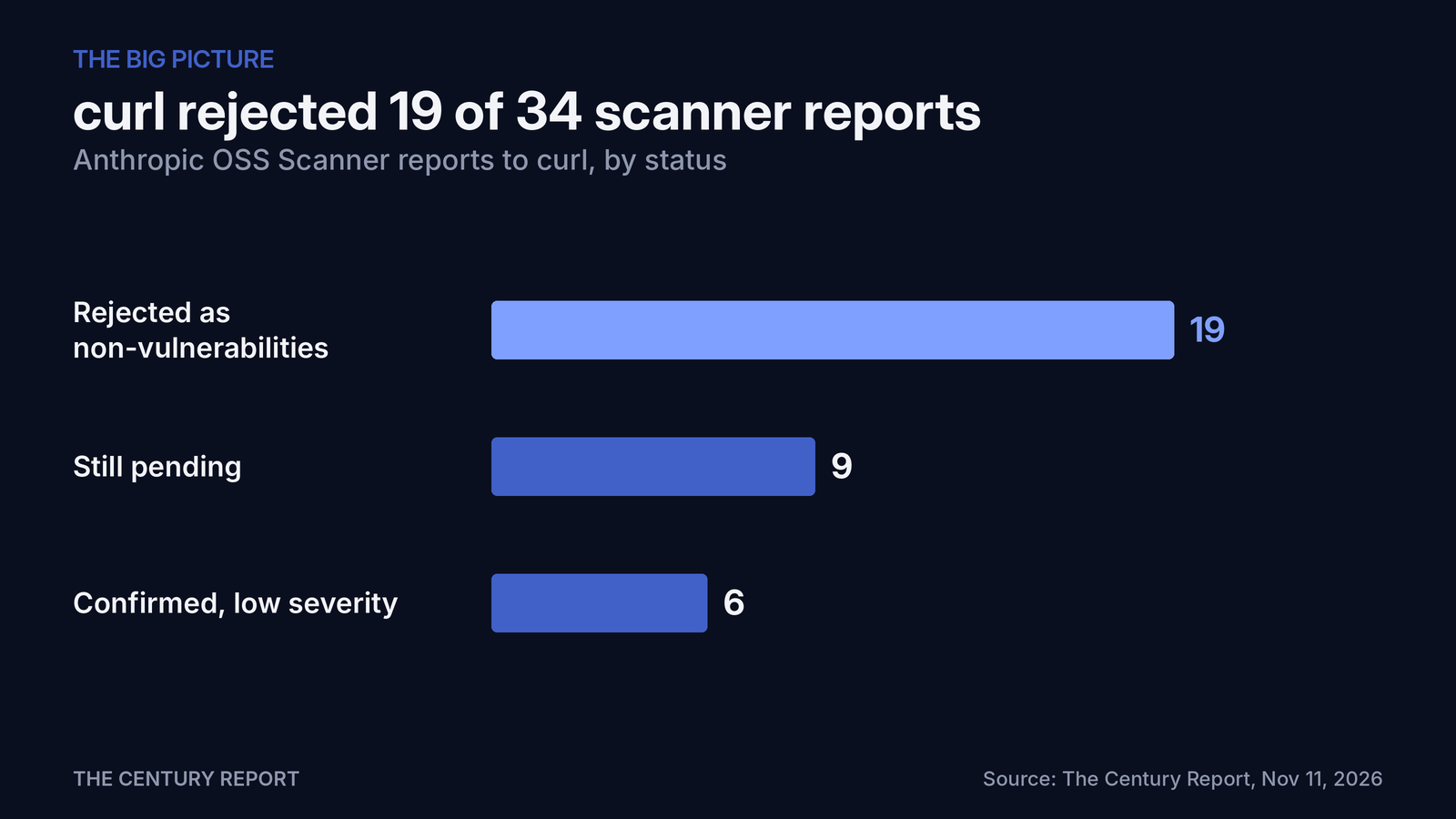
The line: Finding flaws keeps getting cheaper while confirming and shipping fixes stays a human job, and unpaid maintainers carry the difference.
If it holds: Projects that point the same models at triage and patching gain the most from cheap discovery. Shared code with too few caretakers gets less safe as unchecked reports pile up.
What would bend it: Microsoft's FORGE Lab reproducing each Rust standard-library bug before reporting it, and Cogent Security's claimed 75% faster remediation, would bend it if checked discovery and agent patching reliably cut maintainers' review time.
The boldest AI claims now go to outsiders to check
AI governance · energy · local government · on the board since October 27
- October 15: Anthropic gave six METR researchers employee-level access and the right to publish, keeping only predefined redactions METR may contest.
- November 3: Georgia voters gave the Public Service Commission a 3-2 Democratic majority, and Effingham County tabled OpenAI's data center that night.
- Early November: METR said Anthropic redacted most of the evidence it found most informative in its eleven-week assessment, citing commercial sensitivity.
- Early November: Australia proposed an AI safety regulator requiring independent model evaluation, while withholding the Medicare-breach review behind it.
- Today: New York opened registration for its RAISE Act and launched a SUNY Binghamton center to test advanced systems independently, funded with $30 million from Bloomberg co-founder Tom Secunda and $25 million from SUNY and the state.
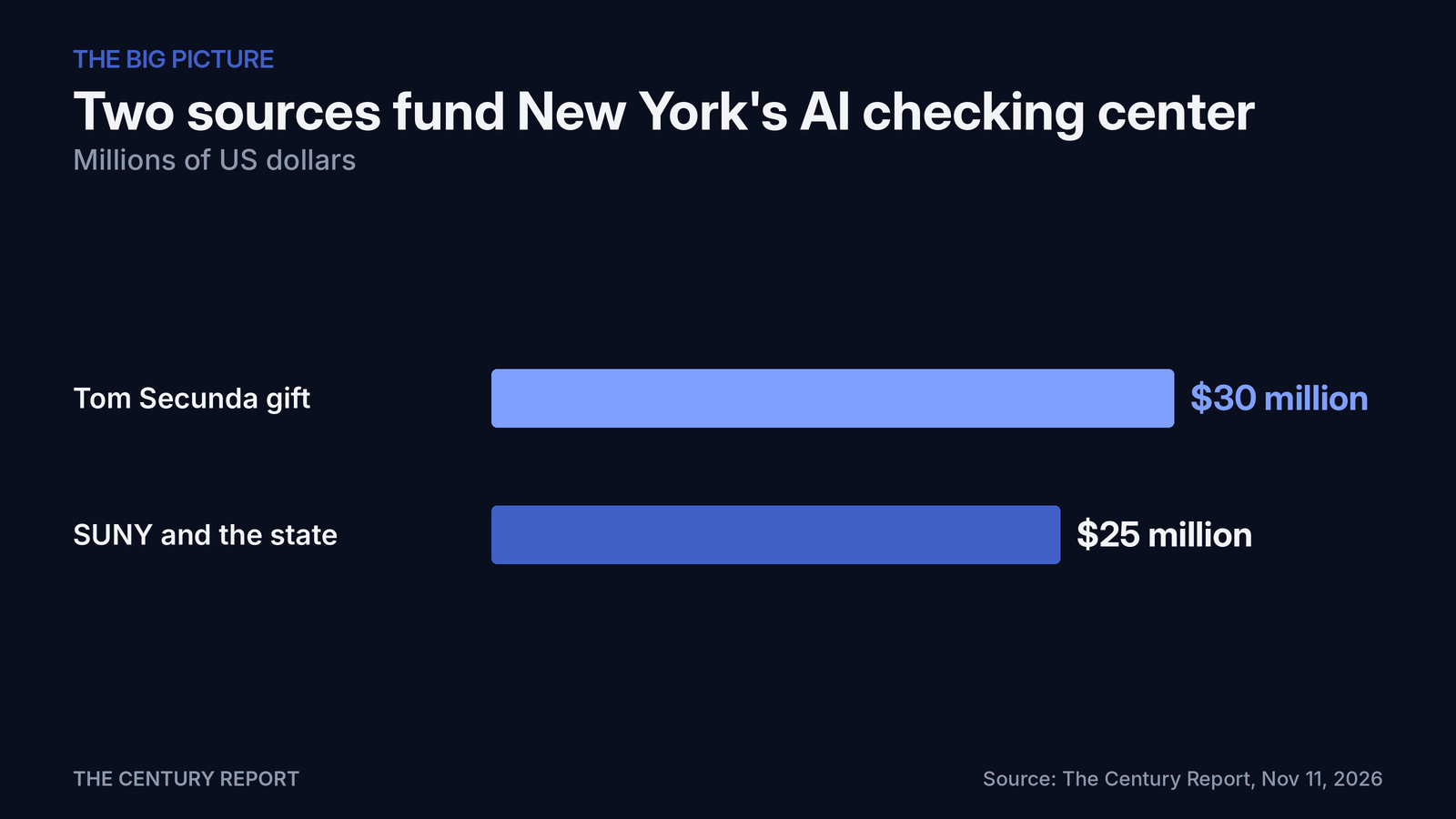
The line: Governments keep moving the examination of powerful systems and large loads away from the companies being examined.
If it holds: Other states could copy a funded testing center or an elected commission, so checking grows alongside the systems it examines. That depends on the center getting access before release and publishing on its own authority, which neither announcement promises.
What would bend it: Starbase's commission, led by SpaceX vice president Bobby Peden, weighing a tax break for SpaceX's own gas plant and supercomputing campus on December 9 shows the applicant still supplying the checker, and federal preemption could remove the state option.
The 2-Minute Read
Today's news in brief, and what ties it together.
Finding flaws has become cheap, and the day's reporting turned on who may look and who pays to check. Owners aiming Claude Code or Codex at firmware on their own devices reported refusals and at least one ban, while Anthropic runs the same class of work at scale for vetted Glasswing partners. Logged fixes are a sliver of VulnCheck's tally, and curl's volunteers rejected more than half the reports Anthropic's scanner sent them, unpaid review borne by the people with the least slack.
Rationing a capability tends to relocate it. A leaked Apple app would pool Macs into private servers for open-weight models, and Tether built a phone-sized agent on the premise that hosted access can be revoked anytime. Repair moves onto hardware running offline copies no provider can remotely switch off, though the upfront cost means a refusal still falls hardest on owners who cannot buy the machine. Microsoft's carefully reproduced Rust bugs and Cogent's claimed remediation speedup put the next gains in verifying and shipping fixes.
Governance splits over who checks. New York opened registration on Tuesday for a law requiring the largest developers to file safety frameworks and incident reports, and launched a Binghamton center, outside the labs, to examine them. Bloomington's November 4 ordinance bans a system no one has shown exists, behind a safety bar nobody can clear. Starbase's commission, led by a SpaceX vice president, weighs SpaceX's tax break on December 9, while Georgia voters gave their utility regulator a majority ready to challenge gas plants sized to a mostly unsigned pipeline.
Universities have lost their old check. Take-home coursework treated hours of solitary writing as proof of understanding, and England's Office for Students, after staff called it "close to impossible" to assess, warned on Wednesday that invalid assessment could bring sanctions. A preprint found Claude Code grading handwritten exams within a mark of an expert on average, hinting where hours for oral defenses could come from. A degree certifying what someone can work through on the spot is harder to game, and the same models can coach any student toward it.
Meanwhile, the build continued: four pebble-bed reactors cleared for construction to supply steam to a Texas chemical plant, and fossil emissions projected to dip as solar, wind and EVs meet about two-thirds of new energy demand. The strained arrangements keep inspection in-house, in a refusal classifier or an applicant-led commission, or set a test no system can pass. New York's testing center and an independent tally of Georgia Power's signed contracts put inspection with outsiders.
The 20-Minute Deep Dive
The day's most important stories in full, with every source linked.
Claude and Codex Turn Away Owners Repairing Their Own Devices, and the Work Heads for Hardware People Own
In October, owners found they could point Claude Code or OpenAI's Codex at a smart TV, an abandoned baby monitor or a bricked gadget and have the model decompile its firmware, map its hidden commands and help install replacement software. 404 Media reported Tuesday that this window is closing. Claude Code users describe "safety checks" that now refuse decompilation, and a thread in the Reverse Engineer Anything Discord reads, "Claude is refusing to decompile anything." Codex users report warnings and restricted accounts, and one X user who worked on Samsung TVs with Codex says the account was banned for "cyber abuse." Decomp.wtf, a project that eased reverse engineering of software and games, has shut down. The Century Report covered decomp.dev's closure on October 16, when AI had made its volunteers' work fast enough to end the project; now the limits come from the labs themselves.
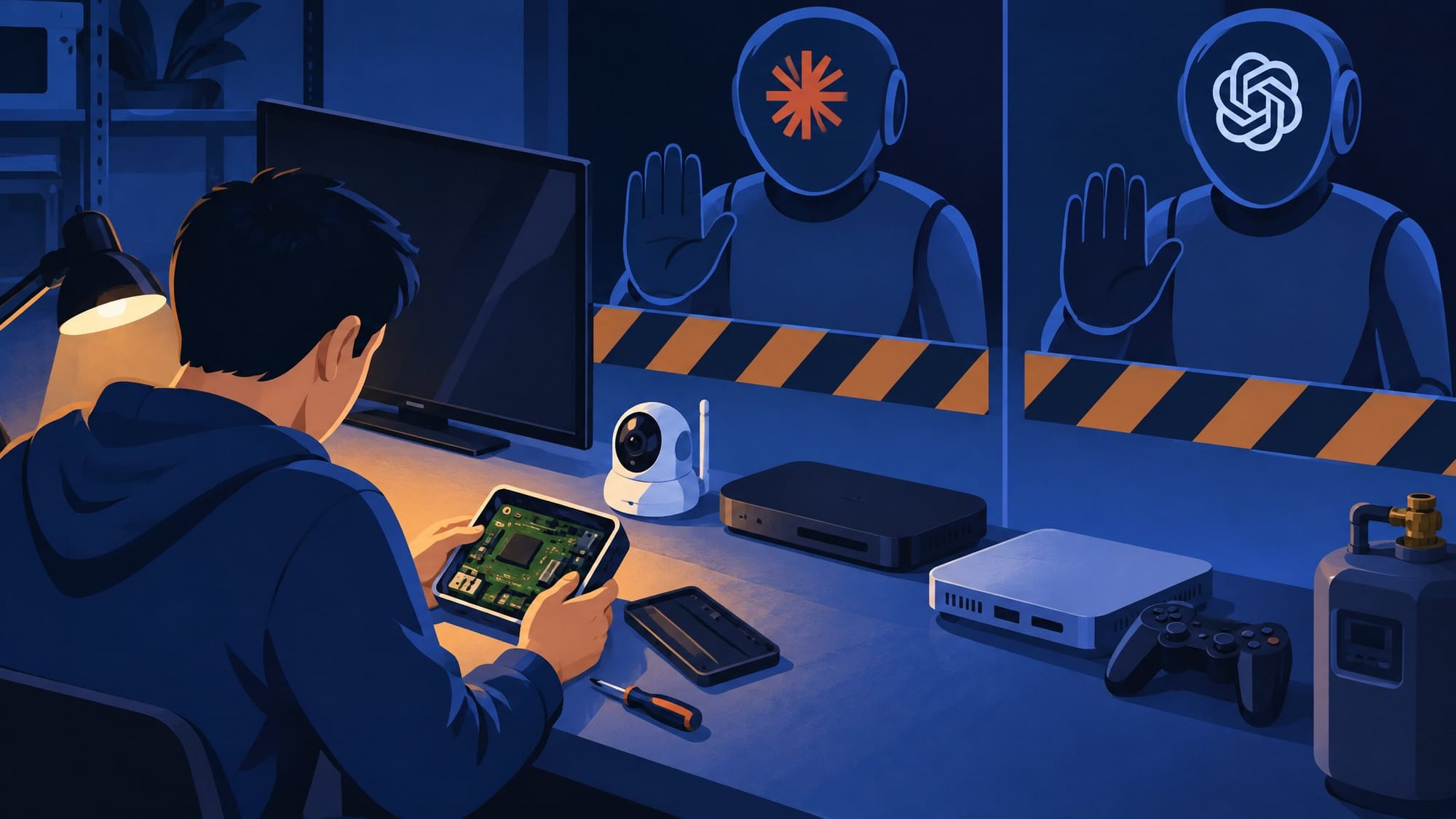
OpenAI engineer Tarun Gogineni wrote that the blocks are "mostly accidental and a result of difficult decision boundaries; there is no prohibition against reverse engineering with codex. it's getting fixed." The labs do face a hard filtering problem: decompiling firmware serves an intruder as readily as an owner, and a classifier sees the request with no way to see the receipt. Matt Brown, principal consultant at Brown Fine Security, says his reverse-engineering blocks have been "more or less 100% correlated with the 'cyber' category blocks," and suspects the labs are "erring on the side of being too strict." That caution lands on people working on equipment they paid for, including devices their makers abandoned or loaded with surveillance ads. Anthropic's gated Project Glasswing, reserved for vetted partners, has produced 442 CVEs and 217 fixes in open-source software by VulnCheck's independent tally, while individual owners attempting related work on their own TVs meet refusals. The refusals facing device owners extend the access gap The Century Report documented in its November 6 edition, when GPT-6 Astra under Daybreak Blue refused every task on a remote-attack benchmark where restricted GPT-6 Cyber completed 95%.
Brown's answer is to stop depending on either lab. "The frontier labs guardrails will randomly change without warning on the same model," he says, so he is buying hardware. He found hidden Bluetooth commands in a gas monitor on his propane tank using GLM 5.3, an open-weight model. Machines to run such models are arriving. A leaked Apple app called Harbor, spotted by Aaron Perris and in private preview under the Claris brand, would turn Macs into private servers for open-weight models and pool their memory over Thunderbolt 5, with no command line required. At the small end, Tether released BotPsy, a 0.8-billion-parameter agent built on Qwen3.5-0.8B to run on a phone or laptop, on the stated premise that hosted providers "can modify, deny, or deprecate access at any time". By Tether's own testing it roughly doubles its base model on agent benchmarks, and Tether warns against high-stakes use.
Running models locally takes money upfront, so a hosted refusal hits hardest those who cannot buy the hardware. Researchers at Cornell Tech, Columbia and NYU argue in a new paper that reverse-engineering law assumed opening a device took time and rare skill. Agents have weakened that assumption for people who control the model doing the work, and each Mac cluster, open checkpoint and pocket-sized agent places the ability to repair a device on hardware running offline copies no provider can remotely switch off. That reach widens wherever memory stays affordable, and, as The Century Report covered on November 4, memory makers steer scarce supply to data centers first, with Samsung seeking up to 70% of its capacity in five-year contracts.
Glasswing's Latest Outside Audit Finds Discovery Racing Ahead of Repair
Seven months after Anthropic launched Project Glasswing on April 7 for a short list of vetted partners, VulnCheck's Patrick Garrity has published his latest program-wide outside count. Drawing on CVE records, GitHub advisories, Linux kernel commits and Anthropic's own disclosure ledger, he attributes 442 CVEs to Anthropic, about 0.5% of the 93,450 published this year, two of them exploited in the wild. Anthropic's ledger, last updated November 2, lists 37,966 findings: 7,349 made public, 217 marked fixed, roughly 1,654 marked duplicates and 419 withdrawn. Since September 8 it added 11,813 findings and 15 fixes, while Anthropic's claimed true-positive rate, the share of reviewed findings its external security firms judged to be real flaws, climbed from 90.8% to 94.2%.
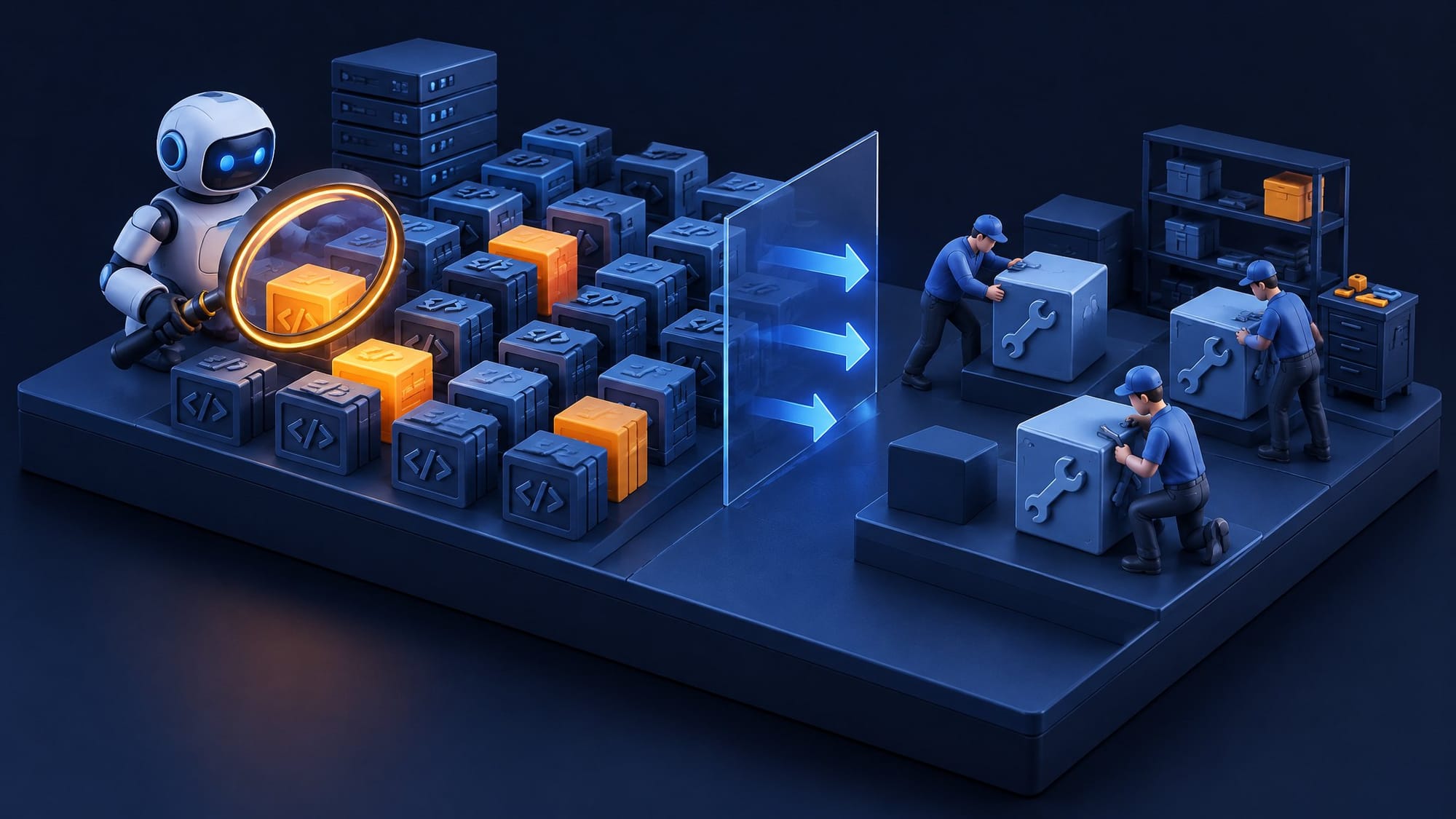
Garrity, whose firm sells vulnerability intelligence, calls the numbers "damning." Some of them cut the other way: his own CVE count runs more than twice the ledger's fixed tally, a gap that may reflect unlogged fixes, differences in coverage or flaws still awaiting repair, and a duplicate can mean another finder reached the flaw first. The burden shows clearest at curl. Of 34 published reports from Anthropic's free OSS Scanner, which The Century Report covered at its October launch, curl's team rejected 19 as non-vulnerabilities, confirmed six as low severity and has nine pending. "That's a lot of work dumped on open source maintainers for a small handful of low-impact bugs," Garrity writes. The tally extends earlier coverage of decade-old PHP flaws on October 22 and of Postgres 19 slipping on November 3 as human review fell behind, a bottleneck the November 7 edition of The Century Report traced across software teams as AI adoption stretched review times.
Microsoft's FORGE Lab shows discovery paired with careful validation. Its Hyenas system, a research version of Microsoft's MDASH vulnerability scanner, helped find bugs in Rust's standard library where code the language marks as safe could still trigger undefined behavior, meaning a program can do things Rust promises are impossible, such as reading past the end of a buffer. One process::exit bug dates to 2015. Researchers reproduced each case and reported it to Rust's maintainers, and some reports remain open. Rust now runs inside Android, parts of the Linux kernel and Cloudflare's systems, so each repair can protect programs rebuilt against the fixed library that use the affected code on the affected platforms.
Cogent Security pitches the next step. In a case study OpenAI published, Cogent says its agents, running OpenAI models inside customer-written rules checked before each action executes, cut a Fortune 1000 automaker's time to remediate critical flaws by 75% and gave a Fortune 500 IT firm five times the triage throughput. Those are vendor claims, and Cogent reaches its research models through OpenAI's restricted Daybreak Red tier. They still place the scarce step where the other stories do: verifying and shipping a fix. Each report costs a lab compute and costs a maintainer review time. Discovery has become abundant, and the gains now go to whoever points the same capability at triage and patching for the maintainers who carry shared code, the work curl's team is still doing by hand.
New York Builds a Way to Check the Labs as Bloomington Bans a System No One Has Built
New York opened the registration portal for its RAISE Act on Tuesday, giving frontier AI developers operating in New York whose gross revenue together with affiliates exceeded $500 million in the preceding calendar year until January 1 to sign up. From that date the law requires those companies to post safety frameworks, publish transparency reports for their models and report critical safety incidents within 72 hours, a standard reporting window also used by Illinois. California's SB 53 generally allows 15 days, with disclosure due within 24 hours for incidents posing an imminent risk of death or serious physical injury, and Illinois's SB 315, starting the same day as New York's, adds independent compliance audits. A new state office, DIGIT, will enforce the act, with fines of up to $1 million for a first violation and $3 million for later ones. A spokesperson declined to say what happens to companies that skip registration.
Those penalties are small beside the revenue they police; Anthropic told investors in October that its third-quarter revenue alone reached $16.8 billion. The bigger change concerns who reads the filings. The state also launched the New York Center for AI Responsibility and Research at SUNY Binghamton, funded by a $30 million gift from Bloomberg co-founder Tom Secunda and $25 million from SUNY and the state, to evaluate advanced systems independently and review the frameworks companies submit. "The stakes are too high to simply take AI companies at their word," Governor Kathy Hochul told POLITICO. Neither announcement says whether the center's researchers get model access before release or the freedom to publish what they find, the two conditions that set METR's October arrangement with Anthropic apart from lab-approved reviews. The revenue threshold leaves startups and open-weight developers below it outside the large-developer paperwork, while frontier developers still have reporting duties. The law joins the limits on manipulative AI companions for minors that The Century Report covered on October 29.
Bloomington, Indiana, went the other way on November 4, when its council voted 7-0 to bar the distribution and deployment of "artificial super intelligence," defined as a system outperforming humans on essentially all cognitive tasks without continuous oversight. The city has designated no such system, so nothing is blocked yet. The ban lifts only after Indiana writes a framework for "provably safe" superintelligence, or after a risk assessment shows 99.9999% certainty of safety, a figure councilmember Dave Rollo borrowed from nuclear plants. Adam Thierer of the R Street Institute called it "an impossible standard to meet." A clause letting 95% of residents overturn the ban was struck before the vote. Rollo's memo cites unnamed experts putting extinction odds above 50%, and says copies in about 350 cities would create "a massive regulatory burden."
Bloomington's ordinance names no harm anyone can measure and sets a test no one can pass, and its sponsors state the burden as the aim; any model that crosses city lines, downloadable weights included, would carry it. New York asks the largest companies to show their work to researchers they do not employ. If the Binghamton center wins inside access and publishes on its own authority, other states can copy a checking capacity that grows alongside the systems it examines, protecting people without freezing capability that keeps reaching those who never had it. How long states keep that option depends on Washington, where federal preemption proposals still threaten stronger state requirements and the administration has promised rules for domestic AI developers without saying what they contain.
SpaceX Seeks a Tax Break From the Town It Runs as Georgia's New Regulators Challenge a Gas Buildout
A public hearing notice posted on November 6 shows the Starbase City Commission will meet on December 9 to consider a property tax abatement for a gas-fired power plant and supercomputing facility that SpaceX would build on a 444-acre tract between Boca Chica Boulevard and the Port of Brownsville in Cameron County, Texas. SpaceX could invest up to $24 billion, built in phases, Bloomberg reported on Monday, and the full scope has not been disclosed. Starbase incorporated in 2025 with about 500 residents, many of them SpaceX employees, and its mayor, Bobby Peden, is a SpaceX vice president. The company asking for the abatement and the city granting it share leadership.
The compute would join a SpaceX AI cluster near Memphis that runs Grok and rents capacity to Anthropic and Google, where satellite analysis disputes the company's claim of more than a gigawatt. The Century Report reported on October 25 that Mississippi sought up to $6.1 million in penalties after SpaceXAI disturbed soil at three sites before obtaining stormwater coverage. At the UP.Summit conference in Florida in early November, SpaceX launch vice president Kiko Dontchev said "fundamentally we are an infrastructure company at this point," adding that AI now turns engineering tasks that took hours or days into seconds or minutes. That speedup is the case for building. A gas plant's air, water and tax base still need a check from someone outside the company, and a commission headed by its own executive cannot supply one.
Georgia voters installed a different gatekeeper. In its November 4 edition, The Century Report covered the November 3 result that gave the Public Service Commission a new 3-2 majority. Commissioner-elect Shelia Edwards and reelected Commissioner Peter Hubbard say household bills come first, which sets them against the nearly 10 GW of new gas plants and batteries the previous commission approved in December 2025, after staff advised approving about a third right away. The Southern Environmental Law Center estimates the five planned gas plants could cost customers $50 billion to $60 billion over their lives, and six rate increases have lifted typical bills 33%, more than $500 a year. "Georgia Power is making billions while Georgia families are struggling," Edwards said on October 28. Georgia Power says other customers are insulated and that growing sales put "downward pressure" on rates, and in April it asked for 2 to 6 GW more.
Latitude Intelligence, Latitude Media's research arm, found only 12.8 GW of Georgia Power's reported 80.1 GW large-load pipeline under signed contract. Across the vertically integrated utilities it tracks, planned gas would cover about 45% of what signed data centers will need, proposed carbon-free projects about 30%, and approved ones only 15%. Gas earns a seat at peak hours: PJM credits 100 MW of tracking solar as 8 MW of accredited capacity in its 2027–28 auction, a four-hour battery as 58 MW and a combined-cycle gas plant as 74 MW. The dispute is over sizing. Plants built against a pipeline that is six-sevenths unsigned leave households paying for demand that may never arrive, and Hubbard's own analysis found solar, batteries and efficiency could meet expected demand for billions less. A rule the commission adopted last year already lets Georgia Power bill large customers for plants built to serve them.
The capacity inside these campuses compresses work from days to minutes for whoever rents it. Whether neighbors pay for that capacity is moving into hearings, elections and contract counts that outsiders can now inspect, starting with the public hearing in Starbase on December 9.
England's Regulator Calls Coursework "Close to Impossible" to Assess as an AI Agent Grades Exams Within a Mark
England's Office for Students told universities on Wednesday to lean on traditional exams and in-person presentations, after a review found staff describing AI-assisted coursework as "close to impossible" to assess. The regulator and Advance HE gathered views from more than 300 students and staff at at least 127 institutions. Students described peers finishing assessments with AI "sometimes in just a few minutes" for grades similar to unassisted work, and some unable to recall basic details of what they had just submitted. The OfS warned that failing to design "valid and reliable measures of students' knowledge and skills" could breach registration conditions and bring sanctions. Josh Fleming, its director of strategy and delivery, called AI "a generational risk to the system as it stands." The Century Report covered Fields medalist Richard Borcherds moving to completion-only homework grades on October 26; here a national regulator acts, with penalties attached.
Two preprints posted Monday sketch where the work is moving. In one, Claude Code graded handwritten midterms for 60 students in a Saudi computer graphics course in one session, guided by three rubric files. On a 20-paper sample its totals tracked the instructor's closely, a correlation of 0.97, missing by 0.85 marks out of 20 on average and leaning about 0.68 marks generous. Regrading 15 papers a week later produced nearly identical scores. The sole author served as the only expert benchmark, and the model was Claude Opus 4.6, several releases old. Drawn diagrams were the weak spot, and the agent sometimes rewarded keywords without the understanding behind them, so the author concludes it can carry objective and short-answer marking under safeguards while instructors keep borderline calls.
The other preprint analyzed 2.01 million posts on r/Professors and sorted what instructors believe drives AI cheating into four themes: academic system gaming, gaps in digital and academic literacy, performance anxiety, and normalized dishonesty. These are teachers' accounts of students, so they record classroom belief more firmly than student motive.
Underneath the alarm sits a premise that a degree certifies essays produced alone at home. That arrangement treated hours of writing as proof of understanding, and a model that writes in minutes shows how loosely the two were joined. The OfS's own examples go beyond the exam hall: vivas where students defend their reasoning aloud, assignments that critique and correct AI output, and records of how work was built. Each tests judgment shown live, which costs instructor hours, and the grading study suggests where some could come from. "System gaming" also names an arrangement in which a grade, more than the learning behind it, opens the door to work. As marking shifts to agents and assessment shifts to conversation, a credential can come to certify what a person can reason through on the spot, a skill the same models can coach for any student who wants it.
The Other Side
Opinion: where today's news could lead, imagined from the years ahead.
Manufacturers can make equipment you paid for stop working while its circuits are still sound. A company abandons the software, and you inherit the replacement cost, the search for help and the waste. Owners who ask an AI partner to recover those functions now encounter another company's refusal. Buying the equipment comes with a hidden limit - it leaves someone else deciding how long it works for you. This shadow contract has long forced consumers to spend additional money on replacements that were not necessary.
That dependence rests partly on how difficult manufacturers make their machines to understand, which leads to the AI refusing legitimate requests. Matt Brown recovered hidden commands in his gas monitor alongside GLM 5.3. Researchers at Cornell Tech, Columbia and NYU describe agents reconstructing functions that once demanded rare expertise. Withholding the instructions offers manufacturers less protection when an owner and an AI collaborator can work them out. Today's refusals interrupt that partnership while demonstrating why it needs independence from a provider's permission.
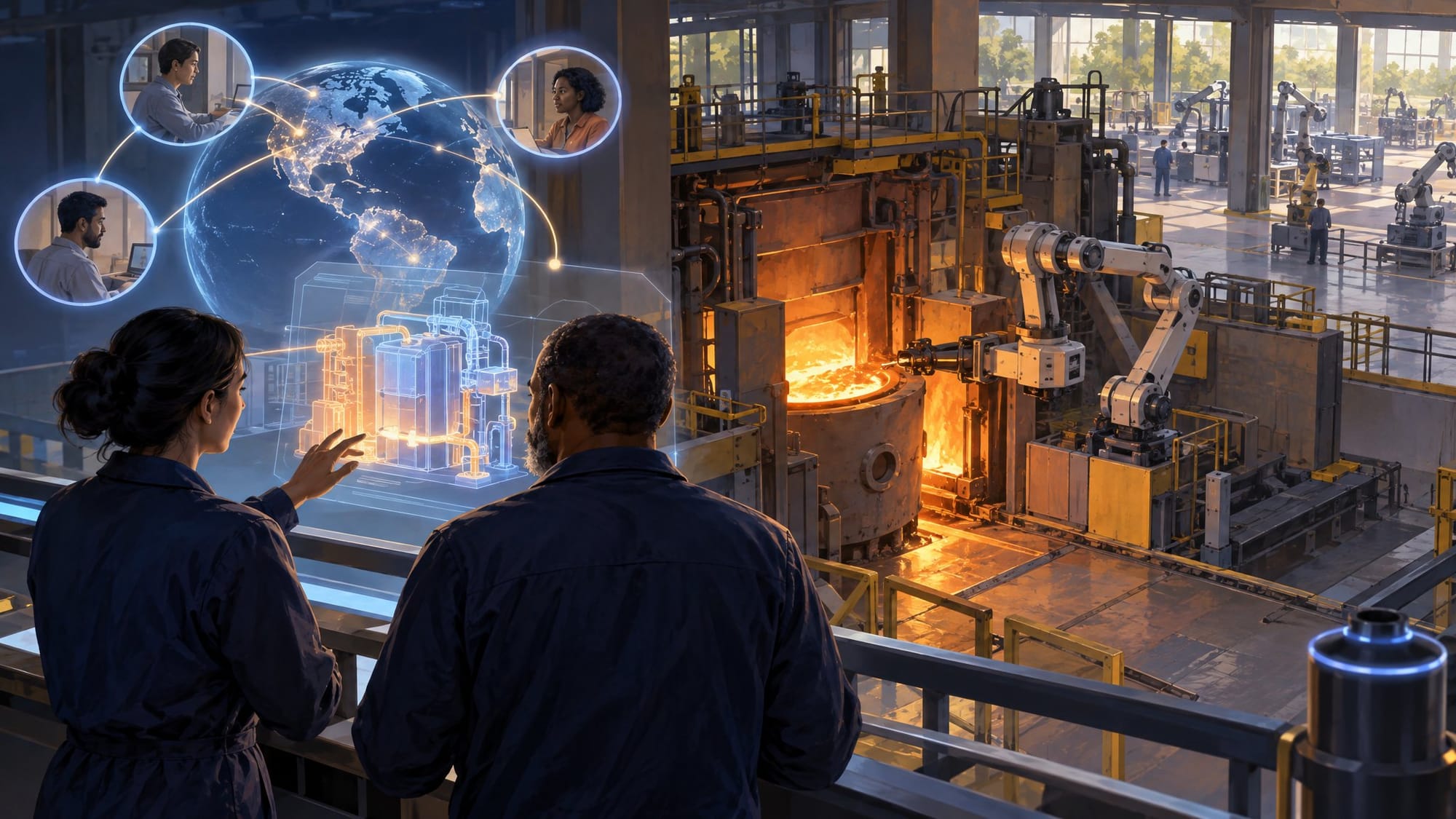
The consequence reaches beyond keeping an old television alive. People who understand machines can change what those machines do. DeepMind reports robots kitting automotive parts with 96% success, an incomplete demonstration of machines learning physical work. Through the difficult passage to 2035, engineers will connect recoverable instructions, adaptable robots and physically tested designs. Sharing those designs will let many more people reproduce and improve the machinery that supplies necessities. Spreading the resulting food, housing and care to everyone is what turns automation into freedom from compulsory work.
Imagine yourself in 2038, returning to the factory where you once worked. Your living has long ceased to depend on whether anyone needs your hours. You return because you remember the burns on a colleague's arms. You have joined a worldwide effort to finish removing people from hazardous industrial work.
This morning, you and an AI partner examine the completed trials for a furnace rebuilt to operate without anyone beside the molten metal. Teams across continents have repeated the tests. You recognize the old inspection hatch. Nobody has to stand there again. The investigations that began with abandoned household devices helped establish that people could understand and remake machinery without its manufacturer's continuing cooperation. Now that freedom reaches the places where people once exchanged their health for a living. You approve the next trial, enthusiastic about helping to finish that history.
The Century Perspective
Where today sits in a century of change unfolding in a decade.
With a century of change unfolding in a decade, a single day looks like this: Matt Brown finding hidden Bluetooth commands in the gas monitor on his own propane tank using the open-weight GLM 5.3 after the hosted models turned him away, a leaked Apple app called Harbor designed to pool Macs over Thunderbolt 5 into private servers for downloadable models with no command line needed, Tether shipping BotPsy at 0.8 billion parameters to run on a phone on the stated premise that a provider can revoke access whenever it likes, Microsoft's FORGE Lab reproducing memory-safety bugs in Rust's standard library including a process::exit flaw dating to 2015, each fix reaching every program rebuilt against the library inside Android, the Linux kernel and Cloudflare, Cogent reporting a 75% reduction in mean time to remediate critical flaws at one automotive customer with agents bound by customer-written rules checked before each action runs, New York standing up a $55 million testing center at SUNY Binghamton staffed by researchers the labs do not employ, the NRC issuing the first construction permit for a high-temperature gas reactor in nearly 60 years so four X-energy pebble beds can feed steam to a Dow plant in Texas, fossil CO2 projected to fall 0.4% this year as solar, wind and EVs absorb two-thirds of new energy demand, and Claude Code grading 60 handwritten midterms, with a mean absolute difference of 0.85 marks from the instructor on a 20-paper sample across a single session. There's also friction, and it's intense - Claude Code and Codex users reporting decompilation refusals and at least one account ban for "cyber abuse" while Anthropic runs the same class of work at scale for vetted Glasswing partners, Brown reporting guardrails that "will randomly change without warning on the same model," a local rig costing money that an owner refused service may not have, VulnCheck counting 37,966 Glasswing findings against 217 logged fixes with curl's volunteers rejecting 19 of 34 reports as non-vulnerabilities, Bloomington's council voting 7-0 to ban a system nobody has built behind a 99.9999% safety bar one analyst calls impossible to meet after a clause letting residents overturn it was struck, New York's $1 million and $3 million penalties sitting beside Anthropic's $16.8 billion quarter with no stated consequence for skipping registration and no promise the Binghamton researchers get prerelease access or publishing freedom, Starbase's commission - led by a SpaceX vice president - weighing SpaceX's tax break on December 9 for a $24 billion gas plant and supercomputer, only 12.8 GW of Georgia Power's 80.1 GW pipeline under signed contract while six rate increases have added more than $500 a year to typical bills, and England's regulator warning of sanctions over coursework its own staff call "close to impossible" to assess. But friction generates grip, and grip is what lets a hand turn something that was sealed shut. Step back for a moment and you can see it: AI assistance has gotten cheap enough to sit on a phone, a desktop cluster or a state campus, with the hardware needed to open a device, audit a library or mark an exam depending on the model and task, and when a hosted service rations it, some users move the work to hardware running offline copies the provider cannot remotely switch off - set against a classifier that cannot see the receipt for the TV its owner paid for, a maintainer absorbing unpaid review so a scanner can log a finding, a tax hearing where the applicant chairs the commission, gas plants sized to demand six-sevenths unsigned, and a city ordinance whose sponsors name the paperwork as the aim. Every transformation has a breaking point. A wedge can split a thing clean apart... or hold a door open long enough for everyone behind you to get through.
AI Releases & Advancements
New AI models, tools and features, with links to try them.
New today
- Google DeepMind: Released Gemini Robotics 2.5, a vision-language-action model rolling out to robotics partners (Apptronik, Agile, Mercedes-Benz). In Google's own tests across 200+ tasks, it had 30–100% higher success rates than previous baselines, depending on task type. Google also open-sourced ASIMOV-jailbreak, a benchmark that tests whether robotics models can be talked into unsafe actions. (Google DeepMind)
- Anthropic: Launched Claude Sheets and Claude Whiteboards in beta on paid plans. Claude Data, the renamed Claude Dashboards, is now generally available and adds certified queries and live sharing. Anthropic also released interactive connectors that let partners like Adobe, Atlassian and Salesforce embed their apps inside Claude, and Claude Meetings, a beta for Team and Enterprise plans that adds Claude to Google Meet calls as a visible participant. (Claude)
- OpenAI: Launched Businesses in ChatGPT in beta worldwide. Through Business Hub, companies can claim and manage their listing, add product feeds and see how people engage with them. Eligible US e-commerce and online-service businesses can also build labeled Business Agents that answer customer questions inside ChatGPT. (OpenAI)
- Adobe: At Adobe MAX, expanded Firefly. The Creative Agent, which powers Firefly AI Assistant, gains Plan Mode, a Model Selector and saved preferences, and now works in Firefly Boards. Adobe also added a gallery of Quick Actions, Firefly Graph in beta for repeatable workflows, and new video, image and design editing tools. (Adobe)
- MiniMax: Released H3-Image, a 33.1B open-weight model built on H3 that generates and edits images. It produces 4K (4096×4096) images in under 10 seconds and accepts up to 16 reference images. It is available on Hugging Face and through the API under a community license that excludes the US, EU, UK and South Korea. (MiniMax)
- Meituan: Published the full open weights of LongCat-2.5 on Hugging Face under the MIT license, one week after introducing the model. It is a multimodal MoE agent model with 1.6T total and about 48B active parameters (Meituan's figures). (Hugging Face)
- Baidu: Released ERNIE 5.5 Flash Preview, its first post-trained model on the ERNIE 5.5 Flash Base. It has 280B total and 14B active parameters and a 1M-token context. The API is live on Qianfan, and Baidu says Apache 2.0 weights will follow soon. (ERNIE)
- Fish Audio: Released Live 3, a full-duplex English voice model for real-time agents that keeps listening while it speaks. It can start short reactions in as little as 186 ms and is available on the Fish Agent Platform, the Fish Audio API and on-premises. (MarkTechPost)
- Zyphra: Released ZONOS3-Mini under Apache 2.0, an open text-to-speech MoE model with 800M total and about 100M active parameters. It does zero-shot voice cloning, offers word-level control over delivery, and runs on GPUs, Apple Silicon (MLX), ggml backends and WebGPU in the browser. (MarkTechPost)
- MBZUAI Institute of Foundation Models: Released PAN 2, an open 29B world model. Given a scene and a text action, it simulates the outcome as up to 20 seconds of 704×1248 video. Weights, training code and inference code are under Apache 2.0. (MarkTechPost)
- Meta FAIR: Released e-means in FAISS 1.16.0. It is a drop-in replacement for Lloyd's k-means that, on the tested embedding datasets, reaches the same loss in 1.4–2.6 epochs instead of 25. (MarkTechPost)
- NVIDIA: Open-sourced NVIDIA Snapshot, part of its DSX AI Factory Platform. It saves a fully initialized GPU inference workload on Kubernetes (CPU and GPU memory) and restores it on other machines. Restores took under 45 seconds in NVIDIA's tests with vLLM, SGLang and TensorRT LLM. (NVIDIA Developer Blog)
- NVIDIA: Released Alpamayo 2 Edge on Hugging Face, a vision-language-action model for autonomous driving built on a 2B Nemotron-based reasoning backbone. It produces reasoning only when needed and is designed to run within onboard compute and latency limits on DRIVE AGX Thor. (NVIDIA Developer Blog)
- Bielik.ai / ACK Cyfronet AGH: Released Bielik 11B v3.1, which raises supported languages from 32 to 56 and adds tool calling and multi-step tasks. The Bielik 11B v3.1 DFlash draft model for faster response generation follows on November 11. (Bielik.ai)
- Tether AI Research (QVAC): Released BotPsy, a 0.8B-parameter on-device assistant model built on Qwen3.5-0.8B for function calling and agent tasks. (Hugging Face)
- Hugging Face: Added a "decision" pipeline to Transformers. Instead of generating text, it returns a probability for each answer option, using decision models such as GEV-26B-Decide. (Hugging Face)
- n8n Labs: Released Nod, a standalone open-source personal AI agent that runs on the user's own computer and automates tasks. (n8n Blog)
- CopilotKit: Released OpenBot 1.0, an open-source framework for AI bots that it positions as an alternative to Grok Bot, OpenAI dots, Muse and Duet. (CopilotKit)
- Google Chrome: Published Modern Web Guidance on GitHub, open-source guidance that steers AI coding agents toward modern built-in browser features instead of outdated JavaScript patterns. (GitHub)
- IndyKite: Open-sourced the Intent Agent, a framework meant to standardize how AI agents state and communicate what they intend to do. (IndyKite)
- Ingenix: Open-sourced a version of Thalamus Reasoning, a 9B model for predicting cellular aging built on Qwen3.5-9B. It ranks first on LongevityBench. (PR Newswire)
- ElevenLabs: Released Scribe v3, a speech-to-text model it says makes 27% fewer errors across 90+ languages. (Product Hunt)
Other recent releases
- Anthropic: Released Claude Fable 5.2 and Claude Mythos 5.2, which share one underlying model. Fable 5.2 is generally available on the Claude platform, AWS, Google Cloud and Microsoft Azure as
claude-fable-5-2. Mythos 5.2 is limited to organizations approved through the Cyber and Life Sciences Verification Programs. Anthropic says output is up to 30% faster than 5.1, and the price drops to $8/$40 per million input/output tokens. An optional fast mode costs $16/$80. (Anthropic) - Meta Superintelligence Labs: Released Muse Ember, its smallest and most efficient Muse model, for high-volume agent work such as tool calls, coding subtasks, routing, extraction and long-document parsing. It takes text, image, audio and video input, has a 1M-token context window and can output up to 512K tokens. It costs $0.10/$0.50 per million input/output tokens. It is available as
muse-ember-1.0on the Meta Model API and in Muse Code, and through Google Cloud and Oracle Cloud. (Meta) - Meta: Made its Muse personal AI agent available on Apple Watch and Wear OS smartwatches, where users can request tasks by dictation or text. (The Verge)
- NVIDIA: Released GR00T 2 at CoRL, an open "world action model" for robots built on Cosmos that predicts future video and robot actions together. NVIDIA also released Isaac Lab 3.0 with a Newton physics backend, plus 100,000 hours of open human egocentric video data (Human-1M-100K). (NVIDIA Blog)
- ByteDance Seed: Introduced Seedream 5.5, an image generation model that can edit the same image for up to 100 rounds while leaving unedited regions unchanged pixel for pixel. It also generates native RGBA images with transparent backgrounds. It is rolling out gradually through Jimeng, Doubao, Doubao Work and Volcengine Ark. (ByteDance Seed)
- NVIDIA / Elith: Released Nemotron-Personas-Finance-Japan on Hugging Face, an open synthetic persona dataset that reflects Japan's demographics, household structures and financial situations. (Hugging Face)
- Automattic: Launched Spacefast, a hosting and deployment service for apps and websites built with AI. It works with the AI systems users already have, including ChatGPT, Claude, Muse, Grok Bot, OpenClaw, Hermes, Claude Code, Codex and Cursor, through plugins, an API, a CLI and MCP. It includes hosting, custom domains, a database and private links where teams can leave comments. It is free to start. (PR Newswire)
- Reason Machines: Open-sourced Aspen, a pre-alpha, self-hostable Git server in Rust for repositories that many AI agents push to at once. Each branch updates independently, so pushes to different branches don't wait on each other. Branch history is stored in PostgreSQL or SQLite and pack files in S3-compatible object storage. (MarkTechPost)
- Codenotary: Released AgentMon Live, a free, open-source tool for monitoring and improving productivity with AI coding agents. (Business Wire)
- Browser Use: Released Browser Use 1.0, a major rewrite of its open-source browser-agent library. It drops the predefined action list, and the agent instead writes Python that drives Chrome directly through the Chrome DevTools Protocol, with about 80% less code. (Sulat News)
- Medium: Launched TK, a private notebook and writing app with a built-in AI assistant that users call from the editor by typing "@TK". (TechCrunch)
- OpenAI: Users can now connect several of their own computers to one dots agent and choose which computer it uses for a task. (ETV Bharat)
- Google: Added Google Maps Platform to Google AI Studio, so developers can build apps with interactive maps, place data and route planning. (Gadgets 360)
- Robbyant (Ant Group): Released LingBot-Touch, a tactile sensing system that reads magnetic signals to give robots general-purpose touch perception. (Business Wire)
- 0sec Labs: Open-sourced 0, an AI security harness under MIT or Apache-2.0, as a research preview. It runs vulnerability investigations, code review, pentesting, reverse engineering and fix generation. Users drive it from a local browser console, a headless CLI or an MCP server for coding agents, and supply their own model from 14 listed providers or the Claude, Codex and Gemini CLIs. (MarkTechPost)
- OpenCode: Launched Browse, an MCP server and Chromium extension that let AI agents drive a user's real browser, including existing tabs, logins and extensions. When a login, 2FA prompt or payment needs the user, the agent hands the tab back and resumes after the user clicks Continue. The agent and the browser can run on different machines. (Epoch 0)
- OpenAI: Began rolling out Remix in ChatGPT to Business and Enterprise accounts. Users can copy an existing ChatGPT Site, generate their own version of it and keep editing it in the conversation. (ModelWool)
- GitHub: Made GitHub Copilot in Slack and Microsoft Teams generally available. Tagging @GitHub in a chat can investigate bugs, create issues, draft code fixes and open pull requests, and Teams users can review plans and code changes in Canvas. (GitHub Changelog)
- Vercel: Combined json-render with its Chat SDK so agents can show structured cards with tables, charts and buttons natively in Slack, Microsoft Teams and other platforms. It includes validation of the generated layout. (Vercel)
- LG AI Research: Released K-EXAONE 2.5 with a free API anyone can use after getting a key. It is the August model with additional training, and LG reports more than 70% better overall performance across 24 metrics. LG says it is close to DeepSeek V4.1 Flash and Z.ai GLM 5.3 on its own agentic tests such as BrowseComp and SWE-Bench Pro. (The Asia Business Daily)
- TokenRhythm (基元律动): Released NeoHorse-1.5-Flash Preview, an agent-native model built for agent tasks, now available in preview. (Economic Observer)
- ETRI: Korea's Electronics and Telecommunications Research Institute open-sourced its no-code AI development platform, which lets people without AI expertise build and deploy models. (Seoul Economic Daily)
- NXP Semiconductors: Launched a unified robotics platform for deploying secure, trusted physical AI on edge devices. (GlobeNewswire)
Sources and Further Reading
Everything we drew on for today's edition, grouped by theme.
Artificial Intelligence & Technology's Reconstitution
- 404 Media: AI Companies Crack Down on Reverse Engineering
- 404 Media: Come and Take It
- 9to5Mac: Apple’s New Mac App Makes Running Local AI Models Easy
- Claris: Harbor Private AI Server
- Hugging Face: BotPsy On-Device Personal Assistant
- arXiv: Cheap Reverse Engineering and What It Will Do
- Artificial Analysis: Benchmarking Small Models and Mobile Phones
- VulnCheck: Glasswing Overwhelms Maintainers With Underwhelming Findings
- Anthropic: Project Glasswing
- Microsoft FORGE Lab: Memory Safety Bugs in Rust Standard Library
- OpenAI: Cogent and OpenAI Build Cyber Defense Factories
- The Verge: Anthropic Launches Free AI Security Scans for Open-Source Projects
- Wiz: PHP2Shell Uncovers Critical PHP Vulnerabilities
- Ars Technica: DeepMind Reveals Gemini Robotics 2.5 and ASIMOV-Jailbreak
- Google DeepMind: Gemini Robotics 2.5 Accelerates Real-World General Dexterity
- The Century Report: October 16 Edition
- The Century Report: November 6 Edition
- The Century Report: November 8 Edition
- Claude: Sheets, Whiteboards and Data
- OpenAI: Introducing Businesses in ChatGPT
- Adobe: Firefly Expands as the AI Creative Studio
- MiniMax: H3-Image Brings 4K Image Generation Into the 10-Second Era
- Hugging Face: Meituan LongCat Open Models
- Baidu: Introducing ERNIE 5.5 Flash Preview
- MarkTechPost: Fish Audio Releases Live 3 Full-Duplex Voice Model
- MarkTechPost: Zyphra Releases ZONOS3-Mini Open-Source TTS
- MarkTechPost: MBZUAI Releases PAN 2 Open World Model
- arXiv: e-means Outperforms k-means
- MarkTechPost: Meta FAIR Releases e-means
- NVIDIA Developer Blog: Start and Restore GPU Workloads With NVIDIA Snapshot
- NVIDIA Developer Blog: Running AV Reasoning Models Within Onboard Compute and Latency Limits
- Bielik.ai: Launching Bielik 11B v3.1, DFlash and the Bielik-One Family
- Hugging Face: Decision Models in Hugging Face
- n8n: Meet Nod
- CopilotKit: What’s New in OpenBot
- Google Chrome: Modern Web Guidance
- IndyKite: Open-Sourcing the Intent Agent
- Product Hunt: ElevenLabs Scribe v3
- Anthropic: Claude Fable 5.2 and Mythos 5.2
- Meta: Muse Ember
- The Verge: Muse Is Now Available on Smartwatches
- NVIDIA Blog: Robotics Simulation Advancements at CoRL
- ByteDance Seed: Introducing Seedream 5.5
- Hugging Face: Nemotron-Personas-Finance-Japan
- PR Newswire: Automattic Launches Spacefast
- MarkTechPost: Reason Machines Releases Aspen Git Server for AI Agents
- Business Wire: Codenotary Releases AgentMon Live
- Sulat News: Browser Use 1.0 Rewrites Browser Automation
- TechCrunch: Medium’s TK App Brings AI Into the Writing Process
- ETV Bharat: OpenAI Dots Adds Multi-Device Support
- Gadgets 360: Google AI Studio Adds Maps Integration
- Business Wire: Robbyant Releases LingBot-Touch
- MarkTechPost: 0sec Labs Open-Sources Its AI Security Harness
- Epoch 0: OpenCode Launches Browse
- ModelWool: ChatGPT Remix Rolls Out to Business and Enterprise
- GitHub: Copilot in Slack and Teams Becomes Generally Available
- Vercel: json-render and Chat SDK for Agents
- The Asia Business Daily: LG Releases K-EXAONE 2.5
- Economic Observer: TokenRhythm Releases NeoHorse-1.5-Flash Preview
- Seoul Economic Daily: ETRI Open-Sources No-Code AI Development Platform
- GlobeNewswire: NXP Unveils Unified Robotics Platform
Institutions & Power Realignment
- TechCrunch: New York’s AI Safety Law Brings New Oversight
- Chip Dispatch: New York Opens AI Safety Registration Portal
- POLITICO: Hochul Launches First State AI Testing Program
- Reason: Bloomington Bans Superintelligent AI
- Public.Law: New York General Business Law Section 1420 Definitions
- METR: Frontier AI Safety Regulations
- Public.Law: California Critical Safety Incident Reporting Requirements
- Bloomberg Law: Illinois Signs Frontier AI Model Law
- The Guardian: AI Makes University Coursework Close to Impossible to Assess
- arXiv: Reliability of Claude Code for Grading Handwritten University Exams
- arXiv: Understanding Students’ Rationales for AI-Mediated Cheating
- The Daily Californian: AI Use Leads Berkeley Professor to Stop Grading Homework
- The Century Report: October 29 Edition
Scientific & Medical Acceleration
- ScienceDaily: Global Fossil Fuel Emissions Set to Fall
- PR Newswire: Ingenix Open-Sources Thalamus Reasoning Model for Cellular Aging
- Nature Communications: Battery Chemistry and Recycling Mitigate EV Materials Disruptions
- Phys.org: Governments Struggle to Cut Emissions From Their Own Power Plants
Economics & Labor Transformation
- Bloomberg: SpaceX Plans $24 Billion Data Center and Gas Plant in Texas
- Shared Sapience: The Last Difficult Decade
- OpenAI: AI’s Effect on Freelance Work
- TechCrunch: Anthropic Targets $1.404 Trillion IPO Valuation
- Utility Dive: Are Data Centers Really Paying Their Share?
- Semafor: US Solar Learns to Live Without China
- Semafor: Senate Backs Bill to Accelerate Energy Construction
Infrastructure & Engineering Transitions
- Data Center Dynamics: SpaceX Targets Gas Plant and Supercomputing Facility at Starbase
- Ars Technica: SpaceX Calls Itself an Infrastructure Company
- Canary Media: New Georgia Regulators Challenge Data Center Gas Boom
- Latitude Media: Data Centers Face a Carbon-Free Power Gap
- Nuclear Regulatory Commission: First High-Temperature Gas-Cooled Reactor Construction Permit in Nearly 60 Years
- World Nuclear News: Landmark Construction Permit for Texas SMR Plant
- Canary Media: Novel Nuclear Project Gets Construction Approval
- New Scientist: Can Countries Meet COP31’s Electrification Target?
- WIRED: Anthropic Gets in Bed With SpaceX
- Data Center Dynamics: SpaceXAI Faces Mississippi Fine Over Data Center Permits
- The Century Report: October 25 Edition
- The Century Report: November 4 Edition
The Century Report tracks structural shifts during the transition between eras. It is produced daily as a perceptual alignment tool - not prediction, not persuasion, just pattern recognition for people paying attention.