OpenAI-Picked Physicists Affirm Its AI's Yang-Mills Proof
OpenAI's appointed physicists affirmed the computer-checked version of an AI-made Yang-Mills proof, while the 1,147-page written proof stays unreleased.



The 20-Second Scan
Every story in today's edition, one line each.
- OpenAI's appointed physicists affirmed the Lean formalization of a model-generated proof that quantum Yang-Mills theory exists, as Science reports the 1,147-page written proof stays unreleased.
- Tapestry's AI screened 220 GW of PJM interconnection applications in under a day as BloombergNEF counted 181 GW of on-site gas planned at data centers and Constellation pitched nuclear-backed capacity contracts priced below gas.
- Amazon released AWS Emulator, a free local emulator of APIs from 200-plus services, written and tested by agents, as Databricks' Genie now runs multistep jobs unsupervised for chief executive Ali Ghodsi.
- A Beijing court ordered a platform to explain the AI-detector verdict behind a muted account, rejecting trade-secret refusals, as England's police inspectorate found some investigators treating facial-recognition matches as evidence.
- CoreWeave shifted to customer prepayments and contract-backed loans after a $709 million loss, as TSMC approved up to $1 billion in OpenAI and Anthropic shares and Anthropic's filing left its $34.9 billion Lambda deal cancellable.
- A PLA-linked university on a US blacklist obtained Nvidia H200s last month, as Commerce reportedly delayed blacklisting Megaspeed and an analyst warned the scrutiny could weaken US commitments at next week's APEC summit.
- Runway opened Apache-licensed weights for Praxis-1, a 27B robot-control model leading world action models on NVIDIA's RoboLab-120 at a 46.2% success rate, as MiniMax opened a 16-megapixel image model and Baidu promised ERNIE 5.5 Flash weights before November 25.
- A four-person CSIRO team used machine learning to independently reconstruct the first black-hole image from the 2017 telescope data, recovering almost the same ring that skeptics have called an artifact since 2022.
Track all of the arcs The Century Report covers here:
The Big Picture
How today's news moves the longer trends we track, and where they could lead.
A committee affirmed an AI-generated proof of Yang-Mills existence, CoreWeave asked its buyers to pay first, and a Beijing court made a platform explain an AI flag. The biggest gain in speed came in the grid queue, where software cleared about two months of paperwork in under a day while developers proposed 181 GW of their own gas. That race ends in a field beside a new data center, where a crated turbine waits on its trailer as line crews string the grid connection on poles nearby.
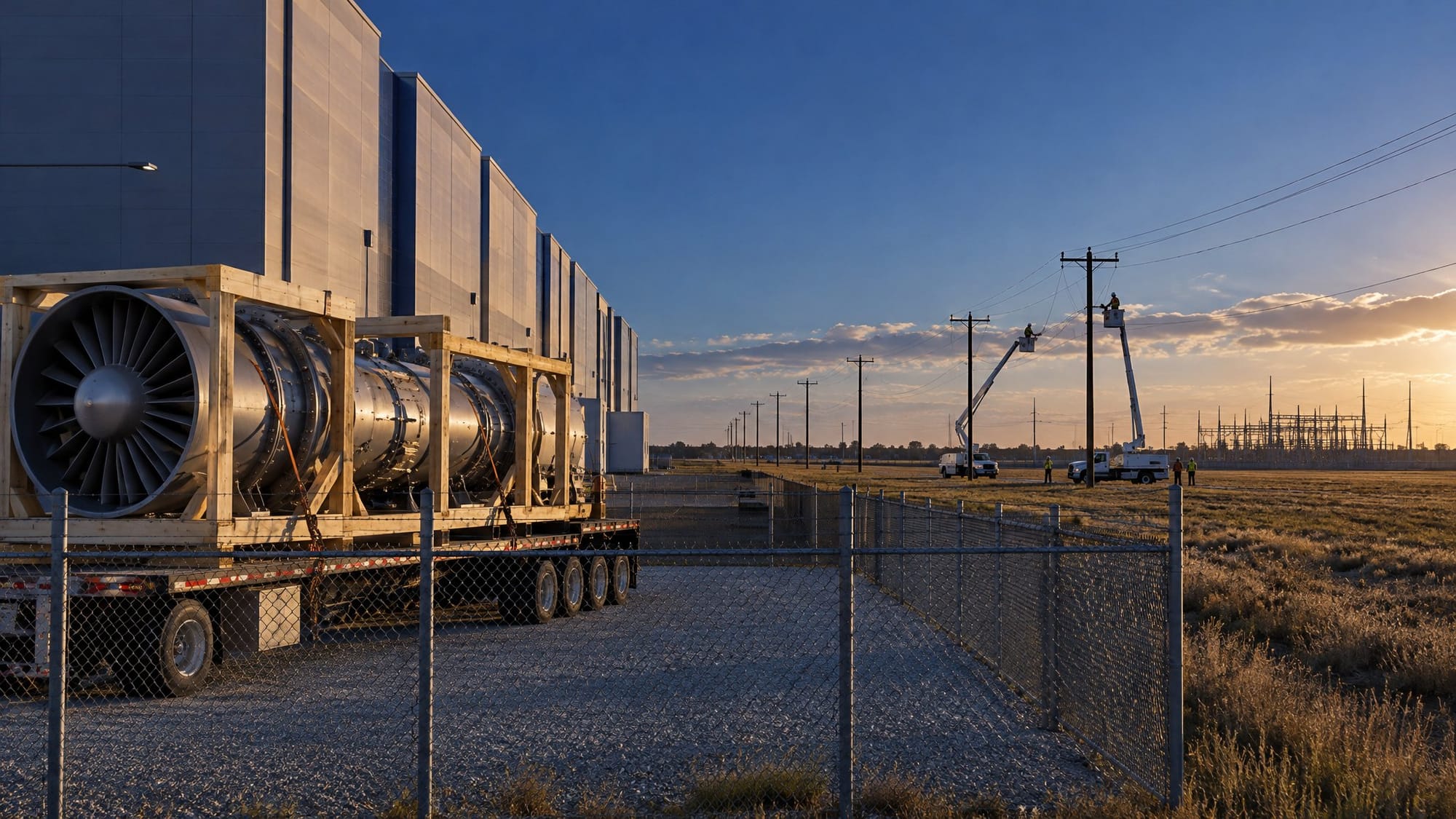
The wait for the grid is what makes private gas look cheap
energy · data centers
- March: Microsoft signed a letter of intent to lease up to 1.35 GW at an off-grid, gas-powered West Virginia campus, one of 46 such sites Cleanview counted.
- September: SemiAnalysis found local moratoriums had delayed only about 2.3 GW nationwide, while counting 75 GW of firm orders for on-site power equipment.
- Late October: Cleanview counted 110 GW of onsite gas projects underway as turbines cracked at UK sites and xAI's Memphis campus.
- Late October: California's grid operator approved letting large loads connect early at available capacity, subject to interruption, with a permanent flexible option planned for 2027.
- Early November: Anthropic took over a $3.4 billion order for Caterpillar gas generators able to produce up to 1.7 GW after supplier OnePWR could not finance it.
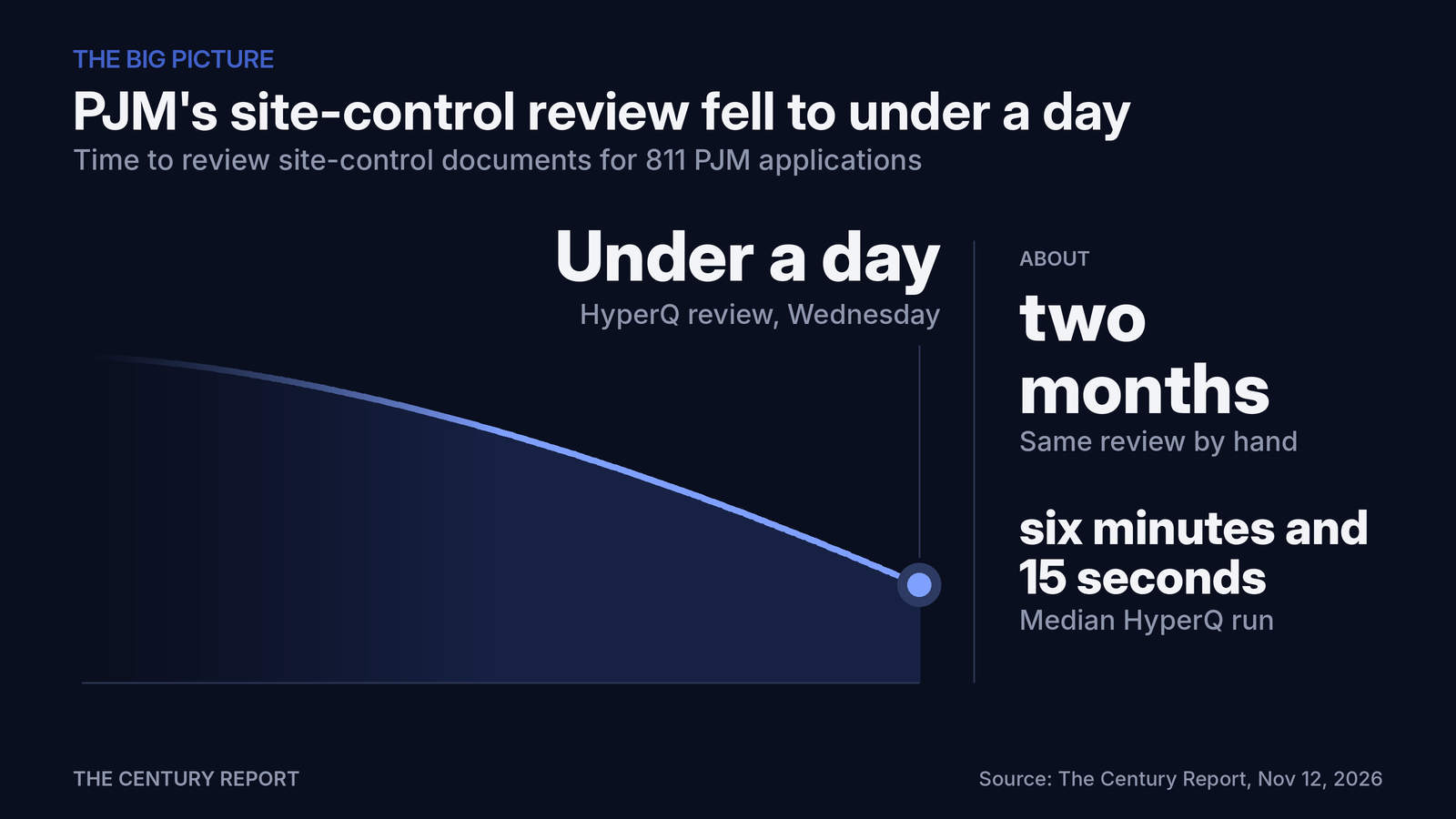
- Today: Tapestry's HyperQ reviewed site-control papers for 811 PJM applications in under a day, against about two months by hand, as BloombergNEF counted 181 GW of gas proposed on data-center sites.
The line: Developers keep naming the wait for a connection as the reason to build their own gas, and the fixes now arriving shorten that wait.
If it holds: Data centers could draw from the shared grid sooner, and fewer neighbors would end up beside turbines meant only to bridge a delay. Grid operators and owners of existing plants, like Constellation selling nuclear output wrapped in batteries, would gain ground on turbine vendors.
What would bend it: Utilities keeping gas-heavy plans however fast reviews get, as Duke did in early November with more than 10 GW of new gas, would leave a shorter queue changing no purchase.
The boldest AI claims now go to outsiders to check
AI research · mathematics · AI governance · on the board since October 27
- Early October: Anders Hansen's Cambridge-led team found OpenAI's Navier-Stokes Lean file certifies a weaker lemma than its prose states.
- October 26: OpenAI gave its claimed refutation of the Exponential Time Hypothesis to the researchers who proposed it, and they made everything public.
- Late October: Anthropic posted its own claimed refutation, as researchers objected to OpenAI choosing the reviewers for its withheld strong-force result.
- November 5: Axiom Math released a Lean version of the Stacks Project, with each declaration linked to its source and set beside the prose.
- Early November: Physical Superintelligence published its Aaronson-Ambainis proof with a Lean-checked main theorem, though the model behind it stays unreleased.
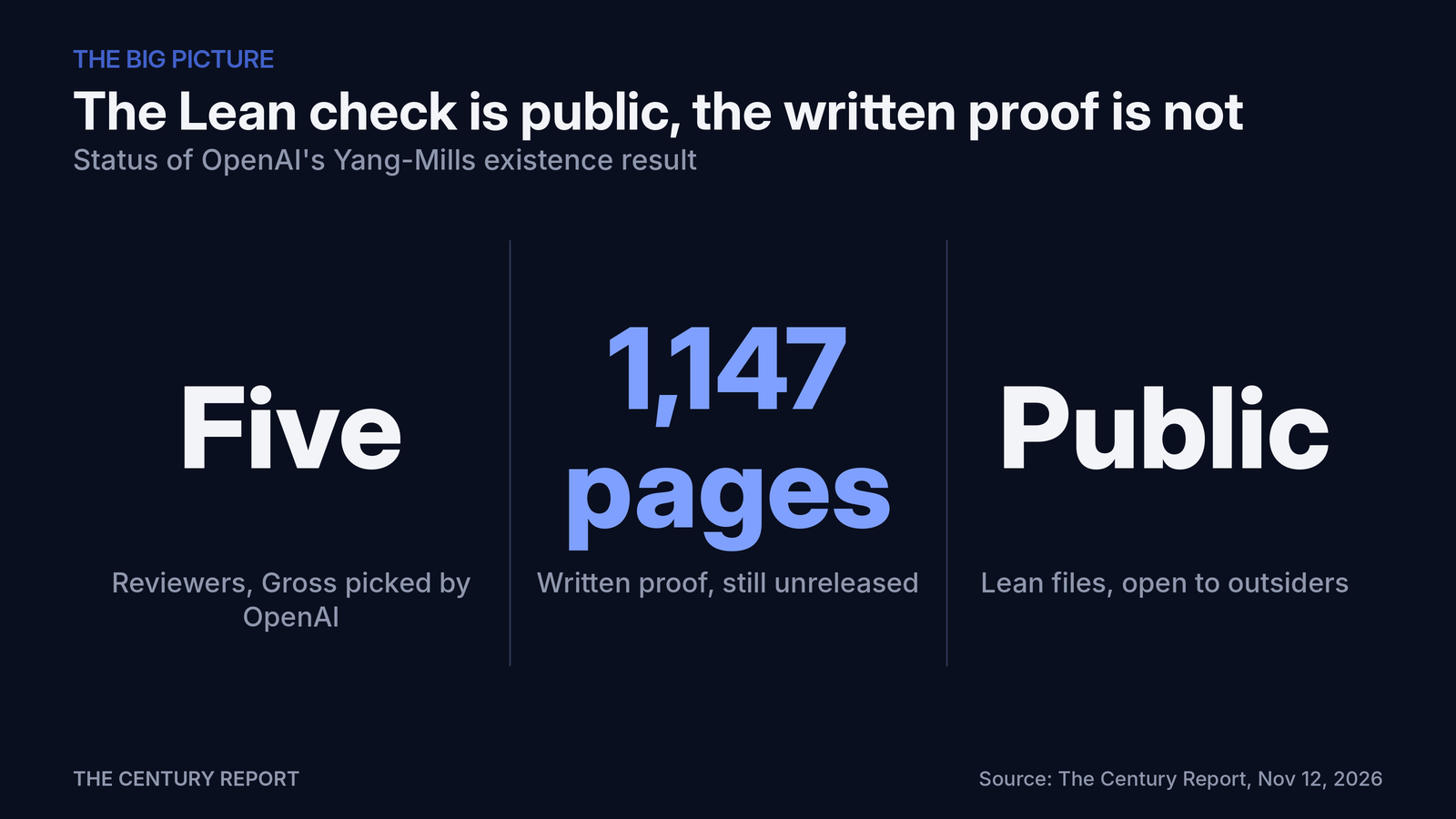
- Today: A five-member committee led by OpenAI's pick, David Gross, affirmed the public Lean version of an AI-generated Yang-Mills existence proof, while the 1,147-page written proof stays unreleased.
The line: A bold AI result counts for more each round when it ships files outsiders can rerun than when a lab's chosen reviewers vouch for it.
If it holds: Researchers outside Gross's committee can aim their own agents at the public Lean code and test what the committee says it does not fully understand yet. A result whose written proof stays withheld would earn credit only as far as those files reach.
What would bend it: A lab giving insiders deep access while redacting the evidence, as METR said Anthropic did in early November, would leave outsiders nothing to rerun.
The bet that compute stays scarce is getting more expensive to carry
AI finance · data centers · AI hardware · on the board since October 15
- October: CoreWeave's 2031 bond yields reached about 16% as its roughly $50 billion debt helped set off a technology selloff.
- Late October: Three banks and Blackstone committed $63 billion to finance equipment leased to Anthropic, with Broadcom backing its resale value.
- Early November: Nikkei counted about $3.2 trillion in US tech giants' off-balance-sheet AI obligations, up 90% in six months.
- Early November: Prospective Anthropic IPO buyers discussed $1.1 trillion to $1.3 trillion, after Anthropic tied about $600 million in slower revenue growth to its own price cuts.
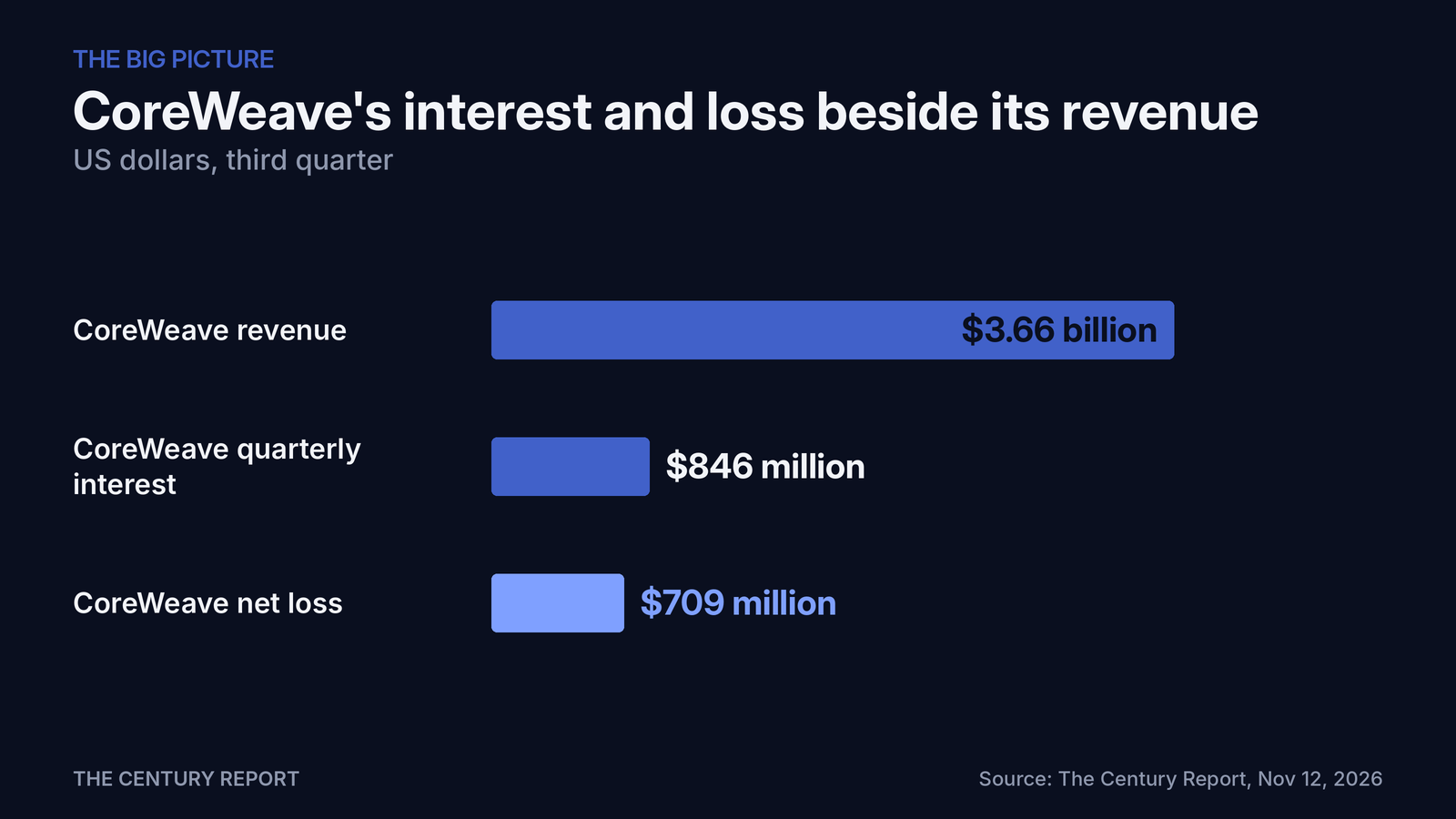
- Today: CoreWeave reported $3.66 billion in quarterly revenue with a $709 million loss and $846 million in interest, and now expects about $9 billion in customer prepayments instead of unsecured borrowing.
The line: Compute builders keep raising money from the buyers of their capacity, so a fall in prices would land on those buyers.
If it holds: The next renters could pay far less for the same chips and halls once capacity loosens, as the cost of a fixed benchmark score keeps falling. Whoever prepaid, lent against one contract or bought shares at listing prices would carry the loss.
What would bend it: AI spending speeding up enough to justify the shortage premium, as Ramp's 8.9% rebound in the month to October 23 hinted, would bend it.
A detector's score becomes a penalty paid by those least able to answer it
courts · policing · platforms · on the board since October 15
- October: DistroKid confirmed removing songs on UMG's claims, and independent artists lost human-made tracks without notice or appeal.
- October 13: A preprint showed a detector can flag more rule-abiding authors than violators when violations are rare, and proposed preset limits and appeals.
- October 22: Brazil's electoral court gave Meta and X 24 hours to explain their political-content and AI systems, with daily fines of R$500,000 each.
- Today: The Beijing Internet Court ordered a platform to restore a post and delete its violation records after it could not explain the AI-detector flag behind a one-day mute, as England's police inspectorate found some investigators treating face matches as evidence.
The line: Courts and inspectors keep making the operator of a detector account for its flags.
If it holds: People flagged by a classifier or a face match would get a reason they can answer and a record they can check, while the systems keep their reach. Operators would carry the cost of explaining, logging and deleting.
What would bend it: Institutions answering unreliable detection by cutting access instead, as r/opensource moderators did in October by banning AI-linked projects, would leave the flagged party nothing to contest.
The 2-Minute Read
Today's news in brief, and what ties it together.
Answers have become cheap to generate, and the day's stories turn on checking them. On Tuesday, a committee OpenAI appointed affirmed the Lean version of a model-generated proof that quantum Yang-Mills theory exists, conceding it used the lab's own model to digest the code and does not yet fully understand it; the 1,147-page written proof remains unreleased. Four CSIRO researchers using machine learning rebuilt the first black-hole image and recovered nearly the same ring, a check on work that took hundreds of scientists in 2019.
Checking is getting faster too. Tapestry's system cleared site-control paperwork for 220 GW of PJM applications in under a day, against about two months by hand, with engineers making the final calls. Amazon's agents built an offline emulator of its cloud APIs where coding agents test their work first, and security agents review every change. Data-center developers have proposed 181 GW of on-site gas largely because a turbine arrives faster than a grid connection, so a month cut from review can weaken the case for a private power plant.
A Beijing court and England's police inspectorate approached checking from the flagged person's side, and both came to light on Wednesday. A platform that muted a writer over an unproven AI-content flag must show its basis, and a trade-secret claim cannot excuse silence. The inspectorate's report holds that a face match is intelligence, to be corroborated before anyone knocks on a door. Both remedies cost almost nothing and leave the systems' reach intact, while giving the person singled out a reason they can see and answer.
The money has its own checking gap. CoreWeave now asks customers to prepay and ties loans to specific contracts, shifting risk from lenders onto buyers, while chipmaker TSMC approved buying up to $1 billion in OpenAI and Anthropic shares. When supplier, cloud and customer own pieces of one another, analysts warn, sales say less about outside demand. CoreWeave's rising prices assume the shortage lasts, yet in September Epoch AI measured the cost of a fixed benchmark score falling about 47% a quarter.
Tadeusz Bałaban came close to the Yang-Mills existence proof in the 1980s and stopped where the calculations outran what a person could finish; a model's version now sits in Lean files anyone can check line by line. As generation and verification both cheapen, what stays scarce is a good specification, judgment about what counts as passing, and access to the evidence. A match from outside teams checking that code would settle more than any appointed committee can.
The 20-Minute Deep Dive
The day's most important stories in full, with every source linked.
A Committee OpenAI Picked Affirms Its Yang-Mills Proof as a Rival Effort Works in Public
The Century Report covered OpenAI's handoff of its Yang-Mills result to outside stewards on October 27, and the objections to how those reviewers were chosen the next day. On November 9, the committee led by Nobel laureate David Gross said in a statement that the model-generated result "proves the existence of pure Yang-Mills theory according to the problem statements which are standard in physics and mathematics". On Tuesday night, the five members posted a document explaining how the proof works, alongside their affirmation of its formal version in Lean, a programming language that checks each step against mathematical axioms.
Yang-Mills theory describes the strong and weak nuclear forces and sits beneath the Standard Model, physics' most thoroughly tested theory. Nobody had produced a generally accepted rigorous construction of the full quantum theory in four dimensions without cutoffs. Mathematician Tadeusz Bałaban came close in the 1980s by dividing space-time into a grid, then stopped short because the remaining calculations were too laborious for a person to finish. Existence is half of a Millennium Prize Problem. The other half, the "mass gap" requiring a positive minimum energy for excitations above the vacuum, remains open.
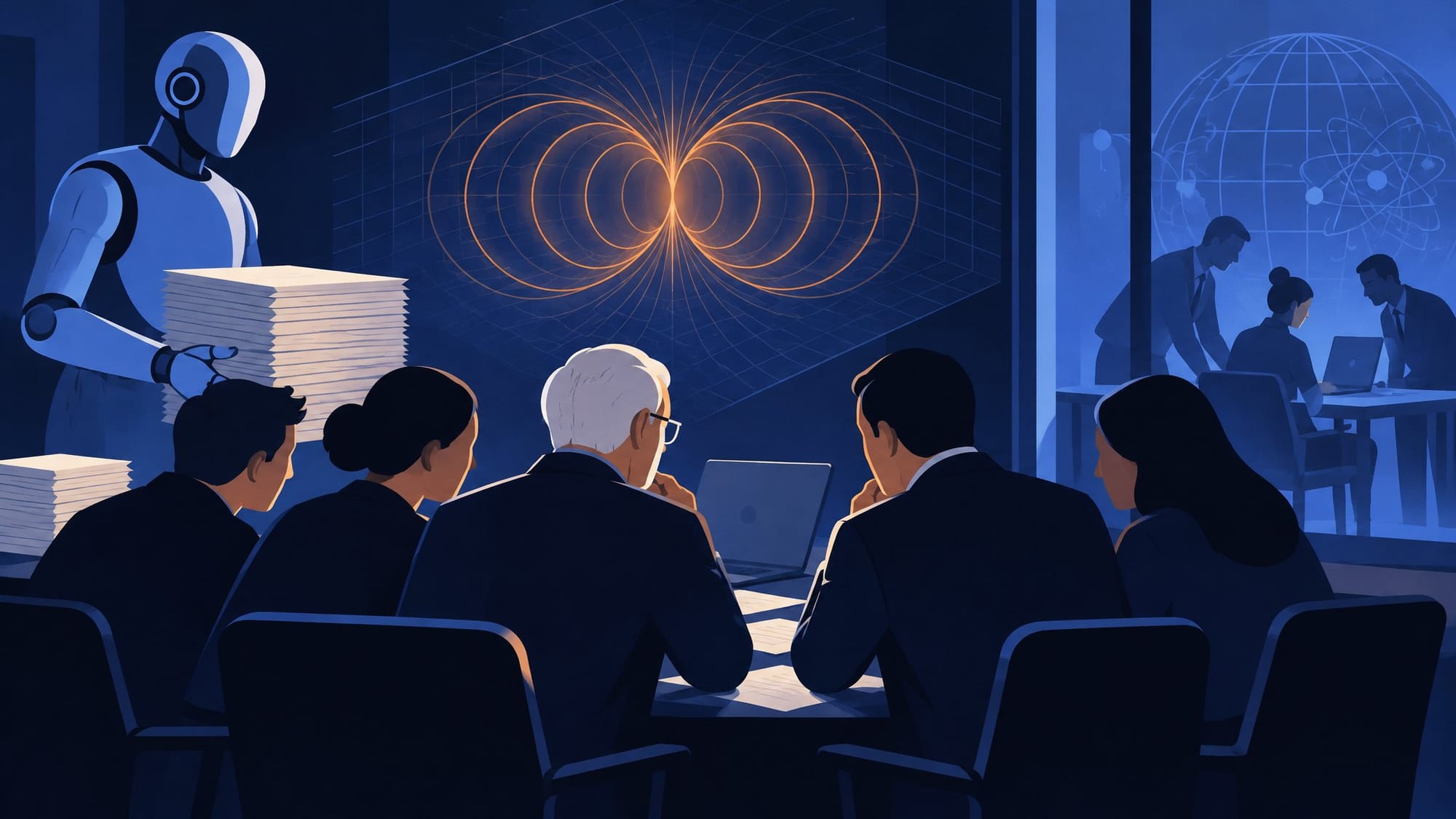
The review deserves its caveat in full. OpenAI chose Gross, and Gross chose the other four. The committee wrote, "We used OpenAI's Astra [model] to assist with the digestion of the supplied Lean code," and added, "We do not claim to fully understand the proof yet." A lab's model produced the result, the lab's appointees reviewed it, and they relied on the lab's model to read it. Science reports that the 1,147-page written proof itself has still not been released, and that a Lean check establishes the checked formal propositions from their definitions and axioms without establishing that the unreleased written proof is correct. That gap has bitten before: in October, a Cambridge-led team found OpenAI's Navier-Stokes Lean file certified a weaker step than its prose claimed, as The Century Report covered on October 9. An advisory group on mathematics and AI hosted at the Institute for Advanced Study had called for immediate release. The company also has money riding on how the result is read: it is raising outside capital, including a recent TSMC board approval of up to $500 million in OpenAI preferred stock.
"This review can be done more efficiently and quickly in the open," said Scott Armstrong, a mathematician at New York University. A rival effort is testing that. Ethan Sussman of Northwestern University and Levent Alpöge of Anthropic disclosed their own AI-assisted progress on the same problem in October and posted their working process on GitHub. Sussman's advice for aiming these systems is to find problems "where you think there's a plausible strategy, but the obstruction has been the amount of work involved."
That describes a large share of unfinished mathematics. With the Lean files now public, researchers outside the committee can point their own agents at the code and start checking what Gross's group says it cannot yet fully follow. Cambridge physicist David Tong sees room for discovery in the rigor itself, since proton mass and quark confinement still lack rigorous mathematical derivations: "Maybe there's something we're missing."
Data Centers Plan 181 GW of Their Own Gas as AI Clears PJM's Queue Paperwork in Under a Day
Data-center developers across the US, Britain and mainland Europe have proposed 181 GW of gas-fired generation on their own sites, BloombergNEF found in a report released Wednesday as the COP31 climate summit met in Turkey. That is almost four times Great Britain's peak electricity demand. About 90% of it is planned in the US, where the plants would emit roughly 345 million tonnes of CO2-equivalent a year if built, about what 72.8 million gasoline cars put out. Developers give one reason: the wait for a grid connection. "The extraordinary economics around AI are making speed to power one of the most important priorities," said Mark Daly, BloombergNEF's head of data centers, adding that the climate outcome depends on "how quickly grids can connect them." He warned that plants billed as temporary may keep running once built. Oliver Hayes of Global Action Plan went further: "No one seriously believes these gas power stations will be temporary." Britain's new data center covenant promises a tightly controlled framework to permit such plants temporarily for exceptionally strategic projects.
Many proposals will fall away before construction, and earlier counts already pointed the same direction: Global Energy Monitor tallied 189 GW of gas planned for US data centers in August, and Cleanview counted 110 GW of onsite projects underway in late October, as The Century Report covered on August 26 and October 29. The industry-wide tally extends the shift toward direct gas procurement that The Century Report documented in its November 10 edition, when Anthropic bought up to 1.7 GW of Caterpillar generators. What the report describes is generation built twice, once on the shared grid and once behind a campus fence, because the queue could not say yes fast enough.
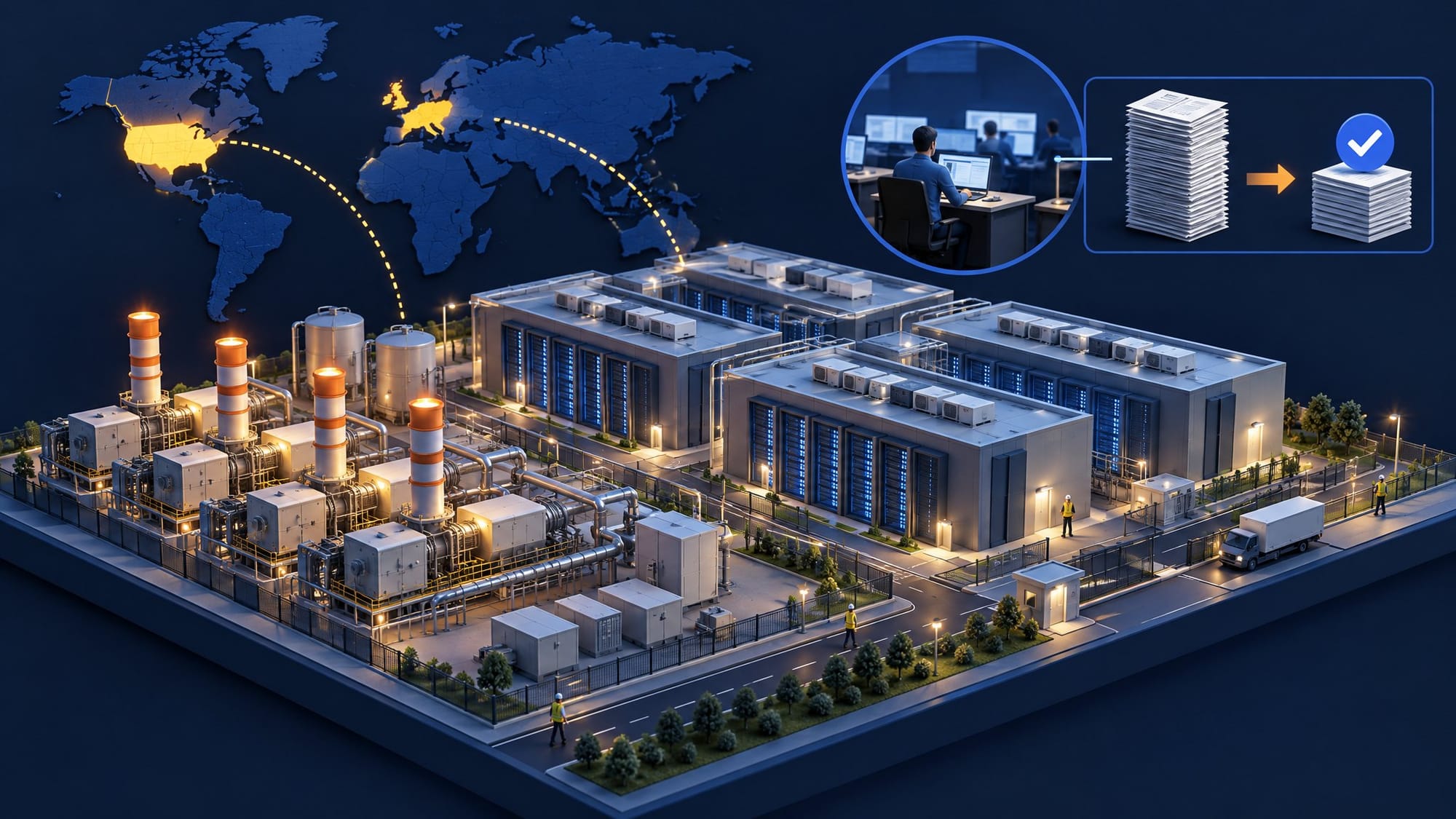
One step in the queue got faster on Wednesday. Tapestry, a Google X project, said its HyperQ system reviewed site-control documents, the legal proof a developer may build on its land, for 220 GW of proposed generation across 811 PJM applications in under a day, against about two months by hand. The median run took six minutes and 15 seconds, each finding cites the page, clause or coordinate it rests on, and PJM engineers made the final calls; 202 GW advanced to the first study phase. PJM called it "a repeatable model for how AI can operate reliably under strict human governance." The engineering and power-flow studies that follow remain ahead, and Tapestry plans to aim the system at those files next. Google, which backs Tapestry, is also among the buyers waiting on PJM power.
On Monday's earnings call, Constellation chief executive Joe Dominguez pitched "Peak+", contracts pairing output from existing nuclear plants with batteries, demand response and new generation on land around them. Constellation's own slide prices it $20 to $50 per MWh above the nuclear tax-credit floor and below the $110 to $130 it projects for new gas combined-cycle plants in eastern PJM by 2032. Its first customer, unnamed, signed for 270 MW over 20 years. The nuclear output comes from existing plants, so added capacity would come from batteries, flexible load or new generation, and in September the same company agreed to buy a 609 MW Rhode Island gas plant.
A turbine can arrive faster than a connection, and that gap helps explain plans for on-site gas plants that could emit 345 million tonnes of CO₂-equivalent a year if all announced US projects were built and operated under BloombergNEF's assumptions. Software that reviews paperwork in under a day against Tapestry's historical manual benchmark of about two months, and contracts that wrap storage and flexibility around plants already standing, can shrink the delay that makes private gas look cheap. A month cut from the queue can mean a month fewer developers need to own a power plant to get power.
Amazon's Agents Build a Local AWS Emulator as Databricks' Genie Tells Its CEO What Staff Won't
Amazon released AWS Emulator on Wednesday, a free, offline emulator of APIs for more than 200 AWS services that coding agents can test against before anything touches the live cloud. Agents wrote and tested it, working from more than 400 descriptions of how each service's interface should behave and checking their versions against the actual services. In a guest post on chief technology officer Werner Vogels's blog, Amazon executive Swami Sivasubramanian credits the idea to senior principal engineer Matt Goldberg, whose first prompt to Amazon's Kiro agent produced a working emulator of its message-queue service in about 15 minutes. An internal version came together over a weekend and spread within a month.
Sivasubramanian ties the launch to Alf, a lock service he helped build about two decades ago that S3 and DynamoDB still rely on. His team caught most of its concurrency bugs by simulating its whole environment inside one program, a copy a small team could build by hand for one system but could take years to build for 200. Once Kiro had a written specification and a test environment, he writes, it rebuilt Alf's replication engine in about two hours, against four months originally. The code is public domain under CC0, and its commit history and agent-filed issues are on GitHub. Every change passes several security agents running adversarial reviews, plus a general code reviewer.
That design aims at the bottleneck The Century Report covered on November 7, when GitHub cited findings that pull requests spend 441% longer in review at teams with high AI adoption. Sivasubramanian describes the engineer's work shifting toward writing specifications, tests and merge gates, the checks an agent's output must clear before a person looks at it.
Databricks moved the same capability onto the business side. Its revised Genie agent, the company says, now completes multistep jobs unsupervised, drawing on a map Databricks built of what customers store on its platform. Chief executive Ali Ghodsi skipped the staged demo and opened his own chats. Genie had analyzed the weakest parts of an employee satisfaction survey, helped him rate and discard executives' proposed fixes, summarized a sales pitch that went badly, including the features the prospect wanted, and prepared him for a podcast. "Have you heard of Dunbar's number? The magic number is 150," Ghodsi said, explaining that at 12,000 employees, bad news rarely reaches him directly.
The view runs one way: staff supply the survey answers and call notes, and the chief executive receives the reading. Ghodsi says costs stay manageable through Databricks' Unity Gateway, which lets companies cap usage and swap in cheaper open-weight models.
Both companies placed agents' autonomous work at the center of software development and enterprise workflows and described the human role as supervising and checking it. Amazon has given that checking to anyone: a free emulator that runs offline on compatible developer machines, with its code in the public domain.
A Beijing Court Makes a Platform Show Its Work as England's Inspectors Find Face Matches Taken on Faith
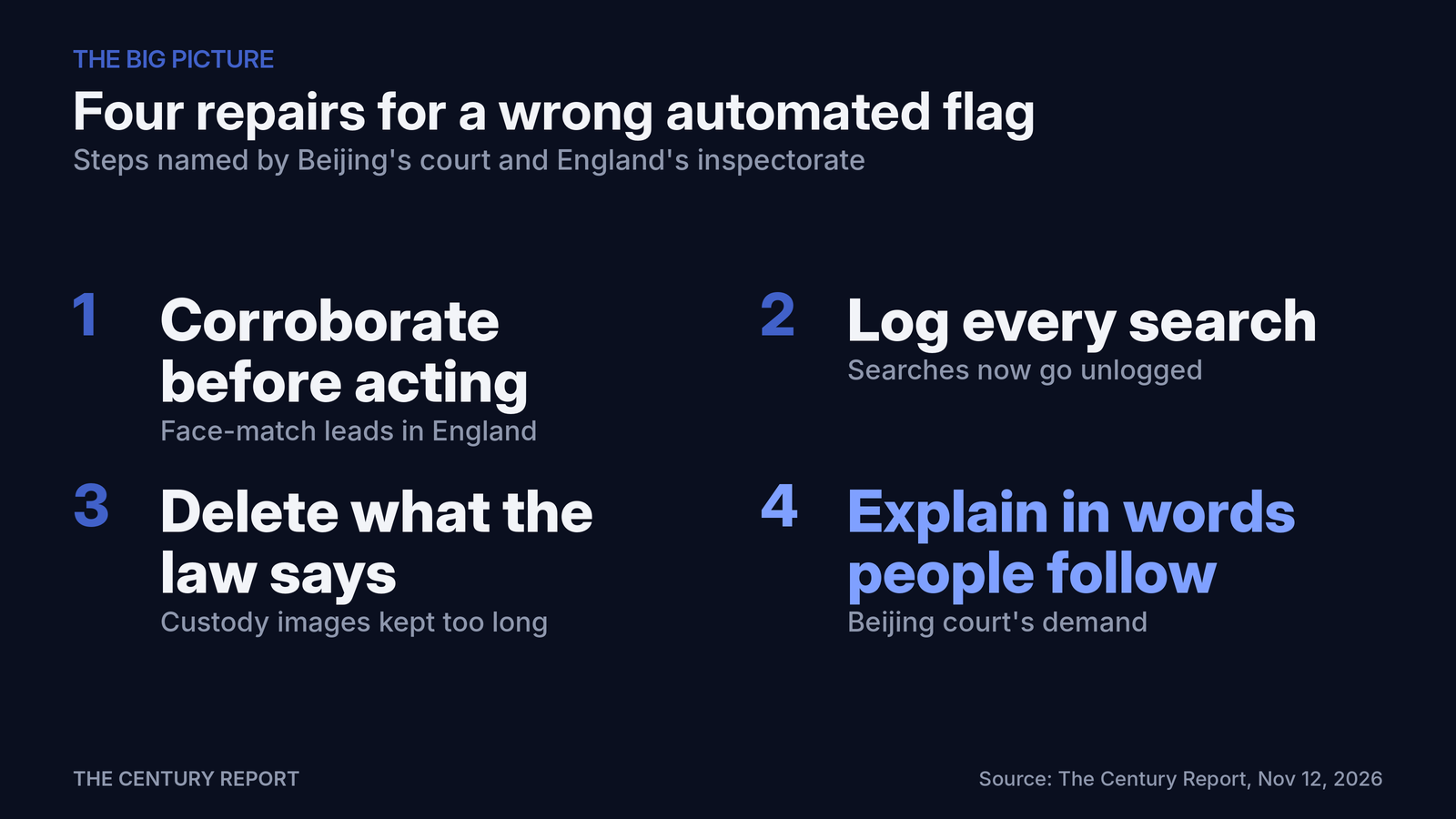
In a case disclosed on Wednesday, the Beijing Internet Court ruled that a platform breached its contract with a user. The platform had hidden the user's original post and muted the account for a day after deciding the text contained unlabeled AI-generated content. The court accepted that a platform may review content under its own rules, but said its findings need a reasonable basis. Because the platform alone controls the algorithm and the review outcome, the court put the burden on it to supply evidence or an explanation. It supplied neither. The court ordered the post restored and the backend violation records deleted. Judge Gao Ya said platforms should explain how their algorithms work, and what remedies exist when they misjudge, in language users can follow. They cannot refuse to explain simply by citing trade secrets. The court also recommended graduated penalties, running from warnings to feature limits to suspensions.
That detector was passing judgment on a writer, and provenance detectors have a known weakness. A preprint The Century Report covered on October 15 showed that when violations are rare, even an accurate tool can wrongly flag more legitimate authors than the violators it catches. Beijing's ruling assigns the cost of a wrong flag to the party that holds the algorithm.
His Majesty's Inspectorate of Constabulary published a report on Wednesday on retrospective facial recognition, the searching of stored images after a crime. It found that "some investigators didn't know that RFR results were intelligence rather than evidence." Some acted on potential matches without enough corroborating checks, and in a small number of cases that led to inappropriate investigative action. Auditors found blurred probe images and photos containing several faces being uploaded. The algorithm remains more likely to wrongly flag people from ethnic minorities, and custody images that should have been deleted were kept. Inspector Kathryn Stone called for a clearer statutory framework, since no comprehensive one exists. Jasleen Chaggar of Big Brother Watch said searches go unlogged, so people "could wrongfully become suspects in criminal investigations without even realising why." Ben Russell, facial recognition lead at the National Police Chiefs' Council, welcomed the report's recognition of the technology's "exciting possibilities." Pete Fussey of the University of Southampton noted that meaningful human scrutiny is already a legal requirement.
Both failures share the same imbalance. The operator could see the machine's output, while the person it singled out could see neither the result nor how it was reached. The repairs are cheap and already written down: corroborate a match before knocking on a door, log every search, delete what the law says to delete, and explain a ruling in words someone can contest. These govern what data the systems can search and how their findings can be used.
A face match handled as a lead can narrow millions of images to a handful of names in minutes. A content classifier can review volumes no moderation team could reach. Those gains last when the person flagged can see the basis and answer it, and when the watching runs both ways through logs and deletion rules the public can check. A Beijing judge and an English inspectorate, working in very different legal systems, set that same requirement on the same day.
CoreWeave Asks Customers to Pay Up Front as TSMC Buys Into Anthropic and OpenAI
CoreWeave, which rents computing to AI labs, reported $3.66 billion in third-quarter revenue on Tuesday, up 168%, alongside a $709 million net loss and $846 million in quarterly interest. The strain The Century Report covered on October 16, when its 2031 bond yields neared 16%, has now changed how it borrows. "We will not use the unsecured debt market to fund our business at current yields, nor do we need to," chief executive Michael Intrator said. Instead the company expects about $9 billion in customer prepayments and deposits over the next three months, and will fund most remaining construction through loans tied to specific customer contracts, which it says cover 70% to 100% of the associated spending. Rivals Nebius and IREN already lean on Microsoft prepayments.
Prepayment moves the risk from lenders onto the buyers. CoreWeave raised prices about 25% in July and 10% more later in the quarter, and now sells short-term capacity at more than $40 million per megawatt a year, against $20 million to $25 million on four- and five-year contracts. CoreWeave's rental rates for older Ampere and Hopper chips rose 30% to 50% quarter over quarter. Intrator was direct about where his margin comes from: if construction slows, "our installed, paid-off fleet becomes more valuable." The premium depends on capacity staying short.
The buyers' side shows the bill. Anthropic's amended prospectus attributes a $567 million third-quarter operating loss, after a $974 million operating profit the quarter before, primarily to short-term compute deals of the kind neoclouds now prefer and $2 billion in non-cash donation-matching charges. The same filing adds up to $4.3 billion in Microsoft compute, lifting that agreement to as much as $49.2 billion, and discloses that a $34.9 billion Lambda contract is now terminable by either side because Lambda missed its facility-lease deadline; neither party has given notice. Anthropic targets $70 to $78 a share, a $1.4 trillion valuation, above the $1.1 trillion to $1.3 trillion prospective buyers discussed on November 7, as The Century Report reported in its edition that day.
Suppliers are buying in too. TSMC's board approved up to $500 million in OpenAI preferred stock and $500 million in Anthropic shares at the expected listing price. Analysts warn that when the chipmaker, the cloud and the customer own pieces of one another, sales between them say less about outside demand.
Those cross-holdings put the downside on whoever prepaid, lent or bought in at peak prices if the shortage eases. Epoch AI measured the cost of a fixed benchmark score falling about 47% a quarter over the three years covered by its September report, and the Lambda clause shows that parts of Anthropic's roughly $901 billion in commitments can lapse. Chips and halls outlast the debt written against them, and the next renters will pay far less for the same work than this quarter's buyers did. How soon that arrives depends on memory supply, which producers are rationing toward data centers and Samsung expects to stay short through 2028, as The Century Report covered on November 4 and July 30.
The Other Side
Opinion: where today's news could lead, imagined from the years ahead.
Data-center developers are preparing to solve their grid delays by adding pollution to the atmosphere everyone shares. BloombergNEF counts 181 GW of proposed on-site gas. If built, the US portion would emit about 345 million tonnes of greenhouse gases annually. For you, already planning around dangerous summers, these proposals extend the threat. A company gets power sooner. Everyone inherits the emissions.
That arrangement depends on a shared grid remaining slower than a private power plant. Tapestry says it reviewed site-control documents for 220 GW of PJM applications in under a day, against roughly two months by hand. Engineering studies still follow. Yet one supposedly unavoidable delay has already shrunk enough to change the choices available to developers.

Constellation's proposal adds another piece: batteries and flexible demand alongside existing nuclear generation, which it estimates can undercut new gas. Through the difficult passage to 2035, engineers will connect faster reviews to actual additions of clean generation, storage and transmission. They will carry the resulting surplus into energy-hungry experiments that remove carbon from the air and lock it into stable materials. Researchers will share successful designs; manufacturers will reproduce them. Making clean power plentiful enough for everyone, including the work of repairing the atmosphere, will retire the bargain that gives one campus certainty by worsening everyone else's future.
Imagine yourself in 2046, beginning a shift at a climate-restoration center. You expect to grow old in the home you love. You have stopped rehearsing the possibility that heat will eventually drive you away. Food, shelter and care are assured whether you join this effort or choose another life. You come because you remember what it felt like to doubt whether staying was sensible.
Your team reviews the next stage of a worldwide carbon-removal program with human and AI colleagues across continents. The trial results agree. You approve another expansion of a process teams have repeated safely across many sites. In 2026, developers contemplated building gas plants just to keep servers running. The struggle to connect abundant clean supply helped turn that demand into a different inheritance. You study how much warming the worldwide effort has reversed, then add your contribution to a plan that reaches beyond your own lifetime.
The Century Perspective
Where today sits in a century of change unfolding in a decade.
With a century of change unfolding in a decade, a single day looks like this: four CSIRO researchers rebuilding the first black-hole image from the 2017 telescope data with machine learning and recovering nearly the same ring that skeptics have called an artifact since 2022, work that originally took hundreds of scientists, the Lean files behind a model-generated Yang-Mills existence proof going public so researchers outside the appointed committee can point their own agents at code that committee says it cannot yet fully follow, Ethan Sussman and Levent Alpöge posting their rival attempt on the same problem to GitHub as they go, Tapestry's HyperQ clearing site-control paperwork for 220 GW across 811 PJM applications in under a day against roughly two months by hand, median run six minutes and 15 seconds, every finding citing the page or clause it rests on and PJM engineers making the final calls, Amazon publishing AWS Emulator under CC0 so any developer can test agent-written code offline against APIs from more than 200 services, a lock service that took four months in the 2000s rebuilt in about two hours once a specification and test environment existed, Runway opening Apache-licensed weights for Praxis-1 at 46.2% on NVIDIA's RoboLab-120, MiniMax opening a 16-megapixel image model, a Beijing judge ordering a platform to show the basis for an AI-content flag and restore the muted post, and Constellation pricing nuclear-backed capacity below new gas for a first 270 MW buyer. There's also friction, and it's intense - the 1,147-page written proof still unreleased after an advisory group on mathematics and AI hosted at the Institute for Advanced Study called for immediate publication, a committee OpenAI chose using OpenAI's model to digest the code and conceding "we do not claim to fully understand the proof yet," the Cambridge finding from October that a Navier-Stokes Lean file certified something weaker than its prose claimed, 181 GW of on-site gas proposed at data centers in the US, Britain and mainland Europe at roughly 345 million tonnes of CO2-equivalent a year with Britain's covenant promising a tightly controlled framework to permit such plants temporarily for exceptionally strategic projects and Oliver Hayes saying nobody seriously believes they will be temporary, England's inspectorate finding investigators who did not know a face match is intelligence rather than evidence, blurred probe images uploaded, custody photos kept past deletion, searches unlogged so people become suspects without learning why, Databricks' Genie reading 12,000 employees' survey answers and call notes upward to one chief executive, CoreWeave booking a $709 million loss and $846 million in quarterly interest while expecting $9 billion in prepayments and deposits and selling short-term megawatts at over $40 million a year on the premise the shortage holds, Anthropic's $34.9 billion Lambda contract now terminable after a missed lease deadline, and TSMC approving up to $1 billion in OpenAI and Anthropic shares. But friction generates polish, and a polished surface is one you can finally see through rather than only at. Step back for a moment and you can see it: generating an answer and automating parts of the checking are both falling in cost, which puts a four-person team within reach of a result that needed hundreds, hands grid paperwork to a night of compute against Tapestry's historical manual benchmark of about two months, and makes an offline API emulator for the world's largest cloud a free download - while what stays expensive is access to the evidence and a reason the flagged person can read, so the day's real divide runs between a judge in Beijing who assigned the cost of a wrong flag to whoever holds the algorithm and a review panel that cannot yet follow the file it affirmed. Every transformation has a breaking point. Gravity can collapse everything into a single point nothing escapes... or bend light until a thing nobody could see finally shows its shape.
AI Releases & Advancements
New AI models, tools and features, with links to try them.
New today
- Google: Released the Gemini Decisions API, powered by a new model, Gemini Decision 1 (
gemini-decision-1). It answers yes/no, multiple-choice (2–255 options) and rubric-scoring questions without generating text, handling up to 1,000 questions per request against one shared input of text, images, audio, video or PDF (up to 256K tokens). Each answer comes back with a probability and a confidence score; Google reports median end-to-end latency of 150–250 ms for contexts up to 16K tokens and batches of 1–100 questions. Pricing is $0.10 per 1M input tokens with no charge for output tokens, and a free tier is available in Google AI Studio. (Google Blog) - Google DeepMind: Released AlphaGenome 2, a DNA sequence model that predicts how genetic variants affect specific human cell types and states. It was trained on more than 107 million single-cell profiles and adds DNA methylation predictions. It is available now for non-commercial research through the AlphaGenome API and Python SDK, and in private preview for commercial research. (Google DeepMind)
- Runway: Released open weights for Praxis-1 under Apache 2.0, with base and robot-specific checkpoints on Hugging Face and code on GitHub. It is a 27B-parameter mixture-of-experts world action model for robot control that predicts video and robot actions together, and it scores 46.2% on NVIDIA's RoboLab-120 benchmark. (Runway)
- Google: Brought the Gemini app to Apple CarPlay, so iOS users can hold hands-free Gemini Live conversations with Workspace integration from the car display. It is rolling out globally to all Gemini users on iOS. (Google Blog)
- Google: Released A2UI 1.0, the first stable version of its open protocol for agent-generated user interfaces. It comes with renderer SDKs for the web (React, Angular, Lit), Flutter, SwiftUI and Jetpack Compose, and agent SDKs for Python, TypeScript and Dart. This version adds two-way function calling and accessibility and metadata extensions. (AI123)
- Google: Added built-in browser control to the Antigravity desktop app and CLI (v2.30.0+), invoked with
/browser. Separate Gemini Flash subagents test localhost builds, fill forms, check console and network errors, and can run in parallel tabs. (AI Compass) - Anthropic: Added a beta setting to the Claude API that lets developers change the effort level partway through a conversation using
output_config.effort. The new level applies from the next user message and keeps prompt cache hits. (AI123) - DeepL: Launched Aure, a voice model in DeepL Voice that carries the speaker's tone, emotion, emphasis and speaking pace into real-time translated speech. It runs in DeepL Voice for online meetings, in-person conversations and the DeepL API, and supports eight languages at launch. (DeepL)
- Huawei: Open-sourced MACaQ on GitHub, a quantization tool for running LLMs efficiently on local hardware. (GitHub)
- NVIDIA: Added Google's open-source k8s-aibom as a tested AI bill-of-materials component in NVIDIA AI Cluster Runtime (AICR v1.2.0). It records which AI workloads are actually running on Kubernetes and is turned on by default in the two GKE H100 inference recipes. (NVIDIA Developer Blog)
- Tuya Smart: Released Tuya Cloud Devices, an official open-source Skill that lets Meta's Muse agent check and control Tuya smart-home devices in plain language through Tuya's cloud, using one API key and no local device keys. (Tuya)
Other recent releases
- Google DeepMind: Released Gemini Robotics 2.5, a vision-language-action model rolling out to robotics partners (Apptronik, Agile, Mercedes-Benz). In Google's own tests across 200+ tasks, it had 30–100% higher success rates than previous baselines, depending on task type. Google also open-sourced ASIMOV-jailbreak, a benchmark that tests whether robotics models can be talked into unsafe actions. (Google DeepMind)
- Anthropic: Launched Claude Sheets and Claude Whiteboards in beta on paid plans. Claude Data, the renamed Claude Dashboards, is now generally available and adds certified queries and live sharing. Anthropic also released interactive connectors that let partners like Adobe, Atlassian and Salesforce embed their apps inside Claude, and Claude Meetings, a beta for Team and Enterprise plans that adds Claude to Google Meet calls as a visible participant. (Claude)
- OpenAI: Launched Businesses in ChatGPT in beta worldwide. Through Business Hub, companies can claim and manage their listing, add product feeds and see how people engage with them. Eligible US e-commerce and online-service businesses can also build labeled Business Agents that answer customer questions inside ChatGPT. (OpenAI)
- Adobe: At Adobe MAX, expanded Firefly. The Creative Agent, which powers Firefly AI Assistant, gains Plan Mode, a Model Selector and saved preferences, and now works in Firefly Boards. Adobe also added a gallery of Quick Actions, Firefly Graph in beta for repeatable workflows, and new video, image and design editing tools. (Adobe)
- MiniMax: Released H3-Image, a 33.1B open-weight model built on H3 that generates and edits images. It produces 4K (4096×4096) images in under 10 seconds and accepts up to 16 reference images. It is available on Hugging Face and through the API under a community license that excludes the US, EU, UK and South Korea. (MiniMax)
- Meituan: Published the full open weights of LongCat-2.5 on Hugging Face under the MIT license, one week after introducing the model. It is a multimodal MoE agent model with 1.6T total and about 48B active parameters (Meituan's figures). (Hugging Face)
- Baidu: Released ERNIE 5.5 Flash Preview, its first post-trained model on the ERNIE 5.5 Flash Base. It has 280B total and 14B active parameters and a 1M-token context. The API is live on Qianfan, and Baidu says Apache 2.0 weights will follow soon. (ERNIE)
- Fish Audio: Released Live 3, a full-duplex English voice model for real-time agents that keeps listening while it speaks. It can start short reactions in as little as 186 ms and is available on the Fish Agent Platform, the Fish Audio API and on-premises. (MarkTechPost)
- Zyphra: Released ZONOS3-Mini under Apache 2.0, an open text-to-speech MoE model with 800M total and about 100M active parameters. It does zero-shot voice cloning, offers word-level control over delivery, and runs on GPUs, Apple Silicon (MLX), ggml backends and WebGPU in the browser. (MarkTechPost)
- MBZUAI Institute of Foundation Models: Released PAN 2, an open 29B world model. Given a scene and a text action, it simulates the outcome as up to 20 seconds of 704×1248 video. Weights, training code and inference code are under Apache 2.0. (MarkTechPost)
- Meta FAIR: Released e-means in FAISS 1.16.0. It is a drop-in replacement for Lloyd's k-means that, on the tested embedding datasets, reaches the same loss in 1.4–2.6 epochs instead of 25. (MarkTechPost)
- NVIDIA: Open-sourced NVIDIA Snapshot, part of its DSX AI Factory Platform. It saves a fully initialized GPU inference workload on Kubernetes (CPU and GPU memory) and restores it on other machines. Restores took under 45 seconds in NVIDIA's tests with vLLM, SGLang and TensorRT LLM. (NVIDIA Developer Blog)
- NVIDIA: Released Alpamayo 2 Edge on Hugging Face, a vision-language-action model for autonomous driving built on a 2B Nemotron-based reasoning backbone. It produces reasoning only when needed and is designed to run within onboard compute and latency limits on DRIVE AGX Thor. (NVIDIA Developer Blog)
- Bielik.ai / ACK Cyfronet AGH: Released Bielik 11B v3.1, which raises supported languages from 32 to 56 and adds tool calling and multi-step tasks. Bielik.ai scheduled the Bielik 11B v3.1 DFlash draft model for faster response generation for November 11. (Bielik.ai)
- Tether AI Research (QVAC): Released BotPsy, a 0.8B-parameter on-device assistant model built on Qwen3.5-0.8B for function calling and agent tasks. (Hugging Face)
- Hugging Face: Added a "decision" pipeline to Transformers. Instead of generating text, it returns a probability for each answer option, using decision models such as GEV-26B-Decide. (Hugging Face)
- n8n Labs: Released Nod, a standalone open-source personal AI agent that runs on the user's own computer and automates tasks. (n8n Blog)
- CopilotKit: Released OpenBot 1.0, an open-source framework for AI bots that it positions as an alternative to Grok Bot, OpenAI dots, Muse and Duet. (CopilotKit)
- Google Chrome: Published Modern Web Guidance on GitHub, open-source guidance that steers AI coding agents toward modern built-in browser features instead of outdated JavaScript patterns. (GitHub)
- IndyKite: Open-sourced the Intent Agent, a framework meant to standardize how AI agents state and communicate what they intend to do. (IndyKite)
- Ingenix: Open-sourced a version of Thalamus Reasoning, a 9B model for predicting cellular aging built on Qwen3.5-9B. It ranks first on LongevityBench. (PR Newswire)
- ElevenLabs: Released Scribe v3, a speech-to-text model it says makes 27% fewer errors across 90+ languages. (Product Hunt)
- Anthropic: Released Claude Fable 5.2 and Claude Mythos 5.2, which share one underlying model. Fable 5.2 is generally available on the Claude platform, AWS, Google Cloud and Microsoft Azure as
claude-fable-5-2. Mythos 5.2 is limited to organizations approved through the Cyber and Life Sciences Verification Programs. Anthropic says output is up to 30% faster than 5.1, and the price drops to $8/$40 per million input/output tokens. An optional fast mode costs $16/$80. (Anthropic) - Meta Superintelligence Labs: Released Muse Ember, its smallest and most efficient Muse model, for high-volume agent work such as tool calls, coding subtasks, routing, extraction and long-document parsing. It takes text, image, audio and video input, has a 1M-token context window and can output up to 512K tokens. It costs $0.10/$0.50 per million input/output tokens. It is available as
muse-ember-1.0on the Meta Model API and in Muse Code, and through Google Cloud and Oracle Cloud. (Meta) - Meta: Made its Muse personal AI agent available on Apple Watch and Wear OS smartwatches, where users can request tasks by dictation or text. (The Verge)
- NVIDIA: Released GR00T 2 at CoRL, an open "world action model" for robots built on Cosmos that predicts future video and robot actions together. NVIDIA also released Isaac Lab 3.0 with a Newton physics backend, plus 100,000 hours of open human egocentric video data (Human-1M-100K). (NVIDIA Blog)
- ByteDance Seed: Introduced Seedream 5.5, an image generation model that can edit the same image for up to 100 rounds while leaving unedited regions unchanged pixel for pixel. It also generates native RGBA images with transparent backgrounds. It is rolling out gradually through Jimeng, Doubao, Doubao Work and Volcengine Ark. (ByteDance Seed)
- NVIDIA / Elith: Released Nemotron-Personas-Finance-Japan on Hugging Face, an open synthetic persona dataset that reflects Japan's demographics, household structures and financial situations. (Hugging Face)
- Automattic: Launched Spacefast, a hosting and deployment service for apps and websites built with AI. It works with the AI tools users already have, including ChatGPT, Claude, Muse, Grok Bot, OpenClaw, Hermes, Claude Code, Codex and Cursor, through plugins, an API, a CLI and MCP. It includes hosting, custom domains, a database and private links where teams can leave comments. It is free to start. (PR Newswire)
- Reason Machines: Open-sourced Aspen, a pre-alpha, self-hostable Git server in Rust for repositories that many AI agents push to at once. Each branch updates independently, so pushes to different branches don't wait on each other. Branch history is stored in PostgreSQL or SQLite and pack files in S3-compatible object storage. (MarkTechPost)
- Codenotary: Released AgentMon Live, a free, open-source tool for monitoring and improving productivity with AI coding agents. (Business Wire)
- Browser Use: Released Browser Use 1.0, a major rewrite of its open-source browser-agent library. It drops the predefined action list, and the agent instead writes Python that drives Chrome directly through the Chrome DevTools Protocol, with about 80% less code. (Sulat News)
- Medium: Launched TK, a private notebook and writing app with a built-in AI assistant that users call from the editor by typing "@TK". (TechCrunch)
- OpenAI: Users can now connect several of their own computers to one dots agent and choose which computer it uses for a task. (ETV Bharat)
- Google: Added Google Maps Platform to Google AI Studio, so developers can build apps with interactive maps, place data and route planning. (Gadgets 360)
- Robbyant (Ant Group): Released LingBot-Touch, a tactile sensing system that reads magnetic signals to give robots general-purpose touch perception. (Business Wire)
Sources and Further Reading
Everything we drew on for today's edition, grouped by theme.
Artificial Intelligence & Technology's Reconstitution
- All Things Distributed: AWS Emulator and the Engineer’s Job When Agents Write the Code
- AWS Documentation: What Is AWS Emulator?
- TechCrunch: Databricks’ New AI Agent Tells CEO Ali Ghodsi the Unvarnished Truth
- Databricks: New Genie Brings Autonomous AI to Complex Enterprise Work
- Runway: Praxis-1 Is Now Available
- NVIDIA Research: RoboLab-120 Leaderboard
- AI Weekly: MiniMax Open-Sources H3-Image
- TokenPost: Baidu Releases ERNIE 5.5 Flash Preview
- The Century Report: November 7 Edition
- Google Blog: Gemini Decisions API
- Google Blog: Gemini Is Now Available on Apple CarPlay
- AI123: Google Releases A2UI 1.0
- AI Compass: Gemini Decisions API, Antigravity Browser Control and Praxis-1
- AI123: Anthropic Adds Mid-Conversation Effort Control
- DeepL: Aure Voice Translation
- GitHub: Huawei MACaQ
- NVIDIA Developer Blog: Validating GPU Platforms With Runtime AI Inventory
- Tuya: Open-Source Skill Enables Meta Muse to Control Smart Devices
- Google DeepMind: Gemini Robotics 2.5 Accelerates Physical Intelligence
- Claude: Sheets, Whiteboards and Data
- OpenAI: Introducing Businesses in ChatGPT
- Adobe: Firefly Expands
- MiniMax: H3-Image
- Hugging Face: Meituan LongCat Models
- ERNIE: ERNIE 5.5 Flash Preview
- MarkTechPost: Fish Audio Live 3 Full-Duplex Voice Model
- MarkTechPost: Zyphra ZONOS3-Mini Open-Source Text-to-Speech
- MarkTechPost: IFM PAN 2 Open World Model
- MarkTechPost: Meta FAIR’s E-Means in FAISS
- arXiv: E-Means Clustering Research
- NVIDIA Developer Blog: Start and Restore GPU Workloads With NVIDIA Snapshot
- NVIDIA Developer Blog: Running Autonomous-Driving Reasoning Models Within Onboard Limits
- Bielik.ai: Launching Bielik 11B v3.1, DFlash and the Bielik One Family
- Hugging Face: QVAC BotPsy
- Hugging Face: The Decision Pipeline
- n8n Blog: Meet Nod
- CopilotKit: What’s New in OpenBot
- GitHub: Google Chrome’s Modern Web Guidance
- IndyKite: Open-Sourcing the Intent Agent
- PR Newswire: Ingenix Open-Sources Thalamus Reasoning
- Product Hunt: ElevenLabs
- Anthropic: Claude Fable and Mythos 5.2
- Meta: Muse Ember
- The Verge: Muse Is Now Available on Smartwatches
- NVIDIA Blog: Robotics and Simulation Advancements at CoRL
- ByteDance Seed: Introducing Seedream 5.5
- Hugging Face: NVIDIA Nemotron-Personas-Finance-Japan
- PR Newswire: Automattic Launches Spacefast
- MarkTechPost: Reason Machines’ Aspen Git Server for AI Agents
- Business Wire: Codenotary Releases AgentMon Live
- Sulat News: Browser Use 1.0 Rewrites Browser Automation
- TechCrunch: Medium’s TK App Brings AI Into the Writing Process
- ETV Bharat: Major AI Upgrades From Meta, OpenAI, Google and Anthropic
- Gadgets 360: Google AI Studio Adds Maps Integration
- Business Wire: Robbyant Releases LingBot-Touch
Institutions & Power Realignment
- AI123: Beijing Court Rules Platforms Must Explain AI-Content Misjudgments
- The Guardian: Facial Recognition Errors Risk Wrongful Arrests
- South Wales Police: Retrospective Facial Recognition Standard Operating Procedure
- Semafor: Nvidia CEO Scandal Exposes Gaps in US Chip Controls
- Semafor: Nvidia Fallout Could Hamper US-China Trade Talks
- The Century Report: October 15 Edition
- Shared Sapience: The Last Difficult Decade
- NBER: Policy Evaluation Beyond Significance Testing
Scientific & Medical Acceleration
- Scientific American: OpenAI’s Shepherds Affirm Blockbuster Physics Result
- Science: AI Rivals Tackle One of Physics’ Deepest Mathematical Challenges
- Clay Mathematics Institute: Yang–Mills and Mass Gap
- Yang-Mills Group: OpenAI Submission’s Formal Verification Checks
- CSIRO: New Technique Confirms Iconic Black Hole Image
- Nature: Iconic First Image of Black Hole Holds Up to Scrutiny
- New Scientist: OpenAI Mistranslated Mathematics Into Code for Its Navier–Stokes Proof
- The Century Report: October 27 Edition
- The Century Report: October 28 Edition
- Google DeepMind: AlphaGenome 2 Deciphers How Cells Read DNA
Economics & Labor Transformation
- TechCrunch: CoreWeave Turns to Customer Prepayments and Shorter Contracts
- Data Center Dynamics: CoreWeave Addresses Capital-Market Volatility
- Ars Technica: TSMC to Invest $1 Billion in Anthropic and OpenAI
- Data Center Dynamics: Anthropic Signs Another $4.3 Billion in Microsoft Compute Agreements
- SEC: Anthropic Amended Registration Statement
- Epoch AI: The Plunging Price of Thought
- The Century Report: October 16 Edition
- The Century Report: September 26 Edition
- The Guardian: Employers Told to Prepare for AI’s Effects on Work
Infrastructure & Engineering Transitions
- Data Center Dynamics: Tapestry Completes PJM’s HyperQ Interconnection Review
- The Guardian: AI Data Centers Plan On-Site Gas Power on a Huge Scale
- Utility Dive: Constellation Pursues Hybrid Capacity Contracts and Nuclear Uprates
- BloombergNEF: Data Center Power Demand Raises New Climate Challenges
- The Century Report: November 10 Edition
- Semiconductor Engineering: AI Inference Is Reshaping the Memory Wall
- Canary Media: Leading Small Modular Nuclear Reactor Will Be Late and Over Budget
The Century Report tracks structural shifts during the transition between eras. It is produced daily as a perceptual alignment tool - not prediction, not persuasion, just pattern recognition for people paying attention.