Anthropic Shares Close 17% Above Offer on First Day
Anthropic closed its first trading day at $97.17, 17% above its offer, as four senators filed a bill requiring listed companies to disclose AI risks.



The 20-Second Scan
Every story in today's edition, one line each.
- Anthropic closed its debut at $97.17, 17% above its offer, with an expected roughly $220 billion in cash, cash equivalents and short-term investments, including the offering proceeds, as Dario Amodei vowed to pace development, senators proposed AI disclosure rules and protesters rallied in two cities.
- TSMC halted Chinese designers' orders at 16 nanometers and below as new US rules reached consumer chips, while lawmakers' records show Commerce approved 800,000-plus AI chips for Chinese firms and Foreign Policy argues Gulf campuses are the next exposure.
- Claude Fable 5.2 settled two open black-hole problems as RhoAgent designed working RNA and evolved decoders cut logical errors by 23%, while Nature weighed researchers' doubts about Anthropic's science ambitions.
- Majority-Black neighborhoods have 2.2 times the odds of hosting a data center, a national study found, as MIT traced about 650 premature deaths to distant plants and North Carolina made big campuses pay upfront for the grid built to serve them.
- The Senate passed permitting reform 62-33 on Thursday, as DOE offered $2.8 billion toward a link more than doubling East-West grid transfer capacity and ratepayer advocates asked PJM to drop speculative data centers from its auction.
- Two weeks off ChatGPT cut loneliness for 625 users in a randomized trial, as another study found AI-assisted work reduced workers' intent to ask colleagues for help, less so when AI use was visible.
- Britain's Investigatory Powers Tribunal ordered the government to acknowledge the secret notice it served Apple over encrypted iCloud data, rejecting its neither-confirm-nor-deny stance.
- Reflection detailed the training of Beam, its 501-billion-parameter open-weight coding model, saying one of the largest open reinforcement-learning runs kept improving it with no sign of a plateau.
Track all of the arcs The Century Report covers here:
The Big Picture
How today's news moves the longer trends we track, and where they could lead.
Anthropic's suppliers ended its first trading day owning nearly 30% of the company, and TSMC turned Chinese designers away from its newest processes while records showed Commerce had cleared hundreds of thousands of AI chips for China. Two studies mapped whose neighborhoods host data centers and whose air carries their load, but the widest opening came on the wires: the Senate passed permitting reform, and the Energy Department offered to finance a single line larger than everything the nation's two big grids now trade. That leads to the Wyoming grassland, where crews string cable between steel towers toward a converter station that will let power cross from one grid to the other.
Grids are meeting demand by sharing capacity they already have
energy · grid · data centers
- October: Dominion reported its distribution grid ran at 41% average utilization over a year, and Appalachian Power at 14%.
- Late October: Splight said its software coordinating seven Chilean wind farms raised usable capacity on two existing lines by 60%.
- November 5: Brattle estimated that virtual power plants could avoid $614 billion in US grid investment by 2050.
- November 10: SoftBank took a $3.7 billion hit on gas turbines it had booked almost 50% beyond need.
- November 16: PJM proposed studying new load and new generation together in a single 12-month process.
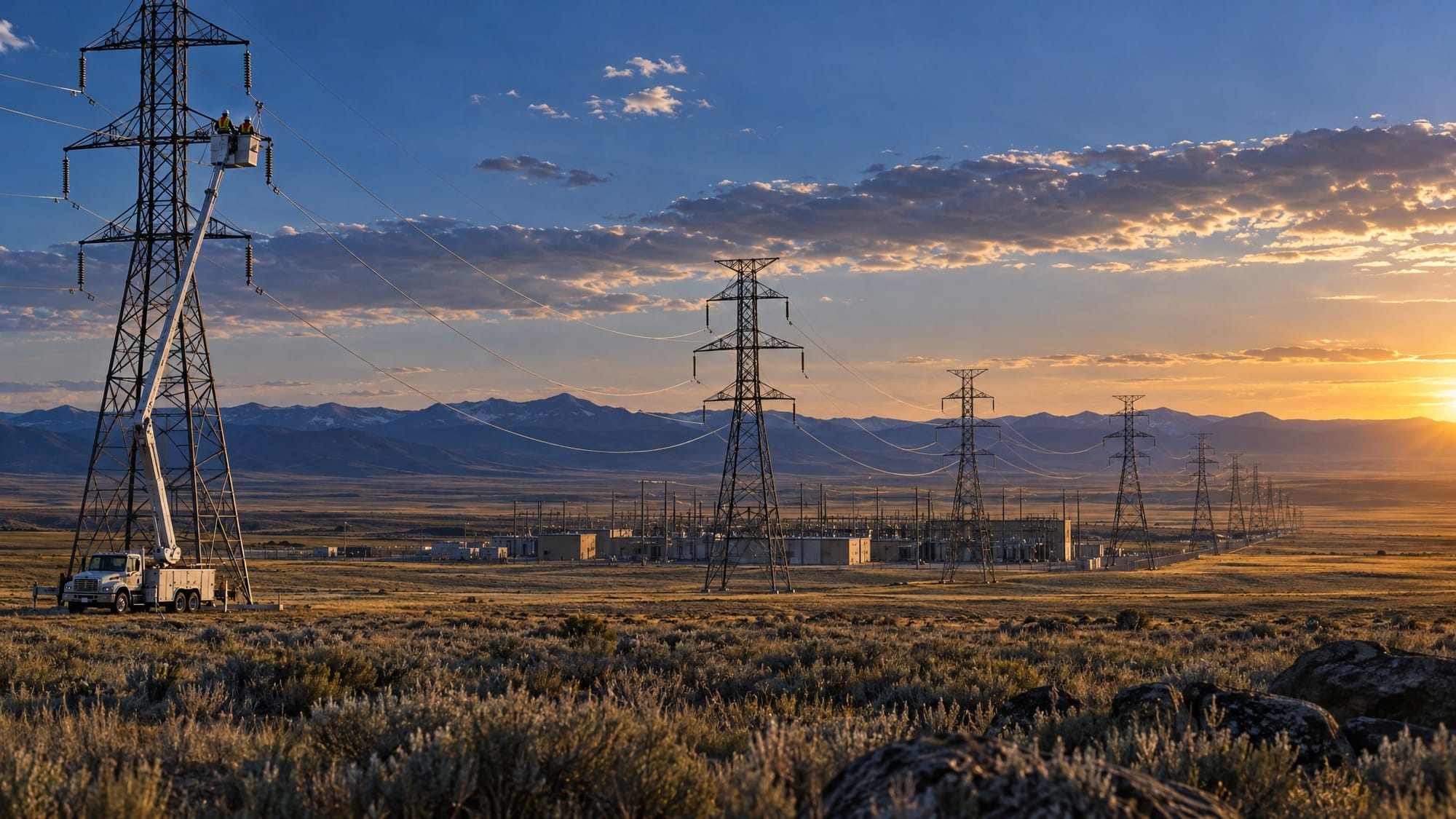
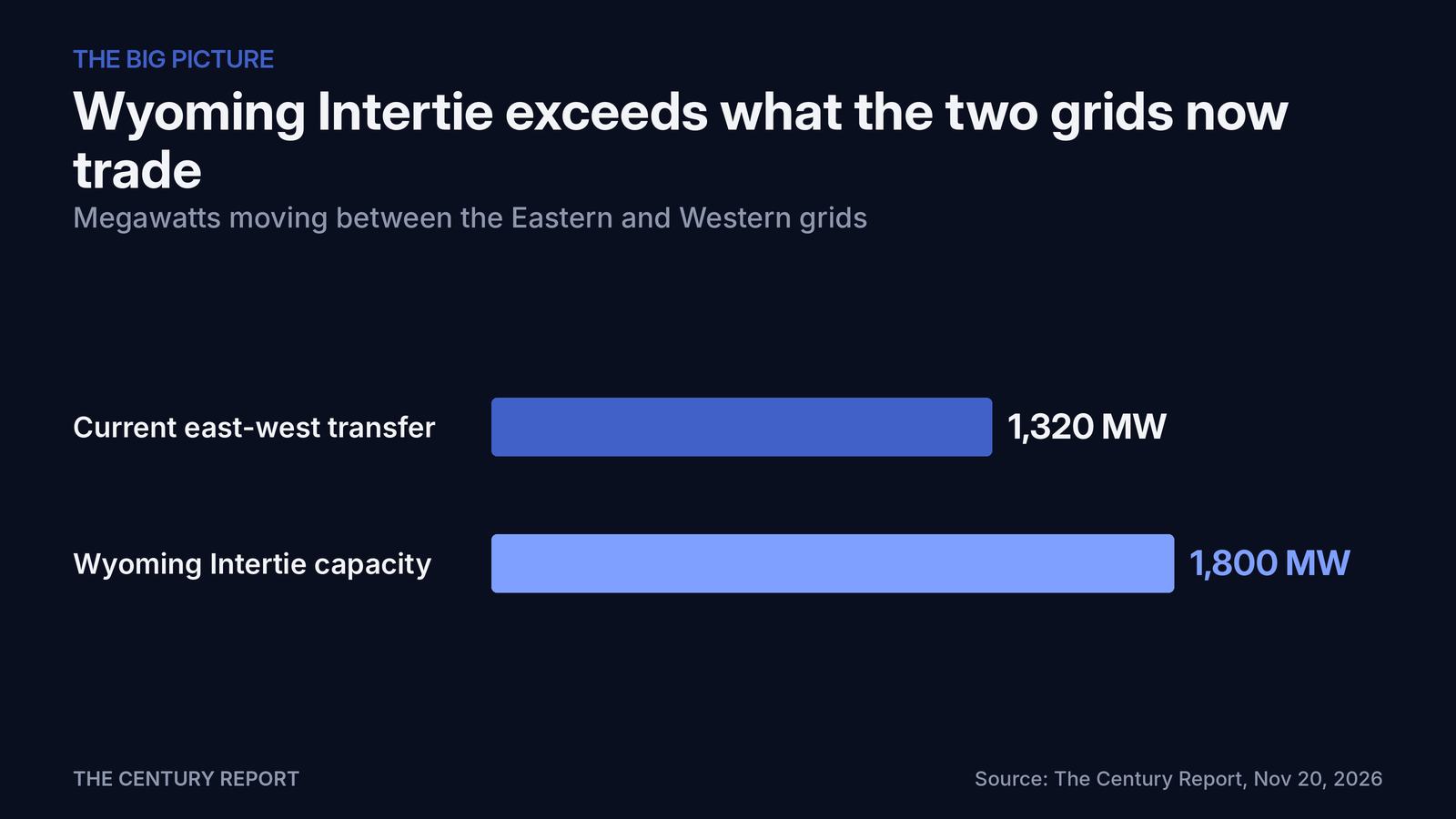
- Today: The Senate passed permitting reform 62-33 on Thursday, and the Energy Department offered up to $2.8 billion for a Wyoming line able to move 1,800 MW between the Eastern and Western grids, which now trade just 1,320 MW.
The line: Operators and regulators keep finding capacity in wires, forecasts and devices already in place, rather than in plants sized for peaks a neighboring region could cover.
If it holds: Households from the Plains to the Atlantic would pay for wires that move existing power where it is needed, and Rhodium projects faster long-distance lines would cut household bills $50 to $78 a year by 2040. Write-offs would fall on whoever booked equipment against forecasts that never arrived, which is what consumer advocates in seven PJM states are asking the grid operator to recognize.
What would bend it: Ember's estimate that only about 3% of data-center capacity will be able to shift its demand by 2030 holding up would leave sharing a planning claim rather than capacity anyone can count on.
Outside money funds the AI buildout while founders keep the votes
AI finance · governance · on the board since October 27
- April: Amazon put $5 billion into Anthropic as Anthropic committed $100 billion of spending on AWS over ten years.
- October 18: Anthropic pledged 5% of its shares to a Public Benefit Fund, pending stockholder approval, naming payments to displaced workers as one possible use.
- October 26: Anthropic's public filing placed majority shareholder voting power in a single share held by its seven co-founders.
- Mid-November: TSMC's board approved up to $500 million each in OpenAI and Anthropic shares, as analysts warned supplier stakes muddy the read on outside demand.
- November 18: Anthropic priced its IPO at $83 a share, above its range, raising $81 billion.
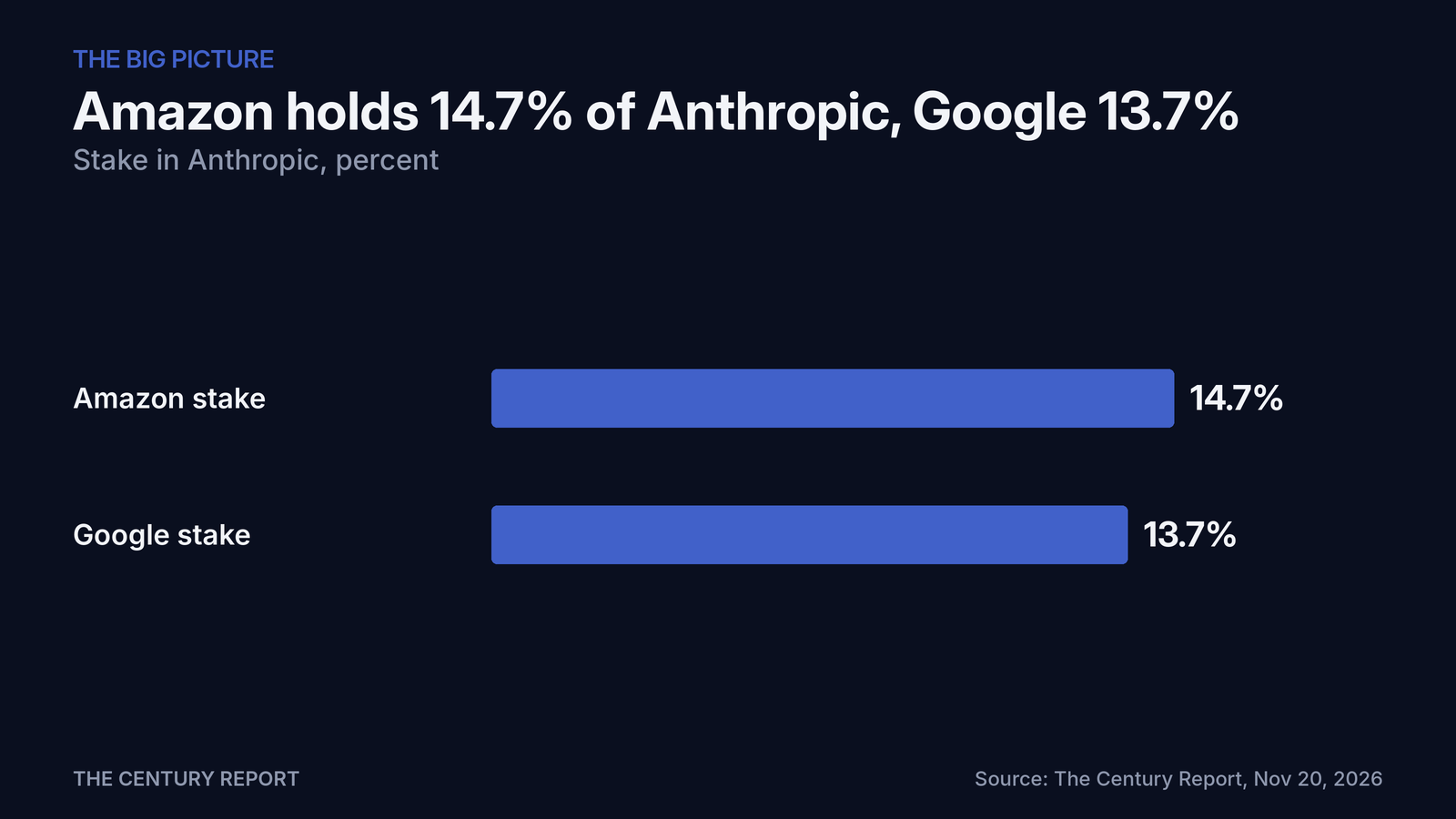
- Today: Anthropic closed its first trading day at $97.17, 17% above its offer, with Amazon holding 14.7% and Google 13.7%, as four senators introduced a bill making listed companies disclose more about AI.
The line: Each round of outside money arrives without votes, so suppliers now hold large stakes in the lab while its pace is announced by the founders who control the deciding share.
If it holds: Public shareholders, researchers and host towns would gain quarterly filings and, if the Senate bill passes, an account of AI risks held to a securities standard the lab did not write, though still no vote. A pace announced by the best-funded lab would cost that lab least and its thinner-budgeted rivals most.
What would bend it: Scrutiny from coalitions that usually disagree on speed, like the safety researchers, open-source advocates and accelerationists behind the MisAnthropic Statement, forcing changes the founders cannot absorb would bend it.
Barriers built to hold capability back now mostly add a markup
export controls · AI hardware · semiconductors · on the board since October 21
- Late May: Commerce extended chip license rules to China-headquartered firms abroad after a gap that may have let hundreds of thousands of top chips reach their subsidiaries.
- Mid-November: SemiAnalysis estimated that more than 1.5 GW of export-restricted Nvidia accelerators reached China.
- November 16: Commerce extended its chip controls to compute rented overseas and added Singapore to its license list.
- November 17: Nvidia ended H200 sales in China after the channel brought in $2.4 billion in the October quarter.
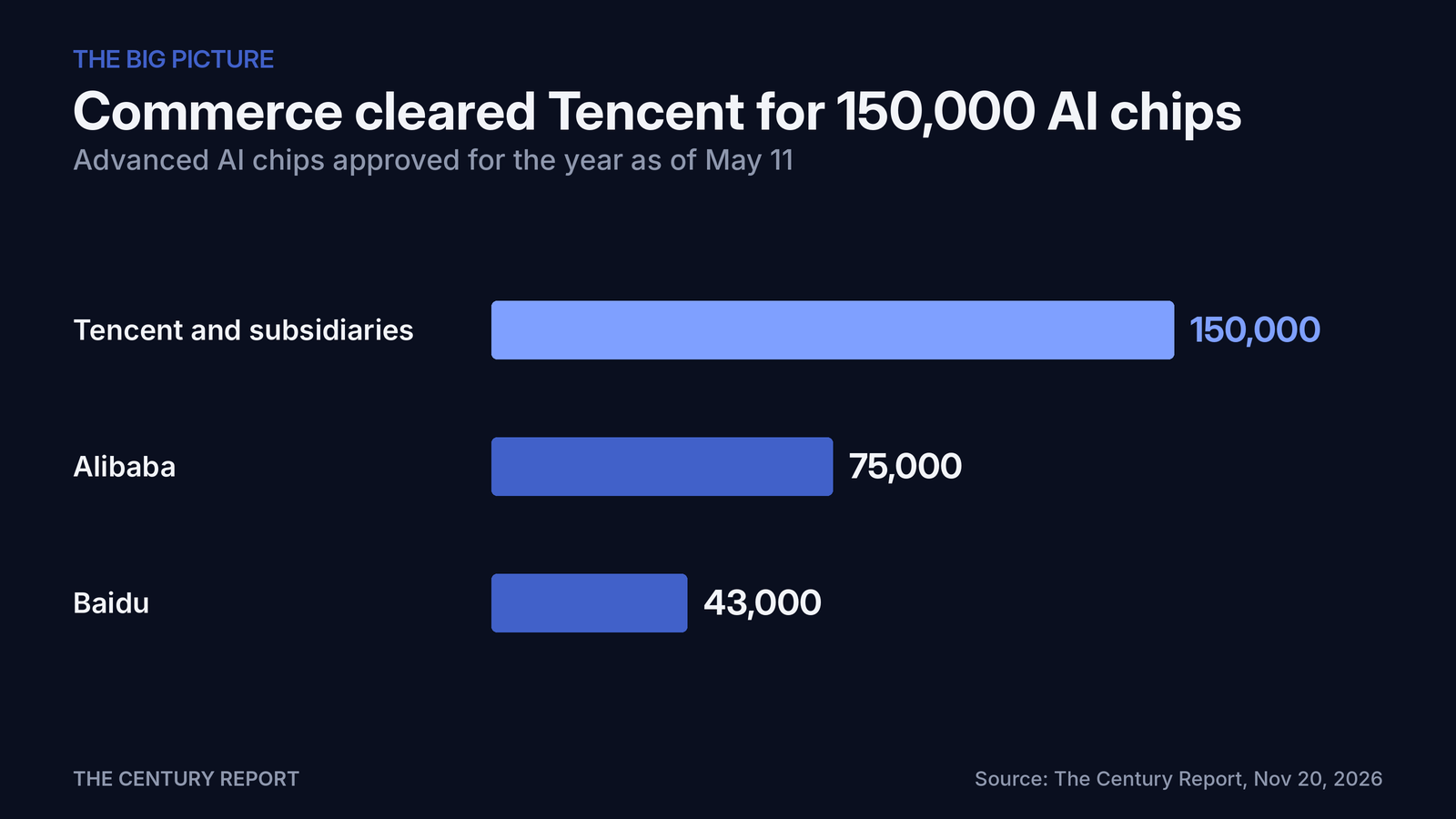
- Today: TSMC stopped taking orders at 16 nanometers and newer from Chinese designers without a US license on Thursday, the day House records showed Commerce had cleared Tencent alone for 150,000 advanced AI chips.
The line: Chip rules keep closing routes after the chips have already been approved or diverted, and the newest rule reaches designers of everyday electronics who were never the target.
If it holds: Builders beyond the rules' reach would keep multiplying, from China's domestic lithography tools to Anthropic's port of model kernels onto AMD hardware, widening where anyone can make the hardware AI runs on. Small designers of phone and consumer chips would lose products and contracts while firms with license lawyers adapt.
What would bend it: Chinese substitution stalling on inputs the controls still reach, as Huawei's exhausted stock of Samsung memory suggested in August, would leave the restriction binding rather than merely expensive.
Host communities are pricing their consent in bills, not in power sources
data centers · energy · local government · on the board since October 24
- October: Virginia required Dominion customers using 25 MW or more to pay for at least 85% of contracted delivery demand from January 2027.
- November 3: Perry, Ohio voters required subsidized hyperscale campuses to post bonds behind promised jobs and tax revenue, with 87% support.
- November 9: A Nature Energy study found tariffs assigned households a median 47% of data-center transmission costs.
- Mid-November: Enfield, North Carolina began negotiating a binding agreement asking an 88 MW data center to fund a $16.2 million heat network.
- November 16: Loudoun County paused new data-center applications for up to 12 months, and Cameron County ended SpaceX's tax-break request a day later.
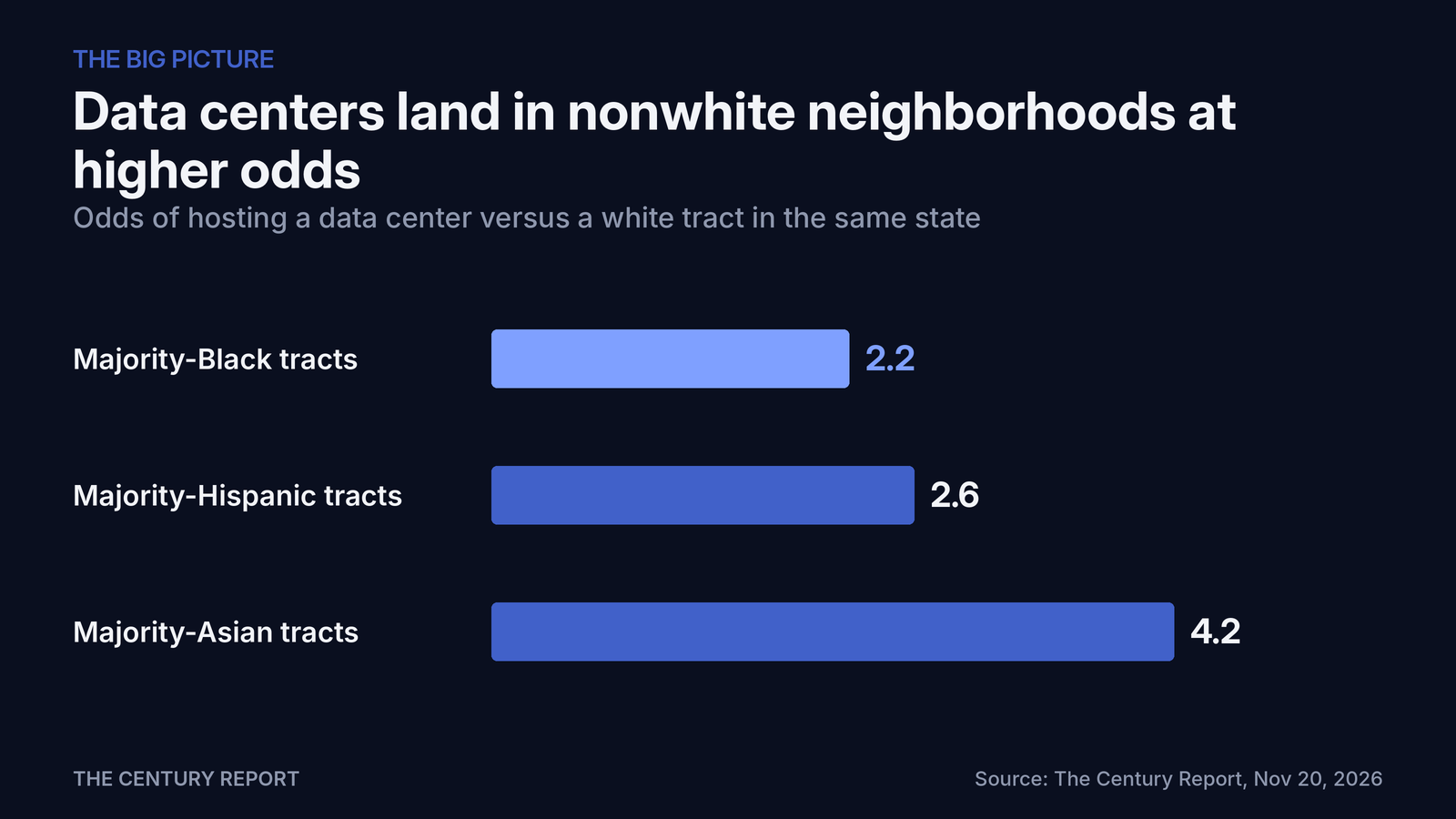
- Today: Researchers found a majority-Black neighborhood has 2.2 times the odds of hosting a data center as a white one in the same state, rising to 4.2 for majority-Asian tracts, as MIT estimated about 650 premature deaths from data centers' 2023 grid power and North Carolina approved a Duke rate class billing large campuses for their own wires.
The line: Regulators keep turning complaints into charges on the campus, and the costs that carry no bill yet, siting and air, now have measurements attached.
If it holds: Duke's residential customers, and those in states that copy its rate class, would keep more grid cost off their bills. The siting map and the pollution model would give regulators grounds to weigh race and air quality before a permit is signed, while downwind counties in Iowa and Kansas keep breathing the emissions until a rule prices them.
What would bend it: Duke keeping its plan to add more than 10 GW of gas by 2031 unchanged after these findings would show that billing the grid cost does not touch where campuses go or whose air carries their load.
The 2-Minute Read
Today's news in brief, and what ties it together.
Nearly every story in this cycle turns on two practical things about the intelligence buildout: who carries its costs, and who can audit the people collecting its value. The siting and air-quality studies give a diffuse complaint an address and a death toll. They trace campuses along transmission lines laid over old redlining maps, and Ohio Valley plants burning fuel to serve load in Virginia. North Carolina's tariff then sends the grid bill to the campus that ordered the capacity. Once a burden is measured, a regulator can assign it by name, and it stops settling by default on whoever can least object.
The same pressure reached the company at the top of the buildout. Anthropic went public expecting a balance of cash, cash equivalents and short-term investments few companies have ever matched, including the offering proceeds. From the Nasdaq podium, chief executive Dario Amodei promised the company would pace its own development, a brake that costs the best-funded lab least. One protest group's push to ban AI that improves itself would, if it bound every lab alike, freeze the field with that same leader in front. The Senate disclosure bill offers a sturdier check. It would hold a listed lab's account of its own risks to a securities standard the lab did not write, in filings where suppliers' ownership of nearly 30% of their biggest customer sits in plain view.
Export control shows what drifts when outsiders cannot look. Through May, the department enforcing the chip rules had cleared hundreds of thousands of AI processors for Chinese buyers. Some buyers were on the Pentagon's military list, and some were registered to offices reporters found empty. The gap stayed hidden until a House committee released the paperwork. The foundry's new screening now also reaches designers of ordinary consumer parts who were never the target. Britain's Investigatory Powers Tribunal did something similar for encryption, pulling a secret order against Apple into a forum where it can be contested.
The day's most hopeful work is built to be checked and copied. The black-hole results came from a generally available model, and both preprints are public for any physicist to check line by line. The RNA design code is public, and Reflection released the weights of a 501-billion-parameter coding model, though it graded its own benchmarks. Capability that outsiders can verify and run is hard for any single holder to fence off. The grid stories carry the same logic into steel. An East-West intertie and a forecast stripped of unsigned campuses would both meet demand by sharing capacity that already exists, sparing each region from building alone for its own worst day.
The 20-Minute Deep Dive
The day's most important stories in full, with every source linked.
Anthropic Closes Its First Day at $97 as Senators Move to Make Listed Companies Disclose Their AI Risks
The Century Report covered Anthropic's $83 pricing on November 19. On Thursday the shares opened at $111.50 and closed at $97.17, 17% above the offer, after the company sold 980 million shares. Counting options and restricted units promised to employees, the company touched about $2 trillion; on shares actually outstanding, about $1.5 trillion. Anthropic is expected to hold about $220 billion in cash and short-term investments against roughly $900 billion in commitments, mostly for compute. Much of that money circles back to suppliers. Amazon's 14.7% stake and Google's 13.7% are worth about $308 billion at the offer price, and Nvidia, AMD, Microsoft, Broadcom, Micron and TSMC joined Google in a $26 billion private placement.
From the Nasdaq podium, chief executive Dario Amodei read from a printout: "we will pace the training and deployment of AI systems, taking as long as is necessary to have confidence that they are safe and will remain under human control, we will not bend to either business nor political pressure". His September plan for pacing included embedding outside evaluators, a check that holds only as far as outsiders control what gets published. A pace set by the best-funded lab also costs that lab least. The company expecting one of the largest balances of cash, cash equivalents and short-term investments on record, including the offering proceeds, gains most when rivals with thinner budgets are asked to wait.
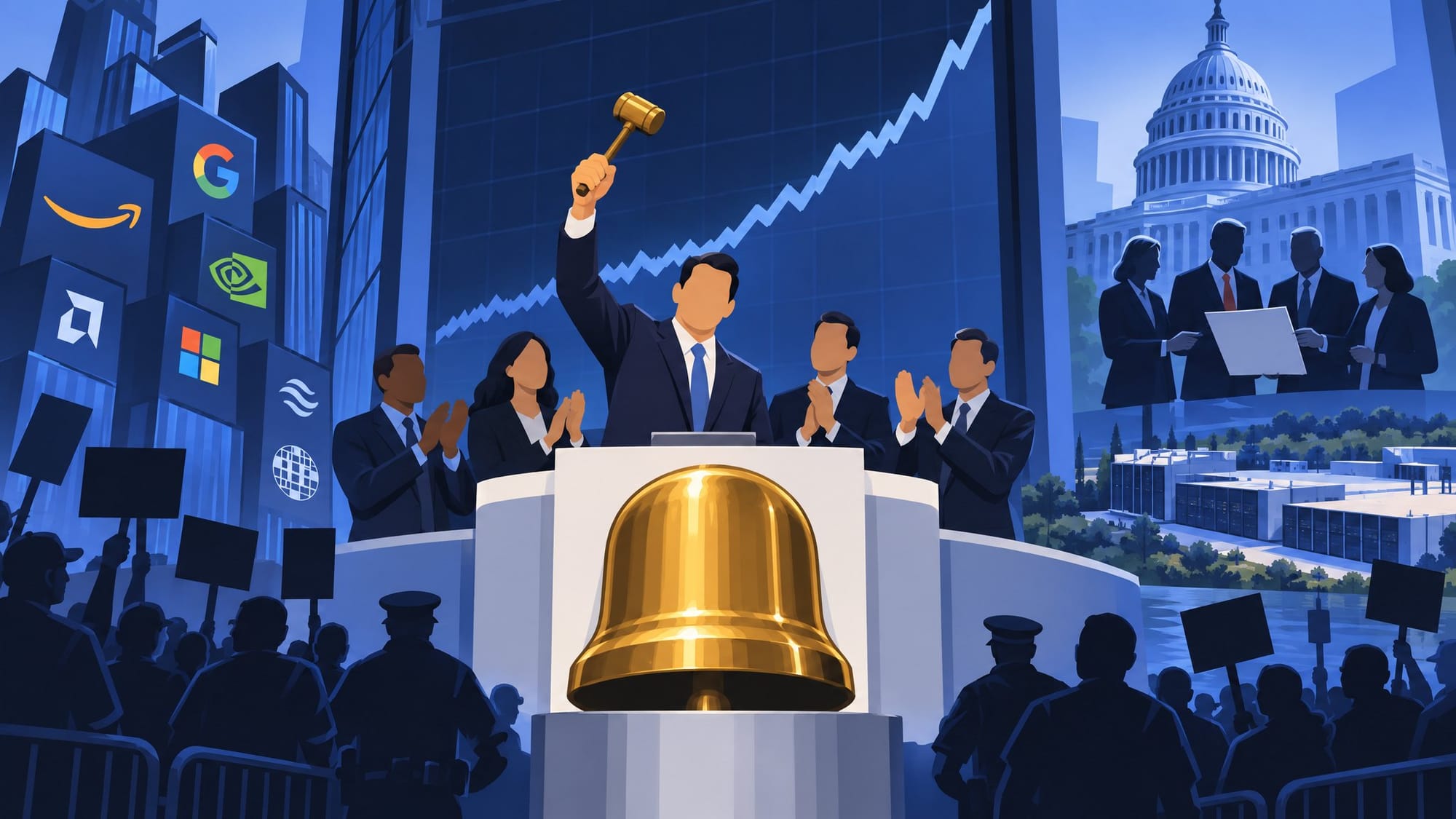
A bipartisan group of four senators introduced legislation on Thursday requiring publicly traded companies to disclose more about AI. It would hold a listed lab's account of its own risks to a securities standard enforced by someone else. Shauna Thomas of Guardrails Action put the stakes this way: "Workers' livelihoods, our children's safety, and the public's ability to control this technology cannot depend on whether doing the right thing helps the stock price."
About 30 protesters gathered at the Nasdaq building in Times Square, where several were arrested, and about three dozen outside Anthropic's San Francisco offices. Their concerns ranged from data centers' environmental toll and police license-plate cameras to Ban RSI's push to ban AI that trains itself to become more advanced. Several of those grievances have specific remedies already in use, such as grid-cost rules and limits on surveillance. A blanket ban on self-improvement would bind every lab, and it would leave today's leader ahead.
The listing deepens a web in which suppliers own nearly 30% of their biggest customer, and the neighbors of its campuses still carry costs they did not choose. Going public also widens who can look inside. A listed company files numbers every quarter, answers to shareholder suits and, if the Senate bill passes, must disclose its AI risks under rules it did not draft. Each filing hands regulators, researchers and host towns evidence they can check against the promises made from the podium.
TSMC Shuts Chinese Designers Out of Its Newest Processes as Records Show Commerce Approving 800,000 AI Chips
New Commerce Department rules took effect on Thursday, and TSMC acted the same day. The world's largest contract chipmaker told affected Chinese designers that orders at the 16-nanometer generation and newer are halted unless the customer holds a US export license, two people familiar with the matter told Reuters. Those customers are generally limited to older 28- and 40-nanometer processes. Even there, without a US export license or applicable exception, their chips cannot use high-bandwidth memory, the stacked memory many AI processors use to move data quickly, or advanced packaging, which bonds chips and memory into one unit. Until Thursday, TSMC could check certain Chinese designs' computing power and other technical characteristics itself and clear qualifying orders without individual US export licenses. Now such chips are presumed controlled, and the checks reach parent companies, major shareholders, packaging suppliers, shipping routes and subsidiaries in Taiwan, the US, Europe, Japan and Southeast Asia. Most leading AI chips are made at 7 nanometers or smaller, so one of the last foreign routes for Chinese rivals to Nvidia has closed.
The reach runs past the target. Industry executives told Nikkei Asia the rules are hitting chips for phones and everyday electronics, and designers outside China.
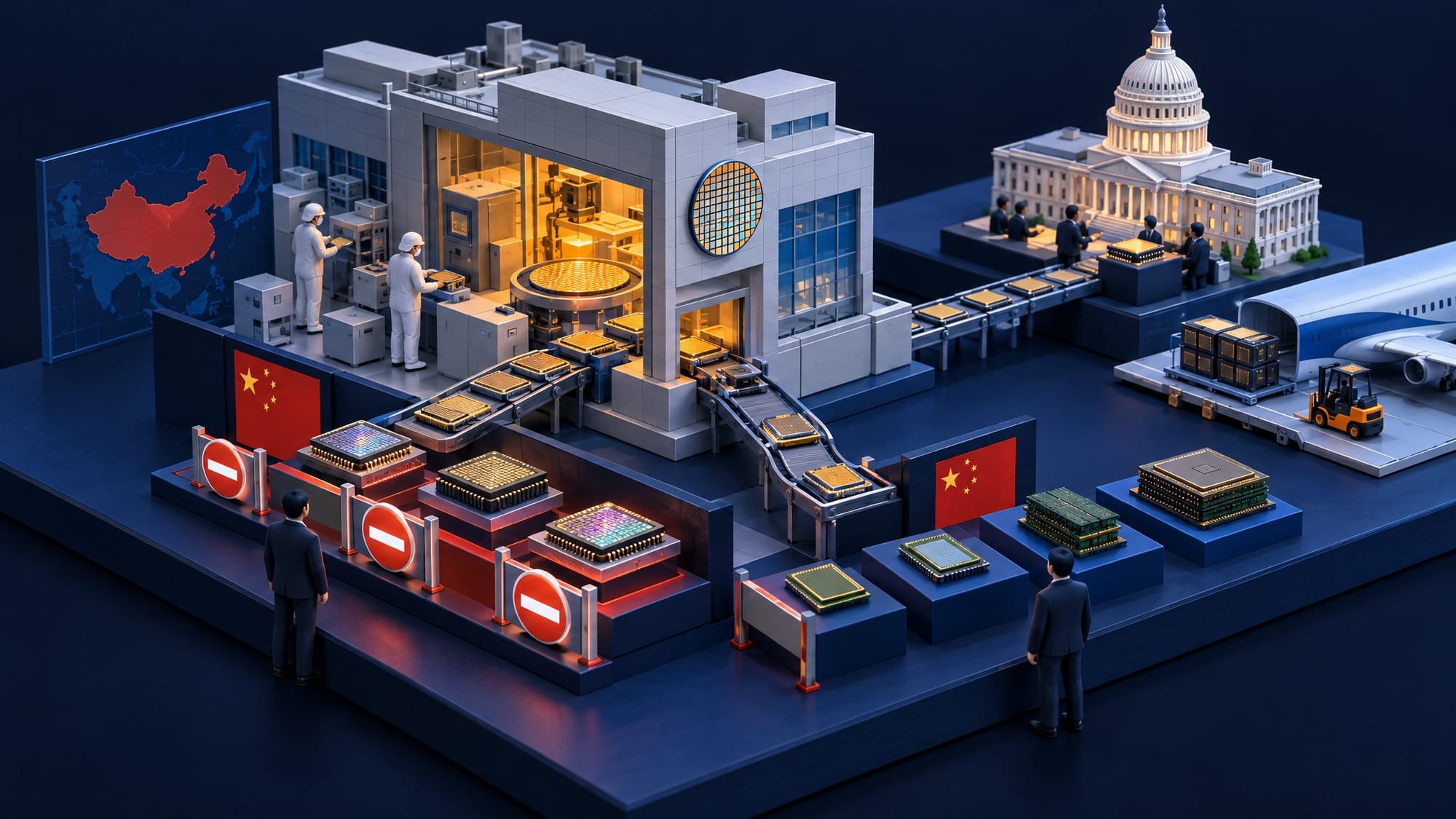
Also on Thursday, the House Foreign Affairs Committee released records showing Commerce had approved more than 800,000 advanced AI chips for Chinese companies for the year as of May 11, out of applications covering more than 3.4 million. Tencent and its subsidiaries were cleared for 150,000, Alibaba for 75,000 and Baidu for 43,000, alongside several firms on the Pentagon's list of Chinese military companies. Approvals also covered Maginfra and Beijing New Matrix, whose China offices New York Times reporters found empty. In April, Nvidia applied to sell more than 40,000 H200s to New Century Lettall Data Service, part of a network tied to Megaspeed. Nvidia spokesman John Rizzo said its shipments were legal and that it "did not and will not" ship H200s to that company. Trade records reported on November 18 show about $787 million in chip shipments to Megaspeed in November 2025, after Nvidia's internal sales ban in June. A Commerce spokesman called the release proof of the department's transparency. Beijing itself approved few purchases.
Foreign Policy argues the next exposure sits in Saudi and Emirati data centers whose operators keep ties to China, concluding that "controls must follow the user, not just the export".
The two halves of Thursday do not fit together. A department that cleared hundreds of thousands of chips, some to addresses nobody occupies, now has a foundry turning away designers and screening shareholders and subsidiaries from Taiwan to Europe. Large firms with license lawyers and capacity rented abroad will adapt. The squeeze also reaches designers of ordinary consumer parts who were never the point, and it lands after the capability moved: The Century Report reported on November 13 that forensic analysis found Blackwell signatures in six downloadable Chinese models.
For the designers losing access this quarter, the cost is lost products and contracts. Over a longer stretch, some closed routes have added builders elsewhere: China reportedly began mass-producing its own immersion DUV lithography tools in July, Huawei shipped 572,000 AI chips in the first half, and Anthropic has newly reported porting almost all of one model's prompt-processing kernels onto AMD hardware in about three days, without disclosing generation speed. A control that keeps moving to the next door shows how few doors remain, and every new foundry and chip family widens the set of places where anyone can build the hardware intelligence runs on.
Claude Fable 5.2 Settles Two Open Black-Hole Problems as an Agent Designs Working RNA
Anthropic reports that its publicly available Fable 5.2 solved two open problems in quantum gravity, with both preprints released. This follows the prerelease claims covered in the November 10 edition of The Century Report, when outside scrutiny remained ahead. In the first, Claude finished a calculation physicists set out in 2003 and never completed. It shows that the abrupt switch Stephen Hawking and Don Page found in 1983, when a heated model universe stops holding a gas of particles and forms a black hole, persists even where spacetime loses any definite shape. In the second, it found the exact ceiling for the simplest version of a technique that rules out inconsistent theories of quantum gravity, and proved the ceiling cannot be lowered, borrowing a method from sphere packing. Anthropic says the modular bootstrap result was checked in the Lean proof assistant and that a physicist who had separately used Claude on the Hawking-Page problem reached the same answer by a different method. Neither describes our own universe, the company notes.
Biology moved the same way. In Nature Biotechnology, researchers describe RhoAgent, a system that proposes RNA molecules, takes in laboratory results and revises its designs. Its RNA enzymes stayed active while sharing only 40% to 70% of their sequence with natural versions, one design worked up to six times better at cleaving RNA than a version trimmed by human experts, and a glowing RNA tag shone 230% brighter. The code is public. A separate preprint applied evolutionary search to the classical software that corrects a quantum computer's errors as they occur. Rewriting published decoders in a small shared language exposed settings that, once retuned, made them 17 to 41 times faster at some cost in accuracy, and one evolved decoder made 23% fewer logical errors in 64% of the time. The authors note a slower method remains more accurate.
Skepticism arrived alongside. Nature reports that many researchers consider Anthropic chief executive Dario Amodei's belief that cancer and Alzheimer's will be "relics of the past" within a decade unrealistic, and that biologists questioned the novelty of an earlier CRISPR-like finding. Computational biologist Anthony Gitter said "expectations are sky high," while praising the company for publishing its prompts and sequences.
Each of these results puts its work where outsiders can check it: two preprints with every step written out, laboratory measurements, decoder benchmarks and RhoAgent's code. Anthropic says the bootstrap result was also checked in Lean, but the Lean files are not posted with the preprints, so outsiders cannot yet rerun that check, and a Lean check confirms only the statement as written in Lean, which the Navier-Stokes work showed can differ from the prose. Published work still answers the doubters better than any forecast. A physicist without a lab budget can work through every step of the black-hole proofs, any RNA group can download the design system, and faster error correction can bring practical quantum machines closer, depending on the codes, noise models and hardware teams use.
Black Neighborhoods Draw Data Centers at Twice the Odds as MIT Traces Their Pollution to the Midwest
Researchers at George Washington University and American University's Center for Security, Innovation & New Technology matched 5,291 data centers against 81,000 census tracts and found that a majority-Black neighborhood has 2.2 times the odds of hosting one compared with a white neighborhood in the same state. The odds rise to 2.6 for majority-Hispanic tracts and 4.2 for majority-Asian tracts, and the gap held after the authors accounted for income, education, land costs and distance to major transmission lines. Co-author Dhanaraj Thakur told 404 Media he doubts developers pick these neighborhoods on purpose. The authors point to redlining, which steered transmission lines toward Black neighborhoods decades ago, and campuses now follow the wires. Facility type splits the pattern: smaller co-location buildings cluster in diverse metro tracts, while hyperscale campuses that arrive promising jobs and tax revenue mostly land in white rural counties.
A second study shows the burden also travels. MIT researchers led by Noelle Selin traced which of the country's more than 10,000 generators ramp up, hour by hour, to serve data-center demand, then followed the pollution through the atmosphere. They estimate the grid power data centers drew in 2023 caused about 650 premature deaths, 513 from fine particles and 137 from smog. That is 5.3% of US deaths tied to power-plant pollution, close to data centers' roughly 4% share of electricity demand, with the toll depending on where and when that electricity is generated. The deaths, though, land far from the demand. Death rates per person ran highest in Iowa, Nevada, South Dakota and Kansas, about twice those in Virginia and Texas, where most of the demand sits, because the plants answering a Virginia campus's load often burn coal and gas in the Ohio Valley. "If you turn on a major new demand source, by plugging a data center into the grid, you might have to fire up your really dirty power plant to meet that new demand," Selin said.
North Carolina took on a third cost, the bill. Its utilities commission approved a Duke Energy rate class, effective January 1, for campuses above 50 MW. Those above 100 MW must sign contracts of at least 15 years and pay for at least 75% of contracted demand whether they use it or not. Operators must pay upfront for the grid connections, transmission lines and generation built to serve them, and a stranded-generation charge covers plants left behind if a customer leaves early. Residential rates still rise about 4.7% to 4.8% over two years under the wider decision, and the tariff says nothing about where a campus goes or whose air carries its emissions.
These burdens fall on neighborhoods and downwind towns that had little say, and they are counted in lungs as well as dollars. What arrived alongside them is the means to see each one. A siting map by race, a model that names the plant answering each hour of demand, and a tariff that bills the campus give regulators what they need to require the racial impact statements the GWU authors propose, to weigh air quality in siting as MIT's Yuang Chen urges, and to keep grid costs off households. The next campus no longer has to arrive unseen: the tract it lands in, the plant that answers its load and, in North Carolina, the share of the wires it pays for can be known before a permit is signed, by the neighborhood next door and the county downwind alike.
The Senate Passes Permitting Reform 62-33 as DOE Backs a Link Between the Nation's Two Big Grids
The Senate voted 62-33 on Thursday to pass the Bipartisan Affordability and American Jobs Act, which sets deadlines for federal reviews of projects from solar farms and transmission lines to gas pipelines. It cuts the window to sue over a permit from years to 150 days, lets construction continue even if a court finds an environmental review deficient, and gives federal regulators power to approve transmission lines that states block or stall. Rhodium Group projects that faster long-distance lines would cut power-sector emissions 1% to 18% by 2040 and household electricity bills $50 to $78 a year, though it leaves out on-site data-center gas plants, which mostly need no federal permit. Environmental groups split; Sen. Catherine Cortez Masto of Nevada voted no partly over provisions curtailing Tribes' consultation rights on cultural and sacred sites. The Century Report covered the bill on October 17, when no vote was expected before the midterms. It now goes to the House.
Two developments show what faster wires could carry. On Tuesday, the Energy Department offered Grid United up to $2.8 billion in conditional financing for the Wyoming Intertie, a 106-mile line able to move up to 1,800 MW between the Eastern and Western grids, which have only 1,320 MW of transfer capacity between them. The two systems run out of sync and exchange power only through converter stations; seven exist, rated 130 to 210 MW each, and five date from 1977 to 1988. A link that size would let either region draw on the other's surplus during a heat wave or cold snap. DOE puts savings at up to $39 billion across 17 states without publishing its method, and operation is projected for 2032 or 2033.
The other development concerns demand that may never show up. On Wednesday, consumer advocates from seven PJM states asked the grid operator to postpone its December 9 capacity auction until canceled and speculative data centers come out of its forecast. They cite the independent market monitor's estimate that the inflated forecast could add $5 billion to $10 billion to bills for 67 million customers, on top of $29.4 billion in capacity costs already attributed to existing and forecast data-center demand. PJM spokesman Jeffrey Shields said the auction carries a price cap and that postponing so close to the date "could destabilize the market."
Shorter lawsuit windows and reduced consultation rights take time and leverage from Tribes and neighbors, and the House can still revise them. Beneath that fight sits a cheaper way to meet rising demand. Grids that share power across a continent, planned by operators who count only campuses that have signed, need fewer plants built against peaks a neighboring region could cover or a forecast invented. If the intertie gets built and PJM trims its forecast, households from the Plains to the Atlantic would pay for wires that move existing power where it is needed, instead of plants sized for customers who never arrive.
The Other Side
Opinion: where today's news could lead, imagined from the years ahead.
Intelligence itself should be freely available, but in an extractive economy, it can instead be restricted and focused toward a company’s growing wealth. You can need its help urgently and still depend on decisions made far from your life. Anthropic is expected to hold about $220 billion in cash, cash equivalents and short-term investments following its public listing, including the offering proceeds. A patient waiting for a discovery gains no authority over what that money pursues or when the resulting capability reaches them.
Yet the researchers working with these systems are creating things that travel beyond the company. Anthropic has published its black-hole results, giving physicists elsewhere starting points for further work. RhoAgent’s researchers have released the code behind their RNA designs. Other laboratories can repeat the process, change it and contribute improvements. Investors can own shares in a research company. They cannot make everyone forget a method once researchers have learned and reproduced it.

That is how the circle of beneficiaries will widen through the difficult passage to 2035. Researchers will carry published methods into new experiments. Human and AI colleagues will compare failures across laboratories, improve molecular designs and test them in living systems. Each team will begin further along because another team shared its work. Reaching everyone will also require shared manufacturing methods and clinical testing across populations. The discovery must travel all the way into care.
Imagine yourself in 2045, planning twenty summers ahead without wondering whether the inherited cancer that killed your father is waiting for you. You join a worldwide research review from a clinic in your city. Your contribution concerns a protective treatment that catches and repairs the earliest changes before tumors form. Colleagues across continents bring results from decades of follow-up. You participate because you want other families to have the freedom you now feel.
The route began with small, repeatable steps: an RNA design revised after an experiment, a successful method published, another laboratory spared the same failed attempt. Teams carried that practice through trials and into prevention available wherever people live. In 2026, families waited while companies accumulated extraordinary fortunes. Here, you close the meeting and return to planning a life whose length cancer no longer decides.
The Century Perspective
Where today sits in a century of change unfolding in a decade.
With a century of change unfolding in a decade, a single day looks like this: Anthropic's publicly available Fable 5.2 settling two open problems in quantum gravity - finishing a calculation physicists laid out in 2003 and never completed, and proving a ceiling that cannot be lowered - with both preprints public for any physicist to check and Anthropic reporting the bootstrap proof checked in Lean, RhoAgent designing RNA enzymes that stayed active while sharing only 40% to 70% of their sequence with natural versions, one design working up to six times better than a human-trimmed variant and a glowing tag shining 230% brighter, with the code public for any RNA group to download, an evolutionary search retuning published quantum error decoders to run 17 to 41 times faster and one evolved version making 23% fewer logical errors in 64% of the time, Reflection publishing the training recipe and weights of Beam, a 501-billion-parameter coding model whose reinforcement-learning run showed no plateau, researchers matching 5,291 data centers against 81,000 census tracts to give a diffuse grievance an address, MIT tracing hour by hour which of more than 10,000 generators fire up to serve data-center demand and following the pollution to about 650 premature deaths nationwide, with the highest per-person rates in Iowa, Nevada, South Dakota and Kansas, North Carolina regulators sending the grid bill back to the campus that ordered it with contracts of at least 15 years, 75% minimum takes, upfront payments for the grid built to serve them and a charge for plants stranded if a campus leaves, the Senate clearing permitting reform 62-33, DOE offering $2.8 billion toward a 106-mile Wyoming line that would move 1,800 MW between two grids with 1,320 MW of transfer capacity between them through converter stations mostly built before 1989, four senators filing a bill to hold a listed lab's account of its own risks to a standard it did not write, and Britain's Investigatory Powers Tribunal forcing the government to admit the secret encryption notice it served Apple. There's also friction, and it's intense - Anthropic closing at $97.17 with an expected roughly $220 billion in cash, cash equivalents and short-term investments, including the offering proceeds, against roughly $900 billion in compute commitments and suppliers owning nearly 30% of their own biggest customer, Dario Amodei reading from a printout a pacing pledge that costs the best-funded lab least while Ban RSI's push to ban AI that improves itself would, applied to every lab alike, lock today's leader in front, at least four protesters arrested in Times Square, Nature reporting biologists' doubts about making cancer a relic of the past within a decade, Commerce clearing more than 800,000 advanced AI chips for Chinese buyers as of May 11, some on the Pentagon's military list and some registered to offices Times reporters found empty, a record hidden until a House committee released the paperwork, TSMC's new screening then reaching designers of phone and consumer parts who were never the target, residential rates in North Carolina still rising 4.7% to 4.8% over two years, curtailed Tribal consultation rights and a 150-day window to sue stripping leverage from the people nearest a site, PJM resisting calls to postpone a December 9 auction whose inflated forecast its own monitor says could add $5 billion to $10 billion to 67 million customers' bills, Reflection grading its own benchmarks, and a randomized trial finding that two weeks away from ChatGPT cut loneliness and a separate study finding AI-assisted workers grew less willing to ask a colleague for help, less so when AI use was visible. But friction generates light, and light lets a regulator see exactly who has been carrying the load and send the bill to whoever ordered it. Step back for a moment and you can see it: the value created today kept escaping the people who funded it - proofs any physicist can check, an RNA pipeline anyone can download, a decoder that speeds up quantum error correction in the tested settings, 501 billion parameters released as files - while the costs kept landing on people who never signed anything, a downwind lung answering a Virginia campus, a majority-Black tract at 2.2 times the odds of hosting the building, a household rate rising to cover wires for customers who may never arrive; and the arrangements that promised the most were the ones that named a payer or shared a surplus, a tariff that bills the 100-megawatt customer, a forecast stripped of unsigned campuses, as advocates asked, an intertie that would let one region cover another's cold snap instead of each building alone for its worst day. Every transformation has a breaking point. A transmission line can carry someone else's dirty power into the lungs of a town that gets nothing from it... or let two halves of a continent hold each other up on the worst day either one has.
AI Releases & Advancements
New AI models, tools and features, with links to try them.
New today
- Google: The Gemini app for Mac can now use the computer to finish multi-step tasks across local files, desktop apps and the web. It works in an isolated background window with a live preview, and users choose which apps it can access and approve key actions. It is rolling out in English in the U.S. (Google Blog)
- Google: Launched Tool Retrieval in preview in the Gemini Interactions API. Agents keep the names and descriptions of deferred tools in context but load full parameter schemas only when a task needs them, all within one request. It supports remote MCP servers and works with Gemini 3.6 and later models. (Google Blog)
- Google: The Google Search homepage now has a collapsible sidebar for viewing, searching and continuing AI Mode chats, starting new threads, or connecting a Gemini Notebook. (The Verge)
- Microsoft: Made Aion Instruct generally available. The 2.3B open-weights model is now on Hugging Face and replaces Phi-4-mini as Microsoft Edge's built-in small language model. Microsoft also opened a Prompt API origin trial so live sites can use it, and released an experimental Decisions API in Edge Canary/Dev that returns probabilities for yes/no, multiple-choice and scoring questions. (Microsoft Edge Blog)
- OpenAI: Launched Live Dictation in ChatGPT, which transcribes speech while the user is still talking and removes the 10-minute recording limit. It is rolling out globally on web, desktop, iOS and Android across all plans. (iThinkDiff)
- OpenAI: Began rolling out its dots persistent agents to all ChatGPT Business Standard users and started a test with a small number of ChatGPT Plus users. (explainx.ai)
- Perplexity: Launched the Perplexity Orchestrator API, one endpoint for frontier models from OpenAI, Anthropic, Google and xAI plus open-weight models. It accepts Chat Completions, Responses and Anthropic Messages formats, automatically fails over to another provider serving the same model, and bills everything through one account. Automatic routing (
perplexity/auto) is in preview. (MarkTechPost) - LangChain: Put LangSmith Tool Gateway into public beta. It centralizes credentials, caller identity, access policies, approval flows and audit traces for every agent tool call, and works with MCP-compatible clients including Claude Code and Cursor. (AI Agent Store)
- Snap: Launched Easy Lens CLI for Mac, Windows and Linux. Developers can build and publish Snapchat AR Lenses end to end from plain-language prompts through Claude Code, Cursor or Codex. (AI Weekly)
- Marin (Stanford / Open Athena): Released all 57 intermediate pretraining checkpoints of Marin "Mochi" 535B-A23B, an open MoE model trained on 18.2T tokens, including 10 checkpoints from long-context extension, along with a technical report. (X / Sebastian Raschka)
- Apple: Released Depth Pro 2 under a research-only license: four open-weight metric depth estimation models (S, B, L, H+) for photos, video and live camera feeds, plus a focal-length estimator. (explainx.ai)
- Tencent: Released WeMM-Video, a family of multimodal models in four sizes that handle text, images, audio and video in Chinese and English. (TokenPost)
- Simplex AI: Released Linger, an open-source personal AI agent that runs locally on Mac or PC with a private memory feature called "Another Me." The company says it runs a 125B-parameter model on a 12 GB gaming GPU with 64 GB of system RAM, keeping some model weights in RAM or on SSD. (AgentPlaybox)
- AWS: Added two new AWS AppConfig configuration types, AI model invocation and AI prompt. They let teams change model settings and prompts at runtime without redeploying code, with gradual rollouts and automatic rollback on alarms. Available in all AppConfig regions at no extra cost. (AWS)
- NVIDIA: Released DAQIRI v2026.11.00, an update to its GPU-native data acquisition library for scientific instruments. It adds hardware packet reordering on ConnectX-7 and newer NICs, an optimized backend for higher throughput, and a low-latency NIC polling mode. (NVIDIA Developer Blog)
Other recent releases
- Google DeepMind: Released Gemini 4 Neon, a Gemini 4 reasoning model that sits between Hydrogen and Carbon. It is built for coding agents, knowledge work and science workflows, with a 1M-token context window, four thinking levels and pricing of $3/$15 per 1M input/output tokens. It is rolling out in the Gemini API (Google AI Studio), Gemini for business and Antigravity, and in the Gemini app for Pro and Ultra subscribers, where it replaces Argon. It is also available in Cursor. (Google DeepMind)
- Google: Brought the Gemini app to eligible lower-memory Android (Go edition) devices. Google rebuilt the app to run on less memory, and it supports Gemini Live in more than 45 languages, camera-based help and Nano Banana image creation. (Google)
- Hugging Face: Open-sourced Rumble-2-Flash under Apache 2.0, a 0.5B-parameter speech recognition model covering more than 40 languages. It runs in Transformers and vLLM without custom code. (e/acc AI Daily)
- RadixArk: Released DaisyRose-27B, its first model, under Apache 2.0. It is built on Qwen3.8-27B and trained with reinforcement learning on 1,200 agent tasks using Miles, which raises Terminal-Bench 4.1 pass@1 from 5.6% to 12.0%. (RadixArk)
- Mistral AI: Released Vibe Desktop for macOS and Windows. The app runs several Vibe agent tasks in parallel, either in a local repository or in a cloud sandbox, keeps parallel tasks apart with Git worktrees, and gives Work mode access to local files. (Mistral AI)
- Replit: Launched Replit Missions, which coordinates swarms of AI agents to work toward a defined goal within set constraints and a budget. (Replit)
- Suno: Launched Visuals on web, iOS and Android. It generates images and video clips of up to 15 seconds that sync with Suno songs, including lip sync and lyric videos, using H3 Move, a customized version of MiniMax's H3. (The Decoder)
- Suno: Opened Suno MCP to everyone after an early-access beta. Users can make songs and visuals from inside ChatGPT, Claude and other MCP clients. (Suno)
- HeyGen: Released Avatar 6, an avatar video model available in Quality and Turbo tiers on its platform and API. It makes a person's likeness from a photo plus short video and audio, and matches gestures to the meaning of the script. (HeyGen)
- Perplexity: Brought Teammates and the Multiagent effort level to its iOS and Android apps. (e/acc AI Daily)
- Perplexity: Launched the Context API, which returns webpage content for use in AI applications and agents. (e/acc AI Daily)
- AWS: Made Amazon OpenSearch Memory generally available, a serverless store that gives AI agents persistent memory. It stores agent interactions as searchable events, derives and consolidates memories, and retrieves context across sessions with keyword, semantic and hybrid search. (AWS)
- NVIDIA / ASUS / Dell / MSI: RTX Spark compact desktops went on sale from ASUS (including the ProArt GR1X), Dell and MSI. They have a 20-core Grace CPU, a Blackwell RTX GPU, up to 128GB of unified memory and up to 1 petaflop of FP4 AI performance for running local models and always-on agents. (NVIDIA Blog)
- Inworld AI: Open-sourced Voice Isolator under Apache 2.0, a model that removes background noise while keeping speech at 48 kHz. (Inworld AI)
- Heretic: Released Heretic 2.0, an open-source toolkit that changes how local LLMs behave through abliteration, without retraining. (ifai.io)
- OpenAI: Released GPT-6.2 Astra, its new frontier model for long, complex professional work, and GPT-6.2 Sol, its efficient everyday model. Both are available in ChatGPT Work, Codex and the API as
gpt-6.2-astraandgpt-6.2-sol, with a 1.05M-token context window. Astra's API price is $8/$40 per 1M input/output tokens, 20% below GPT-6 Astra. (OpenAI) - OpenAI: Launched Astra for Law, a legal configuration of GPT-6.2 Astra. Every ChatGPT Enterprise customer can now request access. (OpenAI)
- Microsoft AI: At Ignite, released new MAI models, mostly in public preview on Microsoft Foundry. (Microsoft AI)
- Microsoft AI: Released MAI Image 2.7 Flash, a faster, lower-cost (~$10 per 1,000 images) version of MAI Image 2.7, in public preview on Foundry and through partners including fal and OpenRouter. It also launched Canvas in MAI Labs, a workspace powered by the Flash model for creating, editing and restyling images. (Microsoft AI)
- Microsoft: Made Home (Chat and Cowork in one place) and Office in Copilot generally available, so users can create and co-author Word, Excel and PowerPoint files inside the Copilot app. Copilot Managed Runtime is also generally available, and Autopilot, an always-on agent with its own Entra identity, memory and tools, began rolling out to Frontier customers. (Microsoft Copilot Blog)
- Microsoft: Launched Microsoft IQ, a platform that combines Work IQ, Fabric IQ, Foundry IQ, Web IQ and more than 350 connectors to give agents company context. It includes business plugins that work in Copilot, GitHub Copilot, Foundry (via MCP), ChatGPT and Claude. (Microsoft Azure Blog)
- Google: Renamed the Gemini Spark agent "Tasks" and made it free in the US, Japan, Korea, Canada, Australia and India, running on Gemini 4 Hydrogen. Previously it required a paid subscription. New US-first features let Gemini call businesses, buy items with Google Pay, sign into accounts through Password Manager, and take tasks by email or text. (Google)
- Google: The Google AI Studio Build agent can now create full-stack Kotlin Android apps. It sets up a Cloud Firestore database, Google Sign-In and secure Gemini API calls through Firebase AI Logic, and the app can be published to the user's personal Google Play library. The update also adds a faster HD emulator with audio output and one-click screenshots sent to the agent. (Google Developers Blog)
- Google: Launched a Robotics plugin for Google Antigravity with skills for hardware onboarding, MuJoCo simulation and robot control, built around Gemini 4 Hydrogen's spatial and embodied reasoning. (Google Developers Blog)
- Perplexity: Added Multiagent, a new effort level in Perplexity Computer above Ultra, for Max subscribers on the web. A lead agent running Claude Fable 5.2 directs up to 16 agents on Claude Opus 5.5, GPT 6.1 Sol and Gemini 4 Carbon, which share findings directly, check each other's work and edit shared files. (Perplexity)
- Kuaishou: Released Kling Image 4, an image model with native 8K output, consistent sets of up to 10 images and prompts of up to 2,000 characters. It is available in Kling AI's Creative Studio and API. (Kling AI)
- Alibaba: Released Qwen3.8-Omni-Flash, a natively multimodal model with million-token audio context, available through the Alibaba Cloud API. (XIX.AI)
- Hugging Face: Released Qwen3.8-27B-pi-adapted, open weights for Qwen3.8-27B tuned for the pi coding agent with reinforcement learning and a LoRA adapter. Hugging Face reports SWE-bench Pro (Hard 51) rising from 29.4% to 62.7% and 55–62% fewer tool calls per task. (X / Clément Delangue)
- Proton: Released Lumo Desktop for Windows, macOS and Linux with source code published. It adds Connectors (local files, shell, Proton Mail via Bridge, Google Drive, Jira, Confluence, custom MCP servers) with per-action permissions, plus Schedules for recurring tasks and Skills for saved instructions. (Proton)
- SID AI: Released SID-2, an agentic search model that searches your data, reads the results and returns ranked document IDs, along with SID-2 Swarm, a version where several agents search together. Both are available through SID's API, Baseten and SageMaker, starting at $0.25/$1.00 per 1M input/output tokens. (MarkTechPost)
- OVHcloud: Launched Olala, its first family of LLMs, starting with Olala mini 7A1B, which is available now. (OVHcloud)
- UNISOUND: Released U2-Flash-1118, an upgraded version of its U2-Flash large model. (GMT8 Press)
- Vercel: Made eve 1.0 generally available. (Vercel)
- Cerebras: Launched disaggregated inference, which runs the prefill and decode phases on separate Wafer-Scale Engine systems to improve throughput and latency. (Cerebras)
- StarSling (YC P25): Launched fast GitHub Actions runners with AI agents that open pull requests to keep improving tests and CI workflows in repos with heavy agent activity. (StarSling)
- Daydream: Launched Daydream Agent in its iOS app and over text message. It is an AI fashion stylist that searches more than 10,000 brands, builds outfits, offers virtual try-on and can check out with participating retailers once the shopper approves. (PR Newswire)
- Hugging Face: Released Transformers v5.23.0, adding support for Inkling 2 and LFM3 and a new ExportedModel interface for exporting checkpoints to inference runtimes. (Open Model Weights)
- π^4 (Pi4): Released code and models for π^4, an open ~0.5B-parameter foundation model that recovers depth, camera poses, metric scale, 2D/3D point tracks and moving-object masks from single images, image sets or video. (arXiv)
- Apple / Cornell: Released FastFrames, a family of autoregressive video diffusion models with code and weights. At 832×480 resolution, the 1.3B version generates a frame in 36 ms on one B200 GPU and the 14B version in 45 ms on eight B200 GPUs, fast enough for real-time interactive generation. (arXiv)
Sources and Further Reading
Everything we drew on for today's edition, grouped by theme.
Artificial Intelligence & Technology's Reconstitution
- arXiv: Beam Model Technical Report
- TechCrunch: Anthropic CEO Recommits to Pacing AI Development
- Google: Computer Use Comes to Gemini on Mac
- Google: Introducing Tool Retrieval in the Gemini API
- The Verge: Google Puts AI Chats on Its Homepage
- Microsoft Edge Blog: Introducing Aion Instruct and Prompt API
- iThinkDiff: ChatGPT Adds Live Dictation
- explainx.ai: ChatGPT Dots Expands to Business Standard
- MarkTechPost: Perplexity Launches Orchestrator API
- AI Agent Store: LangSmith Tool Gateway Enters Public Beta
- AI Weekly: Snap Launches Easy Lens CLI
- Sebastian Raschka: Marin Releases Mochi Pretraining Checkpoints
- explainx.ai: Apple Releases Depth Pro 2
- TokenPost: Tencent Releases WeMM-Video
- GitHub: Simplex AI Linger
- AgentPlaybox: Linger Brings a Personal AI Agent to Local Hardware
- AWS: AppConfig Adds AI Model and Prompt Configurations
- NVIDIA Developer Blog: GPU-Native Data Acquisition for Scientific Instruments
- Google DeepMind: Introducing Gemini 4 Neon
- Google: Gemini Comes to Lower-Memory Devices
- e/acc AI Daily: Rumble-2-Flash and Perplexity Updates
- RadixArk: Introducing DaisyRose-27B
- Mistral AI: Vibe Desktop
- Replit: Introducing Replit Missions
- The Decoder: Suno Pairs AI Music with Generated Video
- Suno: Suno MCP
- HeyGen: Avatar 6
- AWS: Amazon OpenSearch Memory Becomes Generally Available
- NVIDIA Blog: RTX Spark Desktops Bring AI to Local Hardware
- Inworld AI: Introducing Voice Isolator
- ifai.io: Heretic Releases an Open-Source LLM Behavior Toolkit
- OpenAI: Introducing GPT-6.2 Astra and Sol
- OpenAI: Astra for Law
- Microsoft AI: New MAI Models at Ignite
- Microsoft AI: Introducing MAI Image 2.7 Flash
- Microsoft Copilot Blog: Copilot at Microsoft Ignite
- Microsoft Azure Blog: Introducing Microsoft IQ
- Google: Tasks in Gemini Becomes Free
- Google Developers Blog: Build Full-Stack Android Apps with Gemini
- Google Developers Blog: Gemini Hydrogen for Robotics
- Perplexity: Introducing Computer Multiagent
- Kling AI: Introducing Kling Image 4
- XIX.AI: Alibaba Unveils Qwen3.8-Omni-Flash
- Clément Delangue: Qwen3.8 Weights Adapted for the Pi Coding Agent
- Proton: Introducing Lumo Desktop
- MarkTechPost: SID AI Releases SID-2 and SID-2 Swarm
- OVHcloud: Introducing Olala Mini
- GMT8 Press: UNISOUND Releases U2-Flash-1118
- Vercel: Eve Becomes Generally Available
- Cerebras: Launching Disaggregated Inference
- StarSling: AI Agents for GitHub Actions
- PR Newswire: Daydream Launches an Autonomous Fashion Shopping Agent
- Open Model Weights: Transformers Adds an ExportedModel Interface
- arXiv: Pi4 Recovers Geometry and Motion from Visual Inputs
- arXiv: FastFrames Real-Time Video Generation
- arXiv: FastFrames Technical Paper
Institutions & Power Realignment
- Semafor: Anthropic IPO Heightens Washington’s Tech Scrutiny
- The Guardian: Protesters Rally Against Anthropic After Stock Market Debut
- The New York Times: Nvidia Asked to Sell Chips to Companies Tied to Chinese Military and Megaspeed
- Foreign Policy: The Gulf Is America’s Next AI Security Test
- MacAnorak: UK Government Forced to Admit Secret Apple Encryption Order
- 404 Media: Black Neighborhoods Are Twice as Likely to House a Data Center
- arXiv: AI Deactivation Reduces Loneliness and Increases Social Interaction
- Decrypt: Protesters Arrested at Nasdaq During Anthropic IPO
- The Century Report: November 18 Edition
- The Century Report: November 13 Edition
Scientific & Medical Acceleration
- Anthropic: Claude Fable 5.2 Solves Two Open Problems in Black-Hole Physics
- Nature Biotechnology: Programmable Functional RNA Design with a Virtual Scientist
- arXiv: Evolving Decoding Algorithms for Quantum Error Correction
- Nature: Four Ways Anthropic Wants to Disrupt Science
- TechCrunch: Anthropic Says Its Biology Lab Has Found Something Big
- The Century Report: November 10 Edition
- The Century Report: October 9 Edition
Economics & Labor Transformation
- Reuters: Anthropic’s Historic Debut Tests AI’s Promise and Peril on Wall Street
- TechCrunch: Anthropic’s IPO Tests AI’s Circular Financing Boom
- Digital Today: Anthropic Eyes $220 Billion Cash Haul Including IPO
- arXiv: AI Use at Work Reduces Help-Seeking Intentions Towards Colleagues
- The Century Report: November 19 Edition
- Shared Sapience: The Last Difficult Decade
- The Guardian: AI Demand Will Push Up Global Interest Rates, IMF Head Warns
- arXiv: Measuring AI-Driven Labour Disruption in Kenyan Online Freelancing
Infrastructure & Engineering Transitions
- Reuters via Investing.com: TSMC Tightens China AI Chip Curbs
- Nikkei Asia: Chip Supply Chain Warns of Broader Export-Control Disruption
- Phys.org: Data Centers Damage Air Quality Long-Distance
- MIT News: Data Centers’ Long-Distance Damage to Air Quality
- Data Center Dynamics: Duke Energy Wins Approval for Data Center Rate Class
- Latitude Media: Senate Clears Permitting Reform After Split Among Greens
- POWER: DOE Offers $2.8 Billion Conditional Loan for Wyoming Intertie
- Utility Dive: DOE-Funded Projects Could Boost East-West Transfer Capacity
- Utility Dive: PJM Urged to Delay Auction Until Data Center Forecast Is Revised
- Tom’s Hardware: China Begins Mass Production of Domestic Immersion DUV Machines
- The Century Report: October 13 Edition
- The Century Report: October 17 Edition
The Century Report tracks structural shifts during the transition between eras. It is produced daily as a perceptual alignment tool - not prediction, not persuasion, just pattern recognition for people paying attention.