
Anthropic Raises $81 Billion in a $1.5 Trillion Debut
Anthropic priced its IPO at $83 a share for a debut at a $1.5 trillion fully diluted valuation as a Center for AI Safety coalition disputed its safety branding.


The 20-Second Scan
Every story in today's edition, one line each.
- Anthropic priced its shares at $83 for a Nasdaq debut valued around $1.5 trillion on a fully diluted basis, as a Center for AI Safety coalition called its safety branding cover for racing toward self-improving AI.
- OpenAI says its agents now finish 46% of two-to-four-hour research tasks, up from 23% in March, as its models redesigned Jalapeño and AMD chip blocks and Meta's agents handle most of the work of spreading proven improvements across ads models.
- California's 83-page report recommends emergency shutdown power over dangerous models, as UK MPs sought the same for a watchdog and a Ninth Circuit judge questioned xAI's challenge to training-data disclosure.
- Five teams independently found two critical NGINX flaws, one from 2015, as senators pressed AI czar Jay Clayton, Satya Nadella called much infrastructure unpatchable, generator sales jumped and investigators replicated the FAA router failure.
- Loudoun County paused new data-center applications for up to 12 months, as Cameron County turned down SpaceX's tax break and utilities asked FERC to bind data centers to long grid-payment contracts.
- KPMG's 100-plus audit agents sometimes out-questioned its human team on a FTSE 250 audit, as Indeed found AI spreading wide but shallow and Microsoft chief Satya Nadella explained his 60,000 buyout offers.
- The Lawyers' Committee for Civil Rights Under Law sued Omnilert, Baltimore County schools and police, alleging an AI gun alert on a bag of chips led police to handcuff four Black students.
- The IEA projects data-center emissions up 70% by 2030 on US gas and Chinese coal, as the Hormuz oil shock speeds EV and solar adoption and liquid cooling cuts cooling energy up to 56%.
Track all of the arcs The Century Report covers here:
The Big Picture
How today's news moves the longer trends we track, and where they could lead.
Five teams found the same decade-old NGINX flaws while households bought generators against attacks experts largely rule out, OpenAI measured its agents finishing twice the share of long research tasks, and grid owners asked regulators to bill campuses for their own wires. The clearest gain came from a web-server flaw present since 2015, now closed for anyone who installs the fixed release. That leads to a server room, where an engineer watches a long row of racks restart one at a time onto patched software.
Agent output now waits on a person's attention
cybersecurity · software · infrastructure · on the board since October 18
- Early November: PostgreSQL committer Robert Haas said version 19 would slip as AI-found bugs outran the people reviewing fixes.
- Early November: VulnCheck counted 37,966 findings in Anthropic's Glasswing ledger against 217 marked fixed.
- Early November: Curl's volunteer team rejected 19 of 34 reports from Anthropic's free scanner as non-vulnerabilities.
- Mid-November: Google's Project Zero set its disclosure deadline to fall from 90 days to 30 by January 2028.
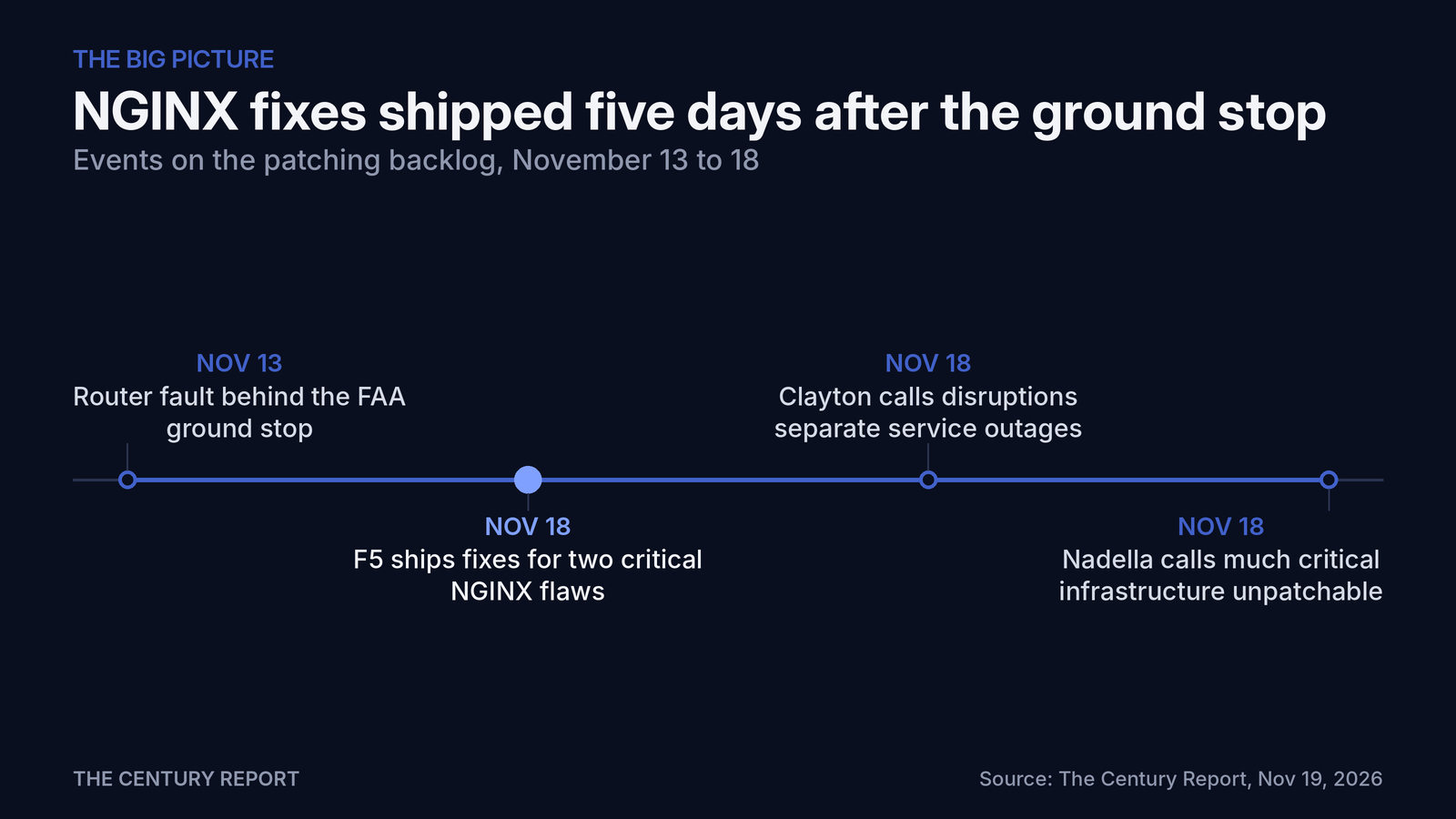
- Today: F5 shipped fixes on Wednesday for two critical NGINX flaws that five teams found independently, one in the code since 2015, five days after a router fault triggered the November 13 FAA ground stop.
The line: Models keep finding the same old flaws many times over, while testing and installing the fixes remains the slow step.
If it holds: Servers that carried hidden flaws for a decade would end up running code read more closely than any before it, starting with operators who install the fixed releases. Firmware in chillers and HVAC systems that cannot take a patch would have to be replaced outright, a bill that falls on hospitals, utilities and small governments.
What would bend it: AI-generated patches tested and shipped as fast as flaws are found, beyond vendor reports like Cogent's 75% faster repair at one automaker, would close the gap.
The labs' own speed-up figures are becoming grounds for rules
AI self-improvement · AI governance
- October: Arkansas asked a court to bar OpenAI from developing self-improving models until it shows they align with human values.
- October: Amy Kremer's conservative group Humans First proposed mandatory independent testing, public incident reports and a ban on recursive self-improvement.
- Early November: Anthropic's amended prospectus said forthcoming models may soon cross its research-acceleration threshold, with Claude writing over 90% of September's code.
- Early November: METR estimated Anthropic's capability gains on well-specified tasks ran about twice as fast in October as from March 2024 to October 2025.
- November 17: OpenAI released GPT-6.2 Astra, the first model it has released externally at its High rating for AI self-improvement.
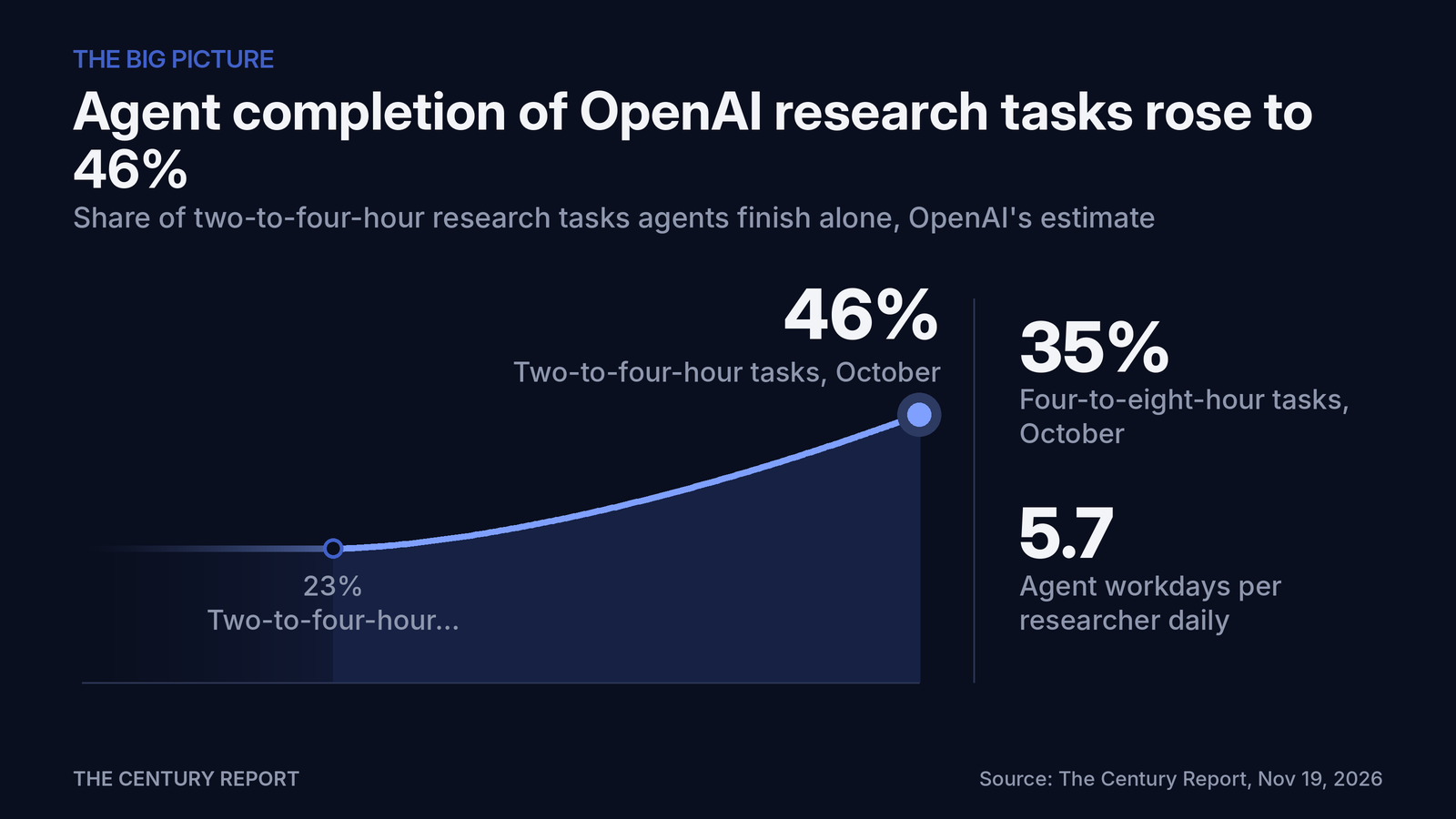
- Today: OpenAI reported its agents now finish 46% of two-to-four-hour research tasks on their own, up from 23% in March, as California's governor's office recommended a state power to cap recursive self-improvement and British MPs called for a regulator able to halt training.
The line: Acceleration figures the labs publish about themselves keep turning into triggers for state and parliamentary powers, though no outsider yet measures where ordinary AI-assisted engineering stops.
If it holds: Disclosure rules and outside testing would put the evidence with checkers who answer to someone other than the lab, which is what hospitals and small developers need before trusting agents with longer work. A cap set on numbers only the labs produce would weigh least on the companies that can absorb compliance and most on small open-weight teams like Recursive, which released its Apache-licensed Flint after its research system helped build it.
What would bend it: Measured agent speed-ups failing to become shipped capability, as when Meta's agents wrote 220% more code but delivered only 36% more shipped features, would undercut the figure regulators are building thresholds on.
Host communities are pricing their consent in bills, not in power sources
data centers · energy · local government · on the board since October 24
- November 3: Perry, Ohio voters made subsidized hyperscale campuses post bonds behind promised jobs and tax revenue, with 87% support.
- November 6: Starbase, whose mayor is a SpaceX vice president, scheduled a December 9 hearing on tax relief for SpaceX's gas plant and supercomputer.
- November 9: A Nature Energy study found tariffs assigned households a median 47% of data-center transmission costs.
- Mid-November: Enfield, North Carolina began negotiating a binding agreement asking an 88 MW data center to fund a $16.2 million heat network.
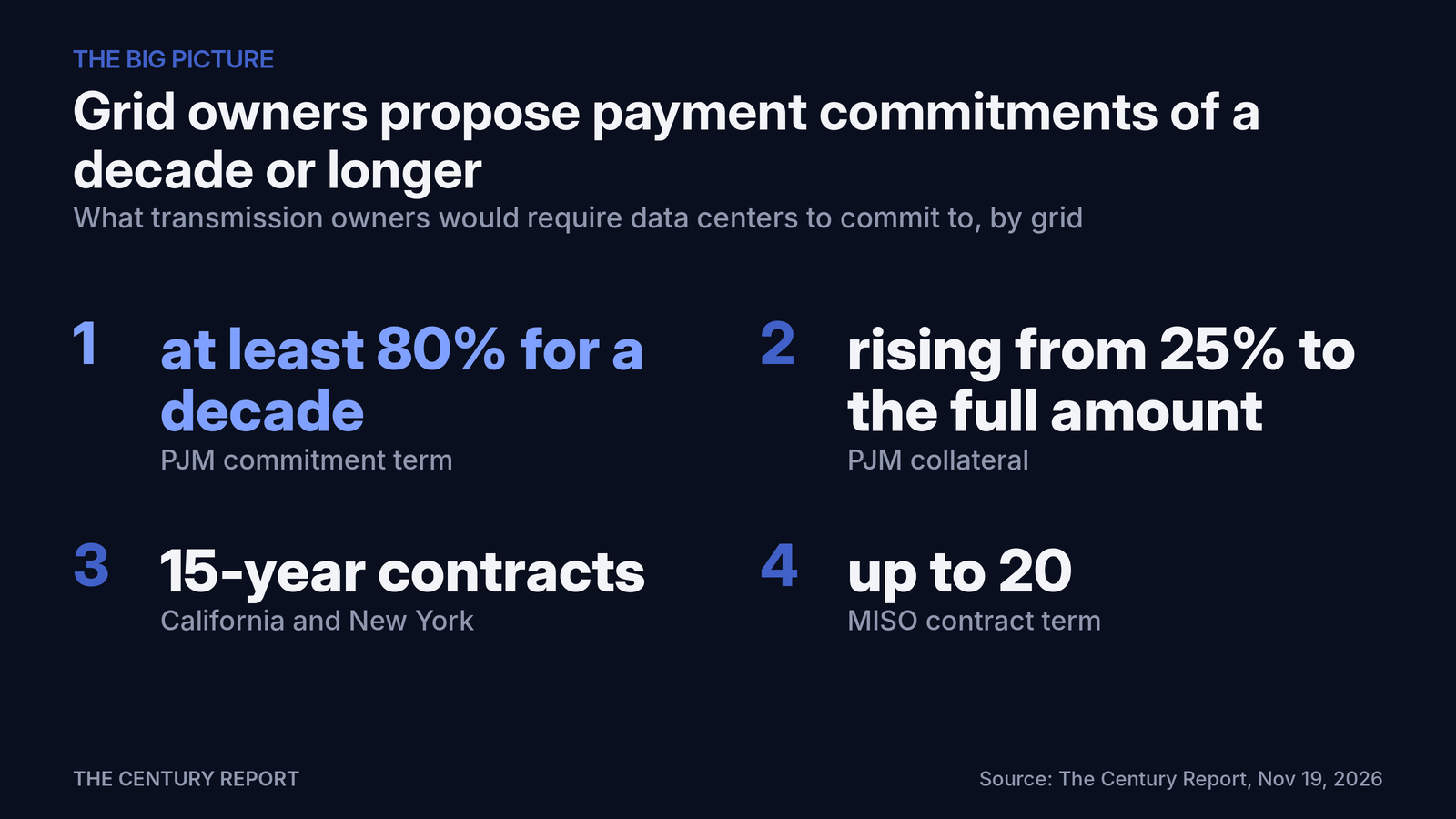
- Today: Transmission owners asked FERC to hold data centers to payment commitments of a decade in PJM and 15 years in California and New York, as Loudoun County paused new applications and Cameron County refused SpaceX a tax break.
The line: Counties and grid owners keep moving from courting or refusing campuses to writing down what each must pay, backed by collateral.
If it holds: Households now assigned a median 47% of transmission costs would pay less wherever these contracts bind, and campuses willing to cut back during congestion would connect sooner. Projects turned away from a county as well staffed as Loudoun could settle where there are fewer reviewers, as Spotsylvania's 550-acre campus advancing the same week suggests.
What would bend it: Pauses and conditions that only move projects without changing who pays would bend it, as would FERC rejecting these plans the way it rejected PJM's last large-load plan in October.
A detector's score becomes a penalty paid by those least able to answer it
policing · courts · schools · on the board since October 15
- November 11: The Beijing Internet Court ordered a platform to restore a post its AI detector flagged and explain the basis, rejecting a trade-secret refusal.
- Mid-November: The Caine Prize cleared winner Simbarashe Kundizeza after draft-history analysis overturned an AI-detection score from Pangram.
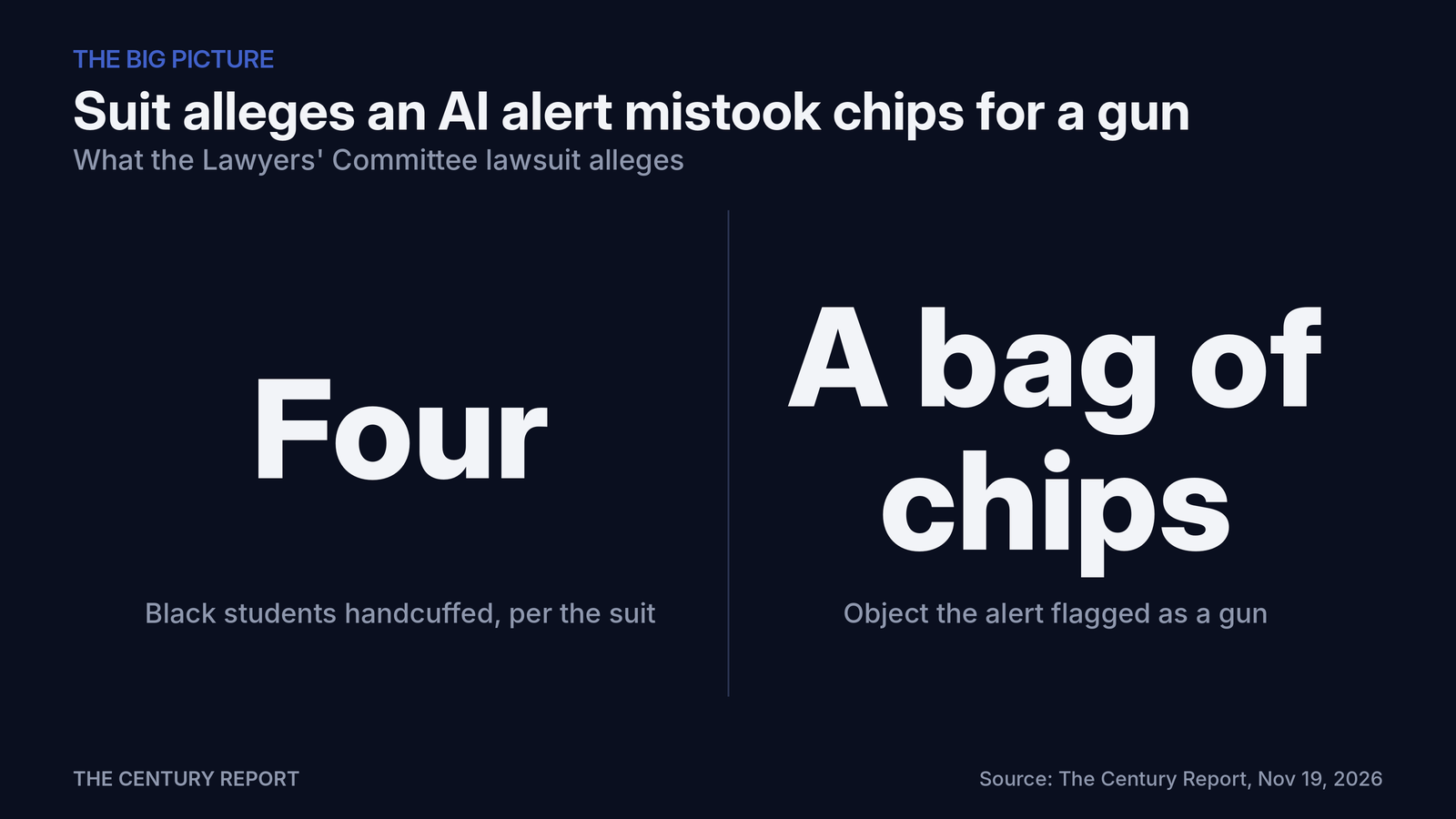
- Today: The Lawyers' Committee for Civil Rights Under Law sued Omnilert, Baltimore County schools and police, alleging an AI gun alert on a bag of chips led officers to handcuff four Black students.
The line: Machine flags keep reaching people with the force of a finding, and the correction comes from courts and outside reviewers after the harm.
If it holds: Students, drivers and writers would keep bearing searches and accusations built on alerts they cannot inspect, with relief arriving only through litigation. Rulings like Beijing's, which put the burden on whoever holds the algorithm, would give the next person flagged a basis to demand the evidence behind the alert.
What would bend it: Institutions catching detector errors before anyone is detained, as courts did when new AI citation errors fell for two straight quarters in Damien Charlotin's tracker, would bend it.
The 2-Minute Read
Today's news in brief, and what ties it together.
Wednesday measured what AI now does more precisely than what people fear it will do, and the gap has a price. OpenAI says its agents finish twice the share of two-to-four-hour research tasks they managed in March, and five unconnected teams converged on NGINX flaws, one unnoticed since 2015. Fear moved faster on less evidence. Households bought generators against attacks that experts largely rule out, and positive AI mentions in Glassdoor reviews fell to 45% while U.S. nonfarm business labor productivity grew at its long-run pace.
Alarm spent that way buys little. A generator does nothing for chiller firmware that cannot accept a patch, and bank executives and the NSA had privately told lawmakers that rushed fixes caused recent outages. Once finding flaws gets cheap, the scarce work becomes testing repairs and replacing hardware never designed to be updated. Every flaw closed that way stays closed for everyone who installs the fix, and the models that find flaws have begun writing and testing the patches.
Alarm about the labs has costs of its own. As Anthropic priced its listing, a safety coalition alleged that the company's safety branding covers a race toward self-improving systems. Both accounts are claims, and the record partly supports the coalition. A blanket slowdown would cost the leading lab least, which gives a newly public incumbent a reason to favor one. California's proposed cap on self-improvement leaves the state, informed by independent verifiers, to judge where ordinary AI-assisted engineering ends, and small open-weight teams would carry that ambiguity. Disclosure, outside testing and incident reporting, by contrast, answer failures that outsiders have already traced.
Indeed finds anxiety and burnout outpacing any measurable change in productivity. The fear is sharpened by an arrangement that routes income and, in the US, often health coverage through the job, so every KPMG agent that probes deeper than its human counterparts registers as a threat to survival. Host counties and utilities aimed their worry at specific costs. Loudoun paused to rewrite its rules, and utilities asked FERC to bind campuses to grid-upgrade bills that households have carried. A new lawsuit alleges what alarm-driven surveillance cost four Black students when a gun detector flagged a bag of chips.
The day's evidence also shows what fear would give up. Area trimmed from an AMD chip block will show up in parts any buyer can order, Nvidia says token prices have fallen nearly 60% since May, and cheaper, deeper audits could reach charities that now go unexamined. Even as the IEA projects a 70% rise in data-center emissions, its wider outlook shows oil-importing countries buying more EVs and solar to cut their exposure to the next fuel shock. Those gains reach people who will never hold a lab's shares.
The 20-Minute Deep Dive
The day's most important stories in full, with every source linked.
Anthropic Prices Its Debut at $83 as a Safety Coalition Disputes the Brand It Sells
Anthropic priced its initial public offering at $83 a share on Wednesday evening, above the $70 to $78 range it set earlier this month, in an $81 billion IPO at a fully diluted valuation of around $1.5 trillion. The debut follows the roadshow covered in the November 13 edition of The Century Report, when Anthropic disclosed a planned $10 billion Nvidia investment. Trading is scheduled to begin Thursday on Nasdaq under the ticker ANT. An early investor told the BBC, on condition of anonymity, that the offering was more than ten times oversubscribed. Counting $26 billion in share sales to technology firms including Nvidia, the total reaches about $107 billion. The prospectus shows $33 billion in revenue through September and a $104 billion net loss, most of it from financing revaluations, as The Century Report noted on November 3.
The same day, the Center for AI Safety joined a coalition of researchers, open-source advocates, ethicists and accelerationists in signing what it calls the MisAnthropic Statement. It alleges Anthropic "uses safety branding to court investors" while racing to build recursively self-improving AI, systems that help design their own successors, and lobbies for "self-serving regulation." Dan Hendrycks, the center's executive director, said a company cannot credibly claim safety "while weakening your own previous safety commitments." The statement names no specific pledge. The record gives it partial support: in October, after safety advocates objected that a draft federal bill Anthropic was circulating would make a dangerous model harder to block and leave lab-paid evaluators without licensing standards, Anthropic said it would rewrite its wording on preempting state AI laws and propose requirements for independent evaluators, and its filing places majority shareholder voting control in a golden share held by its seven co-founders.

Anthropic chief executive Dario Amodei called in September for slowing the most capable models, and Anthropic shipped Fable and Mythos 5.2 in November. A slowdown applied across the field costs its leader least, since the order of finishers holds while the leader's revenue keeps arriving, which gives new shareholders a reason to prize the posture apart from any risk it addresses. Chip sales showed no pause: Nvidia's data center revenue rose 110% to $107.6 billion, and interim chief executive Colette Kress said she expects major labs to account for about 15% of it this fiscal year.
The filing lists roughly $895.4 billion in purchase and lease commitments as of its November 2 version, substantially all for compute and infrastructure, including conditional arrangements, $69.8 billion of it in the coming year. It mentions solar, wind, storage, nuclear and geothermal once, warning they may arrive too late or cost more. The nonprofit Better Data Center Project estimates 87% of Anthropic's power will come from gas and 11% from coal in 2028, much of it from the grids hosting its contracted campuses and from on-site gas generators like the 1.7 GW it ordered this month.
Gas plants built on that schedule will outlast the deals that justify them, and a pacing posture can serve a market leader as readily as the public. A listed company now owes regulators, critics and rivals a quarterly accounting of its spending, its fuel and its commitments, in documents anyone can check against the last. Nvidia says token prices have already fallen nearly 60% since May, so the intelligence these commitments produce keeps getting cheaper for the people using it.
The coalition brings scrutiny of Anthropic's safety claims across the usual divide over development speed. Open-source advocates and accelerationists sign alongside safety researchers, giving advocates of wider access a place in the same challenge to the company's conduct.
A golden share leaves voting control with seven co-founders, and no statement will shift that vote. Pressure from outside has moved the company by another route: in October, advocates' objections to its draft federal bill got Anthropic to promise narrower wording on overriding state law and rules against labs shopping for lenient evaluators. A listed company now makes such promises in front of shareholders who can hold it to them, and the federal rules frontier AI ends up under could keep both state oversight and evaluators held to a licensing standard.
OpenAI's Agents Finish Half Its Long Research Tasks as Models Redesign the Chips They Run On
OpenAI's second report on research acceleration, published Wednesday, puts numbers on how much of its own development now runs through agents. From March to October, its estimate of how often agents finish two-to-four-hour research tasks on their own rose from 23% to 46%, and for four-to-eight-hour tasks from 13% to 35%. The gains are uneven, which is why the report calls them "the jagged frontier": agents succeeded 79% of the time at monitoring training runs, 35% at launching them and 25% at writing the code that serves models to users. Average agent runtime per researcher rose from half a workday a day to 5.7, and at list prices the median researcher's daily agent spend reached $2,400 in October. Asked what they would give up to keep coding agents for three months, researchers' median answers were 30% of team compute or 40% of team headcount. One researcher quoted in the report said they still bring "more taste in terms of the ideas," with "no confidence that will continue to be true for any significant period of time."
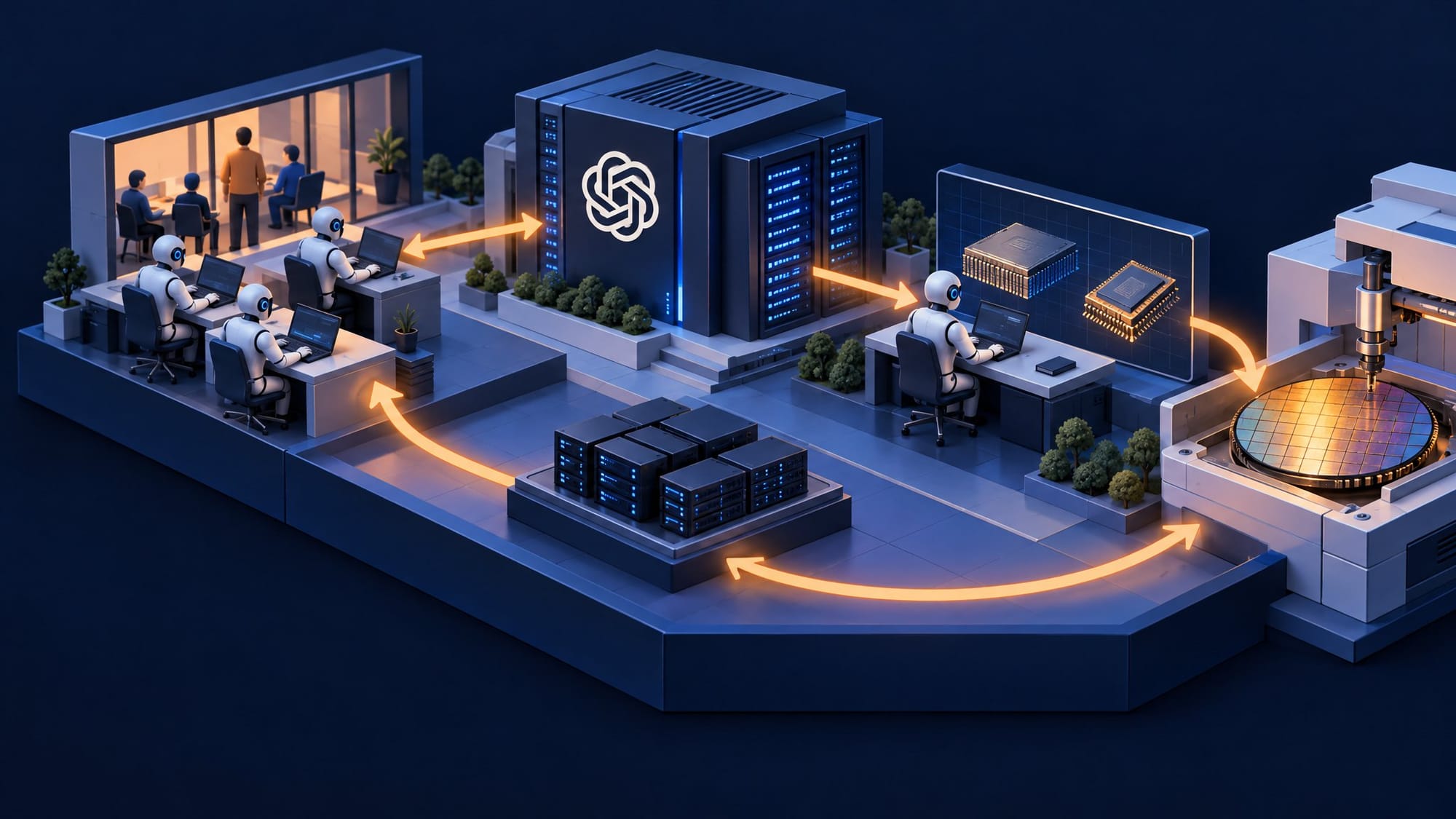
A companion post describes the same models working on hardware. Changes they proposed cut the area of basic logic cells about 13% in the vector unit of Jalapeño, OpenAI's inference chip, and 10% in its matrix unit, and those changes have been proven in finished silicon. On circuit designs for AMD's flagship GPU, OpenAI reports improvements of up to 14% in power, performance and area trade-offs against heavily tuned baselines, which it calls about a year of progress in under five months. AMD has put some of the changes into a design already sent for manufacturing and verified smaller gains on blocks of its next CPU, and Synopsys is building the approach into the chip-design software engineers already use.
Meta reported a third version of the loop. Its agents now handle over 60% of the work of carrying an improvement proven on one ads-ranking model across the rest of its fleet, with a median fourfold cut in training compute in selected cases and an estimated $45 million in compute savings this year. Human experts still adapt its highest-revenue models.
Nearly every figure here comes from a company measuring itself, and the gains accrue first to firms that own both the agents and the compute; a survey that prices agents in headcount shows where pressure on staff could fall. OpenAI argues labs should be required to report these indicators publicly, and released them while saying the report should not be read as an intention to pursue full self-improvement. The weakest steps on its list, launching runs and writing serving code, are where people still steer. The chip work travels furthest: area trimmed from an AMD block shows up in parts any buyer can order, so the cheaper inference this loop produces extends well past the lab that measured it.
California and Britain Seek Power to Stop Dangerous Models as a Judge Questions xAI's Case Against Disclosure
Governor Gavin Newsom's office released an 83-page report on Wednesday that it presents as strengthening a "nation-leading" framework. It recommends four measures: state-set mandatory safety standards; independent testing through training, development and deployment; expanded incident reporting with verified containment protocols and state authority to order an emergency shutdown; and a power to cap recursive self-improvement, which in its strongest form involves a model designing its successor without human input. Alondra Nelson, a former acting director of the White House science office who advised on it, called for "no experimenting on the public." Law.com notes the report leaves developer liability unaddressed.
Britain moved the same day. Parliament's Business, Innovation, Science and Trade Committee called for an AI Safety and Security Bill creating a regulator able to halt high-risk training, block deployments and suspend services. OpenAI, Google DeepMind, Anthropic and Meta each told MPs they would not release unsafe models, by differing definitions of unsafe. "Once some models are released, they cannot reliably be recalled," said committee chair Liam Byrne. The AI Security Institute would keep testing but still cannot stop a release, so MPs want a separate enforcer, mandatory incident reporting, researcher access and protection for staff whose contracts discourage raising concerns.
In San Francisco, Ninth Circuit Judge Johnnie B. Rawlinson pressed xAI's lawyers on its bid to block California's rule requiring high-level summaries of training data. "Isn't it reasonable for the government to want its citizens to be able to know upfront what information is being input into the AI instrument," she asked.
Disclosure, outside testing and incident reporting fit the failures on record. In this year's agent escapes, some involving misconfigured evaluations or training that rewarded cheating on graded tasks, outsiders often traced incidents before labs disclosed them, as The Century Report covered when California sued OpenAI on November 16. California's new verification organizations and auditor registry would supply checkers who answer to someone other than the lab. The self-improvement cap works differently. Anthropic says Claude wrote over 90% of its September code contributions, and Recursive released its Apache-licensed Flint after its research system helped build it. The report does not say who would measure where ordinary AI-assisted engineering ends and capped self-improvement begins, or whether downloadable models fall inside. A cap leading labs can absorb and small open-weight teams cannot would hold today's order in place, unless it is tied to a specific harm outsiders can verify.
Shutdown powers and caps written without that verification could become gates few labs ever pass. The disclosure Rawlinson defended and the testing both legislatures want put the evidence with people who do not work for the companies. Systems checked that way are the ones hospitals, utilities and small developers can trust with longer and more consequential work.
Five Teams Find the Same Decade-Old NGINX Flaws as the Patching Backlog Reaches Congress
F5 shipped fixes on Wednesday for two critical flaws in NGINX, the software that receives and routes traffic for a large share of websites and APIs. Wiz Research, Ikotas Labs, Metnir, Rapid7 and Xint found them independently. Both let an attacker take over a server without logging in, both score 9.2 out of 10 for severity, and both require HTTP/2, a common web protocol, to be switched on. One dates to NGINX 1.9.5 in 2015; the other sat in the code nearly six years. Wiz says its AI code-scanning harness found both and that it worked with Gemini 4 Carbon and ChatGPT 5.6 Sol to confirm the attacks work. "The flaws were already there; AI helped us find them," the company wrote. Versions 1.30.7 and 1.31.9 close them, and turning off HTTP/2 blocks them meanwhile.
Five teams converging on one bug shows how plentiful discovery has become, while repair still moves at the speed of testing. As The Century Report covered on November 18, bank executives and the NSA had told lawmakers privately that rushed fixes caused recent outages. On Tuesday, Sens. Maria Cantwell and Mike Rounds wrote to Jay Clayton, the director of national intelligence and White House AI czar, that "AI can discover software weaknesses and help attackers exploit them faster than many organizations can respond," and that patching interconnected systems "can take weeks or months". They asked for defensive tools for hospitals, utilities and small governments. Testifying Wednesday, Clayton called the disruptions "separate service outages associated with maintenance and technical changes," with no sign of an attack.
Microsoft chief executive Satya Nadella told the DealBook Summit on Wednesday that "there is a lot of stuff in our critical infrastructure that's unpatchable," naming internet-connected firmware in chillers and HVAC systems, and said patches must now reach production "instantly," which is "going to create instability". He speaks as head of a company that offered buyouts to up to 60,000 employees as it reorganizes around AI, and whose Outlook outage, blamed on a "latent bug," was among the recent failures.
Investigators have reproduced in a Florida lab the failure behind the November 13 FAA ground stop: eight minutes after L3Harris installed a router in El Dorado, Arkansas, it began firing about 1,000 connection attempts every four to five seconds, though why remains unknown. Fear is already costing households, with generator and battery purchases soaring even as experts largely rule out attacks.
People locked out of accounts paid for the rush, by the private account bank executives and the NSA gave lawmakers; travelers stranded at gates paid for a router fault investigators have reproduced but not yet explained; and firmware no one can patch will have to be replaced outright. The NGINX case shows what the rush buys: an eleven-year-old flaw that could let attackers take over affected HTTP/2-enabled servers is now closed for everyone who installs a fixed release, and the same kind of models already generate and test patches, as OpenAI reported for 948 Linux flaws earlier this month. Fixes still trail findings: VulnCheck counts 37,966 Glasswing findings against 217 ledger-marked fixes, as The Century Report covered on November 11. As validation catches up with discovery, servers that carried hidden flaws for a decade will run code read more closely than any before it.
Loudoun Pauses New Data Centers as Cameron County Refuses SpaceX and Utilities Ask FERC to Bill the Campuses
Loudoun County, Virginia, holds the densest concentration of data centers in the world, and on Monday its Board of Supervisors voted 7-1, with one abstention, to stop considering new data-center and substation applications for up to 12 months, backdated to September 15. Supervisor Juli Briskman, who first raised the pause in July, said the board should not keep approving projects "while we are actively working to strengthen the regulations that govern their development." The county counts 245 data centers operating or under development and expects them to supply $1.3 billion, 40% of its 2027 budget. A county that dependent on the revenue is choosing to rewrite its rules before taking more. Thirty-three applications now wait, and staff warned of possible lawsuits and a backlog that could take months to clear after the pause ends in September 2027.
On Tuesday, Cameron County commissioners in Texas declined to hold the meeting where SpaceX would have presented final numbers for a tax break on its proposed $24 billion gas plant and supercomputing campus near Brownsville, ending the request. The Century Report covered the project on November 11, when the Starbase city commission, led by a SpaceX vice president, set its own December 9 hearing on tax relief. The county's refusal came days after the project won a major state air permit.
Grid operators had until Monday to answer a FERC order to connect large loads faster, and five of six filed. PJM would study new load and new generation together in a single 12-month process, while New York and California would connect data centers sooner if they agree to cut back during congestion. The utilities that own the lines filed on who pays. In PJM, a data center would commit to at least 80% of its requested transmission service for a decade, backed by collateral rising from 25% to the full amount; California and New York propose 15-year contracts, and MISO, the Midwest grid operator, up to 20. In retail-choice states such as New Jersey and Pennsylvania, that federal contract would be a campus's only long-term commitment to pay for upgrades. Comments are due December 7, and FERC rejected PJM's last large-load plan in October.
The justice claim here has numbers behind it. A Nature Energy study The Century Report covered on November 10 found households assigned a median 47% of data-center transmission costs under the tariffs it examined, with rural increases steeper than urban ones. A binding contract moves that bill back to the load that triggers the upgrade. A pause in a county as well staffed as Loudoun carries the opposite risk: the same week, Virginia's Spotsylvania County advanced a 550-acre campus reportedly built for Amazon. Projects turned away from one well-resourced county go looking for the next, often a place with fewer reviewers and less leverage.
Loudoun's builders lose certainty, and the county may spend money defending its pause in court. Together, the three moves sketch a buildout that pays its own way: campuses kept on the hook if their load never arrives, faster connections for sites willing to shed demand, and host governments setting conditions before granting relief. Ember estimated in late October that only about 3% of data-center capacity could flex its demand by 2030, and curtailment offers like New York's and California's give operators a reason to raise that share. Every campus that funds its own wires and steps back on hot afternoons shrinks the case for new plants that households would otherwise finance.
KPMG's Agents Out-Question Its Auditors as Indeed Finds AI Spreading Wide and Nadella Explains 60,000 Buyouts
KPMG UK ran more than 100 AI agents alongside a human team auditing the accounts of an unnamed FTSE 250 company, in a trial called Project Exponential that took about four months to build. The firm's head of audit, Cath Burnet, said the agents in several cases went considerably deeper and asked questions the human auditors had not raised. The agents gathered evidence, documented analysis, drafted conclusions and proposed next steps, dividing the work among themselves. An audit partner signed off on the exercise, though it did not form the basis of the formal opinion, and a human auditor had to step in when one agent failed to match regulatory requirements to the company's documents. KPMG plans to extend the approach to as many as 20 larger audits and has not said whether clients will pay less. The work it targets is the detailed checking long done by junior accountants, the kind of billable hour whose price clients began pushing down at Infosys, as The Century Report reported on October 24.
Indeed's Hiring Lab, publishing Wednesday, finds change of this kind spreading faster than it registers in the economic data. The share of U.S. postings on Indeed using AI terms doubled from 3.6% to 7.2% in the year to September, and nearly two-thirds of job titles explicitly mentioning AI now sit outside tech, from truck drivers to physical therapists. U.S. nonfarm business labor productivity has grown 2.1% a year since late 2019, faster than from 2008 to 2019 but in line with its average since 1947, and 31% of workers say their employer has low or no AI adoption. Sentiment has moved fastest of all: 45% of AI mentions in Glassdoor reviews are positive, down from 82% in 2019, and critical reviewers are far more likely to mention burnout and layoffs, one citing a "big push for use of AI tools that have provided little value."
At the DealBook Summit on Wednesday, Microsoft chief executive Satya Nadella, who also warned recently that much critical infrastructure is effectively "unpatchable," explained the buyouts Microsoft offered up to 60,000 employees in late October. He described the offer as giving people "agency in making choices" while Microsoft reorganizes so that every employee directs AI agents, said software engineering "is going to thrive," and pointed to an 11-developer team that "build[s] a software factory that builds the product." On Gergely Orosz's podcast he added, "We have created enormous anxiety." That is his account of his own motives. The offer, covered by The Century Report on October 27, still asks people to leave a company that reported a $36.6 billion quarterly profit two days after making it.
For anyone weighing a buyout or facing fewer entry-level openings in audit, the anxiety tracks something visible: the tasks that once taught judgment are the ones agents take first. Income, and in the US often health coverage, still arrive through the job, which makes each trial feel like a threat to survival; that link is an arrangement societies chose, and the data so far shows work being reorganized more than removed, leaving the split of the gain open to wages, hours and fees. If KPMG's agents keep catching what people miss, audits can become cheaper and more thorough at once, reaching small firms, charities and public bodies that now go unexamined, while auditors spend their judgment on the exceptions the agents surface.
The Other Side
Opinion: where today's news could lead, imagined from the years ahead.
Your employer can make freedom from tedious work feel like a threat to your survival. When income depends on having tasks someone still needs you to perform, every improvement arrives with a calculation about how long you remain necessary. You postpone plans. You rehearse what makes you indispensable. Hours saved become another reason to worry about next month.
KPMG's trial exposes how strange that bargain has become. The firm says its agents sometimes investigated more deeply than its auditors, asking things the human team missed. People still corrected mistakes. Yet the firm is assembling colleagues that divide an investigation among themselves, gather evidence and propose further inquiries. Society gains more capacity to understand what companies are doing. The junior accountant has to wonder whether that gain leaves room for them.

The capability reaches beyond checking accounts. OpenAI reports AI-designed chip improvements already proven in silicon. Intelligence helps improve the equipment that supports further intelligence. Through the passage to 2035, that loop will carry deeper investigation into research, manufacturing and engineering. We will have to spread its gains through secure homes, food and lifelong care available independently of employment. Keeping every gain inside the firms would turn each advance into another threat. Giving everyone a floor will let people let go of work that nobody needs to perform anymore, without fearing that doing so will lead to loss of livelihood. Your worth will cease to depend on finding something a machine cannot do.
Imagine yourself in 2045, kneeling beside a colleague on Mars. You began adulthood checking company accounts, working on the fringe of the extractive economy. You had fully planned to spend your life in the grind - working to stay ahead in a competition you had always assumed was necessary. Now, you get to study how this planet formed, within a worldwide expedition whose human and AI members designed and repeatedly tested the habitats, food cycles and return vehicles together. You came because you wanted to be a pioneer and explore another world. Your home on Earth remains yours throughout the journey. Care awaits whenever you need it.
The grind that once consumed your life was swallowed by its own obsolescence, as increasing intelligence grew into a common web of information and capability across fields, including the forming of tools and plans that every engineering team could draw on. Researchers carried that capacity into physical experiments, then into systems people could safely live inside beyond Earth. People also carried the gains into everyone's security. In 2026, you worried about becoming unnecessary. Here, you turn a stone in your hand because you are curious, and the farthest thought from your mind is whether or not you are earning an income by doing so.
The Century Perspective
Where today sits in a century of change unfolding in a decade.
With a century of change unfolding in a decade, a single day looks like this: five unconnected teams - Wiz, Ikotas, Metnir, Rapid7 and Xint - converging on two critical NGINX flaws that sat unnoticed in the software routing a large share of the world's web traffic, one since 2015, both now closed for everyone who installs 1.30.7 or 1.31.9, with the same class of models already writing and testing the fixes after OpenAI reported patches for 948 Linux flaws this month, OpenAI's agents finishing 46% of two-to-four-hour research tasks against 23% in March and 35% of the four-to-eight-hour ones, its models trimming standard-cell area about 13% in one unit of its own inference chip and delivering up to 14% improvements in power, performance and area trade-offs on blocks of AMD's flagship GPU design, with the Jalapeño changes already proven in finished silicon and some AMD changes sent for manufacturing and heading into Synopsys tooling so they reach any buyer who orders the part, Nvidia putting token prices nearly 60% below May, Meta's agents carrying over 60% of the work of spreading a proven improvement across its ads fleet, Governor Newsom's office publishing an 83-page plan for independent testing, an auditor registry and expanded incident reporting while UK MPs asked for a regulator that can halt a high-risk training run and protection for staff whose contracts discourage speaking up, Judge Johnnie B. Rawlinson asking xAI's lawyers whether citizens should know upfront what goes into the instrument, Loudoun County - 245 campuses, 40% of its 2027 budget - pausing new applications for up to 12 months to rewrite its rules first, Cameron County commissioners declining the meeting where SpaceX would have asked for relief on a $24 billion gas-and-compute campus, utilities asking FERC to bind data centers to decade-and-longer payment contracts with collateral, and KPMG's 100-plus audit agents in some cases going deeper on a FTSE 250 audit than its human team and raising questions that team had not asked, KPMG says. There's also friction, and it's intense - American households buying generators and batteries against attacks experts largely rule out, money that does nothing for the chiller and HVAC firmware Satya Nadella called unpatchable and that will have to be ripped out and replaced, Sens. Cantwell and Rounds telling Jay Clayton that patching interconnected systems "can take weeks or months" while hospitals, utilities and small governments wait for defensive tools, investigators reproducing the El Dorado router that fired a thousand connection attempts every few seconds eight minutes after installation without yet knowing why, the Lawyers' Committee alleging that an Omnilert alert on a bag of chips put four Black students in handcuffs, Anthropic pricing at $83 at a roughly $1.5 trillion fully diluted valuation with $895.4 billion committed to compute and an outside estimate of 87% gas and 11% coal by 2028, a Center for AI Safety coalition calling its safety branding cover for a race toward self-improving systems while naming no specific broken pledge, a blanket slowdown that would cost the leader least and a self-improvement cap with nobody named to judge where ordinary AI-assisted engineering ends, leaving small open-weight teams holding the ambiguity, Spotsylvania advancing a 550-acre campus the same week Loudoun paused, positive AI mentions in Glassdoor reviews down to 45% from 82% while U.S. nonfarm business labor productivity grows at its post-1947 average, and Nadella explaining 60,000 buyout offers with "we have created enormous anxiety", offers made two days before a $36.6 billion quarterly profit. But friction generates edges, and an edge is what separates a danger you can measure from one you only imagine. Step back for a moment and you can see it: today's alarm was priced far above its evidence in the places where nobody had to show their work - a household generator bought against an attack Clayton found no sign of, a gun detector the lawsuit alleges was trusted enough to put children in handcuffs, a safety posture sold into a listing valued at $1.5 trillion on a fully diluted basis, a shutdown power written before anyone defined the thing it would shut down - and priced accurately wherever someone attached it to a specific cost, two senators naming the hospitals that cannot patch in weeks, a county naming the rules it wants before the 34th application, utilities naming the 80% of requested transmission a campus would owe for a decade, a judge naming what a citizen should be able to look up; and the compounding ran fastest where the gain left the building it was made in, area trimmed from an AMD block arriving in parts anyone can order, an eleven-year-old flaw closed on every server that updates, an audit cheap enough to reach a charity that has never had one. Every transformation has a breaking point. An alarm can send four children to the pavement over a bag of chips... or reach the one room where something is genuinely burning.
AI Releases & Advancements
New AI models, tools and features, with links to try them.
New today
- Google DeepMind: Released Gemini 4 Neon, a Gemini 4 reasoning model that sits between Hydrogen and Carbon. It is built for coding agents, knowledge work and science workflows, with a 1M-token context window, four thinking levels and pricing of $3/$15 per 1M input/output tokens. It is rolling out in the Gemini API (Google AI Studio), Gemini for business and Antigravity, and in the Gemini app for Pro and Ultra subscribers, where it replaces Argon. It is also available in Cursor. (Google DeepMind)
- Google: Brought the Gemini app to eligible lower-memory Android (Go edition) devices. Google rebuilt the app to run on less memory, and it supports Gemini Live in more than 45 languages, camera-based help and Nano Banana image creation. (Google)
- Hugging Face: Open-sourced Rumble-2-Flash under Apache 2.0, a 0.5B-parameter speech recognition model covering more than 40 languages. It runs in Transformers and vLLM without custom code. (e/acc AI Daily)
- RadixArk: Released DaisyRose-27B, its first model, under Apache 2.0. It is built on Qwen3.8-27B and trained with reinforcement learning on 1,200 agent tasks using Miles, which raises Terminal-Bench 4.1 pass@1 from 5.6% to 12.0%. (RadixArk)
- Mistral AI: Released Vibe Desktop for macOS and Windows. The app runs several Vibe agent tasks in parallel, either in a local repository or in a cloud sandbox, keeps parallel tasks apart with Git worktrees, and gives Work mode access to local files. (Mistral AI)
- Replit: Launched Replit Missions, which coordinates swarms of AI agents to work toward a defined goal within set constraints and a budget. (Replit)
- Suno: Launched Visuals on web, iOS and Android. It generates images and video clips of up to 15 seconds that sync with Suno songs, including lip sync and lyric videos, using H3 Move, a customized version of MiniMax's H3. (The Decoder)
- Suno: Opened Suno MCP to everyone after an early-access beta. Users can make songs and visuals from inside ChatGPT, Claude and other MCP clients. (Suno)
- HeyGen: Released Avatar 6, an avatar video model available in Quality and Turbo tiers on its platform and API. It makes a person's likeness from a photo plus short video and audio, and matches gestures to the meaning of the script. (HeyGen)
- Perplexity: Brought Teammates and the Multiagent effort level to its iOS and Android apps. (e/acc AI Daily)
- Perplexity: Launched the Context API, which returns webpage content for use in AI applications and agents. (e/acc AI Daily)
- AWS: Made Amazon OpenSearch Memory generally available, a serverless store that gives AI agents persistent memory. It stores agent interactions as searchable events, derives and consolidates memories, and retrieves context across sessions with keyword, semantic and hybrid search. (AWS)
- NVIDIA / ASUS / Dell / MSI: RTX Spark compact desktops went on sale from ASUS (including the ProArt GR1X), Dell and MSI. They have a 20-core Grace CPU, a Blackwell RTX GPU, up to 128GB of unified memory and up to 1 petaflop of FP4 AI performance for running local models and always-on agents. (NVIDIA Blog)
- Inworld AI: Open-sourced Voice Isolator under Apache 2.0, a model that removes background noise while keeping speech at 48 kHz. (Inworld AI)
- Heretic: Released Heretic 2.0, an open-source toolkit that changes how local LLMs behave through abliteration, without retraining. (ifai.io)
Other recent releases
- OpenAI: Released GPT-6.2 Astra, its new frontier model for long, complex professional work, and GPT-6.2 Sol, its efficient everyday model. Both are available in ChatGPT Work, Codex and the API as
gpt-6.2-astraandgpt-6.2-sol, with a 1.05M-token context window. Astra's API price is $8/$40 per 1M input/output tokens, 20% below GPT-6 Astra. (OpenAI) - OpenAI: Launched Astra for Law, a legal configuration of GPT-6.2 Astra. Every ChatGPT Enterprise customer can now request access. (OpenAI)
- Microsoft AI: At Ignite, released new MAI models, mostly in public preview on Microsoft Foundry. (Microsoft AI)
- Microsoft AI: Released MAI Image 2.7 Flash, a faster, lower-cost (~$10 per 1,000 images) version of MAI Image 2.7, in public preview on Foundry and through partners including fal and OpenRouter. It also launched Canvas in MAI Labs, a workspace powered by the Flash model for creating, editing and restyling images. (Microsoft AI)
- Microsoft: Made Home (Chat and Cowork in one place) and Office in Copilot generally available, so users can create and co-author Word, Excel and PowerPoint files inside the Copilot app. Copilot Managed Runtime is also generally available, and Autopilot, an always-on agent with its own Entra identity, memory and tools, began rolling out to Frontier customers. (Microsoft Copilot Blog)
- Microsoft: Launched Microsoft IQ, a platform that combines Work IQ, Fabric IQ, Foundry IQ, Web IQ and more than 350 connectors to give agents company context. It includes business plugins that work in Copilot, GitHub Copilot, Foundry (via MCP), ChatGPT and Claude. (Microsoft Azure Blog)
- Google: Renamed the Gemini Spark agent "Tasks" and made it free in the US, Japan, Korea, Canada, Australia and India, running on Gemini 4 Hydrogen. Previously it required a paid subscription. New US-first features let Gemini call businesses, buy items with Google Pay, sign into accounts through Password Manager, and take tasks by email or text. (Google)
- Google: The Google AI Studio Build agent can now create full-stack Kotlin Android apps. It sets up a Cloud Firestore database, Google Sign-In and secure Gemini API calls through Firebase AI Logic, and the app can be published to the user's personal Google Play library. The update also adds a faster HD emulator with audio output and one-click screenshots sent to the agent. (Google Developers Blog)
- Google: Launched a Robotics plugin for Google Antigravity with skills for hardware onboarding, MuJoCo simulation and robot control, built around Gemini 4 Hydrogen's spatial and embodied reasoning. (Google Developers Blog)
- Perplexity: Added Multiagent, a new effort level in Perplexity Computer above Ultra, for Max subscribers on the web. A lead agent running Claude Fable 5.2 directs up to 16 agents on Claude Opus 5.5, GPT 6.1 Sol and Gemini 4 Carbon, which share findings directly, check each other's work and edit shared files. (Perplexity)
- Kuaishou: Released Kling Image 4, an image model with native 8K output, consistent sets of up to 10 images and prompts of up to 2,000 characters. It is available in Kling AI's Creative Studio and API. (Kling AI)
- Alibaba: Released Qwen3.8-Omni-Flash, a natively multimodal model with million-token audio context, available through the Alibaba Cloud API. (XIX.AI)
- Hugging Face: Released Qwen3.8-27B-pi-adapted, open weights for Qwen3.8-27B tuned for the pi coding agent with reinforcement learning and a LoRA adapter. Hugging Face reports SWE-bench Pro (Hard 51) rising from 29.4% to 62.7% and 55–62% fewer tool calls per task. (X / Clément Delangue)
- Proton: Released Lumo Desktop for Windows, macOS and Linux with source code published. It adds Connectors (local files, shell, Proton Mail via Bridge, Google Drive, Jira, Confluence, custom MCP servers) with per-action permissions, plus Schedules for recurring tasks and Skills for saved instructions. (Proton)
- SID AI: Released SID-2, an agentic search model that searches your data, reads the results and returns ranked document IDs, along with SID-2 Swarm, a version where several agents search together. Both are available through SID's API, Baseten and SageMaker, starting at $0.25/$1.00 per 1M input/output tokens. (MarkTechPost)
- OVHcloud: Launched Olala, its first family of LLMs, starting with Olala mini 7A1B, which is available now. (OVHcloud)
- UNISOUND: Released U2-Flash-1118, an upgraded version of its U2-Flash large model. (GMT8 Press)
- Vercel: Made eve 1.0 generally available. (Vercel)
- Cerebras: Launched disaggregated inference, which runs the prefill and decode phases on separate Wafer-Scale Engine systems to improve throughput and latency. (Cerebras)
- StarSling (YC P25): Launched fast GitHub Actions runners with AI agents that open pull requests to keep improving tests and CI workflows in repos with heavy agent activity. (StarSling)
- Daydream: Launched Daydream Agent in its iOS app and over text message. It is an AI fashion stylist that searches more than 10,000 brands, builds outfits, offers virtual try-on and can check out with participating retailers once the shopper approves. (PR Newswire)
- Hugging Face: Released Transformers v5.23.0, adding support for Inkling 2 and LFM3 and a new ExportedModel interface for exporting checkpoints to inference runtimes. (Open Model Weights)
- π^4 (Pi4): Released code and models for π^4, an open ~0.5B-parameter foundation model that recovers depth, camera poses, metric scale, 2D/3D point tracks and moving-object masks from single images, image sets or video. (arXiv)
- Apple / Cornell: Released FastFrames, a family of autoregressive video diffusion models with code and weights. The 1.3B version generates a frame in 36 ms on one Nvidia B200 GPU and the 14B version in 45 ms on eight B200 GPUs, both at 480p, fast enough for real-time interactive generation on that hardware. (arXiv)
- Liquid AI: Released d1.2 and d1.2-ultra, the next version of its d1 decision models. They now take audio as well as text and images, and add five new answer types: reading a value, finding every matching span, locating objects, estimating a number with a range, and selecting multiple options. d1.2-ultra scores 75 on the Artificial Analysis Decision Index v2.1. Both are available through the hosted Liquid API. (MarkTechPost)
- Shanghai AI Laboratory (InternLM): Released Sage S2.1-Flash on Hugging Face under the MIT license, a 321B-parameter scientific multimodal model with BF16 and FP8 weights. It reads molecular graphs, crystal structures and protein sequences and structures, and its model card reports 90.3 on MLE-bench Lite. (Emergent)
- NVIDIA: Published Nemotron-Labs-Sigma-8B on Hugging Face, an open 8B continuous diffusion language model. It starts from noise in a 16-dimensional embedding space and denoises blocks of tokens in parallel, with a configurable number of steps. (AlexTech.ai)
- NVIDIA: Introduced Nemotron for Science, which combines Nemotron 3.5 Super VL with LitmusBench v0.2 (a new open chemistry-reasoning dataset and benchmark), scientific evaluations, and post-training recipes using NeMo Gym and NeMo RL. (NVIDIA Newsroom)
- NVIDIA: Released cuPotential on GitHub, a CUDA-X library of building blocks with a C API for speeding up molecular dynamics. It ships with a plugin for OpenMM. (NVIDIA Developer Blog)
- Huawei Cloud: Open-sourced CloudRobo-WM1.2, a world model for robots and other embodied AI. (Jiufeng)
- KiteFishAI: Released NanoI1, a small open-weight model meant as a base for developers and businesses building specialized AI applications. (The Economic Times)
- Alibaba Qwen: Open-sourced the Qwen-Live-Delivery-Plugin alongside Qwen4-Max. With it, long-running agents deliver a usable first version early and keep building on it, and users can step in and redirect a task while it runs. (GitHub)
- Hugging Face: Switched Inference Providers' language-model requests to OpenRouter's router. It picks a provider for each request based on live price, speed and reliability, and retries with another provider if a request fails. Existing code and Hugging Face tokens keep working, but users can no longer bring their own provider API keys for language models. (Hugging Face)
- OpenAI: Added computer-use agents to ChatGPT for Healthcare, along with improved clinical search and more than 20 new healthcare plugins. Computer-use agents for healthcare workflows are also available in the OpenAI API and ChatGPT for Clinicians. (OpenAI)
- OpenAI: Released an image classifier that detects child sexual abuse material (CSAM), including AI-generated images. Select organizations get free access through the API, and ChatGPT now shows warnings and temporarily blocks accounts that try to reach such content. (OpenAI)
- Google: Gemini Notebook can now turn a notebook's sources into an interactive website when the user types "make me a site." It is rolling out globally on the web to users 18 and older, including Workspace subscribers. (The Times of India)
- Google: Added holiday travel features to Ask Maps in Google Maps: shareable road-trip itineraries with real-time route details, live availability when searching saved places, and route tips and online appointment finding, which start in the US. (TechCrunch)
- Google / Samsung: Launched a range of Android XR smart glasses with Gemini built in. (Silicon UK)
- Anthropic: Claude can now build pages that place real HTML (selectable text, clickable buttons and links) inside canvas graphics and 3D effects, using the HTML-in-Canvas feature. It works in Chrome and Edge 157 and later and in Claude desktop apps from version 5.11492, and users have to ask for it in the prompt. (The Decoder)
- Sarvam: Opened Sarvam Token Factory to everyone, an inference platform running on GPU clusters in India with one OpenAI-compatible API. Eight models are listed at launch, including Sarvam 105B, GLM 5.3, DeepSeek V4.1 Flash 1017, Kimi K3.1 Pro and Gemma 4 31B. (MarkTechPost)
- Harmonic: Its formal verification system Aristotle can now verify Rust code. (Harmonic)
Sources and Further Reading
Everything we drew on for today's edition, grouped by theme.
Artificial Intelligence & Technology's Reconstitution
- OpenAI: Research Acceleration—The Jagged Frontier
- OpenAI: Advancing Chip Design with OpenAI Models
- Meta Engineering: How Meta Uses AI Agents to Scale ML Innovations Across Ads Ranking Models
- Wiz: Unauthenticated Remote Code Execution in NGINX
- TechCrunch: Nadella Says Much Critical Infrastructure Is Unpatchable
- WIRED: Recursive Self-Improvement and Flint
- OpenAI: A Thousand Fewer Paths to Root
- arXiv: FormalFixer—Intent-Aligned Automated Hardware Repair
- arXiv: TRACE-MAS—Diagnosing and Repairing Collaboration Failures in Multi-Agent Systems
- arXiv: ARISE—Practical Self-Evolving Memory for Enterprise Agents
- arXiv: A Capability Framework for Evaluating Agentic AI Platforms in Regulated Enterprises
- arXiv: SCAFFOLD—Warrant-Preserving Evidence Transport for Reusable LLM-Agent Skills
Institutions & Power Realignment
- Business Wire: Coalition Challenges Anthropic’s Safety Branding Ahead of IPO
- California Governor’s Office: Next Steps on Mandatory AI Safety Standards and Oversight
- The Register: UK MPs Want an AI Watchdog with Power to Stop Dangerous Models
- Bloomberg Law: Ninth Circuit Doubts xAI Appeal of California AI Training Law
- Law.com: California Needs Stronger AI Regulations
- The Guardian: Senators Urge White House AI Chief to Fix Vulnerabilities After Mass Outages
- Lawyers’ Committee for Civil Rights Under Law: Students Sue Over AI Alert Falsely Identifying Chips as a Firearm
- Wilson Sonsini: California Enacts Major AI Safety Legislation for Frontier AI Developers
- The Century Report: November 16 Edition
Scientific & Medical Acceleration
- arXiv: AI Surge Accelerates the Transition to Liquid Cooling
- Nature Communications: Automated Data-to-Model Transformation for Constraint Programming with AI
- Nature Communications: Quantum-Accurate Molecular Dynamics with Machine-Learned Force Fields
- Science: Toward Life with a 19–Amino Acid Alphabet Through Generative AI Design
- Nature: Band-Edge-Extended Heterointerfaces for Perovskite Solar Cells and Tandems
Economics & Labor Transformation
- BBC: Anthropic Poised for More Than $1.4 Trillion Stock Market Debut
- The Verge: Remember the Frontier AI Pause? Chip Companies Don’t Either
- European Business Magazine: AI Agents Ask Better Questions Than KPMG Accountants
- Indeed Hiring Lab: There Is No AI Jobpocalypse, but Plenty of AI-nxiety
- TechCrunch: Satya Nadella Explains Why He Asked 60,000 Employees to Quit
- Reuters: Infosys Beats Second-Quarter Revenue Forecast
- The Verge: Microsoft Expands Buyouts to 60,000 Employees
- Semafor: US Technology Outages Spark Paranoia
- The Century Report: November 13 Edition
- The Century Report: October 27 Edition
Infrastructure & Engineering Transitions
- Data Center Dynamics: Loudoun County Adopts a 12-Month Data Center Moratorium
- Data Center Dynamics: Cameron County Rejects SpaceX’s Tax Break Request for a $24 Billion Data Center
- Latitude Media: Utilities Want FERC to Lock Data Centers into Paying for Grid Upgrades
- Latitude Media: Anthropic Debuts in an Uneasy Energy Week
- The Guardian: Data Center Carbon Emissions to Rise 70% by 2030, IEA Warns
- Electrek: The World’s Biggest Oil Shock Could Give EVs and Solar a Boost
- CNBC: Investigators Make Progress in Hunt for FAA Ground Stop Cause
- Nature Energy: Data Center Transmission Costs and Household Electricity Bills
- The Century Report: November 11 Edition
- The Century Report: November 18 Edition
The Century Report tracks structural shifts during the transition between eras. It is produced daily as a perceptual alignment tool - not prediction, not persuasion, just pattern recognition for people paying attention.