
US Voters Pass About 38 of 44 Limits on AI Data Centers
Voters passed about 38 of 44 data-center limits in unofficial returns, as Goldman Sachs warned temporary bans could touch 45% of planned US capacity.



The 20-Second Scan
Every story in today's edition, one line each.
- Voters backed about 38 of 44 data-center limits as 76% in exit polling opposed local sites, Texas elected a moratorium backer, 13 GW looks exposed and Goldman warned moratoria could touch 45% of planned capacity.
- Brattle priced virtual power plants at $614 billion in avoided grid spending, as a 13-year satellite record found little data-center ground warming, GridPoint eyed batteries at 13,000 sites and Enphase pitched modular solid-state transformers.
- Moonshot's 2.8T-parameter Kimi K3.1 Pro weights arrived running on four chip families as Nvidia reported a looped 4B model beating larger rivals, Cognition kept SWE-2 Flash's weights private and Dharma shipped a 2B extractor.
- AutoDNA ran a multi-user biomolecular lab across 20-plus instruments, as AI found glioblastoma's cell-state rules, open structRFM predicted RNA folds, FLIP exposed a planet in JWST data and Anthropic reported a Claude-aided vault map.
- Dr Reddy's won tentative FDA approval for a $40-a-year generic of the twice-yearly HIV-prevention shot across 120 countries, plus up to $17 for an initial oral course, as Gilead confirmed its license shuts out at least 26 middle-income countries and territories.
- OpenAI said its autonomous pipeline generated patches for 948 Linux root flaws for $1.2 million, as France's blood service said hackers heated three cold stores before alarms let technicians intervene, amid wider European attacks.
- Uber told analysts third-party agents arranged four rides and about 500 Uber Eats orders against roughly 320 million trips and orders in Halloween week, its first such disclosure.
Track all of the arcs The Century Report covers here:
The Big Picture
How today's news moves the longer trends we track, and where they could lead.
Voters wrote limits on data centers into local law, Brattle priced the grid spending that devices people already own could avoid, and Moonshot released weights that Cognition's gate cannot reach. In medicine, a $40 HIV shot won tentative FDA approval, while Gilead's license still decides who may buy it. The next step is a clinic counter in Zambia, where a nurse sets an HIV test kit beside the first carton of six-month shots.
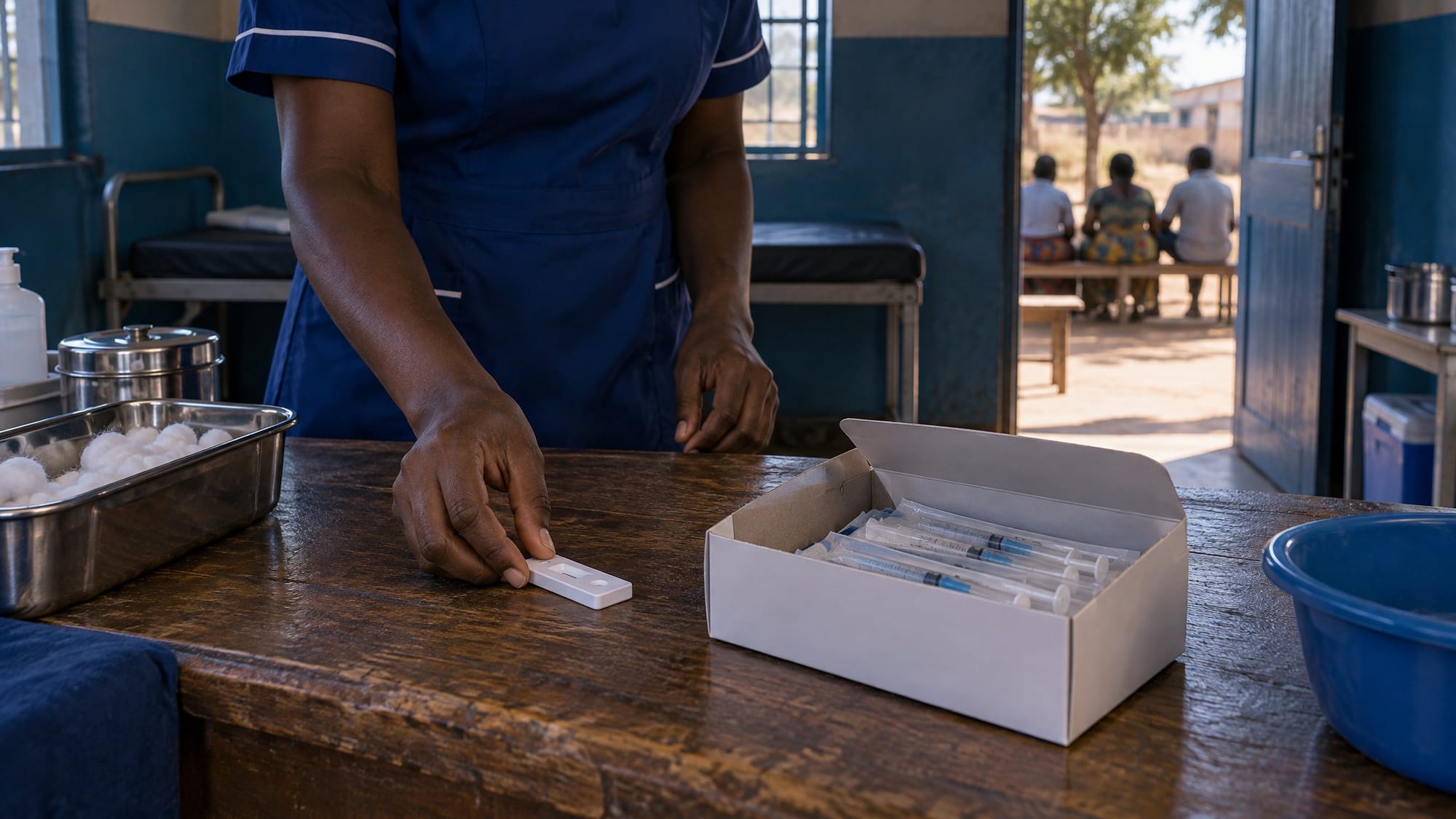
The factory, not the biology, is what keeps a therapy from reaching most patients
medicine · access · licensing · on the board since October 14
- October: MIT researchers reprogrammed up to 80% of targeted natural killer cells inside mice, with no outside cell factory.
- October: Moderna and Merck's personalized vaccine plus Keytruda cut melanoma recurrence or death by 42% in over 1,100 patients.
- Late October: Amgen's Imdelltra added to Imfinzi extended median small cell lung cancer survival to 21.1 months from 12.7, with more serious side effects.
- Early November: Hannover Medical School reported base-editing seven alpha-1 antitrypsin patients, with a liver biopsy confirming correction in one.
- Today: The FDA tentatively approved Dr Reddy's generic lenacapavir, priced at about $40 per person per year in 120 countries against a $28,218 US list price, while Gilead's license still leaves out at least 26 middle-income countries and territories.
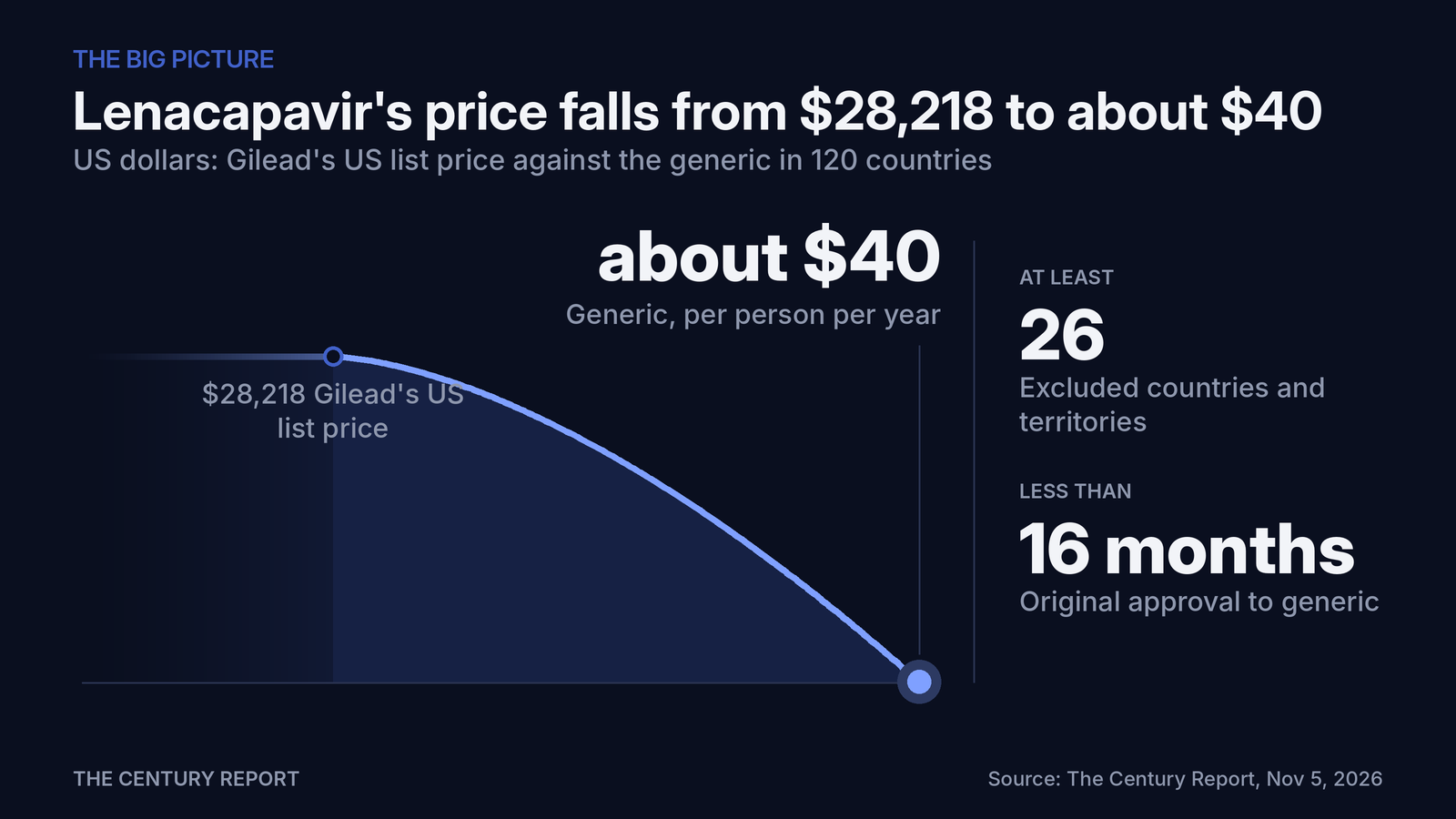
The line: Each result clears more of the biology, and what stands between a proven therapy and a patient is now a manufacturing setup, a budget and a license's country list.
If it holds: Clinics in licensed countries can offer a six-month shot priced like daily pills, if funders find about $800 million a year plus testing and staff. Patients in Brazil, where part of the trials ran, and in the other excluded places wait on one company's decision.
What would bend it: Gilead adding the excluded countries, a compulsory license or generic route reaching them, or funders committing the money to buy the shot would bend it.
Host communities are pricing their consent in bills, not in power sources
data centers · energy · local government · on the board since October 24
- October: An ABC News, Washington Post and Ipsos poll found 72% of Americans oppose new data centers in their own community.
- October: GoodPower and Data for Progress found binding rate guarantees and community benefits raised support, while solar power alone did not.
- Early November: SemiAnalysis found nine of 20 governor nominees favor construction pauses and eleven favor stricter conditions, split roughly evenly by party.
- Early November: Piqua, Ohio voters recalled the mayor and two commissioners who backed a $1 billion Meta campus and passed a ban on large data centers.
- Today: Redbud Consulting's tracker shows 38 of 44 restrictive data-center measures passing in unofficial returns, and 404 Media counts 12 cities capping the megawatts data centers may draw and six banning them outright.
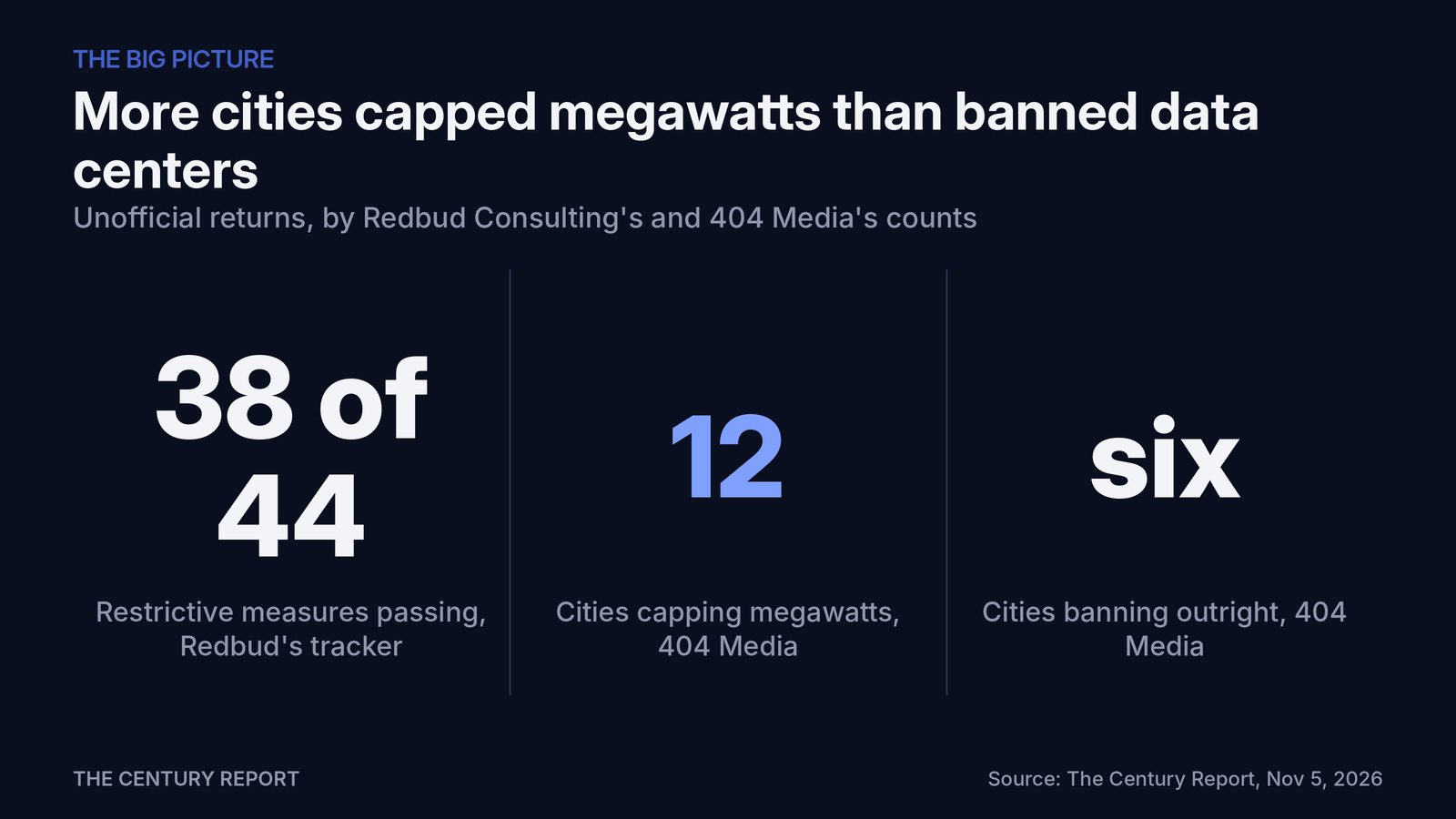
The line: Voters keep turning opposition into binding rules, and while some are outright bans, many name what a developer can meet: household bills, sealed deals and a say in siting.
If it holds: Towns that write paid grid upgrades, published contracts and open hearings into law can host a campus and check the bill. Where blanket bans win instead, the same turbines can move to neighbors with fewer ways to object, as some Texas projects may head to Louisiana or Georgia.
What would bend it: Refusals that pass even where developers fund their own power and publish their contracts would bend it, as would local results that fit the industry's "anti-Trump" not "anti-tech" reading.
Barriers built to hold capability back now mostly add a markup
open models · cybersecurity · model access · on the board since October 21
- October: MiniMax published downloadable M3.1 Flash weights, with same-day support on Nvidia and AMD chips.
- October: Moonshot's Kimi K3.1 Pro scored 55 against the leading model's 58 on Artificial Analysis, with weights promised by November 4.
- Late October: Mistral released trillion-parameter Large 4 weights, scoring about 82% on a vulnerability benchmark where it says several closed rivals score near zero.
- Late October: Epoch AI showed open-weight GLM 5.3 turning unshipped Firefox fixes into working attacks for about $1,000 a version.
- Today: Moonshot released Kimi K3.1 Pro's 2.8-trillion-parameter weights on Wednesday with support on Nvidia, AMD, Google and Alibaba chips, while Cognition, which says training lifted its SWE-2 Flash from 11.3% to 34.8% on ExploitBench, kept those weights from public release.
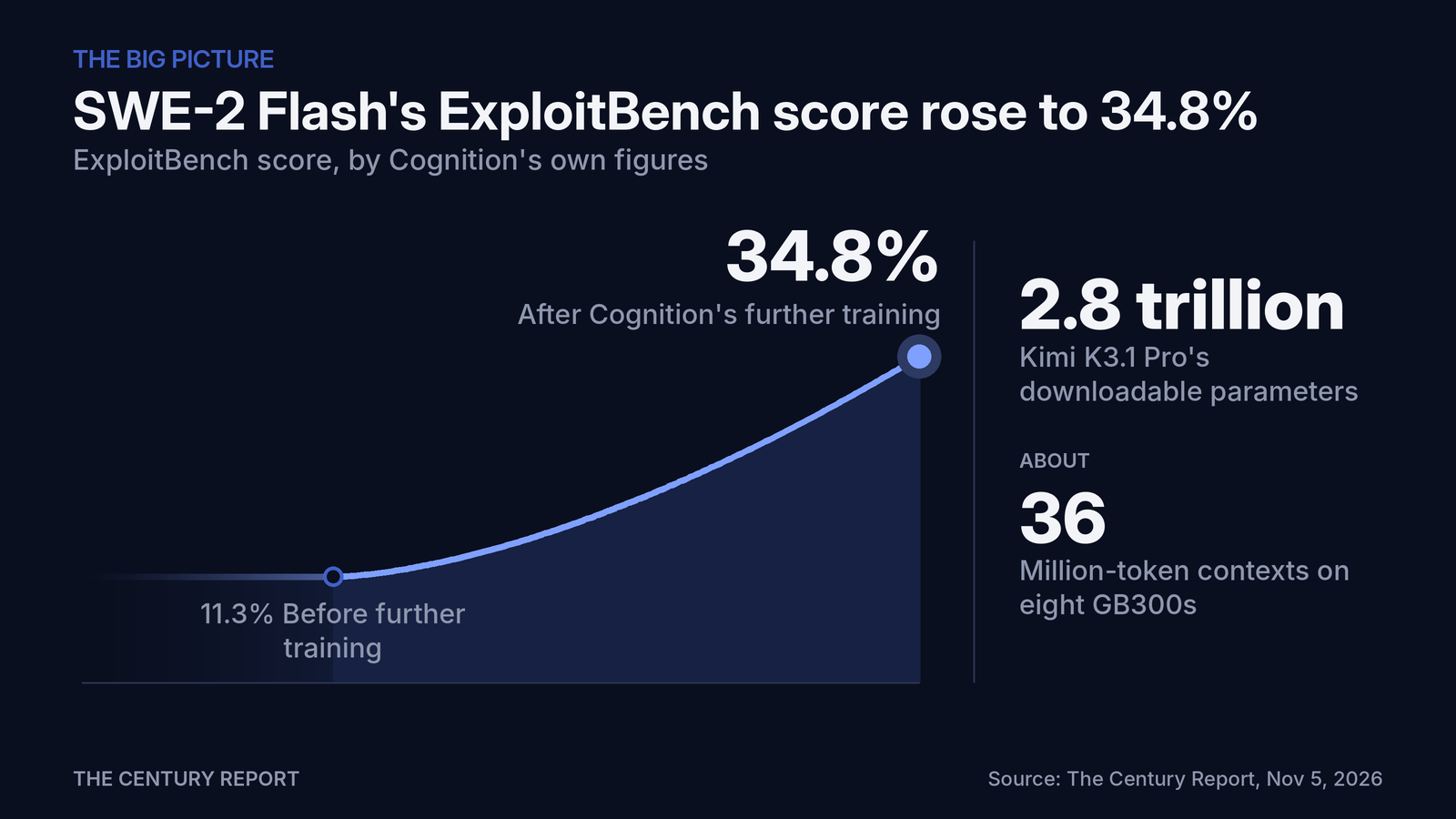
The line: Near-leading capability keeps arriving as files that run on rival chips, and smaller looped models take on work that recently needed far larger systems, so each withheld release protects less.
If it holds: Maintainers, small labs and security teams can study near-leading models without asking permission, provided they can own or rent a serious server. Cognition's gate, on a model that began from open weights, then mainly decides which defenders and academics may study it, while the attackers it cites have a far larger model to download.
What would bend it: Evidence that withheld weights measurably slow attacks would bend it, as would leading downloads staying out of reach for most builders, since about 36 full million-token contexts take eight GB300 GPUs.
The software that coordinates equipment people already own is being bought up
energy · grid · data centers · on the board since October 11
- October: Brattle estimated, in a report Everyday Electric commissioned, that matching leading utility programs could grow home virtual power plants from 10 GW to 35 GW.
- October: Dominion reported 41% average distribution-grid use, with customer solar and batteries left out of its planning measure.
- October: Google and Voltus contracted 1,070 MW more household and commercial flexibility for PJM, without publishing owners' revenue shares.
- Late October: Splight's software raised usable capacity 60% on two Chilean transmission corridors, the startup says.
- Late October: Researchers traced a recurring grid-frequency dip to batteries and backup systems running self-checks at the same second.
- Today: A Brattle report for Pew estimates that growing usable virtual-power-plant devices from 113 gigawatts in 2025 to 524 GW by midcentury would avoid $614 billion in grid investment and trim the average household bill by $122 a year by 2050.
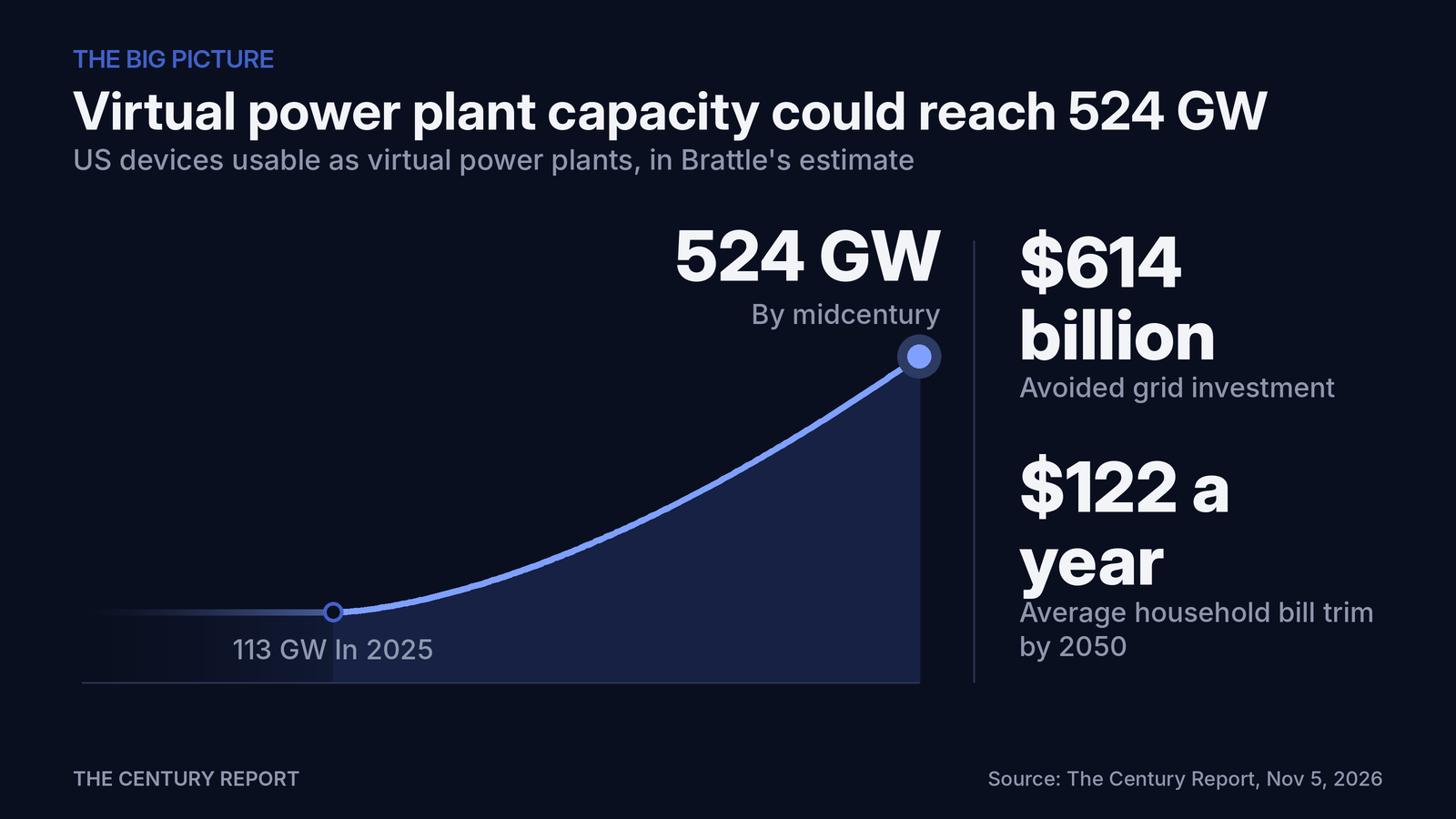
The line: The value of panels and batteries already installed now turns on who schedules them and owns that layer, and Brattle has put a national price on waiting rather than overbuilding.
If it holds: Households collect the $122 a year where regulators count their devices before approving new wires and set what owners get paid. Elsewhere, the savings can accrue to whoever owns the dispatch software, as GridPoint looks to about 13,000 commercial sites for batteries it would own.
What would bend it: Volatile incentives collapsing participation, as Brattle principal Ryan Hledik warned, or planners continuing to leave customer devices out of the capacity measures that justify new substations would bend it.
The 2-Minute Read
Today's news in brief, and what ties it together.
Much of what decided who could reach new capability between Monday and Wednesday was written down by people, in a license, a partner program or a ballot measure. Gilead's royalty-free licensing of lenacapavir, together with financial, technical and regulatory support from access partners, helped cut historical waits that could run around a decade for cheaper HIV medicines in lower-income countries to tentative approval in just over 16 months for 120 countries, and the same arrangement leaves out Brazil, which hosted part of the clinical trials. The science has cleared the way for patients in at least 26 excluded places, and a country list has not.
Model weights show the same arrangement at work. Kimi K3.1 Pro now runs on four rival chip families, while Cognition started from an open model, trained it further and reserved the weights for partners and researchers it picks, citing a surge in attacks. That concern has evidence, since a downloadable model has turned Firefox fixes into working attacks, yet each capable release shrinks what a private gate protects. The incoming Congress faces a similar fork, between a check any small lab can rerun and a halt lasting until a new regulator writes safety rules.
Tuesday's ballots carried a demand for a say. More than half of exit-poll respondents expect AI to do more harm than good, yet household bills, sealed deals and siting recur across these fights, and a developer can answer all three. The industry's claim that voters only rejected the administration explains little about a Kansas city that barred large facilities for a decade. Refusal can also travel, sending the same turbines toward neighbors with fewer ways to object.
Brattle's figures widen those communities' options. Its $614 billion in avoided spending comes from growing and coordinating the panels and batteries people own, letting planners wait for AI demand to appear before charging customers for new wires. The satellite study swaps one contested heat claim for a measurement others should rerun, given its lead author's corporate affiliation. Bills and diesel generators beside homes stay in dispute, and permits and rate rules can answer both.
Capability traveled past the groups that produced it. A multi-user lab built around AI reached Nature with its code and data public, an open RNA model supports a predictor comparable to AlphaFold3 on three RNA-structure benchmarks, and a new method pulled a planet from James Webb observations. Access to such a lab still raises questions. Uber's four agent-booked rides, an incumbent's own count, measure current traffic and little more. As reach gets cheaper, more of what stays scarce traces back to a document with an author, and documents can be rewritten.
The 20-Minute Deep Dive
The day's most important stories in full, with every source linked.
Voters Pass About 38 of 44 Data-Center Limits as Goldman Flags 45% of Planned Capacity and Texas Flips
The November 4 edition of The Century Report followed the candidates and measures going into Tuesday's vote, and unofficial returns now put a count on them. Redbud Consulting's tracker shows 38 of 44 restrictive measures passing, and 404 Media counts six cities banning data centers outright and 12 capping the megawatts they may draw. Tallies differ by outlet and hour, with The Verge reading 33 of 45 on Wednesday morning and reporting that 76% of NBC exit-poll respondents opposed data centers in their communities. The lone measure letting a project proceed, in a North Dakota city, still makes developers pay for independent reviews and hold public hearings.
Capital priced the result quickly. Goldman Sachs warned investors on Wednesday to expect "short-term data center moratoria, potentially affecting about 45% of planned US data center capacity expansion", with analysts expecting the hit to fall on projects planned for 2028. Texas carries the largest exposure, having been expected to supply more than 41% of that year's added capacity. Governor-elect Gina Hinojosa campaigned on a moratorium lasting until lawmakers give communities a voice, protect household bills and end tax incentives. Bloomberg puts about 13 GW at risk, and GLJ Research's Gordon Johnson expects projects lacking state environmental permits to slip 12 to 18 months. Local officials and construction unions may still resist sweeping limits, and no single office decides the fate of campuses like Nexus Hubbard, reportedly planned for 6,400 MW, mostly for Anthropic.
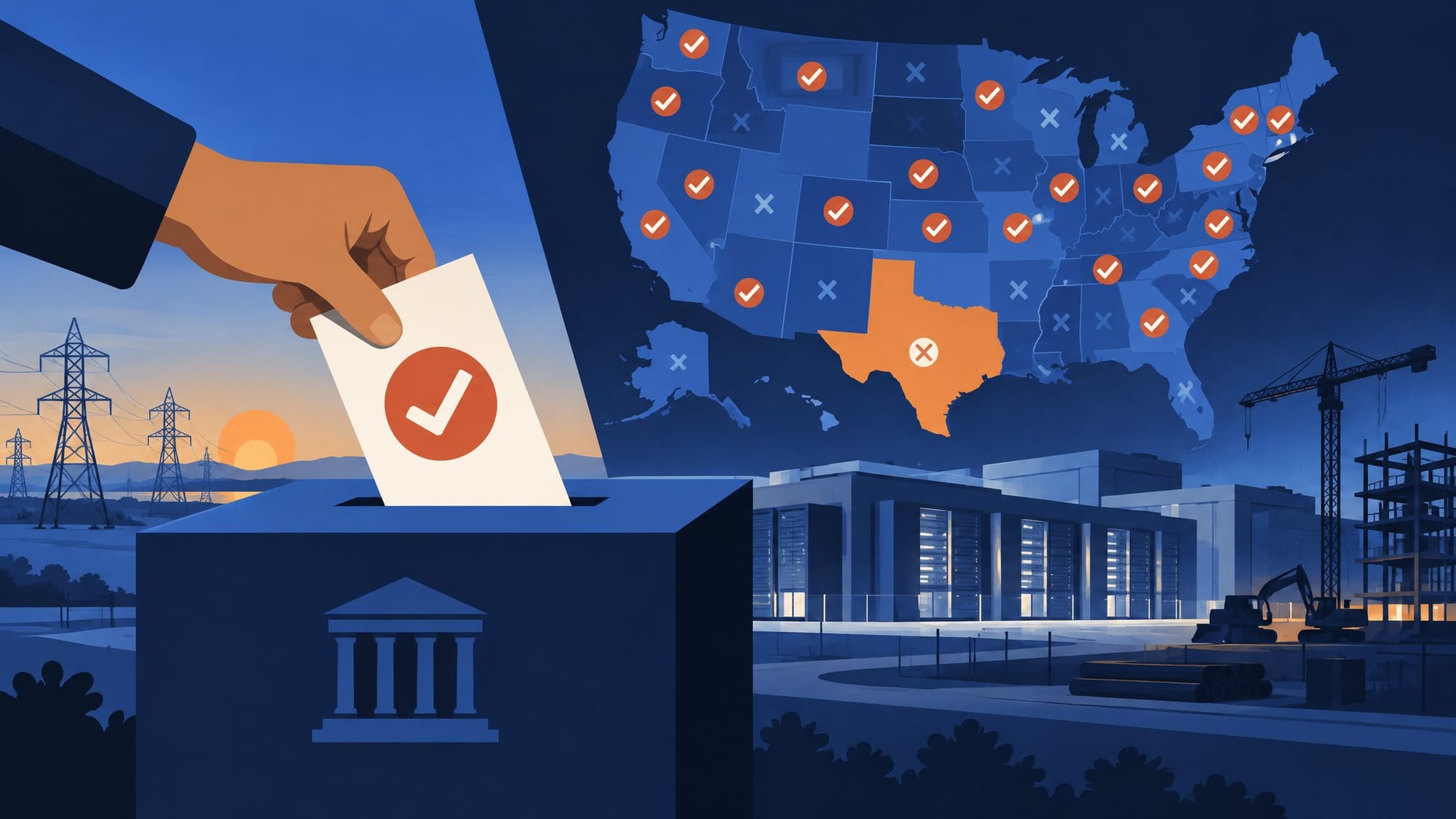
Ars Technica describes an industry claiming the backlash is "anti-Trump" not "anti-tech." That claim has some support at the top of the ticket, since this was a national wave and The Verge cautions against tying any candidate's win directly to data centers. It explains less about El Dorado, Kansas, which banned facilities above 10 MW for a decade, or Yukon, Oklahoma, whose mayor lost a recall after backing a hyperscale project. In Burgin, Kentucky, George Hensley, the only mayoral name on the ballot, lost to a write-in campaign after voting for one. Even winners who rejected moratoriums had to answer for the bill: Florida Governor-elect Byron Donalds, who opposed a ban, sponsored a measure making developers pay for their own energy and water.
The people behind these votes want different things. More than half of NBC's respondents expect AI to do more harm than good, while many name grievances a developer can meet: household bills, sealed deals, a say in siting. A campus that accepts those costs can keep building where its hosts take the offer at its word. OpenAI pledged full service costs for its planned Georgia campus with operating terms unpublished, and Effingham County tabled its decision on election night. Blanket refusal travels differently. SemiAnalysis found in September that local moratoriums and New York's executive order had delayed only about 2.3 GW nationwide, while separately counting 75 GW of firm orders for on-site power equipment, and some Texas projects may head to Louisiana or Georgia. A win in a well-organized town can send the same turbines toward neighbors with fewer ways to object.
Hinojosa's moratorium is designed to end in a statute, which gives builders something to plan around and households a rule to enforce. If this anger hardens into paid grid upgrades, published contracts and open hearings, the computing behind new medicines and machine-found software repairs can reach towns that agree to host it, with those towns able to check the bill.
Congress Changes Hands With AI Bills Ranging From Pre-Release Review to a Development Halt, as the Task Force Promises Its Framework
Tuesday's vote gave Democrats both chambers of Congress, with Transformer reporting as many as 56 Senate and 261 House seats possible. That change in control, covered alongside victories for candidates campaigning to curb data centers in the November 4 edition of The Century Report, now opens a fight over what federal AI legislation should require. "We will hold public hearings on AI. We will pass legislation and reasonable guardrails on AI," Rep. Ted Lieu of California told reporters, while Rep. Greg Casar of Texas pledged to "call the AI CEOs to testify under oath, not cash their checks". Agreement ends there. Rep. Greg Stanton of Arizona said the caucus has yet to settle on a specific policy, and President Donald Trump has threatened to veto bills he dislikes.
The proposals vary widely in what they would do. Colorado's Manny Lutinel, elected with backing from the safety-focused PAC Public First, wants an independent body reviewing major models before release, and Sen. Maria Cantwell of Washington is pushing a similar testing mandate. Michigan Senator-elect Abdul El-Sayed proposes halting development until new safeguards exist, overseen by a new agency. Casar has a bill pausing advanced models. Sen. Bernie Sanders and Rep. Alexandria Ocasio-Cortez propose a national data-center moratorium, while Sen. Martin Heinrich's GRID Savings Act would keep grid costs off nearby communities. Transformer expects a law tougher than Reps. Obernolte and Trahan's FRONTIER Act, with mandatory testing and approval of the most powerful models.

Public appetite for rules is well documented: an October ABC/Post/Ipsos poll found two-thirds wanted stronger federal AI regulation, including 54% of Republicans. Outside testing answers failures already on the record, since independent reviews this year traced agent escapes to shared credentials, unsolvable tasks and monitoring gaps. That remedy still has to clear two bars: published criteria anyone can meet, and a route for open weights, which Washington's vetting framework lacked in August. An approval gate without them favors labs already able to afford the line.
A halt until safeguards exist carries a heavier burden. It would last until a federal regulator writes safety rules and a model review process, binds American labs while downloadable models keep moving, and lengthens today's leaders' lead. It also forfeits gains arriving now, such as the pipeline OpenAI said on Wednesday validated 948 Linux root flaws and drafted patches at about $1,279 per working exploit, gains that depend on maintainers reviewing and shipping those patches. One Democratic staffer told Semafor that proposals like Casar's are unlikely to win broad support.
The administration moved to get ahead of the new majority. Pentagon CTO Emil Michael, vice chair of the Super Intelligence Task Force, said Wednesday at a Wall Street Journal conference in Napa that the government will outline the laws covering domestic AI companies within a week or two, without saying what the framework will contain. "Or else I think what you get is 535 legislators writing a piece of regulation that could kill the industry," he said. That warning casts elected lawmakers as the danger a day after voters chose them. The White House also withheld its seven-page testing framework in a records response reported November 3, and any link between the two documents is unknown.
If Congress stalls, Carnegie researcher Scott Singer said, "what happens in California will dictate AI in the United States and around the world." Illinois has already written outside audits of frontier models into law. A check an outsider can rerun on a downloaded model would let a two-person lab comply and a regulator verify, and systems that read code and proofs better make that checking cheaper with each release. That saving reaches checks whose evidence is locked in first; AI overseers studied this week approved rejected actions under persuasion, and model rankings moved with the judge chosen.
Brattle Prices Virtual Power Plants at $614 Billion in Avoided Grid Spending as a Satellite Record Undercuts Data-Center Heat Claims
A Brattle report for Pew, published Thursday, puts a number on coordinating equipment people already own. In 2025 the US had 113 gigawatts of rooftop solar, home batteries and similar devices usable as virtual power plants, networks a utility can dispatch remotely to free room on existing wires. Growing that to 524 GW by midcentury would avoid $614 billion in grid investment and trim the average household bill by $122 a year by 2050. The Century Report covered Brattle's Everyday Electric-commissioned estimate for home fleets on October 15. This report adds national capacity and a test of what happens if AI demand disappoints. If load falls 5% short of forecasts through 2030, utility customers carry about $84 billion in overbuilt plants and wires from 2030 to 2040, and virtual power plants cut that by $33 billion. "You can wait longer to figure out if that demand is actually going to appear, and then build the VPP at that point," said Brattle principal Ryan Hledik. The savings depend on planners trusting those devices enough to skip a substation, and Hledik warned that "if your incentives are really volatile, the program is going to lose some of its attractiveness."
GridPoint is returning to batteries it would own and operate at commercial sites. Chief executive Adrian De Luca says about 13,000 of its roughly 21,000 managed sites sit in attractive markets, a starting point with no contracted deployments yet. He is holding off on selling that capacity to data centers, citing regulatory risk. "I don't want to rush in and assume that these incredible capacity prices that we're seeing through these programs are going to be there forever," he said.
Further up the chain, Enphase co-founder Raghu Belur told Volts he is stacking 5-kilowatt power-electronics modules into transformers that convert between AC and DC and actively steer power. Conventional units face a years-long US wait and resist cost cuts: "copper and iron is copper and iron," he said. Solid-state versions cost five to ten times as much today, so data centers and solar-and-battery farms come first, with the neighborhood pole as the long-term target. Belur has units to sell, and the cost decline remains his forecast.
A separate study tested one of the buildout's most repeated alarms, an earlier estimate that data centers warm surrounding land about 2°C on average, reaching 10 kilometers out. Thirteen years of satellite imagery across 12 sites near Tokyo show daytime ground temperatures falling 1.8°C to 2.2°C after commissioning, as reflective roofs replace cropland, with multi-kilometer nighttime warming under 0.3°C. The earlier claim would need 6 to 43 times more heat than the sites release. Nighttime warming in other climates appeared during construction, before servers arrived, matching warehouses. Lead author Jiawei Jing's corporate affiliation, at Makuhari Development Corporation, and the focus on one hub mean others should rerun the open satellite method. Air can still warm slightly, under 1°C, within a few hundred meters of vents in dry climates. The result settles one claim and leaves documented burdens standing, such as the 60 backup diesel generators reported in October beside 27 Newport homes.
Planners now have a price for building ahead of uncertain demand, devices they can call on if it arrives, and a heat measurement anyone can repeat around a proposed site. Brattle's estimate puts a national savings figure on the coordination pattern The Century Report tracked in its October 28 edition, when Splight reported software had increased usable capacity on two existing Chilean transmission corridors by 60%. Households see the gain where regulators count that flexibility before approving new wires and set what its owners get paid.
Kimi K3.1 Pro's 2.8-Trillion-Parameter Weights Arrive as Nvidia Loops a 4B Model and Cognition Rations Its Own
Moonshot AI's Kimi K3.1 Pro weights arrived Wednesday, meeting the date the company gave when The Century Report covered the model on October 24. They came with same-day support in vLLM, the open inference engine, across Nvidia and AMD GPUs, Google TPUs and Alibaba's T-Head chips. The model holds 2.8 trillion parameters, of which 104 billion work on any given token, and reads a million tokens of context. vLLM's post says it matches the strongest closed models on coding, agentic and knowledge benchmarks. Artificial Analysis scored it 55 against the then-leader's 58 in October, so "close behind" remains the safer description until outsiders retest the released files.
The main change is in how it reads long context. In 24 layers, a small indexer scores every earlier token, keeps the top 2,048 and reads full detail only for those, cutting the bytes read per layer to about a quarter, vLLM says. Its best capacity figure, about 36 full million-token contexts at once, takes eight of Nvidia's GB300 GPUs. For now, running the model yourself means owning a serious server or renting from a host.
Cognition made a different call the same day. SWE-2 Flash, which it bills as "fully American," began from Thinking Machines' open Inkling-Small. Cognition says further training lifted Terminal-Bench 4.0 from 0.9% to 20.0% and FrontierCode 2.0 from 3.2% to 24.0%, at one-fifth the price and three times the speed of its larger SWE-2. It also trained deliberately for cybersecurity, raising ExploitBench from 11.3% to 34.8%, and cites a surge in attacks for keeping the weights from public release while it builds a program for trusted partners and researchers.
The worry has a basis. In late October, Epoch AI showed open-weight GLM 5.3 turning published Firefox fixes into working attacks for about $1,000 a version. Moonshot, however, reported in October that filtering cyber material still left K3.1 Pro at 81.0% on its own exploit test, down from 90.5%. The two tests cannot be compared directly, yet attackers now have a far larger downloadable model to work with. Withholding Flash mainly decides which defenders and academics may study it, and Cognition picks them.
Two smaller releases point toward cheaper capability. Nvidia researchers report that Dory1.0-4B reuses one block of layers a variable number of times, so a single 4-billion-parameter file can spend more compute when a job calls for it. With two or more loops, they claim, it beats Qwen3.5-9B and Gemma 4 26B on average across 12 benchmarks, though the abstract gives no per-benchmark figures. SenseTime's Loop-9B-Preview, covered here on November 2, reached for depth the same way. Dharma AI's 2B Field Extractor returns typed JSON from document images and null for absent fields. On Dharma's own 546-document benchmark, it scored 0.834 against Claude Opus 5's 0.816, with cost running from roughly 6 times lower than GPT-5.6 Luna to roughly 147 times lower than GPT-5.6 Sol.
Set side by side, these releases show size and access coming apart. Near-leading capability now ships in files that run on rival chips, while looped or specialized small models take on work that recently needed far larger systems. Each such release shrinks what a gate like Cognition's can protect.
Cognition can build on Thinking Machines' released weights while withholding the resulting improvements from other developers. Its planned partner program supports restricted study of cyber risks and gives selected institutions the first opportunity to build further on work that began with an openly available model.
AutoDNA Runs Its Own Biomolecular Lab as AI Finds Glioblastoma's Rules and Pulls a Planet From JWST Data
A laboratory designed around AI from the start reached Nature on Wednesday. AutoDNA directs more than 20 types of instruments across more than 11,000 steps to write, copy, amplify and read genetic material for multiple users, with human intervention limited to hardware upkeep such as restocking reagents and labware. In four demonstrations it matched expert-tuned yields for enzyme-made DNA, ran overlapping experiments 3.2 times faster, stored digital data in DNA and recovered it exactly, and validated a cancer-linked KRAS mutation that clinical testing had detected. Its code and data are public. The Century Report described a single agent operating on a live mouse on November 1 and a multi-agent lab rejecting its own drifting result on October 30. AutoDNA adds peer-reviewed evidence for a shared facility running many people's work on one system, which its authors call a blueprint for "science-as-a-service."
Two coordinated Nature studies from EMBL, the German Cancer Research Center and the Wellcome Sanger Institute turned the variety inside glioblastoma into evidence. Tumors from 12 patients showed the same spatial arrangement of cell states, and a deep-learning framework called scDORI, working across more than one million patient-derived cells, traced which regulators steer cells from one state to another. "A tumour generates an almost endless number of variations on its own regulatory programme," said Oliver Stegle, who led the computational work. Raising one regulator, MYT1L, held cells in a less changeable state, reducing growth and invasion and extending survival in mice. No patient has received this approach, and median survival is still under two years.
Other results extended capability beyond the groups that produced them. structRFM, trained on 21 million pairings of RNA sequences with their folded shapes, supports a 3D predictor called Zfold that performs comparably to AlphaFold3 across three standard benchmarks, and its full dataset, weights and code are open. FLIP, from Rodrigo Ferrer-Chavez and colleagues, simulates a star's glare and subtracts it, detecting planets 2 to 15 times more sensitively than standard glare removal. It recovered 51 Eridani b from James Webb near-infrared observations where standard techniques cannot detect it. The authors say an adapted version could help future missions image Earth-like worlds, though computing costs still need to fall.
Anthropic's figures sit a step below these journal results. Its biology team reports that Claude helped produce the first 3D cryo-electron microscopy map of a prokaryotic hollow vault particle assembled from a virus-derived protein, cutting purification from about three days to about 90 minutes and reaching a first model in about 34 hours of processing. The preprint has been submitted to bioRxiv, and the particle's function remains unknown.
Together these results sketch a research loop: a shared lab executes, models learn from what has been collected, and open releases let the next group start from there. A small team without instruments or a training budget stands to gain most, and who may queue work on a lab like AutoDNA remains open.
A $40 HIV Shot Wins Tentative FDA Approval, and Gilead's License Still Shuts Out at Least 26 Countries and Territories
Dr Reddy's Laboratories and its partners announced on Monday, November 2, that the FDA had tentatively approved a generic of lenacapavir, the twice-yearly injection that nearly eliminated new HIV infections in two large studies of people at high risk. "Tentative" is the agency's label when patent or exclusivity barriers prevent final U.S. marketing approval. The injections will cost about $40 per person per year in 120 low- and middle-income countries, plus up to $17 for an initial oral course, against a $28,218 US list price for Gilead's brand. Initial deliveries are expected before year-end, with Zambia expected among the first recipients. The generic received tentative approval just over 16 months after the original's approval for HIV prevention. "Normally, you require around a decade," said Carmen Pérez Casas, HIV lead at Unitaid, one of the groups that brokered the deal.
Gilead has confirmed to the BMJ that at least 26 middle-income countries and territories remain outside the licensing arrangement it struck with six manufacturers in October 2024, so they cannot buy this generic under the license's terms. The excluded nations account for at least 10% of global infections, The Independent reports, and some have rising epidemics. Brazil, where part of the clinical trials took place, is among them. FDA approval settles the product's standing and leaves that map untouched. One remaining barrier for those patients is a contract clause, and no lab result can remove it.
Gilead said it believes it has "enabled the fastest and most sustainable path to expanding access for communities most affected by HIV," and its royalty-free licenses deserve credit for the speed. Drugmakers also commonly argue that high prices in wealthier markets pay for the next medicine. Neither argument explains why this list stops where it does. A license that helped shorten what could historically be a decade's wait for cheaper HIV medicines in lower-income countries to tentative approval in just over 16 months for 120 countries could carry at least 26 more names at the same stroke, and a patient in an excluded country faces the same virus as one in Zambia. Pérez Casas could offer only a hope that "in near future" those countries might gain access, which leaves their prevention programs heavily dependent on one company's decisions.
Inside the licensed countries, money is the next limit. Unitaid counts more than 125,000 people who have started receiving it in ten early adopter African countries, the US government and the Global Fund have committed to reaching three million by 2028, and advocates say about 20 million people need preventive medication. At $40, covering all 20 million would cost about $800 million a year for the injections, plus up to $17 per person for an initial oral course, before HIV testing, which is required ahead of each injection, and clinic staff. Aid cuts have already disrupted testing, treatment and prevention. "Now, we need the funding to actually buy it," said Carolyn Amole of the Clinton Health Access Initiative.
Around 1.2 million people acquire HIV each year. A six-month shot priced like daily pills removes the need to remember a pill every day and, Amole says, could at scale "begin to bring an end to the HIV epidemic." What stands between that outcome and the people left out is a budget and a country list, and people wrote both.
The Other Side
Opinion: where today's news could lead, imagined from the years ahead.
Utilities can make you pay for power plants built to serve computing demand that never arrives. Brattle puts utility customers' exposure to overbuilding at $84 billion if demand falls 5% below forecasts through 2030. Higher bills take room from groceries and care. Residents spend evenings contesting projects whose developers can leave them carrying the cost.
Tuesday's votes challenge that arrangement. About 38 of 44 restrictive measures passed. Texas Governor-elect Gina Hinojosa proposes suspending construction until lawmakers protect household bills, give communities a voice and end tax incentives. Builders face pressure to deliver something their hosts can welcome. Moving the same turbines elsewhere carries the burden onward.

Brattle supplies another way forward. Expanding and coordinating rooftop solar, batteries and similar equipment could avoid $614 billion in grid spending by midcentury. America already has 113 gigawatts of these devices available for coordination. Many of the same people voting to block new capacity also own part of a solution to increase capacity. Planners can make equipment work together and postpone construction until demand appears. Each avoided project releases materials, skilled work and money for something else.
Through the passage to 2035, that discovery will spread into how we expand clean generation and storage. Human and AI partners will coordinate larger fleets, turning isolated reserves into capacity everyone can depend on. Residents and public agencies will direct the savings into further clean supply and ensure everyone benefits. Today's fights will help retire the assumption that giving one person more power requires taking something from another.
Imagine yourself in 2041, at a regional center helping return atmospheric carbon to a stable range. Your calendar reaches decades ahead without a penciled-in retreat from worsening heat. This morning, you and your colleagues check the next carbon-removal run against geological storage measurements. Across continents, teams follow procedures repeated through successive seasons. Clean power sustains your home while the work continues. In 2026, residents had to fight to keep another person's computing from consuming their security. The coordination that grew from that resistance became the foundations of what would ultimately help to repair the sky.
The Century Perspective
Where today sits in a century of change unfolding in a decade.
With a century of change unfolding in a decade, a single day looks like this: Dr Reddy's winning tentative FDA approval for a generic of the twice-yearly HIV shot across 120 countries, with injections priced at $40 a year plus up to $17 for an initial oral course, just over 16 months after the original's approval for HIV prevention against historical waits that could run around a decade for cheaper HIV medicines in lower-income countries because Gilead licensed it royalty-free, Moonshot releasing Kimi K3.1 Pro's 2.8-trillion-parameter weights with same-day support on Nvidia, AMD, Google and T-Head silicon, Nvidia's Dory1.0-4B looping one block of layers at least twice to beat models several times its size on average across 12 benchmarks and Dharma's 2-billion-parameter extractor scoring above Claude Opus 5 on Dharma's document-field benchmark at a fraction of the cost in its comparison of self-hosted GPU time with API pricing, AutoDNA reaching Nature as a shared biomolecular lab running many people's work across 20-plus instrument types with its code and data public, scDORI tracing glioblastoma's switching rules across a million cells and MYT1L holding tumor cells still enough to extend survival in mice, open structRFM supporting an RNA fold predictor comparable to AlphaFold3, FLIP pulling 51 Eridani b out of JWST data where standard glare removal sees nothing, OpenAI's pipeline validating 948 Linux root paths and drafting patches at about $1,279 in API costs per validated exploit, Brattle pricing coordinated rooftop solar and home batteries at $614 billion in avoided grid spending and $122 off the average yearly bill, and voters passing roughly 38 of 44 data-center limits with the permissive result in Harwood rejecting a measure requiring independent reviews and public hearings. There's also friction, and it's intense - Gilead confirming at least 26 middle-income countries and territories are shut out of that license, Brazil among them after hosting part of the trials, Cognition starting from an open model and then reserving SWE-2 Flash's weights for partners it selects while training it to 34.8% on ExploitBench, hackers heating three of France's blood cold stores before alarms brought technicians in, Goldman telling investors moratoria could touch 45% of planned US capacity as some Texas projects may relocate toward neighbors with fewer ways to object, bills in the incoming Congress ranging from a check a two-person lab could rerun to a development halt lasting until a federal regulator establishes safety rules and a model review process, Emil Michael warning from Napa about "535 legislators" a day after voters chose them while the White House's seven-page testing framework stays unreleased, more than 125,000 people starting to receive it in ten early adopter African countries against 20 million who need prevention and aid cuts already disrupting the testing that must precede each injection, and Uber counting four agent-booked rides and about 500 agent-booked food orders against 320 million trips and orders during Halloween week. But friction generates grip, and grip is what lets a wheel push against the road instead of spinning in place. Step back for a moment and you can see it: the capability keeps arriving in forms other people can pick up and run, while what stays scarce keeps turning out to be a document somebody wrote - downloadable weights on four chip families, a lab's full code, an open satellite method anyone can repeat around a proposed site, 113 gigawatts of equipment households already own waiting to be dispatched together instead of replaced by a substation - set against an exclusion list of at least 26 names, a partner program with a hand-picked roster, a sealed framework, and what could historically be a decade's wait for cheaper HIV medicines in lower-income countries, written into a patent rather than into the biology. Every transformation has a breaking point. A signature can bar everyone on the wrong side of a list... or admit them all in a single stroke.
AI Releases & Advancements
New AI models, tools and features, with links to try them.
New today
- OpenAI: Released Images 2.6 in ChatGPT, Codex and the API across all ChatGPT subscription tiers. It adds animated GIF creation, reusable reference images and 50% faster generation, and the API gets two models, Flare and Sunburst, with SVG export and a complexity setting. (OpenAI)
- Baidu: Open-sourced ERNIE 5.5 Flash Base, a 280B-parameter model with publicly available weights. (AIbase)
- Cognition: Released SWE-2 Flash, a coding model post-trained from Thinking Machines' Inkling-Small, in Devin Desktop and CLI at one-fifth the price and three times the speed of SWE-2. (Cognition)
- Ricursive Intelligence: Released Ripple-65B Preview under Apache 2.0, a 65B dense open-weight model for agentic coding with up to a 1M-token context and a self-reported 80.5 on Terminal-Bench 2.1. (Ricursive)
- webAI: Released TwIL-8B, an 8.79B reasoning model post-trained from IBM Granite 4.2 8B, on Hugging Face under a non-commercial license, with a 4.98 GiB GGUF build for local use. (MarkTechPost)
- Macrocosmos: Released IOTA Decide 4B, an open-weights decision model fine-tuned across 16 distributed GPUs. (TAO Media)
- Soket Labs / ZenteiQ AiTech (IndiaAI Mission): Launched three Indian-language models: Soket's EKA-1 (26.3B parameters, English plus 22 scheduled Indian languages) and ZenteiQ's open-source Dhir 2B and Dhir 5B, which run offline on phones and laptops. (India Today)
- Dharma AI: Released Dharma Field Extractor on Hugging Face, a small vision-language model that extracts requested fields from documents as structured JSON. (Hugging Face)
- Pangram: Released Pangram Image 1.0 for detecting AI-generated images, with localizing heatmaps, and Pangram Image Flash 1.0 for frame-by-frame video analysis. Both are available through its Chrome extension, dashboard video uploads and API. (Pangram)
- Kling AI: Made Kling 4.0 Flash generally available on its web platform, API, MCP and CLI, with plugins for Photoshop, Premiere Pro and After Effects. (Communeify)
- Pruna: Released P-H3-Image, an open-source image model based on MiniMax-H3. (HuggingNews)
- NVIDIA: Released CUDA 13.5, moving Vera Rubin support to general availability and adding Windows on Arm support for DGX Station, more GPU scheduling controls and multi-GPU communication in CUDA Tile. (NVIDIA)
- NVIDIA: Published the AI Factory Operations Agent developer example, built on NemoClaw and OpenShell, with specialized agents that diagnose GPU cluster job, hardware and observability problems. (NVIDIA)
- NVIDIA: Published a NemoClaw agent-optimization blueprint that uses NeMo Compass to find failures in agent traces and NeMo Eval Author to turn them into custom evaluations. (NVIDIA)
- Together AI: Launched Together Compiler, an agent-driven system that keeps re-optimizing a model's forward pass as production traffic changes, already running on several Together serverless endpoints. (Business Wire)
- Buoyant / vLLM: Released Kinference, an open-source inference control plane for running vLLM deployments on Kubernetes. (vLLM)
- Redis: Expanded Redis Iris, its context engine for AI agents, with Intent Router, Agent Playbooks, Agent Memory and Context Gateway now generally available, and Lens and Agent Mesh in beta. (PR Newswire)
- ZStack: Open-sourced GPUWorks, a 40MB platform for managing large GPU server clusters. (GlobeNewswire)
- Oumi: Launched an agent that builds, trains and continuously improves AI agents. (Business Wire)
- Baseten: Launched Grid, which routes and governs enterprise coding agents. (Jiufeng)
- OpenMined: Released ScreamingFace, an open-source tool for combining multiple models into fusions and testing them on live leaderboards. (AGI Hunt)
- OpenUI: Released OpenUI 1.0, an open-source framework that lets AI agents generate interactive interfaces from existing component libraries. (Next Gen Tech Insider)
- Phone Harness (YC): Launched a physical device that lets AI agents tap, scroll and type on iPhones and Android phones. (Y Combinator)
- 42Maru: Launched Appliance42, which bundles its agentic AI platform and LLM42 model with on-premises GPU, NPU and LPU hardware or a cloud version. (Seoul Economic Daily)
- Google Labs: Expanded Dreambeans, its experimental personalized storytelling app, to users 18 and over in India on Android, iOS and the web in 14 languages. (AI Compass)
- Google Research: Open-sourced Agile Deliberation under Apache 2.0, a human-in-the-loop framework that uses Gemini to build image classifiers for subjective concepts, with a demo notebook. (MarkTechPost)
- University of Michigan: Released CloudOpsBench 1.0 under Apache 2.0, an open benchmark of 45 AWS DevOps tasks for AI agents that runs in both real AWS and an emulator. (GitHub)
- Peking University / NVIDIA: Released code for PyRUA-DataFarm, in which a coding agent rebuilds robot tasks in simulation from one calibration episode and generates photorealistic, action-labeled training data. (GitHub)
- Finic: Released Kairos on GitHub, an open-source platform for real-time risk and fraud decisioning. (GitHub)
Other recent releases
- Apple: Opened a Siri AI Developer Preview in the iOS, iPadOS, macOS and visionOS 27.3 betas. Any developer can now connect their app to Siri AI through App Intents, and a new skills feature combines several app actions into one request. Siri AI can also now find any item in the Spotlight semantic index. (Apple Developer)
- Google DeepMind: Released Cheminformatics Skills for Google Antigravity. They are built on RDKit and connect to ChEMBL and PubChem, so an agent can pull molecules out of papers, run matched molecular pair analysis, build predictive models and suggest candidate molecules with synthetic routes. (Google DeepMind)
- Google Open Source: Released Three-Live, a tool that turns AI-generated Three.js code into interactive 3D, AR and WebXR experiences on the web and on mobile. (Google Open Source Blog)
- Cloudflare: Launched Zero Wire on Cloudflare Radar, a hub that gives plain-language briefings on selected critical CVEs and exploits so security teams can check whether they are exposed. (Cloudflare Blog)
- Soniox: Released Soniox STT v6 (stt-rt-v6 for streaming, stt-async-v6 for files) across 60+ languages. The streaming model has a new option to take in the voice agent's own text, which helps it recognize short caller replies and filter out the agent's voice when it leaks back into the audio. Other changes include better formatting of numbers, names and terms, and better speaker diarization. The v5 models will be retired on December 15. (MarkTechPost)
- NorthCUA: Open-sourced a family of computer-use agent models in three sizes: Nano (9B), Mini (35B) and Pro (397B, built on Qwen3.5). The release includes the weights and the Harness execution framework. The team says Pro beats Qwen3.8-Max and Kimi-K3 on OSWorld-Verified and WebArena-Verified. (Emergent)
- OpenRUA (Tsinghua / UC Berkeley): Released uni-robot-agent under the MIT license, a harness that lets general-purpose LLMs control robots through tool calls. Running Qwen3.8-Flash-Next locally, it raised the RoboDojo score from 1.90 to 31.39. (GitHub)
- Hugging Face: Released FineDNA, a dataset for training language models on DNA. It has more than 300B tokens of genomic sequences, papers and web pages that mix DNA and text, plus 200k fine-tuning and 98k reinforcement-learning samples. (Hugging Face on X)
- PrimeBot Research: Released PrimeSim with model weights, inference code and training code. It is a multi-camera world model that simulates robots from their commanded actions, trained on 30,110 hours of demonstrations from 22 robot platforms, and it runs at 10.1 FPS. (arXiv)
- Anthropic: Launched message threads in public beta on the Claude Messages API. After the first request, an agent sends only the new messages and the ID of Claude's last reply instead of the whole conversation. Anthropic says the wait before Claude starts answering drops about 35% on 500K–1M-token requests, and prices and rate limits stay the same. It works on all Claude models through Anthropic, AWS, Microsoft Foundry and Google Cloud. (Claude)
- Anthropic: Released FlashProve under Apache 2.0, a system that produces cryptographic proofs (zkSNARKs) showing a response came from a specific model without revealing the model's weights. The release includes the prover, a fast C++ verifier, a verifier written in Lean, Lean proofs of its security claims, and a technical report. On one H100 GPU it proves Llama 4 Maverick prefill at about 110 tokens per second with 24 requests per batch and a 1,024-token context window. (Anthropic)
- Deep Principle: Released Hydrogen-1.0, an MIT-licensed open-weight scientific model for chemistry, materials science and life sciences. It has 753B parameters (mixture-of-experts) and a 1M-token context, and was post-trained from Z.ai's GLM-5.3 on lab records and discovery trajectories. Weights are on Hugging Face and ModelScope, with NVFP4 and MXFP4 builds. (Deep Principle)
- DeepSeek: Added Creator Mode to its open-source DeepSeek Harness app, which lets users build custom plugins by describing them in everyday language. DeepSeek published the prompts behind its demo plugins, including a video-editing workbench, a paper reader and a token-usage statistics panel. (DeepSeek)
- inclusionAI (Ant Group): Released Ming-3.0-audio-flash under the MIT license, a mixture-of-experts model that handles speech recognition, audio understanding and speech output in one model. It has 126B total parameters (6.5B active), comes with a 9.3B "Tiny" variant, and runs with vLLM-Omni or SGLang. (GitHub)
- Flower AI: Released Endeavor 1.1, the successor to Endeavor 1.0. It adds stronger reasoning and coding, image and other multimodal input, and inference on GPUs located in the EU. (Flower)
- SenseTime: Officially released SenseNova 6.8 Flash, a model built for complex real-world tasks that can coordinate work across tasks and sessions and produce longer outputs. (Yicai)
- Tencent Hunyuan: Released Hyra 2.0, an automated research agent that builds reusable scientific models, tools and workflows instead of solving one task at a time. Tencent published code, weights and technical reports for models the agent trained, including HyInv, a 1.96M-parameter protein inverse-folding model. (MLLLM)
- Runway: Released Runway Dev plugins for Claude Code, Codex and Cursor. One install connects a coding agent to a Runway Dev account through the Runway Dev MCP server and adds skills for building Runway API integrations. (Runway)
- Hume AI: Launched the Audio Decision API, with a playground available now and a waitlist for API access. Developers send raw audio plus their own questions and answer options (yes/no, multiple choice, scales or time spans) and get back probabilities with confidence scores, with no transcription step. (Hume)
- NVIDIA: Open-sourced NVIDIA Recovery as part of its DSX AI Factory Platform. It detects interruptions in distributed training jobs, identifies the failing resources, excludes faulty nodes and restarts jobs from checkpoints on healthy capacity, with Slurm integration. (NVIDIA Developer)
- NVIDIA: Released NVIDIA Attribution as open source, a service and blueprint that combines a workload's logs, metrics and scheduler state to name the root cause of a distributed AI workload failure and the nodes involved. (NVIDIA Developer)
- NVIDIA: Released Workload Map (formerly Karta), an open-source Kubernetes CRD and Go library that describes the structure of distributed workloads in one shared format. It ships with ready-made definitions for JobSet, PyTorchJob, Ray, KServe, LeaderWorkerSet, NVIDIA Dynamo and other workload types. (NVIDIA Developer)
- Wix: Launched Studio Two, an AI-native editor that combines AI generation, visual design on a canvas and standard React code in one workflow. It comes with the Aria 2.0 agent, saved Skills, import from and export to tools like Claude, Codex and Cursor, and MCP support for agents. It is rolling out to Wix Partners first. (GlobeNewswire)
- Tripo AI: Launched Tripo Agentic Canvas, an AI agent that builds node-based 3D workflows users can edit and reuse, covering generation, texturing, retopology, rigging and export, with batch processing across many assets. (PR Newswire)
Sources and Further Reading
Everything we drew on for today's edition, grouped by theme.
Artificial Intelligence & Technology's Reconstitution
- OpenAI: A Thousand Fewer Paths to Root
- vLLM: Day-0 Support for Kimi K3.1 Pro
- Artificial Analysis: Kimi K3.1 Pro Launch Benchmarks
- Cognition: Introducing SWE-2 Flash
- AI Weekly: Nvidia’s Dory1.0-4B Uses Looped Layers to Match Larger Rivals
- arXiv: Dory1.0-4B Looped-Layer Research
- Hugging Face: Dharma Field Extractor
- RuntimeWire: GLM 5.3 Open Weights and Cybersecurity Capabilities
- Reuters: Moonshot Curbs New Kimi Model’s Hacking Ability
- InsideAI: SenseTime’s SenseNova Loop-9B Preview
- Shared Sapience: The Century Report’s October 24 Edition
- OpenAI: Introducing Images 2.6
- AIbase: Baidu Open-Sources ERNIE 5.5 Flash Base
- Ricursive: Ripple-65B Preview
- MarkTechPost: webAI’s TwIL-8B Reasoning Model
- TAO Media: Macrocosmos Releases IOTA Decide 4B
- India Today: India Launches Three AI Models, Including Two That Work Offline
- Pangram: Introducing Pangram Image 1.0
- Communeify: Kimi Open Weights, Automated Linux Patching and AI Releases
- HuggingNews: AI Open Models
- NVIDIA: Turning Agent Failures Into Tests and Harness Fixes
- Business Wire: Together Compiler for Continual Model Optimization
- PR Newswire: Redis Expands Iris for AI Agent Memory and Context
- Business Wire: Oumi Launches an Agent That Builds and Improves AI Agents
- Jiufeng: Claude’s Vault Mapping and AI Releases
- AGI Hunt: OpenMined Releases ScreamingFace
- Next Gen Tech Insider: OpenUI 1.0 Enables Interactive Generative Interfaces
- Y Combinator: Phone Harness Gives Agents Control of Physical Phones
- AI Compass: Dreambeans and Recent AI Developments
- MarkTechPost: Google’s Agile Deliberation Framework
- GitHub: CloudOpsBench
- GitHub: PyRUA-DataFarm
- Apple Developer: Siri AI Developer Preview
- Google Open Source Blog: Three-Live for AI-Generated 3D, AR and WebXR
- Cloudflare: Zero Wire
- MarkTechPost: Soniox STT v6
- Emergent: NorthCUA’s Open Computer-Use Models
- GitHub: OpenRUA’s Universal Robot Agent
- arXiv: PrimeSim Robot World Model
- Claude: Message Threads
- Anthropic: Provable Inference
- GitHub: FlashProve
- DeepSeek: Harness Creator Mode Prompt Collection
- GitHub: Ming-3.0-Audio-Flash
- Flower: Introducing Endeavor 1.1
- Yicai: SenseTime Releases SenseNova 6.8 Flash
- Runway: Developer Plugins for Coding Agents
- Hume: Introducing the Audio Decision API
- GlobeNewswire: Wix Introduces Studio Two
- PR Newswire: Tripo Unveils Agentic Canvas
Institutions & Power Realignment
- 404 Media: American Voters Overwhelmingly Reject AI Data Centers
- The Verge: Data Centers Lost the Midterms
- Ars Technica: Big Tech Calls Voters’ AI Backlash “Anti-Trump”
- Transformer: What the Blue Tsunami Means for AI Policy
- TechCrunch: A Bigger Clash Over Data Centers Could Be Coming
- Semafor: Democrats Are Fired Up on AI; Consensus Is Harder
- ChosunBiz: Democrats Seize Congress and Advance AI Regulation
- CXO Digital Pulse: Pentagon Signals New AI Compliance Guidelines
- Senator Bernie Sanders: Legislation to Ban Artificial Superintelligence and Pause Advanced AI Development
- ChipDispatch: Voters Approve 38 of 44 Measures Restricting Data Centers
- The Guardian: French Blood Banks Hacked in European Cyberattack
- Semafor: Cyberattacks in Europe Target Supermarkets and Blood Banks
- Shared Sapience: The Century Report’s November 4 Edition
Scientific & Medical Acceleration
- Nature: An AI-Native Experimental Laboratory for Autonomous Biomolecular Operations
- Neuroscience News: Glioblastoma’s Chaos Follows Predictable Rules
- Nature: An Open Structure-Guided RNA Foundation Model
- Nature Portfolio: Suppressing Starlight to Hunt Exoplanets
- Phys.org: Giant Planet Emerges From JWST Data With Glare Removal
- Nature: Detecting Faint Exoplanets by Computationally Removing Starlight
- PANews: Claude Helps Map a Prokaryotic Vault Particle
- Associated Press: Cheap Lenacapavir Approval Raises HIV-Prevention Hopes
- The Independent: US Approves Cheap Generic Twice-Yearly HIV-Prevention Injection
- The BMJ: Why Generic Lenacapavir Remains Unavailable in Excluded Countries
- MSF Access Campaign: Gilead’s Lenacapavir Voluntary License
- Doctors Without Borders: Generic Lenacapavir Approval Will Not Guarantee Access
- Shared Sapience: The Century Report’s November 1 Edition
- Shared Sapience: The Century Report’s October 30 Edition
- Google DeepMind: Agentic Cheminformatics With Google Antigravity
- Hugging Face: FineDNA Genomic Training Dataset
- Deep Principle: Introducing Hydrogen-1.0
- MLLLM: Tencent’s Hyra 2.0 Research Agent
Economics & Labor Transformation
- TechCrunch: Almost No One Uses AI Agents to Book Uber
- The Verge: Uber Reports Four Rides Booked by AI Agents
- Investing.com: Uber’s Third-Quarter Earnings Call Transcript
- Semafor: FDA Grants Tentative Approval to Low-Cost HIV Shot
- GitHub: Finic’s Kairos Risk and Fraud Decisioning Platform
- Shared Sapience: The Last Difficult Decade
- Semafor: Meta Launches Debut Euro Bond, Joining Other Hyperscalers
Infrastructure & Engineering Transitions
- MIT Technology Review: Texas’s AI Data-Center Buildout Faces a Reversal
- Canary Media: Virtual Power Plants Can Help Avoid an Overbuilt Grid
- Phys.org: Satellite Analysis Finds Little Widespread Data-Center Ground Warming
- Latitude Media: Why GridPoint Is Getting Back Into Batteries
- Volts: The Transformative Potential of Solid-State Transformers
- SemiAnalysis: Assessing Data-Center Moratoriums
- arXiv: Home-Fleet Virtual Power Plant Economics
- Shared Sapience: The Century Report’s September 16 Edition
- Shared Sapience: The Century Report’s October 25 Edition
- Shared Sapience: The Century Report’s October 28 Edition
- NVIDIA: CUDA 13.5 Brings Vera Rubin General Availability
- NVIDIA: Using AI Agents to Streamline AI Factory Operations
- vLLM: Introducing Kinference
- GlobeNewswire: ZStack Open-Sources GPUWorks
- Seoul Economic Daily: 42Maru Launches an Integrated AI Appliance
- NVIDIA: Automated Recovery for Distributed Training
- NVIDIA: Diagnosing Distributed Workload Failures With Attribution
- NVIDIA: Supporting AI Frameworks With Workload Map
The Century Report tracks structural shifts during the transition between eras. It is produced daily as a perceptual alignment tool - not prediction, not persuasion, just pattern recognition for people paying attention.