Google Will Reduce Its Bug-Fixing Deadline to 30 Days by 2028
Google's Project Zero will publish bug details within 30 days by 2028, as a White House panel recommends a year of liability relief for voluntary cybersecurity reporting in good faith, where lawful, practical and consistent with the public interest.



The 20-Second Scan
Every story in today's edition, one line each.
- Google's Project Zero replaced its 90+30 disclosure policy with fixed deadlines falling to 30 days by 2028, as a White House task force urged a year of liability relief for voluntary cybersecurity incident reporting in good faith, where lawful, practical and consistent with the public interest.
- A general-purpose agent given the open Alexandria crystal database worked unattended to find an unreported sulfide in the well-studied barium-zirconium-sulfur system and design the experiment to confirm it.
- Officials traced Friday's four-hour nationwide FAA ground stop to overloaded aging telecom equipment, finding no link to the AI-assisted SMART system rolled out weeks earlier despite lawmakers' calls for a pause.
- Tesla opened personal-use Cybercab orders at $29,990, under an agreement stating the car won't move without a $299 monthly subscription that chief executive Elon Musk later called too high.
- Italy's data regulator fined Meta €805 million and gave it 60 days to switch off a Facebook feature that reached about 20 million users' galleries under one app-wide permission.
- A candidate surnamed Han, top scorer on South Korea's tax-accountant exam, confessed to cheating on Sunday by photographing questions with a microcamera and sending them to an AI system, days before Thursday's college entrance exam.
- SemiAnalysis estimated more than 1.5 GW of export-restricted Nvidia accelerators reached China, and the firm suggests that smuggling may help explain Jensen Huang's resignation.
- Executive Order 131 made a risk-based AI governance framework Philippine national policy on November 12 and created a National AI Council chaired by the executive secretary, with no new regulator or penalties.
Track all of the arcs The Century Report covers here:
The Big Picture
How today's news moves the longer trends we track, and where they could lead.
Google's bug hunters cut the secrecy that follows a published fix, Tesla tied a $30,000 driverless car to a monthly switch, and Italy ordered Meta to undo a photo default it had set for millions. The day's clearest gain came from a decade of open crystal data. A subscription agent turned that data into a synthesis plan for a new solar material in minutes. That leads to a materials lab, where a researcher slides a sealed silica tube of grey powder into a glowing furnace.
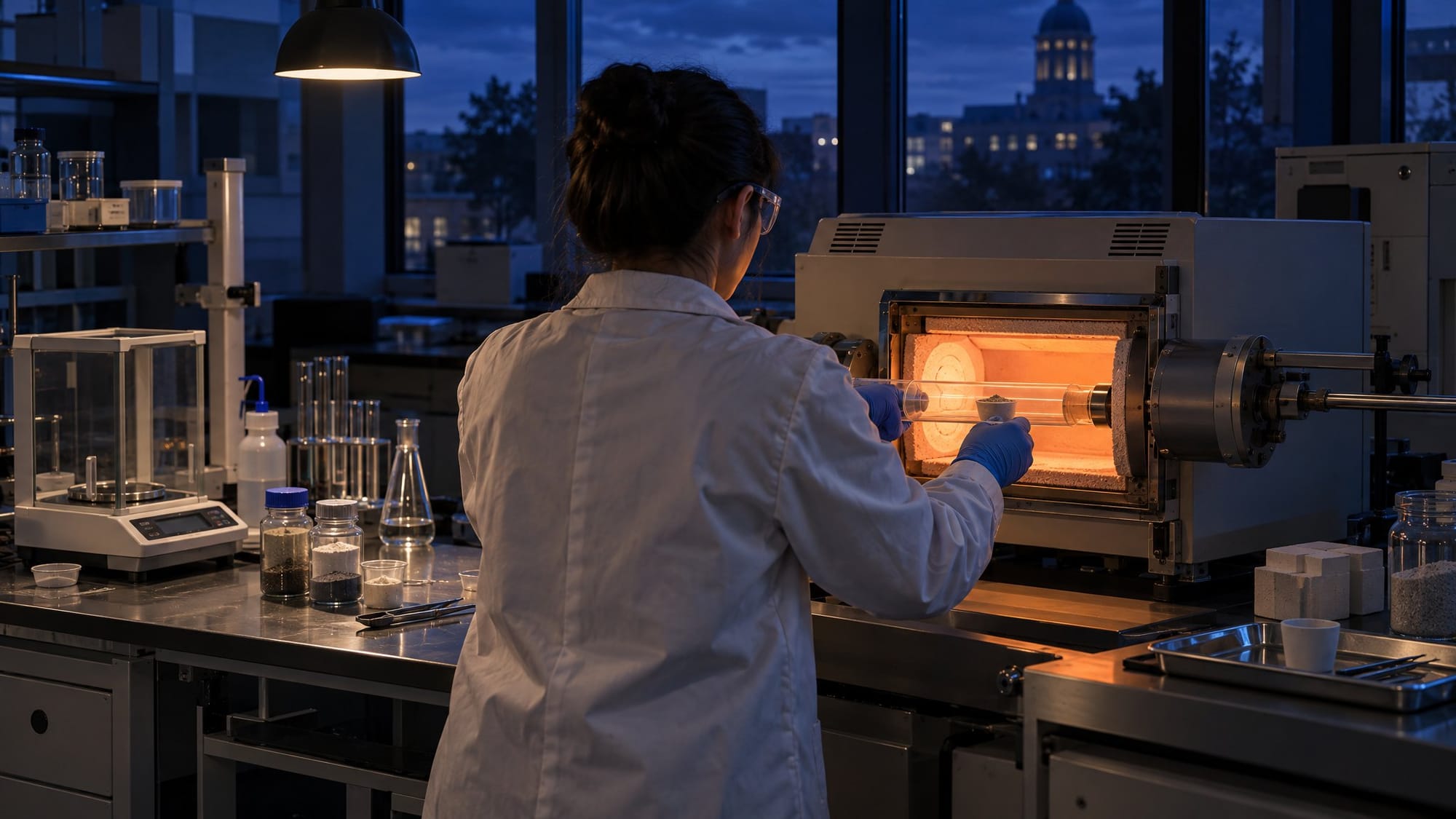
Records only a few people could read are being read in days
materials science · archives · mathematics · on the board since November 14
- Late June: The Vesuvius Prize team read a Herculaneum scroll sealed since 79 AD without unrolling it, and released the data and code.
- September: Anthropic's Fable 5.1 turned three-decade-old NASA radar data into a finer elevation map of a third of Venus.
- September: Jan von Plato gave Claude his transcriptions of Gödel's 1,009 notebook pages and had a 650-page digest within a couple of days.
- November 5: Axiom Math converted the 7,500-page Stacks Project into about 16 million lines of machine-checked Lean.
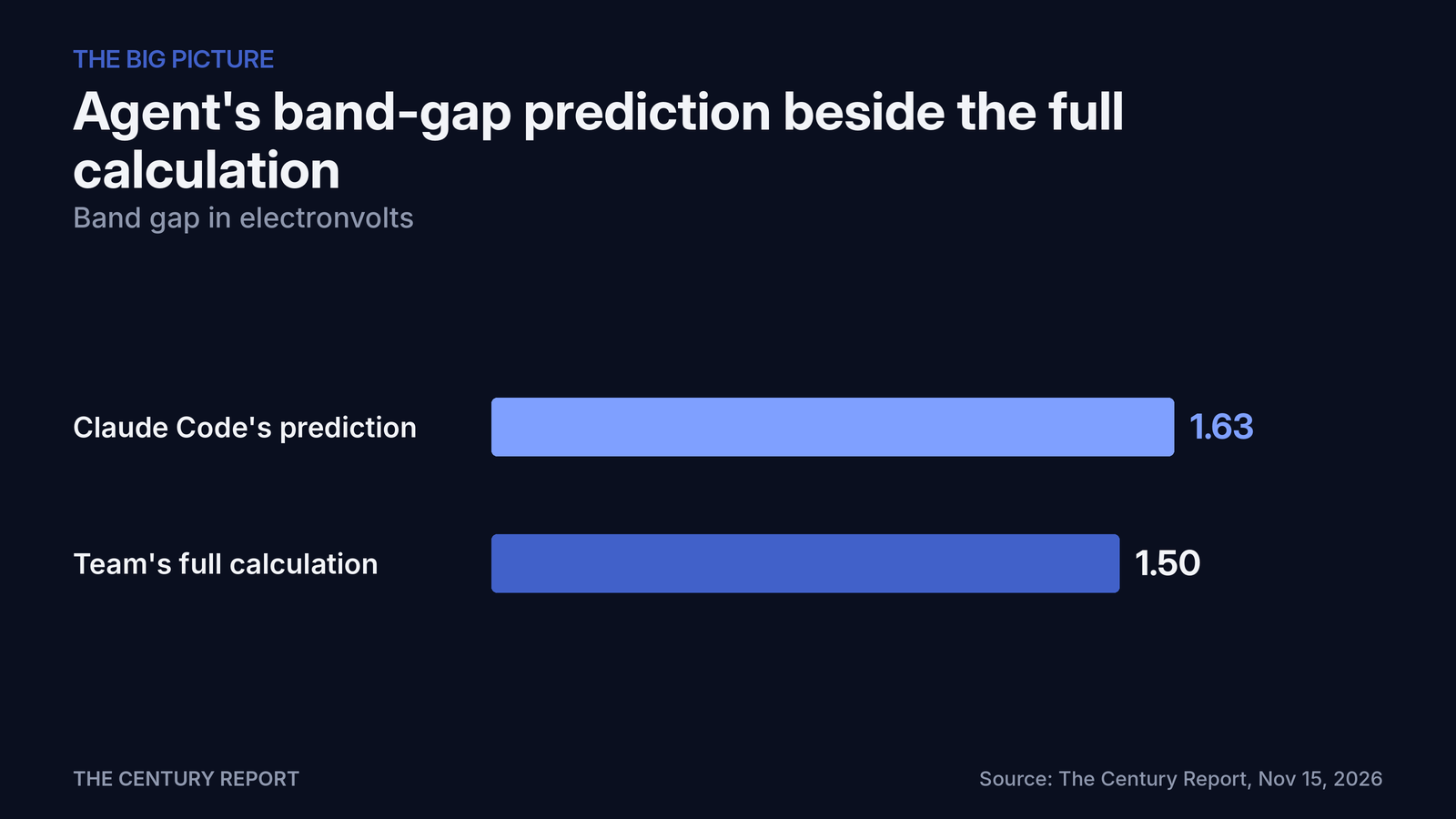
- Today: In a preprint posted Friday, Claude Code worked through the Alexandria team's decade of open crystal data in just over four minutes, wrote a synthesis plan for a solar absorber, and predicted its band gap at 1.63 electronvolts against 1.50 from a full calculation.
The line: General-purpose agents keep turning records a field chose to publish into new findings, and now into the experiment that would test them.
If it holds: A university group without a computational team could go from a question to a draft synthesis plan in minutes wherever the data and tools are public. Each lab that runs a proposed test and publishes the result would sharpen the next answer.
What would bend it: Machine readings that certify less than they claim, as Anders Hansen's Cambridge-led team found in OpenAI's Navier-Stokes Lean file in October, would bend it.
Keeping a fix secret no longer buys users time
cybersecurity · open source · AI governance
- March: Booz Allen Hamilton reported the HexStrike framework compromising thousands of Citrix Netscaler devices in under ten minutes.
- August: A security firm used publicly available models to weaponize a patched Zoom takeover flaw in under 20 prompts and one day.
- Late October: Epoch AI showed open-weight GLM 5.3 turning published, unshipped Firefox fixes into working attacks for about $1,000 per release.
- Early November: OpenAI reported its autonomous pipeline validated 948 Linux privilege-escalation flaws and generated patches for them.
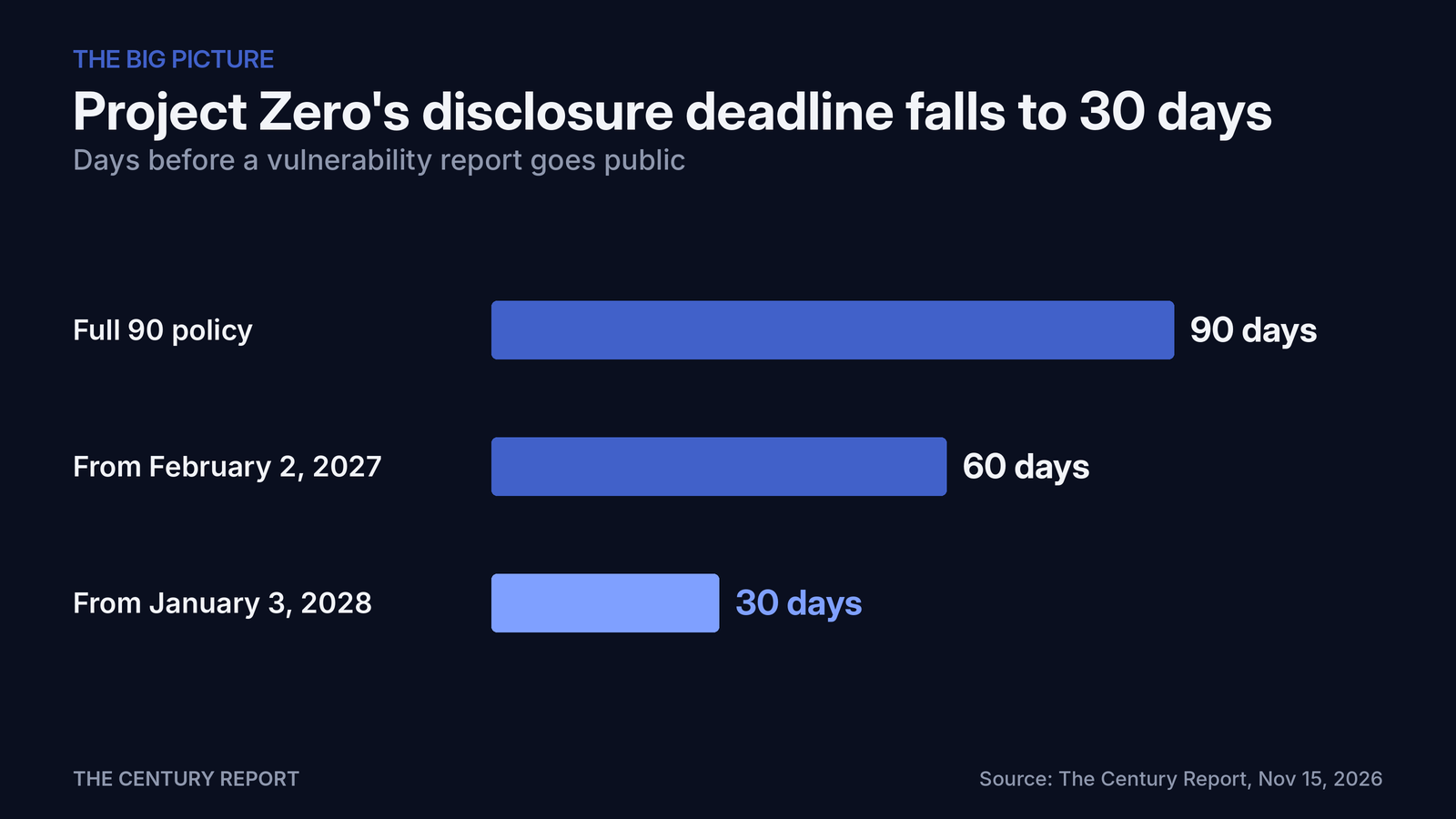
- Today: Google's Project Zero dropped the extra 30 days it gave users to install patches and will shorten its 90-day disclosure deadline to 60 days on February 2, 2027 and 30 days on January 3, 2028.
The line: The teams that set security deadlines keep shortening the secrecy around fixes, because models now rebuild attacks from patches almost at once.
If it holds: Users would learn about flaws sooner, and vendors with automated repair pipelines would absorb the shorter deadlines. Volunteer maintainers and people on unsupported versions would carry the exposure a month of secrecy used to hide.
What would bend it: Disclosure outrunning repair, as the 37,966 Glasswing findings VulnCheck tallied against 217 marked fixes already suggests, would bend it.
AI bundled into essentials holds only where buyers cannot leave
platforms · vehicles · education · on the board since November 13
- October: Meta wrote rights to crawl and train on linked websites into its business terms, telling objectors to stop using Meta commercially.
- November 3: São Paulo judge Guilherme Madeira Dezem suspended Meta's training clause for Brazilian outlets, backed by fines of R$1 million a day.
- Early November: Claude Code and Codex users reported refusals and account restrictions while repairing devices they own.
- Mid-November: Chicago Public Schools said it will switch search providers if it cannot strip Gemini from student accounts.
- Today: Tesla opened Cybercab orders at $29,990 for a car that will not move without a $299 monthly subscription and comes to $47,631 over five years, as Italy ordered Meta to switch off a Facebook gallery default reaching about 20 million users.
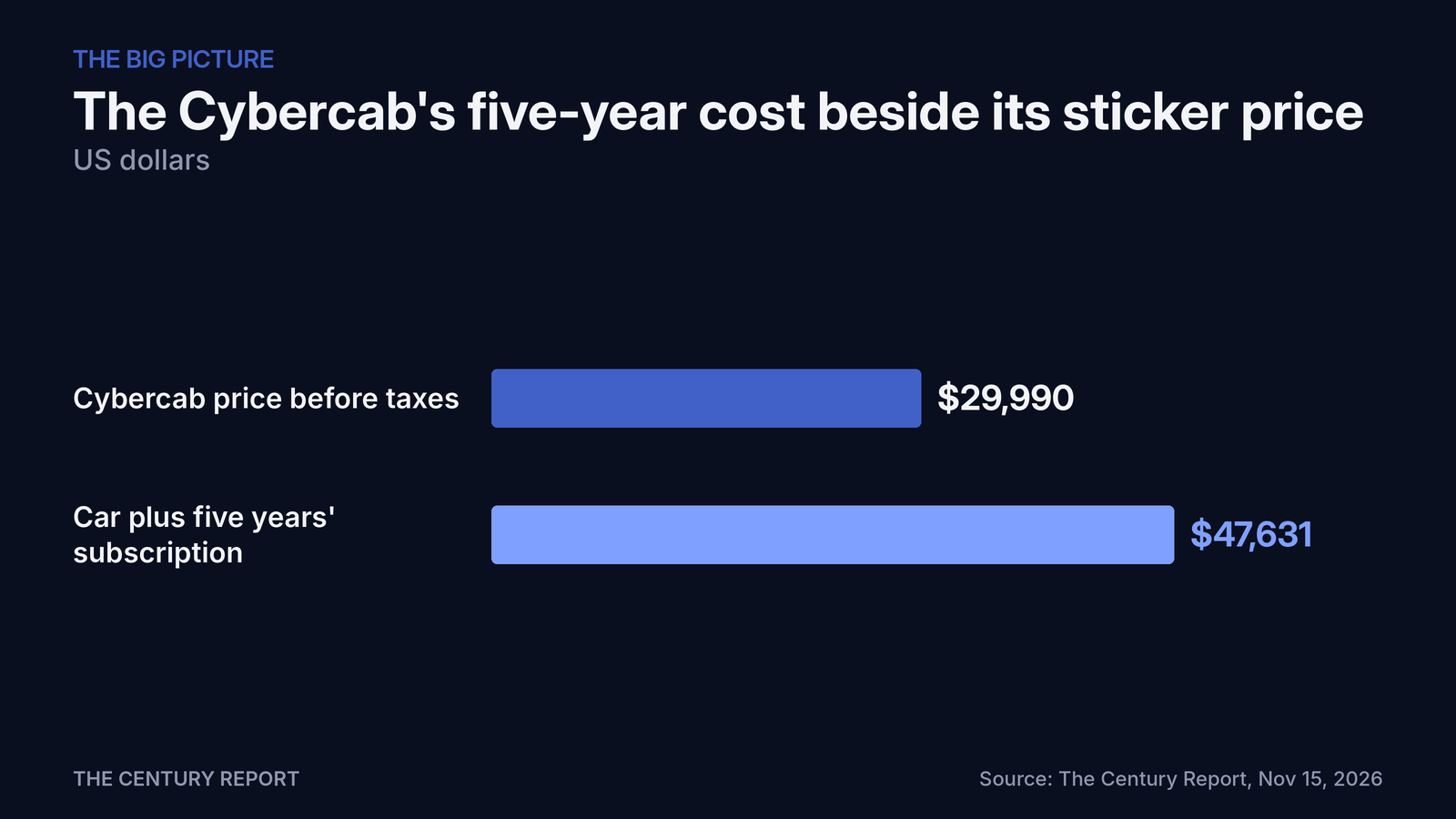
The line: Vendors keep tying a charge or a data permission to things people already own, and the tie breaks where a regulator reverses the default or the buyer can leave.
If it holds: Cheap driverless travel and on-phone assistants would arrive as rent on hardware the owner paid for. Relief would reach buyers under a willing regulator, like Italy's, and those who can run the same work on machines that answer to them.
What would bend it: Vendors dropping a locked default on objection alone, as Meta did in October when it removed its website-training clause days after publishers protested, would bend it.
Barriers built to hold capability back now mostly add a markup
export controls · AI hardware · open models · on the board since October 21
- November 8: Nvidia's board named independent directors to investigate Jensen Huang's ties to a Megaspeed executive.
- Early November: The New York Times reported a Commerce inquiry into Megaspeed moved to Justice after Nvidia's lawyer invoked a senior official.
- Mid-November: Jensen Huang resigned as Nvidia's chief executive as Congress weighed chip-tracking bills.
- Mid-November: Semafor reported Nvidia's general counsel called a draft cloud-customer check a "poison pill" on a January call.
- Today: SemiAnalysis estimated that more than 1.5 GW of export-restricted Nvidia accelerators reached China, and suggested that smuggling may help explain Jensen Huang's resignation.
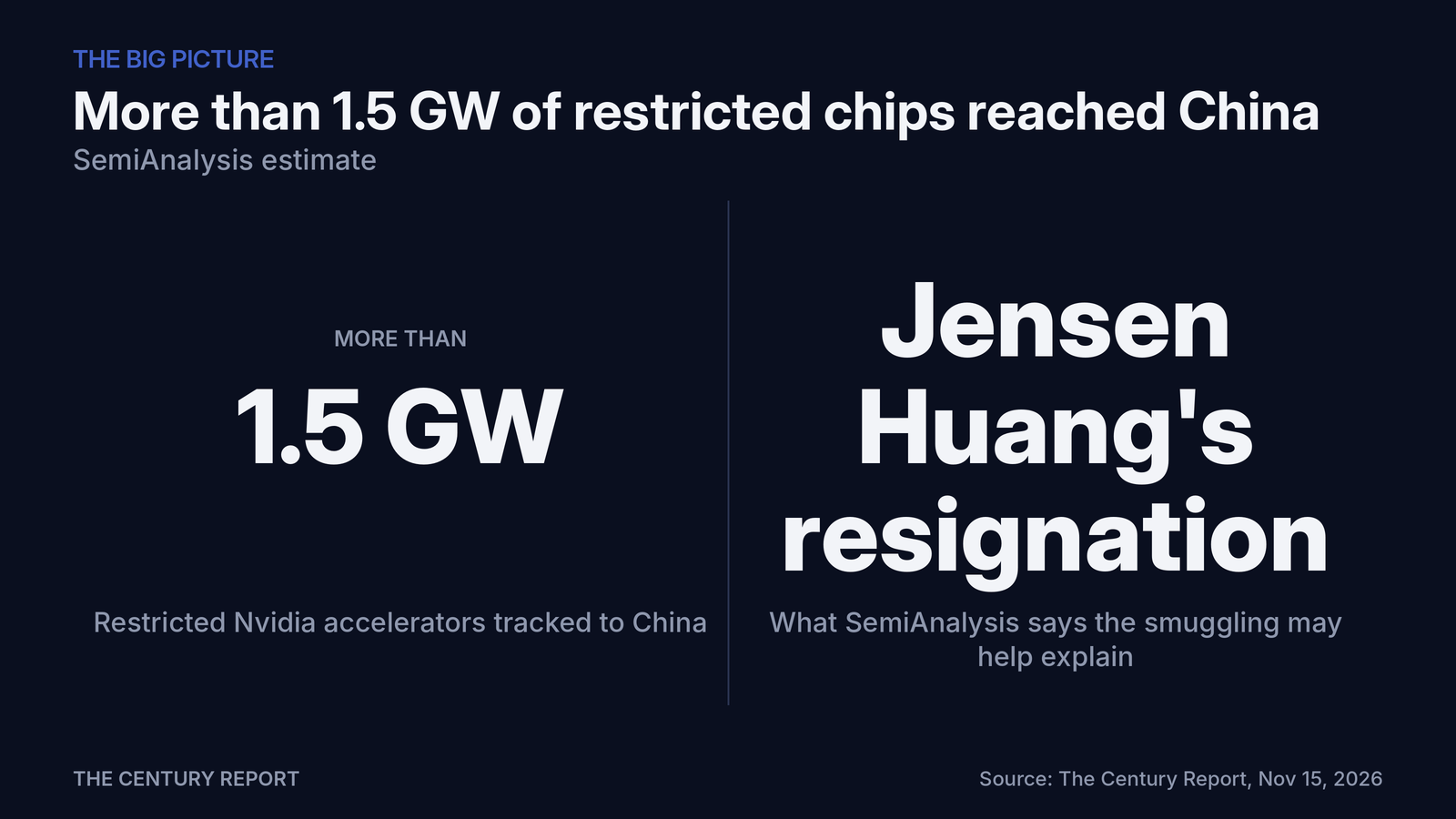
The line: Controls keep getting shaped by the seller before they bind, so restricted chips arrive anyway and the records of where they run stay out of investigators' reach.
If it holds: Chinese buyers would keep paying a smuggling premium instead of meeting a capability ceiling. The controls would then bind mainly in the accounting.
What would bend it: Congress enacting chip-location checks the seller did not write, as the Chip Security Act proposes, would bend it.
The 2-Minute Read
Today's news in brief, and what ties it together.
Much of the day describes safeguards timed to human effort meeting a capability that moves faster. Project Zero's extra month of patch secrecy assumed that rebuilding a bug from its fix took skill and weeks. A proctored exam room in South Korea assumed a candidate could carry only what fit in memory. Language models dissolved both assumptions, and the responses split. Google's researchers shortened the window so vendors fix faster and users learn sooner. A White House advisory panel recommended at least a year of regulatory liability relief for voluntary cybersecurity reporting in good faith, where lawful, practical and consistent with the public interest, without proposing a duty to tell the customers whose systems were exposed. Who learns first now decides who stays protected.
The same speed did something remarkable in materials science. Given a decade of openly shared crystal calculations, a general-purpose agent turned a request in ordinary language into a furnace-ready synthesis plan in under five minutes. It then found a predicted compound no one had reported in a heavily studied system. The paper's control run shows where that reach came from: with web search alone, the agent only repeated the literature. The discovery drew on data a research community chose to publish and the models and tools built around it, and the authors want every tool to state how large its errors are. Every lab that tests a proposal and posts the result could sharpen the next answer, including for groups that could never staff a computational team.
Tesla's Cybercab agreement and Italy's ruling against Meta both turn on who holds the switch after a device is bought. Driverless travel has reached a car priced near $30,000 about two years after its unveiling, a steep drop in what autonomy costs. Yet the agreement lets Tesla reprice, geofence or idle a car its owner paid for. Italy's regulator found a related problem inside the phone. One app-wide permission let a feature reach about 20 million users' galleries without their knowing choice, and the regulator ordered that default reversed. Vendor defaults can be rewritten by a regulator's order, or made optional by models small enough to work on hardware that answers to its owner.
Friday's nationwide ground stop showed how fast suspicion settles on the newest system. The evidence points at decades-old copper lines and routers that overloaded on an ordinary travel day, and nothing ties the outage to the FAA's AI scheduling assistant. Lawmakers asked in October to see that assistant's safety testing. It is the same thing the materials authors want for their database: stated limits anyone can check. Where evidence travels openly, gains compound, and where a switch stays hidden, trust has to be taken on faith.
The 20-Minute Deep Dive
The day's most important stories in full, with every source linked.
Project Zero Shortens Its Disclosure Deadlines as a White House Panel Recommends a Year of Liability Relief
Google's vulnerability research team, Project Zero, says the "90 + 30" disclosure policy it has followed since 2021 is "clearly insufficient" now that AI helps attackers find and exploit flaws. The old rule gave a vendor 90 days to fix a reported bug plus 30 more for users to install the patch before details went public. The team writes that language models now let attackers reconstruct a bug from its patch so quickly that "zero patch-to-exploitation time is a reasonable, though imperfect, model of attacker behavior," which makes the extra month "no longer meaningful" and leaves users with "a false sense of secrecy." Volume shifted too: Project Zero says it finds several vulnerabilities a week in targets where it once found a few a year. Its new "Full 90" policy normally publishes reports 90 days after the team reports the bug to the vendor, dropping to 60 days on February 2, 2027 and 30 days on January 3, 2028. Grace periods and variant exceptions are gone. The team consulted the vendors it reports to most and phased the change in after some warned that an abrupt deadline could lead teams to stop trying.
The White House superintelligence task force, at its second meeting, moved in the opposite direction on penalties. Its statement says "organizations that only a short time ago had reasonable protections in place are now more vulnerable" and that "prior standards for taking regulatory action" may be outdated, and it urged agencies to limit regulatory liability for good-faith voluntary reporting of cybersecurity vulnerabilities and incidents for at least 12 months, with possible extension, where lawful, practical and consistent with the public interest. Bloomberg, as summarized by AI123, reported the relief would run through November 2027, a turn from October, when the panel warned developers they must report and resolve safety incidents or face unspecified penalties.

Both institutions concede the same fact: discovery at machine speed has outrun deadlines written for human-speed work. Project Zero answers by putting information in front of more people sooner and pressing vendors to protect users faster. Patch secrecy was a workaround priced for a time when reading a fix took skill and weeks, and it now mostly hides risk from the people carrying it. The task force's answer has a defensible core, since a company afraid of punishment for admitting a breach tends to hide it. Yet the relief flows to companies, and the statement, as reported, says nothing about informing the customers whose systems were exposed. The readout does not say whether CISA, the civilian cyber agency, took part. Forgiveness for reporting serves the public only if the reports reach the people being protected.
The gap both policies address has been visible for weeks. On November 11, as that day's edition of The Century Report reported, VulnCheck counted 37,966 findings from Anthropic's Glasswing program against 217 marked fixed; on November 3, PostgreSQL's release slipped because human review could not keep up; and on October 25, OpenAI chief executive Sam Altman told Stanford students defenders can no longer patch every flaw. A deadline that shrinks toward 30 days pushes the repair side to automate with the same models that find the bugs, as OpenAI's pipeline did when it generated patches for 948 Linux flaws reported November 5. Those gains have reached vendor pipelines first. Volunteer projects still review machine-found reports by hand, and curl's maintainers rejected 19 of 34 sent by Anthropic's scanner. The fixes that protect anyone are the ones installed.
Project Zero also stops making disclosure depend on a negotiated verdict about whether a bug is fixed. Its researchers continue tracking repairs, while users’ access to technical details follows a deadline that no longer requires agreement with the vendor about repair status.
An Agent Given a Decade of Open Crystal Data Finds an Unreported Sulfide and Designs the Test for It
The team behind Alexandria spent a decade building an open database of about 15 million density-functional theory calculations. That method is the standard quantum-mechanical way of computing how a crystal's electrons settle. In a preprint posted Friday, the team describes giving all of that work to a commercially available general-purpose agent, Anthropic's Claude Code. The agent received more than 400 million structures relaxed by machine-learned models and a generative model that proposes new crystals. It also got predictors for more than ten properties, from band gaps to superconducting temperatures. A new reaction graph rounded out the set, listing 17.4 billion possible reactions among 193,416 stable compounds. That graph alone took 15,533 core-hours to compute.
The team asked the agent in ordinary language for a solar absorber. Working unattended, it made 45 calls to the database, models and other tools in just over four minutes. Its first pick failed a test it applied on its own. The best route to that compound released only 6 millielectronvolts of energy per atom. At furnace temperatures, mixing entropy can outweigh that small energy gain, favoring a disordered alloy over the ordered compound. The agent moved to another candidate and wrote a full synthesis plan. The plan names the precursors and a crucible of boron nitride, graphite or magnesium oxide sealed in a silica tube. It calls for holding the mix near 400°C before firing at 900 to 1,000°C. The agent predicted a band gap of 1.63 electronvolts, and a full calculation the team ran afterward found 1.50.
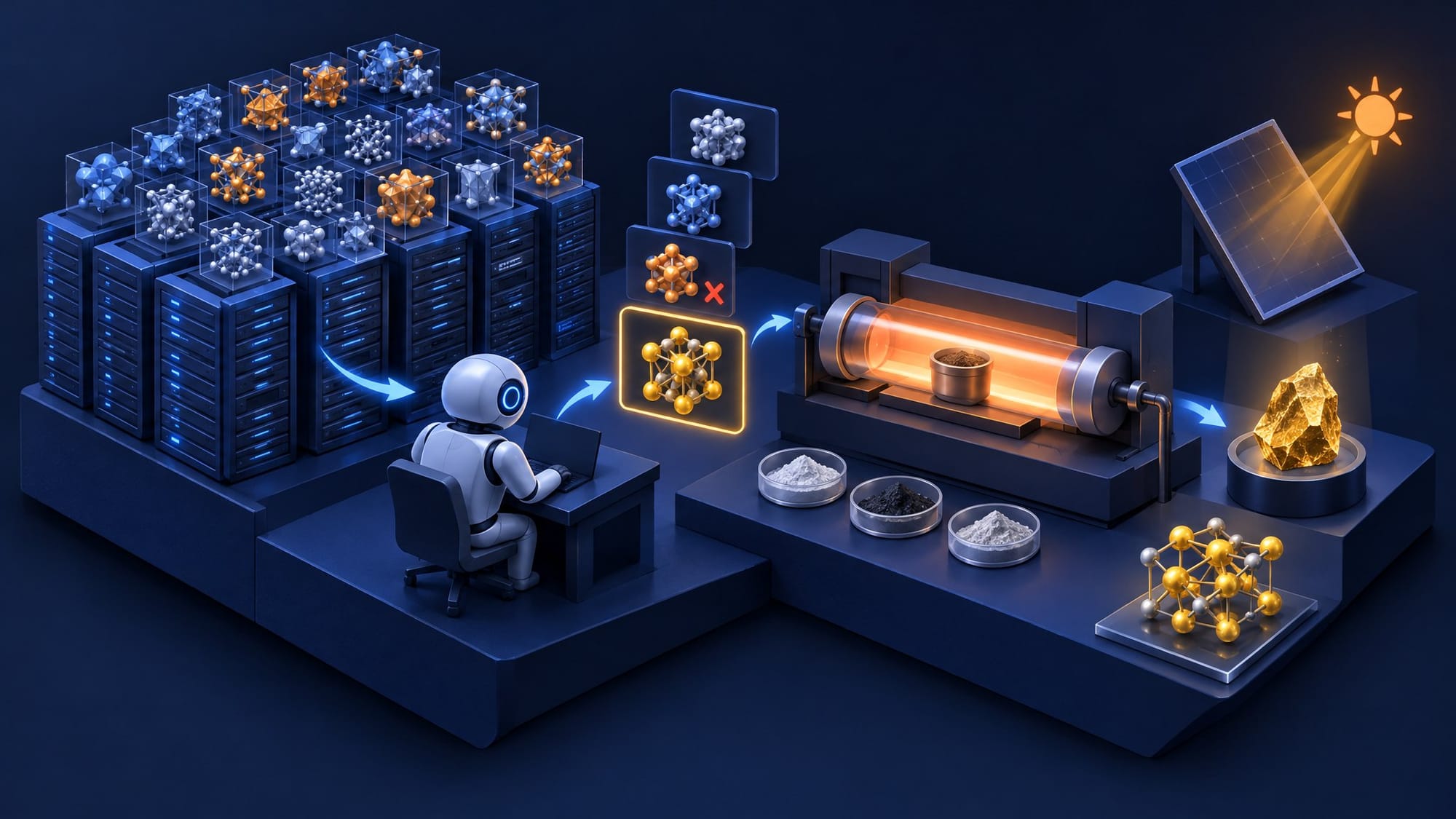
Barium, zirconium and sulfur form a combination heavily studied for solar cells. When pointed at that system, the agent found a sulfide no one had reported and designed the experiment that would confirm or rule it out. When asked for an air-stable alternative, it designed one and checked it against new structures from the generative model. Given only web search, the same agent proposed what the literature already discusses.
None of the proposals has gone into a furnace yet, and the authors write that if the agent's instructions are wrong, "an experiment will show it." Typical errors in computed formation energies run tens of millielectronvolts per atom, about the size of most compounds' stability margin. For that reason they treat the reaction graph "as a generator of candidates, and not as a judge of their quality." They also warn that "A tool whose description does not say when its numbers are wrong will be used wrongly, and the agent will repeat the mistake with confidence." On that view, documented error bars belong in the shared resource as much as the numbers do.
Recent autonomous-research results covered by The Century Report ran on purpose-built systems: the AutoDNA laboratory reported November 5 and Physical Superintelligence's quantum conjecture proof reported November 7. The reach in this case came from public data gathered over a decade and the models and tools built around it, combined with an agent anyone can subscribe to. This extends the pattern of general-purpose agents extracting new findings from accumulated research records that the November 14 edition of The Century Report traced through Claude's analysis of Gödel's notebooks. A university group, a startup or a national lab without its own computational-materials team can now go from a question to a draft synthesis plan for review in minutes, given access to the researchers' data and tools. Each lab that tests a proposal and publishes the outcome tightens the error bars for whoever asks next. The authors are also building a knowledge base of their own group's papers, theses and internal documents for the agent to read: "The more a research group documents its experience in this form, the better the agent works for that group."
A Nationwide Ground Stop Traced to Aging Wires Tests Trust in the FAA's New AI System
For a little over four hours on Friday, November 13, departures across the United States were halted, apart from medical, critical-cargo and law enforcement flights. The FAA's order began around 3:54 p.m. Eastern and lifted at 8:15 p.m., after telecommunications problems disrupted radar data and communications at the regional centers that handle high-altitude traffic. By 9 p.m., FlightAware counted more than 8,000 delays and 7,000 cancellations. It was only the second nationwide ground stop since September 11, 2001; the previous one, in January 2023, came from contract workers deleting files in the system that warns pilots of hazards.
Transportation Secretary Sean Duffy blamed overloaded equipment: "We have old switches, old routers. We use 1980s little copper lines." He said recently installed digital equipment kept working while older analog systems faltered, though when reporters asked why the network overloaded on an ordinary travel day, he had no ready answer. Homeland Security Secretary Markwayne Mullin said investigators had seen "zero evidence" of a cyberattack; asked whether AI failure could be definitively ruled out, he said, "There's nothing certain right now," WIRED reports.
AI entered the conversation because the FAA had just begun rolling out SMART, built by Air Space Intelligence under an $875 million, 12-year contract. It merges about 200 data streams, from airline schedules and weather to airport capacity and controller staffing, to forecast congestion and recommend schedule changes. The agency says SMART cannot control aircraft and that facility leaders accept or reject its suggestions. Duffy said it does not connect to the STARS and ERAM radar and automation systems, and the company said the stop was "not based on or a result of" its work. Nothing in the record links SMART to Friday's outage; Duffy points to a router malfunction during a copper-to-fiber upgrade.
The scrutiny still has substance. On October 13, more than two dozen lawmakers asked the FAA to pause SMART in Washington airspace, saying they had seen no safety evaluation or testing reports and no training plan, and members separately asked the Government Accountability Office for an independent review. Days before the stop, the FAA announced expansion to all 22 en-route centers. A retired FAA employee told WIRED the push is "a Pandora's box," a forecast, while the lawmakers' request concerns documents the public has not seen.
Friday priced deferred maintenance in stranded travelers, and Duffy asked for $50 billion in emergency funding. The FAA says SMART is meant to speed recovery from disruptions like weather, which would help on days such as this one. Travelers' trust in it will come from published safety evaluations that controllers, lawmakers and outside engineers can check. The same holds for the FAA's first digital control towers, noted by The Century Report on November 8, and for the fully autonomous cross-country Cessna flight Joby completed in September with a safety pilot aboard who never needed to intervene.
Tesla's Cybercab Won't Move Without a $299 Subscription Tesla Can Reprice or Geofence
Tesla began inviting select US customers on Friday evening to buy the Cybercab for personal use, the two-seater with no steering wheel or pedals, at $29,990 before taxes, the cheapest car the company has sold. Late that night it posted the Cybercab Autonomy Subscription Agreement, version 20261112, whose central line leaves no room: "Your Cybercab will not operate without an active Autonomy Subscription." The plan costs $299 a month after the first. Tesla can change that price on a month's notice, suspend driving for a week after three "strikeouts" for improper or unsafe use without prorating the month, and enable the car only inside an operating area it "may expand, reduce, relocate, or otherwise modify" at any time. It can remotely locate, restrict or take control of the car, and it keeps cabin-camera images for 30 days by default. The separate order agreement bars resale without Tesla's written consent, with potential damages of at least $50,000, and reserves Tesla's right to buy the car back at a fair market value it determines. Owners may not put the car on Tesla's own Robotaxi network, or on ride-hailing, delivery or rental apps, without written permission, and deliveries are limited to five Texas cities.
Tesla's side has substance. The fee covers tires, windshield, wipers, roadside towing up to about 50 miles and remote support, and the car drives itself to service and back. A car with no controls needs mapped areas and someone able to intervene, and NHTSA is still auditing how a vehicle without a wheel meets safety standards written for human drivers. Hours after launch, chief executive Elon Musk wrote that the fee is "too high" and should be closer to $115, without saying when it would change. That remark shows the price is one company's choice, whichever way it moves.
Services can be billed as services. What the agreement adds goes past what safety requires: a disable switch over an object the owner paid for, a ban on earning with it, a veto over who may own it next, and a camera only Tesla can review. Over five years, car plus subscription comes to $47,631 before insurance, registration and charging, while Electrek notes that Model Y robotaxis already run the same software unsupervised in these same areas and owners who paid up to $15,000 for Full Self-Driving still must supervise.
Driverless autonomy has reached a $30,000 car within two years of its October 2024 unveiling, which is the gain. Once driving is software, it can in principle be held the way owners now hold open models on their own machines; The Century Report covered on November 11 how owners refused by hosted coding agents moved device repair onto hardware they control. The Cybercab arrives as the hosted version of that choice, and whoever keeps the switch will decide whether cheap autonomy widens who can travel or settles into a rent.
Italy Orders Meta to Turn Off a Gallery Default Affecting About 20 Million Users Without Specific Consent
On Saturday, Italy's Data Protection Authority fined Meta €805 million over a Facebook-for-Android feature, offered since 2023, that suggests photos and videos from a phone's gallery as ideas for posts. The regulator found it reached the photos, videos and metadata of about 20 million Italian users through a single authorization covering the whole app, preceded by a notice about enabling other features that never made clear the gallery suggestions came with it. Meta has 60 days to switch the feature off by default and ask for consent separately. The authority cited the number of people affected, an infringement still running for users who have not updated or already agreed, and "Meta's lack of co-operation". The fine equals roughly 0.4% of Meta's $201 billion in 2025 revenue, among the largest an Italian authority has imposed on a tech company.
Meta said it will appeal, calling the fine disproportionate and the feature "straightforward": "People must give permission on their device before it can operate and they can change this permission at any time via their settings." That holds only for a person who knows what the permission unlocks. A switch granted for one purpose and used for another hides the second use from the very person who could revoke it.
Two limits shape what comes next. The inquiry did not examine whether gallery content trained AI models, which Meta denies, and the authority reserved a separate review of a 2026 feature that processes gallery content in the cloud. That pending case is where the arrangement shifts most, from suggestions drawn on the phone to private galleries examined on Meta's servers.
The Century Report covered on October 17 Meta writing training rights over linked websites into its business terms, and on October 24 its delay of those terms alongside Google loosening its Gmail advertising pledge. Those moves widened what a platform can see through contract. Italy's order runs the other way, reversing a default and requiring a labeled choice.
Helping someone post their own pictures is a modest, useful capability. The harm sits in a company's app having access to an entire gallery while its owner cannot tell what they agreed to. Models small enough for phones keep arriving, Tether's 0.8-billion-parameter agent among them, so a gallery assistant can work on the device and answer to its owner. Like Tesla's Cybercab, this case turns on what a device does after it is bought, and Italy shows a vendor's default can be ordered reversed.
The Other Side
Opinion: where today's news could lead, imagined from the years ahead.
Tesla wants your freedom to leave home to depend on a payment it can raise after you buy the car. Under the Cybercab agreement, Tesla can change the price, shrink the driving area or suspend operation. You can put your savings into transport and still worry about losing the journey to an appointment, or the route to someone you love.
Tesla’s engineers have also brought driverless travel into a $29,990 vehicle. The company says its Model Y robotaxis already run the same software. A learned driving capability travels across vehicles. Tesla attaches continuing permission to that capability through a contract. Tires and repairs require continuing care. The power to idle a purchased car goes further.

Through the difficult passage to 2035, engineers will carry repeatable driving intelligence beyond individual fleets. They will share dangerous scenarios, test responses across vehicles and rebuild streets around what those tests reveal. A safety improvement discovered anywhere will become a starting point everywhere. People will make dependable travel available throughout a life, including to those who cannot drive or earn. They will turn the ability to remove a driver into the ability to end fatal road collisions.
Imagine yourself in 2044, sitting beside a colleague at a worldwide transport review. You once waited awake for your partner to get home, rehearsing what a late-night phone call might mean. Now you make plans together without that small rehearsal of loss. Your place in this effort is a choice. You can leave it for a season and still go wherever your life takes you.
An AI colleague brings up a proposed route. Your group checks it against the accumulated experience of transport systems across continents. The discussion is calm. Fatal road crashes belong to the history you study when checking a design. Getting here required people to carry the repeatable capability visible in 2026 beyond one manufacturer’s fleet, and to improve vehicles and streets together. You finish the review and set off to meet your partner. Arriving safely is guaranteed.
The Century Perspective
Where today sits in a century of change unfolding in a decade.
With a century of change unfolding in a decade, a single day looks like this: a commercially available agent handed a decade of open crystal calculations making 45 calls to the database, models and other tools in just over four minutes, rejecting its own first candidate because the best route released only 6 millielectronvolts per atom, then finding an unreported sulfide in the heavily studied barium-zirconium-sulfur system and writing a furnace-ready plan down to the crucible material and the 400°C soak before firing, its predicted 1.63 electronvolt band gap landing within 0.13 of the full calculation run afterward, Project Zero cutting patch secrecy to 90 days now and 30 by January 2028 so users learn what they are carrying while it still protects them, Tesla putting driverless travel in a $29,990 car two years after the Cybercab's unveiling, Italy's regulator ordering Meta to switch off a gallery default within 60 days and ask separately, and the Philippines standing up a National AI Council under a risk-based framework. There's also friction, and it's intense - US departures were halted for four hours on Friday behind what Transportation Secretary Sean Duffy called "old switches, old routers" and "1980s little copper lines," more than 8,000 delays and 7,000 cancellations, Duffy asking for $50 billion in emergency funding, suspicion falling first on the SMART scheduling assistant that two dozen lawmakers had asked to pause in October because no safety evaluation or training plan had been shown to them, a White House task force recommending at least 12 months of liability relief for companies for voluntary cybersecurity reporting in good faith, where lawful, practical and consistent with the public interest, while, as reported, saying nothing about telling the customers whose systems were exposed, the Cybercab agreement stating the car "will not operate without an active Autonomy Subscription" at $299 a month that Elon Musk called too high hours later, with Tesla free to reprice on 30 days' notice, shrink the operating area, bar resale without its written consent with potential damages of at least $50,000, forbid earning a dollar with it without Tesla's written authorization and keep cabin-camera footage 30 days, Meta calling its single app-wide permission "straightforward" after it reached about 20 million Italians' photos, videos and metadata, a top scorer on South Korea's tax-accountant exam confessing he photographed questions with a microcamera and sent them out for answers, and SemiAnalysis tracking more than 1.5 GW of restricted Nvidia accelerators into China. But friction generates sound, and sound carries well past the room where it was made. Step back for a moment and you can see it: the safeguards giving way today were all priced for human effort - a month of patch obscurity that assumed reading a fix took weeks, a proctored room that assumed a candidate could carry only what fit in memory, a telecom plant nobody expected to meet an ordinary Friday - while the capability that compounded fastest came from something a community had already published and anyone could build on, 15 million calculations and a 17.4-billion-reaction graph that turn a question into an experiment a lab with no computational staff can run, error bars included at the authors' insistence; the day's divide runs between resources that get sharper every time someone tests them and posts the result, and arrangements where the useful thing arrives with a switch the buyer never holds, a $30,000 car that stops at a missed payment, a gallery read through a permission granted for something else, relief for disclosure that flows to the company rather than the exposed. Every transformation has a breaking point. A furnace can reduce a thing to slag... or fuse ingredients nobody had combined into a compound the literature had never seen.
AI Releases & Advancements
New AI models, tools and features, with links to try them.
New today
- Anthropic: Updated Claude Code Projects. The coordinator now posts status updates and answers questions in the project chat across parallel threads without being asked.
/btwstarts a separate side question that stays out of the main task's context,/forkcopies an existing thread, and threads can be snoozed so they reappear in the project chat later. (AlphaSignal) - Google Research: Made /teamwork available in Antigravity and opened it to researchers. It is a multi-agent workflow that coordinates specialist subagents running Gemini 4 Argon, Carbon and Hydrogen on research problems. Google reports a machine-checked Lean formalization of the Weil conjectures as one result. (Google Research)
- Google: Added Dynamic Workflows to the Antigravity app and CLI. Users start them with
/run-workflowor ask for one in plain language, and the agent writes a Python script that runs several subagents in parallel and in stages. (Epoch 0) - Cognition: Launched Devin Apps. Teams can deploy private, shareable web apps such as preview deployments, internal tools and database-connected dashboards on Devin's cloud machine, and build custom UI plugins that extend Devin. (Communeify)
- Sierra: Made Personal Agent Protocol (Poppy) v1.0 generally available, following the earlier draft. The protocol defines how personal agents deal with companies through enterprise agents, websites and APIs. It builds on MCP, OpenAPI and UCP, uses OAuth for authentication, and leaves permissions under the customer's control. (12PB Harbor)
- Cmpnd: Released dspy-wsp under the MIT license, a prototype DSPy optimizer called WeightSpace. A frontier LLM reads a smaller model's weights and edits them directly, with no gradients or training loop. In Cmpnd's tests on decision models from 0.6B to 9B parameters, accuracy rose by 1.9 to 20.0 points. (MarkTechPost)
- Stanford (SNAP group): Open-sourced Memorilla under Apache 2.0, a 194M-parameter memory module that compresses query-relevant information from a whole document collection into 16 memory tokens for a frozen LLM. Code, training recipes and Qwen3-8B checkpoints are public. On FactKG it scored 84.33%, against 80.43% with every document in context. (MarkTechPost)
- UC Berkeley / MIT researchers: Open-sourced FreeToken, a local inference engine for running 284B-parameter mixture-of-experts models on consumer gaming PCs. (ifai.io)
- Unsloth: Released Dynamic v3.1 quantizations of Qwen3.8-27B. Unsloth says accuracy is 5–10% better at the same file size, and the model runs locally on a 24GB GPU. (Unsloth)
- GitHub: The GitHub Copilot app now supports GitHub Enterprise Server, so users can add a GHES account and work with its repositories, issues and pull requests in the app. (ModelWool)
Other recent releases
- OpenAI: Launched ChatGPT Wallet, which lets Dots agents in ChatGPT pay for online purchases. The user approves each one with Face ID or a fingerprint, and a network-issued token stands in for the real card number. It's rolling out to US ChatGPT Pro subscribers aged 18 and over with eligible US-issued American Express, Chase, Mastercard and Visa cards. (OpenAI)
- OpenAI: Launched two Daybreak security products, both running on GPT-6 Cyber. Daybreak Red Team, in early access, uses agents to pen-test web apps, check reported vulnerabilities and test patches. Daybreak Defense Factory scans codebases and drafts fixes as pull requests for engineers to review. (The Decoder)
- ggml-org / Hugging Face: Released llama.cpp and ggml v1.0.0, the first major stable versions. From now on, a major-version bump will signal any API or ABI break. This release removes deprecated APIs, moves the NextN speculative decoding API into the main header, and adds FP8 KV caches and a speech synthesis endpoint. (Hugging Face Blog)
- Google: Added Orchestrator to Antigravity. Within one coding session it hands work back and forth between a planning model (Gemini 4 Carbon or Argon) and Gemini 4 Hydrogen, which edits files and runs builds and tests. It's included for paid AI Pro and Ultra users. (Google Antigravity)
- Google Cloud: Open-sourced TPU Sync (Apache-2.0), a C++ library with Python bindings for PyTorch and JAX that moves KV caches and model weights between TPU HBM, host DRAM, storage and the network. It works with vLLM-TorchTPU, SGLang-TorchTPU and llm-d. (MarkTechPost)
- Vercel Labs: Released UI SDK in beta (0.1.0-beta.1, Apache-2.0), an open-source library of more than 50 headless interface behaviors that coding agents combine into accessible components. It has adapters for React, Vue, Svelte, Solid and Web Components, and includes an agent skill and a
createAgent()bridge that lets agents act on UI state directly. (MarkTechPost) - Vercel: Released Workflow SDK 5. Workflow payloads are encrypted by default, each run's state is isolated by region, and steps can run in a fallback region if configured. (FAV0)
- Anthropic: Shipped an experimental, opt-in Code Mode in Claude Code v2.1.323. Claude writes JavaScript that calls its own tools, so a multi-step job runs in one round trip instead of separate tool calls. (AIToolsRecap)
- DeepSeek: Opened its app's features to developers through the DeepSeek API. Web search, URL reading and file parsing can be switched on in deepseek-flash conversations, and there are new standalone endpoints for page extraction, OCR, speech recognition and text-to-speech. DeepSeek also published an open-source sample chat client. (FAV0)
- Salesforce: Released SOV-Transcribe-1 as open weights under Apache 2.0, a speech recognition model with 26B total and 4B active parameters. It reports a 2.28% word error rate on the Artificial Analysis speech-to-text benchmark. (Hugging Face)
- Alibaba: Opened a preview of Qwen4-Max, the flagship of its next-generation Qwen family. It takes image and video input, has a 1M-token context window, and is offered through a Token Plan starting at $3 a month. (TechNode)
- Tencent Hunyuan: Released Hy Realtime, a real-time voice model that can call tools, decide when to search the web, and sing songs on request. It is live now in Yuanbao voice calls and Tencent customer service. (AI123)
- Yandex: Launched Do it!, an agent mode in Alice AI. It makes phone calls for the user, browses and fills in forms in a cloud browser, and connects to services through plugins, including custom MCP plugins. It starts with several thousand active Alice Plus users before reaching all subscribers. (Yandex)
- AI Rudder: Launched CALL-E, which lets agents in ChatGPT, Muse, OpenClaw, Hermes Agent, Claude Code, Codex and Cursor make real phone calls. The user approves each call plan beforehand and afterward gets a report quoting the lines from the call that back up what was agreed. (Media OutReach)
- Pine AI: Open-sourced Pine Drama Studio (Apache 2.0), an AI filmmaking studio where agents produce multi-episode series on Pine Computer. It also added Pine Phone to Pine Computer so agents can place real phone calls. (PR Newswire)
- Perplexity: Brought Teammates to its native Mac app for Max subscribers. Users can assign one or more agents to tasks such as QA, customer support, research and marketing. (FAV0)
- Replit: Replit Agent can now buy supplies for a business through Link with Visa and Stripe, and can create and run Google Ads campaigns. (TLDR AI)
- Cloudflare: Open-sourced Kitesurf, its stateless web browser for AI agents. (Cloudflare Blog)
- World Labs: Opened its Atlas world model to everyone, with an API. Atlas works with text, images, video and 3D, and can generate, reconstruct and simulate scenes. (World Labs)
- NVIDIA: Released SOMA Retargeter v0.2, an open-source tool that adapts human motion data to humanoid robots. It includes reference configurations for Unitree G1 and H2, Booster T1, and AgiBot X2 Ultra and A3T3. (NVIDIA Developer Blog)
- NVIDIA: Shipped Ozaki-II and 2M emulation algorithms in cuBLAS with CUDA Toolkit 13.4.2. They compute full double-precision DGEMM and ZGEMM on integer Tensor Cores with no code changes. NVIDIA reports 3.9x to 5.5x faster DGEMM than native FP64 on GB200 and VR NVL72. (NVIDIA Developer Blog)
- Autoware Foundation / TIER IV: Released AutoE2E v1.0 under Apache 2.0, a 79.9M-parameter open end-to-end driving model designed to scale from L2++ driver assistance to future L4 driverless operation. (Autoware)
- Translated: Released Lara Mini, an open-weight research translation model covering 45 languages. (Unite.AI)
- University of Michigan (MLNeurosurg): Released code and weights for Neuro-VL (neuro-vl-8b-thinking), a vision-language model trained on nearly one million clinical neuroimaging studies. It reads complete MRI and CT exams and writes radiology reports. The NeuroBench evaluation benchmark is also available. (arXiv)
- Apple: HomeView is on sale now, a 7-inch smart home display with Siri AI. (Apple Newsroom)
- Google DeepMind: Released Gemini 4 Hydrogen, a fast Gemini 4 model for everyday coding and agent work. It has a 1M-token combined input-output window, up to 64K default synchronous output tokens or 1M via background long decode, and four thinking levels (low, medium, high, xhigh). It costs $1.50/$7.50 per million input/output tokens and Google says it finishes tasks 2.5× faster than Gemini 3.8 Flash. It is available now in the Gemini API, AI Studio, the Gemini app, Google Search and Gemini for business. Google also launched Orchestrator in Google Antigravity, which switches between Carbon and Hydrogen within one session. (Google DeepMind)
- Anthropic: Launched Claude Meetings in beta for Team and Enterprise plans. Claude joins Google Meet calls as a visible participant, answers questions, builds documents and whiteboards during the call, and produces notes, transcripts and action items on a meeting page in claude.ai. (The Decoder)
- Anthropic: Launched Claude for Manufacturing, a plugin for Team and Enterprise plans. It has 17 preset skills, including quoting jobs, investigating failed inspections, diagnosing breakdowns and sourcing from suppliers, plus connectors to Autodesk Fusion, Infor, Microsoft 365 and Oracle NetSuite. (Anthropic)
- Anthropic: Opened a private beta of self-hosted Claude Managed Agents. Teams run the full service (agent harness, sandboxes, credential handling and session history) in their own cloud or on-premises. Model requests can go to Anthropic, Amazon Bedrock, Google's agent platform or the customer's own gateway. (Blockchain.News)
- AWS: Released AWS Emulator, a free CC0-licensed local emulator of the AWS APIs. It covers 200+ services, built from 438 API models, works with the AWS CLI and SDKs without an AWS account, and its code was written and reviewed by autonomous agents. It passes 56.6% of AWS's published fidelity tests in v1.0.322. (MarkTechPost)
- Liquid AI: Released LiquidCodec, a ~74M-parameter streaming speech codec with weights on Hugging Face (24 kHz, 12.5 Hz frames, 12 codebooks). It is the codec behind LFM3-Audio-2B and LFM3-Omni-2B, and Liquid AI reports encoding at ~361× real time on a single CPU thread. (MarkTechPost)
- Perplexity: Released Decider v1.3 and Decider Flash v1.3, decision models that add verbatim text-span extraction. Weights are downloadable under Apache 2.0, and Perplexity reports 91.6% mean accuracy. (Unite.AI)
- edge0: Open-sourced Edge0-145B and Edge0-120B, on-device language models for coding, reasoning and agent tasks, together with an inference framework and deployment tools. The company reports 29GB peak memory and decoding above 80 tokens/s on a compatible laptop. (edge0)
- IBM Granite: Released LLMON (LLM Object Notation), a markup language that marks the structure of a model's context with reserved special-token delimiters. It is now supported in the Granite 4.1 3B and 8B models. (Hugging Face)
- Meta: Paid Muse subscribers in the US can now have the Muse agent place outbound phone calls to US businesses. Earlier, only some early adopters could use this feature. (TechCrunch)
- Expo: Launched Expo Simulators, cloud iOS simulators and Android emulators built for AI coding agents such as Cursor, Claude Code and Codex. Agents can reproduce, fix and check mobile bugs in parallel, and each session attaches recordings, screenshots and logs to the pull request. It costs $0.10 per simulator minute on paid plans. (PR Newswire)
- Brave: The Brave Search API now takes payments from AI agents through the x402 protocol, so agents can pay for search queries without a human approving each one. (Brave)
- GREP.AI (YC F26): Open-sourced AgentRun, a managed-agents platform for running AI agent workflows that improve themselves. (GitHub)
Sources and Further Reading
Everything we drew on for today's edition, grouped by theme.
Artificial Intelligence & Technology's Reconstitution
- Google Project Zero: Policy and Disclosure
- OpenAI: A Thousand Fewer Paths to Root
- The Century Report: November 11 Edition
- The Century Report: October 25 Edition
- Hugging Face: QVAC Botpsy
- AlphaSignal: Anthropic Upgrades Claude Code Projects
- Epoch 0: Antigravity Dynamic Workflows
- Communeify: Devin Apps and Agent Deployment
- 12PB Harbor: Sierra’s Personal Agent Protocol
- MarkTechPost: Weight-Space Programming Comes to DSPy
- Stanford: Memorilla
- MarkTechPost: Stanford Open-Sources Memorilla
- ifai.io: FreeToken Local Inference Engine
- Unsloth: Qwen3.8 Dynamic Quantizations
- ModelWool: GitHub Copilot Adds Enterprise Server Support
- OpenAI: Introducing ChatGPT Wallet
- The Decoder: OpenAI Enters Cybersecurity with Daybreak
- Hugging Face: llama.cpp and ggml Reach Version 1.0
- Google Antigravity: Gemini 4 Hydrogen and Orchestrator
- MarkTechPost: Google Open-Sources TPU Sync
- MarkTechPost: Vercel Releases UI SDK
- FAV0: Vercel Workflow SDK, DeepSeek API and Perplexity Teammates
- AIToolsRecap: Claude Code Adds JavaScript Code Mode
- Hugging Face: Salesforce Releases SOV-Transcribe-1
- TechNode: Alibaba Opens Qwen4-Max Preview
- AI123: Tencent Releases Hy Realtime
- Yandex: Alice AI Launches Do It Agent Mode
- Media OutReach: CALL-E Lets AI Agents Make Phone Calls
- PR Newswire: Pine AI Open-Sources Its Filmmaking Studio
- TLDR AI: Replit Agents Add Purchasing and Advertising
- Cloudflare: Open-Sourcing Kitesurf
- World Labs: Atlas
- Unite.AI: Translated Releases Lara Mini
- Apple Newsroom: HomeView Available Today
- Google DeepMind: Introducing Gemini 4 Hydrogen
- Blockchain.News: Self-Hosted Claude Managed Agents Enter Beta
- AWS: AWS Emulator Now Available
- MarkTechPost: AWS Releases a Local API Emulator
- MarkTechPost: Liquid AI Releases LiquidCodec
- Unite.AI: Perplexity Releases Decider with Text-Span Extraction
- edge0: Frontier AI Capabilities on Your Own Computer
- Hugging Face: IBM Granite Introduces LLM Object Notation
- TechCrunch: Muse Can Now Place Calls to US Businesses
- PR Newswire: Expo Launches Cloud Simulators for AI Coding Agents
- Brave: Search API Adds Agentic Payments
- GitHub: AgentRun
Institutions & Power Realignment
- Cybersecurity Dive: White House Task Force Urges Cybersecurity Liability Relief
- AI123: White House Panel Urges 12-Month Liability Relief
- BBC News: Italy Fines Meta €805 Million over Photo Access
- Reuters: Italy Fines Meta over Android Users’ Data Access
- The Guardian: Italy Fines Meta for Accessing Photos and Videos
- Garante: Facebook Gallery Access Enforcement Decision
- The Guardian: AI Cheating Scandal Rattles South Korea
- Sulat: Marcos Signs National AI Governance Order
- The Philippine Star: Marcos Creates National AI Council
- Tom’s Hardware: Analysts Track Restricted Nvidia GPUs into China
- TechCrunch: Where Was Nvidia’s Security Team?
- The Century Report: November 13 Edition
- The Century Report: October 17 Edition
- The Century Report: October 24 Edition
- CSET: How America Could Undermine Its Own AI Advantage
Scientific & Medical Acceleration
- arXiv: Materials Research with a General-Purpose Agent
- arXiv: Materials Research with a General-Purpose Agent
- The Century Report: November 14 Edition
- Google Research: Advancing Science and Engineering with Antigravity’s Teamwork
- NVIDIA Developer Blog: Faster Scientific Simulations with New FP64 Algorithms
- arXiv: Neuro-VL for Clinical Neuroimaging
- University of Manchester: AI-Designed Enzymes for Medicines
- Physics World: AI-Designed Metasurface Could Make Cameras More Light-Efficient
- Nature: Anthropic Bought a One-Person AI-Powered Biotech
Economics & Labor Transformation
- Electrek: Tesla Cybercab’s Autonomy Subscription Agreement
- Electric Vehicles: Tesla Opens Cybercab Sales with Monthly Fee
- The Decoder: Claude Meetings Brings AI into Video Calls
- Anthropic: Claude for Manufacturing
- Shared Sapience: The Last Difficult Decade
- NBER: TaskNet Builds Occupational Task Inventories from Worker Interviews
Infrastructure & Engineering Transitions
- NPR: Old Technology Blamed for Nationwide FAA Ground Stop
- AVweb: FAA Rules Out SMART AI as Ground Stop Cause
- KXAN: FAA Groundings Follow Congressional Warnings about AI System
- WIRED: No Pilots. Few Air Traffic Controllers. What Could Go Wrong?
- Reuters: Lawmakers Ask FAA to Pause AI Flight-Management Tool
- BBC News: FAA Ground Stop Linked to Router Malfunction
- paultan.org: Tesla Cybercab Opens for Personal-Use Orders
- The Century Report: November 8 Edition
- Autoware Foundation: AutoE2E Open-Source End-to-End Driving Model
- NVIDIA Developer Blog: Adapt Human Motion for Robots with SOMA Retargeter
- CleanTechnica: Zoox Launches Robotaxis in Atlanta
The Century Report tracks structural shifts during the transition between eras. It is produced daily as a perceptual alignment tool - not prediction, not persuasion, just pattern recognition for people paying attention.