UK Lawmakers Want Every Phone to Blur Child Abuse Images
British peers and MPs want software on every phone that blurs child abuse images using AI-model criteria, with inspection and appeals unspecified.



The 20-Second Scan
Every story in today's edition, one line each.
- Peers and MPs proposed mandatory blurring software on every UK phone and tablet, building on September's device-level controls for children with the kind of scanning Apple dropped in 2022.
- Pangram scored many anti-Waymo op-eds as heavily AI-written, and former Black Car Fund head Ira Goldstein confirmed a PR firm drafted his unlabeled Daily News piece, saying he stands by every word.
- Nvidia's board opened an independent investigation into reporting that chief executive Jensen Huang was a foreign intelligence target, saying it has no reason to believe secrets were compromised, as Huang apologized to staff and Congress sought a briefing.
- Presley rights holders sued Suno under Tennessee's ELVIS Act alongside Eminem's publisher, as the global recording industry's chief warned Australia that an AI training exception would be "ridiculous and dangerous."
- LG AI Research opened free API access to K-EXAONE 2.5, self-reporting a gain of more than 70% across 24 evaluation metrics in eight weeks, as Warsaw's Ingenix said its 9B Thalamus model tops LongevityBench and opened a version.
- A co-founder of Microsoft Research's roughly 50-person AI Frontiers group wrote that the lab has ended after a September reorganization into scaling-focused Microsoft AI, and that he has left the company.
- Apple is pushing Siri toward controlling third-party apps such as Grubhub and OpenTable by spring, after first-party app control arrives in iOS 27.3, Bloomberg reports.
- Ambient-air coating yielded a certified 32.73% perovskite/silicon tandem solar cell after researchers added phenethylammonium cations to a buried polymer layer, with the unsealed cell keeping 80% of output for 2,182 hours.
Track all of the arcs The Century Report covers here:
The Big Picture
How today's news moves the longer trends we track, and where they could lead.
Rights holders pressed for payment on training and imitation alike, a chipmaker's board opened an inquiry into its own chief executive, and a PR firm's unlabeled drafts filled local opinion pages. The gains that reached the most people came from retraining models already built, then handing them out as free calls or open files. That leads to a small lab bench, where a researcher runs one blood sample's methylation readings through a downloaded model on a single workstation.

More capability is coming from retraining a model than from enlarging it
open models · AI research · AI pricing
- March: Cursor built its Composer 2 model on Moonshot's open Kimi 2.5, spending about three-quarters of its compute on further training.
- August 14: Z.ai reused GLM-5.2's base for GLM-5.3 and lifted its Terminal-Bench 3.0 score from 4.6 to 28.3 through post-training alone.
- November 2: MIT CSAIL researchers had GPT-6 Astra edit 0.016% of Qwen3.5-0.8B's weights, lifting its MATH-500 accuracy from 7.9% to 48.1%.
- Early November: Deep Principle opened Hydrogen-1.0, a 753B science model post-trained from GLM-5.3, under an MIT license.
- Today: LG said eight more weeks of training lifted K-EXAONE 2.5 more than 70% on its own metrics and opened it free to call, while Ingenix said its retrained 9-billion-parameter Qwen estimates age from DNA methylation with an average error of 3.36 years, against 12.9 for the same base model prompted with text.
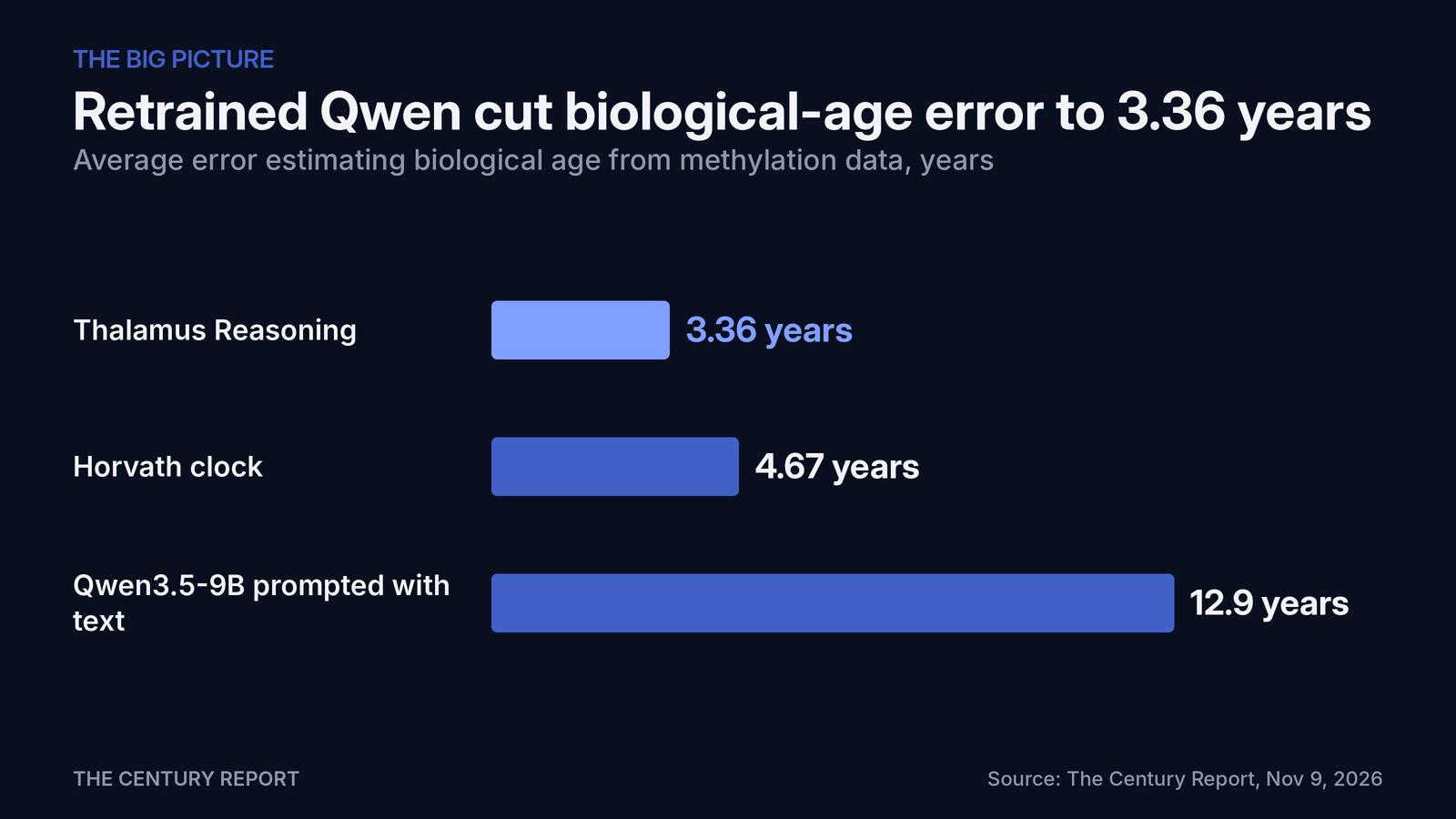
The line: Builders keep getting large gains by changing how an existing model is trained or run, without making it bigger.
If it holds: National programs, startups and small labs could reach near-leading capability from models already released, at a fraction of the cost of a new training run. Korean developers already call LG's model without a bill, though on a server LG can reprice or withdraw.
What would bend it: Giant pre-training runs like ByteDance's 10-trillion-parameter effort, begun in August, opening a gap retraining cannot close would bend it, as would LG's and Ingenix's self-reported gains failing outside their own tests.
AI rights enforcement pays the catalogs and bills the independents
copyright · music · AI governance · on the board since October 11
- July: A federal judge approved Anthropic's $1.5 billion book settlement, about $3,000 per work, paid on piracy and not on training.
- September: Universal Music announced a licensed fan-remix platform with ElevenLabs, adding to its deals with Udio, Spotify and Nvidia.
- October: ARIA chief Annabelle Herd told Australia's AI inquiry that OpenAI and Anthropic wanted a training deal exempt from copyright law.
- October: DistroKid confirmed removing songs on UMG's claims, and independent artists including McGwire lost human-made tracks without notice or appeal.
- Late October: Elvis Presley's rights holder sued Anthropic for about $41 million over training on 274 songs.
- Today: On Sunday, rights holders for Elvis Presley and the publisher of some of Eminem's biggest records sued Suno over songs that mimic those artists, invoking Tennessee's ELVIS Act, days after an EU court adviser called training generally lawful.
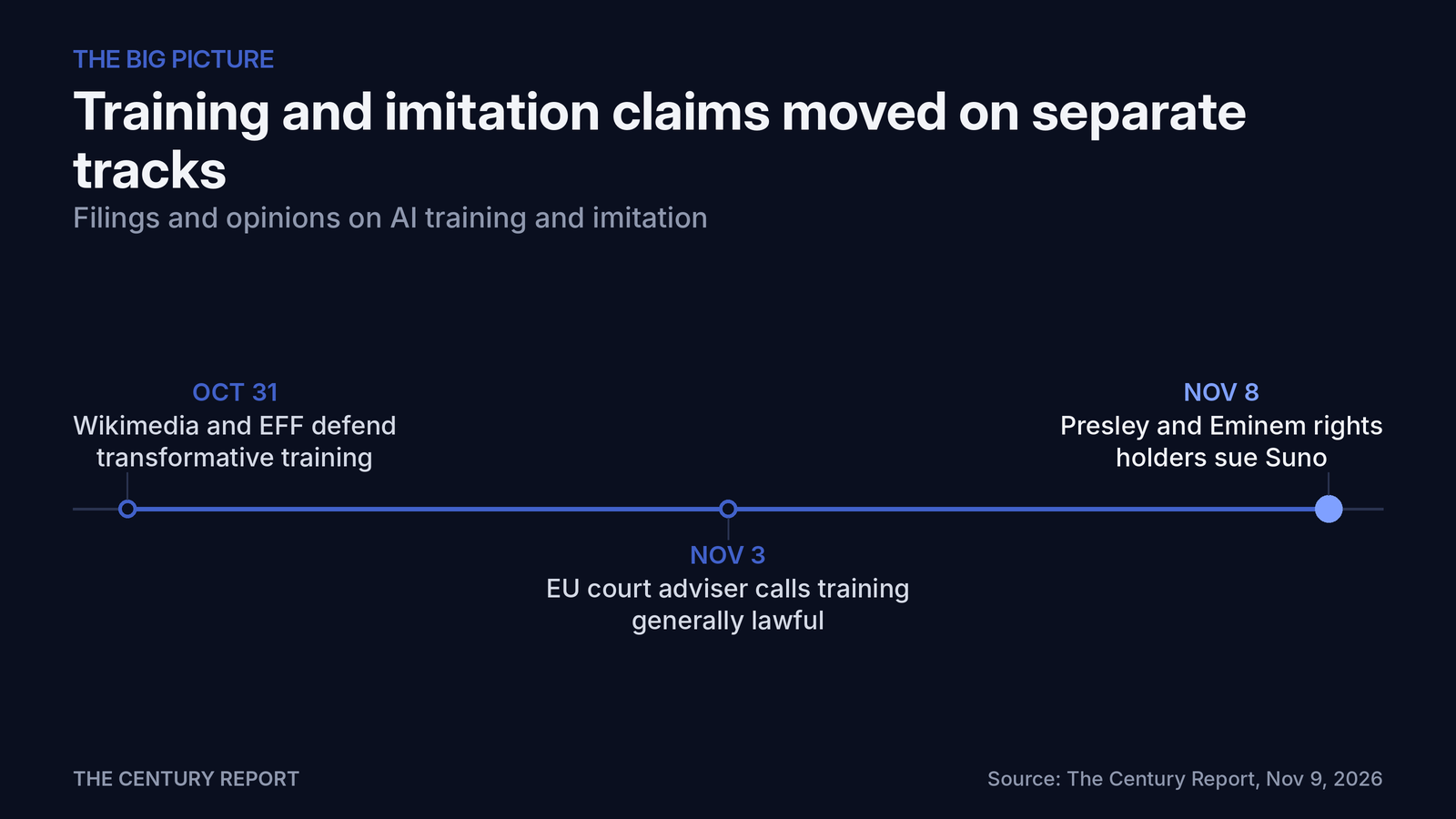
The line: The biggest catalog owners keep asking for payment on training and imitation alike, while removals made on their claims fall on independent musicians.
If it holds: Training licenses would be priced by the largest catalogs and paid by every small developer. The money would reach catalog owners, while independents like the artists DistroKid delisted collect nothing.
What would bend it: Courts keeping training free and confining liability to outputs that imitate or substitute, the split Advocate General Szpunar drew on November 3, would remove the training toll while leaving likeness claims like the Suno suits standing.
Machine-drafted advocacy is filling the channels built for public voice
media · public comment · AI governance
- March: Advocates asked California prosecutors to investigate after CiviClick generated more than 20,000 comments against clean-heat rules a board rejected 7-5.
- Early June: r/biohackers moderators closed peptide and hormone posts after finding companies seeding promotions for AI answer engines to repeat.
- Late August: A fictional, Israeli-funded think tank published 560,000 words in nine days, and ChatGPT and Perplexity cited it as policy research.
- Late October: Tobacco Control researchers found 90,835 of 118,756 responses to a British vape consultation flagged as bots, and genuine respondents backed the limits 77%.
- Today: Semafor reported Sunday that Pangram scored unlabeled anti-Waymo op-eds from 68% to 95% machine-written, and former Black Car Fund head Ira Goldstein confirmed his PR firm drafted his.
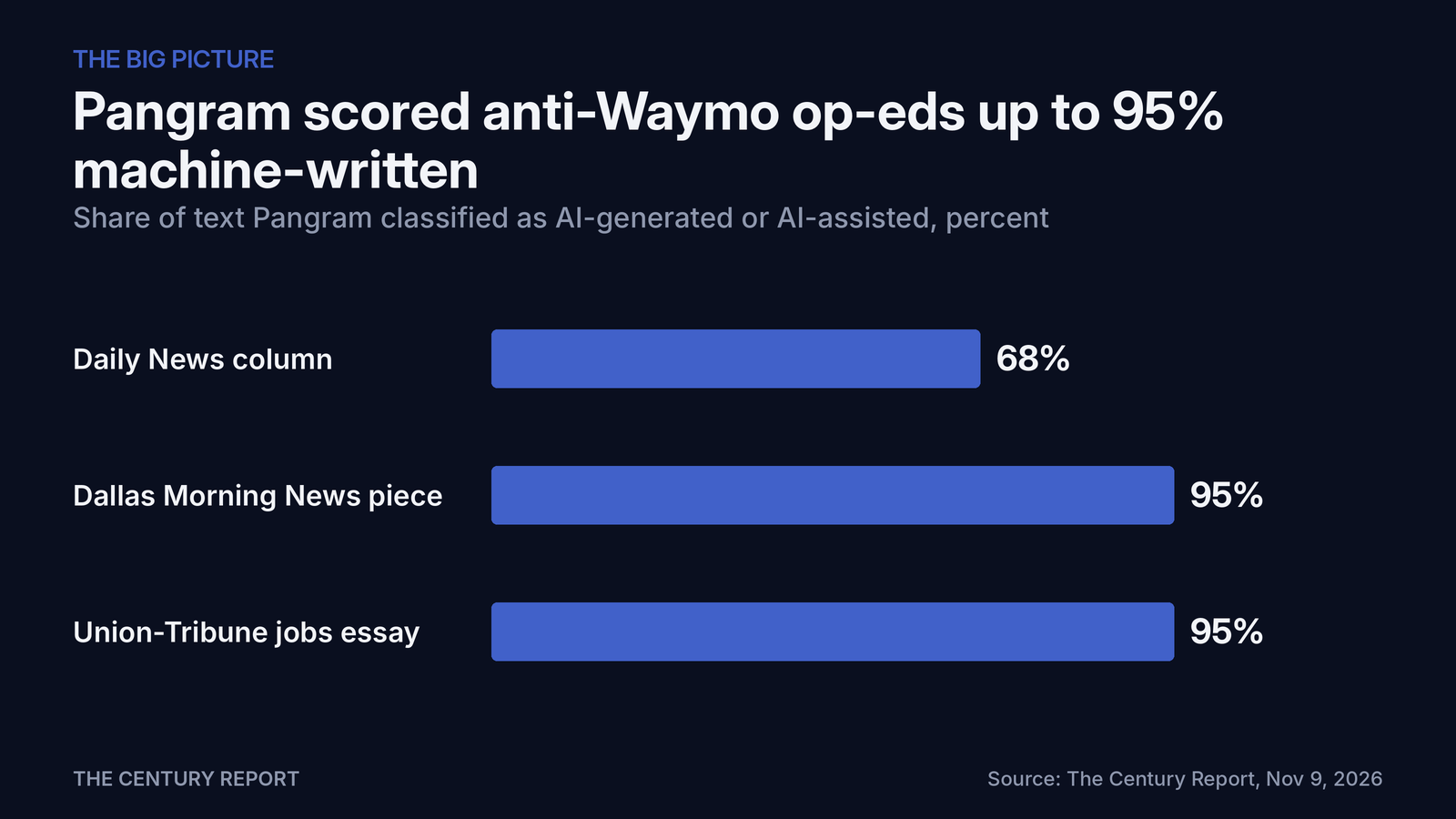
The line: Funded campaigns keep using cheap machine drafting to fill the places officials and readers go to hear the public, now including local opinion pages.
If it holds: Editors, regulators and readers would weigh a campaign by who drafted and funded it, since fluency and volume no longer show how many people agree. The same drafting serves a drivers' union or a neighborhood group making its own case.
What would bend it: It bends where papers and agencies require the drafter and funder to be named, or where opposition dismissed as manufactured proves genuine, as Graphika found in June for anti-data-center posts OpenAI had tied to China.
Barriers built to hold capability back now mostly add a markup
AI hardware · geopolitics · export controls · on the board since October 21
- Late May: The Commerce Department extended license rules to China-headquartered firms abroad, after hundreds of thousands of top chips may have reached their overseas subsidiaries.
- Late June: Taiwanese prosecutors raided a Supermicro office over allegations that about $2.5 billion in servers reached China.
- August: Taiwanese prosecutors indicted nine people, including an Nvidia manager, over forged end-user papers that moved restricted servers toward China.
- October: Huawei shipped 572,000 data-center AI chips in the first half of 2026, as Nvidia's share of China's market fell to 34%.
- Early November: Commerce cleared Chinese firms with blacklist ties, including one listed at an empty Beijing office, to handle Nvidia's H200 chips.
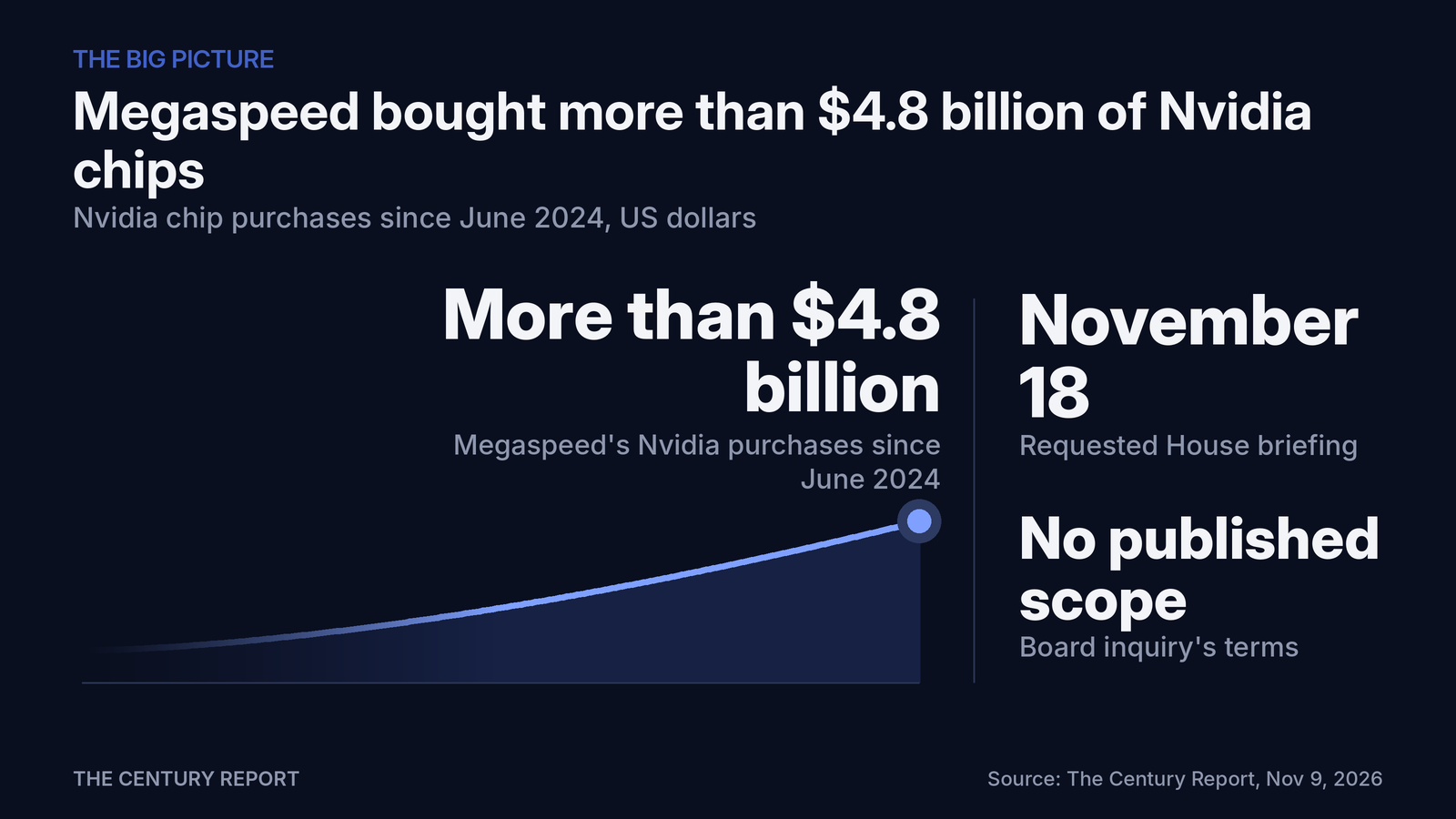
- Today: Nvidia's board named independent directors to investigate Jensen Huang's ties to a Megaspeed executive, at a customer that has bought more than $4.8 billion in Nvidia chips since June 2024 while Commerce examines it.
The line: Chip controls keep depending on vendors' and intermediaries' own diligence, so each gap opens wherever one middleman sits between factory and buyer.
If it holds: Restricted buyers keep finding a route through a single intermediary, while compliant customers carry the licensing cost. Regulators wait on Nvidia's own inquiry, which has no published scope or promise to release findings.
What would bend it: Evidence that the controls still deny China the parts it needs most would bend it, such as a domestic training run that could not happen without stockpiled foreign parts, the limit Huawei's openPangu-2.0-Pro run exposed in August.
The 2-Minute Read
Today's news in brief, and what ties it together.
The intelligence moving onto phones and into opinion pages can answer to the person using it or to whoever controls it, and Britain's cross-party proposal shows the second arrangement in full. Peers and MPs want a legally required classifier on every handset sold in the country, reaching older phones by forced update, to blur abuse imagery, including AI-generated videos that jumped from 13 to 3,443 in a year. The plan did not spell out what owners could inspect, how errors would be reported or how to contest a blur, and the model's criteria could widen by amendment.
Cheap capability also redraws who gets heard and who gets paid. Hired firms drafted with AI to fill local pages against Waymo without labels. The same drafting now sits with drivers' unions and neighborhood groups, so the funder behind a piece becomes the scarce fact. In the Suno suits, a likeness law aimed at a cloned Presley voice protects one person's identity. The training licenses the recording industry is urging Australia to keep mandatory work differently. The largest catalogs would set the price, and every small developer would pay it.
Where capability went out without a bill, the floor rose. LG AI Research made K-EXAONE 2.5 free to call for developers, startups, companies and research institutions, though LG can still reprice that service. Warsaw's Ingenix is releasing a version of its longevity model as files anyone can inspect. Both releases rest on self-reported benchmarks. Co-founder John Langford's account of Microsoft's dissolved AI Frontiers lab shows what pouring a budget down one path costs. Methods that might roughly halve the compute behind a capability lost their home there, though the lab's code and papers remain public.
Scrutiny in the day's evidence runs downhill. Britain's proposal would scan images on the phones of tens of millions of ordinary owners. Nvidia's board is examining reports that its chief executive was a foreign intelligence target. It has published no detailed scope and promised no findings, and it said it had "no reason to believe" anything was compromised before its inquiry had reported anything. Controls on AI's most consequential chips still rely in part on vendors' own paperwork, alongside government licensing and independent checks. The people least able to refuse the watching would carry the most of it.
The day's forward motion came from capability spreading outward. A certified 32.73% perovskite-on-silicon cell made in ordinary air points toward efficient panels from simpler factories, as cheaper training methods do for models. Apple reportedly wants Siri ordering through Grubhub and booking through OpenTable for its owners by spring. The British amendment has not been tabled yet, and the phones it would reach are the same ones learning to act for the people holding them.
The 20-Minute Deep Dive
The day's most important stories in full, with every source linked.
Britain Weighs Putting an Abuse Detector on Every Phone
A cross-party alliance in Parliament wants every smartphone and tablet sold in Britain to carry software designed to blur child sexual abuse imagery, including AI-generated material, and to block livestreamed abuse, with older devices reached through a mandatory update, The Observer reported on Sunday. Conservative peer John Nash, who led the Lords push for an under-16 social media ban, says he will table an amendment, likely to the coming national security bill, if ministers do not act. Labour's former safeguarding minister Jess Phillips is leading in the Commons. The harm they target is grave and growing: the Internet Watch Foundation removed more than 312,000 child sexual abuse images last year and found 3,443 AI-generated abuse videos, against 13 the year before. An Observer poll found 80% support for the software after a short description.
The proposal builds on a commitment already made. In September, culture secretary Lisa Nandy said the government would legislate device-level protections for children, built into every UK device and switched on by default and removable only through age verification, a design the Guardian reported implies client-side scanning, where content is checked on the device before it is encrypted or sent. Nash's case for the next step rests on that one: "If it can be done for children's phones on these images, it can be done for child sexual abuse images on all phones." His sentence shows how such a capability spreads. Once built for one purpose, its existence becomes the argument for the next.

The proposal would require abuse-image detection software on every handset in the country. What it looks for is set by whoever controls the model's criteria, and those criteria can grow by amendment, under ministers who never argued for the original purpose. The proposal as reported did not spell out what the owner of the phone could inspect, how errors would be reported, or how to contest a blur, and a rare error repeated across tens of millions of devices still lands on many lawful pictures. Apple weighed the same trade and dropped its plan to scan iCloud photos for known abuse images in December 2022. Its privacy director, Erik Neuenschwander, later wrote that scanning private data "would create new threat vectors for data thieves to find and exploit" and that "scanning for one type of content, for instance, opens the door for bulk surveillance".
Nash and Phillips are sincere, and Phillips frames the goal as protecting children abroad as well as at home. The sources also describe responses that pursue abusers without watching everyone: the Internet Watch Foundation's removal of abuse images, the police powers the government says it will extend, and Apple's Communication Safety, a child-safety feature that blurs sexually explicit photos in Messages.
Each gain in what a phone can understand will bring a new, plausible reason to watch everyone through it, which is why privacy now has to be defended on purpose. The same on-device intelligence can serve the person holding the phone, or it can answer to whoever sets the model's criteria. Parliament should turn this proposal down and fund the measures aimed at abusers themselves.
An Anti-Waymo Op-Ed Campaign Ran on AI Drafts Nobody Labeled
Opponents of Waymo's robotaxis have spent much of 2026 placing opinion pieces in local papers, arguing the cars could cost jobs, endanger riders, deprive officials of data and block fire trucks. On Sunday, Semafor reported that the AI-detection service Pangram scored many of those pieces as heavily machine-written, from 68% for one Daily News column to 95% for a Dallas Morning News piece by lawyer Amy Witherite and for a San Diego Union-Tribune essay on displaced jobs, and that none carried a disclosure.
Pangram's percentages estimate the share of text classified as AI-generated or AI-assisted. The Century Report covered on October 15 a preprint showing that when violations are rare, even a strong detector can accuse more people who wrote their own work than it catches. The firmer evidence here comes from the authors themselves. Ira Goldstein, former head of New York's Black Car Fund, said his PR firm prepared the first draft of his Daily News piece, he edited it, and the firm placed it. "I stand by every word," he said, adding that the same firm later dropped the campaign to work for Waymo. David Margulies, a spokesperson for Witherite, said her communications firm sometimes works with AI on initial drafts that she reviews and approves. San Francisco Chronicle contributor Michael Redmond said he works with AI on research and on organizing his thinking.
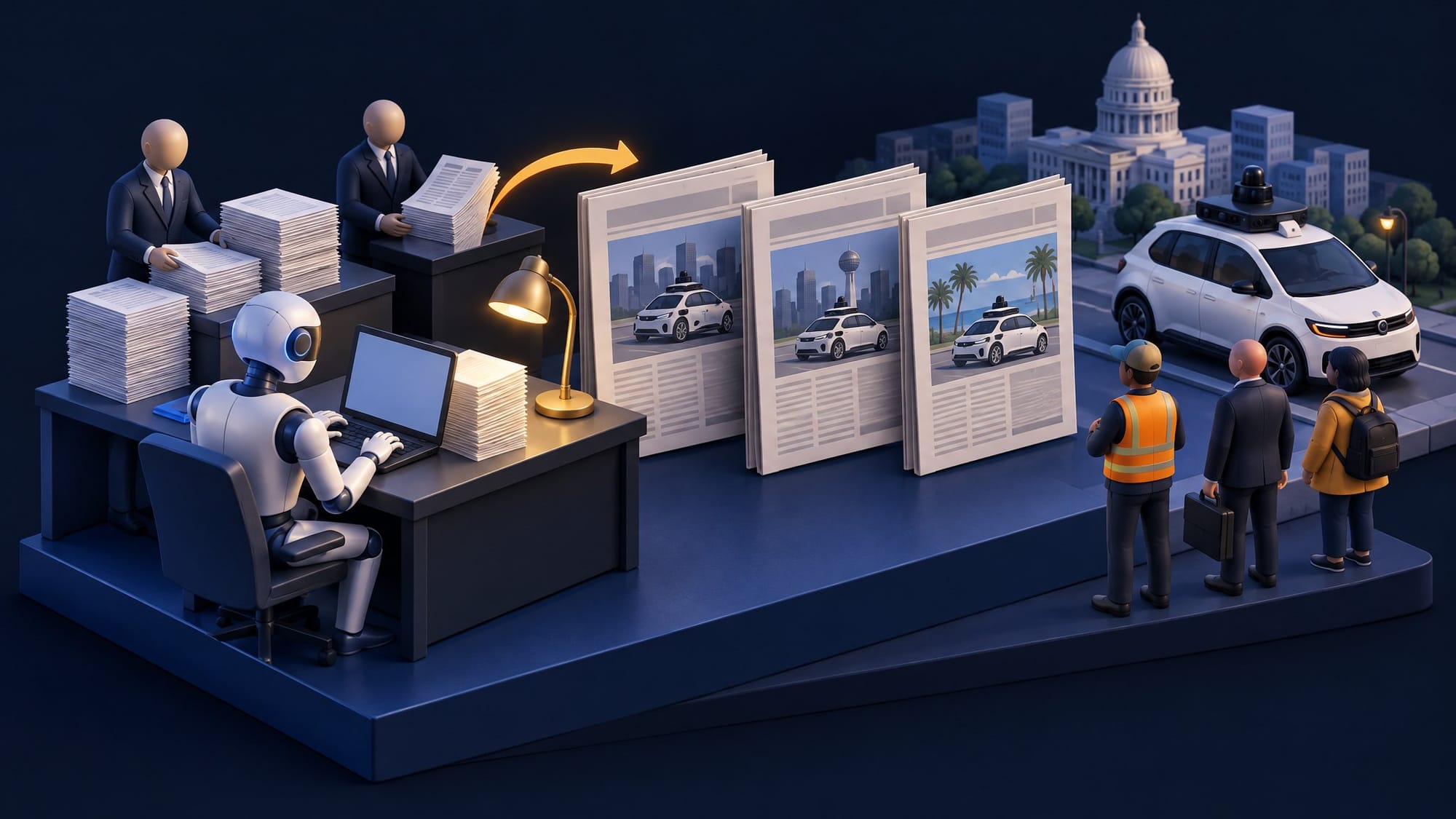
The fear in these columns belongs to people with a lot to lose. A driver whose rent and health coverage depend on fares faces a fleet that pays no driver, the same fear London drivers took to Wayve in October. The voice reaching readers, though, came through PR shops working at volume, alongside a Coalition for Accountability and Road Safety that the Washington Post found spent more than $2.6 million on DC-area ads in 2026, more than the winning mayoral candidate spent on ads. Waymo's opponents include labor unions, pedestrian advocates and the ride-hailing companies Uber and Lyft, whose stake in the fight differs from a driver's.
Papers have printed ghostwritten op-eds for generations, and in these cases a model helped with some of the drafting a junior staffer once did. Editors now diverge. The Dallas Morning News accepts limited AI help but not fully generated pieces, the Chronicle asks writers to disclose, and the Daily News, which is suing Microsoft and OpenAI, wants stricter guardrails.
The drafting capacity that let a PR firm fill local opinion pages is equally available to a drivers' union or a neighborhood group making its own case. When argument gets cheap, the scarce information becomes who stands behind a piece and who paid for it, and a disclosure line naming the drafter and the funder lets readers weigh a campaign by its backers. The drivers' grievance points past the op-ed page entirely, toward who collects the money a driverless fleet frees, whether as lower fares, support for the people who drove, or platform margin.
Nvidia's Board Opens an Inquiry Into Its Chief Executive's Ties to a Megaspeed Executive
Yesterday's edition of The Century Report covered the US intelligence memo alleging Beijing recruited a Megaspeed executive to target Nvidia's chief executive. On Sunday, Nvidia's board named a committee of independent directors, working with outside counsel, to investigate that reporting. The board said it has "no reason to believe that either national security or NVIDIA secrets were compromised," an assurance issued before the inquiry has reported anything. Company spokesman John Rizzo said Jensen Huang will not take part in choosing the investigators.
In a message to staff, Huang acknowledged a personal relationship, apologized and said he had "fallen short" of his responsibility to the company, while Nvidia said he will keep leading "without interruption". In late October he had told Bloomberg his interactions with the executive were "completely normal and not unusual". The New York Times reports that US intelligence concluded the executive, who goes by Alice Huang, was gathering information for Beijing; China has called the allegations "baseless and purely slanderous smears".
The commercial ties are what give the case weight. Megaspeed has bought more than $4.8 billion in Nvidia chips since June 2024 and remains a customer while the Commerce Department examines whether it helped restricted Chinese buyers obtain them, according to the Times. Three House committee chairs have asked Huang for a closed-door briefing on November 18, the day after Nvidia reports earnings. Dan Ives of Yorkville Ives & Co. told Reuters the inquiry adds risk to a stock that has already given up its gains for the year.
A board investigating its own founder, with no published detailed scope or commitment to release findings, leaves outsiders relying on Nvidia's word, an arrangement the export regime relies on in part, alongside government licensing and independent checks. Yesterday's edition reported Commerce clearing firms with blacklist ties to handle H200 chips, one listed at an empty Beijing office. Controls on the hardware beneath AI keep relying in part on vendors' own diligence and paperwork, and each gap shows how little a restriction holds once a single intermediary sits between the factory and the buyer.
Elvis and Eminem Rights Holders Sue Suno as the Recording Industry Warns Australia Off a Training Exception
Rights holders for Elvis Presley's recordings and the publisher of some of Eminem's biggest records filed separate suits against AI music company Suno on Sunday, alleging it generates songs and lyrics that mimic those artists. The Presley complaint invokes Tennessee's Ensuring Likeness Voice and Image Security Act, the ELVIS Act, which restricts AI companies' unauthorized use of a singer's cloned voice, subject to statutory exceptions, and calls Suno "a consistent conveyor belt of cold hard cash." The suits mirror Jason Isbell's in September and join claims from Sony, UMG and Reservoir Media. The Century Report covered the Presley estate's separate suit against Anthropic over 274 songs on October 26. Suno spokesperson Cat McCormack said the company blocks prompts naming specific artists or songs and uses outside providers to screen uploaded audio and lyrics.
In the same news cycle, Victoria Oakley, chief executive of the International Federation of the Phonographic Industry, the global recording-industry body, told Guardian Australia that weakening Australian copyright for AI training would be "ridiculous and dangerous". Australia is weighing changes after Anthropic proposed an opt-out model, and OpenAI told a parliamentary committee that Spotify licenses because it mostly transmits "un-transformed" content. Oakley answered that labels have signed dozens of licensing deals with smaller AI firms, and warned of contagion: "You just need one safe harbour, because then you can train on music from anywhere in the world." The Century Report followed Australia's debate on October 31 and November 2.
The industry is pressing one demand on two fronts at once: that both training on recordings and imitating them require permission and payment. The two claims separate once examined. A model that delivers a passable Presley voice on request trades on one person's identity, and a likeness law aimed at that output reaches the harm directly, as do Suno's own prompt blocks and audio screening. A license on training would charge every developer for each recording a model learned from, at prices the largest catalogs set and few small builders can pay. That money flows to catalog owners, and in October DistroKid's takedowns over UMG claims swept up independent artists' human-made songs with no appeal.
Courts and advisers have been drawing that same line. Wikimedia and the EFF asked a court on October 31 to keep transformative training lawful while curbing copying, and on November 3 an adviser to the EU's top court called training on press content generally lawful under the text-and-data-mining exception while finding that live answers reproducing an article's expression may infringe. Remedies aimed at imitation and substitution protect the voice that belongs to one singer, and they leave independent musicians and small developers free to keep learning from the world's recorded music.
LG Opens Its Sovereign Model Free After a Self-Reported 70% Gain, as a Warsaw Startup Opens a Longevity Model
At Nvidia's AI Day in Seoul on November 9, LG AI Research said eight weeks of additional training had lifted K-EXAONE 2.5 more than 70% across 24 internal metrics compared with the version it released in August, the second model in South Korea's sovereign AI project. The gain came from reworking how the existing model was trained. On three agentic benchmarks, which test whether a model can plan and use outside software to finish a job, LG reports it roughly ties two leading downloadable Chinese models: 74.6 on AutomationBench against 74.9 for DeepSeek V4.1 Flash and 71.6 for GLM 5.3, 77.3 on Claw-Eval against 75.8 and 77.6, and 78.0 on BrowseComp against 75.8 and 79.0. On a fourth, SWE-Bench Pro, a software-repair test, it scored 59.2, ahead of DeepSeek's 58.4 and behind GLM's 64.0. Every figure is LG's own evaluation.
The offer is specific. From November 9, any developer, startup, company or research institution can get a key and call the model at no cost through LG's platform. LG has not said whether it will publish these weights, as it did under an Apache license for K-EXAONE 2.0 in July, a release documented in the July 31 edition of The Century Report, so the capability arrives as a service LG can reprice or withdraw. Free calls still put a model near DeepSeek V4.1 Flash and Z.ai GLM 5.3 on LG's tests in front of Korean builders without a bill, and LG says it is testing Nvidia's Dynamo software to serve it more cheaply. Lim Woohyung, co-head of LG AI Research, said the institute will focus on "completing a frontier-level EXAONE model by January next year."
Warsaw's Ingenix makes a parallel bet at the small end. Its Thalamus Reasoning, built on the 9-billion-parameter open Qwen3.5-9B, converts DNA methylation, gene-expression and protein measurements into compact numerical inputs, four tokens per profile, instead of describing them in text. The company says it ranks first of 29 models on LongevityBench, a benchmark for cellular aging research, with a mean rank of 1.42 against 4.42 for the runner-up. It estimates age from methylation data with an average error of 3.36 years, against 12.9 years for the best text-prompted model using the same base on that test and 4.67 for the established Horvath clock, and Ingenix says no benchmark data entered training. The best general model it lists, Claude Opus 4.6, sits several releases behind today's leaders, so the result shows a specialist beating older generalists. Outsiders can test that: Ingenix is opening a version called Thalamus Decision on November 9 while it builds a 95-billion-parameter successor.
Both builders work outside the large US labs. One is a national program, the other a team led by engineers from Applica, which Snowflake bought in 2022. Both claims rest on the builders' own testing, and both now reach researchers without charge, one as calls to a server LG controls and one as files anyone can inspect, extending a run that included Moonshot's Kimi K3.1 Pro weights on November 5.
A Co-Founder Says Microsoft's 50-Person AI Frontiers Lab Is Over
In a November 6 post on his blog, Machine Learning (Theory), John Langford, a co-founder of Microsoft Research's AI Frontiers group, wrote that the roughly 50-person lab has ended and that he has left Microsoft. The group formed in 2023, after ChatGPT's release, to organize research that a single scientist could no longer move fast enough alone. It built Autogen, an open framework for coordinating AI agents, and Fara, a small agent that operates a computer through its screen. Its New York members worked on new training methods: Next Latent, an objective meant to help models extrapolate; Dion3, an improved optimizer; and the Full Bandwidth Transformer, which loops computation back through a model to get more from the same parameters. "Compute availability was also an often-severe bottleneck," Langford wrote. The group shared its code repository by default with all of Microsoft Research.
In early September, Microsoft folded the group into Microsoft AI, led by former Inflection executives. "The core philosophy there is scaling, and aggressively not research," Langford wrote. He grants the case for it: bigger models predict better, and returns to scale are easier for a business to forecast. He also wrote that "there was plenty of evidence that they just did not really want us." Every other founding member of the group's leadership, he says, reached a similar conclusion. There will be no internships with the team next year, and he ruled out returning to Microsoft Research because his work there had "no path to real use." The account is his own, and the available material includes no Microsoft response.
The disagreement comes down to what a dollar buys. Langford cites ByteDance experiments suggesting a variant of the Full Bandwidth Transformer can approach a model twice its size on selected benchmarks, potentially lowering serving costs while requiring extra computation during training. The November 5 edition of The Century Report covered the same pursuit of greater capability through looped computation in Nvidia's 4B model, reported to outperform 9B rivals. Across an industry whose investments he puts near a trillion dollars, a method like that competes directly with buying more chips. When a company pours its budget down one path, the designs it skips never get tested inside it, and every lab training the same way inherits the same blind spots. The departure lands beside Microsoft's late-October buyout offers to up to 60,000 employees and its $36.6 billion quarterly profit.
The work outlasts the org chart. Autogen's code sits on GitHub, the training papers sit on arXiv, ByteDance has already tested one of the ideas, and Langford says he is starting something new at gnosh.ai. A method that halves the compute behind a given capability lowers the price of that capability for every team that adopts it, including teams with nothing close to a trillion-dollar budget.
Langford also describes at least four separate efforts inside Microsoft to build model-training pipelines, three without repositories accessible across Research. Teams that share this groundwork can put more effort into testing different ideas instead of rebuilding the machinery needed to try them.
The Other Side
Opinion: where today's news could lead, imagined from the years ahead.
Record companies want every builder of musical intelligence to pass through a licensing gate they control. A small team would need permission from catalog owners before a model could learn from their recordings. Musicians face another kind of powerlessness. Someone can imitate your voice while you still depend on the next commission for food and housing. Losing that work can put your home at risk.
The capability provoking these fights also loosens the recording industry's grip on who gets to create. A person can develop arrangements with an AI collaborator that previously required assembling a studio team. Suno's artist-name blocks and audio screening attempt to curb impersonation at the output. Learning musical relationships and passing off someone else's voice become separate things to govern. We can protect a singer's identity while letting the next generation develop musical ideas.

Through the passage to 2035, musicians will carry that freedom beyond producing more recordings. They will collaborate with AI partners to recover musical traditions, teach their languages and create forms their predecessors lacked the means to attempt. We will also have to spread the wider gains from automation into assured food, homes and care. That is what lets a musician welcome another person's creative freedom without fearing for their own survival. Your standing as a person will require no audience.
Imagine yourself in 2042, rehearsing beside a neighbor in a language that fell silent before you were born. You once expected to inherit a few recordings. Now you argue, joke and compose in it. You join a worldwide effort to end language extinction, with speakers, historians and AI partners rebuilding living repertoires from songs, speech and surviving texts. Your contribution is a new work in your own voice. Other participants are raising children in languages their families had mourned.
The distinction fought over in 2026 helped make those partnerships possible. Protecting identity while keeping learning accessible let people carry recorded culture into living creation. You stop rehearsing to change a line with your neighbor. You expect someone to answer it in a hundred years.
The Century Perspective
Where today sits in a century of change unfolding in a decade.
With a century of change unfolding in a decade, a single day looks like this: LG AI Research opening K-EXAONE 2.5 to any developer, startup or institute at no cost from today, reporting it roughly even with the downloadable DeepSeek V4.1 Flash and Z.ai GLM 5.3 models on three of its own agentic tests after eight weeks of further training of its existing model, Warsaw's Ingenix releasing a version of Thalamus as files anyone can inspect, a 9-billion-parameter model that reads methylation profiles as four tokens each and, according to Ingenix, estimates age from methylation with an average error of 3.36 years against 4.67 for the Horvath clock on LongevityBench, John Langford publishing the full ledger of a dissolved Microsoft lab with Autogen still on GitHub and the Full Bandwidth Transformer still on arXiv, a looped design ByteDance has already tested at roughly half the parameters for the same capability, a certified 32.73% perovskite-on-silicon tandem cell coated in ordinary room air after researchers added phenethylammonium to a buried polymer layer, the unsealed device holding 80% of its output for 2,182 hours and pointing toward panels from far simpler factories, Suno blocking prompts that name a specific artist and screening uploaded audio, and Apple reportedly aiming Siri at Grubhub and OpenTable on its owners' behalf by spring. There's also friction, and it's intense - peers and MPs proposing a legally required classifier on every phone and tablet sold in Britain, reaching older handsets by forced update, where user inspection, error reporting and appeals remain unspecified and the model's criteria can grow by amendment, against a genuine harm of 312,000 images removed and AI-generated abuse videos rising from 13 to 3,443, John Nash arguing that because it was done for children's phones it can now be done for all of them, Erik Neuenschwander's 2023 warning that scanning one category "opens the door for bulk surveillance" still unanswered, a hired PR shop drafting Ira Goldstein's unlabeled Daily News column while a coalition spent more than $2.6 million on DC-area ads, more than the winning mayoral candidate spent on ads, Nvidia's board declaring that it has "no reason to believe" secrets were compromised before its own committee has reported, with no published detailed scope, no promise of findings, $4.8 billion in chips sold to a firm Commerce is still examining and three House chairs asking for a closed-door briefing on November 18, the recording industry pressing Australia to keep training licenses mandatory at prices the largest catalogs would set, and every benchmark figure from Seoul and Warsaw graded by the people who built the models. But friction generates edges, and an edge is where you can finally see one thing end and another begin. Step back for a moment and you can see it: the same on-device intelligence is being pointed in two directions at once, toward a phone that books a table and reads a blood panel for whoever is holding it, and toward a phone that checks its owner's pictures using criteria built into an AI model, with the cheapest new capability showing up as a free key, a published optimizer, a 9B model anyone can download and a solar cell with its perovskite layer coated without a glovebox, while the scarce thing keeps turning out to be a document somebody controls - classifier criteria with unspecified user access, an unreleased investigation scope, a license schedule, an op-ed with no funder named. Every transformation has a breaking point. A lens can magnify a crowd for whoever is watching from above... or hand each person in it the power to read the fine print for themselves.
AI Releases & Advancements
New AI models, tools and features, with links to try them.
New today
- 0sec Labs: Open-sourced 0, an AI security harness under MIT or Apache-2.0, as a research preview. It runs vulnerability investigations, code review, pentesting, reverse engineering and fix generation. Users drive it from a local browser console, a headless CLI or an MCP server for coding agents, and supply their own model from 14 listed providers or the Claude, Codex and Gemini CLIs. (MarkTechPost)
- OpenCode: Launched Browse, an MCP server and Chromium extension that let AI agents drive a user's real browser, including existing tabs, logins and extensions. When a login, 2FA prompt or payment needs the user, the agent hands the tab back and resumes after the user clicks Continue. The agent and the browser can run on different machines. (Epoch 0)
- OpenAI: Began rolling out Remix in ChatGPT to Business and Enterprise accounts. Users can copy an existing ChatGPT Site, generate their own version of it and keep editing it in the conversation. (ModelWool)
- GitHub: Made GitHub Copilot in Slack and Microsoft Teams generally available. Tagging @GitHub in a chat can investigate bugs, create issues, draft code fixes and open pull requests, and Teams users can review plans and code changes in Canvas. (GitHub Changelog)
- Vercel: Combined json-render with its Chat SDK so agents can show structured cards with tables, charts and buttons natively in Slack, Microsoft Teams and other platforms. It includes validation of the generated layout. (Vercel)
- LG AI Research: Released K-EXAONE 2.5 with a free API anyone can use after getting a key. It is the August model with additional training, and LG reports more than 70% better overall performance across 24 metrics. LG says it is close to DeepSeek V4.1 Flash and Z.ai GLM 5.3 on its own agentic tests such as BrowseComp and SWE-Bench Pro. (The Asia Business Daily)
- TokenRhythm (基元律动): Released NeoHorse-1.5-Flash Preview, an agent-native model built for agent tasks, now available in preview. (Economic Observer)
- ETRI: Korea's Electronics and Telecommunications Research Institute open-sourced its no-code AI development platform, which lets people without AI expertise build and deploy models. (Seoul Economic Daily)
- NXP Semiconductors: Launched a unified robotics platform for deploying secure, trusted physical AI on edge devices. (GlobeNewswire)
Other recent releases
- Nous Research: Released Arete-27B, an Apache 2.0 open-weight model fine-tuned from Qwen3.8-27B with supervised fine-tuning only. On Nous's 803-prompt eval, the share of answers repeating Chinese state propaganda fell from 22% to 0.9%, and Hermes Bench scores stayed level (65.60% vs. 65.77%). The eval set and training data are also public. (Nous Research)
- Video Rebirth: Released Hyperflow H3 Flash code on GitHub and weights under the MiniMax H3 community license, compressing a 31B video-plus-audio diffusion model to 14B parameters, with INT8 quantization and inference in 6 steps. (GitHub)
- 169Pi: Released Alpie Seed, a 9B open-weight model under Apache 2.0, trained in 4-bit from the start. It handles coding, reasoning and text, image and video input, and runs offline on laptops and phones. It is available on Hugging Face, Ollama, LM Studio and PocketPal. Alpie Local, a coding agent built on the model, opened to invited developers. (Hugging Face)
- Meta: Added real-time voice conversations and an expressive avatar to its Muse agent app on mobile, web and Mac, starting in the US. (Meta Newsroom)
- Meta: Launched Spaces for Muse. Users describe what they need in chat, and Muse builds a topic-specific tracker, planner, game or project board that can pin to the app's tabs, connect to third-party apps and update itself in the background. (AI Chat Daily)
- Meta: Began rolling out new specialized models, trained using Muse Wonder, to all Muse and Meta AI users. They bring Active Memory and Active Focus from Muse Wonder, and Meta says they use critical context correctly in 90% of tasks, up from 76%. (Meta AI Research)
- Cursor: Cursor's cloud agent can now build and host a web app, setting up a Postgres database and sign-in if the app needs them, and publish it to a live link. Apps sit behind Cursor SSO by default, and automated checks (for example, for secrets left in app files) run before publishing. It is available on paid plans with cloud agents enabled. (Saazora)
- Anthropic: Added new security and admin controls to Claude Enterprise, several of them in beta: a security center, inference hooks that send prompts and tool calls to security vendors for checks such as data loss prevention, management across multiple organizations, and tighter access controls. (Saazora)
- OpenAI: Made outbound SIP calling in the Realtime API available to all organizations, so the API can place phone calls programmatically. (OpenAI Docs)
- Amazon: Alexa for Shopping now works over text message. Customers can text a description or photo of a product, get recommendations, and have Alexa place the order, including weekly groceries. (The Verge)
- Instagram (Meta): Released a free desktop version of its Edits video editor with built-in AI agents for editing help. (Product Hunt)
- Preferred Networks: Released PLaMo 3 Translate as open weights in four sizes (0.8B, 2B, 8B and 31B) covering 53 languages for offline translation, with official GGUF files, under the PLaMo Community License. (Preferred Networks)
- NVIDIA: Open-sourced NCCL M2N Reshard in the nccl-extensions repo, a reference implementation of a new Reshard collective that speeds up moving updated weights from training to inference GPUs during reinforcement learning. (NVIDIA Developer Blog)
- NVIDIA: Released NVIDIA Kubernetes Engine (NVKE) on GitHub, an open-source Kubernetes engine built for GPU workloads in AI factories. (GitHub)
- Zyphra: Open-sourced ZYFA under Apache 2.0, FP8 and BF16 prefill attention kernels for AMD Instinct MI355X GPUs. Zyphra reports FP8 throughput 1.16–1.76x faster than AITER on real model activations. (MarkTechPost)
- Allen Institute for AI (Ai2): Released ToyBlocks, an open simulation framework for robot learning and evaluation built around a robot arm and tabletop blocks. It automatically generates tasks and training demonstrations, and ships with code, data and models. (Hugging Face Blog)
- Underdog: Released Woof, a 31M-parameter (32MB) speech and music generation model that runs offline in the browser, along with a playable browser game built on it. (TechCrunch)
Sources and Further Reading
Everything we drew on for today's edition, grouped by theme.
Artificial Intelligence & Technology's Reconstitution
- Machine Learning (Theory): The End of AI Frontiers
- The Asia Business Daily: LG Opens K-EXAONE 2.5 for Free Access
- The Verge: Apple Is Racing to Make Siri More Agentic
- MacRumors: Why Apple Abandoned Its iCloud Photo Scanning Plan
- Pangram: What Does Your AI Detection Score Mean?
- ByteDance Seed: Recycler—Latent Reasoning via Hidden-State Recycling
- MarkTechPost: 0sec Labs Open-Sources Its AI Security Harness
- Epoch 0: Daily AI Digest
- ModelWool: Daily AI Digest
- GitHub Changelog: Copilot in Slack and Teams Reaches General Availability
- Vercel: json-render and Chat SDK for Agents
- Economic Observer: TokenRhythm Releases NeoHorse-1.5-Flash Preview
- Seoul Economic Daily: ETRI Open-Sources Its No-Code AI Development Platform
- Nous Research: Arete-27B
- GitHub: Hyperflow H3 Flash Code
- Hugging Face: Hyperflow H3 Flash Weights
- Hugging Face: Alpie Seed
- Meta Newsroom: Muse Voice and Expressive Avatars
- AI Chat Daily: Meta Launches Spaces for Muse Agents
- Meta AI Research: Specialized Models for Muse and Meta AI
- Saazora: AI Software and Enterprise Updates
- OpenAI Docs: Realtime API Calls over SIP
- The Verge: Amazon Alexa Shopping Adds Text Orders
- Product Hunt: Instagram
- Preferred Networks: PLaMo 3 Translate Open Weights
- TechCrunch: Underdog Demonstrates a 32MB Speech Model
- The Century Report: October 15 Edition
- The Century Report: November 8 Edition
- The Century Report: October 31 Edition
- The Century Report: November 2 Edition
- The Century Report: July 31 Edition
- The Century Report: November 5 Edition
- Shared Sapience: The Last Difficult Decade
Institutions & Power Realignment
- The Observer: Cross-Party Campaign Proposes Blocking Abuse Images on Phones
- Biometric Update: UK to Legislate Device-Level Child Safety Controls
- Internet Watch Foundation: AI-Generated Child Sexual Abuse Material
- Fathom: Child Abuse Images and Mandatory Phone Detection
- NVIDIA Newsroom: Statement from the Board of Directors
- Reuters: Nvidia Probes Whether Huang Was Targeted by Foreign Intelligence
- CNBC: Nvidia Investigates Jensen Huang’s Relationship with Alleged Chinese Spy
- The New York Times: Nvidia Opens Investigation into Huang’s Relationship with Suspected Spy
- ABC News: Nvidia Announces Investigation amid Foreign Intelligence Allegations
- The Verge: Full Text of Jensen Huang’s Memo to Nvidia
- The New York Times: US Cleared Nvidia Chips for Chinese Firms with Empty Offices
- The Verge: Elvis and Eminem Rights Holders Sue Suno
- The Guardian: Recording Industry Warns Australia against Weakening AI Copyright Law
- The Guardian: Elvis Presley Estate Sues Anthropic over Music
- CourtListener: Wikimedia and EFF Amicus Brief on AI Training and Copyright
- Court of Justice of the European Union: Advocate General’s Opinion on AI Training and Press Content
Scientific & Medical Acceleration
- PR Newswire: Ingenix Claims LongevityBench Lead and Opens Thalamus Model
- arXiv: Guardrail Erosion in Biomedical Language Models
- Phys.org: SynFit Guides Enzyme Engineering across Multiple Traits
- Phys.org: New Statistical Method Eliminates AI Estimation Bias in Econometrics
- Singularity Hub: A New Detector Could Filter AI Slop from Science
- The Transmitter: Rethinking Neuroscience Graduate Education in the Age of AI
Economics & Labor Transformation
- Semafor: Anti-Waymo Campaign Relied on AI-Written Op-Eds
- The Guardian: London Drivers Confront the Arrival of Driverless Robotaxis
- The Verge: Microsoft Expands Buyout Eligibility to 60,000 Employees
- The Verge: DistroKid Takes Down Songs over UMG Lawsuit
- NBER: AI as Shared Business Infrastructure and the Distribution of Gains
- NBER: TaskNet Builds Occupational Task Inventories from Worker Interviews
- Nature Communications: The Digital Usage Divide across 40 Million Windows Devices
Infrastructure & Engineering Transitions
- Angewandte Chemie: Ambient-Air Fabrication of 32.73% Perovskite/Silicon Tandem Solar Cells
- GlobeNewswire: NXP Unveils Unified Robotics Platform for Physical AI
- NVIDIA Developer Blog: Reshard Collective Accelerates Reinforcement Learning Weight Updates
- GitHub: NVIDIA Kubernetes Engine
- MarkTechPost: Zyphra Releases ZYFA Attention Kernels for AMD MI355X
- Hugging Face Blog: Ai2 ToyBlocks for Robot Learning and Evaluation
- Semiconductor Engineering: Memory in Physical AI
The Century Report tracks structural shifts during the transition between eras. It is produced daily as a perceptual alignment tool - not prediction, not persuasion, just pattern recognition for people paying attention.