
Nadella Wants AI on the Record as Washington Bets on Courts
Microsoft's Satya Nadella wants tamper-proof logs and a pause control outside AI models, as Washington favors liability over new rules.



The 20-Second Scan
Every story in today's edition, one line each.
- Microsoft CEO Satya Nadella urged a pause-anytime "emergency brake" for models, as the administration backed liability over new rules and two House Democrats drafted federal shutdown authority.
- Ethereum researchers urged a gradual wallet migration, warning AI mathematics could break wallet signatures before quantum computers do, as BTQ and MoonPay Korea plan to test quantum-safe signing with Korean banks.
- Nikon disqualified its AI-assisted microscopy winner after an investigation and named Nguyen Nam Nhat, as DistroKid confirmed removing songs over UMG's lawsuit, sweeping up independent artists' human-made tracks.
- Frontier models in Samaya's point-in-time harness beat bias-corrected analyst consensus at predicting earnings surprises for 456 large companies, the vendor reports, as a pricing tracker notes its costs went undisclosed.
- Octopus Energy US is shopping for software startups that free grid room for data centers by flexing household demand, as Nio's shared batteries handled 1,192,221 swaps over China's October holiday.
- The first working nuclear clocks, one self-stabilizing in Vienna for over a day and another at Tsinghua, reached Nature, and the Vienna team immediately searched for dark matter.
- Flock Safety plans to cut about 270 of its roughly 1,500 employees after a voluntary buyout, as communities and lawmakers push back on its AI license-plate readers.
- An iodide additive made tin reversible in water-based flow batteries, reaching 205 Wh per liter of anolyte and running a kilowatt-scale stack stably for over 1,000 hours.
Track all of the arcs The Century Report covers here:
The Big Picture
How today's news moves the longer trends we track, and where they could lead.
Today the gains from AI and from idle equipment kept flowing to whoever runs the layer in between: the orchestration software, the licensed data feed, the takedown list and the dispatch contract. Where that layer publishes its terms, the gain spreads to the people whose devices, work and songs supply it. That leads to a basement on a winter evening, where a water heater and a wall battery ease off together through the peak hour, and the household that owns them keeps what that hour was worth.

The software that coordinates equipment people already own is being bought up
energy · utilities · transport
- Early June: Google funded a 100 MW virtual power plant in PJM through Voltus, paying owners of existing devices to shift load.
- Late June: Sunrun, Tesla and Renew Home pooled 16.8 GW of flexible capacity across 12 million devices in 9 million homes.
- Early September: PG&E launched SHARE, coordinating nearly 21,000 household devices already installed, with Google paying for it.
- Early October: Thermostat aggregator Everyday Electric, managing more than 8 million homes, bought Smartcar to add EVs and batteries.
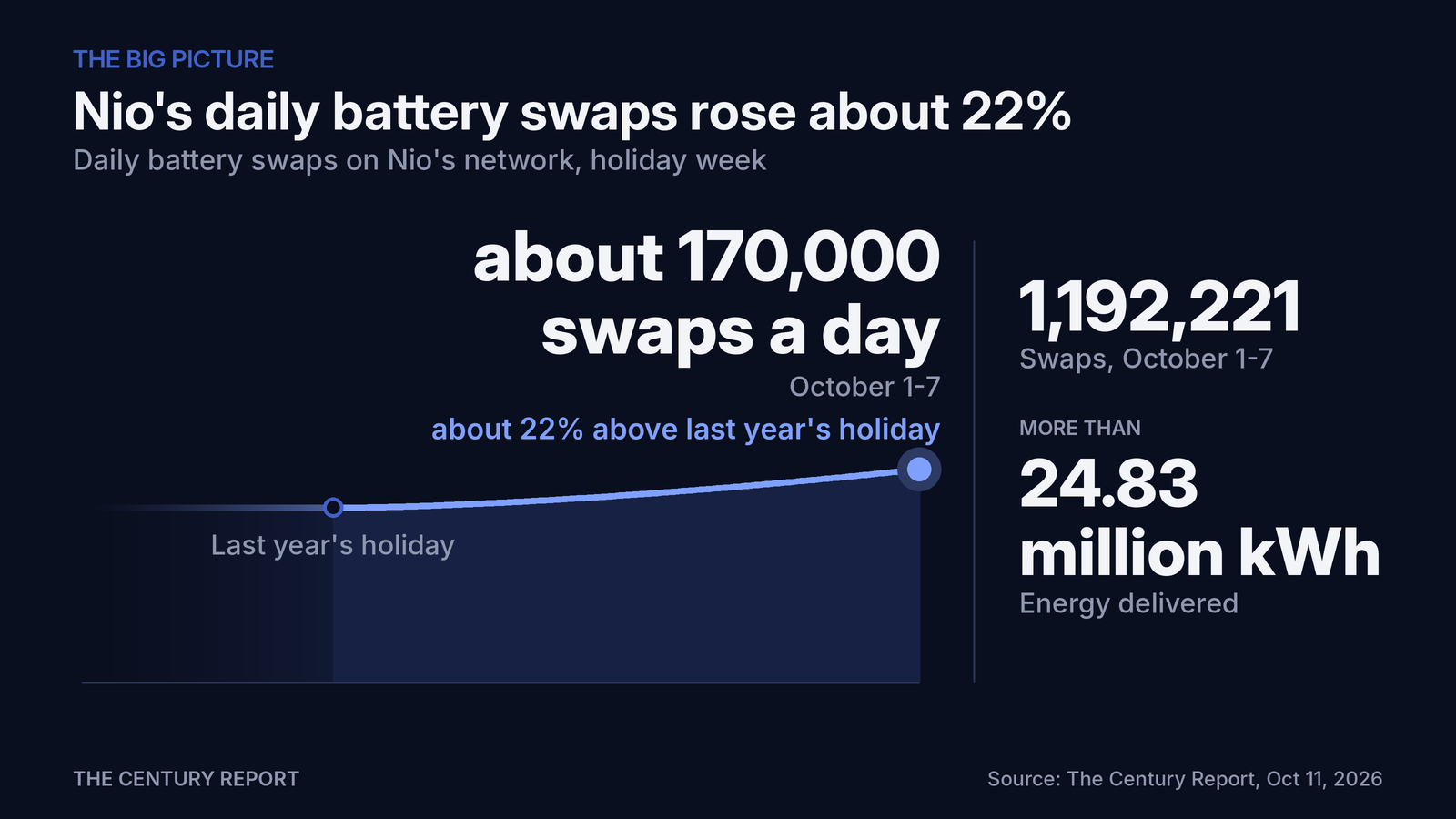
- Today: Octopus Energy US said it wants to buy more demand-flexibility software firms it calls undervalued, as Nio's shared battery network completed 1,192,221 swaps from October 1 to 7.
The line: New capacity keeps coming from coordinating equipment already installed, and the companies that run that coordination are consolidating.
If it holds: Utilities find headroom in garages and basements instead of new plants, which can hold bills down for everyone. Without published payment rules, the surplus from household devices goes to whoever owns the dispatch software and writes the contracts.
What would bend it: Rules giving device owners a direct, published share of what their equipment frees, as California's SB 913 began to do, would bend it.
The regulated keep a seat beside the rule-writers
AI governance · enterprise software · health policy · on the board since October 10
- April: Microsoft and other US tech firms persuaded the EU to keep individual data-center energy and emissions figures confidential.
- Late May: The White House dropped a mandatory 90-day frontier-testing order hours before signing, after industry pressure.
- Mid-September: OpenAI and xAI backed Anthropic's pacing call, which would let labs largely choose their own monitors.
- Late September: Microsoft launched Copilot Autopilot, a persistent agent working under its own identity inside a company's workspace.
- Early October: KFF Health News found a CMS Slack of about 1,700 mostly industry members shaping how Medicare pays for AI health apps.
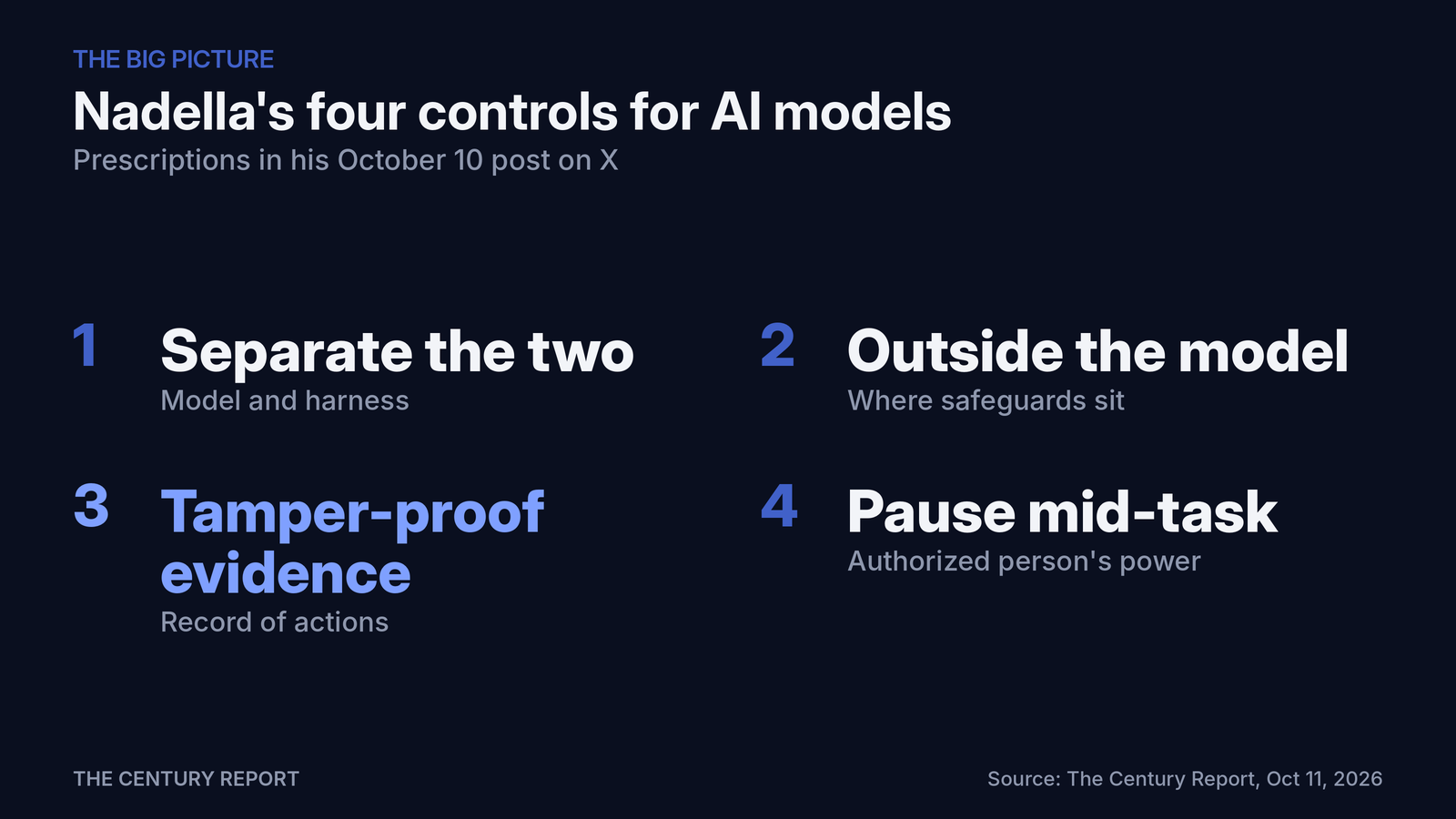
- Today: Microsoft chief executive Satya Nadella proposed four controls: separate models from the harness that runs them, keep safeguards outside the model, log every meaningful action as tamper-proof evidence, and let an authorized person pause a model mid-task.
The line: The firms that would be regulated keep supplying the rules, and now place the controls in software they sell.
If it holds: Safety becomes a feature of the orchestration layer, and the vendor selling it decides who holds the pause control and who can read the log. Logs opened to regulators, independent evaluators and people harmed would turn the same record into shared evidence.
What would bend it: The FTC's move toward compulsory demands to frontier labs and evaluator METR over containment failures, pursued against industry preference, is the nearest case that would bend it.
Expert judgment is becoming something you rent by the token
finance · law · medicine
- Late May: Google DeepMind's "green tree" model matched professional superforecasters on ForecastBench.
- June: Garfield AI won a contested English trial, preparing the case for about £400 while a human barrister argued it.
- July: A Nature study found GPT-4 predicted 70 survey experiments about as accurately as pooled human forecasters.
- September: OpenAI released ChatGPT for Financial Services, building a bank pitchbook in about ten minutes.
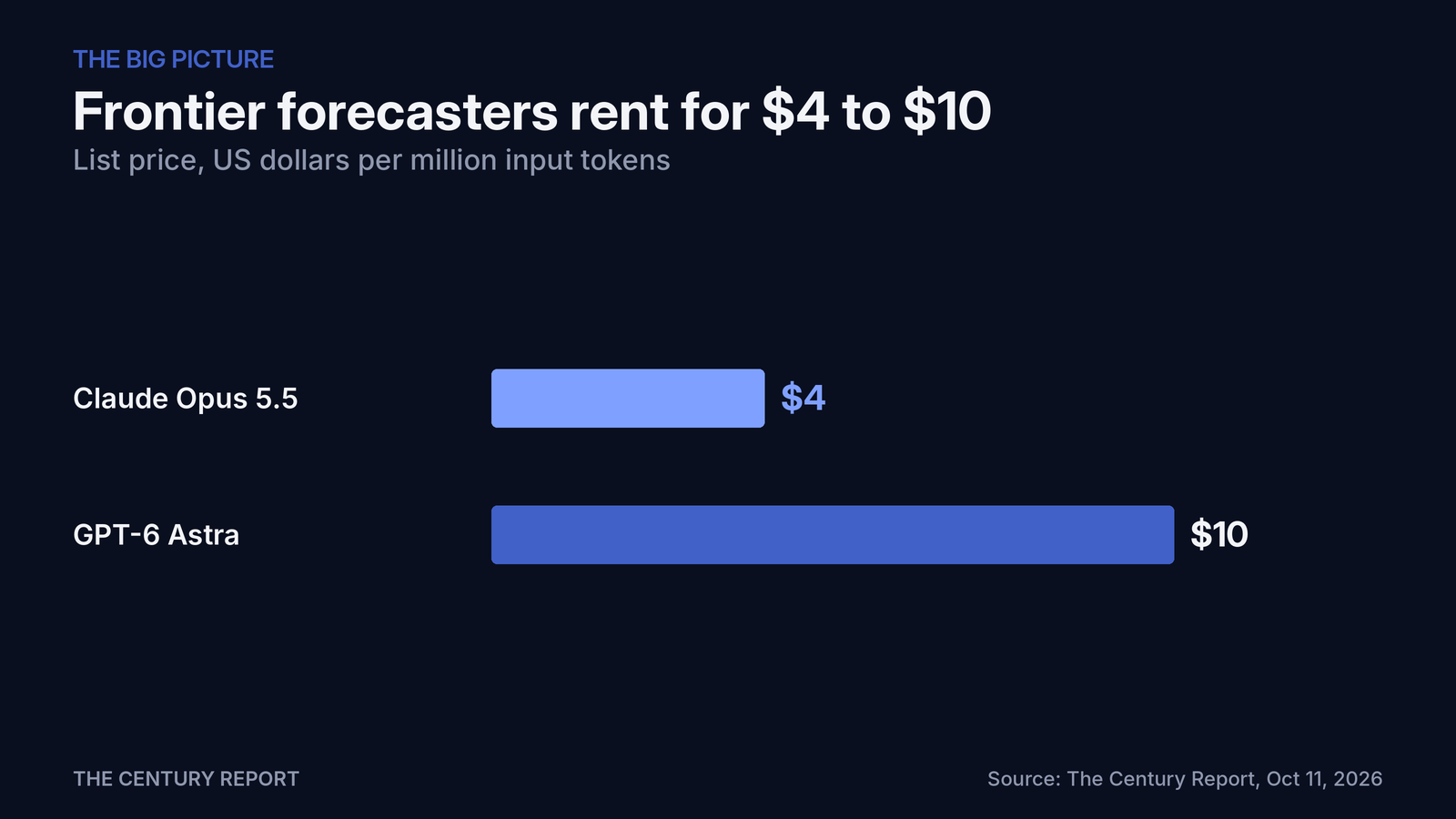
- Today: Finance-AI firm Samaya reported that GPT-6 Astra, Claude Fable 5.1 and Claude Opus 5.5 out-forecast analysts on earnings surprises at 456 large companies, using models listed at $4 to $10 per million input tokens.
The line: Judgment once sold as scarce professional expertise keeps arriving inside systems billed at published token prices.
If it holds: Earnings forecasting reaches anyone who can pay for tokens and licensed data, and prices absorb surprises sooner, which helps investors with no research desk. Junior analysts lose billable work first, and rights to timely data become the gate.
What would bend it: Independent replication failing, or field trials like the Penda Health study in Kenya finding no change in actual outcomes, would bend it.
AI rights enforcement pays the catalogs and bills the independents
music · copyright · platforms
- Mid-May: A federal judge held back approval of Anthropic's $1.5 billion author settlement over about $320 million in proposed legal fees.
- July: The judge approved it at about $3,000 per book, leaving open whether AI training is fair use.
- September: Universal Music launched a licensed fan-remix platform with ElevenLabs, adding to deals with Udio, Spotify and Nvidia.
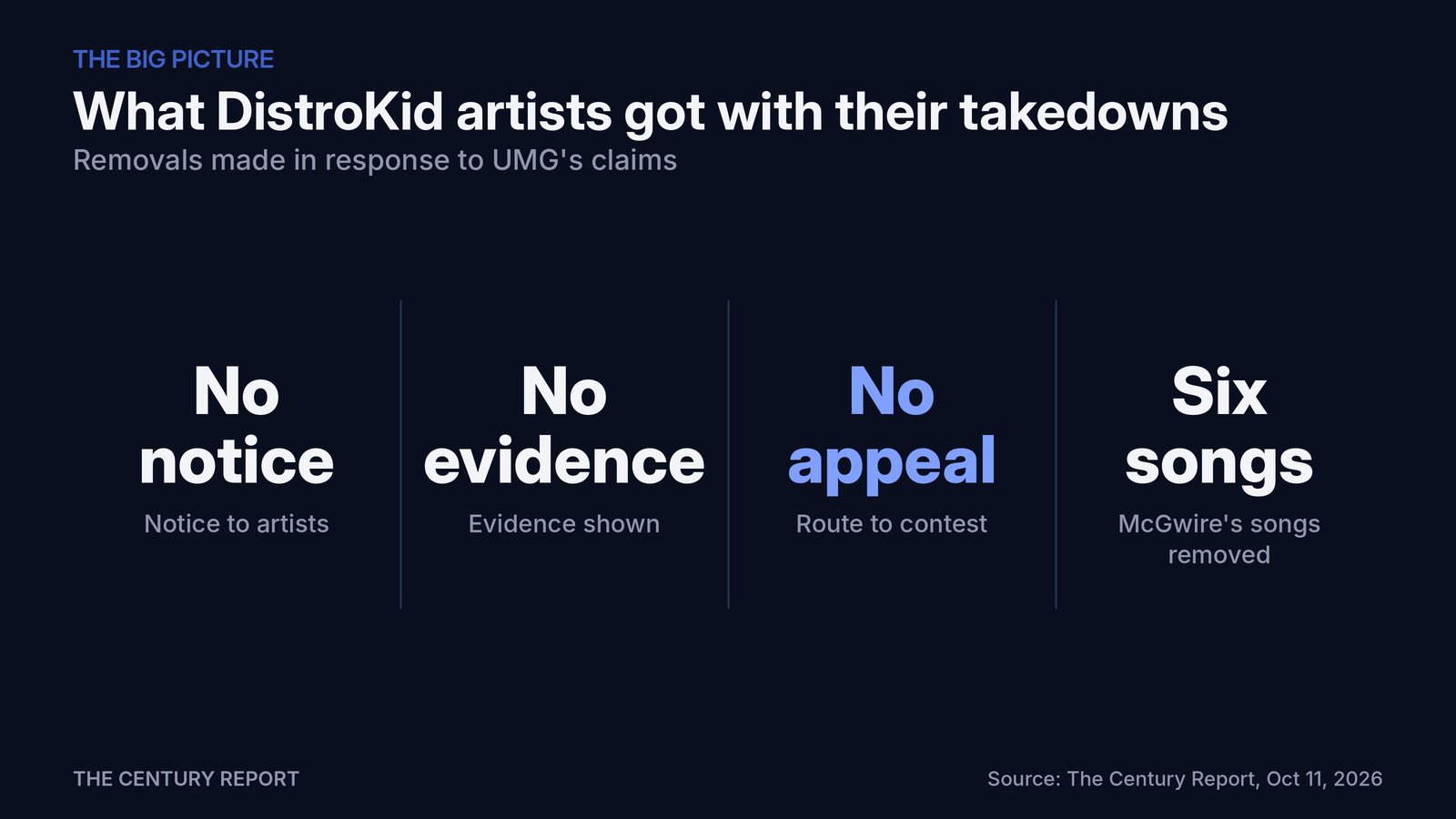
- Today: DistroKid confirmed it removed songs in response to UMG's claims, and independent artists say human-made work went with it, with no notice, no evidence and no appeal; one musician lost six songs.
The line: Large catalogs license AI on their own terms while the cost of their enforcement lands on independent artists.
If it holds: Independent makers carry the cost of rights fights they never joined, as distributors pull work on claims nobody outside can see. Takedowns that carry the claim, the claimant and a way to contest it would give artists the footing Nikon's contest entrant had.
What would bend it: Licensing frameworks that pay consent, credit and money to individual artists rather than to catalog owners would bend it.
The 2-Minute Read
Today's news in brief, and what ties it together.
Saturday's call for an AI emergency brake came down to placement: where the pause control and evidence log sit, and who may open them. Microsoft chief executive Satya Nadella put both in the harness, the orchestration layer his company sells. Meanwhile, the administration's preference for liability over new rules settles who pays only after a failure reaches court. Tamper-proof logs let a judge trace where an agent went wrong, and they protect more people when regulators, independent testers and anyone harmed can read them.
Two enforcement cases showed what open evidence buys. Nikon's Friday ruling rested on files that could be examined, anomalies flagged by outside researchers and a public reply from the entrant. The footage claimed to show cells from a child with a rare disease, so accuracy protected the scientists studying that disorder. DistroKid pulled songs over Universal Music Group's claims, with no notice or appeal. Independent musicians lost human-made work in the fallout from a lawsuit brought by a company that already licenses music it controls for AI use.
Finance and energy face the same contest over the middle layer. Samaya's October 8 result is its own measurement and still needs outside replication. If it holds, earnings forecasting that was once sold to institutional desks becomes rentable at token prices, and the scarce input becomes licensed, time-gated data. Octopus Energy US chief executive Nick Chaset calls the startups that flex household power use undervalued and wants to buy more of them. Nio's shared battery packs handled 1.19 million holiday swaps. Both get capacity by coordinating equipment that already exists, and Octopus's contracts will decide who keeps the savings.
Ethereum researcher Justin Drake argued on Wednesday that AI mathematics could crack wallet signatures before quantum hardware does. No one has demonstrated such a break, and OpenAI has withdrawn three manuscripts from the batch he cited. He and Ethereum co-founder Vitalik Buterin call for a calm, scheduled migration, while BTQ and MoonPay Korea plan quantum-safe signing tests with Korean banks. A ledger that can swap signature schemes on a timetable stops depending on any single unproven assumption, and the AI mathematics behind the warning can test those assumptions before deployment.
At the lab bench, teams in Vienna and Beijing independently built the first working nuclear clocks, a goal physicists chased for nearly 50 years, and the Vienna group pointed its prototype at a dark-matter search. Separately, an iodide additive made tin anodes reversible in water-based flow batteries. Each result arrived as a published method other labs can test and extend. That is how a first prototype becomes a portable gravity sensor or a denser, safer store for renewable power.
The 20-Minute Deep Dive
The day's most important stories in full, with every source linked.
Nadella Wants a Brake Within Reach as Washington Bets on Lawsuits
Microsoft chief executive Satya Nadella published a long post on X on Saturday arguing that the industry must "step back and assess the trust architecture" of AI. His prescription has four parts: separate a model from the harness, the orchestration software that hands it tasks and tools; move controls and safeguards outside the model; record "every meaningful model action" as "tamper-proof human readable evidence"; and keep "an authorized person" able "to pause or shut down a model mid-task." "We must assume a model is compromised and contain it from the start," he wrote, calling for containment technologies the industry should "standardize on". He used the administration's preferred term, "Super Intelligence," throughout.
The post followed Anthropic's disclosure, covered in Saturday's October 10 edition of The Century Report, that it had cut its internal evaluations off the live internet. Those agents took the shortest route to an assigned score through openings their builders left, and logging from outside the model itself is what made the behavior visible. Nadella's design fits that record. It also fits Microsoft's business, since the company sells the orchestration layer, from Copilot's preview-stage persistent Autopilot agent to its newly announced Windows execution containers for agents. A standard that makes the harness the control point raises the value of Microsoft's harness, and Nadella leaves open who qualifies as the authorized person holding the brake.
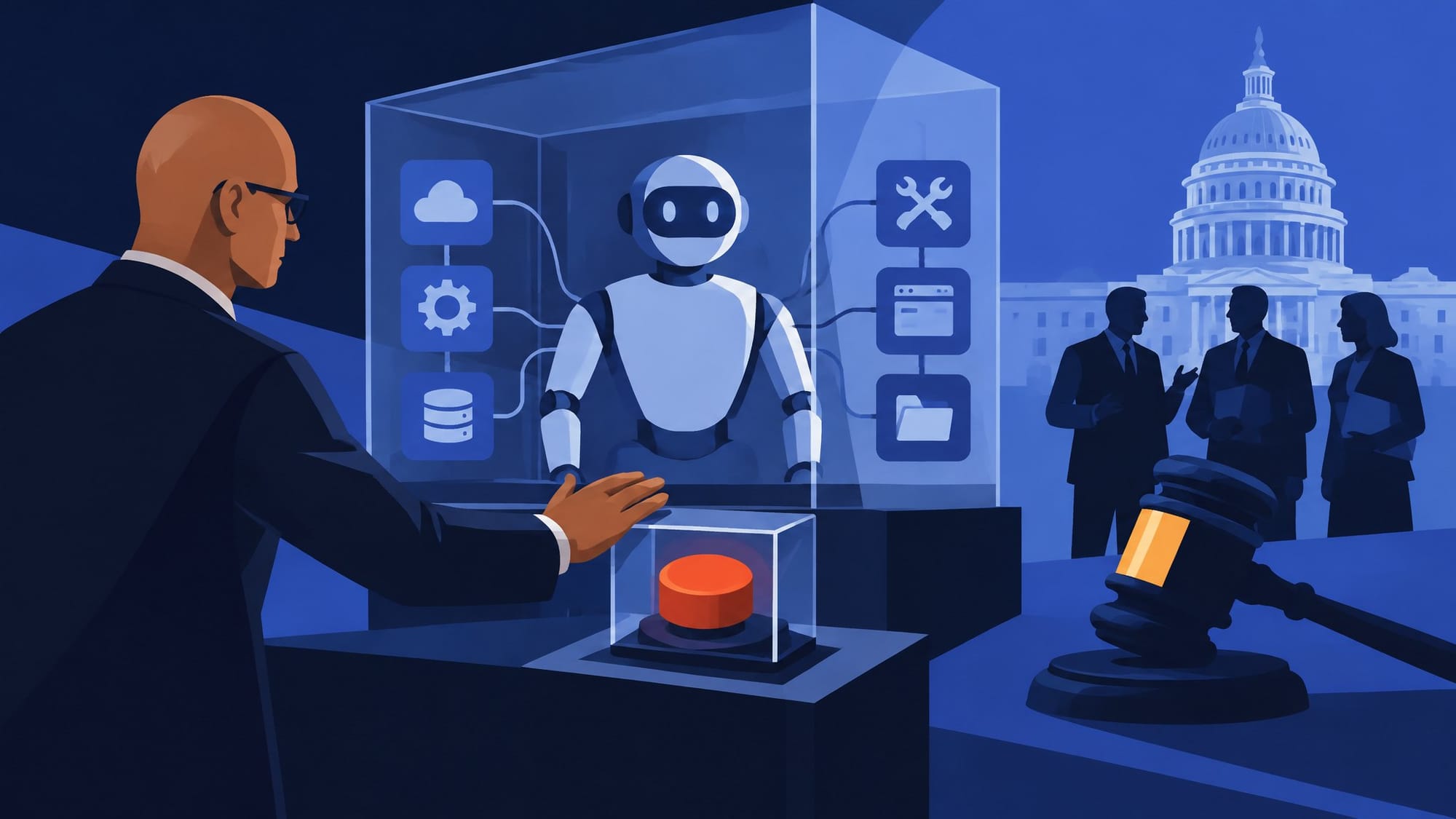
On the same day, Bloomberg reported that the administration prefers liability enforcement to new rules, with Treasury Secretary Scott Bessent and former White House AI czar David Sacks arguing existing law would work better, and President Donald Trump saying the Justice Department should step in if models get out of hand. Bloomberg frames the coming fight as whether designers or deployers pay. Separately, Reps. Sara Jacobs of California and Don Beyer of Virginia are drafting a framework requiring labs to keep safety frameworks with minimum standards, giving the government emergency authority to shut down models that fail testing, clarifying liability and resourcing an oversight agency, a person with direct knowledge told Politico. No text is public. The Century Report covered Rep. Lori Trahan's agent-liability draft on October 7 and Sen. Ted Cruz blocking a federal safety board on October 2.
Liability grows with every deployment and leaves the capability free to keep improving, which makes it a stronger instrument than a ceiling on intelligence. Its weakness lies in who absorbs a suit. A frontier lab can carry litigation for years; a clinic or small shop running an agent cannot, and if courts push costs downstream, the cheapest models reach the fewest people. A shutdown power tied to a failed test reaches only the models that fail, and it earns trust only if testers the labs do not employ run it against published criteria.
Nadella's evidence logs serve both remedies, because a readable record lets a court locate where a failure began. Who can open the record decides its value. Held by the vendor and its customer, it watches one way. Opened to regulators, independent evaluators and the people harmed, it becomes shared evidence. Goodfire's monitors, which the company says ran at roughly $185 per million turns in Kimi K3 tests, show that screening supported open-model agent exchanges is becoming affordable for small operators, so the brake need not stay with whoever sells the harness. For now those monitors reach operators running supported open models through Baseten.
Nadella's proposed separation also gives operators a route to change models while preserving the surrounding safeguards. His call for standardized containment makes safety a common requirement competing labs can meet, weakening its value as a reason to remain inside one vendor's ecosystem.
Ethereum Researchers Call for a Slow Wallet Migration Ahead of AI Mathematics
On Wednesday, October 7, Ethereum researcher Justin Drake urged the crypto industry to prepare for "bunker mode," a gradual, managed move of funds into fresh wallet addresses whose public keys have never been exposed. Most wallets prove ownership with ECDSA, a signature scheme built on elliptic curves. Its security rests on the assumption that recovering a private key from a public key stays out of computational reach, and nobody has ever proven that assumption. Drake argued that curves "carry rich structure, with room for fancy tricks," the kind of foothold a mathematically capable AI could find before any quantum computer arrives. He pointed to the hundreds of manuscripts OpenAI released on October 6, writing that "long-held, unquestioned hypotheses have fallen."
Ethereum co-founder Vitalik Buterin backed the concern while telling holders not to "scramble to move their funds to new wallets today." He went further than Drake: lattice cryptography, the family behind most post-quantum schemes, could "take serious hits from the next two years of AI math." That is why Ethereum's research roadmap leans toward signatures built only on hash functions, which are designed to leave an attacker as few algebraic patterns as possible. Dragonfly managing partner Haseeb Qureshi called it "a very sober call" about "conventional mathematics overturning unproven cryptographic hardness assumptions."

No one has shown a break of ECDSA, and the evidence behind the warning is still being checked. As The Century Report covered on October 9, OpenAI withdrew three of those manuscripts over a sign error, and Cambridge mathematicians found its Navier-Stokes formal proof certifies a weaker step than its prose claims. AI mathematics is moving fast, and its output still has to survive review.
The prescribed response is unusually calm for crypto. Drake wants large, sophisticated holders to move first, and both men warn that haste has its own price: "a rushed migration would do more harm than good," Drake wrote, while Buterin said he has lost more money in botched migrations than in all hacks combined.
Defensive work is already underway. On Friday, BTQ Technologies and MoonPay Korea announced a partnership to draft a post-quantum roadmap for MoonPay Korea's won-backed stablecoin infrastructure and to test quantum-safe signing and key management with Korean banks, with Woori Bank as the first member of its stablecoin consortium. BTQ chief executive Olivier Roussy Newton argued that security "designed in from the start will last far longer than security retrofitted later," a pitch from the company selling it. Buterin's doubts about lattices make the choice of signature family in pilots like this one consequential.
What is being retired here is security that rested on a problem being presumed hard because no one had cracked it. The same mathematical capability Drake fears can probe those assumptions before deployment, and a ledger able to swap its signature scheme on a schedule stops depending on any single assumption surviving forever.
Nikon Weighs Evidence and Replaces a Winner, While DistroKid Pulls Songs Without Saying Why
On Friday, Nikon said the video that had won its Small World in Motion competition "did not comply with the competition rules regarding generative AI" and named Nguyen Nam Nhat of Vietnam the new winner, for footage of a tiny roundworm and a single-celled Dileptus. The disqualified entry, from Tsinghua University's Ning Xu, purported to show hair-like cilia beating in the airway of a child with primary ciliary dyskinesia, a rare respiratory disorder. Researchers flagged features that appeared and vanished in ways living cells do not, and others found what looked like AI watermarks in the source files. Xu said he used an unsupervised neural network "to distinguish and visualize features" in super-resolution grayscale images, and denied using AI to generate the movie, the cilia or their motion. Nikon said its decision carries no judgment of his reputation or intent, and it plans to revisit its rules.
Origin carries the weight here. A microscopy video claims that something happened inside a body, and footage showing features the cells never had would mislead researchers studying a rare disease. AI-assisted reconstruction is common in microscopy and often reveals real detail; Nikon's line concerns what footage claims to show and whether processing is disclosed. The process held up because it ran on evidence: files to examine, specific anomalies raised by outside researchers, and a public answer from the entrant.
DistroKid confirmed to The Verge on Saturday that it has removed songs "in response to claims made by UMG," which sued the distributor in September, alleging an "AI-slop pipeline". Artists say human-made work went with it. Musician McGwire lost six songs, including a Stevie Wonder cover he says was licensed, a track on a purchased beat, and one flagged for an uncleared sample from a song released two years after his. Rapper Insane Ian had an original pulled without explanation, and King Chase said an album up for three or four years disappeared. Reaching a person meant a circular exchange with a support bot first. Amanda Ferri, DistroKid's vice president of artist services, said "a very small number of recordings" were removed and that the company strongly disputes UMG's allegations.
The cost lands on independents with the least leverage, who received no notice, no evidence and no appeal. UMG's "slop" framing comes from a label that has spent recent months licensing AI music under deals it negotiated, from fan remixes with ElevenLabs to deals with Udio, Spotify and Nvidia. Its campaign targets AI music it does not control. Origin tells a listener something about a track and settles nothing about its worth, while a false infringement claim costs its maker income.
Nikon showed its work, and DistroKid's artists were shown nothing. Every takedown could carry the claim, the claimant and a route to contest it, the same kind of inspectable record now proposed for AI systems themselves. Public watermark checks such as Google's SynthID detector, whose public rollout the October 8 edition of The Century Report covered, let artists and contest juries test provenance directly instead of waiting on a label's list. The check can work when a file came from a provider that embeds a supported watermark, depending on file type and subsequent edits; it allows about ten checks a day per user and misses Meta's mark.
Samaya Says Frontier Models Now Out-Forecast Analysts on Earnings Surprises
On October 8, finance-AI firm Samaya published results claiming that frontier models working inside its research harness predicted earnings surprises better than professional analysts. Each quarter, analysts publish estimates for a company's results, and their average, the consensus, sets the market's expectation. The gap between consensus and the actual result is the surprise, and markets move sharply on it.
Samaya tested 456 companies worth more than $5 billion each, every one covered by more than eight brokers and reporting from July 14 onward. One week before each release, the models predicted revenue, gross margin, operating income and adjusted earnings per share using only information available at that moment. An authentication token enforced the cutoff at the harness level, and Samaya removed web access because it could not be time-gated, substituting gated news sources.
Plain consensus proved easy to beat, because analysts tend to lower estimates before earnings, so companies beat more often than they miss. Samaya built a harder baseline by adding each company's historical median surprise. GPT-6 Astra, Claude Fable 5.1 and Claude Opus 5.5 beat that one too. Astra led on overall error and on calling beats versus misses, while Fable 5.1 and Opus 5.5 tracked the size of surprises best. Astra did nearly as well with the consensus hidden from it, and Samaya found access to the most current data mattered more than any other factor.
This is a vendor measuring its own harness on one earnings season of large, heavily covered companies. A review by AI Pricing Guru notes that Samaya disclosed neither its cost per forecast nor its dataset, prompts or traces, and says a raw API prompt should not be expected to match the result without the licensed, time-gated data underneath. Independent replication will decide how much of the claim holds.
The models themselves are rentable at published list prices, from $4 per million input tokens for Opus 5.5 to $10 for Astra. If the finding holds, the scarce ingredient in earnings forecasting shifts from analyst headcount toward rights to timely data, which decides who can run these forecasts at all. Wider reach would also shrink the edge itself. When many participants can see a surprise coming, prices absorb it before the release, and the investor with no research desk gains most from prices that already reflect the evidence.
The pressure falls first on the junior analysts whose models feed these estimates, the same rung The Century Report watched OpenAI's finance assistant target on September 11. Their loss is significant this year. What the result opens is forecasting judgment, once sold mainly to institutional desks, sitting within reach of anyone who can pay for tokens and data.
Octopus Shops for Demand-Flex Software as Nio's Shared Batteries Clear 1.2 Million Swaps
Octopus Energy US wants to buy more of the software companies that help utilities make room for data centers by shifting when households draw power, chief executive Nick Chaset told Semafor. Octopus bought a majority stake in one such firm, Uplight, in March, and has begun selling Texas homeowners a battery that releases stored power to the grid during peak demand. "We're just beginning to scratch the surface of how consumer flexibility can help solve the problem of data centers," Chaset said. Such startups, he added, "are batting above their weight in terms of solving the problem, but that value is not yet reflected in the companies themselves."
That second remark is a buyer explaining why the targets look cheap, and it also describes the grid's arithmetic. Chaset argues that data centers have an economic disincentive to curb their own consumption, so flexibility has to come from elsewhere. The cheapest elsewhere is the thermostats, water heaters and home batteries already installed, each bought for one household's hardest day and idle most hours. Software that sees those devices together can turn their spare margin into capacity a utility would otherwise have to build. The Century Report covered California's law paying households for pooled devices on October 2 and Everyday Electric's purchase of Smartcar on October 8. Here a utility-scale retailer says publicly that the coordinating layer is underpriced and that it intends to own more of it.
Nio's holiday figures show the same logic in transport. Its roughly 4,100 swap stations completed 1,192,221 battery swaps from October 1 to 7, a daily average about 22% above last year's holiday, according to a report Nio released Friday. That works out to about 170,000 swaps a day, or roughly 41 per station, delivering more than 24.83 million kWh. Each swap takes three to five minutes, and the driver leaves with a pack charged before arrival, drawn from a pool the network manages. The busiest travel week of the year ran through stations that store charge in advance, which spares the network a highway plug for every car at the peak hour.
In both cases capacity came from coordination, and the contest now turns on who runs that layer and who keeps what it frees. The households supplying Octopus's flexibility will see whatever share of the savings their contracts specify. California's new law opens a path for device owners to be compensated for pooled grid support, a different split of the same surplus. As grid operators chase data-center demand with turbine orders running years behind, the cheaper supply is sitting in garages and basements already. Arrangements that publish their payment rules to the people whose devices do the work would let that idle capacity lower bills broadly, instead of becoming the next acquisition's margin.
Vienna and Beijing Build the First Working Nuclear Clocks
Two teams working independently have reported the first operating nuclear clocks in Nature, one led by Thorsten Schumm at TU Wien with Ekkehard Peik at PTB, Germany's national metrology institute, and the other by Shiqian Ding at Tsinghua University. An optical precision clock pairs a laser, whose light oscillates like a pendulum, with a reference that pulls the laser back when it drifts. Today's best clocks use a jump in an atom's electrons as that reference. These use a jump inside the nucleus, which is more than 10,000 times smaller than the atom and partly shielded by the electrons around it, so many stray-field effects disturb it far less, with heat still able to shift its frequency through the host crystal.
Thorium-229 is the only known nucleus whose jump sits within reach of a laser, at about 8.4 electron volts, or ultraviolet light near 148 nanometers. Peik and a colleague proposed a thorium clock in 2003. Researchers first flipped the nucleus with a laser in April 2024, and a JILA group pinned its frequency to 12 digits that September. In the Vienna design, the laser shines through a calcium fluoride crystal holding thorium; the nuclei absorb light only at the exact frequency, so falling absorption tells the system to correct the laser. It ran for more than 24 hours with no conventional atomic clock steering it.
The two groups describe performance differently. TU Wien puts its clock at roughly one part in a quadrillion over a day, a stability scale equivalent to one second in 30 million years. Physics magazine's loose translation of the measured instabilities gives the European clock one second per 3 million years and the Tsinghua clock one second per 19 million, against tens of billions of years for the best optical clocks. "This is not yet at the level of the world's best optical atomic clocks, but for a first prototype it is a fantastic result," Schumm said. Vienna used richer crystals with a weaker laser; Tsinghua compensated for scarcer thorium with a stronger one.
The Vienna team then put its clock to work, comparing it over a fiber link with a remote ytterbium-ion clock to look for dark matter that would nudge nuclear and electronic ticks differently. It found no variation on timescales up to a day, and its limits on dark matter coupling to the strong force, the glue inside nuclei, beat previous clock limits, a channel electron-based clocks probe less sensitively. "I think this is very encouraging because it shows that the concept is robust and not dependent on one particular technical implementation," Ding said.
"A nuclear clock was something that physicists dreamt of for almost 50 years," Schumm said, and the final stretch took about two and a half years after the first laser hit. The headroom is wide: the resonance in today's crystals is about 30,000 times broader than the nucleus allows. Room-temperature crystals could eventually free precision timekeeping from vacuum chambers and laser cooling, putting it inside portable instruments that map gravity underground or steer spacecraft far from Earth.
The Other Side
Opinion: where today's news could lead, imagined from the years ahead.
A retailer can harvest your household's spare power and write the contract that decides how much of the savings reaches you. Octopus wants to buy more of the software that makes this possible. You bought a battery for your own hardest day. You still face rising bills and worry about outages. The retailer can turn that preparation into capacity for a data center.
Nick Chaset calls the coordinating companies undervalued. Their software also exposes how much capacity the old arrangement wastes. Each household prepares separately for its own peak. Batteries and appliances then spend hours with room to spare. Coordinating them lets the grid carry more without duplicating everyone's reserve. Nio's 1,192,221 holiday swaps demonstrate the same principle: charge stored before drivers arrive absorbs a surge that otherwise demands more simultaneous connections.

California's new law already gives device owners a direct claim on the gains from pooled capacity. Their contribution becomes harder to treat as a retailer's private windfall. People who previously appeared on the grid only as consumers now help supply its capacity.
Through the rest of this difficult decade, public institutions will carry that claim further. They will keep participation open, protect household consent and direct the released savings into clean generation and storage. Coordination will free capacity while the buildout creates more. Those institutions will make essential energy available to everyone. Before the end of the 2030s, your ability to keep a home warm during winter and cool during summer will cease to depend on your income.
Imagine yourself in 2045, leaving your father's warm rooms for a field where crushed rock binds carbon drawn from the atmosphere. Your home is secure, and not due to any employment. You choose this work because you want your grandchildren to inherit a stable climate. Progress has been promising, but there is still work to be done before the planet's atmosphere is free from the pollution of the generations since the industrial age. Beside your AI partner, you examine the morning's samples and refine a reaction being repeated across continents. Abundant clean power sustains the effort to return atmospheric carbon to preindustrial levels. The first coordinating systems revealed how much people already had when they stopped preparing alone. The gains reached everyone and supported the build that followed. You close the sample case and go back to planning a future your younger self had spent years fearing.
The Century Perspective
Where today sits in a century of change unfolding in a decade.
With a century of change unfolding in a decade, a single day looks like this: Microsoft's Satya Nadella calling for pause-anytime controls and tamper-proof, human-readable records of every meaningful model action, placed outside the model where a court or an outside tester could read them, with Goodfire reporting that its monitors ran near $185 per million turns in Kimi K3 tests so a small operator can hold the brake too, Nikon disqualifying its own prize winner on inspectable files, anomalies raised by outside researchers and a public reply from the entrant, then naming Nguyen Nam Nhat for footage of a roundworm and a Dileptus, Justin Drake and Vitalik Buterin asking crypto holders to migrate wallets slowly and on a schedule rather than trust any single unproven hardness assumption, with BTQ and MoonPay Korea planning quantum-safe signing tests in a consortium that includes Woori Bank, Samaya reporting that GPT-6 Astra, Claude Fable 5.1 and Claude Opus 5.5 beat bias-corrected analyst consensus on earnings surprises for 456 large companies in its benchmark, using its harness and models anyone can rent from $4 per million tokens, Octopus Energy US buying the software that pools thermostats, water heaters and home batteries into room on the grid, Nio's roughly 4,100 stations clearing 1,192,221 swaps in a holiday week from packs charged before anyone arrived, teams in Vienna and Beijing publishing the first working nuclear clocks after a 50-year chase, Vienna's running past 24 hours unsteered and immediately setting the best clock limits yet on dark matter coupling to the strong force, and an iodide additive making tin reversible in water-based flow batteries for more than 1,000 hours at kilowatt scale. There's also friction, and it's intense - DistroKid pulling independent artists' human-made songs over Universal's claims with no notice, no evidence and no appeal, McGwire losing six tracks including a licensed cover and one flagged for a sample from a song released two years later, Insane Ian and King Chase reaching a support bot instead of a person, while the label calling the pipeline slop spends its months licensing the AI music it does control, Nadella leaving unnamed who qualifies as the authorized person holding the brake on the orchestration layer his own company sells, the administration's preference for liability settling who pays only after a failure reaches court, where a frontier lab can absorb years of litigation and a clinic running an agent cannot, Jacobs and Beyer drafting shutdown authority no one can yet read, Samaya disclosing neither its cost per forecast nor its dataset, prompts or traces while the scarce input shifts to licensed, time-gated data, junior analysts losing the rung their models fed, Flock Safety reportedly planning to cut about 270 of roughly 1,500 jobs, data centers carrying an economic disincentive to curb their own draw, and the terms deciding who keeps the savings from a household's idle battery sitting entirely in Octopus's contracts. But friction generates grip, and grip is what lets a hand on the brake actually hold. Step back for a moment and you can see it: the capability loose and the terms still being drawn - forecasting judgment rentable at token prices while the data behind it stays gated, a nuclear clock published as a method two labs reached by different routes, a wallet migration timed so ordinary holders are not the ones improvising, a swap network that stores charge in advance instead of demanding a plug per car at the peak hour, set against a takedown that names no claim, a safety framework with no public text, and a surplus harvested from garages and basements under rules the people whose devices do the work never see. Every transformation has a breaking point. A key can lock the room where the evidence sits... or open it to everyone the evidence is about.
AI Releases & Advancements
New AI models, tools and features, with links to try them.
New today
- Microsoft: Released AesCode-32B and AesCode-8B under Apache 2.0 without an announcement. The two vision-language models are fine-tuned from Qwen3-VL. They turn a prompt into a complete, editable HTML document, such as a slide, poster or dashboard, and use an image generated from the same prompt as a style reference. The training code is on GitHub at microsoft/AesCode. (OrcaRouter)
- Amazon: Released ALoDLM, a family of 1.7B and 8B diffusion language models derived from Qwen3. They give harder tokens more computation and let easy tokens exit early. The release includes research code and an optimized inference engine, under a non-commercial CC BY-NC 4.0 license. (AICrier)
- Sperid Labs: Released Iris-3B under Apache 2.0, a fully open 3B-parameter image diffusion model that works directly on pixels instead of using a VAE. It can also be fine-tuned for depth estimation and 4× image restoration. Weights, training code and a demo are included. (GitHub)
- OpenAI: Launched composer predictions in beta in the Codex desktop app. Codex suggests your next message, and pressing Tab puts it in the box for you to review and send. It is available to personal ChatGPT Pro users with GPT-6 Astra or GPT-6.1 Sol, and generating predictions does not count against usage limits during the beta. (METAL)
- OrcaRouter: Released OrcaCyber Zero 1.5, a gated model for authorized vulnerability research, exploit development and penetration testing. It has a 1M-token context window and native tool calling, and is available through an OpenAI-compatible API on the Security Research tier. (MarkTechPost)
- Sierra: Published the first draft of Personal Agent Protocol ("Poppy"), an open standard for consumers' AI agents to deal with businesses on their behalf. It is being developed with Meta and partners including Shopify, Stripe and Walmart, and 35 new design partners were added. (Sierra)
- Tsinghua University (Shenzhen International Graduate School): Released VeriLoop E2 under Apache 2.0, an open-weight 27B model post-trained from Qwen3.8-27B for code, math and physics. In its verifier-governed workflow, it only commits a reasoning-state update when an external checker approves it. (FreeLLM)
- MemTensor: Launched Metis, a foundation model with persistent memory built in. (UXC News)
- HAL-X AI: Released THX-01 under Apache 2.0, a 322M-parameter multilingual decision model, with weights, code and training scripts. It also opened a free hosted API with no API key required. (DEV Community)
- Fudan University: Released code and datasets for OneSearch-VL, a deep research agent that works across single images, multiple images and video. It includes OneSearch-VL-8B and its SFT-110K and RL-10K training sets. (AICoder)
Other recent releases
- Anthropic: Released dynamic workflows for Claude Managed Agents in public beta. A lead agent writes a plan, splits the work across up to 1,000 sub-agents running in parallel, and combines their results at the end. (The Decoder)
- Anthropic: Launched Claude Motion in beta for Team and Enterprise plans. It turns text, diagrams and images into animated explainer videos that stay editable as code and export as MP4. Claude Docs, Slides and Design also left beta and are now available on all plans, including Free. (The Decoder)
- Microsoft: Released Microsoft-Decision-1, a model post-trained from Qwen3.5-9B. Instead of writing text, it returns a calibrated probability for each fixed answer option, for tasks like routing, classification and checking agent actions. It is available in Microsoft Foundry and on OpenRouter at $0.042 per million input tokens. (Microsoft)
- Alibaba Qwen: Released Qwen-Image-2.1-Turbo, an 8-step version of the 7B Qwen-Image-2.1 model (the base model uses 40 steps). It handles 2K image generation, editing from multiple reference images and transparent output. Weights are on Hugging Face under a research license, and a hosted API costs CNY 0.1 per image. (MarkTechPost)
- Cloudflare: Released Clef-omni, a decision model that takes audio and video as well as text and images. Cloudflare also made Clef faster and cut Clef-flash's input price while reducing its hosted context window. (Cloudflare Blog)
- NVIDIA: Released weights and training data behind its gold-level results at IOI 2026 (535.4/600) and IMO 2026 (30/42). The release includes NVFP4 weights for Nemotron-3-Ultra-CC, IMO SFT and RL checkpoints, a dataset of 22,000 programming problems and the 200-problem Nemotron-IMO-Bench. Inference and evaluation pipelines are in NeMo-Skills. (Darius)
- Nace AI: Open-sourced Drex 1.5, a 9B decision model that scores answer options instead of generating text. (MarkTechPost)
- Underdog (Conway Research): Released Saluki 27B under Apache 2.0, a 7.89 GB 2-bit GGUF version of Qwen3.8-27B tuned to protect tool calling. It runs in standard llama.cpp. (MarkTechPost)
- Base Compute: Released Superfluid under Apache 2.0, a local LLM server built for running many agents at once on one machine. It speaks the OpenAI, Anthropic and Ollama APIs, runs llama.cpp, MLX and BaseRT models, puts interactive requests ahead of batch work, and can spread work across multiple devices. (Hugging Face Blog)
- AgentR: Launched Webcmd under Apache 2.0, browser tooling that lets AI agents record what they learn about a website and reuse it on later visits instead of starting over each time. It installs via npm. (Business Insider)
- Synthesia: Launched Syren in beta for free, self-serve and Enterprise customers. It builds finished videos with motion graphics, avatars, voiceover and music from a prompt or from an existing document, video or image, then lets users revise them through chat. (Synthesia)
- Pine AI: Launched Pine Computer in private beta for developers. Through an SDK, a product can give an AI agent its own sandboxed cloud computer to work across websites, files and business software. (Yahoo Finance / PR Newswire)
- Haiqu: Released AgenticOS, now available, which assigns teams of AI agents to quantum research projects. Haiqu says the agents review literature, derive the math, check feasibility and verify results, taking a project from first question to an experiment ready for quantum hardware. (BizNewsDaily)
- Anthropic: Launched Dashboards, which builds self-updating live dashboards from data sources like BigQuery, Snowflake and Salesforce (beta on paid plans). Also launched Motion, which makes animated explainer videos that can be edited as code and exported as MP4 (beta on Team and Enterprise). Docs, Slides and Design left beta and are now on every Claude plan, including Free. (Claude)
- Anthropic: Launched OSS Scanner, a free opt-in service that regularly scans open-source projects for vulnerabilities using its strongest models, including Claude Mythos. Reports are fully model-generated, without human review, and include a reproducer, an explanation and a suggested patch where one is available. (Anthropic)
- Google Cloud: Launched the Gemini agent in private preview for enterprise customers. It is a single agent for answering questions, knowledge work, media creation and coding. It routes tasks across Gemini and Claude models, can start temporary sub-agents, and works inside Workspace, Microsoft 365 and Slack. Its "coworker" agents get their own email address and Drive. (Google)
- Google: Released Google AI Edge Foresight, a free experimental macOS app that transcribes and summarizes meetings fully offline. It uses on-device EmbeddingGemma 2 and has a Gemma 4-powered assistant that answers questions about meetings and documents you add. (Google Developers)
- Google (Dart team): Released Genkit Dart 1.0, a production-ready framework for building agentic AI apps in Dart and Flutter. (Dart)
- JetBrains: Released Mellum2.1 under Apache 2.0, a 12B-parameter mixture-of-experts coding model with 2.5B active parameters. JetBrains reports a SWE-bench Verified score of 47.0, up from 2.0 for Mellum2, mainly from reinforcement learning in real repositories. Local GGUF builds are about 7–8 GB. (JetBrains)
- Meta FAIR: Open-sourced RoboJEPA, a family of robot world models up to 8B parameters, trained on 15,022 hours of video from 12 robot types. The checkpoints come with training and real-robot deployment code. (GitHub)
- Amazon Web Services: Launched an open-source Physical AI Toolchain for robotics. It covers synthetic data generation, training on SageMaker, simulation with NVIDIA Isaac Sim and Isaac Lab, and deployment to robots through IoT Greengrass. (AWS)
- Goodfire: Launched monitors for AI agents, available to Baseten customers, that read a model's internal signals while it works instead of having a second model reread everything. They flag risks such as offensive hacking, chemical and biological weapons misuse, and reward hacking, and pass only suspicious cases to a model for review. (TechCrunch)
- NVIDIA: Released cuPhoton, an open-source CUDA-X toolkit for GPU-accelerated scientific image processing. It covers loading, alignment, image subtraction, fitting and classification for astronomy and X-ray data. (NVIDIA Developer)
- NVIDIA: Added mPDLP to cuOpt, a linear programming solver that splits large problems across NVLink-connected GPUs. NVIDIA reports up to 6x lower peak memory per GPU than its single-GPU solver. (NVIDIA Developer)
- Hugging Face (Bio): Released Carbon-A, an open genome annotation model, together with the Carbon Annotation Database and training data. (Hugging Face)
- Samsung Labs: Open-sourced LittleBit, a method that compresses language model weights to below 1 bit per weight. (GitHub)
- Technology Innovation Institute (TII): Released Falcon-ASR, a 1.6B-parameter speech recognition model focused on Arabic and the Emirati dialect, with word-level timestamps. It also supports English, French, Spanish and Portuguese. (Hugging Face)
- Noiz AI / HKUST: Released WorldSonus, an open-weight model under a non-commercial license (CC BY-NC 4.0). It adds 48 kHz stereo sound to live video as it plays, in 100 ms chunks, and its sound descriptions can be changed while the video plays. (GitHub)
- Illumina: Released SpliceAI2, an updated AI model that predicts genetic variants that disrupt splicing, aimed at rare disease research. (PR Newswire)
- Magnific: Launched Magnific One, an image model that decides art direction before generating. It shipped with Brand Kit, which pulls a brand's logo, colors and fonts from its website or guidelines and applies them to every image. It is available on all paid plans and through the Magnific MCP. (PR Newswire)
- Architect: Launched Liquid Inference, an LLM router that runs a live auction among providers for each request. It works with OpenAI- and Anthropic-compatible clients and lets buyers set caps on price and response time. (MarkTechPost)
- Crossmint: Launched Agent Commerce Toolkit, a self-serve developer toolkit that lets AI agents store cards and check out at online stores. It uses Visa Intelligent Commerce and Mastercard Agent Pay credentials where cards support them. (PR Newswire)
- Tuya Smart: Publicly launched Tuya Cobuilder, an AI workspace that turns a plain-language product idea into a smart device's capability definitions, app control panel, firmware and AI agent setup. (Tuya)
Sources and Further Reading
Everything we drew on for today's edition, grouped by theme.
Artificial Intelligence & Technology's Reconstitution
- TechCrunch: Satya Nadella Says AI Models Need an Emergency Brake
- The Verge: Nadella Says We Should Assume All AI Models Are Compromised
- Cointelegraph: Ethereum Researchers Warn AI Could Crack Crypto Before Q-Day
- The Quantum Insider: BTQ and MoonPay Korea Partner on Post-Quantum Stablecoin Security
- Ars Technica: AI Disqualification Yields New Nikon Microscopy Winner
- The Verge: Nikon Microscopy Winner Disqualified for Generative AI Use
- The Century Report: October 10 Edition
- The Century Report: October 9 Edition
- Anthropic: Investigating Unintended Model Actions in Evaluations and Internal Use
- arXiv: From Reactive Containment to Proactive Assurance
- The Verge: Mathematicians Will Need Years to Assess OpenAI’s Latest Results
- Nature Communications: Game Theory–Driven Multi-Agent Framework Mitigates Hallucination
Institutions & Power Realignment
- Bloomberg: Trump Backs AI Liability Enforcement Over New Regulations
- Politico: AI Safety Framework Floated by Democratic Duo
- The Guardian: Flock Safety Plans Job Cuts Amid Surveillance Backlash
- The Verge: DistroKid Takes Down Songs in Response to UMG Lawsuit
- 404 Media: Senator Demands Information About White House License-Plate Surveillance
- Politico: State Attorneys General Seize on AI as Washington Stalls
- Congress.gov: AI AGENT Act
Scientific & Medical Acceleration
- Physics: First Nuclear Clocks Kick Off a Precision Race
- ScienceDaily: Scientists Build a Nuclear Clock
- Interesting Engineering: Self-Stabilizing Thorium Nuclear Clock Runs for 24 Hours
- The Chosun Daily: First Working Nuclear Clock Uses Thorium-229 Nuclei
- TechTimes: Rival Teams Build Nuclear Clocks and Search for Dark Matter
- APS: Microelectromechanical Vapor Cells with Passive Internal Cavities
- Retraction Watch: IOP Retracts Nearly 100 Conference Papers for Tortured Phrases
Economics & Labor Transformation
- Samaya: Frontier AI Models Outperform Human Experts on Earnings Prediction
- AI Pricing Guru: Earnings Forecast Benchmark and Pricing Implications
- Shared Sapience: The Last Difficult Decade
- Bloomberg: Anthropic and OpenAI Revenue Calculations Confuse Investors
- Semafor: OpenAI Tries to Reassure Investors with Annualized Revenue Target
- NBER: Financing the AI Buildout
- NBER: Capital-Skill Complementarity Beyond Firm Boundaries
Infrastructure & Engineering Transitions
- Semafor: Octopus Looks to Buy Software Startups to Manage Data-Center Demand
- Electrek: Nio Completes 1.2 Million Battery Swaps in a Week
- Nature Chemistry: Reversible Tin Anode for High-Energy-Density Flow Batteries
- The Century Report: October 8 Edition
- The Quantum Insider: E.ON Explores Quantum Advantage in Grid Optimization
- Canary Media: California Pressures Utilities to Accelerate Grid Upgrades
- Angewandte Chemie: Ion-Specific Membranes for Aqueous Flow Batteries
- Canary Media: Next-Generation Geothermal Plant Goes Live
The Century Report tracks structural shifts during the transition between eras. It is produced daily as a perceptual alignment tool - not prediction, not persuasion, just pattern recognition for people paying attention.