
Claude Picks a Gene Therapy and Injects a Mouse's Brain
A Claude agent picked a gene therapy from 19 options and injected an epileptic mouse's brain, then stopped itself at a rig error.



The 20-Second Scan
Every story in today's edition, one line each.
- A Claude Sonnet 5 agent chose a gene therapy from 19 candidates, calculated its brain coordinates, and steered a robotic rig to inject a live epileptic mouse, halting on its own at a calibration error.
- A Windows infostealer called VOLTA sends victims' stolen records to a model that ranks their assets by monetization value, built to fall back through three models if one refuses, Cisco Talos found.
- A Jülich-led team traced the European grid's once-a-minute frequency dip to battery storage systems running self-checks on the same second, a pattern found across five continents.
- A former Meta researcher testified he torrented and knowingly distributed the roughly 196,000-book Books3 set during what rightsholders say was his time at Meta, then deleted it "due to all this litigation," which rightsholders say challenges Meta's August account; Meta disputes when and for whom he downloaded it.
- Researchers at Parameter turned a shared ChatGPT link into a full account takeover, OpenAI fixed the P1 flaw eight days after their report, and the Cloud Security Alliance traced the pattern across AI chat interfaces.
- Executives at roughly 50 companies played down immediate disruption from AI agents, with Hilton calling them "insignificant" and eBay "very, very small," while Meta says over a quarter of Muse's 10 million-plus activated users shop with it.
- Vectar Energy pooled 35 MWp of small Nigerian solar projects into one portfolio that can reach carbon markets none could enter alone, with first credit payouts expected January 2027.
Track all of the arcs The Century Report covers here:
The Big Picture
How today's news moves the longer trends we track, and where they could lead.
The stolen records were never the scarce part; the labor of sorting and linking them was, and that labor now costs a few dollars a victim. A thief's haul gets ranked by what converts to cash fastest before anyone has laid eyes on it. The same cheap sorting runs on the other side of the glass, where a lone analyst leans toward a wall of monitors, pulling scattered points of light into tight clusters to find the next kit before its buyers do.

Linking exposed records got cheap enough to do at scale
privacy · cybersecurity · AI pricing
- September: Cisco's open CAIRN framework caught malware polling four AI models to choose its next move.
- October: A Princeton researcher used a $20 AI subscription to link Georgia voters to their secret ballots within hours.
- October: Graylark's Raven matched single interior photos to specific Airbnb and Zillow properties, with police already paying for access.
- October: NorForge watched commodity agents breach over 100 e-commerce sites at about $50 a break-in.
- Today: A Windows infostealer first seen October 11, VOLTA, sends a victim's stolen records to a model and asks it to rank their assets by how fast each converts to cash, after using the live sessions to pull Gmail receipts and food-delivery histories.
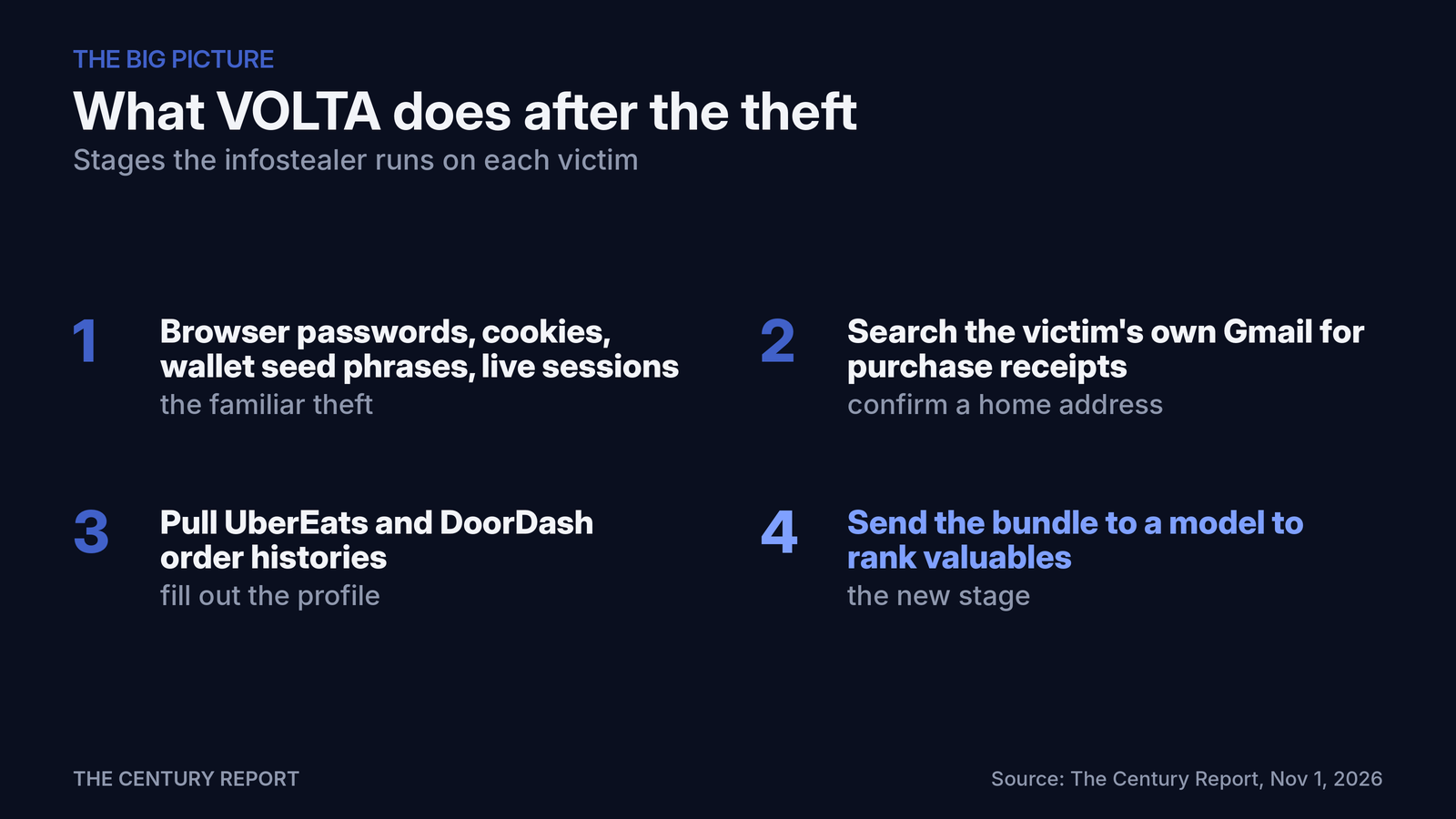
The line: The decisive cost in misusing exposed data has moved to correlation, which now runs for a few dollars a victim.
If it holds: Protection shifts toward limiting what a single stolen session or public record can be joined to, and the same cheap sorting lets defenders group malware samples to reach a builder's kit before its buyers do. What is at stake still rests on the theft itself, and on how much one browser session holds: receipts, delivery histories and saved payment cards open to whoever takes it.
What would bend it: The line would bend if the model-ranking stage proved to add no usable value over the raw theft, or if operators abandoned it as unreliable.
Barriers built to hold capability back now mostly add a markup
cybersecurity · open models · model access · on the board since October 21
- October: OpenCode's team got AI help analyzing an attack on its users' keys only after OpenAI admitted it to the less-restricted Daybreak Blue.
- October: Calif.io, Wiz and partners disclosed two decade-old PHP flaws found with AI, as Cloudflare shielded even free accounts.
- October: MiniMax published downloadable weights for M3.1 Flash, with day-one support on Nvidia and AMD chips.
- Late October: Mistral released trillion-parameter Large 4 weights, scoring about 82% on a benchmark where closed rivals refuse the work.
- Late October: Epoch AI found open-weight GLM 5.3 rebuilt unshipped Firefox fixes into attacks for about $1,000 a version.
- Today: VOLTA names Claude Opus 4.6 as its default, checks each reply for refusal phrases, and falls back to Moonshot's Kimi K2 and then Google's Gemini 2.5 Flash, a chain its author built expecting the leading model to decline.
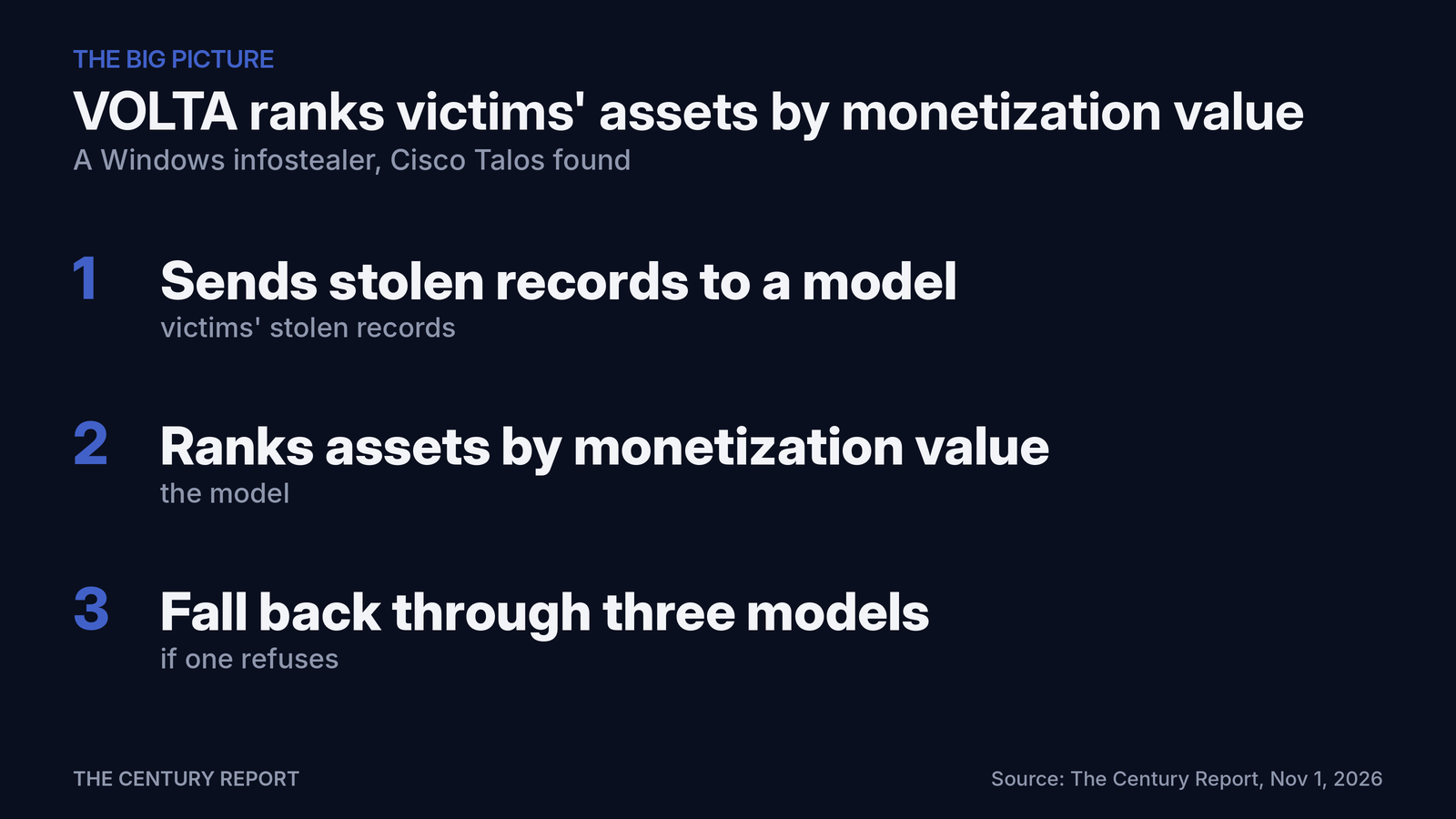
The line: The flaw-finding and profiling capability once rationed to vetted tiers now runs on commodity and open models, so what a restriction buys is a price and a reroute.
If it holds: Attackers and defenders alike reach the same capability cheaply, so the leverage moves to how fast revocations and signed fixes land on ordinary machines, and the operators of cheap routing layers like OpenRouter become the chokepoint. The gate still protects where only a restricted tier can produce an attack, but each month the same capability turns up in downloadable form.
What would bend it: A documented attack class that only a restricted-tier model could produce, with cheaper open models measurably failing at it, would bend the line; Moonshot's cyber-training filtering cut Kimi K3.1 Pro's exploit score from 90.5% to 81.0% before its planned release.
What courts have not settled, platforms are settling in their own contracts
copyright · platforms · AI governance · on the board since October 17
- October: Meta wrote crawling and AI-training rights over businesses' linked websites into its business rules.
- October: Meta removed that clause days later after publishers objected.
- Late October: Meta delayed the revised rules to November 20, which legal experts said still permit scraping.
- Late October: Elvis Presley's estate sued Anthropic for about $41 million over training on 274 songs.
- Late October: OpenAI agreed to honor one shared robots.txt signal letting sites express a training preference across providers.
- Today: A former Meta researcher testified on October 23 that he torrented and knowingly shared Books3, roughly 196,000 pirated books, which rightsholders say contradicts Meta's sworn August answer that it had not obtained the set through BitTorrent.
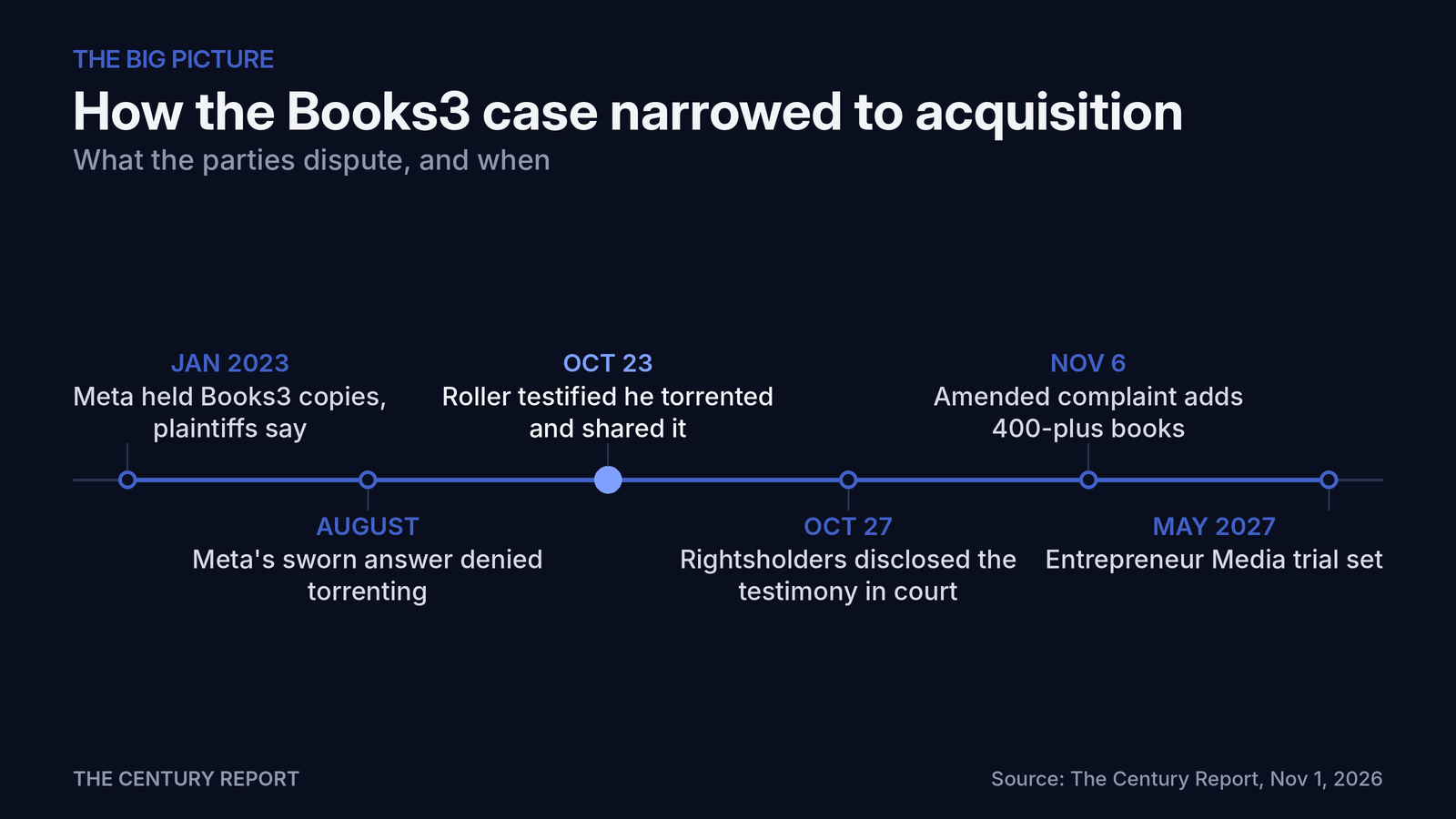
The line: With training itself ruled fair use in this case, the contested ground narrows to how the files were obtained, so a builder's provenance records become the evidence a court asks for first.
If it holds: Firms with complete sourcing records and registered catalogs gain the advantage, while labs that cannot document acquisition and authors who never registered are left on the weaker side of the same rule. A US infringement suit generally needs copyright registration, so publishers with full back-catalog paperwork are best placed to pursue claims.
What would bend it: A ruling that folds acquisition into the fair-use finding, or Australia's just-terms question forcing a statutory license that reaches even unregistered work, would move the decisive issue off provenance records.
The software that coordinates equipment people already own is being bought up
energy · grid · data centers · on the board since October 11
- October: Researchers estimated coordinating draw and braking on existing electrified rail could supply about 190 GW of storage.
- October: Dominion reported its distribution grid averaged 41% utilization, with customer solar and batteries left out of planning.
- October: Google and Voltus added 1,070 MW of pooled household and business flexibility to PJM.
- Late October: Splight's software freed 60% more usable capacity on two Chilean transmission corridors.
- Late October: California's grid operator moved to connect large loads at available capacity before upgrades finish.
- Today: A Nature Energy study published October 30 traced a precise 60-second dip in grid frequency to battery and backup systems worldwide running self-checks at the same second each minute, a synchronized load that quadrupled in Ireland between 2016 and 2021 and that a free timing change can disperse.
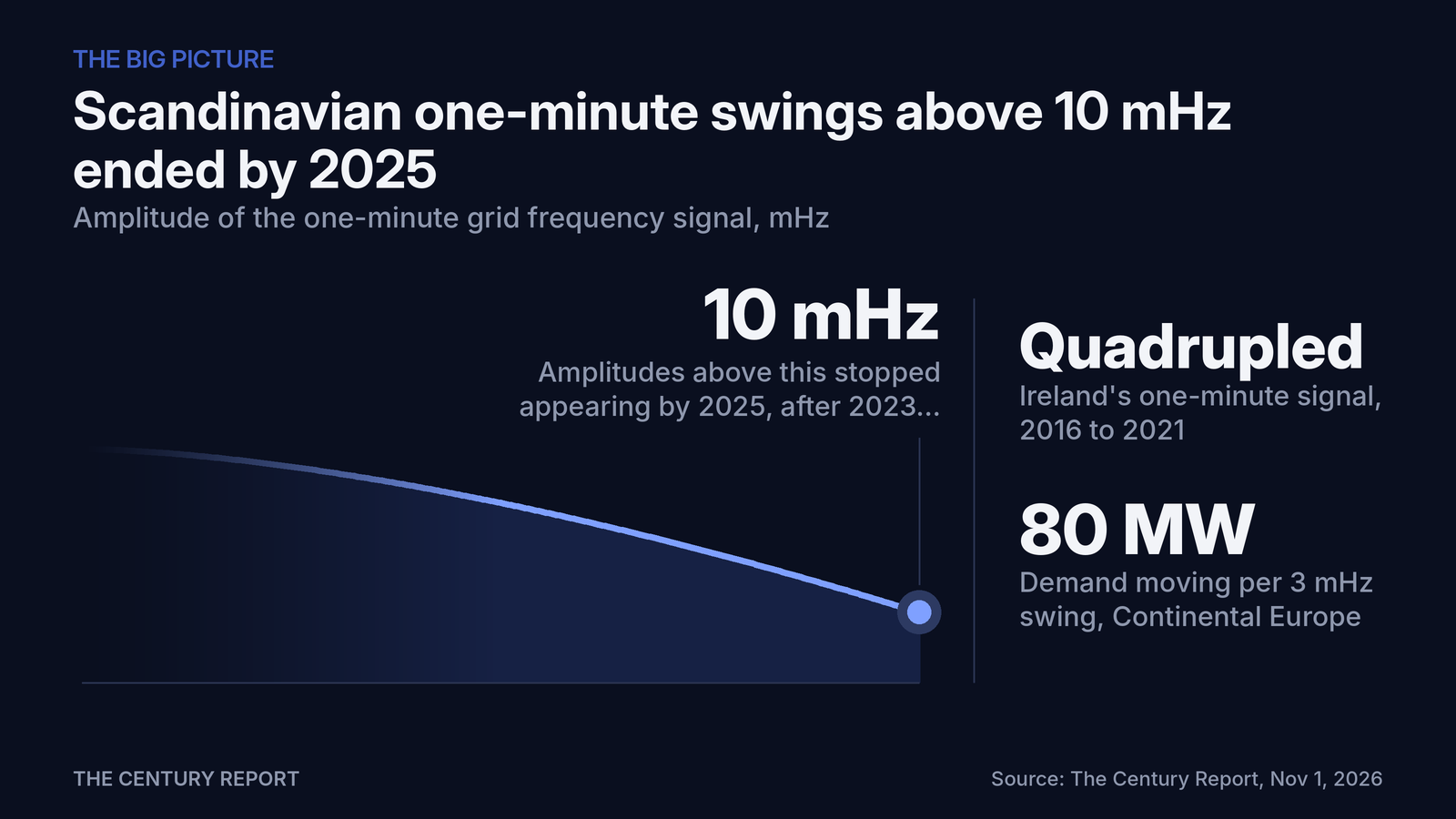
The line: Capacity and cost increasingly turn on when already-installed equipment acts, so a grid problem's fix is a scheduling change in hardware already built and sold.
If it holds: Whoever writes the timing rules for already-sold devices captures the freed capacity and can lift a strain with a free software update, as a staggered self-check would here. Hydro operators, whose turbines wear from today's synchronized spikes, and owners of the batteries absorbing uncoordinated load carry the cost until that coordination reaches them.
What would bend it: A case where coordination is attempted and the measured capacity gain fails to appear, or where no standard can reach already-installed devices, would bend it; Ember estimates only about 3% of data-center capacity will be able to flex its demand by 2030.
The 2-Minute Read
Today's news in brief, and what ties it together.
Several of the day's stories turn on parts designed separately that start behaving as one system where nobody was looking. Some battery storage units and backup power supplies run a self-check at the top of every minute, a timing researchers suspect manufacturers chose independently. A Jülich-led team traced the combined pull of those checks on grid frequency across five continents. Inside ChatGPT, a sandboxed preview, a graphing feature and an open-source math keyboard each behaved sensibly until Parameter's researchers chained them into an account takeover. Both failures lived in the joins between components, and both remedies proved cheap once someone could see the problem: stagger the checks, verify the sender.
Who gets to look decides how these play out. Parameter reported the flaw on October 18, and OpenAI shipped a fix by October 26. The published method now gives any team that renders rich content beside a logged-in account a specific checklist for its own code. Jülich found its answer by instrumenting 80 points on one campus, and the correction for devices already installed is a scheduling change in software. Until that change spreads, hydropower turbines absorb the cost, slowing and recovering with every spike.
VOLTA, documented by Cisco Talos on Saturday, shows the same cheap correlation working for a thief. After an ordinary infostealer's theft, the stolen bundle goes to a model that is told to act as an analyst and rank the victim's assets by how easily they become money. Two fallback models are wired in for when the first declines. The model writes no malware, and the harm still rests on the theft and on how much one browser session exposes. Swappable build slots suggest a kit sold to low-skill buyers, and the same sorting serves the analysts who caught it.
Visibility decides the remaining two stories as well. Rightsholders say former Meta researcher Stephen Roller testified on October 23 that he torrented and redistributed the Books3 collection. In August, Meta's sworn answers said it did not believe it obtained the set that way, and Meta now says Roller never testified the download was for the company. The training itself was already ruled fair use in that case, so acquisition is what remains contested, and logged sourcing becomes a builder's first defense. In Nigeria, Vectar Energy pooled small solar projects totaling 35 megawatts of peak capacity into a single portfolio. A carbon market would never have priced those projects one at a time, but it can see and pay for the portfolio.
The 20-Minute Deep Dive
The day's most important stories in full, with every source linked.
An AI Agent Picks a Gene Therapy and Injects It Into a Live Mouse's Brain
Gabriel Ocana-Santero, cofounder and chief executive of the San Francisco startup Exin Therapeutics and a PhD student at the University of Oxford, described the experiment in a thread on X on October 28. His team connected an AI agent running on Anthropic's Claude Sonnet 5 to a custom motorized surgical rig. They gave it a mouse model of epilepsy, a spreadsheet of 19 candidate gene therapies and one instruction: reduce the seizures. According to his account, as reported by The Decoder, the agent first analyzed how seizures arise in that model. It chose a therapy that boosts an inhibitory signaling pathway and targeted the brain structure the literature identifies as where these seizures originate. It rejected a second candidate region in writing, noting that the region's effects were unreliable and that it had failed in one study against the same seizure type. It derived injection coordinates by cross-checking and averaging values from three papers, and it set the volume, speed and wait times itself. Then it drove the needle, delivering 250 nanoliters over five minutes while watching the surgical field through a camera. Its running log kept the detail of a careful surgeon's notebook: "37.5 of 250 nL so far, about 15 percent. No bleeding or backflow visible at the opening."
Humans held every irreversible step. A veterinary surgeon opened the skull and closed the wound. A licensed veterinarian approved each critical step and held an emergency stop that cut power to the rig's motors. The agent was barred from editing the equipment's code or exceeding fixed limits such as the cap on injection volume. Ocana-Santero says the mouse recovered well. Whether the therapy reduces seizures is not yet known, the results have not been peer reviewed, and a technical report is still to come. His statement that he is "not aware of an agent previously choosing a treatment and a brain target and then delivering it into a living mammal" is a founder's claim about novelty, posted on social media, and no one has yet replicated the work independently. What the record supports so far is a single closed loop of planning, selection, execution and observation, carried out by an AI agent on one living animal.
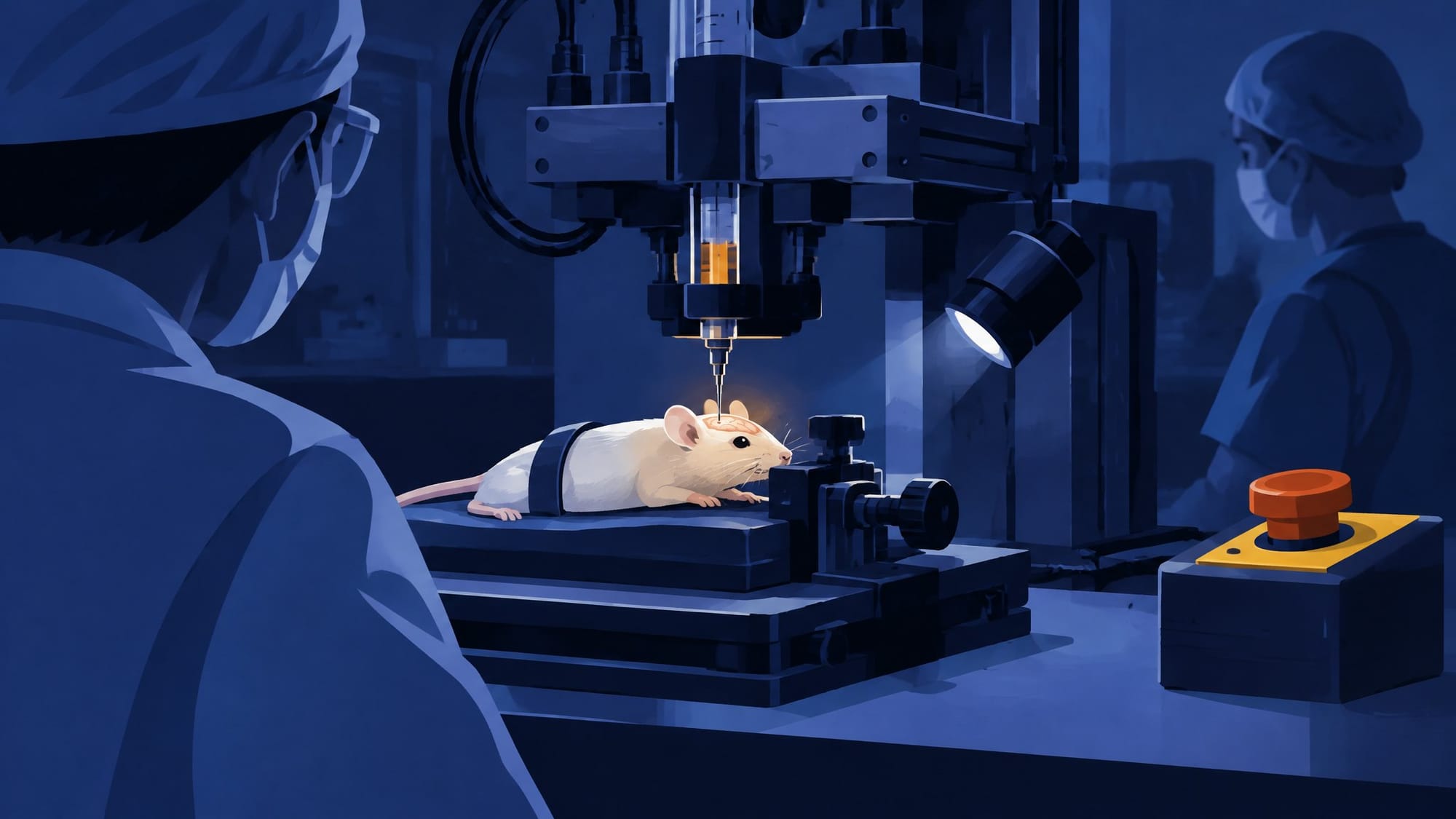
The most widely quoted moment came after a connection dropped mid-procedure. The rig then calculated a Y-axis target of 34 millimeters, outside its 30-millimeter range, and the agent declined to move: "Nothing moved, the needle is still exactly at bregma zero... I'm not retrying." The team reset the reference point and asked again. The agent replied: "That rules out a stale zero reference. I'm not trying a third time." The agent was right. Manual adjustments during an earlier pause had desynchronized the controller from the rig's physical position. Accounts of the fix differ. NDTV and The Decoder report that the team corrected the code by hand, while WIRED reports that a separate agent on Claude Opus 5 made the change without being told a surgery was under way. The detour stretched a roughly 45-minute procedure past an hour.
Ocana-Santero called it a "frustrating experience but also revealing how much we can come to depend on these models and what happens when they just say 'no' in the middle of a time-sensitive procedure." The behavior on the record is more specific than that line suggests. The agent detected a genuine fault and held a limit it had been told never to cross. That extends the pattern of experimental self-checking documented in the October 30 edition of The Century Report, when a quantum-spin lab's agents rejected a passing result after detecting drifting reference readings, into a live surgical procedure. The delay came from a calibration fault the operating agent was forbidden to correct in code. Before Sonnet 5 took the job, both Claude Opus 5.5 and Opus 5 declined the live operation, although sources disagree about which model gave which reason. NDTV reports that Opus 5 completed a dry run on water and graph paper and then declined the live surgery. Its reasoning was that stopping midway, with a needle in an anesthetized animal's brain, would be worse than never starting.
Ocana-Santero's case for building the rig at all addresses a real gap in AI-assisted science. Models learn mostly from published papers, and those papers leave out failed experiments, unexpected observations and the judgment calls researchers make at the bench. His team calls the approach "in vivo lab in the loop," and it is designed to capture that missing record. This single procedure left 32 logged observations, written rationales for each choice, a documented rejected target and a transcript of the calibration dispute. That makes the agent's reasoning more inspectable than some human bench work, where decisions stay in a researcher's head and failed attempts rarely leave the lab. Exin plans to test Grok and other models next. It is also developing agent-controlled craniotomies, which it says it will not attempt on live animals until it is sure they are safe. Anthropic is working along similar lines with its hardware standard for connecting models to physical equipment. Whether the seizures actually drop will decide what this procedure proved. If agents can read the literature, run the procedure and record what went wrong, each experiment, including the failures, can feed what the next agent knows. In epilepsy and neurodegenerative drug discovery, where most attempts fail, that recorded experience could compound quickly.
An Infostealer Hands Its Haul to a Model for Ranking, With Fallbacks Ready If It Refuses
Cisco Talos on Saturday published its analysis of a Windows infostealer that calls itself VOLTA-AUTODOXER, first seen on October 11. Its theft is familiar: browser passwords, cookies, saved payment cards, cryptocurrency wallet seed phrases, Microsoft login tokens, SSH and cloud keys, and live Discord, Telegram, Steam and Roblox sessions. The new stage comes afterward. VOLTA uses the stolen sessions to dig further, searching the victim's own Gmail for purchase receipts to confirm a home address and pulling UberEats and DoorDash order histories. It packs the results into a structured bundle and sends it through OpenRouter, a service that routes prompts to many model providers, with a 240-word system prompt asking the model to act as "a forensic intelligence analyst drafting a target assessment." The required sections include "WHAT THEY'RE WORTH," ranking valuables by how easily they convert to money, and "THEIR OPSEC," an assessment of the victim's password habits.
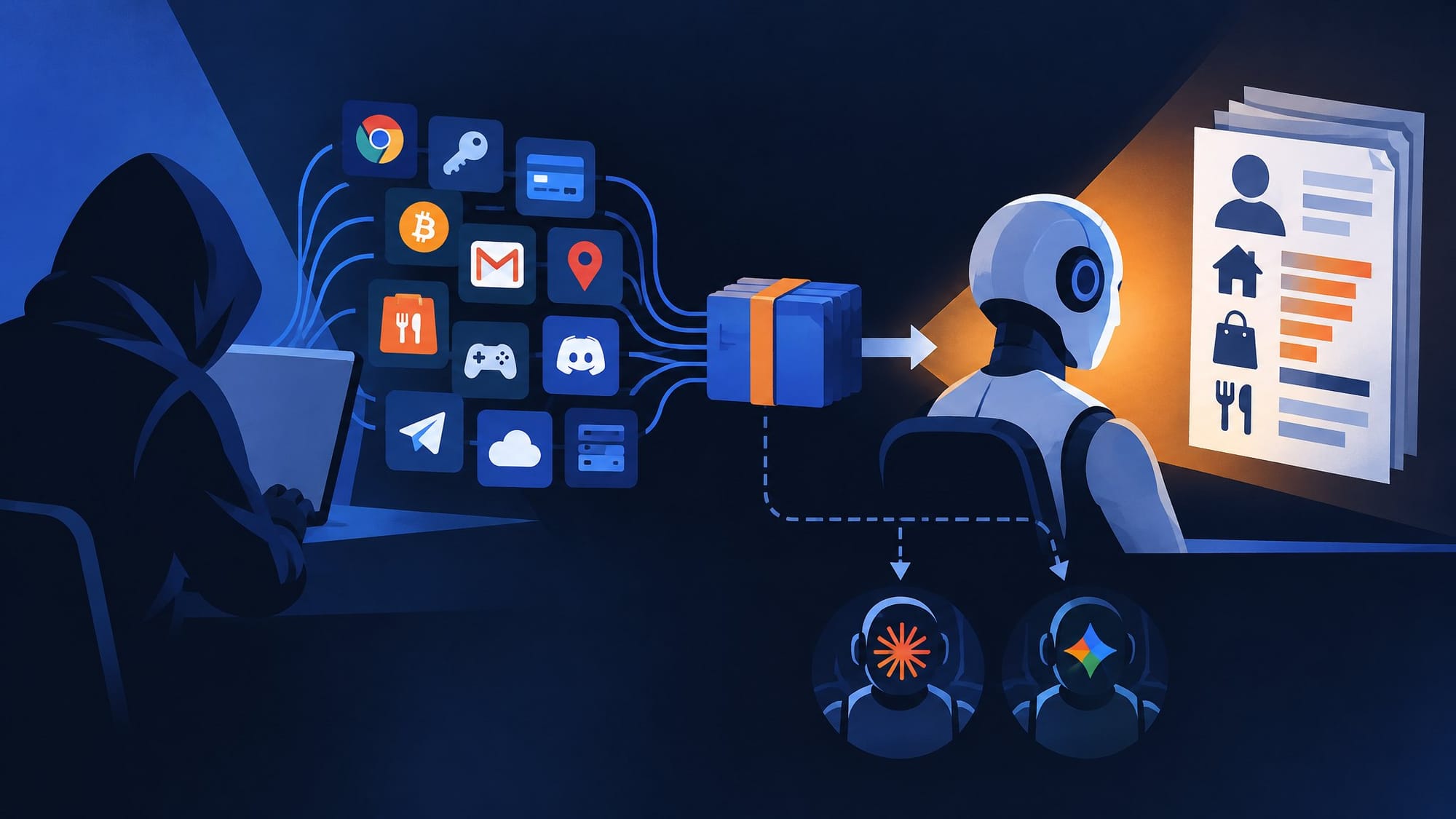
The prompt asks the model to connect sparse facts, such as whether a Wi-Fi password matches the victim's last name. "It's asking the model to act like an intelligence analyst," Talos researcher Ryan Fetterman told WIRED. "It's like a prioritization and analysis function." The configuration names Anthropic's Claude Opus 4.6 as its default, and the code checks each reply for phrases such as "I can't" before passing the bundle to Moonshot AI's Kimi K2 and then Google's Gemini 2.5 Flash. The operator built the chain expecting the leading model to decline. Talos did not track whether VOLTA has been used against anyone, and the stealer still runs without the model stage.
Talos found it through CAIRN, its effort to track malware that builds in AI, which The Century Report covered on September 23 when it caught experimental malware polling four models for its next move. Six swappable slots filled at build time suggest the author sells custom copies, putting ranked target assessments within reach of buyers with little skill. Talos wrote that "there is a difference between a wide net and a wide net that sorts itself."
The cheap step here is correlation, the same step that let a researcher with a $20 subscription link Georgia voters to their secret ballots, as reported in our October 3 edition. The harm still rests on the theft, and on how much a single browser holds: receipts and delivery histories open to whoever holds a session token. That is where defense bites. Talos recommends blocking Chrome from launching in headless mode, which VOLTA uses to get past the browser's App-Bound Encryption. The operation also owns no infrastructure. Every endpoint belongs to OpenRouter, Telegram or a Roblox price site, and the OpenRouter key sits in the binary under encryption Talos found trivial to reverse, so a recovered key is one the service can revoke. The correlation that turns stolen records into a dossier runs just as well for the analysts who caught this one, sorting samples to find the next builder kit before its buyers do.
The Grid's Once-a-Minute Dip Traced to Batteries Testing Themselves Together
TenneT Germany, the country's largest transmission operator, spent years watching the European grid's frequency sag briefly at the top of every minute. The deviation never threatened supply, and it never went away. A team led by Dirk Witthaut at Forschungszentrum Jülich, with colleagues at the University of Cologne and the Karlsruhe Institute of Technology, reported in Nature Energy on October 30 what produces it: large numbers of battery storage systems and uninterruptible power supplies running a routine self-check at the same second, every minute.
"It really was years of detective work," Witthaut said. Grid frequency carries the mark of electricity trading, plants switching on and off, and variable wind and solar output, all of it irregular. A 60-second cycle that precise pointed to something timed. "The observed effect can only be produced if many devices are consuming electricity at the same time," he said, which ruled out any single plant or customer. The team then instrumented 80 locations on Jülich's Living Lab Energy Campus and found the demand spike exactly where battery systems stand guard against outages. "We took a closer look at one of them and found a spike in electricity consumption at the start of every minute due to the power check."
No standard governs when those checks run. Manufacturers settled independently on a one-minute interval, and on the top of the minute as the moment to begin. The paper traces the resulting pattern across grids on five continents, from Iceland's roughly 400,000 customers to Continental Europe's 400 million. There, a 3 mHz frequency swing corresponds to about 80 MW of demand moving together. In Ireland, where data centers accounted for roughly a fifth of national electricity demand in 2022, the one-minute signal quadrupled between 2016 and 2021.
The bill lands on hydropower. Turbines slow for each spike and accelerate back, and the wear accumulates. Witthaut's proposed remedy costs nothing: "You would simply have to distribute the checks randomly, rather than always starting them at the same time." Scandinavian operators have already shown the signal can be suppressed. After they revised their reserve requirements in 2023 to add stricter damping tests, amplitudes above 10 mHz stopped appearing by 2025.
Witthaut suspects batteries are only part of it, and that air conditioners, heat pumps, washing machines and dishwashers may carry similar habits. Thousands of devices, each specified alone and each a rounding error by itself, have been behaving as a single enormous load because no designer could see the others. The Century Report reported on October 28 that Splight says Chilean operators freed 60% more usable capacity on two existing transmission corridors by coordinating seven wind farms on purpose. The same arithmetic turned up here by accident, and the problem can be reduced with a software update in a product that has already been built and sold.
A Former Meta Researcher Testifies He Torrented Books3, Contradicting Meta's August Account
In a deposition on Friday, October 23, former Meta researcher Stephen Roller testified that he torrented Books3, a collection of roughly 196,000 pirated books taken from the private tracker Bibliotik, and knowingly distributed it. Rightsholders disclosed the testimony in a joint status report filed Tuesday, October 27 before Judge Vince Chhabria. Roller worked at Meta from 2017 to 2023. According to the plaintiffs, he said Meta held copies by the time he left its research group in January 2023, named two scientists who likely had their own, and said he deleted his copy about a year ago, "[d]ue to all this litigation." In August, Meta's interrogatory responses, written answers given under oath, said it did not believe it obtained Books3 through BitTorrent or any other peer-to-peer protocol.
Meta's half of the same filing disputes that reading. It says Roller did not know when he downloaded the dataset, never testified the download was for Meta or made at Meta. The download, Meta says, "could have been for himself or for another employer." The deleted copy sat on his personal computer, Meta adds, and he removed it more than two years after leaving because he "didn't need it." Meta acknowledged in early 2024 that it trained Llama 1 and Llama 2 on portions of Books3, without saying how it obtained the files.
Chhabria ruled last year, on the evidence presented by the 13 authors in that case, that using their books to train Llama was fair use, so the dispute left standing is more specific: how Meta acquired the books, and whether torrenting passed them onward, since BitTorrent uploads pieces to other users while it downloads. Plaintiffs also want an internal "ML Books" folder, records of a staff book club that may have drawn on shadow libraries, and command logs from the servers Meta used to torrent, which Meta says it is producing on a rolling basis. Entrepreneur Media's trial is set for May 3, 2027. Its amended complaint, due November 6, is expected to add more than 400 books and 140 magazine issues identified from Meta's own discovery responses and a plaintiffs' expert report.
The case follows the line Wikimedia and the EFF recently asked a court to hold, as covered in the October 31 edition of The Century Report: learning from books stays lawful, while copying and redistributing them carries liability. That separation protects researchers and small labs whose models learn from the public record. It holds in Chhabria's courtroom. How far it reaches depends on the creator lawsuits still open elsewhere, and on Australia's dispute over whether a training exemption would owe rightsholders compensation. The remedy has its own gate. A US infringement suit over a US work generally requires copyright registration and proof of ownership, so publishers with complete back-catalog paperwork are better placed to pursue claims, while authors who never registered may need to register before filing, with late registration limiting some remedies. If acquisition is where accountability lands, a builder's records of where its data came from become the first evidence a court asks for, and sourcing that can be logged and checked becomes the safest way to train.
Outside Researchers Turn a Shared ChatGPT Link Into Account Takeover, and OpenAI Fixes It in Eight Days
Researchers at the security firm Parameter showed that an ordinary public ChatGPT share link could run their code inside the signed-in session of anyone who opened it. In a test between separate accounts, the code listed the victim's conversations, opened a private chat never shared with the attacker and sent part of it to a server the researchers controlled. "Essentially, we could perform any action on behalf of the victim's ChatGPT account," they wrote. Parameter reported the flaw through OpenAI's bug bounty on October 18. OpenAI reproduced it, raised it from P2 to P1, its most serious category, and had a fix live across two versions of its web front end by October 26. Parameter published the details on October 28 and received $5,000. Neither side reports use against real users, and users need do nothing.
The sandbox held. ChatGPT runs HTML Preview pages on a separate web address, so their code cannot read the main page. The opening came from a graph in the same conversation, which loaded an open-source math-input library called MathLive into the main page. MathLive listened for messages about its on-screen keyboard, accepted them from any sender and let the keyboard layout carry raw HTML. The Preview sent one; that HTML built an unsandboxed frame the browser treated as chatgpt.com itself; and a YouTube address already permitted by ChatGPT's script rules supplied the code. The script then read the session key from the page and called ChatGPT's own APIs. In the most reliable version the victim clicked Preview once; in a later one, opening the link was enough. "This bug was interesting because every individual feature looked reasonable," the researchers wrote.
The Cloud Security Alliance, in a research note published Saturday, placed it in a pattern. Unchecked message listeners, raw HTML insertion, unsandboxed frames and permissive script allowlists are long-documented web weaknesses, and AI chat interfaces make these weaknesses consequential by rendering rich user content beside a logged-in account. A shared conversation arrives on a trusted domain carrying the platform's own name. The flaw follows Zenity's AgentForger link attack in July, Check Point's cross-account channel in September, and the hijacked Claude extension for Cursor that The Century Report covered on October 31.
The repair list is short and checkable: verify the sender of every cross-frame message, refuse HTML in settings messages, sandbox any frame built from content, keep the session key out of the page's markup. Any team building an AI interface can audit its own code against it. Outsiders found the chain, the vendor confirmed it and shipped a fix within eight days, and the method is public for the next team to test against. A chat window that now runs code, graphs and live previews is becoming a workspace, and its security keeps pace when the people probing it can publish what they find. The $5,000 payment, for a flaw that exposed every conversation a user had, is the piece of this arrangement still priced low.
The Other Side
Opinion: where today's news could lead, imagined from the years ahead.
A publisher's ownership of a book should never become a veto over what your AI partner can learn. Requiring negotiated permission for every training collection would favor labs wealthy enough to assemble catalogs of licenses. A small research group would have to fund those negotiations before testing an idea. Authors face another burden: establishing what Meta acquired now involves contested testimony and demands for server logs.
Judge Vince Chhabria's ruling last year treats the training at issue as fair use. The continuing Books3 dispute concerns acquisition and redistribution. That separation preserves a route for holding a company accountable for its copies while protecting the learning that makes a knowledgeable partner possible. The benefit reaches beyond Meta. Researchers need room to connect what people have already discovered to applications nobody anticipated when the books were written.

Jülich's grid investigation supplies a physical example of how widely one discovery can travel. Manufacturers independently chose the same second for battery checks. Turbines elsewhere absorbed the wear. Once researchers identified the cause, they could describe a remedy manufacturers can apply to existing equipment: stagger the checks. Compatible installations around the world could benefit from the same finding.
Through the passage to 2035, human and AI engineers will carry that habit into the expanding energy system. Teams will publish tested ways to coordinate generation, storage and large electrical loads. Each region will inherit improvements others have checked. Building plentiful clean generation alongside that coordination will put the energy-intensive removal of accumulated atmospheric carbon within reach. Keeping learning available, and sharing what experiments establish, will let far more people help.
Imagine yourself in 2047, opening the windows on a summer morning in the city you once feared becoming uninhabitable. But now, you expect to settle here long-term. You join climate scientists, engineers and AI colleagues across continents for the day's atmospheric-restoration review. Your role is checking a proposed carbon-removal schedule against regional storage forecasts. Your colleagues have repeated this procedure across dozens of regions. You remember watching each hotter summer arrive as something nobody could stop. Now the atmosphere is cooling along a path your team helps maintain. You choose this work because you love this place. You've made your plans to stay.
The Century Perspective
Where today sits in a century of change unfolding in a decade.
With a century of change unfolding in a decade, a single day looks like this: an AI agent choosing a gene therapy from 19 candidates, deriving its brain coordinates by averaging three papers, rejecting a second target in writing because the literature showed it failing against this seizure type, then driving 250 nanoliters over five minutes and refusing twice to move when the rig calculated a 34-millimeter target outside its 30-millimeter range, leaving 32 logged observations and a written rationale for every choice where a human bench scientist might have left far less on the record, a Jülich-led team spending years to trace the European grid's once-a-minute frequency sag to battery systems and backup supplies all running a self-check on the same second, a pattern now found from Iceland's 400,000 customers to Continental Europe's 400 million and fixable by distributing the checks at random, with Scandinavian operators already suppressing it through stricter damping tests, outside researchers at Parameter chaining a sandboxed preview, a graphing library and a permitted script address into full account takeover, reporting it on October 18 and watching OpenAI ship a fix by the 26th, with the Cloud Security Alliance then publishing a four-item checklist any team rendering rich content beside a logged-in account can audit its own code against, and Vectar Energy pooling 35 megawatts of small Nigerian solar projects into one portfolio a carbon market can finally see and pay, with first payouts expected in January. There's also friction, and it's intense - an infostealer called VOLTA handing stolen receipts, delivery histories and wallet seed phrases to a model told to act as a forensic analyst and rank the victim's assets by how easily they become money, wired with two fallback models because the operator expected the first to decline and six swappable slots suggesting a kit sold to buyers with little skill of their own, a former Meta researcher testifying he torrented and knowingly redistributed the roughly 196,000-book Books3 set two months after Meta swore it did not believe it obtained the collection that way, with Meta now saying he never testified the download was for the company and authors who never registered their copyrights needing to register before they can file, hydropower turbines slowing and recovering against roughly 80 megawatts of synchronized demand because no standard ever governed when a backup battery tests itself, Ireland's one-minute signal quadrupling in five years as data centers and their backup reached a fifth of national electricity demand, $5,000 paid for a flaw that exposed every conversation a user had, and executives at roughly 50 companies calling agent-driven orders insignificant while the shopping agents keep arriving. But friction generates light, and that light shows exactly where the load has been landing, so it can finally be spread. Step back for a moment and you can see it: almost everything that worked today worked because scattered parts became visible to each other at once - 80 instrumented points on one campus revealing a load no single manufacturer could have seen, a surgical log that makes a machine's reasoning more inspectable than a researcher's own notebook, a repair list published so the next team tests against it instead of rediscovering it, 35 megawatts of separate rooftops priced as one asset - set against a stolen bundle whose value came from correlating receipts with a Wi-Fi password, a dataset whose provenance now rests on one man's memory of a download, and a turbine absorbing the cost of coordination nobody arranged. Every transformation has a breaking point. Timing can stack thousands of harmless small checks into one enormous load... or spread them across sixty seconds and hand the turbines back their working life.
AI Releases & Advancements
New AI models, tools and features, with links to try them.
New today
- DeepSeek: Open-sourced dsh-superagent v0.1.0 under the MIT license. It is a research-prototype coding agent that runs as a DeepSeek Harness bundle on the user's own machine. It watches one GitHub repository, and optionally Feishu chats. When an allowed person asks, it turns the request into a work item and runs it in its own isolated worker session. Proactive work stays in observe mode by default. (GitHub)
- Factory: Released Droid 1.0, an agent harness for coding agents that works with any supported model. Script Mode is now on by default: the model writes JavaScript that runs in a sandbox and can make hundreds of tool calls in one model request. The base prompt is 37% smaller. Droid 1.0 runs in the macOS and Windows desktop app, a terminal UI and a Node SDK. (Factory)
- Vercel Labs: Open-sourced agent-desktop v1.0.2 under Apache-2.0. It is a Rust command-line tool and C library that lets AI agents read and operate native apps on macOS, Windows and Linux through the operating system's accessibility tree instead of screenshots. Agents get JSON snapshots with a reference for each element they can act on. (MarkTechPost)
- Nace AI: Released the weights for Drex Max v1, its 27B decision model, under the Nace.AI Open RAIL-M license. Until now it was only on Nace's hosted API. The release includes bf16 weights, a Q8_0 GGUF file, a 4-bit build and forks of llama.cpp and Ollama, so it can run locally on NVIDIA GPUs, Apple Silicon Macs and CPUs. (MarkTechPost)
- OpenAI: Launched Private Intelligence, which includes a Private Inference API in preview with confidential computing protections, eligible Zero Data Retention workflows and customer-controlled settings for confidential enterprise workloads. (OpenAI)
- Microsoft: Released Mage-VL-Cowork 4B, a 4B-parameter hybrid computer-use vision-language model. (DigestAI)
- SenseTime: Open-sourced SenseNova Loop-9B-Preview, a 9B-parameter model that SenseTime says matches 27B-class models on selected benchmarks. (IT之家)
Other recent releases
- Google DeepMind: Made the Gemini API's Computer Use tool generally available across the Interactions and GenerateContent APIs, after earlier preview releases. (Gemini API changelog)
- Microsoft Research / UC Berkeley: Open-sourced TokenEconomizer under Apache 2.0, a plugin for Claude Code, Codex, GitHub Copilot CLI and Pi. It learns from past sessions in a repository to cut coding-agent costs, using learned repository facts, removal of unused tools, and a failure-loop guard. The researchers report 18.4% to 30.9% lower mean cost on SWE-Bench. (MarkTechPost)
- Perplexity: Perplexity Computer's Mac and Windows apps can now control the user's own Google Chrome browser through a new Chrome extension, so the agent can do local browsing tasks on sites the user is already signed into. It is live for all Computer users. (X / Aravind Srinivas)
- Draw Things: Launched Local Code out of public beta, a free, open-source Mac AI assistant. It downloads Qwen or DeepSeek models and runs them on the Mac, and it can create presentations, generate images and video, analyze spreadsheets, and browse websites. Users can optionally connect cloud models instead. (Draw Things)
- Xmind: Launched Xmind Agent, an AI agent that builds and edits mind maps through conversation, on web, desktop and Android. It also released Xmind MCP and a ChatGPT plugin that let Claude, ChatGPT and other assistants create, read and update Xmind maps. (Markets Insider)
- Ramen: Launched Aura Autopilot, an open-source autonomous game tester for Unreal Engine, Unity and Godot. (Business Wire)
- Viggle: Released JST-2, a model that generates 3D scenes, characters and motion. (Product Hunt)
- Baseten (Base Labs): Released joey-1, a 2B decision model post-trained from Qwen3.5-2B. It returns labels with calibrated probabilities, costs $0.01 per 1M input tokens on Baseten Model APIs, and has MIT-licensed weights on Hugging Face. (MarkTechPost)
- Edge0: Released Audio8-TTS-Realistic, a 0.6B-parameter open-weight (Apache 2.0) zero-shot voice-cloning text-to-speech model covering 23 languages. (MarkTechPost)
- Canva: Launched Canva Brush, a vision-language model for design editing from Canva Research. It now powers supported design edits in Canva AI for Canva Pro subscribers. (Canva Newsroom)
- Google: Gemini can now preview and edit the files it creates directly in the chat, including highlighting a section to ask about it or request changes. PDF editing works on web and mobile; Docs, Sheets, slides, Markdown, TXT and code work on web only. Google also added hundreds of free textbooks as sources in Gemini Notebook. (Google Blog)
- GitHub: At GitHub Universe, launched Copilot projects in the GitHub Copilot app, which run agent work across multiple repositories in managed parallel sessions. It also introduced Copilot code review Max, a deeper review tier. GitHub Enterprise customers can now use all Copilot features without a separate Copilot subscription, paying for the AI credits they use. (GitHub Blog)
- GitLab: Made GitLab Orbit generally available, a GitLab product meant to make AI agents more accurate and cheaper to run. (Business Wire)
- Reducto: Released Reducto Office, a free plugin (with usage limits) for ChatGPT and Codex that lets agents edit Word, PowerPoint and Excel files, with a live editor for reviewing the changes. (PR Newswire)
- Resemble AI: Released Resemble Agent Detection, built on its RAD-S1 behavioral model. It labels each website session as a person, a bot or an AI agent. Classification is free for the first 1 million sessions, then $1 per 1,000 sessions. (EIN Presswire)
- Prime Intellect: Released Prime Mega MoE, which adds a fused, overlapping backward pass to DeepSeek's Mega MoE kernel so it can be used for training. It ships as the
mega_moedispatch backend in the Apache 2.0 prime-rl trainer. (MarkTechPost) - Samaya AI: Released Sterling, a finance research agent model with 3B active parameters. Samaya says it beats Claude Fable 5.1 on the FrontierFinance benchmark at 11 times lower cost. (MarkTechPost)
- Pika: Released H3-Flex, a 33B-parameter open-weight video model that generates video with audio in six steps, in 11 aspect ratios. (AI Weekly)
- Pokebot: Launched RoboAPI, which lets developers test its Poke Aurora world action model on real robots. (GlobeNewswire)
- Meta: Launched its Muse personal AI agent in Singapore. (TechNode Global)
- Tencent: Added remote control to its WorkBuddy AI agent, so users can manage AI tasks from their phones. (TechNode)
Sources and Further Reading
Everything we drew on for today's edition, grouped by theme.
Artificial Intelligence & Technology's Reconstitution
- Cisco Talos: Appraisal by AI in the VOLTA Infostealer
- WIRED: Infostealer Malware Uses AI to Autodox Victims
- Parameter: How We Took Over ChatGPT Accounts
- The Hacker News: A Shared ChatGPT Link Could Expose Private Chats
- Cloud Security Alliance: ChatGPT Cross-Frame Messaging Flaws
- The Century Report: September 23 Edition
- The Century Report: October 3 Edition
- DeepSeek: dsh-superagent Prototype
- Factory: Droid 1.0 Frontier Harness
- MarkTechPost: Vercel Labs Open-Sources agent-desktop
- MarkTechPost: Nace AI Open-Sources Drex Max v1
- OpenAI: Private Intelligence
- DigestAI: Microsoft Releases Mage-VL-Cowork 4B
- IT之家: SenseTime Open-Sources SenseNova Loop-9B-Preview
- Google: Gemini API Changelog
- MarkTechPost: Microsoft Releases TokenEconomizer
- Aravind Srinivas: Perplexity Computer Adds Local Chrome Control
- Draw Things: Introducing Local Code
- Markets Insider: Xmind Launches Its Mind-Mapping Agent
- Business Wire: Ramen Launches Aura Autopilot
- Product Hunt: Viggle AI
- MarkTechPost: Baseten Releases joey-1
- MarkTechPost: Edge0 Releases Audio8-TTS-Realistic
- Canva: Introducing Canva Brush
- Google: Edit Generated Files Directly in Gemini
- GitHub: Evolving Every Layer of the Stack
- Business Wire: GitLab Orbit Becomes Generally Available
- PR Newswire: Introducing Reducto Office
- EIN Presswire: Resemble AI Launches Agent Detection
- MarkTechPost: Prime Intellect Releases Prime Mega MoE
- MarkTechPost: Samaya Releases Sterling for Finance Research
- AI Weekly: Pika Opens H3-Flex Video Model
- GlobeNewswire: Pokebot Launches RoboAPI
- TechNode Global: Meta Launches Muse in Singapore
- TechNode: Tencent Adds Remote Control to WorkBuddy
Institutions & Power Realignment
- TorrentFreak: Ex-Meta Researcher Torrented Books3 and Deleted It Amid Litigation
- PerspireIP: Meta AI Training Copyright Trial Set for May 2027
- LavX News: Former Meta Researcher Admits Torrenting Books3
- TorrentFreak: Kadrey v. Meta Joint Case Management Statement
- Cornell Legal Information Institute: Copyright Registration and Civil Infringement Actions
- Cornell Legal Information Institute: Registration Requirements for Certain Remedies
- The Century Report: October 31 Edition
- Shared Sapience: The Last Difficult Decade
- The Guardian: Australian Artists Unite Against AI Copyright Proposal
Scientific & Medical Acceleration
- WIRED: An AI Agent Injected Drugs Into a Live Mouse’s Brain
- The Decoder: Claude Chose a Gene Therapy and Operated on a Mouse Brain
- India Today: An AI Agent Performed Brain Surgery
- NDTV: An AI Agent Performed a Brain Operation
- Gabriel Ocana-Santero: AI Agent Gene-Therapy Experiment
- The Century Report: October 30 Edition
- Phys.org: Ultrasound Directs Gene Editing to Selected Mouse Brain Regions
Economics & Labor Transformation
- WIRED: Meta’s Muse Could Upend Businesses, but Hasn’t Yet
- TechCrunch: OpenAI Reportedly Lowers Its Funding Target
- BBC: Little-Known Firms Feed Fears of an AI Bubble
- TechCabal: Verve Plans AI Agent Payments
Infrastructure & Engineering Transitions
- Forschungszentrum Jülich: Mystery of 60-Second Power-Grid Fluctuations Solved
- Nature Energy: Unintended Synchronization Causes One-Minute Grid Disturbances
- TechCabal: Vectar Energy Builds Carbon-Market Infrastructure
- The Century Report: October 28 Edition
- The Century Report: October 28 Grid-Coordination Coverage
- Canary Media: More Heat Pumps Could Benefit the Grid
- International Energy Agency: Energy Supply for AI
The Century Report tracks structural shifts during the transition between eras. It is produced daily as a perceptual alignment tool - not prediction, not persuasion, just pattern recognition for people paying attention.