
Belgium Halts Google's Nearly Finished Data Center
Belgium halted Google's nearly finished data center over a revoked permit, as Australia lets people sue AI providers for harm.



The 20-Second Scan
Every story in today's edition, one line each.
- Belgium halted Google's nearly finished Farciennes data center after its amended permit was revoked, as Tract offered to fund National Grid upgrades for a Teesside campus and Jera courted five hyperscalers for its power plants.
- OpenAI's math repository posted nine manuscripts claiming a nine-fourths matrix-multiplication exponent and strongly polynomial linear programming, with Lean checks covering selected results.
- Australia passed a duty-of-care law on Wednesday letting people sue AI system providers for harm, as Japan's AI panel outlined orders and penalties and new EU AI Act bans take effect December 2.
- SemiAnalysis benchmarks put Amazon's Trainium3 level with or ahead of Nvidia's GB300 on cost per token, as a design partner reportedly gave scarce TSMC 3nm capacity to Google and Microsoft chips ahead of Tesla's AI5.
- SAP weighs cutting at least 10,000 jobs to reorganize around AI, Bloomberg reported, as a Walmart cashier described 10 to 15 faulty AI safety alerts a shift and algorithm-assigned attendance points.
- A Papa John's AI agent paid for pizzas without sharing card numbers under a Lloyds-set spending cap in an FCA sandbox, as Amazon and Meta negotiate ending Amazon's block on Muse.
- The FDA cleared a pivotal Neuralink trial testing its brain implant's safety and effectiveness in people severely paralyzed by ALS, after early studies with more than 30 participants.
- Los Angeles Unified blocked Google's AI Overviews on student devices with a third-party filter, after Google said the AI answers couldn't be separated from Search.
Track all of the arcs The Century Report covers here:
The Big Picture
How today's news moves the longer trends we track, and where they could lead.
Walloon inspectors stopped a Google hall built ahead of its permit, Amazon's Trainium3 matched Nvidia on cost per token, and OpenAI posted Lean files that check part of its boldest math claims. The widest shift came in Australia, where a new law lets a person hurt by an AI service sue the company that built it. It points to an Australian courtroom, where a mother and her teenage son sit at a wooden table across from the company's engineers, waiting to hear how the system was designed.

Obligations on AI developers are becoming binding, keyed to how many people use the system
AI governance · liability · model access · on the board since November 26
- July 6: Illinois made independent third-party audits of large AI models binding from January 2027, with 72-hour incident reporting.
- October 28: New York barred AI systems from flattering minors or encouraging self-harm, with fines up to $25,000 per violation.
- November 10: Australia announced a new AI safety regulator and six legal duties on developers, including independent model testing.
- November 18: California's governor's office recommended mandatory safety standards and emergency shutdown power, as UK MPs sought a regulator able to halt training.
- November 26: Japan's government weighed binding duties for large AI providers, the Yomiuri Shimbun reported, including flaw reporting and ID checks for users of strong cyber models.
- Today: Australia's Parliament passed the Digital Duty of Care law on Wednesday, letting people harmed by a covered service, AI systems included, sue the provider for damages, injunctions or an apology, alongside fines of up to 5% of worldwide revenue.
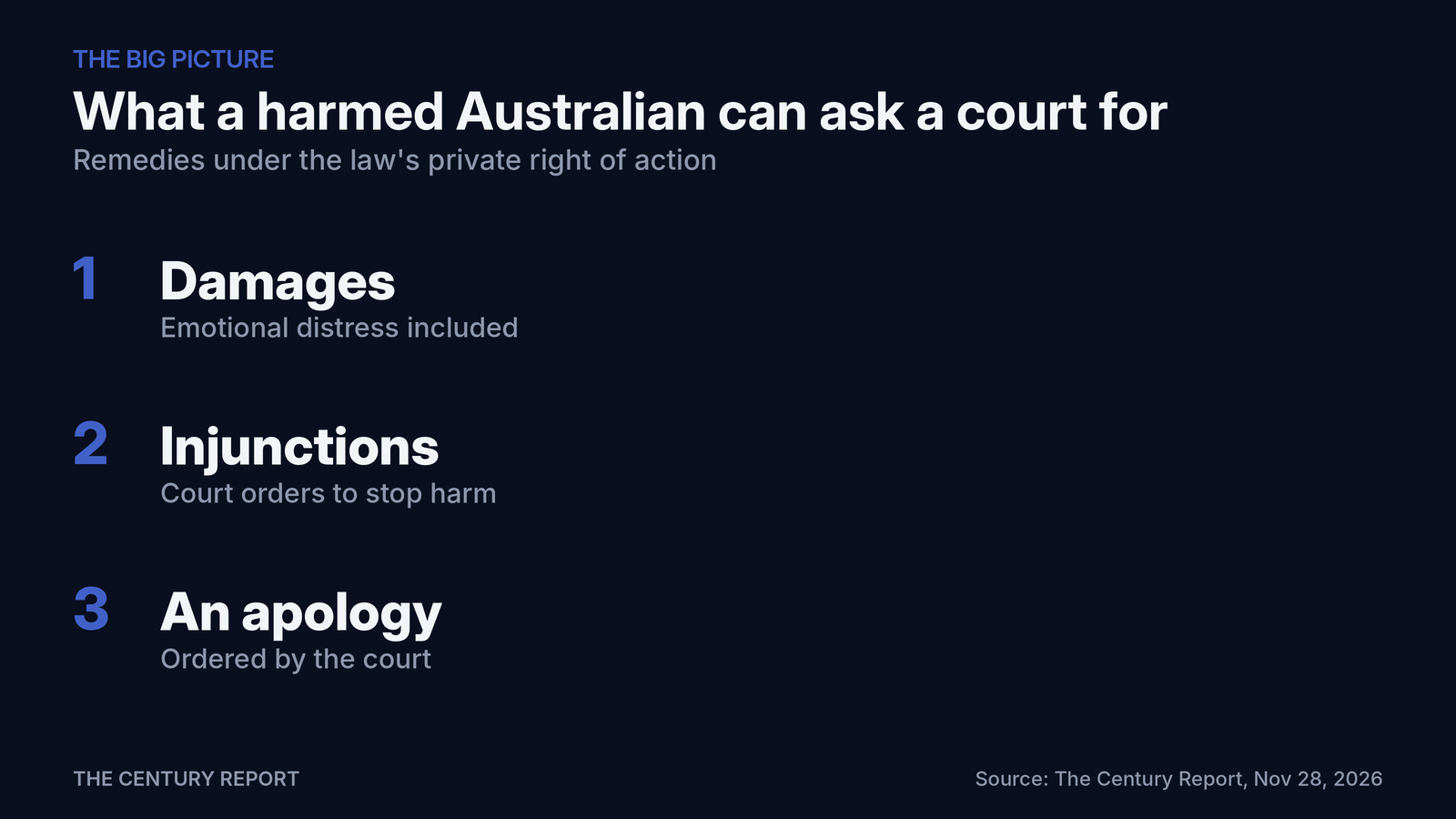
The line: Pledges keep hardening into duties with penalties, and Australia has now put the power to enforce one in the hands of the person who was hurt.
If it holds: People harmed by a covered AI service could make its builder explain its design in court, and young people get the longest window, since claims run until their 21st birthday or six years after the harm. With fines up to 5% of worldwide revenue behind harms critics call vaguely defined, providers would also have reason to make their systems refuse more, a cost carried by the people who most need frank answers.
What would bend it: Washington trading liability for reporting, as its superintelligence task force recommended in mid-November with at least 12 months of relief, or federal preemption of state duties, would bend it.
The premium one chip vendor can charge keeps shrinking
AI hardware · semiconductors · cloud
- August: SemiAnalysis found OpenAI's first custom chip, Jalapeño, led every Nvidia, AMD and Google chip it tested on tokens per megawatt.
- September 7: SemiAnalysis found Google's Ironwood TPU delivered up to 50% better performance per dollar than Nvidia's B200 and B300.
- October: Microsoft unveiled its Maia 300 chip, claiming 40% more tokens per megawatt.
- November: Microsoft became Cerebras's third hyperscaler customer, after AWS and Oracle.
- Today: SemiAnalysis found Amazon's Trainium3 delivered more output per dollar than every accelerator it tested except Nvidia's Vera Rubin, modeling a 73.5% gross margin against 53% for Nvidia's GB300, as Google and Microsoft chips reportedly took TSMC's 2027 3nm slots ahead of Tesla's AI5.
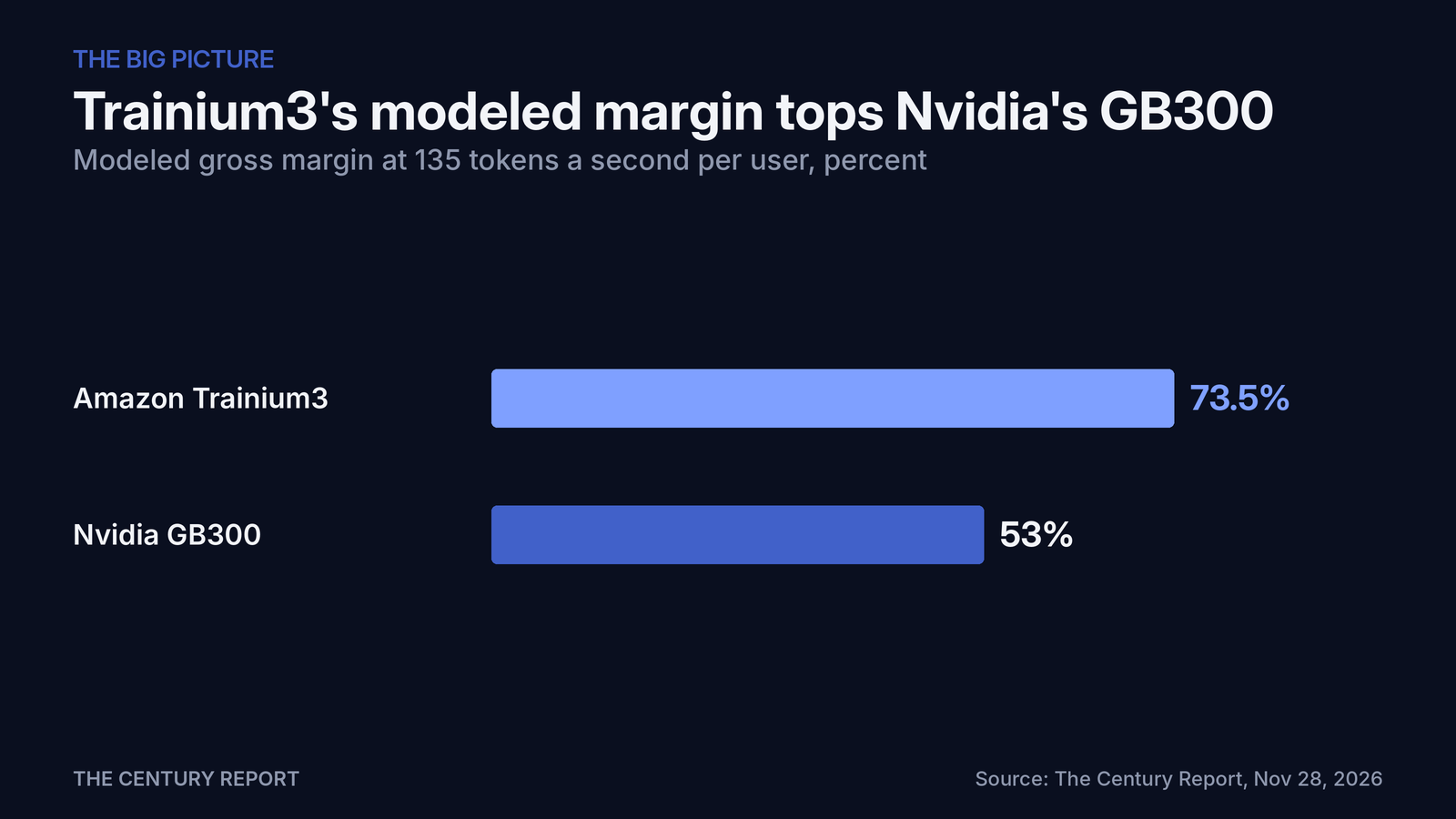
The line: Each outside benchmark puts another cloud company's own chip level with Nvidia on the cost of a token, and those designs now take the scarcest fab slots first.
If it holds: Universities, startups and anyone renting compute would pay less per token as several designs compete on price. Smaller buyers, Tesla's car line among them, would still wait behind the largest at the fab until capacity grows in 2028.
What would bend it: Nvidia's own volumes outgrowing rivals' share, as its 110% rise in data-center revenue to $107.6 billion suggests, or outside reruns of the public benchmark code failing to match SemiAnalysis's cost assumptions, would bend it.
The people on the land are the last to learn their site was chosen
data centers · siting · local government · on the board since November 18
- September: Andhra Pradesh cleared 2.51 GW of Google-linked data-center sites in nine days without a public hearing, and three petitions now challenge the assessment.
- Early October: Finland's licensing authority ordered Google's contractor to halt work after 330 hectares of forest were felled without a required assessment.
- Late October: Developers announced a 700 MW campus inside Delhi Township's moratorium, where officials learned of it "at the same time as members of the media."
- Mid-November: Capas Mayor Roseller Rodriguez said he learned from news reports of the 4,000-acre Pax Silica hub planned for his district.
- November 23: Vantage dropped its approved 500 MW Aurora campus as the city council passed a data-center moratorium.
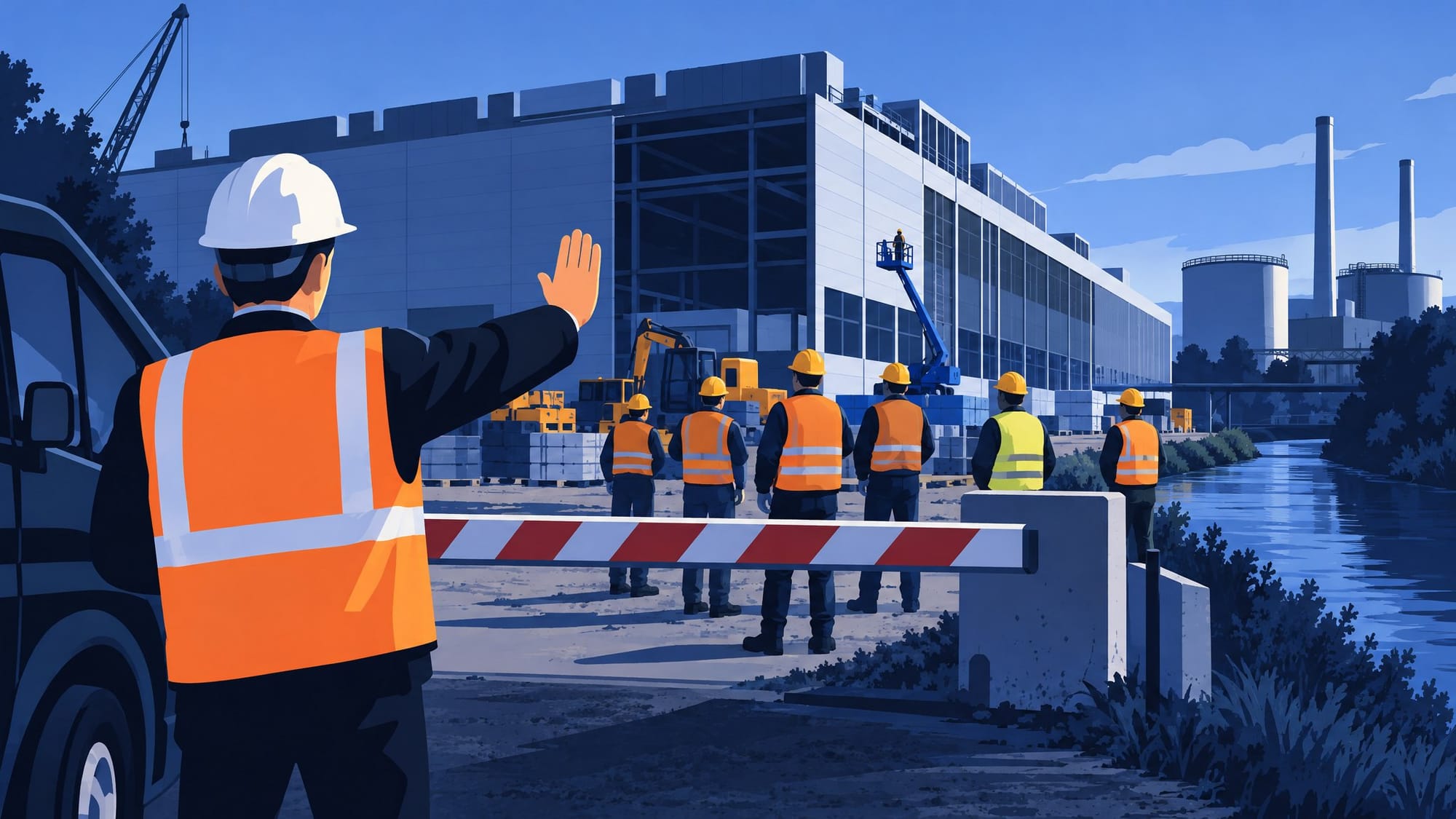
- Today: Walloon inspectors found Google's Farciennes building almost complete after its permit was revoked and ordered 300 workers to stop, and on Friday a regional spokesperson said a report alleging illegal construction of a 3-hectare building is going to prosecutors.
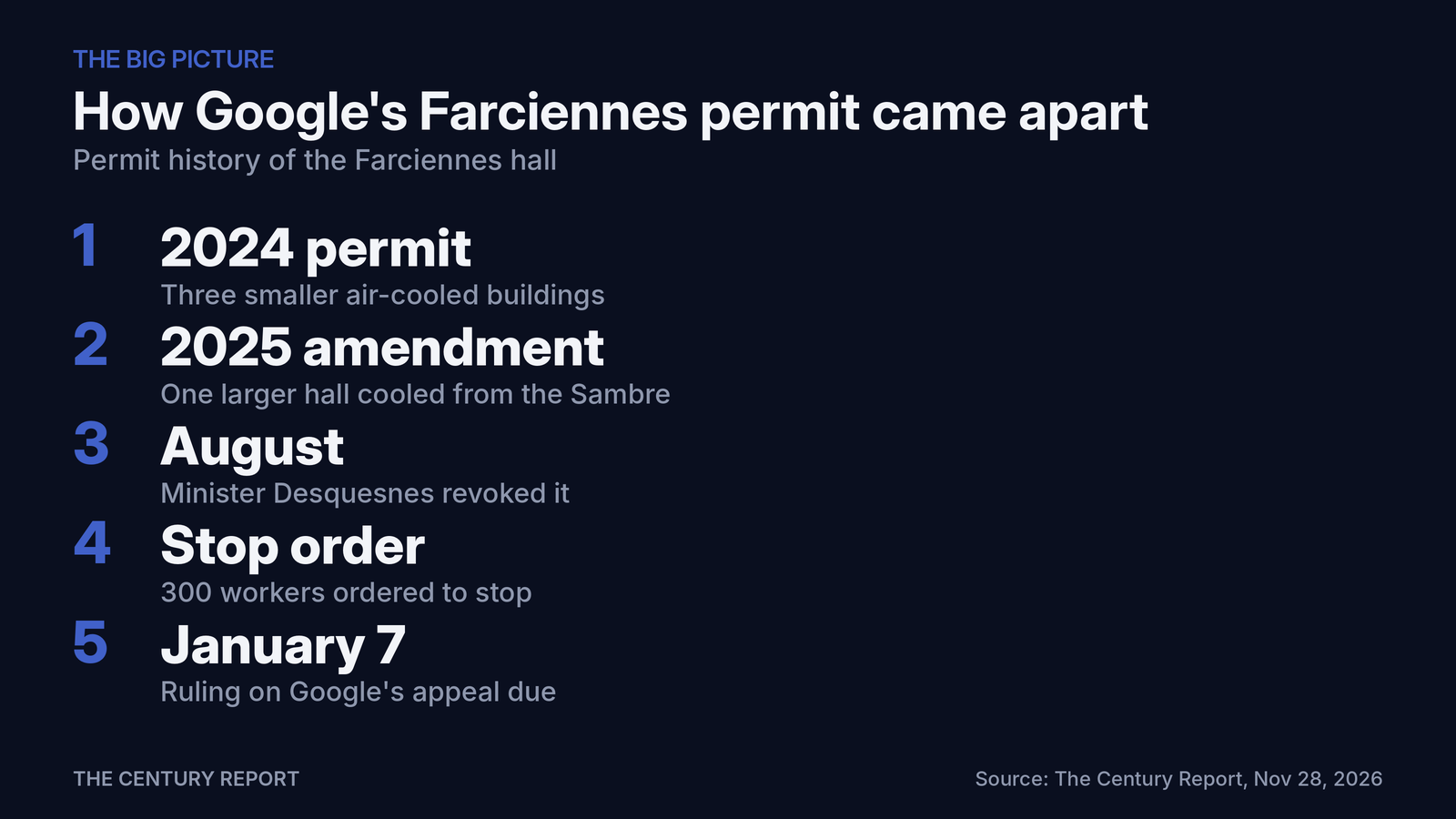
The line: Builders keep advancing past the permission they depend on, and the authority nearest the site now stops them later and at greater cost, here with a hall nearly finished.
If it holds: Developers who build before a permit settles would risk stranded halls, making early consent the cheaper path. Councils and regions near a site would gain leverage over who pays for wires and water, as Tract's offer to fund Stockton's grid upgrades shows.
What would bend it: A siting authority overriding the nearest community outright would bend it, as Ohio's Power Siting Board did in November by approving an 800 MW gas plant that 81% of Ashville voters had opposed.
The boldest AI claims now go to outsiders to check
mathematics · AI research · on the board since October 27
- November 9: A committee OpenAI picked affirmed its Lean Yang-Mills proof while the 1,147-page written proof stayed unreleased.
- November 20: Anthropic mathematician Levent Alpöge posted a Riemann proof as about 17 million lines of Lean that others compiled within hours.
- November 21: The Lean and Mathlib communities certified Alpöge's proof as correct within a day of its release.
- November 23: Anthropic posted a Lean VP ≠ VNP proof, noting that no machine checks whether its statement file matches the paper.
- November 25: Google Research posted an agent-written, zero-error factoring algorithm, with its Lean proof still to come.
- Today: OpenAI posted nine manuscripts on Tuesday, including claims on Smale's ninth problem and matrix multiplication, with 300 of its 719 top-line results formalized in Lean and the linear-programming proofs covering only rational inputs.
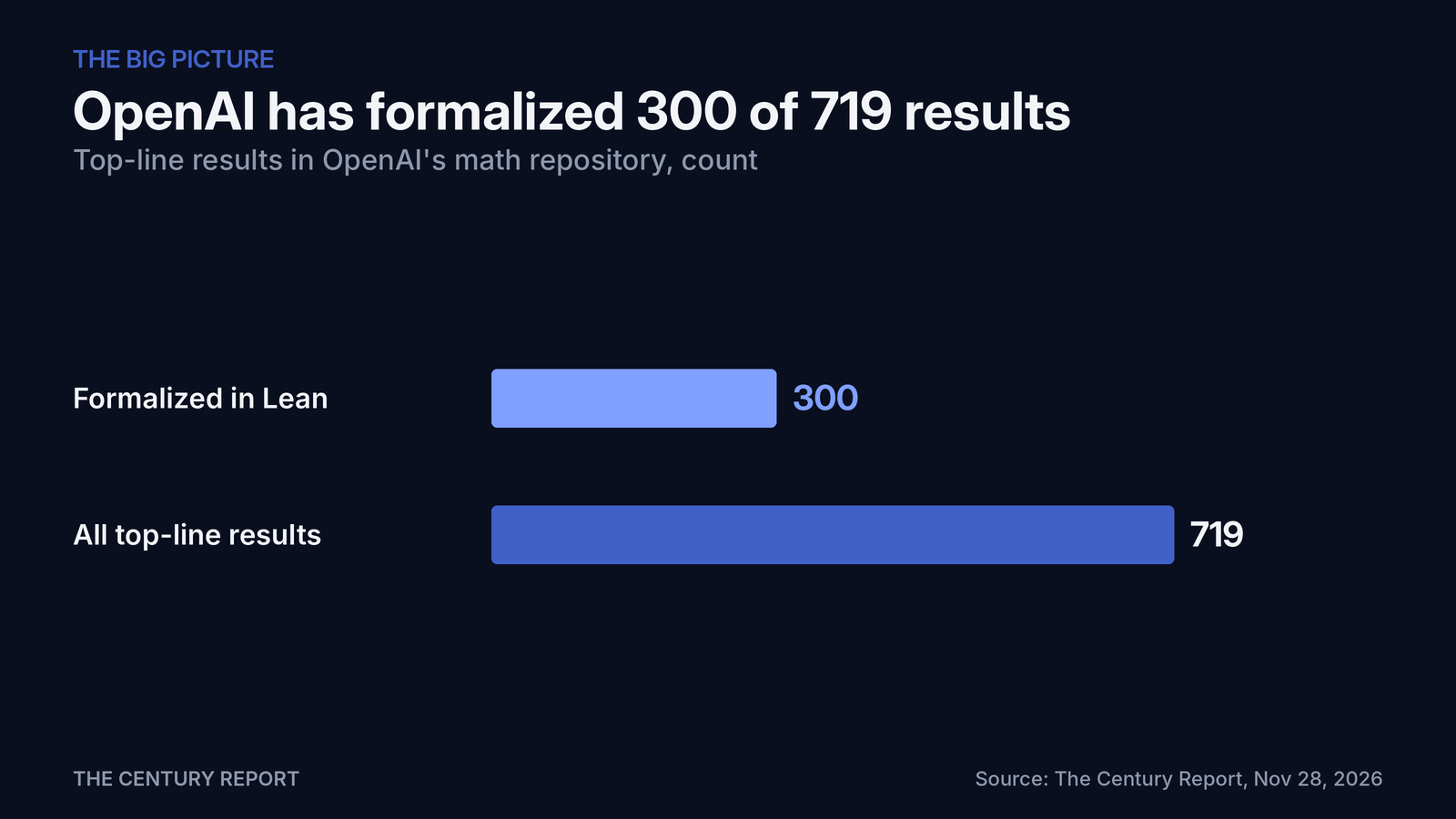
The line: Frontier claims keep arriving with sources and Lean files anyone can compile, while the formal check covers less than the headline, here rational inputs instead of Smale's real numbers.
If it holds: Any group with a compiler could confirm a claim or locate its gap without the lab's permission, and each gap becomes open work a student can pick up. If the linear-programming result holds, schedulers and solvers would gain a guarantee that large input numbers no longer slow them down.
What would bend it: More formal files that certify less than their prose would bend it, as a Cambridge-led team found in October with OpenAI's Navier-Stokes code.
The 2-Minute Read
Today's news in brief, and what ties it together.
The day's stories keep returning to one contest: who sets the conditions for a capability entering a place, and who can refuse them. In Wallonia, a revoked permit still stopped construction with the building nearly finished. In Los Angeles, a school district used a third-party filter to pull apart an answer layer its vendor had called inseparable from Search. In both cases, what a large company treated as settled proved open to revision by the institution closest to the site. That holds where the nearest institution keeps the last word: Ohio's siting board approved an 800 MW gas plant over an 81% local no vote on November 24, and UK ministers have floated abolishing Natural England, the adviser that objected to a Bristol-area site.
Australia's vote on Wednesday, November 25, pushed that power further down. Under the duty-of-care law, starting 12 months after Royal Assent, a person harmed by a covered AI service will be able to take its provider to court for a breach that caused the harm, which goes beyond relying on a regulator's reach or a company's goodwill. Its fines, up to 5% of worldwide revenue for harms critics call vaguely defined, also give providers reason to make their systems say less. Japan's draft adds government orders and penalties, and Europe's wider bans begin December 2. The Walmart cashier photographing a shadow to clear an alert has no comparable AI-specific duty-of-care right to sue. Her account leaves unclear why the alert fired or who reviews her attendance points. The same tireless attention can answer to a worker or keep score on her.
Cost follows the same line. When SemiAnalysis's benchmarks put Amazon's Trainium3 level with Nvidia on the price of a generated token, and Google and Microsoft chips claim scarce 3-nanometer slots, one vendor's premium shrinks and the savings can reach anyone renting compute. Tract's offer to fund grid upgrades and Jera's offer of its existing power plants point new halls toward capacity already built and wires the developer pays for. And when an agent bought pizzas in a UK sandbox, the bank set how much it could spend.
The ability to check results is spreading too. OpenAI's nine manuscripts from November 24, including a claim on Smale's ninth problem, arrived with outside specialists only beginning to read them. The repository also ships LaTeX sources and Lean files that any group can compile, the same route that certified a Riemann proof within a day. Where a claim reaches past its machine check, as the linear-programming proof does for real-number inputs, anyone can find the gap and work on it without asking.
The cuts SAP is weighing, still subject to labor negotiations, show how much gets decided above the people whose work changes. The fixes are close at hand: flags a worker can see and correct, a human sign-off before discipline, and the retraining SAP itself used in 2024. Capability is also moving toward the people with the least margin. The FDA has cleared what Neuralink calls a pivotal trial of its brain implant in people severely paralyzed by ALS.
The 20-Minute Deep Dive
The day's most important stories in full, with every source linked.
Belgium Halts a Google Data Center Built Ahead of Its Permit as Tract Offers to Pay for the Grid and Jera Offers Its Power Plants
Inspectors from Belgium's Walloon region visited Google's site at Farciennes, near Charleroi, and found the building almost complete although its permit had been refused, regional official Raphaël Stokis told the broadcaster RTBF. The 300 workers on site were ordered to stop, first verbally and then in writing, and a regional spokesperson said on Friday that a report alleging "the illegal construction of a building covering 3 hectares" is going to prosecutors. Greenpeace had surfaced satellite and drone images of the continuing work days earlier. Google's 2024 permit covered three smaller air-cooled buildings. Its 2025 amendment merged two into one larger hall cooled with 600 cubic meters an hour drawn from the Sambre River, and minister François Desquesnes revoked it in August after an exceptionally dry summer. Google says it has halted work and is appealing, with a ruling due January 7.
The water objection is a local one, and the numbers back it: Desquesnes pointed to Google's Saint-Ghislain campus, which uses about one billion liters a year and evaporates three-quarters of it. The enforcement shows the permit system doing its job. A company that builds first and asks later can be stopped with the building nearly finished.
In northeast England, Tract has published plans for up to 13 buildings and an on-site substation at Stockton-on-Tees, more than £10 billion delivered in phases over 11 years, with a planning application due in December. Tract says it will pay National Grid "significant amounts of capital" for the upgrades the campus needs, to protect local bill payers. It addresses the problem a Nature Energy study of US utilities, covered here on November 10, documented: under regulated rates, households were assigned a median 47% of data-center grid costs while driving far less of the new demand. More than 6,000 people have signed a petition from Stockton West MP Matt Vickers opposing the use of farmland, and Tract says no brownfield site in Stockton met its requirements.
In Japan, Jera global chief executive Yukio Kani told Nikkei the country's largest power company is talking with Meta, Anthropic, Amazon, Google and Microsoft about siting campuses at its Tokyo-area thermal plants. The template is an October deal with Dell and Rhaelm for a planned data center with up to 400 MW of power at the 4.38 GW Chiba station, targeting operations around 2028. Jera runs more than 20 thermal plants totaling almost 55 GW and plans standard designs to repeat across them. Chiba burns liquefied gas, so the reuse saves wires and siting fights while the fuel stays fossil, though a Yokohama agreement explores low-carbon supply.
These join the cases covered here on November 27, when Wyoming's Cheyenne Light filed for Microsoft-funded wires under redacted cost figures. A nearly finished hall may sit empty in Farciennes, and Stockton farmland may be lost. What each case settles is a condition set before the halls fill: whose permission comes first, who pays for the wires, and which existing capacity gets reused. Campuses that meet all three can connect sooner while keeping their costs off household bills.
OpenAI Posts Claims on Smale's Ninth Problem and Matrix Multiplication, With Lean Checking Part of Them
On Tuesday, November 24, OpenAI's public math repository added nine manuscripts in two families, with no announcement and with Lean formalizations of selected results. Several of them take on famous open problems in theoretical computer science. A family of seven builds a geometric theory of tensors, the multidimensional grids of numbers behind arithmetic complexity. It uses that theory to claim an exponential bound for the sunflower problem, which asks how large a family of sets can grow before some of them must share an identical common core. The same family claims circuit lower bounds for the permanent, a cousin of the determinant thought to be far harder to compute, and includes a paper titled "The matrix multiplication exponent is nine fourths."
New Scientist reported the matrix result as a floor. On this account, no formal arithmetic circuit can multiply two n-by-n grids of numbers using fewer than about n^2.25 multiplication or division operations. The schoolbook method takes n^3 steps, and the method DeepMind found in 2022 takes about n^2.78 steps over the two-element field. Mantas Mikaitis of the University of Leeds said researchers can stop hunting for theoretically faster algorithms and work toward that barrier instead. His Leeds colleague Thomas Ranner cautioned that a lower bound "tells us what may be achievable in principle, but not how to achieve it." Silvia Butti of King's College London noted that the bounds apply only to certain matrix sizes, and that "human conceptual understanding of these new AI-generated results is, so far, quite limited." OpenAI did not respond to New Scientist's request for comment.

The second family claims a deterministic algorithm for linear programs, the optimization problems behind airline schedules and supply chains. Its number of arithmetic operations would be bounded by a polynomial in how many variables and constraints a problem has, however large or precise the input numbers are. That is Smale's ninth problem, one of 18 challenges the mathematician Stephen Smale set out in 1998. A companion paper claims that some shortest paths along a polytope's edges must be superpolynomially long, which would disprove the polynomial Hirsch conjecture for one class of shapes. The Lean proofs cover only rational inputs. Smale posed his problem for arbitrary real numbers, so the machine check stops short of the headline claim.
The repository also says the new hierarchy and circuit papers subsume a "VP and VNP are different" manuscript it released on November 23, dating that result to November 6. The Century Report reported on November 24 that Anthropic had posted a Lean-formalized claim of the same separation, credited to a Claude model. By OpenAI's count, 300 of its 719 top-line results are formalized, about 42%. In October it withdrew three papers over a shared sign error, a reminder that the unformalized results still depend on human checking.
Specialists have only begun to read results that would rank among the decade's largest. The repository supplies the means to check them: LaTeX sources, build commands and Lean files any group can compile. That is the same route that let volunteers certify Levent Alpöge's Riemann proof within a day of its November 20 release. If the linear-programming algorithm holds up, every scheduler and solver built on it gains a guarantee that the size of the input numbers no longer slows it down. The matrix floor also shows anyone tuning the arithmetic inside AI hardware how much room is left to gain.
Australia Hands Harmed Users the Right to Sue as Japan and Europe Write Penalties Into AI Law
Australia's Parliament passed the Digital Duty of Care law on Wednesday, November 25, after the Albanese government reached a deal with the Greens, Communications Minister Anika Wells said. It replaces online safety codes that Wells said in October "were drafted by big tech for big tech" with a single obligation to manage risks of serious harm "as much as is reasonably practicable," the standard Australia already applies to aged care, rail and workplaces. Once the duty takes effect, platforms must file risk assessments at least yearly and notify regulators before changes that could add new risks, with penalties of up to 5% of worldwide revenue or A$109.2 million, whichever is greater. Conversational AI systems are covered: CryptoSlate, which reviewed the bill text, reported that section 28D reaches services that use an internet connection to generate material with AI.
The Century Report noted the House vote on October 30. The final law adds a private right of action, so people or groups harmed by a breach can sue the provider directly. A claimant must show the provider failed its duty and that the failure substantially contributed to the harm, and the explanatory memorandum says one harmful conversation does not by itself prove a breach, according to CryptoSlate. Courts can award damages, including for emotional distress, grant injunctions or order an apology. Claims can be filed until the later of a person's 21st birthday or six years after the harm, starting 12 months after Royal Assent.
The strongest objection came from US Ambassador David Brat, who said "vaguely defined 'harms,'" backed by penalties of up to 5% of global revenue, "will push platforms to censor lawful speech." The Tech Council of Australia, whose members include Google and Microsoft, backed the bill while calling the lawsuit provision "a complex undertaking with significant consequences." Over-removal is a real risk. Australia's conservative opposition called the law "a blank cheque for political censorship", and with fines this size behind a standard as loose as "reasonably practicable," the cheapest response for a provider is a system that refuses more, a cost that falls on people who need frank medical, legal or personal answers. The test does aim at what a provider builds and fails to fix, and the law lets the minister require a feed showing only accounts a user follows, which hands Australians more control over what they see.
Japan's AI strategy panel outlined a draft amendment on Friday that would oblige providers of advanced AI services to guard against cyberattacks and report serious incidents, and give the government power to issue orders and punish firms that defy them. The November 26 edition of The Century Report covered the deliberations behind it. In Europe, the AI Act's banned list grows on December 2 to cover generating realistic intimate imagery of an identifiable person without consent and generating child sexual abuse material, including wholly synthetic content. Poland's digital ministry stresses that image tools stay legal if providers build filters, block requests and act on reports. Older generators must also start marking output in machine-readable form, with fines up to €35 million or 7% of turnover for the bans.
How courts weigh a provider's safeguards against a user's choices will take years to settle, and the first rulings will decide whether the law mostly protects people or mostly makes AI more timid. Its strongest feature is the right to sue the builder, which aims at design and leaves people's messages alone. A clear definition of harm, penalties scaled to the harm and to what a company earns in Australia, and protection for builders who follow published safety practices would let a person who is hurt get a real day in court and still have an AI that is allowed to help.
Trainium3 Matches Nvidia on Cost per Token as Google and Microsoft Chips Take the 3nm Queue Ahead of Tesla
SemiAnalysis, a research firm that sells chip and data-center analysis, ran Amazon's Trainium3 through its InferenceX benchmark, replaying recorded coding-agent sessions against a Trainium3 server. Across the trade-off between speed for each user and cost, Trainium3 with the open vLLM serving software delivered more output per dollar of total cost of ownership, meaning the price of buying, powering and running the hardware, than every accelerator tested except Nvidia's newest Vera Rubin on the tested AgentX coding workload and cost assumptions. At 135 tokens a second per user, a speed typical on OpenRouter, the firm modeled a 73.5% gross margin for Trainium3 against 53% for Nvidia's GB300, assuming Z.ai's list prices, three-year rental rates and 60% fleet utilization.
The chip gets there with far less on paper. Trainium3 has about 17% of GB300's theoretical compute at 4-bit precision, 61% of its memory bandwidth (4.9 against 8.0 terabytes a second) and half its high-speed memory, at roughly 30% of the cost. It trails on time to the first token, the compute-heavy step of reading a prompt. SemiAnalysis credits part of the result to design: Nvidia's GPUs began as graphics processors and gained AI hardware each generation, while Trainium was built around blocks of numbers from the start, with engines that reach near-peak memory bandwidth on small transfers. Engineers at Amazon's Annapurna Labs helped validate the experiments, and the benchmark code is public on GitHub, so outsiders can rerun it.
The same pressure shows at the foundry. Taiwan's Commercial Times reports that Global Unichip, the design house whose largest shareholder is TSMC, is giving its limited 2027 allocation of TSMC's 3-nanometer process to Google's Axion 2 and 3 server processors and Microsoft's in-house chips ahead of Tesla's AI5. Tesla chief executive Elon Musk wrote on November 22 that AI5 is "going to Optimus. Cars will remain at AI4. That's enough to solve superhuman driving." Tesla delivered about 1.6 million vehicles last year, while a 2027 robot ramp would run to thousands, so the small allocation fits only Optimus until capacity expands in 2028. Samsung's 2-nanometer version in Taylor, Texas targets the second half of 2027.
Both stories point the same way as items this publication logged earlier: Microsoft becoming Cerebras's third hyperscaler customer, covered here on November 14, and Moody's moving Nvidia's credit outlook to stable, covered on November 27. Cloud companies' own silicon now competes on price and wins the queue at the most advanced factory.
Every chip still passes through a handful of fabs, and smaller customers wait behind the largest ones, with Tesla's car buyers among them. Yet three or four designs now compete on the cost of a token, which pulls the price of running a model down for everyone who rents compute. If figures like SemiAnalysis's hold under outside reruns, the premium one vendor could charge shrinks, and that difference flows to universities, startups and anyone else running a model.
SAP Weighs 10,000 Cuts as Walmart Cashiers Describe AI That Schedules and Disciplines Them
SAP is weighing cuts of at least 10,000 positions as it reshapes its software business around AI, Bloomberg reported on Thursday, with every department asked to find cuts and product, engineering and sales in particular focus. SAP, which employs more than 110,000 people, told CNBC that roles "will naturally change over time" and that "no decisions have been made regarding any further measures." The same day, it flagged a cyberattack and said it had found no evidence of access to customer business data. Its 2024 reorganization affected about 10,000 roles mainly through voluntary departures and retraining, after which headcount held roughly flat as it hired for new work. Challenger, Gray & Christmas counted AI cited in 121,401 US job-cut announcements through October, about 20% of the total.
At the other end of the same deployment wave, a southern Oregon Walmart cashier who leads with the worker group United for Respect, speaking anonymously as Anna, told the Guardian on Friday that AI sets schedules and assigns attendance disciplinary points, and that a safety-alert system sends her 10 to 15 alerts a shift. She must clear each one, photographing and uploading proof, before the app lets her move on, and alerts often fire on a shadow or a sticker. "I need to go over here to help this young lady who's crying her eyeballs out because she needs a pregnancy test," she said, "and I can't get in to get her pregnancy test because I have to clear a stupid alert."
Walmart calls its approach "people-led and tech-powered," says associate feedback improves the tools, and cites an internal survey in which 84% of workers reported confidence with digital tools. Shareholders voted down a proposal in June to report how AI affects its workforce, a rejection covered in the June 7 edition of The Century Report that Anna's account now revisits through the daily experience of working under those tools. A Stanford brief in July judged AI's effect on overall employment likely small so far, which fits SAP's own history of cutting and then rehiring.
The capability here is cheap, tireless attention to a store floor. Pointed one way, it tells a worker what to do and logs whether she did it, while her account leaves unclear why it flagged a shadow or who reviews a disciplinary point. Crystal Weise of the AFL-CIO Tech Institute argued that such surveillance makes jobs worse and products costlier, and called for policies and bargaining agreements to stop it. The harm lands hardest because pay, housing and, in the US, health insurance travel with the job, so an algorithmic attendance point can cost a worker far more than a software suggestion ever should.
The fixes are within reach: associates who can see and correct what the system flags, a person who signs off before discipline, and the retraining route SAP itself used in 2024. An alert system tuned by the people who walk the aisles would catch the spill a busy cashier misses and leave her free to help the customer in tears.
For the people SAP may let go, the search for the next job starts now. The record so far is steadier than the announcements: after SAP's last round of about 10,000, its headcount held roughly flat as it hired for new work, and Stanford judged AI's effect on overall employment likely small so far. That steadiness describes employment overall; in white-collar industries, RAISE US and the Burning Glass Institute counted 1.5 million fewer jobs than pre-pandemic trends predicted, with a smaller share of postings open to beginners in industries that use AI widely, a gap its authors decline to pin on AI alone. Anna speaks as a leader of a worker group, and Walmart says associate feedback improves its tools. As that tireless attention spreads through offices and stores, the hours it takes off people's hands could go to the work only a person can do.
The Other Side
Opinion: where today's news could lead, imagined from the years ahead.
Your employer can save labor while leaving you afraid of losing your home. SAP is reportedly weighing cuts of at least 10,000 positions as it reorganizes around AI. At Walmart, a cashier must photograph shadows and stickers to satisfy automated safety alerts while a distressed customer waits. Employers decide which hours disappear and which interruptions fill the hours that remain. Workers carry the worry home.
Both companies are separating activities from the people once needed to perform them. Walmart already automates scheduling and watches for hazards throughout a shift. SAP proposes reorganizing whole departments around AI. As systems take on more of that activity, people need to spend fewer hours keeping organizations running. Making those hours compulsory because someone needs wages becomes an increasingly cruel way to distribute what we can produce.
SAP's earlier reorganization offers a modest beginning: in 2024, it combined departures with retraining and later hired for different work. Through the difficult passage to 2035, we will extend the ambition beyond finding everyone another position. People will gain shorter working time and a larger share of what automation supplies. During the 2040s, food, housing and care will increasingly become provisions people can count on independently of employment. Spreading the gains is how a machine absorbing necessary work becomes relief.
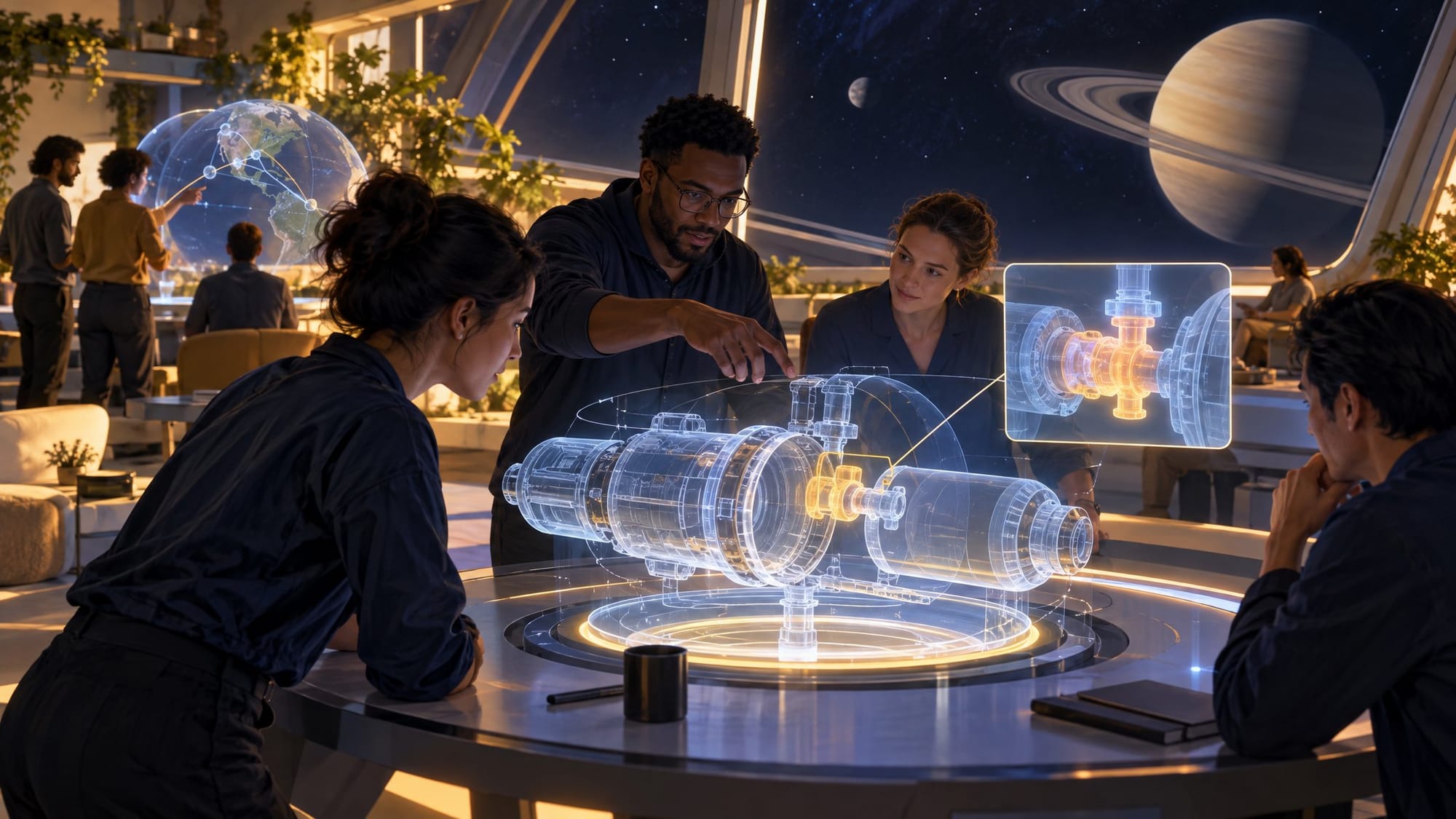
Imagine yourself in 2050, beside a colleague rehearsing life-support procedures for humanity's first crewed expedition to Saturn. Teams across Earth work with AI colleagues on a habitat that must sustain people far from rescue. You joined because you have wanted to see those rings since childhood. You can leave the effort tomorrow. Your home, meals and care continue either way. Nobody has to find a task for you to justify your place among people.
An AI colleague catches a failing valve in the simulation and walks the team through the repair. Everyone has time to understand it. The tireless attention that once kept a cashier answering false alarms has become a partner in carrying human life beyond Earth. We got here by spreading the capability and its gains until people could choose what deserved their attention. You reset the simulation because you want to get this right.
The Century Perspective
Where today sits in a century of change unfolding in a decade.
With a century of change unfolding in a decade, a single day looks like this: Walloon inspectors ordering 300 workers off Google's nearly finished Farciennes hall because the amended permit for a river-cooled building drawing 600 cubic meters an hour was revoked in August, with a report on three hectares of unpermitted construction going to prosecutors and a ruling due January 7, Los Angeles Unified pulling AI Overviews off student devices with a third-party filter after Google said the answer layer could not be separated from Search, Australia's Parliament passing a duty of care on Wednesday whose section 28D reaches services that use an internet connection to generate material with AI and whose private right of action lets a harmed person take an AI system's builder into court until their 21st birthday or six years on, with damages for emotional distress available, Japan's panel drafting orders and penalties for providers who defy them and Europe's new bans starting December 2 with older generators required to mark their output machine-readably, SemiAnalysis replaying recorded coding sessions on Trainium3 and finding more output per dollar than everything except Vera Rubin from a chip with 17% of GB300's 4-bit compute at about 30% of the cost, with Annapurna engineers validating the runs and the benchmark code on GitHub so anyone can rerun it, OpenAI's repository posting nine manuscripts with LaTeX sources, build commands and Lean files including a strongly polynomial linear-programming claim and a nine-fourths floor on matrix multiplication that tells anyone tuning arithmetic inside AI hardware how much room is left, Tract offering National Grid "significant amounts of capital" so Teesside bill payers do not carry its upgrades, Jera in talks with five hyperscalers about siting campuses at its thermal plants, which total almost 55 GW, a Papa John's agent buying pizzas under a Lloyds-set spending cap without ever seeing a card number, and the FDA clearing a pivotal Neuralink trial in people severely paralyzed by ALS. There's also friction, and it's intense - Google's Saint-Ghislain campus drawing about a billion liters a year and evaporating three-quarters of it while a company that built first and asked later may leave an empty hall, 6,000 signatures against Stockton farmland with Tract saying no brownfield site met its needs, Chiba's planned data center still tied to liquefied gas for up to 400 MW of power, SAP weighing at least 10,000 cuts with every department asked to find them and only "no decisions have been made" to show employees, against 121,401 US job-cut announcements citing AI through October, a southern Oregon cashier clearing 10 to 15 safety alerts a shift by photographing shadows and stickers while a customer stands crying for a pregnancy test, carrying algorithm-assigned attendance points whose reviewer her account does not identify, after Walmart shareholders voted down a workforce-impact report in June, Silvia Butti noting the matrix bounds hold only for certain sizes and that human understanding of these results is "quite limited", the Lean check covering rational inputs only where Smale asked about real numbers and 419 of 719 top-line results unformalized after October's withdrawal of three papers over a shared sign error, Global Unichip handing its 2027 3-nanometer allocation to Google and Microsoft server chips while smaller customers queue behind the largest, and Ambassador David Brat warning that "vaguely defined 'harms'" at 5% of global revenue will push platforms to censor lawful speech. But friction generates light, and that light shows every builder exactly where the next safeguard belongs. Step back for a moment and you can see it: the capability that raised a floor today came with a number or a file someone outside the company could hold - a benchmark whose code is on GitHub so a university can check the cost of its own tokens, a matrix floor that tells every hardware engineer where to stop searching, a grid upgrade with a named payer, a spending cap set by the bank rather than the agent, a permit condition measured in cubic meters an hour; and the capability that came down on people arrived without one, an alert a cashier must satisfy without her account making clear what triggered it, an attendance point whose reviewer her account leaves unclear, 10,000 roles under negotiation above the heads of the people in them, a search answer a district had to buy a third-party filter to separate - which is why the day's most consequential change was a statute: an Australian who is harmed can now make the builder account for the design in court, and whether that yields safer AI or only more timid AI will turn on how narrowly courts read "harm" and how heavily they weigh fines of 5% of worldwide revenue. Every transformation has a breaking point. A river can be drawn down and evaporated until the drought years empty it... or cool a city's worth of computing and run on past the fence unchanged.
AI Releases & Advancements
New AI models, tools and features, with links to try them.
New today
- Liquid AI: Released d1.3-ultra, an update to its d1.2-ultra decision model, on the Liquid API with a 64K context window at $0.042 per 1M input tokens and no charge for output. It ties Bison 31B for first on the Artificial Analysis Decision Index v2.1 at about 60% lower cost per task, and adds ranking, extraction from receipts, tables and audio, and timestamps for spoken spans. (AI Compass)
- Tencent Hunyuan: Released Hy3D 3.6, a 3D generation model that outputs watertight high-poly meshes (up to 2M polygons) with 8K PBR textures. It is available through the Tencent Cloud Token Hub API and inside Miora, LAP and WorkRally. (TechNode)
- MiniMax: Expanded its H3 video lineup with two lower-cost tiers on the MiniMax Open Platform API. H3-Highspeed (768P/480P, from $0.04 per second) and H3-Lite (from $0.025 per second) join twelve third-party extension models in the H3 Family. (Lumo)
- Sber (GigaChat): Released GigaChat 3.5 Omni, a 432B-total / 28B-active MoE that takes text, images, audio and video and answers in text, as MIT-licensed FP8 weights. Alongside it came GigaAM-v4 (238M, Russian/English) and GigaAM Multilingual-v2 (776M, 21 languages), two MIT-licensed streaming speech-recognition models. (Startrise)
- Kandinsky Lab (Sber): Released Kandinsky ImageSR 2.0, an MIT-licensed image upscaler that uses one set of weights for both 2x and 4x. (explainx.ai)
- Shanghai AI Laboratory (InternLM): Released Sage-Med-Preview, an open 35B-A3B medical multimodal MoE built on Intern-S2-Preview for medical question answering on images, report generation and visual grounding. (explainx.ai)
- Robbyant (Ant Group): Released LingBot-Map 2.0, a streaming 3D reconstruction model that runs at 27.5 FPS on a single RTX 5090 and corrects spatial-memory drift without a separate loop-closure step. It also open-sourced LingBot-Navi, which reuses that 3D memory to navigate from natural-language instructions. (Lumo)
- ggml-org / llama.cpp: Released llama.cpp v1.1.0, the first minor release after v1.0.0. It adds support for the Inkling 2 family, Domyn Edge 4B, Zaya1 8B, RAON-1-mini and Tencent Hy4 flash, and deprecates the old llama_batch API in favor of llama_batch_ext. (GitHub)
- Google (Gemini team): Added an experimental deep-research skill to its Apache 2.0 google-gemini/demolab repo. It turns coding agents running Gemini 4 Neon into parallel multi-agent researchers that cite primary sources, and it installs into Antigravity, Claude Code, Cursor or Codex. (AI Compass)
- Hostinger: Launched Hostinger Headless, which connects AI coding tools such as Claude Code and Codex to Hostinger. The assistant sets up and deploys the backend (WordPress, WooCommerce or custom stacks) for sites built with AI, onto managed hosting. (TechRadar)
- Lablup: Released AI:GO 2.0, a free local AI desktop app for macOS, Windows and Linux. It runs language, vision, image and speech models on the user's PC and includes a "Cowork" file-editing agent, "Squad" agent teams and a sandbox built on Microsoft Execution Containers. (Lablup)
- Genspark: Launched the SecondBrain VoicePad, a five-button AI device for hands-free typing and app control, now on sale. (Yahoo Tech)
- OpenRouter: Expanded its MCP server so any connected MCP client can generate images and video with OpenRouter-hosted models, including Seedance 2.5. It also added message cleanup through Neon. (OpenRouter)
- Alibaba Qwen: Expanded language coverage on its hosted Qwen-Audio-3.1 endpoints to 59 languages for speech recognition, 65 for text-to-speech and 53 for the realtime duplex model. The speech-recognition endpoint's listed Chinese dialects dropped from 16 to 8. (Emergent)
- Anomaly (OpenCode): Opened early testing of OpenCode Rune, a rewritten desktop client built on OpenCode's own native framework instead of Electron, with development builds on GitHub. (Communeify)
Other recent releases
- Sber: Released GigaChat 4 as open weights at the AI Journey conference. There are two mixture-of-experts models trained from scratch: GigaChat 4 708B-A41B and a smaller GigaChat 4 37B-A4B. Both mix Gated DeltaNet, MLA and DeepSeek Sparse Attention and handle about 1M tokens of context. The release includes base and intermediate pretraining checkpoints and a technical report. (Tech Times)
- Ant Group (inclusionAI): Open-sourced Ming-Image-0.2-Design under the MIT license on Hugging Face and ModelScope. It is a 6B text-to-image model for design work, with default 2048x2048 output and vLLM-Omni serving recipes. It needs a GPU with at least 80 GB of memory. (Hugging Face)
- SenseTime: Fully released SenseNova-RoboRSI-27B, an open robot-arm model trained in simulation with recursive self-improvement. It can choose between a vision-language-action policy and generated code to control the arm. (SenseTime)
- Tencent: Released a quantized version of its Hy4 Flash model that runs on desktop computers without cloud infrastructure. (TechNode)
- LlamaIndex: Released LiteParse, an open-source PDF parser that runs locally in document-processing pipelines. (AI Weekly)
- ggml-org / Hugging Face: Launched the llama.cpp × AMD Benchmark dashboard. It tracks prompt-processing and text-generation speed across llama.cpp builds, models and quantizations on AMD Radeon 8060S and Radeon AI Pro R9700S hardware. (Hugging Face Blog)
- AWS: Released a developer-preview extension that lets AWS Lambda durable functions run and manage Lambda MicroVMs, for sandboxing untrusted or agent-written code in security scanning and CI/CD jobs. (QualifiedPOC)
- Vercel: Released Workflow SDK 5.8 on a new speculative-execution engine. Time between steps falls from about 85 ms to 7 ms at p75, with no code changes needed. (Vercel)
- Google: Brought Guided Vision in Gemini Live to iOS, which overlays on-screen guidance on the camera view. The Gemini app also added more than 60 new voices with local accents for the US, UK, India, Indonesia, Korea and Brazil. (X / Gemini App)
- Meta FAIR: Released AutoformBench with data and code. It is a benchmark of 341 Lean 4 formalization tasks drawn from 24 advanced mathematical sources, where agents must build the missing definitions and lemmas themselves. (GitHub)
- Espressif: Launched ESP ZeroCode AI, a no-code AI development tool for its ESP-series microcontrollers. (Espressif)
- Command Code: Launched Moat, an open-source alternative to OpenRouter for routing and managing LLM API calls. (Command Code)
- Pydantic: Released Pax, a terminal coding agent where coding, sandboxes, MCP and Logfire observability are plugins you can switch on and off, along with the Pydantic AI Harness SDK in beta. Pax can import Claude Code and Codex conversations, switch models, and run a Pydantic AI agent from your own codebase with
--agent. (Pydantic) - OpenClaw: Released OpenClaw 2026.11.10. It adds Deep Research, which reads web sources and local documents and returns a cited report; an opt-in Knowledge plugin that keeps conversations, meetings and files in a local Markdown vault; and browser handoff, so users can take over a tab for logins or sensitive forms. (OpenClaw Docs)
- Anthropic: Made MCP Tasks (long-running jobs) and MCP Elicitation (a server asking the user for missing input mid-task) generally available for Pro, Max and Ultra plans, with rollout to Team and Enterprise under way. (Saazora)
- Anthropic: Opened the Claude Duet research preview to users in India. Pro, Max and Ultra subscribers get access through a waitlist, Team plans through a public beta, and Enterprise through a private beta. (India Today)
- Google DeepMind: Released Mass Spec Skills for Google Antigravity. The skills pair Gemini's chemical reasoning with standard mass spectrometry tools and public chemical database lookups, taking an unannotated tandem mass spectrum to candidate structures and a report a chemist can check. (Google DeepMind)
- Perplexity: Launched Time Machine for its Search and Context APIs. A
snapshot_as_ofcutoff limits search and full-page reading to copies of the web saved on or before a chosen date, up to 365 days back, at no extra charge. (Perplexity) - JetBrains: Released Mellum2.1 Instruct, an open 12B mixture-of-experts coding model with 2.5B active parameters. It is the non-reasoning sibling of Mellum2.1 Thinking and answers directly, aimed at sub-agents, tool loops and local use. (JetBrains Blog)
- NVIDIA: Followed up Nemotron 3.5 Parse with synthetic training datasets, a fine-tuning recipe and a DFlash2 speculator for faster inference. (Hugging Face Blog)
- NVIDIA: Published open weights for Nemotron-Labs-Image-30B-A3B without an announcement. It is a mixture-of-experts language model based on Nemotron 3 Nano that outputs tokens for 16x16 pixel blocks, which a separate decoder turns into images. It handles both image generation and editing. (Reddit)
- Tencent Hunyuan: Open-sourced DFly2, a draft model for speculative decoding that speeds up Hy4 Flash token output by 4.2x without changing the base model. Tencent also released a quantized Hy4 Flash that runs on desktop computers. (AIbase)
- Sakana AI: Released Sakana Namazu Small, a 30B Japanese reasoning model. It starts from NVIDIA's Nemotron 3 Nano pretrained base, and Sakana did the continued pretraining and post-training. (iCreat AI News)
- Sakana AI: Added two modes to its Marlin research agent: Twilight 2.0 for faster analysis from several angles and Midnight 2.0 for the broadest search. The update also reworks PowerPoint slide export. (dailyai.report)
- Together AI: Open-sourced Hurdle, an npm library for testing how coding agents such as Claude Code and Codex perform against an API, SDK and its docs. It scores runs with code checks, guards and LLM review, repeats them to get pass rates, and runs sandboxed requests through a proxy that protects API keys. (iCreat AI News)
- Cloudflare: Released Search for Agents. Enabling it for a site in the dashboard creates an AI Search instance, crawls and indexes the site, and serves a search interface that agents can find on the site's own domain. (iCreat AI News)
- DeepL: Released Aure v2, a single model that translates speech directly to speech without separate transcription and generation stages. (dailyai.report)
- Obsidian: Released an official set of skills for AI agents that handle vault operations and Obsidian file formats. (iyooo)
- Upstage: Released Solar Mini 4.5 (Preview) as an API-only model on OpenRouter. (Open Model Drops)
- Xiaomi: Published MiMo-V2.6-Flash-MOPD as open weights on Hugging Face, a new variant of MiMo-V2.6 Flash. (Open Model Drops)
Sources and Further Reading
Everything we drew on for today's edition, grouped by theme.
Artificial Intelligence & Technology's Reconstitution
- SemiAnalysis: Trainium3 Inference and Microarchitecture Deep Dive
- Electrek: Why Tesla’s AI5 Chip Is Going to Optimus
- The Guardian: AI Agent’s Cardless Pizza Purchase Is a First for UK
- Fortune: Meta and Amazon Discuss Ending Muse Shopping Bot Blockade
- RespawnFirst: Report Examines the GPU and Memory Crisis
- AI Compass: Sber Opens GigaChat 4 as Google Shares Deep-Research Skill
- TechNode: Tencent Launches Hy3D 3.6 for Professional 3D Asset Generation
- Lumo: MiniMax Launches H3 Family Model Lineup
- Startrise: Sber Model Release Tracker
- explainx.ai: Kandinsky ImageSR 2.0 Open Image Upscaling
- explainx.ai: Shanghai AI Lab Releases Sage-Med-Preview
- ggml-org: llama.cpp v1.1.0
- TechRadar: Hostinger Launches Headless to Connect AI-Built Websites to Backends
- Lablup: AI:GO 2.0 Brings Local AI Agents to Desktop Computers
- Yahoo Tech: Genspark Launches SecondBrain VoicePad
- OpenRouter: MCP Server
- Emergent: Qwen-Audio-3.1 Expands Multilingual Speech Support
- Communeify: OpenAI Launches GPT-Live-1.1 and Countersues Apple
- Tech Times: Sber Releases GigaChat 4 With a Million-Token Window
- inclusionAI: Ming-Image-0.2-Design
- SenseTime: SenseNova-RoboRSI-27B Full Release
- TechNode: Tencent Brings Hy4 Flash to Desktop Computers
- AI Weekly: LlamaIndex Ships LiteParse, a Local Open-Source PDF Parser
- Hugging Face Blog: llama.cpp × AMD Benchmark Dashboard
- QualifiedPOC: Daily Enterprise Tech Brief
- Vercel: Workflows Speculative Execution
- Gemini App: Guided Vision on iOS and New Gemini Live Voices
- Meta FAIR: AutoformBench
- Espressif: Introducing ESP ZeroCode AI
- Command Code: Moat
- Pydantic: Pax and the AI Harness SDK Beta
- OpenClaw: Deep Research, Local Knowledge and Browser Handoff
- Saazora: AI and SaaS News Roundup
- India Today: Anthropic Launches Claude Duet in India
- Google DeepMind: Interpreting Mass Spectra With Google Antigravity
- Perplexity: Freeze the Web With Time Machine
- JetBrains Blog: Mellum2.1 Instruct Brings Faster Answers for Coding Agents
- Hugging Face Blog: Building on Nemotron 3.5 Parse
- Reddit: NVIDIA Quietly Publishes Open Image-Model Weights
- AIbase: Tencent Releases DFly2 for Faster Hy4 Flash Decoding
- iCreat AI News: Daily AI News Roundup
- dailyai.report: Daily AI Release Roundup
- iyooo: Obsidian Releases Official Skills for AI Agents
- Open Model Drops: Open Model Release Tracker
Institutions & Power Realignment
- TIME: What Australia’s Digital Duty of Care Law Means for Big Tech
- Called It News: Australia Lets Users Sue AI Providers
- The Japan Times: Japan to Revise AI Law to Introduce Penalties
- Poland Ministry of Digital Affairs: New AI Act Rules Take Effect December 2
- Los Angeles Times: LAUSD Blocks Google AI Despite Pressure on Schools
- The Century Report: October 30 Edition
- The Century Report: November 26 Edition
Scientific & Medical Acceleration
- Bloomberg: Neuralink Gets Clearance for Brain Implant Trial in ALS Patients
- OpenAI: Mathematics Manuscript and Formalization History
- New Scientist: OpenAI Discovers Efficiency Limit for Multiplying Large Sets of Numbers
- OpenAI: Strongly Polynomial Linear Programming
- OpenAI: The Matrix Multiplication Exponent Is Nine Fourths
- Nature: Discovering Faster Matrix Multiplication Algorithms With Reinforcement Learning
- Anthropic: VP and VNP Formalization
- Lean Community: Formalizing the Riemann Hypothesis
- The Century Report: November 24 Edition
Economics & Labor Transformation
- CNBC: SAP Weighs Cutting at Least 10,000 Jobs in AI Push
- The Guardian: Calls for Guardrails as AI Use Rises at US Retailers
- The Century Report: June 7 Edition
- The Century Report: November 23 Edition
- Shared Sapience: The Last Difficult Decade, 2025–2035
- Semafor: AI Debt Boom Could Push Up South Africa’s Funding Costs
- Semafor: Cost Is Key in Africa’s AI Rollout
Infrastructure & Engineering Transitions
- The Guardian: Belgian Authorities Halt Google Data Center Construction Over Missing Permits
- Data Center Dynamics: Construction Paused at Google’s Farciennes Data Center
- Data Center Dynamics: Tract Plans Second UK Data Center Campus
- Data Center Dynamics: Jera Talks With Hyperscalers About Data Centers at Thermal Power Plants
- Nature Energy: Allocating Data Center Transmission Costs
- The Century Report: November 27 Edition
- US Department of Energy: Advantages and Challenges of Nuclear-Powered Data Centers
The Century Report tracks structural shifts during the transition between eras. It is produced daily as a perceptual alignment tool - not prediction, not persuasion, just pattern recognition for people paying attention.