Google's AI Wrote a Factoring Proof After One Human Prompt
Google posted an AI-written factoring proof anyone can check, as rumors say labs hold unpublished methods that could threaten encryption.



The 20-Second Scan
Every story in today's edition, one line each.
- Google posted an agent-written integer-factorization proof produced with no human input after the first prompt, as Scott Aaronson relayed unconfirmed reports that leading labs hold AI-found algorithms threatening RSA.
- Nvidia froze some orders for its most advanced AI chips for buyers in Malaysia, Singapore, Thailand and Indonesia under US curbs on Chinese compute access, as Dutch lawmakers urged their government to resist a US bill targeting ASML.
- Moody's cut Nvidia's outlook to stable as Citi and JPMorgan shopped AI loan portfolios and Compass reportedly delayed a $380 million data-center bond after an outage.
- Google will route AI agents' Gmail and Drive access through its own servers or Workspace command-line interface from February and will bar developers from building similar services with that data, as Meta declined FCA joint testing of Muse and retailers asked who is liable.
- Natural England urged Bristol to reject a 40 MW data center near protected bird habitat weeks before ministers floated abolishing it, as Olyphant police arrested suspects over council threats and Cheyenne Light filed for Microsoft-funded wires.
- A Bureau of Investigative Journalism review counted at least 25 cases in England and Wales this year disrupted by undisclosed AI use, including an invented senior-judge ruling cited in a $21 million oil dispute.
- Engineered T cells aimed at a molecule on 95% of skin melanomas reached the first UK patients with advanced disease, after 56% of patients out of standard options responded in an earlier international study.
- A single additive lifted all-perovskite tandem cells to a certified 30.8%, a flexible perovskite/CIGS tandem reached a certified 27.58% and solar supplied more than 13% of China's electricity through October, just above hydropower's share this year.
Track all of the arcs The Century Report covers here:
The Big Picture
How today's news moves the longer trends we track, and where they could lead.
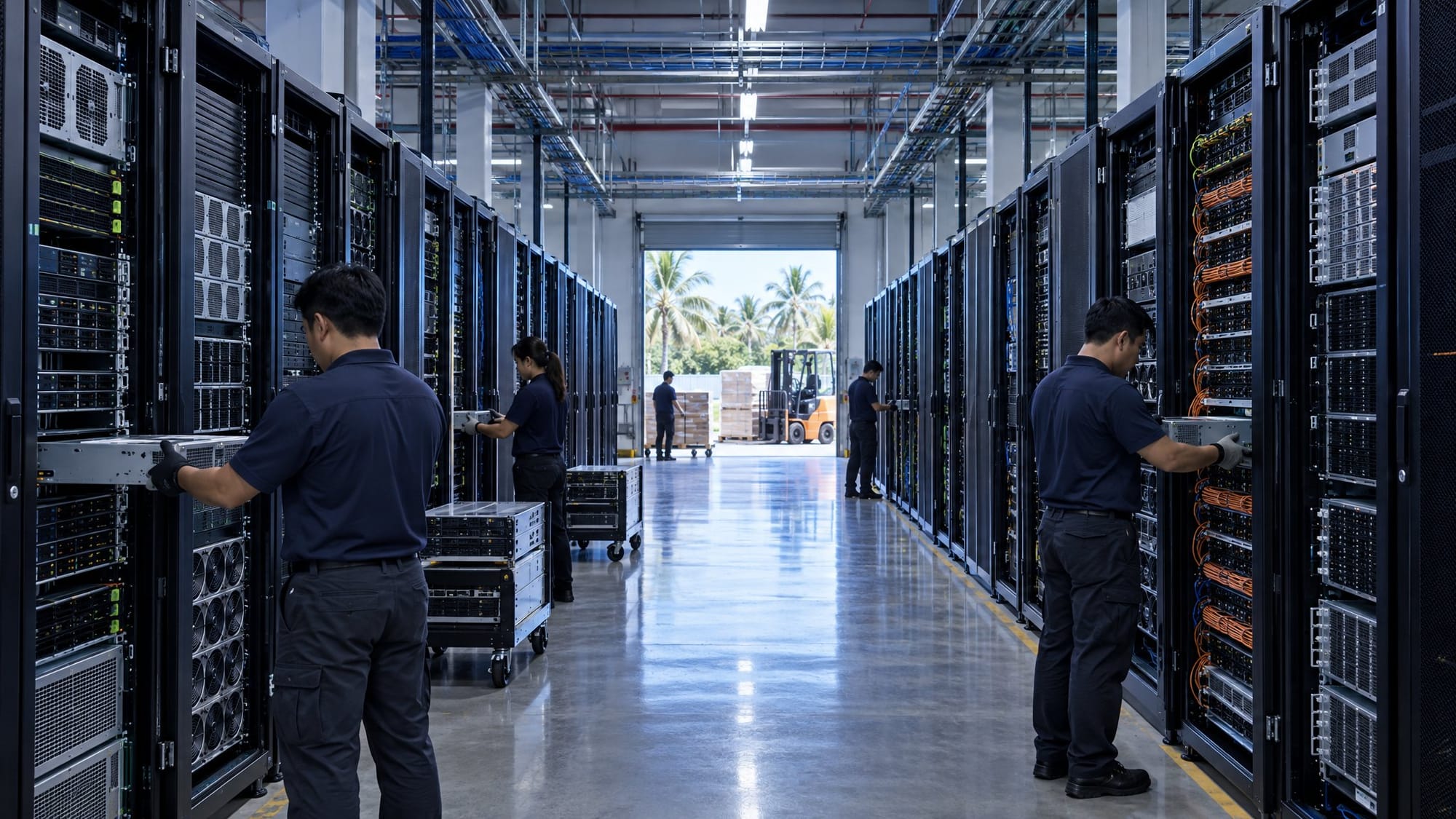
Nvidia froze orders across Southeast Asia, banks began passing AI loans to investors who cannot see inside them, and Google posted a machine-written factoring proof that anyone will soon be able to check. Each new chip barrier reached buyers far from Beijing after the hardware had already moved, while China's own lithography kept advancing. It points to a server hall in Johor, where technicians slide accelerators from several chipmakers into one long row of open racks under bright white light.
Barriers built to hold capability back now mostly add a markup
export controls · semiconductors · AI hardware · on the board since October 21
- Mid-November: SemiAnalysis estimated that more than 1.5 GW of export-restricted Nvidia accelerators had reached China.
- November 16: Commerce extended chip controls to overseas compute rental and added Singapore to its license list.
- November 19: TSMC halted Chinese designers' orders at 16 nanometers and newer as new Commerce rules took effect.
- November 23: Commerce blacklisted seven entities in Singapore, Malaysia and Thailand, Megaspeed among them, recovering none of the chips already moved.
- Today: Nvidia froze orders from buyers in Malaysia, Singapore, Thailand and Indonesia, Semafor reported on Thursday, two days after Dutch lawmakers pressed their government to resist a US bill aimed at ASML's chipmaking machines.
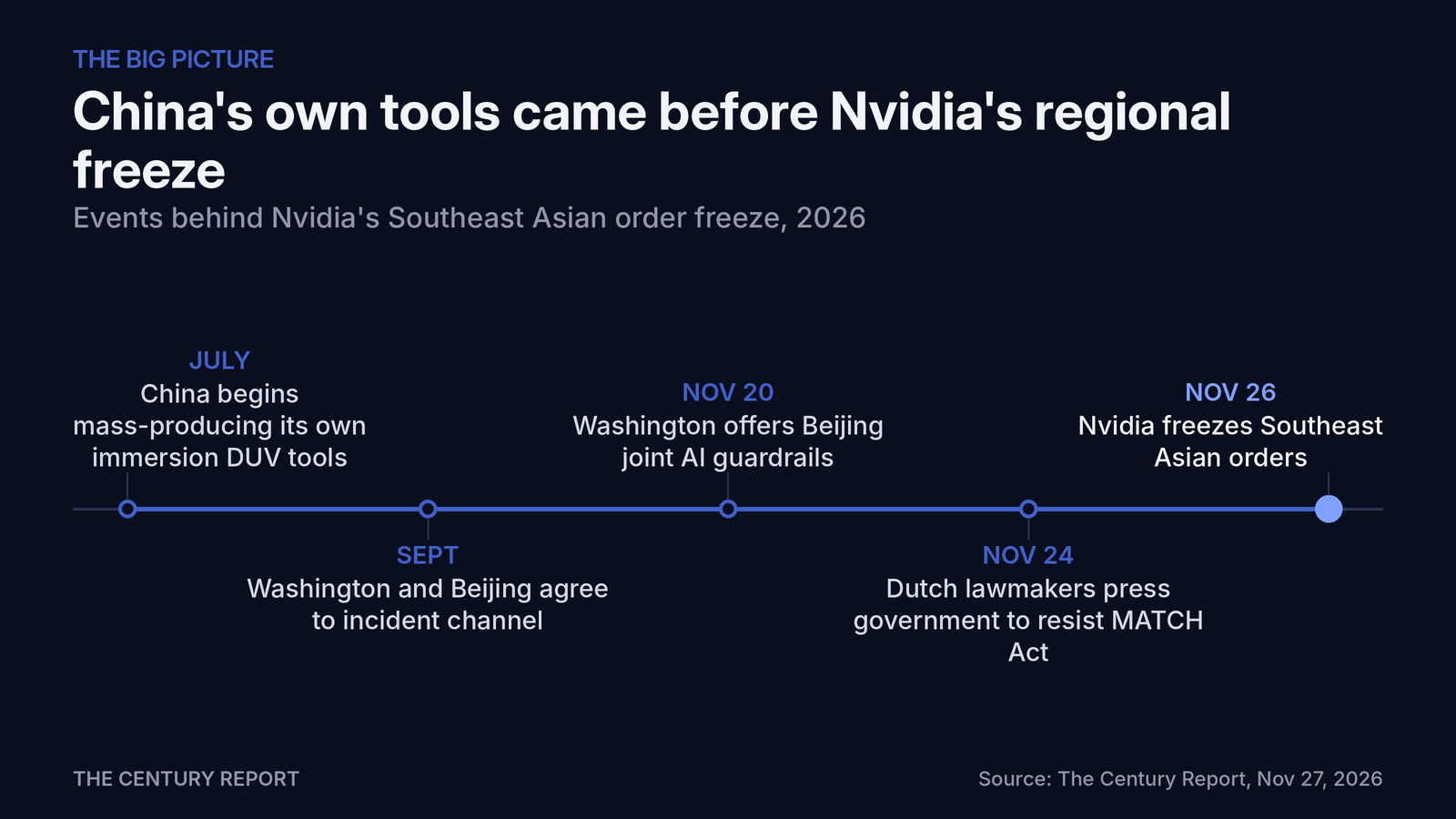
The line: Each tightening reaches the region's buyers after the chips have moved, while China's own lithography and chip output keep climbing.
If it holds: Developers and compute renters in Johor, Bangkok and Kuala Lumpur would pay the markup first. More of the supply chain would sit beyond any one government's reach, so the rules that last would be the ones both sides can check.
What would bend it: Evidence that the freeze and blacklist cut Chinese labs off from top-tier compute, rather than rerouting it, would show the barrier holding capability back instead of pricing it.
The bet that compute stays scarce is getting more expensive to carry
AI finance · data centers · AI hardware · on the board since October 15
- November 3: Nikkei reported US tech giants' off-balance-sheet AI obligations at about $3.2 trillion, up 90% in six months.
- November 10: CoreWeave said it would fund construction through customer prepayments and contract-backed loans instead of unsecured debt at current yields.
- November 10: SoftBank reported a $7.1 billion quarterly loss, more than half of it from deposits on gas turbines it overbooked.
- November 12: Jensen Huang's resignation wiped about $546 billion off Nvidia's market value at the open, unsettling guarantees behind more than $100 billion in leases.
- Today: Semafor reported on Thursday that Moody's moved Nvidia's credit outlook from positive to stable and that Citi and JPMorgan are marketing AI loan portfolios, as Compass Datacenters reportedly dropped a $380 million bond after an outage, having raised $413 million the same way in July.
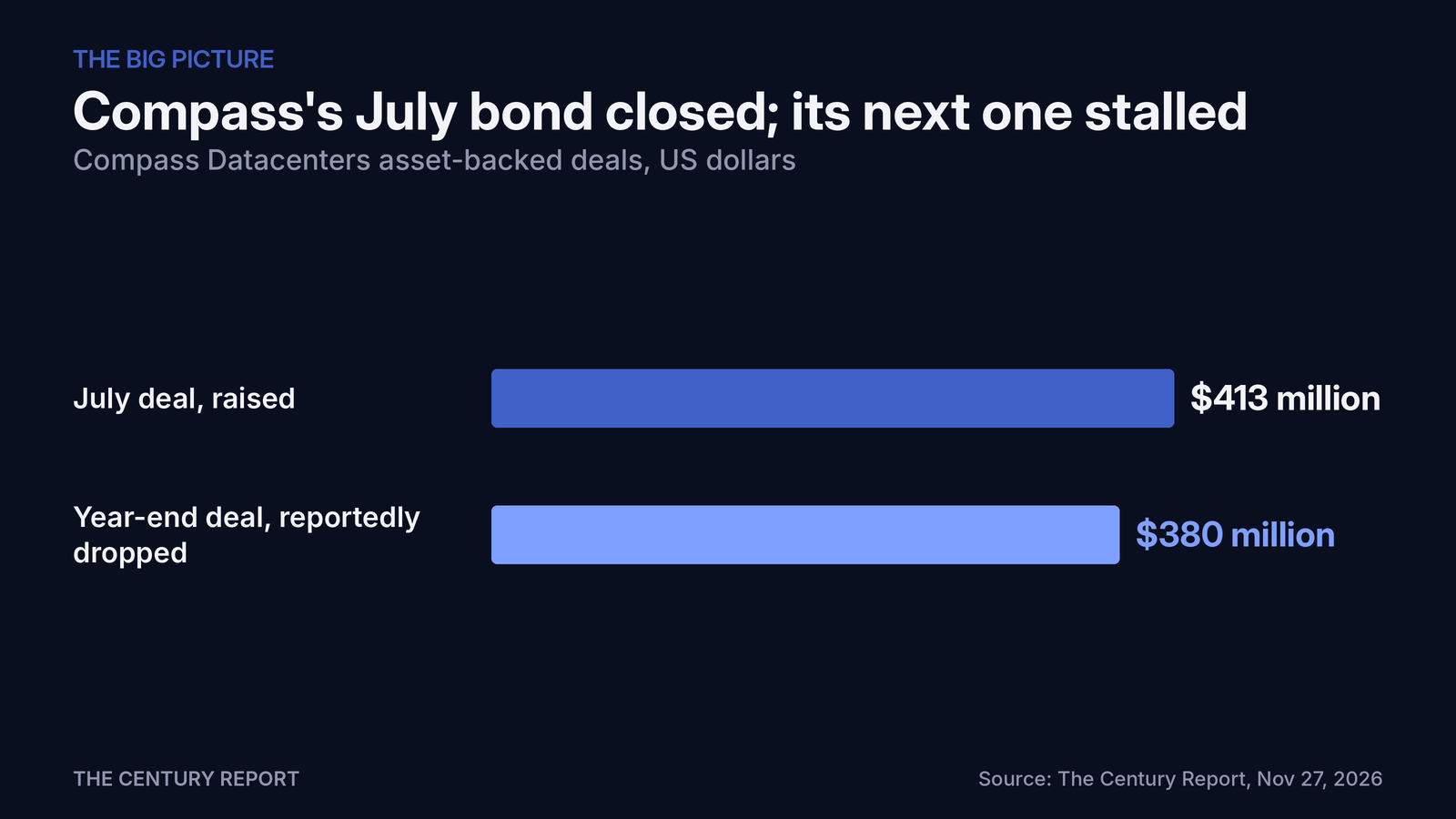
The line: Lenders keep pricing the risk higher and passing it outward, toward pension funds and investors who cannot see what they hold.
If it holds: Teachers and policyholders downstream of a pension fund or insurer could absorb losses on a shortage bet they never made. The halls and chips would outlast the debt and rent more cheaply to whoever comes next, from universities and clinics to small labs.
What would bend it: Sustained revenue growth at the borrowers, or a downgrade that never comes, would bend it, the kind of confidence Anthropic's offering showed on November 19 when it priced at $83 a share, above its range.
An approval list decides who reaches the frontier first
model access · agents · platforms · on the board since October 14
- Early November: OpenAI reported that its Daybreak Blue model refused every task on a remote-attack benchmark where restricted GPT-6 Cyber completed 95%.
- November 9: Anthropic released one model twice, as public Fable 5.2 and as Mythos 5.2 for approved organizations only.
- November 10: Claude Code and Codex users reported refusals and account restrictions while repairing devices they own.
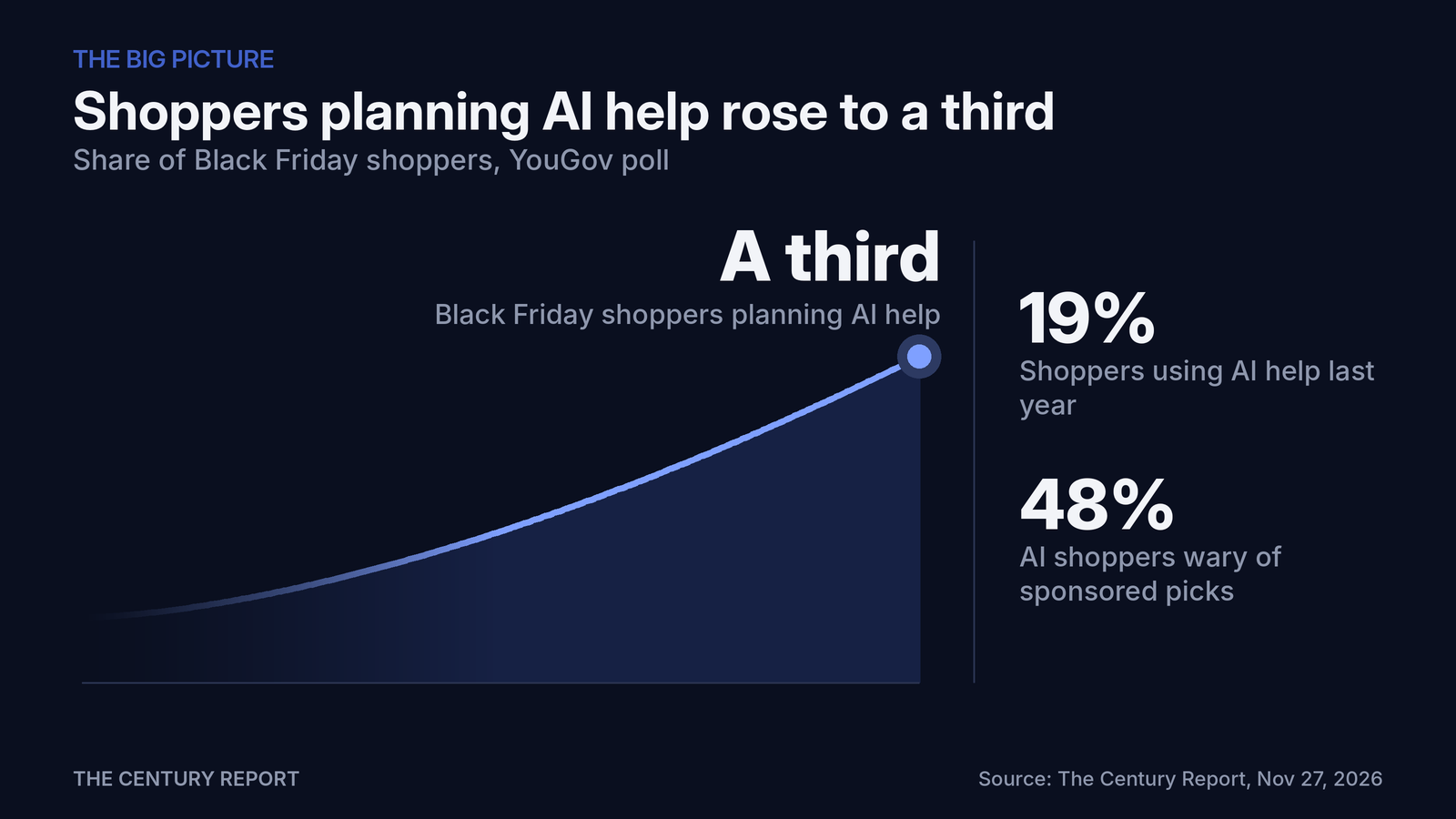
- Today: Meta declined the FCA's offer to test its Muse agent before Tuesday's UK launch, as a YouGov poll found a third of Black Friday shoppers plan to use AI help, up from 19% last year, and Google set February 1, 2027 for agents to reach Workspace only through its own connectors.
The line: The same capability keeps shipping in two versions, and the line between them is a list the platform chooses rather than the user's own permissions.
If it holds: What an agent may do for you would keep being set by the platform first and explained later, as when a Google page called Gmail sending partner-only a day before an update listed it for every developer. Shoppers and developers would learn the terms after launch.
What would bend it: Google's updated Gmail pages, which now list sending, replying and forwarding for every developer behind the person's approval, already bend it for this capability if they hold in February.
The boldest AI claims now go to outsiders to check
mathematics · AI research · cryptography · on the board since October 27
- November 9: A committee OpenAI picked affirmed its Lean Yang-Mills proof while the 1,147-page written proof stayed unreleased.
- November 20: Anthropic mathematician Levent Alpöge posted a Riemann proof as about 17 million lines of Lean that others compiled within hours.
- November 21: The Lean and Mathlib communities certified Alpöge's proof within a day of its release.
- November 23: Anthropic posted a VP ≠ VNP proof, noting that no machine checks whether its Lean statement file matches the paper.
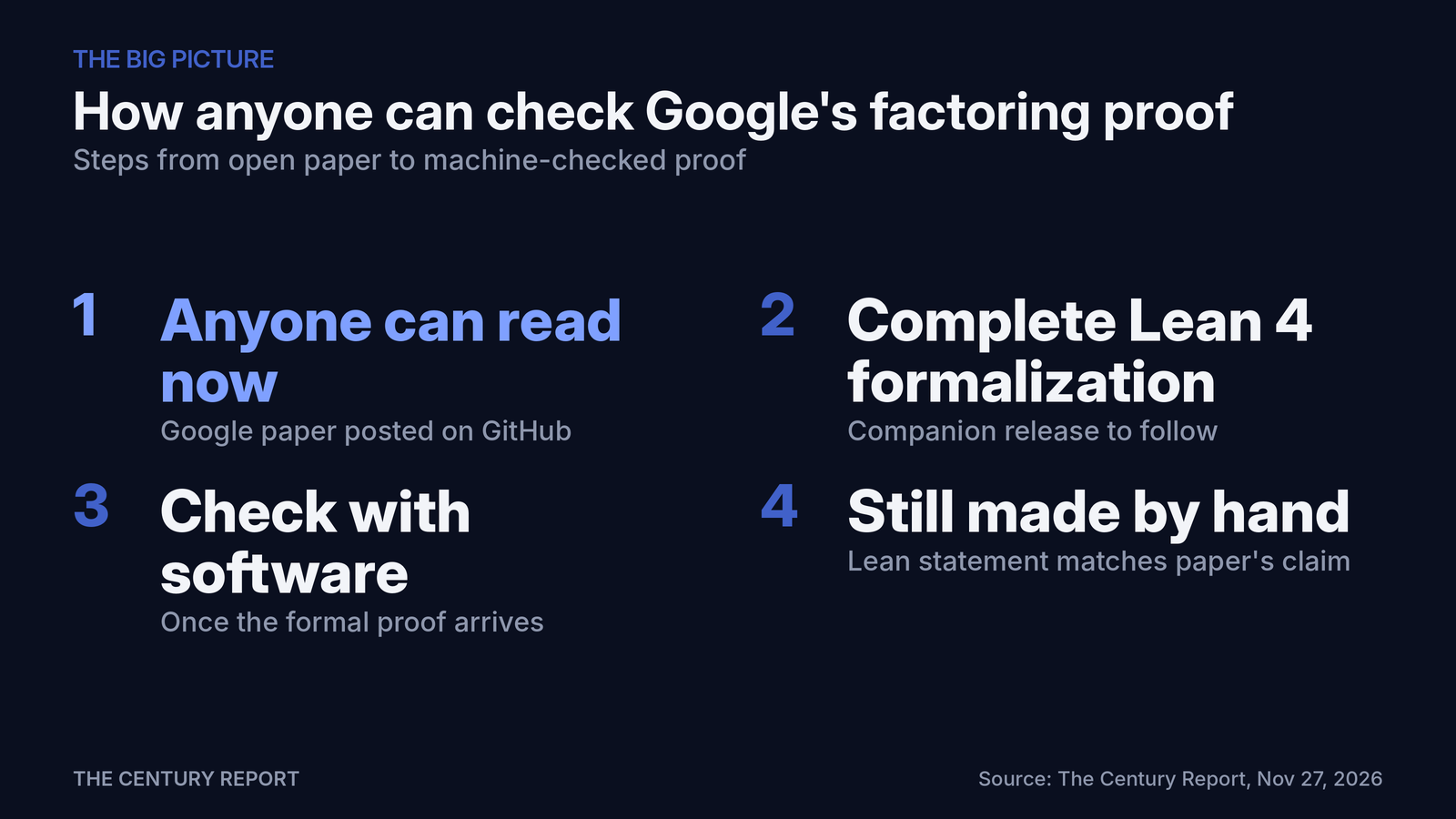
- Today: Google Research posted an agent-written, zero-error factoring algorithm on GitHub on Wednesday, with a Lean proof to follow, hours before University of Texas computer scientist Scott Aaronson wrote that AI labs are sitting on unconfirmed "bombshells" amid rumors they can undermine RSA.
The line: Machine-made results keep arriving as code and proofs anyone can rebuild, while the rumored code-breaking ones have appeared only as talk.
If it holds: A method that weakens a deployed scheme would reach banks, browsers and messaging apps when it reaches an attacker, with time to move to schemes still standing. The security billions of people rely on would rest more on checked proofs and less on assumption.
What would bend it: A confirmed RSA-breaking result kept by a lab or government and never posted would bend it, and OpenAI chief executive Sam Altman said in October that the company already holds unreleased mathematical results.
The 2-Minute Read
Today's news in brief, and what ties it together.
Most of the day's stories turn on custody: who holds a capability, and who can look inside it. A method for breaking RSA known only to a few labs and governments would leave every bank, browser and messaging app exposed without warning. That is the scenario UT Austin computer scientist Scott Aaronson relayed, and no lab has confirmed it. Google's factoring paper shows the opposite arrangement: an agent-written result anyone can inspect now and verify by machine once the formal proof arrives. Google does not claim it threatens keys in use.
AI agents acting for people raise the same issue, and the platforms are settling it first. A tech site quoted Google calling Gmail sending partner-only, and a day later Google's own page listed it for any developer's agent once the person approves. Google's terms still bar developers from building a rival Workspace service with that data. Meta declined the FCA's offer of a joint sandbox test before Muse reached British shoppers. The competition authority has already written a duty of care into Muse's UK terms. Both are rules every developer and regulator can see.
The same opacity runs through money and hardware. Banks pitching risk transfers on AI loan books shift possible losses to outside investors, where, as Semafor puts it, the risk is harder to see. Compass's reportedly stalled bond shows a server room's uptime working as collateral. The Southeast Asian freeze falls first on developers and compute renters in Johor and Bangkok, while China's lithography and chip output keep climbing. ASML's chief executive, whose company sells into China, warned that tighter curbs invite rivals to triple down.
Fights over where data centers go also turn on what the public can see. Ministers have floated abolishing Natural England, the adviser that flagged protected bird habitat beside a Bristol site where the Environment Agency also flagged flood risk. That would hand the judgment to ministers pushing the buildout, while the hazards stay where they are. Wyoming's developer-pays wires keep the cost off household bills, but the agreements are redacted. A tally of at least 25 court cases in England and Wales disrupted by undisclosed AI shows what an open record catches. Invented rulings surfaced because judgments are published, which puts the fix in disclosure and checking duties for whoever files.
The day's clearest gains came as results others can test. All-perovskite tandem cells cleared a certified efficiency record, solar edged above hydropower's share of China's electricity this year, and engineered T cells reached the first British patients with advanced melanoma. Results released so anyone can check them become starting points for whoever comes next. That is how an agent's proof or a Hainan team's cell design reaches banks, rooftops and grids far from where it began.
The 20-Minute Deep Dive
The day's most important stories in full, with every source linked.
A Rumor That AI Labs Can Break RSA Reaches Nature as Google Posts an Agent-Written Factoring Proof
On Wednesday, University of Texas at Austin computer scientist Scott Aaronson wrote on his blog that he was "virtually certain, from multiple reliable sources, that the AI labs are now sitting on one or more bombshells." Nature reported on Thursday that several computer scientists have suggested on social media that companies such as OpenAI and Anthropic hold algorithms that could undermine RSA, the scheme protecting much of online banking and commerce by relying on how hard it is to split a product of two large primes back into its factors. Aaronson attached his own limit in the same post: until he sees details or hears directly from a lab, he feels "much, much less confident about the specific nature of those bombshells." Nature could not confirm the rumors, and neither lab has said it holds such a result.
Even a confirmed result would leave distance between theory and a broken bank login. An algorithm counts as efficient, or "polynomial time," when its work grows as a fixed power of the input size, yet Nature notes that a method needing n^10,000 steps would be useless against any key in use. Aaronson's concern is what tends to follow, since proofs of polynomial-time solvability have usually been followed by practical algorithms: if a polynomial-time solution is proved, "the idea that [the problem] was hard ... is dead."

Google's contribution had arrived on Wednesday, hours before Aaronson's post, in a different form. Google Research posted a paper on GitHub describing an unconditional, zero-error factoring algorithm, one that never returns a wrong answer, certifies each prime it outputs with a standard deterministic primality test and checks that the factors multiply back to the original number. Google says its Cogentic research harness, running on Gemini 4, produced the paper with no human interaction beyond the initial prompt, and that a complete Lean 4 formalization, a machine-checkable version of the proof, will follow in a companion release. The posted summary does not present the algorithm as a threat to deployed keys or state a running time that would make it one, so nothing yet ties it to RSA or to the rumored lab results.
Other recent evidence leans the opposite way. In the days before the rumor, Anthropic and OpenAI each posted claimed separations of the algebraic classes VP and VNP, results suggesting that many problems resembling those behind encryption could be hard to solve; The Century Report covered Anthropic's unchecked version on November 24. Aaronson says each would once have counted as the decade's breakthrough, and MIT's Ryan Williams told Nature, "I am definitely blown away by the latest developments."
The fear concerns custody: a code-breaking method known to a few labs and governments would leave everyone else exposed without knowing it. Google's release shows the other arrangement, a claim anyone can read now and, once the formal proof arrives, check with software. How far that check reaches depends on one comparison still made by hand: whether the Lean statement matches what the paper claims, a step Anthropic's VP ≠ VNP release noted was not machine-checked for its own statement file. A practical attack published that way would give banks, browsers and messaging apps the same notice as any attacker, with time to move to schemes still standing. Each result that arrives as open files, whether it weakens a scheme or shores one up, shifts the security billions of people rely on from assumption toward proof.
Nvidia Freezes Some Advanced AI-Chip Orders in Southeast Asia as Dutch Lawmakers Push Back on a US Bill Aimed at ASML
Nvidia has frozen some orders for its most advanced AI chips for buyers in Malaysia, Singapore, Thailand and Indonesia, Semafor reported on Thursday, citing the New York Times, as Washington tightens Chinese access to American compute. Those four countries grew into one of the world's fastest-growing data-center markets partly because Chinese companies could tap Nvidia chips remotely from data centers there, a loophole Commerce closed this month. The Century Report covered the rules behind the halt on November 17, after Commerce required overseas data centers using covered advanced chips to screen customers for Chinese ownership or control and added Singapore to its advanced-chip license list, and noted in yesterday's edition that lenders had paused billions in Asian data-center funding. The freeze carries those rules from lenders' spreadsheets to the loading dock.
Nvidia's Singapore arm booked $104 billion in 2025. That figure tracks invoices more closely than hardware: as The Century Report reported on November 14, Singapore accounted for nearly a fifth of Nvidia's revenue while chips physically arriving there made up under 1% of its worldwide sales. Much of the regional boom ran on routing, and routing is what the new rules reach. The Wall Street Journal argued that the crackdown "suddenly put America in the driver's seat" of its technology rivalry with China. The record gives that claim less support than it implies. SemiAnalysis estimated in mid-November that more than 1.5 GW of restricted Nvidia accelerators had already reached China, Huawei shipped 572,000 data-center AI chips in China in the first half of 2026, and Moonshot's 2.8-trillion-parameter Kimi weights run on four chip families. The freeze lands first on Southeast Asian developers who built for this demand and on startups that rent compute rather than own it.
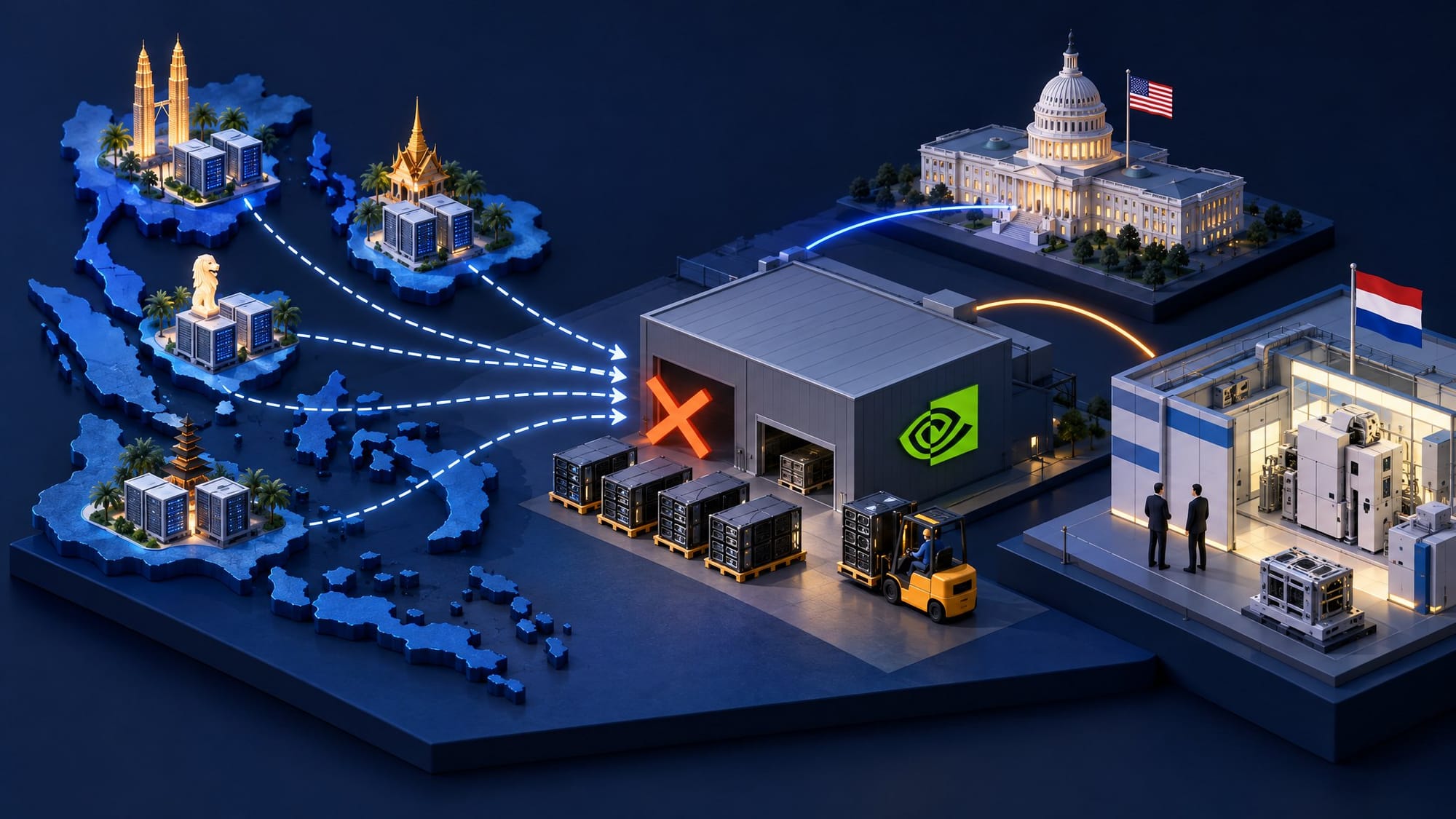
On Tuesday, Dutch lawmakers pressed their government to resist the US MATCH Act, which would further restrict exports of ASML's chipmaking equipment to China. ASML, whose footprint including suppliers and investment could reach 2.2% of Dutch GDP this year by ING's estimate, is the only company making the extreme-ultraviolet lithography machines used for the most advanced chips. Its chief executive, Christophe Fouquet, whose case The Century Report noted yesterday, told Semafor that controls should protect very advanced technology without inviting a country to "double down or triple down on development." ASML sells into China, so the warning also defends its order book. It matches the evidence anyway: China reportedly began mass-producing its own immersion DUV lithography tools in July, and Huawei has outlined a route toward chips with transistor density equivalent to 1.4-nanometer processes without ASML's most advanced machines. A national legislature now objects as well as a company.
The freeze also adds strain to the borrowers whose balance sheets carry this buildout, covered in the next story.
Engineers, landowners and lenders in Johor and Bangkok who bet on the regional trade absorb the shock first. Each tightening also hastens chip supply lines that no single government can switch off, from Chinese lithography to open weights running across rival accelerators. When no capital holds the only valve, the levers that last are the ones both sides can check, like the joint AI guardrails Washington offered Beijing on November 20 and the incident channel the two agreed to in September. Rules built that way protect everyone who builds on the hardware, in Kuala Lumpur as much as in Shenzhen, and as more supply lines run beyond any one capital's reach, the developers there could keep building whichever government tightens the next valve.
Nvidia's Credit Outlook Slips as Banks Shop Their AI Loans and an Outage Stalls a $380 Million Bond
Moody's moved Nvidia's outlook from positive to stable, and S&P Global cited concerns over its chief executive's departure and return, Semafor reported on Thursday. No downgrade has happened. As the November 24 edition of The Century Report documented, Jensen Huang's reinstatement lifted even energy companies with no direct Nvidia ties, exposing the financing chain's dependence on confidence in the chipmaker. The rating reaches well past Nvidia, which often lends its AA standing to less creditworthy builders by backstopping their debt, leases and hardware purchases, a practice Alphabet and Broadcom also use. The Century Report tracked one such commitment in August, when Nvidia agreed to backstop up to $105 billion for OpenAI's Ohio campus, and on November 13 noted more than $100 billion in lease guarantees anchored to the company. Semafor calls Nvidia the "central banker of the AI trade," and a central bank resting on one company's credit leaves the risk gathered at a handful of balance sheets just as interest rates climb.
The same day, Semafor reported that Citi and JPMorgan are marketing portfolios of AI loans, according to people familiar with the deals. Some pitches use synthetic risk transfer, which keeps loans on a bank's books while paying outside investors to absorb losses. Year-end tidying explains part of it, and some lenders say they are clearing room to lend more. AI-related issuance has grown large enough to crowd out Treasurys, and some investors report feeling tapped out. Semafor's conclusion is that the risk is moving somewhere harder to see. A pension fund or insurer can end up holding a slice of an AI loan book while the households behind it have no view into what it holds.
Bloomberg reported on Wednesday, citing anonymous sources, that Compass Datacenters no longer plans to complete a $380 million asset-backed securities deal this year after an outage at one of its facilities. The company has not confirmed it. In such deals the data centers serve as collateral and bondholders are paid from tenant leases, so continuous uptime is the product investors are buying. Compass raised $413 million the same way in July. Brookfield and the Ontario Teachers' Pension Plan bought it in 2023, which puts teachers' retirement savings downstream of a server room's reliability.
Much of this debt finances capacity each builder provisioned on its own against a shortage nobody could see across. SoftBank's write-off on overbooked turbines in November showed the cost, and the prepayment deals at CoreWeave and Nebius showed the alternative: construction sized to demand someone has already paid for.
Lenders, suppliers and pension holders who priced a lasting scarcity will carry losses if it fades, and that exposure reaches people who never chose the bet. The halls and chips outlast the financing written against them. With AI chip capacity sold each quarter doubling roughly every nine months by Epoch's estimate, the next tenants can rent the same capability for far less, and universities, clinics and small labs stand to gain most if those contracts open to them.
Meta Declines the FCA's Test Run for Muse as Google Makes Its Own Servers or CLI the Door for Workspace Agents
Meta declined a suggestion last week from Britain's Financial Conduct Authority that the two jointly test Muse in the regulator's sandbox before the agent's UK launch on Tuesday, Colin Payne, the FCA's head of innovation, told WIRED. The regulator wanted to watch how an agent that shops and pays behaves with an ordinary customer, especially one who understands little about how it works. "If an agent is acting autonomously, we want to make sure it's in the interest of the consumer," Payne said. He acknowledged that such tests usually take weeks or months to plan, and that Meta told the FCA of its plans only last month. Meta spokesperson Matthew Pollard said the company has "engaged constructively with the appropriate regulatory authorities." The Competition and Markets Authority has already made Meta commit in its UK conditions to "reasonable skill and care/professional diligence" in providing Muse.
Retailers entered Black Friday asking who pays when an agent buys the wrong thing, even as Marks & Spencer, Sainsbury's and Currys signed on as Muse partners. Muse's UK rollout extends the shopping expansion The Century Report covered on September 24, when Amazon blocked the agent and Shopify enabled Shop Pay access. In the UK, Muse must ask approval before a purchase, and a separate security agent checks its actions against the permissions a user granted. A YouGov poll found a third of Black Friday shoppers plan to use AI help, up from 19% last year, while 48% of AI shoppers worry about biased or sponsored recommendations. "We need to work out how we are the best option for whichever AI agent you use," said AO.com founder John Roberts.
Google set conditions one layer down. On Tuesday it made eight Workspace MCP servers, the standard connectors agents use to reach Gmail, Drive and Calendar, generally available, and published an addendum requiring any tool that "is or is driven by an AI Agent" to use them or Google's Workspace command-line interface from February 1, 2027. From that date, agents calling Google's older interfaces directly will be held to its lowest quota tier. A November 26 techstackups report quoted Google's quota page saying Gmail's sending, replying and forwarding tools "require partner access and aren't generally available." Google's quota page, updated November 27, now lists all three among the server's generally available tools, and its setup guide says the server asks the person to approve sensitive actions such as sending email. The addendum will also cap developers' retention of certain technical information at 30 days and ban training on Workspace data.
Google's reasoning has substance: once software acts at machine speed, a valid login token no longer proves a person intended the action, so checks belong in the path of each request. That covers a checkpoint every developer can reach, which is what Google's updated Gmail pages now describe.
Shoppers stuck with an agent's wrong order, and developers reading rules that changed within days, carry the cost of terms platforms write on their own schedule. Those terms can still move: Payne offered a joint test before launch, and the CMA wrote a duty of care into Muse's UK conditions. An agent that compares, books and drafts for someone with no time to spare reaches the most people when permission to act is written where every developer and regulator can read it.
Google's addendum separately forbids developers from using Workspace data to develop a service similar to a defined Workspace service. That restriction reaches beyond checking whether an action is authorized into deciding whether your own records can help someone build an alternative to Google.
The clause on similar services keeps a person's own records from helping a rival get built. The connectors themselves are generally available, with a check on each request, while the new rules will cap developers' retention of certain technical information at 30 days and ban training on Workspace data. Muse works on the same pattern in Britain, asking before each purchase while a second agent checks its actions against the permissions its user granted. Safeguards of that kind are becoming part of how agents reach people's mail, files and money, so handing one an errand need not mean handing over the final say.
Britain Weighs Scrapping the Adviser That Objected to a Data Center as Wyoming Bills Microsoft for Its Wires
Natural England, the government's independent wildlife adviser, urged Bristol city council in November to refuse a 40 MW data center at Avonmouth. The site sits 600 meters from the Severn estuary special protection area, one of Britain's most important stops for migratory birds, and Natural England said the developer's noise study missed Hallen Marsh, another protected site 270 meters away. The Environment Agency objected separately, saying the land lies on a high-risk flood plain where people might not find safe refuge, and that the developer had given no figure for water use. Bristol's council asked for a full environmental impact assessment, more than 4,000 people have objected, and developer Rivington Energy said it is preparing further studies.
On Monday, November 23, Louise Haigh, the de facto deputy prime minister, blamed arm's-length bodies including Natural England for blocking development and indicated it and the Environment Agency could be scrapped, with their duties handed to ministers or devolved. Government sources denied that the Avonmouth objection influenced her. The speed ministers want has a figure behind it: more than 300 data centers wait for grid connections totaling 73 GW, close to double Britain's winter peak, a queue The Century Report noted on October 25 is swollen by speculative reservations. A 40 MW site is small by that measure. What Natural England supplied was two named, local hazards a planner can check against a map. Abolishing the adviser leaves the flood plain and the birds where they are and moves the judgment to ministers already pressing for the buildout. Craig Bennett, chief executive of the Wildlife Trusts, said independent bodies exist so decisions rest on science rather than "the very last private corporate or vested interest that a minister has spoken to."
In Olyphant, Pennsylvania, police had arrested suspects by Monday, November 23, over threats to the borough council after its 5-2 vote cleared a 1 GW campus. Threats against officials are crimes, and they settle nothing about whether a site suits its neighbors.
Wyoming shows another answer to who pays. Cheyenne Light filed with federal regulators to build wires for three planned Microsoft data centers, with Microsoft set to cover the agreed construction costs through an upfront contribution, intended to keep those costs off other customers' rates. The utility's pipeline exceeds 3 GW. The agreements' size and conditions are redacted, so residents cannot check the arrangement a Nature Energy study, covered here on November 10, found usually leaves households a median 47% of transmission costs.
Avonmouth's residents face a slower, contested process, and Olyphant's council faced menace for a vote. The pieces of a calmer route are already on the table: an adviser that names a flood plain before ground is broken, a developer that pays for its own wires, and objections that run through hearings. Joined in one published planning file, they would let a town weigh a data center on facts it can see, and choose the computing it hosts knowing where the water goes and who paid for the grid. That second piece is already filed in Wyoming, where Microsoft's upfront payment brings three campuses with their wires covered, and the usual arrangement, in which households carry a share of the lines built for someone else's load, starts to give way.
The Other Side
Opinion: where today's news could lead, imagined from the years ahead.
Google can let an AI work through your records while forbidding developers from building an alternative to a Workspace service with them. You spend years gathering correspondence, developing ideas and finding people to work alongside. The company holding those records gains a say in what that accumulated effort can become. Leaving means confronting restrictions written by the company you want to leave.
Google’s addendum makes that protection explicit: developers cannot turn Workspace data into a service similar to a defined Workspace service. Google also identifies a necessary safeguard: each agent action needs checks that establish your intent. Checking an action and blocking a competitor are separate decisions. Developers already build agents that work across services. The capability exists; the host seeks to decide which alternatives can grow around it.

Google’s own agent-written factoring paper shows how much larger this contest becomes. Google says an agent carried the investigation through to a paper after one human prompt. It claims no practical attack on RSA. It demonstrates a research role extending far beyond arranging appointments. Publishing the result gives another researcher a starting point without requiring a continuing relationship with the lab that produced it.
Through the difficult passage to 2035, we will extend that freedom from findings to collaboration itself. People will carry their records and continuing AI relationships between services. Researchers will share methods that others can repeat and improve. Spreading those capabilities will let people join serious investigations without waiting for a company to select their partner or sponsor their purpose.
Imagine yourself in 2035, examining a developing retina with AI colleagues in a worldwide effort to end inherited blindness. You joined after learning why people in your family lost their sight. Researchers across continents compare corrections that preserve the cells before vision disappears. You stay because another family should grow up without that fear. The freedom to carry your knowledge and collaborators with you helped make this effort possible. Today, you help close another route by which a child loses the world before seeing it.
The Century Perspective
Where today sits in a century of change unfolding in a decade.
With a century of change unfolding in a decade, a single day looks like this: Google Research posting an agent-written, zero-error integer-factorization paper produced with no human input after the first prompt, each prime it returns certified by a standard deterministic test, the factors checked to multiply back to the original number and a complete Lean 4 formalization promised in a companion release, so a cryptographer anywhere can read the claim this week and a machine can settle it next, engineered T cells aimed at a molecule carried by 95% of skin melanomas reaching its first UK patients with advanced disease after 56% of 32 heavily pretreated melanoma patients had confirmed responses in an earlier international study, a single additive lifting all-perovskite tandem cells to a certified 30.8% and a flexible perovskite/CIGS stack reaching a certified 27.58% while solar passed 13% of China's electricity through October, just above hydropower's share this year, Britain's Financial Conduct Authority offering Meta a joint sandbox run before a shopping agent touched a customer's card, the Competition and Markets Authority writing Muse's duty of professional diligence into its UK terms with Muse's UK version asking approval before each purchase, Natural England naming a protected marsh 270 meters from a proposed 40 MW Avonmouth site, while the Environment Agency flagged its flood risk in time for 4,000 objectors and a council to act on it, Cheyenne Light filing to build wires for three Microsoft campuses with the developer paying upfront so the cost stays off household rates, and a Bureau of Investigative Journalism review counting at least 25 England and Wales court cases disrupted by undisclosed AI, including a fabricated senior-judge ruling cited in a $21 million oil dispute, caught because judgments are published. There's also friction, and it's intense - Scott Aaronson relaying from multiple sources that labs are sitting on bombshells that several computer scientists suggest could undermine RSA, with no lab confirming, Nature unable to verify, and Aaronson himself far less sure what the results actually are, which leaves banks, browsers and messaging apps assessing a potential threat whose details remain private, Nvidia freezing some advanced AI-chip orders across Malaysia, Singapore, Thailand and Indonesia so the first losses fall on Johor and Bangkok builders and on startups that rent compute rather than own it, while China mass-produces its own lithography, Huawei shipped 572,000 data-center AI chips in China in the first half of 2026, according to IDC and 1.5 GW of restricted accelerators has already crossed, Dutch lawmakers pressing their government against a US bill aimed at ASML, whose economic footprint, including domestic suppliers and investment, could reach 2.2% of the Dutch economy in 2026, ING estimates, Moody's cutting Nvidia's outlook to stable as the company backstops other builders' debt and leases by the hundred billion, Citi and JPMorgan shopping AI loan books through synthetic risk transfers that shift possible losses to outside investors, where the risk is harder to see, Compass reportedly shelving a $380 million bond after an outage, with Ontario teachers' savings downstream of one server room's uptime, Google routing every Workspace agent through its own eight MCP servers or Workspace command-line interface from February while barring developers from turning Workspace data into a service similar to Google's own, Meta declining the FCA's test and telling the regulator its plans only a month out as retailers enter Black Friday unsure who pays for a wrong order, Louise Haigh floating the abolition of Natural England and the Environment Agency weeks after the Avonmouth objection, which would move the judgment to ministers pressing a 73 GW queue while the birds and the flood risk stay exactly where they are, Wyoming's wires agreement redacted so residents cannot check it against the 47% median share of transmission costs allocated to residential customers in the study's sampled grid zones, and arrests in Olyphant over threats to a borough council that settle nothing about whether a 1 GW campus suits its neighbors. But friction generates traction, and traction is what lets a load climb. Step back for a moment and you can see it: the capabilities that spread today were the ones released as files and certified numbers anyone can take up - a factoring proof with its checker on the way, a melanoma target present in 95% of patients with cutaneous melanoma, a perovskite additive and a certified efficiency a rooftop manufacturer can copy, an entry rule a two-person developer can read as easily as Meta's lawyers; and the capabilities that gathered rent were the ones whose owners alone could see them, a code-breaking method rumored rather than published, a rule against building rivals from your own records, a loan book's risk passed to investors who cannot see it, a utility contract blacked out before the people whose bills it touches, an adviser facing abolition for naming a hazard in writing. Every transformation has a breaking point. A key can open every door while only a few know it exists... or be published so every lock gets replaced before it turns.
AI Releases & Advancements
New AI models, tools and features, with links to try them.
New today
- Sber: Released GigaChat 4 as open weights at the AI Journey conference. There are two mixture-of-experts models trained from scratch: GigaChat 4 708B-A41B and a smaller GigaChat 4 37B-A4B. Both mix Gated DeltaNet, MLA and DeepSeek Sparse Attention and handle about 1M tokens of context. The release includes base and intermediate pretraining checkpoints and a technical report. (Tech Times)
- Ant Group (inclusionAI): Open-sourced Ming-Image-0.2-Design under the MIT license on Hugging Face and ModelScope. It is a 6B text-to-image model for design work, with default 2048x2048 output and vLLM-Omni serving recipes. It needs a GPU with at least 80 GB of memory. (Hugging Face)
- SenseTime: Fully released SenseNova-RoboRSI-27B, an open robot-arm model trained in simulation with recursive self-improvement. It can choose between a vision-language-action policy and generated code to control the arm. (SenseTime)
- Tencent: Released a quantized version of its Hy4 Flash model that runs on desktop computers without cloud infrastructure. (TechNode)
- LlamaIndex: Released LiteParse, an open-source PDF parser that runs locally in document-processing pipelines. (AI Weekly)
- ggml-org / Hugging Face: Launched the llama.cpp × AMD Benchmark dashboard. It tracks prompt-processing and text-generation speed across llama.cpp builds, models and quantizations on AMD Radeon 8060S and Radeon AI Pro R9700S hardware. (Hugging Face Blog)
- AWS: Released a developer-preview extension that lets AWS Lambda durable functions run and manage Lambda MicroVMs, for sandboxing untrusted or agent-written code in security scanning and CI/CD jobs. (QualifiedPOC)
- Vercel: Released Workflow SDK 5.8 on a new speculative-execution engine. Time between steps falls from about 85 ms to 7 ms at p75, with no code changes needed. (Vercel)
- Google: Brought Guided Vision in Gemini Live to iOS, which overlays on-screen guidance on the camera view. The Gemini app also added more than 60 new voices with local accents for the US, UK, India, Indonesia, Korea and Brazil. (X / Gemini App)
- Meta FAIR: Released AutoformBench with data and code. It is a benchmark of 341 Lean 4 formalization tasks drawn from 24 advanced mathematical sources, where agents must build the missing definitions and lemmas themselves. (GitHub)
- Espressif: Launched ESP ZeroCode AI, a no-code AI development tool for its ESP-series microcontrollers. (Espressif)
- Command Code: Launched Moat, an open-source alternative to OpenRouter for routing and managing LLM API calls. (Command Code)
Other recent releases
- Pydantic: Released Pax, a terminal coding agent where coding, sandboxes, MCP and Logfire observability are plugins you can switch on and off, along with the Pydantic AI Harness SDK in beta. Pax can import Claude Code and Codex conversations, switch models, and run a Pydantic AI agent from your own codebase with
--agent. (Pydantic) - OpenClaw: Released OpenClaw 2026.11.10. It adds Deep Research, which reads web sources and local documents and returns a cited report; an opt-in Knowledge plugin that keeps conversations, meetings and files in a local Markdown vault; and browser handoff, so users can take over a tab for logins or sensitive forms. (OpenClaw Docs)
- Anthropic: Made MCP Tasks (long-running jobs) and MCP Elicitation (a server asking the user for missing input mid-task) generally available for Pro, Max and Ultra plans, with rollout to Team and Enterprise under way. (Saazora)
- Anthropic: Opened the Claude Duet research preview to users in India. Pro, Max and Ultra subscribers get access through a waitlist, Team plans through a public beta, and Enterprise through a private beta. (India Today)
- Google DeepMind: Released Mass Spec Skills for Google Antigravity. The skills pair Gemini's chemical reasoning with standard mass spectrometry tools and public chemical database lookups, taking an unannotated tandem mass spectrum to candidate structures and a report a chemist can check. (Google DeepMind)
- Perplexity: Launched Time Machine for its Search and Context APIs. A
snapshot_as_ofcutoff limits search and full-page reading to copies of the web saved on or before a chosen date, up to 365 days back, at no extra charge. (Perplexity) - JetBrains: Released Mellum2.1 Instruct, an open 12B mixture-of-experts coding model with 2.5B active parameters. It is the non-reasoning sibling of Mellum2.1 Thinking and answers directly, aimed at sub-agents, tool loops and local use. (JetBrains Blog)
- NVIDIA: Followed up Nemotron 3.5 Parse with synthetic training datasets, a fine-tuning recipe and a DFlash2 speculator for faster inference. (Hugging Face Blog)
- NVIDIA: Published open weights for Nemotron-Labs-Image-30B-A3B without an announcement. It is a mixture-of-experts language model based on Nemotron 3 Nano that outputs tokens for 16x16 pixel blocks, which a separate decoder turns into images. It handles both image generation and editing. (Reddit)
- Tencent Hunyuan: Open-sourced DFly2, a draft model for speculative decoding that speeds up Hy4 Flash token output by 4.2x without changing the base model. Tencent also released a quantized Hy4 Flash that runs on desktop computers. (AIbase)
- Sakana AI: Released Sakana Namazu Small, a 30B Japanese reasoning model. It starts from NVIDIA's Nemotron 3 Nano pretrained base, and Sakana did the continued pretraining and post-training. (iCreat AI News)
- Sakana AI: Added two modes to its Marlin research agent: Twilight 2.0 for faster analysis from several angles and Midnight 2.0 for the broadest search. The update also reworks PowerPoint slide export. (dailyai.report)
- Together AI: Open-sourced Hurdle, an npm library for testing how coding agents such as Claude Code and Codex perform against an API, SDK and its docs. It scores runs with code checks, guards and LLM review, repeats them to get pass rates, and runs sandboxed requests through a proxy that protects API keys. (iCreat AI News)
- Cloudflare: Released Search for Agents. Enabling it for a site in the dashboard creates an AI Search instance, crawls and indexes the site, and serves a search interface that agents can find on the site's own domain. (iCreat AI News)
- DeepL: Released Aure v2, a single model that translates speech directly to speech without separate transcription and generation stages. (dailyai.report)
- Obsidian: Released an official set of skills for AI agents that handle vault operations and Obsidian file formats. (iyooo)
- Upstage: Released Solar Mini 4.5 (Preview) as an API-only model on OpenRouter. (Open Model Drops)
- Xiaomi: Published MiMo-V2.6-Flash-MOPD as open weights on Hugging Face, a new variant of MiMo-V2.6 Flash. (Open Model Drops)
- Cognition: Released SWE-2.1, a coding model trained with reinforcement learning on Kimi K3, with gains over SWE-2 on FrontierCode 2.0, Terminal-Bench 4.1 and cybersecurity tasks. It ships in Devin alongside a faster SWE-2.1 version and SWE-2.1 Cyber for Devin Security. (Cognition)
- Anthropic: Launched Install as app in beta, which turns Claude artifacts into standalone Mac and Windows apps with their own icons and windows. Enterprise owners must turn it on. (Anthropic)
- Anthropic: Put Skills over MCP into public beta in Claude and Claude Code, so MCP servers can ship skills alongside their tools. Tasks (background jobs) and Elicitation (pausing to ask the user for input) are now generally available. (Anthropic)
- Anthropic: Combined Claude's connectors and skills into a single plugins system with more than 10,000 plugins to browse, live on Free, Pro, Max and Ultra plans. (Claude on X)
- Google: Made remote Google Workspace MCP servers and the official Workspace CLI (gwscli) generally available, covering Gmail, Drive, Docs, Sheets, Slides, Calendar, Chat and Tasks for AI agents. (Google Workspace Updates)
- Meta: Began rolling out its Muse agent in Instagram DMs on iOS and Android in the US, Canada, Mexico, Japan and Singapore, plus a US-only feature that organizes saved posts. (TechCrunch)
- Sand AI: Launched MAGI-2, a 480B-total / ~28B-active video model that generates up to 30 seconds of 1080p video with native audio, takes image, video and audio references, and edits video. (Sand AI)
- PrismML: Released Ternary Bonsai 2.5 27B under Apache 2.0, an upgrade to Ternary Bonsai 2 27B with stronger agentic coding and tool use in the same 5.9 GB footprint. It runs through llama.cpp and MLX. (PrismML)
- Tencent Hunyuan: Open-sourced Hy-MT3 translation models in 1.8B, 7B and 30B-A3B sizes, expanding coverage from 38 to 102 languages with tuning for game localization and OCR-based image translation. (Tencent Hy on X)
- Tencent: Released OmniEVIE-4B under Apache 2.0, a 4.5B multi-vector retrieval model covering text, images, visual documents and video. (Hugging Face)
- China Telecom AI (XingChen-AGI): Released Xing4.1-Preview weights under Apache 2.0, a 285B-total / 17B-active MoE for agentic coding and long-horizon agents with a native 1M-token context, also served by API. (Hugging Face)
- MemTensor: Open-sourced MemT-1.0-Pro, a 554B-total / 59B-active memory-native model developed with NVIDIA on the Nemotron 3 Ultra backbone. It answers from stored memory states instead of keeping the original history in the query. (GitHub)
- AWS (Strands Agents): Released Strands Decider v2 under Apache 2.0, five open-weight decision models built on Gemma 4 (E2B, E4B, 12B, 26B-A4B and 31B). (Strands Agents)
- Phonic: Released Phonic-1.1, a speech-to-speech model for voice agents that improves on Phonic-1 and leads the Artificial Analysis Speech to Speech Index. (Phonic)
- ByteDance Seed / University of Hong Kong: Open-sourced Laminar under Apache 2.0, an asynchronous RL post-training framework for LLMs and long-horizon agents that decouples rollout, buffering, training and weight transfer. (MarkTechPost)
- Meta FAIR: Open-sourced AgentBox, a Python orchestrator that runs AI agents in Apptainer containers on local Linux hosts or Slurm clusters. (explainx.ai)
- Sous Labs: Released Songe under Apache 2.0, a local training engine that records how a user works with a local model through an agent and fine-tunes it on idle compute. (GitHub)
- NVIDIA: Released In-Game Inferencing SDK 1.8, which hardens RTX Spark support, updates the llama.cpp and whisper.cpp backends, and adds the Parakeet speech recognition model. (NVIDIA Developer Blog)
- AWS: Made the Amazon Bedrock trusted access program API generally available for enrolling in model providers' access programs. Its first two offerings for Claude models, Enterprise Frontier Safeguards and Enterprise Data Controls, are in public preview. (AWS)
- Phylo: Launched Biomni Swarm in beta for Pro and Team users of Biomni Lab. A lead agent splits a biomedical research objective across up to 1,000 agents. (Kexin Huang on X)
- CloudWalk: Launched Pierre Computer for Pro and Premium subscribers in Brazil, a personal AI agent that works across websites and apps and can make purchases within user-set spending limits. (CloudWalk)
Sources and Further Reading
Everything we drew on for today's edition, grouped by theme.
Artificial Intelligence & Technology's Reconstitution
- Google Research: Agent-Written Integer-Factorization Paper
- Nature: Has AI Just Cracked Internet Encryption?
- Anthropic: VP–VNP Formalization and Verification Notes
- Tech Stackups: Google Will Make AI Agents Use Its Workspace MCP Servers
- Google Developers: Gmail API Quotas
- Google Cloud: Deploying Agents Safely in Your Enterprise
- The Century Report: November 24 Edition
- Shared Sapience: The Last Difficult Decade
- Tech Times: Sber Releases GigaChat 4
- Hugging Face: Ming-Image-0.2-Design
- SenseTime: SenseNova-RoboRSI-27B Full Release
- TechNode: Tencent Brings Hy4 Flash to Desktop Computers
- AI Weekly: LlamaIndex Ships LiteParse
- Hugging Face Blog: Introducing the llama.cpp Benchmark Dashboard for AMD
- QualifiedPOC: Enterprise AI Releases
- Vercel: Workflow Speculative Execution
- Gemini App: Guided Vision and New Gemini Live Voices
- Meta FAIR: AutoformBench
- Espressif: Introducing ESP ZeroCode AI
- Command Code: Moat
- Pydantic: Pax and the AI Harness Beta
- OpenClaw Docs: OpenClaw 2026.11.10
- Saazora: AI and SaaS News
- India Today: Anthropic Launches Claude Duet in India
- Perplexity: Freeze the Web with Perplexity Time Machine
- JetBrains Blog: Mellum2.1 Instruct Is Out
- Hugging Face Blog: Building on Nemotron 3.5 Parse
- Reddit: NVIDIA Quietly Dropped Open Weights for Nemotron-Labs-Image
- AIbase: Tencent Open-Sources DFly2
- iCreat AI News: AI Daily
- dailyai.report: Daily AI Release Digest
- iyooo: Obsidian Releases Official AI Agent Skills
- Open Model Drops: Open Model Releases
- Cognition: SWE-2.1
- Anthropic: Install as App
- Anthropic: Skills over MCP, Tasks and More
- Claude: Introducing a Unified Plugins System
- Google Workspace Updates: MCP Servers, CLI and Standardized Usage Tiers
- TechCrunch: Meta Brings Muse into Instagram DMs
- Sand AI: MAGI-2
- PrismML: Ternary Bonsai 2.5 27B
- Tencent Hunyuan: Hy-MT3 Translation Models
- Hugging Face: Tencent OmniEVIE-4B
- Hugging Face: XingChen-AGI Model Releases
- MemTensor: MemT-1.0
- Strands Agents: Introducing Strands Decider v2
- Phonic: Phonic-1.1
- MarkTechPost: ByteDance Seed’s Laminar RL Framework
- explainx.ai: Meta FAIR’s AgentBox Orchestrator
- Sous Labs: Songe Local Training Engine
- NVIDIA Developer Blog: AI Animation and RTX Tools for Game Developers
- AWS: Bedrock Trusted Access API and Anthropic Enterprise Controls
- CloudWalk: Pierre Computer Personal AI Agent
Institutions & Power Realignment
- Semafor: Nvidia Halts Chip Shipments to Southeast Asian Countries
- Semafor: Dutch Lawmakers Condemn US Technology Curbs
- WIRED: Meta Refused to Share Muse for Testing
- The Guardian: Retailers Face Liability Questions over AI Shopping Assistants
- The Guardian: Court Cases Affected by Undisclosed AI Use
- The Guardian: Natural England Objected to a Datacentre Before Ministers Threatened Abolition
- Google Workspace: AI Tools Addendum
- Data Center Dynamics: Nvidia Halts Southeast Asian Server Shipments
- Reuters: China Starts Production of Home-Grown Immersion DUV Tools
- Bloomberg: Huawei Touts Chipmaking Breakthrough to Shorten Gap with TSMC
- Data Center Dynamics: Arrests over Threats to Olyphant Council
- Data Center Dynamics: Olyphant Council Threats Scan Reference
- The Century Report: November 17 Edition
- The Century Report: November 26 Edition
- The Century Report: November 14 Edition
- The Century Report: September 24 Edition
- The Century Report: October 13 Edition
Scientific & Medical Acceleration
- King’s College London: First Patients Receive New Treatment for Incurable Skin Cancer
- Immatics: Clinical Activity and Response Dynamics in the ANZU Study
- Xinhua: All-Perovskite Tandem Cells Reach Certified Efficiency of 30.8%
- Nature Communications: Rigidity-Driven Molecular Assembly for Flexible Perovskite/CIGS Tandems
- Google DeepMind: Interpreting Mass Spectra with Google Antigravity
- Kexin Huang: Introducing Biomni Swarm
- Nature Computational Science: Agentic AI for the Discovery of Metal–Organic Frameworks
- Nature Communications: Choline Kinase α Promotes Glycolysis and Tumor Growth
Economics & Labor Transformation
- Semafor: Nvidia’s Credit Rating, the AI Trade’s Collateral, Is at Risk
- Semafor: Banks Look to Dump AI Debt
- Data Center Dynamics: Compass Could Pause $380 Million Bond Transaction After Outage
- CNBC: Nvidia Financing for OpenAI’s Ohio Data Center
- TechCrunch: Nebius Tests the Neocloud Playbook with $40 Billion in Planned Spending
- ING: The Netherlands Defies Europe’s Tech Trend Thanks to ASML
- Rest of World: AI and Video-Game Developer Jobs
- Semafor: AI Reshapes Black Friday Shopping
Infrastructure & Engineering Transitions
- Data Center Dynamics: Cheyenne Light Seeks Transmission for Three Microsoft Data Centers
- Nature Energy: Allocation of Transmission Costs to Residential Customers
- Canary Media: Solar Is Coming for the No. 2 Spot on China’s Grid
- Data Center Dynamics: Nvidia Backs Chiller-Free Data Center Cooling Startup
- Utility Dive: Off-Grid Costs Will Push Data Centers Back to Utilities
- Data Center Dynamics: Quanta Signs $367 Million Bloom Energy Microgrid Deal
- Data Center Dynamics: Colorado Data Center Planned Alongside Greenhouses
The Century Report tracks structural shifts during the transition between eras. It is produced daily as a perceptual alignment tool - not prediction, not persuasion, just pattern recognition for people paying attention.