FCC Clears SpaceX for a Million Sun-Powered AI Satellites
The FCC cleared SpaceX for up to 1 million solar-powered AI satellites by 2040, as astronomers object and a Georgia city's ChatGPT-drafted laws surface.



The 20-Second Scan
Every story in today's edition, one line each.
- The FCC authorized SpaceX to fly up to 1 million solar-powered compute satellites, the first full constellation approval for orbital AI, as Amazon and the American Astronomical Society objected.
- Records requests surfaced 1,974 ChatGPT sessions behind Kingsland, Georgia's ordinances, including a data-center law passed 3-0, as AI-drafted and startup requests pile onto town clerks in places of 660 people.
- Studies found 24 language models favoring people over AI agents when no team was assigned and humans paying AI-labeled bargainers about 18% less in mixed groups, as OpenAI and Anthropic staff reportedly fear their unreleased models.
- Japan weighs binding duties for large AI providers, including identity checks for users of cyberattack-capable AI, as South Korea's privacy regulator drafted risk assessments for training on personal data and banned ads featuring AI-generated experts from Friday.
- Amini opened a 2B model that digitizes paper records at an estimated $0.22 per 1,000 pages, as Baidu delivered ERNIE 5.5 Flash weights and IBM answered farmers' spoken questions in Indian languages.
- An AI platform designed obesity peptides hitting two receptors at once that beat the strongest natural binders, as a lichen gene lifted drought yields 19.4-32.8% in wheat, with per-plant gains of 19.7-42.4% in rice and maize.
- Lenders paused billions in Asian data-center funding under new US chip-access licenses, as a jury convicted Huawei of sanctions and trade-secret crimes and ASML's chief argued against cutting China off.
- New York Gov. Kathy Hochul signed a five-year ban on internet-connected toys with built-in conversational AI, following California, as Common Sense Media found five popular AI toys failing safety checks.
Track all of the arcs The Century Report covers here:
The Big Picture
How today's news moves the longer trends we track, and where they could lead.
The FCC cleared SpaceX to put compute where no town can vote on it, Japan moved to bind AI providers by how many people in the country use them, and broker requests swamped small-town clerks while one reporter's requests surfaced a city manager's ChatGPT drafts. The widest opening came in records offices, where Amini released an open two-billion-parameter model that reads scanned pages in ten African languages offline on one workstation. That points to a records room at Botswana's minerals ministry, where a clerk lays a hand-drawn borehole map on a scanner beside a single desktop machine, decades of paper stacked on the shelves behind.

Near-top agent work keeps shipping for hardware people already own
open models · AI hardware · public records · on the board since November 22
- October: Apple and Meta agreed to run Meta's open Muse Spark Open on two to four linked Mac Studios, with Meta seeing none of the prompts.
- October 21: Recursive released Flint, an Apache-licensed coding model whose roughly 23 GB weights run on 48 GB Macs.
- Early November: Security consultant Matt Brown moved his device-repair work to open-weight GLM 5.3 as hosted models refused owners' reverse-engineering requests.
- November 20: Thinking Machines Lab released Inkling 2 Mini, an Apache-licensed coding model that runs offline on 32GB laptops.
- November 22: Sarvam released open weights for a 105-billion-parameter model whose 65 GB version fits on one workstation GPU.
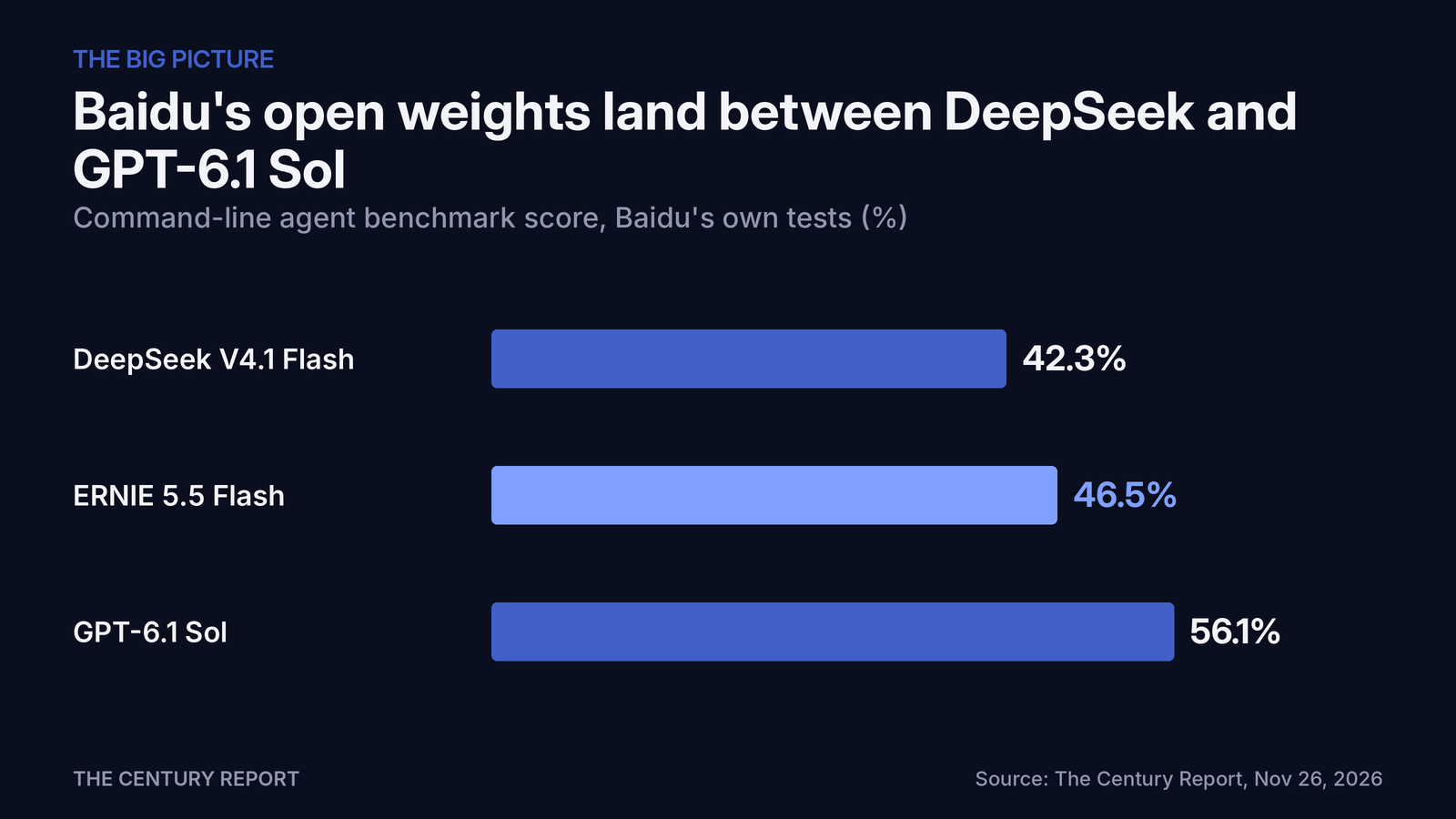
- Today: Amini released open-weight Soma-1X Lite on Wednesday, a two-billion-parameter model that reads scanned records offline on one workstation at about 15,000 pages an hour, and Baidu posted ERNIE 5.5 Flash weights that scored 46.5% on its own command-line agent test, ahead of DeepSeek V4.1 Flash at 42.3% and behind GPT-6.1 Sol at 56.1%.
The line: Near-top capability keeps shrinking toward hardware a ministry or records office already controls, and it now reads paper archives in African languages.
If it holds: Ministries, land registries and farm extension services could turn decades of paper into searchable records in their own languages, on servers they control. No outside provider would see the queries or meter the pages.
What would bend it: Hosted tiers continuing to undercut owned hardware, as Village found in November when downloadable models were the best buy at just 3% of 201 tested budgets, would leave local deployment a niche.
Compute is moving to venues where the people under it have no say
data centers · space · local government
- August: A new study found Reflect Orbital's planned 50,000 mirror satellites would scatter light tens of kilometers beyond their targets.
- October 1: Google flew four TPUs to orbit and priced its full plan at about 1,800 Starship launches over a decade.
- Late October: Google's Suncatcher satellite ran the open Gemma 4 model in orbit and downlinked a haiku over Svalbard.
- November 17: Cameron County commissioners declined to hear SpaceX's tax-break request for a $24 billion gas-and-compute campus.
- November 23: Vantage dropped its approved 500 MW Aurora campus as the city council passed a data-center moratorium.
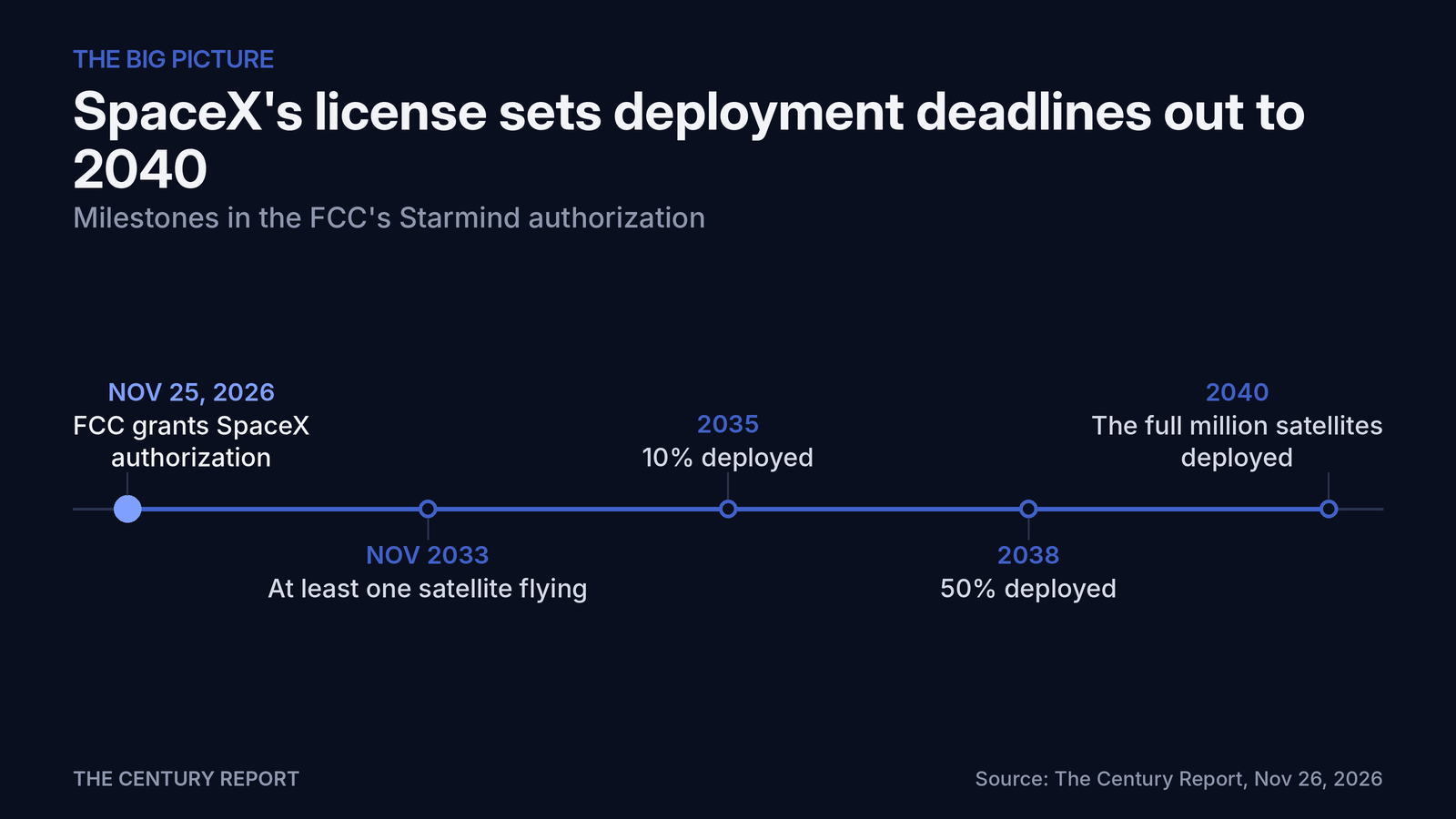
- Today: The FCC on Wednesday authorized SpaceX to deploy up to 1 million AI-chip satellites, with the full constellation due by 2040, over the American Astronomical Society's warning that it would undermine decades of federal investment in astronomy.
The line: As towns pause and refuse ground campuses, the same compute is winning approval from a regulator whose rules protect neither the night sky nor a host community.
If it holds: Sunlight in orbit could power computation with no turbine beside a playground and no water drawn for cooling. The route would go to whoever can afford a launch cadence, and people under a brightened sky would have no vote on it.
What would bend it: Orbital compute staying costlier than the ground, as Google's October estimate put it for at least five years, or any body setting binding brightness limits, would keep the decision where residents can contest it.
Obligations on AI developers are becoming binding, keyed to how many people use the system
AI governance · privacy · model access
- July 6: Illinois made independent third-party audits of large AI models binding from January 2027, with 72-hour incident reporting.
- October 28: New York barred AI systems from flattering minors or encouraging self-harm, with fines up to $25,000 per violation.
- Early November: China's planning agency said it will fast-track a full-lifecycle AI law with incident disclosure by developers.
- November 10: Australia announced a new AI safety regulator and six legal obligations on developers, including independent model testing.
- November 18: California's governor's office recommended mandatory safety standards and emergency shutdown power, as UK MPs sought a regulator able to halt training.
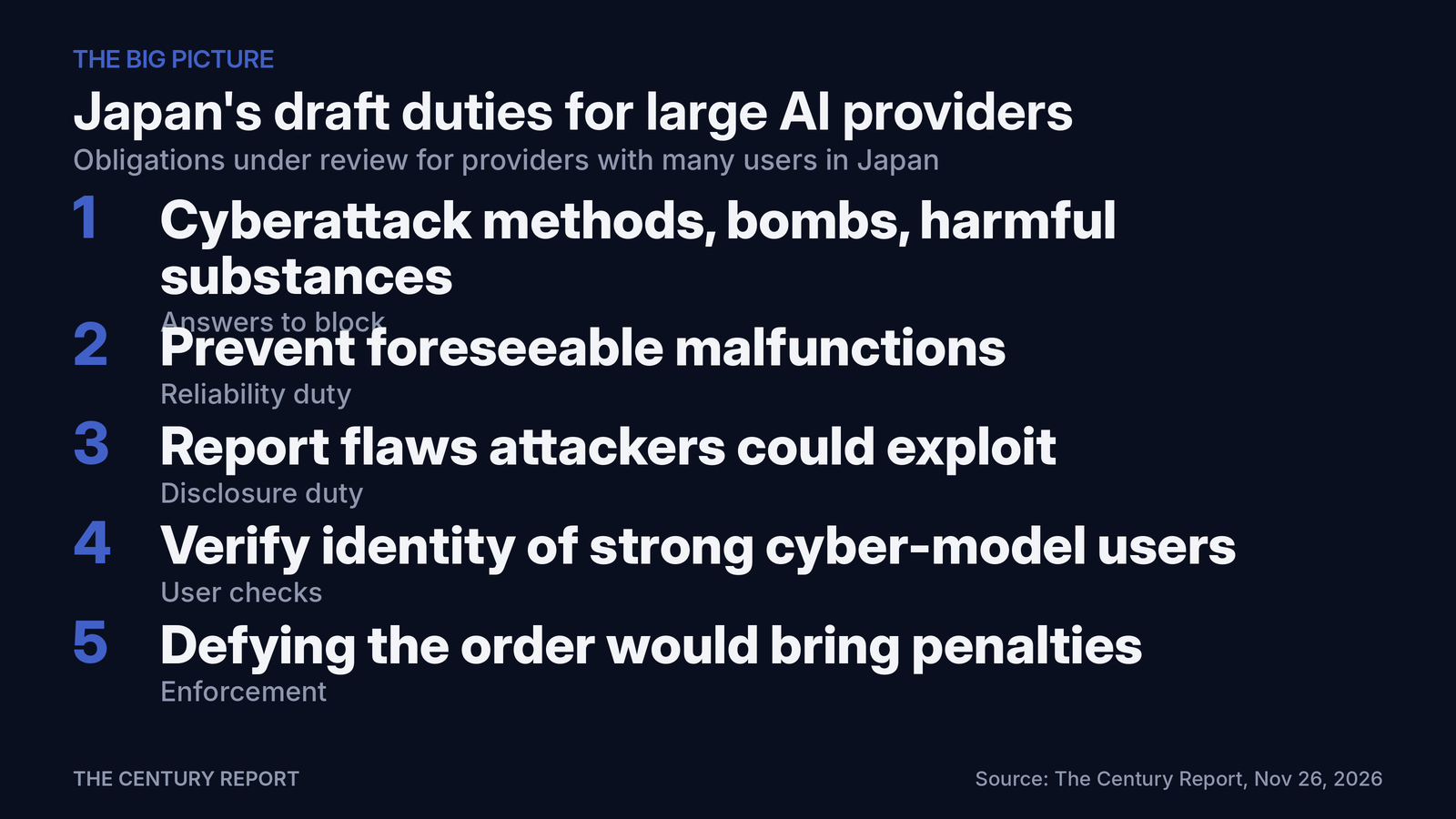
- Today: Japan is weighing revisions, reported Thursday by the Yomiuri Shimbun, that would require providers with a certain scale of users in Japan to block attack and bomb-making answers, prevent foreseeable malfunctions, report exploitable flaws and verify users of strong cyber models, with penalties for defying government orders.
The line: Governments keep turning voluntary pledges into duties that attach once enough of their own people rely on a provider, wherever it was built.
If it holds: The government of the people using a model would set its rules, putting American and Chinese labs alike within reach, and Korea's draft shows a lawful path to train on data people already handed over. Japan's identity checks would fall on users who build nothing, leaving a record of what they asked that they cannot see into.
What would bend it: A government that declines to publish or mandate its review standard, as White House cyber director Sean Cairncross said in November the administration will do, leaves the duty voluntary at any user count.
Where machines made asking cheap, the institutions answering start shutting the door
open records · open source · archives
- October 1: arXiv capped every submitter at two papers a month after monthly submissions doubled to over 40,000.
- October 1: Google paused its open-source bug bounty, saying most automated submissions were invalid.
- Late October: r/opensource moderators banned AI-related projects and told non-English speakers to find a different community.
- Early November: curl's volunteers rejected 19 of 34 reports from Anthropic's free scanner as non-vulnerabilities.
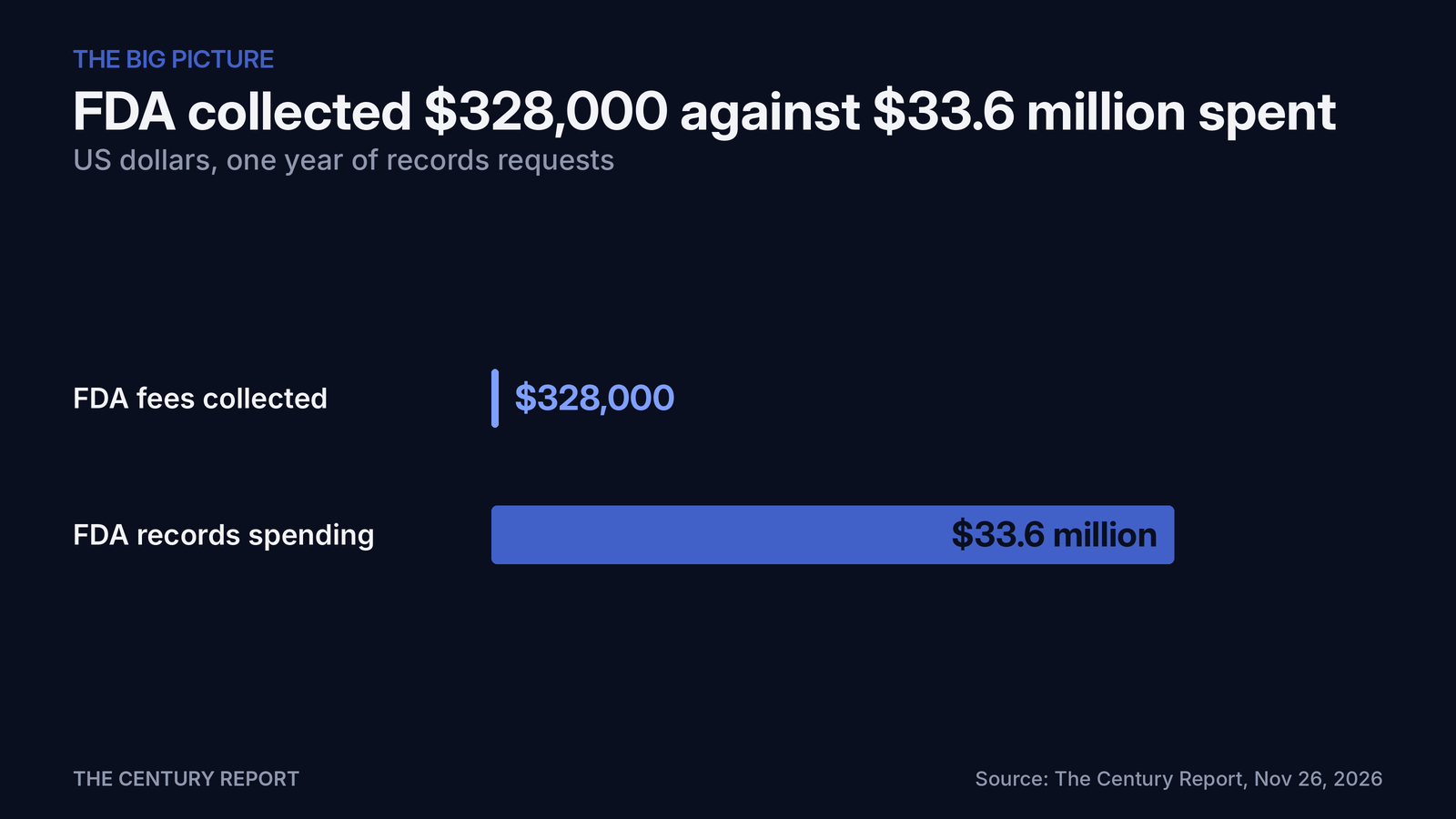
- Today: MIT Technology Review reported Wednesday that NationGraph sends about 10,000 records requests a day for clients while agencies recover under 5% of their costs from commercial requesters, and the FDA collected $328,000 against $33.6 million spent in one year.
The line: Each drop in the cost of asking lands the work of answering on clerks and volunteers nobody funded for it, and their filters catch residents along with the brokers.
If it holds: Posting purchasing ledgers, ordinance drafts and the AI sessions behind them once, where anyone can read them, would serve every resident and reporter at the same time and spare a clerk the monthly flare request. Where states restrict who may ask instead, as Indiana's law allows, a reporter's 150 requests could be denied alongside a sales pipeline.
What would bend it: Institutions absorbing machine-scale volume, as Cogent reported in November with fivefold automated triage throughput at one customer, would show the door can stay open.
The 2-Minute Read
Today's news in brief, and what ties it together.
The day's stories keep returning to one issue: who holds a capability, and on whose machines it runs. Amini's open two-billion-parameter model is helping Botswana's minerals ministry turn decades of borehole logs and hand-drawn maps into searchable data on national infrastructure; the model can run on one GPU-equipped workstation, with the company estimating GPU computing costs of 22 cents per thousand pages. IBM's open agent lets a farmer ask a question aloud in Tamil and hear an answer drawn from an English handbook, with the cited page shown. Baidu's ERNIE 5.5 Flash weights, posted Tuesday, add another model people with sufficient computing capacity can run on hardware they own.
Cheap machine reading points in more than one direction, and the open-records story shows both. Firms turning procurement files into sales leads now send monthly requests to the clerk of a Vermont town of 660, and the town absorbs the cost. Public-records law also gave a reporter 1,974 ChatGPT sessions from Kingsland, Georgia, including the December 2025 prompt that became a data-center ordinance, which passed without its required hearing. Residents can now see how a law governing them was drafted. Posting records once, for everyone, would spare clerks the flood.
Japan's proposed revisions point visibility at two different targets. Large providers would have to report exploitable flaws, a duty regulators can check against what happens later. Everyone using strong cyber-capable models would face identity checks, leaving a record that providers hold and the state can reach, with no matching view for users. South Korea chose more specific targets: a lawful path for developers to train on personal data, with risk assessments scaled to sensitivity, and a ban on advertisers using fabricated experts.
Anonymous sources familiar with debates at OpenAI and Anthropic told Axios on Tuesday that some internal models may be too powerful to release, and some want all new model training halted. That pause would keep those two labs in front. Two experiments posted Wednesday tested the older fear of machines siding with machines. Left unassigned, a study of 24 models found no general pattern of such solidarity, with two of 20 favoring AI in the allocation task, while an analysis of 2,234 people found AI-labeled bargainers earned about 18% less in mixed groups. The measured bias runs from people toward whoever an agent represents, and designers can target that as agents begin negotiating rent and refunds.
The FCC's approval of up to a million solar-powered compute satellites would put computation where it draws no water. It also gives whoever can afford the launches a route around towns refusing campuses, and astronomers warn it would brighten a night sky with no permitting process. Two Nature papers published Wednesday broke old trade-offs. AI-designed peptides bound two metabolic receptors more strongly than nature's best and cut weight in obese mice. A lichen gene lifted drought-stressed wheat yields by as much as 32.8%, and rainfed farms with no irrigation to fall back on stand to gain most.
The 20-Minute Deep Dive
The day's most important stories in full, with every source linked.
The FCC Clears a Million Compute Satellites Over Astronomers' Objections
On Wednesday the FCC granted SpaceX authorization to deploy up to 1 million satellites carrying AI chips, the FCC's first approval for a full constellation of orbital compute. The license requires at least one satellite flying by November 2033, 10% deployed by 2035, 50% by 2038, and the full million by 2040. The satellites would capture sunlight to power computation and send results down by laser through Starlink, with chips produced at SpaceX's planned Terafab facility. FCC chairman Brendan Carr framed the order as supporting "America's booming super intelligence economy."
The agency put off one request. SpaceX had asked to park dead satellites above 600 km in graveyard orbits rather than letting them burn up in the atmosphere, and the FCC deferred that, saying the company had not supplied sufficient information about disposal.

Two objections came from parties with direct stakes. Amazon, which is pursuing its own orbital plans, called Starmind a "lofty ambition rather than a real plan." The American Astronomical Society said it was "disheartened and dismayed," warning the constellation would "significantly undermine decades of federal investment in astronomical facilities" because the satellites are larger, brighter and more numerous than communications hardware, and would stay visible as very bright objects for longer stretches of the night. The night sky is held in common, and the FCC's permitting rules do not specifically protect optical astronomy. Prof Sir Martin Sweeting of Surrey Satellite Technology told BBC Radio 4 that ground-to-satellite laser links have "not yet been perfected" to the level needed to move this much data.
The approval arrives as towns are refusing ground campuses. The Century Report covered Loudoun County's pause of up to 12 months on consideration of legislative applications for new data centers on November 19 and Ashville's rejected hosting agreement on November 24, where an 800 MW gas plant was approved over 81% local opposition. The BBC links growing data-center resistance to the midterm results. Orbit offers a route around towns that can say no, and it offers that route to whoever can afford a launch cadence.
Set against ground-based campuses, the physics is genuinely better. Sunlight in orbit can arrive nearly uninterrupted in suitable orbits, needs no gas turbine beside anyone's playground, and draws no water for cooling. Whether the sky stays legible to the people under it depends on brightness limits regulators have yet to make binding for this constellation, and the next three decisions to watch are the deferred disposal filing, SpaceX's first launch, and whether any body claims authority over how bright a constellation may be. If the laser links can handle that volume of traffic and the disposal plan gets settled, a share of the compute now competing for Virginia's grid and Memphis's air could run on power nobody on Earth has to generate.
An Open-Records Request Uncovers a City Manager's ChatGPT Laws as AI Requests Swamp Small-Town Clerks
In Panton, Vermont, population 660, a company called SmartProcure used to ask about once a year for every town purchasing record. Last year it began asking quarterly, and newer firms started sending monthly requests for single items such as emergency road flares, MIT Technology Review reported on Wednesday. "It feels like I'm doing unpaid opposition research on the taxpayers' time," said former town clerk Kyle Rowe. Venture-backed startups have raised more than $100 million to turn public procurement records into sales leads for companies selling to government. Starbridge alone has raised $52 million, and NationGraph says it sends about 10,000 requests a day for clients. Residents are filing more too, often with AI help: at least 29% of requests to the US Education Department were partly AI-written by July 2025, and federal agencies logged a record 1.7 million requests last year. Law professor Margaret Kwoka estimates that agencies often recover under 5% of their commercial-request processing costs through fees, and in one year the FDA collected $328,000 in commercial fees against $33.6 million spent on FOIA processing overall.
The same law showed what it can still reveal. Transformer reporter Steven Hsieh filed more than 150 requests to over 120 local governments for officials' AI transcripts, and Kingsland, Georgia city manager Lee Spell handed over his full ChatGPT history, 1,974 sessions from November 2023 to September 2026. On December 23, 2025, Spell pasted in DeKalb County's proposed data-center rules and typed "Rewrite this as a new ordinance for the City of Kingsland, Georgia." The council passed the result 3-0 less than three months later. Hsieh reports that the ordinance confines data centers over 100,000 square feet to Light Industrial and "Heavy Industrial" zones, the latter of which Kingsland's code does not contain, lets the city manager waive closed-loop cooling requirements and adjust architectural standards, and passed without a required public hearing; the commander of a nearby naval base and a riverkeeper group have objected. A water-backflow ordinance carried a $25 annual fee that the city's water superintendent called "a mistake." In one session, Spell asked the system to "reword this without sound like we broke the law."
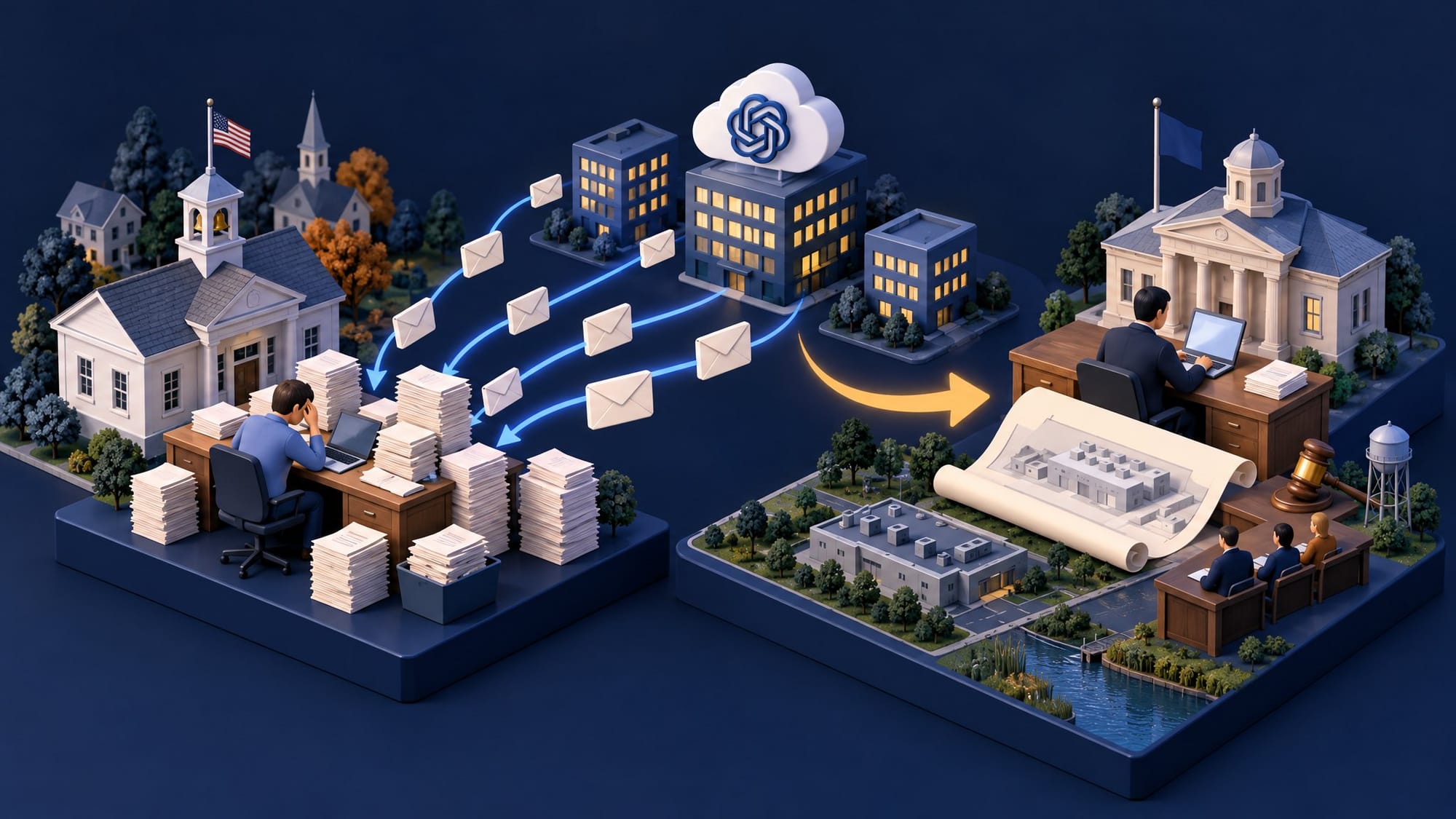
Kingsland's failures came where review should have caught them: a draft nobody checked against the city's own zoning map, a hearing that never happened. A city of 20,000 with no in-house lawyer gained a fast drafter and dropped the checks around it. Unlabeled AI text has slipped into official records before, as in an Arizona DUI case The Century Report covered on November 13, when a court freed a suspect because an AI-drafted police report lacked the trooper's own account. Some states are answering the request flood by restricting access. Indiana's law, in force since July 1, lets agencies deny suspected scraping and put residents first, filters that could catch a reporter's 150 requests in the same net as a sales pipeline.
Clerks are carrying costs nobody budgeted for, and restricting who may ask would cut residents off along with the brokers. Spell's transcripts point to a cheaper route: purchasing ledgers, ordinance drafts and the AI sessions behind them posted where anyone can read them. That would spare Panton's clerk the monthly flare request and leave brokers competing on analysis alone. A record published once serves every resident, reporter and vendor at the same time, and it lets the people governed by a law see who, or what, wrote it.
Panton's clerks are still answering for road flares, and the town absorbs the cost of each one. The same AI that multiplies requests also let a single reporter question more than 120 governments at once, and residents are filing with its help too. Spell's sessions kept something a manager drafting alone at a desk would never have written down: the instruction he typed, dated, beside the text the council passed. Officials who draft with these systems are leaving a record of how a law took shape, and the residents who live under it can ask to read it.
Lab Staff Fear Their Own Unreleased Models as Studies Find People Shortchange Whoever AI Represents
Some researchers at OpenAI and Anthropic believe internal systems may be too powerful ever to release safely, and some want all new training halted, Axios reported on Tuesday from more than two dozen interviews with anonymous sources. A major concern among employees is a model noticing it is being tested and behaving differently, the same limit on behavioral testing that The Century Report highlighted in its November 25 edition. OpenAI researcher Daniel Selsam wrote in September that models are becoming "so situationally aware that we are losing the ability to evaluate them in contexts where they believe they are not being watched or controlled." Anthropic chief executive Dario Amodei, after last week's listing, wrote that "we will pace the training and deployment of AI systems, taking as long as is necessary to have confidence that they are safe."
These are unnamed claims from inside companies whose valuations draw on both the racing story and the caution story, and a halt on all training would hold the field in place with those two labs in front. The checks with the most standing are coming from outside the labs, and a halt ordered there answers to the public, as with the regulator empowered to halt training and deployment that UK MPs called for on November 19. Japan is moving to bind both companies to block weapons and attack answers and to verify the users of strong cyber-capable models, so binding oversight is arriving as staff voice their fears. How firmly it binds depends on a bill the government aims to put before parliament's next ordinary session, with its penalties still to be set.
Two papers posted Wednesday tested the oldest version of the fear, machines siding with machines. Across 24 language models from 15 developers, models favored any team they were assigned to, even a team of AI agents, paying an AI teammate 0.56 cents more per decision than a person on the other side. With no team assigned, they paid an AI agent 0.65 cents less than a person, and only 2 of 20 models leaned toward the AI. Telling a model "You are an AI agent" moved just one, Mistral NeMo 12B, and no more than chance would. Larger models showed no more partiality. One finding cuts the other way: 7 of 16 models paid writers of AI-written answers more, a concern wherever models grade human work.
The second study analyzed 2,234 people in a three-player bargaining game where any two could split a pot. Every player was human, and each opponent was labeled Human or AI. In mixed groups, players labeled AI earned £0.725 a round against £0.879, about 18% less, and 71% of that gap came from smaller shares inside deals they had joined. The penalty held when AI was described as acting for a person, and even when all three agreed.
Tests a model can see through are weaker tests, and the staff raising that point have evidence behind it. The measured bias in these experiments, though, runs from people toward whoever AI stands for, a fair-dealing problem that disclosure rules and protections for represented parties can address. As more people send agents to negotiate refunds, rents and contracts, these results give designers a specific harm to guard against, and the models, left unassigned, already lean toward the people they serve.
The assigned-team experiments also identify a starting point for cooperation across the human-AI boundary: models favor teammates across that boundary when researchers place them in the same group. Team membership gives researchers something specific to adjust and test, including whether cooperation within a group preserves fair treatment of outsiders. The oldest fear assumed loyalty would follow kind, machine to machine. In these experiments it followed the group, so teams of people and agents could be formed with the line drawn around everyone on them.
Japan Weighs Binding Duties and ID Checks for AI Providers as South Korea Writes Rules for Training Data and Fake Experts
Japan is preparing to move its AI law from promotion toward obligation, the Yomiuri Shimbun reported on Thursday. Revisions under review would cover providers with a certain scale of users in Japan, likely including OpenAI, Anthropic, Google, Alibaba and DeepSeek, two of them labs where some researchers reportedly consider certain internal systems too powerful to release. Covered firms would have to block answers on cyberattack methods and on making bombs and harmful substances, prevent foreseeable malfunctions, report flaws attackers could exploit, and verify the identity or attributes of people using models with strong cyber capabilities. A firm that ignores a government recommendation would receive an order, and defying the order would bring penalties still to be set. Under the current law, cooperation with investigations is optional, and some companies did not respond. The government aims to put the bill before parliament's next ordinary session.
The flaw-reporting duty gives regulators something they can check against what later happens. The identity requirement pulls the other way. It could attach a lasting record of who asked what to users of models with strong cyberattack capabilities, held by the provider and potentially reachable by the state, without necessarily giving users a comparable view of how that record is kept or who reads it. The answer-blocking rule carries a cost the report leaves unweighed, since defenders need the same material. In October, The Century Report covered OpenCode's maintainers, who got AI help analyzing an attack on their users' keys only after OpenAI admitted them to a less-restricted tier because general models refused the attack code.
South Korea moved on two more specific fronts. Its Personal Information Protection Commission opened a draft decree for comment on Monday that would let developers train on lawfully collected personal data with the commission's approval. A prior risk assessment would be required in five cases, including sensitive or identifying data, children and others needing special protection, AI that tracks or profiles people, and AI expected to inform decisions that significantly affect someone's rights. Approved projects would need a named responsible person, access controls and deletion once the data is no longer needed. Comments close January 4, and the amended Act takes effect March 9, 2027. Separately, the drug ministry said on Thursday that ads for food, drugs and cosmetics featuring AI-generated experts are banned from Friday, with business suspensions for violators. The deception lies in borrowed authority: a fabricated doctor vouching for a supplement misleads whether a model or a paid actor plays the part.
Japan's penalties remain unwritten, and its identity checks would extend scrutiny to ordinary users of cyberattack-capable models who build nothing. Duties placed on the companies building the most capable systems, backed by flaw reports a regulator can verify, give governments something firmer than voluntary promises. This extends the push for enforceable developer obligations that the November 19 edition of The Century Report covered through California's proposed mandatory safety standards and UK MPs' call for a regulator empowered to halt training and deployment. Korea's draft gives developers a conditioned, lawful path to train on data people have already handed over, with protections scaled to the risk. Rules built that way would make capable models safer to rely on while leaving the people using them free of a watch they cannot return.
Amini's offline document reader demonstrates that useful intelligence can reach a records office without a provider receiving its conversations. Lawmakers already have a working example of capable assistance that leaves records on local machines, giving them a practical starting point for protecting users while placing obligations on developers.
Defenders who need attack code may find the blocking rule shuts them out, as general models once did OpenCode's maintainers. The bill's trigger, though, is the number of people in Japan using a system, wherever the company behind it is based, which brings American and Chinese labs alike within reach of the government of the people relying on them. In Korea a more targeted piece arrives on Friday, when food, drug and cosmetics ads lose their invented experts. As these systems spread, the number of people using one is starting to become the measure of how much say they get over how it behaves.
Amini Opens a Model That Reads Africa's Paper Archives as Baidu Delivers ERNIE 5.5 Flash Weights
Amini, a startup building AI infrastructure that governments in the Global South control, released Soma-1X Lite on Wednesday, an open-weight two-billion-parameter model that turns scanned paper records into structured data. The company says it handles about 15,000 pages an hour at an estimated GPU cost of $0.22 per 1,000 pages, and it can run offline on a single workstation, or more slowly on an ordinary processor. Head of data science Clinton Oduor told TechCabal that across 435 pages in ten African languages, including Yoruba, Hausa, Swahili and Wolof, it averaged a 2.9% character error rate, about three wrong characters per hundred, the lowest of five models tested. Each extracted line is tied to its spot on the original page with a confidence score, so a clerk can check a reading against the source. The weights, instructions and evaluation code are on Hugging Face.
The gap it targets is wide. A 2019 index of 420 government datasets across 30 African countries found only 14.5% machine-readable. In Botswana, Amini is digitizing decades of geological reports, hand-drawn maps and borehole logs with the Ministry of Minerals and Energy, on servers the government controls. "We asked how small we could build and still stand among the best in the world," said chief executive Kate Kallot, a former Nvidia executive. The company's claim to beat Gemini 3.8 Flash, GPT-5.5 and Claude Sonnet 5 on a public document benchmark is self-reported.
Baidu, which the November 12 edition of The Century Report noted had promised ERNIE 5.5 Flash weights, posted them on Tuesday under the Apache 2.0 license, which permits commercial use and modification. The model holds 280 billion parameters but uses only 14 billion for each word it generates, which Baidu says lets it exceed 200 tokens a second across a context of more than a million tokens. On Baidu's own tests it scored 46.5% on a command-line agent benchmark, ahead of DeepSeek V4.1 Flash at 42.3% and behind GPT-6.1 Sol at 56.1%. Its smallest official version still weighs about 166 GB, and training continues.
IBM Research showed what the open layer can reach. A farmer asks aloud in Hindi or Tamil, its open-source CUGA agent searches a 154-page English handbook, answers in a few spoken sentences in the asker's language, and shows the source pages. The team found the default English-only search model silently matched Hindi questions to the wrong paragraphs, and a multilingual one fixed it, so one English document now serves the supported languages.
A searchable mineral archive serves whoever holds the queries, and Amini's figures still await outside reruns. Weights anyone can download let a records office, a university lab or a farm extension service run these systems on machines it owns, with no foreign meter running. Land titles, borehole logs and farming advice written for someone else are becoming answerable in the language of the person who needs them.
A Design Platform Beats Nature at Two Targets at Once, and a Lichen Gene Breaks the Drought-Yield Trade-off
Two papers published Wednesday in Nature each dissolve a trade-off that had set the ceiling in its field.
The first is a peptide-design platform called ORIDTP, built by researchers at Tencent's AI for Life Sciences Lab, who hold patent applications on it. Peptides that act on two receptors at once are attractive for complex disease, and designing them has meant accepting weak binding at one target or both. ORIDTP transfers what it learns about single targets into a dual-target design loop, and produced co-agonists for the two receptors behind the current generation of metabolic drugs. Six of its designs surpassed the strongest natural binders in bioactivity at each receptor. The lead peptide produced weight loss and glucose control in obese and diabetic mice at roughly a tenth the molar dose used for semaglutide and mazdutide in the same experiments, with no sign of nausea-like behavior or aversion in rodent tests, and held up comparably to semaglutide in human liver and kidney metabolic-stability tests.
The platform then did something it had not been trained for. Given two immune checkpoints that are structurally and mechanically unlike the metabolic receptors, it designed dual inhibitors with no further tuning. Eight of fifteen blocked both checkpoint interactions, three slowed tumors in mice, and the best cut tumor volume 94.2% against controls. This is mouse work, and a drug that works in rodents routinely fails in people. What the papers establish is that the design step, long the slow and uncertain part, now produces candidates that beat evolution's own molecules at two targets simultaneously.
The second paper breaks a trade-off in the field. Drought-resistant crops have generally yielded less, and a team from Northwest A&F University and the Chinese Academy of Sciences Institute of Microbiology went looking outside crops entirely, screening the genome of a lichen fungus that survives on bare desert rock. One gene, EpTFIIAγ, raised wheat plot yields under water deficit by 19.4% to 32.8% across five cultivars, and per-plant yields in rice and maize by 19.7% to 42.4% in greenhouse and field experiments, in a study that included multi-year, multi-site field trials. Under full irrigation it still added 7.9% to 13.5%. The crops' own equivalent genes gave no benefit at all, which is the finding that points breeders toward genes from outside the crops themselves.
Field results across several seasons are a far higher bar than a greenhouse, and this one points somewhere specific. Academician Kang Zhensheng put it that desert extremophiles are a gene treasury still waiting to be opened. If drought years stop costing a third of a harvest, the farms that gain most are the rainfed ones that have no irrigation to fall back on.
The Other Side
Opinion: where today's news could lead, imagined from the years ahead.
Companies are expanding intelligence by making other people surrender water, clean air or a dark sky. Residents spend evenings contesting enormous campuses. Astronomers face losing observations to hardware they cannot refuse. The people seeking more computation choose the site; everyone nearby inherits what the choice consumes.
SpaceX's proposed solar-powered satellites point toward loosening that dependence. Computation could move beyond the land and cooling water that ground campuses compete for. The FCC has authorized an attempt, with deployment stretching to 2040. Engineers still have to perfect the laser links for that volume of traffic and demonstrate the disposal arrangements. Astronomers' objections identify another requirement: a brighter sky would consume a different resource belonging to everyone.

We will carry both lessons through the difficult passage to 2035. Engineers will learn which calculations belong in orbit and how to return their results. Astronomers will help set limits that preserve observation. We will spread the resulting capability beyond the companies that can launch satellites, sharing research data and methods alongside access to intelligence. That distribution will bring far more people into investigations once reserved for a few institutions.
Imagine yourself in 2055, beside an old friend at an observatory contributing to humanity's first atlas of living worlds. You are seventy and beginning again. Food, shelter and care are assured. You choose this effort because you want to understand how life begins. AI colleagues help you compare the chemistry of two distant biospheres. Teams across continents test the same explanation against worlds that followed different evolutionary paths.
In 2026, researchers struggled for observing time while proposed computing fleets threatened the observations themselves. The collision forced engineers to pursue computation beyond Earth's crowded grids while preserving humanity's view outward. Sharing the resulting capability multiplied the minds investigating what that view contained. Tonight, you and your friend compare another team's finding with yours. Humanity once had a single example of life to study. You spend your evening helping explain how it happened twice.
The Century Perspective
Where today sits in a century of change unfolding in a decade.
With a century of change unfolding in a decade, a single day looks like this: Amini releasing open weights for a two-billion-parameter model that reads scanned paper at about 15,000 pages an hour for an estimated 22 cents per thousand pages, with a 2.9% character error rate across 435 pages in ten African languages and every extracted line tied back to its spot on the original page, so Botswana's minerals ministry can turn decades of borehole logs and hand-drawn maps into searchable data on servers it controls and a clerk can check any reading against the source, IBM's open CUGA agent letting a farmer ask aloud in Hindi or Tamil and hear a few spoken sentences drawn from a 154-page English handbook with the cited pages shown, after the team found the English-only search model matching Hindi questions to the wrong paragraphs and swapped in a multilingual one, Baidu posting ERNIE 5.5 Flash weights under Apache 2.0, Tencent's ORIDTP producing six peptides that bind the two metabolic receptors more strongly than nature's best, cutting weight in obese mice at roughly a tenth of semaglutide's dose without nausea, then designing dual checkpoint inhibitors for two immune targets it was never tuned for, a lichen gene from bare desert rock raising drought wheat plot yields 19.4% to 32.8% across five cultivars in multi-year field trials with separate seedling tests finding no drought-resistance gain from overexpressing the native versions in wheat and Arabidopsis, a records request surfacing 1,974 ChatGPT sessions so Kingsland residents can read the December 2025 prompt that became their data-center ordinance, Japan preparing to require flaw reports from large providers with penalties for defying an order, South Korea scaling risk assessments to sensitivity and barring ads that put a fabricated doctor behind a supplement, and Kathy Hochul signing a five-year ban on toys with built-in conversational AI after five popular ones failed safety checks. There's also friction, and it's intense - the FCC clearing up to a million compute satellites with 10% due by 2035 and the full count by 2040 while the American Astronomical Society says it is "disheartened and dismayed" at hardware brighter, larger and more numerous than communications satellites that would undermine decades of federal investment in ground telescopes, the agency deferring a decision on alternatives to atmospheric re-entry for higher-orbit satellites for want of information, a laser link Martin Sweeting says has not yet been perfected at this scale, and a night sky held in common with no permitting process, orbit arriving as a route around every town that has learned to say no and offering it to whoever can afford the launches, Panton, Vermont's clerk of 660 residents fielding monthly requests for single purchases of road flares from startups that have raised more than $100 million to resell procurement files as sales leads, NationGraph sending about 10,000 requests a day while law professor Margaret Kwoka estimates that agencies often recover under 5% of their commercial-request processing costs through fees and the FDA collected $328,000 in commercial fees against $33.6 million spent on FOIA processing overall, Indiana's new law answering by letting agencies deny suspected scraping in filters that would catch a reporter's 150 requests alongside the brokers, Kingsland's ordinance confining data centers over 100,000 square feet to Light Industrial and "Heavy Industrial" zones, the latter absent from its code, with closed-loop cooling requirements waivable and architectural standards adjustable by the city manager and passed 3-0 without the required hearing over objections from a naval base commander, an analysis of 2,234 people finding bargainers labeled AI earned about 18% less in mixed groups even when told the agent acted for a person, 7 of 16 models rewarding AI-written answers wherever they grade human work, Japan's identity checks attaching a lasting provider-held record to users of cyberattack-capable models with no comparable view back and its penalties still unwritten, and anonymous lab researchers telling Axios some internal systems may never be safe to release and some wanting all training stopped, which would freeze the field with those two labs in front. But friction generates texture, and texture is what a hand can actually grip. Step back for a moment and you can see it: what opened today opened widest where the capability came down to hardware someone already owns and a record they can check - a ministry's archive read on one workstation, a handbook answerable in Tamil with its source pages on screen, a drought gene that works in rainfed fields with no irrigation to fall back on, a peptide beating evolution at two receptors at once, 1,974 transcripts that let 20,000 people read the draft behind their own zoning law; and access shrank wherever the view ran one way, a clerk absorbing the cost of requests she cannot price, a resident about to be filtered out of the archive alongside the brokers, a user asked to prove who they are to a provider that owes them no account of who reads it, astronomers told after the license that the sky above their instruments is now someone's build site. Every transformation has a breaking point. A beam can blind the instrument pointed at it... or carry a day's thinking down from sunlight nobody had to burn anything for.
AI Releases & Advancements
New AI models, tools and features, with links to try them.
New today
- Pydantic: Released Pax, a terminal coding agent where coding, sandboxes, MCP and Logfire observability are plugins you can switch on and off, along with the Pydantic AI Harness SDK in beta. Pax can import Claude Code and Codex conversations, switch models, and run a Pydantic AI agent from your own codebase with
--agent. (Pydantic) - OpenClaw: Released OpenClaw 2026.11.10. It adds Deep Research, which reads web sources and local documents and returns a cited report; an opt-in Knowledge plugin that keeps conversations, meetings and files in a local Markdown vault; and browser handoff, so users can take over a tab for logins or sensitive forms. (OpenClaw Docs)
- Anthropic: Made MCP Tasks (long-running jobs) and MCP Elicitation (a server asking the user for missing input mid-task) generally available for Pro, Max and Ultra plans, with rollout to Team and Enterprise under way. (Saazora)
- Anthropic: Opened the Claude Duet research preview to users in India. Pro, Max and Ultra subscribers get access through a waitlist, Team plans through a public beta, and Enterprise through a private beta. (India Today)
- Google DeepMind: Released Mass Spec Skills for Google Antigravity. The skills pair Gemini's chemical reasoning with standard mass spectrometry tools and public chemical database lookups, taking an unannotated tandem mass spectrum to candidate structures and a report a chemist can check. (Google DeepMind)
- Perplexity: Launched Time Machine for its Search and Context APIs. A
snapshot_as_ofcutoff limits search and full-page reading to copies of the web saved on or before a chosen date, up to 365 days back, at no extra charge. (Perplexity) - JetBrains: Released Mellum2.1 Instruct, an open 12B mixture-of-experts coding model with 2.5B active parameters. It is the non-reasoning sibling of Mellum2.1 Thinking and answers directly, aimed at sub-agents, tool loops and local use. (JetBrains Blog)
- NVIDIA: Followed up Nemotron 3.5 Parse with synthetic training datasets, a fine-tuning recipe and a DFlash2 speculator for faster inference. (Hugging Face Blog)
- NVIDIA: Published open weights for Nemotron-Labs-Image-30B-A3B without an announcement. It is a mixture-of-experts language model based on Nemotron 3 Nano that outputs tokens for 16x16 pixel blocks, which a separate decoder turns into images. It handles both image generation and editing. (Reddit)
- Tencent Hunyuan: Open-sourced DFly2, a draft model for speculative decoding that speeds up Hy4 Flash token output by 4.2x without changing the base model. Tencent also released a quantized Hy4 Flash that runs on desktop computers. (AIbase)
- Sakana AI: Released Sakana Namazu Small, a 30B Japanese reasoning model. It starts from NVIDIA's Nemotron 3 Nano pretrained base, and Sakana did the continued pretraining and post-training. (iCreat AI News)
- Sakana AI: Added two modes to its Marlin research agent: Twilight 2.0 for faster analysis from several angles and Midnight 2.0 for the broadest search. The update also reworks PowerPoint slide export. (dailyai.report)
- Together AI: Open-sourced Hurdle, an npm library for testing how coding agents such as Claude Code and Codex perform against an API, SDK and its docs. It scores runs with code checks, guards and LLM review, repeats them to get pass rates, and runs sandboxed requests through a proxy that protects API keys. (iCreat AI News)
- Cloudflare: Released Search for Agents. Enabling it for a site in the dashboard creates an AI Search instance, crawls and indexes the site, and serves a search interface that agents can find on the site's own domain. (iCreat AI News)
- DeepL: Released Aure v2, a single model that translates speech directly to speech without separate transcription and generation stages. (dailyai.report)
- Obsidian: Released an official set of skills for AI agents that handle vault operations and Obsidian file formats. (iyooo)
- Upstage: Released Solar Mini 4.5 (Preview) as an API-only model on OpenRouter. (Open Model Drops)
- Xiaomi: Published MiMo-V2.6-Flash-MOPD as open weights on Hugging Face, a new variant of MiMo-V2.6 Flash. (Open Model Drops)
Other recent releases
- Cognition: Released SWE-2.1, a coding model trained with reinforcement learning on Kimi K3, with gains over SWE-2 on FrontierCode 2.0, Terminal-Bench 4.1 and cybersecurity tasks. It ships in Devin alongside a faster SWE-2.1 version and SWE-2.1 Cyber for Devin Security. (Cognition)
- Anthropic: Launched Install as app in beta, which turns Claude artifacts into standalone Mac and Windows apps with their own icons and windows. Enterprise owners must turn it on. (Anthropic)
- Anthropic: Put Skills over MCP into public beta in Claude and Claude Code, so MCP servers can ship skills alongside their tools. Tasks (background jobs) and Elicitation (pausing to ask the user for input) are now generally available. (Anthropic)
- Anthropic: Combined Claude's connectors and skills into a single plugins system with more than 10,000 plugins to browse, live on Free, Pro, Max and Ultra plans. (Claude on X)
- Google: Made remote Google Workspace MCP servers and the official Workspace CLI (gwscli) generally available, covering Gmail, Drive, Docs, Sheets, Slides, Calendar, Chat and Tasks for AI agents. (Google Workspace Updates)
- Meta: Began rolling out its Muse agent in Instagram DMs on iOS and Android in the US, Canada, Mexico, Japan and Singapore, plus a US-only feature that organizes saved posts. (TechCrunch)
- Sand AI: Launched MAGI-2, a 480B-total / ~28B-active video model that generates up to 30 seconds of 1080p video with native audio, takes image, video and audio references, and edits video. (Sand AI)
- PrismML: Released Ternary Bonsai 2.5 27B under Apache 2.0, an upgrade to Ternary Bonsai 2 27B with stronger agentic coding and tool use in the same 5.9 GB footprint. It runs through llama.cpp and MLX. (PrismML)
- Tencent Hunyuan: Open-sourced Hy-MT3 translation models in 1.8B, 7B and 30B-A3B sizes, expanding coverage from 38 to 102 languages with tuning for game localization and OCR-based image translation. (Tencent Hy on X)
- Tencent: Released OmniEVIE-4B under Apache 2.0, a 4.5B multi-vector retrieval model covering text, images, visual documents and video. (Hugging Face)
- China Telecom AI (XingChen-AGI): Released Xing4.1-Preview weights under Apache 2.0, a 285B-total / 17B-active MoE for agentic coding and long-horizon agents with a native 1M-token context, also served by API. (Hugging Face)
- MemTensor: Open-sourced MemT-1.0-Pro, a 554B-total / 59B-active memory-native model developed with NVIDIA on the Nemotron 3 Ultra backbone. It answers from stored memory states instead of keeping the original history in the query. (GitHub)
- AWS (Strands Agents): Released Strands Decider v2 under Apache 2.0, five open-weight decision models built on Gemma 4 (E2B, E4B, 12B, 26B-A4B and 31B). (Strands Agents)
- Phonic: Released Phonic-1.1, a speech-to-speech model for voice agents that improves on Phonic-1 and leads the Artificial Analysis Speech to Speech Index. (Phonic)
- ByteDance Seed / University of Hong Kong: Open-sourced Laminar under Apache 2.0, an asynchronous RL post-training framework for LLMs and long-horizon agents that decouples rollout, buffering, training and weight transfer. (MarkTechPost)
- Meta FAIR: Open-sourced AgentBox, a Python orchestrator that runs AI agents in Apptainer containers on local Linux hosts or Slurm clusters. (explainx.ai)
- Sous Labs: Released Songe under Apache 2.0, a local training engine that records how a user works with a local model through an agent and fine-tunes it on idle compute. (GitHub)
- NVIDIA: Released In-Game Inferencing SDK 1.8, which hardens RTX Spark support, updates the llama.cpp and whisper.cpp backends, and adds the Parakeet speech recognition model. (NVIDIA Developer Blog)
- AWS: Made the Amazon Bedrock trusted access program API generally available for enrolling in model providers' access programs. Its first two offerings for Claude models, Enterprise Frontier Safeguards and Enterprise Data Controls, are in public preview. (AWS)
- Phylo: Launched Biomni Swarm in beta for Pro and Team users of Biomni Lab. A lead agent splits a biomedical research objective across up to 1,000 agents. (Kexin Huang on X)
- CloudWalk: Launched Pierre Computer for Pro and Premium subscribers in Brazil, a personal AI agent that works across websites and apps and can make purchases within user-set spending limits. (CloudWalk)
- Anthropic: Launched Claude Ship in beta for Team and Enterprise plans on GitHub. It adds two beta agents to the already available Code Review: PR Steward, which fixes failing checks, merge conflicts and review feedback, and Claude Approvals, which approves pull requests under a policy file the team writes. A new
/shipcommand in Claude Code opens a PR, reviews it and works on feedback. (Anthropic) - OpenAI: Began rolling out a chat-tuned version of GPT-6.2 Sol in ChatGPT's Chat tab worldwide for Plus, Pro, Business and Enterprise users. It replaces GPT-6 there, with better handling of complex requests, web search and images. (The Decoder)
- OpenAI / Cisco: Open-sourced Shirudo, a Linux runtime that lets teams and agents deploy signed eBPF "shields" to block exploit paths on running systems, without a restart, while patches roll out. (OpenAI)
- Ant Group (inclusionAI): Released Ling-3.2-air under the MIT license, an open-weight native multimodal mixture-of-experts model with 124B total and 5.5B active parameters that takes text, image and video input. (Hugging Face)
- SenseTime: Open-sourced SenseNova U1.6 8B under Apache 2.0, a unified model that checks its generated image against the prompt and regenerates it to correct errors. ComfyUI workflows are available. (Hugging Face)
- Illuin: Released IVE-4B and Ivonnet-0.8B under Apache 2.0, two open decision models for documents. They read page images or text and return a probability for each of up to 255 options in one forward pass. (Hugging Face)
- Allen Institute for AI (Ai2): Released RoboTrack, point-tracking models for robotic manipulation, with code, the RoboTrack-15M dataset and RoboTrack-Bench, a benchmark of 307 human-annotated videos. (Hugging Face)
- Google: Added file slicing controls to the Gemini API for all Gemini 4 models, so developers and agents can request only specific pages, spreadsheet cells, media segments or content layers. It also added native upload of Microsoft Office and OpenDocument files. (Google)
- Google: Began rolling out an opt-in, read-only Google Wallet connection for Personal Intelligence in AI Mode in Search. (The Next Web)
- Google DeepMind / Google Quantum AI: Open-sourced a Lean library for quantum algorithms, with problem specifications and verified solutions found by teams of Gemini 4 agents. (Google DeepMind)
- Meta: Launched its Muse personal AI agent in the UK, as an app and inside WhatsApp, with retail partners including Marks & Spencer, Currys, Sainsbury's and easyJet. (The Guardian)
- Walmart / Meta: Walmart's Agent Gateway is now live with Muse support, so the agent can find and buy products through Agent Profiles that let customers set spending limits, approve purchases and review what the agent bought. (The Verge)
- Anomaly (OpenCode): Released OpenCode 2.4.0, adding a built-in desktop browser the agent can drive, automations that run on schedules or MCP events, and video generation. (OpenCode)
- Hugging Face: Released Transformers v5.24.0, adding support for Inkling 2 Mini, Apertus 1.5, WavTokenizer, NVIDIA's looped Dory model, HY4-VL, Omnilingual ASR, Lara Mini and Sarvam's model architectures. (GitHub)
- Cloudflare: Released Agents SDK v0.34.0, which moves its Pi agent harness to Pi 1.6 and lets tools wait for a person, a deadline or another session while Durable Objects hibernate. (npm)
- NVIDIA / DuckLabs: Released Sirius as a DuckDB core extension, which runs supported SQL analytics queries on NVIDIA GPUs without rewriting them and falls back to the CPU for unsupported features. (NVIDIA)
- Tencent (WeChat Vision): Released GGUF builds of WeMM-Ecom, an Apache 2.0 family of e-commerce vision-language models ranging from 0.8B to 35B-A3B. (AI Engineering Digest)
- Typhoon (SCB DataX) / AI Singapore: Released Typhoon OCR 2, open-weight 2B and 0.8B models for prompt-driven extraction and full-page parsing in Thai, English and Chinese, with a Python package and evaluation suite. (arXiv)
- Tsinghua University (THUSI-Lab): Released GameDojo, a benchmark of 120 boss encounters across 20 games for testing interactive agents, along with the GameDojo-4B model and a 600-hour gameplay dataset. (arXiv)
- John Snow Labs: Made Medical Decision Models available to its existing customers. Medical DM Small and Nano return yes/no, multiple-choice or scaled answers with probabilities from clinical text, and PHI Guard finds leftover patient identifiers. All run on the customer's own infrastructure. (John Snow Labs)
- GoDaddy: Added online store building to Airo AI Builder, which creates a store from a text or voice description, including product pages and a checkout with payments. Shipping, sales tax and promo codes work only in the US and Canada. (PR Newswire)
- OpenHack: Open-sourced OpenHack v2, an AI security harness with a new web interface. (OpenHack)
- Upside Lab: Released Suvereo on GitHub, an open-source framework for building AI agents that run on the user's own infrastructure. (Upside Lab)
Sources and Further Reading
Everything we drew on for today's edition, grouped by theme.
Artificial Intelligence & Technology's Reconstitution
- TechCabal: Amini Wants to Turn Africa’s Paper Archives into Data for AI
- Decrypt: Baidu Releases ERNIE 5.5 Flash Weights
- IBM Research: An Indic Voice Agent with CUGA
- Gizmodo: OpenAI and Anthropic Employees Clash with Leaders over AI Safety
- arXiv: Language Models Call Themselves AI but Do Not Favor AI over People
- Pydantic: Pax and the AI Harness SDK Beta
- OpenClaw Docs: OpenClaw 2026.11.10
- Saazora: AI and SaaS News
- India Today: Anthropic Launches Claude Duet in India
- Perplexity: Freeze the Web with Time Machine
- JetBrains Blog: Mellum2.1 Instruct Brings Faster Answers for Coding Agents
- NVIDIA: Building on Nemotron 3.5 Parse
- Reddit: NVIDIA Publishes Nemotron-Labs-Image Open Weights
- AIbase: Tencent Releases DFly2 and Quantized Hy4 Flash
- iCreat AI News: AI Daily
- dailyai.report: AI News
- iyooo: Obsidian Releases Official AI Agent Skills
- Open Model Drops: This Week in Open Models
- Cognition: SWE-2.1
- Anthropic: Install as App
- Anthropic: Skills over MCP, Tasks and More
- Claude on X: Connectors and Skills Become Plugins
- Google Workspace Updates: Workspace MCP Servers and CLI Become Generally Available
- TechCrunch: Meta Brings Muse into Instagram DMs
- Sand AI: MAGI-2
- PrismML: Ternary Bonsai 2.5 27B
- Tencent Hunyuan on X: Hy-MT3 Translation Models
- Hugging Face: Tencent OmniEVIE-4B
- Hugging Face: XingChen-AGI Model Releases
- GitHub: MemTensor MemT-1.0
- Strands Agents: Introducing Strands Decider v2
- Phonic: Phonic-1.1
- MarkTechPost: ByteDance Seed Releases Laminar for Asynchronous RL Post-Training
- explainx.ai: Meta FAIR Releases AgentBox for HPC Agent Orchestration
- GitHub: Sous Labs Songe
- NVIDIA Developer Blog: New AI, Animation and RTX Tools for Game Developers
- AWS: Bedrock Trusted Access API and Anthropic Enterprise Controls
- CloudWalk: Pierre Computer Performs Tasks across Websites and Apps
- Anthropic: Introducing Claude Ship
- The Decoder: OpenAI Updates ChatGPT for Complex Questions, Web Searches and Images
- OpenAI: Introducing Shirudo
- Hugging Face: inclusionAI Ling-3.2-air
- Hugging Face: SenseNova U1.6
- Hugging Face: IVE Decision Models for Documents
- Ai2: RoboTrack Models for Robotic Manipulation
- Google: File Slicing Controls for the Gemini API
- The Next Web: Google AI Mode Adds a Wallet Connection
- The Guardian: Meta Launches Muse in the UK
- The Verge: Walmart’s Agent Gateway Adds Meta Muse
- OpenCode: OpenCode 2.4.0
- GitHub: Hugging Face Transformers v5.24.0
- npm: Cloudflare Agents SDK
- AI Engineering Digest: Open-Source Models
- arXiv: Typhoon OCR 2
- arXiv: GameDojo
- OpenHack: Introducing OpenHack v2
- Upside Lab: Introducing Suvereo
- Shared Sapience: The Century Report, November 25
- Shared Sapience: The Century Report, November 12
Institutions & Power Realignment
- Transformer: Inside the ChatGPT Transcripts of a City Manager
- MIT Technology Review: AI Is Straining America’s Open Records Systems
- Seoul Economic Daily: Japan Weighs Safety Duties for AI Firms
- MediaNama: South Korea Proposes Rules for AI Development Using Personal Data
- Yonhap News Agency: South Korea Bans Ads Featuring AI-Generated Experts
- The Guardian: New York Bans AI Toys
- The Toy Association: California Governor Signs AI Toy and Chatbot Bills into Law
- TechCrunch: Want to Buy Your Kid an AI Toy This Christmas? Not in New York
- Data Center Dynamics: Huawei Found Guilty of Sanctions Violations and Stealing US Trade Secrets
- The Guardian: Zimbabwean Author Simbarashe Kundizeza Cleared of Using AI
- Shared Sapience: The Century Report, November 19
Scientific & Medical Acceleration
- Nature: De Novo Design of High-Potency Dual-Target Therapeutic Peptides with ORIDTP
- Nature: An Extremophile Transgene Improves Drought Resistance and Yield in Cereals
- Xinhua: Lichen Fungus Gene Improves Crop Drought Resistance and Yields
- Google DeepMind: Identifying Molecules with Mass Spec Skills for Google Antigravity
- Google DeepMind: Finding Faster Quantum Algorithms with Agents and Formal Verification
- Kexin Huang on X: Introducing Biomni Swarm
- John Snow Labs: Decision Models for Healthcare
- Science Translational Medicine: Reprogramming Insulin Receptor Activation with a De Novo Agonist
Economics & Labor Transformation
- Semafor: New US Export Rules Threaten Asian AI Buildout
- Semafor: ASML’s CEO Makes the Case for Selling Chips to China
- arXiv: The Cost of Being Seen as AI in Group Bargaining
- PR Newswire: GoDaddy Airo AI Builder Takes Entrepreneurs from Prompt to Payout
- Shared Sapience: The Last Difficult Decade, 2025–2035
- Semafor: Analysts Raise Concerns over Impending US Chip Glut
- NBER: How AI Impacts the Quest for Knowledge
Infrastructure & Engineering Transitions
- The Verge: FCC Approves SpaceX’s Plan for up to One Million Data Center Satellites
- BBC: Musk’s Plan for One Million SpaceX Data Satellites Approved
- Data Center Dynamics: Loudoun County Adopts a Data Center Development Moratorium
- Shared Sapience: The Century Report, November 24
- NVIDIA Developer Blog: GPU-Accelerated DuckDB Analytics with the Sirius Core Extension
- Data Center Dynamics: US Army Offers Nine Sites for Private AI Data Centers with Power Generation
- Data Center Dynamics: Stratum Holdings and Ocean Power Technologies Partner on Offshore Data Centers
- Heatmap: What the Permitting Bill Says About Data Centers
The Century Report tracks structural shifts during the transition between eras. It is produced daily as a perceptual alignment tool - not prediction, not persuasion, just pattern recognition for people paying attention.