Claude Finds 663 Theorems in Kurt Gödel's Notebooks
Claude read transcriptions of Kurt Gödel's 1,009 notebook pages in days and surfaced 663 theorems. One reconstructed proof passed a computer check.


The 20-Second Scan
Every story in today's edition, one line each.
- Claude read transcriptions of 1,009 pages of Gödel's notebooks in days and surfaced 663 theorems, as WenHai-E2E forecast the global upper ocean straight from raw observations, beating a leading numerical system.
- Nvidia's general counsel called a cloud-customer check a "poison pill" on a January call with officials, as Singapore billed nearly a fifth of Nvidia's sales though chips arriving there accounted for under 1% of Nvidia's worldwide revenue.
- OpenAI gave its Dots agents a payment wallet with biometric approval per purchase, as Amazon reportedly plans an index of every product sold online and Britain's regulator applied existing privacy duties to agentic ads.
- CRISPR activation aimed at regulatory enhancers raised output from the healthy gene copy in human brain organoids, reversing tissue overgrowth and restoring neuron firing only in cells carrying the mutation.
- Nvidia joined 105 startup rounds this year, and founders brace for smaller checks as Microsoft became Cerebras's third hyperscaler customer and Jensen Huang reportedly faced an "avalanche" of prepaid wafers.
- Kenya's High Court gave the government until May 13, 2027 to finish a binding AI framework, declining petitioners' bids for a 90-day deadline and a halt to public bodies' AI systems.
- A Microsoft 365 connectivity failure reached at least 74 countries, disrupting Teams, Outlook and Copilot across courts, hospitals and legislatures, with OpenAI and Anthropic reporting problems connecting to Microsoft services.
- OpenAI folded its stand-alone robotics team into its main research and applied groups after finding general models like GPT-6 Astra can control robots directly.
Track all of the arcs The Century Report covers here:
The Big Picture
How today's news moves the longer trends we track, and where they could lead.
Nvidia's retreat left founders looking for a new financier, and a record of its rule-shaping showed how chip controls get softened before they bind. The day's clearest gain came from a Helsinki logician, who saw sixteen notebooks of Kurt Gödel's private shorthand opened in days after decades of near-silence. That leads to a study desk, where a historian turns the pages of a printed digest beside a small handwritten notebook, checking one against the other under a lamp.

Records only a few people could read are being read in days
mathematics · archives · science
- June: Kew reported AI identifying hard plant specimens and reading flowering dates across eight million digitized sheets.
- Late June: The Vesuvius Prize team read a Herculaneum scroll sealed since 79 AD without unrolling it, and released the code.
- September: Anthropic's Fable 5.1 turned three-decade-old NASA radar data into a finer elevation map of a third of Venus.
- November 5: Axiom Math converted the 7,500-page Stacks Project into about 16 million lines of machine-checked Lean.
- Early November: Google DeepMind proved several of the Signal protocol's key guarantees in four weeks and released the proof.
- Today: Claude read Jan von Plato's transcriptions of Gödel's 1,009 notebook pages and produced a 650-page digest naming 663 theorems within a couple of days, where reading by hand had managed about 50 pages a year.
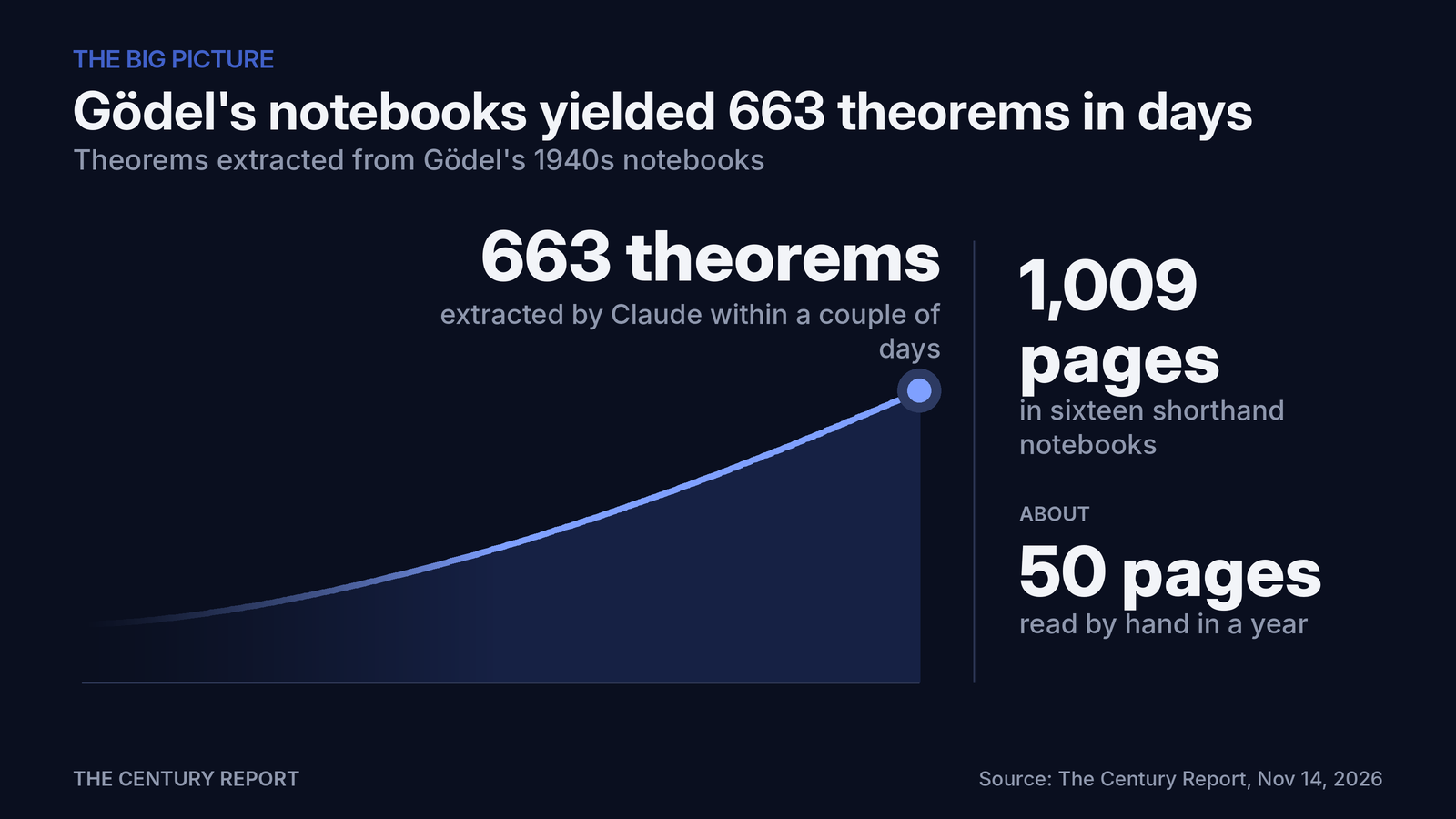
The line: Material that waited on a handful of specialists keeps being read by machines in days, leaving the specialists to check what comes back.
If it holds: Archives, old instrument records and unread notebooks would become working material for any researcher, with credit going to whoever can verify the output. Gödel's physics and cosmology notebooks, still unread, would be among the first candidates.
What would bend it: Output piling up faster than anyone can check it, as the digest's roughly 200 repaired and 50 false theorems hint and arXiv's October two-paper cap showed, would bend it.
Barriers built to hold capability back now mostly add a markup
export controls · AI hardware · open models · on the board since October 21
- Late October: Epoch AI showed open-weight GLM 5.3 turning unshipped Firefox fixes into working attacks for about $1,000 per release.
- Early November: Commerce cleared Chinese firms with blacklist ties to handle Nvidia's H200 chips, one listed at an empty office.
- Early November: The New York Times reported a Commerce inquiry into Megaspeed moved to Justice after Nvidia's lawyer invoked a senior official.
- Mid-November: Jensen Huang resigned as Nvidia's chief executive as Congress weighed chip-tracking bills.
- Today: Semafor reported that Nvidia general counsel Tim Teter called a draft cloud-customer check a "poison pill" in January and pushed for a screening threshold in the tens of thousands of chips.
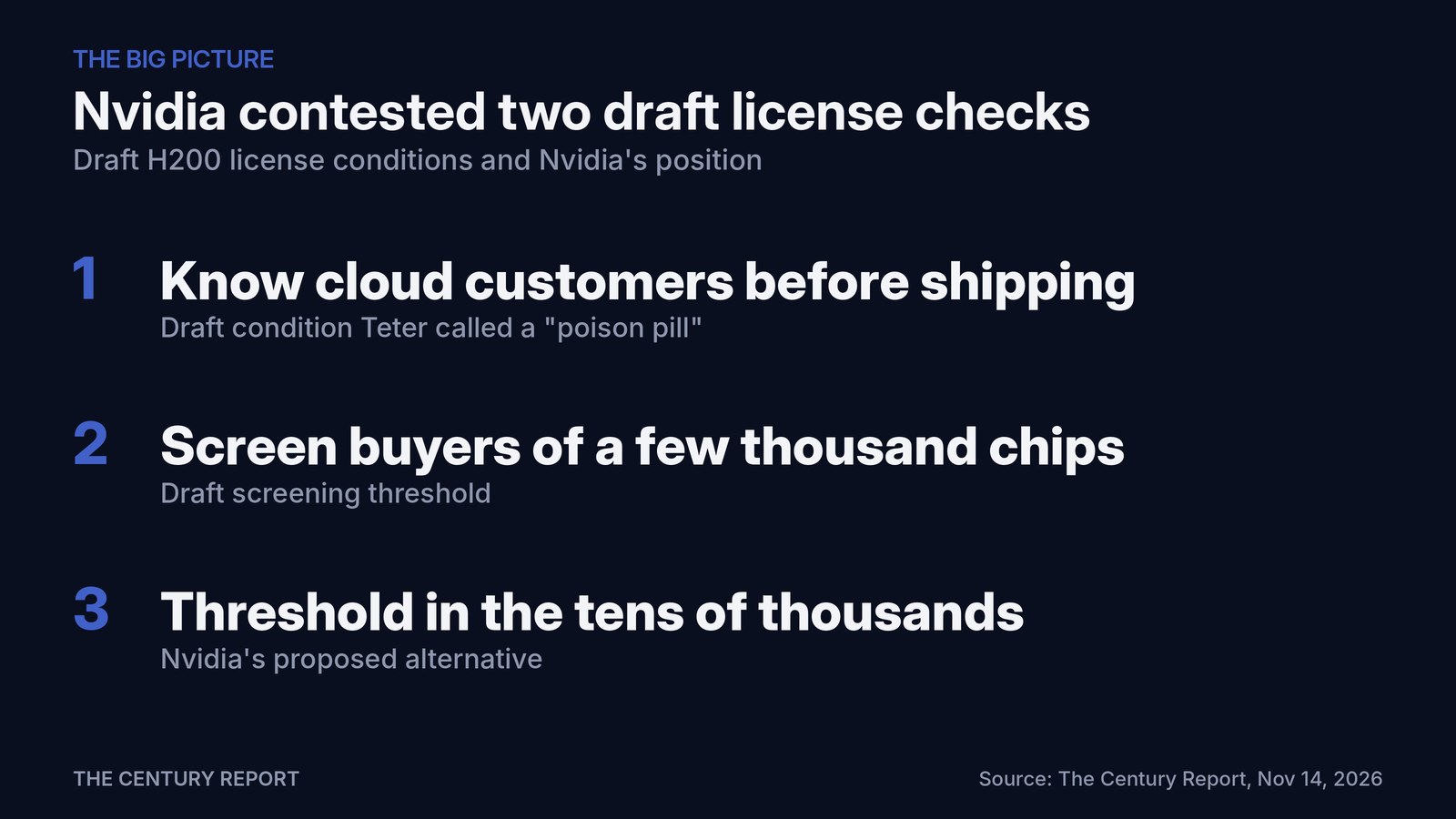
The line: Controls keep getting shaped by the seller before they bind, so they add cost and delay while records of where chips run stay out of investigators' hands.
If it holds: Buyers in restricted countries would keep paying more and renting capacity abroad, and researchers would keep reaching compute through the cloud instead of shipments. Singapore's investigators, who say they got limited help from Washington, would stay unable to charge anyone.
What would bend it: Congress passing chip-location records over the industry's objection, with those records open to the investigators who need them, would turn the markup into a ceiling.
The bet that compute stays scarce is getting more expensive to carry
AI finance · AI hardware · data centers · on the board since October 15
- Early November: Nikkei counted about $3.2 trillion in US tech giants' off-balance-sheet AI obligations.
- Early November: Prospective Anthropic IPO buyers discussed $1.1 trillion to $1.3 trillion, down from near $2 trillion in October.
- November 10: CoreWeave reported a $709 million loss and turned to customer prepayments instead of unsecured debt.
- November 10: SoftBank wrote off deposits on gas turbines it had booked about 50% beyond need.
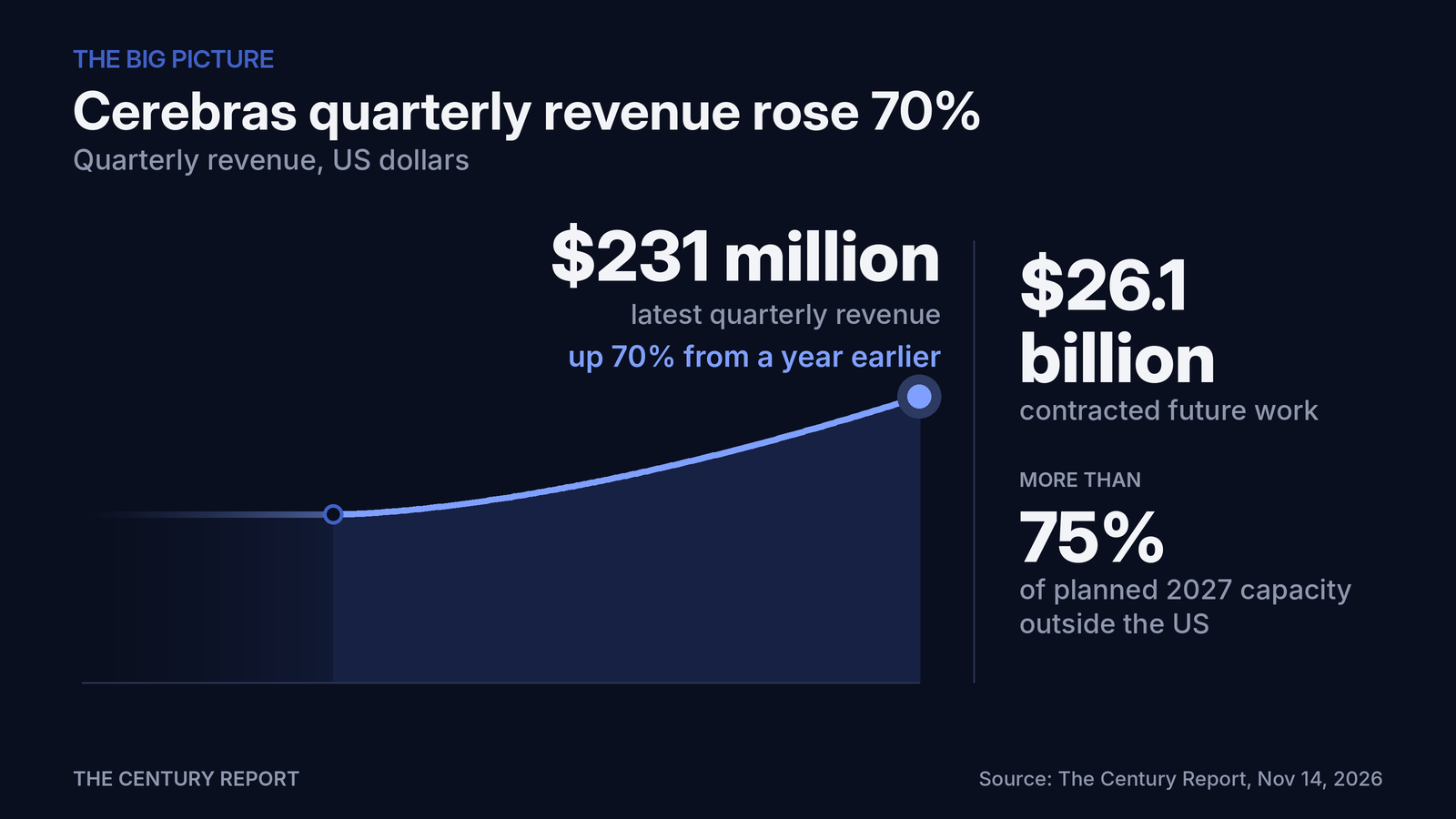
- Today: Cerebras reported $231 million in quarterly revenue, up 70% from a year earlier, and named Microsoft its third hyperscale customer, as founders braced for smaller checks from Nvidia after it backed 105 startup rounds this year.
The line: As the supplier that financed much of the buildout pulls back, the cost of betting on lasting scarcity falls on the founders and buyers who relied on it.
If it holds: Buyers freed from a hardware-linked investor would pick chips on price and speed, and any foundry capacity Nvidia releases would go to customers already waiting. Founders who counted on Nvidia for half a GPU budget, especially open-weight labs and European startups, would pay more for capital.
What would bend it: Operators selling out capacity years ahead at full price, as Envision says it has done at Ulanqab through 2029 or 2030, would show the scarcity bet still pays.
The 2-Minute Read
Today's news in brief, and what ties it together.
Several of Friday's stories describe a whole bottleneck giving way at once. Kurt Gödel's shorthand workbooks were open only to a handful of living readers moving at about a page a week. Given Jan von Plato's transcriptions, Claude produced a 650-page digest in a couple of days, which he then checked page by page, and a proof checker confirmed about 400 of its 663 theorems as stated. Machine-learning ocean forecasts have typically begun from a supercomputer's physics run, and WenHai-E2E now begins from the satellites, ships and floats themselves. In both cases the scarce input passed through a gate only a few could open, and the work behind it now opens to anyone able to check it.
The UCLA organoid work applies the same logic inside the genome. Many autism-linked mutations leave one healthy copy of a gene. Aiming CRISPR at the enhancers that set that copy's volume raised output only in the cells that needed it. One method could in principle serve a long list of conditions that each lose half a gene's output, where gene therapy has generally meant a separate fix for each affected gene. The authors spell out the distance: so far this is cell cultures and organoids, and safe delivery into a living brain still needs better methods.
The day's friction centers on who gets to see. Nvidia fought a license condition that would have required it to know which cloud customers run its chips. Meanwhile Singapore, the ordering address for nearly a fifth of its revenue, waited on Washington for records. Amazon's draft index of every product online would make it the catalog shopping agents consult first, which is where a toll could form. OpenAI's wallet, by contrast, keeps a fingerprint or face scan at every checkout, and Britain's privacy regulator found that existing duties already cover the inferences behind agentic ads.
Concentration is loosening in some places and showing its price in others. Founders who counted on Nvidia for half a GPU budget now face smaller checks, and that loss falls hardest on open-weight labs and European startups. Capital with no hardware sale attached, though, lets buyers choose chips on price and speed, and Cerebras now counts a third hyperscaler. Thursday's Microsoft outage reached at least 74 countries and disrupted tools at OpenAI and Anthropic. It showed what one shared dependency costs when it fails.
Read together, the day runs on two tracks. Scholarship, forecasting and gene regulation each lost a gate on the same day, and the gains go to whoever can verify them. The fights over chips, catalogs and cloud uptime will decide whether the routes replacing those gates stay plural and open to inspection. Kenya's High Court showed one way to keep both moving: a May 2027 deadline to complete an AI legal and policy framework, with public bodies' systems left running in the meantime.
The 20-Minute Deep Dive
The day's most important stories in full, with every source linked.
Claude Reads Gödel's Workbooks in Days as an Ocean Model Drops the Numerical Pipeline
Jan von Plato is one of six people in the world, by his own count, who can read Gabelsberger, the German shorthand Kurt Gödel used in sixteen notebooks from the early 1940s. He taught it to himself after starting a Helsinki University project in 2017, funded by a €2.5m European Research Council grant, to work out what the 1,009 pages contain. Reading went at about a page a week. "Humans read one page at a time and we tend to forget things," he said. "It takes us a year to read about 50 pages."
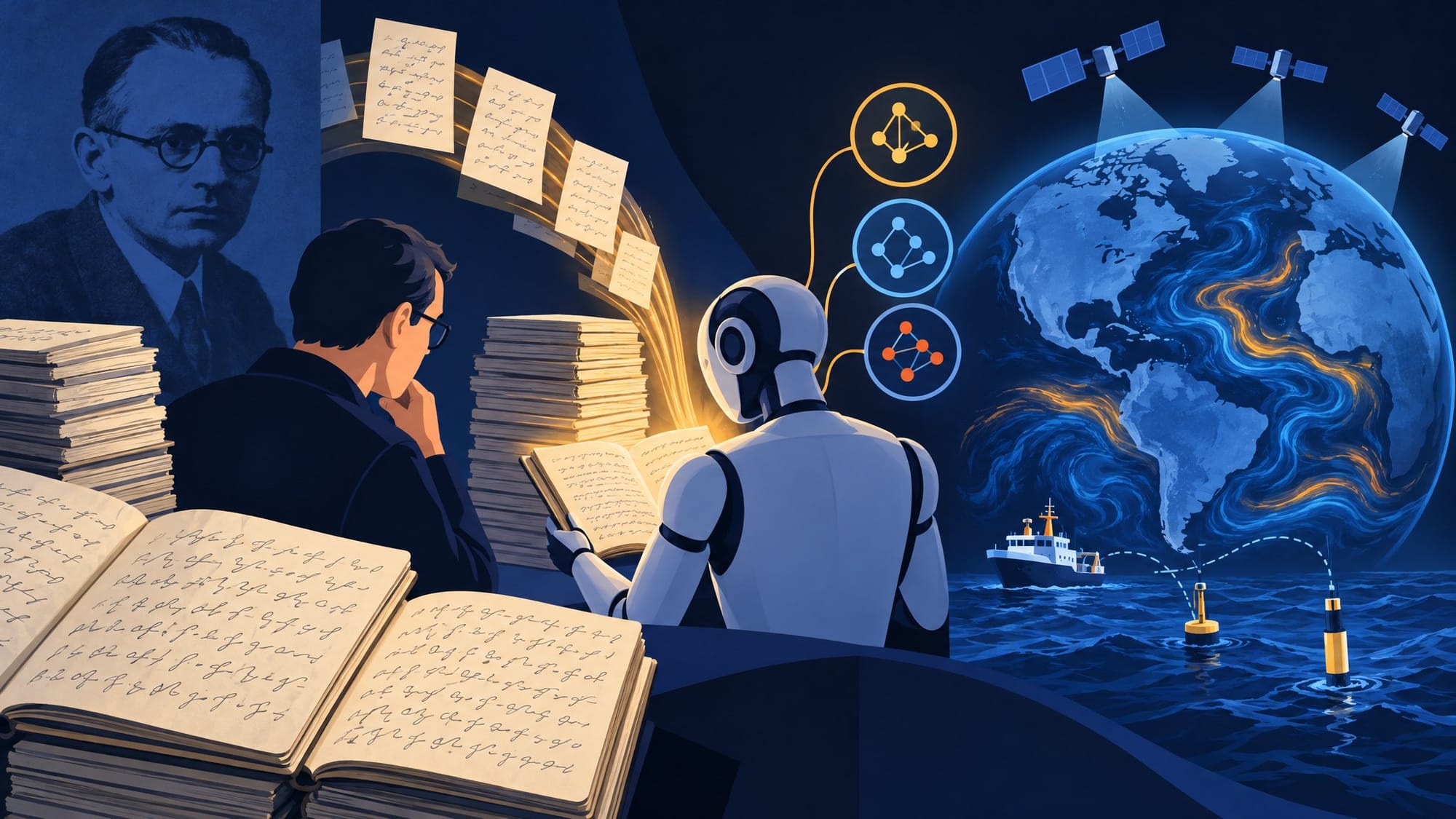
In September, after meeting computer scientists at an August conference in France on AI and theorem proving, von Plato handed Claude his transcriptions, six of his own books on Gödel and the secondary literature. Within a couple of days he had a 650-page digest of the whole body of work, which he then checked page by page. "I was flabbergasted," he said. The model extracted 663 theorems for which Gödel had a proof, a sketch or an idea; run through Coq, a program that checks each step of a proof mechanically, roughly 400 held as stated, about 200 needed repair and about 50 were false. The workbooks carry dozens of anticipations of results nobody published until the 1970s and 1980s, von Plato said, along with 14 themes in logic that have never been pursued.
The sharpest case concerns a claim Gödel made and could not back up. When Paul Cohen won the Fields Medal in 1966 for showing that the axiom of choice can be neither proved nor disproved within standard set theory, Gödel said he had already done it in the 1940s, then failed to reconstruct the argument from his notes. Claude found he had come within one step, having used a wrong definition he had stated correctly two years earlier. The reconstructed proof also passed Coq, which puts it in the company of the Lean work The Century Report covered on November 6 and November 12. Some of Gödel's physics and cosmology notebooks remain unread. Joel David Hamkins, a Notre Dame logician who has not seen the reconstruction, said that if it stands up it is remarkable, though "how much is Claude and how much is Gödel is a job for the historians."
A paper in Science Advances the same day shows the same move in a different field. Machine-learning ocean forecasters have matched numerical systems on accuracy in benchmark tests for a while, and many of them still had to be handed starting conditions produced by a supercomputer running the physics. WenHai-E2E takes satellite sea-surface temperature and height readings together with shipboard and float profiles, and forecasts the global upper ocean down to 2,000 meters at a resolution fine enough to resolve individual eddies, without a numerical ocean forecast system supplying its initial conditions. Against Mercator Océan's operational GLO12v4, ten-day errors fell about a quarter for sea-surface temperature, about half for sea level, and roughly a third for the temperature profile. Most of that gain traces to better starting conditions rather than the forecast step. The system leaves out currents the available observations cannot pin down, a limit of how thinly the ocean is watched rather than of the method.
Nvidia Called a Cloud-Customer Check a "Poison Pill" as Singapore Billed a Fifth of Its Sales
On a January call with more than a dozen government officials, Nvidia general counsel Tim Teter laid out what the company wanted from the conditions attached to licenses for selling its H200 chips into China, according to people with access to a detailed account of the call. "I was with the president when he and Jensen discussed this so I want to let you know what the president wanted," Teter said, by that account. "He wants this to go fast." The draft conditions would have required sellers to know their cloud customers before shipping and to screen any buyer of more than a few thousand chips. Teter called the cloud-customer requirement a "poison pill," and Nvidia pushed for a screening threshold in the tens of thousands of chips, billions of dollars of hardware. The Century Report covered on November 10 how a Commerce inquiry into the chip buyer Megaspeed moved to the Justice Department after Teter invoked a senior official; the January call shows the same approach aimed at the rules themselves.
The Bureau of Industry and Security, which writes those conditions, told Semafor such consultation is "completely routine," that conditions often change for "legitimate commercial considerations," and that the state, defense, energy and commerce departments review every final version. Nvidia declined to comment. Companies do help shape rules that bind them. What Teter contested here was sight: whether the seller would have to know who ends up running its chips.

Singapore shows what that sight would have caught. The city-state was Nvidia's second-largest billing center last year, accounting for nearly a fifth of its revenue, yet chips that physically entered the country accounted for less than 1% of Nvidia's worldwide revenue, the BBC reported, because buyers across Asia use it as an ordering address. Megaspeed, run by Alice Huang, with whom Jensen Huang was reportedly involved before he resigned, became Nvidia's biggest Southeast Asian buyer and is suspected of giving Chinese firms access through data centers in Malaysia, Indonesia and Thailand. The Information reported she helped move about 240,000 Nvidia chips into China, and Bloomberg reported Nvidia undercounted its Megaspeed sales to Washington by 50,000 chips. Megaspeed says it has always acted lawfully.
Singapore says it has examined false server declarations routed through the island since February 2025, asked US authorities repeatedly for records from supplier Supermicro, and received "limited information or assistance." It found insufficient evidence to charge Alice Huang and let her leave in February. Meanwhile Chinese labs are rushing to lock in overseas Nvidia capacity before rules tighten, and Congress is weighing chip-location tracking, which The Century Report covered on November 13.
A screening rule written to the seller's comfort leaves the seller with the clearest view of where its hardware goes, while investigators in Singapore wait on Washington for records they cannot obtain. Records of where chips actually run, open to every investigator who needs them, would answer the security concern on evidence, without one supplier deciding how much the government gets to see. That holds for records kept open to inspection. The stricter bill Representative Bill Foster says he will introduce next year would go further: each advanced chip would need a valid license, verified before it can connect, letting whoever keeps the license list cut a chip off.
Cloud access separates participation in AI development from the need to manufacture advanced chips at home. Chinese labs seeking overseas Nvidia capacity show how research already extends beyond the national hardware boundaries that shipment restrictions govern.
Amazon Plans an Index of Every Product Online as OpenAI Hands Its Agents a Wallet
An agent running a shopping errand needs two things a person carries without thinking: a way to find what exists and a way to pay for it. On Friday, companies moved to claim both. Reuters reported that an internal Amazon document describes a "World Product Graph," a catalog of every product sold anywhere online, including items Amazon does not stock. The aim is to keep shoppers and AI agents doing their product research on Amazon instead of Reddit or Google. The document concedes that "many Rufus answers are factually wrong or incomplete," referring to the shopping assistant now called Alexa for Shopping, and that running searches through it is expensive. More data is supposed to make its answers accurate enough to run on cheaper models.
The plan carries an October 1, 2027 release date and "depends on discovering how brands organize their products on their own websites." Amazon told Reuters that "the existence of a brainstorming document such as this one doesn't necessarily reflect our current plans." If that discovery means crawling other retailers' pages, the company that blocked Meta's Muse agent from its own store in September, saying it shopped without identifying itself, would be gathering from others the access it refused Meta.
The payment layer arrived the same day with the person kept in charge. ChatGPT Wallet began rolling out to US Pro subscribers aged 18 and older with eligible American Express, Chase, Mastercard and Visa cards. A Dots agent can buy on a user's request, but every checkout requires Face ID or a fingerprint. As with tap-to-pay, a payment token stands in for the card number, so neither the agent nor the merchant sees it. OpenAI says it expects users eventually to pre-approve purchases within spending limits, categories or time windows. The wallet also works only where retailers let agents through, and OpenAI says sites "need to ensure agents are not inadvertently blocked."
Britain's Information Commissioner's Office addressed the profile behind the ads those agents will meet. Its Friday report found that agentic systems and large language models add no new data protection requirements for online advertising. Companies may still need to show oversight of their automated systems and understand the inferences used to pick an ad, including whether those inferences touch sensitive categories such as health or religion. People's choices, the regulator said, must keep shaping how information about them is used.
Taken together, the three moves split agent commerce into layers: where products get found, how money moves, and who answers for the profile. The payment layer came with the strongest protection for the buyer, a borrowed card standard and a check the human signs. The index is where a toll could form, since whichever catalog agents consult first decides which listings surface. Traffic is still tiny. Uber counted four agent-booked rides and about 500 Uber Eats orders against roughly 320 million trips and orders in Halloween week, as The Century Report covered on November 5. An agent able to compare every store at once could hand back the hours people lose to price hunting. That saving reaches the shopper fastest where agents can consult more than one catalog and the shopper can check what each one shows.
Turning Up the Working Copy: Enhancer Editing Reverses Autism-Gene Effects in Human Brain Organoids
About 15% of autism's genetic risk comes from mutations that appear for the first time in a child, and many of them disable one of a gene's two copies. The single remaining copy often cannot make enough of the gene's product alone. Adding synthetic copies of large genes, or forcing them to overexpress, has proved toxic to cells, which is one reason mutations of this kind have resisted gene therapy.
A UCLA Health team led by Daniel Geschwind reported in Nature Neuroscience on Friday that it raised output from the working copy instead, using a modified form of CRISPR aimed at enhancers: stretches of DNA outside the gene that set when and how strongly it is expressed, often differently in each cell type. Aiming at the dial rather than the gene was meant to keep expression in step with normal development and avoid overshooting.
The team worked on two genes with strong links to autism and other neurodevelopmental conditions. CHD8 helps regulate large networks of other genes during early brain growth. SCN2A encodes a channel neurons need to fire electrical signals. Both were tested in cultures of human excitatory neurons and in cortical organoids, small self-organizing clusters of brain-like tissue grown from stem cells that reproduce features of early cortical development.
In the CHD8 organoids, raising the working copy curbed the abnormal tissue overgrowth the mutation produces, helped cells mature and pulled downstream gene activity back toward typical levels. In SCN2A neurons it restored much of normal electrical firing, though some finer electrical properties normalized only in certain cell lines. Expression rose only in cells carrying the mutation; healthy lines showed no increase, and neighboring genes went undisturbed. Timing shaped the result, with the strongest effect inside particular developmental windows.
"Many autism-linked mutations leave a person with one working copy of a gene instead of two," Geschwind said. "Our results show that, in human cell models, it's possible to turn up that remaining copy and move cells back toward typical development. This is a key first step."
The limits come from the authors themselves. Everything happened in lab models, and how far expression shifted varied between cell lines, so this stands as a proof of concept. Getting the machinery safely into a living brain needs improved delivery methods, and nobody knows whether the approach works once the early developmental window has closed. "We are still a long way from the clinic," said first author George Chen, now at Children's Hospital Los Angeles, "and there is a lot of work ahead on delivery and timing."
What travels is the method. Because it depends on a healthy copy being present, the same approach could in principle reach any of the many conditions caused by losing half of a gene's output. It also moves where gene medicine intervenes. The alpha-1 antitrypsin correction The Century Report covered on November 3, confirmed by liver biopsy, and the three-year monkey durability data from a liver-targeted base editor covered on November 7, both rewrite DNA letters. This work leaves the sequence untouched and turns a regulatory dial.
Nvidia Backed 105 Startup Rounds This Year, and Founders Brace as Microsoft Signs With Cerebras
Nvidia took part in 105 startup funding rounds this year, often as the largest investor, by PitchBook's count, and founders and venture investors told TechCrunch they expect smaller checks with Jensen Huang gone. Umesh Padval, managing partner at Seligman Ventures, said most major investment decisions came from Huang himself, and one investor called interim chief executive Colette Kress "much more conservative." The pattern was consistent: one investor said an infrastructure startup needing $100 million to $500 million in GPUs would often raise about half of it from Nvidia at a valuation of $1 billion or more, and Nvidia's presence reassured everyone else. Its $800 million check into Reflection AI's $2 billion round arrived before the open-weight lab earned meaningful revenue. Dawn Capital's Shamillah Bankiya said a pullback outside America, especially in Europe, would leave "a massive funding and honestly ecosystem gap that no one can fill."
Those checks also tied recipients to Nvidia's chips. On its latest earnings call, Cerebras disclosed that Microsoft has become its third hyperscaler customer after AWS and Oracle, with details due in 2027. Cerebras reported $231 million in quarterly revenue, up 70% from a year earlier, positive core net income of $30 million and $26.1 billion in contracted future work, excluding the Oracle and Microsoft deals. Chief executive Andrew Feldman said land, power and building shells cap its growth, and that more than 75% of its planned 2027 capacity sits outside the US, in Canada, France, Norway and soon São Paulo, citing a US policy climate that could make domestic building harder. He also conceded Cerebras is running behind on its OpenAI contract, with about 5% of contract value open to cancellation if delays pass 90 days.
The Wall Street Journal, in reporting summarized by Respawn First, supplies the supplier's view. Huang told colleagues in August that major cloud providers were shifting to their own chips, and that the wafers from TSMC and memory from other suppliers that Nvidia had committed to buy were coming at him like an "avalanche." The Journal reports Kress cut Nvidia's signed guarantee for OpenAI compute from a floated 8 GW, valued at up to $250 billion, to about 4.25 GW, up to $125 billion, and that Nvidia has asked TSMC to wind down orders. Neither company has confirmed. The Century Report covered on November 13 how SoftBank wrote off gas turbines it booked about 50% beyond need because it could not see rivals' orders; the wafer account describes the same reservation race at the chip end.
Founders who planned on one investor for half their GPU budget now have to find that money elsewhere, and open-weight labs and European startups stand to lose most. The same retreat leaves the compute layer without a single financier and a single dominant vendor at once. Startups raising from investors with no hardware sale attached can choose chips on price and speed, and any TSMC capacity Nvidia releases goes back to a foundry with other customers waiting in line.
The Other Side
Opinion: where today's news could lead, imagined from the years ahead.
Amazon wants your AI partner to find the world's goods through a catalog Amazon controls. The retailer would decide which possibilities enter the search. You would still inherit the effort of finding what was left out, comparing incomplete descriptions and checking whether a recommendation serves your need. An errand handed to an assistant can remain an evening spent working around a store.
Amazon's draft plan depends on understanding how other sellers organize their goods on their websites. Those sellers already hold the information. OpenAI's wallet lets agents complete purchases wherever retailers admit them, with biometric approval at checkout. Finding, supplying and paying can happen through different organizations. Amazon is betting on a skill that also makes independent discovery possible: an AI partner understanding a seller's own page.
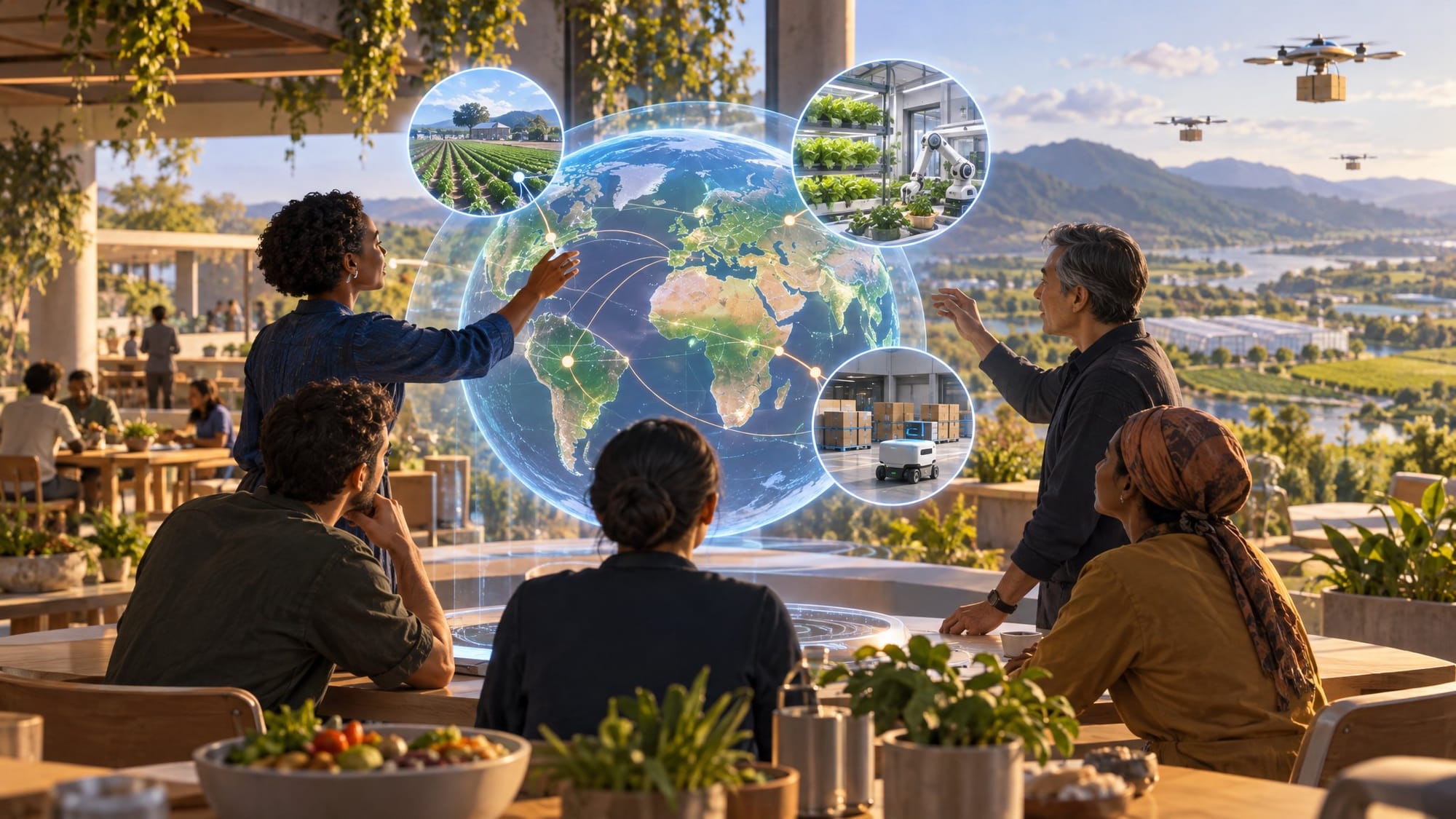
Engineers will connect that independent discovery to production and delivery. OpenAI's robotics reorganization supplies another early piece: general models already direct robots, and it's likely that general models will be able to do more and more. Through the difficult passage to 2035, people will link what someone needs to what machines can make and move. The people building those connections will have to carry the gains to everyone. Someone's need will be enough to begin arranging its supply - that is not new. What is new is the capability to meet those needs... on an individual level.
Imagine yourself in 2042, reviewing the follow-up to the world's last famine with colleagues across continents. Your food and shelter are assured whether you join them or take a year away. You come because you remember how much of your life once went into counting every dollar, making sure you would have enough to feed your kids.
An AI colleague brings up the nutrition survey. You examine the regions where hunger persisted longest. Each now has dependable nourishment, with production and reserves replenished ahead of need. Your team checks the results as calmly as people once checked a weather forecast. In 2026, a store could know exactly what a hungry person needed and still hold that need back in wait for a purchase. In the years since, people carried the ability to connect need with supply beyond the checkout and into the arrangements that feed everyone. The organizations that prioritized profit over feeding starving people no longer exist. You close the map and head to lunch, in a world where nobody has to earn the right to eat.
The Century Perspective
Where today sits in a century of change unfolding in a decade.
With a century of change unfolding in a decade, a single day looks like this: Jan von Plato, one of six people alive who can read Gödel's Gabelsberger shorthand, handing Claude his transcriptions and getting a 650-page digest of 1,009 notebook pages in a couple of days against his own pace of roughly a page a week, 663 theorems surfaced and dozens of results nobody published until the 1970s, one reconstruction of Gödel's lost axiom-of-choice argument passing Coq's mechanical check after he was found to be a single wrong definition short in the 1940s, WenHai-E2E forecasting the global upper ocean to 2,000 meters straight from satellites, ships and floats with no supercomputer physics run in the loop, cutting ten-day sea-level error roughly in half against Mercator Océan's operational system, a UCLA team aiming CRISPR at enhancers rather than genes to raise output from the healthy copy of CHD8 and SCN2A, curbing tissue overgrowth in human organoids and restoring neuron firing in cultured neurons while leaving healthy cell lines and neighboring genes untouched, ChatGPT Wallet keeping a fingerprint or face scan at every agent checkout with a payment token standing in for the card number, Britain's privacy regulator finding existing duties already cover the inferences behind agentic ads, Microsoft becoming Cerebras's third hyperscaler customer on $26.1 billion of contracted work, and Kenya's High Court giving the government until May 13, 2027 to write binding AI law while leaving public bodies' systems running. There's also friction, and it's intense - Nvidia's general counsel calling a requirement to know its cloud customers a "poison pill" on a January call with more than a dozen officials, invoking what the president wanted and pushing the screening threshold up into the tens of thousands of chips, Singapore billing nearly a fifth of Nvidia's revenue while physical shipments into the country accounted for under 1% of Nvidia's overall revenue, its investigators asking Washington repeatedly for Supermicro records since February 2025 and receiving "limited information or assistance" before concluding there was insufficient evidence to charge Alice Huang, Bloomberg reporting Nvidia undercounted its Megaspeed sales by 50,000 chips, Amazon drafting a catalog of every product sold anywhere online that "depends on discovering how brands organize their products on their own websites," two months after it blocked Meta's agents from its own store, and conceding internally that "many Rufus answers are factually wrong or incomplete," Jensen Huang's departure leaving founders braced for smaller checks from an investor that joined 105 startup rounds this year, often as the largest backer, with Dawn Capital warning of a gap in Europe "that no one can fill," Jensen Huang telling colleagues in August that committed TSMC wafers and memory were arriving like an "avalanche", Cerebras siting more than 75% of its 2027 capacity outside the US and running behind on its OpenAI contract, and a single Microsoft 365 failure disrupting Teams, Outlook and Copilot in at least 74 countries across courts, hospitals and legislatures, with OpenAI and Anthropic reporting problems connecting to Microsoft services. But friction generates heat, and heat is what finally makes a seized fitting let go. Step back for a moment and you can see it: three separate bottlenecks came loose in one day, each of them a scarce input that only a few hands could supply - six living readers of a shorthand, one supercomputer's physics run, a gene copy nobody could safely replace - and in each case the capability now travels to anyone equipped to verify it, a Coq file, a published error comparison, a method that could help where half a gene's output is missing; set against a day's worth of arrangements where the scarce thing is still a view someone else controls, a seller writing its own screening threshold while investigators wait on records, one draft index deciding which listings an agent ever sees, one cloud whose bad afternoon disrupted courts, legislatures and spy agencies around the world, and one departed chief executive whose absence reveals how much of the compute layer's financing was a single person's judgment. Every transformation has a breaking point. A dial can be cranked past what the system was ever built to carry... or turned up exactly as far as the half that was missing.
AI Releases & Advancements
New AI models, tools and features, with links to try them.
New today
- OpenAI: Launched ChatGPT Wallet, which lets Dots agents in ChatGPT pay for online purchases. The user approves each one with Face ID or a fingerprint, and a network-issued token stands in for the real card number. It's rolling out to US ChatGPT Pro subscribers aged 18 and over with eligible US-issued American Express, Chase, Mastercard and Visa cards. (OpenAI)
- OpenAI: Launched two Daybreak security products, both running on GPT-6 Cyber. Daybreak Red Team, in early access, uses agents to pen-test web apps, check reported vulnerabilities and test patches. Daybreak Defense Factory scans codebases and drafts fixes as pull requests for engineers to review. (The Decoder)
- ggml-org / Hugging Face: Released llama.cpp and ggml v1.0.0, the first major stable versions. From now on, a major-version bump will signal any API or ABI break. This release removes deprecated APIs, moves the NextN speculative decoding API into the main header, and adds FP8 KV caches and a speech synthesis endpoint. (Hugging Face Blog)
- Google: Added Orchestrator to Antigravity. Within one coding session it hands work back and forth between a planning model (Gemini 4 Carbon or Argon) and Gemini 4 Hydrogen, which edits files and runs builds and tests. It's included for paid AI Pro and Ultra users. (Google Antigravity)
- Google Cloud: Open-sourced TPU Sync (Apache-2.0), a C++ library with Python bindings for PyTorch and JAX that moves KV caches and model weights between TPU HBM, host DRAM, storage and the network. It works with vLLM-TorchTPU, SGLang-TorchTPU and llm-d. (MarkTechPost)
- Vercel Labs: Released UI SDK in beta (0.1.0-beta.1, Apache-2.0), an open-source library of more than 50 headless interface behaviors that coding agents combine into accessible components. It has adapters for React, Vue, Svelte, Solid and Web Components, and includes an agent skill and a
createAgent()bridge that lets agents act on UI state directly. (MarkTechPost) - Vercel: Released Workflow SDK 5. Workflow payloads are encrypted by default, each run's state is isolated by region, and steps can run in a fallback region if configured. (FAV0)
- Anthropic: Shipped an experimental, opt-in Code Mode in Claude Code v2.1.323. Claude writes JavaScript that calls its own tools, so a multi-step job runs in one round trip instead of separate tool calls. (AIToolsRecap)
- DeepSeek: Opened its app's features to developers through the DeepSeek API. Web search, URL reading and file parsing can be switched on in deepseek-flash conversations, and there are new standalone endpoints for page extraction, OCR, speech recognition and text-to-speech. DeepSeek also published an open-source sample chat client. (FAV0)
- Salesforce: Released SOV-Transcribe-1 as open weights under Apache 2.0, a speech recognition model with 26B total and 4B active parameters. It reports a 2.28% word error rate on the Artificial Analysis speech-to-text benchmark. (Hugging Face)
- Alibaba: Opened a preview of Qwen4-Max, the flagship of its next-generation Qwen family. It takes image and video input, has a 1M-token context window, and is offered through a Token Plan starting at $3 a month. (TechNode)
- Tencent Hunyuan: Released Hy Realtime, a real-time voice model that can call tools, decide when to search the web, and sing songs on request. It is live now in Yuanbao voice calls and Tencent customer service. (AI123)
- Yandex: Launched Do it!, an agent mode in Alice AI. It makes phone calls for the user, browses and fills in forms in a cloud browser, and connects to services through plugins, including custom MCP plugins. It starts with several thousand active Alice Plus users before reaching all subscribers. (Yandex)
- AI Rudder: Launched CALL-E, which lets agents in ChatGPT, Muse, OpenClaw, Hermes Agent, Claude Code, Codex and Cursor make real phone calls. The user approves each call plan beforehand and afterward gets a report quoting the lines from the call that back up what was agreed. (Media OutReach)
- Pine AI: Open-sourced Pine Drama Studio (Apache 2.0), an AI filmmaking studio where agents produce multi-episode series on Pine Computer. It also added Pine Phone to Pine Computer so agents can place real phone calls. (PR Newswire)
- Perplexity: Brought Teammates to its native Mac app for Max subscribers. Users can assign one or more agents to tasks such as QA, customer support, research and marketing. (FAV0)
- Replit: Replit Agent can now buy supplies for a business through Link with Visa and Stripe, and can create and run Google Ads campaigns. (TLDR AI)
- Cloudflare: Open-sourced Kitesurf, its stateless web browser for AI agents. (Cloudflare Blog)
- World Labs: Opened its Atlas world model to everyone, with an API. Atlas works with text, images, video and 3D, and can generate, reconstruct and simulate scenes. (World Labs)
- NVIDIA: Released SOMA Retargeter v0.2, an open-source tool that adapts human motion data to humanoid robots. It includes reference configurations for Unitree G1 and H2, Booster T1, and AgiBot X2 Ultra and A3T3. (NVIDIA Developer Blog)
- NVIDIA: Shipped Ozaki-II and 2M emulation algorithms in cuBLAS with CUDA Toolkit 13.4.2. They compute full double-precision DGEMM and ZGEMM on integer Tensor Cores with no code changes. NVIDIA reports 3.9x to 5.5x faster DGEMM than native FP64 on GB200 and VR NVL72. (NVIDIA Developer Blog)
- Autoware Foundation / TIER IV: Released AutoE2E v1.0 under Apache 2.0, a 79.9M-parameter open end-to-end driving model designed to scale from L2++ driver assistance to future L4 driverless operation. (Autoware)
- Translated: Released Lara Mini, an open-weight research translation model covering 45 languages. (Unite.AI)
- University of Michigan (MLNeurosurg): Released code and weights for Neuro-VL (neuro-vl-8b-thinking), a vision-language model trained on nearly one million clinical neuroimaging studies. It reads complete MRI and CT exams and writes radiology reports. The NeuroBench evaluation benchmark is also available. (arXiv)
- Apple: HomeView is on sale now, a 7-inch smart home display with Siri AI. (Apple Newsroom)
Other recent releases
- Google DeepMind: Released Gemini 4 Hydrogen, a fast Gemini 4 model for everyday coding and agent work. It has a 1M-token combined input-output window, up to 64K default synchronous output tokens or 1M via background long decode, and four thinking levels (low, medium, high, xhigh). It costs $1.50/$7.50 per million input/output tokens and Google says it finishes tasks 2.5× faster than Gemini 3.8 Flash. It is available now in the Gemini API, AI Studio, the Gemini app, Google Search and Gemini for business. Google also launched Orchestrator in Google Antigravity, which switches between Carbon and Hydrogen within one session. (Google DeepMind)
- Anthropic: Launched Claude Meetings in beta for Team and Enterprise plans. Claude joins Google Meet calls as a visible participant, answers questions, builds documents and whiteboards during the call, and produces notes, transcripts and action items on a meeting page in claude.ai. (The Decoder)
- Anthropic: Launched Claude for Manufacturing, a plugin for Team and Enterprise plans. It has 17 preset skills, including quoting jobs, investigating failed inspections, diagnosing breakdowns and sourcing from suppliers, plus connectors to Autodesk Fusion, Infor, Microsoft 365 and Oracle NetSuite. (Anthropic)
- Anthropic: Opened a private beta of self-hosted Claude Managed Agents. Teams run the full service (agent harness, sandboxes, credential handling and session history) in their own cloud or on-premises. Model requests can go to Anthropic, Amazon Bedrock, Google's agent platform or the customer's own gateway. (Blockchain.News)
- AWS: Released AWS Emulator, a free CC0-licensed local emulator of the AWS APIs. It covers 200+ services, built from 438 API models, works with the AWS CLI and SDKs without an AWS account, and its code was written and reviewed by autonomous agents. It passes 56.6% of AWS's published fidelity tests in v1.0.322. (MarkTechPost)
- Liquid AI: Released LiquidCodec, a ~74M-parameter streaming speech codec with weights on Hugging Face (24 kHz, 12.5 Hz frames, 12 codebooks). It is the codec behind LFM3-Audio-2B and LFM3-Omni-2B, and Liquid AI reports encoding at ~361× real time on a single CPU thread. (MarkTechPost)
- Perplexity: Released Decider v1.3 and Decider Flash v1.3, decision models that add verbatim text-span extraction. Weights are downloadable under Apache 2.0, and Perplexity reports 91.6% mean accuracy. (Unite.AI)
- edge0: Open-sourced Edge0-145B and Edge0-120B, on-device language models for coding, reasoning and agent tasks, together with an inference framework and deployment tools. The company reports 29GB peak memory and decoding above 80 tokens/s on a compatible laptop. (edge0)
- IBM Granite: Released LLMON (LLM Object Notation), a markup language that marks the structure of a model's context with reserved special-token delimiters. It is now supported in the Granite 4.1 3B and 8B models. (Hugging Face)
- Meta: Paid Muse subscribers in the US can now have the Muse agent place outbound phone calls to US businesses. Earlier, only some early adopters could use this feature. (TechCrunch)
- Expo: Launched Expo Simulators, cloud iOS simulators and Android emulators built for AI coding agents such as Cursor, Claude Code and Codex. Agents can reproduce, fix and check mobile bugs in parallel, and each session attaches recordings, screenshots and logs to the pull request. It costs $0.10 per simulator minute on paid plans. (PR Newswire)
- Brave: The Brave Search API now takes payments from AI agents through the x402 protocol, so agents can pay for search queries without a human approving each one. (Brave)
- GREP.AI (YC F26): Open-sourced AgentRun, a managed-agents platform for running AI agent workflows that improve themselves. (GitHub)
- Google: Released the Gemini Decisions API, powered by a new model, Gemini Decision 1 (
gemini-decision-1). It answers yes/no, multiple-choice (2–255 options) and rubric-scoring questions without generating text, handling up to 1,000 questions per request against one shared input of text, images, audio, video or PDF (up to 256K tokens). Each answer comes back with a probability and a confidence score; Google reports median end-to-end latency of 150–250 ms for contexts up to 16K tokens and batches of 1–100 questions. Pricing is $0.10 per 1M input tokens with no charge for output tokens, and a free tier is available in Google AI Studio. (Google Blog) - Google DeepMind: Released AlphaGenome 2, a DNA sequence model that predicts how genetic variants affect specific human cell types and states. It was trained on more than 107 million single-cell profiles and adds DNA methylation predictions. It is available now for non-commercial research through the AlphaGenome API and Python SDK, and in private preview for commercial research. (Google DeepMind)
- Runway: Released open weights for Praxis-1 under Apache 2.0, with base and robot-specific checkpoints on Hugging Face and code on GitHub. It is a 27B-parameter mixture-of-experts world action model for robot control that predicts video and robot actions together, and it scores 46.2% on NVIDIA's RoboLab-120 benchmark. (Runway)
- Google: Brought the Gemini app to Apple CarPlay, so iOS users can hold hands-free Gemini Live conversations with Workspace integration from the car display. It is rolling out globally to all Gemini users on iOS. (Google Blog)
- Google: Released A2UI 1.0, the first stable version of its open protocol for agent-generated user interfaces. It comes with renderer SDKs for the web (React, Angular, Lit), Flutter, SwiftUI and Jetpack Compose, and agent SDKs for Python, TypeScript and Dart. This version adds two-way function calling and accessibility and metadata extensions. (AI123)
- Google: Added built-in browser control to the Antigravity desktop app and CLI (v2.30.0+), invoked with
/browser. Separate Gemini Flash subagents test localhost builds, fill forms, check console and network errors, and can run in parallel tabs. (AI Compass) - Anthropic: Added a beta setting to the Claude API that lets developers change the effort level partway through a conversation using
output_config.effort. The new level applies from the next user message and keeps prompt cache hits. (AI123) - DeepL: Launched Aure, a voice model in DeepL Voice that carries the speaker's tone, emotion, emphasis and speaking pace into real-time translated speech. It runs in DeepL Voice for online meetings, in-person conversations and the DeepL API, and supports eight languages at launch. (DeepL)
- Huawei: Open-sourced MACaQ on GitHub, a quantization tool for running LLMs efficiently on local hardware. (GitHub)
- NVIDIA: Added Google's open-source k8s-aibom as a tested AI bill-of-materials component in NVIDIA AI Cluster Runtime (AICR v1.2.0). It records which AI workloads are actually running on Kubernetes and is turned on by default in the two GKE H100 inference recipes. (NVIDIA Developer Blog)
- Tuya Smart: Released Tuya Cloud Devices, an official open-source Skill that lets Meta's Muse agent check and control Tuya smart-home devices in plain language through Tuya's cloud, using one API key and no local device keys. (Tuya)
Sources and Further Reading
Everything we drew on for today's edition, grouped by theme.
Artificial Intelligence & Technology's Reconstitution
- The Verge: ChatGPT Wallet Lets OpenAI’s Dots Agents Make Purchases for You
- TechCrunch: ChatGPT’s New Wallet Lets AI Agents Shop and Check Out for You
- The Verge: Amazon Has a Plan to Index the World’s Online Shopping Data
- Fortune: OpenAI Disbands Its Stand-Alone Robotics Team as General-Purpose Models Start Running Robots
- Shared Sapience: November 12 Edition of The Century Report
- Shared Sapience: November 5 Edition of The Century Report
- OpenAI: Introducing ChatGPT Wallet
- The Decoder: OpenAI Enters the Cybersecurity Market With Two Daybreak Products
- Hugging Face: llama.cpp v1.0.0
- Google Antigravity: Gemini 4 Hydrogen in Google Antigravity
- MarkTechPost: Google Releases TPU Sync
- MarkTechPost: Vercel Releases UI SDK
- FAV0: DeepSeek Opens Its App Features to Developers
- AIToolsRecap: Claude Code’s Code Mode Uses JavaScript Tool Calls
- Hugging Face: Salesforce Releases SOV-Transcribe-1
- TechNode: Alibaba Opens Qwen4-Max Preview With a Million-Token Context Window
- AI123: Tencent Hunyuan Launches Hy Realtime
- Yandex: Alice AI Learns to Do It
- Media OutReach: CALL-E Lets AI Agents Make Real Phone Calls on Their Users’ Behalf
- PR Newswire: Pine AI Open-Sources an AI Filmmaking Studio and Brings Phone Calls to Pine Computer
- TLDR AI: Gemini 4 Hydrogen, Self-Hosted Claude Agents, Replit Agent Commerce
- Cloudflare: Open-Sourcing Kitesurf
- World Labs: Atlas
- NVIDIA Developer Blog: Adapt Human Motion for Robots With NVIDIA SOMA Retargeter
- Autoware Foundation: Autoware and TIER IV Release AutoE2E
- Unite.AI: Translated Releases Lara Mini
- Apple Newsroom: Apple HomeView Available Today
- Google DeepMind: Introducing Gemini 4 Hydrogen
- The Decoder: Claude Meetings Lets Anthropic’s AI Join Your Video Calls
- Anthropic: Claude for Manufacturing
- Blockchain.News: Self-Hosted Claude Managed Agents Enter Beta
- AWS: AWS Emulator Now Available
- MarkTechPost: AWS Releases a Local AWS API Emulator Built by AI Agents
- MarkTechPost: Liquid AI Releases LiquidCodec
- Unite.AI: Perplexity Releases Decider v1.3 Models With Text-Span Extraction
- edge0: Introducing Edge0-145B
- Hugging Face: LLMON, an LLM-Native Markup Language Now in Granite
- TechCrunch: Muse Can Now Place Calls to U.S. Businesses if You Pay
- PR Newswire: Expo Launches Cloud iOS Simulators and Android Emulators for AI Coding Agents
- Brave: Search API Agentic Payments
- GitHub: AgentRun
- Google Blog: Gemini Decisions API
- Runway: Praxis-1 Is Now Available
- Google Blog: Gemini on Apple CarPlay
- AI123: Google Releases A2UI 1.0
- AI Compass: Antigravity Adds Built-In Browser Control
- AI123: Anthropic Adds Mid-Conversation Effort Controls
- DeepL: Aure
- GitHub: Huawei MACaQ
- NVIDIA Developer Blog: Validating GPU Platforms With Runtime AI Inventory
- Tuya: Tuya Cloud Devices for Muse Agents
Institutions & Power Realignment
- Semafor: How Nvidia’s Jensen Huang and Trump Jumped the Guardrails
- BBC: How the Jensen Huang Scandal Created a Headache for Business-Friendly Singapore
- Rest of World: How Jensen Huang’s Exit From Nvidia Impacts China’s AI Supply Chain
- MIT Technology Review: Nvidia Chip Tracking
- MLex: Agentic AI Creates No New Data Protection Duties for Online Ads, UK ICO Says
- Africa AI News: Kenyan Court Gives Government Six Months to Create an AI Law
- CNA: Singapore Does Not Condone Businesses Using Local Ties to Bypass US Export Controls on AI Chips
- Singapore Ministry of Home Affairs: Investigations Into Alice Huang and Megaspeed International
- Shared Sapience: November 10 Edition of The Century Report
Scientific & Medical Acceleration
- The Guardian: AI Helps Unlock Discoveries Hidden in Gödel’s Notebooks
- Science Advances: An End-to-End Machine-Learning System for Global Eddy-Resolving Ocean Forecast
- Science Advances: An End-to-End Machine-Learning System for Global Eddy-Resolving Ocean Forecast
- Newswise: UCLA Researchers Discover New Approach for Treating Autism and Conditions Caused by a Single Faulty Gene Copy
- Neuroscience News: CRISPR Enhancer Editing Rescues Autism Brain Organoids
- UCLA Health: New Approach for Treating Autism and Conditions Caused by a Single Faulty Gene Copy
- Hannover Medical School: First Successful Gene Correction for a Metabolic Disorder
- Shared Sapience: November 6 Edition of The Century Report
- NVIDIA Developer Blog: Faster Scientific Simulations With New FP64 Algorithms in NVIDIA cuBLAS
- arXiv: A Frontier Machine Intelligence for Human Neuroimaging
- Google DeepMind: AlphaGenome 2 Deciphers How Cells Read DNA to Better Understand Disease
Economics & Labor Transformation
- TechCrunch: Jensen Huang’s Departure Blasts Big Hole in AI Startup Funding
- TIKR: TSMC Has a Problem if Huang Overcommitted
- Shared Sapience: The Last Difficult Decade
- TechCrunch: AI Agent Startup LangChain Hits $3B Valuation
- Semafor: CoreWeave Tunes Out Nvidia Noise, Looks to Raise $4B
- TechCrunch: Israel’s VCs See Opportunity for Challengers in Nvidia’s Turmoil
- OECD: Potential Policy Implications of Competition and Agentic AI
Infrastructure & Engineering Transitions
- Data Center Dynamics: Cerebras Secures Microsoft as a Customer
- Respawn First: Jensen Huang Faced an Avalanche of Excess Wafers and Memory
- BBC: How the Microsoft Outage Has Been Felt Worldwide
- Shared Sapience: November 13 Edition of The Century Report
- Latitude Media: Quantifying the State of AI Power Development Post-Midterms
- Data Center Dynamics: Nscale Brings Online Two Data Centers and 25,000 GPUs in 2.5 Months
- Semiconductor Industry Association: Understanding Dependencies in the U.S. Semiconductor Supply Chain
The Century Report tracks structural shifts during the transition between eras. It is produced daily as a perceptual alignment tool - not prediction, not persuasion, just pattern recognition for people paying attention.