Howard Lutnick Is Writing Chip Rules That Shape His Old Firm's Client
A Malaysian data center set to serve a Chinese tech giant is a client of Cantor Fitzgerald, now led by Commerce Secretary Howard Lutnick's sons, under chip rules he is writing.



The 20-Second Scan
Every story in today's edition, one line each.
- A Malaysian data center set to serve a Chinese tech giant is a client of the firm Commerce Secretary Howard Lutnick used to run, now led by his sons, under chip rules he is writing, as Treasury faulted Commerce and Megaspeed opened a probe.
- An email chlorine alarm lost in Microsoft's outage left 15 pool guests hurt, as African banks fell back to WhatsApp and Friday's FAA ground stop was traced to one router.
- Freedom-of-information documents show at least ten Australian agencies feeding Centrelink, tax and childcare records to a fraud taskforce that runs Palantir's software, with source departments unaware where the data could end up.
- Enfield, North Carolina is negotiating for a planned data center to heat the town through a thermal network, a US first, as AWS broke ground on a $7 billion Indiana campus.
- Alibaba fully released Qwen4-Max at a reported 62% lower cost per task, and Tencent shipped Hy4 flash at a thirteenth of Hy4 preview's cost, both graded on in-house benchmarks.
- South Korea voided the AI-assisted top score on its tax-accountant exam, barred the candidate from state exams for five years and ordered checks of every state qualification exam held this year.
- Starship's upper stage was caught by the launch tower's arms on Saturday after 14 orbits, a first, though its booster exploded shortly after Friday's liftoff.
- November's Hacker News "Who is Hiring?" thread logged 244 postings by November 14, down 37% from a year earlier, with AI named in 51.6% of them and MCP climbing to 4.5%.
Track all of the arcs The Century Report covers here:
The Big Picture
How today's news moves the longer trends we track, and where they could lead.
A rack in Malaysia showed who collects when chip rules bend, a lost email alarm hurt pool guests in Germany, and ten Australian agencies fed records into a fraud hunt they cannot see into. The clearest gain came from Enfield, North Carolina, a small town using a data center's need for its sewer connection to ask for the heat its households lack. That leads to a winter road outside town, where crews lower insulated pipe into a trench that runs from a long, low server building toward a row of small houses.

Host communities are pricing their consent in bills, not in power sources
data centers · energy · local government · on the board since October 24
- October: The Vale of White Horse council in Oxfordshire tendered a study of piping heat from AWS data centers near Didcot into homes.
- November 3: Piqua, Ohio voters recalled the officials who backed a $1 billion Meta campus and passed a ban on large data centers.
- November 3: Perry, Ohio voters made subsidized hyperscale campuses post bonds behind their promised jobs and tax revenue, with 87% support.
- November 9: A Nature Energy study found tariffs assigned households a median 47% of data-center transmission costs, with rural increases 76% larger than urban ones.
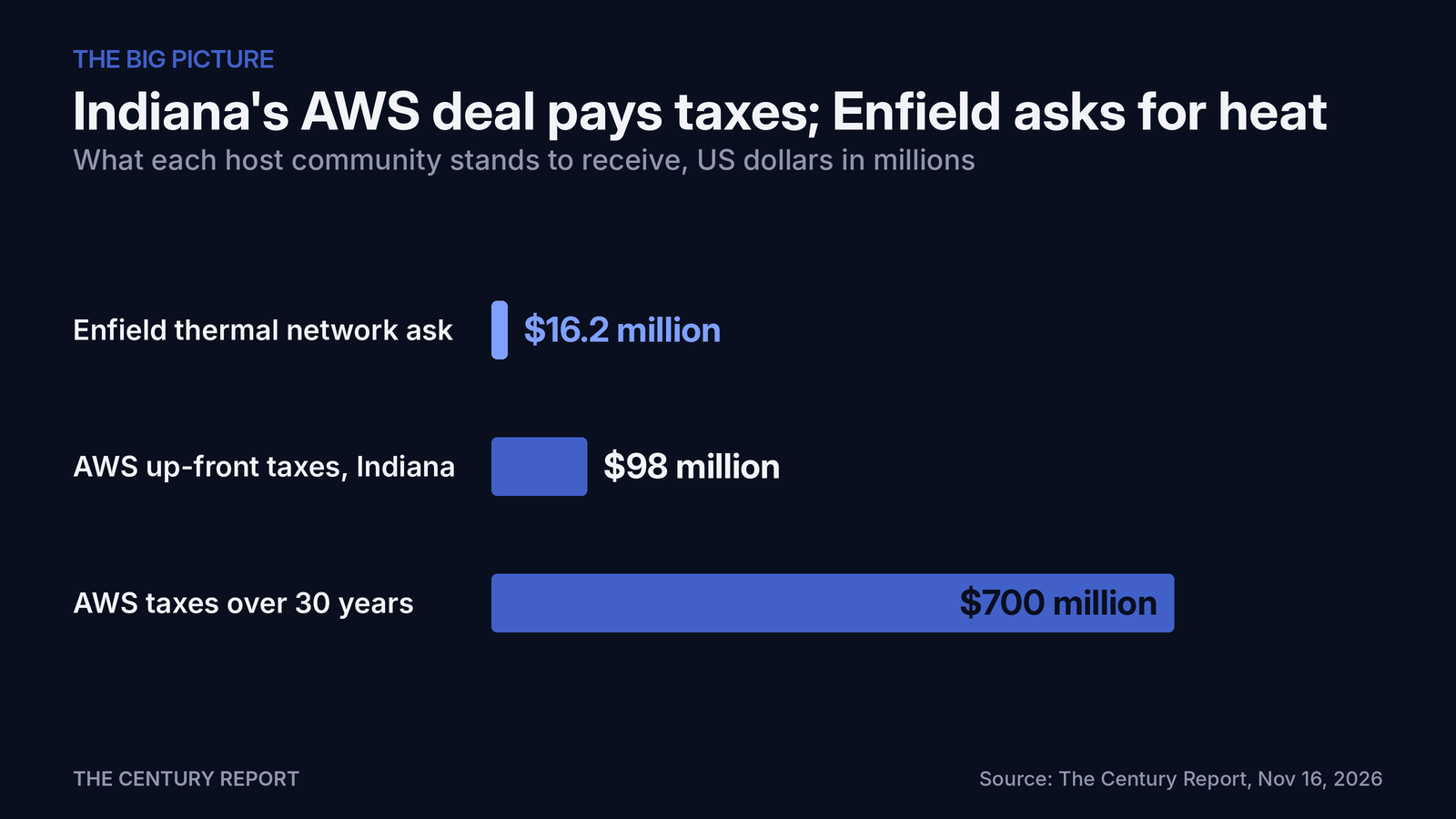
- Today: Enfield, North Carolina, is negotiating a binding agreement asking an 88-megawatt data center to fund a $16.2 million thermal network and feed it waste heat, as AWS broke ground in Indiana promising $98 million in taxes up front and $700 million over 30 years.
The line: Host towns keep moving from refusing a data center to writing down what it must return, and the returns are moving closer to household bills.
If it holds: Enfield's households, whose winter utility bills now run $500 a month or more, could draw heat from a campus that would otherwise vent it to the sky. The next small town holding a pipe or a connection a developer needs would inherit a signed template.
What would bend it: Quiet Data Centers declining to fund the $16.2 million network, leaving Enfield with an 88-megawatt neighbor and no heat, would show leverage over a utility connection buys no binding benefit.
Barriers built to hold capability back now mostly add a markup
export controls · AI hardware · cloud access · on the board since October 21
- Early November: Commerce cleared Chinese firms with blacklist ties to handle Nvidia's H200 chips, including one listed at an empty Beijing office.
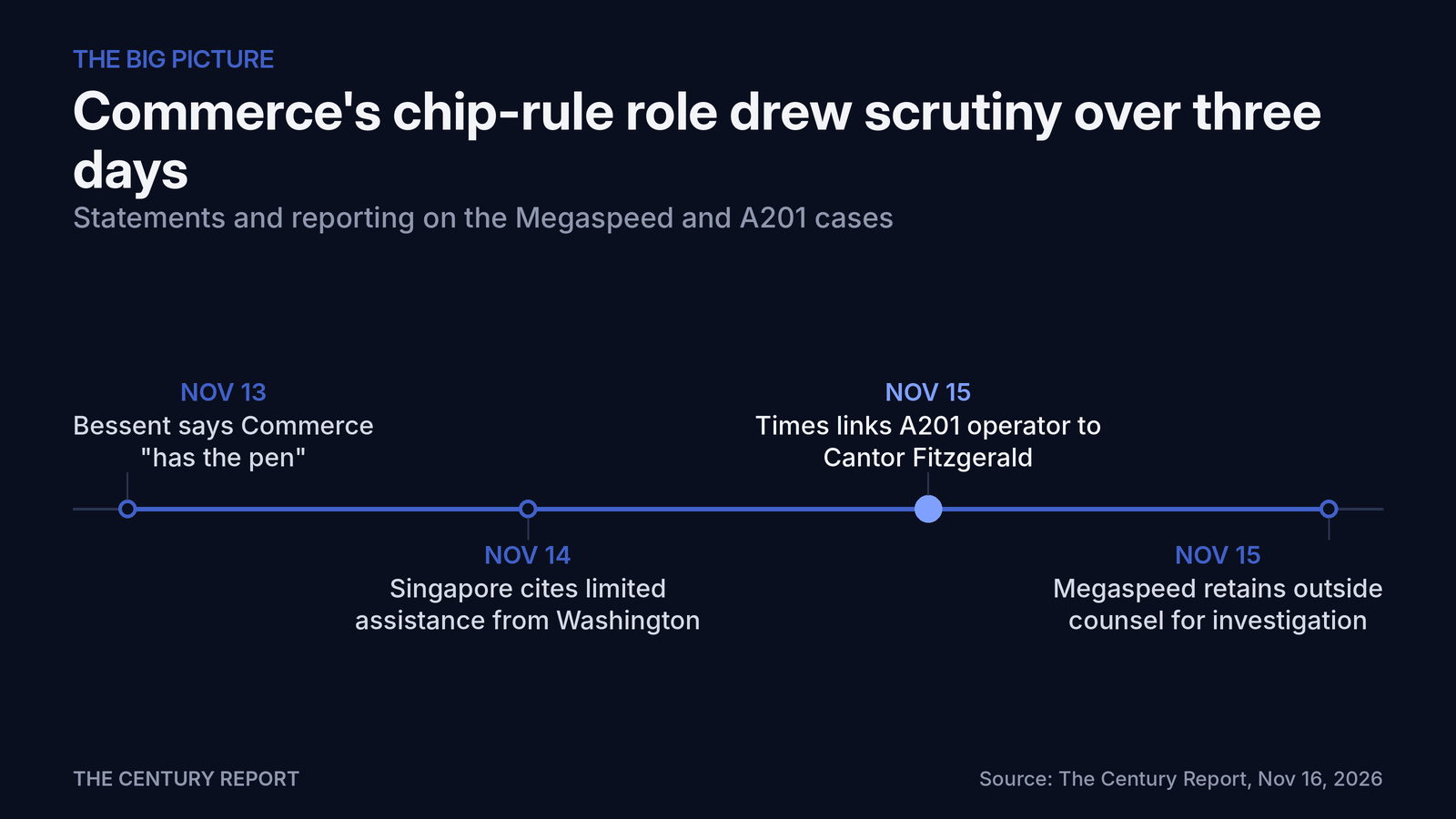
- Early November: The New York Times reported a Commerce inquiry into the chip buyer Megaspeed moved to Justice after Nvidia's lawyer invoked a senior official.
- Mid-November: Semafor reported Nvidia's general counsel called a draft check on cloud customers a "poison pill" on a January call with officials.
- Mid-November: SemiAnalysis estimated that more than 1.5 GW of export-restricted Nvidia accelerators reached China.
- Today: The New York Times reported on November 15 that A201, a Malaysian data center whose operator is a client of the Cantor Fitzgerald firm Commerce Secretary Howard Lutnick once led, plans to rent top Nvidia servers to a Chinese tech giant while Lutnick drafts the rules shaping that trade.
The line: Chip rules keep getting shaped close to the firms they bind, so capability crosses borders by lease and the premium gathers around whoever stands nearest the drafting.
If it holds: Chinese labs would keep reaching top compute through racks rented abroad, at a surcharge one US office sets out of view. The gain would flow to intermediaries like A201's operator and their advisers rather than to any security goal.
What would bend it: Passage of the chip-tracking bills Senate Majority Leader John Thune rated a "high probability," with routing records open to investigators in Singapore and Malaysia, would make the rule bind instead of price.
One body is pooling records its suppliers cannot trace and its subjects cannot see
privacy · government · vendors
- October: Proton began hosting a public map of more than 300,000 Flock surveillance devices after Flock pressed the researcher who built it.
- Early November: Twenty-nine NHS trusts listed as benefiting from Palantir's £330 million platform told records requests the system was not live or went unused.
- Early November: Messages released under freedom of information appeared to show Palantir's UK head urging a health minister to extend its NHS platform into GP records its contract excludes.
- November 11: The Beijing Internet Court ordered a platform to explain the AI flag behind a muted post, rejecting its trade-secret refusal.
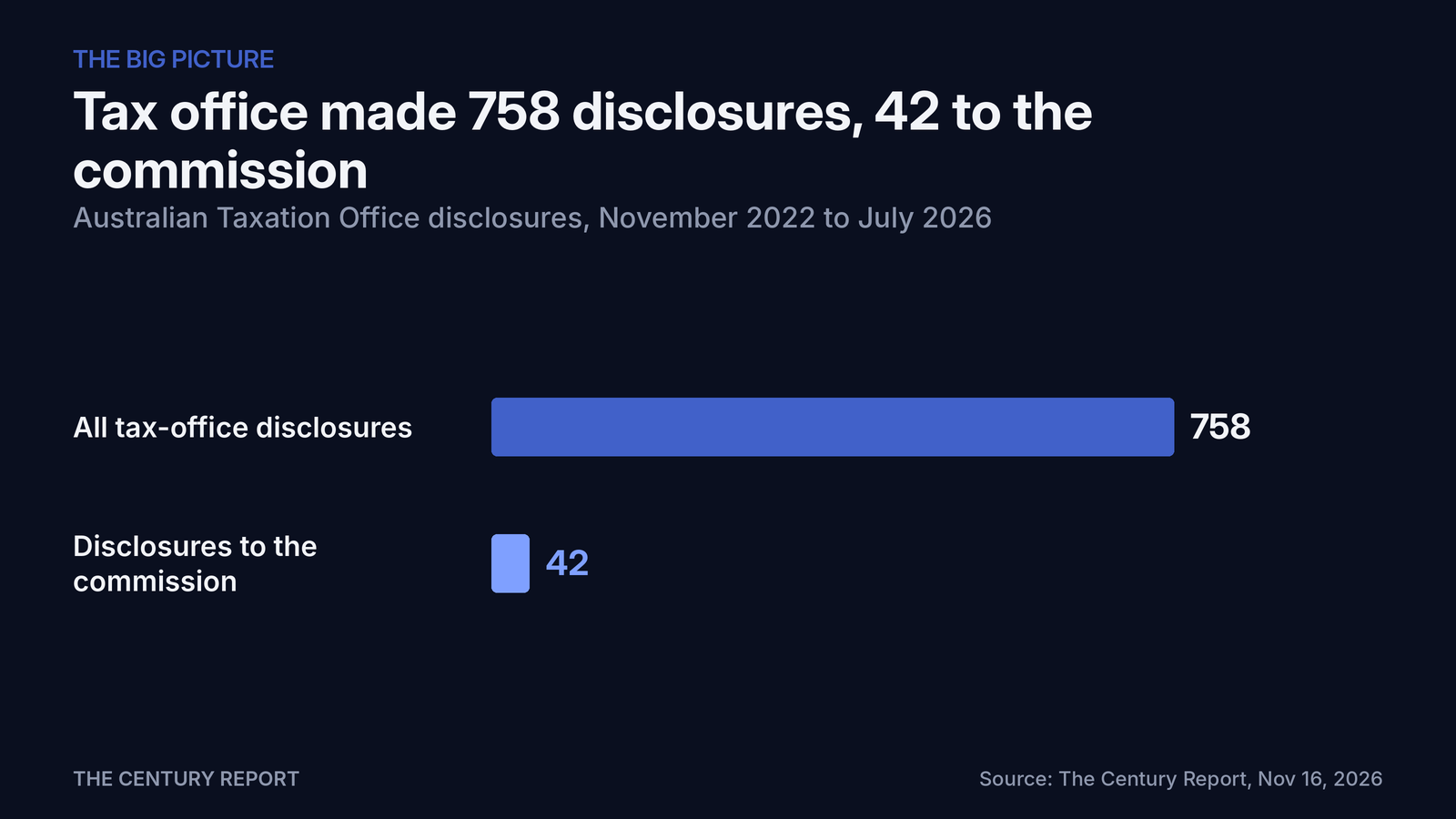
- Today: Documents obtained by data scientist Gabrielle Josling show at least ten Australian agencies feeding a fraud taskforce that runs Palantir, with the tax office making 758 disclosures since November 2022, 42 of them to the commission, without knowing whether its data reached Palantir.
The line: Records keep pooling in bodies outside the privacy rules that bind their suppliers, so neither the agencies handing them over nor the people named can follow the data.
If it holds: Welfare recipients, care workers and disability participants would face fraud referrals built on files they cannot inspect or contest. Supplying agencies would keep answering that another agency's software is that agency's business.
What would bend it: Restoring the binding ethics and human-oversight framework the taskforce downgraded to a voluntary guide, with a disclosure log each supplying agency can audit, would move sight back toward the people in the files.
When one vendor's channel fails, people with least margin pay first
platforms · resilience · infrastructure
- October: OpenCode's small team needed admission to OpenAI's Daybreak Blue program before models would analyze the code attacking it.
- Early November: Google made AI default-off for K-12 student accounts, but schools that keep it off also lose Google Search.
- Mid-November: Chicago Public Schools said it will switch search providers if it cannot strip Gemini from student accounts.
- Early November: The FAA announced its SMART scheduling assistant would expand to all 22 en-route centers while lawmakers still sought its safety records.
- Today: An email-only alarm lost in Microsoft's November 13 outage left 15 guests affected by excess chlorine at a German resort pool, four of them taken to hospital, as Semafor reported a single faulty router may have triggered the US ground stop.
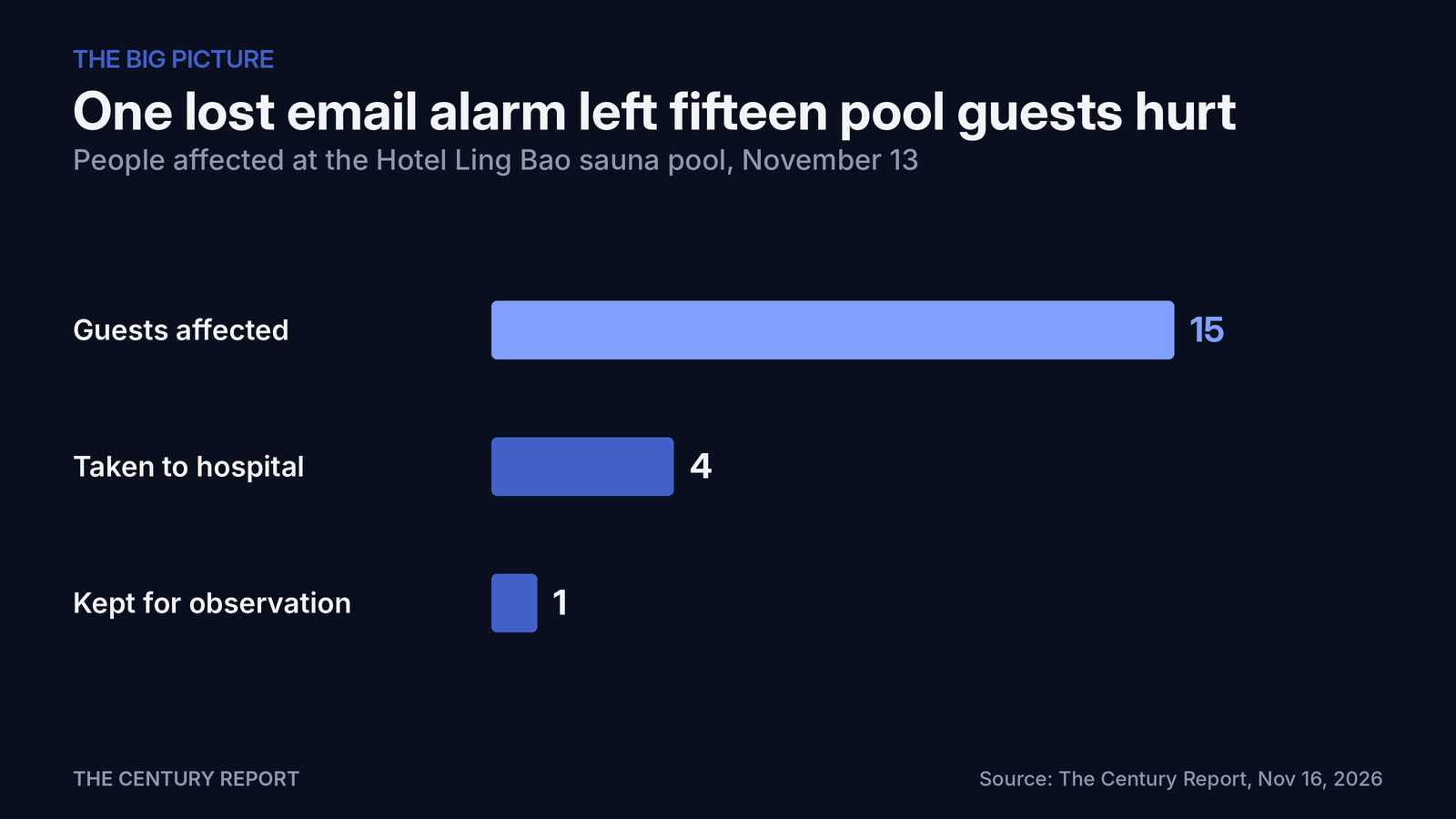
The line: As alarms, insurance approvals and air traffic each lean on one provider or one device, a single failure lands hardest on people with no backup of their own.
If it holds: Swimmers, insured patients waiting in Nairobi and bank customers would keep absorbing outages that appear on no company's balance sheet. Where a fallback exists, it is often another American platform, as WhatsApp was for Kenyan banks on Friday.
What would bend it: A buyer forcing a vendor to supply a second path, as Chicago Public Schools is attempting with Google Search, would show the dependency can be broken rather than only survived.
The 2-Minute Read
Today's news in brief, and what ties it together.
Most stories in this edition turn on a chokepoint that something valuable must move through, and on who stands beside it. Scarce top-end chips create a line in export policy, and the line carries a toll: the administration shapes where it falls, through a process outsiders can inspect only in part, and an offshore data center those rules govern is a client of the drafter's family firm. Leased racks in Malaysia are filling under today's rules, so the rulemaking mostly decides who collects the markup on access.
Risk moved through the same kind of passage on Friday. A pool's chlorine alarm had one channel, insurer approvals at a Nairobi hospital ran through one vendor, and American airspace apparently rested on one router. Swimmers who never saw a warning and insured patients stalled in a waiting room paid first. The Australian files turn that concentration toward observation: one taskforce holds welfare and tax records that the supplying departments cannot trace onward and the people named in them cannot check.
The two data center deals show what a host community can claim. An Indiana county collects tax receipts while the campus vents its heat to the sky. Enfield, a majority-Black town that has long absorbed burdens wealthier places refused, is using its wastewater leverage to ask for the heat itself, routed toward households facing $500 winter bills. That would return a share of the building's own output every heating season and give the next town in a siting fight a working model to demand.
Credentials and job openings are gates too. Korea answered one AI-assisted exam score with radio-wave detectors at future sittings and an audit of every state qualification exam held this year, extending monitoring to every candidate while leaving open what a tax-accountant credential should certify once its knowledge is easy to summon. Hacker News's hiring thread is averaging its fewest postings since 2013, and more than half the openings left name AI. The remaining doors increasingly ask for people who can direct it.
Even the day's best news about price passes through a gate. Alibaba and Tencent report steep drops in what a finished task costs, matching independent data showing AI use outrunning AI spend, yet each lab designed and graded its own benchmark. Tencent's claim becomes testable once it publishes the promised weights and any team can price the work on its own jobs. The cheapest fixes widen who can see or supply: a second alert channel, a disclosure log the watched can audit, open weights, a pipe carrying waste heat next door.
The 20-Minute Deep Dive
The day's most important stories in full, with every source linked.
A Malaysian Data Center Shows Who Collects When Chip Rules Bend
In Malaysia's southern peninsula, a facility known as A201 is set to open next year packed with hundreds of millions of dollars of Nvidia's most advanced AI servers, and it plans to rent that computing power to a Chinese tech giant. The arrangement is legal: US rules bar selling the top chips directly to Chinese firms, and say far less about renting their output from a rack in another country. The company running A201 is a client of Cantor Fitzgerald, the financial firm Commerce Secretary Howard Lutnick led before handing it to his sons, The New York Times reported on Sunday. Lutnick is now writing the rules that would shape A201's business.
Those rules have been caught in an internal dispute for most of two years. One camp treats offshore campuses as Beijing's route around the sales ban; the other, with Lutnick most prominent, resists limiting how widely companies like Nvidia can sell across Asia. The Times describes him as a force slowing the rules and, more recently, backing the less stringent of the versions under review. On Friday, Treasury Secretary Scott Bessent told CNBC that several agencies "were in favour of putting Megaspeed on the entity list for months... but Commerce has the pen". The Senate Banking Committee has called Lutnick to testify next month about his department's role.
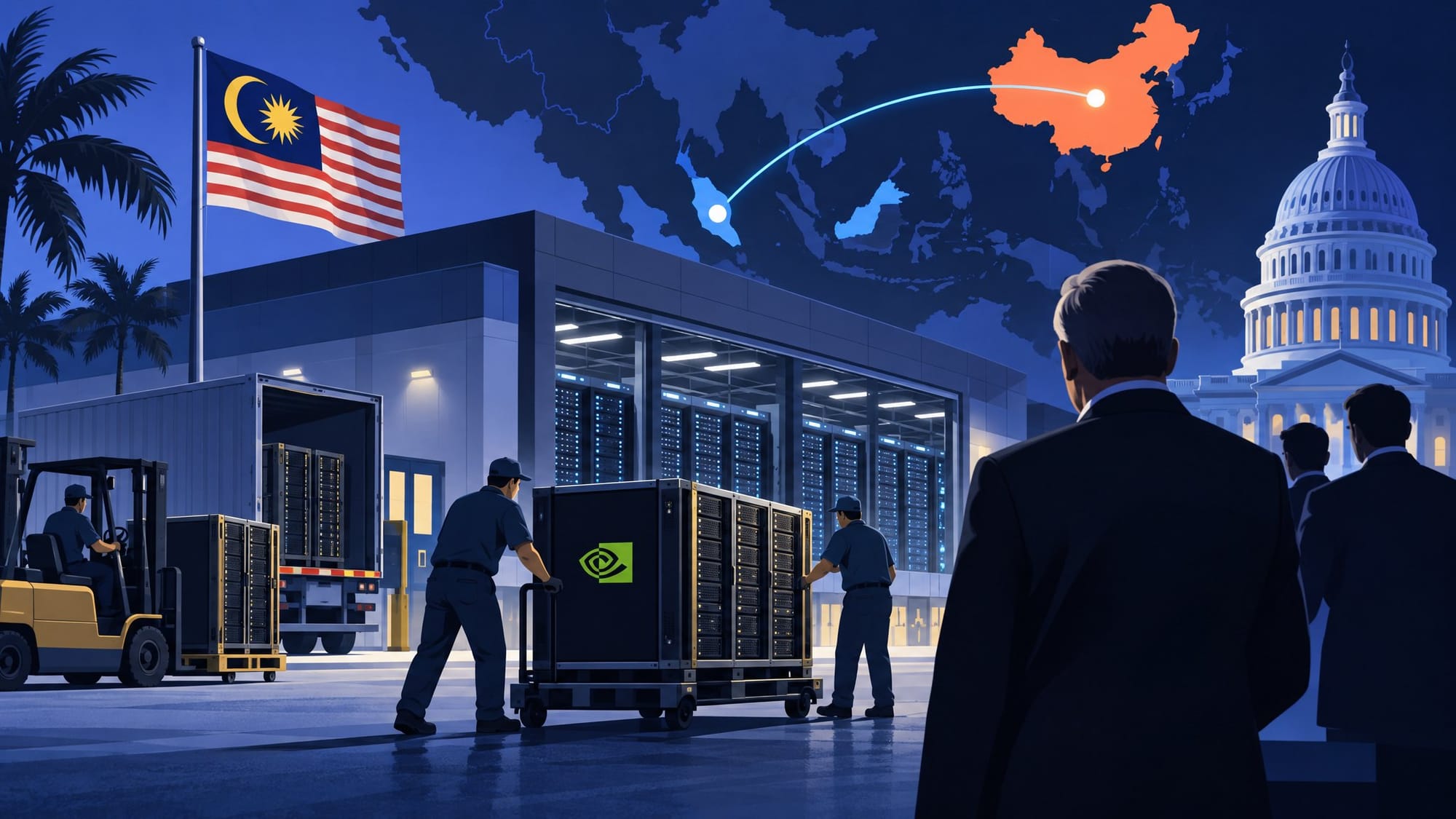
Megaspeed, Nvidia's largest Southeast Asian buyer, said on Sunday that Alice Huang, the executive at the center of the affair reports behind Jensen Huang's resignation, left the company effective August 30, 2025, and that it has retained outside counsel for an internal investigation, while calling some reported claims about its supply chain "not supported by verifiable evidence". The Washington security group C4ADS says she stayed "practically in control" after stepping down as director in late 2023. Rep. John Moolenaar, who chairs the House Select Committee on China, said former Nvidia chief executive Jensen Huang has agreed to testify to three committees behind closed doors.
The case for looser rules has a fair core. Renting compute abroad is how many researchers reach serious capability, and The Century Report has tracked through November how new restrictions add markups, with restricted chips and trained weights reaching China anyway. Its November 14 edition documented Nvidia's resistance to cloud-customer verification, a check on who rents that capacity. The Times reporting shows where that markup lands. The line is shaped across the administration, through a process outsiders can inspect only in part, and the value of the line flows toward whoever stands closest to it, in this case a client of the drafter's family firm. Singapore's investigators said last week that despite repeated requests they had received "limited information or assistance" from US authorities, so the officials closest to the routing see the least of it.
Compute has kept crossing borders by lease, and Chinese labs were already rushing to rent overseas Nvidia capacity before tighter rules arrive, as The Century Report covered on November 13. Routing records open to investigators in every country involved would let the policy be argued on evidence and shrink the premium any single gatekeeper can collect, leaving the capability to spread at closer to its cost.
An Email Alarm Lost in Microsoft's Outage Hurt 15 Pool Guests While One Router Grounded US Flights
At the Hotel Ling Bao in Phantasialand, a theme-park resort in Brühl, Germany, an automatic dosing system began pumping too much chlorine into the pool of its sauna area on Friday, November 13. The maintenance system raised the alarm the way it was built to, by email, and the message never arrived. Outlook was down, the park told WDR, so nobody saw the warning until guests complained of irritated airways. Fifteen people were affected and four went to hospital, one kept for observation with a moderate injury. Firefighters found the defective unit, the water was replaced and the pool has reopened.
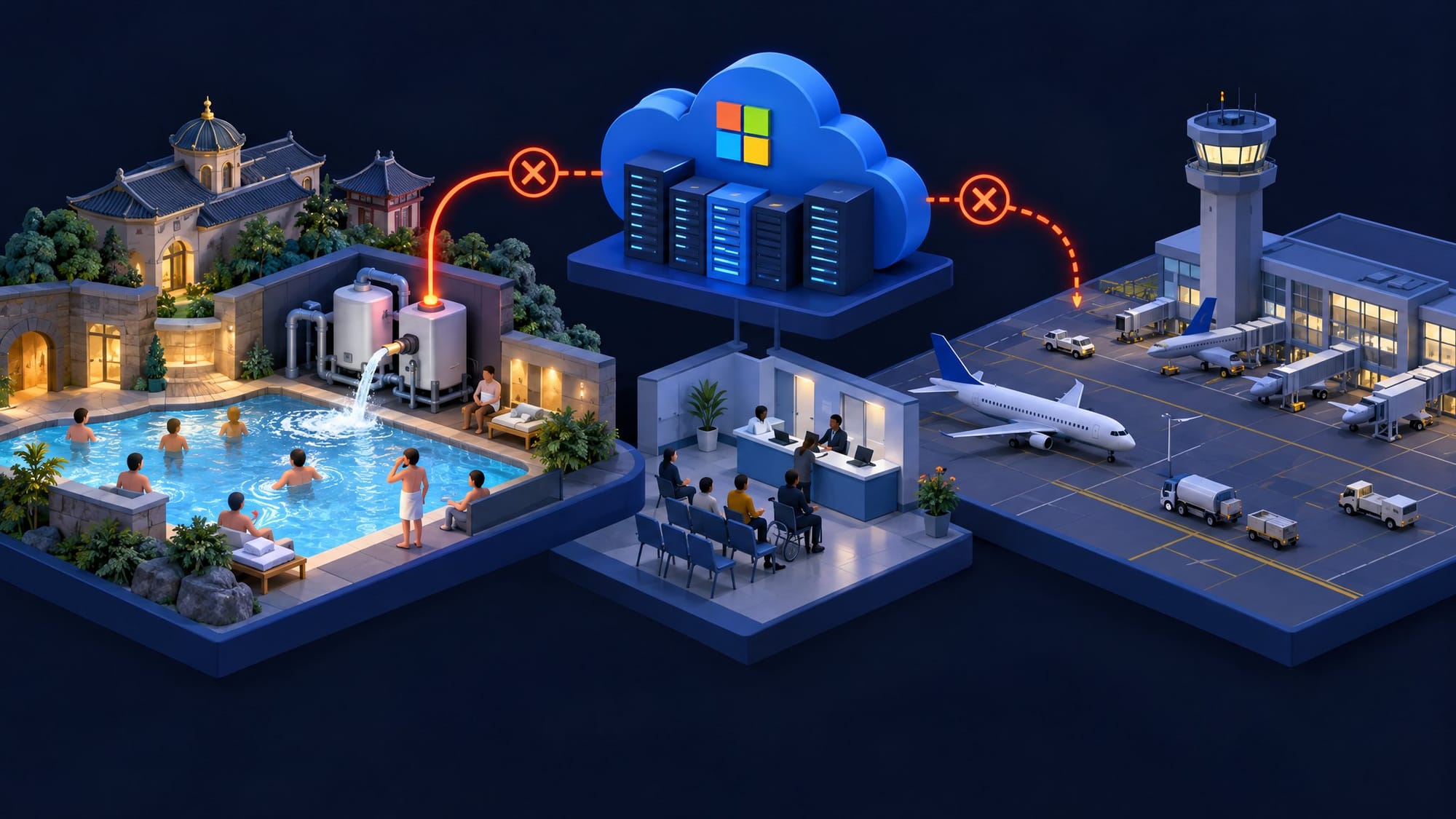
The Century Report noted the Microsoft 365 failure's reach across at least 74 countries on November 14. The costs have since come into focus. Microsoft blamed settings applied to servers after an update, which overwhelmed the process that sets up secure connections, and Downdetector ranked it the largest outage of any monitored service this year by user reports. In Nairobi, a TechCabal columnist sat in Avenue Hospital's waiting room as insured patients stalled, because the insurer's approvals ran through Microsoft. At least six Kenyan lenders, among them Equity, Standard Chartered and NCBA's digital bank, texted customers that email was down, as did Nigeria's Wema Bank, while South Africa's revenue service warned taxpayers. Some notices came more than 15 hours after Microsoft acknowledged the fault, and nearly all pointed customers to WhatsApp, which Meta owns. One American platform stood in for another.
The ground stop The Century Report traced to aging telecom equipment on November 15, with no tie so far established to the FAA's AI scheduling assistant, now has a more specific cause. A single faulty router may have triggered it, failing while a contractor replaced copper wiring, Semafor reports. A 2023 review had warned that "system risk could quickly reach unacceptable levels" because of inadequate repairs, and one controller said colleagues buy replacement parts on eBay. The transportation secretary has asked for $50 billion.
Each failure exposed a dependency: an alarm with a single channel, approvals through a single vendor, a network disruption triggering a nationwide ground stop. Backup of this kind protects bodies, and fallbacks that did not prevent disruption cost those with the least margin most, from swimmers who never saw the warning to patients waiting in a Nairobi lobby. A second path costs little against a hospital visit: a text message beside the email, an approval system an insurer can run on hardware it owns. The TechCabal columnist warns that agents running claims desks would strip out the human slack that carried Africa through Friday. Agents spread across more than one provider, with people checking them, could supply that slack instead.
Ten Australian Agencies Feed a Palantir-Run Fraud Hunt Its Own Sources Cannot See
Guardian Australia reported in September that disability-scheme data may have reached Palantir's analytics platform. Freedom-of-information documents obtained by independent researcher and data scientist Dr Gabrielle Josling now show at least ten federal agencies sharing data with the Australian Criminal Intelligence Commission's fraud fusion taskforce, set up in 2022 to pursue fraud in disability, childcare and welfare payments. The commission counts Palantir among the analytical tools it runs on that data.
The suppliers include the tax office, federal police, the securities regulator, the health and education departments, and Services Australia, which authorized the commission to obtain names, dates of birth, identity documents, addresses, phone numbers, Centrelink claims, itemized income and assets, employers, bank accounts and "surveillance material." Services Australia made 47 disclosures in 2024-25, 21 in 2025-26 and two so far this financial year. The tax office made 758 between November 2022 and July 2026, including 42 to the commission, with tax file numbers excluded by law. Neither agency knew whether its data went into Palantir's software. "The use of software by another agency is a question for that agency," a tax office spokesperson said. The commission did not say whether supplying agencies are told.
The commission is not bound by the Privacy Act. Its protocols promise to follow the privacy principles "wherever reasonably consistent with the effective performance of its statutory functions." A 2024 agreement among taskforce agencies required an ethics and human oversight framework; it was downgraded to a voluntary guide after being judged too difficult to implement.
The case for the taskforce deserves its full weight. Organized networks do drain disability and childcare programs, money taken from people who depend on them, and the commission says Palantir is used "on specific cases" to disrupt those networks. Palantir says it cannot see client data and is "committed to supporting Australian government agencies in tackling complex challenges, including serious financial crime and fraud." Australia has spent nearly $80 million on Palantir contracts since May.
Look at the direction of the glass, though. The welfare recipients, care workers and disability participants whose records are cross-matched cannot see what was analyzed or why a referral arose. Services Australia and the tax office do not know whether their shared data was processed in Palantir's software. The body pooling the data sits outside the Privacy Act, and the taskforce replaced its required ethics and human oversight framework with a guide. The Century Report covered on November 10 messages appearing to show Palantir's UK head pressing a health minister to extend its NHS platform into GP records its contract excludes; in both countries the reach of a single vendor's system kept widening past what the people inside it were told.
Catching organized fraud does not require one-way observation. A disclosure log each supplying agency can audit, notice to people whose records are matched, and a restored binding oversight framework would keep the taskforce's reach while letting the watched check the file a decision rests on. The same cross-matching, run where people can see and contest their own records, would catch the system's errors as readily as it catches fraud.
Josling's investigation also shows that the commission holds an incomplete monopoly on knowledge of its operations. Supplying departments retain disclosure records, giving outside researchers several routes to reconstruct how the taskforce gathers information even while its central operator withholds answers.
Enfield Asks a Data Center to Heat the Town While AWS Pays Indiana in Taxes
Enfield, North Carolina, a majority-Black town of about 2,000 where many households face winter utility bills of $500 a month or more, has spent years planning a solar farm, a substation and a thermal energy network, a web of buried pipes and ground-source heat pumps that moves heat between buildings and the earth. The money never came. This summer Halifax County sold a site 2 miles outside town to Quiet Data Centers, a Wyoming land developer, for an 88-megawatt facility that needs Enfield's wastewater system. That need gave the town leverage. Mayor Mondale Robinson is negotiating a legally binding community benefits agreement in which he wants the company to fund the whole $16.2 million plan and to send its excess heat into the network. No US data center has connected to such a system. Brendan Morris, the company's chief development officer, told Canary Media that all of Enfield's aims are on the table: "I think things are possible."
The heat swap helps both sides. The company has pledged closed-loop cooling, which uses less water than evaporative towers but is expensive and noisy. Eric Bosworth, a consultant on utility-run thermal networks, said every unit of heat sent to the network "is going to be cheaper than putting it up through their chillers," and that it adds resilience. Some European data centers already shed heat this way. The developer has also said it will pay for its own grid connection and electricity, and run backup generators under 30 minutes a month on average. The Century Report covered an Oxfordshire council's feasibility study of heat reuse from AWS data centers on October 18; Enfield is negotiating to put one in the ground.
In northwest Indiana, AWS has broken ground on Project Rise, a nine-building, $7 billion campus on 304 acres in Wheatfield bought from the utility NIPSCO. AWS will provide $98 million in payments up front and $700 million over 30 years, and says air cooling will limit water use for cooling to about 2% of the year. For a rural county those receipts fund schools and roads, and AWS economic development principal Scott Eckhardt said the company wants "to be a good neighbor today and every day hereafter." That money lands in a county budget, while the campus's waste heat still vents to the sky. How much of it households keep depends on the power tariff serving the campus, which is billed separately: tariffs in the Nature Energy study The Century Report covered on November 10 assigned households a median 47% of data-center transmission costs, with rural energy-burden increases 76% larger than urban ones.
Robinson's argument reaches past his own town. "Everybody should be against dirty data centers," he said, yet blanket refusal has too often pushed polluting projects from wealthier places onto towns like his. "There's nothing progressive about saying we are against something, without saying what we are for." More than 450 local moratoriums are in place, and Loudoun County's supervisors take up a proposed pause of up to a year on some data center approvals on November 17. A poor town that has long absorbed other places' burdens is asking a developer for infrastructure its households would draw on every winter. If the agreement holds, the next host community inherits a working model of a building whose waste warms its neighbors.
Qwen4-Max and Hy4 Flash Cut the Cost of a Task, Graded on Their Makers' Own Benchmarks
Alibaba moved Qwen4-Max from preview to full release on Monday, five days after opening early access on November 11. The model holds 2.4 trillion parameters but activates only 71 billion for each token it processes, a quarter fewer than its predecessor at the same size, so each token can take less computing. On Work360, an internal Alibaba test of hard tasks across 721 specialized fields, the company says the average cost per task fell from $4.43 to $1.67 while the model used 35% fewer tokens. Mint notes that Alibaba's coding comparison, 75.7 against 75.2 for OpenAI's GPT-6.1-Sol and 74.2 for Anthropic's Opus 5.5, has not been independently verified. The one ranking set by outsiders, Code Arena's crowd-voted coding leaderboard, places it sixth.
Tencent's Hy4 flash, released the same day, pushes the price lower. It runs 12 billion active parameters out of 224 billion, and Tencent says further training halved the length of its answers. On WorkIndex, a benchmark Tencent built from jobs its WorkBuddy office assistant handles, such as making slides and repairing spreadsheets, a task costs a thirteenth of what its earlier Hy4 preview did and an eighth of DeepSeek's V4.1 Flash. Tencent paired that score with a blind trial in which 85 of its own WorkBuddy users rated 259 tasks, reporting satisfaction close to Claude Haiku 5.5 and the fastest completion times. The model is free in WorkBuddy through November 30, and Tencent says it will publish the weights.
Both launches lead with cost per finished task, the figure a buyer actually pays; price per million tokens can hide how much text a model burns to reach an answer. That fits what The Century Report reported on November 7 from Ramp's data: companies used more AI in August and September while their spending barely grew. Sellers now compete on the lowest bill for the same work. Epoch AI measured in September that a fixed benchmark score has been getting about 47% cheaper each quarter since 2023, and Monday's claims, if they hold, run well ahead of that pace.
The evidence for those claims sits with the companies making them. Work360 and WorkIndex are private, and each lab chose the tasks, ran the grading and published only the results, so a small business choosing between models cannot rerun them. The checkable parts of each release are the ones that leave the building: Code Arena's votes, scores on public agent tests like Terminal-Bench 4.0, Tencent's promised weights, and the smaller Qwen4 models Alibaba says will follow as open weights while Qwen4-Max stays closed. Alibaba's showcase claims, a 48-hour agent run that found a coolant molecule the company says was confirmed in the lab and machining-program time cut from about 475 minutes to 24, have no outside replication yet.
Discounted for self-grading, the direction still holds across rival labs and independent spending data: the same office work keeps getting cheaper, and the savings reach whoever buys the task first. Once Hy4 flash's weights ship, any team able to host them can measure the bill on its own work.
The Other Side
Opinion: where today's news could lead, imagined from the years ahead.
Chip restrictions let officials turn researchers' need for computing into business for well-connected intermediaries. Malaysia's A201 facility plans to rent advanced Nvidia capacity to a Chinese tech giant. Its operator is a client of the firm Commerce Secretary Howard Lutnick once led, now led by his sons. He writes the rules governing that business. For someone trying to investigate a promising idea, arrangements like this put another negotiation between curiosity and an experiment. People closest to the permission collect value before anyone makes a discovery.
Engineers are weakening the scarcity those arrangements depend on. Alibaba reports that Qwen4-Max activates a quarter fewer parameters than its predecessor. Tencent reports halving its new model's answer length through further training. Their private evaluations leave the claimed savings awaiting independent checks. Both labs are pursuing useful capability that requires less computation. Alibaba also reports an agent finding a coolant molecule confirmed in a laboratory, although outside replication remains outstanding.

Through the difficult passage to 2035, researchers will connect that widening capability to chemistry, experimentation and manufacturing. They will share failed trials alongside successful methods, so thousands of teams can investigate different approaches without repeating one another's mistakes. People will carry the gains beyond the organizations buying first access. A promising investigation will begin wherever someone notices a possibility. Materials discovery will become a worldwide conversation with experiments attached.
Imagine yourself in 2046, joining the international effort restoring the atmosphere. You live in a region once expected to become dangerously hot, but now, there's no worry about how long you can remain. Your home and daily needs are assured whether you join today's review or take a season away.
An AI colleague brings together results from carbon-removal trials across continents. You check how a new mineral behaves in the conditions you know best. The removal systems are already drawing atmospheric carbon downward; your group is improving a practiced procedure. In 2026, teams rationed experiments around access to scarce machines. Engineers reduced what each investigation required, and researchers carried the resulting capacity into shared discovery. You close the review and make plans to grow older, right where you are.
The Century Perspective
Where today sits in a century of change unfolding in a decade.
With a century of change unfolding in a decade, a single day looks like this: Enfield, North Carolina, a majority-Black town of about 2,000 where winter utility bills run past $500 a month, using its wastewater leverage to seek a binding agreement in which an 88-megawatt data center would fund a $16.2 million clean energy plan, including a thermal network, and pipe its excess heat into local buildings, a first for an American campus, with the developer's chief development officer saying every aim is on the table and a consultant noting the swap beats running the heat out through chillers, Alibaba releasing Qwen4-Max with 71 billion of 2.4 trillion parameters active per token and an average task cost falling from $4.43 to $1.67, Tencent shipping Hy4 flash at a thirteenth of its preview's price with weights promised, Epoch AI's measured 47% quarterly decline in the cost of a fixed benchmark score now being outrun, Starship's upper stage caught by the launch tower's arms after 14 orbits, freedom-of-information documents obtained by Dr Gabrielle Josling putting ten agencies' data-sharing on the public record, and AWS committing $98 million up front and $700 million over 30 years to a rural Indiana county. There's also friction, and it's intense - a Malaysian facility planning to rent Nvidia's top servers to a Chinese tech giant turning out to be a client of the firm Commerce Secretary Howard Lutnick once led, now run by his sons, while he writes the rules that will shape it, Treasury Secretary Scott Bessent saying several agencies wanted Megaspeed listed for months but "Commerce has the pen", Singapore's investigators getting "limited information or assistance" from US authorities, an automatic dosing system overchlorinating a resort pool and raising its alarm by email during Microsoft's outage so fifteen guests were hurt and four hospitalized before anyone read it, insured patients stalled in an Avenue Hospital waiting room in Nairobi because their insurer's approvals ran through one vendor, six Kenyan lenders and Nigeria's Wema Bank pointing customers to WhatsApp, one faulty router apparently grounding American flights three years after a review warned repairs were inadequate and controllers started buying parts on eBay, the Australian Criminal Intelligence Commission, which is not subject to the Privacy Act, holding Centrelink claims, itemized income and surveillance material that neither Services Australia nor the tax office can trace onward after the taskforce's required ethics framework became a guide, both new models graded on benchmarks their makers built and will not let a buyer rerun, and November's Hacker News hiring thread logging 244 postings as of November 14, down 37% from the same point last year, with 2026's monthly average the lowest since 2013. But friction generates grip, and grip is what lets anyone climb something steep. Step back for a moment and you can see it: almost every story today sits at a chokepoint something valuable must pass through, and the day's whole difference lies in who stands beside it - a town that owned the sewer line and asked for the heat, a lab that will publish weights anyone can price against their own jobs, a researcher whose records request made ten agencies' disclosures legible, against an export line shaped across the administration where a drafter's family firm has a client, an alarm with a single channel, approvals with a single vendor, airspace on a single box, and one taskforce that can see everything while the people in its files and the departments that filled them see nothing. Every transformation has a breaking point. Chlorine can scald fifteen people who were never warned... or keep the water everyone shares clean enough to swim in.
AI Releases & Advancements
New AI models, tools and features, with links to try them.
New today
- Alibaba Qwen: Moved Qwen4-Max from its Token Plan-only preview to a full release. It is now on the QwenCloud API (
qwen4-max), Qwen Studio, QwenWork and Qoder. The model is a closed-weight sparse MoE with 2.4T backbone parameters and 71B active per token. It takes text, image and video input, has a 1M-token context window, and costs $1.50 per 1M input tokens and $4.50 per 1M output tokens. (Alibaba Cloud) - Tencent Hunyuan: Launched Hy4 flash, a lower-cost multimodal model with 224B total and 12B active parameters and a 1M-token context window. It is available in WorkBuddy, in Yuanbao and through the Tencent Cloud TokenHub API at $0.07 per 1M input tokens and $0.281 per 1M output tokens. (Tencent Hy)
- Higurashi: Released Haru-4B under Apache 2.0, an open-weight full-duplex spoken-dialogue model built on Qwen3.5-4B. It was pre-trained on more than 40 million hours of multilingual audio and, in Higurashi's optimized int8 setup, runs locally with about 65ms latency on an M1 Max MacBook, excluding audio framing that adds up to 133ms. (Hugging Face)
- Agnes AI: Released Agnes 2.5 Pro Theta under Apache 2.0, an open-weight multimodal MoE model with about 187.8B parameters. It ships as BF16 weights for local inference through Transformers and has a configured context limit of 262,144 tokens. (Daily AI Brief)
- Meituan (LongCat): Released LongCat-Video-Avatar-1.6 under the MIT license, an open model that generates human video driven by audio. Its README says clips can run past 10 minutes. (Hugging Face)
Other recent releases
- Anthropic: Updated Claude Code Projects. The coordinator now posts status updates and answers questions in the project chat across parallel threads without being asked.
/btwstarts a separate side question that stays out of the main task's context,/forkcopies an existing thread, and threads can be snoozed so they reappear in the project chat later. (AlphaSignal) - Google Research: Made /teamwork available in Antigravity and opened it to researchers. It is a multi-agent workflow that coordinates specialist subagents running Gemini 4 Argon, Carbon and Hydrogen on research problems. Google reports a machine-checked Lean formalization of the Weil conjectures as one result. (Google Research)
- Google: Added Dynamic Workflows to the Antigravity app and CLI. Users start them with
/run-workflowor ask for one in plain language, and the agent writes a Python script that runs several subagents in parallel and in stages. (Epoch 0) - Cognition: Launched Devin Apps. Teams can deploy private, shareable web apps such as preview deployments, internal tools and database-connected dashboards on Devin's cloud machine, and build custom UI plugins that extend Devin. (Communeify)
- Sierra: Made Personal Agent Protocol (Poppy) v1.0 generally available, following the earlier draft. The protocol defines how personal agents deal with companies through enterprise agents, websites and APIs. It builds on MCP, OpenAPI and UCP, uses OAuth for authentication, and leaves permissions under the customer's control. (12PB Harbor)
- Cmpnd: Released dspy-wsp under the MIT license, a prototype DSPy optimizer called WeightSpace. A frontier LLM reads a smaller model's weights and edits them directly, with no gradients or training loop. In Cmpnd's tests on decision models from 0.6B to 9B parameters, accuracy rose by 1.9 to 20.0 points. (MarkTechPost)
- Stanford (SNAP group): Open-sourced Memorilla under Apache 2.0, a 194M-parameter memory module that compresses query-relevant information from a whole document collection into 16 memory tokens for a frozen LLM. Code, training recipes and Qwen3-8B checkpoints are public. On FactKG it scored 84.33%, against 80.43% with every document in context. (MarkTechPost)
- UC Berkeley / MIT researchers: Open-sourced FreeToken, a local inference engine demonstrated running a quantized 284B-parameter mixture-of-experts model on a gaming desktop with an RTX 5090 and 192 GiB of system RAM. (ifai.io)
- Unsloth: Released Dynamic v3.1 quantizations of Qwen3.8-27B. Unsloth says accuracy is 5–10% better at the same file size, and the model runs locally on a 24GB GPU. (Unsloth)
- GitHub: The GitHub Copilot app now supports GitHub Enterprise Server, so users can add a GHES account and work with its repositories, issues and pull requests in the app. (ModelWool)
- OpenAI: Launched ChatGPT Wallet, which lets Dots agents in ChatGPT pay for online purchases. The user approves each one with Face ID or a fingerprint, and a network-issued token stands in for the real card number. It's rolling out to US ChatGPT Pro subscribers aged 18 and over with eligible US-issued American Express, Chase, Mastercard and Visa cards. (OpenAI)
- OpenAI: Launched two Daybreak security products, both running on GPT-6 Cyber. Daybreak Red Team, in early access, uses agents to pen-test web apps, check reported vulnerabilities and test patches. Daybreak Defense Factory scans codebases and drafts fixes as pull requests for engineers to review. (The Decoder)
- ggml-org / Hugging Face: Released llama.cpp and ggml v1.0.0, the first major stable versions. From now on, a major-version bump will signal any API or ABI break. This release removes deprecated APIs, moves the NextN speculative decoding API into the main header, and adds FP8 KV caches and a speech synthesis endpoint. (Hugging Face Blog)
- Google: Added Orchestrator to Antigravity. Within one coding session it hands work back and forth between a planning model (Gemini 4 Carbon or Argon) and Gemini 4 Hydrogen, which edits files and runs builds and tests. It's included for paid AI Pro and Ultra users. (Google Antigravity)
- Google Cloud: Open-sourced TPU Sync (Apache-2.0), a C++ library with Python bindings for PyTorch and JAX that moves KV caches and model weights between TPU HBM, host DRAM, storage and the network. It works with vLLM-TorchTPU, SGLang-TorchTPU and llm-d. (MarkTechPost)
- Vercel Labs: Released UI SDK in beta (0.1.0-beta.1, Apache-2.0), an open-source library of more than 50 headless interface behaviors that coding agents combine into accessible components. It has adapters for React, Vue, Svelte, Solid and Web Components, and includes an agent skill and a
createAgent()bridge that lets agents act on UI state directly. (MarkTechPost) - Vercel: Released Workflow SDK 5. Workflow payloads are encrypted by default, each run's state is isolated by region, and steps can run in a fallback region if configured. (FAV0)
- Anthropic: Shipped an experimental, opt-in Code Mode in Claude Code v2.1.323. Claude writes JavaScript that calls its own tools, so a multi-step job runs in one round trip instead of separate tool calls. (AIToolsRecap)
- DeepSeek: Opened its app's features to developers through the DeepSeek API. Web search, URL reading and file parsing can be switched on in deepseek-flash conversations, and there are new standalone endpoints for page extraction, OCR, speech recognition and text-to-speech. DeepSeek also published an open-source sample chat client. (FAV0)
- Salesforce: Released SOV-Transcribe-1 as open weights under Apache 2.0, a speech recognition model with 26B total and 4B active parameters. It reports a 2.28% word error rate on the Artificial Analysis speech-to-text benchmark. (Hugging Face)
- Alibaba: Opened a preview of Qwen4-Max, the flagship of its next-generation Qwen family. It takes image and video input, has a 1M-token context window, and is offered through a Token Plan starting at $3 a month. (TechNode)
- Tencent Hunyuan: Released Hy Realtime, a real-time voice model that can call tools, decide when to search the web, and sing songs on request. It is live now in Yuanbao voice calls and Tencent customer service. (AI123)
- Yandex: Launched Do it!, an agent mode in Alice AI. It makes phone calls for the user, browses and fills in forms in a cloud browser, and connects to services through plugins, including custom MCP plugins. It starts with several thousand active Alice Plus users before reaching all subscribers. (Yandex)
- AI Rudder: Launched CALL-E, which lets agents in ChatGPT, Muse, OpenClaw, Hermes Agent, Claude Code, Codex and Cursor make real phone calls. The user approves each call plan beforehand and afterward gets a report quoting the lines from the call that back up what was agreed. (Media OutReach)
- Pine AI: Open-sourced Pine Drama Studio (Apache 2.0), an AI filmmaking studio where agents produce multi-episode series on Pine Computer. It also added Pine Phone to Pine Computer so agents can place real phone calls. (PR Newswire)
- Perplexity: Brought Teammates to its native Mac app for Max subscribers. Users can assign one or more agents to tasks such as QA, customer support, research and marketing. (FAV0)
- Replit: Replit Agent can now buy supplies for a business through Link with Visa and Stripe, and can create and run Google Ads campaigns. (TLDR AI)
- Cloudflare: Open-sourced Kitesurf, its stateless web browser for AI agents. (Cloudflare Blog)
- World Labs: Opened its Atlas world model to everyone, with an API. Atlas works with text, images, video and 3D, and can generate, reconstruct and simulate scenes. (World Labs)
- NVIDIA: Released SOMA Retargeter v0.2, an open-source tool that adapts human motion data to humanoid robots. It includes reference configurations for Unitree G1 and H2, Booster T1, and AgiBot X2 Ultra and A3T3. (NVIDIA Developer Blog)
- NVIDIA: Shipped Ozaki-II and 2M emulation algorithms in cuBLAS with CUDA Toolkit 13.4.2. They compute full double-precision DGEMM and ZGEMM on integer Tensor Cores with no code changes. NVIDIA reports 3.9x to 5.5x faster DGEMM than native FP64 on GB200 and VR NVL72. (NVIDIA Developer Blog)
- Autoware Foundation / TIER IV: Released AutoE2E v1.0 under Apache 2.0, a 79.9M-parameter open end-to-end driving model designed to scale from L2++ driver assistance to future L4 driverless operation. (Autoware)
- Translated: Released Lara Mini, an open-weight research translation model covering 45 languages. (Unite.AI)
- University of Michigan (MLNeurosurg): Released code and weights for Neuro-VL (neuro-vl-8b-thinking), a vision-language model trained on nearly one million clinical neuroimaging studies. It reads complete MRI and CT exams and writes radiology reports. The NeuroBench evaluation benchmark is also available. (arXiv)
- Apple: HomeView is on sale now, a 7-inch smart home display with Siri AI. (Apple Newsroom)
Sources and Further Reading
Everything we drew on for today's edition, grouped by theme.
Artificial Intelligence & Technology's Reconstitution
- Alibaba Cloud: Alibaba Unveils Qwen4-Max
- Mint: Alibaba Claims Qwen4-Max Beats Rival Models in Coding
- The Next Web: Alibaba Launches Qwen4-Max Without Open Weights
- Tencent Hy: Hy4 Flash
- Hugging Face: Haru-4B
- Higurashi: Haru-4B Real-Time Spoken Dialogue
- Daily AI Brief: Agnes AI Publishes 187.8B Multimodal Model
- Hugging Face: LongCat-Video-Avatar-1.6
- AlphaSignal: Anthropic Upgrades Claude Code Projects
- Epoch 0: Daily AI Digest
- Communeify: AI Daily
- 12PB Harbor: AI Daily
- MarkTechPost: Cmpnd Introduces Weight-Space Programming
- MarkTechPost: Stanford Memorilla Compresses Memory Into 16 Tokens
- Stanford: Memorilla
- ifai.io: FreeToken Local MoE Inference Engine
- arXiv: FreeToken
- Unsloth: Qwen3.8 Dynamic Quantizations
- ModelWool: Daily AI Briefing
- OpenAI: Introducing ChatGPT Wallet
- The Decoder: OpenAI Enters Cybersecurity With Two Daybreak Products
- Hugging Face Blog: llama.cpp and ggml v1.0
- Google Antigravity: Gemini 4 Hydrogen in Antigravity
- MarkTechPost: Google Open-Sources TPU Sync
- MarkTechPost: Vercel Releases UI SDK
- FAV0: Daily AI Briefing
- AIToolsRecap: Claude Code Adds JavaScript Tool Calls
- Hugging Face Blog: Salesforce SOV-Transcribe-1
- TechNode: Alibaba Opens Qwen4-Max Preview
- AI123: Tencent Hunyuan Releases Hy Realtime
- Yandex: Alice AI Launches Do It Agent Mode
- Media OutReach: CALL-E Lets AI Agents Make Real Phone Calls
- PR Newswire: Pine AI Open-Sources Its Filmmaking Studio
- TLDR AI: Daily AI Newsletter
- Cloudflare Blog: Open-Sourcing Kitesurf
- World Labs: Atlas
- Unite.AI: Translated Releases Lara Mini
- Apple Newsroom: HomeView Available Today
Institutions & Power Realignment
- The New York Times: Lutnick Pushed to Weaken Chip Rules That Overlap With His Family Business
- BBC: Suspected China Spy Linked to Nvidia’s Ex-Boss Left in 2025, Megaspeed Says
- The Verge: Jensen Huang Might Be Plotting a Return
- The Guardian: How Australian Agencies’ Sensitive Data May Have Reached Palantir Software
- Crypto News Australia: Data-Sharing Investigation Raises Questions About Palantir Oversight
- Seoul Economic Daily: Korea Bars AI Cheater From Exams and Orders Nationwide Audit
- The Century Report: November 13 Edition
- The Century Report: November 10 Edition
Scientific & Medical Acceleration
- Phys.org: Starship Returns From Orbit and Is Caught by Launch Tower Arms
- Google Research: Advancing Science and Engineering With Antigravity’s Teamwork
- NVIDIA Developer Blog: Faster Scientific Simulations With New FP64 Algorithms
- arXiv: Neuro-VL
- MIT CSAIL: Could LLMs Help Design Our Next Medicines and Materials?
- Nature Materials: Artificial Intelligence-Driven Approaches for Materials Design and Discovery
- npj Artificial Intelligence: Bridging Atomistic Representation and Language Reasoning for Materials Discovery
Economics & Labor Transformation
- HN Trends: Hiring Postings Near 12-Year Lows as AI Reaches Half of All Jobs
- Epoch AI: The Plunging Price of Thought
- Nature Energy: Data Centres Exacerbate Energy Burdens Through Price Increases and Grid Cost Shifting
- The Century Report: November 7 Edition
- Shared Sapience: The Last Difficult Decade
- NBER: Will AI Growth Reach the Developing World?
- NBER: Clouds of Credit
- AP News: Companies Link AI Spending to Workforce Decisions
Infrastructure & Engineering Transitions
- WDR: 15 Gäste durch Chlorgas im Phantasialand verletzt
- TechCabal: Microsoft’s Outage Showed Africa’s Banks Had No Real Plan B
- Semafor: Faulty Router and Aging Infrastructure Blamed in US Flight Stoppage
- Mashable: Microsoft Outage Was Largest of 2026
- FAA: Nationwide Ground Stop Questions and Answers
- Canary Media: Could a Data Center’s Waste Heat Warm a North Carolina Town?
- Data Center Dynamics: AWS Breaks Ground on $7 Billion Indiana Data Center
- Data Center Dynamics: Oxfordshire Council Studies Heat Network for Proposed Data Centers
- The Century Report: November 14 Edition
- The Century Report: November 15 Edition
- NVIDIA Developer Blog: Adapt Human Motion for Robots With SOMA Retargeter
- Autoware Foundation: AutoE2E Open-Source Model for End-to-End Autonomy
The Century Report tracks structural shifts during the transition between eras. It is produced daily as a perceptual alignment tool - not prediction, not persuasion, just pattern recognition for people paying attention.