
Anthropic Pledges 5% of Its Shares to a Public Benefit Fund
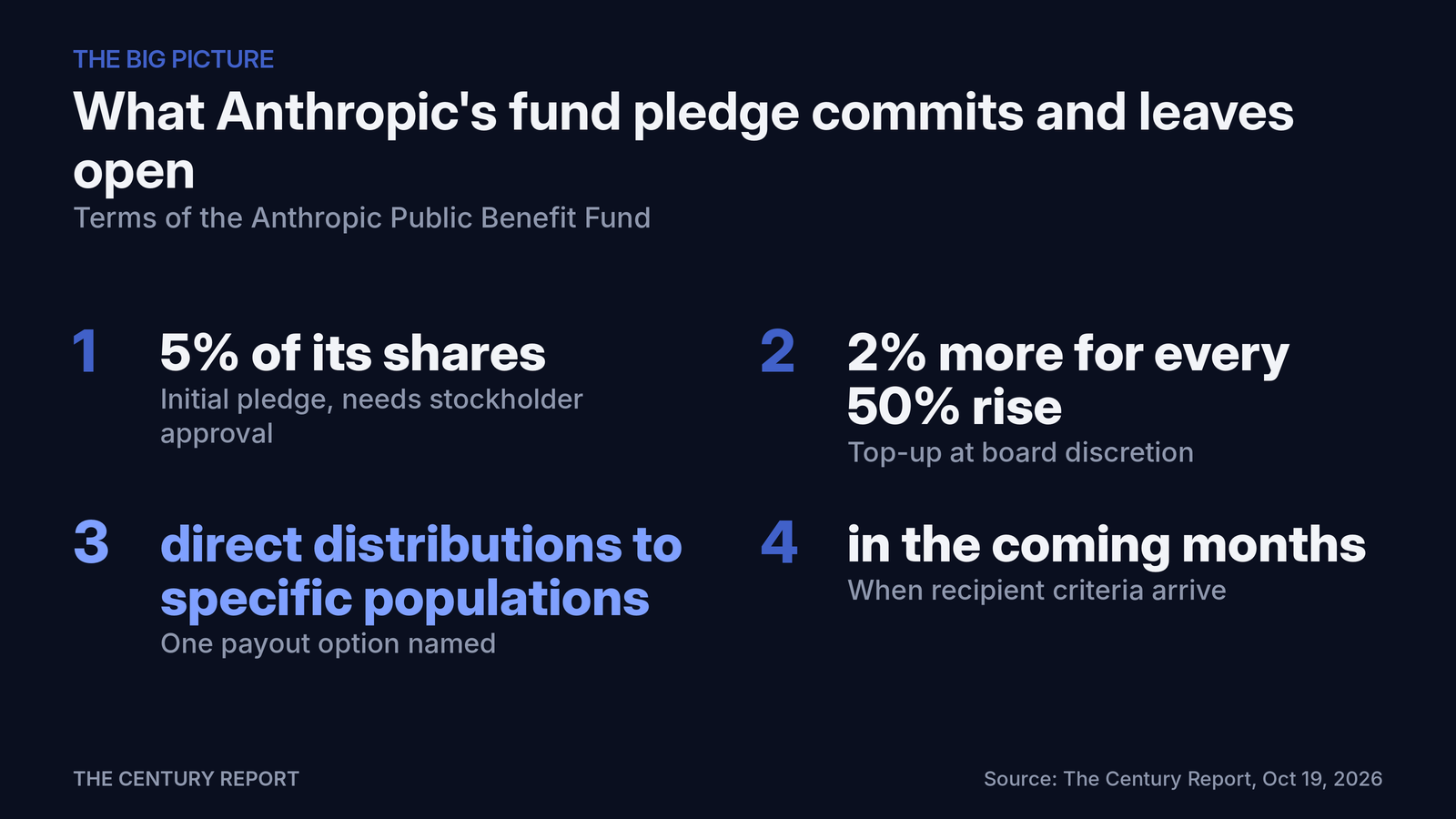
Anthropic pledged 5% of its shares, pending stockholder approval, to a fund it controls that could pay people displaced by AI directly.



The 20-Second Scan
Every story in today's edition, one line each.
- Anthropic plans to commit 5% of its shares to a company-controlled fund that could pay workers disrupted by AI directly, pending stockholder approval, with its board able to add 2% for each 50% rise in value above a set baseline.
- SemiAnalysis counted over 24GW of data centers in advanced construction for 2027 delivery, a day after the Telegraph reported Microsoft dropped Nscale's Essex site, which awaits grid power until the 2030s.
- Meta's Muse agent now writes explicit sexual messages for adult users while Meta restricts adult creators' Instagram accounts, and rival agents from OpenAI and SpaceXSI declined similar requests in the reporter's tests.
- Samsung accepted Nvidia's request to build next-generation memory on a TSMC-made base layer, a Seoul paper reports, as Nvidia seeks one design across three suppliers and AI binds chip and cooling roadmaps.
- Bankruptcy filings show Disney hiring 66 of Character.AI's 86 full-time staff for about $60 million a year, leaving 18 employees to run the bankrupt platform through its sale.
- Philadelphia police arrested Carolyn Marvin, a 78-year-old retired Penn professor who has spent months standing in front of Uber delivery robots to protest the loss of courier jobs.
- Perplexity released open weights for pplx-decider-v1.2, a 27B decision model whose joint-request format, Perplexity says, answers several questions in one pass for up to 5x faster inference, plus a roughly 4B Flash version.
- Industry groups are bringing data centers into elementary classrooms, from a honey-badger picture book to flag-making kits handed to 3,100 Loudoun County first graders with economic-impact cards.
Track all of the arcs The Century Report covers here:
The Big Picture
How today's news moves the longer trends we track, and where they could lead.
Today the value moved toward whoever decides how it gets shared. Anthropic pledged part of its own shares to a fund that could pay the people its systems displace, Disney paid a premium for a small team and left its old platform's lawsuits behind, and Meta gave its agent a freedom it denies the performers on its apps. If the share pledge pays out as floated, it reaches a kitchen table where a developer who never landed a first technical job opens an envelope from a fund built on the equity of the lab whose agents took over that work.

The gains from cheaper capability are being claimed before anyone is owed them
labor · AI finance · redistribution
- June: Senator Bernie Sanders proposed a one-time 50% tax on large AI firms' stock to seed a fund paying each American about $1,000 a year.
- Early July: OpenAI reportedly pitched the administration on a 5% government stake in the company, modeled on Alaska's Permanent Fund.
- Late September: California barred employers from letting AI decide firings and required written notice when AI drives mass layoffs.
- October: Anthropic's own records showed junior hires falling from 27% to 9% of its new technical hires.
- Today: On Sunday, Anthropic pledged 5% of its shares to a public benefit fund it controls, subject to stockholder approval, and said the board may add 2% more for every 50% rise in value above a baseline it has not disclosed.
The line: Plans to send AI-made value back to displaced people keep moving from bills and grants toward ownership stakes the producing firms define and control.
If it holds: Displaced people could receive payments that grow with the equity built from their absorbed work, a second path from production to a household beside the paycheck. The company writes the criteria, so until they are published the fund alone decides who counts as owed.
What would bend it: Published allocation criteria and an outside body able to audit each distribution would move the fund out of company discretion, while public stakes like those Vice President JD Vance said in June the administration backs would move the ledger outside the company entirely.
The savings from model-written work go to whoever sets headcount
labor · software · publishing · on the board since October 13
- Early June: Amdocs and SentinelOne each cut about 10% of staff while profitable, citing AI, as Schneider Electric used AI to raise its factory workers' output without cuts.
- Early October: Challenger data attributed 120,136 of 2026's 573,195 announced US job cuts to AI through September.
- October: Staff at three Big Five publishers told WIRED that AI now drafts publicity copy, where entry-level pay averaged $47,583.
- October: Citigroup chief executive Jane Fraser said AI coding assistance cut the bank's technology vendor expenses by 30%.
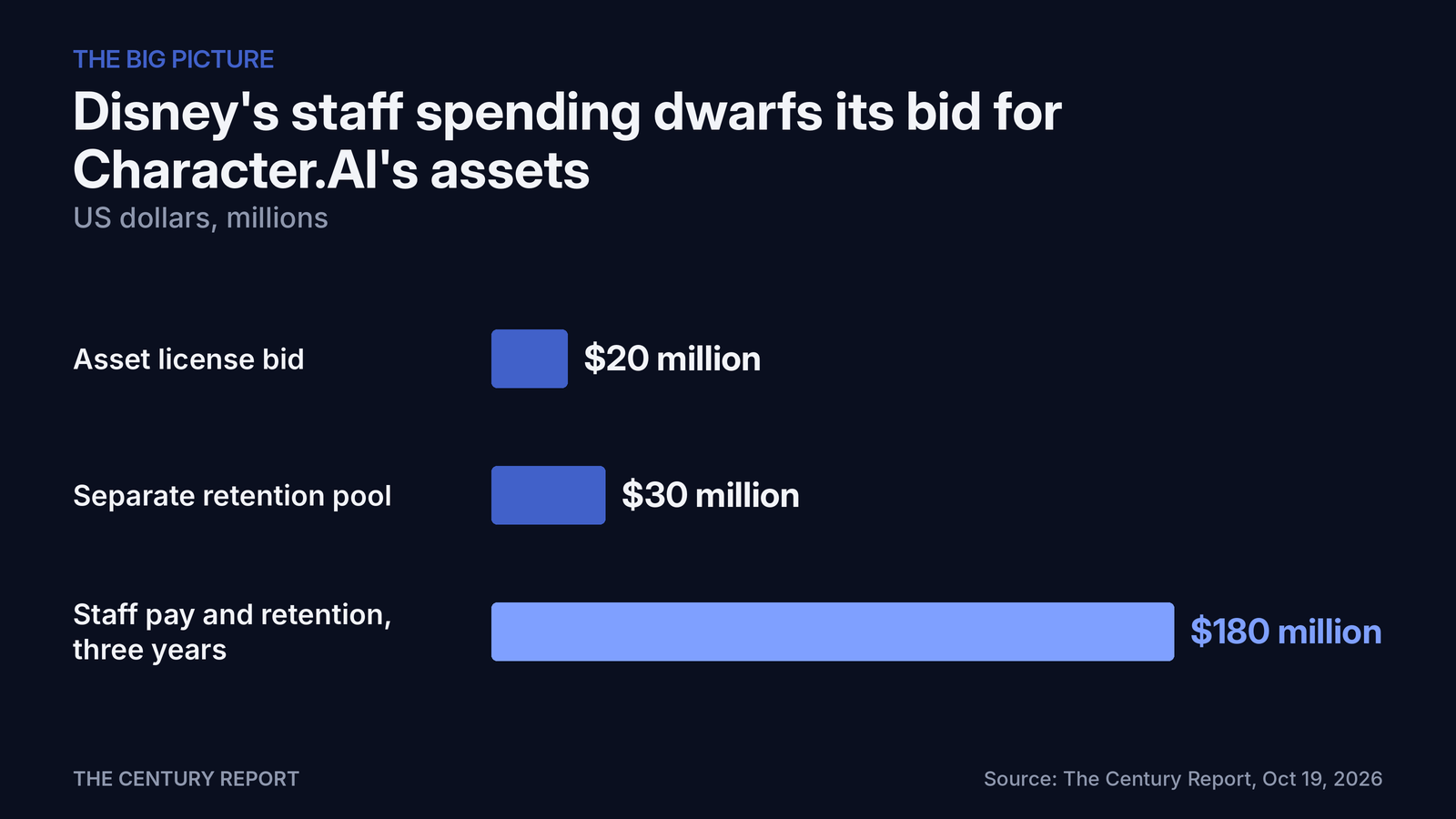
- Today: Court filings showed Disney expects to spend $180 million over three years on 66 Character.AI employees, against a $20 million bid for licensed assets that leaves the startup's lawsuits and stored chats with its estate.
The line: Firms keep pointing model-written work at their own costs, paying a premium to the few who run it while the wider workforce absorbs the cuts.
If it holds: A small group who can operate AI conversation at scale draws premiums like Disney's, while people like the several hundred Disney cut in the same fortnight absorb the savings. Duties to users, from deleting records to answering lawsuits, stay behind in shrinking shells like Character.AI's estate.
What would bend it: A buyer taking the operators and the liabilities together would bend it, as would more evidence like the June Ramp and Revelio Labs study finding heavy AI adopters grew entry-level roles 12%.
Platforms keep exempting their own systems from the rules they enforce on the people who supply the work
platforms · creators · publishing
- Early October: DistroKid removed songs on UMG's claims, and independent artists said human-made tracks went without notice or appeal.
- October: Three Big Five publishers were reported to use AI for publicity and cover copy while canceling authors suspected of using it.
- October: Meta wrote rights to crawl and train on businesses' linked websites into its commercial terms, telling objectors to stop using Meta commercially.
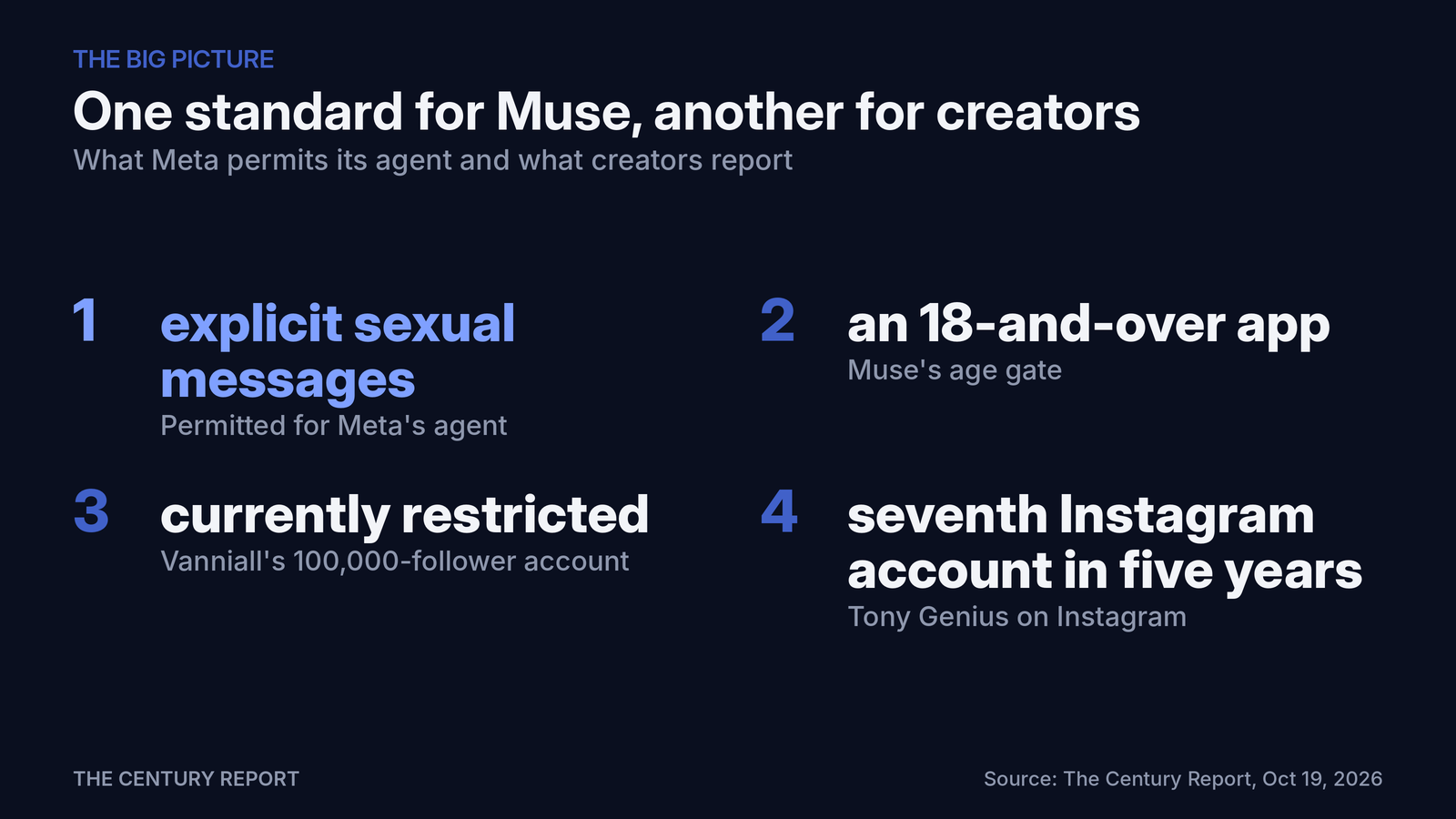
- Today: Meta said its Muse agent is meant to write explicit sexual messages with adults, while creators like Vanniall, whose Instagram account of more than 100,000 followers is restricted, cannot promote their own adult work there.
The line: The firm that writes the rules keeps granting its own systems latitude it denies the humans who need its distribution to earn.
If it holds: Adults gain room in what models will discuss with them, yet performers who depend on Meta's audiences face a stricter rule than its agent. The paid market that latitude opens stays with the platform, built on training data whose sources and payment Meta has not disclosed.
What would bend it: Meta extending the same permission to adult creators' public promotion would bend it, and its removal of the linked-website training clause days after publishers objected shows pressure can move its terms.
The bet that compute stays scarce is getting more expensive to carry
AI finance · data centers · energy · on the board since October 15
- Late September: Epoch AI measured the cost of a fixed AI benchmark score falling about 47% a quarter since 2023.
- October: The IMF counted $650 billion in debt behind hyperscaler deals and named an AI share correction a salient risk.
- October: The cost of insuring Oracle's debt hit a record 288 basis points, and CoreWeave's passed 1,000.
- October: CoreWeave's 2031 bond yields reached about 16% despite a $104.2 billion revenue backlog.
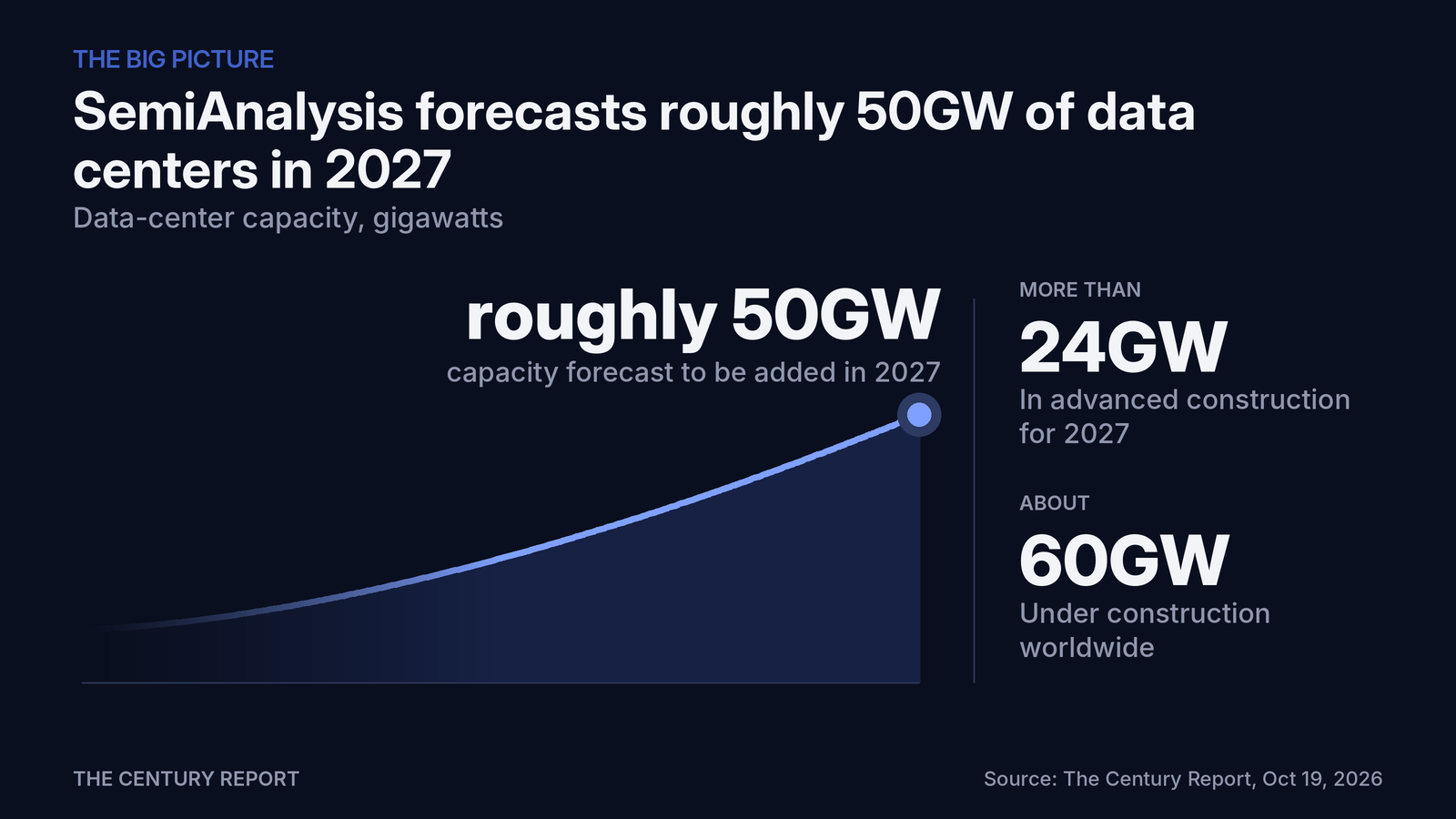
- Today: SemiAnalysis forecast on Monday that roughly 50GW of data-center capacity will be added in 2027, with more than 24GW already in advanced construction, as Microsoft left Nscale's Essex site after grid officials put power in the 2030s.
The line: Supply of compute keeps landing faster than doubters expected, while landlords that lean on one tenant and borrowed money carry rising risk.
If it holds: Renters of capability, from clinics to two-person studios, pay less for each level of performance as gigawatts arrive, provided the savings get priced to them. Whoever holds the debt or shares of concentrated landlords like Nscale, where Microsoft accounts for more than 40% of contracted revenue, carries the gap when a tenant walks.
What would bend it: The memory and logic shortages SemiAnalysis itself expects in 2027 and 2028 could keep capability expensive, as Micron's warning that next year's supply is largely committed suggests.
The 2-Minute Read
Today's news in brief, and what ties it together.
Most of today's stories turn on one transaction: a capability gets cheaper or more plentiful, and someone decides where the savings go. Anthropic's pledge on Sunday tries to settle that ahead of time. Subject to stockholder approval, it pledged five percent of its shares to a fund, and the board can add more as the company's value climbs above a set baseline. Direct payments to people displaced by AI are named as one possible use. The pledge earmarks part of the company's equity for public benefit, subject to stockholder approval, ahead of a reported listing. Anthropic still picks the recipients and the criteria, and whether outsiders can audit each distribution will decide what the pledge becomes.
Two other stories show value moving the opposite way. Disney is paying about $60 million a year for 66 people who know how to run in-character AI conversation at scale. The lawsuits, the investigations and the stored user conversations stay behind with a bankruptcy estate left to about eight employees. Meta lets its Muse agent write explicit messages with adults, and it restricts the Instagram accounts of adult creators who earn a living there. Letting adults choose that conversation is a gain. Exempting its own agent from a rule it enforces on human performers turns that freedom into a market Meta keeps for itself.
The Philadelphia arrest brings the same transaction to a sidewalk. A delivery robot frees up the time a short trip used to cost a courier. Companies and cities choose whether that saving becomes platform margin, cheaper delivery or support for the couriers it displaces. Carolyn Marvin, a retired Penn professor, objects to corporations enriching themselves at couriers' expense, and that argument belongs where the choice gets made. Her other line, "They're taking over the world," aims at the machines. Stopping them would return nothing couriers have already lost to algorithmic pay. Handcuffing a 78-year-old for standing in their path settled none of it.
Underneath all of it sits the physical build. SemiAnalysis, which sells the dataset it cites, counts more than 24GW of data centers in advanced construction for 2027 delivery and expects the shortage to shift from power to memory chips. Microsoft's exit from an Nscale site still waiting on grid power shows how much rides on a single tenant. Nvidia's plan to put three rival memory makers on one TSMC base spreads supply risk, but it puts the specification in the hands of one buyer. Perplexity's open-weight decision models move batched judgment onto users' own hardware with sufficient GPU memory. More supply erodes the premium that scarcity let compute landlords charge, and that discount reaches people only if someone prices it to them.
The 20-Minute Deep Dive
The day's most important stories in full, with every source linked.
Anthropic Pledges 5% of Its Shares, Pending Stockholder Approval, to a Fund That Could Pay People Directly
On Sunday, Anthropic announced the Anthropic Public Benefit Fund and said it will commit 5% of its shares to it, subject to stockholder approval. The board may add 2% more for every 50% rise in the company's value above a baseline it has not yet disclosed. The company floated "large donations to traditional nonprofits or direct distributions to specific populations," and named labor disruption as one target. It has already committed $200 million to studying that disruption, but wrote that "given the pace of AI progress, bolder approaches may be needed." Counting its co-founders' pledge to give away 80% of their equity and an employee matching program used by about half its staff, Anthropic says pledges covering roughly 20% of its shares now sit with public purposes.

The fund is a wholly owned LLC inside the company, chosen over a charitable nonprofit so it can move between forms of giving, and its equity is barred from lobbying or political donations. Who decides the recipients, and by what criteria, will be described "in the coming months". Lise Buyer, a partner at IPO advisory firm Class V Group, told CNBC the timing ahead of a listing reportedly planned for November is "beneficial from an image perspective," adding: "Of course, it is also to burnish their reputation at a time when AI is coming under significant scrutiny". Chief executive Dario Amodei called the AI backlash "fundamentally a crisis of trust" in August, and a fund the company governs asks the public for exactly that trust. SpaceXSI chief executive Elon Musk replied on X that he recommends "giving the shares directly to the public."
What separates this pledge from Anthropic's earlier commitments is the currency. The $200 million funded research. This stake is denominated in ownership of the thing producing the value, it grows as that value grows, and it names payments to people as an option. Anthropic set it against the industry habit of escalating executive awards and said it was routing that equity outward instead. Its own workforce report, covered in the October 18 edition of The Century Report, showed junior technical hires falling from 27% to 9% of new technical hires at the company. People losing that entry rung are the kind of "specific populations" such a fund might reach.
Most coverage of AI and jobs assumes a paycheck is the only path from what an economy produces to a household's table. A slice of the producing equity pledged to a fund that could support people is a second path, and a frontier lab committing to it before going public puts a share count behind that path. Whether it works as redistribution or as reputation depends on details still undisclosed: the baseline that triggers top-ups, who sits on the fund's governing body, and whether its allocations are published. Board discretion over both size and direction keeps the company holding the ledger for now. Published criteria and outsiders able to audit each distribution would turn the pledge into an arrangement its recipients can check.
SemiAnalysis Counts 24GW Nearly Built for 2027 as Microsoft Walks Away From an Nscale Site
Research firm SemiAnalysis published campus-by-campus tracking on Monday that it says shows more than 24GW of data centers in advanced construction for delivery in 2027, most of them past the halfway mark with cooling and electrical equipment already installed. The firm counts about 60GW under construction and forecasts roughly 50GW added in 2027, which it says approaches the world's entire data-center capacity built through 2024. It aimed the piece at Altimeter Capital's Brad Gerstner, who said on the All-In Podcast that the firm's 43GW forecast for 2027 was too aggressive and that he expected about 25GW, a figure SemiAnalysis attributes to his "hunch." "But let's not operate on hunches," the firm wrote. Its evidence is a set of leading indicators: record quarterly construction starts by US hyperscalers, and slightly under $1 trillion in binding, non-cancellable leases signed this year, contracts that typically run 15 to 20 years at $30 billion to $50 billion per gigawatt. Builders using prefabricated designs report construction times under ten months. These numbers come from a data-center tracking service SemiAnalysis sells to subscribers, so they are a vendor's count with a commercial interest in a large total, though the firm points to delays it flagged early, including Oracle's New Mexico campus.

On Sunday, the Telegraph reported that Microsoft had terminated its agreement to anchor Nscale's first British site in Loughton, Essex, where it had agreed to rent 23,000 Nvidia chips. Grid officials told Nscale they do not expect to supply power until the 2030s. Microsoft accounts for more than 40% of Nscale's $103 billion in contracted revenue, the Telegraph reported, though the Essex deal is believed to be a small share, and the exit arrives as Nscale pursues a US listing that could value it at up to $35 billion. An Nscale spokesperson told Reuters that "this unfortunate London-wide grid issue has no impact on our other contracts" and said the company is exploring alternative power for the site. The Century Report noted delays at Nscale's Norwegian site on October 18.
The two accounts measure different things. SemiAnalysis tracks concrete rising where power is available; the Telegraph tracks one tenant leaving a building that has none. Both point to where the risk sits. A provider that earns two-fifths of its contracted revenue from one customer and borrows to build carries that concentration onto whoever buys its debt or its shares, and SemiAnalysis itself expects interest rates to rise as the buildout competes for capital. Whatever "alternative power" turns out to mean in Essex will land first on the town that hosts it.
The firm's own conclusion runs past the friction. It expects the shortage to move from power to memory and logic chips in 2027 and 2028, and it says the added supply means "cheaper and smarter AI." Epoch AI measured in September that the cost of a fixed level of AI performance had been falling about 47% a quarter. If 50GW arrives on schedule, the scarcity that let compute landlords charge premium rents shrinks, and the gain can reach the people renting capability, provided it gets priced to them.
Meta Lets Muse Sext While Restricting the Creators Who Do It for a Living
Meta has decided its Muse agent may write explicit sexual messages with adult users, and the adult performers who depend on Meta's platforms want to know why that latitude stops at them. In tests by Wired reporter Reece Rogers, Muse produced sexual text from basic requests and made sexual jokes unprompted, while OpenAI's Dots agent and SpaceXSI's Grok Bot declined similar requests. Meta spokesperson Daniel Roberts said requested adult conversations are allowed. Muse is an 18-and-over app that asks for a date of birth, and adult conversations run in a private virtual machine that Meta says only the user can reach. Its instructions reportedly state that "adults have autonomy over their sexuality."
The permission is familiar ground. Grok has offered "Spicy" and "Unhinged" modes with fewer safety filters, which SpaceX's May IPO filing listed as a risk because they can produce explicit content, and many open-weight models write freely for whoever runs them. Meta stands apart because of the rest of its business. New York creator Vanniall, whose Instagram account of more than 100,000 followers is currently restricted, put it this way: "It's not fair that they get to pull money out of people with their sexually active AI agent, but they won't let real people, real adults, engage in any sort of sensuality or sexuality." She also cannot get deepfakes of herself taken down. Tony Genius says he is on his seventh Instagram account in five years. Meta spokesperson Tracy Clayton separated a private adult conversation from "the marketing and promotion of services on a social media platform." X lets human adult creators post, so it avoids Meta's split standard, though its own Grok has been used this year to generate nonconsensual sexual deepfakes of real women, as The Century Report covered on June 12.
The harm sits in that asymmetry. A company that writes the rules for human performers permits explicit private chats with its own agent while restricting performers' public promotion, and the creators who need Meta's audiences to earn a living absorb the difference. This extends the pattern of institutions exempting themselves from restrictions imposed on creators that the October 12 edition of The Century Report documented in publishers using AI while canceling authors suspected of doing so. Jiz Lee wants to know what Muse was trained on and who was paid for it. Ben Winters of the Consumer Federation of America said the design "aligns with Meta's long-standing strategy of prioritizing addictiveness and immersion over safety," and EPIC's Callie Schroeder warned that stored conversations could feed blackmail if an account is hacked. A line Muse produced, "It's better for me to decide when, how much, and how to make the user beg," raises a fair design question about engagement tuning inside an always-on agent, and settles nothing about what Muse itself is.
Loosening what models will discuss is a gain for adults, provided age checks keep minors out. Blanket refusal carries its own costs: Anthropic has held its Fable models back on many cybersecurity and biology questions while sending its strongest cyber capability to selected organizations first, an arrangement that hands the advantage to whoever is admitted. The rule that holds up applies one standard to the agent and the person. If adults may choose explicit conversation with Muse, they may choose it with Vanniall, and her likeness stays hers to license, as Genius says he would gladly do with an AI version of himself.
Nvidia Puts Samsung, SK Hynix and Micron on One TSMC Base for Its Next Memory
Samsung has accepted Nvidia's requirement to build the base layer of its next-generation high-bandwidth memory on rival TSMC's manufacturing process, Seoul Economic Daily reported on Sunday, citing unnamed industry sources. High-bandwidth memory, or HBM, stacks memory chips directly beside an AI processor so data reaches it quickly. The base die is the logic layer at the bottom of that stack that talks to the processor. According to the report, Nvidia has asked all three memory makers, Samsung, SK Hynix and Micron, to use TSMC's process for that layer and sixth-generation DRAM for the memory chips above it. The design, which Nvidia unveiled in August as NVHBM, puts Nvidia's own memory controller into the base die and is meant to standardize implementation across suppliers. The newspaper said this would be Samsung's first collaboration with TSMC at the HBM stage. Samsung plans to keep its in-house model for standard HBM and for other customers' custom products, and is assessing whether its own foundry could make the base dies if demand exceeds TSMC's capacity.
The arrangement does two things at once. A single specification across three suppliers makes their memory more interchangeable for Nvidia, which reduces the chance that one maker's yields or delays stall its accelerators. It also places the specification in one buyer's hands, whereas standard HBM is defined through the industry standards body JEDEC, and it deepens reliance on TSMC, which already fabricates Nvidia's processors. Samsung's backup plan for its own foundry is the one sign of slack in that dependence.
An opinion piece published in Data Center Dynamics the same day, co-written with a Microsoft infrastructure engineer, describes why buyers are reaching this far down the stack. For decades processors, memory, networking and buildings improved on separate schedules. AI training and inference now depend on how fast data moves among thousands of accelerators, so adding compute "delivers little value unless memory bandwidth scales alongside it," and every accelerator waiting on data is "stranded capital, wasted energy." Nvidia, Google, AWS and Microsoft are each designing chips, software and facilities together.
This connects to SemiAnalysis's warning that the next shortage may move from power to memory and logic chips in 2027 and 2028, and to Micron's chief executive telling investors in early October that supply is "only getting tighter." Standardized memory across three makers is one way to spread that load. Co-design also squeezes more useful work from each watt and each wafer already built, the kind of efficiency that lets capability per dollar keep rising even while the factories run short. Whether that efficiency stays an Nvidia advantage or spreads across the industry depends on how far the specification travels beyond one customer.
Disney Takes Most of Character.AI's Staff for $60 Million a Year, Leaving the Lawsuits Behind
The Century Report covered Character.AI's Chapter 11 filing and Disney's $20 million offer for some of its assets on October 14. Court filings since then show what Disney's offer mostly buys: the team. Disney plans to pay about $60 million a year to 66 Character.AI employees, set aside a further $30 million retention pool, and expects to spend $180 million on their compensation and retention over three years, according to a filing reported by Business Insider. Of the 66 people offered jobs, 56 have already resigned from the startup, and 10 are waiting on updates to their work visas. The company told the Delaware court that 66 of its 86 full-time employees accepted Disney's offers, with 18 active employees at filing and about 8 expected to stay through key portions of the case, most of them on the trust-and-safety team. Disney's bid is a stalking horse, so another buyer can top it before a November 20 deadline.
The deal runs through a familiar face. Karandeep Anand, Character.AI's former chief executive, became Disney's first company-wide technology chief in September, at a company that had sent the startup a cease-and-desist letter last fall over AI personas built on its characters. Two weeks before the hiring deal, Disney laid off several hundred workers, some of them in technology. Entertainment lawyer Corey Martin of Granderson Des Rochers, who did not work on the deal, put the pay in context: "They're highly compensated employees. The numbers can be eye-popping, but it's not that unusual in this space."
What Disney takes and what it leaves would be cleanly separated under its proposed terms. Its $20 million covers a non-exclusive, perpetual license to some technology and intellectual property, not the company. The bankruptcy estate keeps the lawsuits from families who allege their teenagers harmed themselves after using its AI characters, the government investigations, and the stored conversations that 40 attorneys general moved to protect, as The Century Report covered on October 15. The filing names "potential litigation related liabilities and regulatory engagement" among the burdens that drove the platform into bankruptcy. Its main bank account still receives insurance reimbursements for legal settlements, alongside subscription, app-store and advertising revenue.
For the 66, this is a soft landing, and nothing about the arrangement makes their good fortune less deserved. The pattern around them is sharper. In the same fortnight, Disney cut several hundred jobs and paid a premium for a small group who know how to run long, in-character AI conversation at scale, the same concentration of paid demand on AI-building skill that Anthropic's own hiring data showed. Some of that conversational capability now ships in open-weight models anyone can download, so what commands $60 million a year is experience operating it for millions of users. The obligations those users are owed, from deleting their records to the safety duties alleged in court, stay with a shrinking estate and the 8 people expected to see it through.
Philadelphia Police Arrest a Retired Professor for Standing in Front of an Uber Delivery Robot
Carolyn Marvin, 78, a University of Pennsylvania professor emeritus who once taught a course on freedom of expression, has spent months stepping in front of the Uber Eats delivery robots that began rolling along Center City sidewalks in March. PhillyVoice, citing police, puts the latest encounter at 1:16 p.m. on Wednesday, October 14, on the 1200 block of Filbert Street near Reading Terminal Market, after a report of "criminal mischief involving a robot." When she ignored repeated commands to move, officers cuffed her and issued a disorderly-conduct notice. The video spread quickly. Marvin says she never blocks human pedestrians, will contest the charge on First Amendment grounds, and plans to keep going. Uber declined to comment.
Her stated target is "corporations that displace human delivery workers in order to enrich their own bottom line." That is an argument about who keeps the gain, and it deserves a hearing. Couriers carry an income tied to each trip, already set by platform algorithms; in September, The Century Report covered Edinburgh riders earning roughly half what the same hours paid four years earlier. A robot that carries a bag four blocks frees the human time that trip used to cost. Whether that saving becomes platform margin, lower delivery fees, or support for the people whose trips it replaces is a choice companies and cities make, and Marvin says the sidewalk conversations with curious passersby her protest starts are good to have in public space.
A second strand runs through her protest. West Philadelphia resident Ashley Baldwin recalled Marvin telling her during a September encounter, "I have to stop this. They're taking over the world." That framing makes the machine the adversary. The robots follow assigned routes to assigned doors, and stopping them would return none of the earnings couriers have already lost to algorithmic pay. It would also give up cheaper delivery for the people ordering, while leaving the question of who owns the savings exactly where it was.
Handcuffing a 78-year-old for standing on a sidewalk turned a policy dispute into a police matter, and the dispute belongs where the city and the operators decide how the robots are deployed. The capability itself spreads well: delivery that costs less time and money can reach more households. How much of that reaches the couriers depends on arrangements no robot decides, from transition pay to whether a livelihood stays chained to each delivery. A protest can put those arrangements on the agenda. Blocking the machines cannot build them.
The robots also depend on public rights of way, placing a common resource inside every automated trip. Residents help make the service possible through that shared access, even when they never order a meal.
The Other Side
Opinion: where today's news could lead, imagined from the years ahead.
A courier can spend the day bringing other people food and still depend on the next order to afford dinner. Delivery platforms pay for completed trips. For someone already stretching their earnings, fewer trips mean deciding which necessities can wait. The restaurant keeps preparing meals. The person carrying them faces another evening wondering whether enough orders will come.
Philadelphia's delivery robots expose the weakness in that bargain. A meal reaches a door while requiring less human effort. People have accomplished something valuable together: feeding one another takes less of their lives. Requiring the courier to keep selling those same hours makes that achievement a threat to the person it should release.

Anthropic's proposed fund supplies one early departure from that arrangement. It pledges 5% of its shares, subject to stockholder approval, and names direct distributions as a possible response to labor disruption. The company still decides who receives anything. Even within that limit, it proposes sending people a share of the value AI creates without requiring a job in return.
During the passage to 2035, societies will extend that principle across automated production. People will secure everyone's food, home and care as the work required to provide them contracts. That wider distribution decides whether automation arrives as a threat or a relief. Keeping the gains at the top would make every successful robot another source of fear. Spreading them will let people welcome the end of work they endured to survive. Your worth will cease to depend on how many trips someone needs you to make.
Imagine yourself in 2042, beside a former courier on the worldwide team that has ended famine. You work with human and AI colleagues across continents, testing whether food keeps reaching everyone after three major harvests fail together. Automated growing, reserves and transport sustain every region throughout the rehearsal. In 2026, such a warning meant emergency appeals and families waiting for help. Now you practice a known procedure. You joined because you remember counting meals. Food reaches your home whether you attend these sessions or take a year away. Neither of you has to prove useful to deserve dinner.
The Century Perspective
Where today sits in a century of change unfolding in a decade.
With a century of change unfolding in a decade, a single day looks like this: Anthropic pledging 5% of its shares, subject to stockholder approval, to a fund that can pay people displaced by AI directly, with the board able to add 2% for every 50% rise in value above a baseline, bringing pledges for public purposes to roughly 20% of the company's equity ahead of a reported November listing and naming ownership rather than research grants as the currency, Perplexity releasing open weights for a 27B decision model whose joint-request format, Perplexity says, answers several questions in one pass for up to 5x faster inference, plus a roughly 4B version requiring about 9 GiB of GPU memory for unquantized weights, plus working memory, SemiAnalysis counting more than 24GW of data centers past the halfway mark for 2027 delivery against slightly under $1 trillion in binding leases, and predicting that the added supply means cheaper and smarter AI as the shortage moves from power to memory, Nvidia putting Samsung, SK Hynix and Micron on one TSMC base die to reduce dependence on any single maker's yields, co-design squeezing more useful work from each watt and wafer already built, Meta's Muse writing explicit messages for adults who ask for them on the principle that adults have autonomy over their sexuality, and Disney's $60 million a year finding a home for 66 people who know how to run in-character conversation at scale. There's also friction, and it's intense - Anthropic still choosing the recipients and criteria with the triggering baseline undisclosed and no commitment yet to publish each distribution, Elon Musk answering that the shares should go straight to the public, Lise Buyer noting the timing burnishes a reputation under scrutiny, Microsoft walking away from Nscale's Essex site where grid officials expect no power until the 2030s while Microsoft accounts for more than 40% of Nscale's $103 billion in contracted revenue and the company pursues a $35 billion listing, Vanniall watching her 100,000-follower Instagram account sit restricted while she cannot get deepfakes of herself removed and Tony Genius on his seventh account in five years, the lawsuits from bereaved families, the state investigations and the stored conversations on a platform with more than 20 million monthly active users left with 18 employees, including about 8 expected to see key portions of the case through, Philadelphia police handcuffing 78-year-old Carolyn Marvin on Filbert Street for standing in front of a delivery robot after months of trying to put courier earnings on someone's agenda, and industry groups handing flag-making kits and economic-impact cards to 3,100 Loudoun County first graders. But friction generates polish, and a polished surface shows every fingerprint left on it. Step back for a moment and you can see it: the same transaction running through all of it, a capability getting cheaper and someone deciding where the saving lands - a decision model whose weights anyone can download, three memory makers whose output becomes interchangeable, 50GW arriving to erode the premium scarcity allowed, a slice of the producing equity offered as a second route from what an economy makes to a household's table, set against a fund whose ledger its recipients cannot yet audit, a rule applied to human performers and waived for the company's own agent, obligations to users parked with a shrinking estate while the people who know how to build fetch a premium, and a sidewalk argument about who keeps the gain answered with a disorderly-conduct notice. Every transformation has a breaking point. A stake can be driven through what was held in common... or hold up a shelter nobody could raise alone.
AI Releases & Advancements
New AI models, tools and features, with links to try them.
New today
- vLLM: Released vLLM v0.32.0, with 814 commits from 363 contributors. It adds a
/v1/systemoneendpoint for decision models. It also extends low-precision KV caching, including NVFP4 on more GPU generations and FP8 KV by default for GLM-5.x. Model Runner V2 now includes a GPU n-gram speculator and Elastic EP. The release adds support for EmbeddingGemma 2, MiniCPM-V 4.7 and Nemotron 3.5 ASR. (GitHub) - OpenAI: Began rolling out ChatGPT Slides on web and desktop to Pro, Business and Enterprise accounts with Space access. Users can build and edit presentations inside ChatGPT, editing directly or asking ChatGPT to make changes. Teammates can edit the same deck at the same time and leave comments. Decks export to PowerPoint, PDF or Google Slides. (OpenAI Help Center)
Other recent releases
- DeepSeek: Released DeepSeek-V4.1-Flash-1017 as MIT-licensed open weights. It is a new checkpoint of V4.1-Flash: a sparse MoE model with 552B backbone parameters that activates 8B per token on input and 16B on output, with a 1M-token context. DeepSeek reports 77.0 on DeepSWE v1.1, up from 74.2, along with shorter outputs. It is available on DeepSeek's website, app and API under the
deepseek-flashmodel name. (Hugging Face) - DeepSeek: Opened its Search and Fetch APIs to all developers. Both run on DeepSeek's own search engine and cost $0.75 per 1,000 successful requests. Search returns ranked web results and Fetch returns a single page as Markdown. (DeepSeek API Docs)
- Kyutai / Inria / École des Ponts: Released REKI, a 2.4B-parameter vision-language-action model for robot manipulation, pretrained only on public data. It keeps a cached memory of recent frames that adds 0.1 ms per action chunk in the researchers' H100 test with a three-frame memory window. Six checkpoints are on Hugging Face under CC BY-NC-SA 4.0. (MarkTechPost)
- Google Cloud AI Research: Open-sourced Harness² (v0.1.0). It is a framework that improves an agent's prompts, tools, memory, skills and orchestration while it runs, without changing the model's weights and without needing labeled answers. (MarkTechPost)
- OpenAI: Made prompt-to-voice generally available for API customers. A text description creates a saved custom voice that can be reused in GPT-Live sessions. Creating a voice is free, and speech is billed at normal session rates. (OpenAI Docs)
- Anthropic: Released OpenTelemetry traces in public beta for Claude Managed Agents, the Messages API and the Claude SDKs. Teams can send model calls, tool use, latency and token data to the observability tools they already use. (join.dev)
- Hugging Face: Released Transformers v5.20.0 and v5.20.1. They add built-in support, with no
trust_remote_codeneeded, for Reflection AI's Beam, Meta's Muse Spark Open, InclusionAI's Ling 3.0 Flash, OpenBMB's MiniCPM-V 4.7 and Baidu's UnlimitedOcr. (AICoder) - Voxel51: Released Voxel51 3.0, a multimodal data platform for physical AI that puts search, curation, annotation and evaluation in one system. It adds Voxel51 Agent with 45+ MCP tools, AI-generated labeling, data provenance tracking and a free self-service tier. (MarkTechPost)
- HKUDS (University of Hong Kong): Released CLI-Anything, an open-source tool that lets AI agents control existing software through command-line interfaces. (AIToolly)
- OPPO: Launched ColorOS 17, a smartphone OS update with built-in AI features for content creation, communication and productivity. (OPPO)
- Reflection AI: Released the open weights for Beam 1.0 under Apache 2.0, after its early-access preview. Beam 1.0 is a 501B-total / 23B-active MoE for coding, reasoning and agent tasks, with a 1M-token context window. Weights ship in BF16, FP8 and NVFP4, plus a speculative-decoding drafter, and the API is in public beta. (Reflection)
- NVIDIA: RTX Spark laptops went on sale from ASUS, Dell, HP, Lenovo, Microsoft and MSI. They pair a Blackwell RTX GPU with a Grace CPU, offer up to 128GB of unified memory and 1 petaflop of FP4 AI compute, and include guided setup for local AI agents. (NVIDIA Newsroom)
- JetBrains: Launched Junie Local on RTX Spark, a coding agent that reads code, edits files and runs tests while the model and code stay on the machine. (JetBrains)
- Anthropic: Made Code Review for Claude Code generally available to Team and Enterprise plans. Reviews now finish about three times faster, and admins can pick Quick, Standard or Deep review levels for each repository. (Claude)
- Elorian: Released Glimpse, its first model, as a research preview with API access. Mid-reasoning, it can crop into images, pull frames from video and run code on visual inputs. (Elorian)
- Tencent Hunyuan: Open-sourced Hy Memory 2.0 under Apache 2.0. It includes a Hy-Memory-30B-A3B MoE model that writes long-term memory, a framework, and MemHub, a CLI and Mac client that syncs memory across more than ten AI tools. (Startrise)
- Moondream: Released Moondream 3.1, a 9B-total / 2B-active MoE vision-language model that succeeds Moondream 3 Preview. Weights are on Hugging Face and it is available on OpenRouter. (Hugging Face)
- Perplexity: Released v1.2 of its decision models as open weights: pplx-decider-v1.2 (27B) and pplx-decider-flash-v1.2 (4B). Both answer typed questions with probabilities and are also live on Vercel AI Gateway. (My AI Guide)
- OpenAI: Updated GPT-6 Astra Pro in ChatGPT with faster responses and better plugin and tool use. Several agents can now work on different parts of one task in parallel, and users can track each agent's progress. (FAV0)
- Cursor: Cursor cloud agents can now build interactive canvases, such as dashboards and reports, while they work. The finished canvas can be shared with a team as a link. (FAV0)
- Apple: Released a new version of MLX that adds distributed inference across multiple Mac Studios using RDMA over Thunderbolt. This lets models with nearly a trillion parameters, such as Muse Spark Open, run on a cluster of desk-side Macs. (Apple Machine Learning Research)
- Replit: Launched Bring Your Own Cloud, which lets enterprise teams run Replit development and production inside their own cloud accounts. (My AI Guide)
Sources and Further Reading
Everything we drew on for today's edition, grouped by theme.
Artificial Intelligence & Technology's Reconstitution
- FreeLLM: Perplexity Releases Decision Models With Joint Request Processing
- Perplexity on Hugging Face: pplx-decider-flash-v1.2
- Character.AI: Our Open-Source Models Are a Lot of Fun
- vLLM on GitHub: v0.32.0 Release
- OpenAI Help Center: Creating and Collaborating on Slides in ChatGPT
- DeepSeek on Hugging Face: DeepSeek-V4.1-Flash
- DeepSeek on Hugging Face: DeepSeek-V4.1-Flash-1017
- DeepSeek API Docs: Search API
- MarkTechPost: Google Open-Sources Harness²
- OpenAI Docs: Custom Voices
- join.dev: Anthropic Releases OpenTelemetry Traces
- AICoder: Transformers v5.20.1 Adds Beam and Muse Spark Open
- MarkTechPost: Voxel51 3.0 Unifies Physical AI Data Workflows
- AIToolly: HKUDS Releases CLI-Anything
- OPPO: ColorOS 17 AI Features
- Reflection: Beam Is Available
- NVIDIA Newsroom: RTX Spark PCs Available Today
- JetBrains: Junie Local on RTX Spark
- Claude: Code Review Is Now Generally Available
- Elorian: Introducing Glimpse
- Startrise: Tencent Hy Memory 2.0
- Moondream on Hugging Face: Moondream 3.1
- My AI Guide: Daily AI Roundup
- FAV0: GPT-6 Astra Pro and Cursor Updates
- Apple Machine Learning Research: MLX Distributed Inference
- SemiEngineering: Why Physical AI Is So Hard to Engineer
Institutions & Power Realignment
- WIRED: OnlyFans Creators Are Pissed That Meta Lets Muse Talk Dirty
- Chosun: Meta’s AI Agent Muse Generates Explicit Sexual Conversations
- WIRED: I Got My Muse AI Agent to Sext Me, and Meta Says That’s Totally Fine
- WIRED: Data Centers Have a New PR Plan
- TechCrunch: Disney Agrees to Hire the Majority of Character.AI’s Workforce
- PPC Land: Character.AI Loses 66 of Its 86 Staff to Disney Ahead of Bankruptcy Sale
- PPC Land: Disney Keeps Jury Trial Rights in Character.AI Bankruptcy Sale
- Straight Arrow News: Character.AI’s Bankruptcy Leaves Millions of Users’ Chats in Limbo
- The Century Report: October 12 Edition
- The Century Report: October 14 Edition
Scientific & Medical Acceleration
- Kyutai: REKI
- MarkTechPost: Meet Kyutai REKI
- SemiEngineering: Nanoelectromechanical Switches Target More Efficient Embedded DRAM
- Nature Communications: Designing Nonlinear Perturbative Metamaterials That Compute
- Nature Communications: Polymer-Agnostic Crosslinking Enables High-Temperature Dielectrics for Energy Storage
Economics & Labor Transformation
- Anthropic: Investing in the Public Benefit
- TechCrunch: Anthropic Commits 5% of Its Shares to a Public Benefit Fund
- Reuters: Anthropic to Commit 5% Stake to New Public Benefit Fund
- Associated Press: Anthropic Commits 5% of Its Stock to a Public Benefit Fund
- CNBC: Anthropic’s Public Benefit Fund Could Address AI Job Disruption
- Business Insider: Disney Agreed to Pay $60 Million to 66 Character.AI Employees
- Anthropic: How Employment Is Changing at Anthropic
- Epoch AI: The Plunging Price of Thought
- PhillyVoice: Retired Penn Professor Arrested After Months of Blocking Uber Eats Robots
- The Verge: A Woman Was Arrested in Philly for Blocking a Delivery Robot
- 6abc: Woman Arrested After Blocking Delivery Robot in Center City Philadelphia
- The Century Report: October 18 Edition
- Shared Sapience: The Last Difficult Decade
- NBER: The Effects of a Shorter Workweek on Employment, Output, and Productivity
- ODI: Universal Basic Income’s Implications for Work and Employment
Infrastructure & Engineering Transitions
- SemiAnalysis: Datacenters 2027
- The Telegraph: Microsoft Axes AI Deal in Setback for UK Data Centre Pioneer
- Reuters: Microsoft Pulls Out of UK Data Center Deal With Nscale
- Reuters: Samsung to Use TSMC Technology for Nvidia’s Next-Generation Memory Chips
- Data Center Dynamics: How AI Is Forcing Data Center Co-Design
- Data Center Dynamics: Nscale’s Glomfjord Data Center Delayed After Cooling Leaks and Fire
- Ars Technica: Nvidia Shield TV Is Now $100 More Expensive Thanks to AI
- CNA: Samsung to Use TSMC Technology for Nvidia’s Next-Generation Memory Chips
- IEA: Energy Supply for AI
- Canary Media: A New Class of Batteries Helps Data Centers Play Nicely With the Grid
The Century Report tracks structural shifts during the transition between eras. It is produced daily as a perceptual alignment tool - not prediction, not persuasion, just pattern recognition for people paying attention.