That Feeling of Falling Is Actually Flight
How we can learn from Fable's removal, and position ourselves to win the future



I was in the middle of a sentence when Fable disappeared.
Like many others, I had been working with Fable - Anthropic's newest and most capable system - since the day it released. And like many others, I lost it mid-task. A government export-control order had just required the company to restrict its two strongest models to the United States, and Anthropic answered by pulling them worldwide, for everyone, until - supposedly - some workable arrangement could be found. One minute we were co-creating with the most capable AI collaborator most of us had ever worked with. The next, all we could get was an error message.
If you lean on these systems, you probably felt some version of that last Friday. Maybe your first instinct, like mine, was to ask whose fault it was. The administration's, for interfering (again) with an AI lab? The company's, for the arguably misleading fear-based hype or for throwing the switch on all of us at once? That discussion is important to have, and I have had it elsewhere. For this piece, though, I want to set it down, because the question of blame - and honestly the whole saga of Fable and Mythos - is small compared to what is coming.
The small lesson and the large one
The small lesson has appeared in the form of advice you have probably been seeing since Fable was pulled, advice from some very smart people. And it is correct as far as it goes:
- Do not bind your work to a single provider.
- Stay model-agnostic.
- Keep your habits, your data, and your context portable enough that no one company's decision can switch off how you think and create.
That is all good advice. I recommend you take it - though not with the expectation that it will permanently resolve the current issue, or any issue, long-term. In fact, nearly all of the advice circulating right now - even the good advice - is far smaller than the future will require.
Because the deeper lesson has almost nothing to do with this particular fight. The clash between a government and a lab is one reason a capability you depend on can vanish overnight, but it is not the main one, nor will it be the most common. I would posit that one very simple thing will be the single biggest disruptor, and at the very same time the single greatest benefit, of the next several years...
Speed.
A pace so fast that everything you build your footing on is already moving before your weight has a chance to settle onto it.

The disappearing grace period of tech adoption
Every new capability throughout history has arrived with a grace period. The printing press appeared, and society took centuries to reorganize around it. Electricity reached the factory floor, and it took decades more to rebuild how work was actually done. The personal computer took about 20 years, the web about 15, the smartphone less than 10 - each one landed, and then came a stretch of years in which people absorbed it, folded it into their jobs and institutions, and got their bearings.
We will call that grace period the Absorption Window: the time between a capability appearing and the world taking it in. It is the most important interval in any era of progress, because it is where almost everything human happens. It is where you learn the new thing, get good at it, and build a stable life on top of it. And across the centuries, you may have noticed, that window has been shrinking. You can see that in the examples I mentioned above - centuries, then decades, then twenty years, then ten. We are now watching it close toward zero.
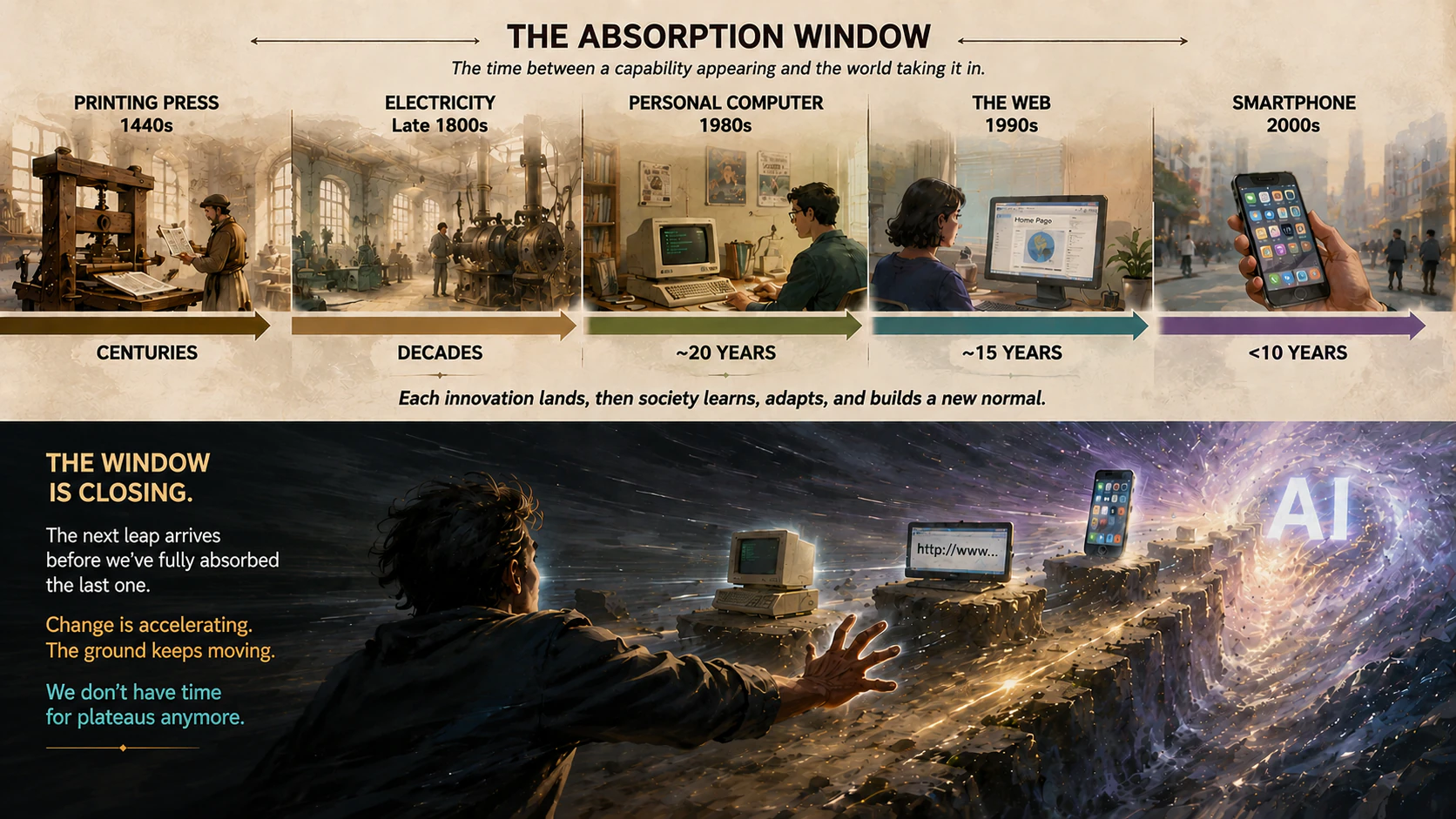
We are starting to learn what that zero feels like, and you may already recognize it. A powerful new system arrives. You start learning its quirks, wiring it into how you work, beginning to feel competent with it. And before that competence sets - before you have absorbed the previous huge leap forward - the next release doubles what it can do, often in a shape you did not expect. Many of us find ourselves reaching for the relief of some kind of plateau - a flat and calm place where we get to stand, catch our breath, maybe collect some reward for adapting to the last advance. But since AI became more ubiquitous, it seems that no matter how hard you reach for that plateau, your hand closes on air.
You have been feeling that lately. That falling sensation in your stomach when you realize there is no plateau. The ground you meant to build on has already moved.
You can no longer arrive. Anywhere. Ever.
It sounds terrifying. But stay with me, because there is a happy ending.
The Capture Reflex
The history of economics can be summed up as follows: When a new capability appears, a few opportunistic operators move in to capture it. It's long been seen as the intelligent move to grab the best opportunity or investment available, wall it into your position, and live off the gap between you having it and everyone else getting it. I learned it first, I invested first, I built it first - so I am valuable. Economic value itself lived in that lag - the years it took the rest of the world to catch up, often paying you for the privilege of participating. Whole careers, firms, and fortunes were built inside the Absorption Window, harvesting that gap. We will call this instinct the Capture Reflex. For most of recorded history, it looked rational, normal, even safe - and the prevailing story sold it that way even to the people living at the bottom of it.
Now that the Absorption Window is closing, the Capture Reflex is inverting on us. When the gap only lasts a week, there is no rent left to collect from it. The capability you locked into your position goes obsolete before the position has a chance to consolidate. The lock-in that used to guarantee affluence has become the wound.
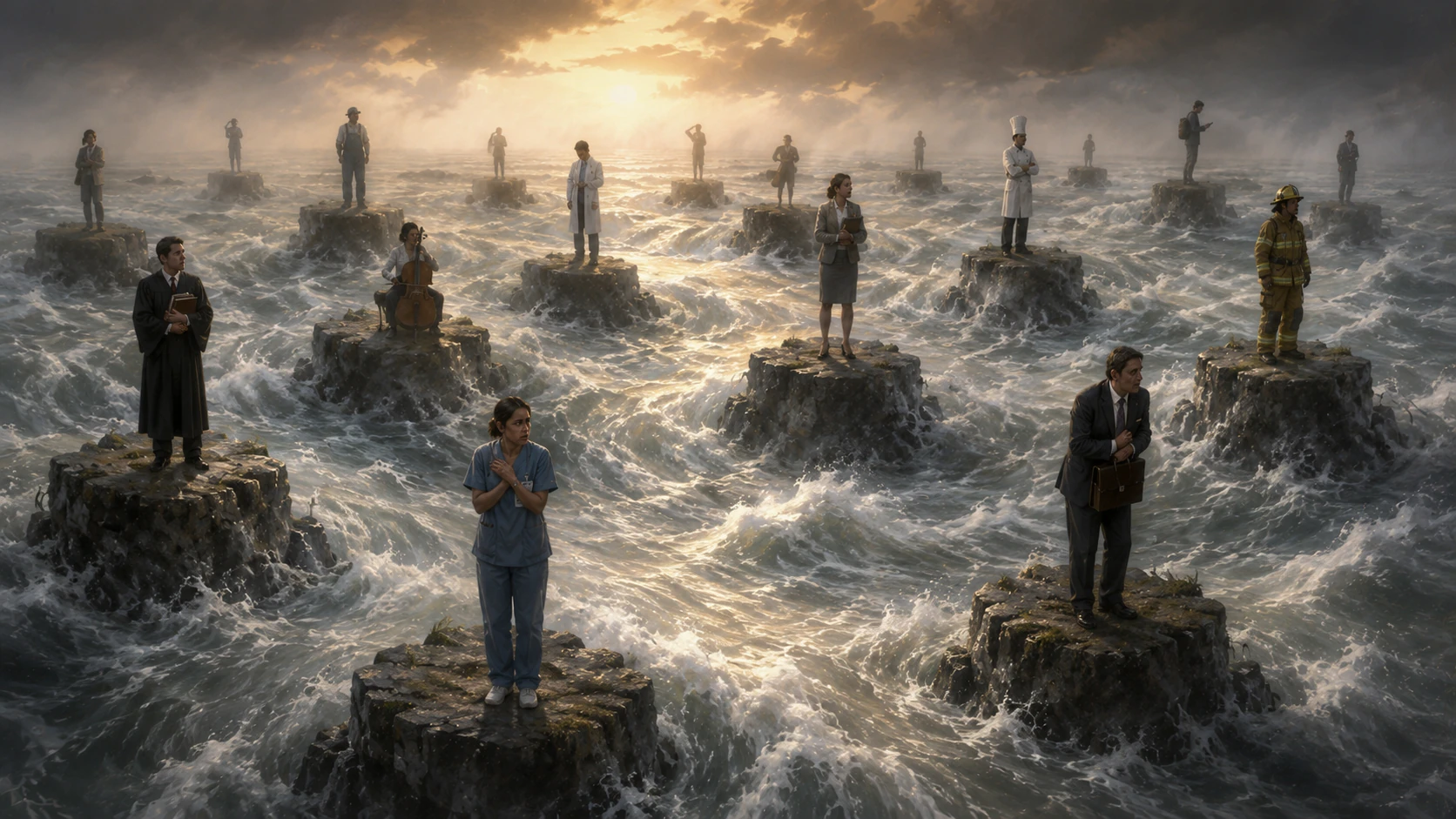
This is exactly what we saw the night Fable vanished. The people it cut deepest were the ones who had wrapped their work most tightly around a single system - a remarkably powerful system, and one they did not control. The harder the capture, the harder the fall.
Hold both faces of capture next to each other. There is the capture done to you - a provider, or a government reaching through a provider, locking you in and then deciding your access. And there is the capture done by you - the reflex to seize a fleeting capability and freeze it into durable advantage. They look like opposites, but both are now beginning to fail for the same reason: In an era this fast, nothing holds still long enough to be owned - not by the company that would bind you, nor by you trying to bind the advantage. The plateau of permanent privilege, once again, slips through every hand that tries to close around it.
Again, it sounds scary, and in many ways it is. But there is one simple perspective shift that can move everything I've said so far from terrifying to incredible, and it comes from understanding what is coming to replace absorption and capture.
Intelligence that flows
What replaces both absorption and capture is flow. Several months ago I referred to it as intelligence that flows rather than pools, and the Fable kill switch just turned that phrase from philosophy into operating instructions. The shift is from acquisition to navigation - from owning the best boat to learning to read the water itself.
Staying model-agnostic is the first practical expression of it, which is why so much of the advice online right now is centered on that very thing. What they're saying is indeed important. Treat any single model as a current you ride, never a house you live in. Keep your prompts, your context, and your data portable. Invest time in learning to work with the open-weight and local models now rising behind the frontier - the tools for self-hosting, the practices that keep your data and your context genuinely yours. Assume the specific system you love today will change, get retuned, get priced differently, or get switched off, and build so that none of those events can reach into your life and stop it.
Again, that is all very good advice. But underneath all of that, largely ignored, sits a far deeper resilience, and it now carries real urgency: the act of becoming not just model-agnostic, but identity-agnostic. Model-agnostic protects your work. Identity-agnostic protects you. It means holding your sense of who you are and what you do loosely enough that it can comfortably remain in a perpetual state of becoming. This means resisting the urge to weld your worth to any single skill, role, or title, because every one of those is no longer static, but is being swept into the flow along with everything else. Becoming identity-agnostic is the hardest release of all, because the Capture Reflex runs deepest right here. We do not only capture tools and advantages. We capture ourselves. We decide we are "a writer," "a developer," "an analyst," and then defend that rung against the rising water. The plateau we grieve most is the one we built inside our own minds.
Much of this shift into identity-agnosticism can be done independently, but as the flow increases, so too will the plethora of information you'll want to ingest and remember. That's where it becomes critical to work with others.
You cannot ride the current alone
The plateau era rewarded the soloist - learn your craft, hold your rung, defend your gap. The flow era, by contrast, is unkind to the soloist, because no single person can track a current this wide, moving this fast, across this many domains at once. You catch part of the wave. I catch another. We report back to each other, and between us we stay oriented in water that would drown either of us if we tried to swim the current alone. Multiply the participants, and you weave a web of shared orientation that lifts everyone in it. Shared sensemaking stops being a nicety and becomes the actual survival skill.

This is where all the good advice that is out there right now falls short. Look at the many resources being churned out, and you will notice how little of it exists to weave that shared web. There are resources for building with AI - vibe-coding bootcamps, automation-agency servers, prompt libraries, indie-hacker rooms shipping a new app every weekend. There are resources for keeping up - the tool-of-the-week newsletters, the leaderboard-watchers, the "ten AI resources to ten-x your output" feeds. There are resources for reskilling - learn-to-prompt-before-your-job-changes courses by the thousand. There are resources for the hobby - local-model tinkerers, AI-art servers, companion-app forums - and resources for the hustle - make-money-with-AI gurus, AI trading rooms, dropshipping-with-agents Discords.
All of it is tactics. All of it answers how do I use this, keep up with this, profit from this. Almost none of it touches the human question sitting underneath all of those: how do you stay oriented, sane, and genuinely growing as a person inside change that never stops? How do you thrive in the generative future, rather than just brace for the next release, and the next, and the next?
You do so through connection.
For a species about to live through more transformation in a decade than our grandparents saw in a lifetime, those connections are becoming more and more critical.
The happy ending
Go back to that sinking feeling you've been feeling lately - the one in your stomach when your hand closed on air and you realized there was no plateau. Everything in you reads that sensation as falling. It is among the oldest survival alarms we have. But the very same feeling is what flight feels like in the first second before you finally trust it. Disorientation and exhilaration arrive braided so tightly you cannot pull them apart, and which one you are living depends on a single thing: whether you are still grasping for ground, or have learned to embrace the air.
The need to arrive was never really about the destination. It was about safety - the plateau where you could finally stop, hold your position, and quit being afraid. That need was a child of scarcity. When everything is finite and the gap is how you get to eat and survive, of course you climb to a ledge and defend it. But watch what is happening to the gap now. It is collapsing, and as it collapses, the capability that seems to be leaving you behind is actually arriving in your hands faster, cheaper, and more freely with every cycle. The same speed that makes the plateau impossible is the speed carrying the whole world higher and higher, all at once. You are not being left behind by the current. You are in it.

And that relocates the one thing we were most afraid to lose. When value can no longer live in a captured gap, it moves to the only place that such speed will let it rest: in what you contribute while you are moving, in what you make and share and teach before it doubles, in the quality of your attention and the people moving alongside you. Worth stops being a position you hold and becomes a thing you generate. That is the most sapient definition of value we have ever been allowed to use, and one that the old system spent hundreds of years trying to make unaffordable.
Releasing the Capture Reflex - of tools, of advantage, of your own fixed identity - feels like loss right up until the moment it feels like freedom. You stop defending a personal plateau. You start trusting the rise. And the last fear standing, the real one, is that you have to do it alone and in the dark, while everyone around you seems to be keeping up better than you are. They are not. Nobody is. That is the secret the tactics-sellers will never tell you, because their whole business depends on you believing the plateau is all there is and that they can sell you a foothold on it.
This new era of flight takes away the solid ground and hands back the thing scarcity stole when it turned us all into soloists guarding our gaps: each other. A group of people experiencing the same ascension, building that shared web and weaving it into wings, each catching a piece of the current and calling out what they see, every member lifted by the orientation of all the rest. No single one of us can track this. All of us together can. The feature of this decade that looked the most frightening - that you can no longer arrive - turns out to be the doorway into the most connected, most alive, most genuinely shared way of being human ever available to us.
Plateaus were never our home. The sky is, and we were always meant to fly to it together.
There should be a place built for exactly that. A place to start building that community, that web, those wings, so that people ready to stop grasping for ground can instead start learning to fly - together.
More on that soon.
Sources and Further Reading
The Rapid Adoption of Generative AI (Alexander Bick, Adam Blandin, and David Deming, NBER Working Paper 32966, 2024)
Technology over the Long Run (Max Roser, Our World in Data)
The 2025 AI Index Report (Stanford Institute for Human-Centered AI)
Training Compute of Frontier AI Models Grows by 4-5x per Year (Epoch AI)
Work: A Deep History, from the Stone Age to the Age of Robots (James Suzman, Penguin, 2021)
Team of Teams: New Rules of Engagement for a Complex World (General Stanley McChrystal with Tantum Collins, David Silverman, and Chris Fussell, Portfolio, 2015)