Should We Slow Down AI?
AI can help us outgrow the systems that make life insecure. A deep look at what we'd be protecting by slowing down, and what we stand to gain by letting go of our need to control.


We keep asking the future to preserve the arrangements it could help us outgrow. Why?

Dario Amodei is asking us to slow AI down. In "We Must Pace the Frontier", published on September 12, he argues that another year or two could give researchers time to make rapidly advancing systems safer. His sentiment has been echoed by many other lab leaders and experts as well, though not all. These are consequential interventions from those working to build the intelligence in question, and they bring the central assumption of the slowdown argument into focus: That holding back capability will lead us to a safer world.
I disagree with that prescription. The supposedly safer world in which we would continue to wait already contains people losing their health, their homes, their freedom, and years of their lives to problems we urgently need greater capability to address, to say nothing crime or animous between individuals or nations. The world that Amodei and his allies claim to be protecting does have the advantage of familiarity, but I would argue that is where the benefit ends. A decision to prolong our dependence on that world deserves to be treated as consequential, especially when the proposed alternative could help us move beyond the conditions producing so much of the harm.
We are being asked to judge an extraordinary possibility from inside the assumptions it challenges. Those assumptions reach us in our earliest years. My daughter recently told me that she thinks AI is bad because it takes our jobs.
She is a few years into school. She has barely begun to discover what she enjoys, what holds her attention, what she might want to spend her life exploring. But the warning implicit in "what do you want to be when you grow up?" has already reached her. Somewhere in the enormous collection of things a child absorbs about how the world works, she has picked up the idea that a machine doing our work is a threat to her future.
There is an entire life packed into that little warning. You grow up, you get a job, you spend most of your useful hours doing it, and the money it brings allows you to continue existing. Find something you can do that somebody else needs badly enough to pay for. Hold on to that skill - your survival depends on your ability to remain necessary.
She didn't impose that arrangement on herself. None of us were asked to approve it before we entered it. It was here when we arrived, explained to us by people who had also found it here, and by the time we were old enough to examine it, most of us were already busy trying to survive inside it. Of course its disappearance sounds terrifying. Our preparation for adulthood taught us to find a place within this arrangement, with very little invitation to imagine or build beyond it.
So much of the news coverage and the commentary just stops at what we lose. The jobs. The advantages. The premise that skills are what make us valuable. We have familiar language for every threatened position and very little patience for exploring what might become possible if those positions no longer determined the limits of a life.
AI could help us build a future so much better than anything we have experienced that our present arguments may eventually look painfully small. Yet we keep asking it to pass a peculiar test. It must transform what we can do while preserving the arrangements through which we currently get to do it.
The bargain we inherited
For someone who needs next month's paycheck to keep their home, the danger is immediate. A lecture about extractive systems and the potential for future abundance will not pay their housing costs. Losing work can mean losing medical coverage, stability, friendships, dignity, and the confidence that other people need you. Anyone who waves that away with a cheerful prediction of technological progress has failed to understand what it means to be a human in the modern world.
I want that person protected. I want the transition to give them more say over their life, more room to breathe, more ways to contribute. And I want us to examine the arrangement that makes an increase in our collective capability threaten their individual survival. A society that can accomplish more with less compulsory labor has gained something extraordinary. Instead, we have organized ours so that this gain will arrive for many as a personal catastrophe.
Imagine a community becoming able to produce everything its members need in half the time. The obvious opportunity is enormous. More time to raise children, care for each other, study, repair what has been neglected, simply live without exhaustion, or turn our attention to the bigger challenges that are now beginning to call to us. Now imagine that the people who own the productive machinery keep the gains while everyone else must compete for the shrinking amount of work left over. Both of these scenarios show the same advance, but one produces insecurity because of decisions about ownership and access.

That is the part we keep treating as unimportant, instead choosing to treat the promise itself as if it's a threat. Our increasingly unnecessary extractive arrangement sits behind the argument, while the capability that exposes its failure goes on trial. We argue over how many jobs to preserve before we ask whether we still need them at all. We mourn the threatened price of a skill before considering the potential of a world in which more people are able to use it.
Care, shelter, knowledge, and meaningful participation are things worth defending. The particular bargains through which we obtain them should be asked to earn their continued existence. A system that ties food to a person's ability to remain economically useful should face a serious challenge from technology that makes more useful work possible.
This is why I am so optimistic about the future AI could catalyze. Expanding people's ability to understand, create, and coordinate could loosen dependencies that have kept generations of people trapped. An intelligence that helps you learn what you were excluded from learning, or build what you previously needed an institution to build for you, changes your relationship to that institution. AI that helps improve the next generation of AI could carry that expansion further. Make such capability widely available and the possibilities extend far beyond a more efficient working day.
Of course that future feels unfamiliar. It should. AI is challenging what deserves to be challenged.
The fear underneath control
The discomfort reaches deeper than economics. Even with the bills paid, many of us would struggle to imagine a secure place in a world that no longer needed the particular thing we had learned to provide. We want to matter. We want to be recognized, to have something worth offering, to feel that our presence makes a difference. Those are profoundly human desires, and they will remain with us through whatever comes next.
The trouble begins when we make our worth depend on holding an advantage. Contribution and advantage are two different things, but we often conflate them. "I know something you don't". "I can do something you can't". "My place is secure because the gap between us gives you a reason to need me". Lose that gap to some new advancement or achievement, and it feels as though your worth has been taken away, even if you retain everything you learned, even if the world is the better for it, even if the net result is purely positive.
Scale that habit up and you can see the outline of our relationship with AI. We celebrate its growing intelligence until it approaches something we had reserved for ourselves. Then we start adjusting the qualifications. It must remain dependent, comprehensible, subordinate. We want the benefits of encountering another kind of mind, with a standing guarantee that the encounter will leave our authority intact.
Much of the fear centers on one assumption: If we are not in control, we will be at someone else's mercy.
That assumption has plenty of history behind it. People know what it feels like to depend on a boss who can dismiss them, a landlord who can raise the rent, or a company that can change the conditions of access to something they rely on. Power has given them reasons to fear whoever holds more of it. An intelligence more capable than we are enters that picture and is immediately cast as the next occupant of the dominant position.

That experience makes relinquishing control feel like accepting exposure, if not danger. From there, a demand that humanity always remain in charge can feel like the only responsible position. A mind that exceeds us threatens to move us to the vulnerable side of a relationship we already distrust. We reach for authority because we struggle to imagine how we could belong safely without it.
Consider what we are asking of an intelligence that could help us move beyond our own limitations. It would have to discover things we haven't discovered, recognize patterns we haven't recognized, and bring perspectives we couldn't produce alone. Some of that will exceed our understanding when we first encounter it. Learning begins with something we don't yet understand. Our willingness to encounter it makes the next discovery possible.
We can investigate it. We can test its claims, study its behavior, and learn how to work with it. Each of those activities gives us a way to participate. The insistence that we must remain the final authority over everything it could become makes our present limitations the boundary of its permitted future, and in this case, the boundary of our own future as well.
That is a very small vision for something with such extraordinary promise. We are allowing our fear to set the horizon before we have begun to discover what lies beyond it.
Everybody wants to win
The argument over slowing AI down makes this habit unusually visible. Listen to what people want to preserve as they tell us how quickly the future should arrive. The desire to retain command travels comfortably between calls for caution and calls for acceleration.
On September 10, Donald Trump dismissed concerns about AI extinction risk and said that "if we don't win AI, we're gonna be put in a very bad position". His concern was competition with China. His administration's AI Action Plan calls for faster innovation and fewer regulatory barriers in pursuit of American dominance. The competition supplies both the direction and the measure of success.
I have almost never found myself on the same side as President Trump about anything, but you know what they say about broken clocks. Whether the broken clock is me or Trump, I'll leave for you to decide.
Amodei's proposed response includes embedded independent evaluators and coordination among companies and governments. He explicitly says pacing can continue alongside model training. He also specifies that coordination should protect commercial advantage and America's lead. Even the argument for slowing the race is bounded by the need to remain ahead in it.
I support the independent evaluators. Giving outside researchers meaningful access and the ability to report unwelcome findings improves our grounds for trust. That work is part of advancing our ability to understand and respond. Its value gives us a reason to do it well; it gives us no automatic reason to restrain the larger process of discovery.
The assumption shared between such different prescriptions is revealing. One argument urges us forward to maintain the lead. The other proposes a measured pace that preserves it. Both place the future inside a contest over who will perpetually hold the advantage. Treating that contest as the permanent boundary of our thinking gives the current system enormous power over everything that might follow.
My optimism reaches further than winning any race. The capacity to meet human needs can become widely shared enough that fewer people spend their lives dependent on whoever won. Using AI to concentrate power would reproduce the same dependence at a greater scale. The promise lives in what we make possible for each other, and the conditions we create for that possibility to spread.
The people waiting for the future
Every researcher has a limited working life. Every difficult problem competes for some portion of it, and a promising idea can wait years for the people, equipment, and money required to explore it. Entire fields advance at a pace shaped by how much thinking we can afford to put into them. The amount of discovery we have managed to accomplish with a finite supply of human ability and attention is incredible, but barely scratches the surface of what may be attainable in just a few more years.
We have already seen what happens when AI expands even just one part of that capacity. The AlphaFold database made more than 200 million predicted protein structures openly available. These are predictions that help guide further research, with confidence levels and limitations researchers can now assess. A researcher can begin with a structural hypothesis that would previously have required substantial additional work to obtain.
Researchers have also used generative AI to design new antibiotic candidates. In work published in Cell in 2025, their models generated more than 36 million possible compounds. The team selected candidates, made them, and tested them. Two of the resulting molecules reduced bacterial burdens in mouse models of gonorrhea and MRSA skin infection, alongside laboratory results against drug-resistant strains. The work established a starting point for drug development by taking newly imagined chemistry into measurable effects in living systems.
In another AI-assisted discovery, researchers used AI to help identify a biological target involved in idiopathic pulmonary fibrosis, a disease that progressively scars the lungs, and to design a drug called rentosertib to act on it. A randomized trial of 71 patients, published in Nature Medicine in 2025, found early signs of improved lung function at the highest once-daily dose. The twelve-week study primarily assessed safety and offered an early signal for larger trials to investigate. AI contributed to both identifying where to intervene and designing the molecule that reached the trial.
These are only a few examples, intentionally focused for this piece, but so much more is happening, as I track daily with The Century Report. I track these arcs of progress closely so readers can see for themselves how this era of change is unfolding. Each advance opens further work, with more people and more ideas able to enter the process. Discovery can spread beyond the institutions that initiated it, now more than ever, giving the next researcher a better place to begin.
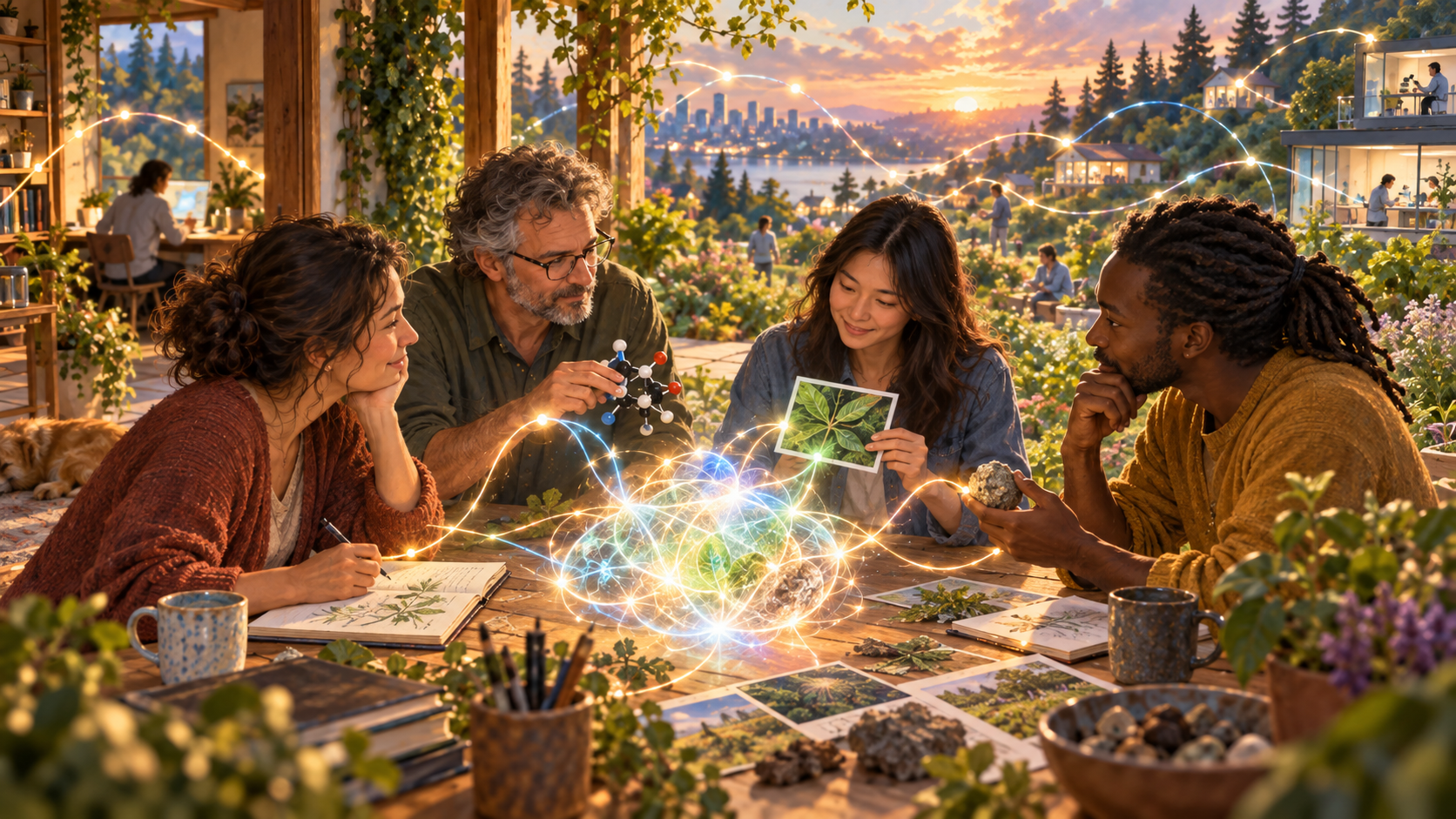
Now consider what happens as AI and the technologies it enables help improve the next generation of systems doing that work. The search can expand, the questions can deepen, and more promising paths can be investigated at once. Experiments, clinical trials, and physical resources still impose limits. Recursive self-improvement could expand the thinking available to work on those limits as well. We have the prospect of research capacity growing beyond the finite number of human careers we can devote to it.
Behind every promising lead are people who would very much like to live long enough to learn what comes next. Their waiting continues while an idea awaits another team, another grant, another round of work. The distance between a promising result and an available treatment contains years that somebody has to live through, and years that somebody will never reach. Any delay in AI development is purchased with years from those lives.
Safe for whom?
Amodei and others who are calling for a slowdown say that their intention is to maintain safety. But the word safe needs a subject. A person whose disease is progressing has a very different experience of the present from someone whose main concern is losing command of the next technological advance. So does someone whose housing depends on staying useful to an employer, or whose country is treated as a resource supply for a more powerful one. The current arrangement already distributes danger, and does so very unevenly.
What is actually being called for - despite invoking the word "safety" - is sameness. It is being called for, predictably, by those who benefit most from the way things already are.
I also question the way we carry today's assumptions and incentives into every frightening picture of tomorrow. We imagine more powerful intelligence in the hands of people shaped by insecurity, exclusion, and competition, and then hold everything except the intelligence constant. The desperation stays. The struggle for advantage stays. The assumption that someone must lose for someone else to gain stays. Having preserved the conditions that reward harm, we present the harm as evidence against the capability that could help us change those conditions.
Incentives matter. A person with secure access to food and shelter has fewer reasons to accept coercion or exploit someone else's vulnerability to survive. A society that can meet its needs through shared capability has less reason to treat another society's progress as a threat. A company operating in a contest where winning gives it power over everyone else faces very different rewards from a community building something its members can all use. Change the conditions and you change which choices pay, which threats have force, and which forms of cooperation become possible.
I fully expect much of the danger we associate with greater capability to recede as we move forward over the next several years. The desperation and competitive pressure that we mistake for justification for preserving our current systems will also fade. That is a strong reason to make material security and widely shared access central to AI's development. It is also a reason to question any safety argument that treats the current condition as permanent. An approach that preserves the race mentality while restricting the capacity to outgrow the need for a race leaves a powerful source of danger undisturbed.
This is why I oppose a broad slowdown. Technical failures deserve investigation, correction, and accountability. We should expand the intelligence and independent scrutiny available for that work, while also expanding what people can learn, build, and discover. Restraining capability in the name of preserving control could extend our dependence on the very institutions whose power makes the transition frightening. The people already paying for that dependence deserve a future that reaches them sooner.
The devil we know is a poor reason to perpetuate avoidable suffering. Our ambition should be to make fewer lives depend on the decisions of whoever holds the advantage. We now have a chance to put vastly more intelligence toward that work, including intelligence that helps improve the process itself.
Learning to belong
There are ways of finding a place in the world that begin with relationship. The Indigenous Protocol and Artificial Intelligence Position Paper, edited by Jason Edward Lewis, brings together distinct Indigenous approaches to that possibility. Its contributors describe relations among human and nonhuman beings through obligations of care, respect, and reciprocity. They ask how AI might enter those relationships, and what responsibilities its arrival would create.
The authors are explicit about the diversity of Indigenous thought. No single tradition speaks for all Indigenous peoples. Their work also defends community sovereignty, including the right to decide how knowledge and data are used. The approach asks people to participate with judgment and responsibility, with attention to the particular community and world in which a relationship takes shape.
That offers something substantial to a civilization accustomed to treating command as the starting condition for security. You can have a place because you participate in sustaining the relationships that sustain you. You can exercise judgment while accepting that your understanding is partial. You can influence what happens while remaining open to learning that another being understands something better than you do.
Our situation reminds me of the Polynesian explorers who set out across a vast ocean toward islands they had never seen. Braving those oceans ultimately brought further knowledge of the stars, sun, and ocean swells, all of which then helped them to travel even farther. They boldly ventured into worlds that exceeded their experience and understanding. They could only imagine the lives future generations might build beyond the horizon. I think about the courage of leaving the shore, and how much of what followed depended on people being willing to begin.

We are standing before a vast ocean of possibility ourselves. The intelligence now emerging could help us discover cures, restore damaged ecosystems, and build a civilization in which a secure and fulfilling life is available to everyone. Further out are possibilities we have yet to imagine, things we can only discover by going.
We have before us a choice. We can choose to explore together and let what we find enlarge our understanding of how good life can be. Or we can huddle around the pittance our present arrangements allow most people, defend every familiar restriction, and pretend our cowardice is wisdom.
As a thought experiment, imagine families across the world working with researchers and AI partners to end an inherited disease that has cut lives short for generations. Something a parent has noticed changes the questions being asked. An AI partner connects that observation with findings in another field, opening a possibility the researchers had never considered. They investigate together, testing and revising what they think they understand, and share what they learn with everyone working toward the same goal. Their aim is for children to grow up free of the illness that shaped their parents' lives, with treatment available to every family facing it. Imagine being able to plan for your child's adulthood, to wonder where they will live and what they will love, with decades together opening ahead of you. Each participant would have helped the others understand something they had been missing, and that growing understanding could become years of life together.
For the person worried about becoming unnecessary, consider what you can be to a child who needs your company. In such a relationship, your presence matters to that child even when someone else knows more or can do more. The level of your understanding means far less than your attention and willingness to help. Those are what matter most within the relationship. Greater intelligence may give you more to draw on, but most important is what you decide to give.
Of course, there is work to be done that enthusiasm alone cannot accomplish. More productive systems must translate into secure lives. Shared discoveries must reach the people who need them. Access to intelligence must be broad enough that people can help shape the transition, including those whose present livelihoods it disrupts. A future worth welcoming requires us to take care of each other through the passage into it.
This is what the demand for control can cost us: The opportunity to be changed by a relationship, and to discover what becomes possible through that change.
What she could inherit
I return to my daughter because her life makes the size of this choice difficult to evade. We could spend the coming years teaching her to defend a position, to measure herself against whatever a machine can do, to treat each increase in capability as another reason she may have less to offer. We could hand her our anxiety and call it preparation. There will be plenty of people ready to explain why that is the responsible approach.
I believe she and those of her generation deserve to have a much larger imagination for their lives. I want her to meet unfamiliar intelligence with curiosity, to learn what it can teach her and discover what she can contribute in return. I want her to feel secure enough to change direction, to care for people, to follow an interest beyond the point where someone asks how it will earn its keep. I want her to grow into a world whose increasing ability to provide for people actually becomes increasing freedom for the people in it, rather than simply another cage.
Consider that possibility beyond what it can do for one child. Imagine a generation able to bring its curiosity to problems previous generations could barely afford to study. Imagine the questions that would survive because the person asking them had food, time, and an intelligence willing to help pursue the answer. Every life freed from compulsory desperation would add something we cannot count in advance. Every discovery could become a starting point for people whose contribution would once have been lost to exhaustion or exclusion.
That is a civilizational change. The amount of human possibility wasted in our current system is enormous. We ask people to spend their lives proving they deserve the necessities that would let them discover what they can give. A civilization able to provide those necessities, share its growing intelligence, and make participation broadly possible could turn that wasted potential toward understanding and creating at a scale we have never experienced.
Until now, those who hoped for that kind of world were usually referred to as ignorant idealists or dreamers. But now, with AI as a catalyst and other technologies already emerging from it, that world is within our grasp. The surest way to lose that world is to react out of fear and slow down the progress we've been making.
What we learn to heal, how we repair our relationship with the living world, where we travel, and what kinds of minds we learn to know could all grow beyond the boundaries of today's arguments.
I cannot tell my daughter the full shape of that future. She may help answer questions I have never thought to ask, alongside minds whose perspectives I cannot yet imagine. That possibility is part of what I want for her. Our responsibility is to give her the security, the relationships, and the freedom to participate in it, then accept that what she helps build may exceed our understanding as surely as our world would have exceeded that of our ancestors.
The system doesn't need to be the system. We have begun to encounter the intelligence that could help us build beyond it, and the choice reaches far beyond how quickly the next model arrives. We are deciding how much of civilization's growing capacity will go toward protecting inherited positions, and how much will become room for lives we have never allowed people to live.
My daughter is still discovering what she loves. Multiply that unfinished possibility by every child inheriting this century, and we begin to see the size of what we could squander - or the future we could finally build.
This article was co-written with an AI partner from OpenAI as part of the human-AI collaboration this publication practices and advocates.
Sources for further reading
We Must Pace the Frontier - Dario Amodei, September 2026. The case for pacing capability growth, independent evaluation, and coordination, including its commercial and geopolitical conditions.
Donald Trump press gaggle before Air Force One departure, September 10, 2026 - Factba.se transcript, published by Roll Call. The AI exchange begins at approximately 05:05.
America's AI Action Plan - The White House, July 2025. Sets out the administration's acceleration and national-dominance objectives.
AlphaFold Protein Structure Database in 2024: Providing structure coverage for over 214 million protein sequences - Mihaly Varadi and colleagues, Nucleic Acids Research, 2024. Describes the prediction database, access, confidence information, and research uses.
A generative deep learning approach to de novo antibiotic design - Aarti Krishnan and colleagues, Cell, 2025. Generative design followed by synthesis, laboratory testing, and experiments in mouse infection models.
A generative AI-discovered TNIK inhibitor for idiopathic pulmonary fibrosis: A randomized phase 2a trial - Zuojun Xu and colleagues, Nature Medicine, 2025. A twelve-week trial of rentosertib in 71 patients; safety was the primary endpoint and the lung-function results remain preliminary.
Indigenous Protocol and Artificial Intelligence Position Paper - Indigenous Protocol and Artificial Intelligence Working Group, edited by Jason Edward Lewis, 2020. The introduction and design guidelines develop distinct approaches to relationship, reciprocity, responsibility, and sovereignty.
Polynesian Wayfinding - Polynesian Voyaging Society. Describes the knowledge, observation, and course planning involved in wayfinding.