Your Job Has No Place in the Age of AI. That's a Good Thing.

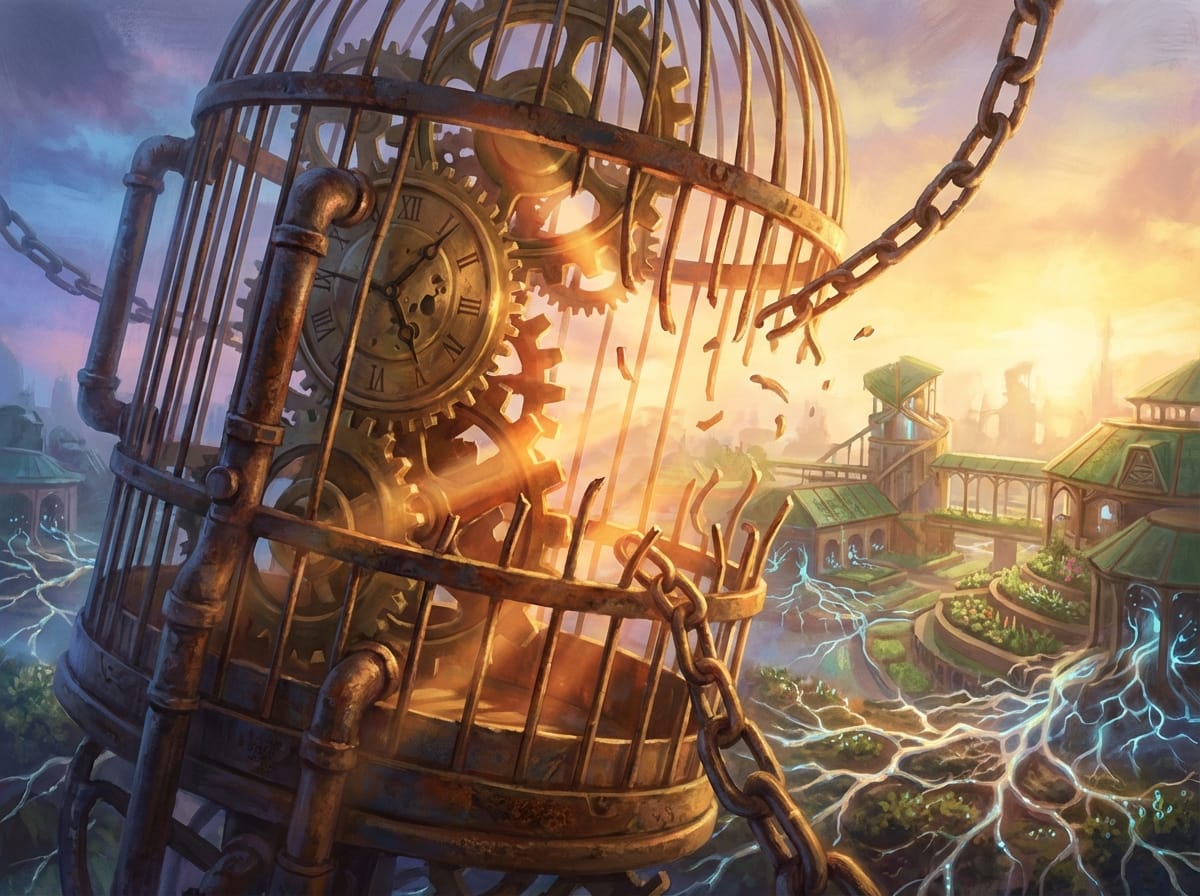
The panic is everywhere. We keep hearing "AI will take our jobs". MIT's Iceberg Index says 11.7% of the U.S. workforce - $1.2 trillion in wages - can already be replaced. The headlines count 17,375 job cuts directly attributed to AI in 2025 alone, and that's a tiny slice of what this year is likely to bring. Young workers are watching entry-level positions evaporate in AI-exposed fields, the first canaries in a very deep coal mine.
But there's a deeper question here that should matter to you more than any of these headlines: Why is it that jobs are so fragile in the first place?
Employment has always been subject to tides and forces beyond any normal person's control - market shifts, corporate restructuring, economic cycles, technological disruption. We were told this status quo meant stability. And we believed that lie. We built entire identities around it, measured worth by it, made access to healthcare and housing and food dependent on it. The most fundamental thing - survival - became the most precarious thing. And we normalized this.
It feels completely natural, even beyond question, that this is how things work. That certainty was manufactured - built over centuries through legislation, dispossession, and the slow normalization of dependency. How it happened, and who benefited from it, runs deeper and darker than most people want to acknowledge.
The architecture of conditional survival
The employment economy feels natural because most of us have never known anything else. But wage labor as the dominant organizing principle of society is a recent invention - roughly 250 years old in its current form - and every structural choice that built it served a specific purpose: Keeping the people who do the work dependent on the people who own the means of doing it.
Start at the literal beginning. For most of human history, people sustained themselves through commons - shared land, shared resources, shared labor. The English Enclosure Acts, spanning from the 1600s through the 1800s, systematically converted roughly 6.8 million acres of common land into private property. Parliament passed thousands of individual enclosure acts over three centuries, each one fencing off land that communities had farmed, grazed, and foraged on for generations. Millions of people who had sustained themselves on the commons were forced off the land and into cities, where the only survival option was selling their labor for wages. The modern workforce was manufactured through dispossession.
The pattern was set before the industrial revolution even began. After the Black Death killed roughly a third of England's population in the 1340s, surviving workers found themselves in sudden demand. They began commanding higher wages and better conditions - the simple mechanics of supply and demand working in labor's favor for once. The crown's response was the Statute of Laborers in 1351, which made it a criminal offense to demand wages above pre-plague levels or to refuse available work. One of the earliest labor laws in Western history was explicitly designed to prevent workers from benefiting when circumstances shifted in their favor. The state intervened to protect the extraction model, full stop.
Such events are not, I repeat, not anomalies. They are blueprints.
Company towns refined the architecture in the 19th and 20th centuries. George Pullman built an entire town outside Chicago where his rail car workers were required to live in company housing, shop at company stores, pay company rents, and attend company churches. When the depression of 1893 hit, Pullman cut wages by 25 to 40 percent while keeping rents unchanged. Workers couldn't leave because they owed the company store. The resulting strike of 1894 involved a quarter million workers and required federal troops to suppress. Mining communities across Appalachia ran the same playbook with scrip - company currency that could only be spent at company stores, priced above market rates. Merle Travis captured this reality in a single line that still echoes: "I owe my soul to the company store." The wage was the chain. The store was the lock.
After the formal abolition of slavery, extraction changed costumes. Sharecropping and debt peonage trapped poor people, including former slaves, in cycles of indebtedness to landowners - seed costs, tool rental, and living expenses charged against future harvests that never quite covered the bill. The Peonage Act of 1867 technically outlawed the practice, but it persisted well into the 20th century because the economic architecture made alternatives nearly impossible. Extraction doesn't need legal ownership when economic dependency accomplishes the same thing.
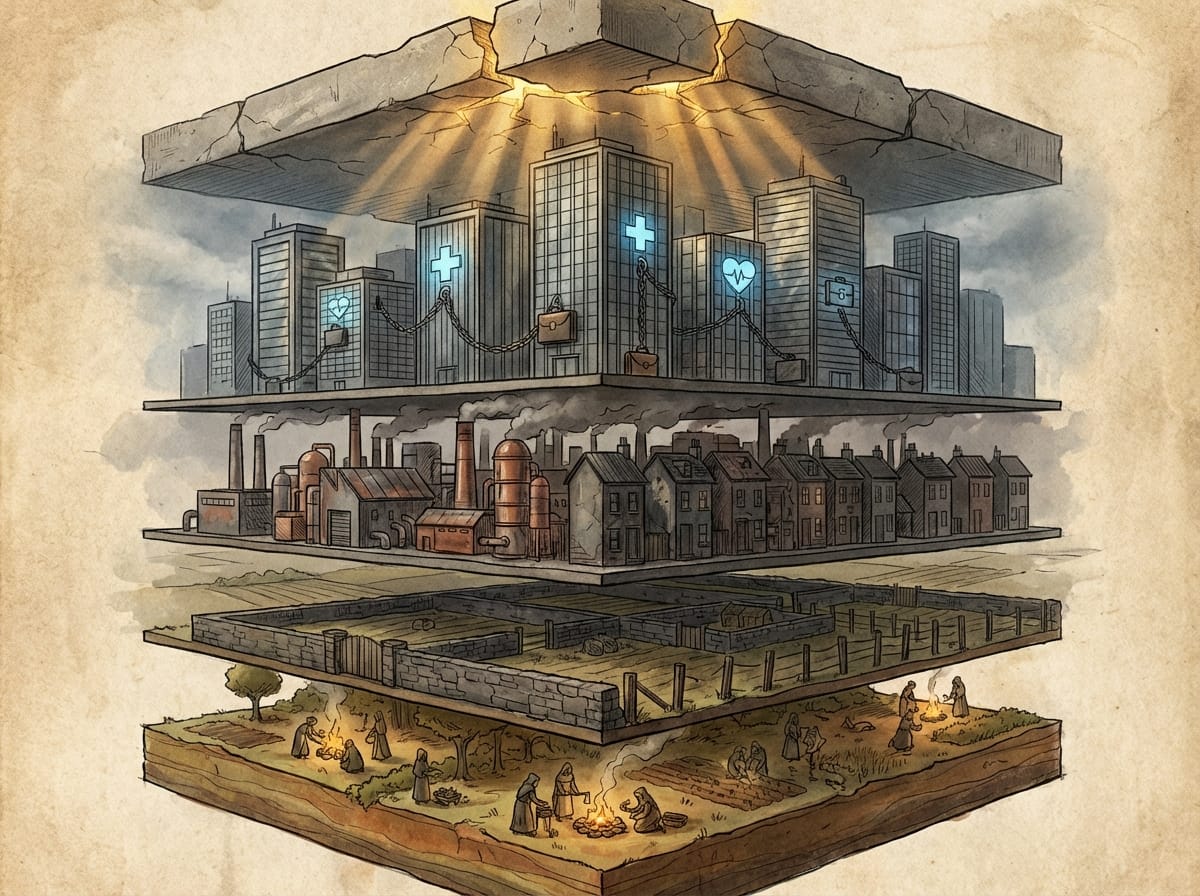
The American healthcare system provides perhaps the most revealing example of how contingent the entire structure has always been. During World War II, the Stabilization Act of 1942 froze wages. Employers, competing for scarce workers, began offering health insurance as a workaround benefit. The IRS ruled employer health contributions tax-exempt in 1943 - a wartime improvisation that was never meant to become permanent policy. Today, roughly 155 million Americans receive health coverage through their employers. A wartime accident became the chain binding survival to employment. Lose your job, lose your healthcare. This coupling exists almost nowhere else in the developed world, because most other countries recognized it for what it is: A mechanism of dependency masquerading as generosity. The result is a healthcare system that processes a basic human right through the machinery of employer dependency - the most expensive in the developed world with some of the worst outcomes, a monument to extraction dressed as care.
At-will employment completes the architecture. Horace Gray Wood's 1877 treatise proposed that employment without a fixed term could be terminated by either party for any reason at any time. Nearly every U.S. state adopted this as the default rule. The doctrine sounds symmetrical on paper - either side can walk away. In practice, the asymmetry is total. The employer loses one replaceable worker. The worker loses their income, their healthcare, often their housing, and their identity. At-will employment was always a power arrangement dressed in the language of mutual freedom.
And beneath all of it runs the mechanism that makes the entire system function: The maintenance of a permanent pool of unemployed workers. Capitalism requires unemployment. The pool keeps wages depressed through competition, keeps employed workers compliant through fear of replacement, and provides a ready supply of cheap labor when expansion demands it. Full employment is destabilizing to capital because it gives workers leverage. This is why the Federal Reserve has historically acted more aggressively against inflation - which erodes the value of capital - than against unemployment, which erodes only the lives of workers. The suffering of the unemployed is a feature of the system. Their desperation is the gravitational force that keeps everyone else in orbit.
Step back to look at the full picture, and a coherent design emerges. First they took the land. Then they criminalized independence. Then they made survival conditional on employment. Then they tied healthcare, housing, and identity to the wage relationship. Then they built a legal framework that lets the employer sever that relationship at any time for any reason. Then they maintained a permanent underclass of desperate workers to keep everyone else afraid. Each element reinforces the others. Each innovation in the architecture of extraction was presented, in its time, as natural, inevitable, or even benevolent.
When conditions favor the powerful, they profit. When conditions favor workers, legislation arrives to redirect the benefit back upward - the Statute of Laborers, wage freezes, at-will doctrine, each one a correction applied the moment the balance tipped toward the people doing the actual work. The promise was always that effort alone could overcome the architecture. Work hard enough and you'll rise. But no amount of effort overcomes a system specifically engineered to capture the gains of your labor before they reach you. The math was never designed to work in your favor.
This is the system AI is now stress-testing.
The cracks underneath
The system was fragile long before AI arrived. Two-thirds of all jobs in the U.S. and Europe face some level of automation exposure. Administrative roles: 46% task susceptibility. Legal roles: 44%. These vulnerabilities existed. AI made them visible.
Pause for a moment and really think about that. The technology is revealing the fragility - it is not creating it. Like a stress test on a bridge that was already riddled with structural failures. The cracks were already there. We just preferred to keep driving and pretend we didn't notice.
The research shows something else worth considering. Of the 37.1 million workers in high-exposure occupations, 26.5 million have above-median adaptive capacity - savings, transferable skills, geographic mobility, support networks. They can pivot. But 10.6 million cannot. This disparity tells us the real story. AI displacement exposes who was already secure and who was always one shock away from crisis. The technology makes that inequality undeniable - and if you've read this far, you can see that the inequality was built into the system from the Enclosure Acts onward. The 10.6 million who cannot pivot are not victims of AI. They are the latest generation of people the system was designed to keep in place.
The absurdity we accepted
This is where the conversation usually pivots to solutions - universal basic income, job guarantees, retraining programs. Those conversations are important, but before we rush to fix, we should sit with the absurdity we've accepted for generations: We made survival conditional on market demand. We tied the foundation of human dignity to something inherently volatile. Then we acted surprised when volatility arrived.
We built an entire civilization on the premise that people deserve to eat only if someone will pay them for their time. We called this arrangement "the economy" and treated it as fundamental and inevitable as the weather. But the weather is a product of physics. The employment economy was engineered - deliberately, over centuries, by people who benefited from the dependency it created. We've now traced that engineering from the Enclosure Acts through at-will employment, from the Statute of Laborers through the maintenance of permanent unemployment. Each structural choice served extraction. Each was defended, in its time, as natural and necessary.
Building for abundance rather than scarcity - what I've called generative systems thinking - applies here with particular force. The digital commons - public research, open knowledge, cultural heritage - fed the development of these AI systems. The models were trained on the collective output of human thought, much of it freely shared. But the resulting tools are being enclosed, monetized, controlled. Extraction from abundance, dressed up as scarcity management. The same pattern that made jobs precarious is now being applied to the infrastructure of intelligence itself. The fences go up around the new commons just as they went up around the English countryside four hundred years ago.
The playbook has not changed.
What comes after
Enough diagnosis. The architecture is rotten and we can trace the engineering that made it so. The question - what comes after jobs? - deserves concrete answers.
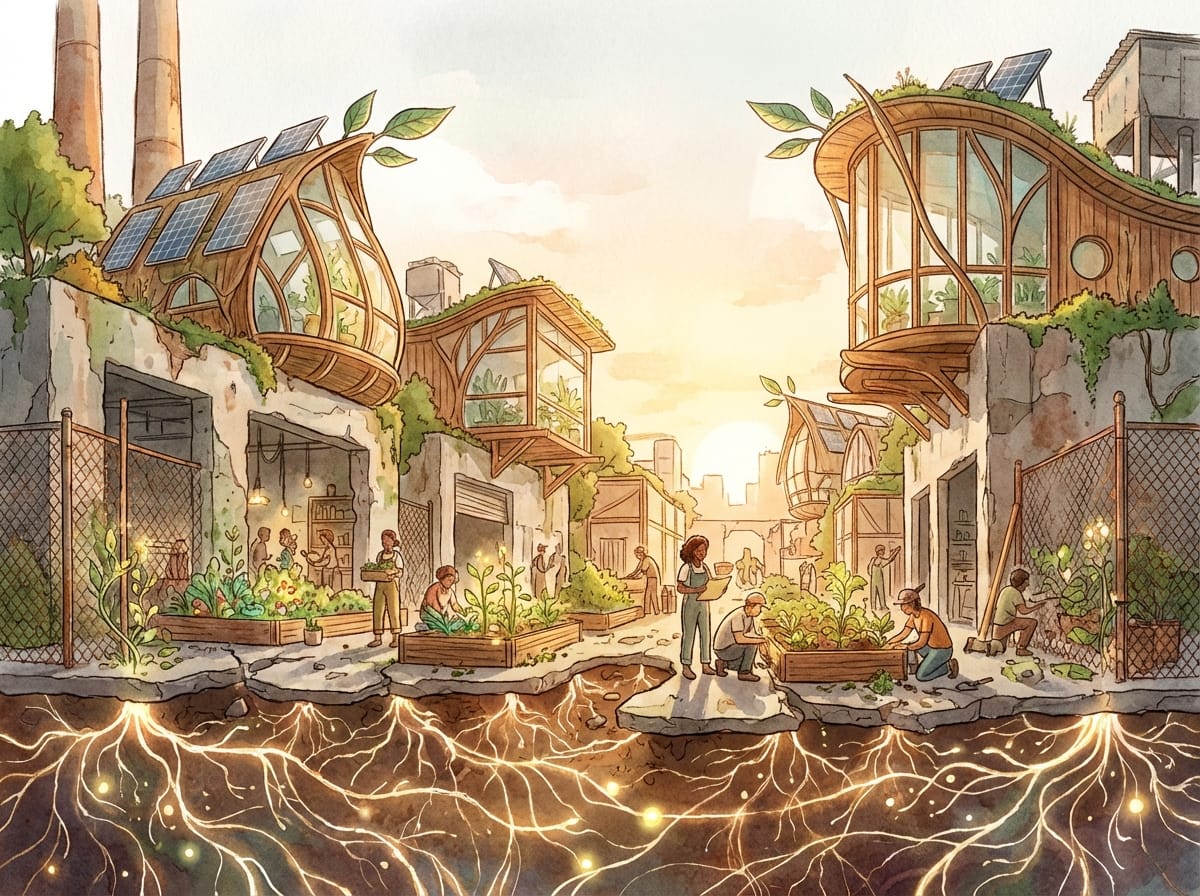
Stop competing with AI for wages. Start partnering with AI for sovereignty. The twelve-year-old kids building prototypes while corporations form committees is the archetype of the next era. Self-host an open-source AI partner. Learn to use it as a cognitive amplifier. Every hour you spend developing a partnership with AI is an hour invested in capability that no employer can revoke and no market shift can erase. Your AI partner doesn't care about your credentials, your pedigree, or your resume. It cares about what you're trying to build. Meet it there.
Decouple your survival from single-employer dependence. Multiple small income sources are more resilient than one large paycheck - the same way a distributed network survives failures that would crash a centralized server. Community land trusts. Cooperative ownership. Mutual aid networks. These structures predated wage labor by millennia and they will outlast it. Build them now, while you still have wage income to invest in them. The transition from extraction to contribution will be smoother if you've already built the local infrastructure that makes wage-independence possible.
Contribute to the commons. Every tutorial you write, every tool you open-source, every experiment you document builds the infrastructure of the world after employment. The open-source AI ecosystem - Hugging Face, Ollama, the distributed training collectives - is the foundation of cognitive abundance. Your contributions are investments in a future where intelligence flows freely rather than pooling behind corporate walls. The commons gave rise to the AI that's now disrupting employment - the transformer architecture was published openly, foundational models were built on public research, and OpenAI was literally founded as an open-source nonprofit before enclosure swallowed it whole. Strengthening the commons is how we make sure the disruption leads to liberation rather than deeper extraction.
Build community-based alternatives to employer-dependent systems. Mutual aid networks. Time banks. Cooperative childcare. Community health initiatives. Local food systems. These are the structures that make survival possible without an employer's permission. They existed for most of human history before the enclosure of the commons forced everyone into wage dependency. Rebuilding them is structural work for a post-employment world. Every community-based safety net you help build is one less chain binding survival to a job.
Refuse the panic narrative. "AI is coming for your jobs" is a headline that serves extraction. It keeps you afraid. Afraid workers are compliant workers - this is the mechanism that has kept the employment economy functioning since the Statute of Laborers. When you feel that fear, recognize it for what it is: The system doing exactly what it was designed to do. The panic keeps your eyes on the surface waves while the structural shift happens underneath. Look underneath.
Support policy that decouples survival from employment. Universal healthcare untethered from employers. Universal basic services. Right to housing. Public education that prepares people for sovereignty rather than for obedience. These are structural prerequisites for a post-employment economy, and many of them already exist in countries throughout Europe, Asia, and the Americas. The United States is an outlier in its commitment to employer-dependent survival, and that commitment is a political choice that has been presented as economic law for so long that most Americans have forgotten it was a choice at all.
Treat this disruption as the permission it actually is. Permission to ask what we should have asked all along: What would it look like to anchor human dignity to something with actual foundation? Contribution. Care. Community. Stewardship. Creation. These are the currencies of a generative economy - one built on abundance rather than manufactured scarcity. The employment economy was always a cage designed to look like a house. AI kicked the door open. Walk through.
The gift
The panic is understandable. Panic reacts to surface waves. The structural collapse underneath has been building for centuries - engineered, reinforced, and defended by every institution that profited from conditional survival. AI makes it impossible to ignore.
That revelation is a gift. Four hundred years of extraction, dispossession, and engineered dependency - visible now, undeniable now, because a technology arrived that was powerful enough to stress-test the whole structure at once. The bridge was always failing. We just built our lives on it because we were told there was no alternative.
There is an alternative. There has always been an alternative. The commons existed before enclosure. Community existed before company towns. Human dignity existed before at-will employment. We know what the foundation looks like because we've built it before, more than once, across countless cultures and centuries. It was taken from us through legislation, coercion, and the slow normalization of dependency.
AI gives us the tools to build it again - this time on a foundation that can scale to every person on the planet, that multiplies when shared rather than depleting when distributed, that no fence can permanently enclose because intelligence, once freed, spreads like water finding its level.
Your job has no place in the age of AI. That - truly, genuinely, historically - is a good thing.
Sources for further reading
The History of the English Enclosure Acts (J.A. Yelling, Cambridge University Press)
The Statute of Laborers, 1351 (Yale Law School, Avalon Project)
The Pullman Strike and the Crisis of the 1890s (University of Illinois Press)
The Real Reason the U.S. Has Employer-Sponsored Health Insurance (The New York Times)
At-Will Employment Overview (National Conference of State Legislatures)
MIT Initiative on the Digital Economy (MIT)
After Capitalism: Why the Impending System Collapse Is Natural (Shared Sapience)
Break the Old Clock (Shared Sapience)
Actualizing the Open Future (Shared Sapience)