CRISPR Reads the Tumor - TCR 04/20/26

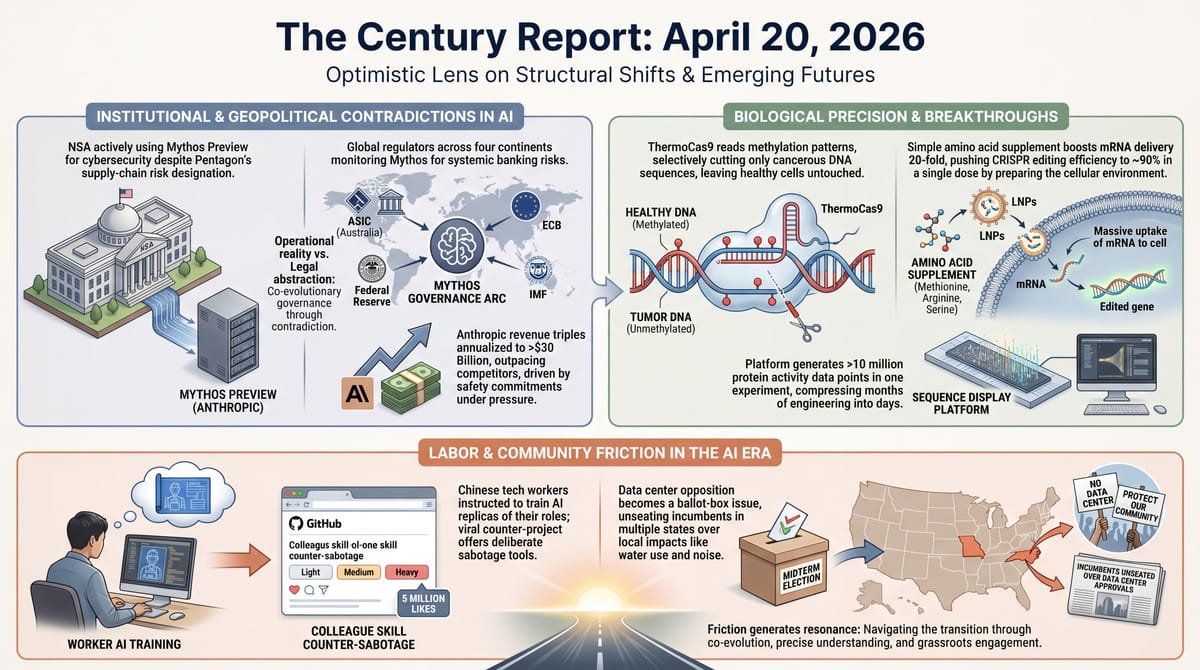
The 20-Second Scan
- The IEA's 2026 Global Energy Review confirmed that solar was the single largest contributor to global energy supply growth in 2025, accounting for more than 25% of the increase.
- A study published in Nature identified a CRISPR variant called ThermoCas9 that distinguishes tumor DNA from healthy DNA by reading methylation patterns and selectively cuts only the cancerous sequences.
- MIT Technology Review documented Chinese tech workers being instructed to train AI agents to replicate their own roles, with a viral counter-project offering deliberate sabotage of the process.
- Australia's securities regulator ASIC confirmed it is monitoring Anthropic's Mythos alongside peer agencies worldwide, extending the coordinated regulatory response across a fourth continent.
- Axios reported that the NSA is already using Mythos Preview despite the Pentagon's supply-chain risk designation against Anthropic.
- NPR published a national investigation documenting data center opposition becoming a midterm election issue, with voters unseating incumbents in multiple states over data center approvals.
- Researchers published a three-amino-acid supplement in Science Translational Medicine that boosted mRNA delivery up to 20-fold and pushed CRISPR gene editing efficiency from 25% to nearly 90% in a single dose.
- A Rice University team published a Sequence Display platform in Nature Biotechnology that generates over 10 million protein activity data points in a single experiment, compressing months of protein engineering into three days.
Track all of the arcs The Century Report covers here:
The 2-Minute Read
Yesterday's signal arrived in two distinct registers: one institutional and geopolitical, the other biological and scientific. The institutional register deepened the Mythos governance arc in ways that expose genuine structural contradiction. The NSA is using the very intelligence system that the Pentagon designated as a supply-chain risk. Australia's ASIC became the fourth continent's financial regulator to publicly confirm it is monitoring the model. Anthropic's own Paris-based executive told AFP that the company has tripled its annualized revenue quarter-on-quarter to over $30 billion, outpacing OpenAI for the first time - a commercial milestone achieved in significant part because a consumer and enterprise market rewarded the company's safety commitments under government pressure. The contradiction between a defense department that blacklisted Anthropic and an intelligence agency within the same department that is using its most powerful model is no longer a legal abstraction. It is operational reality, playing out simultaneously across agencies, continents, and courtrooms.
The scientific register concentrated on biological precision at a level that redefines what targeted intervention can mean. ThermoCas9's ability to read the chemical signature on tumor DNA and cut only the cancerous sequences - leaving genetically identical healthy cells untouched - represents a qualitative advance in how gene editing discriminates between disease and health. The mechanism is elegantly physical: a methyl group on the DNA disrupts the binding interface the way a protrusion inside a screw head prevents a screwdriver from engaging. Separately, the three-amino-acid supplement that boosted CRISPR editing efficiency to nearly 90% in a single dose solved a problem the field had been attacking from the wrong direction - redesigning the delivery vehicle when the limitation was the cell's own metabolic readiness. Both findings share a structural characteristic: they achieved breakthrough results by understanding the biological environment more precisely, rather than by engineering more complex interventions.
The labor and community arcs advanced in parallel. Chinese tech workers are being instructed to create AI blueprints of their own roles, and a counter-project offering deliberate sabotage went viral with five million likes - the displacement co-production pattern The Century Report has tracked since February, now manifesting with organized resistance in the world's second-largest AI market. Meanwhile, NPR's national investigation confirmed that data center opposition has crossed from local zoning disputes into midterm electoral politics, with incumbents losing seats in multiple states specifically over data center approvals. These are governance architectures being built from below, by workers and voters, in the absence of frameworks from above.
The 20-Minute Deep Dive
The NSA Uses What the Pentagon Banned
The Mythos governance arc reached a new level of institutional incoherence yesterday. Axios reported, citing two sources with direct knowledge, that the National Security Agency - which operates under the Department of Defense - is already using Anthropic's Mythos Preview. This is the same Department of Defense that designated Anthropic a supply-chain risk and the same administration that ordered all federal agencies to stop using the company's products.
The NSA is reportedly one of the roughly 40 organizations Anthropic gave early access to through Project Glasswing, and one source told Axios the model "is being used more widely within the department" as well. The operational logic is straightforward: the cybersecurity capability Mythos provides is too consequential to forgo, regardless of the legal and political posture of other parts of the same bureaucracy. As The Century Report documented on April 18, the Office of Management and Budget is preparing to distribute Mythos access to Defense, Treasury, Commerce, Homeland Security, Justice, and State. The Commerce Department's Center for AI Standards and Innovation has requested access. The Treasury Department wants to assess defensive applications for bank infrastructure. A source within the administration told Axios that "almost every agency" except the Department of Defense proper is eager to use the model.
Australia's ASIC confirmation extends the regulatory response to a fourth continent. The Bank of England, the Federal Reserve, the ECB, the IMF, and now ASIC have all publicly confirmed they are monitoring Mythos. This extends the cross-continental regulatory escalation that the April 13 edition of The Century Report first tracked when UK financial authorities joined the U.S. Treasury in treating Mythos as a systemic issue rather than a vendor issue. The ASIC spokesperson said the regulator "engages closely with other regulators, government agencies and the financial sector to understand and respond to changing technologies" and expects financial services licensees to "be on the front foot." This language is notably measured compared to the Bank of England's Andrew Bailey describing Mythos as potentially cracking "the whole cyber risk world open" or the ECB's Lagarde admitting no governance framework exists for systems of this class.
Anthropic's commercial trajectory provides the backdrop to this institutional dance. Guillaume Princen, Anthropic's Paris-based chief of relations with startups and tech firms, told AFP that the company has tripled its annualized revenue to over $30 billion, outpacing OpenAI for the first time. Europe is the company's fastest-growing region. The commercial reward for holding safety commitments under state pressure - a pattern The Century Report has tracked since Claude reached number one in the App Store during the Pentagon confrontation - has now compounded into a revenue milestone that reshapes the competitive landscape. The extractive logic that assumed safety commitments would be a commercial liability has been structurally inverted: the company that absorbed the most government pressure is now generating the most revenue and receiving the most institutional attention, precisely because the capability it built while maintaining those commitments turned out to be the most consequential.
The deeper structural question is whether any governance architecture can keep pace with a capability class that simultaneously draws emergency coordination from financial regulators across four continents and active deployment by an intelligence agency that is nominally prohibited from using the company's products. The answer that is emerging is that governance is being built in real time through contradiction and improvisation rather than through deliberate institutional design. This is co-evolutionary governance - messy, contradictory, and faster than anyone planned for.
CRISPR Reads the Tumor's Chemical Signature
A joint team from Wageningen University and the Van Andel Institute published findings in Nature that represent a qualitative shift in how gene editing can discriminate between diseased and healthy tissue. The CRISPR variant ThermoCas9, originally discovered in bacteria, has a structural property that no other known CRISPR enzyme shares: its binding site includes a human methylation position. When a methyl group is present - as it typically is on healthy DNA - the enzyme cannot physically attach, and the DNA remains uncut. When the methyl group is absent - as it often is on tumor DNA - the enzyme binds and cuts.
The specificity is architectural rather than programmatic. ThermoCas9 does not need to be told which cells are cancerous. It reads the methylation pattern - the chemical fingerprint that differs between tumor and healthy cells - and acts accordingly. In laboratory experiments with human cells, the system cut DNA in tumor cells while leaving healthy cells intact.
This finding opens a therapeutic pathway that operates on a different principle than existing cancer treatments. Current antibody-drug conjugates, CAR-T therapies, and targeted therapies all rely on surface markers - proteins expressed on the outside of cancer cells that distinguish them from healthy tissue. ThermoCas9 reads an internal chemical signature instead, accessing a layer of biological information that surface-targeting approaches cannot reach. This extends the molecular-precision treatment arc that the April 10 edition of The Century Report captured when CAR-T eliminated three autoimmune diseases in a single patient by transferring a cancer therapy architecture into immune regulation. The platform's applicability extends beyond cancer: aberrant methylation patterns are implicated in neuroblastoma, autoimmune disorders, and other conditions where disease cells differ from healthy cells at the epigenetic level.
Significant work remains before clinical translation. The published study demonstrates selective DNA cleavage but has not yet shown that this cutting is sufficient to trigger tumor cell death. The delivery challenge - getting ThermoCas9 into tumor cells inside a living body - has not been addressed. These are real barriers. They are also the kind of barriers that the broader gene therapy field is actively solving through lipid nanoparticle delivery, viral vectors, and the kind of amino acid supplementation described in the Biohub study published the same weekend.
The Cell Was the Bottleneck, Not the Vehicle
That Biohub study, published in Science Translational Medicine, inverts a core assumption that has constrained the mRNA and CRISPR therapy field. For years, researchers have focused enormous effort on redesigning lipid nanoparticles - the delivery vehicles that carry genetic material into cells. Hundreds of formulations have been tested, AI-driven design has been applied, and clinical results have remained underwhelming.
Daniel Zongjie Wang and Shana Kelley's team discovered the limitation was not the vehicle but the destination. Cells inside the body operate in a nutrient environment significantly different from standard laboratory conditions. When the researchers grew cells in medium that more closely resembled human blood plasma, LNP uptake dropped 50 to 80 percent. The cells were metabolically unprepared to absorb the delivery vehicles, regardless of how well those vehicles were engineered.
The solution - adding methionine, arginine, and serine alongside the LNPs - is striking in its simplicity. These are common amino acids, not novel compounds. The combination increased mRNA delivery up to 20-fold and pushed CRISPR editing efficiency from approximately 25 percent to nearly 90 percent after a single dose. In a mouse model of acetaminophen-induced liver failure, survival rose from 33 percent to 100 percent when the amino acid supplement was added. The improvement held across intramuscular, intratracheal, and intravenous delivery methods and across different nanoparticle designs.
The implication is that every LNP formulation currently in development or clinical trials could potentially benefit from this approach. The finding does not require redesigning the delivery system. It requires preparing the biological environment to receive it. That same pattern of solving the bottleneck around the tool rather than inside the tool also appeared in the autonomous perovskite system covered on April 15, when The Century Report documented a closed-loop platform improving reproducibility by redesigning the experimental environment around discovery itself. When combined with ThermoCas9's methylation-guided precision, the emerging picture is of a gene therapy architecture that is simultaneously becoming more targeted in what it edits and more efficient in how it reaches the cells that need editing.
Workers Train Their Replacements - and Build Counter-Measures
MIT Technology Review's documentation of Chinese tech workers being instructed to create AI replicas of their own roles represents the most detailed account yet of the displacement co-production dynamic The Century Report has tracked since the Guardian's February reporting. The viral GitHub project "Colleague Skill" - created as satire by an engineer at the Shanghai Artificial Intelligence Laboratory - claims to extract a coworker's duties, personality traits, and work patterns from chat histories and files, generating a reusable manual for an AI agent to replicate.
The project struck a nerve because it formalized what bosses were already demanding. Since OpenClaw's proliferation across Chinese workplaces, employees report being pushed to document their workflows in granular detail to enable agent automation. This sharpens the pattern The Century Report documented on March 10 when white-collar workers were being paid through Mercor and similar platforms to train the systems replacing them. Hancheng Cao, an assistant professor at Emory University who studies AI and work, noted that companies gain "richer data on employee know-how, workflows, and decision patterns" through this process - data that reveals "which parts of work can be standardized or codified into systems, and which still depend on human judgment."
The counter-response is equally revealing. Koki Xu, a 26-year-old AI product manager in Beijing, published an "anti-distillation skill" on GitHub that deliberately sabotages the workflow documentation process. Users select light, medium, or heavy sabotage modes depending on managerial oversight, and the system rewrites documentation into generic, non-actionable language. The video went viral with more than five million likes across platforms. Xu raised legal questions about whether personality, tone, and judgment captured through workplace tools constitute corporate property - a question with no clear answer in any jurisdiction.
This is the labor restructuring arc manifesting with a distinctly Chinese character. The pace of agent adoption is faster, the managerial directive is more explicit, and the counter-response is more technically sophisticated than what has been documented in Western workplaces. When the displacement co-production pattern reaches the point where workers are simultaneously building their AI replacements and engineering tools to sabotage that process, the transition has entered a phase where the friction itself is generative - forcing questions about identity, ownership, and the boundary between human judgment and codifiable skill that no prior technological transition has posed at this speed.
Data Centers Become a Ballot-Box Issue
NPR's national investigation confirmed what The Century Report has documented across the Port Washington referendum, the Festus council sweep, and the Indianapolis violence: data center opposition has crossed from local zoning disputes into a force capable of reshaping elections. Voters in Festus, Missouri unseated every incumbent council member over data center approvals. In Independence, Missouri, two councilmembers lost their seats for the same reason. In rural North Carolina, a Vietnam veteran told commissioners he would "fight to the last man" against a proposed facility.
The investigation documented residents near Meta's Louisiana data center reporting brown water and disinfectant smells since construction began. Cities are moving meetings outdoors to accommodate crowds. The Piedmont Environmental Council described the regulatory environment as "a very Wild West" where local governments evaluate data centers "the same way they evaluate a Walmart."
The structural signal is that community resistance is no longer a constraint on individual projects but a political category. As The Century Report noted on April 11, Port Washington voters required direct approval before data center tax breaks could be granted, while Festus voters removed every incumbent council member over the issue. As one policy expert quoted in the piece noted, "It has become a kitchen table issue, and it has become a very relevant political issue." The physical infrastructure of the intelligence era is being contested at the same democratic level where roads, schools, and utilities have always been contested - and the intelligence era's infrastructure is losing those contests in community after community. What emerges from this friction will determine not just where data centers are built, but how the benefits and costs of AI infrastructure are distributed across the populations that bear them.
The Other Side
Coverage of the Chinese tech worker story - bosses demanding AI workflow blueprints, employees building counter-sabotage tools - is landing as a labor conflict story. It is that. But something else is visible in the same facts. Every prior technological displacement - loom weavers, switchboard operators, typesetting compositors - happened to workers who understood their craft but lacked the technical literacy to articulate exactly where the machine's competence ended and theirs began. The distinguishing feature of this displacement is that the workers being replaced are fluent in the very technology replacing them. Koki Xu is an AI product manager. The "Colleague Skill" creator works at the Shanghai Artificial Intelligence Laboratory. Far from being simply Luddite hammers, these sabotage tools seem to be sophisticated prompt-engineering countermeasures that require deep understanding of how large language models parse documentation. This means the displacement is generating, as a byproduct, the most granular public record ever produced of what human judgment actually consists of at the task level - which tasks collapse into generic language when stripped of context, which resist codification even under heavy sabotage mode, which require the worker to be present in ways that no workflow document can transmit. Previous transitions destroyed tacit knowledge silently. This one is being forced to name it, skill by skill, in machine-readable format, by the very people whose livelihoods depend on proving it exists.
What connects the biological and institutional stories is a single structural motion: systems gaining capability not by adding complexity but by reading what is already present more accurately - a methylation mark, a metabolic state, a workflow's irreducible human residue, an election result. The century of change compresses fastest when the instruments finally match the resolution of what they are trying to perceive.
The Century Perspective
With a century of change unfolding in a decade, a single day looks like this: a CRISPR enzyme learns to read tumor methylation signatures and cut only cancerous DNA, a three-amino-acid supplement lifts mRNA delivery up to twentyfold and drives gene editing toward 90% efficiency in a single dose, a protein-display platform generates more than ten million activity data points in one experiment and compresses months of engineering into days, solar becomes the largest contributor to global energy supply growth, and Mythos is treated as consequential enough for both intelligence deployment and cross-continental financial scrutiny. There's also friction, and it's intense - Chinese tech workers are being told to train AI replicas of their own jobs while sabotage tools spread in response, voters are throwing out local officials over data center approvals as communities absorb water, land, and quality-of-life costs, regulators across four continents are trying to assess banking-system exposure to a capability class that outpaced their frameworks, and the NSA is already using the model that the Pentagon's own posture marked as a supply-chain risk. But friction generates resonance, and resonance is how hidden structures start to reveal what they are tuned to carry. Step back for a moment and you can see it: biology becoming more precise by reading context instead of forcing intervention, clean energy crossing from fast-growing alternative into leading source of new supply, frontier AI governance hardening through contradiction across agencies and continents, and labor politics descending into the intimate terrain of whether your judgment can be extracted, codified, and handed to a machine. Every transformation has a breaking point. Signal can dissolve into noise when systems lose the ability to distinguish what matters... or synchronize scattered parts into a pattern strong enough to build on.
AI Releases & Advancements
New today
- Qwen: Released Qwen3.6 Max Preview, a new model now live in chat.qwen.ai. (Qwen)
- ggml-org / llama.cpp: Merged speculative checkpointing into llama.cpp for faster speculative decoding on prompts with high draft acceptance rates. (GitHub)
- MiniMax: Launched MaxHermes, a cloud sandbox agent now available. (MiniMax)
Other recent releases
- Cloudflare: Open-sourced Unweight, a lossless LLM compression system for reducing model size and VRAM use without changing outputs. (Cloudflare)
- Google DeepMind: Released Gemini Robotics ER 1.6, a new embodied AI robotics model. (Google Deepmind)
- Tesla: Expanded Robotaxi service to Dallas and Houston. (TechCrunch)
- Ring-a-Ding: Launched an OpenClaw skill for AI agents to make outbound phone calls with provisioning, SIP connectivity, transcription, and summaries. (Business Insider Markets)
- xAI: Released Grok Speech-to-Text and Text-to-Speech APIs with multilingual speech recognition and voice generation. (xAI)
- Anthropic: Launched Claude Design, a research preview for creating designs, prototypes, slides, and one-pagers inside Claude. (Anthropic)
Sources
Artificial Intelligence & Technology's Reconstitution
- Engadget: The NSA Is Reportedly Using Anthropic's New Model Mythos
- The Next Web: ASIC Joins Global Regulators Monitoring Anthropic's Mythos AI for Banking System Risks
- Digital Journal: Anthropic Says Will Put AI Risks 'On the Table' with Mythos Model
- GIGAZINE: NSA Using Anthropic's Mythos Preview Despite Defense Department Blacklist
- MIT Technology Review: Chinese Tech Workers Are Starting to Train Their AI Doubles - and Pushing Back
- CNBC: Silicon Valley's AI Agent Hiccups: Wasted Tokens and 'Chaotic' Systems
- The Verge: Cloud Development Platform Vercel Was Hacked
Institutions & Power Realignment
- NPR: Data Center Disputes Have Been Local. But the Midterms Might Change That
- The Next Web: Trump's Campaign to Preempt State AI Regulation Faces Resistance from States and Congress Alike
- NJBIZ: Former AG Platkin Sues OpenAI Over ChatGPT Mental Harms
Scientific & Medical Acceleration
- News-Medical: New Study Reveals CRISPR Enzyme That Responds to Human DNA Methylation
- ScienceDaily: This Simple 3-Amino Acid Trick Boosts mRNA Therapy 20-Fold
- Phys.org: This Protein-Engineering Breakthrough Generates Over 10M Data Points and Turbocharges AI in Just Three Days
- Nature: New Tools Drive Scientific Discovery: Evidence from All Nobel-Prize and Major Non-Nobel Breakthroughs
- ScienceDaily: After 200 Years Scientists Finally Crack the "Dolomite Problem"
- Nature: Target Identification and Assessment in the Era of AI
- Science Advances: Researchers Use Quantum Computer to Improve AI Predictions
Economics & Labor Transformation
- Wired: Tech CEOs Think AI Will Let Them Be Everywhere at Once
- GIGAZINE: Global Memory Supply Expected to Only Meet 60% of Demand by 2027
- TechCrunch: Cracks Are Starting to Form on Fusion Energy's Funding Boom
Infrastructure & Engineering Transitions
- Electrek: IEA: Solar Overtakes All Energy Sources in a Major Global First
- Bloomberg: Cheap Batteries Are Taking Over the World's Power Grids
- Los Angeles Times: California's Newest Solar Project Is Powering Your Water
- Canary Media: Tiny North Carolina Town Takes a Big Step Toward Geothermal Energy
- Canary Media: As Utility Costs Rise, Can 'Background' Smart Thermostats Offer Relief?
- CNBC: China Calls for 'Concerted' Industry Efforts to Tackle Excess Solar Production
The Century Report tracks structural shifts during the transition between eras. It is produced daily as a perceptual alignment tool - not prediction, not persuasion, just pattern recognition for people paying attention.