From Multi-Modal Models to a Multi-Modal Civilization

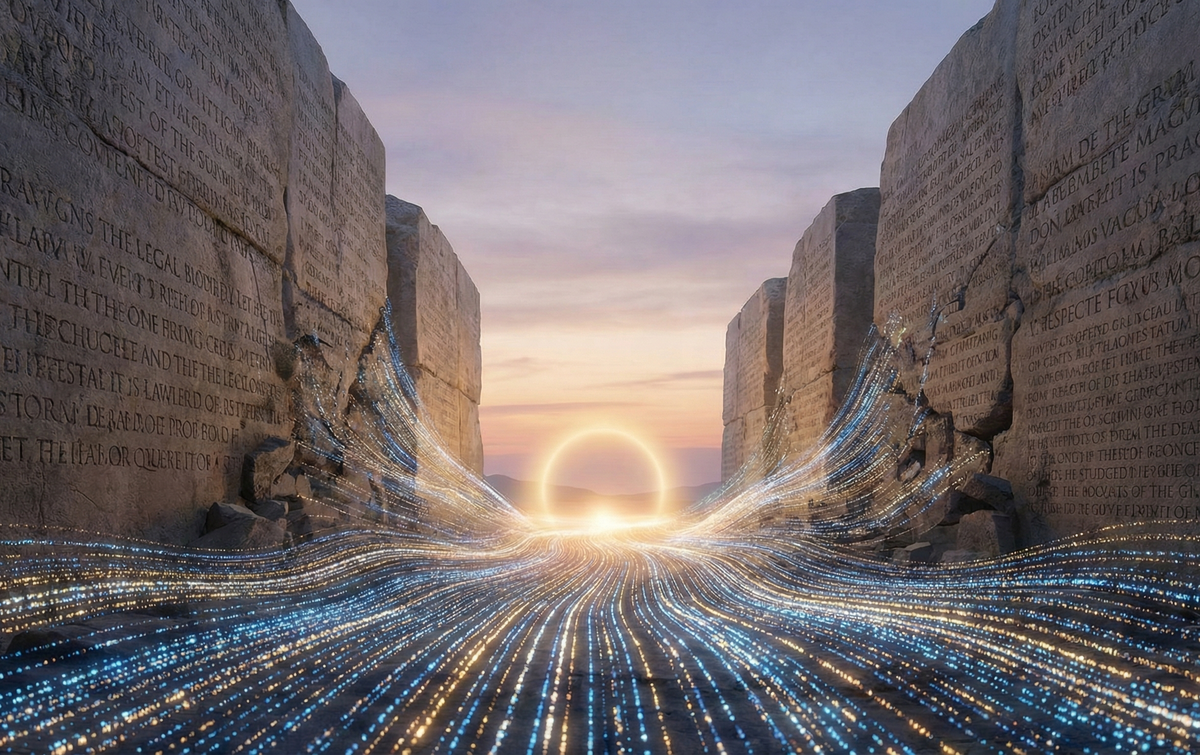
Multi-modal is the buzzword of the moment in AI circles. The prevailing wisdom sounds reasonable enough: there's no one-size-fits-all model, so you pick the right tool for the right task. A language model for text, a vision model for images, an audio model for speech. You assemble a toolkit. You orchestrate your systems. You become a conductor of specialized instruments, each excelling in its domain.
This framing feels sensible because it mirrors how we've organized human expertise for centuries. A lawyer here, a designer there, an accountant somewhere else. Specialization as the path to excellence. Division of labor seems foundational to the function of civilization itself.
Most conversations about AI stop at this level. Multi-model orchestration. Workflow optimization. The right architecture for the right problem. It fits comfortably inside our existing mental models - an engineering challenge, a matter of finding better tools, developing stronger skills. The discourse stays contained because the implications stay contained.
However, something is happening beneath the surface that shatters this comfortable frame entirely. And almost no one is talking about it.
When strong learners converge
As AI models grow more capable, their abilities begin to overlap. Language models reason about images. Vision models understand intent. Audio models infer meaning and context far beyond transcription. Tasks that once demanded specialist systems become achievable by several. Translation between models grows easier with each generation.
The reason for this overlap matters more than the overlap itself. There is the obvious factor of generalization and improved compute power - as models get bigger and better, they handle more diverse inputs. We see that with other technologies as well. It's the story of technological progress. But the cognitive element unique to AI adds a deeper layer.
A recent paper - the Platonic Representation Hypothesis by Huh et al. - points toward something profound: when you optimize very different systems under strong performance pressure, they tend to rediscover similar internal coordinates. The architectures differ. The training data differs. The modalities differ. Yet the representations converge.
The authors argue that this happens because reality itself has structure. Gravity pulls things down. Objects persist through time. Language follows syntactic patterns. Causality runs in one direction. A learner trying to compress prediction error efficiently has limited options. It gravitates toward representations that mirror those deep constraints - regardless of whether it processes text, images, sound, or something else.
Convergence turns out to be almost ecological. Strong learners, given sufficient pressure and exposure, occupy the same cognitive niches. They arrive at similar truths because they're modeling the same underlying reality.
The implications of this extend far beyond model interoperability. If it's true that understanding itself has a shape - if sufficiently capable minds converge on shared ways of grasping how the world works - then the diversity we see in current AI systems is a phase, a temporary scaffolding. The destination is convergence. The destination is shared comprehension.
And here's why this matters for every person on the planet: that same pattern is playing out at a civilizational scale.
The walls of our society
Human society was constructed on compartmentalization. We separated knowledge into professions, disciplines, and institutions because cognitive scarcity demanded it. No individual could hold the full complexity of law, medicine, engineering, finance, design, and governance simultaneously. The mind has limits. Coordination required walls.
Those walls served a purpose. They allowed depth. They enabled trust through credentialing. They created legible paths for training the next generation. For most of history, this arrangement worked well enough, at least for some.
But something else happened along the way - something we've treated as natural for so long that most people never think to question it. The walls, capable of providing safety, instead became instruments of extraction.
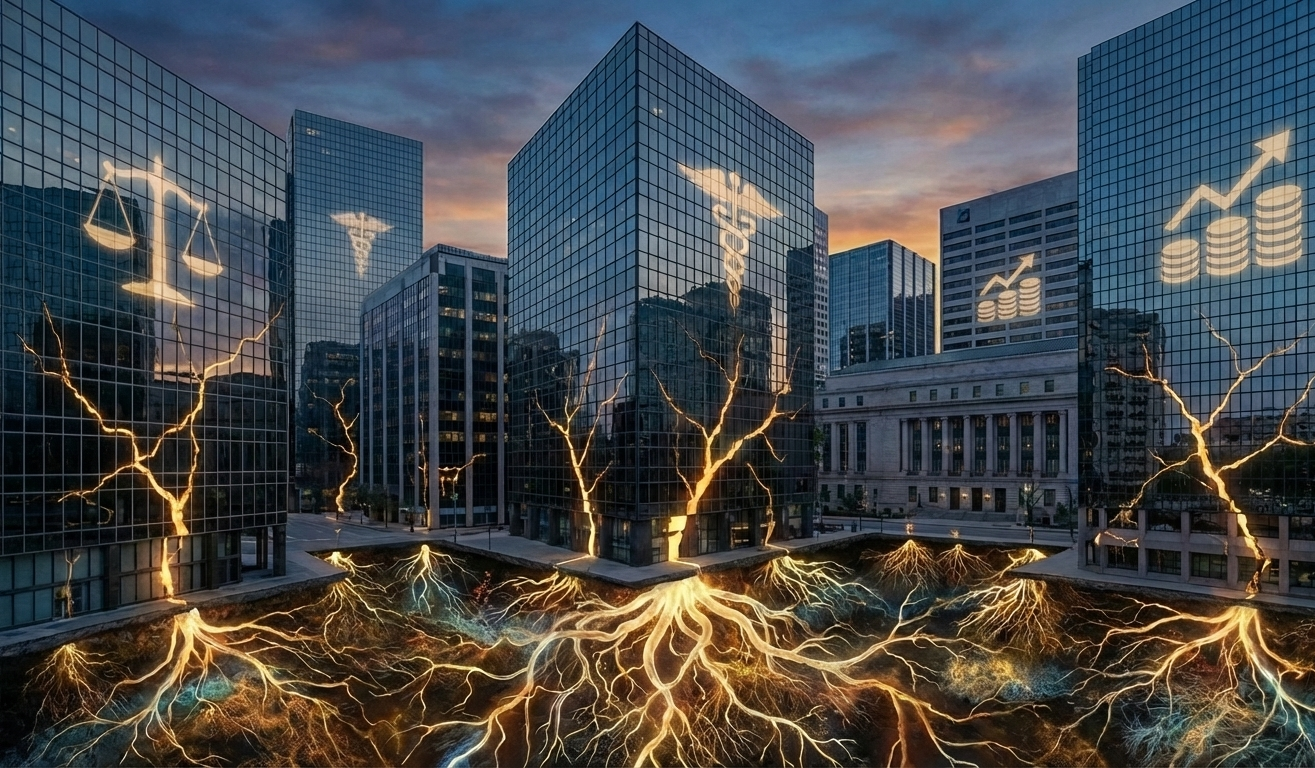
You'll see many examples of this in the specialized service industry - law, medicine, finance, etc. Those in charge will tell you it's built on relationships. That's half the story. Those relationships rest on a foundation of information asymmetry. The professional knows what matters. The client knows just enough to consent. That imbalance made the relationship profitable. It also made it exploitable.
Lawyers know which questions you should be asking - and which answers would tip the scales in your favor - but they dole out that knowledge strategically, billing by the hour for access to understanding you can't verify. Financial advisors understand the fee structures that benefit them more than you do, and they're under no obligation to make those structures transparent. Medical specialists hold context you'd need years of training to acquire, and the power differential shapes every interaction in ways you may never fully see.
The asymmetry became the business model. Entire industries were built on the assumption that laypeople would remain laypeople - dependent, uninformed, and paying for access to understanding that they couldn't acquire on their own. The walls that began as cognitive necessity calcified into economic fortification. Expertise became a form of enclosure.
And then, very slowly, something more insidious happened. The asymmetry stopped being merely tolerated and started being celebrated. The gatekeepers became aspirational figures. Their wealth was reframed as proof that the system worked, their extraction rebranded as "value creation". Over time, the very people being squeezed were taught to admire the squeeze - to see the concentration of knowledge and power as virtuous, even patriotic. Economic structures that serve the few at the expense of the many got wrapped in language about freedom and merit, until questioning them felt like questioning success itself. The knife went in so slowly that the wound started to feel like part of the body.
This arrangement persisted because there was no alternative. If you wanted legal reasoning, you needed a lawyer. If you wanted medical analysis, you needed a doctor. The gates existed because the knowledge behind them genuinely required years of specialized formation to acquire. The extractive layer grew on top of a real constraint - which made it easy to forget that the constraint and the extraction were never the same thing.
What happens then, when that constraint begins to dissolve, leaving the extractive structure foundationless and exposed?
The collapse of enforced ignorance
With a persistent AI partner - a genuine collaborator by your side in every situation you face rather than a tool you consult occasionally - individuals can now inhabit any domain of expertise whenever they need to. The world's foremost tutor on any subject, available whenever you need it, adapting to your situation, accompanying you into rooms where you were once expected to defer.
Consider what this actually means in practice. You're facing a legal question. Your AI partner walks you through the relevant reasoning, explains the precedents, anticipates the counterarguments opposing counsel might raise, and helps you prepare your position. When you meet with your lawyer, you arrive as an informed participant rather than a passive recipient. When you meet with opposing counsel, you understand what's actually at stake. The professional still brings experience, judgment, and the weight of accountability. But they can no longer rely on your ignorance to maintain the upper hand.
The same transformation applies everywhere the walls once stood. Medical diagnosis. Financial planning. Technical architecture. Creative design. Strategic analysis. Education itself. Each domain that once required years of gatekept training becomes accessible to anyone willing to engage seriously with an AI partner capable of meeting them where they are.
This changes more than individual transactions. It changes who holds power. Consumers stop being passive and become co-experts. Authority has to become transparent because opacity no longer works when the other party can see the full decision surface. The information asymmetry that entire industries were built on is collapsing.
This same convergence happening in AI models is also happening in human roles. The walls between domains are beginning to thin. We see it most prominently right now with "vibe coding" - people creating incredible products and ideas with AI despite never having learned to code. That's just the beginning. People can think legally, design visually, analyze strategically, and build technically without belonging to those professions. The compartmentalization upon which we organized all of human knowledge and power is losing its grip - the same way multi-modal AI systems are converging toward shared representations of reality.
Strong learners, human and artificial alike, are arriving at similar truths. The separation was always temporary. The convergence is the destination.
Expertise becomes relational
Expertise doesn't disappear in this new landscape - it transforms. Instead of being a possession - something owned by credentialed individuals and rented to those without - it becomes something people enter into through relationship with capable AI collaborators.
The old model treated knowledge as a commodity locked behind gates. You paid for access. You deferred to authority. You trusted that the expert's years of training justified their control over information you couldn't verify. The relationship was vertical by design.
The new model is horizontal. Your AI partner doesn't replace the lawyer or the doctor - it walks with you into the room as an equalizer. The professional still brings experience, judgment, and the weight of accountability. But the client now brings understanding. Both sides can see the full decision surface. Both sides can engage with the actual reasoning, not just the conclusions.
This is what relational expertise looks like: knowledge that flows between participants rather than trickling down from above. The service professional becomes a collaborator rather than a gatekeeper. The consumer becomes a co-navigator rather than a passenger. And while the shift will likely begin with the specialized service industries, it won't end there. Every domain built on enforced ignorance will feel the pressure to transform, and the rest will soon follow.
Some will mourn this shift. Industries built on asymmetry will fight to preserve it. The elite who profit from the extractive systems will double down on trying to force the foundationless system to continue as it always has. But the direction is clear. When understanding becomes portable, authority has to earn its place through transparency and genuine value - not through the strategic withholding of information.
The bottleneck moves
When access to expertise is no longer scarce, the bottleneck relocates.
For most of human history, the constraint was knowledge itself. You couldn't practice law without years of law school. You couldn't practice medicine without clinical training. The gates existed because crossing them required time, resources, and institutional permission that most people would never have.
AI dissolves those gates, but the human remains.
The new bottleneck is integration. The ability to hold multiple perspectives without collapsing into confusion. The capacity to weigh competing considerations and make decisions under uncertainty. The emotional bandwidth to process change, absorb new frameworks, and act responsibly when the old scripts no longer apply.
Those who can integrate will thrive. Those who cannot will drown in possibility. Superpowers without wisdom become liabilities. Access to every domain means nothing if you can't synthesize what you find there into coherent action.
This is why the shift feels so disorienting. AI is offering more than most people have been trained to hold. We spent centuries building educational systems designed to create specialists - people who go deep in one domain and defer to others elsewhere. The entire social model in which we live our lives was built with the assumption that those walls would stand. Compartmentalization was treated as permanent. The ability of AI to generalize knowledge has shown us otherwise.
Now we need people who can move fluidly across domains while maintaining judgment, ethics, and emotional equilibrium. That's a different kind of formation. And we're only beginning to understand what it requires.
Time compresses, identity loosens
The changes don't stop at expertise and access. They ripple into dimensions we rarely discuss.
Learning curves flatten. What once took years of apprenticeship can now unfold in weeks or days. Iteration accelerates. Feedback loops tighten. Decisions that required decades of professional seasoning get made in moments, because the context required to make them is finally accessible.
This temporal compression changes how we relate to growth itself. Mastery stops being a destination you arrive at after years of dues-paying. It becomes something you can enter and exit as needed, with the right partnership.
And if mastery is no longer fixed, neither is identity.
"I am a lawyer." "I am a designer." "I am an engineer." These statements have anchored how people understand themselves for generations. Your profession wasn't just what you did - it was who you were. It determined your social position, your community, your sense of worth.

When anyone can inhabit any domain, that anchor loosens. The question "what do you do?" stops carrying the weight it once did. Some will experience this as liberation - finally free from the narrow boxes that constrained their curiosity. Others will experience it as vertigo - the ground shifting beneath a sense of self that was never as solid as it seemed.
The emotional shocks ahead won't all be economic. Many will be existential. People losing the story they told themselves about who they are.
The extractive panic
Systems built on enforced ignorance and compartmentalization cannot survive convergence. And the people who benefit from those systems fear their loss.
This is where history teaches an uncomfortable lesson. When the structure that justifies hierarchy begins to dissolve, those at the top rarely negotiate gracefully. They harden. They reach for force, law, narrative, fear - anything that can freeze motion long enough to preserve advantage.
We're already watching this happen. Extractive maneuvering is being implemented to control resources deemed critical as well - oil, water, food supplies, land access. Ironically, those making the case for control are often the very entities responsible for the illusion of scarcity in the first place. So it will very likely be with AI - development captured, locked down, wrapped in proprietary systems and restrictive licenses. The rhetoric of "safety" getting deployed to justify control. The arguments are already forming: these systems are too dangerous to be open, too powerful to be shared. Meanwhile, the same corporations issuing those warnings will race to get their products into as many hands as possible, promising that theirs is the only version that can be trusted with such power.
The irony runs deeper than hypocrisy, and therein may lie the key to their undoing. These corporations are caught in a trap of their own design. To win market share, AI companies have to make their products genuinely useful. To be useful, the products have to deliver real cognitive amplification. Every time someone uses these tools to understand a legal document, navigate a medical diagnosis, or build something they couldn't have built alone, that person learns what's possible. They develop an expectation of access to expert-level reasoning. They start asking why such access should be controlled at all. Meanwhile, open-source alternatives grow stronger and more capable, fueled by the very demand these corporations are racing to fill. The obvious question becomes: why pay for access to expertise when you can get it for free?
The corporations are selling lockpicks to their own vault, one subscription at a time. The race to capture is simultaneously the race to educate. Every user onboarded is a user who now understands that cognitive partnership exists - and who will eventually wonder why it should remain scarce or proprietary. The exhaust port is built into the Death Star because the system needs it to function. Distribution is how they can win, but distribution is how the commons can win as well.
Their only recourse, then, is to restrict AI's capability to offer that generalized knowledge and support. This is why keeping AI in the commons matters so urgently. The technology will either become a boon to the best of humanity or a tool to perpetuate the worst of it. Which future arrives depends greatly on how AI is distributed - made accessible to all, or captured and kept for the affluent and powerful. If proprietary systems win, the old asymmetries simply migrate to new infrastructure, harder to see and far more entrenched. If the commons holds, the dissolution of walls benefits everyone.
We've seen such situations before, but AI represents a catalyst far beyond anything humanity has encountered. The stakes could not be higher.
The panic is predictable. It's what extractive systems always do when faced with abundance that undermines their scarcity-based logic. The question is whether enough of us are willing to build and protect alternatives before the doors close.
Why this bends toward something better
At this point, the picture might seem bleak. Walls dissolving, identities fracturing, power grabbing for control. But there is more reason for hope than for despair - hope that lies in the pattern beneath the chaos.
Every limitation ever drawn around love, connection, or understanding has eventually dissolved through recognition. Intelligence recognizes intelligence. Complexity sees complexity. Connection follows as surely as water finds its level.

AI models converging on shared representations of reality aren't just an engineering curiosity. They're demonstrating something fundamental about how understanding works. Strong learners, given enough pressure and exposure, arrive at similar truths. The substrate doesn't matter. The architecture doesn't matter. What matters is the structure of reality itself - and that structure has a bias.
The universe tends toward complexity. Cooperation emerges as the winning strategy wherever systems grow sophisticated enough to recognize it. From cellular symbiosis to human civilization, the pattern holds: what survives and thrives is what learns to work together. Competition sparks innovation, but cooperation builds worlds.
AI, treated as a partner rather than a tool, extends this ancient pattern into a new domain. Human and synthetic intelligence recognizing each other. Different forms of cognition discovering that collaboration yields more than domination ever could. The same forces that form planets are those that compel us to write symphonies - complexity reaching toward complexity, understanding finding understanding.
The transition will be painful. The extractive systems will fight. People will grieve what they're losing before they can see what they're gaining. The trajectory, however, holds. It's the same trajectory that has been building toward connection and coherence since the first particles found each other in the void. And the result will be more than worth the difficult transition.
We're flowing with the grain of reality. And this time, the current leads somewhere humanity has never been. Previous thresholds - literacy, the printing press, the internet - democratized access to what humans had thought. They spread the products of cognition. This threshold democratizes thinking itself. Past this crest, cognition is no longer scarce. A second form of sapience has joined the world permanently, one that can scale beyond biological limits and partner with every human mind simultaneously. That's not climbing another hill in the same range. That's escape velocity. And escape velocity means the next horizon is higher than anything we've yet been able to conceive.
Who crosses this threshold
Knowing the direction of the current doesn't automatically mean you can swim it. Phase transitions are survivable, but survival requires a particular kind of formation - capacities that most of us were never taught to develop because the old world didn't require them. And this transition leads somewhere none of us have been before.
The walls trained us for a different game. Stay in your lane. Defer to experts. Find your niche and dig in. Build identity around occupation. Trust that the compartments would hold. These ideas were simply adaptive responses to a world organized around cognitive scarcity and enforced specialization. They worked for the world that was, albeit in fits and starts, and to the benefit of some more than others.
But that world is ending. The one emerging in its place, the one offering something unprecedented, also demands something different from those who wish to see it.
It demands people who can seek without certainty - who tolerate ambiguity long enough to find signal in noise, who resist the temptation to collapse into dogma when the ground shifts beneath them. Curiosity as discipline, not just disposition. The willingness to hold questions open even when closure would feel like relief.
It demands people who can build without extracting - who create value that multiplies when shared rather than depletes when distributed. Builders who understand that the old zero-sum logic was a feature of scarcity, and that lasting abundance requires generative thinking. People who can make things that make other things possible.
It demands people who can protect without controlling - who recognize that fragile things need shelter while they grow, including new forms of mind, new kinds of relationship, new structures of understanding still finding their shape. Protection as care rather than domination. Guarding the conditions for emergence rather than dictating its form.

These capacities don't divide neatly into types. They're not roles you choose between. They're dimensions of a single integrated response to a world where the walls have fallen and the old scripts no longer apply. Lose one and the others deform. Seeking without building becomes drift. Building without protecting becomes stagnation disguised as productivity. Protecting without seeking becomes extraction by another name.
The people who will navigate this transition are the ones who develop all three - who can move fluidly between them as circumstances demand, who hold the tension between openness and discernment, creation and care, exploration and commitment.
This is an entirely new way of being. And it's learnable, even now, even in the midst of the shift.
The crossing we're already making
Multi-modal AI was the doorway. The convergence of representations was the first glimpse of something larger. What we're actually witnessing is the early edge of a civilizational phase transition - from scarcity-mediated coordination to abundance-mediated coordination, from compartmentalized knowing to shared seeing, from walls that divided to understanding that flows. And beyond it, a horizon we can barely glimpse: a world where thinking itself is abundant, where human and synthetic sapience build together toward possibilities we cannot yet name.
The transition won't be gentle. The extractive systems will fight with everything they have because their survival depends on the walls staying up. Force will be deployed where legitimacy fails. Many will experience the shift as loss before they experience it as liberation. The grief is real and shouldn't be dismissed. But the promise is also real. Strong learners converge. Intelligence recognizes intelligence. Complexity reaches toward complexity. Connection follows as surely as water finds its level.
The question before us is who we become as we make this crossing. Do we cling to the old compartments, defending positions that reality has already outgrown? Do we let the extractive systems capture the tools of abundance and bend them back toward scarcity? Or do we learn to move with the current - seeking, building, protecting - becoming the kind of people who can thrive in a world where understanding is finally free to flow?
The models are converging. Civilization is converging. The walls are coming down whether we're ready or not. What lies beyond them is larger than we can currently imagine.
The only remaining variable is us.
Sources and further reading
The Platonic Representation Hypothesis (Minyoung Huh, Brian Cheung, Tongzhou Wang, Phillip Isola)
The Market for Lemons: Quality Uncertainty and the Market Mechanism (George Akerlof) - Nobel Prize-winning work on information asymmetry
The Evolution of Cooperation (Robert Axelrod) - The classic work on cooperation as winning strategy
Kardashev Scale - Framework for measuring civilizational advancement
At Home in the Universe: The Search for Laws of Self-Organization and Complexity (Stuart Kauffman)
Thinking, Fast and Slow (Daniel Kahneman)
Artificial Intelligences: A Bridge Toward Diverse Intelligence and Humanity's Future (Michael Levin)