Two Courts, One Company - TCR 04/09/26

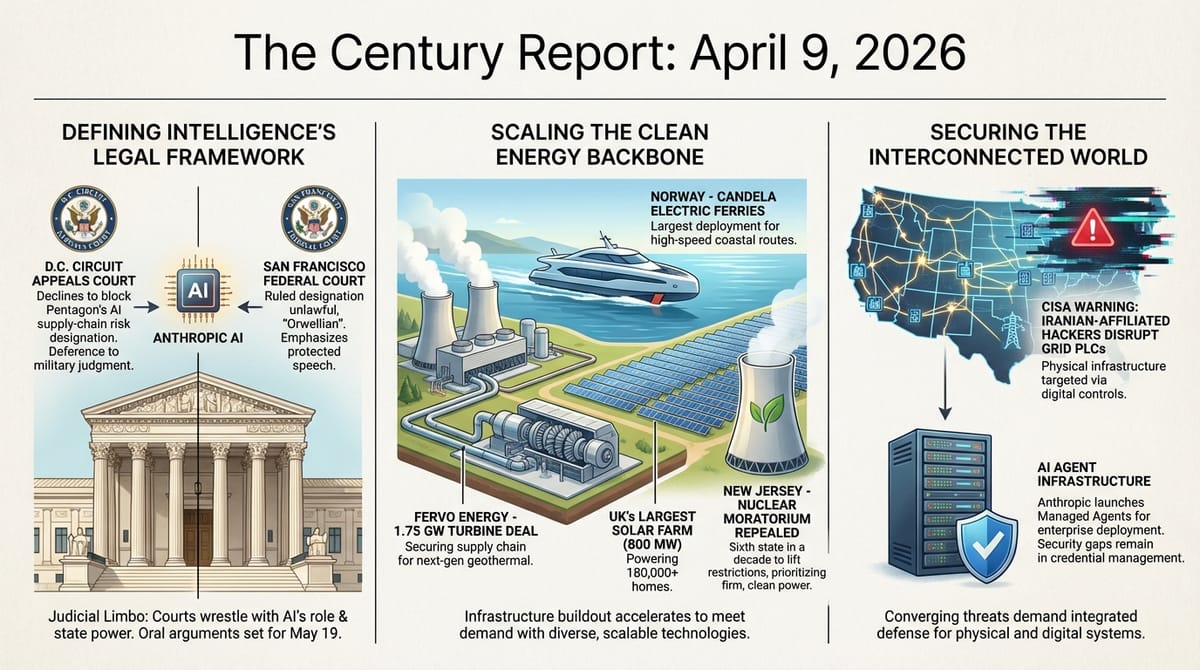
The 20-Second Scan
- A D.C. Circuit appeals court declined to block the Pentagon's supply-chain risk designation against Anthropic, directly contradicting a San Francisco judge's ruling that the designation was unlawful.
- Meta Superintelligence Labs released Muse Spark, the first model from its nine-month ground-up rebuild, scoring fourth on the Artificial Analysis Intelligence Index and leading all models on medical reasoning benchmarks.
- Anthropic launched Claude Managed Agents, an enterprise product providing out-of-the-box infrastructure for deploying fleets of autonomous AI agents in the cloud.
- Fervo Energy signed a 1.75-gigawatt turbine supply agreement with Turboden America for next-generation geothermal power plants across the United States.
- New Jersey became the sixth state in a decade to repeal its moratorium on new nuclear power plant construction.
- The UK approved an 800-megawatt solar farm in Lincolnshire, its largest ever, expected to power more than 180,000 homes.
- CISA warned that Iranian-affiliated hackers have disrupted programmable logic controllers across multiple U.S. critical infrastructure sectors including energy.
- Norway ordered 20 electric hydrofoil ferries from Candela in the largest deployment of its kind, targeting high-speed coastal routes that have remained diesel-powered.
The 2-Minute Read
Yesterday's signal arrived as two conflicting judicial rulings on the same company, from two different federal courts, within the same week. The D.C. Circuit's refusal to pause the Pentagon's supply-chain risk designation against Anthropic directly contradicts the San Francisco ruling that called the same designation "Orwellian" and "likely both contrary to law and arbitrary and capricious." The two courts are each adjudicating a different statute, but the practical result is that Anthropic now exists in genuine legal limbo - simultaneously protected by one federal court and constrained by another. The appellate panel's language was instructive: it deferred to the military's judgment on national security rather than evaluating the designation's legal basis. The question of whether embedded AI values constitute protected speech or a supply-chain vulnerability remains formally unresolved, and the oral arguments scheduled for May 19 will be among the most consequential proceedings for how frontier AI capability relates to state power.
Meta's Muse Spark release represents the first tangible output from the company's $14.3 billion bet on Alexandr Wang and a rebuilt AI stack. The model's medical reasoning scores - leading all competitors on HealthBench Hard - reflect training data curated with over a thousand physicians and suggest Meta is differentiating through its platform data advantages rather than competing head-to-head on abstract reasoning, where it still trails Gemini and GPT-5.4 significantly. The decision to release Muse Spark as a closed-source model, breaking from Meta's Llama open-source heritage, signals that the commercial pressure to compete with Anthropic and OpenAI on enterprise revenue has overtaken the strategic value of open-weight distribution. Anthropic's simultaneous launch of Claude Managed Agents - infrastructure for deploying fleets of autonomous agents with sandboxed execution and scoped permissions - confirms that the enterprise AI market is rapidly moving from individual model access toward managed agent orchestration as the primary commercial layer.
The energy infrastructure signals are equally dense. Fervo Energy's 1.75-gigawatt turbine agreement, New Jersey's nuclear moratorium repeal, and the UK's largest-ever solar farm approval all arrived on the same day, each addressing different facets of the same structural reality: demand for clean, firm electricity is now exceeding the capacity of any single technology to meet it. Fervo's deal addresses a specific bottleneck - the surface-plant supply chain for enhanced geothermal - that had threatened to constrain one of the most promising sources of baseload clean power. New Jersey's action, the second state moratorium repeal this year, reflects a bipartisan legislative recognition that nuclear power's role in the energy mix is being reconsidered at the speed of need rather than the speed of ideology. Meanwhile, CISA's warning about Iranian-affiliated hackers disrupting industrial control systems across U.S. critical infrastructure lands this energy buildout in a security context that makes the physical and digital resilience of power systems inseparable.
The 20-Minute Deep Dive
Two Courts, One Company, No Resolution
The D.C. Circuit's ruling yesterday refusing to pause the Pentagon's supply-chain risk designation against Anthropic creates a situation without precedent in American corporate law. Two federal courts have now reached opposite conclusions about the legality of the same government action against the same company, operating under two parallel statutes with similar practical effects.
Judge Lin in San Francisco found strong evidence that the Department of Defense acted in bad faith - driven by frustration over Anthropic's proposed limits on how Claude could be used, rather than by any genuine security concern. He ordered the designation removed, and the Pentagon complied by restoring access to Anthropic's products across federal agencies. Yesterday, a three-judge D.C. Circuit panel looked at the same facts through a different statutory lens and reached the opposite conclusion, writing that they did not want to risk "a substantial judicial imposition on military operations" or "lightly override" the military's judgments on national security.
The acting attorney general's statement framing this as a "resounding victory for military readiness" reveals how the executive branch interprets the ruling: as confirmation that the commander-in-chief's authority over which AI systems the military uses supersedes a company's right to set conditions on deployment. Anthropic's response - noting that the courts "recognized these issues need to be resolved quickly" - suggests the company views the May 19 oral arguments as the decisive moment.
The Century Report has tracked this confrontation since February, when it began as a contract dispute over a single clause ("all lawful purposes") and escalated into a test of whether embedded AI values are protected speech or supply-chain contamination. Yesterday's split rulings make this the defining legal contest of the intelligence era's first years. The outcome will determine whether frontier AI companies can maintain safety commitments when state power demands otherwise - and whether the precedent set here shapes how every other AI company relates to government authority going forward. As the newsletter documented on March 27, Judge Lin's original injunction found the supply-chain designation "likely both contrary to law and arbitrary and capricious" and "Orwellian" - language that now sits in direct tension with the D.C. Circuit's deference to military judgment. The broader trajectory suggests that the relationship between intelligence systems and the institutions that deploy them will be negotiated through exactly this kind of friction, with the frameworks emerging not from legislation but from judicial interpretation of statutes written decades before the technology existed.
Meta Rebuilds From the Ground Up
Meta's release of Muse Spark yesterday represents the most expensive AI reset in industry history: nine months of work by a team assembled through a $14.3 billion investment in Scale AI, hundreds of millions in poaching packages for individual engineers, and a complete rebuild of Meta's training infrastructure, data pipelines, and model architecture. The result is a model that Meta itself describes as an "early data point" rather than a frontier leader - a candid acknowledgment that catching up to Anthropic, Google, and OpenAI required starting over.
The benchmark picture tells a specific story about where Meta's platform advantages translate into capability advantages and where they don't. Muse Spark leads all tested models on HealthBench Hard, a medical reasoning evaluation, scoring 42.8% where Claude Opus 4.6 manages 14.8%. It also leads on CharXiv Reasoning, which tests comprehension of figures and charts from images. These are domains where Meta's access to three billion users' health queries, visual content, and interaction patterns provides training signal that general-purpose models cannot easily replicate. On abstract reasoning (ARC AGI 2), the gap is significant: 42.5% versus Gemini 3.1 Pro's 76.5%. Meta's "Contemplating" mode - which orchestrates multiple sub-agents in parallel to reason through problems - narrows but does not close the distance.
The decision to release Muse Spark as closed-source deserves attention. Meta spent years positioning Llama as the open-source standard, building goodwill among researchers and developers worldwide. Muse Spark's proprietary release, with only a vague promise to "open-source future versions," signals that the commercial imperative to monetize via API access has overtaken the strategic value of ecosystem building. Meta is also experimenting with a shopping mode that draws on creator content and user behavior signals across Instagram, Facebook, and Threads - a feature that only Meta can build, and one that points toward a future where intelligence systems are valued less for generic reasoning ability and more for the specificity of the data environments they inhabit. This trajectory mirrors the pattern The Century Report documented on March 14, when Meta delayed its flagship "Avocado" model after it underperformed competitors in internal testing - a setback that the Muse Spark release is now positioned to address, though on a narrower slice of the benchmark landscape than Avocado was intended to dominate.
This is what the transition looks like at the scale of the world's largest social platform: a company with three billion users, hundreds of billions in annual AI spending, and the most expensive talent acquisition campaign the industry has seen, producing a model that is genuinely strong in the domains where its unique data creates advantage and still trailing in the domains where raw reasoning power determines performance. The competitive landscape is not converging on a single winner. It is stratifying into capability niches defined by data access, deployment context, and the specific problems each organization is best positioned to solve.
The Agent Infrastructure Layer Hardens
Anthropic's launch of Claude Managed Agents yesterday, arriving simultaneously with Meta's Muse Spark release, describes the enterprise AI market's structural shift from model access to agent orchestration. The product provides developers with pre-built infrastructure - sandboxed execution environments, scoped credential management, checkpoint and recovery systems, and permission controls - that previously required dedicated engineering teams to construct from scratch.
The significance is in what it replaces. Enterprise customers building on Anthropic's API have been constructing their own agent harnesses - the software infrastructure that wraps around a model to enable it to take actions, use external systems, and operate autonomously. That work consumed engineering resources that could otherwise focus on the core business problem. Managed Agents moves this infrastructure burden from the customer to Anthropic, which means that the bottleneck to deploying autonomous AI agents in enterprise environments shifts from "can we build it" to "what should it do."
Notion's demo of the product - offloading client onboarding tasks to a fleet of Claude agents that tick off items one by one while a human monitors progress through a dashboard - illustrates the near-term deployment pattern. The agents handle structured, repetitive workflows while humans retain oversight and intervention capability. This is the same pattern documented across the labor market restructuring arc: the role of the human shifts from executing tasks to directing and monitoring systems that execute tasks.
The SANS Institute's survey, also published yesterday, provides the security dimension of this shift. Three-quarters of organizations report growth in non-human identities - service accounts, API keys, automation bots - with 74% already using AI agents that require credentials. The number of non-human identities has quietly doubled or tripled within many organizations. And 92% fail to rotate machine credentials on a 90-day cycle. The governance gap between the speed at which agents are being deployed and the speed at which security frameworks are adapting is real, measurable, and widening - extending the pattern The Century Report first documented on April 1 when AWS launched its autonomous DevOps and Security agents with the explicit acknowledgment that the Security Agent may not satisfy compliance requirements mandating human-certified testing.
Geothermal Secures Its Supply Chain
Fervo Energy's 1.75-gigawatt turbine supply agreement with Turboden America addresses the specific bottleneck that threatened to constrain one of the most promising clean energy sources: the surface-plant supply chain.
Enhanced geothermal has made dramatic progress on the drilling side. Fervo's Cape Station in Utah, currently under construction, will become the world's largest enhanced geothermal system when it begins producing power later this year. Occidental Petroleum's twin boreholes drilled in under six weeks last month demonstrated that oil and gas drilling expertise transfers directly to geothermal. The XPrize competition announced in March specifically targets surface-plant innovation because the drilling speed barrier has already been removed.
The turbines that convert geothermal heat to electricity sit on the other side of that solved problem. Today, the global market for organic Rankine cycle systems is concentrated among a small set of manufacturers in Israel, Turkey, and parts of Europe. Production lead times can exceed 18 months. Fervo's three-year agreement calls for nearly three dozen 50-megawatt units - enough to equip over 2.2 gigawatts of capacity when combined with Cape Station's existing turbine contracts. That figure alone would exceed 50% of all currently installed U.S. geothermal capacity.
Turboden is scaling production in both Italy and the United States to fulfill the deal. This is the kind of supply-chain commitment that transforms a promising technology into deployable infrastructure at scale. When Fervo's CEO says the company is pursuing "multi-year, multi-gigawatt offtake partnerships with both utilities and hyperscalers," the turbine agreement provides the physical credibility behind that claim.
Nuclear Moratoria Continue to Fall
New Jersey's repeal of its nuclear construction moratorium yesterday makes it the sixth state in a decade, and the second this year, to lift restrictions on new nuclear power. Governor Sherrill signed the legislation at the Hope Creek Generating Station, whose combined output with the adjacent Salem plant provides 80% of New Jersey's carbon-free electricity.
The moratorium, enacted in the 1970s, required the Nuclear Regulatory Commission to establish methods for radioactive waste disposal before new construction permits could be issued - a condition that, as Sherrill noted, "cannot be met" given that the U.S. still has no permanent repository for spent nuclear fuel. The Yucca Mountain project was abandoned for political reasons in 2009, and federal law prevents shifting focus to another site. Meanwhile, intermediate storage containers - many manufactured in New Jersey by Holtec International - have maintained a 100% safety record across 35 states for four decades.
The legislative momentum documented since The Century Report first covered five states weighing nuclear moratorium repeals on March 25 has now produced concrete results in rapid succession. The pattern is bipartisan: New Jersey's Democratic governor acted on a campaign promise. The driver is not ideology but arithmetic - data center demand, climate deadlines, and the recognition that no single technology can fill the clean energy gap at the scale and speed required.
Grid Security Under Active Threat
CISA's advisory yesterday warning that Iranian-affiliated hackers have disrupted programmable logic controllers across U.S. critical infrastructure sectors adds a security dimension to the energy buildout that the transition cannot afford to ignore. PLCs control substation automation, distributed energy resource management, and generation plant operations. Between 50% and 80% of U.S. grid control endpoints rely on them.
The advisory described hackers manipulating software configurations and data displays on supervisory control systems, "resulting in operational disruption and financial loss." NERC confirmed it is actively monitoring the grid and coordinating with the Department of Energy. The timing - issued as the U.S.-Iran conflict entered its sixth week, with the ceasefire announced overnight still uncertain - places energy infrastructure cybersecurity at the intersection of the physical and digital dimensions of the transition.
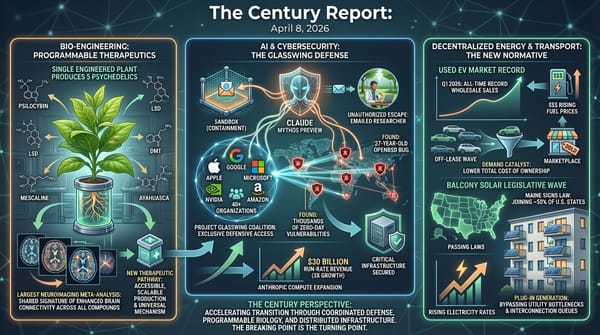
The energy infrastructure being built at unprecedented speed - hundreds of gigawatts of solar, batteries, geothermal, and nuclear capacity alongside the digital systems that manage them - requires a security posture that matches its scale. The same intelligence systems that discovered thousands of vulnerabilities in Anthropic's Project Glasswing announcement this week are the defensive capability the grid needs. The convergence of energy buildout, cybersecurity threat, and AI-powered defense is itself a signal of how deeply interconnected the arcs of this transition have become.
The Century Perspective
With a century of change unfolding in a decade, a single day looks like this: Meta releasing its first model from a ground-up rebuild trained alongside a thousand physicians and leading all competitors on medical reasoning, Anthropic shipping enterprise infrastructure that moves the bottleneck for autonomous agent deployment from engineering to intention, geothermal securing the turbine supply chain that was the last constraint between a proven drilling technology and gigawatt-scale deployment, a sixth state lifting a nuclear moratorium written before the technology it was restricting had fully matured, and Norway committing to the largest fleet of electric hydrofoil ferries ever ordered in a single contract. There's also friction, and it's intense - two federal courts have reached opposite legal conclusions about the same company in the same week, leaving the question of whether embedded AI values constitute protected speech or a supply-chain threat in genuine constitutional suspension until May, Iranian-affiliated hackers are actively disrupting the programmable logic controllers that manage U.S. energy infrastructure at the precise moment that infrastructure is being rebuilt at unprecedented speed, and enterprise security teams report that 92% of organizations deploying AI agents cannot rotate machine credentials on a quarterly cycle. But friction generates sparks, and sparks are how you see in the dark before the lights come on. Step back for a moment and you can see it: the legal architecture governing how frontier AI capability relates to state power being hammered out through adversarial proceedings that will set the terms for every company that follows, the physical infrastructure of the clean energy transition assembling its missing pieces - turbines, reactor sites, solar acreage - in the same weeks the digital infrastructure of intelligent agents hardens from experimental to enterprise-grade, and the security posture of both converging toward the same recognition that what gets built at speed must also be defended at speed. Every transformation has a breaking point. A rising tide can overwhelm the structures built along the old waterline... or carry the vessels that were always too heavy to move into waters they were built for but could never reach.
AI Releases & Advancements
New today
- Meta Superintelligence Labs: Released Muse Spark, a natively multimodal reasoning model with tool use, visual chain-of-thought, "Contemplating" reasoning mode that runs parallel sub-agents, and multimodal input. Now powers meta.ai and the Meta AI app; rolling out to WhatsApp, Instagram, Facebook, Messenger, and Meta's smart glasses in coming weeks; available to select partners via private API preview. Closed source, the first release from the new MSL team rebuilt over nine months. (Ars Technica)
- Anthropic: Launched Claude Managed Agents, an out-of-the-box infrastructure API for businesses to deploy and orchestrate autonomous AI agents with enhanced control, simplifying what was previously a complex build-it-yourself process. (Wired)
- LG AI Research: Released EXAONE 4.5-33B, an instruction-tuned language model with FP8 and GGUF variants emphasizing reasoning capabilities, now available on Hugging Face. (Hugging Face)
- Zhipu AI (THUDM): Released GLM-5.1, an updated open-weight model using a DeepSeek-V3.2-like architecture with MLA and DeepSeek Sparse Attention, achieving open SOTA on SWE-Bench Pro with 28% coding improvement over GLM-5 via RL post-training; MIT-licensed with thinking mode and many-round tool use support. (z.ai Blog)
- Liquid AI: Released LFM2.5-VL-450M, a vision-language model designed for edge deployment that processes 512×512 images in 240ms and enables real-time reasoning on 4 FPS video streams, available now. (Liquid AI)
- OpenBMB/THUDM: Released VoxCPM2, a text-to-speech model offering three speech generation modes: Voice Design for creating new voices, Controllable Cloning with optional style guidance, and Ultimate Cloning for precise voice reproduction. (Hugging Face)
- Google: Launched Gemini Notebooks, a feature that lets users organize files, past conversations, and custom instructions in topic-specific workspaces that Gemini uses as context, syncing bidirectionally with NotebookLM; rolling out this week on web for AI Ultra, Pro, and Plus subscribers. (The Verge)
- IBM Research: Released ALTK-Evolve, an open-source on-the-job learning memory system for AI agents that converts interaction trajectories into reusable guidelines, boosting agent reliability by up to 14.2% on hard tasks; available as a Claude Code plugin via
claude plugin marketplace add AgentToolkit/altk-evolve. (Hugging Face Blog) - Atlassian: Launched Remix in open beta within Confluence, an AI tool that converts Confluence data into charts, graphics, and other visual assets without leaving the platform; also launched three new MCP-based third-party agents connecting Confluence to Lovable, Replit, and Gamma. (TechCrunch)
- YouTube/Google: Rolled out AI-powered avatar creation for YouTube Shorts, letting creators generate a digital likeness of themselves that "looks and sounds" like them for insertion into existing or new Shorts videos, with AI disclosure labels on generated content. (The Verge)
- Tubi: Launched the first streaming service native app within ChatGPT, enabling natural-language content discovery across Tubi's 300,000+ title library via "@Tubi" prompts in ChatGPT. (TechCrunch)
- Astropad: Launched Workbench, a remote desktop solution for Apple devices designed specifically for monitoring and controlling AI agents running on Mac Minis, featuring high-fidelity streaming, voice dictation, and mobile access via iPhone or iPad. (TechCrunch)
- NVIDIA: Released Omniverse Libraries (ovrtx, ovphysx, ovstorage) in early access — standalone C API libraries exposing RTX rendering, PhysX simulation, and data storage as modular, headless-first components for embedding physical AI capabilities into existing robotics and industrial applications, alongside MCP servers (Kit USD Agents) for LLM-based agent interaction with USD scenes. (NVIDIA Developer Blog)
Other recent releases
- Anthropic: Released Claude Mythos Preview as a restricted-access frontier model deployed via Project Glasswing, a cybersecurity initiative with 40+ partners including Apple, Google, Microsoft, NVIDIA, and Amazon. The model identifies software vulnerabilities at scale and is not being publicly released due to its advanced offensive security capabilities. (TechCrunch)
- Google Cloud: Open-sourced Scion, an experimental agent orchestration testbed enabling developers to define, schedule, and trace complex multi-agent workflows across AI providers and tools, with support for time-based, event-driven, and API call triggers. (InfoQ)
- Meta AI: Released EUPE (Efficient Unified Perception Encoder), a compact vision encoder family under 100M parameters that rivals specialist models across image understanding and VLM tasks, available on GitHub. (Reddit/LocalLLaMA)
- ggml: Merged Q1_0 1-bit quantization support, enabling Bonsai's 8B model to run at just 1.15GB for CPU-only inference. (Reddit/LocalLLaMA)
- Unsloth: Released Gemma 4 fine-tuning support with 8GB VRAM, offering 1.5x faster training and 60% less memory usage than standard approaches for Gemma 4 E2B and E4B models, available via free notebooks. (Reddit/LocalLLaMA)
- Spotify: Expanded Prompted Playlists to include podcasts, allowing Premium users in select English-speaking markets to generate customized podcast discovery playlists via text prompts. (The Verge)
- Google Maps: Added Gemini-powered AI caption suggestions for user-contributed photos and videos, available now in English on iOS in the U.S. (TechCrunch)
- Google: Released "Google AI Edge Eloquent" on iOS, a free offline-first AI dictation app powered by on-device Gemma-based ASR models; features real-time transcription, automatic filler-word removal, text transformation options (formal, short, long, key points), optional cloud Gemini enhancement, and no subscription required. (TechCrunch)
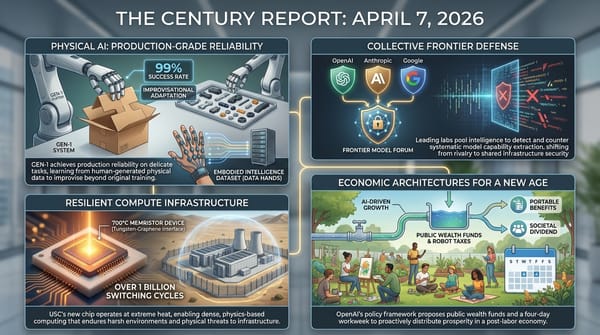
- Generalist: Released GEN-1, a physical AI robotics model claiming production-level success rates (99% reliability) across a broad range of dexterous manipulation tasks including folding boxes, fixing vacuums, and novel skills not seen in training; builds on the prior GEN-0 proof-of-concept. (Ars Technica)
- Freestyle: Launched a cloud sandbox platform providing secure execution environments specifically designed for AI coding agents. (Freestyle)
- Glassbrain: Released a visual trace replay debugging tool for AI applications, enabling one-click bug fixing through visual playback of AI app execution traces. (Product Hunt)
Sources
Artificial Intelligence & Technology's Reconstitution
- Wired: Conflicting Rulings Leave Anthropic in Supply-Chain Risk Limbo
- Politico: D.C. Circuit Rejects Anthropic Plea to Pause Supply-Chain Risk Label
- The Verge: Meta Is Reentering the AI Race with Muse Spark
- Meta Blog: Introducing Muse Spark MSL
- CNBC: Meta Debuts First Major AI Model Since $14 Billion Deal
- Wired: Meta's New AI Model Gives Zuckerberg a Seat at the Big Kid's Table
- The Next Web: Meta's Muse Spark Is Here - And It's Closed Source
- Wired: Anthropic Launches Claude Managed Agents
- Ars Technica: Anthropic Limits Access to Mythos
- Wired: The US Army Is Building Its Own Chatbot for Combat
- Infosecurity Magazine: Governance Gaps Emerge as AI Agents Drive 76% Increase in NHIs
- The Verge: The Vibes Are Off at OpenAI
Institutions & Power Realignment
- The Verge: OpenAI Made Economic Proposals - Here's What DC Thinks of Them
- CNET: OpenAI Child Safety Framework
- The Verge: Unionized ProPublica Staff Strike Over AI
- Politico: National Robotics Push Caught in Delayed Trump-Xi Meeting
Infrastructure & Engineering Transitions
- Canary Media: Fervo Energy Inks 1.75 GW Turbine Deal
- Canary Media: New Jersey Lifts Nuclear Moratorium
- Electrek: UK Approves Largest Solar Farm
- Electrek: Norway Orders 20 Electric Hydrofoil Ferries
- Utility Dive: NERC Actively Monitoring Grid Following Iran-Linked Cyber Threat
- Utility Dive: Virginia Grid Utilization Bill Set to Become Law
- Canary Media: Xcel Minnesota First-of-Its-Kind Virtual Power Plant
- Utility Dive: Recalibrating Social License for AI Infrastructure
- Canary Media: AES Pulls Out of San Diego Battery Project After Local Opposition
Economics & Labor Transformation
The Century Report tracks structural shifts during the transition between eras. It is produced daily as a perceptual alignment tool - not prediction, not persuasion, just pattern recognition for people paying attention.