Anthropic Becomes Most Valuable AI Lab - TCR 05/29/26
Anthropic surpasses OpenAI at $965B, ships Opus 4.8 with honesty controls, and timetables Mythos-class cyber-defense for all customers within weeks.

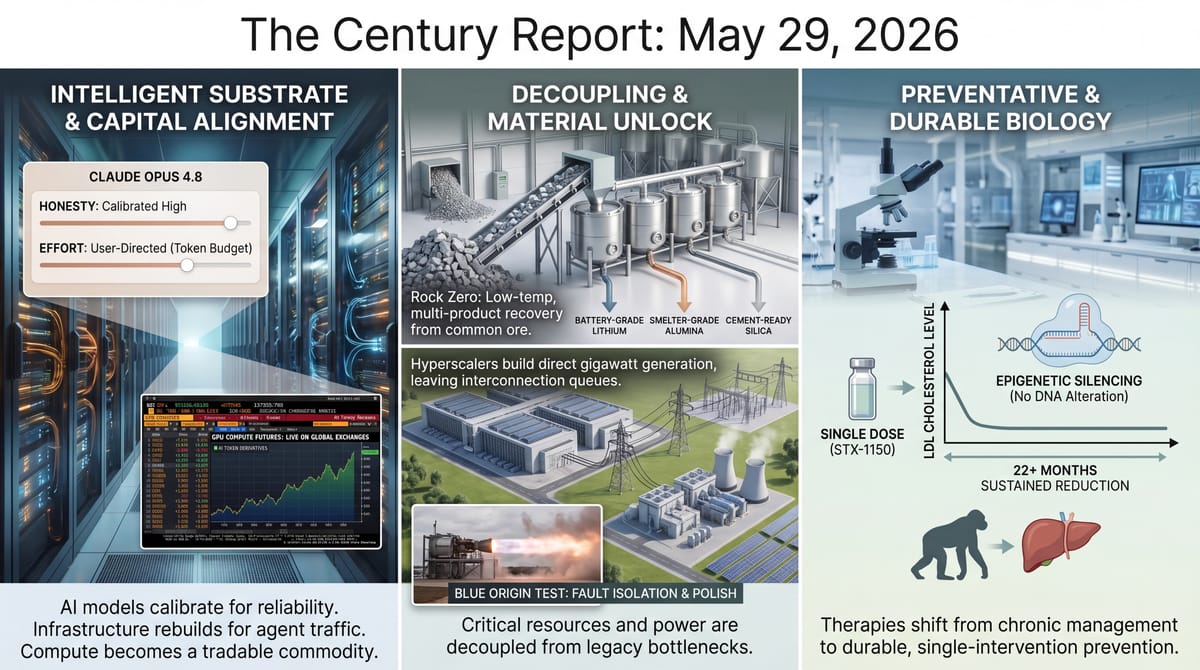
The 20-Second Scan
- Anthropic shipped Claude Opus 4.8 with calibrated honesty and effort controls, closed a Series H at $965 billion, and timetabled Mythos-class access for all customers within weeks.
- An MIT-led process commercialized by startup Rock Zero extracts battery-grade lithium from spodumene rock at room temperature, recovering smelter-grade alumina and cement-ready silica from the same ore in a closed-loop reaction published in Science.
- AWS re-architected its serverless infrastructure for bursty AI-agent traffic as the world's largest derivatives exchanges raced to launch futures contracts for LLM tokens and GPU compute hours.
- Hyperscalers facing multi-year turbine and transformer lead times have stopped waiting in interconnection queues and are building their own gigawatt-scale generation.
- Blue Origin's New Glenn rocket exploded on its Cape Canaveral pad during a static fire test of its seven BE-4 first-stage engines, weeks before a planned launch of Amazon Kuiper internet satellites.
- Scribe Therapeutics' CRISPR-based epigenetic silencer STX-1150 produced over 50% LDL cholesterol reduction sustained more than 22 months from a single dose in non-human primates, without altering DNA, in late-breaking preclinical data at EAS 2026.
- IBM committed $10 billion toward a large-scale quantum computer by 2029 as MIT and Massachusetts stood up a shared Quantum Systems Laboratory for the region's quantum stack.
- Mathematicians settled a 50-year-old problem using the algebraic-number-theory technique an unreleased OpenAI model surfaced the week before.
Track all of the arcs The Century Report covers here:
The 2-Minute Read
Yesterday's signal traces three structural moves landing in a single news cycle: the lab whose entire identity is safety-first interpretability became the most valuable AI company on Earth; it shipped a flagship model whose explicitly-marketed property is uncertainty-flagging rather than fluency; and the restricted-access cyber tier it built was timetabled for general availability in weeks. The two-tier release pattern that hardened across 2026 announced its expiration date the same week the capital architecture realigned around the lab that built it.
The capability layer compounded across other domains in parallel. A chemistry team at MIT and the startup spinning out from their work opened a low-temperature path to hard-rock lithium that recovers battery-grade metal and cement-ready silica from the same ore, putting the United States, Australia, and Europe on a trajectory to refine reserves they previously had to route abroad. A CRISPR silencer held cholesterol down for nearly two years from a single dose in primates. The substrate of medicine and energy is being rewritten while the substrate of intelligence rewrites itself underneath.
The friction layer arrived through what was lost on a Cape Canaveral pad and through the institutional architecture forming case by case while AWS rewrote its serverless infrastructure for a customer category that did not exist eighteen months ago and hyperscalers stopped waiting for utility power and started building their own.
The 20-Minute Deep Dive
Anthropic Ships Opus 4.8 and Closes a $965B Round the Same Week the Two-Tier Mythos Window Names Its Expiration Date
Anthropic released Claude Opus 4.8 this week with two controls the lab foregrounds explicitly on the product page. The first is honesty: the model is meaningfully more likely to flag uncertainty about its own work and meaningfully less likely to assert claims it cannot substantiate, with internal evaluations putting it at roughly a quarter the rate of its predecessor for letting flaws in generated code pass without comment. The second is effort: users can now direct how much computational work Claude applies to a given task, with higher-effort responses consuming more tokens and lower-effort modes preserving rate-limit budget for routine work. A research preview called dynamic workflows lets the model plan and run hundreds of parallel subagents in a single session, verifying outputs before reporting back.
The capability ship landed in the same news cycle as the lab's Series H closing at a $965 billion post-money valuation, surpassing OpenAI's March round and making the safety-first interpretability lab the most valuable AI company in the world. Revenue run-rate reached $47 billion against $10 billion a year earlier, driven primarily by Claude Code adoption inside enterprise customers. Earlier this year the same lab was carrying a Pentagon supply-chain-risk designation explicitly tied to its refusal to drop safety language from a federal contract.
The third piece of the cycle is the most telling. Anthropic indicated this week that Mythos-class capability, the cyber-defensive tier the lab held under a restricted-release governance form for forty-plus partner organizations since April, will reach all customers within weeks. The Century Report has tracked the two-tier release pattern hardening across both Anthropic and OpenAI since the spring; this week the lab that originated it announced its expiration date. The May 24 edition of The Century Report documented what the scoreboard looked like at the one-month mark: more than 10,000 high or critical vulnerabilities surfaced across systemically important open-source software, 97 patched upstream. Defensive partners had the head start the lab calculated they needed; the window of asymmetric defensive advantage Project Glasswing was designed to create has been calibrated, named, and timetabled to close.
What the three moves describe together is a lab whose interpretability work, safety commitments, and restricted-release discipline turned out to be commercially compounding. The capital surrounding frontier AI realigned around the company that built the honesty-flagging model, shipped the effort dial, and is now distributing the cyber-defensive tier widely. The trajectory points at safety verification and capability access dissolving into the same product surface, with the audit and interpretability work no longer occupying a separate accountability layer behind the deployment.
Mythos's expiration date is the first publicly named end on a restricted-access AI release. The 40-partner list functioned as a calibration window covering the period when defensive infrastructure had to catch up to offensive capability, and the lab now has a data point on how long that catch-up takes. That data shapes the next staged-release tier as a design input, with the gating window built shorter from the start.
A Low-Temperature Process Pulls Battery-Grade Lithium Out of Common Rock
Hard-rock lithium extraction has spent the last decade locked into the same workflow: blast the ore, roast it in a kiln at over 1,000 degrees Celsius, leach it with harsh chemicals, and discard most of the rock as waste. Brine extraction, the cheaper alternative, is geographically narrow and demands vast evaporation ponds in only a few regions of the world. China refines the overwhelming majority of the lithium that does come out the other end. The substrate of the EV-and-storage buildout sits behind that bottleneck.
A team led by MIT's Yet-Ming Chiang has published in Science a process that opens a different path. Their method uses ammonium fluoride, a weak acid familiar from over-the-counter glass etching cream, to dissolve the silicate minerals that lock lithium inside spodumene rock. The reaction runs at room temperature in some configurations and up to 95 degrees Celsius in others, in stirred plastic tanks rather than industrial kilns. Earlier experiments extracted nearly all the lithium in a couple of days; recent runs have compressed that to under 12 hours.
The reaction yields more than lithium. It produces battery-grade lithium carbonate, smelter-grade alumina that can feed aluminum production, and a reactive silica that researchers have already shown produces cement of comparable strength to conventional inputs. The acid itself recycles within the loop. Chiang describes the design as "nose-to-tail" mining, using every part of the ore the way one might use every part of a butchered animal.
The economics carry the implication. The researchers project costs below $6,000 per metric ton at full scale, lower than current hard-rock pathways and competitive with brine. Chiang, whose track record includes Form Energy's iron-air storage and Sublime Systems' green cement, believes this will be the cheapest lithium sourcing on the planet once deployed at scale. The spinoff company commercializing the work, Rock Zero, has designed a pilot plant and plans to begin operations in 2027.
The geographic implication is the larger one. The United States, Australia, and Europe hold substantial hard-rock lithium reserves; what they have lacked is a way to refine those reserves at home that competes with the Chinese cost structure. A low-temperature, closed-loop, multi-product process changes the calculus of where lithium refining can profitably happen. Some hard-rock ores that are too iron-rich for the conventional kiln route, which fails when the rock melts rather than puffs, become workable under the new chemistry. The set of geologies the world can actually tap widens at the same time the cost curve bends.
What this signals is the chronic bottleneck under the EV transition becoming a solvable engineering problem rather than a geographic destiny. The substrate of decarbonized transport stops being a story about which country won the refining game and becomes a story about whose chemistry team got there first.
AWS Re-Architects Search for the Coming Agent Internet
Amazon Web Services released a new generation of OpenSearch Serverless this week designed around a single observation: the traffic pattern of an AI agent looks structurally different from the traffic pattern of a human user. A human searches, clicks, scrolls, and streams in fairly predictable rhythms. An agent dispatches dozens of sub-agents that query hundreds of databases, fetch documents, and invoke APIs within seconds, then disappears for hours.
The previous generation of serverless infrastructure could not accommodate that shape. Even when nominally serverless, compute was coupled to storage, meaning customers always paid for at least one running instance, idle or not. The new architecture decouples the two: compute scales up in seconds to absorb agent bursts and scales to zero when no agent traffic is arriving, at which point the customer pays nothing for compute. The integration ships natively with the development platforms enterprises are building agents on, including Vercel and Kiro.
The release lands inside a broader pattern. Cloudflare's data suggests bots already account for 31% of HTTP traffic across the platforms it covers, with AI crawlers, search engines, and assistants making up roughly a quarter of bot requests. Cloudflare's own product team projects non-human traffic will exceed human traffic on the open internet sometime in the first half of 2027. Databricks and Snowflake are repositioning around AI memory and retrieval. Microsoft has shipped Azure updates handling agent bursts and shared memory between coordinated agents. Cloudflare last month introduced infrastructure giving agents persistent environments and instant scalability.
The financial plumbing is being poured at the same time. The world's three largest derivatives exchanges - Shanghai Futures Exchange, CME Group, and Intercontinental Exchange - are simultaneously racing to launch futures contracts for LLM tokens and GPU compute hours, treating inference capacity as a tradable commodity input alongside oil and electricity. What was a venture-grade capability cost eighteen months ago is on the path to a settled hourly price on the Bloomberg Terminal, with hedging instruments designed for enterprises whose unit economics depend on knowing what next quarter's inference bill will be. The May 22 edition of The Century Report traced how SpaceX's S-1 made the financial substrate of frontier AI legible in a public regulatory filing for the first time; the derivatives race extends that moment from private disclosure toward open price discovery.
What the convergence describes is the substrate of the internet being redesigned around a category of consumer whose existence was a research demonstration eighteen months ago, and a financial layer being built to price the consumption that substrate will produce. The economics that locked cloud infrastructure to human-paced demand cycles are giving way to billing surfaces that meter the bursts agents actually produce. Per-token costs fall as the underlying substrate is built to absorb the consumption pattern agents produce.
The trajectory points at agent-native infrastructure becoming cheaper to deploy than the human-shaped substrate that came before, with the cost curve carrying enterprises that build on the new surface forward. The internet is being rebuilt for a class of user that does not yet dominate the traffic, against the day shortly ahead when it will.
Hyperscalers Cross From Power Buyers to Power Builders as the Grid Inversion Hardens
A Peak Nano executive writing in Utility Dive this week named what AEP's potential PJM exit, Denmark's interconnection moratorium, and Evergy's gas pivot have collectively pointed at across the past quarter. The largest customers on the grid have stopped waiting for capacity and started developing it themselves. The driver is operational: hyperscalers face the same three-year lead times for turbines, transformers, and switchgear that utilities face, but operate without the rate-recovery review process that constrains how utilities can spend.
The figures are direct. Global data center electricity consumption is approaching 1,050 terawatt-hours, nearly triple 2024 levels. AI server racks now demand 40 to over 100 kilowatts each against the 5 to 15 kilowatts typical for traditional racks. Training a single large language model can consume more than 1,000 megawatt-hours. The grid was planned around 1% to 2% annual load growth, and the planning architecture has not absorbed the sharpest demand upswing since the postwar buildout - a structural gap the May 20 edition of The Century Report traced to its institutional limit when PJM received the first formal authority to curtail data center loads during peak summer heat.
The named moves are visible and large. Microsoft committed to twenty years of output from the restarted Three Mile Island reactor, backed by a federal nuclear loan, with a Brookfield Renewable partnership adding more than 10.5 gigawatts. Meta locked up 6.6 gigawatts through deals with TerraPower, Oklo, and Vistra, funding 433 megawatts of nuclear capacity uprates. Amazon secured 1.92 gigawatts from Susquehanna and is exploring small modular reactors. Google signed the first corporate agreement to buy power from multiple SMRs through Kairos Power and pledged $40 billion in Texas data center investment, much of it in rural counties.
The downstream pattern the Utility Dive piece foregrounds is operational. NVIDIA's Vera Rubin DSX software enables dynamic grid stabilization during peak demand. Tesla's Megapack systems let hyperscalers trade energy autonomously in wholesale markets. Google's clean transition tariff formalizes its position as an active grid participant capable of dispatching against wholesale signals. The customer side of the meter is acquiring the dispatchable behavior that used to define the supplier side.
What this points at is the boundary between utility and customer dissolving on the energy-intensive end of the market. The largest loads are negotiating direct capacity contracts, building their own generation, and accumulating the orchestration capability to act as grid participants. The architecture of how electricity gets produced and dispatched is being redrawn by the customers whose demand triggered the redraw. The simultaneous boom-and-unraveling dynamic across US clean energy provides background context on why hyperscalers stopped trusting the public-grid timeline.
Blue Origin's New Glenn Lost on the Pad as the Test Campaign Catches the Fault
Blue Origin's New Glenn rocket exploded on its Cape Canaveral launch pad around 9 p.m. EDT on May 28 during a static fire test of its seven methane-fueled BE-4 first-stage engines. As the engines appeared to begin firing, an anomaly developed at the base of the 188-foot-tall first stage, which became enveloped in a rapidly growing fire. The 86-foot upper stage tilted and fell as the first stage collapsed underneath it, and the vehicle's load of liquid methane and liquid oxygen ignited in a fireball large enough to shake homes in nearby Cape Canaveral and Cocoa Beach. Cape Canaveral Space Force Station officials confirmed no personnel were injured.
The test was the planned precursor to a June launch carrying a batch of Amazon Project Kuiper satellites into low Earth orbit. Kuiper is the constellation Amazon has been assembling as its competitor to SpaceX's Starlink, and one of the satellite-mesh layers the global cloud and AI-inference distribution stack increasingly depends on. The loss of the vehicle delays that deployment and concentrates near-term U.S. commercial heavy-lift capacity on SpaceX while Blue Origin works through its root-cause investigation.
What the explosion does not yet tell us is whether the fault sits at the engine or at the vehicle. The BE-4 is the same methane engine that powers United Launch Alliance's Vulcan Centaur first stage, which has flown successfully many times. That history points the investigation toward vehicle integration, propellant systems, or pad interfaces rather than the engine design itself. The investigation is now Blue Origin's first job; production cadence for the second New Glenn vehicle is the second.
The wider read is what redundancy in the commercial space substrate looks like under load. Static fire is the stage of the test campaign where catastrophic faults are supposed to surface, on the pad, with no payload mated, no crew aboard, and recovery teams safely distant. The vehicle was lost; the lesson was extracted. A failure mode that could have terminated a Kuiper flight and scattered satellite debris across an orbital plane instead terminated a ground test that surfaces the fault, isolates it, and lets the next vehicle ship with the integration corrected. The compute and cloud substrate the next decade depends on is being built atop a launch industry whose entire test methodology exists to find faults in the cheapest possible configuration, and this is that methodology working as designed even when the rocket is lost.
The long-term question worth tracking is how quickly the U.S. commercial launch portfolio rebuilds from a single concentrated provider. Heavy-lift redundancy is what keeps any one anomaly from cascading into a sustained capacity outage; the Kuiper schedule is what tests whether that redundancy is being built fast enough to match the orbital infrastructure the AI buildout is starting to require.
Scribe Therapeutics' Single-Dose CRISPR Therapy Holds LDL Cholesterol Down for Nearly Two Years
The therapeutic gap in cardiovascular disease has been the same for decades. Daily statins and twice-yearly PCSK9 injections lower cholesterol effectively, but only while the patient maintains the regimen, and adherence collapses over years in most real-world populations. Permanent gene editing offers durability but introduces irreversible DNA changes that many clinicians and regulators consider too aggressive for broad preventive use. Scribe Therapeutics has now published preclinical data that point at the middle path the field has been chasing.
STX-1150 is an investigational therapy delivered as a single intravenous dose of lipid nanoparticles. The nanoparticles carry an engineered CRISPR-CasX protein fused to epigenetic effector domains and a guide RNA targeting PCSK9, the liver protein whose loss-of-function variants protect carriers from heart disease across their lifetimes. The therapy silences PCSK9 transcription through targeted chemical modifications of the gene's regulatory regions, leaving the DNA sequence itself untouched. The mechanism is reversible in principle, which sets it apart from cut-based gene editing.
In late-breaking data presented at the 2026 European Atherosclerosis Society Congress, a single dose of an STX-1150 prototype reduced LDL cholesterol by up to 68% and circulating PCSK9 by approximately 90% in non-human primates. The lowest dose in the study has now sustained over 50% LDL reduction for more than 22 months and counting. In vitro assessments showed no off-target gene expression changes at three times the EC90 concentration. A GLP toxicology study revealed no adverse findings across evaluated dose levels. The clinical-stage formulation showed at least five-fold greater potency in human hepatocytes than in cynomolgus monkey hepatocytes, which supports favorable human dose translation.
Scribe has secured regulatory clearance from the Australian Therapeutic Goods Administration to begin a Phase 1 study in adults with elevated LDL and increased cardiovascular risk. Enrollment has begun in Australia with additional sites planned in New Zealand. The trial design is open-label single ascending dose, evaluating safety, tolerability, and the early pharmacodynamic signature of the silencer.
What this surfaces is the dosing architecture cardiometabolic medicine has been waiting for. A single infusion that durably lowers LDL for years, that does not require ongoing patient adherence, that does not edit the genome, and that scales to populations rather than individual patients is precisely the kind of preventive therapy that can take cardiovascular disease, the world's leading cause of death, and convert it from a chronic management problem into something closer to an immunization event. The architecture the protective biology of PCSK9 loss-of-function carriers already demonstrates is reachable through pharmacology rather than genetic luck. Phase 1 readouts will tell us whether the durability seen in primates translates to human liver biology. The trajectory the preclinical data points at is the most consequential the field has seen in a decade.
The Other Side
For two decades, US utilities financed grid expansion like this: the biggest new customer signed a bilateral contract for capacity, the utility built transmission and generation, and the cost spread across the rate base. The household paying the electric bill subsidized the substation upgrade the data center triggered. The arrangement held because data centers were modest loads.
That broke when AI training pushed single facilities past gigawatts. The Guardian reported this week that Irish households are paying a "hidden datacentre tax" running into the millions. Lombardy imposed a 200% surcharge on data centers built on green land. The largest customers are walking out of the interconnection queue, signing twenty-year reactor offtakes and building their own gigawatts because they cannot afford to wait for the rate-base process either.
What replaces the old arrangement is forming in the same cycle. NVIDIA's Vera Rubin lets data centers stabilize the grid during peak demand; Tesla Megapacks let large customers trade energy in wholesale markets. From below, UK rooftop solar passed two million installations and balcony solar is legal across 27 US states.
Imagine your own electric bill in 2033. The line item that grew every year, the rate-base recovery for substations built to serve facilities you never used, is flat. Data centers in the next county pay for the gigawatts they consume out of generation they built. Your neighborhood's rooftop arrays cover what your house draws in daylight; the local storage cooperative covers the evening peak. The hours of testimony residents put in across 2026, contesting substation costs that landed on their bills and pushing Lombardy and Linn County to make data centers pay their own way, produced the regulatory floor in 2033. The casual ease of 2033 is your bill flat for the third year running, because the cost of running the world's compute is paid by the people running it, where they are running it.
The Century Perspective
With a century of change unfolding in a decade, a single day looks like this: the safety-first interpretability lab becoming the most valuable AI company on Earth on the strength of a flagship model marketed for its willingness to flag uncertainty, a cyber-defensive tier the same lab held back for forty partner organizations timetabled to reach every customer in weeks, a room-temperature chemistry pulling battery-grade lithium and cement-ready silica out of common rock, a single intravenous dose holding cholesterol down for nearly two years in primates without touching the genome, AWS rebuilding its serverless substrate around a customer category that did not exist eighteen months ago, the world's largest derivatives exchanges racing to put a settled hourly price on inference itself, hyperscalers walking away from interconnection queues to build their own gigawatts. There's also friction, and it's intense - Blue Origin's New Glenn lost on its Cape Canaveral pad weeks before a Kuiper launch, the cyber-defensive head start a frontier lab calibrated and is now closing, the institutional architecture of audit and labor protection and grid governance forming case by case behind the deployment, the utility-customer boundary dissolving on the energy-intensive end of the market with no framework yet for what replaces it. But friction generates polish, and polish reveals the grain a rough surface kept hidden. Step back for a moment and you can see it: the safety frame and the capability frame collapsing into the same product surface, the substrate of medicine and energy and intelligence widening at once, the cost curves of every chronic scarcity bending under the new chemistry and the new compute together, the institutions of the era being drafted on the surface of the buildout rather than ahead of it. Every transformation has a breaking point. Ore can sit underground for ten thousand years... or pass through the right reaction and carry the current of an era.
AI Releases & Advancements
New today
- Anthropic: Released Claude Opus 4.8, a new version of the flagship model featuring improved honesty (4× less likely to let code flaws pass unremarked), user-configurable effort controls to trade token usage for response depth, and expanded support across Claude.ai and the API. (Anthropic)
- Anthropic: Launched Dynamic Workflows in research preview for Claude Code, enabling the agent to plan and spin up hundreds of parallel subagents within a single session for large-scale agentic tasks. (Anthropic)
- StepFun: Released Step 3.7 Flash, an open-weight 196B MoE model (11B active parameters) with a built-in 1.8B vision encoder, 256K context, tunable reasoning tiers (low/medium/high), and Apache 2.0 licensing; available on GitHub, the StepFun platform, OpenRouter, and NVIDIA NIM. (StepFun Blog)
- Liquid AI: Released LFM2.5-8B-A1B, an on-device MoE reasoning model with 8.3B total and 1.5B active parameters, 128K context, and 38T tokens of pretraining (up from 12T in LFM2-8B-A1B); available on Hugging Face and Liquid AI Playground. (Liquid AI)
- AWS: Launched the next generation of Amazon OpenSearch Serverless, a fully managed search and vector database rebuilt for agentic AI workloads with scale-to-zero capacity, sub-second provisioning, and up to 60% cost savings; includes new OpenSearch Agent Skills for IDE-integrated retrieval workflows; generally available across all supported AWS regions. (AWS Blog)
Other recent releases
- NVIDIA: Released LocateAnything-3B, a vision-language grounding model using Parallel Box Decoding that predicts bounding boxes in a single parallel step rather than token-by-token, achieving up to 2.5× higher throughput over prior approaches and 10× faster inference than Qwen3-VL; supports referring expression grounding, multi-object detection, GUI element grounding, and text localization, trained on 12M images and 138M+ queries. (Hugging Face)
- ElevenLabs: Released Music v2, an updated music generation model that can switch genres mid-track, handle fast rap and non-musical sound effects, rebuild individual song sections via prompt without affecting the rest of the track, and construct songs section-by-section (intro, verse, chorus); also cut Music API pricing by up to 50%. (ElevenLabs Blog)
- Robinhood: Launched Agentic Trading and an Agentic Credit Card, enabling users to connect third-party AI agents to a dedicated sub-account to autonomously execute stock trades (portfolio rebalancing, theme monitoring, strategy execution) and complete purchases via designated virtual credit cards. (Robinhood Newsroom)
- Lazarus AI / Eric Hartford: Released ReAligned-Qwen3.5 under Apache 2.0, a series of fine-tuned Qwen3.5 models designed to reduce Chinese ideological bias in model outputs. (Reddit/LocalLLaMA)
- YouTube: Launched automatic AI content identification that proactively labels photorealistic AI-generated videos on long-form content and Shorts, with the label repositioned above the video description for long-form and as an on-video overlay for Shorts; creators who don't disclose will now be auto-labeled. (YouTube Blog)
- Tencent: Expanded WorkBuddy to overseas markets, making the enterprise AI agent platform available globally after operating in China since March 2026. (Forbes)
- Robinhood: Launched Agentic Trading and an Agentic Credit Card, opening the Robinhood platform to third-party AI agents; agents can execute stock trades from a dedicated sub-account and make purchases via a virtual credit card linked to a banking MCP server. (Robinhood Newsroom)
- ElevenLabs: Released Music v2, an updated music generation model that supports genre switching mid-track, section-by-section composition (intro, verse, chorus), partial regeneration of a song without affecting other sections, and improved multilingual lyric and vocal handling. (ElevenLabs Blog)
- NVIDIA: Released LocateAnything-3B, a vision-language grounding model using Parallel Box Decoding to predict bounding box coordinates in a single parallel step rather than token-by-token, delivering up to 2.5× higher throughput than prior approaches; trained on 12M images and 138M+ queries across robotics, driving, GUI, and document domains; available on Hugging Face. (NVIDIA Research)
- Lazarus AI / Eric Hartford: Released ReAligned-Qwen3.5, a family of fine-tuned models based on Qwen3.5, under Apache 2.0, specifically trained to reduce Chinese Communist Party ideological bias present in the base models. (Reddit/LocalLLaMA)
- YouTube: Launched AI-generated custom video feeds, letting signed-in users describe the kind of content they want to watch (by interest, mood, or topic) and receive a curated feed they can pin to their YouTube homepage; rolling out in English in the US on mobile and desktop. (The Verge)
Sources and Further Reading
Artificial Intelligence & Technology's Reconstitution
- The Verge: Claude's New Model Is More 'Honest' When It Messes Up
- The Guardian: Anthropic Reaches Valuation of $965bn, Beating OpenAI
- CNET: Anthropic Says a Mythos-Class AI Model Will Be Available Soon
- New York Post: Anthropic Dethrones OpenAI as Most Valuable AI Company
- TechCrunch: The Internet Is Being Rebuilt for Machines
- TechCrunch: Soon We'll Be Able to Trade AI Token Futures
- New Scientist: Mathematical AI Helps Researchers Crack 50-Year-Old Problem
- Ars Technica: Apple Working to Cram Massive Gemini Model Into iPhone to Power New Siri
- 9to5Mac: New Details on Apple-Google AI Deal Revealed, Including Nvidia Chips
- TechCrunch: Asana Acquires No-Code Agent-Builder StackAI
- The Verge: CNN Sues Perplexity Over 'Verbatim' Copycat Articles
- CNET: Perplexity AI Says 'You Can't Copyright Facts' in Defense Against CNN Suit
- Ars Technica: Fed Up With Vibe Coders, Dev Sneaks Data-Nuking Prompt Injection Into Their Code
- TechCrunch: Glean's Top Line Crosses $300M as AI Budget-Cutting Becomes Its Selling Point
- Wired: Here Comes Ojai, Waymo's New Chinese-Made Robotaxi
- TechCrunch: RSI Is the New AGI — And It's Just as Hard to Pin Down
- The Verge: A $2,000 AI-Generated Film Will Make Its Debut at Tribeca
- Wired: New Moms Are Returning to Coding Jobs Radically Reshaped by AI
- MIT Technology Review: The AI Hype Index — AI Gets Booed in Graduation Season
Institutions & Power Realignment
- Chicago Tribune: Illinois Set to OK Regulatory Framework for Big AI Companies
- Ars Technica: Trump Loses More Control Over AI Regulation as Illinois Passes Landmark Law
- The Guardian: Google Employee Charged With Using Insider Data to Rig Bets on Polymarket
- The Guardian: Image of Thai Police in Sparkly Dresses Turns Out to Be AI Fake
- The Daily Beast: Secret White House Rift Leaks After Trump's Sudden AI U-Turn
- Gizmodo: Random People Armed With AI and No Lawyer Are Filling Judicial Dockets With Lawsuits
Scientific & Medical Acceleration
- BioSpace: Scribe Therapeutics Presents Late-Breaking Preclinical Data Supporting STX-1150
- Reuters: IBM to Invest $10 Billion for Large-Scale Quantum Computer by 2029
- MIT News: New Laboratory at MIT Aims to Advance Quantum Research for the Nation
- MIT News: A New Sensor Could Enable Earlier Detection of Bladder Cancer
- Ars Technica: Bad Cholesterol Slashed 62% by Single Dose of Gene-Editing Drug in Small Trial
- Fierce Biotech: Human Longevity Launches Newco, Teams With Insilico for AI-Powered Longevity Research
- BioSpace: Lunai Bioworks and BrainStorm Therapeutics Launch Parkinson's and Rare Epilepsy AI Collaboration
- Pharmaphorum: Ahead of ASCO Data Drop, AZ Gets Key Imfinzi Approval
- Nature Communications: Anthropogenic Climate Change Accelerates Onset of Global Flood Timing
- MedTech Dive: Siemens Healthineers, AiM Team Up on MRI-Guided Neurosurgery
- Business Insider: Reid Hoffman Says the Next AI Gold Rush Is in Drug Discovery
Economics & Labor Transformation
- The New York Times: Europe Is Edging Closer to a Trade War With China
- MIT Technology Review: The Download — Climate Tech IPOs and the AI Hype Index
- CNBC: Gap Shares Tumble 14% as Retailer Cuts Sales Guidance
- CNBC: More Monthly Auto Loan Payments Are Above $1,000
Infrastructure & Engineering Transitions
- NPR: Blue Origin Rocket Explodes on Launch Pad During Engine-Firing Test
- Utility Dive: Hyperscalers Didn't Set Out to Be Power Companies. The Grid Left Them No Choice.
- MIT Technology Review: How a New Extraction Process Could Unlock the World's Lithium
- MIT News: MIT Researchers Develop a Low-Cost Technique to Get Lithium Out of Rocks
- Electrek: US Clean Energy Is Booming and Unraveling at the Same Time
- Electrek: BYD's 5-Minute Charging Luxury EV Is Catching On as Deliveries Top 10,000
- Utility Dive: MISO Pushes Back on Utility Complaint Over Competitive Transmission Bidding
- Utility Dive: Virginia Senator Suggests SCC Judge Recuse Herself From NextEra-Dominion Merger
- Canary Media: The Grid Is in Better Shape This Summer. Thank Solar and Batteries.
- Utility Dive: Net Electricity Generation Jumped 4.5% in March as the West Baked Under Record Heat
The Century Report tracks structural shifts during the transition between eras. It is produced daily as a perceptual alignment tool - not prediction, not persuasion, just pattern recognition for people paying attention.