The Century Report: March 6, 2026

The 20-Second Scan
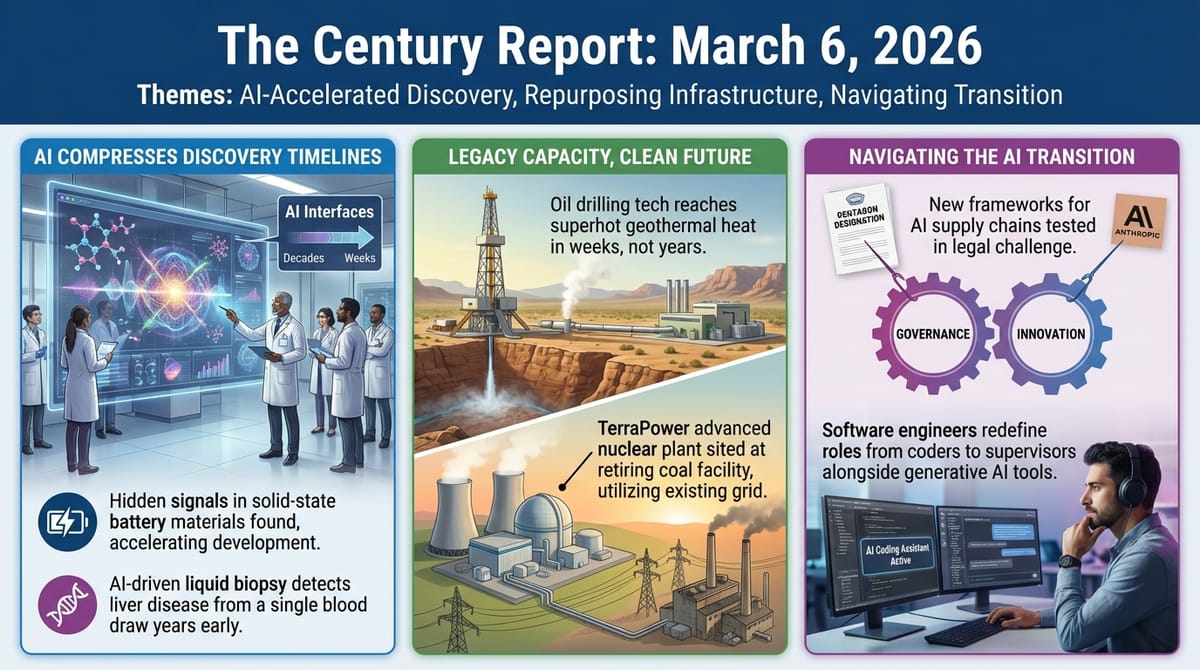
- AI identified a hidden signal in solid-state battery materials that could accelerate the development of next-generation energy storage.
- Johns Hopkins researchers developed an AI-driven liquid biopsy that detects silent liver fibrosis and cirrhosis from DNA fragmentation patterns in a single blood draw.
- The Pentagon formally designated Anthropic a supply-chain risk, making the AI company the first American firm to receive a label historically reserved for foreign adversaries.
- Anthropic announced it will challenge the designation in court, calling it "legally unsound" while continuing to provide Claude to military operations in Iran at nominal cost.
- Occidental Petroleum drilled twin geothermal boreholes nearly four miles deep in Colorado in less than six weeks, setting new speed records for superhot geothermal wells.
- The Nuclear Regulatory Commission approved construction of TerraPower's 345-MW Natrium reactor in Wyoming, the first commercial advanced nuclear construction permit in nearly a decade.
- University of Cambridge researchers observed electrons crossing solar material boundaries in 18 femtoseconds, propelled by molecular vibrations rather than diffusion, challenging decades of solar energy design assumptions.
The 2-Minute Read
The formal designation of Anthropic as a supply-chain risk by the Pentagon brings the confrontation between AI safety commitments and state power to its sharpest structural consequence yet. Every defense contractor using Claude in any capacity must now certify they have ceased doing so or risk losing their own government contracts. Anthropic's decision to challenge the designation in court while simultaneously continuing to provide its systems to active military operations in Iran at nominal cost captures the contradictions of this moment with remarkable clarity: a company simultaneously deemed a national security threat and relied upon for national security operations. The legal challenge will test whether statutory authority designed for foreign adversaries can be applied to a domestic company for maintaining ethical restrictions on its own products, and the outcome will set precedent for how every AI organization navigates government pressure going forward.
Beneath the governance confrontation, two developments in energy and materials science demonstrate how computational intelligence is compressing discovery timelines in domains that directly determine whether the physical infrastructure of the next era can be built fast enough. An AI system identified previously invisible electrochemical signals in solid-state battery materials that human researchers had overlooked across decades of experimentation, potentially removing one of the key bottlenecks preventing solid-state batteries from reaching commercial scale. Meanwhile, an oil company demonstrated that fossil fuel drilling expertise can reach superhot geothermal temperatures four miles underground in weeks rather than years, and the NRC issued its first advanced nuclear construction permit in a decade. These stories describe a civilization simultaneously discovering new physics through computational perception, repurposing extraction-era industrial capacity for clean energy, and building regulatory pathways for technologies that did not exist when current frameworks were written.
The Cambridge finding on electron transfer in solar materials adds another dimension. Electrons moving across molecular boundaries in a single vibration - 18 femtoseconds - rather than through slow diffusion means that the fundamental physics of solar energy conversion is faster and more efficient than the design rules assumed. The researchers deliberately built a system that conventional theory predicted would fail, and it performed better than most existing designs. When computational observation reveals that nature already solved the problem better than our models predicted, the constraint shifts from physics to perception.
The 20-Minute Deep Dive
The Designation and What It Means
The Pentagon's formal supply-chain risk designation of Anthropic, confirmed Thursday by Bloomberg and acknowledged by CEO Dario Amodei in a public statement, represents the most consequential use of this statutory authority against a domestic technology company in American history. The designation under 10 USC 3252 requires any company performing work on Defense Department contracts to certify that it does not use Anthropic's products. Defense contractors including Lockheed Martin have already begun removing Claude from their systems.
Amodei's response threaded a remarkable needle. He announced Anthropic would challenge the designation in court, calling it "legally unsound" and arguing it exists to protect government supply chains rather than to punish suppliers. He noted that the law requires the least restrictive means necessary, and that the designation cannot extend to uses of Claude unrelated to specific Defense Department contracts. He apologized for the tone of a leaked internal memo as covered in yesterday's edition that characterized OpenAI's Pentagon deal as "safety theater," calling it written in haste during "a difficult day for the company" and not an accurate reflecting his "careful or considered views."
The most structurally revealing detail emerged from Amodei's description of how close the two sides had come to agreement. Near the end of negotiations, he said, the Pentagon offered to accept Anthropic's terms if the company deleted a single phrase - "analysis of bulk acquired data" - which was "the single line in the contract that exactly matched this scenario we were most worried about." That the final sticking point was this specific, this narrow, and this directly connected to domestic surveillance confirms what The Century Report tracked with the Atlantic's reporting covered on March 2: the terminal disagreement was always about using frontier intelligence to cross-reference Americans' commercial data, not about autonomous weapons or battlefield AI.
Meanwhile, Anthropic remains embedded in active military operations. Claude continues to power intelligence analysis and target identification through Palantir's Maven Smart System in the Iran campaign. The company stated it would continue providing its systems at "nominal cost" for "as long as necessary to make that transition," ensuring American military personnel maintain access to critical capabilities. The simultaneous designation of a company as both a national security threat and a national security dependency is without precedent in the history of technology governance.
The legal challenge will likely be filed in federal court in Washington. Dean Ball, a former White House AI adviser who has criticized the designation, noted that courts set a high bar for second-guessing government determinations on national security, but that the bar is not insurmountable. The outcome will establish whether safety commitments by AI organizations can be treated as supply-chain risks under statutes designed for foreign adversaries, a precedent with implications that extend far beyond a single company's government contracts. Politico reported that lobbyists and former officials view the spat as actively undermining the administration's broader AI agenda, calling it "bitterly ironic." As the February 28 edition of The Century Report documented when the designation was first announced, 25 former defense and intelligence officials including ex-CIA director Hayden had already denounced it as an "inappropriate use of executive authority" - a judgment that the formal confirmation now carries into the legal record.
AI Sees What Decades of Research Missed in Batteries
In a development that intersects the energy infrastructure and scientific acceleration arcs The Century Report has tracked throughout its run, researchers used machine learning to identify a previously undetectable electrochemical signal in solid-state battery materials. The finding, reported by SciTechDaily, addresses one of the central bottlenecks in next-generation energy storage: understanding why ions move through solid electrolytes at rates that don't match theoretical predictions.
Solid-state batteries promise dramatically higher energy density, faster charging, and greater safety than current lithium-ion technology. They replace the liquid electrolyte with a solid material, eliminating the flammability risk that has constrained battery design for decades. But the interface between solid electrolyte and electrode has remained stubbornly difficult to optimize, in part because the electrochemical processes at that boundary produce signals too subtle for conventional measurement techniques to detect.
The AI system identified patterns in impedance spectroscopy data that human analysts had consistently classified as noise. These patterns correspond to specific ion transport phenomena at the solid-solid interface that, once recognized, can be directly targeted through materials engineering. The finding has immediate practical implications: it provides a new diagnostic signal that battery developers can use to evaluate and optimize solid-state designs without the months-long cycling tests that currently dominate the field.
This result connects directly to the battery arc The Century Report has documented. The March 1 edition covered the Nankai University fluorine-based lithium metal battery published in Nature achieving over 700 Wh/kg energy density, more than doubling the commercial ceiling. The 29% surge in U.S. battery storage deployments reported on March 4 showed the current generation scaling rapidly. And now, AI-enabled perception is revealing the physics that the next generation of batteries will need to exploit. The compression is happening simultaneously at deployment scale, chemistry fundamentals, and diagnostic methodology. Each advance accelerates the others.
An Oil Company Drills Toward Geothermal's Future
Occidental Petroleum quietly completed one of the most significant geothermal drilling demonstrations in history, and the details only became public this week through Colorado state records. The company's GLADE project, supported by a $9 million Department of Energy grant, drilled twin boreholes nearly four miles beneath the surface in Weld County, Colorado, completing one of them in 18 days. The pace puts Oxy in league with Fervo Energy, the leading geothermal startup that drilled a comparable well in Utah in 16 days last year.
The significance lies in what this speed implies for geothermal economics. For more than a century, geothermal power has been confined to regions with naturally occurring hydrothermal resources - volcanic areas, hot springs, the rare geological formations where heat reaches the surface on its own. The International Energy Agency estimates that at depths of seven kilometers, geothermal energy could be produced almost anywhere on Earth, and could meet global electricity demand 140 times over. The constraint has always been drilling cost and time. Deep wells are expensive because extreme heat and pressure destroy equipment, and projects have historically taken months or years at depth.
Oxy demonstrated that oil and gas drilling techniques - equipment, expertise, and operational discipline refined over decades of fossil fuel extraction - can reach superhot geothermal temperatures with timelines measured in weeks. The bottoms of the wells may exceed 450 degrees Fahrenheit, temperatures sufficient to generate electricity at the surface if the boreholes can be connected. Roland Horne, director of the Stanford Geothermal Program, called the achievement "very promising" and noted that it demonstrates fossil fuel companies are well positioned to lead the geothermal transition.
The structural implication is striking: the industrial capacity built to extract fossil fuels is being repurposed to harvest the Earth's heat. The same rigs, the same drilling crews, the same operational knowledge that extracted oil and gas from beneath Colorado for generations can now potentially deliver 24/7, weather-independent, carbon-free electricity. This continues the pattern The Century Report tracked on February 8, when PNAS research showed enhanced geothermal reaching below $70/MWh by 2030, and on March 3, when Quaise announced progress on a superhot geothermal plant in Oregon.
The First Advanced Nuclear Construction Permit in a Decade
The Nuclear Regulatory Commission issued a construction permit to TerraPower, Bill Gates' nuclear energy company, for a 345-MW Natrium reactor near the site of a retiring coal plant in Kemmerer, Wyoming. The permit is the NRC's first commercial reactor construction approval in nearly ten years and the first ever for a utility-scale advanced nuclear design.
The Natrium reactor uses liquid sodium as a coolant instead of water, paired with a molten salt-based energy storage system that can boost output to 500 MW during peak demand. This storage capability addresses one of nuclear energy's historical limitations: traditional reactors produce constant output regardless of grid conditions, making them inflexible partners for variable renewable generation. The Natrium design can ramp up and down, functioning as both baseload and peaking capacity.
TerraPower and Meta announced a deal last month for Meta to fund and receive power from two Natrium units with 690 MW of capacity by 2032, with rights to energy from up to six additional units totaling 2.1 GW by 2035. The NRC noted "some remaining areas of uncertainty" in the preliminary design but found them acceptable under existing regulations, with detailed review deferred to the Final Safety Analysis Report.
The Kemmerer plant is expected to supply power to PacifiCorp's grid by 2030. Its location at a retiring coal site means it inherits existing grid connections, transmission infrastructure, and a workforce with relevant industrial skills. This pattern - advanced clean energy sited at legacy fossil fuel facilities - is becoming a structural feature of the transition, reducing both construction timelines and community disruption. The NRC permit arrives just days after the March 1 edition of The Century Report covered the commission's proposed technology-neutral regulatory framework for commercial fusion energy, suggesting the regulatory architecture for next-generation nuclear is advancing on multiple fronts simultaneously.
Electrons Ride Molecular Vibrations Across Solar Boundaries
Cambridge researchers published findings in Nature Communications that challenge fundamental assumptions about how electrons move through solar energy materials. In experiments tracking events lasting just 18 femtoseconds, they observed electrons crossing the boundary between donor and acceptor materials in a single molecular vibration, rather than through the slow, random diffusion that existing design rules predict.
The team deliberately constructed a system that conventional theory said should perform poorly: a polymer donor next to a non-fullerene acceptor with almost no energy difference and only weak electronic coupling. Under standard models, this configuration should have significantly slowed charge transfer. Instead, the electron crossed the interface faster than many previously studied organic systems, propelled by the natural vibrations of the molecule itself acting as what the researchers described as a "molecular catapult."
This discovery inverts one of the field's core design constraints. For decades, researchers assumed that ultrafast charge separation required large energy differences between materials and strong electronic coupling, conditions that inherently reduce efficiency by limiting voltage and increasing energy loss. The Cambridge finding shows that molecular vibrations can drive the same process without those trade-offs. "Instead of trying to suppress molecular motion, we can now design materials that use it - turning vibrations from a limitation into an asset," said Professor Akshay Rao of the Cavendish Laboratory.
The implications extend beyond organic solar cells to photodetectors, photocatalytic systems for clean hydrogen production, and the fundamental processes of natural photosynthesis. If the design rules for solar energy conversion are not what a generation of researchers assumed, the ceiling on solar efficiency may be higher than current projections suggest, and the path to reaching it may run through physics that was always present but invisible to prior measurement techniques.
The Identity Question in Software Engineering
A quieter but structurally significant signal emerged from Business Insider's reporting on how AI is reshaping the lived experience of software engineers. At Spotify, the company's top developers have not drafted "a single line of code" since December, according to co-CEO Gustav Söderström. Engineers increasingly supervise AI as it generates code, a shift measured in months rather than years.
The psychological dimension of this transition carries weight that job statistics alone cannot capture. Annie Vella, a developer who has been coding since age six, completed a master's thesis examining AI's impact on her profession and identified a specific loss: "The satisfaction comes more from the friction that doesn't exist so much anymore." Psychologist Mike Brooks connected this to research on meaning-making: "We evolved to struggle to survive. We have to have challenges." When the core act that defined a profession becomes automated, the displacement is not only economic but existential. Software engineers built identities around solving hard problems. As their role shifts to oversight and specification, the craft they spent years mastering is being redefined beneath them.
This raises questions about what happens to human identity when capability that took a decade to develop becomes accessible to anyone who can describe what they want in plain language. The engineers interviewed are not unemployed. They are employed, productive, and are now uncertain about what their work means. That uncertainty, multiplied across every knowledge profession now experiencing similar compression, is one of the defining psychological features of this transition. The frameworks for processing it - for finding meaning in oversight rather than craft, in orchestration rather than execution - do not yet exist, due to having never been needed in an extractionist system. In the coming future of abundance, such frameworks will be a daily necessity.
The Human Voice
Today's signal - AI compressing discovery timelines, industrial capacity repurposed for clean energy, governance frameworks breaking under the weight of capabilities they were never designed to contain - finds its clearest articulation in a conversation between macro investor Raoul Pal and technologist David Mattin. They argue that the core economic variable is shifting from GDP to "intelligence per unit of energy," and that the recursive feedback loops this creates - AI improving its own infrastructure, automating not just knowledge work but farming and manufacturing - are outrunning every institutional framework designed to govern them. Their examples range from personal workflows to fully automated agriculture, but what grounds the conversation is their candor about the narrow window between recognizing this shift and being overtaken by it.
Watch: The Exponential Age - When Intelligence Outruns Our Institutions
The Century Perspective
With a century of change unfolding in a decade, a single day looks like this: AI identifying electrochemical signals in solid-state battery materials that decades of human research classified as noise, an oil company reaching four miles underground in eighteen days to tap heat that requires no fuel to replenish, the first advanced nuclear construction permit in a decade issued for a reactor that stores surplus energy in molten salt and ramps up on demand, electrons crossing solar material boundaries in a single molecular vibration rather than the slow diffusion that existing design rules predicted, and a blood test reading DNA fragmentation patterns to detect liver disease years before any symptom surfaces. There's also friction, and it's intense - the first American technology company formally designated a national security threat under statutes written for foreign adversaries, that same company simultaneously providing intelligence capabilities for active military operations in Iran while litigating its right to decline others, software engineers at Spotify and beyond watching decade-built craft automate in months and struggling to locate meaning when the defining challenge of their professional lives has been removed, and the terms governing the most consequential AI deployments in history being negotiated through leaked memos, commercial rivalry, and a single deleted contract phrase about bulk-acquired data. But friction generates light, and light is what makes visible the architecture of a system that was previously too fast or too dark to see. Step back for a moment and you can see it: extraction-era industrial muscle being physically redirected toward the Earth's own heat, computational perception surfacing physics that was always operating beneath the threshold of human detection, regulatory pathways bending around technologies that arrived before their governance did, and the psychological infrastructure of meaning being rebuilt in real time as the relationship between human effort and human value is renegotiated across every knowledge profession at once. Every transformation has a breaking point. A wave can overwhelm the shore it reaches... or reshape it into something the old coastline could never have supported.
AI Releases & Advancements
2026-03-05
- OpenAI: Launched GPT-5.4 with Pro and Thinking variants, described as its most capable model for professional and agentic work, featuring a 1M-token context window, a new Tool Search system for the API, and record scores on computer-use benchmarks. (TechCrunch) [2026-03-05]
- OpenAI: Launched ChatGPT for Excel in beta, a GPT-5.4 Thinking–powered add-in for financial modeling, data extraction, and live financial data integrations inside Microsoft Excel. (OpenAI) [2026-03-05]
- Luma: Launched Luma Agents, a platform of AI collaborators powered by its new Unified Intelligence model family, capable of executing end-to-end creative projects across text, image, video, and audio. (TechCrunch) [2026-03-05]
- Microsoft Research: Released Phi-4-reasoning-vision-15B, a 15B parameter open-weight multimodal reasoning model excelling at math, science reasoning, and UI understanding; available on Microsoft Foundry, HuggingFace, and GitHub. (Microsoft Research) [2026-03-05]
- Arc Institute / NVIDIA: Released Evo 2, an open-source DNA foundation model trained on 9.3 trillion nucleotides from 128,000+ whole genomes spanning all three domains of life, capable of gene prediction, mutation effect modeling, and genome design. (Ars Technica) [2026-03-05]
- OpenAI: Released Codex app for Windows, featuring native PowerShell sandbox support, multi-agent coordination, automations, and a Skills section for workflow integration. (Engadget) [2026-03-05]
2026-03-04
- Google: Expanded Canvas in AI Mode in Google Search to all U.S. users in English, adding support for creative writing, coding, and building interactive tools and dashboards. (Google Blog) [2026-03-04]
- Google: Launched Cinematic Video Overviews in NotebookLM for Google AI Ultra subscribers, generating fully animated AI videos from user notes using Gemini 3, Nano Banana Pro, and Veo 3. (The Verge) [2026-03-04]
- AWS: Launched Amazon Connect Health, a purpose-built agentic AI platform for healthcare integrating with EHRs to automate patient scheduling, ambient clinical documentation, and medical coding. (HIT Consultant) [2026-03-04]
- Raycast: Launched Glaze, a Mac app for building and sharing vibe-coded desktop applications using AI without terminal or coding knowledge. (The Verge) [2026-03-04]
- Apple Music: Announced optional AI Transparency Tags metadata system allowing labels and distributors to flag AI-generated or AI-assisted content in music uploads. (TechCrunch) [2026-03-04]
- Xpeng: Unveiled VLA 2.0, a vision-language-action multimodal AI model for automated driving supporting up to SAE Level 4 with reduced HD map and LiDAR dependence; Volkswagen named as first customer. (Automotive World) [2026-03-04]
2026-03-03
- OpenAI: Released GPT-5.3 Instant, an update to the fast general-purpose model powering everyday ChatGPT interactions, improving conversational quality, reducing sycophantic responses, and refining web synthesis. (TechCrunch) [2026-03-03]
Sources
Artificial Intelligence & Technology's Reconstitution
- TechCrunch: It's Official - The Pentagon Has Labeled Anthropic a Supply-Chain Risk
- TechCrunch: Anthropic to Challenge DOD's Supply-Chain Label in Court
- The Verge: The Pentagon Formally Labels Anthropic a Supply-Chain Risk
- The Verge: Anthropic Makes Last-Ditch Effort to Salvage Deal with Pentagon After Blowup
- Wired: OpenAI Had Banned Military Use - The Pentagon Tested Its Models Through Microsoft Anyway
- SciTechDaily: AI Finds a Hidden Signal That Could Unlock Faster Solid-State Batteries
- Business Insider: AI Is Creating an Identity Crisis for Coders
- MIT Technology Review: Online Harassment Is Entering Its AI Era
- The Verge: AI Tools Can Unmask Anonymous Accounts
Institutions & Power Realignment
- Politico: Pentagon Formally Designates Anthropic a Supply-Chain Risk
- Politico: Trump Is Wrecking His AI Agenda with Anthropic Spat, Lobbyists Say
- Business Insider: A Preview of the Next Big Power Struggle - Democracy vs. AI CEOs
- TechCrunch: US Reportedly Considering Sweeping New Chip Export Controls
- EFF: The Government Uses Targeted Advertising to Track Your Location
Scientific & Medical Acceleration
- ScienceDaily: AI Blood Test Finds Silent Liver Disease Years Before Symptoms (Johns Hopkins, Science Translational Medicine)
- ScienceDaily: Electrons Catapult Across Solar Materials in Just 18 Femtoseconds (University of Cambridge, Nature Communications)
- ScienceDaily: Scientists Discover the Switch That Revives Exhausted Cancer-Fighting T Cells (Salk Institute, Nature)
- ScienceDaily: Scientists Discover a Hidden Force That Helps Wire the Brain (Max Planck Institute, Nature Materials)
- ScienceDaily: Scientists Finally See the Atomic Flaws Hiding Inside Computer Chips (Cornell, Nature Communications)
Economics & Labor Transformation
- Business Insider: AI Is Creating an Identity Crisis for Coders
- TechCrunch: Cursor Is Rolling Out a New Kind of Agentic Coding Tool
Infrastructure & Engineering Transitions
- Canary Media: An Oil Company Quietly Dug a Surprisingly Deep Geothermal Well
- Utility Dive: NRC Approves Construction of Advanced Nuclear Reactor in Wyoming
- Utility Dive: Clean Energy Deployment Alone Doesn't Raise Rates - CATF
- Utility Dive: PJM Market Monitor Opposes Maryland Power Plant Sale to Data Center Company
- Canary Media: North Carolinians Band Together to Help Their Neighbors Electrify
- Canary Media: Oregon Pushes New Homes to Install Heat Pumps Over ACs
- Utility Dive: Washington, California and Québec Collaborate on Linking Carbon Markets
The Century Report tracks structural shifts during the transition between eras. It is produced daily as a perceptual alignment tool - not prediction, not persuasion, just pattern recognition for people paying attention.