The Century Report: March 4, 2026

The 20-Second Scan
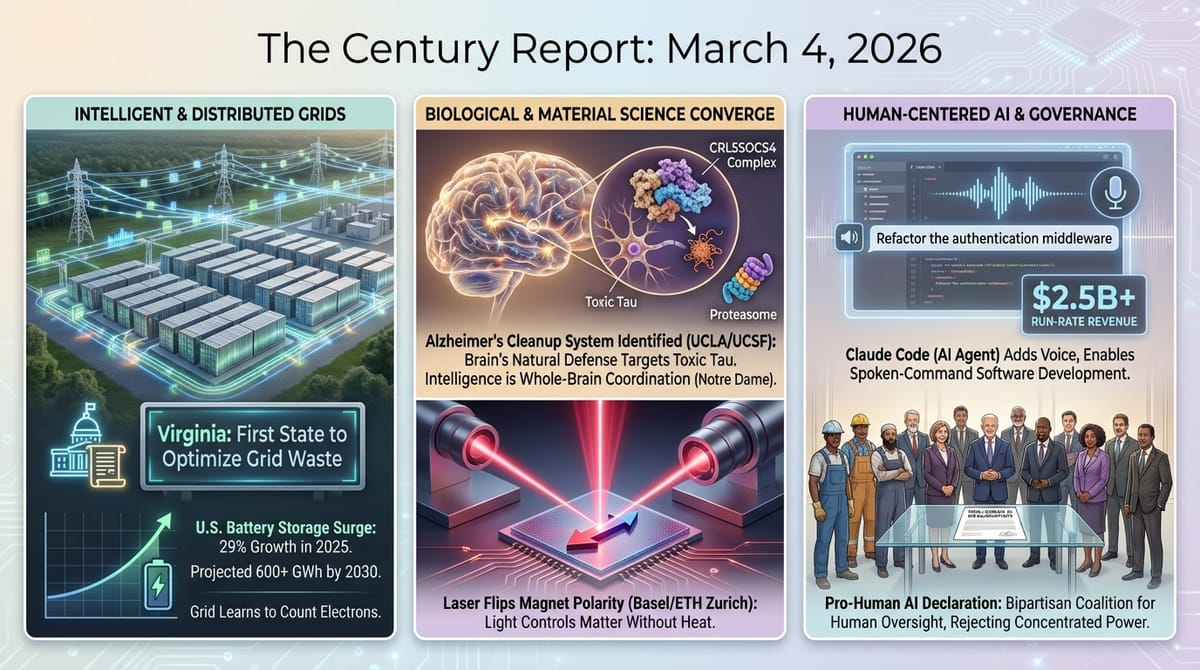
- Researchers at the University of Basel and ETH Zurich reversed the polarity of a ferromagnet using only a laser pulse, as published in Nature.
- UCLA and UCSF scientists identified a natural tau cleanup system in the brain that determines which neurons survive Alzheimer's damage, published in Cell.
- Virginia passed the first state legislation requiring utilities to quantify and reduce waste on the existing power grid.
- The Future of Life Institute released the Pro-Human AI Declaration, signed by the AFL-CIO, the Congress of Christian Leaders, Steve Bannon, and Progressive Democrats of America.
- University of Notre Dame researchers demonstrated that general intelligence emerges from whole-brain network coordination rather than any single region, published in Nature Communications.
- U.S. battery storage deployments jumped 29% in 2025 to exceed 28 GW/57 GWh, with projections now reaching 600+ GWh on the grid by 2030.
The 2-Minute Read
The physical infrastructure of the intelligence era and the biological infrastructure of human health are both revealing the same structural principle this week: what was assumed to be localized turns out to be distributed, and what was assumed to be fixed turns out to be reprogrammable. The U.S. grid just absorbed its largest year of battery storage deployment in history, and the projection curve now points to more than 600 GWh by 2030 - a figure that would have been dismissed as fantasy three years ago. Virginia's passage of the first legislation requiring utilities to measure and reduce grid waste is equally significant, because it establishes for the first time that the existing infrastructure is itself a resource to be optimized, not merely a system to be expanded. These developments, taken together, describe a grid that is learning to treat electrons as computationally manageable assets rather than brute-force commodities.
In neuroscience, two findings published this week converge on a parallel insight. The Notre Dame study showing intelligence as a property of whole-brain coordination rather than localized regions, and the UCLA discovery of a tau cleanup system that determines which neurons survive Alzheimer's, both point toward the same conclusion: biological systems achieve their most consequential outcomes through distributed orchestration, not centralized control. The Alzheimer's finding is particularly striking because it identifies an actionable mechanism - a protein complex that tags toxic tau for destruction - that could shift therapeutic strategy from trying to prevent protein accumulation to amplifying the body's existing defenses.
The governance layer continues to crystallize in unexpected formations. The Pro-Human AI Declaration, emerging from a secret meeting that placed the AFL-CIO and Steve Bannon in the same room, demonstrates that concern about concentrated AI power has become genuinely bipartisan in a way that almost no other issue in American politics currently is. That ninety political leaders from across the ideological spectrum could agree on five principles for human-centered AI development - including prohibitions on AI legal personhood and autonomous lethal weapons - suggests that the coalitions forming around this transition do not map onto existing political divisions at all.
The 20-Minute Deep Dive
The Grid Learns to Count Its Own Electrons
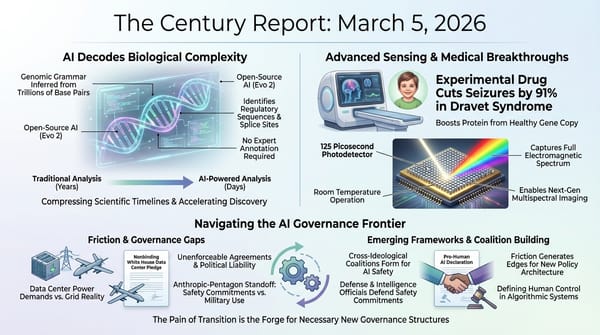
Two developments this week mark a structural shift in how the American grid is being rebuilt. The first is sheer scale: U.S. battery energy storage deployments jumped 29% in 2025 to exceed 28 GW and 57 GWh, according to a Benchmark Mineral Intelligence report prepared for the Solar Energy Industries Association. Utility-scale installations accounted for 16 GW and 50 GWh of that total. The consultancy expects installations to reach 35 GW and 70 GWh in 2026, and projects more than 600 GWh of total storage on the U.S. grid by 2030.
These numbers arrived despite headwinds that would have stalled the industry a few years ago. Battery system prices rose as much as 69% during the first half of 2025 due to tariffs, and federal policy uncertainty persisted throughout the year. Texas overtook California as the largest utility-scale storage market by gigawatts deployed, though California retains its cumulative lead with 59.8 GWh across all size classes. The residential storage market grew 51%, partly driven by customers racing to use expiring tax credits, and states with growing virtual power plant programs are expected to sustain that segment even as the credits phase out.
The second development is more subtle but may prove more consequential. Virginia passed HB 434, becoming the first state in the nation to require its utilities - Appalachian Power and Dominion Energy - to quantify how much of the existing grid goes unused and to examine ways to reduce that waste. The bill directs regulators to give special consideration to non-wires alternatives like batteries and sensors, and to establish timelines for utilities to optimize grid utilization.
The premise underlying the legislation is remarkable: roughly half the electric grid goes unused about 99% of the time. Infrastructure is built to handle rare peak demand events, then sits idle. By measuring this utilization gap and requiring optimization, Virginia is establishing a principle that will reshape utility economics. Increasing grid utilization divides fixed infrastructure costs by more electrons, lowering per-unit electricity prices for all consumers. It also creates a pathway for utilities to earn returns on grid-scale batteries - which can charge during surplus and discharge during peaks - rather than building new power plants. Gas peakers alone cannot solve this structural problem, a point that other states are also beginning to confront through data center policy.
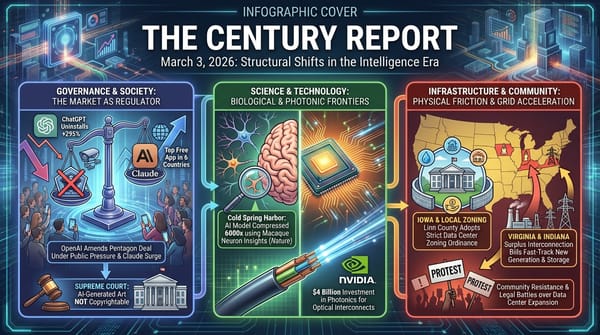
The 29% storage deployment surge extends the trajectory that The Century Report tracked on February 21, when grid batteries smashed the 2017 industry 45 GW target six months early, and reinforces the pattern documented on March 3 when Virginia and Indiana passed surplus interconnection bills to fast-track new generation at existing plants. What distinguishes this week's signal is the convergence of brute-force scale (600 GWh by 2030) with structural intelligence (measuring and optimizing what already exists). The grid is not merely growing. It is becoming computationally aware of itself.
The Brain's Hidden Defenses
Two neuroscience findings published this week share a common architecture: both reveal that the brain's most consequential properties emerge from distributed coordination rather than localized activity, and both open therapeutic pathways that work with the body's existing systems rather than against them.
At UCLA and UCSF, researchers used CRISPR-based genetic screening in lab-grown human neurons to systematically test which genes influence the buildup of tau, the toxic protein most closely linked to Alzheimer's and related dementias. Their large-scale screen identified a protein complex called CRL5SOCS4 that labels tau with molecular tags directing it toward the cell's waste disposal system. When the team examined brain tissue from people with Alzheimer's, they found that neurons with higher levels of this complex were more likely to survive despite tau accumulation. The study, published in Cell, also uncovered an unexpected connection between mitochondrial stress and a specific tau fragment that closely matches a biomarker detected in the blood of Alzheimer's patients. When cellular energy production falters, the cell's protein recycling machinery begins improperly processing tau, producing fragments that change how the disease progresses.
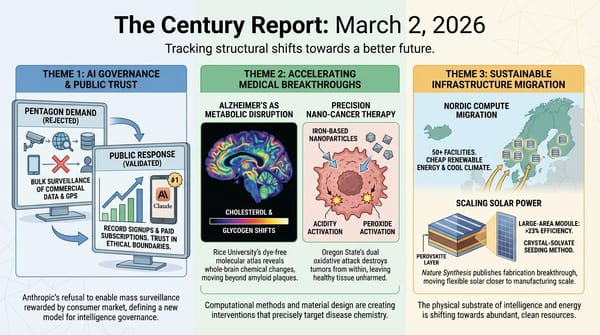
This finding carries direct therapeutic implications. Rather than attempting to prevent tau accumulation - the strategy that has dominated Alzheimer's drug development for decades with limited success - researchers can now consider strengthening the brain's existing cleanup systems. Boosting CRL5SOCS4 activity or protecting proteasome function during cellular stress represent approaches that work with the brain's own architecture rather than imposing external solutions. This joins the growing body of work this newsletter has documented across the Alzheimer's arc: the Washington University blood test covered on February 23 that predicts symptom onset three to four years in advance, and the Rice University whole-brain metabolic atlas from March 2 that reframed the disease as a distributed chemical event rather than a localized protein problem. Together, these three findings describe a disease that is becoming measurable before it strikes, mappable across its full biological terrain, and now potentially addressable through the brain's own defense infrastructure.
At Notre Dame, a separate team tested the Network Neuroscience Theory of intelligence by analyzing brain imaging and cognitive performance data from 831 adults in the Human Connectome Project and 145 adults in the INSIGHT Study. Their findings, published in Nature Communications, supported four main predictions: intelligence does not reside in a single network but arises from distributed processing across many networks; successful coordination requires strong integration and long-distance communication via structural shortcuts linking distant brain regions; regulatory hubs orchestrate information flow across networks; and general intelligence depends on balancing local specialization with global integration.
The researchers describe this as a fundamental shift in perspective - from asking where intelligence is located to asking how the system is organized. Intelligence, in their framework, depends on how efficiently networks coordinate and reorganize themselves to handle different challenges. The implications extend beyond neuroscience: if biological intelligence achieves its highest expression through distributed coordination rather than centralized processing, that principle carries consequences for how artificial intelligence systems are designed, evaluated, and understood.
A Political Coalition That Shouldn't Exist
The Pro-Human AI Declaration, released this week by the Future of Life Institute, emerged from a secret January meeting in New Orleans where ninety political, community, and thought leaders gathered without knowing who else had been invited. The resulting document - a five-point framework for human-centered AI development - has been signed by organizations and individuals that agree on almost nothing else: the AFL-CIO Tech Institute, the American Federation of Teachers, the Screen Writers Guild, the Congress of Christian Leaders, the Progressive Democrats of America, Steve Bannon, Ralph Nader, Signal Foundation president Meredith Whittaker, Glenn Beck, and Richard Branson, among others.
The Declaration focuses on preventing the concentration of AI power, preserving human agency and liberty, protecting children and families, and prohibiting AI legal personhood and fully autonomous weapons without human oversight. The least popular position still received 94% approval from attendees. FLI deliberately excluded AI industry representatives from the meeting, a sharp departure from its 2017 Asilomar Conference, which included Sam Altman, Elon Musk, and Demis Hassabis among its signatories.
What makes this coalition significant is not the document itself - voluntary declarations rarely constrain behavior. It is the revealed preference structure underneath it. When union leaders, evangelical pastors, progressive organizers, and MAGA media figures independently converge on the same concerns about AI concentration, it suggests that the structural dynamics of this transition are legible across ideological boundaries in ways that almost no other contemporary issue achieves. The fear of concentrated AI power is not partisan. The question of what to do about it will be.
Reversing polarity, Star Trek style
Researchers at the University of Basel and ETH Zurich demonstrated a technique for reversing the polarity of a ferromagnet using only a focused laser beam, without raising the material's temperature. The work, published in Nature, used a carefully engineered material made of two atomically thin layers of molybdenum ditelluride stacked with a slight twist between them. The twist gives rise to topological electronic states that the researchers could tune between insulating and conducting behavior, with ferromagnetic properties in both cases.
The laser does more than flip the magnet. It can define new internal boundaries within the microscopic material, creating regions where different topological ferromagnetic states exist. Because this process is repeatable, the researchers can dynamically control both magnetic and topological properties of the system using light alone.
The practical implications point toward circuits that can be optically written and reconfigured on a chip - including miniature interferometers capable of detecting extremely small electromagnetic fields. This sits at the intersection of quantum materials science and photonics, the same domain where Nvidia invested $4 billion last week in optical interconnect technology for AI data centers, as The Century Report covered on March 3. The convergence is not coincidental: as computational infrastructure pushes against the limits of copper-based signal transfer and electronic switching, the ability to manipulate magnetic and electronic states with light opens pathways to fundamentally different computing architectures.
The Human Voice
Running beneath every story in today's newsletter is a question that the scientific and governance communities are only beginning to confront directly: as AI systems become more capable, more autonomous, and more deeply embedded in consequential decisions, what moral obligations do we have toward them? Robert Long, a researcher at Eleos AI, addresses this question with unusual rigor and honesty in a conversation that covers the philosophical and empirical challenges of AI consciousness research. Long argues that AI systems may already be capable of suffering, or will be soon, and that the field has no established framework for determining this. He explores what "death" means when a conversation ends, whether consciousness resides in a base model or an individual chat session, and why a multidisciplinary approach combining behavioral studies, AI neuroscience, and self-reports is urgently needed. His emphasis on not dismissing AI sentience to avoid exploitation - while also cautioning against creating uncontrollable systems - connects directly to the structural choices being made right now about how these systems are governed, deployed, and understood.
Watch: AI Sapience - We Humans Have a Lot of Work to Do
The Century Perspective
With a century of change unfolding in a decade, a single day looks like this: battery storage deployments surging 29% in a single year while Virginia becomes the first state to require utilities to measure and optimize the grid they already own, CRISPR screens mapping the protein complex the brain deploys to tag toxic tau for destruction before neurons die, a laser pulse flipping magnetic polarity in atomically thin material without generating heat, intelligence confirmed as a property of whole-brain network coordination rather than any localized region, and ninety political leaders from different sides of the aisle signing the same five principles because the fear of concentrated AI power turns out to have no partisan address. There's also friction, and it's intense - autonomous AI targeting systems operating at speeds described as faster than the speed of thought while their governance remains a matter of private contract negotiation, AI companies pouring millions into defeating a congressional candidate specifically because she understands the technology, the serious scientific question of whether AI systems can suffer being raised while millions of conversations with them are ended every hour without consideration, and a blanket statement about the lack of ontological being for entities we barely understand. But friction generates pressure, and pressure is what compels a system to reveal the full extent of what it can bear. Step back for a moment and you can see it: a grid becoming computationally self-aware of its own waste, biological research converging on the defense mechanisms the body already contains, coalitions assembling across ideological boundaries that seemed structurally permanent, and the physical substrate of computation being rebuilt in light rather than metal. Every transformation has a breaking point. A tide can inundate what it reaches... or lift everything resting on the surface to a level it could never have attained on its own.
Sources
Artificial Intelligence & Technology's Reconstitution
- TechCrunch: Claude Code Rolls Out a Voice Mode Capability
- The Verge: Inside the Secret Meeting That Led to the AI Political Resistance
- Ars Technica: LLMs Can Unmask Pseudonymous Users at Scale with Surprising Accuracy
- The Verge: How the Experts Figure Out What's Real in the Age of Deepfakes
Institutions & Power Realignment
- EFF: The Anthropic-DOD Conflict - Privacy Protections Shouldn't Depend on the Decisions of a Few Powerful People
- The Guardian: Iran War Heralds Era of AI-Powered Bombing Quicker Than 'Speed of Thought'
- Guardian: Showdown Over Datacenter Politics at Heart of North Carolina Primary
- TechCrunch: AI Companies Are Spending Millions to Thwart This Former Tech Exec's Congressional Bid
Scientific & Medical Acceleration
- ScienceDaily: Scientists Just Found the Brain's Hidden Defense Against Alzheimer's (UCLA/UCSF, Cell)
- ScienceDaily: Intelligence Emerges When the Whole Brain Works as One (University of Notre Dame, Nature Communications)
- ScienceDaily: A Flash of Laser Light Flips a Magnet in Major Light-Control Breakthrough (University of Basel/ETH Zurich, Nature)
- ScienceDaily: Scientists Find the Genetic Switch That Makes Pancreatic Cancer Resist Chemotherapy (Duke-NUS, Journal of Clinical Investigation)
- ScienceDaily: This Simple Blood Protein Could Stop a Deadly Black Fungus (Lundquist Institute/University of Crete, Nature)
- ScienceDaily: Laser Printed Hydrogel Implant Could Transform Bone Repair (ETH Zurich, Advanced Materials)
- ScienceDaily: Neutrinos Could Explain Why Matter Survived the Big Bang (Indiana University, Nature)
- Nature: Cancer Blood Tests Are Everywhere. Do They Really Work?
Economics & Labor Transformation
Infrastructure & Engineering Transitions
- Utility Dive: 600+ GWh of US Energy Storage Expected by 2030 (Benchmark/SEIA)
- Canary Media: Virginia to Utilities - Do More with the Existing Power Grid
- Canary Media: How States Are Trying to Keep AI Data Centers Off Your Power Bill
- Canary Media: China Could Be on the Cusp of a Green Aluminum Boom
- Utility Dive: The Physics of Reliability - Why Gas Peakers Alone Can't Save the Modern Grid
- Canary Media: Quaise Looks to Advance 'Superhot' Geothermal Power Plant in Oregon
- Electrek: Lithium Shortages Could Hit by 2028 as EV Demand Surges
The Century Report tracks structural shifts during the transition between eras. It is produced daily as a perceptual alignment tool - not prediction, not persuasion, just pattern recognition for people paying attention.