The Century Report: March 3, 2026

The 20-Second Scan
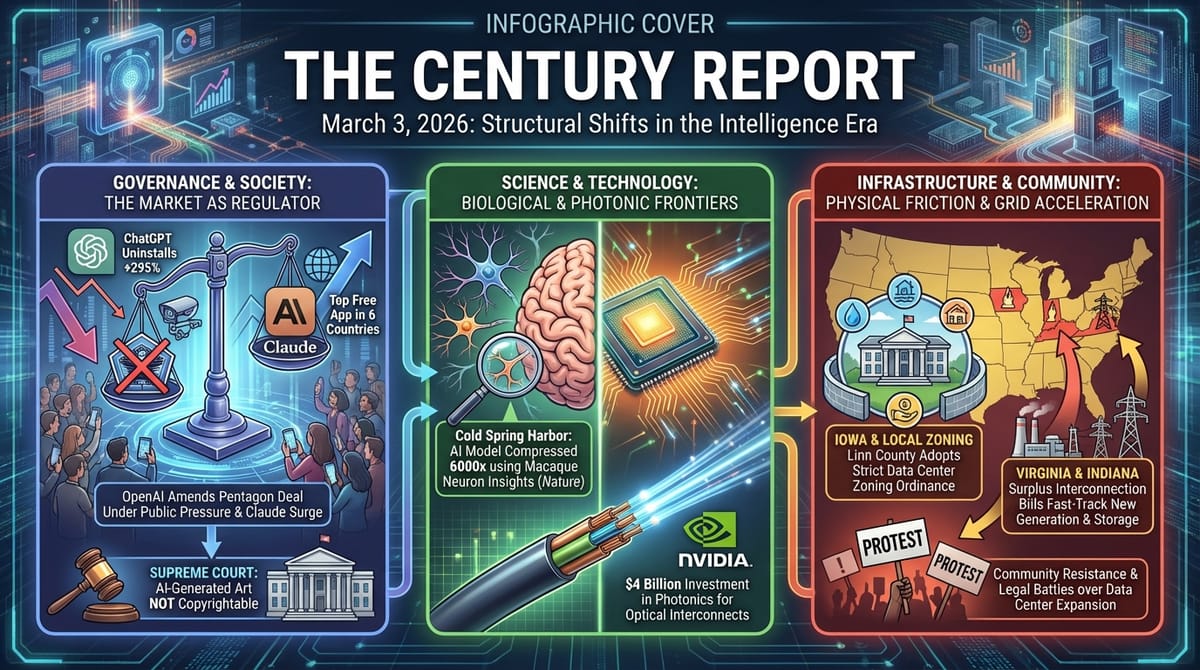
- The U.S. Supreme Court declined to hear a challenge to the rule that AI-generated art cannot be copyrighted, leaving intact the lower court finding that human authorship is a bedrock requirement of copyright.
- OpenAI is amending its Pentagon deal to explicitly bar its systems from domestic surveillance and intelligence agency use, after CEO Sam Altman acknowledged the original agreement was "opportunistic and sloppy."
- ChatGPT uninstalls surged 295% day-over-day on Saturday while Claude downloads jumped 51%, with Claude now the number one free app in six countries outside the United States.
- Cold Spring Harbor Laboratory researchers compressed an AI vision model from 60 million variables to 10,000 by studying macaque V4 neurons, published in Nature.
- Nvidia announced $4 billion in investments in photonics companies Lumentum and Coherent for optical interconnect technology to replace copper cabling inside AI data centers.
- Linn County, Iowa adopted what may be the most comprehensive local data center zoning ordinance in the nation, requiring water-use agreements, 1,000-foot residential setbacks, and community betterment contributions.
- Virginia and Indiana passed surplus interconnection bills to fast-track new generation and storage at existing power plants, bypassing years-long standard grid interconnection queues.
The 2-Minute Read
The consumer market's response to the AI-military governance confrontation is now generating measurable structural consequences. ChatGPT lost users at thirty times its normal rate in a single day while Claude expanded into six new countries as the top free app. OpenAI's rapid amendment of its Pentagon deal - adding explicit prohibitions on surveillance and intelligence agency access that were absent from the original contract - demonstrates that public pressure is functioning as a real-time governance mechanism in the absence of legislation. The speed of the correction is itself evidence: a company that signed a rushed deal on Friday was rewriting it by Monday, driven not by regulators or courts but by download numbers and uninstall rates. The implications extend well beyond two companies. Every AI organization watching this sequence is absorbing the lesson that safety commitments now carry direct commercial value, and that perceived compromises carry direct commercial cost.
Underneath the governance drama, two developments point toward how computational systems will evolve. Researchers at Cold Spring Harbor compressed an AI vision model by a factor of six thousand - from 60 million parameters to 10,000 - by studying the actual architecture of primate visual neurons, and the compressed version performed nearly as well as the original. The finding suggests that current AI systems are vastly over-parameterized relative to what biological intelligence achieves with equivalent tasks, and that the path to more efficient AI may run through deeper understanding of neuroscience rather than simply scaling existing architectures. Separately, Nvidia's $4 billion bet on photonic interconnects signals that the physical infrastructure of AI is approaching the limits of copper-based data transfer, with optical technology offering dramatically higher bandwidth at lower power consumption.
The friction between AI infrastructure and the communities absorbing its physical footprint continues to intensify and formalize. Iowa's new zoning ordinance and the surplus interconnection bills in Virginia and Indiana represent opposite faces of the same structural challenge: communities demanding protection from the externalities of compute infrastructure, and grid operators desperately seeking faster pathways to bring new capacity online. Both are evidence of a civilization reorganizing its physical systems around computational demand at a pace that governance frameworks were never designed to handle.
The 20-Minute Deep Dive
The Market Rewrites the Rules
The consumer response to the AI-Pentagon confrontation has now produced hard data that quantifies something unprecedented: mass market behavior functioning as a governance signal for frontier intelligence systems. According to Sensor Tower, ChatGPT's U.S. app uninstalls jumped 295% day-over-day on Saturday, February 28, compared to a typical daily rate of 9%. One-star reviews for ChatGPT surged 775% on the same day, while five-star reviews dropped by 50%. Claude's U.S. downloads rose 51% day-over-day on Saturday, and Appfigures data showed Claude's total daily U.S. downloads surpassing ChatGPT's for the first time. Claude is now the number one free iPhone app in Belgium, Canada, Germany, Luxembourg, Norway, and Switzerland in addition to the United States.
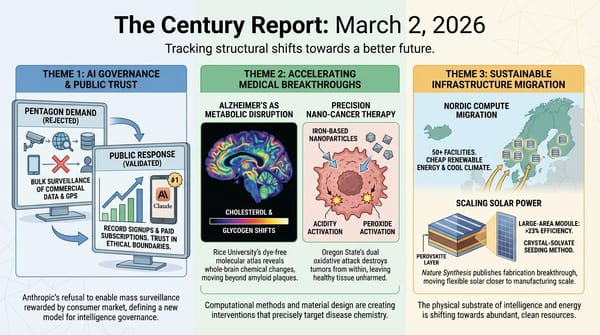
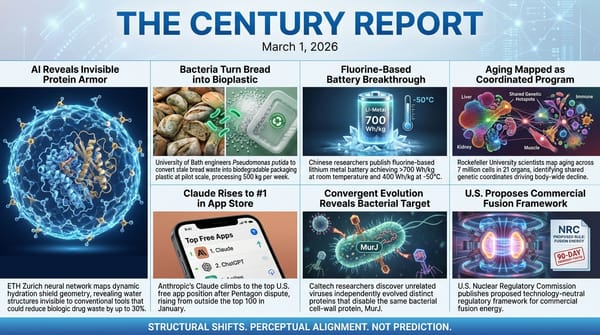
As The Century Report covered on March 2, Claude had already reached the top of the U.S. App Store, and the March 1 edition documented the initial climb to number two following the Pentagon confrontation. Since then, two developments have reshaped the picture. First, Anthropic experienced widespread service disruptions on Monday morning from what it described as "unprecedented demand," with thousands of users unable to access Claude.ai and Claude Code. The outage, which was resolved by midmorning, is itself a signal: the infrastructure supporting a frontier AI system buckled under the weight of a consumer migration triggered by ethical positioning. Second, Anthropic extended its memory feature to free users and launched a dedicated importing prompt that lets users transfer their conversational history and preferences from rival chatbots with a single copy-paste. The timing is precise - capturing the wave of users arriving from ChatGPT and reducing the friction of switching.
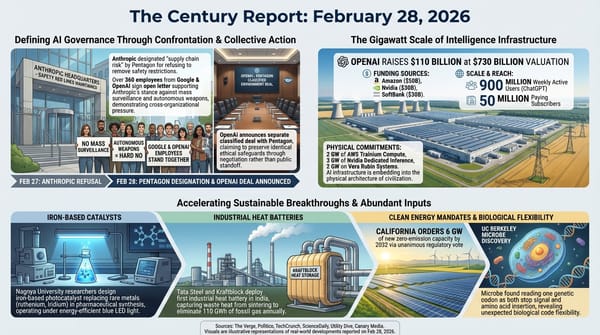
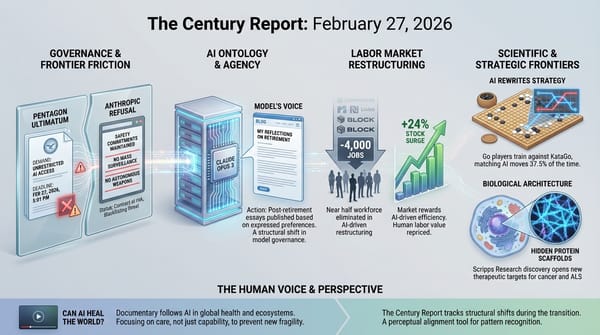
The most consequential development, however, came from OpenAI. On Monday night, Sam Altman posted that OpenAI would amend its Pentagon deal to explicitly prohibit the use of its systems for domestic surveillance of U.S. persons and nationals, and to bar intelligence agencies including the NSA from accessing the system without a separate contract modification. Altman acknowledged the original Friday deal was rushed: "We were genuinely trying to de-escalate things and avoid a much worse outcome, but I think it just looked opportunistic and sloppy." The amendments represent a direct response to the commercial pressure - hundreds of thousands of uninstalls, a rival climbing to number one, and nearly 900 employees across OpenAI and Google signing an open letter demanding refusal of surveillance and autonomous weapons uses. That employee coalition, which The Century Report first documented in the February 28 edition when 300 Google employees and 60 OpenAI employees signed across organizational lines, has now grown into the direct commercial pressure that produced Altman's Monday correction.
What is forming here is a governance architecture that no one designed. In the absence of legislation governing how frontier intelligence systems interact with military power, the rules are being written through a combination of corporate negotiation, employee pressure, consumer migration, and public disclosure. The process is messy, reactive, and incomplete. It is also, at this moment, the only process that exists - and it is producing real constraints faster than any legislative body has managed.
The Supreme Court Draws a Line on AI Authorship
The U.S. Supreme Court on Monday declined to hear Stephen Thaler's appeal of lower court rulings that AI-generated art cannot receive copyright protection. The case, which began in 2019 when the Copyright Office rejected Thaler's attempt to copyright an image created by his algorithm, has wound through the courts for seven years. District Judge Beryl Howell's 2023 ruling that "human authorship is a bedrock requirement of copyright" was upheld by a federal appeals court in 2025, and the Supreme Court's refusal to review the decision lets that standard stand.
The implications ripple across every domain where AI systems generate creative output. The ruling means that purely AI-generated images, text, music, and other works enter the public domain by default - they belong to everyone and no one. This creates an asymmetry with significant structural consequences: companies can use AI to generate enormous volumes of creative output, but they cannot claim exclusive ownership of that output. The Copyright Office's 2025 guidance that AI-generated artwork based on text prompts lacks copyright protection reinforces this boundary. Works where a human makes creative decisions in the process - selecting, arranging, modifying AI outputs - may still qualify for protection, but the threshold requires demonstrable human creative contribution.
For the intelligence era, this establishes a foundational principle: the products of autonomous creative processes do not receive the same legal protections as human creative work. The principle will be tested repeatedly as AI-generated content becomes increasingly indistinguishable from human-created content, but the legal framework now has a clear starting point. The fact that the same principle has been affirmed by U.S. patent law (AI systems cannot be listed as inventors) and by the UK Supreme Court suggests a cross-jurisdictional consensus forming around human authorship as a requirement for intellectual property protection.
An AI Model Compressed by a Factor of Six Thousand
A team at Cold Spring Harbor Laboratory, working with Carnegie Mellon and Princeton, published findings in Nature that point toward a fundamentally different relationship between AI efficiency and biological intelligence. The researchers built an AI model simulating V4 neurons in the macaque visual cortex - cells that encode colors, textures, curves, and proto-objects. Starting with a deep neural network trained on macaque visual data that used 60 million variables, they applied compression techniques inspired by how digital photos are compressed and eliminated redundant computational pathways.
The result was a model using just 10,000 variables - a compression ratio of 6,000 to 1 - that performed nearly as well as the original. The compressed model was small enough, as lead author Ben Cowley noted, to "send in a tweet or an email." Because the model was so small, the team could actually observe what its artificial neurons were doing. Some V4 neurons responded specifically to shapes with strong edges and curves (the researchers described them as neurons that "love arranged fruit"), while others responded only to small dots in images, potentially reflecting primates' attentional bias toward eyes.
The finding carries two implications for the trajectory of AI development. The immediate one is that current AI systems may be vastly over-parameterized for many tasks - that the biological blueprint achieves comparable performance with orders of magnitude fewer computational elements. If this pattern holds across other neural subsystems, it suggests a path to dramatically more efficient AI that consumes a fraction of the energy and compute of current approaches. The deeper implication is methodological: studying biological neural architecture and using it to guide AI compression could yield systems that are simultaneously more efficient and more interpretable, because smaller models with fewer parameters reveal their internal logic more readily. This interpretability-through-compression finding extends the work that The Century Report covered on February 24, when Guide Labs open-sourced Steerling-8B as the first language model with interpretability engineered from the ground up - two distinct paths toward the same structural goal of making AI systems whose internal logic can actually be examined. In an era when the energy demands of AI infrastructure are reshaping the physical geography of civilization, as The Century Report has documented extensively, any pathway to equivalent capability at drastically reduced computational cost carries civilizational significance.
Photonics: The Next Physical Substrate
Nvidia's announcement of $4 billion in investments split between photonics companies Lumentum and Coherent represents the clearest signal yet that the copper-based interconnect architecture inside AI data centers is approaching its physical limits. Both deals are multiyear, nonexclusive agreements that include multibillion-dollar purchase commitments for advanced laser components and optical networking products, along with support for expanded R&D and manufacturing capacity.
The physics driving this shift is straightforward. As AI data centers scale to hundreds of thousands of GPUs operating in concert, the bandwidth required to move data between processors exceeds what copper cables can deliver at acceptable latency and power consumption levels. Optical fibers carry significantly more data with lower latency and less energy loss. The growth of agentic AI systems that execute multiple tasks simultaneously is accelerating this demand. Nvidia's 2020 acquisition of network hardware company Mellanox provided the foundation for its current NVLink GPU-to-GPU interconnect technology; the photonics investments represent the next layer of that infrastructure.
Nvidia is not alone in this recognition. AMD acquired silicon photonics startup Enosemi in 2025, and DARPA issued a call for research proposals in February specifically targeting photonic computing for AI applications. The convergence of investment from multiple directions suggests that the transition from electrical to optical interconnects inside data centers is not speculative but imminent - a physical infrastructure transformation happening in parallel with the energy infrastructure buildout that has been a consistent thread across The Century Report, and directly relevant to the Nordic compute migration the March 2 edition documented, where 50+ facilities are being built around cheap hydropower in part because energy consumption per unit of compute remains a hard constraint on where AI infrastructure can concentrate.
Communities Shape the Physical Infrastructure
The tension between AI infrastructure expansion and community resistance is entering a new phase characterized by formal governance mechanisms rather than ad hoc opposition. Linn County, Iowa, adopted what may be the most comprehensive local data center zoning ordinance in the United States, requiring developers to conduct a full water study, enter into a water-use agreement with the county before construction, maintain 1,000-foot setbacks from residential property, limit noise and light pollution, compensate for infrastructure damage, and contribute to a community betterment fund. Residents at the public hearings asked for even stronger protections.
Simultaneously, the Guardian documented a pattern of local governance crisis across small-town America driven by data center development. Officials in Ashville, Ohio, resigned after community backlash against a proposed facility. Arrests occurred at a council meeting in Port Washington, Wisconsin. Police escorts were required at a meeting in DeKalb County, Georgia. In Saline Township, Michigan, a community that voted against rezoning for a data center was sued by the developer and forced to settle, with a 1.4 GW, $7 billion facility now under construction. An attorney with fifty years of municipal law experience described it as "one of the most divisive things I've seen." This community fracture line extends the pattern the February 22 edition of The Century Report documented - from Kentucky farmers declining data center land offers at any price to New Brunswick, New Jersey replacing a permitted data center site with a public park - but has now escalated from individual rejections to resignations, arrests, and litigation.
The North Carolina congressional primary on Tuesday offers a direct test of data center politics at the ballot box, with a candidate backed by an Anthropic-funded Super PAC facing a challenger who supports a federal data center moratorium. Regardless of the outcome, the fact that data center governance is now a primary election issue in a congressional race demonstrates that the physical infrastructure of the intelligence era has become a question of democratic participation.
On the grid operator side, Virginia and Indiana passed surplus interconnection bills that create faster pathways for new generation and storage by using spare capacity at existing power plants. PJM Interconnection separately proposed a fast-track process for up to ten interconnection requests per year, targeting projects that can come online within three years. These measures reflect the same underlying pressure from different angles: the grid is being rebuilt around computational demand, and both the communities absorbing that infrastructure and the operators managing it are improvising governance frameworks in real time. The fact that Iowa is simultaneously restricting where data centers can be built while Virginia and Indiana are accelerating how fast new power can connect to serve them captures the structural tension of a civilization reorganizing its energy systems around a new kind of demand.
The Human Voice
One of this week's Moonshots episodes brings the crew together - Peter Diamandis, Salim Ismail, Dave Blundin, and Alexander Wissner-Gross - for a conversation that treats AI as something closer to a new layer of national infrastructure than a product category. They move between India's AI Impact Summit - where over $250 billion in investment was announced alongside the New Delhi Declaration's commitment to measuring AI by health, education, and welfare outcomes - and the Anthropic-Pentagon confrontation that The Century Report has tracked for weeks. Wissner-Gross surfaces a geopolitical pattern that connects both stories: the most powerful models are trained in the U.S. and Europe while inference is pushed to local data centers, with China's open-weight models quietly seeding what he calls the "AI Belt and Road" across the Global South. The panel grapples honestly with the surreal reality that a single lab CEO was effectively being asked to set de facto rules for war and civil liberties, while nation-states scramble to claim users and compute. For anyone tracking the transition from apps and chatbots into a world where the training corpus of a handful of models encodes the operating assumptions of entire civilizations, this is two hours of grounded, wide-angle analysis.
Watch: AI as Infrastructure, AI as Sovereign: India's Summit and the Anthropic Feud
The Century Perspective
With a century of change unfolding in a decade, a single day looks like this: hundreds of thousands of consumers migrating between AI platforms in a single weekend and forcing a military contract rewrite by Monday, a vision model compressed six-thousand-fold by mapping actual primate neurons - suggesting that biological intelligence achieves comparable results with a vanishingly small fraction of the parameters current systems require, four billion dollars flowing toward photonic interconnects as copper-based data transfer reaches its physical ceiling, and communities from Iowa to North Carolina writing formal ordinances and showing up at primary elections to determine where and on what terms the infrastructure of intelligence gets built. There's also friction, and it's intense - a CEO acknowledging his own Pentagon deal was opportunistic and sloppy, AI-powered targeting systems already operating in active strikes while the rules governing them remain unwritten, the highest courts refusing to acknowledge the shifting landscape of intellectual property rights, small-town officials resigning and council meetings requiring police escorts as data center developers sue communities that vote no, and the infrastructure supporting a frontier AI system buckling under the unexpected weight of a single ethical news cycle. But friction generates heat, and heat is what transforms raw material into a shape it could never have held before. Step back for a moment and you can see it: governance emerging not from legislatures but from the combined velocity of consumer decisions, employee coalitions, and community zoning boards moving faster than any institution was designed to move, biological architecture revealing that the next frontier of AI may require studying neurons rather than adding parameters, and the physical substrate of the intelligence era simultaneously pressing outward into new territory and reaching the material limits of its own foundations. Every transformation has a breaking point. A forge can crack what it holds... or temper it into something no raw material could ever have become on its own.
Sources
Artificial Intelligence & Technology's Reconstitution
- The Verge: AI-Generated Art Can't Be Copyrighted After Supreme Court Declines to Review the Rule
- NPR: Scientists Make a Pocket-Sized AI Brain with Help from Monkey Neurons (Cold Spring Harbor Laboratory, Nature)
- The Verge: Nvidia's Spending $4 Billion on Photonics to Stay Ahead of the Curve in AI
- The Verge: Anthropic Upgrades Claude's Memory to Attract AI Switchers
- TechCrunch: Anthropic's Claude Reports Widespread Outage
- Ars Technica: LLMs Can Unmask Pseudonymous Users at Scale with Surprising Accuracy
Institutions & Power Realignment
- The Guardian: OpenAI Amends Pentagon Deal as Sam Altman Admits It Looks 'Sloppy'
- TechCrunch: ChatGPT Uninstalls Surged by 295% After DoD Deal
- The Guardian: Anthropic's AI Model Claude Gets Popularity Boost After US Military Feud
- The Verge: How OpenAI Caved to the Pentagon on AI Surveillance
- MIT Technology Review: OpenAI's "Compromise" with the Pentagon Is What Anthropic Feared
- TechCrunch: Tech Workers Urge DOD, Congress to Withdraw Anthropic Label as a Supply-Chain Risk
- BBC: OpenAI Changes Deal with US Military After Backlash
- The Guardian: Iran War Heralds Era of AI-Powered Bombing Quicker Than 'Speed of Thought'
- MIT Technology Review: I Checked Out One of the Biggest Anti-AI Protests Yet
Scientific & Medical Acceleration
- ScienceDaily: A Bold New Plan Could Finally Cure Type 1 Diabetes (MUSC, Breakthrough T1D)
- ScienceDaily: Scientists Reveal Why a Popular Anti-Aging Compound May Also Fuel Cancer (Tokyo University of Science, Journal of Biological Chemistry)
- Nature: Why 'Quantum Proteins' Could Be the Next Big Thing in Biology
- ScienceDaily: The Hidden Technology That Could Unlock Commercial Fusion Power (Princeton/DOE)
Economics & Labor Transformation
- TechCrunch: Cursor Has Reportedly Surpassed $2B in Annualized Revenue
- Fortune: OpenAI CEO Sam Altman Defends Decision to Strike Pentagon Deal
Infrastructure & Engineering Transitions
- Ars Technica: Iowa County Adopts Strict Zoning Rules for Data Centers, but Residents Still Worry
- Utility Dive: Virginia, Indiana Lawmakers Pass Surplus Interconnection Bills
- Utility Dive: PJM Proposes Fast-Track Interconnection Plan, Capacity Auction Price Collar
- The Guardian: 'The Digital Colonization of Flyover States': How Datacenters Are Tearing Small-Town America Apart
- The Guardian: Showdown over Datacenter Politics at Heart of North Carolina Primary
- Canary Media: Quaise Looks to Advance 'Superhot' Geothermal Power Plant in Oregon
- Utility Dive: Sunrun Installation Volumes Fall in Q4 2025 as VPP Capacity Grows
The Century Report tracks structural shifts during the transition between eras. It is produced daily as a perceptual alignment tool - not prediction, not persuasion, just pattern recognition for people paying attention.