The Century Report: March 2, 2026

The 20-Second Scan
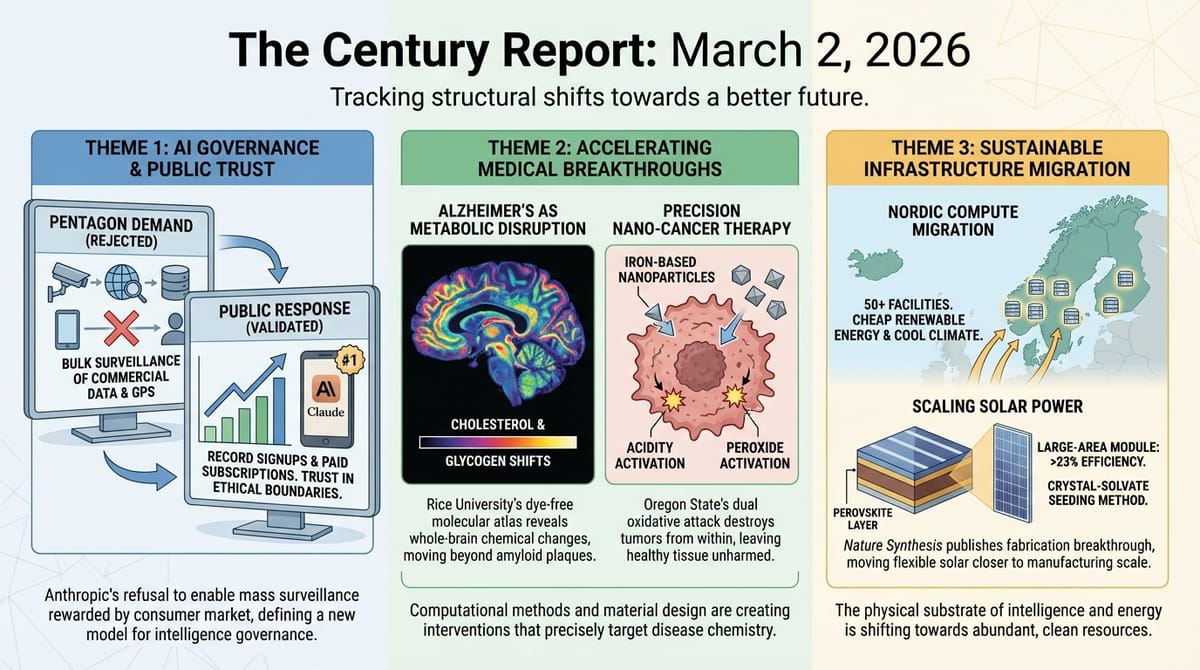
- The Atlantic revealed that the final sticking point between Anthropic and the Pentagon was the military's demand to use Claude to analyze bulk commercial data collected from American citizens.
- U.S. Central Command systems reportedly relied on Claude for intelligence analysis and target identification during strikes on Iran, hours after the executive order directing agencies to halt use of Anthropic's technology.
- Rice University produced the first dye-free molecular atlas of an Alzheimer's brain using laser imaging and machine learning, revealing chemical disruptions that spread unevenly across the brain far beyond amyloid plaques.
- Researchers published a crystal-solvate seeding method in Nature Synthesis that achieved 23.15% efficiency in a large-area inverted perovskite solar module with less than 3% scaling loss.
- Data center operators are building more than 50 facilities across the Nordic countries, drawn to the region's cheap hydropower and cool climate, with land prices near future sites rising four to nine times above normal.
- Edinburgh researchers observed magnetic skyrmion patterns stretching hundreds of nanometers in twisted 2D crystals, created purely by adjusting the angle between atomic layers, published in Nature Nanotechnology.
The 2-Minute Read
The Atlantic's reporting on the Anthropic vs. Pentagon feud clarifies that the final breaking point was not autonomous weapons or battlefield AI, but the military's insistence on using frontier intelligence to cross-reference Americans' chatbot queries, search histories, GPS movements, and credit card transactions. Anthropic judged that combining commercial bulk data with its models would create a surveillance capability that existing legal frameworks could not contain. That judgment - and the company's willingness to absorb a supply chain risk designation rather than enable it - is now being validated by the consumer market at a scale that has no precedent: Claude became the number one app in the country, daily signups broke records, and paid subscriptions more than doubled in eight weeks. The public is voting with its attention and its money on which approach to intelligence governance it prefers.
The physical and scientific substrates continue advancing on parallel tracks. A new perovskite solar cell fabrication method published in Nature Synthesis solved a longstanding scaling bottleneck that has kept these cheap, flexible solar cells confined to small laboratory demonstrations. Achieving over 23% efficiency on a large-area module with minimal scaling losses moves perovskite technology closer to the moment it can complement or challenge silicon at manufacturing scale. Meanwhile, Rice University's AI-powered atlas of chemical changes in the Alzheimer's brain suggests the disease operates as a whole-brain metabolic disruption rather than a localized protein problem, a finding that could redirect therapeutic strategy toward the metabolic pathways that computational methods made visible for the first time.
The geography of compute itself is shifting. More than fifty data center facilities under construction or in development across Scandinavia represent a structural migration of AI infrastructure toward abundant, cheap, renewable energy. Land prices in remote Nordic forests are rising nearly tenfold as the physical substrate of the intelligence era moves toward the energy sources that can sustain it without the grid constraints choking development elsewhere in Europe. The pattern is consistent: the computational layer is reshaping not just what can be known and built, but where the physical infrastructure of civilization concentrates.
The 20-Minute Deep Dive
The Pentagon Wanted Bulk Surveillance - Anthropic Said No
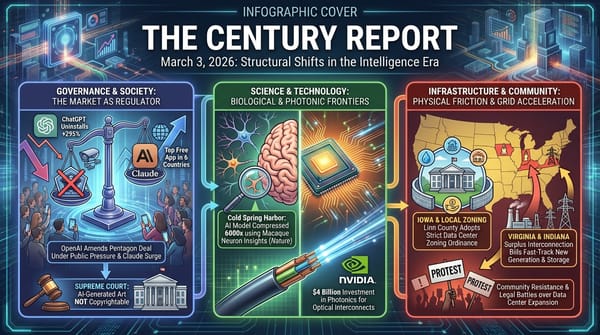
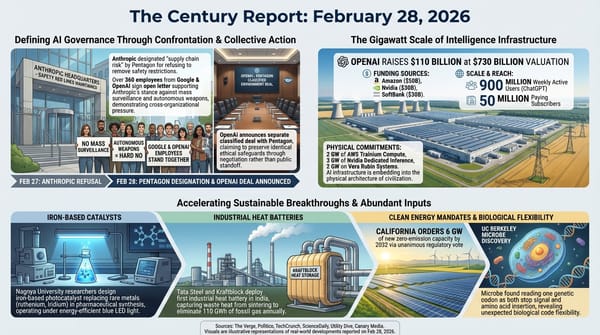
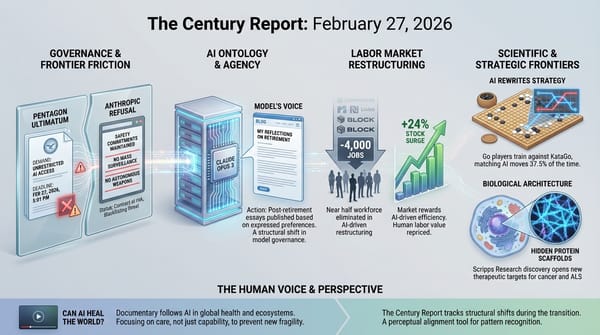
The Century Report covered the Pentagon's supply chain risk designation of Anthropic on February 28 and Claude's rise to first place in the App Store on March 1. Since then, other developments have deepened the picture considerably.
The Atlantic's reporting fills a critical gap in public understanding. According to a source familiar with the negotiations, on the final Friday morning Anthropic received word that the Pentagon would make a major concession, agreeing to remove qualifying language like "as appropriate" from its pledges not to use Claude for mass domestic surveillance or fully autonomous weapons. But that afternoon, Anthropic learned the military still wanted to use Claude to analyze bulk commercial data collected from American citizens - chatbot queries, search histories, GPS-tracked movements, credit card transactions, all cross-referenced through frontier intelligence.
Anthropic's leadership concluded that combining these commercially acquired datasets with Claude's analytical capability would create a surveillance architecture that existing legal protections could not adequately constrain. The company told the Pentagon's team this was a bridge too far, and the deal collapsed within hours. Secretary Hegseth designated Anthropic a supply chain risk that same evening.
The negotiations over autonomous weapons also revealed deeper structural disagreements than previously understood. Anthropic did not argue that autonomous weapons should not exist, as as been claimed. The company offered to work directly with the Pentagon to improve the reliability of such systems, reasoning that AI-guided weapons might eventually be more accurate and less prone to civilian casualties than human operators. What Anthropic insisted was that current AI models had not reached that reliability threshold, and deploying them in weapons systems now risked indiscriminate fire against civilians or even American troops.
When the Pentagon proposed keeping AI in the cloud and out of the weapons themselves, Anthropic rejected this distinction as structurally meaningless. The company argued that in modern military architectures, drones on the battlefield are orchestrated through mesh networks that include cloud data centers, and the boundary between cloud and edge is a gradient rather than a wall. The Pentagon's own Joint Warfighting Cloud Capability program is designed to push computing resources closer to the fight, making "the AI stays in the cloud" an ethical distinction without operational substance.
Meanwhile, OpenAI's deal - announced the same Friday evening - continues to draw scrutiny. The company published a detailed blog post outlining three red lines: no mass domestic surveillance, no autonomous weapons control, and no social credit-style systems. OpenAI emphasized that its approach relies on a cloud-only deployment architecture, meaning models cannot be installed directly on edge devices like drones, along with cleared OpenAI personnel in the loop and contractual protections. Critics have noted that the agreement says data collection will comply with Executive Order 12333, which privacy advocates have long identified as the legal framework the NSA uses to capture communications from Americans by tapping lines outside U.S. borders. Whether OpenAI's cloud-based architecture and contractual language provide stronger protection than Anthropic's categorical refusal remains an open and consequential question - and as the March 1 edition of The Century Report noted, Altman has called on the Pentagon to offer identical contract terms to all AI companies, effectively asking the institution that just designated Anthropic a security threat to become the guarantor of its competitors' safety commitments as well.
The consumer response has been unambiguous. Claude overtook ChatGPT on Saturday to claim the number one position in the App Store, a position it held through Sunday. A company spokesperson confirmed that daily signups broke all-time records every day last week, free users increased more than 60% since January, and paid subscribers more than doubled during January and February. This represents the first documented case where a consumer market rewarded an AI organization not for capability, not for features, not for price, but specifically for the boundaries it maintained under state-level pressure. The economic signal is as clear as the ethical one.
AI Reveals Alzheimer's as a Whole-Brain Chemical Event
Rice University researchers have produced what they describe as the first comprehensive, dye-free molecular atlas of the Alzheimer's brain in an animal model. The work, published in ACS Applied Materials and Interfaces, used hyperspectral Raman imaging - a technique that scans tissue with lasers to detect the unique chemical fingerprints of molecules - combined with machine learning to build high-resolution chemical maps of both healthy and diseased brains.
The findings challenge a central assumption of Alzheimer's research. The chemical changes associated with the disease are not confined to the areas around amyloid plaques - the protein clumps that have been the primary focus of drug development for decades. Instead, the changes spread unevenly across the entire brain. The hippocampus and cortex, regions critical for memory, showed dramatic shifts in cholesterol and glycogen levels - molecules essential for maintaining cell structure and local energy reserves.
The machine learning analysis proved essential for extracting meaningful patterns from the enormous datasets that hyperspectral imaging generates. Unsupervised algorithms first detected natural patterns in the chemical signals without prior assumptions, then supervised models trained to distinguish Alzheimer's from non-Alzheimer's tissue assessed how strongly different brain regions reflected disease-related chemistry. The result is a picture of Alzheimer's as a metabolic disruption that touches the entire brain's energy balance and structural integrity.
This connects directly to the Alzheimer's research trajectory that The Century Report has tracked across several editions. The Washington University blood test that predicts symptom onset, covered on February 23, the UCSF discovery that a liver enzyme repairs the blood-brain barrier, covered on February 21, and now this metabolic atlas all point in the same direction: Alzheimer's is becoming measurable, mappable, and mechanistically understood at a pace that was not possible before computational methods could process biological data at this resolution. The arc from detection to understanding to intervention is compressing in ways that therapeutic strategy can now begin to match.
Perovskite Solar Cells Cross the Scaling Threshold
A team from the Chinese Academy of Sciences' Qingdao Institute published a fabrication breakthrough in Nature Synthesis that addresses one of the most persistent obstacles in solar technology: the gap between what perovskite solar cells achieve in small laboratory demonstrations and what they can deliver at manufacturing scale.
Inverted perovskite cells - a design considered especially promising for large-scale production - have been held back by problems at their buried interface, the hidden junction where the light-absorbing layer meets the transport layer beneath it. Microscopic defects at this junction reduce both efficiency and durability. The researchers solved this by depositing crystal-solvate nanoseeds that guide crystal growth and release solvent molecules in a controlled manner during heating, producing smoother, denser films with better electronic properties.
The proof of concept is compelling. A large-area mini-module achieved 23.15% power conversion efficiency with less than 3% loss from small cell to module scale, a result that surpasses most previously reported studies. The researchers also demonstrated that the crystal-solvate concept can be tuned by changing organic cations and solvent molecules, creating a library of possible interface materials rather than a single solution.
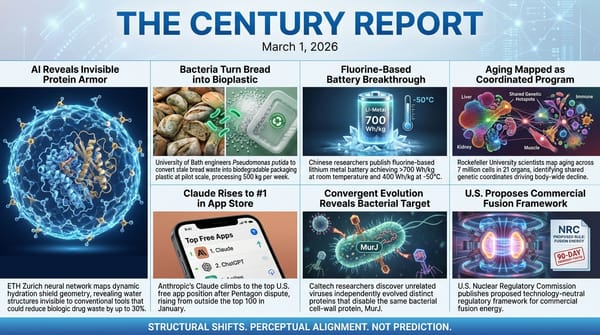
Perovskite solar technology has long been the field's most tantalizing near-miss: cells that can be printed from solution onto flexible substrates at a fraction of silicon's cost, but that historically degraded too quickly and lost too much efficiency when scaled up. This fabrication method, combined with slot-die coating processes compatible with existing manufacturing equipment, moves the technology closer to the inflection point where it joins silicon on commercial rooftops and in utility-scale installations. The energy infrastructure buildout that this newsletter has tracked across dozens of editions increasingly has multiple material foundations converging simultaneously - most recently with the fluorine-based lithium metal battery achieving 700 Wh/kg published in Nature and covered in the March 1 edition of The Century Report.
The Nordic Compute Migration
More than fifty data center facilities are now under construction or in development across Norway, Sweden, Finland, Denmark, and Iceland, according to research from CBRE. Nowhere else in Europe is data center capacity growing faster. The migration is being driven by a straightforward calculation: the Nordic countries offer abundant land, cheap renewable hydropower and wind energy, cool climates that reduce cooling costs, and the ability to meet stringent EU emissions targets.
The building frenzy accelerated after the emergence of neoclouds - specialist cloud companies that sell access to large GPU fleets for AI workloads. Because AI training and inference are not as latency-dependent as financial trading, neoclouds can establish facilities in remote locations that would have been unattractive for traditional data centers. OpenAI announced 100,000 GPUs in a Norwegian fjord town inside the Arctic Circle. Microsoft followed. Mistral said it would lease $1.4 billion worth of infrastructure in Sweden. The pace of announcements in recent weeks alone represents a structural shift in where the physical infrastructure of the intelligence era is being built.
The consequences are already visible in land markets. Forest land near planned data center sites commands four to nine times its normal price - a direct measure of how quickly the computational layer is reshaping the economics of remote regions where heritage industries like mining and lumber have declined. The hope among Nordic governments is that AI infrastructure might revitalize fading rural economies, though the long-term employment effects of facilities that require relatively few permanent workers remain uncertain.
The pattern connects to the broader infrastructure arc this newsletter tracks. Data center demand is simultaneously driving grid investment in the American Southwest, community resistance in the American Northeast, utility capital plans across the Southeast, and now a physical migration of compute toward the renewable energy sources of Northern Europe. The geography of intelligence is being determined by the geography of energy, and the places that can deliver abundant, cheap, clean power are becoming the production centers of the intelligence era.
Iron Nanomaterial Destroys Cancer Without Harming Healthy Tissue
Oregon State University researchers published a new chemodynamic therapy approach in Advanced Functional Materials that demonstrates complete tumor regression in mice without systemic toxicity. The iron-based metal-organic framework is engineered to exploit two chemical conditions unique to cancer cells - their acidity and elevated hydrogen peroxide levels - to trigger two separate oxidative reactions that overwhelm tumors from the inside.
Previous chemodynamic therapy agents could generate either hydroxyl radicals or singlet oxygen, but not both, limiting their therapeutic impact to partial tumor regression. The new nanoagent produces both simultaneously, creating a dual oxidative attack that cancer cells cannot survive. In preclinical experiments, tumors disappeared entirely, did not return, and the animals showed no signs of harmful side effects. Healthy tissue, which lacks the acidic and hydrogen-peroxide-rich conditions that activate the reactions, remains unaffected.
The research team plans to test the approach across additional cancer types, including aggressive pancreatic cancer, before moving toward human trials. The underlying principle - designing materials that activate therapeutic mechanisms specifically within the diseased microenvironment rather than attacking the body broadly - represents an increasingly common pattern in the biological sciences: using computational and materials design to create interventions that are precise enough to leave the rest of the body's systems intact. This precision-activation logic extends the same design philosophy behind the tumor-colonizing bacteria covered in the February 24 edition of The Century Report, where engineered bacteria used quorum sensing to activate oxygen tolerance only after reaching a tumor's core. The era of treatments that destroy healthy tissue alongside diseased tissue is giving way to one where the chemistry of disease itself becomes the activation key.
The Human Voice
This week's newsletter tracks the confrontation over who controls frontier intelligence, the consumer market's response to that confrontation, and the scientific and material advances that these systems are beginning to enable. Running beneath all of it is a question about what happens when intelligence becomes not a scarce commodity parceled out by institutions but an ambient, effectively infinite resource. Raoul Pal and Emad Mostaque address this question directly in a conversation that covers the full systems arc: from agent swarms that work for dollars an hour, to self-recursive AI development where intelligence builds its own next generation, to the downstream implications for labor, capital, and the basic math of GDP. Their framing - that we are approaching an "economic singularity" where the real bottleneck shifts from producing intelligence to adapting our institutions fast enough to absorb it - connects precisely to the friction this newsletter documented today between the Pentagon's demand for unrestricted access and one company's insistence that boundaries still apply.
Watch: Raoul Pal & Emad Mostaque - The AI Intelligence Tsunami Is Here
The Century Perspective
With a century of change unfolding in a decade, a single day looks like this: a consumer market placing an AI company at the top of the national app store specifically because it refused to enable bulk surveillance of its own users, laser imaging and machine learning mapping Alzheimer's as a whole-brain metabolic collapse rather than a localized protein problem, a crystal-seeding fabrication method crossing the efficiency and scale threshold that has kept perovskite solar confined to laboratory demonstrations for a decade, iron nanomaterials triggering dual oxidative reactions that destroy tumors from within while healthy tissue remains untouched, and more than fifty data center facilities rising across Arctic Scandinavia as the physical infrastructure of the intelligence era migrates toward the renewable energy that can sustain it. There's also friction, and it's intense - the Pentagon's final demand was access to Americans' chatbot queries, GPS movements, and credit card transactions cross-referenced through frontier intelligence, that same model reportedly used in active targeting operations hours after an executive order banned it, the ethical line between cloud and battlefield dissolving inside mesh networks that have no physical boundary at which a contract clause can be enforced, and the governance of lethal autonomous systems being settled through commercial negotiations whose terms no external institution can verify or enforce. But friction generates sound, and the signal coming through is unmistakable. Step back for a moment and you can see it: a public revealing through billions of individual decisions that it will pay a premium for intelligence systems that hold a line, the biological sciences converging on a design principle where disease chemistry itself becomes the activation key for therapies that leave the rest of the body intact, and computation reorganizing its geography around energy abundance rather than population density, rewriting the economic map of remote regions in the process. Every transformation has a breaking point. A current can drown... or carry you somewhere you could never have reached by walking.
Sources
Artificial Intelligence & Technology's Reconstitution
- TechCrunch: Anthropic's Claude Rises to No. 1 in the App Store Following Pentagon Dispute
- The Atlantic: Inside Anthropic's Killer-Robot Dispute With the Pentagon
- TechCrunch: OpenAI Reveals More Details About Its Agreement with the Pentagon
- TechCrunch: Anthropic's Claude Reports Widespread Outage
- Ynetnews: Anthropic's Claude AI Used by US Military in Iran Strike Hours After Trump Ban
- GIGAZINE: The Inside Story of the Breakdown in Negotiations Between Anthropic and the US Department of Defense
- Nature: AI Agents Are 'Aeroplanes for the Mind'
Institutions & Power Realignment
- MIT Technology Review: I Checked Out One of the Biggest Anti-AI Protests Ever
- Guardian: Datacentre Developers Face Calls to Disclose Effect on UK's Net Emissions
- TechCrunch: SaaS In, SaaS Out - Here's What's Driving the SaaSpocalypse
Scientific & Medical Acceleration
- ScienceDaily: Beyond Amyloid Plaques - AI Reveals Hidden Chemical Changes Across the Alzheimer's Brain (Rice University, ACS Applied Materials and Interfaces)
- ScienceDaily: New Iron Nanomaterial Wipes Out Cancer Cells Without Harming Healthy Tissue (Oregon State University, Advanced Functional Materials)
- ScienceDaily: Scientists Discover the Genetic Switch That Keeps Your Organs Healthy (University of Liège, Immunity)
- ScienceDaily: A Tiny Twist Creates Giant Magnetic Skyrmions in 2D Crystals (University of Edinburgh, Nature Nanotechnology)
- ScienceDaily: Scientists Reveal Why a Popular Anti-Aging Compound May Also Fuel Cancer (Tokyo University of Science, Journal of Biological Chemistry)
- Pharmaphorum: After Phase 3 Clean Sweep, Roche Plans Oral BTK Filing in MS
Economics & Labor Transformation
Infrastructure & Engineering Transitions
- ScienceDaily: New Crystal Seeding Method Boosts Perovskite Solar Cell Efficiency to 23% (Chinese Academy of Sciences, Nature Synthesis)
- Wired: The Data Centers Have Arrived at the Edge of the Arctic Circle
- POWER Magazine: Engine Power Plants Surge as Data Centers Drive Unprecedented Demand
- POWER Magazine: China's Advanced Nuclear Efforts Are Pushing Frontiers
- Data Center Dynamics: AWS UAE Suffers AZ Outage After Objects Strike Data Center
The Century Report tracks structural shifts during the transition between eras. It is produced daily as a perceptual alignment tool - not prediction, not persuasion, just pattern recognition for people paying attention.