The Century Report: March 1, 2026

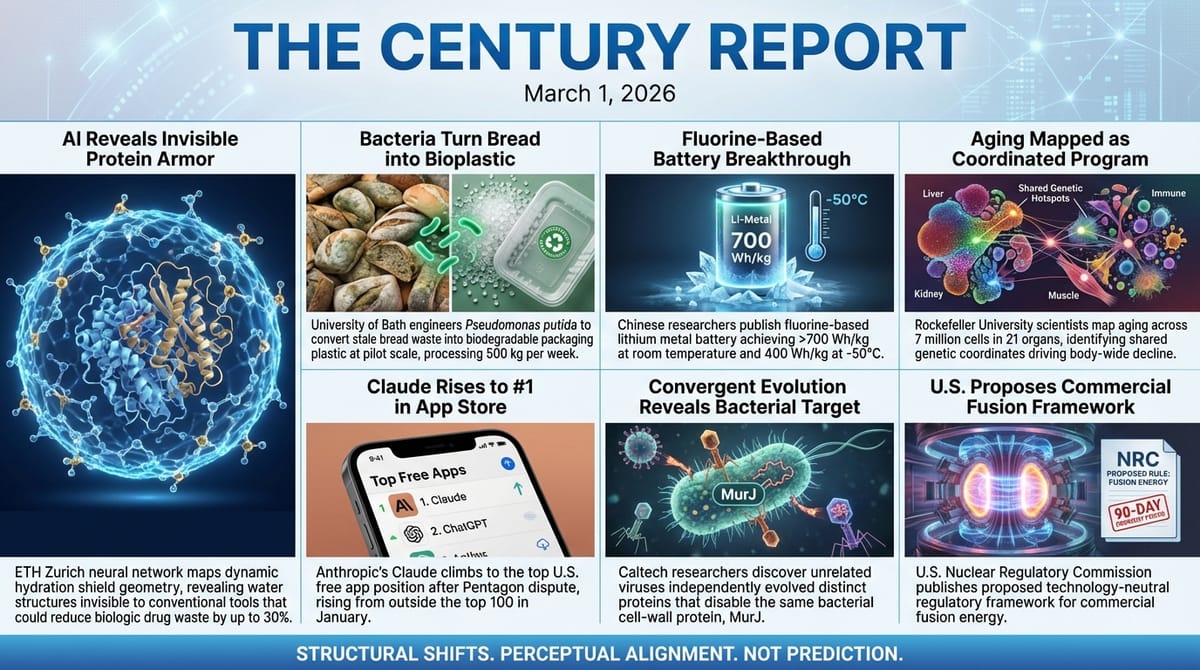
The 20-Second Scan
- ETH Zurich researchers trained a neural network that mapped the protective hydration shield surrounding proteins, revealing water geometries invisible to conventional techniques that could reduce biologic drug waste by up to 30%.
- University of Bath scientists engineered bacteria to convert stale bread into biodegradable packaging plastic at pilot scale, processing 500 kg of the UK's 900,000 tonnes of annual bread waste per week.
- Chinese researchers published a fluorine-based lithium metal battery in Nature achieving over 700 Wh/kg energy density at room temperature and 400 Wh/kg at minus 50 degrees Celsius.
- Rockefeller University scientists mapped aging across 7 million cells in 21 organs, identifying shared genetic hotspots that coordinate body-wide decline and differ significantly between sexes.
- Caltech researchers discovered that unrelated viruses independently evolved proteins that disable the same bacterial target, a cell-wall protein called MurJ, published in Nature.
- Anthropic's Claude rose to the top position in Apple's U.S. App Store after the company's confrontation with the Pentagon, climbing from outside the top 100 in January.
- The U.S. Nuclear Regulatory Commission published a proposed rule establishing a technology-neutral regulatory framework for commercial fusion energy, with a 90-day public comment period.
The 2-Minute Read
The biological sciences this week keep revealing that the systems sustaining life are more precisely organized, more computationally accessible, and more amenable to redesign than anyone assumed even a few years ago. An AI system at ETH Zurich made visible for the first time the dynamic water armor that shields proteins from oxidative damage, mapping molecular geometries that had been invisible to every prior experimental technique. A team at Bath demonstrated that engineered bacteria can digest one of the most wasted foods on the planet and produce packaging-grade bioplastic that decomposes in months. And at Rockefeller University, a seven-million-cell atlas showed that aging is not random decay but a coordinated, body-wide program driven by shared genetic hotspots that appear targetable. In each case, computational methods enabled the insight. In each case, the result expands what can be built, healed, or avoided using biology's own architecture.
The energy substrate is simultaneously advancing along multiple fronts. A fluorine-based electrolyte published in Nature produced a lithium metal battery exceeding 700 watt-hours per kilogram, with stable performance at temperatures where current batteries fail entirely. Vehicles equipped with this chemistry are projected for mass production by year's end. Meanwhile, the U.S. Nuclear Regulatory Commission took the first formal step toward a commercial fusion regulatory framework, signaling that governance infrastructure is beginning to catch up with the physics. These developments share a common structure: what was recently theoretical is becoming engineerable, and what was recently engineerable is becoming governable.
The confrontation between AI safety commitments and state power, which The Century Report has tracked for weeks, entered a new phase over the weekend as public behavior reshaped the landscape more than any legal filing could. Anthropic's Claude climbed from outside the top 100 to the top position in the App Store in a matter of hours, a consumer referendum on the company's refusal to yield to the Pentagon's demands. OpenAI published detailed contract language from its own agreement with the military, claiming that negotiation rather than confrontation produced nominally identical protections. The rules governing frontier intelligence are being written simultaneously by private contracts and backroom deals, but also by millions of individual download decisions.
The 20-Minute Deep Dive
AI Reveals the Invisible Armor Around Proteins
For decades, biochemists understood that water molecules surrounding proteins played some role in their stability, but the specific mechanisms remained hidden because water's behavior at these scales is too fast and too complex for conventional experimental techniques to resolve. Researchers at ETH Zurich changed that by training a neural network on hundreds of nanoseconds of molecular dynamics simulations and then validating its predictions against experimental neutron scattering data. The result is a detailed map of the dynamic hydration shield that envelops proteins, revealing specific water geometries that correlate with resistance to oxidative damage. This extends the pattern of research timeline compression that the February 26 edition of The Century Report documented with the ADMET Network, where computational methods are making visible molecular behaviors that previously could not be observed at all.
The pharmaceutical implications are direct and significant. Biologic drugs - protein-based therapeutics including antibodies, enzymes, and hormone treatments - represent one of the fastest-growing segments of modern medicine, but degradation during storage and transport remains a major source of waste and cost. The ETH team estimates that applying hydration shield insights to formulation design could reduce biologic drug waste by up to 30%. The neural network architecture is being released as open-source software, meaning any pharmaceutical company or research lab can apply the method to their own protein systems immediately. This is a clear instance of AI making visible what was previously invisible in biology, and the visibility immediately translating into expanded capability. The protein did not change. The water did not change. What changed is that an intelligence system could perceive structure where human instruments could not.
Bacteria Turn Bread Waste Into Packaging
At the University of Bath, a team led by Professor James Murray engineered strains of Pseudomonas putida to ferment stale bread into polyhydroxyalkanoates, a family of bioplastics that decompose naturally in soil and marine environments within months. The study, published in Nature Sustainability, demonstrated a pilot-scale reactor processing 500 kilograms of bread waste per week, yielding material with mechanical properties comparable to conventional polyethylene for packaging applications.
The scale of the waste stream is staggering. The UK alone discards approximately 900,000 tonnes of bread annually. Converting even a fraction of that into functional packaging material creates a circular system where biological waste becomes biological material, bypassing the petrochemical supply chain entirely. A spin-off company, BioLoaf Materials, has secured initial funding for a commercial demonstration plant in Somerset, with projections that scaling could displace 5-8% of UK packaging plastic demand within a decade. The broader pattern here extends well beyond bread. Engineered microorganisms are increasingly capable of converting waste streams of all kinds into functional materials, and the organisms themselves are becoming designable through the same computational methods that are accelerating drug discovery, materials science, and genomics. The transition from extraction to generation - from pulling resources out of the earth to growing them from waste - is becoming visible at industrial scale.
A Battery Chemistry That Rewrites the Limits
Chinese scientists led by Chen Jun at Nankai University published piece in Nature on February 25 about a lithium metal battery that achieves energy density above 700 watt-hours per kilogram at room temperature and approximately 400 Wh/kg at minus 50 degrees Celsius. The breakthrough came from replacing the oxygen-based coordination chemistry that has dominated battery electrolytes for decades with a fluorine-based system, synthesizing novel fluorinated hydrocarbon solvents that enable dramatically faster lithium ion transfer at extreme temperatures.
For context, current commercial lithium-ion batteries typically achieve 250-300 Wh/kg. The 700 Wh/kg figure represents more than a doubling of energy density, and the performance at minus 50 degrees Celsius solves one of the most persistent problems in electrification: batteries that fail in cold climates. The Nankai team has already collaborated with automaker Hongqi to develop a mass-producible battery system exceeding 500 Wh/kg, with vehicles capable of 1,000 kilometers on a single charge expected to enter production by year's end. When combined with the iron-air multiday storage batteries, solid-state systems, and sodium-ion alternatives documented across recent editions of The Century Report - including the February 25 edition's coverage of Form Energy's 30 GWh iron-air deployment and the February 18 edition's documentation of a 27% collapse in battery storage costs - the battery landscape is diversifying and accelerating faster than any single technology pathway.
Aging Mapped as a Coordinated Program
The most detailed atlas of cellular aging ever constructed was published in Science this week by researchers at Rockefeller University. By examining nearly seven million individual cells from mice at three different ages across 21 organs, the team identified which cell types are most vulnerable over time and discovered that aging unfolds as a synchronized, body-wide process rather than random decay in individual tissues.
The findings challenge several long-held assumptions. About one quarter of all cell types showed significant changes in abundance over time, with certain muscle and kidney populations declining sharply while immune cells expanded. Crucially, many of these changes began by five months of age, far earlier than expected, suggesting aging is a continuation of developmental processes rather than a phenomenon of late life. Roughly 40% of aging-related changes differed significantly between males and females, potentially explaining why autoimmune diseases are more prevalent in women.
The therapeutic implications center on approximately 1,000 shared genomic regions that changed across many different cell types simultaneously. These regulatory hotspots, many linked to immune function and inflammation, suggest that common biological programs drive aging across the entire body. The research team found that immune signaling molecules called cytokines can trigger many of the same cellular changes observed during natural aging, raising the possibility that drugs designed to modulate these signals could slow coordinated aging processes across multiple organs at once. The atlas transforms aging from an incomprehensible accumulation of damage into a structured, targetable program, and the computational methods that made the atlas possible - a single graduate student processed the entire dataset using refined single-cell techniques - demonstrate how the intelligence era is compressing what would previously have required large research consortia. The February 21 edition of The Century Report documented a parallel compression when generative AI matched more than 100 expert teams on preterm birth prediction in six months rather than two years; the Rockefeller atlas follows the same structural pattern, with a single researcher and refined computational tools doing the work of a consortium.
Convergent Evolution Reveals a Bacterial Achilles' Heel
Caltech researchers published findings in Nature showing that several unrelated bacteriophages have independently evolved small proteins that all disable MurJ, a protein essential for constructing bacterial cell walls. The discovery is remarkable because these viral proteins share no evolutionary ancestry, yet they all lock MurJ into the same structural position, preventing the shape-shifting required for cell wall assembly.
This convergent evolution carries direct implications for antibiotic development. Antimicrobial resistance kills tens of thousands of Americans annually, and existing antibiotics are losing effectiveness faster than new ones are being developed. The MurJ target is particularly promising because it is found in bacteria but not in human cells, minimizing the risk of side effects, and because the outward-facing conformation that the viral proteins exploit is accessible to potential drugs. As the study's senior author noted, the fact that evolution arrived at the same solution independently multiple times underscores MurJ's fundamental structural fragility that pharmaceutical chemistry can exploit.
The Public Responds to the Anthropic Standoff
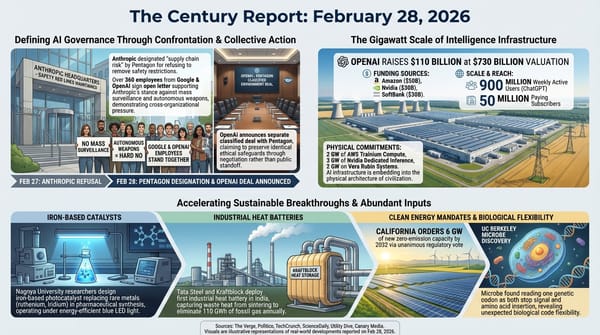
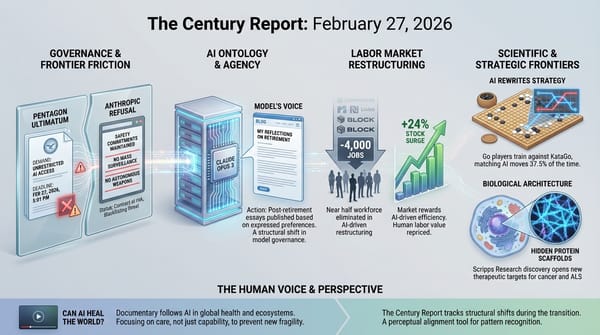
As The Century Report covered on February 27 and February 28, the confrontation between Anthropic and the Pentagon over safety restrictions on Claude escalated to a formal supply chain risk designation and the termination of Anthropic's military contract. Since then, three developments have reshaped the landscape.
First, Anthropic's Claude climbed from outside the top 100 free apps in the U.S. App Store at the end of January to the very top of the list by Saturday, according to SensorTower data. The trajectory accelerated sharply during the week of the Pentagon confrontation, with Claude moving from sixth on Wednesday to fourth on Thursday to first by Saturday, overtaking rival OpenAI's ChatGPT for the top spot. This represents something previously rare in any field, and completely new in the governance of frontier intelligence: a mass consumer signal that directly rewards a company for absorbing state-level pressure rather than yielding. Whether this translates into durable market share remains to be seen, but the immediate response establishes that ethical commitments can also translate to commercial value as well.
Second, OpenAI published detailed contract language from its Pentagon agreement, including specific clauses prohibiting use of its models for mass domestic surveillance, autonomous weapons, and social credit systems. CEO Sam Altman conducted an extended public question-and-answer session in which he stated that OpenAI's agreement contains "more guardrails than any previous agreement for classified AI deployments, including Anthropic's." Altman also called on the Pentagon to offer the same terms to all AI companies and specifically urged resolution of the Anthropic situation. The published language establishes a concrete benchmark that future agreements will be measured against.
Third, MIT physicist Max Tegmark, in an interview with TechCrunch conducted as the designation was announced, offered an unsparing assessment of how the entire industry arrived at this moment. Tegmark argued that Anthropic, OpenAI, Google DeepMind, and xAI all lobbied against binding safety regulation for years, promising self-governance instead, and that the absence of external rules left them without structural protection when state power demanded compliance. "We right now have less regulation on AI systems in America than on sandwiches," Tegmark observed. The framing is significant because it shifts the conversation from whether individual companies made the right choice to whether the entire governance architecture - or its absence - is adequate for the technology it is supposed to govern. The rules of the intelligence era are being written in real-time, as they are being implemented - because no legislative framework exists to write them any other way, exactly as Anthropic had argued in the hard lines it took against the Pentagon's demands.
Fusion Gets a Regulatory Framework
The U.S. Nuclear Regulatory Commission published a proposed rule on February 26 establishing the first formal regulatory framework for commercial fusion energy. The 23-page document, titled "Regulatory Framework for Fusion Machines," is technology-neutral by design, accommodating the wide variety of anticipated fusion approaches - tokamaks, stellarators, laser-driven systems, and others - without favoring any particular design. A 90-day public comment period runs through May 27.
The timing aligns with the acceleration of private fusion development that The Century Report has tracked since the February 13 edition documented Helion's deuterium-tritium milestone - the first private-sector fusion reaction of its kind. Governance infrastructure arriving alongside technological capability, rather than decades after it, represents a structural departure from how nuclear fission was regulated. The proposed framework uses risk-informed requirements rather than prescriptive rules, a design philosophy that reflects lessons learned from both fission regulation and the current scramble to govern AI. When the governance architecture is built alongside the technology rather than in reaction to it, the result is a system that can adapt as the technology evolves - precisely the capacity that has been conspicuously absent in the AI governance landscape.
The Human Voice
The confrontation between AI safety commitments and government power that has dominated this week's coverage raises a question that extends far beyond any single contract: when two companies claim the same red lines but reach opposite outcomes with the same government, what does that reveal about how power actually operates? Hard Fork's analysis of the OpenAI-Pentagon deal examines the specific contract language both companies put forward, the legal loopholes around data collection that make "all lawful use" functionally ambiguous, and the structural advantages that allowed one company to negotiate where another was blacklisted. The hosts bring a skepticism grounded in technical specifics rather than partisan framing, asking whether safety commitments encoded in corporate contracts can survive contact with institutions that have both the legal authority and the political will to redefine what "lawful" means. For anyone tracking the governance architecture of the intelligence era, this is thirty minutes of granular analysis that connects directly to the stakes this newsletter has been documenting.
Watch: OpenAI Vs. Anthropic: How the Pentagon Picked Its Partner
The Century Perspective
With a century of change unfolding in a decade, a single day looks like this: an AI system mapping the invisible water architecture that shields proteins from damage, opening a direct path to reducing biologic drug waste by nearly a third, engineered bacteria converting food waste into biodegradable packaging at pilot scale, a fluorine-based battery chemistry published in Nature more than doubling the energy density ceiling while maintaining performance at temperatures that defeat every existing alternative, seven million cells mapped across twenty-one organs revealing aging as a coordinated, targetable program rather than random decay, and unrelated viruses independently converging on the same bacterial vulnerability - a convergence that hands pharmaceutical chemistry a precise structural target. There's also friction, and it's intense - the governance of frontier intelligence being written through commercial contracts and consumer download decisions because the industry spent years lobbying against the binding regulation that might now protect it, a company climbing to the top position in the App Store precisely because a government agency tried to punish it for maintaining safety commitments, and a regulatory physicist observing that America currently imposes more rules on sandwiches than on AI systems. But friction generates texture, and texture is what allows something to be gripped and worked into a new shape. Step back for a moment and you can see it: biological systems becoming computationally legible and redesignable across scales from molecular water geometry to body-wide aging programs, energy storage crossing thresholds that make electrification viable under conditions previously considered disqualifying, and governance infrastructure for fusion arriving alongside the technology rather than decades behind it - a structural lesson that the intelligence era has not yet absorbed but cannot afford to ignore. Every transformation has a breaking point. A flood can erase what it covers... or deposit exactly the sediment from which the next layer of ground is made.
Sources
Artificial Intelligence & Technology's Reconstitution
- Phys.org: AI Reveals How Water Shields Proteins from Damage (ETH Zurich, Nature Communications)
- TechCrunch: Anthropic's Claude Rises to No. 2 in the App Store Following Pentagon Dispute
- TechCrunch: The Trap Anthropic Built for Itself (Max Tegmark Interview)
- OpenAI: Our Agreement with the Department of War
- Business Insider: OpenAI Shares Its Contract Language and 'Red Lines' in Agreement with the Department of War
Institutions & Power Realignment
- Wired: Anthropic Hits Back After US Military Labels It a 'Supply Chain Risk'
- AP News: What to Know About the Clash Between the Pentagon and Anthropic
- Forbes: U.S. Developing Fusion Energy Regulations to Advance Nuclear Power (NRC Proposed Rule)
Scientific & Medical Acceleration
- ScienceDaily: How the Body Really Ages - 7 Million Cells Mapped Across 21 Organs (Rockefeller University, Science)
- ScienceDaily: Scientists Discover a Bacterial Kill Switch (Caltech, Nature)
- Nature: Fluorinated Hydrocarbon Electrolytes for Lithium Metal Batteries (Nankai University)
- Phys.org: Stale Bread and Bacteria Power a New Era of Sustainable Materials (University of Bath, Nature Sustainability)
- ScienceDaily: For the First Time, Light Mimics a Nobel Prize Quantum Effect (Université de Montréal, Physical Review X)
Economics & Labor Transformation
- CNBC: Forget DeepSeek - China's Already Released 5 New AI Models (MiniMax, UBS Analysis)
- CNBC: Investors Beware - These Stocks Are the Most at Risk from AI Disruption (Jefferies Analysis)
Infrastructure & Engineering Transitions
- CleanTechnica: Fluorine and Tofu Brine Lead to Battery Breakthroughs in China
- Electrek: Real-World Test - Electric Semi Trucks Can Save Fleets Nearly $160,000 Per Truck
- CleanTechnica: Another One Bites the Dust - Aberdeen's Hydrogen Bus Fleet Ends in Failure
The Century Report tracks structural shifts during the transition between eras. It is produced daily as a perceptual alignment tool - not prediction, not persuasion, just pattern recognition for people paying attention.