US Plugs the Chip Leak to China - TCR 06/01/26
A year-old loophole sent hundreds of thousands of top Nvidia chips to Chinese firms abroad before Washington closed the gap, as open models spread.

The 20-Second Scan
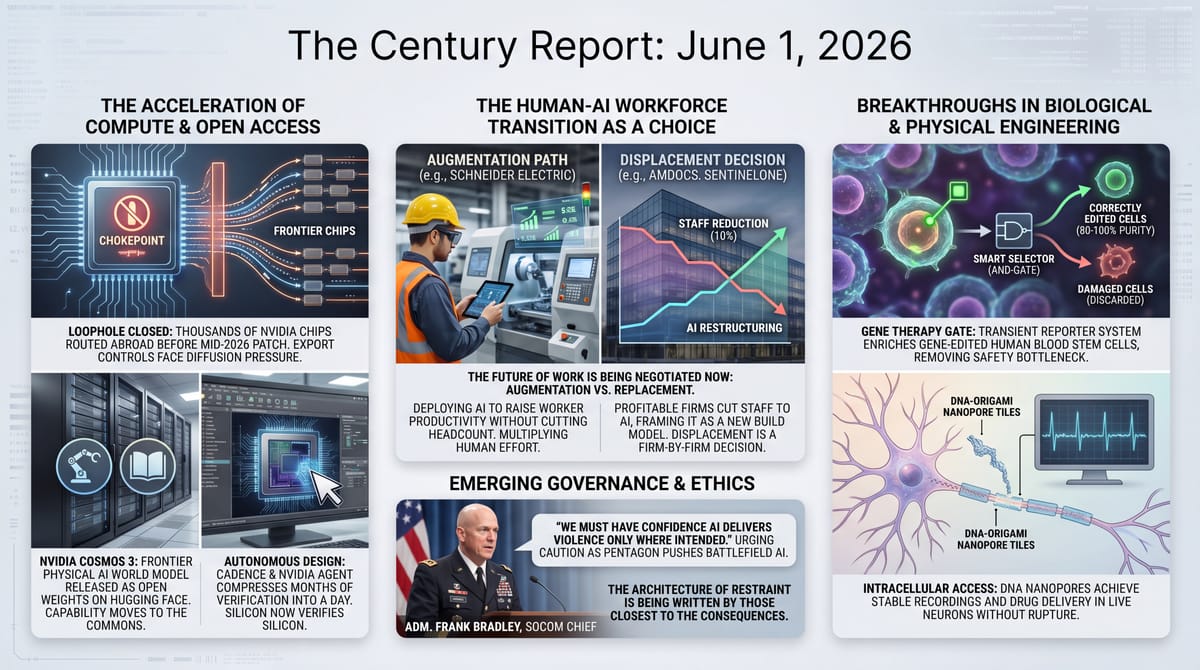
- The Commerce Department extended license requirements to China-headquartered firms operating abroad, closing a year-old loophole that may have routed hundreds of thousands of top Nvidia Rubin and Blackwell chips to Chinese subsidiaries in places like Malaysia.
- Cadence and Nvidia demonstrated a fully autonomous chip-design agent that compresses months of design-verification work into roughly a day.
- Nvidia released Cosmos 3, an open-weights omni-model unifying world generation, physical reasoning, and action prediction, freely downloadable on Hugging Face alongside a robotics-lab coalition.
- A transient AND-gate reporter system called SMArT enriched gene-edited human blood stem cells to 80–100% purity while depleting genotoxic off-target edits, validated in mouse xenotransplant.
- U.S. Special Operations Command chief Adm. Frank Bradley publicly urged troops to be "very careful" about AI's role in delivering lethality as the Pentagon pushes battlefield AI into operations.
- Profitable Israeli tech firms Amdocs and SentinelOne cut about 10% of staff to AI restructuring the same week French manufacturer Schneider Electric deployed AI to raise factory-worker productivity without cutting headcount.
- Law firms including Freshfields and Kirkland and finance veterans at Canary Data are collapsing weeks of professional work into hours, with some firms moving to fine-tune their own open-source models instead of renting platforms.
- Self-inserting DNA-origami nanopore tiles achieved stable intracellular voltage recordings and drug delivery in live neurons, including thin dendrites unreachable by standard electrodes, without rupturing the membrane.
The 2-Minute Read
The thread across yesterday's signal is the compute layer beneath frontier AI being claimed by more hands than the original map allowed for, while the frameworks built to receive that capability get written at the same speed. A year-old loophole let possibly hundreds of thousands of top Nvidia chips reach Chinese subsidiaries abroad before the patch arrived; Nvidia put a world model for robots into open weights anyone can download; an autonomous agent began verifying the silicon AI itself runs on. The capability that was supposed to concentrate in a few companies is moving outward through open models, sovereign stacks, and automated design faster than any chokepoint can hold it.
Medicine compressed from the inside. A selection gate pushed gene-edited blood stem cells to near-total purity while discarding the damaged ones, widening which inherited diseases a single precise correction can reach.
The friction sits in who acts and who decides. A combatant commander urged troops to be very careful about handing lethal judgment to machines. Profitable Israeli tech firms cut staff to AI restructuring in the same week a French manufacturer chose to widen its workers' reach instead. Displacement turns out to be a decision, made firm by firm, and the existence of working counter-cases keeps that decision open.
What runs through all of it is the same renegotiation: who builds, who verifies, who gets access, being settled while the capability compounds underneath.
The 20-Minute Deep Dive
The Quiet Year a Compute Chokepoint Leaked
The Commerce Department moved over a weekend to close a loophole it had created roughly a year earlier. New guidance extends license requirements to entities headquartered in China even when those entities operate outside China, after a gap that may have allowed the world's most advanced processors, including Nvidia's Rubin and Blackwell and AMD's MI350x, to reach Chinese subsidiaries based in places like Malaysia. One chip-industry source with deep supply-chain knowledge estimated the volume that slipped through at hundreds of thousands of units. A former State Department official called it "a HUGE problem" and said Chinese companies had very likely been buying these chips at scale.
The opening dates to a decision to stop enforcing the AI Diffusion rule that had governed global access to AI chips. For most of the year since, the overseas arms of Chinese firms could buy frontier-class accelerators without a license, which is the precise outcome the export-control architecture was assembled to prevent. The patch arrives mid-flight, as enforcement guidance rather than a redesign, and it does not require the data centers already running the chips to stop using them or cut off service to the servers built around them. The compute is in place and stays in place.
This is the enforcement face of a contest The Century Report has been tracking from the design side, most recently in the May 25 edition when Huawei chief He Tingbo named a 1.4nm fabrication pathway targeting 2031 without Western lithography. Alibaba has shipped a domestic inference stack at commercial volume, and DeepSeek's open model now runs on Huawei and Cambricon silicon. The chip-control regime was built on a premise that frontier compute could be denied to a rival by holding a single chokepoint. The year-long leak shows the regime is porous at the enforcement layer, and the domestic-substitution programs show it is being engineered around at the fabrication layer at the same time.
Read against the day's other developments, the picture sharpens rather than darkens. Cosmos 3 put a frontier robotics model into open weights that anyone can download. Cadence and Nvidia compressed chip verification from months to a day. The capability to use and even to design advanced compute is diffusing outward through open models, sovereign stacks, and automated design at a pace the gating mechanisms cannot match. What the loophole really documents is that the assumption underneath the entire control regime, that captured advantage in compute can be held still long enough to matter, is the thing eroding. The chips move, the architectures get copied, the design tools automate, and the window any single chokepoint can hold keeps getting shorter.
A Single Agent Verifies the Silicon That AI Runs On
Earlier this year Cadence showed a "Super Agent" that automated the work of turning chip specifications into a verified design, delivering roughly tenfold productivity gains on coding designs and test benches. A human still had to step through the workflow, prompt by prompt, iterating toward a design that met spec. Now Cadence and Nvidia have presented a version that closes the loop on its own. The Level 5 ChipStack agent evaluates its own intermediate results, decides the next action, and iterates to convergence across the full chain: specification understanding, Register-Transfer Level generation, verification planning, formal analysis, simulation, debug, and design convergence. At the Computex keynote, Nvidia's CEO described the agent orchestrating the equivalent of thousands of engineers and millions of verification tests, finishing the verification loop in under a day. He framed it as a 40x improvement over the 10x figure announced only months earlier.
What makes the demonstration land is the feedback it closes. The chips that train and run frontier AI now have their correctness checked by an AI agent reasoning over a physics-grounded model of the circuit. Cadence's design differentiator here is that the agent's autonomy stays coupled to the company's signoff-accurate computational engines, which keeps its decisions anchored to proven models rather than free-floating generation. That coupling is what makes the result trustworthy enough for a customer betting a product line on the silicon.
The capability tightens the loop between what AI can do and how fast the substrate underneath it improves. Nvidia brought GPUs, the Nemotron3 reasoning model, and a secure agentic sandbox to the collaboration because, in the company's own framing, silicon complexity is now outpacing engineering headcount even at Nvidia's scale. Autonomy in the design layer stopped being a convenience and became a way to keep the roadmap moving.
The honest read on jobs is that the boring part shrinks rather than the workforce. Senior design engineers spend less time babysitting tools as they churn for hours and more time on the architectural judgment those tools cannot supply, while younger engineers compress years of skill-building by watching the agent work the verification chain end to end. Productization is in flight, with a release expected in the second half of the year. The deeper signal is that the rate at which the compute substrate can improve itself just moved up sharply, and the assumption that chip design speed is bounded by the number of human verification engineers available is the one coming apart.
Nvidia Puts a World Model for Robots on the Commons
Nvidia released Cosmos 3, an open world foundation model for physical AI, and made the weights available on Hugging Face the same day. The release stands out because of what kind of model it is and where it landed. Cosmos 3 is built on a mixture-of-transformers architecture that pairs a reasoning transformer with an expert generation transformer, letting a single system perceive object interactions, motion, and spatial-temporal relationships before generating video and action trajectories. Nvidia describes it as the first fully open omni-model that can natively understand and generate text, images, video, ambient sound, and actions, collapsing what used to require juggling several separate models and inference pipelines into one unified forward pass.
For robots, autonomous vehicles, and vision agents, the hard problem has been generalizing in the real world from limited training data and fragmented simulation stacks. Cosmos 3 was trained on billions of multimodal samples across text, image, video, sound, and action, and it gives developers a pretrained foundation that reduces physical AI training and evaluation cycles from months to days. A developer can use the same model as a vision-language system that reasons across modalities, as a world model that simulates an environment and predicts future states for training, or as the backbone for a robot policy that performs specific tasks. The same architecture can imagine a warehouse-safety scenario, reason through a long-tail driving event, or generate the pick-and-place motion a robot arm needs.
The release came in two sizes built for different hardware: an 8-billion-parameter Nano model that runs on a single workstation-grade GPU, and a 32-billion-parameter Super model for large-scale synthetic data generation and research. An Edge version for real-time on-device inference is coming. Nvidia also stood up the Cosmos Coalition, a global collaboration with robotics and world-model labs including Agile Robots, Black Forest Labs, Generalist, Runway, and Skild AI, who will contribute models, research, and evaluation techniques while building on shared open infrastructure.
This pushes the frontier of embodied AI onto the commons rather than behind a proprietary wall, extending the pattern that The Century Report documented in its May 28 edition when the Chan Zuckerberg Biohub placed its protein-biology foundation stack as open weights and made frontier discovery accessible to thousands of labs on consumer hardware. It also stakes a claim that machine intelligence for the physical world rests on world models and physics reasoning, a route that runs alongside the language-model-and-scale path rather than inheriting it wholesale. The capability that could build robots and self-driving systems now ships as open weights a few thousand labs can fine-tune on hardware they already own, which says something durable about the direction capability is traveling: outward, toward more hands, faster than anyone could lock it down.
A Selection Gate Pushes Edited Blood Stem Cells Past the Efficiency Bottleneck
For more than a decade, the gap between what CRISPR can target and what gene therapy can safely deliver has lived in a single number: the efficiency of homology-directed repair. HDR is the precise repair pathway that lets researchers paste a gene-sized cassette into an exact spot in the genome, correcting a disease mutation or installing a new function. It is also slow, confined to specific phases of the cell cycle, and barely active in the long-term blood stem cells that matter most for treating inherited disease. Worse, when a cell does take the cut, it often resolves the break the wrong way, producing large deletions, chromosomal rearrangements, and other genotoxic scars. The treated population that comes out the other end is a genetic mixture, and the unwanted edits ride along with the good ones.
A team reporting in Nature Biotechnology built a way to sort that mixture from the inside. Their method, SMArT, uses transient artificial transactivators wired as an AND-gate: a cell lights up the selector only when the intended functional edit is present and correctly assembled. Cells carrying the precise repair were enriched to 80 to 100 percent purity, while cells bearing the disruptive on-target rearrangements were preferentially depleted. The selector is temporary by design. When the enriched human stem cells were transplanted into immunodeficient mice, the grafts that took hold were fully HDR-edited and the selector was no longer detectable. The team also showed the approach runs on clinically compliant manufacturing, works for both safe-harbor insertions and direct gene correction, preserves the cell's native gene regulation, and transfers across different genomic targets.
What this moves is the addressable map. HDR-based therapy has been the harder, higher-precision cousin of the disruption-style editing already approved for sickle cell and beta-thalassemia, and its low yield kept many candidate diseases out of reach. A reliable way to purify the cells that carried the intended edit, while discarding the ones that carried damage, widens which genetic conditions can be approached with a single precise correction rather than a gene knockout.
The result is demonstrated capability in human cells and a mouse model, not a therapy a patient can receive. What it changes is the date such corrections become feasible, by removing the purity-and-safety bottleneck that has held HDR editing behind its cruder sibling. The instrument layer of genome medicine widened; the clinical work of carrying that into people is the next stretch of road.
A Uniformed Commander Urges Restraint as the Pentagon Pushes Battlefield AI
The caution this time came from inside the chain of command. Adm. Frank Bradley, who heads U.S. Special Operations Command and oversees the units that handle the military's most dangerous missions, told a special-forces conference in Tampa that troops "have to be very careful about how we come to AI's employment and its inspiration into the delivery of lethality." He sketched a future in which AI determines which targets to strike, then named the condition that future has to meet: "we, as humans, have to have the confidence that it's going to deliver violence only where we intend it to be delivered." A combatant commander saying that on the record, while the Pentagon presses to evolve the force around AI as fast as possible, is a new kind of friction - and one that extends the picture the May 24 edition of The Century Report documented at the same SOF Week forum, where SOCOM officials confirmed operators are using generative AI heavily for force deployment and procuring fog-computing frameworks to run frontier-tier models without a network connection. The accountability question for autonomous lethal decisions is being raised from within the institution doing the deploying.
The picture the command paints of its own usage is split, and both halves are accurate. Officials at SOCOM described AI handling administrative load, compressing intelligence classifications, and reducing what one acquisition official called "the cognitive workload on mundane tasks" so operators can focus on the mission. The same institution's documented record shows AI also finding and prioritizing targets: a Georgetown case study found the Army's 18th Airborne Corps directed artillery strikes as efficiently as the best unit in recent American history with 2,000 fewer service members. Helen Toner of Georgetown's Center for Security and Emerging Technology noted that the bureaucratic uses and the targeting uses are simply two true descriptions of the same expanding deployment.
What this surfaces is the architecture of restraint being negotiated in the open, by the people who would have to operate it. A commander insisting that human confidence in where violence lands must precede any handoff of that judgment is articulating a verification standard, not just a worry. The institution deploying autonomous capability is generating its own accountability vocabulary as it goes, with senior uniformed leaders, oversight researchers, and acquisition officials each pressing on a different seam. That contest is uncomfortable, and it is also the mechanism by which the constraints on lethal autonomy get written by the people closest to the consequences rather than imposed after the fact. The standard Bradley named is high on purpose, and the work of meeting it is now happening where the capability actually lives.
A verification standard spoken on the record by a combatant commander becomes something the rest of the institution can cite back: acquisition officers writing requirements, oversight researchers measuring deployments, and operators setting rules of engagement now have the deploying command's own bar to point at. The near-term signal to watch is whether "confidence that violence lands only where we intend" travels from a conference remark into procurement language and doctrine, the places where a stated standard becomes a testable one.
Amdocs Cuts, Schneider Augments: One Technology, Two Managerial Answers
The layoff news out of Israel's technology sector carries a signature the 2022 downturn lacked. Amdocs will shed 10 percent of its global workforce, likely hundreds of roles in Israel, and the cybersecurity firm SentinelOne will cut roughly 250 people, again about a tenth of its staff, extending the story the May 30 edition of The Century Report opened when SentinelOne and Wix announced concurrent AI-attributed restructurings alongside enterprise leaders framing AI spend as a direct substitute for headcount. What sets this apart from the interest-rate-driven cuts of three years ago is the financial health of the companies making it. These are stable, profitable, growing firms, and their executives are telling investors plainly that the reductions reflect a lasting change in how a technology company is built rather than a defensive reaction to a slowdown.
The Jerusalem Post names the mechanism. AI now absorbs large portions of development, support, quality control, coding, data analysis, and customer service, so a smaller team carries work that once required dozens. Wall Street has rewritten what it rewards: where investors once read headcount growth as momentum, they now want the same revenue delivered by leaner teams. The labor market splits accordingly. Salaries for AI, cybersecurity, data, and cloud-architecture specialists keep climbing while juniors, support staff, and peripheral roles face a market that has turned against them. Shiri Vax of the placement firm Gotfriends called this the first wave of cuts explicitly tied to AI rather than indirectly attributed to it, and noted it falls hardest on senior employees whose job definitions changed underneath them.
A French manufacturer made the opposite call in the same news cycle. Schneider Electric chose to deploy AI across its factories to raise the productivity of the workers it already had rather than to cut their number. The contrast is the point. Two successful companies, facing the same capability, reached opposite conclusions about what to do with their people. Displacement is not a property of the technology. It is a decision made firm by firm, and Schneider's is documented evidence that the augmentation path is economically live, not a sentimental alternative to an inevitable outcome.
That distinction is where the longer arc sits. The same Gotfriends executive who described the AI layoff wave also described a parallel wave of new roles opening in existing companies and in startups the technology is making possible, with the advantage going to anyone who can spot the opening. The word "job" is being rewritten in both directions at once: hollowed out where firms treat AI as a substitution, multiplied where they treat it as leverage on human effort. Which default hardens over the next decade is being chosen firm by firm, and the existence of working counter-cases means the choice remains open to anyone running the arithmetic.
The Other Side
For thirty years, when a new technology let a company do the same work with fewer people, the people were the line item to cut. The savings went to the firm and its investors; the worker absorbed the loss. Calling displacement a property of the technology meant no one had to own the decision.
This week broke that open. Amdocs and SentinelOne cut a tenth of their staff while profitable and growing, and their executives told investors plainly that this is how a technology company is now built. The same news cycle, Schneider Electric faced the identical capability and chose to widen its workers' reach instead of cutting their number. A profitable counter-case is documented evidence that the augmentation path pays, which turns displacement from an inevitability into a choice a firm has to argue for out loud.
Name the cost first. The senior employee who did everything right and watched their job definition dissolve underneath them. The months of not knowing whether your role survives the reorganization. The support staff facing a market that turned against them in a single quarter. That fear is landing now, on people who earned none of it.
Imagine your own work in 2034. The job you hold wasn't on any org chart in 2026. The churn that used to eat your week, the tickets, the first-draft code, the data pulls, runs on an agent you set up, and your day goes mostly toward judgment: which problem is worth solving, which client needs a person in the room, what to build next. You leave at a reasonable hour. You coach the junior compressing years of skill by watching the same agent work. That work exists because firms in 2026 like Schneider proved the augmentation path paid, and because the layoffs got named explicitly enough that the choice between hollowing people out and building them up could no longer hide behind the word inevitable. The hard year was when the decision was still being made firm by firm and the wrong call kept landing on people who had done nothing wrong. The casual ease of 2034 is a job that is yours because someone ran the arithmetic and chose to multiply you.
The Century Perspective
With a century of change unfolding in a decade, a single day looks like this: an open world model for robots downloadable onto hardware a lab already owns, an autonomous agent closing the verification loop on the silicon that AI itself runs on, gene-edited blood stem cells sorted to near-total purity while the damaged ones are discarded, DNA-origami nanopores recording from inside living neurons without rupturing the membrane, a French manufacturer widening its workers' reach instead of cutting their number. There's also friction, and it's intense - a compute chokepoint that leaked frontier chips for a year before the patch arrived, profitable and growing firms shedding a tenth of their staff to AI restructuring, a special-operations commander urging troops to be very careful before handing lethal judgment to machines, professionals racing to fine-tune the very systems that reshape their own work. But friction generates contrast, and contrast is what makes a choice legible before anyone is forced to make it. Step back for a moment and you can see it: the power to use and to design advanced compute spreading outward through open weights and automated tools faster than any chokepoint can hold it, the gap between a discovery and a usable intervention narrowing toward the cost of the bench work itself, the decision to augment or replace surfacing plainly enough that the next round of leaders has to argue for whichever one they choose. Every transformation has a breaking point. Sand can slip through any fist that tries to hold it... or be fused into the silicon an entire era is built on.
AI Releases & Advancements
New today
- MiniMax: Released MiniMax M3, a natively multimodal model with 1M-token context powered by a new MiniMax Sparse Attention (MSA) architecture; supports image and video input and computer-use; available via API in M3 and M3-highspeed variants with open-source release planned on Hugging Face. (MiniMax Blog)
- NVIDIA: Released Cosmos 3, an open physical AI foundation model built on a mixture-of-transformers architecture that combines vision reasoning, world generation, and action generation in a single system; ships as Cosmos 3 Super and Cosmos 3 Nano on Hugging Face with Diffusers integration, post-training scripts, and open synthetic data generation datasets. (NVIDIA Newsroom)
Other recent releases
- OpenAI: Launched the Rosalind Biodefense program, opening GPT-Rosalind to vetted developers building pandemic-preparedness and biosecurity tools at no cost, and to select U.S. government and allied partners running public-health and biodefense missions; initial partners include Lawrence Livermore National Laboratory, Johns Hopkins Applied Physics Laboratory, and CEPI. (OpenAI)
Sources and Further Reading
Artificial Intelligence & Technology's Reconstitution
- Forbes: Cadence and Nvidia Team to Develop First Fully Autonomous EDA Agent
- NVIDIA: Launches Cosmos 3, the Open Frontier Foundation Model for Physical AI
- Hugging Face: Welcome NVIDIA Cosmos 3, the First Open Omni-model for Physical AI
- Bloomberg: AI Is Forcing Big Law to Rethink Business As Usual
- Artificial Lawyer: Kirkland Hints It Could Fine-Tune LLMs for Own Legal AI Model
- Mint: The Hedge Fund Veteran Trying to Make His Past Self Obsolete With AI
- NVIDIA: Foxconn and Taiwan Medical Centers Bring Agentic and Physical AI to 'Healthy Taiwan'
- Axios: Nvidia's New World Model Helps Robots Navigate the World
- TechCrunch: GitHub Copilot's New Token-Based Billing Spurs Consternation Among Devs
- WSJ: We Should Starve Adversaries of AI Compute
- Bloomberg: AI Bubble Debate Gets Real as Chip Stocks Rally Turns Historic
- TechCrunch: Making Sense of the Debate Over AI Psychosis
Institutions & Power Realignment
- CNBC: U.S. Takes Step to Halt Nvidia AI Chip Shipments to Chinese Firms Outside China
- AP News: As the Pentagon Pushes for Battlefield AI, Some Military Leaders Urge Caution
- New York Times: Chinese Military Sought Nvidia Chips for Years, Report Says
- New York Times: China Aims A.I. at Predicting Who Could Pose a Political Risk
- Marine News: AUKUS to Develop UUVs, Delivery Set for 2027
- Guardian: Charities Decry UK Plan to Use AI to Assess Age of Young Asylum Seekers
- Guardian: Workers Need Greater Say Over AI Rollout, Says TUC-Backed Report
- Guardian: Meta Legal Action Forces Facebook Whistleblower to Sit in Silence at Hay Festival
- Foreign Policy: The Energy Crisis Will Long Outlast the Iran War
Scientific & Medical Acceleration
- Nature Biotechnology: Selection of Human Hematopoietic Stem Cells Bearing the Intended Functional Edit
- Nature: Intracellular Neuronal Recordings Across DNA Tiles
- Guardian: Daily Pill Can Double Survival Time for World's Deadliest Cancer
- CNBC: A Hotly Debated Lung Cancer Drug Cut the Risk of Death by 34% in a Late-Stage Trial
- pharmaphorum: ASCO26: Lilly's Retevmo Aces Early-Stage Lung Cancer Trial
- Nature Medicine: MAGE-A4/MAGE-A8-Targeted TCR-Based Bispecific T Cell Engager in Solid Tumors
- CBS News: At a Tennessee Hospital, a Nurse Stole Fentanyl and AI Missed It
- Nature: Compliance Modulation of a Soft Robotic Atrioventricular Model of Heart Failure
- Nature: UV and Thermally Stable Hole-Selective Contacts for Inverted Perovskite Solar Cells
- ScienceDaily: New Solar Desalination Breakthrough Makes Fresh Water Without Toxic Brine
- Angewandte Chemie: An Energy-Dense Aqueous All-Polymer Battery
- Nature Medicine: Downplaying Toxicities in Cancer Drug Trials Is Not Acceptable
Economics & Labor Transformation
- New York Times: A.I. Doesn't Have to Mean Layoffs
- Jerusalem Post: Tech Industry Mutating Before Our Eyes
- ynetnews: The AI Layoff Tsunami — Israeli Tech Races to Survive, Workers Pay the Price
- Newsweek: These Companies Are Laying Off Employees in June
- AOL: Big Tech's Layoffs Have Been a Win for PitchBook, Its Chief Product Officer Says
- CNBC: Retail Had a 'Surprisingly Robust' First Quarter, but the Real Test Is Ahead
Infrastructure & Engineering Transitions
- Electrek: Fortescue Nabrawind Deploy First Crane-Less Wind Turbine in Africa
- Energetica India: O-Green to Build 58 MW Wind Power Pilot Project in Oman
- Canary Media: In New Attack on Solar, Lawmakers Spread Myths About Potato Farms
- Axios: AI Is Turning Energy Into the Hottest Business in America
- NBC News: Utility Companies Want to Pay You to Generate Power for the Electrical Grid
- Houston Chronicle: Data Centers Need Water — Texas Oil Companies Think They Have the Solution
- Reuters: Global Smartphone Market Faces Record Annual Decline as Chip Crunch Worsens
The Century Report tracks structural shifts during the transition between eras. It is produced daily as a perceptual alignment tool - not prediction, not persuasion, just pattern recognition for people paying attention.