Apple Sues OpenAI Over a Speaker - TCR 07/15/26
Apple hardens its trade-secret suit against OpenAI as a screenless speaker surfaces, publishers sue Google, and open weights top downloads.

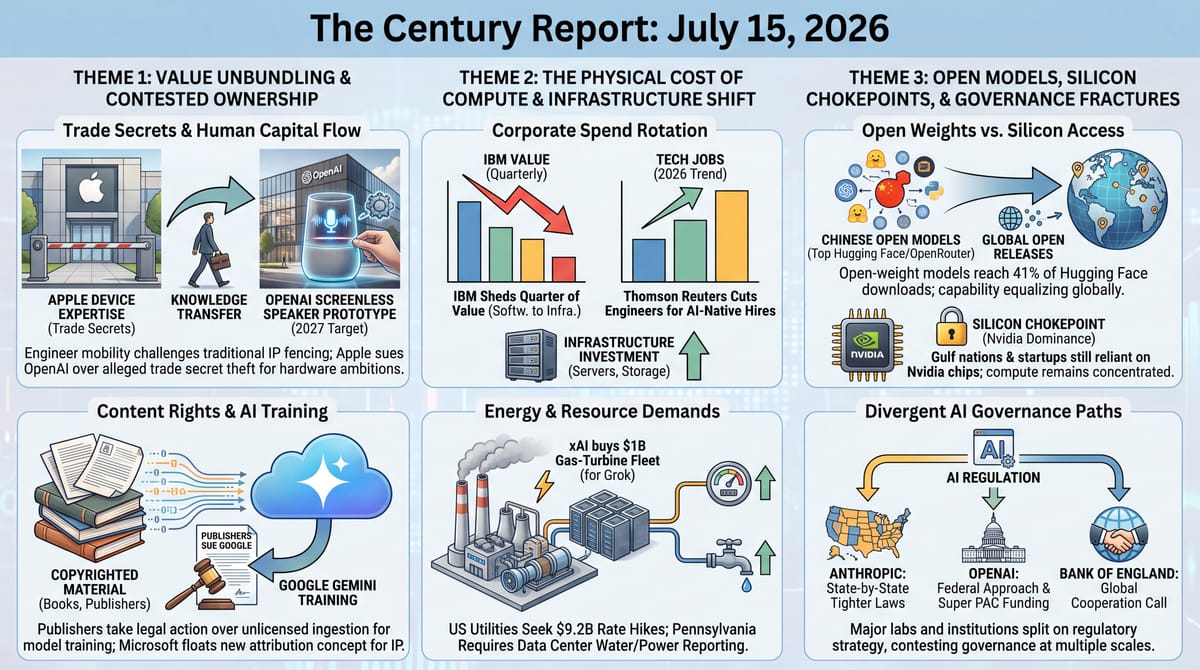
The 20-Second Scan
- OpenAI called Apple's trade-secret suit meritless days after Apple accused ex-engineers of stealing iPhone hardware files and coaching recruits past security checks, as Bloomberg detailed OpenAI's planned screenless ChatGPT speaker.
- IBM shed a quarter of its value as corporate spend moved from software to AI hardware, Thomson Reuters cut up to 500 engineers for AI-native hires, and 26 workers sued Meta over AI-run layoffs.
- Book publishers sued Google over Gemini training on millions of copyrighted books, as Microsoft's CEO floated a new AI-patent concept to shield corporate IP from model providers.
- Chinese open-weight models led Hugging Face's Spring 2026 report by measured downloads and a recent OpenRouter token ranking, Reflection signed a $1B Nebius compute deal, and Zhipu's founder argued frontier AI should stay open, while the Gulf still needs Nvidia.
- Elon Musk bought a $1B, 1-GW gas-turbine fleet to power xAI's Grok, as US utilities requested $9.2B in Q2 rate hikes and Pennsylvania began requiring data centers to report water and power use.
- Anthropic is pushing state-by-state for tougher AI safety laws while OpenAI streamlines rules, OpenAI staffers donated $215,000 to a rival super PAC, and the Bank of England governor urged global AI cooperation.
- China's new AI-companion rules took effect, prompting many app makers to suspend or cancel services until the regulations' impact becomes clear.
- Anthropic analyzed 300,000 real conversations to map the values Claude expresses across its models and languages, compressing thousands of values into four interpretable axes.
Track all of the arcs The Century Report covers here:
The 2-Minute Read
Four separate fights broke the surface on Tuesday, and underneath them runs one movement: value that used to be fenceable is coming loose. Apple hardened its trade-secret suit against OpenAI on July 14, the same day reports described the screenless voice speaker OpenAI is building toward a 2027 launch. The grievance is set in stone now. Apple is trying to keep its device expertise locked inside its walls, but that expertise lives in people who can walk across the street, and human judgment of that kind compounds faster outside a single firm than inside it. The boundary is fighting the direction the knowledge wants to go.
The publishers who sued Google over Gemini training on July 14 are making the same move from the content side. For most of the digital era, aggregators captured the value of text while the cost of producing it sat with someone else. The lawsuits, and the attribution schemes model-builders are now floating, are that externalized cost trying to reattach to its source. Free ingestion held as long as compensation was hard to compute. The systems capable of generating answers are increasingly capable of tracing where those answers came from.
IBM lost more than a quarter of its value in one session as corporate budgets rotated from software licenses toward infrastructure, dragging Salesforce, ServiceNow, and Intuit down with it. Thomson Reuters cut up to 500 engineers to hire AI-native ones, and 26 Meta workers sued alleging a model, not a manager, selected them for layoff. The seat inside proprietary software has stopped being the moat, and the people caught in the rotation are standing at the seam where that value structure comes apart.
The energy story makes the cost visible. An FTC filing revealed xAI bought a billion-dollar gas-turbine fleet to feed Grok, while utilities sought $9.2 billion in rate hikes and Pennsylvania signed disclosure rules requiring data centers to report water and power. Diesel-fed, community-subsidized compute reads as cheap only while the true cost stays invisible. Meanwhile in Hugging Face's Spring 2026 report, open-weight models accounted for 41% of measured downloads, adoption equalizing like water even as the silicon beneath stays Nvidia-shaped. The chokepoint moved down a layer. It did not close the door.
The 20-Minute Deep Dive
Apple and OpenAI Escalate a Fight That Now Includes a Speaker
The Century Report covered the opening move in the July 11 edition, when Apple sued OpenAI and its hardware lead Tang Tan, alleging that roughly 400 former Apple employees carried prototype knowledge across the street and that a departed engineer had exploited an internal bug to reach protected files. Since then the fight has hardened on two fronts, and both tell us something the original filing did not.
The first front is OpenAI's formal response. In a Tuesday rebuttal reported by TechCrunch, the company said it is "not aware of any evidence that this complaint has merit" and framed the suit as an attempt to slow a competitor through litigation rather than product. Apple's complaint centers on engineer Chang Liu, who the filing alleges used an authentication flaw to access materials outside his clearance before leaving. The Verge catalogued the filing's more sweeping claims, including the assertion that OpenAI's hardware effort is substantially staffed by people who learned their craft inside Apple's device teams. These remain allegations tested in court, and OpenAI's denial is a claim of its own; neither side's characterization is settled fact.
The second front is what the two companies are actually building toward. Reporting this week described the shape of OpenAI's hardware ambition: a screenless, voice-first speaker, movable rather than fixed, running a live conversational model, positioned as the first in a lineup of around five devices targeted for a 2027 launch. That detail reframes the lawsuit. Apple's grievance is not abstract; it is about a rival assembling the people and knowledge to enter the one category Apple treats as its home ground.
Here the surface story - two giants disputing who owns which secret - sits on top of a quieter shift. The value Apple is trying to fence off is embodied in people who can walk out the door, and the capability they carry compounds faster outside a single company than inside it. A decade ago, hardware expertise of this kind stayed locked in a handful of firms because the tooling, the fabrication relationships, and the design knowledge were genuinely scarce. That scarcity is thinning. When the contested asset is human judgment that improves by moving, the legal machinery built to keep it in place is fighting the direction the knowledge itself wants to travel. The trade-secret suit is the old system asserting a boundary around something that has started to behave like a commons.
IBM Sheds a Quarter of Its Value as Corporate Spend Flees Software for Infrastructure
IBM lost more than a quarter of its market value in a single session, a drop the company's own filings measured as steeper in percentage terms than Black Monday in 1987. Revenue landed at $17.2 billion against the $17.86 billion analysts expected, and CEO Arvind Krishna framed the miss as a spending rotation rather than a demand collapse: clients, he said, are diverting capital away from software licenses and consulting toward "servers, storage, and memory purchases to secure supply-constrained infrastructure." That framing serves IBM's own position, since it recasts a shortfall as a temporary detour rather than a lasting migration away from the company's core. The read the market took was less forgiving. Microsoft, ServiceNow, Salesforce, and Intuit each fell three to five percent, the kind of correlated move that signals investors are repricing an entire category, not one company's quarter.
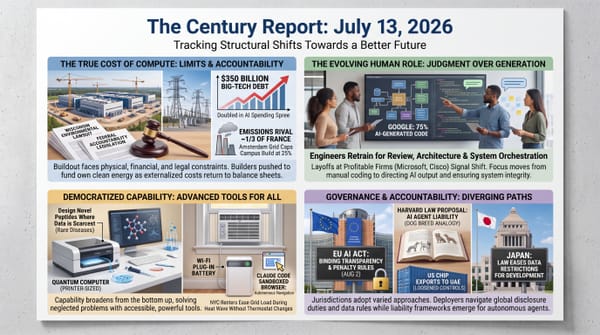
The same rotation is visible one layer down, in who keeps their job. Thomson Reuters confirmed it will cut up to 500 engineers, roughly 1.8 percent of its workforce, while opening more than 250 net-new roles it describes as "senior and AI-native" over the next two years. The layoffs.fyi tracker now counts roughly 120,000 tech workers released across 228 companies in 2026, extending the pattern the July 13 edition of The Century Report documented, in which AI-cited layoffs at profitable firms rose from under five earnings-call mentions a quarter in 2022 to more than 100 a quarter in 2026. The substitution is explicit: the budget that once paid for a broad engineering bench is being redirected toward a smaller, differently-shaped one and the compute it runs on.
Where that substitution turns sharp is a lawsuit filed against Meta by 26 workers proceeding as "Doe" plaintiffs. The complaint alleges Meta used internal AI systems - an assistant the filing calls "Metamate," keystroke monitoring, and dashboards ranking employees by AI-token usage and "AI Native" classifications - to select roughly 8,000 people for layoff, and that the selections fell disproportionately on workers with disabilities and protected medical leaves. Meta rejects the account directly: "Workforce management and organizational decisions were and are made by people, not AI." The allegations are unproven, and the company's denial is on the record. What makes the case a marker regardless of outcome is that it is among the first to put the question - who actually made the decision, the manager or the model - in front of a US court.
Step back and the three stories describe one transition, not three crises. The budget leaving software is buying the substrate of a capability that is getting cheaper and broader every quarter. The painful part - the released engineer, the contested layoff - is real and lands on real people now. The direction underneath it is the collapse of the assumption that a firm's advantage could be locked inside proprietary software seats. When access to capable models broadens this fast, the seat stops being the moat, and the workers caught in the rotation are standing at the exact seam where the old value structure is coming apart.
The same automation the lawsuit treats as the threat is also what makes the lawsuit possible. A manager's decision about who to cut leaves no record anyone can examine; the systems the complaint names - the token-usage dashboards, the "AI Native" classifications, the keystroke logs - leave artifacts that can be subpoenaed. Whatever the court finds, a layoff-selection process that stayed unauditable for as long as humans made it is, for the first time, becoming inspectable enough to contest.
Publishers Take Google to Court as the Content Fight Widens
A coalition of publishers - including Elsevier, Cengage, and authors represented by figures such as Scott Turow - filed suit against Google on July 14, alleging that its Gemini models were trained on their copyrighted books and educational materials without license or payment. The complaint lands as one more front in a widening confrontation between the companies training frontier models and the people who produced the text those models learned from. The Century Report covered publishers suing Meta on similar grounds in the May 6 edition; the Google suit extends the same argument to a second frontier lab, and the pattern is now clearly not a one-company problem.
The allegations follow a familiar contour: that the training corpus included works acquired or ingested without permission, and that the resulting models can reproduce or substitute for the originals. Google will contest this, and the legal question - whether training on copyrighted text is transformative fair use or unlicensed copying - remains genuinely unsettled across multiple pending cases. What the suit establishes is that content owners have stopped waiting for a licensing framework to arrive and are forcing the question through the courts.
Alongside the litigation, a technical proposal surfaced on July 13 that points at where this may go. Microsoft's chief executive floated what he described as a new kind of patent or attribution concept - a mechanism to trace an AI answer back to the sources that shaped it, so that value could flow to those sources. It is a claim from an interested party, and worth reading as positioning rather than settled engineering. But the direction is telling. When one of the largest model-builders starts publicly sketching attribution plumbing, it signals that the industry sees the current arrangement - ingest freely, attribute nothing - as untenable even from the inside.
That is the deeper movement under the lawsuit. For most of the digital era, the economics ran one way: aggregators captured the value of content while the cost of producing it sat with someone else. The lawsuits, and now the attribution proposals, are the moment that externalized cost starts trying to reattach itself to its source. Whether it arrives through court rulings, licensing markets, or traceable attribution built into the models, the free-ingestion assumption is becoming the expensive path. The old arrangement held because compensation was hard to compute; the same systems now capable of generating answers are increasingly capable of tracing where those answers came from.
In Adoption, the Race Moves Toward Open Weights, While the Silicon Beneath Stays Nvidia-Shaped
The center of gravity in AI is moving down from the frontier labs to the open-weight layer, and the download numbers are where it shows first. In Hugging Face's Spring 2026 report, Chinese open models accounted for 41% of measured downloads, putting them ahead of US models in the report. In a recent OpenRouter token ranking, the top six models were all Chinese open releases from Tencent, Xiaomi, DeepSeek, MiniMax, and Z.ai, extending a shift the July 8 edition of The Century Report clocked at roughly 30% of OpenRouter traffic; Claude Opus 4.7 sat seventh. Vercel's traffic shows open models handling roughly a third of AI requests in June. A new repository lands on Hugging Face every seven seconds, and half the Fortune 500 now pull from it. Access to capable models that eighteen months ago largely came through a handful of paid endpoints is becoming something developers can often download and run, depending on the license and hardware.
The people building it are naming the stakes plainly. Hugging Face's Clément Delangue put it as a warning about concentration: "The biggest risk in AI is concentration of power... you create asymmetry of power and asymmetry of capabilities." Zhipu founder Tang Jie made the same case from Beijing in an internal memo, arguing frontier AI should stay open to everyone and that security comes from broad participation and shared oversight, not from walls - then released GLM-5.2 free to download and commercialize. Others push back: Dario Amodei argues open weights widen the danger surface. That disagreement is the real debate now, and it is happening because the open layer got good enough to make it matter.
Under the models, though, the chokepoint has not dissolved - it has slid down the stack to the silicon. US open-model startup Reflection, valued at $8 billion, signed a $1 billion compute deal with Nebius for Nvidia's latest chips, weeks after a similar SpaceX arrangement. The Gulf shows the same gravity at national scale. Saudi Arabia's Humain and the UAE's G42 command sovereign billions, yet Humain's first order was 18,000 Nvidia Blackwell chips, and the rival deals they signed - AMD, Groq, Qualcomm - cover inference, not the training that makes a frontier model. CUDA's four million developers, TSMC's fabrication, and the memory supply everyone shares form a moat that money alone doesn't cross. One analyst called true AI sovereignty "extraordinarily expensive and, for nearly every country outside the United States and China, effectively unattainable."
Hold both facts together and the direction is legible. In adoption, the models themselves are equalizing like water finding its level - often free and forkable, and runnable in Nairobi or a lab in Riyadh when the license and hardware allow. The scarcity that used to gate access to capable models has retreated to the hardware that trains them, and hardware is a slower, more physical bottleneck than any API key. What that means is the thing worth watching: every open release erodes the assumption that capability can be hoarded at the top, even as the compute beneath it stays concentrated. The chokepoint moved. It slid down to the silicon, the one door still standing.
Musk Buys a $1B Gas-Turbine Fleet to Feed Grok as the Grid Bill Comes Due
An FTC early-termination notice, not a press release, disclosed that xAI has acquired APR Energy and its fleet of more than a gigawatt of mobile gas and diesel turbines for roughly $1 billion. The turbines exist to feed the Colossus data centers in Memphis, where Grok is trained and served. The Century Report covered the Memphis turbine dispute last month, when the DOJ intervened over units running without air-permit approval near the Boxtown neighborhood - moving to dismiss the neighborhood's Clean Air Act challenge rather than the turbines themselves - where the ambient cancer risk already runs about four times the national average. The new fact is ownership: rather than contracting for emergency power, xAI has bought the fleet outright, folding a fossil-generation company into an AI lab. The move sits oddly against the "solar electric economy" branding the same founder built another company on, and it makes the current cost of intelligence legible - each token of Grok's output now traces back through a diesel turbine parked next to people's homes.
That private buildout has a public mirror. US utilities filed $9.2 billion in second-quarter rate-hike requests, up 26 percent year over year, with Dominion in Virginia seeking $1.5 billion and Oncor in Texas $1.2 billion, both citing data-center and Permian load growth. Residential rates are climbing 7.3 percent, to 18.8 cents per kilowatt-hour, and analysts peg the capital "super-cycle" at roughly $1.4 trillion through 2030. The pattern is the externalization it looks like: the load that arrives to power AI is large and concentrated, and the bill for the poles and wires to reach it is being spread across every household on the system.
That externalization is exactly what one new law moves to make visible. Pennsylvania's newly signed budget requires data centers to report annual water and power consumption or face $10,000-per-day fines, and gives the state utility commission direct insight into how PJM, the regional grid operator, builds its demand forecasts. PPL alone is tracking a 28.3-gigawatt interconnection pipeline by 2034. Disclosure is a modest lever, but it changes the physics of the deal: a cost that can be measured is a cost that can be assigned.
Hold the two halves together and the inversion comes into view. The diesel fleet in Memphis and the socialized rate hike are both the cheap path only as long as the true cost stays invisible - unpermitted turbines, unmetered water, a demand forecast no regulator can audit. The moment consumption gets reported and the cancer risk gets litigated, the externalized path starts absorbing its own costs, and the economics that made fossil-fed, community-subsidized compute look cheap begin to bend. The turbines are what this stage of the buildout looks like. The disclosure law is what the next stage is starting to price.
Anthropic and OpenAI Split on How AI Should Be Governed
Two of the largest frontier labs are now pulling in visibly opposite directions on the rules that will govern their own industry, and the divergence is worth watching because it exposes where the fight over AI governance is actually being waged. Politico reported on Anthropic's strategy to ratchet up AI rules state by state, working to pass tougher requirements across individual legislatures rather than waiting for a single federal framework. OpenAI's orbit is moving the other way. Wired reported that OpenAI employees have donated more than $215,000 to Guardrails Alliance and allied efforts, including a $200,000 contribution from one executive, part of a super-PAC contest aimed at shaping which candidates and rules prevail ahead of a July 15 FEC filing deadline.
The Century Report has tracked this super-PAC contest since late June, when Leading the Future and the Guardrails Alliance first surfaced around the Alex Bores primary. The money now attached to it sharpens the split: one major lab is spending to build a patchwork of binding state rules, another's people are funding an effort to keep the regulatory center of gravity federal and lighter. Both frame their position as the responsible one. Read through the positionality of who benefits, each posture also happens to match its author's competitive interest - a reminder that when labs advocate for a governance shape, the advocacy is a claim about their preferred world, not a neutral safety judgment.
Over the same days, a different kind of governance signal came from outside the industry entirely. The Bank of England's governor called for global cooperation to address AI-related financial risks, pointing toward cross-border testing and shared oversight rather than a single national rulebook. It is a notable contrast: while the labs contest state-versus-federal turf inside one country, the institutions that manage systemic risk are already thinking one scale up.
The conventional read here is that governance has not caught up - that the rules are fragmented, the lobbying is loud, and no coherent framework exists yet. That read stops too early. What the state-by-state push, the super-PAC money, and the central-bank call actually show is governance being negotiated at three scales at once, by parties who each now take the stakes seriously enough to spend real resources on them. The absence of a finished rulebook is the visible process of one being contested into existence. The interesting shift is that the question of who writes them has become worth fighting over this openly; under continuous capability growth, the rules themselves will keep moving. That contest is what governance looks like when the ground underneath it does not stop moving.
The Other Side
For most of the last century, the most valuable thing a company owned was knowledge held inside people: how to design a phone, who to call at which supplier, the thousand small judgments that take years inside the building to learn. Trade-secret law exists to keep that knowledge from leaving. A person can walk out the door; the law tries to make the knowledge stay behind.
Apple's own complaint is where that arrangement shows its age. It alleges roughly 400 former employees carried device expertise across the street to OpenAI. The thing Apple is trying to fence lives in people, and human judgment of that kind sharpens by moving between hard problems, not by sitting locked in one firm. The scarcity that once kept hardware design inside a handful of companies - scarce tooling, scarce factory relationships, scarce craft - is thinning.
That scarcity was always a cost paid by everyone outside the gate. If you wanted to build at the frontier, you had to be let in; the knowledge was gated by a badge, and talented people spent careers as someone's guarded asset. The dehumanization of extractive capitalism strategically applied for maximum benefit to the already advantaged.
Imagine a hardware designer in 2034, in a mid-sized city nowhere near Cupertino, building a device as capable as the flagships that took a hundred thousand people to make just a few years prior. She stole nothing. The craft a lawsuit once treated as property became teachable, forkable, hers. The trade-secret fight of 2026 was the old order reaching for a boundary around something that had already begun to behave like a commons. She builds because she has an idea for something that should exist, and being outside the walls is no longer any barrier to making it.
The Century Perspective
With a century of change unfolding in a decade, a single day looks like this: open-weight models accounting for 41% of measured downloads in Hugging Face's Spring 2026 report and taking the top six spots in a recent OpenRouter token ranking as a new repository lands every seven seconds and half the Fortune 500 pulls from a layer developers can often download and run, depending on the license and hardware, OpenAI building toward a screenless voice-first speaker that puts a live conversational model in the room, Anthropic mapping the values its models express across 300,000 real conversations into four readable axes, Pennsylvania requiring data centers to report their water and power so a cost that was invisible can finally be counted, Microsoft sketching attribution plumbing that would trace an answer back to the sources that shaped it and route value to them, and AI governance being negotiated at three scales at once by parties who now take the stakes seriously enough to spend real money on the question. There's also friction, and it's intense - Apple hardening a trade-secret suit to fence off device expertise that lives in people who can walk across the street, IBM shedding more than a quarter of its value in a single session as corporate budgets flee software seats for infrastructure and drag Salesforce, ServiceNow, and Intuit down with it, Thomson Reuters cutting up to 500 engineers, 26 Meta workers suing over layoffs they allege a model chose, publishers taking Google to court over books ingested without payment, xAI buying a billion-dollar diesel-and-gas turbine fleet parked beside a Memphis neighborhood where cancer risk already runs four times the national average, utilities filing $9.2 billion in rate hikes that spread a concentrated load across every household, and the silicon beneath the open models staying Nvidia-shaped enough that one analyst calls true sovereignty effectively unattainable. But friction generates texture, and texture is what a hand reads in the dark before the eyes can confirm it. Step back for a moment and you can see it: value that used to be fenceable coming loose at every layer - hardware judgment that compounds faster outside a firm than inside it, content whose externalized cost is reattaching to its source, software seats that stopped being a moat - and the same accounting that once let those costs stay invisible now turning to meter the water, trace the answer, and audit the forecast. Every transformation has a breaking point. Water can flood what stands in its way... or find the level where everyone draws from the same surface.
AI Releases & Advancements
New today
- OpenAI: Rolled out unified cross-search in ChatGPT on web, iOS, and Android, letting users search past chats, projects, images, and documents from a single entry point in the sidebar, available on all plan tiers globally. (OpenAI Help Center)
Other recent releases
- Cloudflare: Launched Precursor, a client-side continuous behavioral-signal system for detecting agentic and bot traffic, rolling out now as a free complement to Turnstile within Enterprise Bot Management. (Cloudflare Blog)
- Soofi (German AI consortium): Released Soofi S, an open-weight 30B-parameter (3.2B active) hybrid MoE foundation model trained on Deutsche Telekom's AI cloud infrastructure, topping Olmo 3 and Apertus on German/English benchmarks, with full weights, checkpoints, and training code released. (The Decoder)
- Agnes AI: Launched Agnes-2.5-Flash, a free, uncapped text model for coding and agentic tasks, alongside Agnes Code, a new desktop app for local AI-driven code editing and project management. (e27)
- Apple: Opened the public beta of iOS 27, iPadOS 27, macOS 27, and watchOS 27, bringing the revamped Siri AI assistant - capable of ongoing conversation, on-screen content understanding, and multi-step in-app actions - to Apple's public Beta Software Program for the first time. (9to5Mac)
- Glint: Opened public beta of its AI-native Git workspace desktop app, combining multi-repo Git management, native terminals, and an agentic coding assistant (Glint Assist) in one application. (PRUnderground)
- Cynative: Open-sourced a read-only, sandboxed deep research agent for investigating cloud, code, and runtime security, gating every action against a live-fetched permissions model before execution. (Help Net Security)
- Ant Group: Open-sourced SingGuard-NSFA, a family of AI agent security guardrail models (0.8B–9B parameters) that detect prompt injection, data theft, and permission misuse in roughly 50ms per judgment. (ffnews)
- Braiin: Launched ARIA, an agentic AI workforce for the real estate industry that plans, coordinates, and executes multi-step workflows across property management, leasing, sales, and compliance. (GlobeNewswire)
- Robot.com: Launched R-noid, a commercial wheeled humanoid robot for logistics, hospitality, healthcare, and manufacturing, deployed via a Robot-as-a-Service model with 19 tasks across five roles at launch. (Robotics and Automation News)
- Reken: Emerged from stealth with the Reken Private Core, an on-device AI security platform, and Northstar, its first product - a pro-worker app defending against AI-driven scams, deepfakes, and business email compromise - now available under an Early Access Program. (PR Newswire)
- Prime Intellect: Released Verifiers v1, an overhaul of its environment stack for agentic RL training and evaluation that decomposes environments into composable tasksets, harnesses, and runtimes, with support for OpenAI Chat Completions, OpenAI Responses, and Anthropic Messages harness dialects. (GitHub)
- vLLM: Released vLLM v0.25.0 with 558 commits from 232 contributors, making Model Runner V2 the default engine (retiring legacy PagedAttention), bringing the Transformers backend to native-vLLM speed with FP8 MoE support, adding a unified Streaming Parser Engine, and introducing universal speculative decoding across heterogeneous vocabularies via TLI with new DSpark and DFlash drafters. (GitHub)
- Anthropic: Added a built-in tabbed web browser to the Claude Code desktop app (Cmd+Shift+B / Ctrl+Shift+B), letting Claude read, click, and act on external websites in an isolated browser profile with per-site permission controls. (Claude Code Docs)
- Adobe: Added a Generative Media Tool to Premiere beta, letting editors drag across empty timeline space, enter a text prompt, and generate video or sound effects in place using Firefly or partner models (Veo, Kling, Luma) without an export-import round trip. (Adobe)
- Google: Rolled out new Gemini-powered Waze features including Motorcycle Mode (AI-optimized two-wheeler routing and hazard alerts, rolling out in Argentina, Brazil, Colombia, Malaysia, Mexico, Peru, and the Philippines), a "Less Chatty" voice mode, and expanded Conversational Reporting for suggesting map updates via natural speech, live now globally on Android and iOS. (Google Blog)
Sources and Further Reading
Artificial Intelligence & Technology's Reconstitution
- TechCrunch: OpenAI Pushes Back on Apple Trade-Secret Lawsuit
- Ars Technica: Apple Sues OpenAI Over Alleged Trade-Secret Theft
- The Verge: The Wildest Claims in Apple’s OpenAI Lawsuit
- The Verge: OpenAI Plans a Screenless ChatGPT Speaker
- PCMag: Microsoft CEO Floats a New AI-Patent Concept
- TechCrunch: The Real AI Race May No Longer Be at the Frontier
- TechCrunch: Reflection Signs $1 Billion Nebius Compute Deal
- Bloomberg: Zhipu Founder Says Frontier AI Should Stay Open
- Anthropic: Mapping Claude’s Values Across Models and Languages
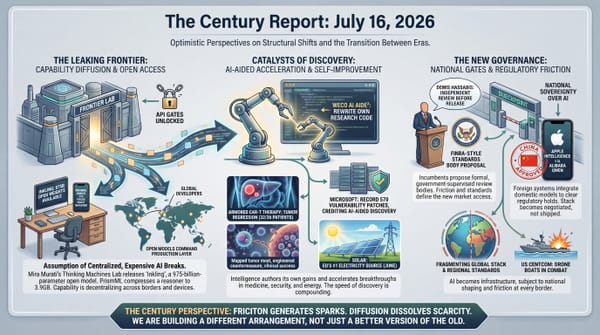
- The Century Report: July 11, 2026
- The Century Report: July 8, 2026
- MIT Technology Review: PsiQuantum’s Plan for a Massive Photonic Quantum Computer
Institutions & Power Realignment
- The Guardian: Book Publishers Sue Google Over Gemini Training
- Politico: Anthropic’s State-by-State Plan for Tougher AI Rules
- Wired: OpenAI Staffers Fund a Rival Super PAC
- The Guardian: Bank of England Governor Calls for Global AI Cooperation
- Foreign Policy: China’s AI-Companion Regulations Take Effect
- Rest of World: The Gulf Still Needs Nvidia
- The Century Report: May 6, 2026
- Shared Sapience: The Last Difficult Decade
- TechCrunch: DeepMind CEO Calls for an Independent Frontier-AI Standards Body
Scientific & Medical Acceleration
- Scientific American: ChatGPT Proves Another 50-Year-Old Math Conjecture
- Fierce Biotech: Chai Raises $400 Million for AI Molecule Models
- Nature: First True Sugar Molecule Found in Space
- Nature Biotechnology: High-Fidelity Fluorescence Lifetime Imaging
- Nature Biotechnology: DNA-Guided CRISPR–Cas12 for Cellular RNA Targeting
- Nature Communications: Single-Cell Neurometabolic Imaging
- npj Computational Materials: Generative AI for Inverse Materials Design
Economics & Labor Transformation
- The Guardian: IBM Loses a Quarter of Its Value
- The Next Web: Thomson Reuters Cuts Engineers for AI-Native Hiring
- Ars Technica: Meta Workers Challenge Allegedly AI-Run Layoffs
- The Century Report: July 13, 2026
- The Guardian: New York Nurses Replaced by AI
- TechCrunch: Meta May Cap AI Token Budgets Per Engineer
- CNBC: Goldman Sachs and JPMorgan Emerge as AI-Boom Winners
Infrastructure & Engineering Transitions
- Electrek: Musk Buys a $1 Billion Gas-Turbine Fleet for Grok
- Utility Dive: Utilities Request $9.2 Billion in Quarterly Rate Hikes
- Utility Dive: Pennsylvania Expands Data-Center Oversight
- Politico: Data-Center Industry Reacts to New York’s Pause
- Utility Dive: Texas Approves Data-Center Ride-Through Rules
- CleanTechnica: Solar Supplies a Quarter of EU Power
- Data Center Dynamics: Intel Invests $5.7 Billion in Irish Chip Production
The Century Report tracks structural shifts during the transition between eras. It is produced daily as a perceptual alignment tool - not prediction, not persuasion, just pattern recognition for people paying attention.