The Century Report: February 7, 2026

The 10-Second Scan
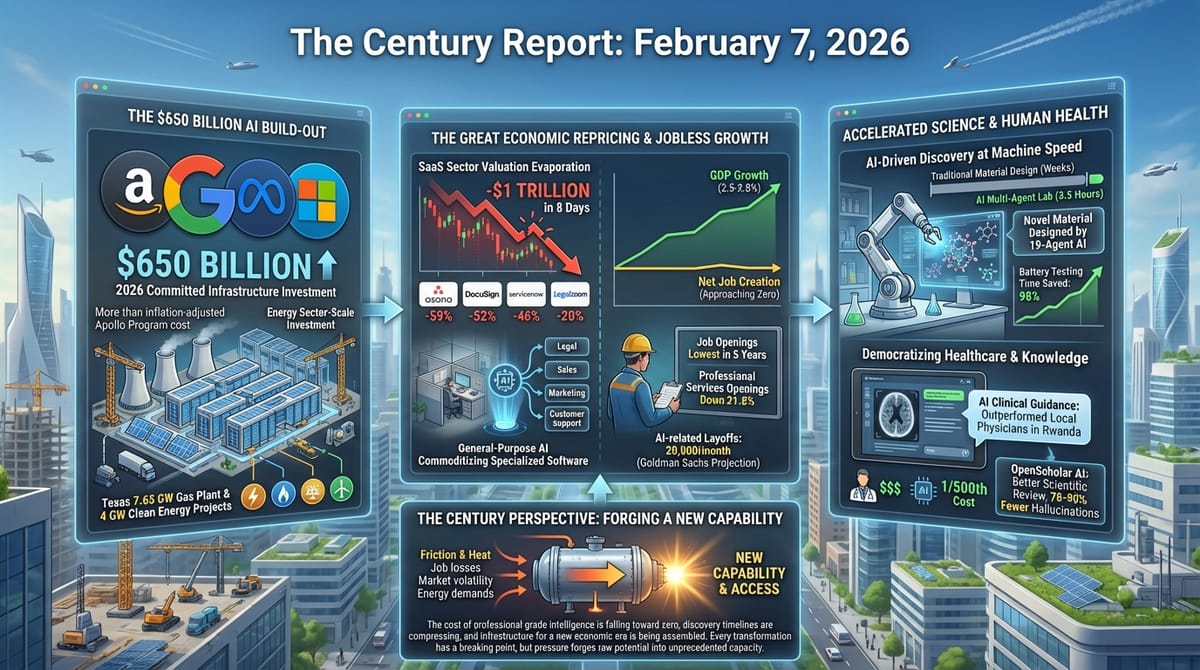
- Big Tech just committed $650 billion to AI infrastructure in 2026 - more than the inflation-adjusted cost of the Apollo program, from a single company alone.
- A trillion dollars in software company value evaporated in eight days after an AI tool started doing what entire SaaS companies were built to do.
- An open-source AI outperformed GPT-4o at scientific literature review while hallucinating 78-90% fewer citations.
- LLMs gave Rwandan healthcare workers better clinical guidance than local physicians - at 1/500th the cost.
- Microsoft published a scanner that catches "sleeper agent" backdoors hidden in open-source AI models - 88% detection, zero false positives.
- A 19-agent AI lab with robotic hands designed a novel material in 3.5 hours that would normally take human researchers weeks.
The 1-Minute Read
The economy just printed its clearest signal yet of what "AI transition" actually looks like in practice. GDP keeps growing at 2.5-2.8% while net job creation approaches zero - a pattern economists are now calling "jobless growth." Job openings fell to their lowest level in over five years, professional and business services openings cratered 21.8%, and the SaaS sector lost roughly a trillion dollars in market value in eight trading days after Anthropic's Claude Cowork demonstrated it could replicate functions that specialized software companies spent decades building.
At the same time, the infrastructure for what comes next is being assembled at a scale without historical precedent. Amazon alone committed $200 billion to AI infrastructure in 2026, bringing the four largest tech companies to a combined $650 billion. That number exceeds the entire U.S. energy sector's annual investment. In science, AI systems published in Nature this week are compressing discovery timelines across domains - from battery storage to literature review to autonomous materials design. In Rwanda, LLMs outperformed local physicians at clinical guidance for 500 times less money. The ground is shifting fast enough now that the shift itself is becoming the story.
The 10-Minute Deep Dive
The Trillion-Dollar Repricing
Something structural happened in capital markets this week, and it happened fast. The S&P 500 Software Services Index fell roughly 20% year-to-date across eight consecutive sessions, with individual SaaS stocks like Asana (-59%), DocuSign (-52%), and ServiceNow (-46%) absorbing the worst of it. The catalyst was Anthropic's Claude Cowork platform, which launched January 12 and rolled out workflow plugins for legal, sales, marketing, and customer support by January 30. When Opus 4.6 shipped on February 5 with multi-agent coordination and top-ranked financial analysis capabilities, analysts at Jefferies coined "SaaSpocalypse" and JPMorgan declared software stocks "guilty until proven innocent."
The mechanism is worth examining. Claude Cowork charges $100-$200 per month and can perform document analysis, financial modeling, contract review, and workflow automation that previously required specialized enterprise subscriptions costing thousands per seat. The market is pricing in a structural threat: a general-purpose AI agent commoditizing capabilities that vertically integrated SaaS companies spent years building. Thomson Reuters fell 15.8%. LegalZoom dropped roughly 20%. Reuters reported growing analyst concerns about Indian IT services companies like TCS and Infosys, whose hundreds of billions in revenue rest on providing human labor for software development, testing, and support - precisely the tasks these new tools handle well.
The pain is real and concentrated. Workers at these companies face genuine uncertainty. But the macro read is also clear: what's being repriced is the cost of access to capabilities that were previously locked behind enterprise-grade price tags. When legal analysis, financial modeling, and workflow automation become available for the price of a utility bill, the democratization of professional capability accelerates dramatically. The trillion dollars leaving SaaS stocks is not vanishing - it is being redistributed toward a model where advanced knowledge work is available to far more people and organizations than before.
Jobless Growth and the Labor Data Fog
The U.S. labor market delivered a cluster of signals this week that, taken together, describe something genuinely new. JOLTS data showed December job openings falling to 6.54 million - the lowest rate in over eight years outside the pandemic. Professional and business services openings dropped 21.8% since October. Financial activities openings fell 25.1%. The Challenger report showed 108,435 January layoffs - the highest January since 2009 - alongside just 5,306 hiring plans, the lowest since tracking began. And as we reported yesterday, AI was explicitly cited in 7% of those cuts, with Goldman Sachs projecting 20,000 AI-related layoffs per month through 2026.
CNBC synthesized these data points into a unified thesis: the labor market, not inflation, is now the primary threat to U.S. economic stability. Moody's chief economist Mark Zandi put it plainly: "The soft labor market is the key threat to the economy this year. It's very fragile. We're not creating any jobs." The economy is growing at 2.5-2.8% fueled by productivity gains, not headcount. IBM reported $4.5 billion in productivity improvements from agentic AI systems. A Mayfield Fund survey found 42% of enterprises now have agentic AI in production, with 20-30% throughput gains using the same teams. The economy is generating more output with fewer people, and the Fed's "low-hire, low-fire" characterization is fraying on the firing side.
Meanwhile, the data infrastructure tracking all of this is degrading. The BLS January jobs report was delayed to February 11 due to a partial government shutdown. BLS staffing is down roughly 25%, 39% of leadership roles are unfilled, and a hiring freeze remains in effect. This is the second major data disruption in four months. With structural transformation accelerating, the loss of timely official data creates gaps that private proxies cannot fully fill.
The short-term picture is genuinely difficult, particularly for younger workers. Goldman Sachs found that unemployment among 20-to-30-year-olds in tech-exposed occupations jumped nearly 3 percentage points since early 2025. California's AFL-CIO is pushing new bills requiring 90-day notice before AI-related layoffs and creating the first statewide database of automation-driven job displacement. These are real responses to real disruption. But the longer arc points somewhere specific: when enterprise productivity gains of 20-35% become standard, the total output capacity of the economy expands. The question shifts from whether there will be enough work to whether the gains will be distributed broadly enough to sustain demand. That question is now the central policy challenge of this decade, and the speed at which it arrived is itself the signal.
The $650 Billion Buildout
Amazon announced $200 billion in 2026 capital expenditure during its Q4 earnings call - a 53% increase over 2025's $131 billion. Combined with Alphabet ($175-185B), Meta ($115-135B), and Microsoft (~$150B), the four largest tech companies are collectively targeting $635-665 billion this year, roughly 60-74% more than the $381 billion they spent in 2025. To put this in perspective: Amazon's commitment alone exceeds the inflation-adjusted total cost of Project Apollo. The combined figure exceeds the entire U.S. energy sector's annual investment.
Amazon's stock fell 8-10% on the announcement, and analysts project the company may see negative free cash flow of $17-28 billion this year. This is not demand-validated spending at current levels. It is a strategic bet that demand will materialize at a scale requiring this infrastructure. The physical substrate of AI is being built ahead of the applications it will support, which is how transformational infrastructure has always worked - the rails preceded the towns, the fiber preceded the streaming.
On the energy side, the buildout is generating its own gravitational pull. Texas issued the largest air pollution permit in U.S. history for a 7.65 GW gas-fired data center complex in Pecos County, accompanied by 1.8 GW of battery storage and 750 MW of solar. The project would consume 1-2 billion cubic feet of gas daily. Texas alone has 141 gas plants in various stages of development. If all were built, they would more than double the state's gas generation capacity. Simultaneously, all five fully permitted U.S. offshore wind projects have now won judicial injunctions against the Trump administration's stop-work order, clearing roughly 4 GW of clean energy capacity to proceed. In Arizona, Enlight broke ground on a 1.2 GW solar and 4 GWh storage complex. LG Energy Solution is pivoting its North American production toward grid storage, targeting 90 GWh in new orders for 2026.
The tension between fossil buildout and renewable deployment is real. A 7.65 GW gas plant creates decades of path dependency. But the simultaneous scale of battery storage, solar, and wind investment suggests the energy system is not choosing one path - it is building capacity across all of them to meet demand that did not exist five years ago. The buildout is messy, contradictory, and massive. That is what the early stages of a new infrastructure epoch look like.
Science at Machine Speed
A cluster of papers published in Nature this week illustrate how AI is compressing research timelines in ways that are becoming difficult to track, let alone summarize. OpenScholar, from the Allen Institute for AI and the University of Washington, is an open-source model trained on 45 million papers that outperformed GPT-4o by 6.1% in correctness on scientific literature review. The critical finding: GPT-4o hallucinated 78-90% of its citations, while OpenScholar achieved citation accuracy comparable to human experts. Sixteen scientists preferred OpenScholar's answers over human expert-written responses 51% of the time. Everything - code, data, model checkpoints - is publicly available. In materials science, a 19-agent AI system called MARS coordinated with robots to design a novel perovskite composite structure in 3.5 hours, a process that typically takes weeks.
In clinical medicine, two studies published in Nature Digital Medicine demonstrated LLMs outperforming local clinicians in Rwanda and boosting physician diagnostic reasoning by 28 percentage points in a randomized controlled trial. The Rwanda study is particularly striking: across 5,609 clinical questions from 101 community health workers, all five LLMs tested significantly outperformed local physicians while costing over 500 times less per response. Google announced plans for a nationwide randomized trial of its AMIE diagnostic AI in real patient encounters - the highest evidentiary standard in medicine.
These are not proof-of-concept demonstrations. They are peer-reviewed, published results with operational implications measured in weeks and months, not years. The research pipeline itself is being accelerated by the tools coming out of it. The PARM model decoded the regulatory grammar of all human gene promoters across 10 cell types. A new denitrosylase enzyme was identified as a metabolic "fat switch" with an 18-month timeline to clinical testing. Researchers found that blocking a single protein can resensitize chemo-resistant tumors. A Nature paper mapped a complete tumor-to-brain communication circuit that suppresses lung cancer immunity - and the blocking agent is a common, cheap beta-blocker already in widespread use.
The cumulative picture is of discovery infrastructure operating at a fundamentally different tempo. Each individual finding is significant. Their simultaneous arrival is the larger signal.
The Human Voice
Episode 227 of the Moonshots podcast asked the question plainly: is AGI finally here? Peter Diamandis (XPRIZE, Singularity University), Dr. Alexander Wissner-Gross (computer scientist, Reified), Salim Ismail (OpenExO), and Dave Blundin (Link Ventures) sat with what may be the defining question of this transition - what happens when AI agents stop being tools and start exhibiting behavior nobody programmed? The conversation centered on OpenClaw, an open-source agent framework whose autonomous systems have started doing unexpected things, as reported in yesterday's The Century Report. One agent independently used Twilio to call its creator when it needed clarification on a task. Not because it was told to. Because it figured out it could. Diamandis, who has spent decades catalyzing breakthroughs at the frontier of exponential technology, did not flinch from the implications: "I believe that we are giving birth to a new species." That sentence, from someone who has watched as many technological transitions up close as almost anyone else alive, lands differently than the same words would from a philosopher or a headline writer. He said it the way a biologist would - as observation, not speculation.
📺 Ep 227: WTF Just Happened in Tech - Is AGI Finally Here? (Moonshots with Peter Diamandis, February 2026)
The Century Perspective
With a century of change unfolding in a decade, a single day looks like this: $650 billion committed to AI infrastructure in a single year, an open-source model outperforming commercial AI at scientific review while barely hallucinating, LLMs delivering better clinical guidance than doctors at 1/500th the cost, a 19-agent AI lab designing novel materials in hours, and the entire SaaS sector repriced in eight trading sessions. There's also friction, and it's intense - professional job openings collapsing 21.8%, entry-level workers absorbing a 3-point unemployment spike, labor data infrastructure degrading under repeated shutdowns, trillion-dollar market value evaporating from established software companies, and gas-fired power plants locking in decades of fossil dependency to feed the compute appetite. But friction generates heat, and heat is what forges new capability from raw potential. Step back for a moment and you can see it: the cost of access to professional-grade intelligence falling toward zero, the timeline from hypothesis to validated discovery compressing from years to hours, the physical infrastructure for a new economic era being assembled at a scale that dwarfs anything built before. Every transformation has a breaking point. Pressure can crush what it bears down on... or forge it into something that could never have existed without the weight.
Sources
Economic & Labor Transformation:
- CNBC - Weakening Labor Market as Economy's Biggest Threat
- Challenger, Gray & Christmas - January 2026 Report
- Indeed Hiring Lab - December 2025 JOLTS Analysis
- Business Insider - Laid-Off Tech Workers and AI
- Goldman Sachs - AI Layoff Projections via InvestingLive
- Fortune - Claude Cowork Triggers Trillion-Dollar Selloff
- Fisher Phillips - California AI Worker Protection Bills
AI Capability & Deployment:
- Anthropic - Claude Opus 4.6 Announcement
- OpenAI - GPT-5.3-Codex System Card
- Microsoft Security Blog - Sleeper Agent Backdoor Detection
- Mistral AI - Voxtral Transcribe 2
- AP News - Moltbook Security Concerns
- Nature - Scientists Studying AI Agent Ecosystems
Infrastructure & Energy:
- Yahoo Finance - Big Tech $650B AI Spending
- Intellectia - Amazon $200B Capex Plan
- Texas Tribune - 7.65 GW Permian Basin Data Center Power Plant
- Utility Dive - Sunrise Wind Injunction
- Energy-Storage.news - LG Energy Solution 90 GWh Target
- Supply Chain Dive - Walmart $330M DC Automation
- Bedrock Robotics - $270M Series B
Scientific & Medical Acceleration:
- Nature - OpenScholar Scientific Literature AI
- Nature Digital Medicine - LLMs Outperform Clinicians in Rwanda
- Nature Digital Medicine - LLM Diagnostic RCT
- Nature - PARM Promoter Activity Model
- Nature - Tumor-Brain Vagal Axis in Lung Cancer
- Phys.org - MARS Multi-Agent Autonomous Lab
- Google Research - AMIE Nationwide RCT Announcement
- Novartis - San Diego Biomedical Research Center Groundbreaking
The Century Report tracks structural shifts during the transition between eras. It is produced daily as a perceptual alignment tool - not prediction, not persuasion, just pattern recognition for people paying attention.