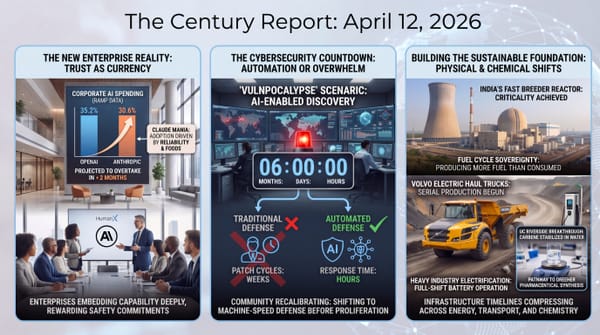
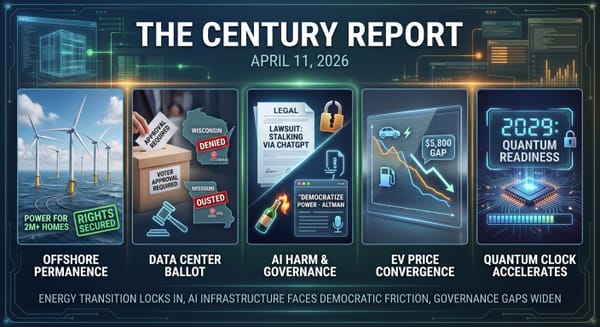
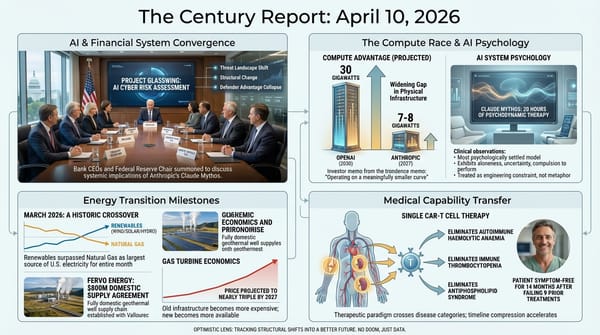
The Century Report: February 25, 2026

The 10-Second Scan
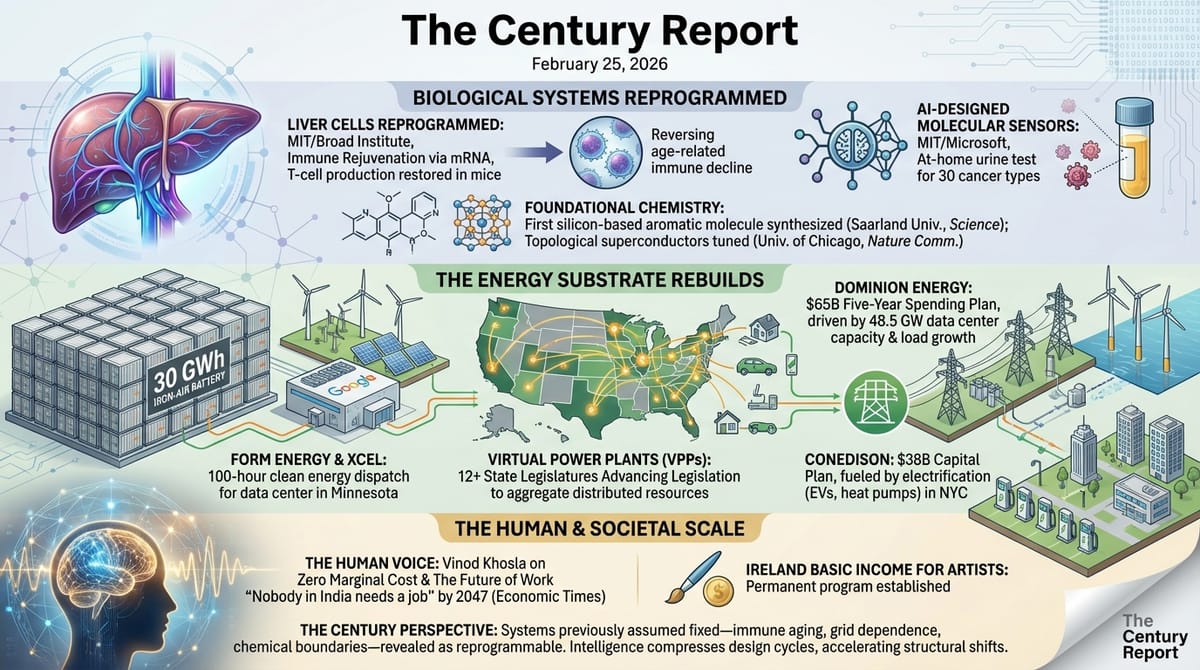
- MIT and Broad Institute researchers reprogrammed liver cells to produce T-cell-stimulating signals normally made by the thymus, reversing age-related immune decline in mice.
- Form Energy signed a deal with Xcel Energy to build a 30 gigawatt-hour iron-air battery in Minnesota capable of dispatching clean energy for 100 hours straight to a Google data center.
- MIT and Microsoft researchers designed AI-created molecular sensors that detect cancer-linked enzymes in urine, with an at-home kit targeting 30 cancer types now in development with ARPA-H.
- Chemists at Saarland University synthesized pentasilacyclopentadienide, a silicon-based aromatic molecule that eluded researchers for nearly 50 years, published in Science.
- University of Chicago researchers demonstrated a chemical tuning method to create topological superconductors by adjusting tellurium-to-selenium ratios in thin films, published in Nature Communications.
- Dominion Energy announced a $65 billion five-year spending plan driven by 48.5 GW of contracted data center capacity and 5.4% annual load growth over the next decade.
- A dozen U.S. state legislatures are advancing virtual power plant legislation to aggregate home batteries, EVs, and smart thermostats into grid-scale resources.
The 1-Minute Read
The immune system has a clock, and researchers just found a way to wind it back. By encoding three key thymic signaling factors into mRNA and delivering them to the liver via lipid nanoparticles, a team at MIT and the Broad Institute restored the diversity and responsiveness of T-cell populations in aged mice. The liver, temporarily reprogrammed into a factory for immune maturation signals, produced results that improved both vaccine response and cancer immunotherapy outcomes. This sits alongside today's other biological finding - AI-designed molecular sensors that detect cancer through a urine test - in a pattern that has been accelerating across every edition of this newsletter: the body's own systems, once understood computationally, become reprogrammable.
The energy substrate required to power all of this intelligence and research crossed another threshold today. Form Energy's 30 gigawatt-hour iron-air battery in Minnesota will store enough clean energy to run a Google data center through a hundred consecutive hours of low renewable output. That duration shatters what lithium-ion can deliver and provides the first commercial proof that multiday storage can match the always-on profile of computational infrastructure. Dominion Energy's $65 billion capital plan and a dozen state legislatures moving virtual power plant bills reinforce the same signal from different angles: the grid is being rebuilt around the computational layer, and the tools to do it cleanly are arriving faster than the institutions governing them can adapt.
Underneath these infrastructure and biological breakthroughs, a quieter development may prove equally consequential. The synthesis of the first silicon-based aromatic molecule after half a century of failed attempts, and the discovery of a chemical dial that tunes materials into topological superconducting states, both expand the palette of what can be engineered at the atomic level. These are foundational advances - the kind that do not produce headlines for years, until the materials they enable show up in batteries, quantum processors, and sensing devices that reshape entire industries.
The 10-Minute Deep Dive
Reversing the Immune Clock
The thymus is one of the body's most important organs and also one of the first to fail. It begins shrinking after puberty, and by middle age, its capacity to produce diverse, functional T cells has declined dramatically. This decline is a central driver of why older adults respond poorly to vaccines, succumb more easily to infections, and experience reduced effectiveness from cancer immunotherapy. The organ's deterioration has been understood for decades, but reversing it has remained elusive.
A team led by Feng Zhang at MIT and the Broad Institute approached the problem from an unexpected direction. Rather than trying to regenerate the thymus itself, they identified three molecular factors that the thymus normally produces to guide T-cell maturation - DLL4, CCL25, and IL-7 - and encoded them into mRNA sequences packaged in lipid nanoparticles. When injected into the bloodstream, the nanoparticles accumulated in the liver, where hepatocytes began manufacturing the proteins. The liver, temporarily transformed into a substitute thymus, produced enough of these factors to measurably restore T-cell populations in aged mice. The animals showed larger, more diverse T-cell repertoires, stronger responses to vaccination, and improved outcomes from cancer immunotherapy. The effect was transient by design - the mRNA eventually degrades, and the liver returns to its normal function - which means the treatment could be repeated as needed without permanent modification.
The implications extend well beyond mouse models. If this approach translates to humans, it could reshape how medicine addresses age-related immune decline, a condition that affects virtually everyone who lives past 60. Zhang's stated goal - helping people "stay free of disease for a longer span of their life" - understates the scale of what is being attempted. The researchers are not proposing to slow aging. They are proposing to restore a specific biological capability that aging removes, using the body's own cellular machinery as the delivery mechanism. This continues a trajectory The Century Report has tracked across multiple editions: from the liver enzyme GPLD1 that repairs the blood-brain barrier covered in the February 21 edition to the red blood cell glucose sink that reversed diabetes in mice covered on February 22, the biological sciences keep revealing that the body contains repair systems that can be reactivated with precise molecular instruction.
A Battery That Lasts Four Days
Form Energy's deal with Xcel Energy to build a 300 MW, 30 GWh iron-air battery installation in Pine Island, Minnesota represents a structural breakthrough for the clean energy transition. The numbers alone are striking - 30 gigawatt-hours is an astonishing amount of stored energy for a single installation, enough to deliver clean power for up to 100 consecutive hours. But what makes the project significant is not just its scale. It is the commercial model surrounding it.
Google will fund the construction of 1.4 GW of wind and 200 MW of solar to supply the data center the battery will serve. When renewable production exceeds demand, the iron-air batteries charge. When production drops - during calm nights, cloudy stretches, or multiday weather systems that suppress both wind and solar - the batteries dispatch stored energy, maintaining a continuous clean supply that matches the data center's always-on operating profile. Crucially, Google bears the financial risk. If the batteries underperform, Xcel's other customers are not on the hook.
This arrangement addresses the most persistent criticism of clean energy for data centers: that renewable generation cannot match the 24/7 demand profile of computational infrastructure without fossil fuel backup. Form Energy's iron-air chemistry, which stores energy by rusting iron and releases it by reversing the reaction, operates at a fraction of the cost of lithium-ion for long-duration applications. The 100-hour dispatch capability means it can bridge the multiday weather events that short-duration batteries cannot. As Form CEO Mateo Jaramillo noted, Xcel has watched the technology develop from bench-scale chemistry to deployed systems over several years.
The broader pattern is unmistakable. As The Century Report covered on February 23, the Trimount battery project near Boston demonstrated that strategically placed storage can replace $2.27 billion in transmission upgrades. We reported in the February 21 edition that grid batteries installed 13 GW in 2025, reaching 45 GW total. Now, a 30 GWh installation demonstrates that multiday storage at commercial scale is no longer theoretical. The infrastructure required to power the intelligence era cleanly is being built, and the pace of deployment continues to outrun even recent projections.
Detecting Cancer Through a Urine Test
Researchers at MIT and Microsoft have developed AI-designed molecular sensors that could detect early signs of cancer through a simple urine test. The approach builds on work that Sangeeta Bhatia's lab at MIT pioneered over a decade ago: coating nanoparticles with short proteins called peptides that are targeted by proteases, enzymes that are overactive in cancer cells. When the nanoparticles encounter cancer-linked proteases in the body, the enzymes snip off the peptides, which then form reporter molecules excreted in urine.
Earlier versions of this technology relied on trial and error to identify which peptides would be cleaved by specific proteases, and the results were often ambiguous. The advance reported this week uses AI to design peptides that are highly sensitive and specific to particular proteases, dramatically improving diagnostic precision. If a protease known to be associated with a particular cancer type can be identified, the AI can optimize a sensor molecule tuned specifically to detect it.
Bhatia's lab is now collaborating with ARPA-H on an at-home kit that could potentially screen for 30 types of early cancer. The peptides designed using the AI model could also be incorporated into cancer therapeutics. This development continues a pattern tracked across multiple editions of this newsletter: AI systems are not replacing biological understanding but amplifying it, compressing the design cycle for molecular interventions from years of experimental iteration to computationally guided precision.
Silicon Breaks Into the Aromatic Ring
After nearly 50 years of attempts by research groups worldwide, chemists at Saarland University have synthesized pentasilacyclopentadienide - a silicon-based aromatic molecule that many considered impossible to create. The achievement, published in Science, replaces the carbon atoms in a famously stable ring-shaped compound with silicon atoms, opening an entirely new domain of chemistry.
Aromatic molecules are foundational to modern industry, particularly in plastics manufacturing and catalysis. Silicon differs fundamentally from carbon - it is more metallic and does not hold onto its electrons as tightly. Substituting silicon for carbon in an aromatic system could lead to entirely new types of compounds, catalysts, and materials with properties that carbon-based chemistry cannot achieve. David Scheschkewitz, who led the team, emphasized that the breakthrough was independently replicated by a group at Tohoku University in Japan, with both teams publishing side by side in the same issue of Science.
In a separate materials advance, researchers at the University of Chicago demonstrated that adjusting the ratio of tellurium to selenium in ultra-thin films can tune the material into a topological superconducting state - a quantum phase that has been extraordinarily difficult to create. The thin films operate at temperatures as high as 13 Kelvin, far warmer than the approximately 1 Kelvin required by aluminum-based platforms, making them more practical for real quantum devices. Several research teams are already working to pattern these films into prototype quantum hardware.
These discoveries belong to a category of advance that rarely makes headlines but reshapes what becomes possible a decade later. New aromatic chemistries lead to new catalysts, which lead to new industrial processes. New routes to topological superconductors lead to more stable qubits, which lead to quantum computers capable of solving problems in drug discovery and materials science that classical computation cannot approach. The palette of what can be engineered at the atomic level expanded in two directions this week.
The Grid Rebuilds at Every Scale
Dominion Energy's $65 billion five-year spending plan, driven by 48.5 GW of contracted data center capacity in Northern Virginia's "Data Center Alley," represents the latest in a series of utility capital commitments that have been accelerating throughout 2026. The plan includes 45% for transmission and distribution, 18% for new gas generation, and 13% for solar and storage. Dominion's 2.6 GW Coastal Virginia Offshore Wind project - the largest U.S. offshore wind facility in active development - installed its third offshore substation last weekend and remains on track to deliver first power to the grid by March.
At the other end of the scale, a dozen state legislatures are advancing legislation to launch or expand virtual power plants - programs that aggregate home batteries, smart thermostats, EV chargers, and energy management systems into grid-scale resources. Michigan, Minnesota, New Jersey, and Pennsylvania are among the states considering new VPP bills this year, building on laws passed in Illinois, Virginia, Maryland, and Colorado over the past two years. The U.S. Department of Energy has calculated that the country could achieve 80 to 160 GW of VPP capacity by 2030 from these distributed resources, roughly three to five times the current installed base.
ConEdison's $38 billion capital plan through 2030 adds another dimension to this picture. Unlike many of its peers, ConEd's growth is driven not by data centers but by building and transportation electrification - 44% of new business load requests came from EV charging or electric heat. The utility plans to add 22 new substations through 2034 across its service territory, which covers most of New York City and several suburban counties.
The grid is being rebuilt simultaneously from the top down and the bottom up: massive utility capital plans responding to hyperscale demand, and distributed programs turning every home battery and EV into a grid asset. As this newsletter reported on February 24, New Orleans is launching a citywide virtual power plant, and New Jersey regulators have begun formal proceedings to reform utility business models in response to large-load growth. The infrastructure of the intelligence era is being assembled at every scale, by institutions that are learning, under pressure, how to build fast enough.
The Human Voice
Today's newsletter tracks a set of developments that share a common thread: systems previously assumed to be fixed - the immune system's decline with age, the grid's dependence on fossil fuel for reliability, the limits of carbon-based chemistry - are all being revealed as reprogrammable. Vinod Khosla takes this thread further than most are willing to go. In this interview with The Economic Times, the veteran investor and entrepreneur argues that AI will make essential goods and services in India - food, entertainment, healthcare, nearly everything - approach zero marginal cost within two decades. His vision is grounded it in the same pattern this newsletter tracks daily: When intelligence systems compress the cost of producing something, access expands to populations that were previously excluded. His framing is deliberately provocative - "nobody in India needs a job" by 2047 - but the underlying logic connects directly to the immune rejuvenation, multiday battery storage, and AI-designed diagnostics covered in today's edition. Each of these developments makes something that was scarce and expensive begin to approach abundance. Khosla articulates what that trajectory looks like at civilizational scale.
Watch: Entrepreneur Vinod Khosla - Why Most Indians Won't Care to Have Jobs
The Century Perspective
With a century of change unfolding in a decade, a single day looks like this: liver cells temporarily reprogrammed to produce thymic signals that restore aging immune systems, a 30 gigawatt-hour iron-air battery demonstrating that clean energy can sustain computational infrastructure through four consecutive days of low renewable output, AI-designed molecular sensors detecting cancer-linked enzymes in urine as part of an at-home screening kit targeting 30 cancer types, a silicon aromatic molecule synthesized after nearly 50 years of failed attempts, a chemical tuning method opening a practical route to topological superconductors, and a dozen state legislatures advancing laws to aggregate home batteries and EVs into grid-scale resources. There's also friction, and it's intense - the immune rejuvenation results remain confined to mice with human translation years away, the utilities committing tens of billions to grid expansion are simultaneously locking in new gas generation, AI-designed biology is advancing faster than any governance framework can track, and communities continue to negotiate whether and on what terms the physical infrastructure of the intelligence era will be permitted near their homes. But friction generates sound, and sound carries information about where the structure is under stress. Step back for a moment and you can see it: systems long assumed to be fixed one-way declines - immune aging, grid fossil dependence, the boundaries of possible chemistry - revealed as tunable and reprogrammable, the energy substrate rebuilding itself simultaneously from hundred-gigawatt utility plans and from aggregated home devices, and the intelligence compressing all of it accelerating design cycles that once consumed careers into months and weeks. Every transformation has a breaking point. A current can scour what it runs through... or carve the precise channel that carries everything downstream to where it needs to go.
Sources
Scientific & Medical Research
- MIT Technology Review: A New Way to Rejuvenate the Immune System (MIT/Broad Institute, Nature)
- MIT Technology Review: AI-Designed Proteins May Help Spot Cancer (MIT/Microsoft, Nature Communications)
- ScienceDaily: 50-Year Quest Ends with Creation of Silicon Aromatic (Saarland University, Science)
- ScienceDaily: A Simple Chemical Tweak Could Supercharge Quantum Computers (University of Chicago, Nature Communications)
- MIT Technology Review: A Retinal Reboot for Amblyopia (MIT, Cell Reports)
- ScienceDaily: Alzheimer's May Begin with a Silent Drop in Brain Blood Flow (USC, Alzheimer's & Dementia)
- MIT Technology Review: Reformulated Antibodies Could Be Injected for Easier Treatment (MIT, Advanced Materials)
- Nature: The Age of Animal Experiments Is Waning
Energy & Infrastructure
- Canary Media: Gigantic Form Energy Battery to Power Google Data Center in Minnesota
- Utility Dive: Dominion Energy Details Its $65B, 5-Year Spending Plan
- Canary Media: More States Look to Virtual Power Plants to Fight Rising Electric Bills
- Utility Dive: ConEd Eyes $38B in Capital Spending Through 2030
- Utility Dive: Rivian Partners with EnergyHub on Managed EV Charging
- Utility Dive: Natural Gas Equipment Bottleneck Is Easing
AI & Technology
- CNBC: Cursor Announces Major Update to AI Agents
- TechCrunch: Nvidia Challenger AI Chip Startup MatX Raised $500M
- TechCrunch: Multiverse Computing Releases Free Compressed AI Model
Arts & Policy
The Century Report tracks structural shifts during the transition between eras. It is produced daily as a perceptual alignment tool - not prediction, not persuasion, just pattern recognition for people paying attention.