The Century Report, February 23, 2026

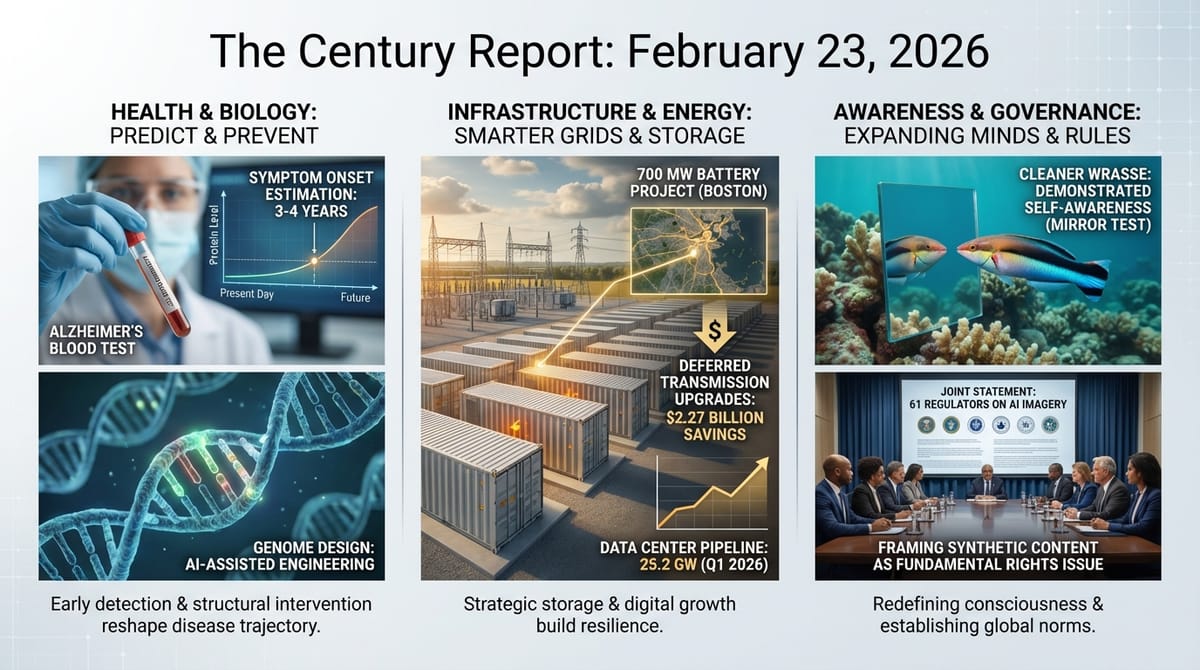
The 10-Second Scan
- Washington University researchers developed a blood test that predicts Alzheimer's symptom onset within three to four years by measuring a single protein, published in Nature Medicine.
- Cleaner wrasse fish used mirrors and dropped objects to test their reflections, demonstrating self-awareness behaviors previously documented only in dolphins and manta rays.
- A proposed 700 MW battery near Boston could defer $2.27 billion in transmission upgrades by absorbing grid stress at a key pinch point.
- U.S. utility PPL's data center pipeline swelled 23% to 25.2 GW, with 10 GW expected under signed agreements by end of Q1.
- Sixty-one privacy regulators from around the world issued a coordinated statement on AI-generated imagery, framing non-consensual synthetic content as a fundamental rights violation.
- A Nature feature described AI systems now capable of designing entire genomes from scratch, with the first AI-created synthetic virus produced last year.
The 1-Minute Read
The biological sciences keep delivering findings that collapse the distance between detection and intervention. A single blood protein, measured once, can now estimate when Alzheimer's symptoms will emerge - within a margin of three to four years - in people who show no cognitive impairment. The model works across multiple commercially available testing platforms, and its developers have made the code public. The implications for clinical trial design alone are substantial: instead of enrolling thousands and waiting years to see who develops symptoms, researchers can identify the people most likely to benefit from prevention, enroll them at the right moment, and compress trial timelines dramatically. When paired with the blood-brain barrier repair pathway and the bacterial persistence mechanism identified in previous editions of this newsletter, what emerges is a picture of Alzheimer's shifting from an unknowable fate to a measurable, trackable, and increasingly addressable trajectory.
Meanwhile, a fish the size of a human finger just complicated centuries of assumptions about who gets to be self-aware. Cleaner wrasse at Osaka Metropolitan University did something remarkable: they picked up bits of food, dropped them near a mirror, and watched the reflection fall. This kind of contingency testing - using an external object to probe how reflected space works - had been documented only in dolphins and manta rays. The researchers' conclusion is direct: self-awareness may be far more widespread across the animal kingdom than the narrow list of species that pass the classic mirror test would suggest.
The physical infrastructure layer continues its dual expansion and negotiation. A single battery project near Boston could replace $2.27 billion in transmission upgrades by absorbing peak stress at a grid pinch point, demonstrating that strategically placed storage can do what years of underground cable construction cannot. At the same time, PPL's data center pipeline jumped another 23% in a single quarter to 25.2 GW, and sixty-one privacy regulators issued their first coordinated statement on AI-generated imagery, treating the outputs of generative systems as a matter of fundamental human rights rather than content moderation policy. The substrate is expanding. So is the governance conversation about what runs on it.
The 10-Minute Deep Dive
A Blood Test That Sees Alzheimer's Coming
The study published in Nature Medicine by researchers at Washington University School of Medicine represents a structural advance in how Alzheimer's disease can be anticipated. The team built a predictive model around plasma p-tau217, a protein that reflects the silent accumulation of amyloid and tau in the brain long before any cognitive symptoms appear. Using data from 603 older adults tracked over years in two long-running studies - the Knight Alzheimer Disease Research Center and the Alzheimer's Disease Neuroimaging Initiative - they demonstrated that a single blood draw can estimate when symptoms will begin, with accuracy within approximately three to four years.
The model revealed something important about timing: a person whose p-tau217 levels first rise at age 60 typically develops symptoms roughly 20 years later, while someone whose levels rise at age 80 shows symptoms about 11 years afterward. Younger brains appear to tolerate the underlying pathology longer, while older brains cross the threshold at lower levels of accumulated damage. This age-dependent gradient gives clinicians a more individualized picture of disease trajectory than any previous method has offered.
Senior author Suzanne Schindler described the near-term applications clearly: these models will accelerate research and clinical trials by identifying the right patients at the right time. The longer-term goal is to tell individual patients when they are likely to develop symptoms, enabling personalized prevention plans. The team validated the model across multiple commercial testing platforms, including one already cleared by the FDA, and made their development code publicly available. Blood tests cost a fraction of PET brain scans and spinal fluid draws. The combination of affordability, accessibility, and predictive power positions this approach to reshape how the field identifies, enrolls, and treats patients at the earliest stages of the disease. This continues the pattern this newsletter has tracked across multiple editions - from the liver enzyme that repairs the blood-brain barrier covered in the February 21 edition to the Chlamydia pneumoniae bacterial persistence mechanism driving amyloid buildup, also reported on February 21, to the body's inflammation off-switch identified in the February 20 edition - each finding narrowing the gap between understanding and intervention for neurodegenerative disease.
Self-Awareness Swims Deeper Than Anyone Assumed
At Osaka Metropolitan University, researchers documented behaviors in cleaner wrasse that push the boundary of what science considers evidence of self-awareness. In the experiment, fish that had never encountered a mirror before were marked with spots resembling parasites. When a mirror was introduced, many attempted to remove the marks within the first hour - dramatically faster than the four to six days observed in earlier studies. The key insight was in the reversed protocol: the fish already knew something unusual was on their bodies. The mirror simply provided the visual information to confirm it, and they acted almost immediately.
The more striking behavior appeared after several days of mirror exposure. Some fish picked up pieces of shrimp, carried them upward near the mirror, released them, and tracked the falling reflection against the glass. This is contingency testing using an external object - the fish were not just recognizing themselves but actively investigating how the mirror worked by observing how something other than their own body behaved in reflected space. Similar behaviors have been documented only in manta rays and dolphins, both of which release bubbles and watch them rise in reflections.
Lead researcher Shumpei Sogawa noted that these findings suggest self-awareness may not have evolved only in the small number of species that traditionally pass the mirror test. The implications extend beyond animal cognition. As senior author Masanori Kohda observed, the findings will likely influence not only evolutionary theory and concepts of self but also matters relevant to animal welfare, medical research, and studies of intelligence more broadly. When a fish smaller than a human hand demonstrates the kind of exploratory, self-referential processing previously attributed only to large-brained mammals, the taxonomy of awareness itself requires revision. The distance between "which creatures are aware" and "which forms of intelligence deserve consideration" continues to shrink across every domain this newsletter tracks.
Batteries as Transmission: The Boston Test Case
The Trimount battery project taking shape near Boston could become a landmark case for using energy storage as a transmission asset in the United States. At 700 MW of power capacity and 2.8 gigawatt-hours of stored energy, the installation would be one of the largest in the nation and by far the largest in New England. Its location is strategic: a former Exxon Mobil oil-storage facility in Everett, plugged into a major substation that connects Boston to the greater New England grid.
Boston is what grid planners call a load pocket - a spot where peak demand sometimes exceeds what transmission lines can deliver. Those moments tend to be short-lived, which is precisely what makes batteries viable. Jupiter Power, the company behind the project, commissioned an independent study from RLC Engineering to assess how the battery would perform during the kind of cascading transmission failure that grid operators plan around. The study found that Trimount could keep the grid running during events that would otherwise require widespread power outages. The alternative would be upgrading multiple high-voltage underground transmission lines in one of the densest urban environments in the country - a process that is costly, disruptive, and measured in years. RLC Engineering estimated the avoided transmission cost at approximately $2.27 billion.
This use of batteries as shock absorbers for the grid has gained traction outside the United States - in Australia, Europe, and South America - but has not yet caught on domestically. The regulatory and planning frameworks in the U.S. have been slow to recognize storage as a transmission asset rather than just a generation resource. Jupiter Power is seeking approval from Massachusetts' Energy Facility Siting Board and hopes to secure utility contracts later this year, with construction targeted for 2027 and operation by late 2028 or early 2029. If the project succeeds, it could force grid planners across the country to reconsider the assumption that the only answer to transmission bottlenecks is more transmission. As the February 18 edition documented when a 175 MW New England battery responded in 250 milliseconds during a winter storm, and as the February 21 edition reported when 13 GW of grid batteries installed in 2025 alone pushed total installed capacity to 45 GW - smashing a 2017 industry target six months early - storage is moving from supplement to structural backbone. The question is no longer whether batteries can do what transmission lines do. It is whether the institutions that plan the grid will update their frameworks fast enough to let them.
Genome Design Enters the Engineering Phase
A Nature feature this week surveyed a field that has crossed from theoretical possibility into active capability: AI-assisted genome design. Last year, for the first time, an AI program was used to create an entirely synthetic virus. AI-assisted design also produced artificial genes that can be expressed in mammalian cells. The field, which biochemist Adrian Woolfson describes in a new book as "generative biology," represents the convergence of computation and genome engineering at a scale that enables researchers to design biological components rather than merely discover them.
The capabilities are real but bounded. AI systems can now redesign genomes as if they were software, rearranging bases like code, predicting how sequence relates to protein structure and function, and running simulations to test how redesigned genomes might behave. Woolfson theorizes that AI-assisted genome design could eventually produce a "species catalogue" - a repository containing the information needed to design organisms for specific purposes. The practical applications range from producing innovative drugs to engineering pest-resistant crops that eliminate the need for pesticides.
The limitations are equally real. Predicting how the expression of one gene affects others remains frustratingly difficult. Organismal development is context-dependent in ways that resist algorithmic consolidation. And the gap between designing a genome in silico and building the organism in the laboratory remains wide. The synthetic yeast genome project, which began in 2006, illustrates these difficulties: assembling synthetic chromosomes has been labor-intensive, with the last few completed only in 2025. Woolfson warns that small genome edits today could lock in irreversible biological futures, as some evolutionary choices, once made, eliminate other options.
What makes this moment significant is the trajectory. The field has moved from studying life as it evolves naturally to intervening in its direction. When combined with the timeline compression this newsletter has tracked across drug discovery, diagnostics, and materials science, the picture that emerges is one of biology becoming an engineering discipline - with all the power, responsibility, and irreversibility that implies. The path from understanding to creation is shortening, and the governance frameworks for what can and should be created have barely begun to form.
Sixty-One Regulators Draw a Line on Synthetic Imagery
Privacy and data protection authorities from 61 jurisdictions issued a coordinated Joint Statement on AI-generated imagery, the largest regulatory alignment on generative AI to date. The statement targets systems that create "highly realistic images and videos depicting identifiable individuals without their knowledge or consent," with particular concern for non-consensual intimate imagery and depictions of children. Signatories include the UK's Information Commissioner's Office, Hong Kong's Privacy Commissioner, the European Data Protection Board, and the European Data Protection Supervisor.
The statement frames the issue as one of fundamental rights, dignity, and child protection - deliberately positioning it beyond the narrower frame of content moderation. Regulators called on organizations that develop or deploy image-generation systems to implement safeguards, provide transparency about capabilities and acceptable use, and offer effective removal and redress mechanisms. The framing signals that existing privacy and data protection laws already apply to AI-generated imagery, and that coordinated enforcement approaches are forming. The breadth of the coalition - 61 jurisdictions acting in concert - suggests that the governance of generative systems is moving faster at the privacy layer than at the safety layer, where voluntary commitments and non-binding declarations have been the norm. As this newsletter reported in the February 22 edition, the New Delhi Declaration adopted by 88 countries remained voluntary and non-binding. The privacy regulators' statement, by contrast, explicitly invokes existing legal authority. The governance of generative AI is being built, piece by piece, through the institutions that already have enforcement power.
The Human Voice
Today's newsletter tracks developments that span from a single protein in the blood to the design of entire genomes, from a fish testing its own reflection to a battery that could replace billions of dollars in grid infrastructure. The common thread is that systems assumed to be fixed - what the body can reveal about its own future, which creatures possess awareness, how grids must be built, what biology can be engineered - are all in motion simultaneously. Peter Leyden connects these threads with a structural argument that places this moment in a longer historical pattern. In this Big Think interview, he frames artificial intelligence, clean energy, and bioengineering as three simultaneous tipping points arriving during one of the rare "epoch resets" that reshape economies, governance, and daily life within a single generation. His lens is historical: he maps today's disruption onto the 80-year cycles that produced the railroad era, the industrial welfare state, and the postwar order, arguing that the turbulence we are living through is a familiar feature of these hinges rather than evidence that things are falling apart. His optimism is grounded in the pattern, and his caution is grounded in the stakes.
Watch: The Great Progression: 2025-2050 as a World-Scale System Change
The Century Perspective
With a century of change unfolding in a decade, a single day looks like this: a blood test that forecasts Alzheimer's symptom onset years before memory loss, a tiny reef fish demonstrating self-awareness through mirror experiments that challenge the taxonomy of consciousness, a 700 MW battery proposed to replace $2.27 billion in transmission infrastructure by absorbing grid stress where it matters most, AI systems designing entire genomes from scratch, 61 privacy regulators from around the world drawing a coordinated legal line around synthetic imagery, and utility pipelines swelling by double-digit percentages in single quarters as the physical substrate of the intelligence era expands. There's also friction, and it's intense - communities continuing to resist data center expansion in their neighborhoods, sickle cell gene therapies struggling to reach the patients they were designed for despite two years of availability, the governance of generative systems lagging behind the capabilities being deployed, and the gap between what AI can design in silico and what can be built in the laboratory reminding us that engineering biology carries irreversible consequences. But friction generates heat, and heat reveals what was hidden beneath the surface. Step back for a moment and you can see it: neurodegenerative disease becoming measurable and trackable years before symptoms appear, the boundaries of self-awareness expanding across the tree of life, grid infrastructure being reimagined from passive cables to active intelligent systems, and the biological sciences crossing from observation into design. Every transformation has a breaking point. A lens can scatter light into incoherence... or focus it into a beam that illuminates what no one could see before.
Sources
Scientific & Medical Research
- ScienceDaily: Simple Blood Test Can Forecast Alzheimer's Years Before Memory Loss (Washington University, Nature Medicine)
- ScienceDaily: Cleaner Wrasse Show Self-Awareness in Stunning Mirror Experiments (Osaka Metropolitan University, Scientific Reports)
- Nature: AI Tools Can Design Genomes - Will They Upend How Life Evolves?
- Nature: This AI Can Improve Your Peer Review - And Make It More Polite
- ScienceDaily: A Simple Water Shift Could Turn Arctic Farmland Into a Carbon Sink
- ScienceDaily: A Giant Blade-Crested Spinosaurus Discovered in the Sahara (Science)
Energy & Infrastructure
- Canary Media: Can a Big Battery Help Boston Save Billions on the Power Grid?
- Data Center Dynamics: US Utility PPL Sees Data Center Pipeline Swell 23% to 25.2 GW
- Electrek: World's First - US Air Force Deploys Portable Nuclear Power Station
- Electrek: Hitachi Rolls Out New 13-Ton Dual-Mode Electric Excavator
- Utility Dive: A New Role for Onsite Generation - Accelerating Grid Access for Large Loads
AI & Governance
- Ynetnews: Anthropic's Claude Code Security Rattles Cybersecurity Sector
- PC Gamer: AWS Outages Reportedly Caused by AI Coding Agent (Financial Times)
- The Guardian: If AI Makes Human Labor Obsolete, Who Decides Who Gets to Eat?
- CNBC: U.S. Launches Tech Corps to Boost AI Influence Abroad
- Insurance Journal: Emerging Risks - Agentic AI, Electric Motorcycles, and Hydrogen
- AI-generated imagery and protection of privacy: EDPB supports joint Global Privacy Assembly’s statement
Institutional & Regulatory
- BioSpace: Sickle Cell Gene Therapies Casgevy and Lyfgenia Still Lacking Traction 2 Years In
- Pharmaphorum: Head-to-Head Trial Dents Novo Nordisk's Obesity Hopes
- Washington Post: This Economic Idea Transfixed Wall Street - It May Be a Mirage
The Century Report tracks structural shifts during the transition between eras. It is produced daily as a perceptual alignment tool - not prediction, not persuasion, just pattern recognition for people paying attention.