The Century Report: February 22, 2026

The 10-Second Scan
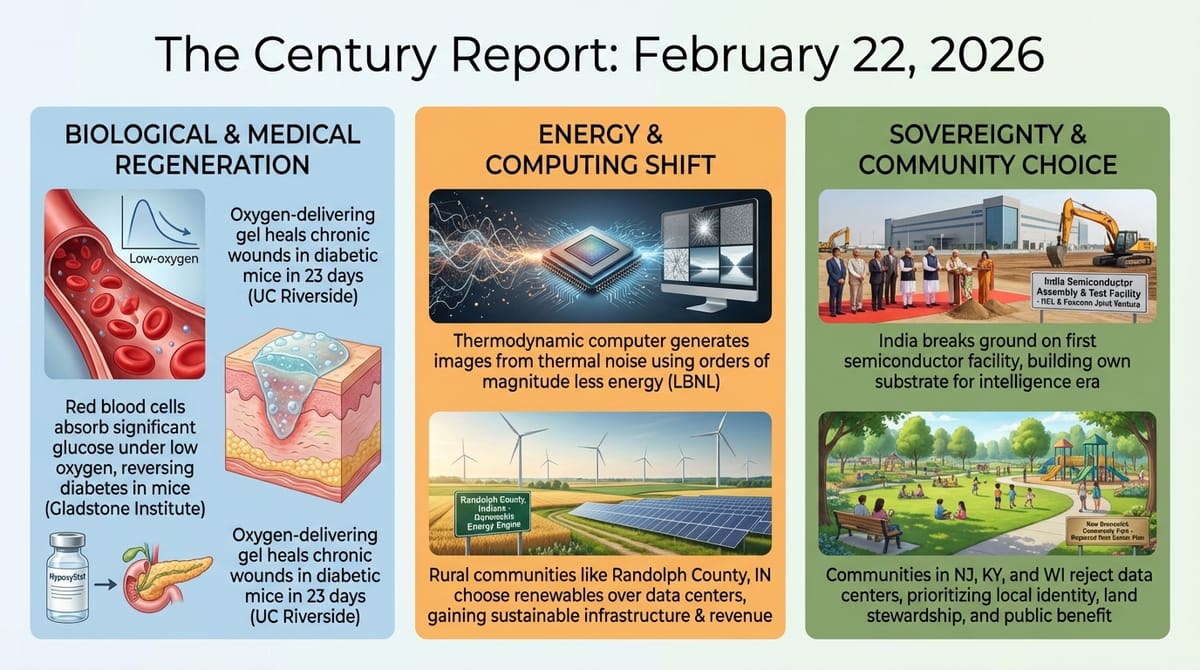
- Eighty-eight countries adopted the New Delhi Declaration on AI Impact, framing AI as shared human infrastructure organized around seven pillars of global cooperation.
- Gladstone Institute researchers discovered that red blood cells absorb large amounts of glucose under low-oxygen conditions, and a drug mimicking this effect reversed diabetes in mice.
- A thermodynamic computer generated images from thermal noise using orders of magnitude less energy than conventional AI systems.
- UC Riverside developed an oxygen-delivering gel that healed chronic wounds in diabetic mice within 23 days, published in Nature Communications Materials.
- India broke ground on its first semiconductor assembly and test facility, a joint venture between HCL Group and Foxconn targeting 20,000 wafers per month by 2028.
- New Brunswick, New Jersey removed data centers from its redevelopment plan after community opposition, replacing the permitted use with a public park.
The 1-Minute Read
The signal from the biological sciences this week keeps deepening in ways that rewrite inherited assumptions about the body's own capacity for self-regulation. The discovery that red blood cells function as a hidden glucose sink under low-oxygen conditions, and that a drug can activate this mechanism to reverse diabetes in mice, opens an entirely new axis for metabolic treatment. Alongside it, an oxygen-delivering gel that rescued chronic wounds in diabetic animals by addressing the fundamental problem of tissue hypoxia - not with new pharmaceuticals but by restoring the conditions under which the body already knows how to heal. These findings share a common architecture: they work with the body's existing systems rather than overriding them, and they were enabled by computational and molecular methods that compressed years of investigative work into months.
The physical and institutional layers are also being rapidly reorganized. India's semiconductor groundbreaking, its adoption of the New Delhi Declaration framing AI as shared infrastructure for 88 nations, and the continued community pushback against data center expansion in American towns all point toward a distributed negotiation over who controls the substrate of the intelligence era and on what terms. Rural communities in New Jersey, Kentucky, and Wisconsin are rejecting offers that would have been unimaginable a few years ago, choosing identity and land stewardship over data centers. The geography of computational power is being shaped simultaneously by sovereign industrial policy in the Global South and by individual landowners who decline to sell.
Meanwhile, a thermodynamic computer that generates images by harnessing thermal noise rather than overpowering it represents something more than an engineering curiosity. The approach inverts the dominant paradigm of AI computation, which spends enormous energy suppressing noise, and instead makes noise the engine. The energy reduction is an improvement by multiple orders of magnitude. If this scales, the physical constraints that currently define where and how intelligence can operate will begin to dissolve.
The 10-Minute Deep Dive
The Body's Hidden Glucose Sink
For years, epidemiologists observed that people living at high elevations develop diabetes at lower rates than those at sea level. The correlation was well documented but the mechanism remained unknown. Researchers at Gladstone Institutes have now identified what they believe is the answer: under low-oxygen conditions, red blood cells switch into a new metabolic mode and absorb large quantities of glucose from the bloodstream, functioning as what the researchers call a previously unrecognized "glucose sink."
The finding, published in Cell Metabolism on February 19, emerged from a series of experiments in which mice exposed to low-oxygen air cleared sugar from their bloodstreams almost instantly after eating. When researchers examined muscle, brain, and liver tissue, none of these organs could explain the disappearance. A different imaging method revealed that red blood cells were the missing compartment, taking in and metabolizing significant amounts of glucose. The effect was substantial: red blood cells produced under hypoxic conditions both proliferated and individually absorbed more glucose than those formed under normal oxygen levels. The molecular mechanism involves red blood cells using glucose to generate a molecule that helps release oxygen to tissues more efficiently, a process that becomes especially important when oxygen is scarce.
The practical implications arrived quickly. The team evaluated HypoxyStat, a drug developed in the same lab that mimics low-oxygen exposure by causing hemoglobin to bind oxygen more tightly. In mouse models of diabetes, HypoxyStat completely reversed high blood sugar and outperformed existing treatments. The metabolic benefits of prolonged hypoxia persisted for weeks to months after mice returned to normal oxygen levels. Senior author Isha Jain described the discovery as opening an "entirely new way to think about controlling blood sugar" by recruiting the body's most abundant cell type as a metabolic regulator. The broader implication extends well beyond diabetes into exercise physiology, trauma medicine, and any condition where glucose metabolism plays a role. This continues the pattern this newsletter has tracked across recent editions - from the body's inflammation off-switch to the liver enzyme that repairs the blood-brain barrier - where hidden regulatory systems within the body, once identified, offer therapeutic paths that work with biology rather than against it.
Healing What Won't Heal
A parallel development in wound care addresses a problem that affects 12 million people worldwide each year. Chronic wounds - those that remain open for longer than a month - currently lead to amputation in roughly one in five patients. UC Riverside researchers have developed an oxygen-delivering gel that targets what they identify as the central obstacle: hypoxia deep within damaged tissue, where oxygen from the bloodstream or surrounding air cannot reach.
The gel, published in Nature Communications Materials, uses a choline-based liquid that is antibacterial, nontoxic, and biocompatible. Connected to a small battery similar to those in hearing aids, it splits water molecules and steadily releases oxygen over time. Unlike surface-level oxygen treatments, the gel conforms to the exact shape of a wound before solidifying, filling gaps and uneven areas where oxygen levels are lowest and infection risk highest. In diabetic and older mice whose wounds resemble chronic wounds in aging humans, untreated injuries failed to close and were often fatal. With the oxygen-producing patch, wounds healed in approximately 23 days. The gel's choline component also helps regulate immune activity and reduce excessive inflammation, addressing both the oxygen deficit and the overactive inflammatory response that traps chronic wounds in a cycle of deterioration. The researchers noted that this same approach could eventually address oxygen and nutrient shortages in tissue engineering, bridging toward the creation and sustaining of replacement organs.
Computing With Noise Instead of Against It
A study published in Physical Review Letters describes a fundamentally different approach to generative AI. Stephen Whitelam of the Molecular Foundry at Lawrence Berkeley National Laboratory demonstrated that a "generative thermodynamic computer" can produce images from random thermal noise using orders of magnitude less energy than conventional neural networks require.
The core insight inverts standard computing logic. Conventional AI systems use energy to flip bits in environments where thermal noise is negligible by design. The thermodynamic approach instead leverages that noise as the computational engine. Whitelam drew an analogy: conventional computing is like an ocean liner that plows through waves regardless of cost, while thermodynamic computing is like a surfer harnessing wave power. The approach builds on a decade of research into probabilistic computing, where working with probabilities of values rather than definite binary states yields substantial efficiency gains, particularly for optimization problems. Researchers at Normal Computing Corporation have already built hardware close to a thermodynamic computer, using networks of circuits operating at low energies comparable to thermal noise, with programmable coupling strengths that pose questions the resulting equilibrium fluctuations answer.
The practical significance is direct. AI's energy footprint is one of the defining constraints of the current buildout. The Century Report has tracked the enormous infrastructure required to sustain computational intelligence - the 86 GW of new utility-scale capacity projected for 2026, the CenterPoint load forecasts accelerating by two years, the communities pushing back against data center expansion. A computing paradigm that achieves comparable generative capabilities at a fraction of the energy cost would reshape every assumption about where and how intelligence infrastructure can be deployed. The work remains early, but the direction it points toward - intelligence that emerges from physical processes rather than brute-force computation - resonates with findings across multiple domains where working with natural systems proves more effective than overriding them.
India Builds Its Own Substrate
India's semiconductor ambitions took a concrete step forward with the groundbreaking of the country's first Outsourced Semiconductor Assembly and Test facility, a joint venture between HCL Group and Foxconn at Jewar, Greater Noida. The facility represents an investment of Rs 3,700 crore (approximately $440 million), targets 20,000 wafers per month, and is expected to be operational by 2028 with over 3,500 direct and indirect jobs. The plant will manufacture display driver chips, positioning India to meet growing domestic demand while building the supply chain infrastructure that currently concentrates overwhelmingly in East Asia.
This development sits alongside the New Delhi Declaration on AI Impact, adopted by 88 countries at the AI Impact Summit, which frames AI as shared human infrastructure organized around seven pillars: democratizing AI resources, economic growth and social good, secure and trusted AI, AI for science, access for social empowerment, human capital development, and resilient and efficient AI systems. The declaration is voluntary and non-binding, but it codifies a shared vocabulary around AI as a public-good capability rather than purely proprietary technology, with explicit emphasis on open-source approaches and affordable connectivity as prerequisites for equitable deployment.
Taken together with the G42-Cerebras deployment of 8 exaflops in India covered in the February 21 edition of The Century Report and the Sarvam open-source models that run on feature phones, the pattern is one of deliberate infrastructure sovereignty. India is building compute, chips, and governance frameworks simultaneously, aiming not merely to participate in the intelligence era but to shape its terms from within. The semiconductor facility is modest by global standards, but as the first domestic assembly operation in a country that imports virtually all its chips, it represents the beginning of a structural shift in where the physical substrate of intelligence is manufactured.
Communities Redraw the Map
The friction between computational expansion and community identity continues to intensify across the United States. In New Brunswick, New Jersey, the city council removed data centers from the list of permitted uses in a redevelopment plan, replacing them with a requirement for a public park. No data center had been formally proposed, but the mere possibility was enough to mobilize residents who cited concerns about energy consumption, water usage, noise pollution, and the broader implications of large-scale AI infrastructure in residential spaces. The decision followed similar actions in San Marcos, Texas, where a council scrapped data center plans after a nearly nine-hour debate, and Claremore, Oklahoma, where community opposition drew hundreds. As the February 19 edition documented when Illinois proposed its two-year pause on data center tax incentives, communities are increasingly demanding that developers absorb the full costs of their footprint rather than externalizing them onto local ratepayers and residents.
Meanwhile, a USA Today investigation of Randolph County, Indiana documented a different model entirely: a rural county where renewable energy has become the economic engine, with wind and solar operator EDPR NA on track to pay over $65 million by 2038 to a county whose total annual budget is $20 million. The company funded a $2.8 million fairgrounds renovation, rebuilt 60 miles of roads, and upgraded the county courthouse HVAC system. The contrast with data center dynamics is instructive. Renewable energy projects distribute benefits across landowners, tax rolls, and community infrastructure over decades. Data centers concentrate computational power behind security fences while externalizing costs onto local grids and water systems. Communities are learning the difference and making choices accordingly.
Kentucky farmers are rejecting multimillion-dollar data center offers for land their families have worked for generations. One farmer declined $8 million for his 250 acres - 3,500% more than he paid - and when developers returned with "name your price," he answered: "There is none." These decisions carry real economic weight: globally, 40,000 acres of powered land are projected to be needed for new data center projects over the next five years, double the current amount. The intelligence era requires physical space, and the people who own that space are increasingly asserting terms that no amount of capital can override. The infrastructure of the future is being negotiated not only in boardrooms and legislative chambers but on front porches, where families are deciding what is and is not for sale.
The Human Voice
Today's newsletter tracks the physical, biological, and institutional substrates being built beneath the intelligence era - from semiconductor fabs and thermodynamic computers to the body's own hidden regulatory systems. But the deepest infrastructure question may be the one that takes longest to answer: how do we prepare the next generation to live inside all of this? Futurist Sinead Bovell, speaking at SXSW EDU, makes the case that education is standing at a hinge moment where AI becomes a background utility like electricity, and children will grow up streaming artificial intelligence the way we stream power today. Rather than banning AI or bolting gadgets onto old classroom structures, Bovell argues for rebuilding the system around the skills that matter most when polymathic machines handle the mechanics: deep reading, play, critical thinking, cross-disciplinary reasoning, ethics, and the ability to ask good questions. Her framework connects directly to the pattern visible across every domain this newsletter covers - working with emerging systems rather than against them, and investing in human capacity rather than trying to preserve structures that have already shifted beneath our feet.
Watch: School in an AI World: Making Learning Harder, Deeper, and More Human
The Century Perspective
With a century of change unfolding in a decade, a single day looks like this: the body's most abundant cell revealed as a hidden glucose regulator that a single drug can activate to reverse diabetes, a gel that restores the conditions for healing by delivering oxygen where blood cannot reach, a computing paradigm that generates intelligence from thermal noise at a fraction of current energy costs, 88 nations codifying AI as shared human infrastructure rather than proprietary advantage, a country of 1.4 billion breaking ground on its own semiconductor supply chain, and rural communities choosing parks over data centers and land stewardship over extraction. There's also friction, and it's intense - chronic wounds still claiming limbs from 12 million people annually, coal communities losing another 1,600 jobs despite promises of revival, prolonged unemployment draining savings Americans do not have, the global internet fragmenting as censorship technologies grow cheaper and more exportable, and the governance structures for the intelligence era still being assembled under pressure from forces that move faster than institutions can respond. But friction generates clarity, and clarity reveals what was always there waiting to be seen. Step back for a moment and you can see it: the body disclosing its own repair mechanisms to computational methods that did not exist until recently, intelligence emerging from physical processes rather than brute-force computation, sovereign nations building their own substrates rather than renting someone else's, and communities asserting that the most valuable things cannot be purchased at any price. Every transformation has a breaking point. A wave can erode what stands rigid in its path... or carry new life to shores that were barren before it arrived.
Sources
AI & Governance
- Politico: Dozens of Countries Steer Clear of Safety Commitment in Global AI Pledge
- Business Insider: A Top Anthropic Engineer Warns AI Agents Will Transform Every Computer-Based Job
- The Guardian: Sanders Warns US Has No Clue About Speed and Scale of Coming AI Revolution
- TechCrunch: OpenAI Debated Calling Police About Suspected Canadian Shooter's Chats
- Samsung: Galaxy AI Expands Multi-Agent Ecosystem
Scientific & Medical Research
- ScienceDaily: Scientists Discover Why High Altitude Protects Against Diabetes
- ScienceDaily: New Oxygen Gel Could Prevent Amputation in Diabetic Wound Patients
- Live Science: Thermodynamic Computer Can Mimic AI Neural Networks
- ScienceDaily: Celtic Curse Hotspots Found in Scotland and Ireland
- ScienceDaily: A Simple Water Shift Could Turn Arctic Farmland Into a Carbon Sink
- ScienceDaily: James Webb Space Telescope Captures Strange Magnetic Forces Warping Uranus
- ScienceDaily: NASA's Hubble Spots Nearly Invisible Ghost Galaxy Made of 99% Dark Matter
Energy & Infrastructure
- Business Insider Africa: Data Center Replaced With Park in New Jersey
- USA Today: Big Windmills Mean Big Money for a Small Town
- The Guardian: US Farmers Are Rejecting Multimillion-Dollar Data Center Bids
- The Hindu BusinessLine: India Aims for Self-Reliance in Chip Manufacturing
- CleanTechnica: The US Is Still Bleeding Coal Jobs
- Los Angeles Times: U.S. Military Airlifts Nuclear Reactor for First Time
Labor & Economy
- Business Insider: Americans Don't Have Enough Savings for Longer Job Searches
- The Guardian: The Splinternet - How Online Shutdowns Are Getting Cheaper and Easier
The Century Report tracks structural shifts during the transition between eras. It is produced daily as a perceptual alignment tool - not prediction, not persuasion, just pattern recognition for people paying attention.