The Century Report: February 21, 2026

The 10-Second Scan
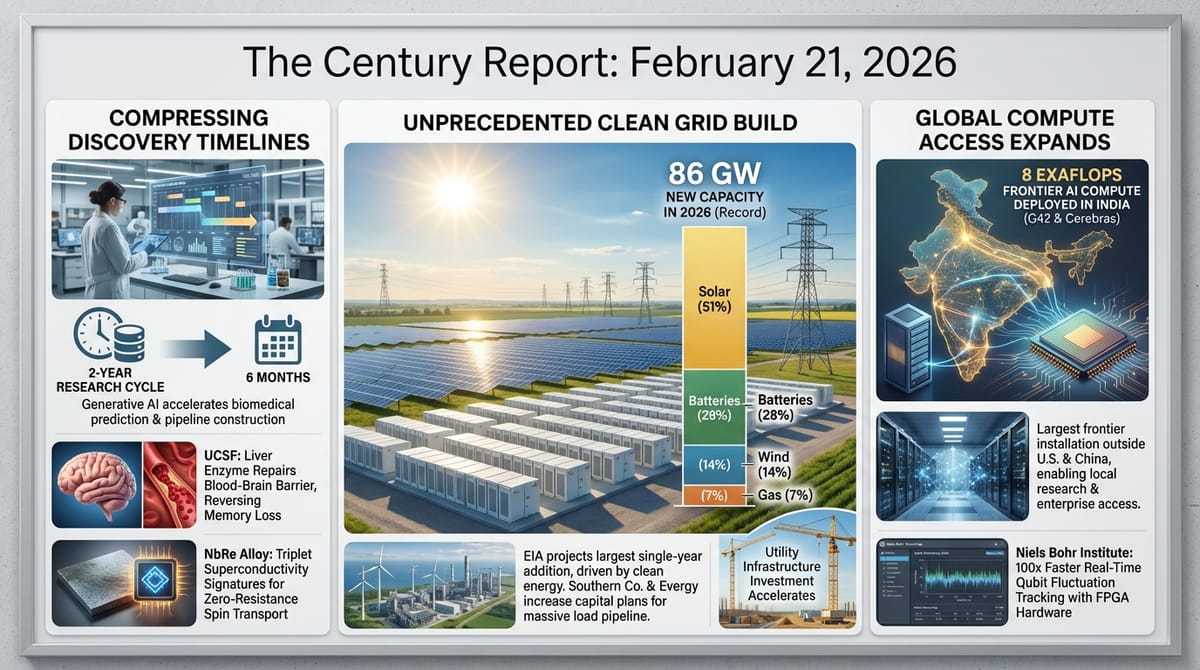
- Generative AI matched or outperformed 100+ expert teams on preterm birth prediction tasks, compressing a two-year research cycle into six months.
- The EIA projects a record 86 GW of new utility-scale capacity in 2026, with solar at 51%, batteries at 28%, wind at 14%, and gas at 7%.
- UCSF researchers identified a liver enzyme that repairs the blood-brain barrier by trimming a harmful protein from barrier cells, reversing memory loss in aged mice.
- An NbRe alloy showed the first experimental signatures of triplet superconductivity, a long-sought state that transmits both electricity and electron spin with zero resistance.
- Cedars-Sinai researchers found that Chlamydia pneumoniae persists in the retina and brain, triggering amyloid-beta buildup linked to Alzheimer's, especially in APOE4 carriers.
- G42 and Cerebras announced 8 exaflops of AI compute deployed in India, the largest frontier compute installation outside the U.S. and China.
- Niels Bohr Institute researchers achieved 100x faster real-time tracking of qubit fluctuations using FPGA-based control hardware.
The 1-Minute Read
The compression of research timelines - a thread this newsletter has tracked since its first edition - crossed a threshold this week that deserves attention. When generative AI systems independently built analytical pipelines that matched or exceeded the work of more than a hundred expert teams on complex biomedical prediction tasks, and did so in months rather than years, the bottleneck shifted. The constraint on translating biological data into clinical insight is no longer the months of pipeline construction and debugging that previously consumed most of a research team's effort. A master's student and a high school student, working with AI-generated code, reached publication-ready models within a timeline that would have been impossible for experienced programmers just two years ago. The implication extends well beyond pregnancy research: Every data-intensive biomedical field faces the same pipeline bottleneck, and that bottleneck just cracked open.
The physical infrastructure layer also continues its unprecedented expansion. The EIA's projection of 86 GW in new utility-scale capacity for 2026 would be the largest single-year addition in U.S. history, and the composition tells the story: Solar and batteries together account for nearly 80% of planned additions, with gas at just 7%. Grid batteries installed 13 GW in 2025 alone, reaching 45 GW total and smashing a 2017 industry target six months early. Southern Company raised its five-year capital plan to $81 billion with a 75 GW large-load pipeline. The energy substrate of the intelligence era is being built predominantly with clean generation and storage, at a pace that keeps surprising even the utilities building it.
Underneath the infrastructure story, new biological and physical discoveries are quietly rewriting what is possible. A liver enzyme that repairs the aging blood-brain barrier. The first experimental evidence of triplet superconductivity - a state that could transmit both electrical current and quantum information with zero resistance. A common respiratory bacterium identified as a persistent driver of Alzheimer's pathology. Real-time qubit monitoring at speeds a hundred times faster than previous methods. Each finding was enabled by computational or experimental methods that did not exist recently enough for anyone to have planned around them, and each opens a path that was blocked until this week.
The 10-Minute Deep Dive
When AI Becomes the Scientist's Hands
The study published in Cell Reports Medicine by researchers at UCSF and Wayne State University represents something more consequential than another AI benchmark. The team took datasets from three prior DREAM challenges - crowdsourced competitions in which more than a hundred expert teams built machine learning models to predict preterm birth and estimate gestational age from microbiome, blood, and placental data. They then asked eight generative AI systems to independently build complete analytical pipelines from natural-language prompts alone, with no example code provided. Four of the eight produced working pipelines that matched or exceeded the best human submissions.
The time compression is striking. The original DREAM challenges took months for participating teams to complete their models, and nearly two years to consolidate and publish the results. The generative AI effort - from conception to journal submission - took approximately six months. A junior research pair consisting of a UCSF master's student and a high school student used AI-generated code to reach publication-ready models within that window, doing work that would have required experienced programmers spending weeks on pipeline construction and debugging. Senior investigator Marina Sirota described the significance plainly: "These AI tools could relieve one of the biggest bottlenecks in data science: building our analysis pipelines."
What makes this finding structurally important is that it addresses the rate-limiting step in translational biomedical research. The hard part has never been collecting data or even knowing what questions to ask. The bottleneck has been the months of specialized programming required to move from raw datasets to tested models. Every field that depends on computational analysis of complex biological data - genomics, proteomics, clinical trials, epidemiology - faces this same constraint. When that constraint loosens by an order of magnitude, the number of questions that can be asked and answered in a given year expands correspondingly. The approximately 1,000 babies born prematurely every day in the United States alone represent one population that stands to benefit as diagnostic and predictive models can be built, tested, and refined at the speed of the intelligence systems generating them rather than the speed of the human programmers who previously had to write every line.
The Grid Breaks Its Own Records
The EIA's projection of 86 GW of new utility-scale capacity in 2026 would shatter the previous record set just last year, when 53 GW came online. The composition of that pipeline signals where the energy system is headed: 43.4 GW of solar, 24 GW of battery storage, 11.8 GW of wind, and 6.3 GW of natural gas. Texas alone accounts for roughly 17.4 GW of solar and 12.9 GW of storage. The pipeline includes major milestone projects - Vineyard Wind 1 off Massachusetts, Revolution Wind off Rhode Island, and the 3,650 MW SunZia Wind project in New Mexico - alongside hundreds of smaller installations that collectively represent the grid's largest annual transformation.
The battery storage story within these numbers deserves its own attention. Grid batteries installed 13 GW in 2025, reaching nearly 45 GW of total installed capacity. In 2017, the Energy Storage Association set what seemed like an ambitious target: 35 GW by 2025. The sector hit that target six months early and kept going. Less than a decade ago, U.S. grid battery capacity stood at 500 MW total; now individual installations exceed that size. The 24 GW of storage planned for 2026 would nearly double the 2025 additions. As The Century Report covered on February 20, battery storage costs fell 27% in 2025 to $78/MWh, and solar-plus-storage hybrids delivered power at $57/MWh. The cost trajectory and deployment trajectory are reinforcing each other.
Utility earnings calls this week amplified the signal. Southern Company raised its five-year spending plan from $76 billion to $81 billion, with a large-load pipeline now sitting at 75 GW and 10 GW fully contracted. The company is "in late stage discussions for another 10 GW," with 3 GW expected to reach executed contracts in the near term. Commercial sales are projected to more than double through the end of the decade. Evergy's capital plan jumped 24% to $21.6 billion, driven by nearly 1.9 GW of new generation and signed electric service contracts with Google, Meta, and Beale Infrastructure. The utility expects retail load growth of 6% annually through 2030, up from the 0.5% to 1% that characterized recent years.
The tension between this buildout and the communities absorbing it remains acute. Thirteen state attorneys general filed suit against the Department of Energy for terminating approximately $8 billion in clean energy funding, alleging unconstitutional bypass of congressional appropriations. New York is falling behind on its climate goals, with its utility regulator considering suspending clean energy targets. Mercury emission standards for coal plants were rolled back this week even as data center demand pushes for more generation capacity. The macro direction is clear - solar, storage, and wind are the dominant sources of new capacity by a wide margin - but the institutional resistance to that direction is generating real costs for the communities caught in the transition. This is a pattern previously documented in the February 9 edition of The Century Report, when New York proposed a three-year data center moratorium and Indiana counted more than a dozen stopped projects. What matters at the decade scale is the direction of the infrastructure being built, and that direction has not wavered despite the political headwinds.
The Body's Hidden Repair Systems
Two publications this week expand the frontier of what is known about neurodegeneration - from opposite directions. UCSF researchers identified the mechanism by which exercise protects the aging brain, publishing in Cell. The team discovered that physical activity prompts the liver to release an enzyme called GPLD1, which travels to the blood vessels surrounding the brain and removes a harmful protein, TNAP, from the surface of barrier cells. TNAP accumulates with age and weakens the blood-brain barrier, allowing inflammatory compounds to enter brain tissue. When researchers reduced TNAP levels in two-year-old mice - the equivalent of 70 human years - the barrier became less permeable, inflammation decreased, and memory improved. The finding traces a complete body-to-brain repair pathway: Exercise triggers a liver enzyme that fixes the brain's protective shield by trimming a specific protein from specific cells.
Meanwhile, Cedars-Sinai researchers demonstrated in Nature Communications that Chlamydia pneumoniae, a common respiratory bacterium, can persist in the retina and brain for years, where it triggers inflammation, nerve cell death, and amyloid-beta accumulation - the hallmark protein of Alzheimer's disease. Analysis of retinal tissue from 104 people found that Alzheimer's patients had significantly higher bacterial levels in both retinas and brains. The connection was strongest in carriers of the APOE4 gene variant, which is already known as the most significant genetic risk factor for Alzheimer's. The retina, accessible through noninvasive imaging, may serve as an early warning system for brain pathology. This finding also raises the possibility that early antibiotic intervention could address a modifiable risk factor for the disease.
A separate study in PLOS Medicine documented that long-term exposure to fine particulate air pollution was linked to higher Alzheimer's risk in nearly 28 million older Americans, with the connection stemming largely from pollution's direct effects on the brain rather than through conditions like hypertension or depression. People with a history of stroke appeared especially vulnerable. Together, these three publications - the liver enzyme pathway, the bacterial persistence mechanism, and the air pollution link - converge on a single structural insight: The blood-brain barrier is both more vulnerable and more repairable than previously understood, and the factors weakening it are increasingly identifiable and addressable. This is a line of investigation that connects to the UCL inflammation off-switch finding covered in yesterday's edition, where a fat-derived molecule that the body already produces was shown to be boosted by an existing drug. The path from understanding to intervention is shortening with each finding.
Frontiers in Physics: Triplet Superconductivity and Real-Time Quantum Control
Two physics results published this week could reshape the hardware foundations of quantum computing. At the Norwegian University of Science and Technology, researchers reported in Physical Review Letters that an alloy of niobium and rhenium, NbRe, exhibits properties consistent with triplet superconductivity - a long-sought state in which superconducting particles carry spin. Conventional superconductors transmit electricity with zero resistance but cannot carry spin information. A triplet superconductor could transmit both electrical current and spin current without energy loss, which would enable quantum computers to process information with dramatically less energy and greater stability. The material superconducts at 7 Kelvin, comparatively warm for this class of system - other candidate triplet superconductors require temperatures near 1 Kelvin. The result requires verification by other experimental groups, but the team noted that NbRe "behaves completely differently from what we would expect for a conventional singlet superconductor."
Separately, researchers at the Niels Bohr Institute in Copenhagen achieved 100x faster real-time tracking of qubit fluctuations using FPGA-based control hardware. The breakthrough matters because qubits - the fundamental units of quantum computers - can shift from reliable to unreliable states in fractions of a second, far faster than previous measurement methods could detect. Standard testing took up to a minute per measurement, meaning researchers could only see averaged performance, masking the real instability. The new system updates its estimate of a qubit's relaxation rate within milliseconds, matching the natural speed of the fluctuations themselves. This revealed something previously unknown: how quickly superconducting qubits actually fluctuate. The practical consequence is that quantum processors can now be monitored and calibrated in real time, identifying which qubits are performing well and which have degraded, on timescales that matter for actual computation. Both results - the triplet superconductor candidate and the real-time qubit monitoring - address different aspects of the same fundamental challenge: making quantum computation reliable enough to scale. This finding relates closely to the Majorana qubit single-shot readout reported in the February 17 edition of this newsletter, where millisecond-scale coherence was confirmed in the most noise-resistant quantum architecture yet demonstrated.
Frontier Compute Reaches India
G42 and Cerebras announced the deployment of 8 exaflops of AI compute in India, hosted locally and following Indian data residency and compliance rules. The system will serve educational institutions, government entities, and small and medium enterprises. This is the largest frontier compute deployment outside the United States and China, and it arrives alongside the India AI Impact Summit announcements this newsletter covered earlier this week - Sarvam's open-source models trained for Indian languages, Adani's $100 billion data center commitment, Reliance's $110 billion infrastructure pledge, and OpenAI's partnerships with Tata Group and Indian universities. The G42/Cerebras deployment adds a non-NVIDIA, non-U.S.-headquartered hardware layer to India's AI infrastructure, using Cerebras's wafer-scale chips rather than GPU clusters, a continuation of the hardware diversification arc first tracked by The Century Report on February 13, when OpenAI deployed its first production model on non-NVIDIA hardware at over 1,000 tokens per second, and extended in the February 18 edition, when Sarvam demonstrated that frontier-trained models could run offline on Nokia feature phones. The geography of computational capability continues to distribute, and the diversity of hardware pathways continues to expand. India's 1.4 billion people are gaining access to frontier AI infrastructure built on their own terms, hosted on their own soil, and increasingly running models trained in their own languages.
The Human Voice
Today's newsletter tracks two parallel compressions: the shrinking timeline between data and discovery in the sciences, and the expanding infrastructure that makes intelligence accessible to broader populations. Nate B. Jones connects these threads with a structural observation that cuts through much of the anxiety around AI and employment. His argument is historical and empirical: every time the cost of compute has dropped by an order of magnitude - from mainframes to PCs, from PCs to cloud, from cloud to serverless - the total amount of software in the world did not flatten. It exploded into categories that literally could not exist at the old price point. Now, as AI collapses the cost of intelligence work, he argues the same dynamic is about to repeat at a much larger scale. The regional hospital, the mid-market manufacturer, the family logistics company that today runs on spreadsheets suddenly becomes a viable customer for custom intelligence. The story is about an expanding addressable market for applied intelligence woven into every corner of the economy, with all the turbulence and opportunity that entails.
Watch: When Intelligence Gets Cheaper, the World Fills With Software
The Century Perspective
With a century of change unfolding in a decade, a single day looks like this: generative AI compressing two years of biomedical research into six months, a record 86 GW of new clean energy capacity in the pipeline for a single year, a liver enzyme identified that repairs the aging brain's protective shield, the first experimental evidence of a superconducting state that carries both electricity and quantum information without loss, a common bacterium revealed as a hidden driver of Alzheimer's pathology, qubit monitoring accelerated a hundredfold, and 8 exaflops of frontier compute deployed in India for researchers and small businesses who had no access to such capability a year ago. There's also friction, and it's intense - thirteen state attorneys general suing to restore $8 billion in terminated clean energy funding, mercury standards rolled back as data centers demand more power, New York retreating from its own climate targets, private credit markets shaking as AI disruption stress-tests software loan portfolios, and workers across white-collar sectors reshaping their entire career trajectories out of anxiety over what comes next. But friction generates light when it strikes the right surface, and what's illuminated is the shape of what's forming. Step back for a moment and you can see it: research timelines collapsing from years to months as AI takes over the pipeline bottleneck, a grid rebuilding itself around clean generation at a pace that keeps outrunning its own forecasts, the body's hidden repair mechanisms becoming legible and addressable one pathway at a time, and the physical substrate of intelligence distributing across continents and hardware architectures that did not exist three years ago. Every transformation has a breaking point. A fault line can tear a landscape apart… or lift it into entirely new terrain that didn’t exist before the plates moved.
Sources
AI & Research
- ScienceDaily: Generative AI Analyzes Medical Data Faster Than Human Research Teams
- Fortune: Anthropic Rolls Out AI Tool That Can Hunt Software Bugs on Its Own
- Android Authority: Android Malware PromptSpy Uses Generative AI at Runtime
- Nature: AI Is Threatening Science Jobs
- The Guardian: How AI Anxiety Is Upending Career Ambitions
- TechCrunch: G42 and Cerebras Deploy 8 Exaflops in India
Energy & Infrastructure
- Utility Dive: Southern Raises Spending Plan to $81B
- Canary Media: Grid Battery Installations Soared to New High in 2025
- Utility Dive: Evergy Capital Spending Jumps 24%
- Utility Dive: States Sue DOE for Terminating $8B in Clean Energy Funding
- Canary Media: New York Falling Behind on Climate Goals
- The Verge: Trump Rolls Back Mercury Standards as Data Centers Demand More Power
- New U.S. electric generating capacity expected to reach a record high in 2026
Scientific & Medical Research
- ScienceDaily: Scientists Reveal How Exercise Protects the Brain from Alzheimer's (UCSF, Cell)
- ScienceDaily: Common Pneumonia Bacterium May Fuel Alzheimer's Disease (Cedars-Sinai, Nature Communications)
- ScienceDaily: Air Pollution Linked to Alzheimer's Risk in 28M Older Americans (PLOS Medicine)
- ScienceDaily: NbRe Alloy Shows Signatures of Triplet Superconductivity (Physical Review Letters)
- ScienceDaily: Quantum Computer Breakthrough Tracks Qubit Fluctuations in Real Time
- ScienceDaily: Oxford Battery Binder Visualization (Nature Communications)
- ScienceDaily: Doctors Implant Dopamine-Producing Stem Cells in Parkinson's Patients
Institutional & Regulatory
- Wired: AI Safety Meets the War Machine (Anthropic-Pentagon)
- NBC News: Tensions Between Pentagon and Anthropic Reach Boiling Point
- The Guardian: Sanders Warns Congress Has 'No Clue' About AI Revolution
- CNBC: Blue Owl Software Lending Triggers Private Credit Concerns
The Century Report tracks structural shifts during the transition between eras. It is produced daily as a perceptual alignment tool - not prediction, not persuasion, just pattern recognition for people paying attention.