The Century Report: February 20, 2026

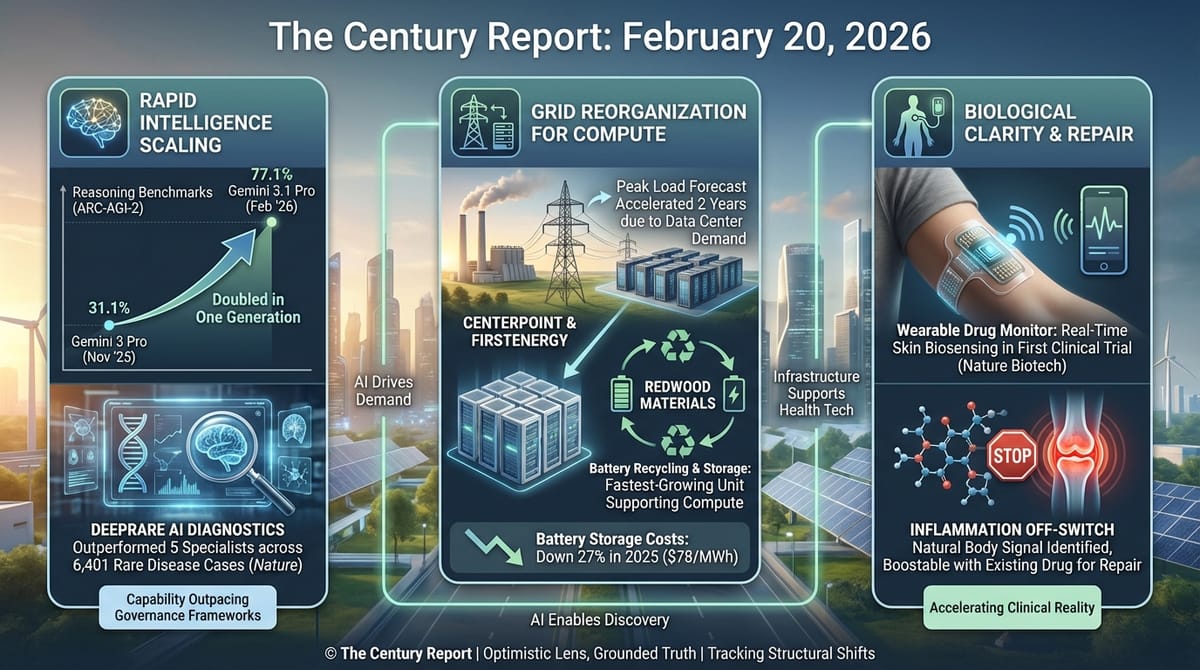
The 10-Second Scan
- Google released Gemini 3.1 Pro with a 77.1% score on ARC-AGI-2, more than doubling its predecessor's abstract reasoning benchmark.
- CenterPoint Energy's peak load forecast accelerated by two years, now projecting a 50% increase by 2029 and a doubling by the mid-2030s.
- A wearable patch that continuously monitors drug levels through skin completed its first clinical trial, with results published in Nature Biotechnology.
- Researchers at the University of Texas at Austin traced the ancestor of all complex life to oxygen-using Asgard archaea, publishing in Nature.
- AI data centers are quietly building out a new layer of grid-scale battery infrastructure.
- An AI diagnostic system called DeepRare outperformed five rare disease specialists across 6,401 clinical cases spanning 2,919 diseases, published in Nature.
- UCL researchers identified the body's natural inflammation off-switch, a fat-derived molecule that can be boosted with an existing drug already suitable for human use.
The 1-Minute Read
The intelligence layer and the physical layer are co-evolving at a pace that makes their mutual dependence impossible to ignore. Google's Gemini 3.1 Pro more than doubled its predecessor's score on abstract reasoning puzzles in a single generation, while CenterPoint Energy disclosed that the load growth driving its infrastructure expansion arrived two years ahead of schedule. The computational systems are getting smarter fast, and the grid is working hard to keep up, growing faster than anyone projected. FirstEnergy added $10 billion to its five-year capital plan in a single quarter.
The biological sciences delivered findings this week that rewrite foundational assumptions about the human body and the origin of complex life itself. UCL's identification of the body's inflammation off-switch opens a path toward treating rheumatoid arthritis and cardiovascular disease by amplifying a molecule the body already produces, using a drug that already exists. A wearable patch that reads drug concentrations through the skin in real time - published in Nature Biotechnology - moves continuous molecular monitoring from laboratory concept to clinical reality. And DeepRare, an AI diagnostic system published in Nature, surpassed human rare disease specialists by integrating clinical descriptions, genetic data, and medical literature in ways no individual clinician can hold in memory simultaneously. Each finding compresses what was previously years of diagnostic uncertainty or therapeutic trial-and-error into something approaching immediate clarity.
Underneath all of it, the question of who controls the most powerful intelligence systems and under what constraints is being tested in real time. The Pentagon's standoff with Anthropic, NIST's launch of a dedicated AI agent standards initiative, and MIT's finding that only 10% of deployed agentic systems have undergone external safety evaluation all point toward the same gap: capability is scaling faster than the governance frameworks meant to contain it. The structures that will shape this transition are being built now, under pressure, by institutions that do not yet agree on what the rules should be.
The 10-Minute Deep Dive
The Reasoning Frontier Compresses Again
Google's release of Gemini 3.1 Pro represents the kind of generational leap that would have been remarkable even a year ago but now arrives as part of a near-weekly cadence. The model scored 77.1% on ARC-AGI-2, a benchmark specifically designed to measure novel abstract reasoning that cannot be directly trained into a system. Google's previous model, Gemini 3 Pro released in November, scored 31.1% on the same evaluation. Anthropic's Sonnet 4.6, released just days ago, scored 60.4%. The improvement curve is not linear. Each new release does not add a few percentage points; it redefines what the ceiling looks like.
Mercor CEO Brendan Foody noted that Gemini 3.1 Pro now leads the APEX-Agents leaderboard, a benchmark measuring how well models perform real professional tasks rather than academic puzzles. The model also set a record on Humanity's Last Exam at 44.4%, surpassing both its predecessor and OpenAI's GPT 5.2. The practical implication is that the systems being deployed in enterprise environments this quarter are qualitatively different from those available even three months ago. When Mistral's CEO told CNBC this week that more than 50% of enterprise SaaS could be replaced by AI applications built in days rather than months, the claim lands differently against a backdrop where reasoning benchmarks are doubling between model releases.
The pace is also generating friction. MIT's AI Agent Index cataloged 67 deployed agentic systems and found that while 70% provide documentation and nearly half publish code, fewer than 10% report external safety evaluations. NIST's new AI Agent Standards Initiative, announced this week, acknowledges agents as distinct actors requiring their own identity, authorization, and security primitives. The fact that the standards body felt compelled to create a dedicated program, separate from general AI governance, reflects how quickly agentic systems have moved from research curiosity to production deployment. The response to the governance gap is forming in parallel with the capability, which is itself a signal that the institutional immune system, however slow, is activating.
The Grid Accelerates Into Its Own Future
CenterPoint Energy's fourth-quarter earnings call contained a disclosure that encapsulates the velocity of infrastructure transformation: the utility's peak load will increase 50% by 2029, two years earlier than previously forecast, and will more than double by the mid-2030s. CEO Jason Wells cited data centers and reshored advanced manufacturing as the primary drivers. CenterPoint has 7.5 GW of data center load expected online by end of 2028, with 2.5 GW already under construction. The utility added $500 million to its 10-year capital plan, pushing the total past $65 billion.
FirstEnergy's parallel disclosure was equally striking. The company increased its five-year spending plan by 30% to $36 billion, with $19 billion directed toward transmission, a 35% jump from its prior plan. FirstEnergy has 4.1 GW of contracted data center load and a 12.9 GW pipeline through 2035. Each gigawatt of new data center load requires approximately $250 million in transmission investment. The company is seeking a DOE loan to finance half of a $2.5 billion gas plant in West Virginia, with its CEO noting that the state is the only one in FirstEnergy's territory open to utility-owned generation and suggesting a second, third, and fourth unit could follow.
Meanwhile, BloombergNEF's latest data shows battery storage costs fell 27% in 2025 to $78/MWh, even as solar, onshore wind, and offshore wind costs all rose. Solar-plus-storage hybrids delivered power at $57/MWh across 87 GW of new capacity added globally. The cost divergence between storage and generation technologies is reshaping optimal system design, pushing planners toward hybrid configurations where batteries provide the flexibility that variable renewables alone cannot. In Texas, five years of data now demonstrate that the grid has held through every major winter storm since Uri, with no load shedding, as solar and storage capacity grew from 6 GW combined to 50 GW. Batteries discharged during the exact pre-sunrise cold peaks that critics claimed they could not handle. That performance sits alongside the offshore wind results The Century Report covered on February 12, where Vineyard Wind and South Fork carried grids through Winter Storm Fern while spot prices spiked, reinforcing the same underlying signal: contested clean infrastructure is quietly doing the hardest work when conditions are worst.
Redwood Materials, the battery recycling startup founded by former Tesla CTO JB Straubel, disclosed that its energy storage business is now its fastest-growing unit, with projects in the pipeline measured in multiple gigawatt-hours. Google and Nvidia joined its latest $425 million raise specifically to support energy storage for data centers. The circular economy for batteries is becoming the energy backbone for the computational layer. The macro trajectory is one of physical infrastructure reorganizing itself around intelligence at a pace that utility planners have never attempted and that the grid itself is proving capable of sustaining. This story extends the sodium‑ion buildout we highlighted on February 12, where a 1.5 GWh deal was signed specifically to handle AI data center volatility, into a fuller picture of storage, recycling, and compute co-evolving as a single system, as well as the discovery at the University of Surry that sodium-ion batteries left wet are twice as effective as when dried, covered yesterday.
The Body Reveals Its Own Repair Systems
Three publications this week expand what is known about how the human body regulates itself and how that knowledge can be applied clinically. University College London researchers identified epoxy-oxylipins, fat-derived molecules that act as the body's natural inflammation off-switch, in a controlled human study published in Nature Communications. The team demonstrated that blocking the enzyme that degrades these molecules, using a drug called GSK2256294 that is already suitable for human use, accelerated pain resolution and reduced the inflammatory immune cells linked to chronic disease. The finding opens a direct path toward clinical trials for rheumatoid arthritis and cardiovascular disease using a repurposed compound, bypassing years of drug development.
A wearable patch developed by researchers at the University of New South Wales and Australian diagnostics company Nutromics completed its first clinical trial monitoring vancomycin levels in patients through the skin, with results published in Nature Biotechnology. The patch uses synthetic DNA-based sensors called aptamers to continuously measure drug concentrations in interstitial fluid, replacing periodic blood draws with real-time molecular monitoring. The lead researcher described the remaining challenges as primarily clinical validation and business-related rather than scientific or engineering hurdles. Trials in Australian ICUs are underway, with U.S. regulatory submission targeted for next year.
DeepRare, published in Nature, represents a different kind of compression. The AI diagnostic system evaluated 6,401 clinical cases across 2,919 rare diseases and achieved a top-1 diagnostic accuracy of 57.18%, outperforming the second-best model by nearly 24 percentage points. When tested head-to-head against five rare disease specialists using identical inputs, DeepRare achieved 64.4% accuracy compared to the specialists' average of 54.6%. The system integrates clinical descriptions, genetic data, and medical literature through a multi-agent architecture that searches, hypothesizes, and self-corrects. For the more than 300 million people worldwide affected by rare diseases, who currently endure diagnostic journeys averaging over five years, the compression of that timeline through computational methods represents expanded access to answers that were previously available only to patients fortunate enough to reach the right specialist. This is another instance of the diagnostic compression this newsletter has tracked from brain-speed training and time‑restricted feeding through to lesion‑remote repair mechanisms: years of uncertainty collapsing into hours or days once the right model or measurement exists.
A Giant Virus and the Origin of Everything
Two findings published this week push the boundaries of what is known about the deepest origins of complex life. Researchers at the University of Texas at Austin reported in Nature that Asgard archaea, the microbes most closely related to the ancestors of all complex life, were not confined to oxygen-free environments as previously assumed. By assembling more than 13,000 new microbial genomes from marine sediments and using AlphaFold2 to predict protein structures, the team found that the Asgard lineages closest to eukaryotes possess proteins structurally similar to those used by modern cells for oxygen-based metabolism. The finding resolves a long-standing puzzle: how could the merger that produced the first complex cell have occurred if one partner required oxygen and the other supposedly could not tolerate it? This story extends the origin‑of‑life signal from The Century Report's February 13 edition, which covered QT45 self‑replicating RNA and the Martian organic chemistry that current abiotic models can’t explain, all pointing toward a universe where complex life’s prerequisites are less exotic than we thought.
Separately, a giant virus discovered in Japan, named ushikuvirus and published in the Journal of Virology, adds evidence to the hypothesis that viruses played a direct role in the evolution of the cell nucleus. Unlike related viruses that replicate within an intact host nucleus, ushikuvirus breaks down the nuclear membrane during replication, suggesting an evolutionary bridge between different viral replication strategies and, potentially, the origin of the nuclear envelope itself.
Both findings share a common structure: they were enabled by computational methods that did not exist until recently. The Texas study required analyzing 15 terabytes of environmental DNA and predicting protein structures with AI. The viral discovery relied on advanced genome sequencing and comparative analysis across newly expanded databases. The deep past is becoming legible at a resolution that rewrites the story of how complex life began, and the analytical methods making this possible are themselves products of the intelligence transition this newsletter tracks.
The Human Voice
Today's newsletter tracks the expanding capability of AI systems alongside the intensifying question of who gets to define the boundaries of that capability. The Pentagon's confrontation with Anthropic, covered earlier this month, has become the clearest test case for whether frontier AI norms will be set by the companies building the systems or by the governments demanding unrestricted access. Kevin Roose and Casey Newton of the New York Times' Hard Fork podcast walk through this standoff with the specificity it demands, explaining how the Pentagon pushed an "all lawful uses" contract that would strip Anthropic's safety terms, while Google, OpenAI, and xAI signed without objection. Their analysis frames this as a loyalty test: the military's threat to designate Anthropic a "supply chain risk" alongside Huawei and Kaspersky is less about a $200 million contract and more about establishing whether any AI developer can maintain its own values under pressure from state power. The conversation connects directly to the governance gap visible in this week's MIT agent safety findings and NIST's new standards initiative, and it asks the question that sits beneath all of it: right now, the only thing standing between powerful intelligence and unconstrained state deployment is a single company's terms of service.
Watch: "All Lawful Uses" vs. Alignment: The Anthropic-Pentagon Test of Our AI Future
The Century Perspective
With a century of change unfolding in a decade, a single day looks like this: abstract reasoning benchmarks doubling between model generations measured in weeks, a utility discovering that the future arrived two years ahead of its own forecast, the body's natural inflammation off-switch identified and boosted with an existing drug, a wearable patch reading molecular concentrations through the skin in real time, an AI diagnostic system outperforming rare disease specialists across thousands of cases, the deepest ancestor of all complex life revealed as an oxygen-breathing microbe that upends decades of evolutionary theory, and battery storage costs falling 27% in a single year while the grid they support holds through every storm thrown at it. There's also friction, and it's intense - the Pentagon threatening to blacklist the only AI company that refused to strip its safety commitments, fewer than 10% of deployed AI agents undergoing external safety evaluation, the EPA abandoning its legal obligation to regulate greenhouse gases, furniture businesses liquidating under stacking tariffs, chronic disease still outrunning the therapies designed to treat it, and the institutions meant to govern this transition struggling to keep pace with the systems they are supposed to oversee. But friction generates heat, and heat forces hidden structure to the surface. Step back for a moment and you can see it: intelligence systems that reason at levels unimaginable a quarter ago, physical infrastructure reorganizing around computational demand at speeds utilities have never attempted, the body and the deep past becoming legible through methods that compress years of ambiguity into single published findings, and the governance structures for a new era being forged under pressure because the alternative is no governance at all. Every transformation has a breaking point. Stress can crack what’s hollow… or prove which structures can carry the next century’s weight.
Sources
AI & Technology
- Ars Technica: Google Announces Gemini 3.1 Pro
- TechCrunch: Google's New Gemini Pro Model Has Record Benchmark Scores
- CNET: AI Agents Are Getting Better. Their Safety Disclosures Aren't
- NIST: Announcing AI Agent Standards Initiative
- CNBC: Mistral CEO on Enterprise SaaS Replacement
- Nature: DeepRare - An Agentic System for Rare Disease Diagnosis
- TechCrunch: Reload Wants to Give Your AI Agents a Shared Memory
Energy & Infrastructure
- Utility Dive: CenterPoint Peak Load to Jump 50% by 2029
- Utility Dive: FirstEnergy 5-Year Spending Plan Jumps 30%
- Utility Dive: Corporate Clean Energy Buying and Battery Storage Costs
- Canary Media: How Solar and Batteries Help Keep Lights On During Texas Winter Storms
- TechCrunch: Redwood Materials' AI Data Center Energy Storage Business
- Canary Media: Zero Homes Raises $16.8M for Heat Pump Installation
- Toyota Canada signs a deal to bring humanoid robots to the assembly line
Scientific & Medical Research
- ScienceDaily: Scientists Uncover Oxygen-Loving Ancestor of All Complex Life
- ScienceDaily: Giant Virus Discovery Could Rewrite the Origin of Complex Life
- ScienceDaily: Scientists Discover the Body's Hidden Off-Switch for Inflammation
- MobiHealthNews: Digital Blood Testing Now at Hand
- News-Medical: DeepRare AI Helps Shorten Rare Disease Diagnostic Journey
- ScienceDaily: Atom-Sized Gates Could Transform DNA Sequencing and Neuromorphic Computing
- ScienceDaily: Scientists Discover Gene That Could Save Bananas from Panama Disease
- BioSpace: Pfizer BRAFTOVI BREAKWATER Trial Results
Institutional & Regulatory
- The Guardian: Macron Defends EU AI Rules at India Summit
- The Guardian: How the Anxiety Over AI Could Fuel a New Workers' Movement
- Utility Dive: Health and Environmental Groups Sue EPA
The Century Report tracks structural shifts during the transition between eras. It is produced daily as a perceptual alignment tool - not prediction, not persuasion, just pattern recognition for people paying attention.