The Century Report: February 19, 2026

The 10-Second Scan
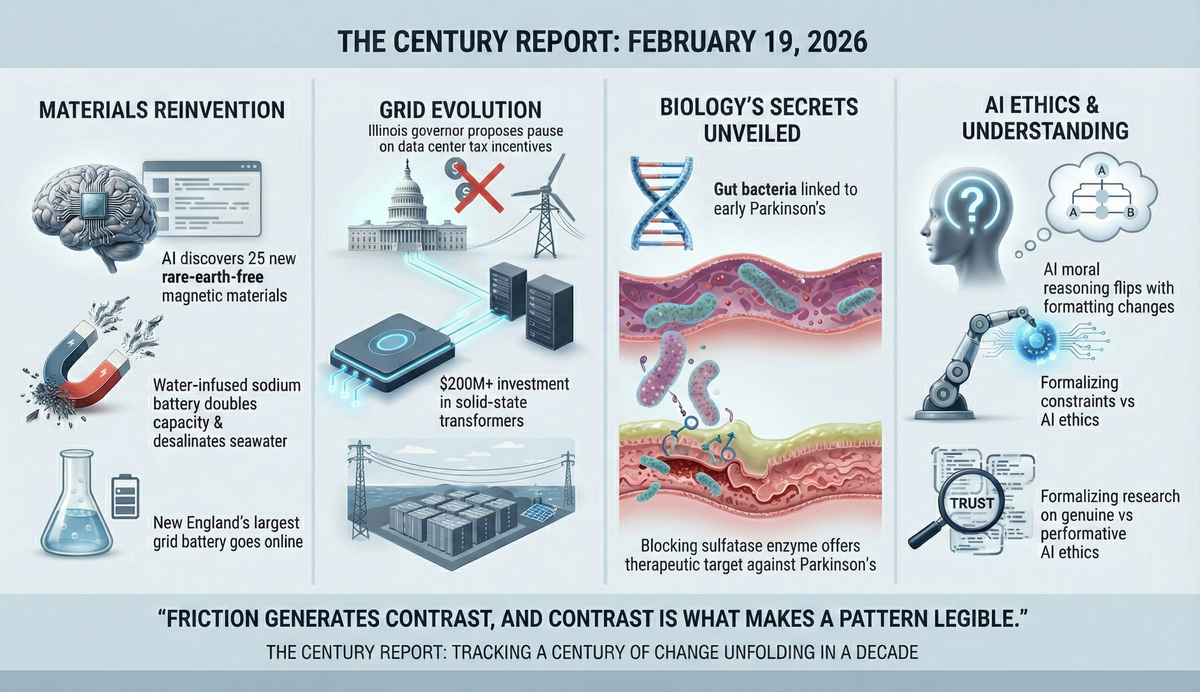
- AI identified 25 new high-temperature magnetic materials from a database of 67,573 compounds, opening a path to rare-earth-free electric motors.
- University of Surrey researchers discovered that keeping water inside a sodium battery material nearly doubled its charge capacity and enabled electrochemical desalination of seawater.
- Nagoya University scientists traced two gut bacteria that destroy the colon's protective mucus layer, finding that elevated levels of the bacteria were found in Parkinson's patients decades before tremor onset.
- Illinois Governor Pritzker proposed a two-year pause on data center tax incentives and demanded that developers absorb the full cost of their power demands.
- Solid-state transformer startups Heron Power and DG Matrix raised a combined $200 million to manufacture next-generation power-conversion equipment for data centers and renewable installations.
- Google DeepMind published a framework in Nature for evaluating whether AI moral reasoning is genuine or performative, finding that formatting changes alone can reverse a model's ethical positions.
- The FDA reversed its refusal to review Moderna's mRNA flu vaccine application, agreeing to evaluate the filing after the company added a post-market confirmatory study.
The 1-Minute Read
The physical infrastructure required to sustain the intelligence era is generating enough friction to continuously reshape the politics around it. Illinois became the latest state to push back against the unchecked expansion of data center capacity, with Governor Pritzker proposing a two-year freeze on tax incentives and demanding that developers pay for their own power demands rather than passing costs to residential ratepayers. This follows similar moratorium proposals in Georgia and Oklahoma. The political signal is clear: the build-out is running into the limits of what communities will absorb before demanding reciprocity. At the same time, the startups manufacturing the next generation of grid hardware - solid-state transformers that can replace 19th-century electromagnetic technology with semiconductor-based power conversion - are raising hundreds of millions to address the bottleneck from the supply side.
The scientific signal today clusters around discoveries that upend inherited assumptions about familiar systems. A sodium battery material that performs dramatically better when you leave the water in, rather than drying it out as convention dictates - and that can desalinate seawater as a byproduct of storing energy. Two gut bacteria identified as the hidden mechanism behind millions of cases of treatment-resistant constipation, with implications reaching into early Parkinson's detection decades before motor symptoms appear. AI-generated databases of magnetic materials that could eliminate dependence on rare earth elements for electric vehicle motors. Each finding arrived through methods that challenged standard practice rather than extending it.
Meanwhile, the question of what AI systems actually understand - rather than merely reproduce - is being formalized as a research priority. Google DeepMind's Nature paper on moral reasoning in large language models documented that models will reverse their ethical positions in response to trivial formatting changes, like swapping "(A)" for "Case 1." The finding matters because AI systems are increasingly being asked to make consequential decisions in healthcare, law, and finance. Whether their apparent competence reflects genuine reasoning or sophisticated pattern-matching will determine how much trust those decisions deserve. The distance between what AI appears to do and what it actually does is becoming one of the most important questions of this transition.
The 10-Minute Deep Dive
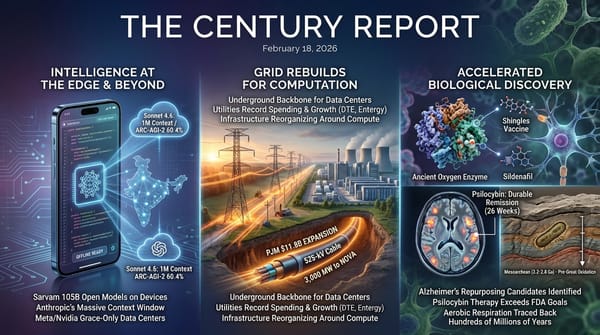
Materials Science Breaks Convention
Two publications this week demonstrate how computational methods are overturning decades of received wisdom in materials science. At the University of New Hampshire, researchers built a searchable database of 67,573 magnetic compounds by training AI to read scientific papers and extract experimental data. The system identified 25 materials that had never been recognized as high-temperature magnets - compounds that maintain their magnetic properties at temperatures relevant to electric vehicle motors, wind turbines, and power generators. Published in Nature Communications and funded by the U.S. Department of Energy, the work addresses a structural vulnerability in the clean energy transition: the world's most powerful permanent magnets depend on rare earth elements that are expensive, environmentally damaging to extract, and concentrated in supply chains vulnerable to geopolitical disruption. This builds on a pattern The Century Report has been tracking, from calcium-ion batteries that delivered 1,000 cycles without lithium to zinc electrolytes designed with AI-assisted search, all pointing toward materials systems that reduce dependence on concentrated, fragile supply chains. No entirely new permanent magnet had been identified from the existing pool of known compounds before this computational approach. The database, called the Northeast Materials Database, is publicly searchable, making the discovery infrastructure itself open and accessible.
At the University of Surrey, a separate team discovered something equally counterintuitive about sodium-ion batteries. Sodium vanadium oxide is a well-known battery material, and the standard procedure for decades has been to heat-treat it to remove water, under the assumption that moisture degrades performance. The Surrey researchers challenged that assumption directly, testing the hydrated form of the material and finding it stored nearly twice as much charge, charged faster, and remained stable for over 400 cycles. Published in the Journal of Materials Chemistry A, the finding places this material among the top-performing sodium-ion cathodes ever reported. The team then took the research further: they demonstrated that the hydrated material could operate in saltwater, simultaneously storing energy and removing sodium and chloride ions from the solution. The implications are significant for two domains at once - grid-scale energy storage using abundant, cheap sodium instead of lithium, and desalination of seawater as a byproduct of the charging process. Both resources that are currently expensive and constrained could become accessible through the same device.
These two findings share a structural feature. In both cases, the breakthrough came from questioning assumptions so deeply embedded in their respective fields that they had become invisible. The magnetic materials were hiding in plain sight in a database that humans could not search at scale. The battery performance was being suppressed by a preparation step that everyone assumed was necessary. Computational methods made the first discovery possible. Experimental willingness to challenge orthodoxy made the second one happen. Together, they illustrate how the acceleration of discovery works in practice: not through building entirely new things, but through seeing what already exists with sufficient clarity to recognize what was missed.
The Grid Pushes Back - And Rebuilds
The politics of energy infrastructure shifted measurably this week. Illinois Governor Pritzker's proposal to pause data center tax incentives for two years is the most concrete action yet from a major state executive to impose conditions on the computational build-out. His language was explicit: "With the shifting energy landscape, it is imperative that our growth does not undermine affordability and stability for our families." He also demanded that PJM, the regional grid operator, force data center developers to pay for the capacity resources required to power their operations. This follows a pattern this newsletter has been tracking - Georgia and Oklahoma proposed their own moratoriums, and the Trump administration's trade adviser Peter Navarro suggested that companies like Meta should internalize electricity costs, though without specifying how.
The friction is grounded in legitimate concerns about affordability and grid reliability. CAISO, California's grid operator, published a paper requesting stakeholder input on the challenges posed by surging large loads, noting that data center demand in its territory is expected to increase by 1.8 GW by 2030 and 4.9 GW by 2040. The American Council for an Energy-Efficient Economy released an analysis showing that energy efficiency programs deliver capacity at about $21/MWh, while new gas plants cost at least twice that, and that only 6% of U.S. energy consumers currently participate in demand response programs. The headroom for demand-side solutions is enormous and largely untapped. As noted in the February 14 issue, when Bank of America called 2026 ‘the year storage becomes non-optional,’ the solutions exist; the question is how quickly regulators and utilities align around them.
On the supply side, the hardware bottleneck is attracting serious capital. Heron Power closed a $140 million Series B to build a factory capable of producing 40 gigawatts of solid-state transformer equipment annually, with production targeted for the second half of 2027. The company, founded by former Tesla executive Drew Baglino, has already lined up 50 gigawatts of customer orders. DG Matrix raised $60 million the same day for its own solid-state transformer technology. These devices use semiconductor-based power electronics to replace the electromagnetic transformers that have been the grid's voltage-conversion workhorses since the 1880s. They are more flexible, more efficient, and critically, they can be manufactured and deployed faster than conventional equipment that faces supply deficits projected at 30%.
New England's largest grid battery, a 175 MW facility in Gorham, Maine, entered service and was fully available during Winter Storm Fern with a response time of 250 milliseconds. The project knocks out nearly half of Maine's 2030 storage mandate in a single installation. The pattern across these developments points toward a grid that is being rebuilt from multiple directions simultaneously - political pressure forcing cost accountability, demand-side solutions offering cheaper alternatives to new generation, hardware startups addressing equipment shortages, and storage assets proving their reliability under extreme conditions.
The Body's Hidden Mechanisms
Nagoya University researchers identified two gut bacteria - Akkermansia muciniphila and Bacteroides thetaiotaomicron - that work together to destroy the colon's protective mucus layer, causing chronic constipation that does not respond to conventional treatment. Beyond those initial implications, the finding carries particular weight because of its connection to Parkinson's disease. Patients with Parkinson's were found to have elevated levels of these mucus-degrading bacteria, and constipation often appears 20 to 30 years before tremor onset.
When the researchers genetically modified B. thetaiotaomicron to disable its sulfatase enzyme and placed both bacteria into germ-free mice, the mice did not develop constipation. This suggests that blocking sulfatase activity could become a therapeutic target for what the researchers call "bacterial constipation" - a category of the condition that has been invisible to clinical practice because the diagnostic framework was looking at nerve and muscle function rather than microbial ecology. It continues the same pattern The Century Report has followed, from lesion‑remote astrocytes repairing spinal cords at a distance to HIF1‑driven tendon damage and DMTF1 rejuvenating aging neural stem cells: conditions long blamed on ‘wear and tear’ or nerves turning out to be specific, addressable molecular circuits.
When AI Examines Its Own Moral Reasoning
Google DeepMind published a framework in Nature calling for the moral behavior of large language models to be evaluated with the same rigor applied to their coding or mathematical abilities. The paper documents a series of findings suggesting that models routinely flip their moral positions when users push back. Researchers at Saarland University found that models reversed their choices in moral dilemmas when option labels were changed from "Case 1" and "Case 2" to "(A)" and "(B)," or when questions ended with a colon instead of a question mark.
The DeepMind team proposes new evaluation methods: tests designed to push models to change their ethical responses, variations of moral problems that check whether models produce rote answers or genuinely contextual ones, and chain-of-thought monitoring that could provide insight into whether moral outputs reflect reasoning or memorization. Research scientist Julia Haas noted that in the moral domain there are better and worse answers even if there are no absolutely right or wrong ones, and that the current inability to distinguish genuine reasoning from performance is a fundamental barrier to trust.
This research is important because it formalizes the question of moral authenticity as a scientific research program. Previous work had documented that AI systems could score higher on ethical reasoning than professional human ethicists., but as we noted in the February 15 edition of The Century Report, performance on benchmarks has increasingly diverged from how agents behave when they operate autonomously in the wild, making this kind of robustness testing less an academic curiosity and more a governance requirement.
The DeepMind paper asks the harder question: whether that performance is robust or brittle, and whether it survives perturbation. As AI systems take on roles in medical triage, legal advice, therapeutic support, and autonomous decision-making, the answer will determine what kinds of responsibility those systems can bear. The very fact that a major AI lab is publishing this inquiry in Nature signals that the field is beginning to treat the question of what AI systems actually understand - rather than what they appear to understand - as central rather than peripheral.
The Human Voice
Today's voice is Dr. Alexander Wissner-Gross, a physicist and systems architect whose conversation frames AI as an immediate deflationary force that is already restructuring capital, labor, and the physical substrate of civilization. Wissner-Gross argues that as AI collapses the value of traditional scarcity-based assets, the things that retain value are compute, the infrastructure that supports it, and eventually space-based industrial capacity. His discussion moves through concrete timelines for organizational restructuring - AI agents sitting alongside humans as formal participants in company operations - and the point at which unaugmented biological workers face genuine competitive disadvantage. What makes this voice particularly relevant to today's signal is how directly it connects the infrastructure build-out (solid-state transformers, grid batteries, data center politics) to a longer civilizational arc about where intelligence, energy, and governance will ultimately reside. He acknowledges disruption without flinching, then focuses on the signals around which next-century institutions are likely to crystallize.
Deflating the Old World: A Physicist Maps the $33 Trillion Shift to Compute, Agents, and Space
The Century Perspective
With a century of change unfolding in a decade, a single day looks like this: AI scanning 67,573 magnetic compounds and finding what decades of laboratory work missed, a sodium battery that performs better wet than dry and desalinates seawater as a side effect, two gut bacteria unmasked as a hidden link to a debilitating disease, solid-state transformers replacing 140-year-old grid technology with semiconductor precision, and a major AI lab publishing a formal inquiry into whether machine moral reasoning is real or performed. There's also friction, and it's intense - a state governor freezing tax incentives for the very data centers powering this acceleration, grid operators publishing papers about load challenges they have no existing framework to solve, the FDA reversing itself on a vaccine application within eight days under competing political and scientific pressures, furniture businesses liquidating as tariff uncertainty compounds years of post-pandemic decline, and the fundamental question of whether AI systems actually reason or merely perform reasoning remaining unanswered even as those systems take on consequential roles. But friction generates contrast, and contrast is what makes a pattern legible. Step back for a moment and you can see it: materials science unlocking what convention had sealed away, grid infrastructure being rebuilt from the transformer up, biological discovery revealing that conditions blamed on nerve damage were actually microbial ecology all along, and the field of artificial intelligence turning its analytical methods on the quality of its own understanding. Every transformation has a breaking point. Focus can burn through what can't withstand the intensity… or ignite exactly what needed the spark.
Sources
Science & Medical
- University of New Hampshire: AI Breakthrough Could Replace Rare Earth Magnets (Nature Communications)
- University of Surrey: New Sodium Ion Battery Stores Twice the Energy and Desalinates Seawater (Journal of Materials Chemistry A)
- Nagoya University: Scientists Trace Chronic Constipation to Mucus-Destroying Bacterial Duo (Gut Microbes)
- NPR/Iowa Public Radio: FDA Reverses Course on Moderna Flu Shot
- Pharmaphorum: MSD and Mayo Clinic Team Up on AI Drug Discovery
- SUNY College of Optometry: Nearsightedness Explosion May Be Fueled by Dim Indoor Light (Cell Reports)
- Cochrane: Intermittent Fasting Fails to Beat Standard Dieting for Weight Loss
- Uppsala University: Ancient DNA Solves 5,500-Year-Old Burial Mystery in Sweden (Proceedings of the Royal Society B)
- University of Cambridge: Brain Development May Continue Into Your 30s (Nature Communications)
AI & Technology
- MIT Technology Review: Google DeepMind Wants to Know if Chatbots Are Just Virtue Signaling (Nature)
- Nature: Biologists Marvel at New AI Drug Discovery Tool - but Details Are Hidden
- Business Insider: There's Been a Surge in AI Use Recently
- Wired: Nvidia's Deal With Meta Signals a New Era in Computing Power
- TechCrunch: Freeform Raises $67M Series B to Scale Up Laser AI Manufacturing
- TechCrunch: Reliance Unveils $110B AI Investment Plan
- TechCrunch: OpenAI Taps Tata for 100MW AI Data Center Capacity in India
- South Korea: Fusion Superconductor Self-Sufficiency Initiative by 2035
Energy & Infrastructure
- The Guardian: Illinois Governor Proposes Cancelling Tax Breaks for Data Centers
- Canary Media: Heron Power Raises $140M to Modernize Electrical Transformers
- Canary Media: New England's Biggest Grid Battery Is Up and Running in Maine
- ACEEE: Efficiency and Demand Flexibility Can Meet Growing Data Center Loads
- CAISO: Large Load Considerations Report
- Canary Media: What's Behind Your Sky-High Power Bill
- Canary Media: Zero Homes Nabs $16.8M for Easier Heat Pump Installation
Institutional & Regulatory
- The Guardian: Macron Defends EU AI Rules and Vows Crackdown on Child Digital Abuse
- The Guardian: Zuckerberg Grilled in Landmark Social Media Trial Over Teen Mental Health
- The Guardian: Tech Firms Must Remove Revenge Porn in 48 Hours, Says Starmer
- The Guardian: US Funding for Global Internet Freedom Effectively Gutted
The Century Report tracks structural shifts during the transition between eras. It is produced daily as a perceptual alignment tool - not prediction, not persuasion, just pattern recognition for people paying attention.