The Century Report: February 17, 2026

The 10-Second Scan
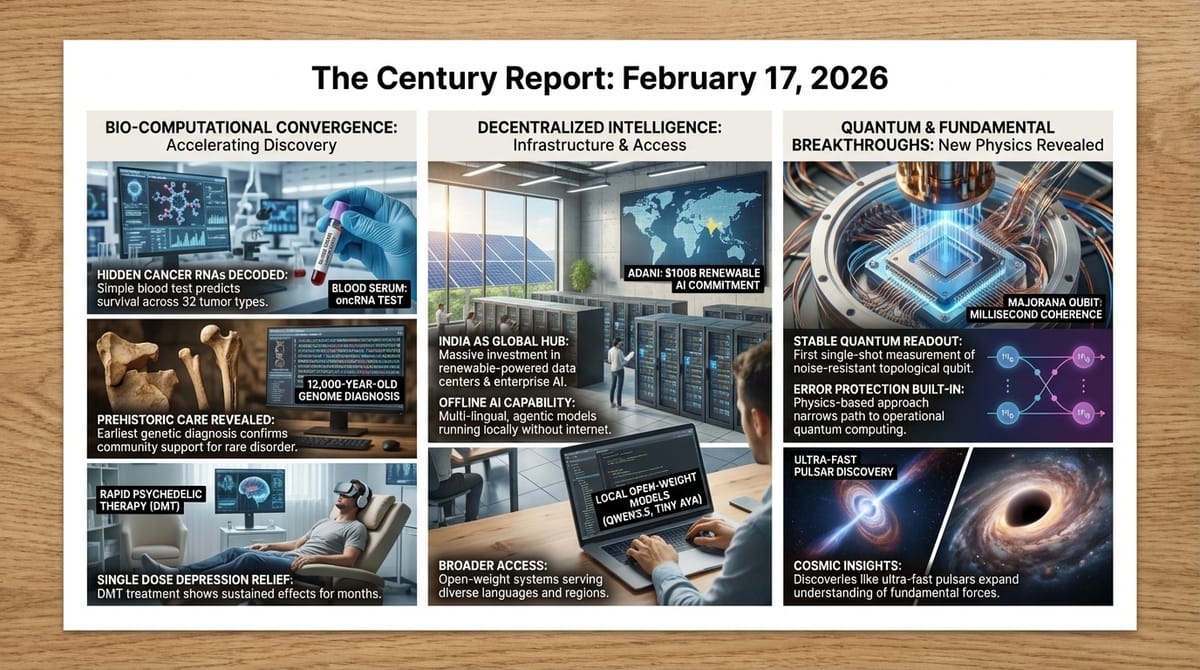
- Researchers at the Arc Institute discovered an entire hidden class of cancer-specific RNAs across 32 tumor types, with a simple blood test tracking treatment response and predicting survival.
- Physicists achieved the first single-shot readout of a Majorana qubit, confirming millisecond-scale coherence in the most noise-resistant quantum computing architecture ever demonstrated.
- A single dose of DMT reduced depression symptoms for up to six months in a clinical trial of people with treatment-resistant major depressive disorder, published in Nature Medicine.
- Adani Group announced a $100 billion commitment to build renewable-powered AI data centers across India through 2035, targeting 5 gigawatts of capacity.
- Alibaba released Qwen3.5 as open-weight with native agentic capabilities and support for 201 languages, compatible with OpenClaw and other open-source agent frameworks.
- Ancient DNA from a 12,000-year-old burial in Italy provided the earliest genetic diagnosis of a rare growth disorder, published in the New England Journal of Medicine.
The 1-Minute Read
The biological sciences are producing findings this week that compress years of diagnostic ambiguity into single measurements. A hidden layer of cancer biology - hundreds of thousands of RNA molecules specific to tumors and invisible to previous methods - has been mapped across every major cancer type, and a milliliter of blood serum can now reveal how a patient is responding to treatment with greater predictive power than existing clinical markers. A 12,000-year-old skeleton in Italy just received the earliest genetic diagnosis ever performed on a human being. A single intravenous dose of DMT, lasting twenty-five minutes, lifted treatment-resistant depression for months. Each of these findings arrived through the convergence of computational methods and biological insight that did not exist in combination until recently, and each collapses a timeline that previously stretched across years of ambiguous clinical observation into something approaching real-time clarity.
The infrastructure layer is reorganizing just as rapidly. India's AI Impact Summit became the venue for announcements that, taken together, describe a new geography of computational power: $100 billion in renewable-powered data center commitments, Anthropic opening its first Indian office and partnering with Infosys to deploy enterprise AI agents, Alibaba releasing open-weight models supporting 201 languages with native agent capabilities. The pattern is one of distributed capability rather than concentrated control. Open-weight models that run on local devices without internet access, multilingual systems trained on a single cluster of 64 GPUs, and AI agents designed to operate autonomously across regulated industries are all moving in the same direction: toward broader access to intelligence infrastructure, anchored in regions and languages that proprietary systems have historically underserved.
At the quantum frontier, physicists confirmed what theorists predicted but experimentalists had never demonstrated: that information encoded in Majorana qubits can be read without destroying it. The millisecond coherence times they measured represent orders of magnitude beyond what conventional qubits achieve before environmental noise corrupts their states. This matters because the path to reliable quantum computing has always run through error correction, and topological qubits offer a fundamentally different approach - one where protection against noise is built into the physics rather than engineered after the fact. The distance between theoretical possibility and operational reality continues to narrow across every domain, and the compression is accelerating.
The 10-Minute Deep Dive
Cancer's Hidden RNA Language, Decoded
The Arc Institute published findings that rewrite the map of cancer biology at a molecular level. Yesterday The Century Report covered the identification of N4BP2, the enzyme that triggers chromothripsis, and today brings another development in the ongoing question to understand and address cancer. Beginning with a single anomalous RNA molecule detected in breast cancer in 2018, researchers spent six years systematically identifying what they call orphan non-coding RNAs - or oncRNAs - across every major cancer type. The scale of what they found was unexpected: approximately 260,000 cancer-specific small RNAs distributed across 32 tumor types, each cancer displaying its own distinct expression pattern. Machine learning models trained on these patterns classified cancer types with 90.9% accuracy, and in independent validation on 938 tumors, accuracy held at 82.1%.
According to the researchers, functional screening in mouse models revealed that roughly 5% of the oncRNAs they tested actively drove tumor growth and metastasis. Two breast cancer oncRNAs triggered specific molecular cascades - one initiating the epithelial-mesenchymal transition essential for metastasis, the other activating cell proliferation pathways. When the team checked patient tumor data from The Cancer Genome Atlas, they found the same pathway changes in tumors expressing those same RNAs.
The clinical implications became concrete when the team analyzed blood samples from 192 breast cancer patients in the I-SPY 2 chemotherapy trial. They measured circulating oncRNA levels before and after treatment and found that a single measurement of residual oncRNA burden predicted overall survival with nearly fourfold discrimination. The researchers noted that detecting such a strong signal from just one milliliter of serum was unexpected, and that RNA-based monitoring may offer advantages over cell-free DNA approaches because cancer cells actively secrete RNA rather than passively shedding DNA. What was a curiosity in a single cancer eight years ago has become a pan-cancer diagnostic framework, a functional genomics finding, and a blood-based monitoring method - all enabled by computational analysis that was not feasible when the original molecule was first noticed.
Reading the Unreadable Qubit
A collaboration between Delft University of Technology and the Madrid Institute of Materials Science achieved something that had been theoretically anticipated but experimentally elusive for years: they read the quantum state of a Majorana qubit in a single measurement. Published in Nature, the work confirms that topological qubits - which distribute quantum information across paired Majorana zero modes rather than storing it at a single point - can be accessed without destroying the information they carry.
The achievement has monumental implications for the architecture of future quantum computers. Conventional qubits are fragile. Environmental noise corrupts their states in microseconds, requiring elaborate error correction schemes that consume the majority of a quantum computer's resources. Majorana qubits take a fundamentally different approach: their information is encoded non-locally, spread across two quantum modes connected through a superconductor. Corrupting the information requires affecting the entire system simultaneously rather than disturbing a single point, which gives them inherent protection against the decoherence that plagues every other qubit type.
The team engineered a minimal Kitaev chain - two semiconductor quantum dots connected through a superconductor, assembled from modular components - and applied a quantum capacitance probe that functions as a global measurement sensitive to the overall state rather than any local property. For the first time, they determined in real time whether the qubit was in a filled or empty state. They also measured parity coherence exceeding one millisecond, a duration that researchers describe as highly promising for future topological quantum operations. The theoretical contribution from Madrid was described as "crucial for understanding this highly sophisticated experiment," highlighting how progress at this frontier requires the convergence of experimental platforms and mathematical frameworks developed in different institutions and on different continents.
A Twenty-Five-Minute Treatment for Years of Depression
A phase IIa clinical trial published in Nature Medicine demonstrated that a single intravenous dose of dimethyltryptamine, infused over ten minutes, produced rapid and sustained antidepressant effects in people with moderate to severe treatment-resistant depression. The 34 participants had lived with depression for an average of more than a decade and had not responded to at least two prior antidepressant treatments.
Two weeks after treatment, participants who received DMT showed significantly greater reductions in depressive symptoms than those given a placebo. The improvement appeared within a week for many participants and persisted for three to six months. Receiving a second dose did not significantly improve outcomes, suggesting that a single session may be sufficient. The trial was designed, funded, and sponsored by Cybin UK, a neuropsychiatric firm, and led by Dr. David Erritzoe at Imperial College London.
What distinguishes DMT from other psychedelics under investigation is the brevity of its action. The psychedelic experience lasts approximately twenty-five minutes, compared to several hours for psilocybin. This has practical implications for how therapy sessions are structured, how clinics manage patient flow, and how costs scale. The researchers also found that the intensity of the psychedelic experience correlated with therapeutic outcomes - participants who reported more profound subjective effects showed greater improvement.
This result arrives alongside positive phase 3 data from Compass Pathways on psilocybin for the same patient population. Compass reported that 39% of patients treated with COMP360 saw clinically significant symptom reduction, and the company is now preparing to discuss a rolling FDA submission. The convergence of positive results from two different psychedelic compounds, in the same treatment-resistant population, within the same month, represents a meaningful acceleration in the evidence base. Approximately 100 million people worldwide live with treatment-resistant depression. The existing pharmacological toolkit has been largely unchanged for decades. What is emerging now is a genuinely new class of intervention - brief, intense, and apparently capable of sustained effects through a single administration.
India as Infrastructure Anchor
The India AI Impact Summit in New Delhi became the site of announcements that, when assembled, describe a structural shift in where computational infrastructure is being built and who controls it. Adani Group's $100 billion commitment to renewable-powered AI data centers through 2035, targeting 5 gigawatts of capacity, represents the largest single infrastructure pledge from a non-U.S. entity. The company said the investment would catalyze an additional $150 billion in related investments across server manufacturing, electrical infrastructure, and cloud platforms.
Anthropic opened its first office in Bengaluru and partnered with Infosys to deploy Claude models and Claude Code across telecommunications, financial services, and manufacturing. India is now Anthropic's second-largest market after the United States, accounting for about 6% of global Claude usage. Sam Altman disclosed that India has more than 100 million weekly active ChatGPT users, second only to the U.S. These numbers represent access at a scale that fundamentally changes the distribution of intelligence infrastructure.
Meanwhile, Cohere Labs launched Tiny Aya, a family of open-weight multilingual models supporting over 70 languages, trained on a single cluster of 64 H100 GPUs, capable of running on laptops without internet access. Regional variants were optimized for South Asian, African, and Asia-Pacific language communities. Alibaba released Qwen3.5 as open-weight with native agentic capabilities and support for 201 languages. Both releases share a structural feature: they are designed to operate locally, offline, and in languages that proprietary systems have historically deprioritized. The capability to run sophisticated AI on a device without cloud connectivity, in Bengali or Tamil or Marathi, represents a different kind of access expansion than building larger data centers. It is intelligence infrastructure that does not require permission from, or payment to, any centralized provider.
There is also visible tension in the same summit. HCL's CEO stated that Indian IT companies will focus on profits rather than job creation. Vinod Khosla predicted that IT services and BPOs could "almost completely disappear" within five years. Fractal Analytics, India's first AI company to IPO, debuted below its issue price and closed down 7% on its first day. The Indian IT services sector, worth $280 billion and employing millions, is being restructured in real time by the same intelligence systems being deployed at the summit. The macro trajectory, however, points toward expanded capability: more people with access to sophisticated AI, in more languages, on more devices, with less dependency on any single provider or platform. The short-term disruption to existing business models is real, but the long-term direction is toward distributed intelligence infrastructure that serves populations rather than extracting from them.
Twelve Thousand Years of Care
An international team led by the University of Vienna and Liège University Hospital Centre published in the New England Journal of Medicine the earliest genetic diagnosis ever performed on a human being. DNA extracted from a 12,000-year-old double burial at Grotta del Romito in southern Italy revealed that the two individuals - long assumed to be male and female - were in fact a mother and daughter. The daughter carried a homozygous mutation in the NPR2 gene, confirming acromesomelic dysplasia, a rare inherited disorder marked by severe short stature and limb shortening. The mother carried a single copy of the same mutation, explaining her own moderately reduced height.
The finding resolves a decades-old archaeological mystery about the burial, but its deeper significance lies in what it reveals about human social behavior during the Ice Age. The daughter, who stood approximately 110 cm tall and faced severe physical limitations, survived into adolescence or adulthood. The researchers concluded that her survival would have required sustained support from her community, including help with food and mobility in the challenging environment of Upper Paleolithic southern Italy. The evidence of care is written into the bones themselves and into the burial arrangement - a mother holding her daughter in an embrace that has lasted twelve millennia.
What made this diagnosis possible was the convergence of paleogenomics, clinical genetics, and physical anthropology - computational methods applied to ancient biological material, producing clinical-grade results across a span of time that dwarfs recorded history. The finding proves that rare genetic diseases were present in prehistoric populations and can now be identified with the same precision applied to living patients. It also demonstrates something about the human capacity for care that no genome can encode but that the archaeological record makes visible.
The Human Voice
Today's voice comes from Vinod Khosla, speaking at India's AI Impact Summit about how AI can serve as what he calls "a great equalizer." Khosla's framing is direct: free primary healthcare, personalized education, and legal advice for every citizen, enabled by AI systems that compress the cost of expert guidance by orders of magnitude. He is candid about the disruption - predicting that IT services and BPO industries could largely disappear within five years - but pivots to what that same capability makes possible when directed toward expanding access rather than maintaining existing business structures. His perspective connects directly to what today's newsletter tracks: open-weight models running in 70+ languages on laptops without internet, $100 billion in renewable-powered infrastructure commitments, and clinical AI systems that turn a $1,500-per-month drug regimen into a wearable sensor and a coaching app. The tension between what is being lost and what is becoming available is the defining feature of this transition, and Khosla articulates both sides with unusual clarity.
Vinod Khosla: AI as the Great Equalizer
The Century Perspective
With a century of change unfolding in a decade, a single day looks like this: a hidden language of 260,000 cancer-specific RNAs decoded and turned into a blood test that predicts survival, a qubit architecture that stores information so securely it took physicists years to figure out how to read it, a twenty-five-minute psychedelic session lifting a decade of treatment-resistant depression for months, open-weight AI models running in 201 languages on a laptop without an internet connection, and the earliest genetic diagnosis ever performed on a human being - conducted across twelve thousand years. There's also friction, and it's intense - India's $280 billion IT services industry confronting predictions of its own obsolescence within five years, a first-of-its-kind AI company IPO landing below its issue price, GDPR enforcement racing to catch up with generative deepfakes of children, Hollywood issuing cease-and-desist letters against video generation so realistic that screenwriters are publicly declaring their profession finished, and the workers building the intelligence infrastructure describing twelve-hour days, seven-day weeks, and the quiet dread that they are training systems to replace themselves. But friction generates heat, and heat reveals what can stand the temperature. Step back for a moment and you can see it: diagnostic precision reaching backward through millennia and forward through a single milliliter of blood, intelligence infrastructure distributing itself across languages and continents rather than concentrating in a handful of corporate data centers, quantum architectures achieving stability by distributing information rather than isolating it, and a species that cared for its most vulnerable members twelve thousand years ago now building systems that could extend that care to every person alive. Every transformation has a breaking point. What looks like collapse is often the organism shedding what it no longer needs... to channel energy toward what it must become.
Sources
Science & Medical
- Arc Institute: Mysterious RNA Led Scientists to a Hidden Layer of Cancer
- ScienceDaily: Majorana Qubits Decoded in Quantum Computing Breakthrough (Nature)
- The Guardian: Single Dose of DMT Could Help Treat Depression, Trial Shows (Nature Medicine)
- Newsweek: Just One Dose of Psychedelic Drug Reduced Depression in a Week
- Pharmaphorum: Compass Points to Strong Psilocybin Data in Depression
- University of Vienna: Ancient DNA Solves 12,000-Year-Old Mystery of Rare Genetic Growth Disorder (NEJM)
- ScienceDaily: Nearly 200,000 People Reveal the Real Key to Heart Health (JACC)
- Nature: Brain Differences Between Sexes Get More Pronounced from Puberty
- ScienceDaily: Ultra-Fast Pulsar Found Near the Milky Way's Supermassive Black Hole (Astrophysical Journal)
- New Scientist: The Mystery of Nuclear Magic Numbers Has Finally Been Resolved (Physical Review Letters)
AI & Technology
- TechCrunch: Adani Pledges $100B for AI Data Centers in India
- CNBC: Alibaba Group Unveils Qwen3.5 with Agentic Capabilities
- TechCrunch: Cohere Launches a Family of Open Multilingual Models
- TechCrunch: Infosys Partners with Anthropic to Build Enterprise-Grade AI Agents
- TechCrunch: All the Important News from the India AI Impact Summit
- TechCrunch: After All the Hype, Some AI Experts Don't Think OpenClaw Is All That Exciting
- Wired: AI Digital Twins Are Helping People Manage Diabetes and Obesity
- MIT Technology Review: The Scientist Using AI to Hunt for Antibiotics Just About Everywhere
- TechCrunch: Fractal Analytics' Muted IPO Debut Signals Persistent AI Fears in India
- Nature: Why Sky-High Pay for AI Researchers Is Bad for the Future of Science
- The Guardian: 12-Hour Days, No Weekends: AI's Brutal Work Culture
Energy & Infrastructure
- POWER Magazine: Wärtsilä Building 50-MW/100-MWh Energy Storage for Belgian Grid
- Canary Media: Why Xcel's Bid to Reinvent the Virtual Power Plant Is So Controversial
- Canary Media: States Push Climate Superfund Bills Despite Trump's Opposition
- Electrek: BYD's New Electric SUV Delivers Over 440 Miles Range for $26,000
Institutional & Regulatory
- The Verge: ByteDance Will Tweak Safeguards on Seedance 2.0 After Hollywood Backlash
- The Guardian: Claims That AI Can Help Fix Climate Dismissed as Greenwashing
- The Guardian: Starmer Vows to Fast-Track Social Media Law for Under-16s
The Century Report tracks structural shifts during the transition between eras. It is produced daily as a perceptual alignment tool - not prediction, not persuasion, just pattern recognition for people paying attention.