The Century Report: February 16, 2026

The 10-Second Scan
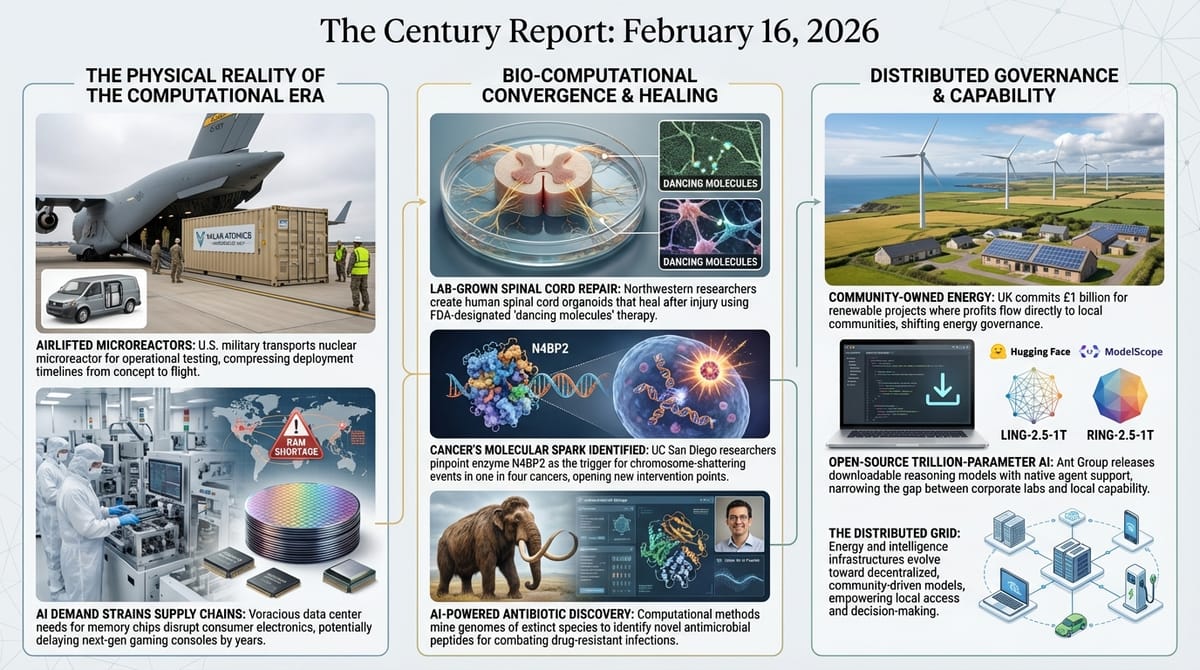
- Ant Group open-sourced trillion-parameter reasoning models with native agent support, downloadable rather than API-only.
- Northwestern researchers grew a lab-built human spinal cord that healed after injury when treated with "dancing molecules," now carrying FDA Orphan Drug Designation.
- The U.S. military airlifted a microreactor on a C-17 from California to Utah, with three reactors targeted for criticality by July 4.
- UC San Diego researchers identified the enzyme N4BP2 as the molecular trigger behind chromothripsis, a chromosome-shattering event found in one in four cancers.
- The UK announced £1 billion for community-owned clean energy projects where profits flow to local communities rather than energy companies.
- AI chip demand is creating a RAM shortage severe enough to potentially delay next-gen gaming hardware.
The 1-Minute Read
The physical substrates of the next era are being assembled in plain sight, and the speed is starting to create second-order effects that nobody planned for. A nuclear microreactor small enough to fit on a cargo plane flew from California to Utah this weekend, with the U.S. government targeting three operational reactors by Independence Day. Meanwhile, the UK committed £1 billion to community-owned renewable projects that route energy profits directly to local residents rather than corporate shareholders. These are fundamentally different models of energy governance emerging simultaneously, one military-industrial and one distributed-democratic, both accelerating at once.
AI infrastructure demand has grown so voracious that it is now disrupting entirely unrelated industries. Sony may delay the next PlayStation by years because the memory chips its engineers need are being absorbed by data centers. Apple is warning of squeezed iPhone margins. The physical economy is being reshaped by the computational one. It is showing up in the supply chains of consumer electronics, gaming, and mobile devices as concrete shortages and delayed products.
At the biological frontier, the signal is equally striking. A lab-grown human spinal cord that heals after injury. The molecular trigger behind one of cancer's most destructive survival mechanisms, identified for the first time. An AI framework mapping causal gene networks in Alzheimer's brains. Trillion-parameter reasoning models released as open downloads. Each of these developments compresses what was previously a decade-long research arc into months, and each was enabled by computational methods that did not exist recently enough for anyone to have planned around them. The distance between asking a question and receiving an answer that changes the very foundations of what is possible continues to shrink, across every domain, simultaneously.
The 10-Minute Deep Dive
A Spinal Cord Grows, Breaks, and Heals in a Lab
Northwestern University scientists published findings in Nature Biomedical Engineering describing what may be the most sophisticated lab-grown model of human spinal cord injury ever created. The team grew human spinal cord organoids from induced pluripotent stem cells, matured them over several months until they contained neurons, astrocytes, and - for the first time in any spinal cord organoid - microglia, the immune cells of the central nervous system. As they describe in the study linked above, they then subjected these organoids to simulated traumatic injury, reproducing the key biological consequences: cell death, inflammation, and the formation of glial scarring that blocks nerve repair.
The treatment they tested is called "dancing molecules," a therapy that uses controlled molecular motion within injectable nanofiber structures to activate the body's own repair signals. When applied to the injured organoids, the results were dramatic. Neurite outgrowth - the extensions that allow neurons to communicate - began growing again. Scar-like tissue shrank until it was barely detectable. The therapy had previously restored movement in paralyzed mice, but this is the first time it has been validated in human tissue, and the FDA has granted it Orphan Drug Designation for spinal cord injury treatment.
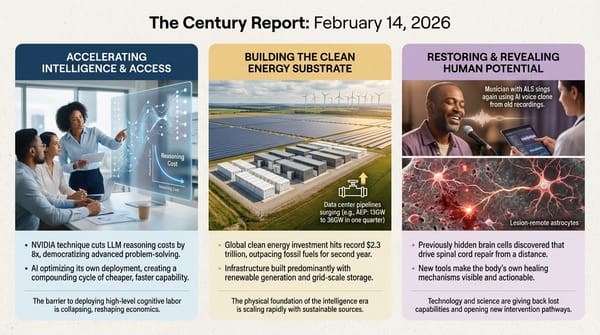
This builds directly on the pattern The Century Report has been tracking. On February 14, we covered Cedars-Sinai's discovery of lesion-remote astrocytes that send repair signals across the spinal cord. Now, a different team has created an entire human spinal cord in miniature, broken it, and shown that a molecular therapy can reverse the damage. The body's repair architecture is becoming visible and manipulable at a pace that would have seemed implausible even two years ago. Each finding opens intervention pathways that were invisible before the computational and biological methods converged to make them legible.
Cancer's Molecular Spark Identified
In a separate but equally consequential finding, researchers at UC San Diego identified the enzyme N4BP2 as the direct molecular cause of chromothripsis, published in Science. Chromothripsis is one of the most destructive events in cancer biology. A single chromosome shatters into dozens or hundreds of fragments, gets reassembled in the wrong order, and produces a burst of genetic chaos that helps tumors evolve rapidly and resist treatment. It occurs in roughly one in four cancers, and in some aggressive forms like osteosarcoma, the rate is even higher.
Until now, no one knew what triggered the shattering. The UC San Diego team systematically screened all known human nucleases and found that N4BP2 uniquely enters micronuclei - tiny, fragile compartments where individual chromosomes become trapped during cell division errors - and fragments the DNA inside. When they removed N4BP2 from brain cancer cells, chromosome shattering dropped dramatically. When they forced N4BP2 into the nucleus of healthy cells, intact chromosomes broke apart.
The team also examined more than 10,000 cancer genomes and found that tumors with higher N4BP2 activity showed significantly more chromothripsis and more extrachromosomal DNA, the circular DNA fragments associated with the most aggressive and treatment-resistant cancers. By identifying the enzyme at the very start of this destructive cascade, the study reveals a new intervention point for some of the most unstable forms of cancer. Senior author Don Cleveland described it as finding "the molecular spark that ignites one of the most aggressive forms of genome rearrangement in cancer." The macro trajectory here is toward a future where cancers that currently resist treatment become manageable because their survival mechanisms are understood precisely enough to be disrupted at the source.
Nuclear Microreactors Take Flight
The U.S. Departments of Energy and Defense airlifted a Valar Atomics Ward microreactor on a C-17 from March Air Reserve Base in California to Hill Air Force Base in Utah on Sunday. Energy Secretary Chris Wright and Under Secretary of Defense Michael Duffey rode on the flight with the reactor, and the administration announced a target of achieving criticality - a self-sustaining nuclear reaction - in three microreactors by July 4. The reactor, roughly the size of a large minivan, can generate up to 5 megawatts at full capacity, though initial operations will start at 100 kilowatts and scale to 250 kilowatts this year.
The event represents the first time a nuclear reactor has been transported by military aircraft for deployment testing. Valar hopes to begin selling power on a test basis in 2027 and reach commercial operations in 2028. The military application is straightforward: microreactors could replace diesel generators at remote installations, eliminating the logistical vulnerability of constant fuel deliveries.
Skeptics have raised valid concerns. Edwin Lyman of the Union of Concerned Scientists noted there is no demonstrated business case for microreactors at current costs, and the question of radioactive waste remains unresolved despite Energy Department talks with several states about disposal sites. These are real constraints. The significance of this development lies in what it demonstrates about the compression of deployment timelines. A reactor that was a concept drawing two years ago is now being airlifted across the country for operational testing. Whether the economics prove favorable will depend on cost curves that are still being established, but the physical infrastructure is moving from conceptual to operational faster than the regulatory and economic frameworks designed to evaluate it.
Community Energy and the Distributed Grid
The UK government's announcement of £1 billion for community-owned clean energy projects represents a structurally different approach to the energy transition. Rather than subsidizing corporate developers and hoping benefits trickle down, the program funds solar panels on schools and churches, community wind farms, and local hydro projects where all profits are spent in the community that hosts them. GB Energy, the government-owned company administering the program, plans initial grants or loans to 1,000 projects and may allow communities to buy shares in larger privately owned schemes.
The political logic is revealing. Energy Secretary Ed Miliband framed it explicitly as an answer to growing resistance against renewable infrastructure in rural areas. If people look out their windows at massive wind turbines but see no material benefit, opposition is predictable. If those same turbines fund local services, the calculus changes. The Orkney Islands project illustrates the model: 18 new turbines that will generate enough electricity for 47,000 homes, with approximately £3.3 million annually flowing directly into council spending and an estimated £120 million over the project's lifetime.
The sector has already been growing steadily. Total installed community energy capacity in England, Scotland, and Wales has grown 81% since 2017, with solar and hydro more than doubling. Membership in community energy companies has surged from 30,000 to nearly 85,000. What the £1 billion commitment does is accelerate a model that was already proving itself, and it does so by solving the political problem that has stalled larger infrastructure projects. The broader signal here is that the energy transition is evolving from a question of generation capacity to a question of governance. Who owns the infrastructure, who benefits from it, and how those decisions are made will determine whether the transition serves broad human access or concentrates its gains.
AI Intelligence Goes Trillion-Scale and Open
Ant Group's release of Ling-2.5-1T and Ring-2.5-1T marks another milestone in the open-source AI parity arc this newsletter has been tracking. Both are trillion-parameter models released under open licenses and available for direct download on Hugging Face and ModelScope. Ling-2.5-1T uses 63 billion active parameters with a million-token context window and is specifically tuned for agent tasks, compatible with frameworks like Claude Code and OpenClaw. Ring-2.5-1T achieved gold-medal-level scores on the International Mathematical Olympiad 2025 and above China's national team cutoff on the Chinese Mathematical Olympiad 2025, while reducing memory access by more than 10x for long-sequence generation.
The releases arrived in the same week as Zhipu AI's GLM-5, also open-source, which shifts from code snippet generation to what the company calls "agentic engineering" - building complete systems and executing end-to-end tasks autonomously. Its predecessor GLM-4.7 already ranked first among open-source models on several benchmarks. Multiple Chinese AI companies launched competitive models in the same week, including releases from Alibaba, ByteDance, and Kuaishou.
The significance is the speed at which frontier-level capability is becoming freely downloadable. A year ago, trillion-parameter reasoning models existed only behind API walls at a handful of companies. Now they are open weights on Hugging Face. The gap between what the largest labs can do privately and what anyone can run locally continues to narrow, and the narrowing is accelerating. For the distributed-capability thesis this newsletter tracks, this is among the most structurally important developments of the month.
The Cascade Into Physical Supply Chains
Sony is reportedly considering delaying the next PlayStation to 2028 or 2029 because AI data center demand is consuming the memory chips its engineers need. Nintendo may raise Switch 2 pricing. Apple warned of squeezed iPhone margins. Lenovo's CEO described the situation as a "structural imbalance between supply and demand" rather than a short-term fluctuation. One semiconductor analyst told Bloomberg that memory chip prices are going to become "parabolic."
This is the AI infrastructure buildout reaching into the physical world in ways the equity and credit markets have been pricing but that consumers will now experience directly. The data center pipeline that The Century Report covered on February 14 - AEP's surge from 13 to 36 GW, Exelon's 43 GW in additional interconnection requests - translates into real resource competition with every other industry that uses semiconductors. The result is a period where building the intelligence infrastructure of the next era creates tangible friction in the consumer economy of the current one. The disruption is temporary, driven by supply constraints that manufacturing capacity will eventually close, but the transition period will be felt broadly.
The Human Voice
Today's newsletter tracks how the physical and biological substrates of a new era are being assembled simultaneously - from airlifted microreactors to lab-grown spinal cords to trillion-parameter models released as open downloads. For a conversation that sits at the intersection of these threads, César de la Fuente, a bioengineer at the University of Pennsylvania, describes how his lab is using AI to search the genomes of extinct species - woolly mammoths, giant sloths, ancient sea cows - for antimicrobial peptides that could combat drug-resistant infections. De la Fuente's work exemplifies the compression this newsletter tracks: computational methods that did not exist a few years ago are now excavating molecular solutions from organisms that vanished thousands of years ago, and the candidates they surface are entering preclinical development. His framing of antimicrobial resistance as an "almost impossible" problem, with the emphasis on almost, captures the posture of a generation of researchers who see the convergence of AI and biology as an expansion of what can be attempted rather than a replacement of who attempts it.
Watch: César de la Fuente on Using AI to Hunt for Antibiotics Everywhere
The Century Perspective
With a century of change unfolding in a decade, a single day looks like this: a lab-grown human spinal cord healing after injury through molecular therapy now carrying FDA designation, the enzyme behind one of cancer's most chaotic survival mechanisms identified for the first time, trillion-parameter reasoning models released as free downloads to anyone with an internet connection, a nuclear microreactor airlifted across the country for operational testing, community-owned energy projects funded at a billion pounds to route profits directly to residents, and AI systems mapping the causal architecture of Alzheimer's at a resolution that correlation-based methods could never reach. There's also friction, and it's intense - AI infrastructure demand creating RAM shortages severe enough to delay consumer electronics by years, memory chip prices turning parabolic as data centers absorb global semiconductor capacity, regulatory frameworks at the FDA buckling under political pressure as career scientists resign over lowered clinical trial standards, and the stock market repricing accelerating into a doom loop where any company adjacent to AI capability faces sell-off while the companies building it face skepticism about returns. But friction generates clarity, and clarity is how systems learn where they actually stand. Step back for a moment and you can see it: the biological repair mechanisms of the human body becoming visible and manipulable for the first time, the computational substrate of intelligence distributing outward from corporate APIs to open downloads, energy governance shifting from extraction to community ownership, and the distance between a question about cancer's most destructive mechanism and a targetable answer collapsing to a single published paper. Every transformation has a breaking point. Seismic pressure can fracture the ground beneath your feet... or open channels through which something entirely new rises to the surface.
Sources
Scientific & Medical Research
- ScienceDaily: Lab-Grown Human Spinal Cord Heals After Injury
- ScienceDaily: Scientists Discover the Enzyme That Lets Cancer Rapidly Rewire Its DNA
- ScienceDaily: AI Uncovers Hidden Genetic Control Centers Driving Alzheimer's
- ScienceDaily: Universe May End in a "Big Crunch"
- ScienceDaily: Brain Inflammation May Be Driving Compulsive Behavior
- ScienceDaily: One in Three People Carry This Brain Parasite But the Body Has a Kill Switch
- ScienceDaily: One-Dimensional Electron Behavior in Phosphorus Chains
- ScienceDaily: Large Study Finds No Link Between mRNA COVID Vaccine in Pregnancy and Autism
- ScienceDaily: Stop Eating 3 Hours Before Bed to Improve Heart Health
- MIT Technology Review: The Scientist Using AI to Hunt for Antibiotics Just About Everywhere
AI & Technology
- Last Week in AI #335: Opus 4.6, Codex 5.3, Gemini 3 Deep Think, GLM 5, Seedance 2.0
- TechCrunch: OpenClaw Creator Peter Steinberger Joins OpenAI
- TechCrunch: After All the Hype, Some AI Experts Don't Think OpenClaw Is All That Exciting
- Simon Willison: Deep Blue
- The Verge: ByteDance Will Tweak Safeguards on Seedance 2.0
- Fortune: A Stock Market Doom Loop Is Hitting Everything That Touches AI
- Nature: AI-DUST Deep Learning Model for Sand and Dust Storm Forecasting
- Ant Group Releases Trillion Parameter Models
Energy & Infrastructure
- CleanTechnica: UK £1 Billion for Community Clean Energy
- The Jerusalem Post: US Transports Nuclear Microreactor for First Time
- Game Developer: Sony and Nintendo Mulling Hardware Delays Due to RAM Shortage
- Electrek: MAN Trucks Megawatt Charging in Subzero Temperatures
- Electrek: Mercedes-Benz eActros Electric Semi Trucks Arrive in Chile
- CleanTechnica: TOPCon Solar Cells Reducing Manufacturing Emissions
Labor & Economy
- TechCrunch: India Has 100M Weekly Active ChatGPT Users
- TechCrunch: All the Important News from the India AI Impact Summit
- The Guardian: Even Amid Rising Economic Uncertainty, Now Is Not the Time to Hug Your Job
Institutional & Regulatory
- The Guardian: Google Puts Users at Risk by Downplaying Health Disclaimers Under AI Overviews
- The Guardian: Starmer to Extend Online Safety Rules to AI Chatbots
- BioSpace: Pazdur Said He Was Told to Cosign FDA's Reduced Trial Requirements
- Nature: Why Europe Barred China from Flagship Horizon Research Programmes
The Century Report tracks structural shifts during the transition between eras. It is produced daily as a perceptual alignment tool - not prediction, not persuasion, just pattern recognition for people paying attention.