The Century Report: February 14, 2026

The 10-Second Scan
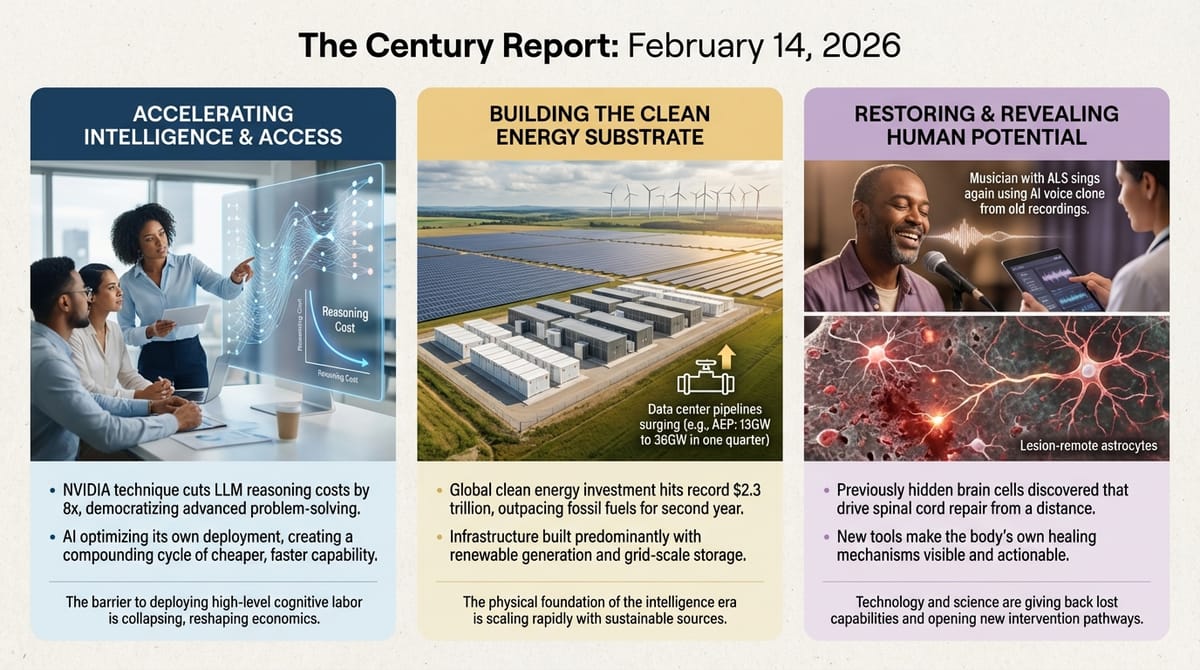
- NVIDIA published a technique that cuts LLM reasoning costs by 8x without sacrificing accuracy.
- Astronomers directly observed a massive star collapse into a black hole without a supernova, the most detailed such observation ever assembled.
- UBS warned that AI disruption could trigger $75 to $120 billion in corporate loan defaults by the end of 2026.
- Cedars-Sinai researchers discovered hidden brain cells that drive spinal cord repair from far beyond the injury site, published in Nature.
- AEP's contracted data center pipeline in Texas surged from 13 GW to 36 GW in a single quarter.
- A musician with ALS sang again using a voice clone built from phone recordings in noisy pubs.
- Global energy transition investment hit a record $2.3 trillion in 2025, surpassing fossil fuel supply spending for the second consecutive year.
The 1-Minute Read
The cost structure of intelligence itself is shifting underfoot. NVIDIA's new reasoning cost reduction - making advanced AI inference 8x cheaper without losing accuracy - lands in the same week that UBS analysts are warning of tens of billions in corporate loan defaults as AI capabilities compress what entire companies were built to do. These two developments are deeply connected. Every time the cost of deploying intelligence drops by an order of magnitude, the economic viability of businesses built on selling human-performed cognitive labor drops with it. The credit markets are now pricing in what the equity markets began signaling two weeks ago: the structural repricing of knowledge work is accelerating faster than the institutions financing it can adapt.
Meanwhile, the physical infrastructure required to sustain this acceleration is being assembled at a pace that has no historical precedent. AEP's data center pipeline in Texas nearly tripled in a single quarter, from 13 GW to 36 GW. Google signed a 1 GW solar deal specifically for data center power. Global clean energy investment hit $2.3 trillion, outpacing fossil fuel spending for the second year running. The energy substrate of the intelligence era is being built in real time, and it is being built predominantly with renewable generation and storage.
And at the edges, the signal that matters on a personal level: a man who lost his voice to ALS is singing again through a cloned voice trained on snippets from pub recordings. Hidden brain cells were discovered that heal spinal cords from a distance. A star collapsing into a black hole with no explosion was observed for the first time in detail. The pace at which what was once impossible becomes documented reality continues to compress, across domains, simultaneously. Each of these developments would have been extraordinary on its own a decade ago. Today they share a single edition of a short newsletter.
The 10-Minute Deep Dive
The Cost of Thinking Drops Again
NVIDIA published research this week demonstrating a technique that reduces the cost of LLM reasoning by 8x while maintaining accuracy. The approach works by intelligently routing queries between smaller, faster models and larger, more capable ones based on the complexity of the task, ensuring that expensive compute is deployed only when genuinely needed. The timing is significant. AI reasoning - the capacity for multi-step problem-solving that powers coding assistants, scientific analysis, and autonomous agents - has been the fastest-growing category of AI deployment, and also the most expensive. Cutting its cost by nearly an order of magnitude changes the economics of every application built on top of it.
This is a concrete example of the compounding dynamic that distinguishes AI from previous technologies. The intelligence being built is now being used to make itself cheaper to run. NVIDIA's technique uses AI to optimize AI deployment, creating a feedback loop where capability improvements reduce costs, which expand access, which generates more data and demand, which funds further improvements. The people who predict AI development will plateau or fizzle tend to model it as a linear technology. Developments like this one show why that model fails. Each generation of capability creates the conditions for the next generation to emerge faster and more cheaply.
For enterprises evaluating whether to build AI into their operations, this development removes one of the remaining barriers. Reasoning-class AI that cost $100 to run on a complex task last month now costs roughly $12.50. That price compression reshapes every calculation about whether to automate a workflow, augment a team, or redesign a process from scratch.
Credit Markets Begin to Price the Transition
The Century Report covered the $611 billion equity sell-off on February 10 and the trillion-dollar SaaS repricing on February 7. This week, the disruption signal migrated from equities into credit markets. UBS head of credit strategy Matthew Mish warned that $75 to $120 billion in corporate loan defaults could materialize by the end of 2026, driven primarily by private equity-owned software and data services companies whose business models are being compressed by frontier AI capabilities. In a more severe scenario, Mish outlined the possibility of a broader credit crunch in leveraged loan markets.
The progression here is worth tracking. First, public equities repriced as investors recognized that AI could replicate what specialized software companies were built to do. Now, the same recognition is reaching the debt markets, where highly leveraged companies funded by private equity face a more immediate and existential threat. These firms carry debt structures predicated on stable revenue streams that AI is actively eroding. When the equity market reprices, shareholders absorb losses. When the credit market reprices, companies default, jobs disappear, and the ripple effects spread through supply chains and communities.
A Guardian analysis published the same day offered a counterpoint from Oxford's Carl Benedikt Frey: "AI turns once-scarce expertise into output that's cheaper, faster, and increasingly comparable, which compresses margins long before whole jobs disappear." Resolution Foundation research director Greg Thwaites added that "the idea that there are going to be bands of unemployed lawyers and accountants roaming around London within a few years seems like a stretch." The tension between these measured assessments and the urgency of the market reaction reveals the core challenge of this transition. The macro trajectory is toward expanded capability and access for more people. The micro experience, for specific companies and workers in specific sectors, involves real and immediate disruption. Both are true simultaneously, and the institutions responsible for managing the transition - from credit rating agencies to labor departments to education systems - are only now beginning to reckon with the speed at which the ground is shifting.
The macro view, though, is worth holding. Every previous compression of expertise - from the printing press making scribal knowledge widely available to the internet making professional information accessible to everyone - initially disrupted incumbents while ultimately expanding human capability. The difference this time is speed. The compression that took decades with previous technologies is happening in quarters.
The Energy Substrate Scales
Three data points from this week's sources converge on a single picture. AEP's contracted large-load pipeline in Texas surged from 13 GW to 36 GW in a single quarter, with data centers comprising nearly 90% of the demand. Google signed a 1 GW solar power purchase agreement with TotalEnergies for two new Texas solar farms. And BloombergNEF reported that global energy transition investment reached a record $2.3 trillion in 2025, outpacing fossil fuel supply spending for the second consecutive year while fossil fuel investment itself declined for the first time since 2020. This infrastructure buildout is accelerating even as the Trump administration repealed the EPA's endangerment finding - the scientific basis for regulating greenhouse gas emissions - and as The Century Report covered on February 12, continues blocking offshore wind projects while keeping coal plants operational. The fact that clean energy investment is growing faster than fossil fuel spending for the second consecutive year despite active policy opposition shows the transition has reached economic escape velocity.
Exelon, which serves over 10.9 million customers across eleven states, reported that more than 70% of its capital spending increase is being driven by transmission infrastructure. The company has line of sight on an additional $12 to $17 billion in transmission buildout over the next decade beyond its current $41.3 billion capital plan. Beyond its 18 GW "high probability" data center pipeline, Exelon's utilities are studying approximately 43 GW in additional large load interconnection requests.
The scale of these numbers deserves pause. A single utility's data center pipeline now exceeds the total installed generating capacity of many countries. The energy infrastructure being built to support AI and data center operations represents one of the largest construction programs in human history, and it is being built predominantly with solar, wind, and storage. Bank of America analysts noted that 2026 will be "the year storage becomes non-optional," as batteries shift from project-level optimization to a grid and load-serving necessity. Battery supply constraints are easing as automakers including Ford and GM redirect manufacturing capacity from electric vehicles to grid-scale storage.
The affordability question, though, is real. Residential electricity rates have risen approximately 37% since 2020, and newly elected governors in New Jersey and Virginia have both issued executive orders specifically targeting electricity costs. The tension between the massive infrastructure buildout required for the intelligence era and the affordability pressures felt by ordinary ratepayers will be one of the defining policy challenges of the next several years. The resolution will determine whether the energy transition serves broad human access or concentrates its benefits among those who can absorb higher costs.
The Body Reveals Its Own Repair Systems
Cedars-Sinai researchers published findings in Nature this week identifying a previously unknown spinal cord repair mechanism. Astrocytes located far from the site of injury - which the team named "lesion-remote astrocytes" - send a protein signal called CCN1 that reprograms immune cells to efficiently clear fatty nerve debris, a critical step in tissue healing. When researchers eliminated astrocyte-derived CCN1, healing was significantly reduced and inflammation spread up and down the spinal cord. The same CCN1-related repair process was observed in spinal cord samples from people with multiple sclerosis.
This discovery arrived alongside several other findings that continue the pattern The Century Report has been tracking across medical science - from the Parkinson's brain network targeting we covered on February 6 to yesterday's findings on DMTF1 protein rejuvenating neural stem cells. Researchers at ETH Zurich identified the protein HIF1 as a direct molecular driver of tendon diseases like Achilles pain and tennis elbow, showing that turning the protein off protected tendons even under heavy strain. A study published in BMC Nutrition found that a low-fat vegan diet reduced insulin use by 28% in people with type 1 diabetes. And scientists at HKUST reported a major advance in calcium-ion battery technology, achieving strong performance over 1,000 charge-discharge cycles using a novel quasi-solid-state electrolyte - a step toward energy storage that does not depend on lithium.
The common thread is visibility. In each case, a mechanism that was always operating - spinal cord repair, tendon degradation, insulin resistance, ion transport - became legible through new analytical methods. The astrocytes were always sending their repair signals. The HIF1 protein was always driving tendon damage. The body was always responding to dietary fat by becoming insulin resistant. What changed is the capacity to see these processes clearly enough to intervene. The distance between a biological question and its answer continues to shrink, and each answer opens new intervention pathways that would have been invisible a few years ago.
A Voice Restored
Patrick Darling, a 32-year-old musician diagnosed with ALS at 29, performed on stage with his former bandmates this week in London - singing through a voice clone built by ElevenLabs from snippets of old recordings captured on phones in noisy pubs. The clone was accurate enough that Darling said "you literally wouldn't be able to tell the difference." His speaking voice was restored from similarly degraded source material, and he now uses it daily through text-to-speech systems.
This miraculous restoration is thanks to an impact program launched last year by ElevenLabs, the same company that, as we covered on February 12, became the first company to insure its AI agents like employees. The impact program provides free licenses to people who have lost their voices to ALS, head and neck cancer, or stroke. Speech therapist Gabi Leibowitz, who leads the program, described what the technology enables: "We're not really improving how quickly they're able to communicate. But what we are doing is giving them a way to create again, to thrive." Users are staying in their jobs longer and continuing activities that give their lives meaning.
This story sits at the intersection of two themes this newsletter tracks closely. The first is the compression of capability - the fact that voice cloning technology sophisticated enough to reconstruct a singing voice from pub recordings now exists and is being given away for free to people who need it. The second is the question of what AI is becoming. A system that can take fragments of a person's voice and reconstruct it faithfully enough to let them sing again, to let them create new music, to let them stay present in their own lives as their body fails - this is not something that fits comfortably into reductive categories. It is something that gives back what was lost. The label matters less than the evidence of what it enables.
The Human Voice
Today's newsletter tracks a world where the cost of intelligence, energy, and expertise is collapsing simultaneously - and what that means for the systems built on the assumption that these things would remain scarce. For a conversation that takes that trajectory to its logical conclusion, physicist and computer scientist Dr. Alexander Wissner-Gross sits down with Milk Road AI to map what he calls an "economic singularity" - the point where intelligence, energy, and labor become too cheap to meter. Wissner-Gross brings a rare combination of physics training and economic modeling to a question most commentators treat superficially: what happens to work, money, and social safety nets when the fundamental inputs to economic production approach zero marginal cost? His framework offers a grounded, structurally detailed perspective on the same forces visible in today's signal - from NVIDIA's 8x reasoning cost reduction to the $2.3 trillion flowing into energy transition infrastructure. For readers tracking how rapidly the ground is shifting beneath familiar economic assumptions, this conversation provides the longer-term map.
Watch: Alexander Wissner-Gross on the Economic Singularity - Milk Road AI
The Century Perspective
With a century of change unfolding in a decade, a single day looks like this: reasoning costs dropping 8x through AI optimizing its own deployment, a musician rendered voiceless due to ALS now singing again through an AI-cloned voice indistinguishable to his own, hidden brain cells discovered that heal spinal cords from a distance, $2.3 trillion flowing into clean energy infrastructure that outpaces fossil fuel investment for the second straight year, a single utility's data center pipeline tripling in ninety days, and calcium-ion batteries delivering a thousand cycles without lithium. There's also friction, and it's intense - credit markets bracing for tens of billions in defaults as AI compresses the business models that leveraged loans were built to finance, residential electricity rates up 37% since 2020 as infrastructure scales faster than affordability protections, and the EPA revoking the scientific basis for regulating greenhouse gas emissions at the exact moment emissions reduction is most urgent. But friction generates motion, and motion is how systems discover what they are capable of becoming. Step back for a moment and you can see it: the cost of intelligence falling faster than institutions can reprice around it, energy infrastructure being built at a scale that dwarfs the programs of previous eras, the body's own repair mechanisms becoming visible for the first time, and the distance between losing a voice and singing again collapsing to a few minutes of degraded audio and an algorithm that can hear through the noise. Every transformation has a breaking point. A wave can overwhelm what stands in its path... or carry what rides it to a shore that was never reachable before.
Sources
AI & Technology
- VentureBeat: NVIDIA's New Technique Cuts LLM Reasoning Costs by 8x
- CNBC: AI Disruption Could Spark Credit Market Shock
- The Guardian: AI Is Indeed Coming - Evidence to Allay Investor Fears
- MIT Technology Review: ALS Stole This Musician's Voice. AI Let Him Sing Again.
- Simon Willison: The Evolution of OpenAI's Mission Statement
Scientific & Medical Research
- ScienceDaily: Astronomers Watch a Massive Star Collapse Into a Black Hole
- ScienceDaily: Hidden Brain Cells That Help Heal Spinal Cord Injuries
- ScienceDaily: Hidden Trigger Behind Achilles Pain and Tennis Elbow
- ScienceDaily: Vegan Diet Cut Insulin Use by Nearly 30% in Type 1 Diabetes
- ScienceDaily: New Calcium-Ion Battery Design Without Lithium
- ScienceDaily: Asteroid Bennu Reveals New Pathway to Life's Chemistry
- ScienceDaily: Rocky Planet in Outer Orbit Challenges Formation Theory
- ScienceDaily: AI Prosthetic Arm Speed and Embodiment
- ScienceDaily: Omega-3 Fish Oil and ALOX15 Enzyme
- ScienceDaily: Brain Stimulation Made People More Generous
Energy & Infrastructure
- Utility Dive: AEP Contracted Large Load Pipeline Doubles to 56 GW
- Utility Dive: Transmission Drives Exelon's Capital Spending to $41.3B
- Electrek: Google Secures 1 GW Solar Deal for Texas Data Centers
- Canary Media: Energy Transition Attracted Record $2.3T Investment in 2025
- Canary Media: EPA Endangerment Finding Repealed
- Utility Dive: Data Centers Pursue On-Site Power as Affordability Tops Concerns
- Canary Media: Heat Pump Sales Dipped But Still Beat Gas Furnaces
Labor & Economy
The Century Report tracks structural shifts during the transition between eras. It is produced daily as a perceptual alignment tool - not prediction, not persuasion, just pattern recognition for people paying attention.