The Century Report: February 11, 2026

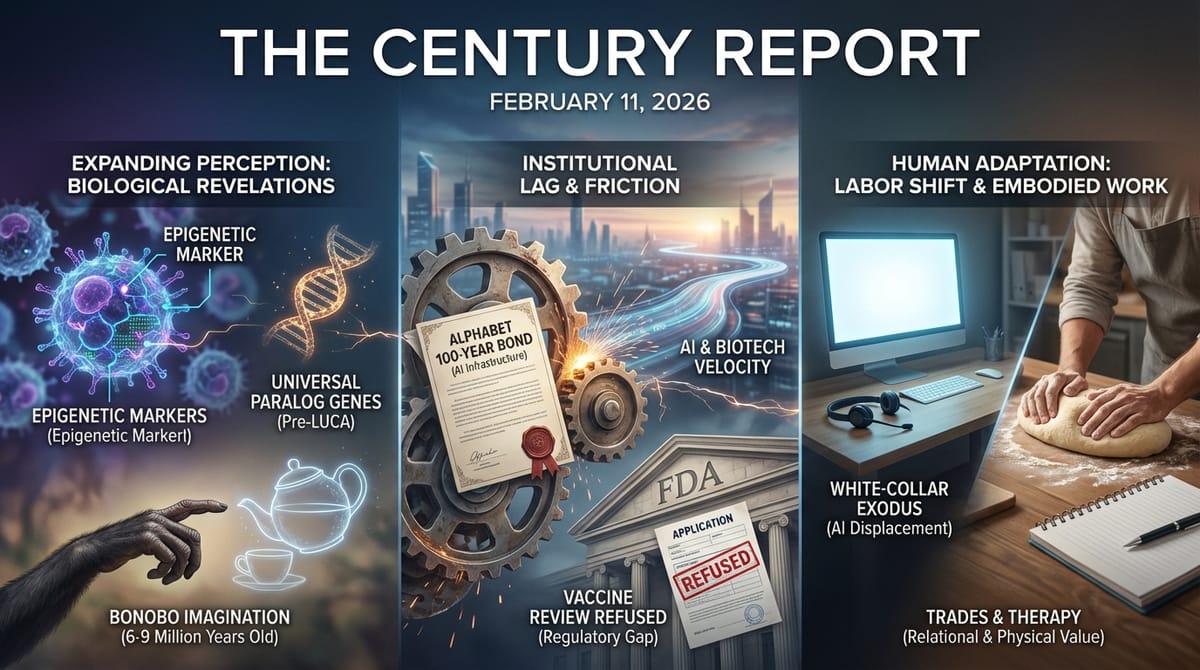
The 10-Second Scan
- The FDA refused to review Moderna's application for the first mRNA flu vaccine.
- White-collar workers are leaving their careers for trades and therapy degrees.
- With AI assistance, scientists have identified rare “universal paralog” genes that duplicated even before the last universal common ancestor.
- Half of xAI's twelve founding members have now departed the company, with two leaving in a single 24-hour span.
- Salk Institute scientists created the first epigenetic atlas of human immune cells, revealing how infections, vaccines, and chemical exposures leave molecular fingerprints that shape each person's immune response.
- A bonobo named Kanzi tracked imaginary objects during pretend tea parties in controlled experiments, providing the first evidence that imagination may not be unique to humans.
- Alphabet is selling 100-year bonds - the first century bond from a tech company in nearly three decades - to finance AI infrastructure that won't fully mature for decades.
The 1-Minute Read
Today's headlines trace a single underlying pattern: the capacity to perceive what was previously invisible is expanding faster than the systems built to act on that perception can keep up. An epigenetic atlas now reads the molecular autobiography each immune system has been writing since birth. Ancient genes that predate all known life are surfacing through new computational analysis. A bonobo's pretend tea party has pushed the timeline for imagination back millions of years. In each case, the information was always there - encoded in cells, in genomes, in behavior - waiting for analytical methods sharp enough to make it legible.
The institutional side of this expansion is where the friction lives. The FDA declined to review a vaccine that cleared clinical trials and is already under regulatory consideration on three other continents. A massive Swedish study reveals that autism diagnoses in women have been systematically delayed for decades, with the supposed 4:1 male-to-female ratio dissolving by adulthood. The knowledge exists. The diagnostic frameworks and regulatory processes have not yet caught up to it. This gap between what we can now see and what our institutions are structured to act on is the defining tension of the current moment - and it shows up everywhere, from medicine to labor markets to AI governance.
Meanwhile, the human response to that tension is already underway. Writers are retraining as therapists. Editors are becoming bakers. Half of a leading AI lab's founding team has departed. And Alphabet is issuing hundred-year bonds - the longest time horizon a corporation can express in financial language - to build infrastructure whose full shape remains undefined. People and institutions alike are making bets, some with their careers and some with century-scale capital, on a future that is arriving faster than any existing framework was designed to process. The common thread is not disruption for its own sake, but the compression of the distance between what exists and what we can know about it, playing out simultaneously across biology, labor, governance, and infrastructure.
The 10-Minute Deep Dive
The FDA Decision and the Governance of What Comes Next
The FDA's refusal to review Moderna's mRNA flu vaccine application landed like a quiet shockwave on Monday. The vaccine had completed clinical trials, showed stronger antibody responses than existing shots, and raised no safety concerns. Moderna designed the trial in consultation with the FDA's Center for Biologics Evaluation and Research. The application is already under review in the European Union, Canada, and Australia.
The refusal came in a letter signed by CBER director Vinay Prasad, who argued that Moderna's comparator - standard flu shots for adults under 65 - did not reflect "the best-available standard of care." Moderna pointed out that high-dose flu vaccines are not standard of care for that age group, making the comparison appropriate. The company said it was "blindsided" by the decision and has requested a meeting. As UC Law San Francisco professor Dorit Reiss noted, the move "is likely to discourage industry from investing in future influenza vaccines, and makes working with the US FDA uncertain and problematic."
What makes this story structurally significant, beyond the immediate policy implications, is what it reveals about the lag between institutional governance and emerging capability. mRNA technology represents a fundamentally more adaptable approach to vaccine development - faster to update, more responsive to viral evolution, and potentially more effective across age groups. The technology itself is ready. The institutional framework for evaluating it is caught between the previous era's standards and the current one's realities. The same pattern is playing out across medicine, energy regulation, and AI governance: new capabilities arriving faster than the institutions designed to assess them can adapt their own processes. The question now is whether that adaptation happens through reform or through the kind of institutional drift that leaves populations without access to what the science has already made possible.
The Labor Migration That Cannot Be Reversed
The Guardian published a deeply reported feature this week on white-collar workers leaving their careers because AI has made them economically unviable. Jacqueline Bowman, a California freelance writer, watched her income collapse as clients replaced her with AI-generated content or asked her to edit AI output at half her previous rate - work that took twice as long. She is now studying to become a marriage and family therapist. Janet Feenstra, a 52-year-old academic editor in Sweden, retrained as a baker after watching AI close in on her specialty of language editing for research journals. She earns less, commutes farther, and does more physically demanding work.
It may be tempting to dismiss such moves as a failure to adapt to adapt, but these may instead be moves by people who adapted precisely because they read the situation clearly. Bowman's reasoning is worth quoting directly: she chose therapy partly because "AI took my job, AI ruined my life. I'm not going to go to an AI therapist." She is betting on a demand for human presence that will outlast the current wave of automation. Feenstra chose baking because she "didn't want to wait until it was too late."
The Century Report has tracked the macro data on this transition since its first edition - 108,000 January layoffs, professional services openings cratering 21.8%, AI explicitly cited in a growing share of cuts. What these individual stories add is the texture of lived experience inside those numbers. The transition is real, it is happening now, and it is pushing people toward work that is more embodied, more relational, and more resistant to automation. That movement carries genuine loss - Bowman did not want to stop writing, Feenstra did not want to leave editing - but it also reveals something about where human value concentrates when machine capability expands. The roles people are moving toward - therapy, physical craft, caregiving - are precisely the ones where human presence is irreducible. The labor market is not just contracting in some areas and expanding in others. It is restructuring around a new understanding of what requires a human being.
xAI's Exodus and the Fragility of Concentrated Ambition
Six of xAI's twelve co-founders have now left the company. Tony Wu and Jimmy Ba departed within twenty-four hours of each other this week, joining Kyle Kosic (who left for OpenAI in mid-2024), Christian Szegedy (February 2025), Igor Babuschkin (August 2025), and Greg Yang (January 2026). The departures have all been described as amicable, and the timing makes financial sense - with a SpaceX-xAI IPO targeting a $1.5 trillion valuation as soon as this summer, everyone involved stands to do very well on their way out.
But the pattern is worth watching for what it says about the organizational dynamics of AI development at scale. At an all-hands meeting Tuesday night, Musk told employees that xAI needs a lunar manufacturing facility to build AI satellites and launch them into space via catapult. He did not address how this would be built or how the newly merged xAI-SpaceX entity would be reorganized for its pending IPO. "If you're moving faster than anyone else in any given technology arena, you will be the leader," he told staff, adding that "some people are better suited for the early stages of a company and less suited for the later stages."
Meanwhile, Grok continues to face criticism over bizarre behavior, apparent internal tampering, and the generation of sexualized images of minors that has triggered investigations by California's attorney general and a police raid of xAI's Paris offices. The gap between the rhetoric of cosmic ambition and the reality of product quality, talent retention, and governance represents a microcosm of a broader tension in AI development: the distance between what leaders say they are building and what their organizations can actually sustain.
Science Reads the Body's Hidden Records
Several publications this week revealed how much more information biological systems carry than previous methods could detect, and how new analytical approaches are making that information legible for the first time.
At the Salk Institute, researchers created the first comprehensive epigenetic atlas of human immune cells, published January 27 in Nature Genetics. By analyzing blood samples from 110 people with diverse backgrounds and exposure histories - including flu, HIV, SARS-CoV-2, anthrax vaccination, and organophosphate pesticide exposure - the team mapped how both inherited genetics and life experiences leave distinct molecular fingerprints on four major immune cell types. The key finding is that these two sources of variation operate in fundamentally different ways: genetic influences tend to appear near stable gene regions in long-lived T and B cells, while experience-driven changes concentrate in flexible regulatory regions that control rapid immune responses. Senior author Joseph Ecker described the implications directly: "By resolving these effects cell by cell, we can begin to connect genetic and epigenetic risk factors to the specific immune cells where disease actually begins." This is the foundation for genuinely personalized immune medicine - treatments calibrated not just to a person's genome but to the accumulated record of everything their immune system has encountered.
In a separate study published in Science, Johns Hopkins researchers demonstrated that a bonobo named Kanzi could track imaginary objects during controlled pretend tea party experiments. Across three experiments, Kanzi consistently pointed to the correct locations of pretend juice and grapes, while reliably choosing real food when given the option. The findings push the estimated evolutionary origins of imaginative cognition back 6 to 9 million years, to a shared ancestor of humans and modern apes. Co-author Christopher Krupenye framed the significance: "Imagination has long been seen as a critical element of what it is to be human but the idea that it may not be exclusive to our species is really transformative."
A third study, published in Cell Genomics, identified genes that existed before the last universal common ancestor of all life on Earth - approximately four billion years ago. By analyzing "universal paralogs," gene families that appear in at least two copies across nearly all living organisms, researchers from Oberlin College, MIT, and the University of Wisconsin-Madison found that protein production and membrane transport were among the first biological functions to evolve. New AI-based analytical techniques are making it possible to extract information from these ancient genetic patterns that was previously inaccessible.
And a massive Swedish study tracking 2.7 million individuals, published in The BMJ, found that while boys are diagnosed with autism more often in childhood, girls steadily catch up during adolescence. By age twenty, the ratio approaches 1:1. The study's authors concluded that the longstanding 4:1 male-to-female ratio "may no longer be distinguishable by adulthood" and called for investigation into why female individuals receive diagnoses so much later. Patient advocate Anne Cary warned that while autistic women wait for accurate diagnosis, "they are likely to be (mis)diagnosed with psychiatric conditions."
Each of these findings shares a common structure: information that was always present in biological systems but invisible to previous methods is becoming readable through better analytical approaches. The immune system was always carrying a molecular diary. Ape cognition always included some form of imagination. Pre-cellular genes always contained information about the earliest functions of life. Autism always affected women at higher rates than diagnostic practices recognized. What has changed is our ability to see what was already there. This is the deeper pattern beneath the headlines - the expansion of perception itself, enabled by computational and analytical methods that keep compressing the distance between what exists and what we can know about it.
The Hundred-Year Bet
Alphabet's decision to issue 100-year bonds - the first century bond from a tech company since IBM in 1996 - is a structural signal worth noting. The company upsized its dollar bond offering from $15 billion to $20 billion due to strong demand, and is simultaneously tapping sterling and Swiss franc markets to diversify its investor base. The bonds will help fund AI infrastructure spending that Alphabet has projected could reach $185 billion in 2026.
A century bond is a bet that the entity issuing it will still exist and generate value in the year 2126. Life insurance companies and pension funds buy them because they need assets that match their own long-duration obligations. What Alphabet is telling the market is that it expects the infrastructure it is building today to generate returns across a timeline that extends beyond any living person's career. That framing matters because it shifts the conversation about AI infrastructure spending away from quarterly earnings and toward the kind of generational buildout that characterized previous transitions - railroads, electrification, telecommunications. The infrastructure being assembled now is not being optimized for next quarter's revenue, but instead is being built to last, and the capital markets are pricing it accordingly.
The Human Voice
This week’s The Human Voice comes from New Delhi, where a roomful of diplomats, researchers, and practitioners sat down under the banner “2026: India’s Tryst with AI.” Hosted by the Indian Council of World Affairs, the panel was chaired by Ambassador Rakesh Sood and brought together AI scientist Mihir Kulkarni (Wadhwani AI), policy and governance expert Joanne D’Cunha (Centre for Communication Governance, NLU Delhi), innovation leader Nikhil Agarwal (IIT Delhi’s FITT), and independent researcher Anulekha Nandi.Right from the opening minutes, the frame is unapologetically structural: AI is described as “rapidly shaping economies, governance structures and global power equations in real time,” with India using its upcoming India AI Impact Summit to highlight “measurable impact” in education, health, and other sectors that touch everyday life. It’s an hour of people wrestling, in plain language, with how to turn AI from abstract power into situated, negotiable infrastructure.
Panel Discussion on ‘2026: India’s Tryst with AI’, 6 February 2026
The Century Perspective
With a century of change unfolding in a decade, a single day looks like this: an epigenetic atlas revealing the molecular diary each immune system has been writing for a lifetime, a bonobo demonstrating that imagination stretches back millions of years before humans claimed it, a Swedish study exposing decades of systematic underdiagnosis of autism in women, genes identified that predate all life on Earth, and a tech company issuing hundred-year bonds to build infrastructure for an intelligence that does not yet fully exist. There's also friction, and it's intense - the FDA refusing to review a vaccine the science supports, writers and editors forced from careers they spent lifetimes building, half a major AI lab's founding team walking out the door, and governance structures across medicine, energy, and technology straining under the weight of capabilities they were never designed to evaluate. But friction generates motion, and motion is what carries a system from one configuration to the next. Step back for a moment and you can see it: perception itself expanding as analytical methods make visible what biology always contained, labor reorganizing around the irreducibly human, institutional frameworks cracking open at the seams where new capability presses hardest, and capital flowing on timelines measured not in quarters but in centuries. Every transformation has a breaking point. A seed can split the stone that contains it... or remain buried in the dark where nothing grows.
Sources
Science & Medical
- The Guardian: FDA Declines to Review Moderna mRNA Flu Vaccine
- Washington Post: FDA Won't Review Moderna's mRNA Flu Vaccine Application
- ScienceDaily: Scientists Discover How Life Experiences Rewrite the Immune System (Nature Genetics)
- ScienceDaily: A Bonobo's Pretend Tea Party Rewrites What We Know About Imagination (Science)
- ScienceDaily: Scientists Find Genes That Existed Before All Life on Earth (Cell Genomics)
- ScienceDaily: Everyone Thought Autism Mostly Affected Boys - This Study Says Otherwise (BMJ)
- ScienceDaily: When Immune Cells Stop Fighting Cancer and Start Helping It (Cancer Cell)
- ScienceDaily: Depression May Be the Brain's Early Warning Sign of Parkinson's or Dementia
- ScienceDaily: Methane Spiked After 2020 and the Cause Was Unexpected (Science)
- Nature: What Drugs Are Safe During Pregnancy? A Shocking Lack of Data
AI & Technology
- TechCrunch: Half of xAI's Founding Team Has Now Left the Company
- TechCrunch: With Co-Founders Leaving, Musk Turns Talk to the Moon
- Ars Technica: Yet Another Co-Founder Departs xAI
- Ars Technica: Alphabet Selling 100-Year Bonds to Fund AI Investment
- TechCrunch: Former GitHub CEO Raises Record $60M Seed Round for Entire
- MIT Technology Review: QuitGPT Campaign Urges ChatGPT Subscription Cancellations
Labor & Economy
- The Guardian: The Big AI Job Swap - White-Collar Workers Ditching Their Careers
- Bureau of Labor Statistics: January 2026 Employment Data
- The Guardian: Telstra Joint Venture to Cut 200+ Jobs Amid AI Rollout
Infrastructure & Energy
- Utility Dive: Data Centers Can Tap Batteries, Microgrids for Faster Interconnection
- Utility Dive: CAISO Shifts Transmission Focus to Reliability
- Canary Media: Loss of Green Smelter Highlights Kentucky's Need for Clean Electricity
- MIT Technology Review: EVs Could Be Cheaper to Own Than Gas Cars in Africa by 2040 (Nature Energy)
- Electrek: Trump Can't Freeze NEVI Funds, So He's Trying to Stall Them Again
Institutional & Regulatory
- EFF: Open Letter to Tech Companies on DHS Subpoenas
- The Verge: Tech Workers Frustrated by Companies' Silence About ICE
- The Guardian: Apple and Google Pledge Not to Discriminate Against Third-Party Apps in UK
The Century Report tracks structural shifts during the transition between eras. It is produced daily as a perceptual alignment tool - not prediction, not persuasion, just pattern recognition for people paying attention.